Dennis Johnson, Blechschmidt Chair of Environmental Science, conducted a workshop on unsteady river flow modeling and developing river models using GIS for the National Weather Service at the Stennis Space Center in Mississippi. Kathy Jones, associate professor of education, was elected as vice president of the Pennsylvania Science Teachers’ Association. Jill Keeney, Goodman-Rockwell Professor of Biology, published a paper with two students, John O’Donnell ’10 and Marie Gehman ’09, on her long-running Saccharomyces cerevisiae, or baker’s yeast, research in the Nov. 22 issue of Mobile DNA. Debra Kirchhof-Glazier, professor of biology, chaired a workshop “Health Care SOS: Advising for the Titanic” at a meeting of the NE Association of Advisors for the Health Professions in March in Providence, R.I. James Latten, associate professor of music, in March began service as state president of the Pennsylvania Collegiate Bandmasters Association for a one-year term. As national chair of the Small College/Community College Task Force of the College Band Directors National Association, Latten presided over task force meetings at the group’s national conference in Seattle, Wash.
Mark McKellop and Kathy Westcott, both associate professors of psychology, with students Lyndsey Gianella ’12, of Pittsburgh, Pa., and Nicholas Talisman ’12, of Bethesda, Md., presented “Talking about Death: Does the Discussion End when Class is Over?” at the 23rd Annual Convention of the Association for Psychological Science in May in Washington, D.C.
Peter Rothstein, lecturer in English, published “Abe Kobo and the Search for a Modern Identity” in Who Are We? Old, New, and Timeless Answers from Core Texts, and presented “Return to the Right: The Unexpected Legacy of the Cold War in Japanese Education” at the Cold War Cultures: Transnational and Interdisciplinary Perspectives conference in October at the University of Texas, Austin.
Norris Muth, assistant professor of biology, with student researcher Acer van Wallendael ‘11, co-wrote an article on the case for and against Walnut Allelopathy in Forest Leaves, a publication of the Natural Resources Extension office of Penn State. Muth also reviewed or edited articles in Biological Invasions, Ecology Letters, Functional Ecology, Journal of Ecology and Plant Ecology.
Henry Thurston-Griswold, professor of Spanish, published “Una propuesta testimonial alternativa: Señores bajo los árboles, de Mario Roberto Morales” An Alternative Testimonial Proposal: Mario Roberto Morales’ Face of the Earth, Heart of the Sky in the JulyDecember Revista Iberoamericana.
Neil Pelkey, associate professor of environmental science, with two co-authors, published “Googleology: Powerful Tool or Unreliable Evidence” in the September 2010 Bulletin of Zoological Nomenclature. Rosalie Rodriguez, special assistant to the president for diversity and inclusion, received the Bunton-Waller Graduate Scholarship to pursue a master’s degree in community psychology at Penn State University-Harrisburg. Rodriguez receives full tuition funding, as well as $15,000 for each year of the two-year scholarship. She is currently on leave from Juniata.
Belle Tuten, W. Newton and Hazel A. Long Professor of History, co-edited Feud, Violence and Practice: Essays in Medieval Studies in Honor of Stephen D. White. She also wrote the introduction. Robert Wagoner, professor emeritus of philosophy at Juniata College, published Spinning and Sex, illustrated with 79 reprints of works from his collection, through the Huntingdon County Historical Society, and spoke on “Spinning and Sex,” at an exhibit of Wagoner family spinning prints at the Exhibit Gallery of the society.
So What?
Juniata magazine: First off, why were you and Cy going to the conference? Dan Welliver: We were making a presentation on sociology’s new capstone course, which we called “Small Meets World,” which provides a project that makes it clearer how the principles you are learning at Juniata are applied in the larger world outside of Huntingdon. Q: How were you able to get funding to take Shelleisha and Brittany to the conference and what did they do there? A: Cy applied to Provost Lakso’s faculty development fund. Shelleisha was showing a poster for her research on “Aging, AIDS and African-American Women,” and Brittany showed a poster on her emerging research comparing public transportation access in London and Baltimore (Md.) Q: Why is it important to take students to a professional conference? A: Both Shelleisha and Brittany are graduate school-bound, where they are going to be expected to discuss their work and research. This conference and their poster presentations gave them the experience of meeting other professionals in their field, getting some positive feedback and critiques on their work. It’s interacting with an audience that will help them to refine and affirm what they are doing. Q: Did you and Cy prepare them at all? A: We did do a dry run in the hotel before the poster session, which I think helped them work out any nervousness. It must have worked because Shelleisha talked at length with a professor from Columbia University who was doing similar research. Brittany was so impressive in fielding questions that one professor from Lehigh University asked her to apply to their graduate program.
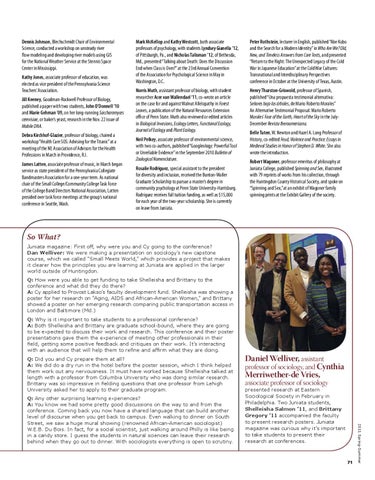
associate professor of sociology
presented research at Eastern Sociological Society in February in Philadelphia. Two Juniata students, Shelleisha Salmon ’11, and Brittany Gregory ’11 accompanied the faculty to present research posters. Juniata magazine was curious why it’s important to take students to present their research at conferences.
71
2011 Spring-Summer
Q: Any other surprising learning experiences? A: You know we had some pretty good discussions on the way to and from the conference. Coming back you now have a shared language that can build another level of discourse when you get back to campus. Even walking to dinner on South Street, we saw a huge mural showing (renowned African-American sociologist) W.E.B. Du Bois. In fact, for a social scientist, just walking around Philly is like being in a candy store. I guess the students in natural sciences can leave their research behind when they go out to dinner. With sociologists everything is open to scrutiny.
Daniel Welliver, assistant professor of sociology, and Cynthia Merriwether-de Vries,