At Juniata, the relationship between patient and trainer extends to more than just treatment of the initial injury. Leydig, the head athletic trainer, is valued just as much for his healing attributes as for his being a confidant, therapist and friend. The trainer, who favors Juniata football shirts and sweats as his “uniform,” began his tenure at Juniata in 1994, as a student intern, and was officially hired by the College the spring of 1999. He spends the majority of his time in the training room, catering to the needs of athletes. Though he does not spend his days in an academic classroom, Leydig plays a crucial role in the stability and functionality of the athletic department. Juniata employs just three athletic trainers, compared to Penn State, a program that utilizes over 20 trainers. The College’s threeperson staff is a marked upgrade over conditions prior to 2002, when Leydig was the sole athletic trainer. Considering the College currently has over 350 athletes, it’s a challenge for the training staff to prep every athlete and have them at practice on time.
Assistant trainers Dodie Edwards and Samantha Morgan complete Juniata’s trio of athletic trainers. Edwards agrees that working with Juniata’s athletes is something special. “There is just a different caliber of athlete here,” says Edwards. “We’re a small school and you get to know more than just a few players in one sport,” says Morgan. “Instead, you know all the athletes more personally. At bigger schools you are assigned one sport and predominately take care of just that team.” Although Juniata’s budget does not allow for additional athletic training staff, Morgan reiterates that a close relationship between the trainers, players and coaches plays a vital role in avoiding common problems associated with being understaffed, such as helping players and getting them ready to practice on time. Active communication within the athletic department allows the training room to move athletic teams through preparations more smoothly at different interval times. During the fall alone, there are seven individual teams that need preparation from the trainers, not
BY THE NUMBERS: 1 1/2 -inch normal white tape: 150 cases per year 32 rolls per case 15 yards per roll 4802 rolls 72,000 yards = almost 41 miles of ONLY 1 1/2 -inch tape per year 500 lbs. of ice per day 700 lbs. of ice per day during preseason 300+ varsity athletes 3 trainers
to mention teams training for their nontraditional seasons and club teams. Not only is personal attention time consuming, but each team prepares for practice and games differently. “The difference in team preparations is all in the numbers,” says Edwards. “Generally speaking, number of players on a team affects prep time. Since football has the most players, they require the most time. Soccer and field hockey have more than volleyball. Game days function much the same way as a practice day, with the added pressure of us taking care of the opposing team as well.” A second, highly important challenge for the training staff is the amount of time the job demands. “We turn on the lights on campus and shut them off when we leave,” says Leydig with a smile. Leydig’s not entirely joking. During preseason alone the training staff averaged numerous 16-hour days. Their schedule requires staffing all athletic events, many of which run seven days a week and well into the evenings.
Juniata
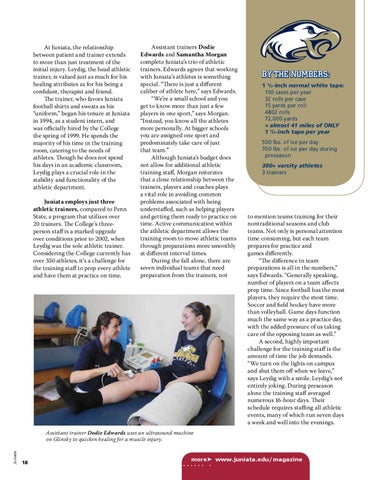
Assistant trainer Dodie Edwards uses an ultrasound machine on Glinsky to quicken healing for a muscle injury.
18
more➤ www.juniata.edu/magazine