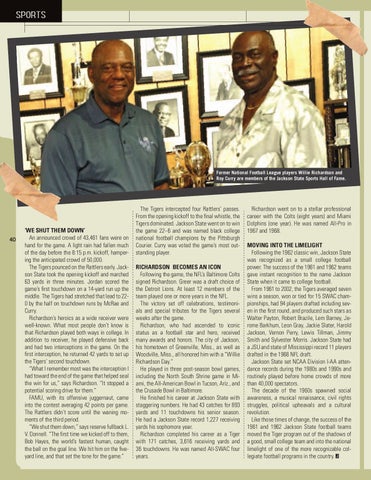
Former National Football League players Willie Richardson and Roy Curry are members of the Jackson State Sports Hall of Fame.
‘WE SHUT THEM DOWN’ An announced crowd of 43,461 fans were on hand for the game. A light rain had fallen much of the day before the 8:15 p.m. kickoff, hampering the anticipated crowd of 50,000. The Tigers pounced on the Rattlers early. Jackson State took the opening kickoff and marched 63 yards in three minutes. Jordan scored the game’s first touchdown on a 14-yard run up the middle. The Tigers had stretched that lead to 220 by the half on touchdown runs by McRae and Curry. Richardson’s heroics as a wide receiver were well-known. What most people don’t know is that Richardson played both ways in college. In addition to receiver, he played defensive back and had two interceptions in the game. On the first interception, he returned 42 yards to set up the Tigers’ second touchdown. “What I remember most was the interception I had toward the end of the game that helped seal the win for us,” says Richardson. “It stopped a potential scoring drive for them.” FAMU, with its offensive juggernaut, came into the contest averaging 42 points per game. The Rattlers didn’t score until the waning moments of the third period. “We shut them down,” says reserve fullback L. V. Donnell. “The first time we kicked off to them, Bob Hayes, the world’s fastest human, caught the ball on the goal line. We hit him on the fiveyard line, and that set the tone for the game.”
The Tigers intercepted four Rattlers’ passes. From the opening kickoff to the final whistle, the Tigers dominated. Jackson State went on to win the game 22–6 and was named black college national football champions by the Pittsburgh Courier. Curry was voted the game’s most outstanding player. RICHARDSON BECOMES AN ICON Following the game, the NFL’s Baltimore Colts signed Richardson. Greer was a draft choice of the Detroit Lions. At least 12 members of the team played one or more years in the NFL. The victory set off celebrations, testimonials and special tributes for the Tigers several weeks after the game. Richardson, who had ascended to iconic status as a football star and hero, received many awards and honors. The city of Jackson, his hometown of Greenville, Miss., as well as Woodville, Miss., all honored him with a “Willie Richardson Day.” He played in three post-season bowl games, including the North South Shrine game in Miami, the All-American Bowl in Tucson, Ariz., and the Crusade Bowl in Baltimore. He finished his career at Jackson State with staggering numbers. He had 43 catches for 893 yards and 11 touchdowns his senior season. He had a Jackson State record 1,227 receiving yards his sophomore year. Richardson completed his career as a Tiger with 171 catches, 3,616 receiving yards and 36 touchdowns. He was named All-SWAC four years.
Richardson went on to a stellar professional career with the Colts (eight years) and Miami Dolphins (one year). He was named All-Pro in 1967 and 1968. MOVING INTO THE LIMELIGHT Following the 1962 classic win, Jackson State was recognized as a small college football power. The success of the 1961 and 1962 teams gave instant recognition to the name Jackson State when it came to college football. From 1961 to 2002, the Tigers averaged seven wins a season, won or tied for 15 SWAC championships, had 94 players drafted including seven in the first round, and produced such stars as Walter Payton, Robert Brazile, Lem Barney, Jerome Barkhum, Leon Gray, Jackie Slater, Harold Jackson, Vernon Perry, Lewis Tillman, Jimmy Smith and Sylvester Morris. Jackson State had a JSU and state of Mississippi record 11 players drafted in the 1968 NFL draft. Jackson State set NCAA Division I-AA attendance records during the 1980s and 1990s and routinely played before home crowds of more than 40,000 spectators. The decade of the 1960s spawned social awareness, a musical renaissance, civil rights struggles, political upheavals and a cultural revolution. Like those times of change, the success of the 1961 and 1962 Jackson State football teams moved the Tiger program out of the shadows of a good, small college team and into the national limelight of one of the more recognizable collegiate football programs in the country.