Leben im Haus Tugendhat und danach Life in the Tugendhat House and Thereafter
Ivo Hammer
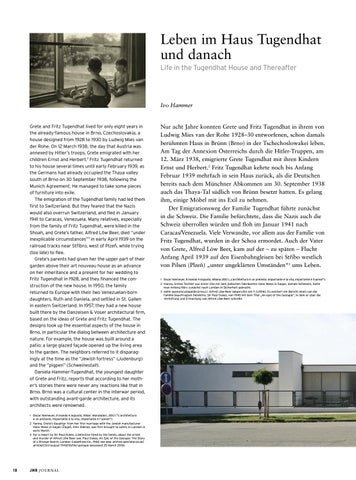
Grete and Fritz Tugendhat lived for only eight years in the already-famous house in Brno, Czechoslovakia, a house designed from 1928 to 1930 by Ludwig Mies van der Rohe. On 12 March 1938, the day that Austria was annexed by Hitler’s troops, Grete emigrated with her children Ernst and Herbert.2 Fritz Tugendhat returned to his house several times until early February 1939, as the Germans had already occupied the Thaya valley south of Brno on 30 September 1938, following the Munich Agreement. He managed to take some pieces of furniture into exile. The emigration of the Tugendhat family had led them first to Switzerland. But they feared that the Nazis would also overrun Switzerland, and fled in January 1941 to Caracas, Venezuela. Many relatives, especially from the family of Fritz Tugendhat, were killed in the Shoah, and Grete’s father, Alfred Löw Beer, died “under inexplicable circumstances”3 in early April 1939 on the railroad tracks near Strˇíbro, west of Plzeˇ n, while trying (too late) to flee. Grete’s parents had given her the upper part of their garden above their art nouveau house as an advance on her inheritance and a present for her wedding to Fritz Tugendhat in 1928, and they financed the construction of the new house. In 1950, the family returned to Europe with their two Venezuelan-born daughters, Ruth and Daniela, and settled in St. Gallen in eastern Switzerland. In 1957, they had a new house built there by the Danzeisen & Voser architectural firm, based on the ideas of Grete and Fritz Tugendhat. The designs took up the essential aspects of the house in Brno, in particular the dialog between architecture and nature. For example, the house was built around a patio; a large glazed façade opened up the living area to the garden. The neighbors referred to it disparagingly at the time as the “Jewish fortress” (Judenburg) and the “pigpen” (Schweinestall). Daniela Hammer-Tugendhat, the youngest daughter of Grete and Fritz, reports that according to her mother’s stories there were never any reactions like that in Brno. Brno was a cultural center in the interwar period, with outstanding avant-garde architecture, and its architects were renowned. 1 Oscar Niemeyer, Il mondo è ingiusto, Milan: Mondadori, 2012 (“L’architettura è un pretesto. Importante è la vita, importante è l’uomo!”). 2 Hanna, Grete’s daughter from her first marriage with the Jewish manufacturer ˚ Hans Weiss in Sagan (Zaga´ n, then Silesia), was first brought to safety in London in early March. 3 For a report by Sir Paul Dukes, a detective hired by the family, about the arrest and murder of Alfred Löw-Beer see: Paul Dukes, An Epic of the Gestapo: The Story of a Strange Search, London: Cassell and Co., 1940; see also: archive.spectator.co.uk/ article/23rd-august-1940/16/the-gestapo (accessed 25 March 2016).
18
J M B JOURNAL
Nur acht Jahre konnten Grete und Fritz Tugendhat in ihrem von Ludwig Mies van der Rohe 1928–30 entworfenen, schon damals berühmten Haus in Brünn (Brno) in der Tschechoslowakei leben. Am Tag der Annexion Österreichs durch die Hitler-Truppen, am 12. März 1938, emigrierte Grete Tugendhat mit ihren Kindern Ernst und Herbert.2 Fritz Tugendhat kehrte noch bis Anfang Februar 1939 mehrfach in sein Haus zurück, als die Deutschen bereits nach dem Münchner Abkommen am 30. September 1938 auch das Thaya-Tal südlich von Brünn besetzt hatten. Es gelang ihm, einige Möbel mit ins Exil zu nehmen. Der Emigrationsweg der Familie Tugendhat führte zunächst in die Schweiz. Die Familie befürchtete, dass die Nazis auch die Schweiz überrollen würden und floh im Januar 1941 nach Caracas/Venezuela. Viele Verwandte, vor allem aus der Familie von Fritz Tugendhat, wurden in der Schoa ermordet. Auch der Vater von Grete, Alfred Löw Beer, kam auf der – zu späten – Flucht Anfang April 1939 auf den Eisenbahngleisen bei Strˇíbo westlich von Pilsen (Plzen) ˇ „unter ungeklärten Umständen“3 ums Leben. 1 Oscar Niemeyer, Il mondo è ingiusto, Milano 2012 („L’architettura è un pretesto. Importante è la vita, importante è l’uomo!“). 2 Hanna, Gretes Tochter aus erster Ehe mit dem jüdischen Fabrikanten Hans Weiss in Sagan, damals Schlesien, hatte man Anfang März zunächst nach London in Sicherheit gebracht. 3 siehe www.encyclopedie.brna.cz: Alfred Löw-Beer (abgerufen am 11.3.2016). Es existiert ein Bericht eines von der Familie beauftragten Detektivs, Sir Paul Dukes, von 1940 mit dem Titel „An epic of the Gestapo“, in dem er über die Verhaftung und Ermordung von Alfred Löw-Beer schreibt.