18
Jesuittoday
S P R I N G
2 0 0 9
it. They want to solve it. I don’t have to sell them that it is worth solving because it is fun. They enjoy doing the hard work. When I think back to our first days it’s amazing how far we’ve come since we started with a somewhat random collection of parts. We were not told what to do, but given the challenge the robots have to face. The specifications helped narrow down the possibilities, but the solution was really up to us. Our students have shown enormous creativity. That’s really helped make it fun.
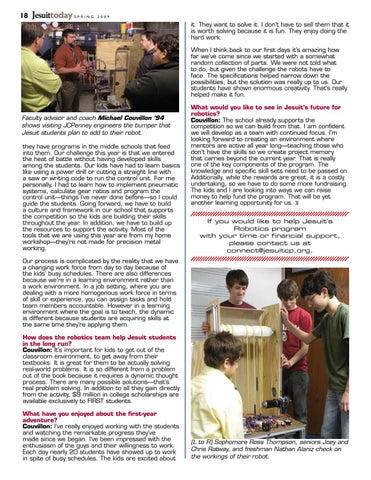
Faculty advisor and coach Michael Couvillon ’94 shows visiting JCPenney engineers the bumper that Jesuit students plan to add to their robot. they have programs in the middle schools that feed into them. Our challenge this year is that we entered the heat of battle without having developed skills among the students. Our kids have had to learn basics like using a power drill or cutting a straight line with a saw or writing code to run the control unit. For me personally, I had to learn how to implement pneumatic systems, calculate gear ratios and program the control unit—things I’ve never done before—so I could guide the students. Going forward, we have to build a culture and framework in our school that supports the competition so the kids are building their skills throughout the year. In addition, we have to build up the resources to support the activity. Most of the tools that we are using this year are from my home workshop—they’re not made for precision metal working.
What would you like to see in Jesuit’s future for robotics? Couvillon: The school already supports the competition so we can build from that. I am confident we will develop as a team with continued focus. I’m looking forward to creating an environment where mentors are active all year long—teaching those who don’t have the skills so we create project memory that carries beyond the current year. That is really one of the key components of the program. The knowledge and specific skill sets need to be passed on. Additionally, while the rewards are great, it is a costly undertaking, so we have to do some more fundraising. The kids and I are looking into ways we can raise money to help fund the program. That will be yet another learning opportunity for us. J If you would like to help Jesuit’s Robotics program with your time or financial support, please contact us at connect@jesuitcp.org.
Our process is complicated by the reality that we have a changing work force from day to day because of the kids’ busy schedules. There are also differences because we’re in a learning environment rather than a work environment. In a job setting, where you are dealing with a more homogenous work force in terms of skill or experience, you can assign tasks and hold team members accountable. However in a learning environment where the goal is to teach, the dynamic is different because students are acquiring skills at the same time they’re applying them. How does the robotics team help Jesuit students in the long run? Couvillon: It’s important for kids to get out of the classroom environment, to get away from their textbooks. It is great for them to be actually solving real-world problems. It is so different from a problem out of the book because it requires a dynamic thought process. There are many possible solutions—that’s real problem solving. In addition to all they gain directly from the activity, $9 million in college scholarships are available exclusively to FIRST students. What have you enjoyed about the first-year adventure? Couvillon: I’ve really enjoyed working with the students and watching the remarkable progress they’ve made since we began. I’ve been impressed with the enthusiasm of the guys and their willingness to work. Each day nearly 20 students have showed up to work in spite of busy schedules. The kids are excited about
(L to R) Sophomore Ross Thompson, seniors Joey and Chris Ratway, and freshman Nathan Alaniz check on the workings of their robot.