N E W S
A N D
T R E N D S
e-Health 2019: A bold new conference experience, coming to Toronto in May
I
f you have made professional development a priority for 2019, the eHealth Conference and Tradeshow is an event to include in your activities for the year. The 19th annual eHealth Conference and Tradeshow is Canada’s largest congregation of digital health professionals, offering proactive, top-quality learning and an opportunity to network with organizations and people that value quality health information. This May, e-Health will continue to deliver in-demand keynote presenters, expert panelists, networking opportunities, social events and leading-edge vendors. The 2019 conference is shaping up to deliver on another successful event. Come Celebrate, Grow & Inspire Bold Action in Digital Health in Toronto, Ontario from May 26 to 29. What’s New at e-Health 2019? Whether you are an e-Health veteran or a first-time delegate, all attendees can look forward to a refreshed and modernized conference experience. Let’s start with the tradeshow floor. eHealth 2019 is literally breaking down walls and moving toward a completely open concept space. By removing barriers between the tradeshow floor, sponsors, exhibits and plenary rooms, delegates will be able to move freely between conference sections and ensure they don’t miss a thing. All attendees will re-
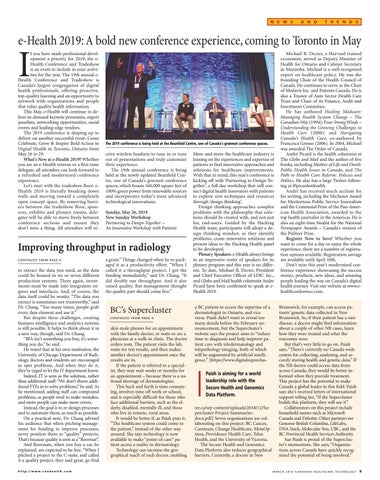
The 2019 conference is being held at the Beanfield Centre, one of Canada’s greenest conference spaces.
ceive wireless headsets to tune in or tune out of presentations and truly customize their experience. The 19th annual conference is being held at the newly updated Beanfield Centre, one of Canada’s greenest conference spaces, which boasts 160,000 square feet of 100% green power from renewable sources and incorporates today’s most advanced technological innovations. Sunday, May 26, 2019 New Sunday Workshop Partnering to Design Together – An Innovative Workshop with Patients
Improving throughput in radiology C O N T I N U E D F R O M PA G E 6
to extract the data you need, as the data could be housed in six or seven different production systems. There again, investments must be made into integration engines and interfaces. And, of course, the data itself could be wonky. “The data you extract is sometimes not trustworthy,” said Dr. Chang. “Too many times, people grab every data element and use it.” But despite these challenges, creating business intelligence and analytics systems is still possible. It helps to think about it in a new way, though, said Dr. Chang. “BIA isn’t something you buy, it’s something you do,” he said. He noted that at his own institution, the University of Chicago Department of Radiology, doctors and residents are encouraged to spot problems. And when they do it, they’re urged to let the IT department know. Indeed, IT is seen as the solution, rather than additional staff. “We don’t throw additional FTEs in to solve problems,” he said. As he mentioned, adding staff can compound problems, as people tend to make mistakes, and more people can make more errors. Instead, the goal is to re-design processes and to automate them, as much as possible. On a practical note, Dr. Chang advised his audience that when pitching management for funding to improve processes, never position them as “quality” projects. That’s because quality is seen as a “floormat”. And floormats, when you buy a car, he explained, are expected to be free. “When I pitched a project to the C-suite, and called it a quality project, they said great, go find h t t p : / / w w w. c a n h e a l t h . c o m
a grant.” Things changed when he re-packaged it as a productivity effort. “When I called it a throughput project, I got the funding immediately,” said Dr. Chang. “It did double our throughput. And it also raised quality. But management thought the quality part should come free.”
BC’s Supercluster C O N T I N U E D F R O M PA G E 4
skin mole phones for an appointment with the family doctor, or waits to see a physician at a walk-in clinic. The doctor orders tests. The patient visits the lab, waits for test results, and then makes another doctor’s appointment once the results are in. If the patient is referred to a specialist, they may wait weeks or months for an appointment – because there is a national shortage of dermatologists. This back and forth is time consuming, involves time off work or school, and is especially difficult for those who face additional barriers, such as the elderly, disabled, mentally ill, and those who live in remote, rural areas. It would be better if, as Paish puts it, “The healthcare system could come to the patient,” instead of the other way around. She says technology is now available to make “point-of-care” patient access a reality in dermatology. Technology can increase the geographical reach of each doctor, enabling
More and more the healthcare industry is leaning on the experiences and expertise of patients to find innovative approaches and solutions for healthcare improvements. With that in mind, this year’s conference is kicking off with ‘Partnering to Design Together’, a full day workshop that will connect digital health innovators with patients to explore new techniques and resources through ‘design thinking’. Design thinking approaches complex problems with the philosophy that solutions should be created with, and not just for, end-users. Guided by the Hacking Health team, participants will adopt a design thinking mindset, as they identify problems, create innovative solutions and present ideas to the Hacking Health panel to be developed. Plenary Speakers: e-Health always brings in an impressive roster of speakers for its plenary program and this year is no different. To date, Michael B. Decter, President and Chief Executive Officer of LDIC Inc., and Globe and Mail health columnist Andre Picard have been confirmed to speak at eHealth 2019. a BC patient to access the expertise of a dermatologist in Ontario, and vice versa. Paish didn’t want to reveal too many details before the February announcement, but the Supercluster’s website says the project aims to “reduce time to diagnosis and help improve patient care with teledermatology and telepathology imaging, both of which will be augmented by artificial intelligence.” [https://www.digitalsuperclus-
Paish is aiming for a world leadership role with the Secure Health and Genomics Data Platform. ter.ca/wp-content/uploads/2018/12/Supercluster-Project-Summariesdocx.pdf] Seven organizations are collaborating on this project: BC Cancer, Careteam, Change Healthcare, MetaOptima, Providence Health Care, Telus Health, and the University of Victoria. The Secure Health and Genomics Data Platform also reduces geographical barriers. Currently, a doctor in New
Michael B. Decter, a Harvard trained economist, served as Deputy Minister of Health for Ontario and Cabinet Secretary in Manitoba. Michael is a well-recognized expert on healthcare policy. He was the founding Chair of the Health Council of Canada. He continues to serve as the Chair of Medavie Inc. and Patients Canada. He is also a Trustee of Auto Sector Health Care Trust and Chair of its Finance, Audit and Investment Committee. He has authored Healing Medicare: Managing Health System Change – The Canadian Way (1994); Four Strong Winds – Understanding the Growing Challenges to Health Care (2000); and Navigating Canada’s Health Care, co-authored by Francesca Grosso (2006). In 2004, Michael was awarded The Order of Canada. André Picard is the health columnist at The Globe and Mail and the author of five books, including Matters of Life and Death: Public Health Issues in Canada, and The Path to Health Care Reform: Policies and Politics. He also has a large Twitter following at @picardonhealth. André has received much acclaim for his writing, including the Michener Award for Meritorious Public Service Journalism and the Centennial Prize of the Pan-American Health Association, awarded to the top health journalist in the Americas. He is also an eight-time finalist for the National Newspaper Awards – Canada’s version of the Pulitzer Prize. Register Now to Save! Whether you want to come for a day or enjoy the whole experience, there are a number of registration options available. Registration savings are available until April 10th. Don’t miss this year’s modernized conference experience showcasing the success stories, products, new ideas, and amazing people leading the way on Canada’s digital health journey. Visit our website at www.ehealthconference.com. Brunswick, for example, can access patients’ genetic data collected in New Brunswick. So, if their patient has a rare disease, a doctor might find information about a couple of other NB cases, learn how they were treated and what the outcomes were. But that’s very little to go on. Paish says, “There’s currently no Canada-wide system for collecting, analyzing, and securely storing health and genetic data.” If the NB doctor could access data from across Canada, they would be better informed when they provide treatment. This project has the potential to make Canada a global leader in this field. Paish says she’s received letters of international support telling her, “If the Supercluster builds this platform, they will use it”. Collaborators on this project include household names such as Microsoft Canada and Deloitte. Other partners are Genome British Columbia, LifeLabs, DNA Stack, Molecular You, UBC, and the BC Provincial Health Services Authority. Sue Paish is proud of the Supercluster’s momentum. She says, “Organizations across Canada have quickly recognized the potential of being involved.”
M A R C H 2 0 1 9 C A N A D I A N H E A LT H C A R E T E C H N O L O G Y
9