12 JEFFERSON MEDICAL COLLEGE ALUMNI BULLETIN
and consider the diagnosis because the patient may not, surprisingly, make the connection himself.” Dalit Gross, PsyD, agrees. “Some people may only know that something is wrong — for example, they may be hyper-vigilant or anxious — so they see a physician for a different reason,” says Gross, a psychologist who is a member of a research team working on an NIMH-funded research study on PTSD at New York State Psychiatric Institute. “That’s why a comprehensive intake evaluation is important.” Undiagnosed trauma can distort how a person’s behavior is perceived, which could lead to problems with diagnosis. “It’s important to acknowledge the role of trauma because it helps put the person, his behaviors and his feelings into perspective. For example, if a patient’s response is incongruent to a situation, like jumping when you make physical contact, you might be unknowingly triggering a traumatized patient,” says Stober. “To get the best clinical picture of a patient, we want to first take time to understand behavior before making a diagnosis or writing a prescription.” Patients need their primary and other care providers to be sensitive to their needs. “Doctors see a lot of people, and they expect everyone to respond the same way. But I’m not like every patient,” says Mikayla, a patient being treated for trauma at Jefferson. “Even the smallest thing can trigger me; the way you touch me, something you say. I need my doctors to be aware of how they should handle me so that I can feel safe in their offices. People take things like safety for granted. But I can’t close my eyes at night and trust that I’ll be safe like everybody else. Trauma patients
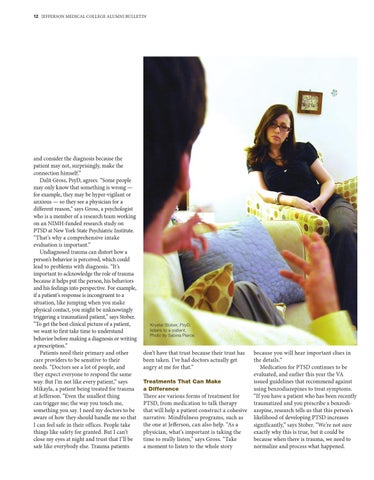
Krystal Stober, PsyD, listens to a patient. Photo by Sabina Pierce.
don’t have that trust because their trust has been taken. I’ve had doctors actually get angry at me for that.” Treatments That Can Make a Difference
There are various forms of treatment for PTSD, from medication to talk therapy that will help a patient construct a cohesive narrative. Mindfulness programs, such as the one at Jefferson, can also help. “As a physician, what’s important is taking the time to really listen,” says Gross. “Take a moment to listen to the whole story
because you will hear important clues in the details.” Medication for PTSD continues to be evaluated, and earlier this year the VA issued guidelines that recommend against using benzodiazepines to treat symptoms. “If you have a patient who has been recently traumatized and you prescribe a benzodiazepine, research tells us that this person’s likelihood of developing PTSD increases significantly,” says Stober. “We’re not sure exactly why this is true, but it could be because when there is trauma, we need to normalize and process what happened.