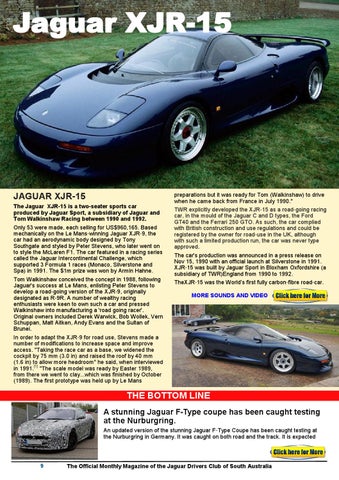
Jaguar XJR-15
JAGUAR XJR-15 The Jaguar XJR-15 is a two-seater sports car produced by Jaguar Sport, a subsidiary of Jaguar and Tom Walkinshaw Racing between 1990 and 1992. Only 53 were made, each selling for US$960,165. Based mechanically on the Le Mans-winning Jaguar XJR-9, the car had an aerodynamic body designed by Tony Southgate and styled by Peter Stevens, who later went on to style the McLaren F1. The car featured in a racing series called the Jaguar Intercontinental Challenge, which supported 3 Formula 1 races (Monaco, Silverstone and Spa) in 1991. The $1m prize was won by Armin Hahne. Tom Walkinshaw conceived the concept in 1988, following Jaguar's success at Le Mans, enlisting Peter Stevens to develop a road-going version of the XJR-9, originally designated as R-9R. A number of wealthy racing enthusiasts were keen to own such a car and pressed Walkinshaw into manufacturing a 'road going racer'. Original owners included Derek Warwick, Bob Wollek, Vern Schuppan, Matt Aitken, Andy Evans and the Sultan of Brunei. In order to adapt the XJR-9 for road use, Stevens made a number of modifications to increase space and improve access. "Taking the race car as a base, we widened the cockpit by 75 mm (3.0 in) and raised the roof by 40 mm (1.6 in) to allow more headroom" he said, when interviewed in 1991.[1] "The scale model was ready by Easter 1989, from there we went to clay...which was finished by October (1989). The first prototype was held up by Le Mans
preparations but it was ready for Tom (Walkinshaw) to drive when he came back from France in July 1990." TWR explicitly developed the XJR-15 as a road-going racing car, in the mould of the Jaguar C and D types, the Ford GT40 and the Ferrari 250 GTO. As such, the car complied with British construction and use regulations and could be registered by the owner for road-use in the UK, although with such a limited production run, the car was never type approved. The car's production was announced in a press release on Nov 15, 1990 with an official launch at Silverstone in 1991. XJR-15 was built by Jaguar Sport in Bloxham Oxfordshire (a subsidiary of TWR)England from 1990 to 1992. TheXJR-15 was the World’s first fully carbon-fibre road-car. MORE SOUNDS AND VIDEO
THE BOTTOM LINE A stunning Jaguar F-Type coupe has been caught testing at the Nurburgring. An updated version of the stunning Jaguar F-Type Coupe has been caught testing at the Nurburgring in Germany. It was caught on both road and the track. It is expected
9
The Official Monthly Magazine of the Jaguar Drivers Club of South Australia