INDUSTRY INSIGHT
*
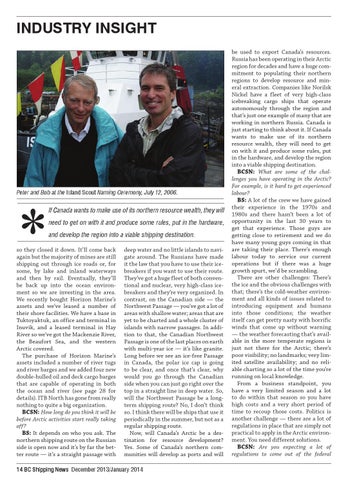
Peter and Bob at the Island Scout Naming Ceremony, July 12, 2006.
If Canada wants to make use of its northern resource wealth, they will need to get on with it and produce some rules, put in the hardware, and develop the region into a viable shipping destination.
so they closed it down. It’ll come back again but the majority of mines are still shipping out through ice roads or, for some, by lake and inland waterways and then by rail. Eventually, they’ll be back up into the ocean environment so we are investing in the area. We recently bought Horizon Marine’s assets and we’ve leased a number of their shore facilities. We have a base in Tuktoyaktuk, an office and terminal in Inuvik, and a leased terminal in Hay River so we’ve got the Mackenzie River, the Beaufort Sea, and the western Arctic covered. The purchase of Horizon Marine’s assets included a number of river tugs and river barges and we added four new double-hulled oil and deck cargo barges that are capable of operating in both the ocean and river (see page 28 for details). ITB North has gone from really nothing to quite a big organization. BCSN: How long do you think it will be before Arctic activities start really taking off? BS: It depends on who you ask. The northern shipping route on the Russian side is open now and it’s by far the better route — it’s a straight passage with
deep water and no little islands to navigate around. The Russians have made it the law that you have to use their icebreakers if you want to use their route. They’ve got a huge fleet of both conventional and nuclear, very high-class icebreakers and they’re very organized. In contrast, on the Canadian side — the Northwest Passage — you’ve got a lot of areas with shallow water; areas that are yet to be charted and a whole cluster of islands with narrow passages. In addition to that, the Canadian Northwest Passage is one of the last places on earth with multi-year ice — it’s like granite. Long before we see an ice-free Passage in Canada, the polar ice cap is going to be clear, and once that’s clear, why would you go through the Canadian side when you can just go right over the top in a straight line in deep water. So, will the Northwest Passage be a longterm shipping route? No, I don’t think so. I think there will be ships that use it periodically in the summer, but not as a regular shipping route. Now, will Canada’s Arctic be a destination for resource development? Yes. Some of Canada’s northern communities will develop as ports and will
14 BC Shipping News December 2013/January 2014
be used to export Canada’s resources. Russia has been operating in their Arctic region for decades and have a huge commitment to populating their northern regions to develop resource and mineral extraction. Companies like Norilsk Nickel have a fleet of very high-class icebreaking cargo ships that operate autonomously through the region and that’s just one example of many that are working in northern Russia. Canada is just starting to think about it. If Canada wants to make use of its northern resource wealth, they will need to get on with it and produce some rules, put in the hardware, and develop the region into a viable shipping destination. BCSN: What are some of the challenges you have operating in the Arctic? For example, is it hard to get experienced labour? BS: A lot of the crew we have gained their experience in the 1970s and 1980s and there hasn’t been a lot of opportunity in the last 30 years to get that experience. Those guys are getting close to retirement and we do have many young guys coming in that are taking their place. There’s enough labour today to service our current operations but if there was a huge growth spurt, we’d be scrambling. There are other challenges: There’s the ice and the obvious challenges with that; there’s the cold-weather environment and all kinds of issues related to introducing equipment and humans into those conditions; the weather itself can get pretty nasty with horrific winds that come up without warning — the weather forecasting that’s available in the more temperate regions is just not there for the Arctic; there’s poor visibility; no landmarks; very limited satellite availability; and no reliable charting so a lot of the time you’re running on local knowledge. From a business standpoint, you have a very limited season and a lot to do within that season so you have high costs and a very short period of time to recoup those costs. Politics is another challenge — there are a lot of regulations in place that are simply not practical to apply in the Arctic environment. You need different solutions. BCSN: Are you expecting a lot of regulations to come out of the federal