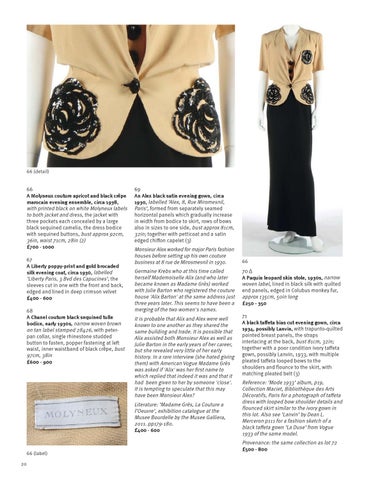
66 (detail)
66 A Molyneux couture apricot and black crêpe marocain evening ensemble, circa 1938, with printed black on white Molyneux labels to both jacket and dress, the jacket with three pockets each concealed by a large black sequined camelia, the dress bodice with sequined buttons, bust approx 92cm, 36in, waist 71cm, 28in (2) £700 - 1000 67 A Liberty poppy-print and gold brocaded silk evening coat, circa 1930, labelled ‘Liberty Paris, 3 Bvd des Capucines’, the sleeves cut in one with the front and back, edged and lined in deep crimson velvet £400 - 600 68 A Chanel couture black sequined tulle bodice, early 1930s, narrow woven brown on tan label stamped 28426, with peterpan collar, single rhinestone studded button to fasten, popper fastening at left waist, inner waistband of black crêpe, bust 97cm, 38in £600 - 900
69 An Alex black satin evening gown, circa 1930, labelled ‘Alex, 8, Rue Miromesnil, Paris’, formed from separately seamed horizontal panels which gradually increase in width from bodice to skirt, rows of bows also in sizes to one side, bust approx 81cm, 32in; together with petticoat and a satin edged chiffon capelet (3)
Monsieur Alex worked for major Paris fashion houses before setting up his own couture business at 8 rue de Mirosmesnil in 1930. Germaine Krebs who at this time called herself Mademoiselle Alix (and who later became known as Madame Grès) worked with Julie Barton who registered the couture house 'Alix Barton' at the same address just three years later. This seems to have been a merging of the two women's names. It is probable that Alix and Alex were well known to one another as they shared the same building and trade. It is possible that Alix assisted both Monsieur Alex as well as Julie Barton in the early years of her career, but she revealed very little of her early history. In a rare interview (she hated giving them) with American Vogue Madame Grès was asked if 'Alix' was her first name to which replied that indeed it was and that it had been given to her by someone 'close'. It is tempting to speculate that this may have been Monsieur Alex? Literature: ‘Madame Grès, La Couture a l’Oeuvre’, exhibition catalogue at the Musee Bourdelle by the Musee Galliera, 2011. pp179-180. £400 - 600
66 (label) 20
66
70 ∆ A Paquin leopard skin stole, 1930s, narrow woven label, lined in black silk with quilted end panels, edged in Colubus monkey fur, approx 135cm, 50in long £250 - 350 71 A black taffeta bias cut evening gown, circa 1934, possibly Lanvin, with trapunto-quilted pointed breast panels, the straps interlacing at the back, bust 81cm, 32in; together with a poor condition ivory taffeta gown, possibly Lanvin, 1933, with multiple pleated taffeta looped bows to the shoulders and flounce to the skirt, with matching pleated belt (3)
Reference: ‘Mode 1933’ album, p19, Collection Maciet, Bibliothèque des Arts Décoratifs, Paris for a photograph of taffeta dress with looped bow shoulder details and flounced skirt similar to the ivory gown in this lot. Also see ‘Lanvin’ by Dean L. Merceron p111 for a fashion sketch of a black taffeta gown ‘La Duse’ from Vogue 1933 of the same model. Provenance: the same collection as lot 72 £500 - 800