1400-1430
The common companion to the orle, the vervelle cover was almost as conspicuous as a form of helmet decoration.
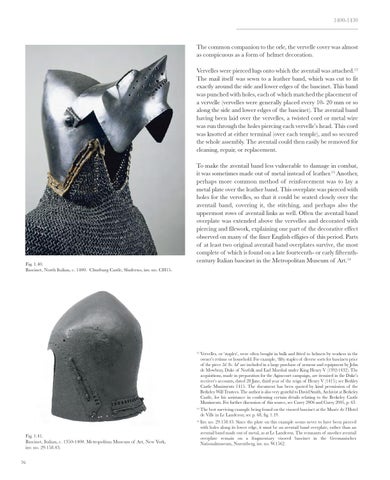
Vervelles were pierced lugs onto which the aventail was attached.12 The mail itself was sewn to a leather band, which was cut to fit exactly around the side and lower edges of the bascinet. This band was punched with holes, each of which matched the placement of a vervelle (vervelles were generally placed every 10- 20 mm or so along the side and lower edges of the bascinet). The aventail band having been laid over the vervelles, a twisted cord or metal wire was run through the holes piercing each vervelle’s head. This cord was knotted at either terminal (over each temple), and so secured the whole assembly. The aventail could then easily be removed for cleaning, repair, or replacement.
Fig. 1.40. Bascinet, North Italian, c. 1400. Churburg Castle, Sluderno, inv. no. CH15.
To make the aventail band less vulnerable to damage in combat, it was sometimes made out of metal instead of leather.13 Another, perhaps more common method of reinforcement was to lay a metal plate over the leather band. This overplate was pierced with holes for the vervelles, so that it could be seated closely over the aventail band, covering it, the stitching, and perhaps also the uppermost rows of aventail links as well. Often the aventail band overplate was extended above the vervelles and decorated with piercing and filework, explaining one part of the decorative effect observed on many of the finer English effigies of this period. Parts of at least two original aventail band overplates survive, the most complete of which is found on a late fourteenth- or early fifteenthcentury Italian bascinet in the Metropolitan Museum of Art.14
12
13 14
Fig. 1.41. Bascinet, Italian, c. 1350-1400. Metropolitan Museum of Art, New York, inv. no. 29.158.43. 76
Vervelles, or ‘staples’, were often bought in bulk and fitted to helmets by workers in the owner’s retinue or household. For example, ‘fifty staples of diverse sorts for bascinets price of the piece 2d. 8s. 4d’ are included in a large purchase of armour and equipment by John de Mowbray, Duke of Norfolk and Earl Marshal under King Henry V (1392-1432). The acquisitions, made in preparation for the Agincourt campaign, are itemised in the Duke’s receiver’s accounts, dated 28 June, third year of the reign of Henry V (1415); see Berkley Castle Muniments 1415. The document has been quoted by kind permission of the Berkeley Will Trustees. The author is also very grateful to David Smith, Archivist at Berkeley Castle, for his assistance in confirming certain details relating to the Berkeley Castle Muniments. For further discussion of this source, see Curry 2006 and Curry 2005, p. 63. The best surviving example being found on the visored bascinet at the Musée de l’Hotel de Ville in Le Landeron; see p. 68, fig. 1.19. Inv. no. 29.158.43. Since the plate on this example seems never to have been pierced with holes along its lower edge, it must be an aventail band overplate, rather than an aventail band made out of metal, as at Le Landeron. The remnants of another aventail overplate remain on a fragmentary visored bascinet in the Germanisches Nationalmuseum, Nuremberg, inv. no. W.1562.