election-night atmosphere in his 2012 book Teaching History in an Uncivilized World, Bigler says: “The tension in the classroom was palpable as everyone anxiously awaited the returns. As each state finally projected, often late into the simulated evening, the students would either shout with delight or cry in anguish. Other teachers on our hallway would often look out of their classroom doors, perplexed by the commotion, but what they were actually witnessing was authentic, content-rich learning.” Such engagement earned Bigler honors as Most Influential Teacher at McLean High School as voted by the senior classes of 1995 and 1996 and later Teacher of the Year for MHS, Fairfax County, Virginia, and ultimately National Teacher of the Year in 1998. From a White House Rose Garden ceremony with President Bill Clinton to a whirlwind year of speaking engagements as the nation’s top teacher, Bigler used his position to spotlight the need for support of public education and the importance of studying history. “Every age goes through its own unique challenges,” Bigler says. “But looking at the turmoil throughout history, we can gain a better perspective on our own time.” He also views teachers as people with great responsibility beyond their content areas. “Quite frankly, for six and a half or seven hours [per day], you may be the only positive influence on a student’s life,” he says. “You need to be an exemplary person for students to look up to.” Now retired from the classroom, Bigler remains committed to education. He is editor and president of Apple Ridge Publishers, a company that focuses on education and history-related materials. He remains involved with the Virginia Teacher of the Year network and the Virginia Teachers of Promise Institute, and he likes what he sees in the next generation of educators. “The students and young teachers are every bit as good as we were,” he says. “This is one of the most exciting times to be an educator because of the technology and the ability to do things that were unheard of 30, 40 years ago,” Bigler says. “One of my emphases has been that teachers need to change and always have. I was a much better teacher later in my career.”
M I L DR E D DICK E R SON
“S
he put teacher education on the map,” says Dean Wishon. “She was one of the most distinguished early-childhood professionals in the nation during her time here.” Dickerson, who joined the Madison College faculty in 1958, established the nursery school in the newly developed Anthony-Seeger Campus School. In concert with that role, she taught classes for the Madison College education students who were observing and working with preschool children. Her expertise in early-childhood education was invaluable to Madison’s future teachers when Virginia mandated public kindergarten in 1965. Named coordinator of the early-childhood education program, Dickerson developed the undergraduate and master’s programs of study.
She also served the education profession as president of the Southern Early Childhood Association from 1984 to 1985 and earlier as president of the Virginia Association for Early Childhood Education. Dickerson led the effort to establish what is now the Harrisonburg-Rockingham Child Day Care Center. For her dedication to teaching thousands of young pupils and college students, Dickerson received the VAECE Award for Outstanding Service to Young Children. She retired from JMU in 1986.
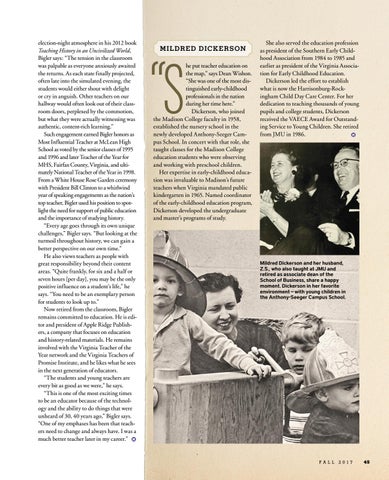
Mildred Dickerson and her husband, Z.S., who also taught at JMU and retired as associate dean of the School of Business, share a happy moment. Dickerson in her favorite environment — with young children in the Anthony-Seeger Campus School.
FA L L
2 017
45