September 2017 : Tishrei 5778
Modern-day action hero MK Rachel Azaria Architect Prakash Nair’s new school of thought World kickboxing champion Nili Block
1
SAVE THE DATE
ANNUAL DINNER 2017 HONORING
Jordana Alpert Martin Elias Sharon & Solomon Merkin Audrey & Max Wagner
SUNDAY, NOVEMBER 19, 2017 5:00 P.M. PIER SIXTY, NEW YORK CITY 2
PRESIDENT’S MESSAGE BY DEBBIE MOED
R
osh Hashanah, the Jewish New Year, is a time of rejoicing as well as introspection. It is a time to celebrate the completion of another year and take stock of our achievements while looking ahead at what is to come. Taking pride in AMIT’s accomplishments in the past year comes quite naturally: The Education Ministry named AMIT as the leading educational network in Israel across many measures—quality bagrut (matriculation exam); pedagogical innovation; pluralism, bridging the gap between all students, regardless of their academic, religious or socioeconomic background; lowest dropout rate; and integrity—a value that is stressed each day. The ministry’s designation reflects the positive, life-changing impact that our 110 schools and programs have had on the 34,000 children we serve. Just before our students went on their summer break, they chalked up several notable accomplishments, a few of which I’d like to share with you. Aviad Sinvani, an 8th-grader at AMIT Gwen Straus Jr. & Sr. Science High School for Boys in Ra’anana, won first place in the national mishnayot competition. Upon winning, Aviad said, “The most important thing that I gained from studying in general and from the competition in particular is…to relate the wisdom that is learned from mishnayot to today’s world.” This directly reflects the project-based-learning approach implemented in AMIT classrooms throughout the Network. How gratifying to see it in action! Also thinking about today’s world—and tomorrow’s—are boys from AMIT Sutker Modi’in Jr. & Sr. High School. Their wildly successful, eco-friendly “pick-nic” tablecloth serves as a table covering, game board and trash bag, and was conceived to solve Israel’s chronic litter problem. The boys established a company, Promoter, sold thousands of tablecloths, won several young entrepreneurship competi-
tions, including the national one, and represented Israel at the International Young Entrepreneurship competition in Belgium, where they took third place. Another highlight for the Network this past year was the opening of Midreshet AMIT Be’er Ashdod, a sister to our seminary in Yerucham, and a continuation of the revolutionary “hesder” model for young women. The girls spend a year before and after the army learning and serving the elderly and youth in these communities. It’s so inspiring to see their commitment to Torah and devotion to Israeli society. Our students’ innovative and optimistic outlook stems in large part from their teachers and principals, who lead by example. I witnessed this firsthand during my recent trip to Israel, where I joined AMIT principals at a summer retreat in Ashdod. The twoday seminar focused on the Network’s values of Torat Chaim and Klal Yisrael—how to make our Jewish values resonate with all students and their families. At one panel discussion, the four participants who represented vastly different sectors of Israeli society—secular and traditional, religious Zionist and ultra-Orthodox—held an honest debate, with a principals’ Q&A that followed, about building bridges in Israeli society. I left the seminar reinvigorated and with new respect for what AMIT is accomplishing: encouraging an open dialogue and finding common ground within Israel’s diverse communities. That is what AMIT is all about—acceptance, diversity, creating a level playing field where everyone can participate and be heard. Seeing the fruits of AMIT’s hard work in action is such a reward for me as president, and I encourage each of you to visit our schools and witness the tangible difference that your support makes. If last year is any indication, we will have many more achievements to be proud of in the year to come. Wishing you all a Shana Tova u’Metuka!
3
Nearly 300 AMIT students, staff and supporters ran this year’s Jerusalem Marathon — and raised over $60,000 — in support of Frisch Beit Hayeled. Now that’s what we call team spirit!
4
TABLE OF CONTENTS
03 06 07 08 11
22
14 16 18 20 22 24 27 29 30
President’s Message On the Cover: The “Pop Art Rabbi” Executive VP’s Impressions Rachel Azaria: From AMIT to the Knesset Nili Block: She is the champion! Prakash Nair’s new school of thought AMIT student makes his mark The gift of friendship Idra Novey’s award-winning Jewish mystery Ultra-Orthodox women on the silver screen AMIT celebrates Yom Yerushalayim AMIT highlights & successes Dvar Torah by Rabbanit Malke Bina Development news
Signed articles do not necessarily represent the opinion of the organization. Reproduction of any material requires permission and attribution.
President Debbie Moed Executive Vice President Andrew Goldsmith Director General Dr. Amnon Eldar Vice President, Marketing & Communications Naomi Max
Chair, Marketing & Communications Cara Kleiman
AMIT enables Israel’s youth to realize their potential, and strengthens Israeli society by educating and nurturing children from diverse backgrounds within a framework of academic excellence, religious values and Zionist ideals.
Director of Marketing & Communications Shelley Labiner
Visit us online at www.amitchildren.org AMIT Magazine (ISSN 1085-2891) is published biannually, fall and spring, by AMIT.
Editor Anat Rosenberg
AMIT national office: 817 Broadway, New York, NY 10003 1.800.989.AMIT or 212.477.4720
Design Michael Shirey
Periodicals postage paid at New York, NY, and additional mailing offices.
5
POSTMASTER: Send address changes to: AMIT 817 Broadway, New York, NY 10003
ON THE COVER
The “Pop Art Rabbi” “His response was, ‘Stay here for the time being until you accomplish what you’re here to accomplish,’” Moully, now 39, said. So they did—for four and a half years—before returning to Melbourne. “If not for those four and a half years marinating in, imbibing the energy of Crown Heights, I’d be, in the little Australian slang I have left, a bloody good surfer,” Moully said. He attended the Rabbinical College of America, in Morristown, New Jersey, and still lives in the Garden State with his wife and their six children.
Y
itzchok Moully, who makes vibrant works that put a Jewish spin on Andy Warhollike silkscreen paintings, created this issue’s cover art (seen above in its original form). Moully’s life story is just as colorful as his work: Born in the Australian Outback to former hippies who lived on a commune, Moully’s destiny changed dramatically after his mother met a Chabad rabbi in Melbourne. Soon after, the young Yitzchok was enrolled at a Jewish day school, and the family later planned to settle on a religious kibbutz in Israel. Well, they never quite made it to that kibbutz. Traveling from Australia via Los Angeles and New York, they ended up in Crown Heights, Brooklyn, and spent the High Holy Days there. While in Brooklyn, Moully’s parents wrote a letter to the Lubavitcher Rebbe, Menachem Mendel Schneerson, seeking guidance on what to do next.
6
While working as a Chabad youth rabbi, Moully, who was always creative, taught himself how to silkscreen. “I really had no idea what I was doing, but I had the determination,” he said. When he got to the point that doing both things meant that he couldn’t give 100% to either, Moully consulted with his rabbi and mentor, who told him, “The question isn’t should you paint; the question is, how can you take the gift G-d gave you and impact the world in your own unique way?” Since then, he has worked full-time as an artist, and said that uniting art and Judaism “was the most natural thing in the world.” To see more of his work, visit moullyart.com
IMPRESSIONS BY ANDREW GOLDSMITH
N
ary a week goes by that I don’t receive a call asking that AMIT join a cause that the petitioner feels is important. Some days, I’ll get calls from those on opposite sides of the same argument. The callers are informative, sometimes articulate and occasionally threatening (“I’ve been a lifetime supporter, and if AMIT doesn’t X,Y,Z then I’m never…) but always, always passionate. The political calls—demanding we condemn or support a United States or Israeli political leader, come out for or against a policy here or abroad or mobilize our membership for a demonstration—are a constant. It’s no secret that Jews disagree on stuff: Hashem himself called us a “stiff-necked people” and the old joke of the lone Jew stranded on a desert island needing two synagogues (“that’s the one I don’t pray at”) is an accurate portrayal of our people. With that said, this summer was unique. The yet-unresolved Kotel and Conversion controversies hit a nerve, cutting to the core of many complicated, sensitive issues of our communal and individual relationship with Israel and each other. There were screaming Op-Ed pieces, salivating reporters, emergency delegations, righteous and not-so-righteous anger from across the spectrum. Utilizing political levers outside of Israel to influence Israeli policy is, tragically, the new normal, but the angry action by some, of using financial levers to influence policy, is unprecedented and, to me, frightening. So, how should we respond? How do we counteract destructive communal forces in a meaningful way? What has nourished and sustained AMIT through its 93-year history is its unique culture and its
simple agenda: the children of Israel. Organizationally ego free, our culture demands that, regardless of our individual political or religious views, when it comes to the AMIT children we do what is best for them. It’s easier said than done. Our supporters run the political and religious gamut—from far left to far right, barely affiliated to ultra-Orthodox. Yes, we’re opinionated and have strong feelings about most everything (we’re Jews, after all), but when it comes to decisions that impact AMIT, our lay leaders check their feelings at the door. The only litmus test that matters is what’s best for the kids. Period. Still, when we disagree with a government decision that affects our kids, we act. We discuss internally, plan and quietly lobby and cajole (never threaten) by way of the mutually respectful relationships our lay and professional leadership have with those in Israel who recognize that our sole motivation is what’s best for our children. AMIT was created well before Israel existed, and has dealt with many life-and-death issues since then. Which children got evacuated first from refugee camps? Who gets the limited slots? Do we prioritize orphans or families with small children? Nutrition or medicine? Jobs or shelter? Most of these horrible questions are behind us, but we always struggle with who gets what. Do we bring a basic standard to many or more opportunity to fewer children? Invest in the neediest or in those who have greater potential? These are the burning questions that truly matter. They may not be as sexy to discuss, but they are far more critical to the long-term success of the Jewish people. That’s the debate that occupies AMIT. If you’d like to join in, there’s always room for one more at our table.
7
Modern-day
Action Hero BY ANAT ROSENBERG
B
orn in Jerusalem and still living there with her husband and four children, Knesset member Rachel Azaria, 39, entered politics because she wanted to improve life for the city’s residents. She established the Yerushalmim political party in 2008, and in the nearly ten years since then has fought to make Israel a more pluralistic, equitable and affordable country. An alumna of the AMIT Gould Jr. and Sr. High School for Girls in Rehovot, Azaria spoke with us about her work as an MK, the challenges facing Israel and the tough high school teachers who inspired her. AMIT: You got into politics to have an impact on social issues in Israel. Do you feel that much has changed in the almost ten years since you entered politics, or local politics, in Jerusalem? Rachel Azaria: I went into politics because I cared for Jerusalem. Jerusalem is changing rapidly, and not for the better. Then I joined the Kulanu party because I was very active in social issues that were important to me. One of the main issues I was addressing is the fact that, in Israel, over the past 20 years, the percentage of mothers of young children that work has jumped from 55% to 75%. The labor market and the school system are organized as if there is someone at home with the children. There is no one at home with the children anymore. Over the past two years, I have accomplished a lot and it also became an issue that many people are working on. AMIT: You’ve also worked to promote pluralism in Israel, but at the same time have said that the country’s divergent groups have yet to establish a cohesive Israeli identity. How do you see that coming about, and do you feel the divisions are growing
8
deeper or is it getting closer to that goal of defining an ‘Israeliness’ within the population? RA: I think that both are happening at the same time. The world is becoming more and more divided, but there are more people that are worried by that fact, and more people are trying to see how to create this cohesiveness. We don’t yet know how to make it happen, but I think this is part of the challenge. In the state of Israel, since it was born, every generation has had a challenge. Now the challenge we’re dealing with is the economic gaps. Every time we have one of these challenges, it looks impossible, and somehow, we make it happen. I’m hoping the same thing will happen here. AMIT: Do you mean developing the identity? RA: When I think about this issue of developing the identity, I think of what has happened every time we have had a state. In the first temple period, there were big gaps between the groups, and then there was exile for 70 years, then we came back. Again, we started working together and again, there were gaps, and again, we went through 2,000 years of exile. Every exile was because of infighting. It’s happened twice in history, and I think that it’s very important that we make sure it won’t happen again. AMIT: You also said that socioeconomic issues are a challenge the Zionist effort has to overcome today. Can you talk a little bit about what Kulanu is doing to improve day-to-day life for Israelis? RA: Oh, so much. There is a special program for people who are buying their first apartment, and it gives them an opportunity to buy at much lower prices. There is a program for families that
Knesset member and AMIT alumna Rachel Azaria may not have a lasso of truth or indestructible bracelets, but she is going to heroic lengths to make Israel a better home for everyone.
subsidizes after-school activities, and there are also tax breaks for parents that work, which adds some income to every family. Then there’s a lot of work on breaking up monopolies. Israel is still a pretty monopolistic economy. The fourth is strengthening the Israeli economy by changing the tax breaks for high-tech companies to create more job opportunities. AMIT: You were born in Jerusalem, and we just celebrated the 50th anniversary of the city’s reunification. What was that experience like for you, and what do you say to people who say that Jerusalem isn’t really a unified city? RA: I’d say that, first of all, they should come to Jerusalem. Jerusalem has the rhythm of a city. It’s a very dynamic, very exciting, vibrant city. It’s not that I don’t think we’re unified. I don’t think that all the neighborhoods are the same, but we live in the same city. We love the city, and no one owns the city. The city owns us. There are different neighborhoods—there’s a lot of work that has
to be done in east Jerusalem, but I’ve never met a city that has a wall going down it that’s a happy city. I think that Jerusalem has to stay one city. AMIT: You’ve also been working to improve conditions in the periphery, and as you know, AMIT has many schools in the periphery. Can you talk a little bit about how Israel can make the peripheral areas feel more included and level the playing field for them? RA: I think it’s happening in many ways. This week I was in Afula. There’s a lot of building of high-tech everywhere. The big army base from the center of Tel Aviv is moving to the south, and that is a big game-changer. For years, there was this concept that no one wanted to live in the periphery, and now everyone realizes that we’re building thousands of apartments in the periphery and people want to live there. People will feel less and less ‘periphery’ over the next few years. continued on page 10
9
continued from page 09 AMIT: You’ve also long fought for women’s rights within Judaism and Israeli society and have been called an Orthodox feminist. How can we get more women and more Orthodox women involved in Israeli politics? RA: I often go to Orthodox young girls’ schools and I talk about it. I think it’s important for young Orthodox women to be in politics, because at the end of the day, everyone sees the world through their eyes. If you don’t have decision-makers that have similar experiences to yours, so often issues that are important to you are ignored. I think that sometimes Orthodox young women have it hard because you’re taught many times to be modest. You can be modest and still have your voice heard.
“ I can’t stress how important the American-Jewish community is to Israel. I feel that sometimes Israelis don’t realize how important it is for our security, for our economy.”
AMIT: You obviously studied at an AMIT school. What was that like for you? RA: We had very strong women teachers. I liked them. They had very high expectations. We studied very seriously. You knew you had to work hard. AMIT: Do you feel that those tough women shaped who you are today? RA: Yes, they taught us to be very determined, that nothing comes easy. One time we went to Givat Hatachmoshet [Ammunition Hill], and it was very hard. It was when we were in Lebanon. We were in 12th grade. Every other day, there were a few soldiers killed in Lebanon. That day, there
10
were some soldiers killed, so a lot of us got very emotional. Then, the teacher said, ‘You have to remember that the only choice we have is between this and Auschwitz.’ She said, ‘Get yourself together, let’s continue, this is what we need to do and deal with and that’s it.’ That was very strong. AMIT: What do you see as the biggest challenges for Israel in the years ahead? RA: I think the major issue that’s awaiting us is forming an identity. External challenges are always there. It’s part of our life, unfortunately. AMIT: How can we bring the American-Jewish community closer to Israel? Studies are showing that the younger generation here is detached from Israel—how do you think Israel can reach out to them more? RA: I think, first of all, we need to start talking about brotherhood and sisterhood. I realize that there’s criticism about what’s happening in Israel. I think something that’s a challenge that we need to deal with is how Israelis perceive the American-Jewish community. Unfortunately, there’s a lot of work that has to be done there. I can’t stress how important the American-Jewish community is to Israel. I feel that sometimes Israelis don’t realize how important it is for our security, for our economy, for our relationship with the defense that the United States gives us, like security issues with the United Nations, and that’s huge. Often, people take relationships for granted or what they have for granted, and I think this is something we need to work on. AMIT: Finally, do you see yourself aspiring to become prime minster one day? Have you thought about it? RA: I’d be happy to be a minster—there’s still a lot of work that I want to do. This interview has been edited for length and clarity.
Nili Block first turned to sports as an outlet during tough times. Now she’s a world champion kickboxer!
I
sraeli athlete Nili Block often says that her motto in life is something her late grandfather used to tell her repeatedly: “Don’t worry, be happy.” Block has plenty to be happy about: She kicked off 2017 by accepting the award for Israeli athlete of the previous year, in May she clocked her fourth career world championship in Thai boxing and in July, she won the bronze medal in the women’s 60-kilogram Muay Thai event at the World Games in Wroclaw, Poland, considered the equivalent of the Olympics for the sport. “It feels amazing,” Block says of her achieve-
ments. “I devote my life to the sport, so it’s an amazing feeling to see the fruit of what I planted years before.” Block is only 22 years old, but her journey into the world of Muay Thai, or Thai boxing, a combat sport like kickboxing, began when she was 10. Her mother, Rina, who was a volunteer in Israel’s Border Police at the time, took a Muay Thai class for self-defense and brought her daughter. “I went along with her, and it just stuck with me,” Nili says. continued on page 12
11
continued from page 11 Born in Baltimore, Maryland, Block and her family immigrated to Israel when she was 2, and settled in Beit Shemesh. When Nili was 11, her parents divorced, and it was a challenging time for her. When she entered the seventh grade at AMIT Bellows Ulpanat Noga, Nili’s grades were low and she was on probation. Sports, especially flag football and Thai boxing, provided an outlet and a refuge. “For the first two years, I was regressing in my schoolwork and I didn’t really care,” she says, adding that a turning point came when she decided she wanted to be on the national flag football team. “I had to prove myself…. The moment I worked through that, it went toward my schooling as well.” While at the ulpana, Nili says her teachers were extremely encouraging of her involvement in sports, even if some in the Orthodox community saw it as an unusual choice for a religiously observant teenage girl. (Even today, Block brings cans of kosher tuna and bread to international competitions and is a member of an organization
12
that aims to provide equal opportunities in sports for Shabbat-observant athletes.) The school, which didn’t really offer sports classes, sent her to a nearby secular school to pursue her passion. “They were very open-minded, and they let me go to a different school that was not religious—it took a lot of courage on their part,” she says. Block began competing in Israel at age 12, and within a few years was already traveling around the world to take part in international Thai boxing and kickboxing competitions. As most Israeli teens do after high school, she enlisted in the Israel Defense Forces, which recognized her as an outstanding athlete and allowed her to continue training during her military service. By the time Nili completed her army service in 2015, she already had two world championships under her belt, and would go on to win two more—the most recent of which she picked up May 11 at the International Federation of Muaythai Amateur (IFMA) games, in Minsk, Belarus. Just two days before her win, Belarus celebrated Victory Day, marking the defeat of Nazi Germany in World War II, a unique moment the significance of which was not lost on Block.
“For me, as an Israeli, to be in Belarus on that day, it was like coming full circle,” she told Israel’s Minister of Culture and Sport, Miri Regev, after defeating her Russian opponent. “You have brought respect and pride to the state of Israel and to Israeli sports,” Regev told Block, according to Israeli media. “Winning a championship is hard, and retaining that championship three times in a row is even harder…. Your victory symbolizes the Israeli spirit that is never broken, even when faced with opponents that on paper appear stronger.” Block is working to instill that same fighting spirit in other Israeli teens, especially girls. She has returned to her AMIT alma mater and taught some of the girls there krav maga, the Israeli self-defense technique. She also hopes to convey to young women that models on magazine covers don’t have to be their only source of inspiration. As she wrote in a Facebook post, young girls today should aspire to be “beautiful, healthy, strong women,” who are assertive in life.
“ Over the years, I learned that’s how it has to be done. I just had to work very hard to achieve whatever it was, in school, in sports.” Ever determined to succeed, Nili’s next challenge will be combining her training in the ring with studies in the classroom this fall. She will be attending the Interdisciplinary Center (IDC) in Herzliya, focusing on getting a degree is sports psychology and ultimately becoming an international sports psychologist. “Over the years, I learned that’s how it has to be done,” she says. “I just had to work very hard to achieve whatever it was, in school, in sports. If I wanted to buy something, I never asked my parents for the money. I always worked for it—I cleaned buildings on my street, I gave out newspapers and I sold cotton candy. I never ran straight to my parents. I don’t believe in that.” —AR
13
New School of Thought Architect and planner Prakash Nair, the man behind AMIT’s Gogya center, explains why school design matters.
T
hey say that behind every successful man, there’s a woman—and in the case of visionary architect and planner Prakash Nair, that happens to be true. While Nair was serving as director of operations for school construction in New York City, a post he held for more than a decade, his wife persuaded him to quit and launch his own consulting company, telling him, as he recalled, “Hopefully there’s a market somewhere for somebody who wants to do schools differently.” Almost two decades later, it seems there’s a market all over the world for educators who want to improve their schools and transform the learning process for their students. Nair and the company he co-founded, Fielding Nair International, have built and redesigned schools in 47 countries around the world, from Belgium to Beijing, over the last 15 years. One of those projects, the AMIT network’s Gogya center in Ra’anana, which opened its doors in 2014, has already had a sweeping effect on Israel’s educational landscape. “AMIT is having a real impact in terms of presenting both to the Education Ministry and to others that change is possible,” Nair said at AMIT’s annual assembly in New York in June. More than
14
17,000 people have been trained at the state-ofthe-art facility, where teachers become students again and learn to teach in radically new ways. It is exactly this type of change that Nair had hoped to engender when he left his job in New York. From 1989 to 1999, the years he oversaw school construction there, Nair said the city spent more than $10 billion on building 100 schools and renovating 600 schools, and yet the children’s education didn’t improve. He set out to explore why, embarking on what he now calls his “journey of redemption.” “The notion that you put a bunch of kids, sorted by age, in a room with one adult—and somehow that is education—is mind-boggling,” Nair said, “because it has nothing to do with the research of how children actually learn.… What we’re saying is, there has to be a better way of doing this, and there is—it’s called learning communities.” These “learning communities” depart from traditional educational models in that students are more involved in the process—they are active participants as opposed to passive listeners—and teachers become facilitators. The schools themselves also look different: Nair and his firm elimi-
nate the long hallways and drab, boxlike classrooms where students sit in rows facing a lone teacher at the front of the room. They introduce color and modular furniture into classes so that students can move around and collaborate more easily; they connect learning spaces to nature (one of their projects even included a tree house); they provide quiet nooks where children can read, hang out with friends or take part in other activities together. As Nair puts it, they move schools away from the “cells and bells” system that drains children of their creativity and toward a method that inspires collaborative learning, in which children learn the skills they need to thrive in the 21st century. “Students start their day in a cell, the bell goes off and then they move to another identical cell,” Nair said of the traditional school system. “And, somehow, we’ve all accepted that this is okay.” However, Nair added, it’s wrong to assume that children will learn to think outside of the box when they are sitting in a box all day long. “Why would a student want to be trapped in a box for 12 years of his or her life? This is a kind of inhumane treatment that we don’t even give our prisoners. Prisoners in a high-security prison have more space per square foot than students have.” In Israel, the schools don’t just resemble boxes, some are imposing brutalist structures that are cold and unwelcoming—and hardly conducive to learning. Nair’s association with AMIT began several years ago, when the Network’s Director General, Amnon Eldar visited his home in Tampa, Florida. Eldar thought they would be talking about buildings, “but it ended up being a very intense conversation about education,” Nair said. Nair then traveled to Israel, where he met with hundreds of AMIT
teachers and conducted workshops to introduce them to the concept of learning communities. Then, in the U.S., the teachers went on “learning tours” of schools in Florida, New York and Michigan to “give them an experience of schools that have already embarked on the journey.” “Prakash taught us about the essence of the change, explaining that it’s like app development,” Eldar said. “You can develop the most cutting-edge app with new and innovative content, but if you put the app onto an old-fashioned, non-smartphone, the application is totally pointless. The same is true in the world of education, where to have meaningful pedagogical innovation and change, you must enable this by providing the proper environment. Prakash opened our eyes to the new world of pedagogical architecture. Thanks to our work with Prakash, AMIT is the leader in this area in Israel.” In addition to the teacher-training hub in Ra’anana, Nair’s firm is also working on an AMIT campus in that city, which will house kindergarten through 12th grade. “The world has changed rapidly and dramatically,” Nair said. “You cannot put children through that factory model school and expect them to be prosperous with the skills you need today. You need to be critical thinkers, you need to be problem solvers, you need to be able to think on your feet, you need to be able to change jobs in a heartbeat—all the kinds of things that schools are actually destroying. Kids come into school creative and they leave school with all their creativity sucked out of them.” The way to remedy that, he believes, is through transforming education and educational spaces. “Our children have this hidden potential, this latent power that’s just waiting to be unleashed,” Nair said. “We need to give them the opportunity to do that.” —AR
15
“My goal is to be
Hai Levi, far left, with colleagues in a Magen David Adom ambulance.
significant” AMIT student Hai Levi wants to make a mark on the world. Volunteering has helped him get off to a good start.
H
ai Levi, a student going into 12th grade at the AMIT Sderot Religious Junior and Senior High School, jokes that his mother “freaked out” on him recently because she rarely sees him. Hai isn’t hanging out with friends all the time, as most 17-yearolds do, especially during summer vacation. Instead, he’s spending his time volunteering at every opportunity.
16
“Volunteering saved my life,” Hai said recently, as he recounted how he transformed from a troubled junior high student into a shining example of a teenager who wants to help others, who lives his Jewish values and his love of Israel every day. “Seeing someone that you did something good for,” he said, “you understand the power you hold in your hands and what it means to do something for someone else.” Hai’s family has faced its fair share of challenges. Some 10 years ago, his mother was diagnosed with cancer; his father also has a physical disability, and neither parent can support the family financially. From a young age, Hai has worked odd jobs: at a local pizza shop, selling Israeli flags ahead of Yom Ha’atzmaut or flowers on the side of the road on Fridays.
When he started junior high school, Hai wasn’t the most well-adjusted student. “It’s not something I like to talk about,” he said, “but I was very problematic in seventh grade. I used to smoke, drink and hang out with not the best crowd. There was a lot of nonsense.” With the help of the teachers and rabbis at his school, he began doing some soul-searching and became increasingly religious. But Hai’s true turning point came when he saw his older sister, also an AMIT student in Sderot, train to become a youth guide for the Education Ministry’s Shelach program. A Hebrew acronym for field, nation and society, Shelach fosters knowledge about Israel through field trips, hikes and group dynamics exercises. Being a youth guide in the program is prestigious and helps students develop leadership skills, but participation in the program usually begins in the eighth grade. Nurit Davidi, a teacher at the school, approached Hai about taking part, even though he was too young. “You have potential,” he recently recalled her telling him—and she was right. After getting special permission from the Education Ministry to join the program, Hai applied himself to every challenge and slowly rose through the ranks. He completed his first course as the outstanding student, and then continued through the advanced course, the reconnaissance and navigation course and a final mission that simulates Golani Brigade exercises and includes trekking about 400 miles in one week. Hai became the Shelach youth program leader within his school and the regional head of the program. He works alongside teachers to coordinate Shelach activities for students and joins younger students on field trips, guiding hikes throughout the country and helping educate them about leadership and values. Hai routinely organizes courses for more than 400 kids at a time on behalf of the Education Ministry, and is responsible for the courses’ content, guidance and logistics. Hai also completed a training course through Magen
David Adom, Israel’s emergency medical service, and volunteers with them doing ambulance shifts several times a month, as well as with the local firefighters in Sderot and with the Bnei Akiva youth movement, where he has been a counselor for three years. Another volunteering effort that Hai speaks of fondly is his work with a non-profit in Israel called Etgarim, which means “challenges.” The organization helps Israelis with disabilities, at-risk youth, terror attack and car accident victims and those with other impairments integrate socially through participation in outdoor sports. “It’s all about paying attention to the small details, seeing where help is needed, where an extra hand is needed, and being there,” Hai said. “If we open our eyes, we can see there are plenty of opportunities to do good things and plenty of opportunities to help others. It’s not just about giving your seat on the bus to an elderly person. It goes far beyond that.” Hai spent his summer vacation taking part in a grueling Shelach course called “Survivor” and helping to oversee the reconnaissance and navigation course for younger children. Naturally, as he is going into his senior year, he is also thinking about his studies and the bagrut exams. He is looking ahead to studying at yeshiva and enlisting in the army, where he’s got his eyes set on Unit 669, the elite airborne rescue and evacuation unit. “I want to do significant service—and that is my intention,” he said. “That is my goal in life: to be significant, to be someone who makes a mark—not so that people remember the name Hai Levi, but to leave a mark on the world, to have made an impact.” Clearly, he’s well on his way. —AR
17
The Vikings, including Robert Krain (front row, second from left) and Robert M. Lewis (back row, center), in the Bronx in 1951.
The Gift of
Friendship
Dr. Robert Krain, a retired internist, wanted to help children by bequeathing a portion of his estate to a worthy cause. He chose AMIT because of his childhood friend from the Bronx.
D
r. Robert Krain was among nine boys, all second-generation American Jews, who spent their formative years growing up within 200 yards of each other in the Parkchester section of the Bronx. They attended P.S. 106 and bonded over their shared love of sports, among other things. They played touch football, softball
18
and eventually formed a basketball team, shooting hoops against the Irish and Italians in their neighborhood and representing their synagogue, Temple Emanuel. They called themselves the Vikings. Since four of them were named Robert, each had a nickname. Dr. Krain’s was “Lefty” because “he was the best scorer, and probably the best athlete, on the basketball team, and he is left-handed,” another Viking, Dr. Robert M. Lewis, said. Dr. Krain knows the importance of a good education. He knows that it is the foundation for a successful—and often interesting—life, and equally important, he knows that school is the place where you make lifelong friends, just as he did growing up in the Bronx in the 1940s and ’50s. After finishing high school, the Vikings went their
separate ways—but all of them were encouraged by their parents (few of whom had college degrees) to get the best possible education and to prosper, and they did exactly that. Four became physicians, two dentists, two successful businessmen and one a state’s deputy commissioner of education.
across the United States. Dr. Krain still resides in Riverside, while his friends live all around the country—in Florida, Massachusetts, New York, Kansas, Tennessee and New Hampshire. When they meet, they naturally reminisce about their childhood in the Bronx, about their parents and about their life stories and trajectories.
Dr. Krain pursued three degrees (a B.A., master’s and M.D.) in three different states. After completing his medical degree, in 1962, he returned to New York— this time to Brooklyn—where he did an internship and three years of his residency in internal medicine. In May of 1966 he started a fellowship, but that August got a letter drafting him into the Air Force, and was shipped out to Vietnam, where he served from 1966 to 1967. Dr. Krain spent the second year of his two-year army commitment at what was then known as March Air Force Base in Riverside County, California, where he ended up settling down. “In April 1968, I was at the right spot at the right time to take care of General Eisenhower,” Dr. Krain recalls, “and I had the responsibility of taking care of him for 10 days.” He ended up accompanying Eisenhower, who had suffered a series of heart attacks over the years, to the Walter Reed Army Medical Center in Washington, flying there on a plane that had recently transported President Lyndon Johnson. Some 10 years later, Dr. Krain married Ruth, a Michigan native who had relocated to Riverside, and while the couple were married for 40 years, they never had children of their own. “I missed that part of life,” he said, adding, “I always knew I would like to have given something to a cause that had to do with children.” Now 81, Dr. Krain, a retired internist, decided to help children by bequeathing a portion of his estate to AMIT. Out of all the child-centered organizations, how did Dr. Krain choose AMIT? Well, it all goes back to his childhood friends, the Vikings. After many years of not seeing one another, the Vikings reunited in 1991—when they were all in their 50s—and began holding biannual reunions
The Vikings, including Dr. Krain (front row, left) and Dr. Lewis (back row, third from left), at a 2008 reunion in Nashville.
When Dr. Krain began thinking about philanthropy and researching different charities, he turned to one of his old Viking pals, Dr. Lewis. “I asked him about any Israeli avenues” that could benefit from such generosity. Dr. Lewis said he suggested two or three charities, and strongly recommended AMIT, a cause that is dear to his family’s heart, as his daughter Debbie (Lewis) Isaac has long been involved with the organization and served as a past president. After learning more about AMIT and its mission of providing cutting-edge education and instilling Jewish values in Israeli children, Dr. Krain said, “It just hit me that that was exactly what I wanted.” Ruth Krain regrettably passed away in February 2017. However, Dr. Krain said, “If she’s up there somewhere, she knows that she’s got a lot of kids now. I know if she were alive today, she’d think that was wonderful.” —AR Thanks to Ginny Volk for providing additional information for this article.
19
AWoman of Her Words Author, poet and translator Idra Novey’s award-winning novel honors the many ways a book can speak to the Jewish experience.
D
ebut author, poet and translator Idra Novey recalls one day when she had to be at multiple places at once and didn’t want to go to any of them. Instead, she felt the urge to vanish into a tree with a book—and while she didn’t actually do that, she did use that image to open her award-winning novel, “Ways to Disappear.” Set in Brazil, Novey’s novel centers around the disappearance of celebrated writer Beatriz Yagoda—who climbs into a tree with a book, a suitcase and a cigar—and her American translator, Emma Neufeld, who hops on a plane from Pittsburgh to search for Beatriz alongside her two children and her publisher. The book is a mash-up of noirish mystery, black humor and budding romance with a smattering of surrealism. Itt has received glowing reviews and its aesthetic has drawn comparisons to that of a Coen brothers’ film. It also won Novey the 2017 Sami Rohr Prize for Jewish Literature. Despite the name of the $100,000 prize, “Ways to Disappear” isn’t an overtly Jewish book. The characters are all Jewish—apart from the loan shark trying to reclaim a hefty debt from Beat-
20
riz—and there are mentions of Shabbat and reciting kaddish at a funeral, but the allusions to Jewishness are all quite understated. “The Jewish aspect of the book was subtle, but certainly a significant part of the story,” Novey said. “I thought that choosing it for this award was honoring the many ways that a book can speak to the Jewish experience, and especially the Jewish experience in Latin America, which I think is not as visible in English-language literature.” Subtle but significant could also be an apt description of Novey’s relationship with Judaism growing up in Johnstown, Pennsylvania, in the Rust Belt. “Appalachia, where I grew up, is this very underdeveloped, sort of forgotten area,” she said. “It’s racist and anti-Semitic and backwards. There were very few Jewish kids in my class. I had someone in the cafeteria say to me that they were worried I was going to ‘Jew them out of their lunch money.’ So that was the kind of place I grew up in. On more than one occasion someone had graffitied a swastika on the synagogue. You learned to be very cautious. You don’t tell people that your family is Jewish if you don’t have to.”
Still, Novey’s parents introduced her to what she calls the “Jewish value” of social justice activism. Her father was active at the local synagogue, and she said, “My dad was always writing letters on behalf of the ACLU and the Southern Poverty Law Center. And that was just seen as part of life and your duty, just like what you, as an educated person, were responsible to do.” Novey applies this philosophy both in her teaching and in her family life. She and her husband, a Sephardic Jew from Chile, who she said also grew up feeling like an outsider in a Catholic country, have written to Mayor Bill de Blasio, thanking him for making New York a sanctuary city, and have taken their young children to various marches in support of civil and human rights. “I’ve always sought out ways to teach beyond academia,” Novey said. “When I was teaching at Columbia, I taught in the Bard Prison Initiative, and when I was teaching in Chile, I set up a writing workshop at a local domestic violence shelter. At my new position at NYU this coming year, I’m helping out with a workshop for women at Rikers.” Novey also credits learning basic Hebrew during her youth for setting her on a path to languages and writing. “I think it was actually through Hebrew school that I realized how much I loved languages,” she said. “It was through seeing how quickly I learned Hebrew, how easily it came to me, that I realized that I really loved decoding language and wanted to do something with languages.” That, coupled with the fact that her family had welcomed Argentinian and Brazilian exchange students into their home, is what attracted Novey to learning Spanish and Portuguese at Barnard College, to traveling to South America and, ultimately, to translating the work of Latin American authors into English. Among the notable writers whose work she has translated is Clarice Lispector, a Brazilian Jew whose writings have experi-
Idra Novey. (Credit: Donata Zanotti)
enced a resurgence in recent years, and whom one critic has described as the “most important Jewish writer in the world since Kafka.” Now Novey’s work is the one being translated. “Ways to Disappear” is being published in Italian, French, Portuguese, German and Spanish. She hasn’t sold the Hebrew rights yet, but thinks that, in light of the Jewish literature award, it would appeal to Israeli readers—particularly those who are fans of author Etgar Keret. “I love Etgar Keret’s work, and I would definitely consider him an influence on this book,” Novey said. “He pushes toward the darkness through humor. His humor is very subversive, and I think that’s true of this book.” Novey now hopes to turn her attention to writing another book. The “life-changing” Sami Rohr prize money will enable her to do that, though it will also ensure that the process for the second book is much different than the first. The author kept “Ways to Disappear” a secret for five years, throughout the process of writing and up until she sold the book. “It’s funny, when you have children, people just always ask about your children first,” she said. “So, it wasn’t like I denied it existed, it just didn’t occur to anyone to ask. I just didn’t bring it up, but I also loved that I had this secret dimension; it was really freeing. I’d highly recommend it.” —AR
21
“ The Wedding Plan” and “ The Women’s Balcony” shine a light on emotionally rich portrayals of religious women.
BY DEBRA KAMIN
W
hen Rama Burshtein, the ultraOrthodox female film director, was shooting her debut picture “Fill the Void” in 2011, she cried every morning as she walked to the set from her Tel Aviv apartment. Burshtein—who grew up secular in the Tel Aviv bedroom community of Kfar Saba and became ultra-Orthodox at the age of 27—had been making films for religious Israeli women like herself for two decades, films that were shot on shoestring budgets and shown at special female-only screenings during Hanukkah and Sukkot. But “Fill the Void,” an intimate, warmly woven story of desire and duty within Tel Aviv’s ultra-Orthodox community, was her first film for the outside world, and her first experience as a director on
22
set with both men and women. She was conflicted every day, she says, with how to adhere to Jewish law while practicing her craft, and she struggled immensely. Despite her misgivings, the film was a runaway success—it swept the Ophir Awards, Israel’s version of the Oscars, earned rave reviews at the Venice Film Festival, where it premiered, and went on to represent Israel as its submission for Best Foreign Language Film at the 2012 Academy Awards. Now Burshtein is back, with her warmhearted, comedy-infused follow-up, “The Wedding Plan,” which opened across the United States in May and has been greeted with the same accolades. And this time around, she isn’t crying at all. “This is the difference between the first film and the second,” she said in a phone interview just before the film’s U.S. debut. “I was feeling a lot more comfortable.” That wasn’t necessarily a good thing, Burshtein added, because the discomfort of her earlier filmmaking experience both brought out her creativity and forced her to work harder. “It was a different kind of spiritual work,” the second time around, she said, a lot of which was centered on Burshtein grappling with the weight of sky-high expectations. “I wasn’t crying, I was
Noa Koler (center) in “The Wedding Plan.” (Credit: Roadside Attractions)
playing a kind of make believe. I am not naive.… I always will feel that my talent is a gift and it can be taken away at any second.” “The Wedding Plan,” which originally opened in Israel under the title “Through the Wall,” centers around thirtysomething Michal, who after years of searching for a mate is finally about to tie the knot and realize her dreams of becoming a Jewish wife and mother. But then her fiancé dumps her just one month before the wedding. In a brilliantly executed scene, Michal decides to take a phenomenal leap of faith, keep her reservation at the wedding hall and trust that G-d will bring her a husband before her scheduled walk down the aisle. It’s a soapy premise, and one that may appear strange to secular viewers unacquainted with the deep mysticism and faith in G-d that underlies ultra-Orthodox life. But on screen, in the deft hands of Noa Koler, a relatively unknown Israeli actress who handles Michal’s complex, anguished and resoundingly optimistic character with flair and charm, it works. “Ms. Burshtein asks viewers to take a leap of faith as well with a borderline surreal finale, which finds Michal, woozy in close-ups during a fast, trying to comprehend what’s happening around her,” wrote Ben Kenigsberg in The New York Times.
“It’s a mystical touch—another tipoff that this ordinary-sounding movie is actually pretty special.” “Fill the Void” was groundbreaking in the portal it offered viewers into the female ultra-Orthodox world, and “The Wedding Plan” digs even deeper by continuing to offer viewers intimate access into the cloistered community but doing so with humor and genuine sweet romance. Burshtein’s work has created a quiet revolution for Israeli filmmaking, opening a space for stirring, emotionally rich portrayals of religious women that go deeper than ever before. Accompanying “The Wedding Plan” to the U.S. box office this season is “The Women’s Balcony,” a mellow, approachable film that draws viewers in with its warm ensemble cast and then offers a sharp analysis of religious fundamentalism run amok. It’s a timely topic, no doubt, and one as old as the hills—indeed “The Women’s Balcony,” which follows a close-knit congregation of Mizrahi Orthodox Jews in Jerusalem, has been likened to a modern-day telling of “Lysistrata.” continued on page 26
23
AMIT Brings One of the Largest Groups on a
Yom Yerushalayim Mission Over 80 AMIT leaders traveled to Jerusalem and participated in a once-in-a-lifetime opportunity celebrating the historic 50th anniversary of the city’s reunification. The mission opened with an al fresco dinner overlooking a dazzling presentation on the walls of the Old City and featuring live music, a laser show, drones and fireworks. Rabbi Yoel Bin-Nun, one of the seven paratroopers who fought in the 1967 battle for Jerusalem and reunited the city, described that momentous event, enabling AMIT leaders to relive that historic moment. The following days included visits to AMIT schools and programs, including the junior college in Rehovot, the boys’ school in Modi’in (where we saw a presentation of the buzzed-about, competition-winning tablecloth that doubles as a trash bag), the Kamah girls’ school and Midreshet Be’er in Yerucham. The mission culminated in a festive Yom Yerushalayim dinner at the Begin Museum featuring a special talk with Uzi Eilam, a retired IDF brigadier general and battalion commander in the paratroopers who was among the first soldiers to reach the Kotel and blow a shofar there during the Six-Day War, and former director of the Israel Atomic Energy Commission, as well as a performance by singer Tamar Giladi. The next day, after a euphoric gathering at the Kotel, participants watched a live broadcast of Nachum Segal’s “JM in the AM” that featured AMIT leadership and showcased the important work we do to change children’s lives in Israel every day.
24
Credit: Jacob Dyckman
Credit: Jacob Dyckman
25
The film was a box-office hit in Israel and has garnered positive reviews across the U.S., something that surprised first-time screenwriter Nehama. “I was sure this was a very local story that no one who doesn’t understand the local culture would identify with,” she told JTA. “The Women’s Balcony.” (Credit: Menemsha Films)
continued from page 23 The film opens with a joyful bar mitzvah celebration at a synagogue, where the festivities come to a crashing halt when the open-air women’s balcony suddenly collapses. The rabbi’s wife is injured and the aging rabbi can no longer cope with the crisis and continue to lead his congregation. With the rabbi out of commission, the men of the congregation welcome a new ultra-Orthodox leader, Rabbi David, to the helm. He is charismatic, engaging and immediately has the men transfixed. But trouble ensues when Rabbi David suggests that the women’s balcony collapsed as punishment for the women’s lack of modesty, and that rather than repair the balcony, the female members of the congregation should instead be relegated to a cordoned-off inner room. Screenwriter Shlomit Nehama, who grew up in an Orthodox Jerusalem community like that of the film, has said she aspired “to tell the story of the moderate people who are forced to deal with growing religious extremism.” She brought the idea to director Emil BenShimon, and together the pair began building a story of a community in Jerusalem with religious women at its center. “All the time we are reading newspaper articles and news about rabbis who say unkind things about women,” Ben-Shimon said. “We wanted to say something on this subject.”
26
Ben-Shimon admits that when he was working on the film, he was unaware that he was handling such a flash-point issue. Since the film’s release, issues of women and their place in religious life in Israel have reignited, most recently over Prime Minister Benjamin Netanyahu’s reneged agreement to create an egalitarian prayer space at the Western Wall, widely viewed as a slap in the face to Reform and Conservative Jewry. And “The Women’s Balcony,” suddenly, is being embraced by more liberal sects of Judaism as a stirring example of how gender segregation can go wrong. “People have told me, many people, that they used to be against the Reform movement and the idea of men and women praying together, and now after they see the film they feel more liberal, and think maybe it’s not such a problematic thing,” Ben-Shimon said. Clearly the film’s honest, straightforward portrayal of devout women resonates with viewers regardless of gender or level of religious observance, and allows them to understand the soul of these protagonists and connect to their basic humanity. It’s a promising change for Israeli filmmaking—and if the reception of the projects in the U.S. is any indication, one that may go on to eventually impact the way religious women are portrayed in films across the globe. Burshtein agrees. She said of her protagonist, Michal, “She is so many women…. This is why people are so attached to her.” Debra Kamin is an American journalist in Tel Aviv.
HIGHLIGHTS & SUCCESSES Yud Ashdod Team is No. 1 at National Robotics Competition The AMIT Yud Ashdod robotics team won the national innovation award at the FLL robotics competition for youth, held in Tel Aviv. The “Roboteens” team, comprising students from the 8th grade led by their teacher Alejandra Pielnik, competed against 12 teams from across the country in the finals, and was chosen to represent Israel in the international competition. The contest’s theme was animal assistance, and the AMIT students explored the preservation of sea turtles, creating a sensor meant to be installed on the turtles’ backs to prevent them from entering fishing nets. “This is an achievement of cooperation, persistence and great teamwork,” said Ido Aharonowitz, principal of AMIT Yud Ashdod.
Bar Ilan Netanya Students Honored for Autism Invention Three students from AMIT Bar Ilan Netanya took home an innovative technology award granted by the Ness Technology leadership program for high school students. Ari Bakush, Yochai Simchoni and Shlomi Morad developed a device that addresses communication between autistic children and their parents. The device has a camera that tracks and deciphers a child’s movements and a thermometer that measures the child’s body temperature. Using this information, the device identifies the child’s mental and emotional state, and that data is sent to an app that the parents can use to best respond to their child’s needs. “The students have shown that even in the 21st century, which is characterized by innovation, there is room for the belief that we must work to help others,” said Rabbi Yuval Elimelech, the school’s principal.
Garbage-Sorting Invention Takes 2nd Place Three students from the electronics track of the AMIT Ofek Technological School won second place in a national competition held at Tel Aviv University under the auspices of the university engineering department and the Education Ministry. Valery Feldman, David Zalmanovich and Babin Miriani, who are studying in the cadet program, developed an innovative garbage-sorting machine that is already being used in several factories. Mr. Shlomi Achnin, the ministry’s supervisor, praised the students’ achievements across all measures examined in the project: complexity, innovation and usability.
27
HIGHLIGHTS & SUCCESSES
Gwen Straus Student Places 2nd at Startup Showdown Tomer Segev, a student at the AMIT Gwen Straus Science and Technology High School in Ra’anana, won second place in the national startup championship with an app he developed that tackles communication among families in which the parents are divorced. The championship, the first of its kind in Israel, was organized by the Education Ministry in cooperation with high-tech companies and venture capital funds. Education Minister and former startup entrepreneur Naftali Bennett appeared in a video that offered students tips for promoting their startups. “For me, winning is the beginning of a fascinating and challenging path,” Tomer said of his achievement.
AMIT Students Give Their Classmate the Gift of a Lifetime Chananel Vaknin, a 7th-grader at the AMIT Jr. and Sr. High School in Ma’ale Adumim, suffers from a rare lung disease that requires him to be connected to an oxygen tank and limits his mobility, especially on vacations. Ahead of summer break, Chananel’s classmates decided to surprise him: They raised 15,000 shekels and bought him an electric scooter. The students presented the scooter to Chananel at an emotional ceremony, in which not one eye remained dry. “When Chananel first mentioned that his dream was to have a scooter that would help him move around independently, I realized that I needed to do whatever I could to get it for him,” said Guy Zino, a 7th-grader who led the fundraising campaign. “Seeing Chananel’s excitement when he received the scooter made me so happy and so proud of my friends.”
Ulpanat Haifa Ranked 4th Best High School in Israel AMIT Anna Teich Ulpanat Haifa was ranked No. 4 on the Education Ministry list of the top-ranking high schools in the entire country. Schools were ranked according to percentage of students making honor roll, matriculation pass rate and school dropout rate. This is the fifth year in a row that the ulpana achieved a 100% pass rate on the matriculation exam; its excellence rate (honor roll) is 32% and the dropout rate is less than 1%. It is unique as it’s the only school on the list that accepts everyone, meaning its population is incredibly diverse. “The staff feels a deep sense of responsibility for the success of its students, not only academically but also in terms of inculcating Jewish values together with a love of the Jewish people and of Israel, through the empowerment and personal development of each student,” said Principal Rabbi Yaron Ben-Chaim.
28
Reconnecting to Our Spiritual Selves
R
osh Hashanah is a time dedicated to prayer when the Almighty makes Himself accessible to us and we express our devotion to Him through our tefillot. At the heart of the Rosh Hashanah service is the recitation in the Musaf Shemoneh Esrei of the verses of —מלכיות זכרונות ושופרותKingship, Remembrances and Shofar blasts, interspersed with the blowing of the shofar. Our sages teach us that G-d Himself commanded us to say מלכיות זכרונות ושופרות. G-d explains that we recite the verses of Kingship accepting His Kingdom upon ourselves, and the verses of Zichronot, which are nestled between the life-giving power of the King and the sound of the shofar, so that He will remember us positively. This is accomplished through the sounds and symbolism of the shofar. In both the Malchiyot and Shofrot sections of the tefillah, it is clear that each individual standing in prayer has an active role to play. In Malchiyot, we coronate G-d and accept His sovereignty. For Shofrot, we are required to sound the blasts of the shofar and listen attentively to its call for repentance. Its piercing tones reenact the blowing of the shofar at Har Sinai. It is through the experience of the shofar that we are able to crown G-d as King; we are inspired to rededicate ourselves to Jewish life. But what is the individual’s role in Zichronot? On the one hand, the verses of Zichronot relate that G-d remembers us and that our actions matter. The opening words highlight that there is absolutely no possibility that He has forgotten anything whatsoever. If, however, the totality of our actions and of the Almighty’s promises are always in His consciousness, why must we remind Him of
Dvar Torah BY RABBANIT MALKE BINA, Founder of Matan
עקידת יצחקand the eternal covenant He made with the Jewish nation in order to arouse His mercy? The Sfat Emet in his Likutim L’Rosh Hashanah comments on the words of the Gemara ”—זכרונות שיעלה זכרוניכם לפני לטובהyour memory shall rise before Me for the good”—and asks how man can help effect this favorable outcome. He explains that memory means connecting to our sacred innermost point, our interior light, the divine element that is at our core. When we recite Zichronot we are doing far more than just asking for G-d’s recognition. We are in essence acknowledging Him by reminding ourselves of who we really are and reconnecting to our spiritual selves and lives. The common understanding of Zichronot “remembrances or memories” is that we are praying for G-d to retrospectively remember the accomplishments of our ancestors and judge us in their merit. The Sfat Emet adds a brilliant twist and posits that Zichronot actually begins with man’s introspection, connecting to his inner divine soul, which in turn leads to G-d bringing us to mind retrospectively in a positive way, thus arousing His mercy and favorable judgment. When we reconnect to our inner selves, we bond with the Almighty and understand that we have to redouble our efforts to live up to the standards set by our forefathers as we go forward into the new year. More than merely reminding G-d of His eternal covenant with the Jewish people, we are emphasizing our role in that covenant, reigniting our inner spark through which we can experience “the face of the Lord G-d”—( פני יהוה אלהיךDvarim 16:16). We are reawakening in ourselves the intimate relationship between G-d and the Jewish people, preparing us to hear and internalize the sounds of the shofar and asking to be inscribed for life.
29
DEVELOPMENT
Israel
Dedication of the Rav Zev Chamudot Junior College
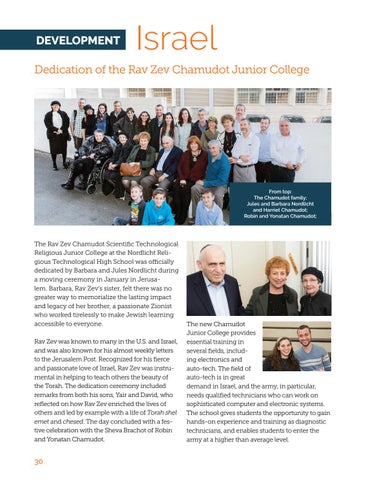
From top: The Chamudot family; Jules and Barbara Nordlicht and Harriet Chamudot; Robin and Yonatan Chamudot;
The Rav Zev Chamudot Scientific Technological Religious Junior College at the Nordlicht Religious Technological High School was officially dedicated by Barbara and Jules Nordlicht during a moving ceremony in January in Jerusalem. Barbara, Rav Zev’s sister, felt there was no greater way to memorialize the lasting impact and legacy of her brother, a passionate Zionist who worked tirelessly to make Jewish learning accessible to everyone. Rav Zev was known to many in the U.S. and Israel, and was also known for his almost weekly letters to the Jerusalem Post. Recognized for his fierce and passionate love of Israel, Rav Zev was instrumental in helping to teach others the beauty of the Torah. The dedication ceremony included remarks from both his sons, Yair and David, who reflected on how Rav Zev enriched the lives of others and led by example with a life of Torah shel emet and chesed. The day concluded with a festive celebration with the Sheva Brachot of Robin and Yonatan Chamudot.
30
The new Chamudot Junior College provides essential training in several fields, including electronics and auto-tech. The field of auto-tech is in great demand in Israel, and the army, in particular, needs qualified technicians who can work on sophisticated computer and electronic systems. The school gives students the opportunity to gain hands-on experience and training as diagnostic technicians, and enables students to enter the army at a higher than average level.
DEVELOPMENT
Israel
The Mildred Hellerstein Math Excellence Program at the Dina and Moses Dyckman Ulpanat AMIT Beersheva BY ALVIN HELLERSTEIN s Alzheimer’s took greater hold of Millie, turning to shadow a once vital, witty and feisty mind, my family and I looked for a way to honor her as she once had been. We turned to AMIT, for it was her favorite charity and her major occupation. She had been its National Treasurer, Administrative Vice President, mentor to successor officers and a devoted board member. And since AMIT is all about its children, we looked to do something to enhance their education and welfare. Thus, the Mildred Hellerstein Math Excellence Program was born.
A
We chose the Dina and Moses Dyckman Ulpana for Girls in Beersheva, and contributed $50,000 to establish a tutoring program to raise the achievement level of girls in mathematics and quantitative measurements. The ulpana, a microcosm of Israeli society, attracted daughters of professors, doctors and agricultural laborers; native Israelis as well as new immigrants. Millie would have been pleased by the choice, for she too had risen from the slums of the Bronx, propelled by her skills in math and logical thinking, at the Bronx High School of Science, Barnard College and in the infancy of computer applications in business. As her achievements gave her the self-confidence to compete at a time of deep prejudice against women, so, we thought, could a tutoring program achieve that type of self-confidence for girls in Israel. In the summer of 2016, we chose 20 girls in the 7th and 8th grades who could perform at bagrut level 4 but who, without support and tutoring, might revert to level 3. If, in the periphery of Israel, working with girls in disadvantaged circumstances, we could raise achievement levels in measurable ways
and improve their self-confidence, AMIT would have a program that could be replicated. The program continued in the 20162017 school year with 21 7th-grade girls and 23 8th-grade girls. Private tutors were hired, marathon study sessions were scheduled and treats and games lightened the program. The result after just one year: 7th-grade test scores rose from a class average of 64 to 78, a 22 percent improvement. One of the girls rose to the fifth bagrut level; none fell back to level 3. Moreover, the girls’ ability to master such a difficult course boosted their self-assurance, and gave them a better feeling about school in general with better attendance and attention in class. Our family is happy with these results and plans to expand the program. We wish to make it available to girls at bagrut level 3 who aspire to improve, and to continue the program for a second year for girls wishing to pursue higher level math in 9th grade. The program expands the girls’ horizons, enabling them to study physics and robotics in high school and to pursue post-secondary education, thereby improving their lives and allowing them to contribute at higher levels to Israeli society.
Alvin Hellerstein, Dina Hellerstein and Joshua Metzger, Judith Hellerstein, Daniella and Joseph Hellerstein
31
DEVELOPMENT
Israel
Annual Spring Luncheon, Jerusalem The annual spring luncheon of the Ayelet & Dvorah Masovetsky Jerusalem Chug honored Rabbanit Malke Bina, founder of Matan, and commemorated the 50th anniversary of the reunification of Jerusalem. A record number of attendees came to the Crowne Plaza Hotel to recognize Rabbanit Bina, who is at the forefront of furthering advanced Jewish learning for women. Dr. Naomi L-R: Deanne Shapiro, Marsha Witkin, Rabbanit Malke Bina, Cohen, the wife of Sha’ar HaYishuv Rosalie Bernman, Annette Jotkowitz, Sarah Maslow Cohen, former chief rabbi of Haifa, gave a moving account of life in the city before and during the Six-Day War. Her talk was followed by the screening of a dramatic film showing scenes from 1967 including the capture of Har HaBayit and the Kotel. Attendees also got a glimpse of the award-winning tablecloth developed by AMIT Modi’in students, which proved to be a big hit with the chug.
Campaign 2017 Kick-Off Event, Jerusalem The kick-off event for AMIT’s 2017 campaign, chaired by Judy Aronson, Barbara Wachspress and Ellen Miller, was held March 7 at Kikar HaMusica in downtown Jerusalem. The camRabbi Yehoshua Pffefer paign focuses on Klal Yisrael-United Jewry, AMIT’s cornerstone. A highlight of the well-attended event was a tour of the new Museum of Jewish Music, followed by dinner. Rabbi Yehoshua Pfeffer, a teacher at AMIT Hedvat HaTorah, spoke about the importance of core subjects for Haredi students and Israeli society alike.
32
L-R: Ellen MIller, Estelle Fink, Barbara Wachspress, Judy Aronson
A student from AMIT Menorat HaMaor in Petach Tikva captivated the audience with his thoughtful comments about AMIT’s impact on his future. The attendees were inspired and genuinely pleased to learn how their continuous support contributes to the future of Israel and its society.
DEVELOPMENT
Midwest Annual Pre-Shavuot Bake Sale
L-R: Amy Ashkenasy, Lilach Karavani, Chaya Keren, Judy Joffe, Edith Tesler
On Memorial Day, AMIT Cleveland held its annual pre-Shavuot bake sale. Cleveland Jewish community members volunteered to bake goods for the sale, which was held at the home of an AMIT Cleveland member. As usual, the event was very popular in the community and was a great success. We can’t wait to continue the tradition next Shavuot.
2017 Eleanor Greenberg, z”l, Evening of Learning A large group of friends and family gathered for the Midwest AMIT’s Ninth Annual Eleanor Greenberg, z”l, Evening of Learning with guest speaker Rabbi Yitzy Sprung of the YU Torah Mitzion Kollel of Chicago. Tami Drapkin, Midwest AMIT’s co-president, talked about her long relationship with the Greenberg-Kolom-Schwab family and the impact it made on her life. Molly Zwanziger also spoke about her recent visit to Yeshivat AMIT Kfar Ganim in Petach Tikva.
The Greenberg family
2017 Mother-in-Israel Event
L-R: Debbie Alexander, Fern Spielman, Patty Ray, Sue Stein, Sherri Bressman
The Midwest Council of AMIT hosted its 2017 Mother-in-Israel event, “A Tale of Two Women,” with a presentation by longtime AMIT supporters and children’s book authors Michelle Friedman and Debbi Geller. Michelle and Debbi, both past AMIT chapter and council presidents, wrote and illustrated the children’s book “There Once Was a Camel.” Attendees had brunch and learned about the creative and collaborative processes they used to complete and publish their book.
2017 Carmel Chapter’s Shavuot Bake Sale This year’s Midwest AMIT’s Carmel chapter Shavuot bake sale was dedicated in memory of Ellen Koplow, z”l, a devoted AMIT supporter, and was a great success!
L-R: Rebecca Gorenstein, Sarah Bajtner, Adina Shyovitz, Jen Koplow
33
DEVELOPMENT
Mid-Atlantic
AMIT Birah Chapter of Greater Washington, D.C. Annual Family-in-Israel Event
Fran Wollner
On a beautiful summer evening in June, over 50 people attended this annual event hosted at the lovely home of Fran and George Wollner. Felice Grunberger gave a brief update on AMIT and introduced Dr. Chaim Himmelfarb, who spoke engagingly about his family’s longstanding support of Beit Hayeled. Our keynote speaker of the evening, Aviad Haramati, professor of physiology and director of the Center for Innovation and Leadership in Education at Georgetown University School of Medicine, spoke about mindfulness as an antidote to chronic stress. Everyone enjoyed an Israeli supper and the fine delicacies from Donna Lawrence’s kitchen.
AMIT Philadelphia Council/Shira Chapter Annual Generations-in-Israel Event Over 70 people attended the lovely celebration of deserved honoree Lisa Dardashti on June 12 at Lower Merion Synagogue in Merion Station. Lisa presented a wonderful PowerPoint presentation that explained the Conversational English Enrichment Program in Sderot, an initiative that Philly has taken on. While in Israel, Lisa visited Sderot and became passionate and committed to raising the funds for this program for the next three years. Rebbetzin Adina Shmidman delivered a moving D’var Torah, and the evening culminated with Torah Academy Girls’ Choir performing for the audience.
Lisa holding framed art
My Personal Experience with Daniel Silva: An Evening with Scott Ference
Scott Ference
34
Fifty members and friends of AMIT came to hear Scott Ference speak about his experience as Daniel Silva’s escort while Mr. Silva presented his book “Black Widow” to Philly. Everyone was in high spirits as they heard Scott’s story. Mr. Silva’s book was given to the guests. The video “AMIT Saves the Children” was viewed and appreciated by all.
DEVELOPMENT
Southeast Cholent and Chili Challenge
Will & Jen Coane, Aliza Aronin, Rebecca Kinzbrunner
The southeast IMA chapter held its cholent and chili challenge at the home of Debby and Danny Aqua and was chaired by co-presidents Aliza Aronin and Rebecca Kinzbrunner. Cooks brought their best dish to the table and there was tasting for all! At evening’s end, the winner was declared and everyone left happy and full!
Mother-in-Israel Honoring Rebbetzin Meira Davis The southeast IMA chapter held its annual Mother-in-Israel evening on March 19 at the home of Joan and David Kornbluth. Brenda Pritzker, Judy Goldberg Committee, honoree and host The committee—Judy Goldberg, Marilyn Kaplan, Brenda Pritzker and Nancy Zombek—managed to surprise the honoree, Rebbetzin Meira Davis, with a video of wishes from family near and far. The video was put together by our very own Rebecca Kinzbrunner.
Paint the Night Away
Attendees and their masterpieces
SE Region and the Geulah Shalva chapter held a canvas paint night on March 21. Attendees enjoyed lite bites and wine and released their inner Van Gogh to create their own work of art! The evening was chaired by Robin Jacobs and Harriet Sklar.
35
DEVELOPMENT
Emerging Leaders
AFLI’s Ninth Annual Yom Ha’atzmaut Social
L-R: Elan Hollander, Zach Noble, Zev Lindenbaum
AFLI’s ninth annual Yom Ha’atzmaut social was a hit, with over 75 college-age participants enjoying handmade delicious sushi, hor d’oeuvres, music and socializing at The Vanity NYC in downtown Manhattan. AFLI chairs Sarah Mendlowitz and Jason Abramson, the entire board and committee created an outstanding event, offering incredible donated raffle prizes—from a day at the spa with friends to table service at a bar to free spin classes—which were a hit. All the proceeds went to the Horse and Dog Training Program at AMIT Bienenfeld Hevruta Yeshiva in Ra’anana, which caters to boys ages 14 to 18 and offers them a last chance at a quality education. The staff takes a non-traditional educational approach to find each student’s inherent abilities and talents, build their self-esteem and give them tools to succeed in life.
NewGen Summer BBQ Under the Stars More than 90 people gathered in the backyard of Vivian and Stanley Bernstein for a very special AMIT of Greater Westchester event. The guests had the pleasure of viewing the hit YouTube Jonathan Tropper (center) series “Soon by You,” about and the “Soon by You” cast Guests enjoying delicious BBQ singles living and dating in Manhattan, with a talkback from the cast. Best-selling author Jonathan Tropper moderated the cast discussion, which featured an engaging question-and-answer session. Everyone enjoyed a delicious BBQ and a special sorbet counter from Screme Gelato, where people got to choose their own delicious dessert. The chairs and committee created an outstanding event, the first of many AMIT of Greater Westchester is planning!
SE AYP (AMIT Young Professionals) I-Fly, You Fly, We all Fly!
Southeast AYPs get their wings at AMIT i-Fly event
36
The SE AYPs got their wings! Packed to capacity, the entire group learned to fly high in the indoor wind tunnel. Once the class was completed, everyone’s dreams of flight became a reality, at least for one day!
DEVELOPMENT
Western Purim at the Masquerade Ball AMIT and Chabad SOLA joined forces for their annual Purim bash, with this year’s theme being “Masquerade Ball.” Close to 1,000 Jewish partygoers in creative costumes enjoyed a spectacular evening with a DJ, live band, chill-out room, two photo booths and an hourly megillah reading until the wee hours of the morning. Happy Purim partygoers
Honoring the 50-Year Anniversary of the Reunification of Jerusalem The AMIT L.A. Leadership Council hosted its inaugural event to celebrate the 50th anniversary of the reunification of Jerusalem. A sushi L-R: Sandra Roklen, Carole Shnier, Michal Taviv-Margolese, and dessert reception was held June 8 in the Daniel Altshuler & Moshe Uziel beautiful home of Lauren and David Lunzer in Hancock Park. Council Chair Evan Green emceed the event, which featured guest speakers Rabbi Abraham Leiberman and AMIT Alumnus Moshe Uziel, who now serves as the director of the Center for Technology and Leadership Values at AMIT Kfar Blatt, and who shared his personal journey.
Young Professionals Independence Day BBQ
Hundreds of young professionals joined the event
Three hundred and fifty young Jewish professionals flocked to Beverly Hills for a kosher BBQ on July 4. Thanks to Cathy and Sam Lebovitz for welcoming us into their home. Between nonstop burgers and hot dogs, DJ Aviel rocking the house and the infinity pool with a view to die for, everyone had a great time!
37
DEVELOPMENT
TriState
Generations-in-Israel Luncheon The Sabra & Massada Chapters held its Generations-in-Israel Luncheon celebrating the 50th anniversary of the reunification of Jerusalem on May 15. The event paid tribute to longtime supporter Lilly Friedman and her children. Lilly and her family were honored for Lilly and Al Friedman and Family their commitment and tireless efforts on behalf of Israel. Lilly spoke emotionally about her family’s love of Israel and her commitment to AMIT, which can be traced back to her late mother-in-law, Marion Friedman, z”l, who served as president of the Kew Gardens chapter of AMIT for many years.
Long Island Yom Iyun Over 100 women spent a July morning together in prayer and learning at AMIT’s 18th annual Long Island Yom Iyun, which took place at the Sephardic Temple. Chairwoman Rebbetzin L-R: Esther Press, Mimi Mehlman, Malki Feigenbaum, Mehlman emphasized the importance of this Ruth Burian, Dr. Shoshano Poupko, Audrey Wagner, event, which is “for women, by women,” and Sondra Sokal how meaningful it is to have such a large gathering of women learning together before Tisha B’Av. Participants were captivated by Dr. Shoshana Poupko’s lecture and her moving message about the power of community.
Daniel Silva Launches New Book Daniel Silva, No. 1 New York Times best-selling author, captivated the audience on July 10 as he spoke about the latest installment of his Gabriel Allon series, “House of Spies.” The evening was moderated by Marie Brenner, author and writer for Vanity Fair magazine. After the Q&A, Daniel signed books for every single person in the room, while the attendees enjoyed a sumptuous dessert buffet. The evening was co-chaired by Elissa and Michael Katz, Miriam and Howard Rosenblum and Tammy and Kenneth Schaum.
38
Daniel Silva with Marie Brenner
DEVELOPMENT
TriState
3rd Annual Greater New Jersey Summer Event A group of 25 AMIT donors from around the New York/ New Jersey region attended the 3rd Annual Greater New Jersey Summer event on July 26. They spent the day touring and exploring Boscobel House and Gardens in Garrison, New York, one of the leading historic Guests enjoying lunch Guests enjoying the Boscobel museums in the United States. by the Hudson River House and Gardens The house holds an exceptional collection of New York furniture from the Federal period. Everyone was able to stroll the lovely grounds and eat lunch against the backdrop of the Hudson River. Thank you to our co-chairs, Hattie Dubroff, Connie Kadish, Dorene Richman and Miriam Rosenblum.
Moshe Uziel, Director of the Center for Technology and Values at Kfar Blatt, Visits the U.S.
Francine Stein and Mollie Siegel
Alan and Linda Lewis
Moshe Uziel, a graduate of AMIT Beit Hayeled and Kfar Blatt, came to the United States this past summer to visit N.Y., N.J., FL. and L.A. to update us on his new role at AMIT as Director of the Center for Technology and Leadership Values Evan Green at Kfar Blatt. Moshe shared his moving life story and described how he feels it’s his “mission” in life to give back to the students of Israel. The program is run in cooperation with the IDF, and trains students in auto-tech, preparing them to become diagnostic technicians for the tank and armored corps. This specialized training ensures that students enter the army at a high level, which then opens the door to opportunities in the tech sector after they complete their service. Moshe is a shining example of how education, support and love can shape one’s future.
39
PLANNED GIVING Give Today or Tomorrow? Do Both With the Blended Gift Approach Would you rather support Israel’s children today, allowing you to see your gift at work, or after your lifetime, ensuring that our students and schools benefit for years to come? With a “blended gift,” you can do both. Gifts You Make Today:
• Cash • Stock and Securities • Real Estate • Life Income Gifts • Charitable Gift Annuity • Charitable Remainder Trust
Future Gift: Combined with
• Bequest in Will/Trust • IRA/Retirement Plan Assets • Life Insurance • Other Beneficiary Designations
Next Steps: • Seek the advice of your financial or legal advisor. • If you include AMIT in your plans, please use our legal name and Federal Tax ID. Legal Name: AMIT Address: New York, NY Federal Tax ID Number: #85-8012621885C-2
With a Will, There’s a Way Create Your Vision for the Future with This Important Document Momentous events like a milestone birthday, the arrival of a grandchild or retirement are a time to celebrate and reflect on where your family has been and what the future might hold. Create a will. Through this important document, you can direct the division of your property the way you choose. If AMIT has been important in your life, you can also include a gift to support our future and help children in Israel flourish.
Go a Step Further If supporting AMIT is a part of your future plans, share your intentions with loved ones. Does your family know why our mission is important to you? Tell them! You could also inspire them to make a connection with AMIT.
Control Your AMIT Legacy Contact Robin Isaacson National Director Planned Giving at (954) 922-5100 or robini@amitchildren.org for help in creating a plan. www.AMITChildren.planmylegacy.org
40
Robyn Price Stonehill and David Stonehill, NY Yeftah NPO, Israel
$50,000-$74,999 $1,000,000 + Ellen, z”l, and Meyer Koplow, NY The Moise Y. Safra Foundation, NY Ellen and Stanley Wasserman, NY
$250,000-$999,999
Rabbi Meyer Strassfeld, z”l, DC
Hadassah and Marvin Bienenfeld, NY
Joyce and Daniel Straus, NJ
Barbara Bloom, MD
Trump Foundation, Israel
Elaine Brimer, z”l, NY
The Harry and Jeanette Weinberg Foundation, Inc., MD
Suzanne and Jacob Doft, NY David Goldman Charitable Trust, Israel
The Maurice and Viviene Wohl Philanthropic Foundation, London
Harvey Goodstein Foundation, PA Norma and Emanuel, z”l, Holzer, NY
Shari and Jacob M. Safra, NY
$100,000-$249,999 Anonymous, NY Canada Foundation, Israel Kirsch Foundation, Israel Alice Levi, z”l, NY Barbara and Jules Nordlicht, NY
Ria and Tim Levart, NJ
Lee and Louis Benjamin, NY
Debbie and Samuel Moed, NJ
Laurie and Eli Bryk, NY
Seed the Dream Foundation, PA
Gazit-Globe, Israel
Harriet and Heshe Seif, NJ
Kitty Hoory, z”l, Israel
Carrie and Ilan Stern, NY
Sarena and David Koschitzky, Canada
Trudy and Stanley Stern, NY
Ellen and Emanuel Kronitz, Israel
Yedidut Toronto, Israel
Leon and Gloria, Edward, Sari, and Howard Miller, NY
Molly and Jack Zwanziger, IL
AMIT • B I
•
T
Renee Silverstein, z”l, NJ
The Kolatch Family Foundation, NJ
$75,000-$99,999
Ethel and Lester Sutker, IL
• O C
$36,000-$49,999
Glencore Foundation, Israel
Shirley and Morris Trachten, z”l,
Selma and Jacob Dyckman, NY
Mitzi Golden, NY
Family Foundation, Israel
Ike, Molly and Steven Elias Foundation, NY
Goldhirsh-Yellin Foundation, CA
Audrey and Chaim Trachtman, NY
Laura and Jonathan Heller, NY
Ari Wexler, Israel
Mildred, z”l, and Alvin Hellerstein, NY
Yoreinu Foundation, Israel
Amy, z”l, and Jimmy Haber, NY Brenda and Albert Kalter, NY Barbara and Fred Kort Foundation, CA Dorothy Koplow, z”l, MA Dina Kuperman, z”l, FL
$25,000-$35,999 Anonymous, FL Anonymous, NY Martin Block, z’l, FL Sherry and Neil Cohen, NY Jewel and Ted Edelman, NY Joseph and Rae Gann Foundation, MA
Orli and Eric Herschmann, NJ Robert Kent, z”l, PA
$18,000-$24,999
Kirkland & Ellis LLP, NY
Grace, Shua, Jacob Ballas
Kislev Tuvla Veschar, Israel
Charitable Trust, Israel
The Joan S. and Leon Meyers Foundation, NY
Blackman Foundation, CA
Barbara and Joel, z”l, Rascoff, NY Micheline, z”l, and Marc Ratzersdorfer, Israel Norman and Bettina Roberts Foundation, NJ Rose and Kurt Stanger Charitable Trust, NY Zahava and Moshael Straus, NJ
As of 7/19/17. We apologize if your name was inadvertently left off this list.
Adena and Ezra Dyckman, NY Ceil Fenster, NY
Sylvia Holder, z’l, NJ Sarah Liron and Sheldon Kahn, CA Gitta and Richard Koppel, Israel Sharon and Solomon Merkin, NJ Esther and Sidney Mochan, z”l, NY Sandra and Evan Roklen, CA Deena and Adam Shiff, NY Beatrice Shustko, z”l, NY Helena Inga and Marc Singer, Israel Rita and Eugene Schwalb, FL
$10,000-$17,999 Anonymous, CA Anonymous, IN Anonymous, Israel Anonymous, MA Anonymous, NY ABS Realty, NY Trudy and Ted, z”l, Abramson, FL
Tamar and Eric Goldstein, NY
Max & Anna Baran, Ben & Sarah Baran and Milton Baran, z”l, CA
Pnina and Jacob Graff, CA
Zelda and Solomon Berger, NY
Hamifal Education Childrens Home, Israel
Daisy Berman, NY
Russell Jay Hendel, MD
Helen and Henry Bienenfeld Foundation, PA
Kimberly and Larry Heyman, NY
Anne Bernstein, CA
41
I
T
AMIT • B
•
• O C Lotte and Ludwig Bravmann, NY
Ilan Nissan/Goodwin Procter LLP
Sarah and Maurice Aghion, MA
Ethlynne and Stephen Brickman, MA
North American Conference of Ethiopian Jews, Israel
Randi Schatz Allerhand and
Eliyahu Maccabi Carraso, Israel Trina and Paul, z”l, Cleeman, NY Rosa and Isaac Cohanzad, CA Marion Crespi, NY Jone and Allen Dalezman, MA Rochelle and Eli Dweck, Israel Suzanne and Samuel Eisenstat, NY Trudy and Sol, z”l, Englander, NY Ruth and Gene Fax, MA Lisa Rosenbaum and Ronald Fisher, MA Lilly and Alfred Friedman, NY Rosalyn and Ira Friedman, NJ Dianne Golub, NY Layla and Evan Green, CA Lillian Gross, z”l, NY Gruer Family Foundation, CA Harwit Charitable Trust, CA Debbie and David Isaac, NY Ithaca United Jewish Community, NY Edith and Herman Itzkowitz, PA Rabbi Arthur Jacobowitz, Israel Suzanne and Norman Javitt, NY Ruth and Hillel Kellerman, CA Keren HaYesod, Israel Kibbutz Mishmar HaEmek, Israel Ruth and Daniel Krasner, NY Rochelle and Seymour, z”l, Kraut, NJ Ruth M. Finglass and Kevin A. Kubach, MD
Or Peace for Children and Youth, Israel Regina Peterseil, NY Lauren and Mitchell Presser, NY Price Waterhouse Cooper, FL Jerald Ptashkin, CA Joyce and Stanley Raskas, NY Marsha Roth, Israel
Joseph S. Allerhand, NY Daniel Altshuler, CA Amdocs, Israel Ann and Hy Arbesfeld, NY Lolly and Harris Bak, NY Rachel, z”l, and Martin Balsam, NY Regina Wang Baumann, z”l, FL Joan and Shael Bellows, IL
Jennie and Avi Rothner, IL
Tamar and Ethan Benovitz, Israel
Shirley and Milton Sabin, FL
Ilana and Daniel Benson, NY
Michele and Mark Saks, NY
Debbie and Julio Berger, NY
Debbie and Daniel Schwartz, NY
Phyllis and Edward Berkowitz, NY
Erica and Robert Schwartz, NY
Vivian and Stanley Bernstein, NY
Sharon and Rony Shapiro, MA
Evelyn and Isaac Blachor, NY
Shemesh Foundation, Israel
Beth and Reuben Blumenthal, NY
Judy and Isaac Sherman, NY
Deborah Stern Blumenthal and
Salia and Ruven Silia, Israel
Michael Blumenthal, NJ
Marilyn and Herbert, z”l, Smilowitz, NJ
Bnei Akiva, Israel
Sondra and Myron Sokal, NY
Sari and Stuart Braunstein, NY
Nellie and Aharon Stavisky, Israel
Adrianne and Leon Brum, FL
Adina Straus, NY
Carol and Arnold Caviar, KS
Ina and David Tropper, NY
Margaret and Chaim Charytan, NY
Judy and Morry Weiss/SapirsteinStone-Weiss Foundation, OH
Vivian and Daniel Chill, NY
Western Wall Heritage Foundation, Israel
Michael Cleeman, NY
White and Case, LLP, NY Dorothy Wittcoff, z”l, MN Helene and Gerald Zisholtz, NY
Barbara and Melvyn Ciment, MD Shevi and Milton Cohen, NY
Gabriella and David Fridman, NY Rena and Michael Friedman, IL Marisa and Andrew Gadlin, NY Shifra and Perry Garber, NY Linda and Norman Garfield, PA Rita Geller, IL Randi and Alan Gelman, Israel Debbie and Elliot Gibber, NY Lakie Gilden, z”l, CA Leelah and Joseph Gitler, Israel Abigail and Ari Glass, NY Miriam and Felix Glaubach, NY Paulette and Max, z”l, Goldberg, NY Esther and Jack Goldman, NY Anne and Sheldon Golombeck, NY Sandra E. Goodstein and Arthur Rosenblatt, PA Gorlin Family Foundation, MD Sara and Ronald Gottlieb, FL Paula Yudenfriend and Arlin Green, PA Sharon and Melvin Gross, NY Phyllis Hammer, MA Debbie and Robert Hartman, IL Howard Heller, MA Debbie and Eddie Herbst, CA Hertz Family Foundation, CA Hiburim, Israel Aviva Hoschander-Saltzberg and Vernon Saltzberg, NY Max and Sunny Howard Memorial Fund, NY Shulamit and Joakim Isaacs, Israel Peggy and Robert Insel, NY
Diane and Howard Cole, NY
Sonia Bodenstein-Izenstark and Ira Izenstark, CA
Melvin S. Cutler Foundation, MA
Elaine and Robert Jacobs, NY
Lisa Dardashti, PA
Barbara and Manfred Joseph, NY
Emily and Paul Dauber, NJ
Connie and Alan Kadish, NJ
Selma Daye, CA
Ilana and Mitchell Kahn, NY Robin and Simon Kahn, Israel
Shirley Lerner, Israel
$5,000-$9,999
Esther Loveman, z”l, FL
Anonymous, CA
Rita Lowi, CA
Anonymous, FL
Elaine and Lewis Dubroff, NY
Zipporah and Arnold Marans, NY
Anonymous, Israel
Hattie and Arthur Dubroff, NJ
Hermann Kaiser, NJ
Etella and Haim Marcovici, NY
Anonymous, Israel
Susan Ederson, NY
Ruth and Jerome Kamerman, NY
Lisa and Leon Meyers, NY
Anonymous, MA
Linda and Barry Eichler, PA & NY
Stacey and David Kanbar, NY
The Dorothy Phillips Michaud Charitable Trust, CA
Anonymous, NJ
Sherry and Aaron Eidelman, NY
Ruth and William, z”l, Kantrowitz, NY
Anonymous, NY
Joseph Fabian, z”l, FL
Harriet and Joel Kaplan, NY
Judy and Albert Milstein, IL
Anonymous, NY
Iris and Stephen Feldman, NY
Elissa and Michael Katz, NJ
Marilyn and Leon Moed, NY
Lisa Bellows Ablin and Jason Ablin, CA
Sheila and Kenneth Fields, NJ
Daniel Kaufthal, NY
Moskowitz Foundation, Israel
Adelson Foundation, MA
Sylvia Freyer, NJ
Keren Limudai Hemshech, Israel
42
As of 7/19/17. We apologize if your name was inadvertently left off this list.
T
I
AMIT • B
•
Francine and Aaron Stein, NJ Blimie and Joel Strauss, NJ Nechama and Howard Taber, NY Talpiot Religious Children’s Village, Israel Lilly Tempelsman, NY
• O C Keren Roi, Israel
Manette and Louis Mayberg, MD
and Len Rosen, Israel
Rochelle Stern Kevelson, NY
Elizabeth and Barry Mayer, NY
Vivian and Solomon, z”l, Rosen, FL
Diane and Barry Kirschenbaum, FL
Benay and Ira Meisels, NY
Miriam and Howard Rosenblum, NJ
The Klibanoff Family, NJ
Myra Mitzner, NY
Gale and Eric Rothner, IL
Jane Klitsner, Israel
Vera and Robert Moreen, PA
Elizabeth and Gidon Rothstein, NY
Laurie and Robert Koppel, NY
Sylvia Nadel, z”l, OH
Madeline, z”l, and Ethan Kra, NJ
Leah and Arnold Rotter, CA
Paul Newman Foundation, PA
Evelyn and Lawrence Kraut, NJ
Hedda Rudoff, NY
Gloria and Burton Nusbacher, NY
Edy and Jacob Kupietzky, IL
Beth Chiger and Neil Sambrowsky, NY
Carole Nussbaum, FL
Donna and Jeffrey Lawrence, MD
Tammy and Kenny Schaum, NY
Bea and Irwin, z”l, Peyser, NY
Diane and David Lent, NY
Jan and Sheldon Schechter, NY
Hedy and Paul Peyser, MD
Esther and William Schulder, NJ
Suzy and Paul Peyser, NY
Diana Schiowitz and Paul Schwartz, Israel
Kari and Joshua Levine, NY Rose and Jacob Levine, z”l, CA Sylvia and Norman Levine, FL Dorothy and Robert Lewis, NY Ruth and Robert Lewis, NY Mindy and Seymour Liebman, NY Jennifer and Marc Lipschultz, NY Audrey and Haskel Lookstein, NY Naomi and Carl Lopkin, MA
Vicki and Jerry Platt, NY Esther and Donald Press, NY Tzippi and Ira Press, NJ Judy and Jerry Pressner, NY Rose Ptashkin, CA Evelyn Reichenthal, TX Reut Foundation, Israel Rose Rich, z’l, CA
Rita Lourie-Galena, PA & NY
Shelley Rindner, NY
Malka Lozowick, Israel Adama Makhteshim, Israel
Fritzie and Sheldon, z”l, Robinson, IL
Meira and Solomon Max, NY
Kristina Reiko Cooper
Deanne and Leonard Shapiro, Israel Chana and Daniel Shields, NJ Jane Shiff, NY Yehuda Shmidman/Sequential
Sandra, z”l, and Max Thurm, NY Marilee and Michael Tolwin, CA Bertie and Fred Tryfus, NY Amy and Jeffrey Verschleiser, NY Audrey and Max Wagner, NY Paula and Leslie Walter, NY Anne and Mark Wasserman, NY Mamie Wasserman, z”l, CA Harold Watman, z”l, NY Marion and William Weiss, NJ Roselyn and Walter, z”l, Weitzner, NY Linda and Stanley Weissbrot, IL Linda and Steven Weissman, NY Joyce and Jeremy Wertheimer, MA Booky and Jerome Wildes, NY Stella and Samy Ymar, MD
Brands Group, NY
Hilde and Benjamin, z”l, Zauderer, NY
Mollie Siegel, NJ
Esther and Dov Zeidman, NY
Rosalyn and Richard Slifka, MA
Gloria Zeisel, IL
Sharon and Morris Silver, CA
Tamar and Benjamin Zeltser, NY
Sara and Gabriel Solomon, MD
Charles Zeluf, Israel
Nancy and Benjamin Sporn, NY
Nathan Zussman, Israel
As of 7/19/17. We apologize if your name was inadvertently left off this list.
AMIT Offices Around the World AMIT National Office 817 Broadway, 3rd Floor New York, NY 10003 Tel: 212.477.4720 Fax : 212.353.2312 info@amitchildren.org www.amitchildren.org AMIT ISRAEL Jerusalem Office info@amit.org.il www.amit.org.il Mailing Address: P.O. Box 71075 Jerusalem 91071, Israel
Petach Tikva Office Tel: +972-3-912-3171 Fax: +972-3-912-3166 info@amit.org.il
Cleveland Tel: 216.382.4441 amitcleveland @amitchildren.org
Baltimore/Boston/ D.C./Philadelphia Tel: 410.484.2223 RobbieP@amitchildren.org
Florida Tel: 954.922.5100 Robini@amitchildren.org
Chicago Tel: 847.677.3800 amitchicago@amitchildren. org
AMIT France Tel: +33-611-487-314 france@amitchildren.org AMIT UK Tel: 212.477.4737 LizK@amitchildren.org www.amitchildren.org.uk
Los Angeles Tel: 310.859.4885 MichalT@amitchildren.org
43
PRSRT STD US Postage Paid Pontiac, IL Permit No. 397
AMIT Children 817 Broadway New York, NY 10003
STRONG CHILDREN BUILD A STRONG FUTURE FOR I S RAE L !
DELIVERING CUTTING-EDGE EDUCATION TO ISRAEL’S DIVERSE POPULATION
INSTILLING JEWISH VALUES IN ISRAEL’S FUTURE LEADERS
CLOSING THE OPPORTUNITY GAP FOR CHILDREN IN ISRAEL
Guidestar Gold status—Their highest mark of excellence based on efficient use of charitable funds. Charity Navigator rates AMIT 4 Stars—Their highest rating
44
AMIT
Building Israel. One Child at a Time.
W W W. A M I TC H I L D R E N . O RG