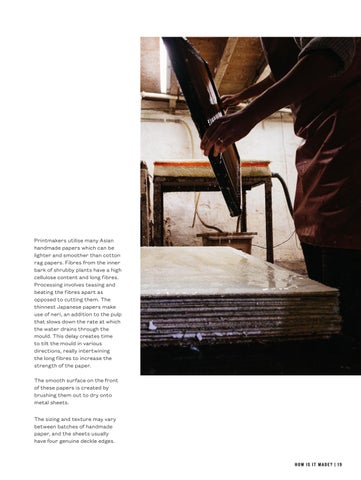
Printmakers utilise many Asian handmade papers which can be lighter and smoother than cotton rag papers. Fibres from the inner bark of shrubby plants have a high cellulose content and long fibres. Processing involves teasing and beating the fibres apart as opposed to cutting them. The thinnest Japanese papers make use of neri, an addition to the pulp that slows down the rate at which the water drains through the mould. This delay creates time to tilt the mould in various directions, really intertwining the long fibres to increase the strength of the paper. The smooth surface on the front of these papers is created by brushing them out to dry onto metal sheets. The sizing and texture may vary between batches of handmade paper, and the sheets usually have four genuine deckle edges.
HOW IS IT MADE? | 19