Robert Darden, The Greenwood Commonwealth
film friend Mary Preston Hays in 1995. “Tate was in Jackson at that time and wanted to get into film. Mary Preston said, ‘You need to meet Brunson; he’s in town,’” Green says. They were introduced at a Medgar Evers homecoming event and reconnected in Los Angeles. Expanding the Southern Base While Green and Taylor developed their film careers, Sonya Lunsford, who is from Georgia, was moving and shaking her own way in the film business. “I started in craft services providing snacks and refreshments for commercial crews in Atlanta,” Lunsford says. “I liked the business so much I wanted to work in every single department to see where I could land.” Having a knack for budgets and finances, Lunsford found that she best enjoyed the business end of production. Lunsford worked her way up the ranks from accounting clerk to co-producer. Among other films, she managed the budgets on Steven Soderbergh’s “Traffic,” “Che” Parts 1 and 2, and “The Good German.” Around the time that Green and Taylor were doing their first short film, “Chicken Party,” Lunsford had reconnected with Green, whom she first met when he was her neighbor in Austin. “There was a whole southern contingent that would get together in L.A., and we talked about projects,” Lunsford says. Lunsford’s first project with Green and Taylor was their feature film, “Pretty Ugly People.” After working on the $60 million “Che” films, Lunsford knew “there was nothing we couldn’t do.” Converging Forces A convergence of forces aligned perfectly for adapting “The Help” into a movie. Besides the obvious fact that the book became a tri-
umphant success and that Taylor, Green and Lunsford had reached the right stage in their careers to pull off a major motion picture, Chris Columbus, who has a distinguished career directing and producing films, including “Harry Potter and the Philosopher’s Stone” and “Harry Potter and the Chamber of Secrets,” took a shine to the project. Taylor met Columbus a few years ago. “My sister lives in San Francisco, and her daughter goes to school with Chris’ daughter. When my niece was invited to a sleepover at the Columbus home, I asked her to take a copy of ‘Chicken Party’ with her. Yes, I pimped my 10-year-old niece,” Taylor says, laughing. “Chris loved the film, and we met and talked and kept in touch.” With his clout and stature in the film industry, Columbus actively campaigned to get “The Help” made. It is because of Columbus that this film had a fast track and did not languish in the studio system. While there were many studios vying for the opportunity, DreamWorks Studios sealed the deal first. The film “landed in the right place,” says Lunsford, who has worked for a number of studios. “DreamWorks Studio has been extremely supportive in making this film,” Taylor says. Taylor and Green wanted to film in Mississippi because it grounds the film in authenticity. “I used to hunt in Carrollton, Miss.,” Taylor says. This area is “a timeless, enchanting place. It’s very cinematic.” The Homecoming The Mississippi Film Office, the Mississippi Development Authority, the GreenwoodLeFlore-Carroll Economic Development Foundation, the Greenwood Convention and Visitors Bureau, Bill Crump, chairman of the foundation, and Viking Range CEO Fred Carl Jr. made Mississippi a financial viable place to
No Rough Edges serving his country, and Miss Grace mourns his death by scrawling out long letters to her dead son. Her daughter Savannah (Savannah Bearden) and the family housekeeper Sherrene (Stephanie Norwood) fret about Miss Grace’s reclusiveness. Murphy’s widow, Hope, is too dazed and confused to help. The movie gets more interesting and a bit less predictable when John Mazilli In “One Came Home,” the fictional city of Magnolia, Miss., seems perfect. But is it? (Corey Parker of “Will & Grace” fame) wanders into Miss Grace’s life. Mazilli ne Came Home,” the first feature film from claims to be Murphy’s war buddy, and he has a dandy idea Rolling Fork native Willy Bearden, is about an to build a war memorial for his unit. Miss Grace lights up. idyllic rural community in Mississippi called “Will this memorial include Murphy?” she asks. Magnolia, where all the mamas are nice, all “Why, of course,” John responds. the men are handy, and all the grown children live with While not journeying into virgin territory, the their parents. If there was a water body nearby (perhaps Bearden and David Tankersley-written “One Came just an outdoor privy where the snakes run rampant), this Home,” inspired by Bearden’s own family history, is town would be Mississippi’s version of Lake Wobegon. homey and comfortable and provides a glimpse of the Set in 1946, everybody in Magnolia knows Miss shattered innocence of the post-WWII era. Ryan Parker’s Grace’s (Julia Ewings) sad story. Her son Murphy died cinematography, Rachel Bolden’s art direction and Meri-
“O
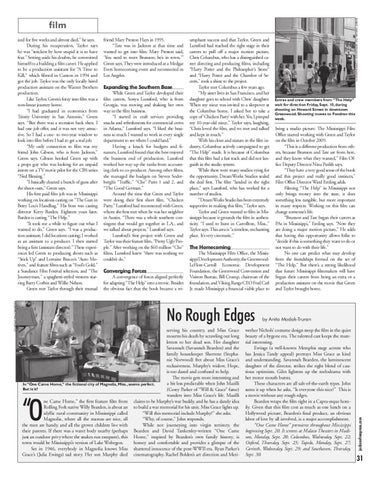
Extras and crew members from “The Help” wait for direction Friday, Sept. 10, during shooting on Howard Street in downtown Greenwood. Shooting moves to Fondren this week.
bring a studio picture. The Mississippi Film Office started working with Green and Taylor on the film in October 2009. “This is a different production from others, because Brunson and Tate are from here, and they know what they wanted,” Film Office Deputy Director Nina Parikh says. “They have a very good sense of the book and this project and really good instincts,” Film Office Director Ward Emling adds. Filming “The Help” in Mississippi not only brings money into the state, it does something less tangible, but more important in many respects. Working on this film can change someone’s life. “Brunson and Tate began their careers as PAs in Mississippi,” Emling says. “Now they are doing a major motion picture.” He adds that having this opportunity allows folks to “decide if this is something they want to do or not want to do with their life.” No one can predict what may develop from the friendships formed on the set of “The Help.” But there’s a strong likelihood that future Mississippi filmmakers will have begun their careers from being an extra or a production assistant on the movie that Green and Taylor brought home.
by Anita Modak-Truran
wether Nichols’ costume design steep the film in the quiet beauty of a bygone era. The talented cast keeps the material interesting. Ewings (a well-known Memphis stage actress who has Jessica Tandy appeal) portrays Miss Grace as kind and understanding. Savannah Bearden, the luminescent daughter of the director, strikes the right blend of cautious optimism. Giles lightens up the melodrama with her motor mouth bursts. These characters are all salt-of-the-earth types. John sums it up when he asks, “Is everyone this nice?” This is a movie without any rough edges. Bearden wraps the film tight in a Capra-esque homily. Given that this film cost as much as one lunch on a Hollywood picture, Bearden’s final product, an obvious labor of love by all involved, is a major accomplishment. “One Came Home” premieres throughout Mississippi beginning Sept. 20. It screens at Malaco Theaters in Madison, Monday, Sept. 20; Columbus, Wednesday, Sept. 22; Oxford, Thursday, Sept. 23; Tupelo, Monday, Sept. 27; Corinth, Wednesday, Sept. 29; and Southaven, Thursday, Sept. 30.
jacksonfreepress.com
courtesy Willy Bearden
ized for five weeks and almost died,” he says. During his recuperation, Taylor says he was “stricken by how stupid it is to have fear.” Setting aside his doubts, he committed himself to a building a film career. He applied to be a production assistant for “A Time to Kill,” which filmed in Canton in 1994 and got the job. Taylor was the only locally hired production assistant on the Warner Brothers production. Like Taylor, Green’s foray into film was a non-linear journey home. “I had graduated in economics from Trinity University in San Antonio,” Green says. “But there was a recession back then. I had one job offer, and it was not very attractive. So I had a one- to two-year window to look into film before I had to get a real job. “My only connection to film was my friend John Gibson, who is from Jackson,” Green says. Gibson hooked Green up with a props guy who was looking for an unpaid intern on a TV movie pilot for the CBS series “Ned Blessing.” “I basically cleaned a bunch of guns after the shoot-outs,” Green says. His first paid film job was in Mississippi working on locations casting on “The Gun in Betty Lou’s Handbag.” His boss was casting director Kerry Barden. Eighteen years later, Barden is casting “The Help.” “It took me a while to figure out what I wanted to do,” Green says. “I was a production assistant; I did locations casting; I worked as an assistant to a producer. I then started being a first (assistant director).” These experiences led Green to producing shorts such as “Stick Up” and Lorraine Bracco’s “Auto Motives,” and feature films such as “Fool’s Gold,” a Sundance Film Festival selection, and “The Journeyman,” a spaghetti-styled western starring Barry Corbin and Willie Nelson. Green met Taylor through their mutual
31