Opi n ion
Thursday, Septem be r 2 3 , 2 0 1 0
The Ithacan 11
Guest commentary
Death penalty makes redemption impossible
B
elow is an excerpt from a chapter of the memoir “Dead to Deliverance: A Death Row Memoir” written by Steven Champion, a former member of the Crips street gang who is on death row. Tom Kerr, associate professor of writing at Ithaca College, edited and published the book. The public, with its hunger for revenge, does not want to hear about personal acts of atonement by people who have been sentenced for a crime. Acts of atonement by the condemned are usually viewed as a ploy to save his or her own life — not as a Steven genuine act of redemption. Champion People on death row are deemed the lowest of the low. Many people believe death-row prisoners cannot be “reformed” because they are “unformed” as human beings. Executing the condemned is not viewed the same as killing a human — it is chalked up to society’s attempt to rid itself of its toxic waste. Proponents of capital punishment freeze condemned-to-die criminals at the worst moments of their lives; to justify their execution, they must be barred from redemption. But history is full of individuals who have made major mistakes but manage to turn their lives around and make significant contributions to humanity. Many religious people have mixed emotions about whether a murderer can be redeemed. But when it comes to biblical figures like Moses, King David and Saint Paul, they are quick to make exemptions. In fact, these figures are highly revered around the world precisely because society has determined that their contributions to humanity outweigh their crimes. Why are some people worthy of redemption while others are denied it? Why are death-row prisoners damned as unrepentant criminals incapable of transforming their lives? Redemption is not reserved for some. Redemption is a road map for reconnecting to one’s humanity. If redemption
Andrew Weiser
Colleges check in with Foursquare
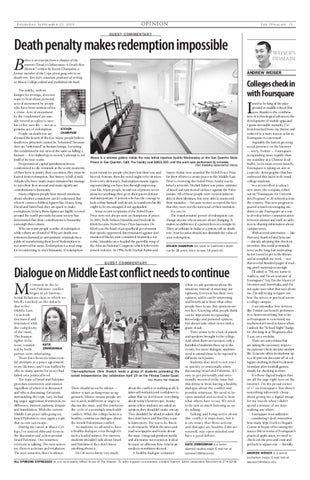
I Above is a witness gallery inside the new lethal injection facility Wednesday at the San Quentin State Prison in San Quentin, Calif. The facility cost $853,000, and the work was performed by inmates. Eric Risberg/Associated Press
is not meant for people who have lost their way and hit rock bottom, then the word ought to be stricken from every dictionary. Redemption means regaining something you have lost through improving your life. Many people, in and out of prison, never atone for anything; they go to their graves defiant and unrepentant. A person who has the courage to look within himself and decide to transform his life ought to be encouraged, if not applauded. Some recent recipients of the Nobel Peace Prize were not always seen as champions of peace. In 2001, both Nelson Mandela and Frederik de Klerk became Nobel Peace Prize laureates. De Klerk was the head of an apartheid government that openly oppressed, discriminated against and murdered blacks, and considered Mandela a terrorist. Mandela once headed the guerrilla wing of the African National Congress, which believed in armed violence. In 1994, both Yitzhak Rabin and
Yasser Arafat were awarded the Nobel Peace Prize for their efforts to create peace in the Middle East. Prior to receiving the Nobel Prize, Arafat was labeled a terrorist. Yitzhak Rabin was prime minister of Israel and sanctioned violence against the Palestinians. All of these people were viewed unfavorably in their lifetimes, but were able to transcend their mistakes — because society accepted the fact that they were not the sum total of their mistakes. No one is. The transformative power of redemption can change anyone who is sincere about changing. It makes no difference if a person lives in a temple in Tibet, an ashram in India or a prison cell on death row. Your location should not diminish the value of your redemption. Steven Champion has been on California’s death row for 28 years, since he was 18 years old.
Guest commentary
Dialogue on Middle East conflict needs to continue
M
y interest in the Israel/Palestine conflict began in an International Relations class in which we briefly touched on the debacle that is the Middle East. I was both fascinated and frustrated with the complexity of the issue. The human rights violaKatie tions commitZimmerman ted by both parties were infuriating. There have been six unsuccessful attempts at a peace agreement in my lifetime, and I was baffled by why so many quests for peace had failed on a political level. The topic of Israel and Palestine provokes controversy and tension regardless of where it is discussed and who is discussing. Emotions surrounding the topic vary, including anger, aggression, frustration, indifference, interest, sadness, despair and humiliation. With the current Middle East peace talks going on, Israel/Palestine is once again a topic that no one can escape. During my career at Ithaca College, I’ve noticed ebbs and flows in the discussion and action around Israel/Palestine. One semester, everyone is talking. The next semester, there is activism and retaliation. The next semester, there is silence.
Weiser’s Domain
Then-sophomore Chris Zivalich leads a group of students protesting the Israeli Independence Day celebration April 19 on the Fitness Center Quad.
There should never be silence — silence is just as dangerous as aggression. Silence means people are too scared, indifferent or angry to discuss the issue, and this reinforces the cycle of a seemingly unsolvable conflict. What the college lacks is a healthy, continuous dialogue about the Israeli/Palestinian conflict. As students, we all need to have a healthy dialogue, even though it’s such a loaded subject. For starters, students shouldn’t talk about Israel and Palestine if they don’t know anything about it. It’s OK not to know very much
file photo/the Ithacan
about the conflict or nothing at all. It takes self-restraint and confidence to admit that we don’t know everything about today’s hottest topic. In situations where students are asked an opinion, they shouldn’t make one up. They shouldn’t be afraid to admit that they don’t know and that they want to learn more. The way to fix this is to do research. Watch the news and read newspapers and books about the issue. Using independent media and alternative news sources is ideal because we all know how American media is sometimes skewed. A healthy dialogue continues
when we ask questions about the situation, instead of asserting our opinions. Everyone has their own opinion, and it can be interesting and beneficial to hear what other people have to say. But opinions are not fact. Knowing what people think can be important in expanding knowledge and personal opinion, but always take other views with a grain of salt. There seems to be a lack of panels and speakers brought to the college. And when there are lectures, only a handful of students show up to the events. For more dialogue, students need to attend these to be exposed to different viewpoints. Students also need to not react so quickly or irrationally when discussing Israel and Palestine. It’s easy to get personally and emotionally invested in the issue but this detracts from having a healthy dialogue about the conflict and possible solutions. We need to be open-minded and excited to hear what others have to say. We need to do just as much listening as we do talking. Talking and being active about this conflict is important, but it is necessary that these actions and dialogue are healthy. Educate yourself, stay open-minded and have a good debate. Katie Zimmerman is a senior planned studies major. E-mail her at kzimmer1@ithaca.edu
All opinions expressed do not necessarily reflect those of The Ithacan. To write a guest commentary, contact Opinion Editor Jacqueline Palochko at 274-3208.
used to be king of the playground in middle school. But now, thanks to the combination of technological advances, the development of mobile apps and I guess inevitable maturity, I’ve been knocked from my throne and reduced to a mere mayor, as far as Foursquare is concerned. Arguably the fastest growing social presence on the Internet — sorry, Twitter — Foursquare is expanding more rapidly than my waistline at a Chinese food buffet. In its most recent launch, Foursquare is taking an aim at a specific demographic that has embraced this latest tech trend: college students. In a recent effort to attract new users, the company rolled out its “Foursquare for Universities Program” to 20 schools across the country. This new program is geared toward encouraging students to use Foursquare as a way to develop better communication between alumni and staff, in addition to sharing information about campus news. With several universities — like Harvard, Stanford and Syracuse — already adopting this check-in incentive, this could potentially serve as the long-lost motivating factor I need to get to the library and accomplish my work — not that several hundred pages of reading aren’t motivation enough. I’ll admit it. “Hi, my name is Andrew, and I’m an avid user of Foursquare.” Yes, I’m the Mayor of Moonies and Ameritalia, and I’m not quite sure what that says about me. I’m still trying to figure out how the service is practical across a college campus. I can rationalize how services like Twitter can benefit professors in a classroom setting, but as far as Foursquare is concerned, my teachers don’t need to know when I unlock the “School Night” badge for checking in at Wegmans after 3 a.m. on a weekday. There are universities that are taking the necessary steps to incorporate check-ins into student life. Syracuse offers its students up to a 30 percent discount off of collegiate clothing in their bookstore Mondays after football games, simply for checking in there. It’s these digital badges that are all the rage right now on the Internet. I’m the proud owner of 17 on Foursquare. But there’s something inherently cheap about giving me a digital image for my travels when I didn’t spend a minute of my time walking anywhere. Foursquare is an addiction — considering I don’t remember how many trips I took to Rogan’s Corner in hopes of becoming the mayor. But in terms of Foursquare’s practical application, we need to check out the pros and cons and get back to square one — literally.
andrew weiser is a senior journalism major. E-mail him at aweiser1@ithaca.edu