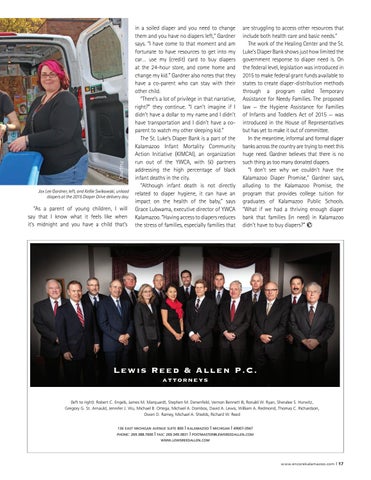
Courtesy Jax Lee Gardner, left, and Kellie Swikowski, unload diapers at the 2015 Diaper Drive delivery day.
“As a parent of young children, I will say that I know what it feels like when it’s midnight and you have a child that’s
in a soiled diaper and you need to change them and you have no diapers left,” Gardner says. “I have come to that moment and am fortunate to have resources to get into my car… use my (credit) card to buy diapers at the 24-hour store, and come home and change my kid.” Gardner also notes that they have a co-parent who can stay with their other child. “There’s a lot of privilege in that narrative, right?” they continue. “I can’t imagine if I didn’t have a dollar to my name and I didn’t have transportation and I didn’t have a coparent to watch my other sleeping kid.” The St. Luke’s Diaper Bank is a part of the Kalamazoo Infant Mortality Community Action Initiative (KIMCAI), an organization run out of the YWCA, with 50 partners addressing the high percentage of black infant deaths in the city. “Although infant death is not directly related to diaper hygiene, it can have an impact on the health of the baby,” says Grace Lubwama, executive director of YWCA Kalamazoo. “Having access to diapers reduces the stress of families, especially families that
are struggling to access other resources that include both health care and basic needs.” The work of the Healing Center and the St. Luke’s Diaper Bank shows just how limited the government response to diaper need is. On the federal level, legislation was introduced in 2015 to make federal grant funds available to states to create diaper-distribution methods through a program called Temporary Assistance for Needy Families. The proposed law — the Hygiene Assistance for Families of Infants and Toddlers Act of 2015 — was introduced in the House of Representatives but has yet to make it out of committee. In the meantime, informal and formal diaper banks across the country are trying to meet this huge need. Gardner believes that there is no such thing as too many donated diapers. “I don’t see why we couldn’t have the Kalamazoo Diaper Promise,” Gardner says, alluding to the Kalamazoo Promise, the program that provides college tuition for graduates of Kalamazoo Public Schools. “What if we had a thriving enough diaper bank that families (in need) in Kalamazoo didn’t have to buy diapers?”
Lewis Reed & Allen P. C. attorneys
(left to right): Robert C. Engels, James M. Marquardt, Stephen M. Denenfeld, Vernon Bennett III, Ronald W. Ryan, Sheralee S. Hurwitz, Gregory G. St. Arnauld, Jennifer J. Wu, Michael B. Ortega, Michael A. Dombos, David A. Lewis, William A. Redmond, Thomas C. Richardson, Owen D. Ramey, Michael A. Shields, Richard W. Reed
| kalamazoo | michigan | 49007-3947 | fax: 269.349.3831 | postmaster@lewisreedallen.com www.lewisreedallen.com
136 east michigan avenue suite 800 phone: 269.388.7600
w w w.encorekalamazoo.com | 17