the right to rub the shoulders of the person who had been rubbing theirs. “Tenderize!” he commands. “The tactile thing for the kids is important,” Sang says. “They don’t go to school together. They don’t hang out together a lot, but they become very good friends because they share such a deep joy in making music.” And despite the temptation to compare them to a team preparing to take the field, Sang cautions against making athletic comparisons. “We’re not a team,” he says. “We’re better than a team. On a team, if someone is not having a good day, they get replaced. But in an ensemble, we play together all the time. If someone is having a bad day, we have to be able to work together anyway. You have to have stamina. From downbeat to cutoff, you are on all the time. To perform like that, you can’t be a team player. You have to be an ensemble player.” Singing is a multi-disciplinary practice. It involves not only music, but history, literature and foreign languages. As the choir practices There Will Be Rest, a poem by 18th-century poet Sara Teasdale set to music by Victor Johnson, Sang encourages the choir to “go
to the edge,” that meeting place between the emotions and the intellect. “Singing something historical is very different than reading about it in a textbook,” he says. “You can feel it.” The Touring Choir is KCC’s top-level choir. With biannual international tours, the singers are taught to be ambassadors. “When we go somewhere in our uniforms, we represent our community, our organization, our state and our country,” Sang says. “How we behave is critical to our reception, almost more so than our singing. “What happens on tour is just remarkable. They get on the bus to leave, waving a little at their parents, a little sad. When they come back, they are different children. They learn to be self-reliant.” On its tour to Italy this past summer, the choir experienced many memorable moments. After a long day on their feet, the choir members arrived in Luca, the birthplace of Puccini. “The place was packed,” Sang recalls. “We talked about what we needed to do and how they needed to be more animated. And it was electric. The audience response was incredible. The kids fed off that. They will never forget that experience. (continued on page 43)
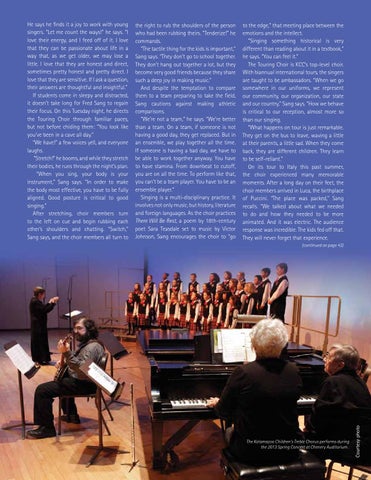
The Kalamazoo Children’s Treble Chorus performs during the 2013 Spring Concert at Chenery Auditorium . w w w.encorekalamazoo.com | 33
Courtesy photo
He says he finds it a joy to work with young singers. “Let me count the ways!” he says. “I love their energy, and I feed off of it. I love that they can be passionate about life in a way that, as we get older, we may lose a little. I love that they are honest and direct, sometimes pretty honest and pretty direct. I love that they are sensitive. If I ask a question, their answers are thoughtful and insightful.” If students come in sleepy and distracted, it doesn’t take long for Fred Sang to regain their focus. On this Tuesday night, he directs the Touring Choir through familiar paces, but not before chiding them: “You look like you’ve been in a cave all day.” “We have!” a few voices yell, and everyone laughs. “Stretch!” he booms, and while they stretch their bodies, he runs through the night’s plan. “When you sing, your body is your instrument,” Sang says. “In order to make the body most effective, you have to be fully aligned. Good posture is critical to good singing.” After stretching, choir members turn to the left on cue and begin rubbing each other’s shoulders and chatting. “Switch,” Sang says, and the choir members all turn to