215474_01-64.qxd:IH
6/11/10
12:31 PM
Page 1
JULY/AUGUST 2010/1431 | $4.00 | WWW.ISNA.NET
THAILAND: UNSETTLED • AL-ANDALUS: LOCKED IN TIME
WHAT MAKES CHICAGO CLICK FOR MUSLIMS?
215474_01-64.qxd:IH
6/11/10
12:31 PM
Page 2
215474_01-64.qxd:IH
6/11/10
12:31 PM
Page 3
215474_01-64.qxd:IH
6/11/10
12:31 PM
Page 4
Introducing the Amana Developing World Fund. Emerging markets with a long-term focus. Your world of investment choices just got bigger. Explore the potential of emerging economies in your portfolio. To learn more about the Amana Developing World Fund visit www.amanafunds.com/amdwx
Visit us at ISNA booth #717
Sharia Compliant Investment Solutions
Amana Mutual Funds Trust 888/73-AMANA
www.amanafunds.com
The Amana Developing World Fund limits the securities it purchase to those consistent with Islamic principles. This limits opportunities and may increase risk. Investing in foreign securities involves risks not typically associated with investing in U.S. securities, including fluctuations in currency exchange rates; less public information; less governmental market supervision; and lack of uniform financial, accounting, social, and political standards. Please request a prospectus which contains information about the investment objectives, risks, charges, and expenses of the Amana Developing World Fund which you should read and consider carefully. The Amana Funds are distributed by Saturna Brokerage Services, member FINRA/SIPC and a wholly-owned subsidiary of Saturna Capital Corporation, investment adviser to the Amana Funds.
215474_01-64.qxd:IH
6/11/10
12:31 PM
Page 5
visit isna online
www.isna.net
CONTENTS 32 38
VOL.39 NO.4 JULY/AUGUST 2010
50
54
COVER STORY:
What Makes Chicago Click for Muslims? . . . . . . . . . . . . . . . . . . . . . . . . 32 Harnessing the Energy . . . . . . . . . . . . . . . . . . . . . . . . 36 A City of Big Hearts . . . . . . . . . . . . . . . . . . . . . . . . . . . 40 CIOGC Rich History Promising Future . . . . . . . . . . . . . . 44 Ever Vibrant: Imam WD Mohammed . . . . . . . . . . . . . . 46
ISLAM IN AMERICA You Cannot Cheat Sleep . . . . . . . . . . . . . . . . . . . . . . . . . . . 23 China - A Multi-Faith Look Into China . . . . . . . . . . . . . . . . . 24 With Iman and Collective Vision . . . . . . . . . . . . . . . . . . . . . 28 Halal and American . . . . . . . . . . . . . . . . . . . . . . . . . . . . . . 31
ISLAMIC ARCHITECTURE Al-Andalus: Locked in Time . . . . . . . . . . . . . . . . . . . . . . . . 50
SPIRIT FOOD FOR THE
PAGE 56
DEPARTMENTS Editorial . . . . . . . . . . . . . . . . . . . . 6 ISNA Matters . . . . . . . . . . . . . . . . 8 Letters to the Editor . . . . . . . . . . . 14 National News . . . . . . . . . . . . . . . 16 Food for the Spirit . . . . . . . . . . . . 58 Matrimonials . . . . . . . . . . . . . . . . 60 Reviews . . . . . . . . . . . . . . . . . . . . 62
THE MUSLIM WORLD Kashmir: Kashmiris Own their Future . . . . . . . . . . . . . . . . . 53 Thailand: Unsettled . . . . . . . . . . . . . . . . . . . . . . . . . . . . . . 54
TRIBUTES Dawud Tauhidi . . . . . . . . . . . . . . . . . . . . . . . . . . . . . . . . . . 49 Mujahid Muhammadi . . . . . . . . . . . . . . . . . . . . . . . . . . . . . 49 COVER: Chicago skyline aerial photograph by Trey Ratcliff, cc-by-sa-2.0.
47th ISNA Convention Illustration by Peter Gould, creativecubed. (TOP MIDDLE) PHOTOGRAPH BY FADHIRUL FITRI JAMSARI; CC-BY-SA-2.0; (TOP RIGHT) PHOTOGRAPH COURTESY OF AARON GOODMAN
DESIGN & LAYOUT BY: Omar El-Haddad, DesignWorks Copyeditor: Jay Willoughby The views expressed in Islamic Horizons are not necessarily the views of its editors nor of the Islamic Society of North America. Islamic Horizons does not accept unsolicitated articles or submissions. All references to the Qur'an made are from The Holy Qur'an: Text, Translation and Commentary, Abdullah Yusuf Ali, Amana, Brentwood, MD.
215474_01-64.qxd:IH
6/11/10
12:31 PM
Page 6
EDITORIAL PUBLISHER
The Islamic Society of North America (ISNA)
Building on Numbers
PRESIDENT
Dr. Ingrid Mattson SECRETARY GENERAL
Safaa Zarzour
______________________
EDITOR
Omer Bin Abdullah ______________________
EDITORIAL ADVISORY BOARD
Susan Douglass (Chair); Dr. Jimmy Jones; Dr. Sulayman Nyang; Dr. Ingrid Mattson. ______________________
ISLAMIC HORIZONS
is a bimonthly publication of the Islamic Society of North America (ISNA) P.O. Box 38 • Plainfield IN 46168-0038 Copyright ©2010 All rights reserved Reproduction, in whole or in part, of this material in mechanical or electronic form without written permission is strictly prohibited. Islamic Horizons magazine is available electronically on ProQuest’s Ethnic NewsWatch and LexisNexis, and is indexed by Readers’ Guide to Periodical Literature. Please see your librarian for access. The name “Islamic Horizons” is protected through trademark registration ISSN 8756-2367 ______________________
POSTMASTER
Send address changes to Islamic Horizons, P.O. Box 38 Plainfield, IN 46168-0038 ______________________
SUBSCRIPTIONS
Annual, domestic - $24 Canada - US$30 Overseas airmail - US$60 TO SUBSCRIBE
Contact Islamic Horizons at (317) 839-8157 / (317) 839-1811 Fax (317) 839-1840 e-mail: membership@isna.net ______________________ ADVERTISING
For rates contact Islamic Horizons at (703) 742-8108, horizons@isna.net, www.isna.net ______________________
Canada Post International Publications Mail Product (Canadian Distribution) Sales Agreement No. 0666300 ______________________
CORRESPONDENCE
Send all correspondence and/or Letters to the Editor at: Islamic Horizons P.O. Box 38 • Plainfield, IN 46168-0038 E-main: horizons@isna.net
6
ISLAMIC HORIZONS JULY/AUGUST 2010
W
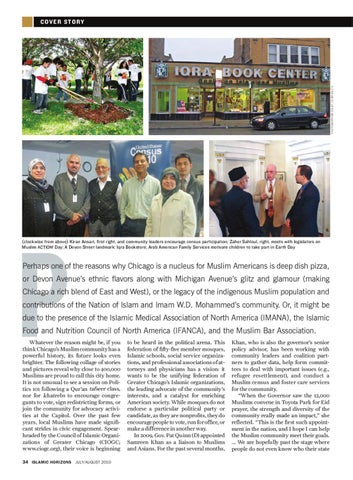
Welcome to the 47th annual ISNA Convention, where an estimated 30,000 Muslims will gather to discuss “Nurturing Compassionate Communities.” We love coming to Chicago to see what our fellow Muslims are up to. They always inspire us with their beyond-the-mosque activities. For example, in Apr. 2010, more than 1,000 of them rallied in the state capital, Springfield, for fresh food for inner cities, prevention of foreclosures, and teaching English to immigrants at mosques. Muslim ACTION! Day, coordinated by the Council of Islamic Organizations of Greater Chicago (www.ciogc.org), drew nearly 1,000 (mostly young) participants. Their readiness to dedicate themselves to advocating for mainstream issues created a synergy that led to doubling the number of last year’s participants. And considering the pattern, these numbers should only continue to increase. Would that this were the case with all of our communities!
But there is even more. Chicago’s Muslims are showing North American Muslims that there is life beyond creating infrastructures. Civic activism and welfare activities have not adversely affected the improvements of mosques and schools; indeed, new projects continue to prosper. The Inner-City Muslim Action Network (IMAN), IQRA, Sound Vision and Interfaith Youth Core (IFYC) call Chicago home, as does America’s first green mosque and the first liaison to the Governor for Muslim Affairs. IMAN has partnered with ISNA to create a home for formerly incarcerated
Muslims. There, they will find both shelter and training that can help them reenter the mainstream. Chicago’s estimated 400,000 Muslims are making their presence recognized as a positive force. Samreen Khan, the governor’s liaison to the Muslim and Asian community, remarks: “When the governor saw the 12,000 Muslims convene in Toyota Park for Eid prayer, the strength and diversity of the community really made an impact.” This simple statement points out just how important it is for Muslims to stop their internal bickering and overcome their own apathy so that they can unite and get things done for the benefit of everyone. A most fortunate trend is that many Muslim organizations are moving beyond the idea that their civic engagement consists of voting once a year. In March, for example, several busloads of Chicagoan Muslims marched in Washington, DC, to support immigration reform. Kiran Ansari notes in her article in this issue of “Islamic Horizons”: “Whether it is circulating petitions for a fair district map in the state or to end racial profiling or to support a petition, there is a lot of political buzz in the community as compared to the last decade. At the rate at which it is going, in the next 10 years, Muslims will be more prominent in the political landscape in Illinois and beyond.” Today, Muslim intra-community organizations are thriving all over America. This is a welcome development, for our communities have for far too long been isolating themselves in their own cultural, linguistic, and sectarian ghettoes. And where has such a policy gotten us? Nowhere! We have been divided against ourselves for so long that we are now far behind other religious communities. It is vital that these organizations share their experiences with others so that this trend can spread even further afield. How else can we make our presence felt?
215474_01-64.qxd:IH
6/11/10
12:31 PM
Page 7
215474_01-64.qxd:IH
6/11/10
12:31 PM
Page 8
ISNAMATTERS Community Engagement
T
he best way for filmmakers to represent Prophet Muhammad (salla Allahu ‘alayhi wa sallam) is, according to Dr. Ingrid Mattson’s (president, ISNA; director of Macdonald Center for the Study of Islam and Christian-Muslim Relations at Hartford Seminary) to look at the life of his followers. She made this statement while addressing the decennial conference of the Religion Communication Congress (RCC) 2010 in Chicago (7-10 April). Speaking on how 9/11 continues to affect Muslim Americans, she asked rhetorically: “How do you respond to injustice when you are persecuted because someone hijacked your religion? We had to divert money, human resources, creativity, thoughts, and strategy to keep the Muslim community safe. God has a purpose, and we are only responsible for our own response.” These difficulties, she added, have led so many Muslims to participate in interfaith activities that they have become a part of the community’s life. Another post-9/11 response was a push to define more globally “who is a Muslim.” Since religious authority is decentralized in Islam, in 2005 King Abdullah of Jordan called together a group of scholars, who subsequently is-
Dr. Ingrid Mattson, president, ISNA
sued the Amman Declaration (http://amarcwiki.amarc.org/?The_Amma n_Declaration) to stop intra-Muslim sectarianism. Such developments have helped Muslim Americans find new partners, become more open to change, and learn to use it as the basis for new opportunities, Dr. Mattson opined. The congress is a once-a-decade gathering of communications professionals from all over the world. The 500-plus participants explored “Embracing Change: Communicating Faith in Today’s World.” Diana Eck (developer and director, The Pluralism Project, Harvard University;
professor of comparative religion and Indian studies, Wertham Professor of Law and Psychiatry in Society, Harvard) noted that “pluralism begins with difference. Real religious pluralism means our engagement with one another requires building sturdy relationships” and that “religious faith is a powerful force in people’s lives and choices. We must find new ways to spread the message of hope through new communication venues in our world. … Pluralism is more than differences, more than tolerance. It requires that we know something of others. It is based on relationships.” The congress was also addressed by Nabil Echchaibi (assistant professor, School of Journalism and Mass Communication, University of Colorado at Boulder) and Abdul Malik Mujahid (founding chairman, Sound Vision Foundation; chairperson, Council for a Parliament of World’s Religions; executive producer, Radio Islam WCEV 1450 AM, Chicago). “Islamic Horizons” was among the winners of the 2010 DeRose-Hinkhouse Awards. These tributes, presented by the RCC, recognized the magazine in its “Best of Class” category (Mar./Apr. 2009 issue) and with an “Award of Excellence” (Mar./Apr. 2009 issue) and a “Certificate of Merit” (Nov./Dec. 2009 issue).
Religious Freedom in the Military
O
n 18 May, Dr. Mohamed Elsanousi addressed the forum on Religious Freedom in the Military hosted by the Interfaith Alliance in Washington, DC. This new initiative is envisaged as a first step in to identifying problems, working constructively with military leaders and members of Congress, and proposing solutions that respect religious freedom in the armed forces. “Rapidly increasing diversity among loyal Americans serving courageously in our nation’s military forces is accompanied by a growing number of problems related to assuring religious freedom 8
among those charged with protecting our freedom,” said Rev. Dr. C. Welton Gaddy (president, Interfaith Alliance). Dr. Elsanousi said Muslim servicepeople should follow the chain of command vis-à-vis policies related to religious practices and respect the offered accommodations. He al-
ISLAMIC HORIZONS JULY/AUGUST 2010
(from left) Dr. Kristen Leslie, Rabbi Dr. Israel Drazin, Dr. Mohamed Elsanousi, Maj. David E. Fitzkee, Dr. Martin L. Cook, and Rev. Dr. C. Welton Gaddy _____________________________________
so mentioned that recruiters should not overpromise concerning religious observance, that interfaith training for military chaplains is necessary,
that hate speech about Islam and Muslims under the guise of education should not be allowed, and that normative Islamic practices and extremism should be differentiated. In conclusion, he mentioned that Muslim servicepeople are concerned with their prayers, fasting, halal food, and fulfilling other religious obligations. Other speakers included Dr. Kristen Leslie (associate professor of pastoral care and counseling, Yale Divinity School; consultant, US Air Force Academy), Dr. Martin L. Cook, Adm. James Bond Stockdale (professor of professional military ethics, US Naval War College), Brig. Gen. (US Army, ret.) Rabbi Dr. Israel Drazin (former assistant chief of chaplains, US Army), and Maj. David E. Fitzkee (US Army, ret.; associate professor of law, US Air Force Academy). (BOTTOM) PHOTOGRAPH BY RON SACHS
215474_01-64.qxd:IH
6/11/10
12:32 PM
Page 9
+HO S %XL O G D 0DVM L G
Future Leaders Safaa Zarzour (secretary general, ISNA), who keynoted the annual fundraising dinner of Lexington’s Universal Academy on 11 Apr., shared his personal and professional experience on how the country’s Islamic schools are forming future Muslim leaders: “In Chicago alone, only 0.5% of Muslim high school graduates come from Islamic schools, yet 60% of the Muslim student leadership at Chicago universities are graduates of Islamic schools.� At a fundraiser for the Minaret Academy in Anaheim on 7 Mar., he emphasized the importance of Islamic education. Pointing out that America’s Jews and Catholics were able to establish successful educational institutions despite religious discrimination, he suggested that Muslims could learn from them. He also met with the region’s community leaders and discussed ISNA’s role and support for Islamic schools, youth programs, leadership training, and community cooperation. On 22 Apr., this self-identified Chicagoan joined more than 1,000 Muslims from across Illinois in Springfield, the state capital, for the second annual Muslim ACTION! Day. In addition, he was part of a delegation that met with legislators to discuss better opportunities for public school students, healthy food choices for inner city residents, preventing foreclosures for struggling families, empowering immigrants, and thwarting deportations by the local police. This event was coordinated by the Council of Islamic Organizations of Greater Chicago.
(from left) Rev. Donald Heckmen (director for external relations, Religions for Peace), Dr. Al-Khater, Dr. Al-Marwani, Cardinal McCarrick, Imam Magid, and Dr. Syeed
) L U V W 0D V M L G L Q W K H 6W D W H R I 0R Q W D Q D
ÔąŐ€Ô˝ ÔŚ Ő‹ Ő„ ÔšŐ…Ő Ôť Ô Ô˝Ő†ŐŒ Ô˝ŐŠ Ő‡Ôž Ô&#x;Ő‡Ő’ Ô˝Ő…ÔšŐ†
ÔŚ Ô Ô&#x;
Ôť ÔšŐ„ Ő„ Ő‹ Ő?ŐˆŐ‡Ő† Ő‡Ő?ŐŠ ÔŞŐ?Ő‹ Ő„ Ő Ő… ÔşŐŠ Ő‡ŐŒ Ő€Ô˝ŐŠ Ő‹ ÔšŐ†Ôź Ő‹ Ő Ő‹ ŐŒ Ô˝ŐŠ Ő‹ ŐŒ Ő‡ Ő‹ Ő?ŐˆŐˆŐ‡ŐŠ ŐŒ Ő‡Ő?ŐŠ Ő‡Ő†ÔżŐ‡Ő Ő†Ôż ÔŞÔšŐ‹ Ő‚ Ő Ôź ŐˆŐŠ Ő‡Ő‚ Ô˝Ôť ŐŒ Ő?Ő€Ő Ôť Ő€ Ő?Ő Ő„ Ő„ ÔşÔ˝ ŐŒ Ő€Ô˝ Ôž Ő ŐŠ Ő‹ ŐŒ Ő Ő†Ő‹ Ő€Ôš0 ÔžŐ„ Ő„ ÔšŐ€ Ő Ő† ŐŒ Ő€Ô˝ Ô°ŐŒ ÔšŐŒ Ô˝ Ő‡Ôž ÔŞŐ‡Ő†ŐŒ ÔšŐ†Ôš ÔśŐ‡Ő?ŐŠ Ő‹ Ő?ŐˆŐˆŐ‡ŐŠ ŐŒ Ő Ő‹ ŐˆÔ˝ŐŠ ŐˆÔ˝ŐŒ Ő?ÔšŐ„ Ôť Ő€ÔšŐŠ Ő ŐŒ Ő‘
Ô°ÔšÔźÔšŐ‰Ôš Ô§ ÔšŐŠ Ő Ő‘ Ôš ŐŒ Ő€ÔšŐŒ Ő?Ő Ő„ Ő„ ÔşÔ˝ ŐŠ Ô˝Ő?ÔšŐŠ ÔźÔ˝Ôź ŐŒ ŐŠ Ô˝Ő…Ô˝Ő†ÔźŐ‡Ő?Ő‹ Ő„ Ő‘ ÔşŐ‘ ÔžŐ„ Ő„ ÔšŐ€
Ő‹ Ő?ŐŒ
, VODPL F &HQWHU RI %R]HPDQ : HVW 0DL Q 6WUHHW %R]HPDQ 07
IMAM NEEDED The Islamic Association of Mid-Cities located in Colleyville, Texas is seeking a qualified Imam to lead this community.
ISNA Sponsors US-Gulf Interfaith
I
SNA organized a high-level interfaith roundtable discussion and luncheon in Washington, DC, on 26 Apr. The event, “To Each a Key: Unlocking the Door to Interfaith Harmony,� which welcomed the Doha International Center for Interfaith Dialogue (DICID), was attended by religious figures from across the nation. Imam Mohamed Magid (vice president, ISNA-US) addressed the opening session. A roundtable discussion of thirty national interfaith leaders was moderated by Dr. Sayyid M. Syeed (national director, ISNA Office of Interfaith Alliances and Community Initiatives). During it, Dr. Khalid Bin Nasser Al-Khater and Dr. Hamed Abdulaziz AlMarwani, both DICID board members, familiarized the audience with the DICID, the Gulf
region’s largest and most respected interfaith entity. Reports about its projects and activities in America were also given. Safaa Zarzour (secretary general, ISNA) and Cardinal Theodore McCarrick (Archdiocese of Washington) discussed ongoing efforts to promote such dialogue. Dr. Al-Marwani expounded upon the center’s mission and achievements. Mara Vanderslice (deputy director, White House Office of Faith Based and Neighborhood Partnerships) expressed the Obama administration’s positive outlook and goals regarding interfaith work. Rashad Hussain (U.S. Special Envoy to the OIC) reaffirmed the administration’s commitment to the primacy of dialogue and trust building between America and Muslim communities around the world.
JULY/AUGUST 2010 ISLAMIC HORIZONS
9
DUTIES: > >
> >
>
Lead prayers at the Masjid Lead Halaqa for adults and organize youth activities Effectively communicate with all age groups Provide consultation on Islamic and social matters in the light of Qur’an, Hadith, and Fiqh Lead Da‘wah and interfaith activities
Q U A L I F I C AT I O N S : > > >
>
CandidaMust be fluent in English and Arabic Proficiency in moderate level of computer skills Formal degree in Islamic studies from a recognized institution Hafiz e Qur’an preferred
C O M P E N S AT I O N : IAMC offers
competitive compensation and benefits package based on the qualification and experience. T O A P P LY: Interested individuals
should submit their resume with salary history and references to rsnauert@gmail.com
215474_01-64.qxd:IH
6/11/10
12:32 PM
Page 10
ISNAMATTERS A Community of Trust
A
New ISNA Fellows
I
SNA has announced the 2010-11 Fellows, whose studies in nonprofit management are supported by the Prince Alwaleed Bin Talal/ISNA Fellowship Program. The winners are Anbar Mahar, Celene Ayat Lizzio, Sofia Latif, Mohammad Bilal Kaleem, Naaima Khan, and Shahla Khan. They will receive education and training in nonprofit management and philanthropy at the Center on Philanthropy at Indiana University or other accredited institutions of higher education and centers of philanthropic studies. Hasan Abdullah remarked: “I am very passionate about social justice, especially when working with Muslim American issues. Growing up in the United States, I have witnessed firsthand the progress of the Muslim American community. There is still a lot of work that needs to be done in terms of civil rights, representation, and identity. For a religious group with some of the highest levels of education, experience, success and diversity in the U.S., there is much potential for greater and accurate representation in all fields of society.” Naaima Khan, who believes that Muslim Americans have a great stake in continuing to expand social and advocacy organizations, would “like to take part in contributing to the growth
Doug Sauer (executive director, New York Council of Nonprofits), first left, spoke to ISNA fellows (Left to Right) Nida Saleem (ISNA Student Programs and Planned Giving Coordinator), fellows Shahla Khan, Celene Lizzio, Naaima Khan, Sofia Latif, Anbar Mahar, and Hasan Abdullah, with Ahmed ElHattab (executive director, ISNA Development Foundation) _________________________________________________
and development of Muslim nonprofits.” The fellowship, says Shahla Khan, will enable her to further “the advancement of those that are flourishing in my community, meeting and gaining experiences from other Muslims and nonMuslims who share the same passions I do, learning to work, share ideas, and communicate effectively with others in my community.” Sofia Latif hopes to utilize her internship to further explore her interest in applying data analysis-oriented fields so that nonprofits can focus their resources strategically to better serve their various stakeholders. Celene Ayat Lizzio seeks to develop a theoretical framework for leadership while honing skillsets and capacity to be that essential “behind-the-scenes” figure: the effective organizer, humble administrator, minister, and leader who does not chase after public recognition and praise. Anbar Mahar sees the fellowship as a “learning experience that goes beyond the classroom as key components of the program provide me the opportunity to learn from others.”
Leaders Meet at Entrepreneurship Summit ISNA was part of President Obama’s 14-30 Apr. “Summit on Entrepreneurship,”
which brought about 250 Muslim entrepreneurs from all over the world. On 29 Apr., ISNA joined Interfaith Youth Core, One World 2011, and the All Dulles Area Muslim Society (ADAMS) in feting Muslim delegates who had attended the summit proceedings earlier that day. The reception was addressed by Farah Pandith (U.S. State Department Representative to Muslim Communities),Virginia Sate Delegate Tom Rust (R), Dob Walsh (president, One World 2011), and Imam Mohamed Magid (vice president US-ISNA; imam and director, ADAMS), and Dr. Sayyid M. Syeed. Attendees included heads of national Muslim organizations and Muslim business executives. Robert Marro (board member, ADAMS) served as master of ceremonies. 10 ISLAMIC HORIZONS JULY/AUGUST 2010
t a conference on “Managing Fear through Faith,” held in suburban Washington (DC) on 23 Mar. Dr. Sayyid M. Syeed (national director, ISNA Office of Interfaith Alliances and Community Initiatives) emphasized that everyone must strive to build a community of trust by promoting mutual understanding and confidence. Drawing an analogy from the earthquakes in Haiti and Chile, he noted that Chile had a far lower loss of human lives and infrastructure because it has a strong infrastructure and is relatively prepared for these disasters. This, he added, is just as “true for us as a multifaith society. We need to have strong intrafaith and interfaith institutions. Just like the impact of natural disasters can be less damagDr. Sayyid M. Syeed ing if there are institutions, similarly, extremism and bigotry can have less impact in societies where there are effective programs and activities that promote understanding.” This provided a very positive background for introducing ISNA’s interfaith activities and alliance building. Sponsored by Bradley Hills Presbyterian Church, the U.S. in the World Initiative, and the Rockefeller Brothers Fund, this conference was co-hosted by the Bethesda Jewish Congregation, Idara e Jaferia Mosque, the “Journal of Inter-Religious Dialogue,” the InterFaith Conference of Metropolitan Washington, and the New America Foundation. David Gray (pastor, Bradley Hills Presbyterian Church) stressed the need to overcome stereotypes, division, and overreaction against groups in the event of another fearinducing event in America. Other speakers included Priscilla Lewis and Sue Veres Royal (co-directors, the U.S. in the World Initiative), David Myers (director, Department of Homeland Security Faith Based Office), Prof. Peter Stearns (provost, George Mason University), Stephen Heintz (president, Rockefeller Brothers Fund), Daisy Khan (executive director, American Society for Muslim Advancement), Clark Lobenstine (InterFaith Conference of Metropolitan Washington), Chloe Breyer (Interfaith Center of New York), Arthur Waskow (The Shalom Center), Joshua Stanton (founder, “Journal of InterReligious Dialogue”), and Tyler Zoanni (Harvard University).
215474_01-64.qxd:IH
6/11/10
12:32 PM
Page 11
215474_01-64.qxd:IH
6/11/10
12:32 PM
Page 12
ISNAMATTERS Dr. Elsanousi (second from right, second row), Joshua DuBois (first right, first row), and Mara Vanderslice (second right, first row) __________________________________________________
Religions for Peace
I
SNA was represented by Dr. Mohamed Elsanousi (director of community outreach, ISNA Office of Interfaith and Community Alliances) in the executive council meeting of the Religions for Peace USA held under the theme Advancing Partnerships between US Religious Communities and the US Government” on 7 April. The meeting discussed the report "A New Era of Partnerships - Report of Rec-
12 ISLAMIC HORIZONS JULY/AUGUST 2010
ommendations to the President" and focused on the section dealing with interreligious cooperation. Rev. Joshua DuBois (Assistant to the President; executive director, White House Office of Faith Based and Neighborhood Partnerships) reiterated the government’s commitment to interreligious cooperation and partnership and reported on the enthusiasm and cooperation across all federal agencies as regard to this new beginning. He reaffirmed the President’s commitment to the implementation of the recommenda-
tions of the President’s Taskforce on Interfaith Dialogue and Partnerships. ISNA president Dr. Ingrid Mattson was member of this taskforce. Rev. DuBois lauded ISNA’s leadership and participation in the United we Serve project last summer. Dr. Elsanousi appreciated the Administration’s involvement in the project at the highest level and noted the positive messages it sends to interreligious communities at the grassroots level such as the Muslim community’s response to the President’s call for service. Muslim Americans organized more that 3000 service projects last summer—a report on these projects was presented to the White House. He said implementation of these recommendations already started in various ways. Action at the highest level, he added, has sent a positive message globally and manifested in ways such as the visit by the Doha International Center for Interfaith Dialogue to Washington to learn about various interfaith projects and activities.
215474_01-64.qxd:IH
6/11/10
12:32 PM
Page 13
215474_01-64.qxd:IH
6/11/10
12:32 PM
Page 14
LETTERS TO THE EDITOR Dangerous Levels Your coverage on the prevalence of alcohol use among Muslims is most timely (“IH,” May-June 2010). I referred to this article in a recent khutbah. The Institute for Social Policy and Understanding (ISPU; www.ispu.org), Policy Brief #37 (2009), shows that a whopping 47% of Muslim collegians consume alcohol. ISPU scholars used the survey database of “Harvard School of Public Health College Alcohol Study 2001.” A Gallup study reported that 16% of Muslims aged 18 to 29 reported binge drinking during the week of the survey (“Muslim Americans: A National Portrait,” Mar. 2009). Binge drinking means consuming five or more drinks in one sitting. Samana Siddiqui’s research (Sound Vision; www.soundvision.com) revealed that alcohol consumption is one of the major factors for rising divorce rates among Muslim Americans. The Muslim community needs to not only be aware of, but also to educate others about this problem. Imams should focus on the dangers of alcohol and develop educational campaigns to combat this evil. —ABDUL MALIK MUJAHID, PRESIDENT, SOUND VISION
Excellent Content “Islamic Horizons” is always full of information and exciting news, but I wish to congratulate specifically Nabeelah Naeem for going to all aspects of janazah so thoroughly. A job well done indeed. This should wake up each one of us to prepare for the essential journey from this world. I have been involved in janazah services in my community for a long time and have so many stories, but Nabeelah has left no corner undiscovered. Next, about alcohol and its relationship with young Muslim Americans, both Sabrina Enayatulla and Shabana Mir have done a good job and need to be congratulated. Sabrina’s coverage is thorough (I am a neurologist and know what I am saying) and deserves special mention. Shabana’s is an academically solid write-up. May God bless these writers and you all to make such selections. —WAHAJ-UD-DIN AHMAD, MD, RALEIGH, NC
How to Submit a Letter to the Editor Islamic Horizons welcomes letters about any article that has appeared recently in the magazine. A letter must include the writer’s mailing address, telephone number, and e-mail. We may edit letters for clarity, civility and accuracy, and they may be shortened for space requirements. We regret that we are unable to acknowledge letters. Letters for publication should be e-mailed to horizons@isna.net. Tips on Writing a Letter to the Editor: • Write concisely and clearly. • Keep it to 150 words at most.
14 ISLAMIC HORIZONS JULY/AUGUST 2010
• Letters are not rejected for publication because of their political coloration. On the contrary, Letters to the Editor is a forum for a variety of voices. Some criticize, some seek to set the record straight, some want to add a different perspective or expertise to an issue. We welcome them all: the agreers, the dissenters, the critics, the curmudgeons and even those who are happy with us. • Islamic Horizons and its parent, the Islamic Society of North America (ISNA), reserve the right to include a response to any letter they deem. • We do not accept open letters, and we do not publish letters sent in a coordinated letter-writing campaign.
215474_01-64.qxd:IH
6/11/10
12:32 PM
Page 15
215474_01-64.qxd:IH
6/11/10
12:32 PM
Page 17
Board of Appeals Chairman Attorney Aziz Ahsan has been appointed chairman of the Zoning Board of Appeals for the Town of East Fishkill, NY. Prior to this, he served a twoyear term on its planning board. In this new capacity, he will lead the team responsible for interpreting the zoning code, reviewing and granting of special permits and variances, and dealing with appeals to the decisions of the town building department. Ahsan, who encourages Muslim Americans to take full advantage of what America has to offer, has represented ISNA at various regional and national events. He strongly feels that his leadership skills were developed as the president of MSA-University of Minnesota chapter.
From Fighter to Insider
N
awar Shora, 33, legal director for the American-Arab Anti-Discrimination Committee (ADC), has joined the Transportation Security Administration as a senior adviser for its office of civil rights and liberties. A native of Syria who was raised in Huntington, WV, he started with the ADC as an intern in 1999 after graduating from Marshall University and the West Virginia University College of Law. Shortly after 9/11, he became a founding member of an Arab, Muslim, and Sikh advisory council that aired concerns about hate crimes,
Nawar Shora receives the Director’s Community Leadership Award from FBI Director Robert Mueller ________________________________________
the USA Patriot Act, FBI investigations, and other sensitive topics. In March, this author of “The Arab American Handbook” (Cune: 2008) was honored by FBI Director Robert S. Mueller III with the director’s “Community Leadership” award for his role in creating the FBI’s Future Agents in Training program. This week-long program introduces the FBI to forty high school juniors selected nationwide. ISLAMIC HORIZONS 17
215474_01-64.qxd:IH
6/11/10
12:32 PM
Page 18
PHOTOGRAPH COURTESY OF CLAREMONT SCHOOL OF THEOLOGY
NATIONALNEWS
Budding Writer DuPage county (IL) sixth grader Taskeen Khan, 12, won first place in the “Expository” category in the Writing Conference Inc., a national writing contest. She collected her prize at the awards ceremony in Kansas, where the winning pieces were acted out by high school students. Her entry, “Courage,” tells the story of Ahlam, who came to America because of persecution in her home country and went on to build a new life for herself and help others to do the same. Her winning story was also published in the “Writers Slate,” an online journal. She has been published twice in “Chicago Parent” — the first time being at the age of six, and has won the “Writing We Love Competition” in Chicago as well as second place in the Dunham International Memorial Poetry Competition when she was nine years old. Her poetry has also been chosen for publication in the “2010 Poetic Power” anthology.
CST Names First Muslim Faculty Member
N
ajeeba Syeed-Miller is joining the Claremont School of Theology as assistant professor of interreligious education in fall 2010. The first Muslim faculty member at CST, she is a practitioner and educator in conflict resolution among communities of ethnic and religious diversity. Fully conversant with the emerging discipline of “jurisprudence of Muslim minorities” and armed with her J.D. from Indiana University, she has been an active participant in conflict resolution and education, gender issues, and community activism; is a former executive director of the Western Justice Center (Pasadena) and Asian Pacific American Dispute Resolution Center (Los Angeles); and has worked closely with the Los Angeles Human Relations Commission on the Middle East Taskforce. She is also a part-time faculty member at the California State University Dominguez Hills Master’s program in negotiation, peacebuilding, and conflict resolution. Syeed-Miller has spoken and taught widely on issues of interreligious conflict and strategies for peacemaking, including events at the UN, USAID, the Smithsonian, Harvard, Pepperdine, USC and UCLA law schools, and Claremont Graduate University. She was featured on the cover of “Azizah” magazine and also is vice chair of the City Commission on the Status of Women.
18 ISLAMIC HORIZONS JULY/AUGUST 2010
CORRIGENDUM The bio for the author of “Days of Haze”(May-Jun 2010, p. 52) should read: Umair A. Shah, MD, MPH, has extensive emergency response experience and currently serves as deputy director of the Harris County (TX) Public Health and Environmental Services, Houston.
Health Activism Dr. Faisal Qazi (board member, American Muslim Health Professionals [AMHP]) was among the invited guests when President Obama signed the healthcare reform bill. The bill contains a number of targeted reforms
advocated by AMHP: scholarships and loans for minority health workforce development, data collection on minority Americans, major investment in community health centers, and substantive improvements in preventive health. AMHP, which adopted a proactive role in supporting healthcare reform, has also worked hard with other organizations to inform the community about healthcare reform and engaged in governmental channels, including congressional visits, forums, publications, and federal consultation.
CIOGC’s New Director The Council of Islamic Organizations of Greater Chicago (CIOGC) welcomed its new executive director, Mohamad I. Nasir, a professional with a rich background in executive management, marketing, sales, and social media. Before accepting this position, this Temple University graduate served as coach and consultant with the Chicago Business and Practice Development. To familiarize himself with the umbrella organization, for the first few weeks he will alternate between the council and some of the member organizations and civic partners. “We are excited to have Mohamad join our team,” enthused Dr. Zaher Sahloul (chairperson, CIOGC). “He has been an active board member of one of our member organizations, the Islamic Community Center of Illinois (IICI), for the past five years and will be an asset to the community.” “Br. Mohamad brings experience and enthusiasm to the council, and we look forward to having him lead our team to new heights,” remarked Kiran Ansari (acting executive director, CIOGC). A vice president for public relations at Toastmasters, he serves as chairman of the ICCI Bylaws Committee and curriculum representative with Park Ridge School District 64.
215474_01-64.qxd:IH
6/11/10
12:32 PM
Page 19
)POFZ )FBMT 4LJO %JTFBTF BOE )BJS -PTT (YHU\ 0XVOLP KDV UHDG WKDW WKH 3URSKHW 6DOODOODKX µDO\KL ZD VDOODP WROG KLV XPPDK DERXW WKH ZRQGHUIXO QDWXUH RI KRQH\ ,Q WKH 4XU¶DQ LQ 6XUDK $Q 1DKO $OODK GHVFULEHG KRQH\ DV D ³GULQN RI YDU\LQJ FRORU ZKHUHLQ LV KHDOLQJ IRU PHQ´ ,WV QR ZRQGHU WKDW VFLHQWLVWV DUH VSHQGLQJ PRUH DQG PRUH UHVRXUFHV H[DPLQLQJ WHVWLQJ DQG GHYHORSLQJ KRQH\ EDVHG PHGLFDO WUHDWPHQWV $V HDUO\ DV 'HFHPEHU WKH $VVRFLDWHG 3UHVV UDQ D VWRU\ WLWOHG ³+RQH\ PDNHV PHGLFDO FRPHEDFN´ 2QH FRPSDQ\ WKDW KDV EHOLHYHG LQ WKH UHVWRUDWLYH SRZHU RI KRQH\ IRU D ORQJ WLPH LV +RQH\'HUP ,QF D /DQVLQJ 0LFKLJDQ EDVHG FRPSDQ\ WKDW VSHQW \HDUV EULQJLQJ WKH KHDOLQJ SRZHU RI KRQH\ WR SHRSOH VXIIHULQJ IURP KDLU ORVV GDQGUXII DQG VNLQ GLVHDVH 7KHLU PRVW IDPRXV SURGXFW OLQH LV +DLUEDFN /RWLRQ DQG +DLUWRQL[ 6KDPSRR WKDW ³KHOSV VWLPXODWH QHZ KDLU JURZWK DQG WKLFNHQ H[LVWLQJ KDLU´ +RQH\GHUP ,QF DOVR FODLPV WKH SURGXFWV VROYH GDQGUXII DQG VFDOS SVRULDVLV 7KH 0XVOLP /LQN UHTXHVWHG DFFHVV WR VRPH RI +RQH\GHUP¶V FXVWRPHUV DQG %URWKHU 0DKPRXG IURP +RQH\GHUP JODGO\ RIIHUHG XV VRPH SKRQH QXPEHUV %URWKHU +DVDQ LQ KLV ODWH ¶V LV IURP 0DU\ODQG DQG VXIIHUV IURP WKH FRPPRQ VNLQ GLVHDVH HF]HPD ³,¶YH KDG HF]HPD VLQFH KLJK VFKRRO DQG LW JRW ZRUVH DV WKH \HDUV ZHQW RQ , ZHQW WR D GHUPDWRORJLVW DQG KH UHFRPPHQGHG D FRUWLVRQH W\SH SUHVFULSWLRQ FUHDP ,W GLG VWRS WKH LWFK EXW P\ VNLQ ZDV VWLOO GU\ DQG WLJKW ,¶YH WULHG ORWLRQV DQG VKDPSRRV IURP $YHHQR /XELGHUP
9DVHOLQH DQG RWKHUV $OKXPGXOLOODK , IRXQG +RQH\GHUP¶V 'HUPDWRQLF 3 DQG LW LV UHDOO\ UHDOO\ D EOHVVLQJ IRU SHRSOH ZLWK (F]HPD RU RWKHU VNLQ LOOQHVVHV , QR ORQJHU ZDNH XS VZHDWLQJ DW QLJKW $OODKX $NEDU ´ :H FDOOHG $EGXULKPDQ .KDOLO IURP &KLFDJR +H GLG QRW NQRZ ZH ZHUH JRLQJ WR FDOO $EGXULKPDQ VWDUWHG ORVLQJ KLV KDLU ZKHQ KH ZDV DERXW +H GLVFRYHUHG WKH +DLUEDFN SURGXFW OLQH DW D FRQYHQWLRQ DQG GHFLGHG WR WHVW LWV FODLPV ³7KH KDLU ORVV VWRSSHG FRPSOHWHO\ ´ VDLG $EGXULKPDQ ³,W¶V H[FHOOHQW DQG ,¶YH EHHQ XVLQJ LW QRZ IRU \HDUV DV P\ QRUPDO VKDPSRR , UHFRPPHQG LW WR EH IULHQGV DQG IDPLO\ DOZD\V ´ :H DOVR FDOOHG %URWKHU 0XVWDID $O 2PDU\ LQ 6WHUOLQJ +HLJKWV 0LFKLJDQ +H GHFLGHG WR GR VRPHWKLQJ DERXW KLV WKLQQLQJ KDLU DW DJH DQG WULHG WKH +DLUEDFN WUHDWPHQW $VNHG KRZ ORQJ LW WRRN IRU KLP WR VHH UHVXOWV KH WROG XV ³2K JRVK OHVV WKDQ D ZHHN 0\ WKLQ VSRWV ¿OOHG LQ ´ +H VDLG KH ZRXOG ³DEVROXWHO\´ UHFRPPHQG WKH SURGXFW WR DQ\RQH ³,W¶V QRW D À\ E\ QLJKW SURGXFW LWV DZHVRPH ´ VDLG 0XVWDID :H DOVR FDOOHG 1DMHHEXGKHHQ $SSDW D \HDU ROG OLYLQJ LQ /RV $QJHOHV &$ +H¶V KDG D VHYHUH GDQGUXII SUREOHP IRU D ORQJ WLPH DQG KDG EHHQ VHDUFKLQJ IRU D VROXWLRQ ³, WULHG VR PDQ\ GLIIHUHQW SURGXFWV OLNH WRQLFV DQG VKDPSRRV , FDQ¶W HYHQ UHPHPEHU WKHP DOO XQWLO , IRXQG WKLV SURGXFW DURXQG 0\ SUREOHP ZDV VROYHG FRPSOHWHO\ WKH HQWLUH WKLQJ LV WDNHQ FDUH RI , HYHQ FDOOHG >+RQH\GHUP@ ZLWK WKH JUHDW IHHGEDFN ´ UHFDOOHG 1DMHHEXGKHHQ +H WROG XV WKDW $OODK FUHDWHV VKLID LQ PDQ\ WKLQJV DQG +RQH\GHUP¶V SURGXFWV DUH D SDUW RI WKDW ³)RU GDQGUXII SUREOHPV WKLV LV WKH
ő#NJWOFWNKNNCJ + HQWPF *QPG[FGTOŏU >OCVQPKE 2 CPF KV KU TGCNN[ TGCNN[ C DNGUUKPI HQT RGQRNG YKVJ 'E\GOC QT QVJGT UMKP KNNPGUUGU + PQ NQPIGT YCMG WR UYGCVKPI CV PKIJV #NNCJW #MDCT Œ $T *CUCP /CT[NCPF WRWDO VROXWLRQ ´ KH WROG XV IURP KLV PRELOH SKRQH 2Q +RQH\GHUP¶V ZHEVLWH WKHUH DUH PDQ\ PRUH WHVWLPRQLDOV IURP 0XVOLPV DQG QRQ 0XVOLPV IURP DURXQG WKH QDWLRQ DQG WKH ZRUOG 7KHUH LV DOVR D JDOOHU\ RI ³EHIRUH DQG DIWHU´ SLFWXUHV RI ERWK KDLU ORVV WUHDWPHQWV DV ZHOO DV VNLQ WUHDWPHQWV $QG EHVW RI DOO IRU WKRVH RI XV ZKR¶YH ³WULHG LW DOO´ WKHUH LV D IXOO
EHIRUH
EHIRUH
PRQH\ EDFN JXDUDQWHH $OODK VDLG KRQH\ KHDOV 7KH 3URSKHW 6DOODOODKX¶DO\KL ZD VDOODP VDLG KRQH\ KHDOV 7KH SHRSOH ZH FDOOHG VDLG KRQH\ KHDOV :LWK D PRQH\ EDFN JXDUDQWHH WKHUH LV DEVROXWHO\ QRWKLQJ WR ORVH DQG HYHU\WKLQJ WR JDLQ ± \RXU KDLU DQG VNLQ
7KHVH DUH DFWXDO SKRWRV RI +RQH\GHUP FXVWRPHUV 0DQ\ PRUH SLFWXUHV DYDLODEOH DW ZZZ KRQH\GHUP FRP
DIUHU
DIUHU PRQWKV
*QPG[ $CUGF *GCNKPI HQT
+DLU 3URGXFWV IRU +DLU ORVV 'DQGUXII ,WFKLQJ 6FDOS 3VRULDVLV 6NLQ 3URGXFWV IRU $FQH :ULQNOHV 3VRULDVLV DQG $OOHUJ\ UHODWHG SUREOHPV /10'; $#%- )7#4#06''
)POFZ%FSN JT WFSZ DPOmEFOU UIBU JUT QSPEVDUT XJMM EFmOJUFMZ IFMQ ZPV *G GPS BOZ SFBTPO ZPV BSF OPU TBUJTmFE XJUI UIF QSPEVDU XF PąFS ZPV B GVMM NPOFZ CBDL HVBSBOUFF XJUI UIF SFUVSO PG BOZ SFNBJOJOH QPSUJPO PG UIF QSPEVDU JO UIFJS PSJHJOBM DPOUBJOFST 4FF PVS XFCTJUF GPS UJNF SFTUSJDUJPOT "MM QSPEVDUT BSF ESVH GSFF BOE BSF OPU JOUFOEFE UP DIBOHF BOZ PG UIF CPEZ QIZTJPMPHJDBM GVODUJPOT PS USFBU BOZ EJTFBTF PS QPTTFTT BOZ ESVH DMBJN
2UGHU 5LVN )UHH 7RGD\ \ E\ FDOOLQJ RU EX\ RQOLQH DW ZZZ KRQH\GHUP FRP
215474_01-64.qxd:IH
6/11/10
12:32 PM
Page 20
NATIONALNEWS NEWS BRIEFS ^ Dr. Muzammil Siddiqi was
elected president of the Academy of Judaic, Christian and Islamic Studies at UCLA. The Academy, which has been working on relations between the three Abrahamic faiths for over 25 years, has a regular course of instructions at UCLA and conducts lectures and seminars on the issues of commonalities and history of relations between Jews, Christians and Muslims.
Moving a Mosque to the North Pole First there was the “Little Mosque on the Prairie.” Soon there will be a little mosque on the tundra, thanks to a Muslim charitable foundation based in Manitoba. A 1,554-sq. ft. prefabricated mosque will be sent from Winnipeg, MB, courtesy of Canada’s Manitoba-based Zubaidah Tallab Foundation (www.zubaidahtallab.com), more than 2,500 miles to its new home in Inuvik, a resource-rich town of 3,500 people located two degrees above the Arctic Circle. Soon, its approximately 100 Muslims will be praying in the world’s northernmost mosque. Many Muslim families currently send their children elsewhere because the community has no mosque or Islamic education center. Until the mosque arrives and is established on the two lots of land purchased by the community, they will continue to use a 9’x14’ trailer. Originally established in memory of the late mother of Dr. Susan
The pre-fab building becomes the world’s northern most mosque __________________________________________
Ghazali, the foundation raised enough funds for a mosque in Thompson, MB, and then set its sights further afield. To contribute to the ongoing fund drive — CAD 300,000 (US$ 284,813) is still needed — contact the Zubaidah Tallab Foundation, BOX 532, Thompson, MB, R8N 1N4, Canada. Dr. Ghazali’s husband, Dr. Hussain Guisti, who serves as the foundation’s CFO, says that this “beautiful project” will make history by “sending a mosque [almost] to the North Pole.” The pre-fab construction will cost close to CAN$185,000, and the shipping another $80,000. It will be shipped 1,500 miles from Winnipeg, MB, to Hay River, NWT, and then travel another 1,000 miles by barge on the Hay and Mackenzie rivers to Inuvik. They plan to ship it before 30 Sept., when the last barge of the season will leave Hay River.
Grants Manager Dr. M. Iqbal Shafi (executive director, LeMoyne-Owen College Office of Sponsored Programs) has been involved in or has helped manage more than $10 million in grants from private and public sources. During his career, he has served as chairman of the division of natural and mathematical sciences (1994-present) and as professor of biology. Dr. Shafi has received recognition and numerous awards for his work in science and mathematics and is active in numerous professional associations and committees. 20 ISLAMIC HORIZONS JULY/AUGUST 2010
^ Bellingham, WA-based Saturna Capital Corporation
(www.saturna.com), an American investment management company, has received the “Failaka Islamic Fund” award (www.failaka.com) for the Best Global Equity Fund in the three-year category for its flagship Amana Income Fund. The award was presented at the Fifth Annual 2009 Islamic Fund Awards held 12 April in Dubai. The Amana Income Fund earned this distinction by achieving the best three-year performance among the thirty-eight Shari‘ah-compliant funds in the “Global Equity” category. Failaka Advisors (est. 1996) is recognized as the global leader in Islamic fund research and reporting. It currently tracks the performance of over 350 funds worldwide. Since Failaka began its awards program in 2005, the Amana Funds and Saturna Capital have received a total of eight awards. ^ Mohdudul Huq (senior
planner, planning and development department, City of Houston) received a “meritorious service award” from Mayor Annise D. Parker (D), which was presented by Marlene Gafrick (director of planning and development) during the department’s 75th birthday celebration. He is the first Muslim professional to receive such an award. ^ The multimillion-dollar Robertson Foundation for
Government (www.rffg.org) encourages graduate students to pursue government careers in national security, foreign policy, and international development. Set up by the heirs to the A&P supermarket fortune, the foundation plans to provide full financial support to students who agree to devote at least three years of service to working with a federal agency within five years of graduation: the U.S. Foreign Service, the U.S. Agency for International Development, congressional committees, intelligence agencies, and international development programs. None of the schools will be members of the Ivy League.
215474_01-64.qxd:IH
6/11/10
12:32 PM
Page 21
Think Tank Director Shireen Zaman has assumed office as executive director of the Institute for Social Policy and Understanding (ISPU), an independent public policy research organization with a focus on the Muslim American community. Zaman will lead the Michigan-based nonprofit from its new Washington D.C. office. Dr. Iltefat Hamzavi (chairperson, ISPU board of directors) said, “The demand for ISPU’s work is growing, and we need an executive director who will strengthen our presence nationally and increase the visibility of our research and analysis. Shireen is a well-respected voice in the nonprofit world who is skilled at growing organizations and building collaborations. She is the ideal person to lead ISPU forward.” Zaman comes to ISPU from Vital Voices Global Partnership (VVGP), a women’s leadership organization based in Washington, DC. Zaman’s prior experience includes work with several nonprofit organizations and with the US Department of State. She has an MA from the School of International Service at American University in Washington, DC (2006).
PRINCIPAL WANTED for an Elementary/Middle School in Little Rock, Arkansas The Huda Academy in Little Rock, Arkansas seeks a principal to serve a diverse Muslim community. The school has grades from pre-K through 6th grade. More info can be obtained by visiting: hudaacademy.org Minimum Qualifications: ¥ Master’s degree in education, business or a related field ¥ Experience in administration in Islamic schools ¥ Strong computer and analytical skills ¥ Knowledgeable in Islamic studies Benefits: ¥ Salary competitive ¥ Children tuition discount ¥ Health insurance Mail a cover letter and resume to: Huda Academy Board of Directors 3221 Anna St. Little Rock, AR 72204 Or email to aali@uams.edu
United Muslim Heartland On 17 Apr. an alliance of Muslim nonprofit organizations and mosques inaugurated the Midland Islamic Council (www.midlandcouncil.org) to serve the growing Muslim communities of western Missouri, eastern Kansas, parts of Nebraska, California, and Iowa. In his keynote address, Dr. Muzammil Siddiqui (chairperson, Islamic Shura Council of Southern California [ISCSC]), remarked that the stronger the people’s iman (faith), the stronger the community. Shakeel Syed (director, ISCSC) stated that MIC will be able to accomplish quite a lot when this cohesive effort begins to bear fruit. Speakers included Sheikh Zaid Shaheed (imam, Islamic Center of Johnson County), Imam Khalil Hanif (Kansas City), Imam Omar Hazim (Islamic Center of Topeka; Islamic advisor for the State of Kansas), Dr. Mohamed Kohia, Dr. Eqbal Hasan, Bassam Helwani, and Akhtar Chaudry. Farah Abdi (executive director, The Somali Foundation) hosted the event. MIC brings Muslim organizations to-
gether to address common issues and coordinate social, interfaith, government, and financial programs and services. For the first time, the Midland Muslims will have a chance to officially pool their regional resources. Membership and board positions are open to all Muslims, regardless of school of thought, ethnicity, or age. More than half of the existing mosques and nonprofit organizations have joined. Without interfering in any member organization’s internal affairs, the council represents the majority view of its members on matters of interest to the Muslim community as a whole. MIC will seek to strengthen communities through education, empowerment, and mobilization, and also by building a membership base of organizations and mosques that will work together in the spirit of collaboration, unity, and cooperation. The meeting elected an interim board comprising Shakil Haider (chairman), Jabir Hazziez Jr., (vice chair), Farah Abdi (treasurer), Nadeem Bade (secretary), Abid Malik (parliamentarian), AK Tayiem (member), Kasim Suljik (member), and Irshad Cheema (executive director). JULY/AUGUST 2010 ISLAMIC HORIZONS 21
Looking for an
IMAM The Central Mosque of Charleston, South Carolina seeks an Imam with knowledge, skills, and vision to lead its diverse community, and to develop and enrich its religious programs. The CMC offers competitive compensation package commensurate with qualifications. Please send resume, references and salary requirements to Chairman Imam’s Search Committee at has_sh2001@yahoo.com OR call at 843-259-9900
215474_01-64.qxd:IH
6/11/10
12:33 PM
Page 22
ISNA CONFERENCE
Crayons to College Are Islamic school serving to empower Muslim students in crafting a better future? BY FARHEEN KHAN AND SHAZA KHAN
C
amaraderie. Solidarity. Collaboration. ISNA’s 11th annual Education Forum—which has found a permanent home in Chicago— attracted Muslim educators from around the country, and cultivated an atmosphere of energy and inspiration. With nearly 700 Muslim educators participating in this year’s event (2-4 April), the Forum experienced the largest assembly of Islamic school teachers in the history of its existence. This year’s theme, “Crayons to College: Empowering Muslim Students to Color a Brighter World,” was reflected upon in over 30 educational seminars throughout the weekend. Sessions included lectures, hands-on workshops, preconference seminars, bazaars, and formal banquet dinners. Participants attended seminars on topics ranging from Arabic curricula to the development of school business plans and considered issues such as emotional development of learners and effective character education. Speakers pulled from decades of experience and from a variety of areas of expertise. Dr. Mohammed Sadiq, a Canadian psychologist at Shifa Psychological Services and a human services activist for over 35 years, reminded teachers that they serve as “surrogate parents…and are helping parents raise their children.” Dr. Sadiq focused on self-reflection and self-awareness as educators, emphasizing that teachers must 22 ISLAMIC HORIZONS JULY/AUGUST 2010
“know themselves” in order to be effective. One track of the Forum was also dedicated to the young Muslim American generation. Fifty-eight youth from across the region participated in this track, engaging in age-appropriate workshops and lectures, one-on-one counseling sessions, and other breakout sessions meant to empower the youth to be confident and contributing members of their broader communities. Speakers included members of the national executive MYNA board as well as of the Majlis Youth Committee, such as Habeeb Quadri (principal, MCC Schhol, Chicago) and Iyad Alnachef (director, ISNA Dept. of Youth Programming and Services). A new addition to this year’s forum was the “Ask the Experts” segment, where school administrators could sign up for one-on-one consultations with experienced professionals. The forum also facilitated partnerships through a networking session on Saturday morning, bringing together approximately 500 teachers, board members, principals, and others committed to Islamic education. Daoud Ali (board member, Alhuda Academy, Worcester, MA) reflected on the “learning of different strategies…and networking with educators” to be among the most beneficial aspects of the Forum. In addition to the main sessions, there were three preconference workshops held at this forum — Guide to Starting Your Is-
lamic High School, Art and Science of Teaching, and Arabic Teaching. These fullday workshops honed in on specific areas of interest for educators and helped provide solutions to teachers and administrators based on research and national standards. Saturday’s luncheon program featured Dr. Edward Krenson (vice president, AdvancED) and Dr. Kem Hussain (acting president, Council of Islamic Schools of North America), who highlighted the ways in which full-time Islamic schools can attain accreditation and how AdvancED works with schools, teachers, and Islamic communities to meet the needs of their students more effectively. Their organization emphasized cultural sensitivity and meeting the specific needs of the schooling community. Saturday’s banquet dinner featured Imam Zaid Shakir as the keynote speaker, who addressed Muslim educators as “heroes,” reminding us that children are an amanah (trust), and emphasized the need to help students apply Islamic studies curriculum and critical thinking, which he posited as one of the goals of Islamic education. The Lifetime Achievement Award was presented to Freda Shamma for her over 25 years of dedicated service to Islamic education. Year after year, the Forum provides Muslim educators from around the nation the opportunity to collaborate, inspire, and support one another towards a common goal. Dr. Mathew Moes (executive director, Good Tree Academy in Dallas, TX), a fre-
215474_01-64.qxd:IH
6/11/10
12:33 PM
Page 23
SPECIALIST: Dr. Freda Shamma is joined by her son as she accepts an award for her contributions to curriculum development; (far left) Safaa Zarzour calls for continued activism in developing Islamic education ___________________________________________________
quent presenter at the Forum, commented, “I see the Forum as a primary gauge for informally assessing where we are nationwide with our schools. It provides us with the pulse of Islamic education in our country. This is drawn not just from all the networking, but also the quality and scope of the workshops and how they are received.”
Expanding each year, the Forum continues to provide its attendees with a sense of unity, which Dr. Moes referred to as “a big family reunion.” As Islamic schools continue on their quest for self-betterment, the Forum’s family is sure to continue growing, invigorating educators to carry on their noble journey of teaching the next generation of Muslims in America. “Every year it gets better” remarked Kathy Jamil (principal, Universal School, Buffalo, NY) an attendee of the forum. The forum’s participants also enjoyed excursions to the bazaar, where about 50
exhibitor tables were arranged, offering a variety of Islamic educational materials and services. Muslim educators were exposed to new products such as teacher training DVDs for Arabic teachers developed by BIAE (Bureau of Islamic and Arabic Education) and up-and-coming services such as a globally recognized, online Islamic teacher certification program hosted by the University of Toronto.
_______________________________ Farheen Khan is the founder of Crescent Learning Center and the Association of Muslim Educators. Dr. Shaza Khan focuses on issues of identity and adolescent development of Muslim American youth.
who attend conventions or seminars put together by organizers who feel the need to cram in as many activities as possible. Cheating on sleep does not pay; rather, it generates potentially negative During such events, many attendees socialize and stand in consequences for one’s self, family, and community. BY S. A. RAHMAN qiyam (late night optional arch 2010 will always prayers), further depriving thembe remembered by selves of sleep. Hoping to make those who knew Amiit to work the next day, they ofnah Assilmi, the dediten start driving home late at cated and beloved Islamic worker night. Some make it home; othwho helped get the Eid stamp iners are seriously injured or killed. troduced. As reported in “Islamic The resulting tragedy affects Horizons” (May-June 2010, p. 57), many people. No one ever seems she died in a one-car accident in to think, however, that all of this Tennessee after her sleep-decould be avoided if such people Sleep deprived drivers prived son lost control of his car. would just give themselves harm themselves and Her death reminds many Musenough time to sleep or at least others. Amina Assilmi, lims in Cincinnati of a tragedy that check into a hotel or stop at a the dedicated and occurred some fifteen years ago. A rest area for a while. beloved Islamic worker family from Indianapolis was reOrganizers and Islamic organiwho helped get the Eid stamp introduced, turning home after attending a zations need to emphasize that was a recent victim. weekend seminar. The visiting Isall attendees should have 6-8 lamic worker’s twelve-year-old hours of restful sleep per night. daughter was talking about Hellfire There should be no sessions afand Jannah. As she drew a beauti- yet fully explained by science, be- passed the decree of death and ter 11 p.m., 6-8 hours should be gins. Sleep can have a major imsends the others back until an ful picture of Jannah, she did not given before the fajr prayer, and late night and social gatherings pact on the overall quality of one’s appointed term” (39:42). know that she would be traveling should be discouraged. In fact, Infants and children require there a mere twelve hours later be- life, according to the National Sleep Foundation (NSF; 12-16 hours of sleep per night. As organizers should feel responsicause her sleep-deprived father www.sleepfoundation.org), for it one ages, one requires at least 6- ble and accountable for any sufwould fall asleep at the wheel. rejuvenates, restores, and heals. 8 hours of restful sleep per night fering that follows their event. Such tragedies are repeated over On the average, adults need 9.5 to sustain good health. Sleeping For a start, they should insert into and over again—often after conhours of uninterrupted sleep a for long periods, however, makes their budget a day of rest for their ventions and seminars. volunteers and staff to help them night so that their bodies and one sluggish, a condition that God mentions sleep, one of His catch up on their sleep. This will minds can perform properly the leads to wasting one’s time, life, blessings for humanity, in the cost a little more; however, such next day, says the NSF. If this and productivity. Lack of sleep, Qur’an: “And among His signs is an extra expenditure is nothing does not occur, the body cannot on the other hand, makes one the sleep that you take by night when compared to the pain and confused, dizzy, and subject to and by day, and your seeking of His complete all of the necessary suffering that families will feel if passing out while walking, dribounty” (30:23). And yet many of processes needed for muscle repair, memory consolidation, and ving, or working with machinery. their loved ones or friends are seus continue to ignore its imporriously injured or killed. Consuming coffee, tea, or other tance to our continued well-being. the release of those hormones God states that He wants to A restful sleep is a precious gift that regulate growth and appetite. stimulants may keep one awake, The Qur’an describes sleep as as many college students know; make life and religion easy for which there is no substitute. however, that effect only lasts for (2:185; 94:28), so why do we try During it, one’s body and muscles temporary death, for “God takes to make it difficult for ourselves? 28-30 hours, after which sleep relax and the body’s cells are reju- the souls at the time of their will overcome the person. Unfor- _______________________ venated. While every tissue rests, death and those who do not die Dr. S. A. Rahman is a physician and an Islamic during their sleep; then He withtunately, this phenomenon has the brain becomes more active been observed in Islamic workers worker. and dreaming, a phenomenon not holds those on whom He has
You Cannot Cheat Sleep
M
JULY/AUGUST 2010 ISLAMIC HORIZONS 23
215474_01-64.qxd:IH
6/11/10
12:33 PM
Page 24
CHINA
Dr. Ghulam Nabi Mir (member, ISNA Founders Committee), who toured China with an interfaith delegation during the fall of 2009, believes that Muslim individuals and organizations, both inside and outside of China, have forgotten the values and legacies of the high societies established by our ancestors and that they simply cannot match the dedication, prioritization, and financial commitment of other faith groups.
OUTREACH: A visit by an American multi-faith delegation to China helped open new vistas
China’s indigenous estimated 23 million Muslims — more than 9 million Uighur Muslims in Chinese Turkestan (officially “Xinjiang”) alone — who have over 1,200 years of history in the country and can be found throughout the country, are not viewed as followers of a foreign and western religion, as are Christian Chinese. Despite this handicap contemporary Christian evangelists work through and fund the China Christian Council (CCC), a dynamic, powerful, unrelenting, and pervasive organization of young Christian Chinese established in 1980 as an umbrella organi24 ISLAMIC HORIZONS JULY/AUGUST 2010
zation for all Protestant churches operating in the country. In addition, the West keeps pushing for religious freedom. As for their Muslim counterparts, they are nowhere to be found. With his wife Sara, Dr. Mir — representing ISNA—accompanied the fourteen-member American-Chinese Multi-Faith Religious Exchange delegation. Cosponsored by the Forest Hills Baptist Church (Raleigh, NC), the Baptist Joint Committee for Religious Liberty (Washington, DC), and the Cooperative Baptist Fellowship (Atlanta, GA), it included Catholic, Methodist, and
Buddhist representatives. Led by Rev. Dee Froeber (associate pastor of internationals, Forest Hills Baptist Church), it apparently had the blessings of a former American ambassador to China, Zhou Whenzhong (China’s ambassador to America), and Chinese officials at China’s State Administration for Religious and Ethnic Affairs (SARA). This trip was a response to the Sept. 2008 visit by a Chinese delegation representing the country’s five officially recognized religions: Buddhism, Taoism, Catholicism, Protestantism, and Islam. That delegation, which visited various American religious
215474_01-64.qxd:IH
6/11/10
12:33 PM
Page 25
CHINA
A MULTI-FAITH LOOK INTO institutions and the Carter Center, included high-level SARA officials. Dr. Mir explains that one reason for this bilateral multi-faith initiative’s success has been the demand of both countries’ Christian communities to allow free religious activities in China and their lobbying of Congress and the administration, along with open access for missionaries. Significant progress has been made in this regard, for China wants to be perceived as a politically stable and socially harmonious society that can provide a suitable environment for foreign investment. Since the full normaliza-
‘‘
Beijing is more even-handed with the country’s recognized religious groups than any other country, including those in the West that boast of separation of religion and state.” tion of American-Chinese diplomatic relations in 1979, China has made huge strides in its social, cultural, and economic spheres in a relatively short time. A gradual liberalization with regard to religious institutions has occurred and a significant amount of religious freedom is allowed, albeit with some government oversight. In addition, President Hu Jintao has called for religion to play a positive role in society. These incremental steps have led to what seems to be a positive religious environment. For millennia, Confucian principles have provided the country’s basic moral and ethical guidelines. Initially rejected by
communism, they again found acceptance as Beijing entered upon an official policy of accommodation and moderation. Realistically speaking, however, Confucianism, Buddhism, and Taoism have adapted, and thus have essentially been “tamed” by Chinese culture. Neither Islam nor Christianity has been able to dislodge these almost primordial religious philosophies. But decades of communism have weakened their grip, and the resulting postMarxist disjunction between them and the people may explain the accelerated rate of conversion to Christianity and Islam. In the belief that Muslim Americans can assist their Chinese co-religionists improve their living and health conditions and explain Islam’s moral, ethical, and spiritual beliefs to their fellow Chinese, Dr. Mir calls for a closer relationship between the two communities. Considering China’s religious landscape and unique religion-state relationship, however, such an undertaking will need to secure the blessings of such governmental institutions as SARA. Ironically, and for good reasons, Dr. Mir states that the Communist Party is showing interest in a unified multi-faith exchange not only within China, but also across the Pacific. Senior SARA officials, including Wang Zuan (cabinet minister, SARA) and Wei Guo (director, SARA Beijing), have broadly hinted that leaders of the China Islamic Association would be welcome to attend the upcoming ISNA convention in Chicago. This will offer Muslim Americans an unprecedented opportunity to interact with Muslim Chinese. The delegation visited institutions and met with leaders of the five organized religions and government officials, including top-level officials of SARA, in Beijing, Nanjing, Shanghai, and Hong Kong. In Bei-
jing, they were hosted by Chen Guangyuan (president, China Islamic Association) and his associates at their national headquarters. They toured its small but elegant museum of historical artifacts chronicling 1,350 years of Islam’s presence in China, participated in an interfaith forum at its beautiful office, and fully enjoyed a Chinese-style Islamic banquet. Hand-written manuscripts of the Qur’an and vases with Islamic calligraphy dating back to the Ming dynasty (1368-1644) are well-preserved in the museum. This display of religious relics, he says, serves to anchor, connect, and intertwine Islam into China’s indigenous culture and national history. They remind the Chinese national psyche that Islam, like the country’s other popular religions and philosophies, is a part of it. Chinese officials and religious leaders seemed to feel compelled to mention this historical reality at every meeting. This is a distinctive advantage Muslims have in the country, he adds. China, he opines, is a “transformed nation, proud of its history, conscious of its place in the contemporary world and cautiously optimistic about its destiny. With that view of itself, it wants to do everything it can not to jeopardize the good thing it has going for it. By giving organized religions their proper place and allowing them to play a role in fostering a harmonious environment, the ruling Communist Party is pursuing an ambitious economic policy to build a new stable, powerful, and prosperous China. There exists a unique relationship between the ruling Communist Party and the faith communities, one based on symbiosis. The ruling party rules without any challenge to its authority, while religious groups preach and practice with relative freedom. Religious leaders are accomJULY/AUGUST 2010 ISLAMIC HORIZONS 25
215474_01-64.qxd:IH
6/11/10
12:33 PM
Page 26
CHINA modated and accorded high positions, albeit only in advisory capacity, in the Communist Party. It is not possible for any entity to work independently of the system. Those are the constraints religious groups have to contend and work with.” He adds that Beijing is more even-handed with the country’s recognized religious groups than any other country, including those in the West that boast of the separation of religion and state. For example, it grants funds and land to build places of worship for all such groups when a need is identified and helps communities rebuild centers that are dilapidated. The minister for religious affairs told the delegation that exceptions are made to respect certain religious sensitivities, such as the Muslims’ need for land in which to bury their dead. Likewise, the government facilitates hajj every year. Dr. Mir sees a “considerable opportunity to engage Chinese officials and the Muslim leadership to improve the individual and collective life of Chinese Muslims.” But, he adds, this must be done properly. A strong proponent of interfaith outreach with China, he envisions ample space for Muslim-specific activities, especially as Chinese officials have given their blessings to contacts between Muslim Americans
and the China Islamic Association. He would like to see the ISNA Office for Interfaith and Community Alliances (IOICA) encourage young Muslim Americans to study China on an ongoing basis and to establish regular contacts with its embassy in Washington, SARA in Beijing, and the Chi-
universities, and colleges, a project that could be facilitated by setting up a scholarship fund and a network of potential host families. Members of Islamic centers could help them become fluent in English so that they will have better opportunities back home, especially as businesspeople, inter-
“[There is a] considerable opportunity to engage Chinese officials and the Muslim leadership to improve the individual and collective life of Chinese Muslims.” —Dr. Ghulam Nabi Mir, member, ISNA Founders Committee na Islamic Association. Relating that a few researchers at the Beijing and Shanghai Social Sciences Academies are dedicated to studying Islam and Muslims, he then mentioned their interest in communicating with members of the Association of Muslim Social Scientists. But to make this a two-way street, in his words, Muslim Americans, particularly students, must learn Chinese. Therefore, ISNA should consider funding a special university- and college-level scholarship. Dr. Mir would like to see Muslim Chinese students studying in American high schools,
preters, and translators. Specialists could also offer their help. For example, the Islamic Medical Association of North America, the Association of Pakistani-Origin Physicians in North America, and similar healthcare organizations could design appropriate medical missions to rural China, which still lacks adequate healthcare. ISNA should explore the possibility of being invited by the China Islamic Association, with SARA’s blessings, and of becoming involved in other needed projects.
_______________________________ Hilal Shimlavi is a freelance writer.
Z AY T U N A C O L L E G E Ann Idea A I d e a Whose W h o s e Time T i m e Has H a s Come Come
Join Join i uss att ISN ISNA IS SN NA N A 2010 200010 10 Booths B ths # #1210, 13 1311 311 1 & 11313 3113 IInformational Informa nform ormatio ionaal sessions, s lectu lectures, tures, and book book-signings -sign si ningss by by guest sc scholars cholars ho rs and and academics acad cademics de
Zaytuna Z aytuna una P Parallel aarall a lell Session Sessi sion n with Shaykh Shaaykh kh Hamza Ham a Y Yusuf, usuf, Imam m Zaid Sh Shakir hak akirr & O Others Sunday, SSund nda day, JJu July uly ul 4 | 9am-1 9am-11am: 1a “Educa 1am: ““Education d tion as a P Path ath hT Towards owarrds d Comp Compassion assio ion & Servi SService” ice” F mor For moree in information: nfformation: ti www.ZaytunaCollege.org/event/ISNA www.ZaaytunaColleg yttun naCollege.org/event/ISN NA
26 ISLAMIC HORIZONS JULY/AUGUST 2010
215474_01-64.qxd:IH
6/11/10
12:33 PM
Page 27
What are you having for iftar tonight
?
sweat tears trash
food
Your Fitra and Zakat will help her and the poor in India this Ramadan. $1 Feeds a person for one day $10 Buys a week’s groceries, for a family of 4 Last year 6 Million meals of grains were distributed @ $0.15 each, by IMRC. This year help expand IMRC’s target beyond the 6 Million meals! ($1,000,000 needed!) 1000 San Antonio Road Palo Alto, CA 94303
Ph: (650) 856-0440 Fax: (650) 856-0444
www.imrc.ws info@imrc.ws
Visit us in the lobby of the 47th Annual ISNA Convention. July 2-5,2010.
215474_01-64.qxd:IH
6/11/10
12:33 PM
Page 28
ISLAM IN AMERICA
With Iman and Collective Vision Muslims from Guyana and Trinidad realize their long-held dream. BY JAMAL A. ABDUL-KARIM
O
n 15 May, an enthusiastic gathering celebrated the realization of a project launched in 1973: the new 16,000 sq. ft. mosque of the Islamic Society of Washington (ISWA; www.iswamd.org). This wholly community-financed project held its first major on-site community event in Ramadan 2009 and on ‘Eid al-Fitr. As a reminder of the past, the new mosque’s foundation was set and built around a portion of the original basement structure in order to remind the people of how this new structure is the result of iman, sacrifice, dedication, and collective effort. Community members who remember the original converted single-family house that sat on a 5.6-acre lot in Silver Spring, MD, savor the new structure’s accommodating and peaceful atmosphere. Some years ago I had the pleasure of interviewing Imam Faizul Rahman Khan about the congregation’s primary cultural composition: Guyanese and Trinidadian Muslims. Today, ISWA is a well-respected organization with a diverse membership. I have witnessed its growth for nearly ten years, since my family and I actively began participating in the community’s and mosque’s activities. To most regular congregates and core members, this deed is a miracle. Standing inside the main entrance, one immediately notices the beautifully tiled floor of the area located beyond the main hall’s vestibule. At the other end is the imam’s office. Looking up, one can see the spectacular central opening in the ceiling. Peering into the ascending vault, a beautiful open space in the mosque’s upper level, one notices that the uppermost chamber is flanked by a series of windows that permit natural light to filter into the building. This vision creates a feeling of openness within the heart while one’s eyes take in the sight. The décor itself appears in warm earth tones of beige, green, and light yellow. In the sisters’ area, a fuchsia color creates a softened effect. The carpets are quite comfortable, and the color schemes in both rooms are complimentary. The mosque features regular weekend classes in Qur’anic studies and ‘aqidah (applied Islamic principles of daily life) for children, tafsir classes on Friday evenings for adults, fiqh discussions on weekend mornings, matrimonial and counseling services, proactive lectures, seminars and programs designed to prevent domestic violence, a Muslim women’s monthly “Get Together,” an on-going guest khatib and imam program, and classes for new Muslims. Whenever I enter the mosque, I feel the same sense of humility evoked by the old site. The peace endures throughout the day, while tranquility descends upon it and those who pray fajr here. It is truly amazing, for local community members actually raised this structure from the ground up. And of course this physical raising was accompanied by the raising of renewed faith, hope, loyalty, promise, and devotion through worship. 28 ISLAMIC HORIZONS JULY/AUGUST 2010
Community members who remember the original converted single-family house that sat on a 5.6-acre lot in Silver Spring, MD, savor the new structure’s peaceful and accommodating atmosphere
An artist’s conception and model were displayed in the original building’s main lobby. Today, it is as if we have stepped into that very model. With more than three times the original space, men and women can pray comfortably in their designated — and much larger — areas. On the upper level, one finds three large multipurpose rooms and another room set aside for the mosque’s library and a stateof-the-art resource center. There are four restrooms, two on the main floor, each equipped for wudu’, and two on the upper level that include shower facilities. A full professional kitchen, with storage and cabinet space, is also located on the upper level. In the original building, the kitchen was the place for preparing meals or for informal gatherings among the imam or other mosque officials with community members. The mosque also features an elevator and, in the not-too-distant future, a small but well-equipped gym will be added. ISWA has come a long way from holding congregational prayers and other activities in family homes, church recreation centers, and various rented facilities. To say the least, the new building is quite impressive; each time I pass through it to make salat or attend the jumu‘ah prayer, I still come away thoroughly impressed by the accomplishment. It is the same feeling that others express to me, and we all say that it is truly amazing.
______________________________________ Jamal A. Abdul-Karim is a faculty member at the College Park, MD-based Al-Huda School.
215474_01-64.qxd:IH
6/11/10
12:33 PM
Page 29
215473_02-64.qxd
4/13/10
11:54 PM
Page 30
… ONE OF THE ACTIONS MOST LOVED BY ALLAH (SWT) IS THE GOOD DEED DONE
HȐȝɤȵǸɑȵɴ ELECTRONIC FUNDS TRANSFER IS A GOOD DEED DONE REGULARLY. THROUGH EFT ISNA CAN RECEIVE YOUR DONATION EACH MONTH AUTO AUTOMATICALLY FROM YOUR BANK ACCOUNT OR CREDIT CARD SAVING ACCOU YOU POSTAGE AND TIME.
BE THE SO SOURCE OF SUPPORT TO ISNA’S A LONG LO TERM FINANCIAL STABILITY AND GROWTH. STAB Benefits of the EFT program include: ; Donor Convenience ; Less Administrative Cost and Time ; A Predictable Cash Flow for ISNA ; Ability to Stop at Any Time
To support ISNA please visit: www.isna.net or contact us at idf@isna.net
215474_01-64.qxd:IH
6/11/10
12:33 PM
Page 31
Halal and American How Muslim Americans can improve the halal foods and products sector. BY UMBERINE ABDULLAH A customer buying organic toothpaste at a major retail store was surprised to find that the product was certified halal. Wow! Despite the challenges, the halal symbol is turning up more and more products. One reason for this might be that many countries prohibit the import of genetically modified or extremely adulterated products because they have no idea of the possible health and environmental repercussions. Similarly, many Muslim importers as well as consumers are demanding authentic halal certification, not just the way the animal is slaughtered but also how it is raised and what ingredients go into a product. ISNA is poised for a major role in the halal certification process. In 1988 ISNA-Canada became a federally registered halal certification agency. In 2009 ISNA joined with the nonprofit American Halal Association (AHA; americanhalalassociation.org), which seeks to ensure the certification’s validity. The AHA is working with established organizations to certify and verify through formalized audits that all labeling on these products are accurate and transparent. In the future, it envisages itself as being involved with the financial, pharmaceutical, logistical, travel, healthcare, and other sectors. America’s 9 million Muslims represent a powerful consumer segment that spends an estimated $170 billion annually. The food industry giants that are hoping to penetrate that market, as well as the global Muslim market, know that their business plans will fail if they do not meet certain religious and health requirements. The AHA is designed to help them realize their plans in this regard. While the halal movement is just starting here, Middle Eastern and Southeast Asian communities, as well as New Zealand and Australia, have already established accreditation agencies. Perhaps the AHA could serve as a liaison for American producers. Muslim consumers must become more educated and aware of how to live an authentic halal lifestyle. ISNA is presenting itself as the American Halal Accreditation Board (AHAB). Washington, which seeks to promote American agriculture, also has a stake in the success of those who want to enter this growing export market. The Muslim business sector can further this effort by joining and supporting the Illinois-based AHA, while Muslims can choose halal products and convince the food industry to take demands for certification seriously. For this movement to succeed, a sound diverse Shari‘ah Board, a Standards Council, and a third-party auditing body harmonized by ISNA’s Accreditation Board are needed to
establish the checks and balances necessary to ensure the certifying agencies’ integrity, transparency, and excellence. The AHA will act as a base for cooperation among the halal industry, the government, and the public. AHA’s “HalalConnect” (www.halalconnect.com) focuses on the halal lifestyle and how it is connected with God and Prophet Muhammad (salla Allahu ‘alayhi wa sallam). The magazine connects this rapidly growing industry’s producers, cus-
tomers and end-users, academics, Shari‘ah scholars, and food scientists with each other and with the global halal movement “The importance of the developing halal markets of North America, both the role played by industry and by the consumers is now emerging …We welcome this new phase of the halal market as a challenge, an opportunity and, above all, as a responsibility,” says Dr. Ingrid Mattson (president, ISNA) The ISNA-AHA partnership, along with the establishment of the AHAB, will help advance and expand this sector, ensure authentic certification and accreditation for North American producers and consumers, and allow more Muslims to live a complete halal lifestyle.
_______________________________ Umberine Abdullah is a freelance writer.
THINK HALAL EAT HALAL•LIVE HALAL The perfect recipe for a tastier, healthier, better world
Stop by and see us at the Crescent Foods booth at the ISNA Convention for great giveaways July 2-5, Rosemont Convention Center, Rosemont, IL
To purchase Crescent Premium Halal Products, visit us at www.crescenthalal.com for exact locations • No preservatives • No artificial ingredients • No coloring agents • Just natural, vegetarian-fed premium Halal chicken • It’s fresh, pure, and humane from our farms to your families. www.crescenthalal.com • communications@crescenthalal.com
JULY/AUGUST 2010 ISLAMIC HORIZONS 31
215474_01-64.qxd:IH
6/11/10
12:34 PM
Page 32
WHAT MAKES CHICAGO C Windy City. Second City. President’s City. This is how the world knows Chicago. Bu Seven of the world’s most influential Muslims, recognized in a Georgetown Univ Nashashibi all hail from Chicago. Such nationally recognized organizations as the InterfaithYouthCore (IFYC) also call Chicago home. The nation’s first green m os affairs. And, Chicago has the distinction of having hosted the most ISN A c S T O R Y
PHOTOGRAPH BY TREY RATCLIFF, CC-BY-SA-2.0
C O V E R
32 ISLAMIC HORIZONS JULY/AUGUST 2010
215474_01-64.qxd:IH
6/11/10
12:34 PM
Page 33
O CLICK FOR MUSLIMS? go. But for North American Muslims, Chicago holds even more importance: n University study, such as Dr. Abidullah Ghazi, Eboo Patel and Rami as the Inner-City Muslim Action Network (IMAN), IQRA, Sound Vision, and m osque is located there, as is the first liaison to the governor for Muslim SN A conventions. BY KIRAN ANSARI
JULY/AUGUST 2010 ISLAMIC HORIZONS 33
215474_01-64.qxd:IH
6/11/10
12:34 PM
Page 34
PHOTOGRAPH BY ZOL87, CC-BY-SA-2.0
COVER STORY
(clockwise from above) Kiran Ansari, first right, and community leaders encourage census participation; Zaher Sahloul, right, meets with legislators on Muslim ACTION! Day; A Devon Street landmark: Iqra Bookstore; Arab American Family Services motivate children to take part in Earth Day
P
Perhaps one of the reasons why Chicago is a nucleus for Muslim Americans is deep dish pizza, or Devon Avenue’s ethnic flavors along with Michigan Avenue’s glitz and glamour (making
Chicago a rich blend of East and West), or the legacy of the indigenous Muslim population and contributions of the Nation of Islam and Imam W.D. Mohammed’s community. Or, it might be due to the presence of the Islamic Medical Association of North America (IMANA), the Islamic Food and Nutrition Council of North America (IFANCA), and the Muslim Bar Association.
Whatever the reason might be, if you think Chicago’s Muslim community has a powerful history, its future looks even brighter. The following collage of stories and pictures reveal why close to 400,000 Muslims are proud to call this city home. It is not unusual to see a session on Politics 101 following a Qur’an tafseer class, nor for khateebs to encourage congregants to vote, sign redistricting forms, or join the community for advocacy activities at the Capitol. Over the past few years, local Muslims have made significant strides in civic engagement. Spearheaded by the Council of Islamic Organizations of Greater Chicago (CIOGC; www.ciogc.org), their voice is beginning
34 ISLAMIC HORIZONS JULY/AUGUST 2010
to be heard in the political arena. This federation of fifty-five member mosques, Islamic schools, social service organizations, and professional associations of attorneys and physicians has a vision: it wants to be the unifying federation of Greater Chicago’s Islamic organizations, the leading advocate of the community’s interests, and a catalyst for enriching American society. While mosques do not endorse a particular political party or candidate, as they are nonprofits, they do encourage people to vote, run for office, or make a difference in another way. In 2009, Gov. Pat Quinn (D) appointed Samreen Khan as a liaison to Muslims and Asians. For the past several months,
Khan, who is also the governor’s senior policy advisor, has been working with community leaders and coalition partners to gather data, help form committees to deal with important issues (e.g., refugee resettlement), and conduct a Muslim census and foster care services for the community. “When the Governor saw the 12,000 Muslims convene in Toyota Park for Eid prayer, the strength and diversity of the community really made an impact,” she reflected. “This is the first such appointment in the nation, and I hope I can help the Muslim community meet their goals. ... We are hopefully past the stage where people do not even know who their state
215474_01-64.qxd:IH
6/11/10
12:34 PM
Page 36
COVER STORY language. They based their ultimately successful request on the facts that the State Department has identified Arabic as a strategic world language, that learning it can help students in world trade and national security, and that it can open more doors for our children. “It was a pleasure to see so many Muslims from different parts of Illinois doing advocacy for the first time right in the heart of Illinois State government” said Abdul Javid (board member, the Islamic Society of Northwest Suburbs, Rolling Meadows). Around half of the Muslim ACTION! Day participants were students from the Muslim Education Centre, the Aqsa School, the Chicago Metropolitan Educational Center for Community Advancement, the Islamic Foundation School, the
Universal School, and other full-time Islamic schools. Students also wrote essays and applied for honorary Senate page positions so they could be in the Senate chamber while it was in session. “I enjoyed the amount of action that was taking place in the Senate chambers, and being able to feel like I was trusted with some great responsibilities,” said tenth-grader Haleema Shah from Islamic Foundation School in Villa Park. “I was at Aqsa School the day after Muslim ACTION! Day and the school’s principal and administrative assistants walked up to me with their arms wide open and gave me a very warm hug of appreciation” said Amal Ali, the Council’s youth director. “Words can’t do justice for the amazing experience our students had today,” wrote
Khalida Baste (principal, Aqsa School) in an email message to the Council. “These are the steps that will lead them to be the leaders we need” she remarked.
More Civic Achievements Muslim Democrats (www.muslimdemocrats.net) is a Chicago-area organization that played an active role during the 2008 presidential election. From articles like “What a masjid can and cannot do in the elections” to phone banking and mobilizing people to vote early, the organization encouraged Muslims to engage in training and promote civic engagement. The community has also participated wholeheartedly in national campaigns like “Muslim Serve” (http://maserve.org/), with close to eighty projects submitted by the Council and its member organizations. Blood
Harnessing the Energy CIOGC has helped facilitate networking, capacity building, and coordination among Greater Chicago’s young Muslims. BY AMAL ALI ith a profound vision to fulfill the prophetic model of youth development, the Council of Islamic Organizations of Greater Chicago (CIOGC) has allocated a substantial portion of its energy and resources to working with young Muslims. When one considers the actual extent of the area’s youth-work landscape — 46 weekend schools, 15 fulltime Islamic schools, over 50 member organizations, over 100 youth mentors, more than 15 MSA campus chapters, and at least 40 youth groups — one can understand CIOGC’s focus on network facilitation, capacity building, and coordination among Greater Chicago’s young Muslims. Leadership retreats entitled “SOAR! Muslim Youth at the Highest Elements” have been very well-received by the community. SOAR!, a day-long retreat offering team challenges and leadership workshops led by youth development experts, enables participants to experience a series of initiatives held at least 30 ft. in the air. Strategy and strength, combined with strong spirituality, are employed by teams to ascend climbing towers with over 1,000 sq. ft. of climbing surface and multiple routes. Relying on their teammates and concentrating intensely, they are compelled—if they want to make it back down safely—to master the qualities of unity and personal excellence. After the vigorous four-hour course in the field, young minds and souls are stimulated
W
36 ISLAMIC HORIZONS JULY/AUGUST 2010
by illuminating workshops from service learning, community organizing to social and civic responsibility, leadership development, character building, all of them led by youth development activists and spiritual trainers. Greater Chicago’s approximately 200,000 Muslim youth, many of whom carry a hyphenated identity, are largely left alone to negotiate a trail between assimilation and denial. This retreat is very timely, for the post-9/11 strengthening of traditional stereotypes has often left young Muslims unsure of how to address these social tensions constructively. SOAR cultivates a positive selfimage, a well-integrated Muslim American identity, and important community-building skills. “The youth discovered the importance of working together and persevering,” said Dr. Bambade Shakoor-Abdallah (mentor, SOAR; member, CIOGC Executive Committee). “Young people learned to confront and push pass their fears. They discovered a greater sense of self and closeness to God.” The Council has also made great strides in getting Muslim cultural sensitivity and education in public schools. Whether they are forward-thinking and progressive or fixed about their cultural hegemony, all schools will hopefully benefit from an updated resource guide sent to approximately 700 public schools this year. Ayesha may now be delighted upon seeing a guest Muslim story-teller or puppeteer enter her classroom to demonstrate her own culture and faith.
Yusuf may now be overjoyed to notice the selection of books in his teacher’s library that feature Muslim characters as good, honest people or brave, admirable superheroes. These are among the many resources now offered in the Council’s updated “Public School Resource Guide on Muslim Students’ Cultural Sensitivity.” The 2010 version includes a suggested reading list divided by grade-appropriate categories, recommended video documentaries, synopses of Muslim holidays, resourceful websites, references to guest performers, presenters, curricular materials, lesson plans, and more—all of which promise an enriching experience with Muslim culture and will foster communal cohesion within each school. “We don’t like people because they look different or dress different. We fear people who are different. But this show made everyone realize that it is GOOD to be different,” said Merrit Arnold (president, Oak Lawn Elementary, Parents’ Association). “I want Dawud Wharnsby Ali to come back every week. I want to surround the kids and the school with his message. And that song, ‘People of the Boxes,’ it gave me goosebumps. I’m sorry for all those who didn’t come to the show ... and stayed in their boxes. Dawud promoted healing and understanding. We could have brought Bon Jovi or anyone else ... but no, we needed Dawud. We needed that calmness that he and his messages of peace and positivity bring. People
215474_01-64.qxd:IH
6/11/10
12:34 PM
drives, planting flowers, free health clinics, and refugee services were just the tip of the iceberg of how Illinoisans answered President Obama’s call to serve. The Council’s “Green Ramadan” campaign asked member organizations to sign a pledge to initiate recycling projects, improve awareness of green issues, and carpool to taraweeh and other prayers. “Green is the color of Islam, but
Page 37
Muslims, like other faith groups, need to translate the symbols into action,” said Dr. Sahloul. “We will continue to work hand in hand with our faith partners in order to raise awareness about environmental issues and play an active role in protecting our earth and our living.” The Qur’an advises care for the environment, as in “... eat and drink, but waste not by excess because Allah does
ELDERLY CARE Need Live-in healthy female for elderly care (90 years old father and 80 years old mother) living in Columbus, Ohio. Must speak Urdu. Salary $1000 per month. 614-419-6753 aatashfeen@yahoo.com
GUIDE: Mary Ali (Director, Institute of Islamic Information & Education) continues her leadership in training through her annual summer girls camp
American Muslim Health Professionals (AMHP)
NETWORKING LUNCHEON Saturday, July 3, 2010 (12 - 3pm)
Embassy Suites, Rosemont, IL (630) 310-2010 • www.amhp.us $60 Student, $75 Professional Keynote address by Dr. James Galloway, Assistant U.S. Surgeon General
left there feeling positive and smiling.” In addition, the Council has organized conferences and summits to empower Muslims who dedicate their weekends to the development of roughly 9,000 Muslim youth. By establishing dynamic and creative teaching methods, incorporating hands-on experiences in service learning and character building, providing scriptural and spiritual studies that take the abstract beautiful truth and relate it tangibly to our young people’s lives and cultural realities, and creating an environment that upholds the dignity of all children will allow each one of them to have a groundbreaking experience with God, Islam, and their community. Such positive childhood experiences will equip them with a solid foundation to serve humanity as ambassadors of their Creator.
MSA Chicago Is Born. A fusion of scattered campus energies merged into one unified Chicago-wide MSA network, MSA Chicago mentors young activists who want to build cross-campus connections, enhance MSAs, and support young Muslims during their “soul-searching.” What is on the agenda for the coming months? Shura, khateeb and leadership training, inter-MSA service projects, and the MSA Olympics, to name a few.
MSA Chicago was launched in late 2008 with the first Chicago-wide MSA summit; 120 Muslim college students attended. This facet of our community is like an enlivening personification of that old monotonous cliché: the youth are our future leaders. These student activists have emerged from the region’s mosque communities where, as children, they frequented the weekend and full-time Islamic schools. Today they pave their own career paths and stride on Chicago’s campuses as ambassadors of their own particular Muslim communities. “I always get a high from this kind of networking, seeing this kind of potential. There was a lot of hope and enthusiasm about what Muslim youth can do if they’re allowed to connect more,” enthused Nura Sediqe (MSA National Central Zone Rep). “I felt as though the leaders of Chicago will make a difference in the world, as opposed to just Chicago,” remarked Iqbal Shariff (DePaul MSA). MSA youth are clearly the community’s future leaders. In fact, their fresh and innovative perspectives may very well help them manage the mosques in such a way that tremendous advances can finally be realized.
_______________________________ Amal Ali is the youth director at the Council of Islamic Organizations of Greater Chicago. JULY/AUGUST 2010 ISLAMIC HORIZONS 37
215474_01-64.qxd:IH
6/11/10
12:35 PM
Page 38
COVER STORY not love those who waste” (7:31) and “Now, behold. Your Lord said to the angels: ‘I am placing upon Earth a human successor to steward it’” (2:30). Consequently, Chicago mosques have switched to LED lights and spread awareness of shrinking ecologic footprints through khutbahs and electronic and print media. Imam Jamal Said (the Mosque Foundation), said: “The Prophet Muhammad (salla Allahu ‘alayhi wa sallam) taught us to be environmentally conscious and to protect this Earth, and that is apparent in many of his traditions. He told us to never waste water even if you have a river flowing at your door. We will be mindful of his teachings as we wash for prayers with this water warmed naturally by the sun.”
Three Invitations Every Weekend This is the story every community activist talks about in Chicago. Especially in the spring and fall, there are multiple fundraising dinners, conventions, lectures, and interfaith events every weekend. Many a time patrons go from one event to another, as they support both causes. Other times they attend one event
38 ISLAMIC HORIZONS JULY/AUGUST 2010
CIOGC chair Dr. Zaher Sahloul leads fellow Muslims in meeting with state Sen. Christine Radogno during the Second Annual Muslim Action Day
and send a check to another. Add social gatherings and parties to the mix, and you have one very active calendar for Chicago Muslims. Pick up a copy of the popular “Chicago Crescent” or read it online at www.chicagocrescent.com to get a glimpse of teenagers hosting skating parties to raise funds for Haiti, a local mosque seeking support to expand, and out-of-town organizations hosting events to tap into
Chicago’s generous pockets. The Council provides the “Chicago Crescent” as a free community service to more than 100 mosques, Islamic schools, ethnic stores, and other venues. On top of that, several libraries, state representative offices, churches, and law enforcement agencies also receive a copy each month.
_______________________________ Kiran Ansari is interim executive director of the Council of Islamic Organizations of Greater Chicago and editor of its “Chicago Crescent” newspaper.
215474_01-64.qxd:IH
6/11/10
12:35 PM
Page 39
215474_01-64.qxd:IH
6/11/10
12:35 PM
Page 41
JULY/AUGUST 2010 ISLAMIC HORIZONS 41
215474_01-64.qxd:IH
6/11/10
12:35 PM
Page 42
COVER STORY mestic violence among, South Asians and Middle Easterners. It features caseworkers fluent in Urdu/Hindi, Gujrati, Arabic, Bosnian, Serbo-Croatian, and Spanish. As the economy shrinks and jobs are lost, domestic tensions escalate and some previously stable families fall victim to violence. “We have to turn away over 400 women and children seeking shelter every year,” said Dr. Mohammad Hamid, cofounder and chairman of its Capital Campaign to raise funds for a new domestic violence shelter. “Hamdard will be able to offer clients more beds, more space, more opportunities, and more services, including indoor and outdoor play areas for children.” ^ ZAM’s Hope: Zehra Quadri turned a personal tragedy into redemption for other survivors. Working through the social stigma of divorce and making ends meet for her two pre-teen daughters and herself, she began to offer previously unavailable services to South Asian women and families, especially on Chicago’s north side, from her home and using her own resources and her daughters’ help.
42 ISLAMIC HORIZONS JULY/AUGUST 2010
In Aug. 2000, she founded and incorporated ZAM’s Hope as a not-for-profit. Originally created to assist primarily low-income South Asian immigrant women and their families adjust to life in the area, it provides emergency assis-
tion’s “Chicago 2006 Immigrant Achievement Award.” ^
Muslim Women Resource Center:
In 2003 Sima Qureshi founded the Muslim Women Resource Center (MWRC; www.mwrcnfp.org) in Chicago’s Rogers
Knowing that collaboration is key and that actions, not just intentions, change situations, RAP has brought together Muslim, Christian, and Jewish individuals and organizations to help refugees. tance, after-school care, citizenship support, economic empowerment, family support, and cultural preservation services. Later this year, it will launch Chicago’s first halal (soup) kitchen. Presently, Quadri works for Cook County and serves at ZAM’s Hope as president. “I commend Zehra’s humanitarian spirit that encourages individuals to become more active and involved in their communities,” said Illinois governor Pat Quinn in 2003. Quadri was honored with the American Immigrant Law Founda-
Park/West Ridge neighborhood. In her capacity as its director, she works with immigrant and refugee women and their families. While ZAM’s Hope helps clients learn to swim rather than sink, MWRC assists them to build on that foundation through several programs: the Immigrant Family Resource Program; Women, Infants, and Children; the New American Initiative; Job Training Economic Development; Low Income Home Energy Assistance Program; Youth Empowerment Services; and the Internship Program.
215474_01-64.qxd:IH
6/11/10
12:36 PM
Page 44
COVER STORY member is ill may mean lost opportunities. Options are often limited by a lack of information, and a sense of urgency during a crisis makes the wait for answers even worse. We may even find there are insufficient resources to pay for preferred services,” says Dr. Khan. Since its inception, AARA has located translators and interpreters, made referrals, and arranged for compassionate companionship to elders through home
and nursing home visits. Long-term goals include planning and creating a culturally sensitive multipurpose facility, including a permanent Senior Community Center and Assisted Living Facility. ^
Refugee Assistance Programs:
Another recently incorporated nonprofit, Refugee Assistance Programs (RAP; www.refugeeassistanceprograms.blogspot. com), is a fully volunteer effort designed to disburse emergency financial assistance
for rent, kitchen kits, and personal care items. Over the last six years, it has often been new refugees’ first point of contact with Chicago-area Muslims. Based on the philosophy of “wings not crutches,” the organization contributes toward driving lessons and school tuition, connects refugees to existing resources, helps them find work, and offers friendship. Knowing that collaboration is key and that actions, not just intentions, change
faith dialogue, the CIOGC became synonymous with civic life by embracing immigration reform and joining various coaliMuslim communities are benefitting from the Greater Chicago Muslim tions. It also witnessed the largest expansion in its budget, experience in collaborative working. BY DR. MOHAMMED ZAHER SAHLOUL members, and staff. Gov. Howard any people consider Dean (chairman, Democratic Natheir eighteenth birthday tional Committee) addressed a to be a landmark. And large audience of Chicago Musyet as we celebrate the eighlims at the council chair’s invitateenth year of working together at tion and praised its role in advothe Council of Islamic Organizacating political empowerment. tions of Greater Chicago (CIOGC; In 2009, attorney Junaid www.ciogc.org), we have many Afeef led 450 Muslims to the other and more important landfirst Muslim ACTION! Day. This marks to highlight and celebrate. year more than 1,000 Muslims, In the summer of 1989, I arrived including 650 high school stufrom Syria to pursue advanced dents, participated in the second training in medicine. In my mind Muslim ACTION! Day in SpringChicago was the city of Al Capone, field. The icing on the cake was crime, gangs, and skyscrapers. Resolution SJR 0785, introBut I soon discovered an ever-welduced by State Sen. Mattie coming neighbor: one of the city’s Hunter, to designate Ramadan oldest mosques—in fact, its Mothas a “green month” in Illinois in CIOGC component organizations meet every two months er Mosque—the Muslim Commu- SHURA: order to promote awareness _______________________________________________________________________ nity Center. During my first few among faith communities about months in the city I also visited the of uniting this growing community along with the Chicago archdio- environmental issues. Those under a common umbrella. An ad cese, and other groups. area’s oldest mosque, Northearly visionaries who sought to hoc committee was formed to inbrook’s Islamic Cultural Center, In the aftermath of 9/11, attor- set up a basic coordinating orgavestigate this ambitious project. home to the Bosnian community; ney Kareem Irfan (2001-2004), nization could not have fathits largest mosque, Villa Park’s Is- The CIOGC was officially formed who led the CIOGC through one omed a day when “their council’ lamic Foundation; and a few small- in 1992, with twenty member of the community’s most crucial would comprise more than sixty mosques and organizations. er mosques near Devon Avenue. moments, was assisted by Amina member organizations and many Dr. Mohammed Kaiseruddin Although the community looked Saeed, a young outreach direcmore would be waiting to join. (1993-1996), a nuclear engineer tor. Council leaders met with vibrant, diverse, and entrepreThey probably did not dream of a with a great passion for Islam and public officials and law enforce- day when it would take 1,000 neurial, it had no central leadercommunity service, led the coun- ment representatives, and mem- Muslims to Springfield to advoship or official spokesperson. Everyone was working without co- cil in its formative period. Around bers were invited to meet with cate for the common good, serve the same time the war in Bosnia ordination, networking, or planFBI and DHS representatives at as a role model for other regional ning. Thus when a crisis hit, televi- broke out. The Chicago Muslim the Chicago Roundtable to adcouncils, coordinate care for response represented a true sion stations and news reporters dress the mounting cases of civil Muslim refugees, empower Musdemonstration of unity, and the would scramble to find any rights violations. Under the lead- lim youths and women, train Bosnia Task Force, USA helped “Moslem or Arab or something” ership of the council and United leaders, and present a positive create national awareness about Power, more than 2,000 Muslims Muslim face to the media. who happened to be near a mosque. They would then ask that this holocaust. Over the following met with 2,000 Christians to The CIOGC has come a long four years (1997-2000), Dr. Talal demonstrate their commitment “expert” what Muslims thought way and, with the Almighty’s Sunbulli, a physician, led the about what was happening. Of to mutual understanding, and blessings and continued commucourse the victim spoke, and most council with humility and sinceri- good neighborliness. nity support, faces a bright future. _______________________ ty. During his tenure, it became a of the time it was not pretty. Under the relentless leaderDr. Mohammed Zaher Sahloul, a pediatrician, is founding member of United Pow- ship of Abdul Malik Mujahid In 1990, Muslim visionaries president of the Mosque Foundation, Bridgeview, IL, er for Action and Justice (United (2005-2008), a seasoned from across the greater Chicago and chairperson of the CIOGC. area met to discuss the possibility Power; www.united-power.org), champion of activism and inter-
Rich History — Promising Future
M
44 ISLAMIC HORIZONS JULY/AUGUST 2010
215474_01-64.qxd:IH
6/11/10
12:36 PM
Page 45
215474_01-64.qxd:IH
6/11/10
12:36 PM
Page 46
COVER STORY situations, RAP has brought together Muslim, Christian, and Jewish individuals and organizations to help the more than 500 refugee families from Iraq, Africa, and Burma. Refugee leaders serve as liaisons to their refugee communities, providing RAP with input that often shapes the services offered. “You cannot imagine how many organizations I have contacted, and RAP is the only one that has even bothered to call back, let alone donate and give me info on other sources of help. Thanks so much for all the help you have given! I appreciate (their team) so much,” said Nancy Lee, a volunteer working with Iraqis in Chicago. RAP recently became an affiliate of the
global interfaith service organization World Faith (www.worldfaith.org). It received the CIOGC’s “Excellence in Community Service” award in 2009, and founder Naazish YarKhan received the Muslim Women’s Alliance “Inspiring Woman” award the same year. RAP currently is part of the Golden Door Coalition (www.goldendoorcoalition.org), working with the State Department and other refugee resettlement organizations to improve the system. RAP partners with ICNA Relief Chicago on various projects to raise and distribute donations among refugees. ICNA Relief also has a food pantry, hosts Eid gatherings for refugees, and offers Qur’an
classes for them at its Da’wah Center in Chicago. It is now in the process of setting up another food pantry in a neighborhood that is home to many refugees. ^ Masjid Al-Farooq: Southeast Chicago’s Masjid Al-Farooq (www.alfarooqoutreach.com), perhaps one of the region’s most diverse mosques, consists of first- to sixth-generation Muslims with origins in West Africa, the Middle East and South Asia. Its leader, Imam Ousmane Drame, can be credited with removing the artificial barriers that may have existed between these groups. His success, in large part, stems from his ability to deliver the khutbah in Arabic, English, French, and his native African lan-
Ever Vibrant Imam WD Mohammed set the course for Muslim African Americans to establish themselves here at home in the US. BY AYESHA K. MUSTAFAA mam W. Deen Mohammed (1933-2008) was born out of the need to advance the Muslim African-American community beyond its origin during the days of the African-Americans’ oppression by the strong arm of white supremacy that dominated the country’s political, social, and religious life. Although racism and oppression did not start with the transatlantic slave trade, this river flowing through the African-Americans’ history has its birth there. Herded onto slave ships through the “Door of No Return,” which still stands on the west coast of Senegal’s Goree Island, millions of men and women and some children were deported from such Muslim strongholds as the Ghana Empire and the Ivory Coast. As the process of restoring the freed slaves’ human dignity began with many historical players, their ancestors’ religion — Islam — also emerged through several channels. The most outstanding process was that directed by the person known as Master Fard Muhammad, a member of the Muslim Indian community who in-
I
troduced Islam into the AfricanAmerican communities. Cloaking Islam between the pages of a mythology that was as much about breaking the yoke of white supremacy as it was to bring the new audience of African-Americans to the proper worship of God, he fought fire with fire by creating a black supremacy movement. At the same time, however, he pointed to the purity of the Qur’an and what it embodied as humanity’s Final Destination. His star student, the Hon. Elijah Muhammad, was left to build the Nation of Islam (NoI) with the ever-present objective of restoring the exslaves’ human dignity and put them in touch with their glorious past in Africa. In addition, he set up a scenario in which even Elijah Muhammad’s successes would be concluded by passing his leadership on to Wallace D. Mohammad, the one son who was raised to differ with him and the black supremacy theology he had brought in the first place. Named by Master Fard, from his very birth Wallace was set on a course to overcome the flaws in the NoI’s teachings. Later known as Imam Warith Deen Mo-
46 ISLAMIC HORIZONS JULY/AUGUST 2010
hammed, his father arranged for him to learn Arabic from Dr. Jamil Diab, a Palestinian refugee. Although other children of the NoI were among these students, Wallace, just as Master Fard had predicted, was the quickest among them to grasp Arabic and, ultimately, the Message of the Qur’an, or “Islam proper,” as it was referred to by those who transitioned with him out of the NoI’s racist teachings and into the Prophet’s (salla Allahu ‘alayhi wa sallam) message. From the onset of his leadership on 26 Feb. 1975, Imam Mo-
hammed deciphered the messages, ideas, and direction left by Master Fard embedded in the NoI’s original teachings. Thus he formulated a safe passage for many thousands of his father’s followers to the salvation awaiting them in the Qur’an, to be purified of false worship and to see God as having no partners or equals, the Creator, the One Supreme, All Knowing God of all the systems of knowledge, over the heavens and Earth, and over all worlds of which we do and do not know. Given that Muslims the world over, for the most part, distanced themselves
PHOTOGRAPH BY HAROON AZZAAM RAJAEE (©) FOR THE MUSLIM JOURNAL. REPRODUCED WITH PERMISSION.
215474_01-64.qxd:IH
6/11/10
12:36 PM
Page 49
TRIBUTES
A Visionary Leader DAWUD TAUHIDI (1949-2010)
Veterans Organizer
D
Mujahid Muhammad (1935-2010)
awud Tauhidi passed away on 23 May after a two-year battle with cancer. ISNA salutes his great contribution to advancing Islamic education in North America. For more than two decades, he labored in the field as a teacher, researcher, administrator, and curriculum developer. His most recognized work, the Tarbiyah Project, seeks to translate Islamic values into practical and implementable programs. “I mourn brother Tauhidi not only as an educational leader and a pioneer in Islamic character education, but also as a dear brother whom I worked with for over 5 years when the school I was principal of was chosen as a pilot program for the Tarbiyah Project,” said Safaa Zarzour (secretary general, ISNA; former principal, Universal School of Bridgeview, IL). “He was such a selfless and dedicated soul that you could not help but admire and respect him.” A native of Philadelphia, Tauhidi, who embraced Islam in 1972, attended Lehigh University and later studied Arabic at the University of Pennsylvania. In 1980 he graduated from al-Azhar University with a degree in usul al-din and returned to Philadelphia to teach at its Islamic Community Center School. During his career, Tauhidi earned an M.A. in Islamic studies (University of Michigan, 1983) and two years later completed his Ph.D. candidacy examinations in the same field. During that time he served as a teaching assistant and a research assistant, and studied for a second M.A. in teaching Arabic as a second language. His research interests included “Towards a Model of an Islamic Philosophy of Education,” “Educational Institutions in Early Islam,” “The Affective Domain in Second Language Acquisition,” “Statistical and Lexical Studies of the Qur’anic Lexicon,” “Semantic Structures and Worldview of the Quran,” and other topics. In 1985, he began his life-long engagement with establishing Islamic
schools in North America by becoming a founding member of the Council of Islamic Schools in North America (CISNA), cofounding the Michigan Islamic Academy (Ann Arbor), and serving as its founding principal for three years. In 1988, he
U
Tauhidi’s most recognized work, the Tarbiyah Project, seeks to translate Islamic values into practical and implementable programs ________________________________________
helped form the Michigan Education Council and cofounded Crescent Academy International, a college-preparatory, Islamic school in suburban Detroit; he became its director in 1988. Tauhidi—who is survived by three sons and two daughters—was experienced in planning and establishing schools, policy development, school administration, curriculum development, teaching Arabic as a second language, holistic education, character education, public relations, computer programming, multimedia and graphic design, and fundraising for Islamic schools. During the past twelve years, he focused on developing an integrated curriculum for Islamic education. Known as the Tarbiyah Project, it seeks to provide an effective paradigm for teaching today’s Muslim children based on the Integrated Learning Model (ILM2), a holistic and integrated approach to education.
S Army Sergeant and Korean War POW Mujahid Muhammad (in red cap leading Boy Scouts from Masjid Muhammad at a National Mall parade) passed away 28 Mar. and was laid to rest on 1 Apr. at the Quantico National Cemetery, Triangle, VA. A cofounder of the Muslim American Veterans Association (MAVA), he joined the Nation of Islam in 1952 in Philadelphia and, after the passing of the late Hon. Elijah Muhammad, followed Imam W. D. Mohammed into mainstream Sunni Islam. Mujahid, whose distinguished Army career began on 28 Nov. 1953 at Roanoke, VA, was also a leader of Boy Scout Troop 1547 of Masjid Muhammad (Washington, DC) and a great and generous community pioneer. He served as a scout leader for over fifty years in both Philadelphia and Washington, DC. In collaboration with Dr. USAF Maj. (ret.) Christopher Bell, Jr., US Army Capt. (ret.) TalibDin Abdul-Wakil, and several other members of Masjid Muhammad, he cofounded MAVA to foster patriotism, fulfill civic duties, and establish Islamic communities. In pursuance of its mission to empower veterans “to do for self,” MAVA Post No.1 was formed in 1997. MAVA recruits Muslims who have separated or retired from the U.S. Armed Forces, preferably under honorable terms, and want to serve the general public. Considering the growing reluctance among Muslim soldiers to acknowledge their faith, MAVA reaches out to all active duty Muslim personnel and veterans who serve or have served in the Armed Forces. Mujahid, a POW for two years, was honorably discharged in 1967 at Fort Knox, KY. During his lifetime, he also worked as a long-distance truck driver, a construction worker, and a businessman. The eighth of nine children, he leaves behind one surviving sister, Joyce, and three daughters: LaChrista Jones, Sakina Smith, and Jacqueline Smith. His son, Warren Smith, Jr., is deceased. JULY/AUGUST 2010 ISLAMIC HORIZONS 49
215474_01-64.qxd:IH
6/11/10
12:37 PM
Page 50
ISLAMIC ARCHITECTURE
Locked in
Time An imposing monument seated on the peaks of Spain’s no-less-imposing Sierra Nevada, the Alhambra fortress and palatial complex reveals how architecture locks many aspects of a society in time. BY REEM ELGHONIMI
50 ISLAMIC HORIZONS JULY/AUGUST 2010
6/11/10
12:37 PM
Page 51
PHOTOGRAPH BY FADHIRUL FITRI JAMSARI; CC-BY-SA-2.0
215474_01-64.qxd:IH
JULY/AUGUST 2010 ISLAMIC HORIZONS 51
6/11/10
12:37 PM
Page 52
ISLAMIC ARCHITECTURE BUILT IN THE THIRTEENTH CENTURY
on a hilltop overlooking the city of Granada, the Alhambra expanded throughout the fourteenth century when it housed the Nasrids, the Iberian Peninsula’s last Muslim dynasty. With the advancing Christian Reconquista, much of Spain’s Muslim population sought refuge in the southern region of Andalusia. Muhammad ibn al-Ahmar began constructing the citadel in 1238, the same year in which he founded the Nasrid dynasty and, not coincidentally, rose to power by establishing the Alhambra as a secure retreat for fleeing Muslims. A rugged structure on an equally rocky mountain terrain, the stone fortress served its purpose well. Its five-hundred-foot defensive walls and thirteen towers complemented and extended the Sierra Nevada’s massive grandeur. The resulting sense of protection conveyed to would-be enemies and conquistadores that attack was futile. The Alhambra’s prime location also meant that it was near enough to North Africa to request aid rapidly if the Christian monarchs attempted to invade. This advantage must have given the citadel a measure of added security as well as an implied invincibility. In contrast to its exterior, the fortress’ interior tells a different version of the Nasrid’s rule. The palaces reveal exquisite aspects of the private lives and tastes of those who lived within the citadel’s protective walls. For instance, the Comares Court highlights the use of muqarnas, crystal-like geometric stalactites made of thin plaster that extend downward from arches and cornices. The delicate shapes, hollow at the ends, form concave prisms that direct light and then reflect its dancing, varied hues. In the Court of the Lions, more than one hundred slender marble columns gracefully adorn the patio. Fragile honeycomb figures and arabesques form the scalloped arches that are supported by the columns. The Court of the Myrtles, like the Fountain of the Lions’ basin surrounded by twelve marble lions, reveals one of the Andalusians’ greatest scientific achievements as well as one of their most relaxing diversions: waterworks. The long reflecting pool mirrors the court’s seven arches and canopy without a ripple or disturbance, evoking a sense of tranquility
52 ISLAMIC HORIZONS JULY/AUGUST 2010
and unfolding a greater sense of space. Still more technical expertise is evident in the Water Stairwell, which deposited the life-giving liquid down a man-made waterfall separated by three landings. At each landing, visitors could rest during their ascent or descent to reflect upon the engineering marvel. The obvious application of hydraulics also appears in the Royal Aqueduct, a network of pipes that made all of these systems and devices—irrigation, garden horticulture, fountains, and bathing facilities—possible throughout the complex. Finally, the lush gardens of the Generalife (Arabic: Jannat al-Arif [the Architect’s Garden]) created seven levels of paradise on Earth on the Alhambra grounds. Pools and greenery combined to reflect light and provide shade in an atmosphere of privacy and meditation. With clear views of Granada possible from the highest levels of these gardens, the walkways were—and remain—journeys of solitude and serenity. As a reflection of the Andalusians, the Alhambra mirrors their exteriors, which seem to be severe, while hiding the vulnerability—the delicacy—that they identified as the core of their identities. As their last hope for survival, the Alhambra’s exterior was just as necessarily barren and defensive as its interior was welcoming and life-enriching. By creating its graceful
__________________________________ Reem Elghonimi, a graduate student in the humanities in Dallas, TX, is a member of the Muslims for Peace, Justice, and Progress’ (www.mpjp.org) steering committee.
palaces, delicate arches, cooling fountains, and lush gardens, the Muslims focused on their own scientific and artistic achievements. In response to the expected wave of attacks that would dislodge them forever from their homeland of eight hundred years, a society that had formerly coexisted and intermingled (with resulting flourishing arts and sciences) chose to refine those pursuits for its own sole and internal appreciation and utilization. Though Muslim civilization in Spain ended, its pointer and indicator—the Alhambra’s architectural legacy—endures to tell the tale. Ultimately, any number of people will claim any number of lessons to be gained from the Muslims’ long period of convivencia in Spain. With much time and space between that world and our own, it is necessary not only to appreciate the medieval Iberian Peninsula’s historical dimensions, but also to pass beyond the simple nostalgia and emotion that is Islamic Spain, to see in it the complexities of identity that we also share today. Though many interpretations of the inward-looking Granadans exist, we cannot miss either the irony of their refinement or the delicacy of their manners and tastes, which characterizes exactly what survives of—and is beloved about—the Alhambra today. In their fragile existence, Andalusia’s Muslims could not share the elegant and aesthetic aspects of their religion and culture with society at large. That opportunity, when available, is undoubtedly a rare and tremendous privilege. It is worth noting that the face given by the last bastion of Islam in Spain to the outside world, one of harsh exteriors and unconquerable fortresses, did not succeed in protecting Spanish Muslims. But the hidden refined nobility of the Alhambra’s interiors did survive, somehow reminding us, chiding us, lest we move away from the story’s moral core: the choices we make about identity are not all-or-nothing. How will we use the mirror of the Alhambra? Will we choose to conceal or reveal the authenticity of who we are? Will it be the rough or the smooth side, the harsh or the gentle aspect? In that decision resides our hopes and efforts, our practical collective future. But even more importantly, our decision as to which one to adopt will either confirm or disprove to the West ^ the viability of our faith.
PHOTOGRAPH BY MAIT JURIADO; CC-BY-SA-2.0
215474_01-64.qxd:IH
215474_01-64.qxd:IH
6/11/10
12:37 PM
Page 53
Kashmiris Own Their Future Resolving the Kashmir dispute requires active international involvement.
BY GHULAM NABI FAI
UNITED: Kashmiris of many faiths rally for the restoration of their right to self-determination
T
___________________________________________________
here can be “no redrawing of borders in Jammu Kashmir,” claims Indian prime minister Dr. Manmohan Singh (23 Nov. 2009, “Times of India”). Former Indian supreme court judge Saghir Ahmad recommends “restor[ing] the autonomy [in Kashmir] to the extent possible” (“Saghir Ahmad Report,” 23 Dec. 2009). Such views need to be supplemented by the Kashmiri viewpoint and heeded by those who seek a final settlement. When the Kashmir dispute erupted in 1947-48, the UN ruled that its status must be ascertained according to its people’s wishes and aspirations. The resulting Security Council resolution, adopted on 21 April 1948, was based on that unchallenged principle. India and Pakistan, and the international community have acknowledged and endorsed this right of self-determination; thus, any other formula is an absolute fallacy — especially when such an arrangement would on a provision of the easily changeable Indian constitution. The Kashmiris’ past experiences with limited autonomy under Indian hegemony have been fruitless: first under a personal understanding between Jawaharlal Nehru and Sheikh Abdullah and then provided for by Section 370 of the Indian constitution. The ceasefire line, which is just as ugly and sinister as the Berlin Wall, deserves to be torn down. If it is not erased peacefully in accordance with the people’s will, it will remain a continual provocation to violence that, even if curbed for a while, will always reappear with greater force and potential destructiveness. Converting it into a permanent international border is another ideal (and therefore unrealistic) solution, for it both insults the Kashmiris’ intelligence and
is the best possible formula for sowing a minefield in nuclear-armed South Asia. The Kashmiris have revolted against the Indianenforced status quo in order to emphasize that their homeland cannot be parceled out between India and Pakistan; rather, it is the home of a nation with a history far more compact and coherent than India’s and far longer than Pakistan’s. No settlement will hold unless it is explicitly based on self-determination and erases the line of control. A joint opinion poll conducted by CNNIBN and “Hindustan Times” in India and “Dawn” and “News” in Pakistan on 12 Aug. 2007 found that the vast majority of those polled in the Muslim-majority Kashmir Valley (87% to be precise) preferred freedom from Indian occupation. This result was consistent with another poll conducted on 5 Nov. 2004 by the monthly magazine “Outlook” (New Delhi): 78% demanded freedom from Indian occupation. To the Kashmiris, freedom (ITALICS azadi) means rejecting the concept of autonomy as well as not having the line of control converted into an international border. The Kashmiri leadership is mindful of Washington’s desire that India and Pakistan keep “talking to each other.” But to expect a breakthrough is to ask for miracles. The goal of resolving this ongoing dispute cannot be left to either country, for bilateral talks have gone nowhere ever since this dispute arose sixty-three years ago. In fact, any attempt to strike a deal between any two parties without the association of the third party will fail, as proven by the IndianPakistani talks at Tashkent (1966), Simla (1972), Lahore (1998), and Agra (2001). These attempts went nowhere because JULY/AUGUST 2010 ISLAMIC HORIZONS 53
they sought to bypass the primary party: the Kashmiris. Similarly, the agreements between Sheikh Abdullah and Nehru (1952), the pact between Abdullah and Indira Gandhi (1975), and an agreement between Farooq Abdullah and Rajiv Gandhi (1980s) — all of which sought to bypass Pakistan — left the basic issue unsettled. There is but one fair, just, legal, and moral solution: the use of peaceful means to bring about self-determination, which means including the Kashmiris’ genuine leadership — Muslim, Hindu, and Buddhist — as an equal partner in all negotiations with New Delhi and Islamabad. The mediation of a UN-appointed figure such as Bishop Desmond Tutu of South Africa, is also necessary. If all parties negotiate in good faith, a common ground leading to a just, fair, and final resolution can be obtained. If self-determination can work in East Timor, South Africa, and Serbia, it can work in Kashmir — a land surrounded by nuclear powers with plenty of missiles.
_______________________________ Dr. Ghulam Nabi Fai is executive director of the Kashmiri American Council.
IMAM WANTED For Muslim Community of the Quad Cities (MCQC), Bettendorf, Iowa Qualifications: Degree in Islamic Studies/related fields, fluent in English and Arabic, ability to effectively communicate with groups of diverse age and background. Applicants should be able to: > Give khutbahs and conduct educational programs/ activities for the community; > Activities and Sunday school classes for children and youth; > Need to network with neighboring Muslim communities; > Involve MCQC in local activities and community service in the city; > Initiate and participate in interfaith and da‘wah programs. Salary and benefits commensurate with experience. Send resume/inquiries to: qrmcqc@hotmail.com, cell 563 503 9611
215474_01-64.qxd:IH
6/11/10
12:37 PM
Page 54
I N E T E R N AT I O N A L
d n a l i Tha
What is really causing the current ethnoreligious conflict in southern Thailand?
PHOTOGRAPH COURTESY OF AARON GOODMAN
d e l t t e s Un The Kru Se Mosque, the oldest mosque in the region, was damaged in a 2004 shootout between Muslim insurgents and the army
BY IMTIYAZ YUSUF Thailand’s 5 to 7 million Muslims consist of two distinct groups: the largely assimilated “Thai Muslim” population living throughout the country, and the ethnically, culturally, and linguistically “Malay Muslim” communities concentrated in the “Deep South” — the region’s majority population, representing about 44 percent of the country’s Muslims. In 1906, Buddhist Siam (now “Thailand”) annexed the seven Malay Muslim provinces of Patani, Yala, Sai Buri, Yaring, Nong Chik, Raman, and Ra-ngae, which were parts of the independent (but vassal state of Siam) Malay Muslim state of Patani. Siam then dissolved and united the seven provinces into the new subdivision 54 ISLAMIC HORIZONS JULY/AUGUST 2010
of Pattani. Its annexation was strengthened in 1909 by an Anglo-Siamese treaty that drew a border between Pattani and British-ruled Malaya. The British recognized Siam’s sovereignty over Pattani, and Siam relinquished its territorial claim over Kelantan and recognized British control over the Malay states of Perak, Kedah, and Perlis. The name Pattani is actually the Thai derivation of Patani as spelled in the Jawi language. After 1909, Siam embarked upon a centralization policy that was profoundly resented in the Deep South and planted the seeds for the Pattani separatist movement. Initially, this was a royalist movement led by Tengku Mahmud Mahyuddin, a promi-
nent Pattani leader and son of the dissolved sultanate’s last ruler. The leadership role soon passed to the network of Malay ulama and their role as custodians of religion and ethnic tradition. Haji Sulong, an indigenous reformist and political activist educated in Makkah, sought upon his return in 1930 to reform the local Malay Muslim community, brought Malay Muslim nationalist ideas to southern Thailand, and petitioned Bangkok for political autonomy within a federal system, as proposed by the then prime minister Pridi Phanomyong. During World War Two, he led a resistance movement. In 1947, he made seven ethnoreligious demands, six of which dealt with political freedom and the preservation of
215474_01-64.qxd:IH
6/11/10
12:37 PM
Page 55
Malay identity; the religious demand was recognition and enforcement of the Shari‘ah. His “mysterious” death in 1954 transformed him into a symbol of resistance to the Thai state. Over the years this struggle has engendered many political movements: the Association of Malays of Greater Patani, the Patani People’s Movement, Barisan Nasional Pembebasan Patani, Barisan Revolusi Nasional, the Patani United Liberation Organization (PULO), and Barisan Bersatu Mujahideen Patani (BBMP), all of which were formed during the 1960s. During the 1970s the resistance movement evolved into a nationalist irredentist movement. In the 1980s and 1990s, new groups emerged: Barisan Revolusi Nasional-Coordinate (BRN-C), Pemuda, Gerakan Mujahidin Islam Patani, and Bersatu (New PULO). The present insurgency, an ethno-religious nationalist one with a strong emphasis on Malay Muslim ethnic and religious identity, remains largely faceless. Although it calls for separation from Thailand, true autonomy might be acceptable. In the past, Pattani was an important and respected center for traditional-conservative Islamic learning. The people’s close identification of Islam with Malay ethnicity makes religion, along with language and education, strong identity markers. Thousands of the region’s young Muslims pursue higher religious studies in the Middle East, South Asia, and Southeast Asia. Influenced by the religio-theological trends of Islamic resurgence while abroad, upon returning home they try to promote Islamic reform and resurgence along puritan and sectarian lines. Yet this does not make all of them insurgents. Recent events in the Deep South have destroyed the centuries-long social relations between the region’s Muslims and Buddhists. Bangkok’s calls for national integration or encouraging the region’s Muslims to enter mainstream Thai society are seen as entailing their own cultural disintegration for, according to them, Thai Buddhism and Malay Islam belong to two different cosmological orientations. Given the largely ethnic orientations of these two communities, each of them has been described as a “closed system.”
Recent History On 28 Apr. 2004, insurgents attacked 15 security posts and police stations in Yala, Songkla, and Pattani. In the ensuing battles, 107 Muslim “militants” and 5 securi-
ty personnel died; 17 were arrested. Thirty-seven of the Muslims were killed in the blockade of the Krue Se mosque, where soldiers were given shoot-to-kill orders. All of this was a reaction to Prime Minister Thaksin’s imposition of martial law on the grounds that the region was a “local front” in the “war on terror.” A 34-page Jawi/Malay language booklet, “Berjihad di Pattani,” found on the body of a dead Muslim called for a jihad to separate Pattani, killing non-Muslims (even one’s parents) if they leak information to the government, and forming a constitutional state of Pattani based on the Shafi‘i school of law. Those killed during the “Krue Se mosque incident” were treated by their relatives as martyrs (shahid). The chularajmontri (the Shaykh al-Islam of Thailand), the national chief official representative of the country’s Muslims, along with the Central Islamic Committee, called for the booklet’s destruction and appointed a nine-member committee to write a Thai-language rebuttal: “Facts about the Distortion of Islamic Teachings as Appeared in ‘The Struggle for Pattani’
Thai Muslims have coexisted with Thai Buddhists for centuries, but their relationship has been put to the test in southern Thailand. (Berjihad di Pattani).” This incident led to a large public media debate about the methods employed and a wider policy debate on how the government should address matters in the South. Surin Pitsuwan, a southern Muslim, former Thai foreign minister, and present secretary general of ASEAN, criticized the Thaksin government’s move to implement a CEO style of leadership and promote tourism, the cultural and religious insensitivity of which offended the southern Muslims. He also issued a seven-point plan for long-term development and called for a unified analysis of the problem and conflict resolution via protecting human rights, encouraging local participation, focusing on human resource development before embarking on grand economic and materialistic
schemes, and cautioning Bangkok to realize that the Muslim world is watching. Another incident took place during Ramadan (25 Oct.) 2004 over the killing of 84 Muslims who were protesting outside the Takbai district police station against the jailing of some teachers in a local pondok (Islamic school; madrassa) suspected of being behind the violent incidents in the South. Six persons died on the scene, and 78 suffocated to death after being piled upon each other while being taken by truck to a military camp. This incident set off charges of excessive use of force, harsh methods, and neglecting human rights. Despite calls from the public, Thaksin refused to apologize for mishandling the incident. The government-appointed independent fact-finding commission, while criticizing the mismanagement, ruled that the deaths had been caused unintentionally. It also faulted some senior security officials and suggested that compensation be paid to the families of those who died, were injured, or went missing. In light of the arrest of these four Islamic teachers, Bangkok assumed that the pondoks were a breeding ground for insurgents and initiated the policy of streamlining them within the general educational system. This is not the first time that Bangkok has tried to assert its control over this system of religious schools. Pondoks have played a formative role in the indigenous Muslims’ educational development for many years. During the 1930s and 1940s, Phibun Songkram’s government decreed that they should use Thai instead of Malay and Arabic. Seeing this as a threat to their ethno-religious identity, the schools started to disseminate panMalay nationalist and Islamic revivalist ideas. As Bangkok does not recognize these schools, many graduates go abroad to further their education and, upon return, set up their own pondoks. Today there are 500 pondoks, most of which are registered. The Thaksin government wanted all of them to register themselves; some, however, preferred to dissolve or retreat. On 28 Apr. 2004, the government adopted a pondok-watch policy. It has been suggested that Bangkok leave religious education to the religious scholars so that graduates can pursue higher education within the Thai educational system. Recent events have shown that there is great variety in the type of Islamic education in Pattani, which means that blaming the pondoks is not enough. The issue of education JULY/AUGUST 2010 ISLAMIC HORIZONS 55
215474_01-64.qxd:IH
6/11/10
12:37 PM
Page 56
I N T E R N AT I O N A L
Chinese Muslim Built Mosque in Chiangmai North Thailand must be addressed without treading upon the local Muslims’ cultural and religious sensitivities.
Political Developments The 2006 military coup led by Gen. Sonthi Boonyaratkalin, a Thai Muslim, adopted a reconciliatory stance toward the Deep South. During the previous Thaksin regime, as army chief, Sonthi was the first to propose talking with the insurgents; however, he was sidelined. After the coup, both he and interim prime minister Gen. Surayud Chulanont recognized the need for dialogue with the separatists and favored the role played by former Malaysian prime minister Mahathir Mohamad in contacting the separatist leaders for peace talks. In his first visit to the South after taking office, Gen. Surayud apologized for the Thaksin government’s mishandling of the crisis and announced an amnesty for those who would leave the insurgency. This policy was designed to reconnect with the older generations of PULO and BRN separatists so they would mediate between the government and the new generation of younger, and more determined and violent, insurgents. Barisan Revolusi Nasional-Coordinate (BRN-C), currently the most ac56 ISLAMIC HORIZONS JULY/AUGUST 2010
tive insurgent group, rejected negotiations; other groups did not respond. Gen. Surayud’s main position was readiness to talk, the possibility of granting autonomy, and the rejection of separation. The interim government also revived the Southern Border Provinces Administrative Center (SBPAC), a civilian-military-police task force that had formerly played a crucial role in offering a forum for dialogue between the locals and the authorities; Thaksin had dissolved it. Renamed the Southern Border Provinces Development Center (SBPDC), after five years of continued violence it is finally working to change the attitude of mutual hostility to one of mutual acceptance, trust, and cooperation. The Surayud government’s apology and dialogue approach has to be supplemented with the delivery of justice, recognition of local language and culture, letting the locals manage their affairs, and other measures if it is to succeed. Although his desire to resolve this conflict was sincere, his preoccupation with larger issues (e.g., restoring democracy) had occupied much of his time and energy (“The Nation,” 29 Dec. 2006). After the Dec. 2007 parliamentary elections, Samak Sundaravej formed a new government, one supported by the exiled
Thaksin. The public was surprised when interior minister Chalerm Yubamrung announced the possibility of some form of autonomy. This was received with great enthusiasm; however, the prime minister soon shot it down and chided his minister for engaging in loose talk. When the Samak administration talked of studying the Aceh model, a senior military officer and security experts said the two situations were not compatible. After this debacle, the Samak government proposed initiating joint military and private business ventures to boost the local economy and thus offset the insurgency. But by this time, the government found itself caught in political bickering with the outside parliament opposition group bent on driving it out of office. The army had already been made responsible for the insurgency, and it applied a heavy hand. The level of violent attacks had declined, but the ongoing assassinations, disappearances, human rights abuses, and killing of Muslim religious teachers had not been addressed. As a result, local Muslims were becoming even more alienated. During July 2008, some obscure group claiming to be real separatists came forward to announce a ceasefire; they were soon exposed as former separatist leaders who had no real
215474_01-64.qxd:IH
6/11/10
1:05 PM
Page 57
control. And so the ground situation remains controlled by a new, young, and faceless group of insurgents. On 18 Sept. 2008, Somchai Wongsawat became the new prime minister. News came that Jakarta was hosting talks between Bangkok and a group of southern separatists; it soon turned out, however, that the Thai general at the signing event was not an official government representative and that these talks were mainly an Indonesian initiative. Although Prime Minister Somchai visited the South on 28 Oct. 2008, the army was clearly in full control of the region. Soon thereafter, the government allotted the army 8 billion Thai baht ($247.6 million) for Fiscal Year 2009 to establish a special force. Somchai was out of office office by by 22 Dec. Dec. 2008. 2008. He was succeeded by the present Democrat Party led government of Abhisit Vijjajiva, which came to power on 17 Dec. 2008. This ongoing and intensifying southern Thailand conflict, when combined with the national political crisis following the Sept. 2006 coup, has affected the local political and economic environments. Despite the return to democracy after the 23 Dec. 2007 election, the continued political instability (e.g., the court’s expelling of two prime ministers and their governments and the Nov. 2008 closure of Bangkok’s international airport) has driven away investors and intensified local political debate about the future. International analysts, financiers, business investors, and policymakers are paying close attention. The current Southern Thailand separatists are generally identified as belonging to BRN-C, which become active in 1990 by recruiting a new and younger generation of separatists who represent a radicalized Shafi‘i Islamist perspective. The current “militants� are inspired more by Malay Shafi‘i Islam rather than the jihadist Islam of international terrorists, and their agenda is more local and national than religious. The Muslim world is also watching very closely. Lacking accurate information, the Muslim world views this conflict in religious terms. The International Crisis Group report on southern Thailand, as well as PULO, states that the conflict remains entirely local. The possibility of a linkage with global or regional jihadists cannot be completely ruled out, if the conflict continues, and some Thai military officials officials have seen “signs� of local insurgents having obtained training from foreign jihadists.
religious, linguistic, and cultural diversity. If Bangkok wants to solve this ongoing conflict and show the global Muslim community that it is not hostile to Islam, it must find a way to deliver what the local Malay Muslims want. This requires that practical steps be taken to implement the recent joint discussions held between Bangkok and Ekmeleddin Ihsanoglu (secretary-general, Organization of the Islamic Conference) at the end of April 2007, as well as the recommendations made in the communiquĂŠ issued at the end of the ThirtyFourth Session of the Islamic Conference of Foreign Ministers held in Islamabad between 15-17 May 2007: i.e., addressing the root causes of the problem, accelerating the process of accountability in order to build confidence among the local Muslims, and letting them manage their own affairs within the sphere of the Thai constitution. At the national level, the government should implement the National Reconciliation Commission’s recommendations submitted on 5 June 2006: introducing the Shari‘ah, making ethnic Pattani/Malay an official official language language in in the region, establishing an unarmed peacekeeping force, and setting up a Peaceful Strategic Administrative Centre for Southern Border Provinces. The report was submitted to the Thaksin government; however, the concurrent political instability deprived it of any official attention. With current political instability at the center, where there is a legitimacy gap and political power is up for grabs, the army is in control of the South. Malaysian leaders have called for autonomy in the South, whereas the Thai government has adopted a “developmentâ€? approach to “make the conflict go away.â€? In July 2009, Bangkok designated 63.1 billion Baht (US$1.85 billion) for security and development programs in the region with the goal of ending the insurgency in the next three years. Any political solution for the South depends on the political will of the Thai state. Autonomy is a preferred option. Any exhibition of Bangkok’s political will to address the conflict’s root causes will create a longterm political solution. Thai Muslims have coexisted with Thai Buddhists for centuries, but their relationship has been put to the test in southern Thailand. Bangkok should work toward recognizing the region’s ethno-religious and cultural diversity, for doing so will help build multicultural citizenship in the country.
The Way Forward
_______________________________
The problem in the Deep South is the result of many factors: decades of economic neglect; the lack of public- and privatesector employment opportunities; and Bangkok bureaucracy’s cultural insensitivity and non-recognition of the Thai polity’s
Dr. Dr. Imtiyaz Imtiyaz Yusuf Yusuf isis currently currently serving serving as as Malaysia Malaysia Chair Chair of of Islam Islam inin Southeast Southeast Asia, Asia, Prince Prince Alwaleed Alwaleed Bin Bin Talal Talal Center Center for for Muslim-Christian Muslim-Christian Understanding, Understanding, Georgetown Georgetown University. University. In In Thailand, Thailand, he he isis program program didirector rector of of the the Department Department of of Religion, Religion, Graduate Graduate School School of of Philosophy Philosophy and and Religion, Religion, Assumption Assumption University University (Bangkok). (Bangkok). He He specializes specializes inin religion, religion, with with aa focus focus on on Islamic-Buddhist Islamic-Buddhist dialogue dialogue and and Islam Islam inin Thailand. Thailand. JULY JULY//AUGUST AUGUST 2010 2010 ISLAMIC ISLAMIC HORIZONS HORIZONS 57
! ! " " # # $ !
# ! $ " $$$$$$$$$ %%%%%%%%%
% & & ' ' ( ( )
% ) & * #*+, - ' ! $+,- . ( " . " /' * , , / # 0( + - ,# 00+ 12+ -$ 11, 23, !# 1#3 ! "$ 2$4 " """! ! 4 ###" " 5 ! "! # ! "!#" $ $ %& % ' % &' & ( % $ ( ) &* + + & % ) * '+ , ,
215474_01-64.qxd:IH
6/11/10
12:38 PM
Page 58
BY IMAM MOHAMMED IBN HAGMAGID ^ WITH SAMUEL ROSS
In this final exploration, we focus on the closing words of Surat al-Fatihah: “Guide us to thestraightpath,thepathofthosewhomYou have favored, not of those who earn Your anger, nor of those who go astray” (1:6-7). Who exactly are “those who go astray”? In our previous article, we warned about the “above-average effect” — our tendency to have an inflated sense of self, which results in such amusing findings as that 88 percent of Americans consider themselves to be above-average drivers, as reported by Ola Svenson (“Are we all less risky and more skillful than our fellow drivers?” Acta Psychologica 47 [2 Feb. 1981]: 143–48). It can be tempting to imagine that we are not among those who have gone astray by trying to limit them to specific groups of people. But while undoubtedly many groups do go astray, it is imperative to remember that God intentionally chose to keep the wording open. So too must we keep our hearts open to the possibility that we might be among those people, regardless of how we seek to define them. How, then, can we accurately diagnose ourselves? One way is to see where the Qur’an uses dalin (those who have gone astray) and its cognates. When the angels inform Ibrahim (‘alayhi al-salaam) that he will have a son, he is amazed, given his advanced age, and responds: “Do you give me good news (of a son) when old age has come upon me?” The angels reply: “Do not despair.” Ibrahim says that he is not despairing but merely surprised, for “who despairs of the mercy of his Lord, except the dalun [those who go astray]?” (15:54-56). Here we learn that one quality of those who go astray is that they despair of God’s mercy. What does this mean, for according to the Qur’an every aspect of our religion is a mercy. The Qur’an’s most common name for God is “the Most Merciful.” God says of Prophet Muhammad (salla Allahu ‘alayhi 58 ISLAMIC HORIZONS JULY/AUGUST 2010
Food for the Spirit Surat al-Fatihah / The Opener. Part XI wa sallam) that “We have sent you as a mercy to the worlds” (21:107). The Qur’an also calls itself a mercy: “These are verses of the wise book, a guide and a mercy to the doers of good” (31:2-3). We thus go astray when we give up on God’s mercy. Every time we fail to follow the Islamic way of life, it is as if we are saying: “I don’t think there’s mercy in this for me.” When we do not pray or seek perfection in our prayer, it is as if we are saying: “I don’t think there’s mercy in fully connecting with the Most Merciful and in experiencing what Prophet Muhammad called ‘the coolness of my eye’” (“Musnad Ahmad ibn Hanbal,” hadith no. 14069). When we fail to pick up the Qur’an, it is as if we are saying: “I don’t think God was truthful when he called it a ‘healing
While undoubtedly many groups do go astray, it is imperative to remember that God intentionally chose to keep the wording open. ______________________________________________________
Imam Mohammed ibn Hagmagid, vice president of ISNA, was educated by his father, an al-Azhar graduate and a leading scholar in Sudan, and other notable scholars, and earned the ijazah (permission to teach) in several disciplines. Samuel Ross is a student of the Arabic language.
and a mercy to those who believe’” (17:82). When we have an inappropriate sexual (or otherwise) relationship, it is as if we are saying: “I don’t think there’s mercy in God protecting me from a broken heart, from breaking someone else’s heart, from unwanted children, and from sexually transmitted diseases.” When we drink alcohol, it is as if we are saying: “I don’t think there’s mercy in being protected from a substance that destroys people, marriages, and families and that is associated with a third of all hospital admissions, as reported in 2003 World Health Organization’s report “Alcohol and Injuries” [www.who.int/substance_abuse/activities /injuries/en/index.html]). So why are we sometimes tempted to give up on God’s mercy? As Imam Muhammad al-Birgivi (1522-73) points out, despair often begins when people let themselves get overly attached to the world. Since nothing in this world is permanent, someone attached to the world inevitably faces disappointment.Thosewhoareungratefulareperhaps even more likely to lose their blessings, for as God says: “If you are grateful I will certainly give you more, and if you are ungrateful My chastisement is truly severe” (14:7). In this state of disappointment, Satan can encourage us to try a path other than
215474_01-64.qxd:IH
6/11/10
12:38 PM
Page 59
that urged by the Most Merciful. Perhaps we will find happiness if we buy more, eat more, relax more, dabble in drugs and alcohol, or engage in illicit sexual relationships. At this time, when the power of advertising has been fortified with the insights of psychology, the alternatives to leading an upstanding life are perhaps more alluring now than they have ever been before. Such paths, of course, only lead to more disappointment. Self-medicating through shopping often leads to financial difficulties that cause more despondency. Turning to food can lead to obesity, which causes low body image. Turning to drugs and alcohol can ruin one’s family and career, leaving one alone and jobless. Turning to un-Islamic sexual relationships can break and harden hearts. In the end nothing satisfies, because what thirsts is not our body, but our soul — and our soul ultimately thirsts for God. As He says: “Verily in the remembrance of God do hearts find rest” (13:28). At the same time, one who despairs of God’s mercy begins to rely more intensely upon one’s self and others, since he/she no longer relies upon God. But this can lead to other problems. For example, since no one but God can guarantee our sustenance, we begin to fear poverty. Since no one is invincible, we begin to fear others instead of God. What can we do, then, to stay on the straight path? The first step is to watch out for Satan’s myriad tricks. Every time we sin or fail to perform an act of worship we had hoped to perform, let’s examine what went wrong. How did we get distracted? How did we fail to reach our goals? Second, let’s make sure that our environment, including our friends and those who advise us, helps us see the truth. Third, let’s take our Islam from authentic sources. The leaves of a tree must take their water from the uninterrupted chain of branch, trunk, and root. Do we have this chain of transmission in our lives? Fourth, let’s strive to be a source of unconditional mercy to those who are struggling to see God’s mercy in their lives so that they might see His mercy through our own acts. Surat al-Fatihah is a microcosm of the Qur’an that reflects the perfection of the whole. How appropriate, then, that it should end with perfect symmetry. We begin it by invoking God’s mercy, “In the name of God, the Most Merciful, the Most Compassionate,” and end it by beseeching God to keep us from the path of those who have given up on His mercy. May God envelop us in His mercy, just as the Fatihah’s verses are wrapped. Ameen. Please send your feedback and questions to: foodforthespirit@isna.net. Visit us at our website, where you can download this and previous columns at: www.isna.net/foodforthespirit. ISLAMIC HORIZONS 59
215474_01-64.qxd:IH
6/11/10
12:38 PM
Page 62
REVIEWS
Short Takes
Sanctity of Life
S
achedina rejects the informal consensus that Islamic theology and human rights, at least within the context of the 1948 Declaration of Human Rights, cannot coexist. Instead, he argues for their essential compatibility by measuring Islam against the yardstick of human rights — and human rights against Islam’s theological principles. He criticizes those western experts who have ignored or downplayed religion’s importance on the development of human rights, assertIslam and the Challenge of Human Rights Abdulaziz Sachedina ing that any theory of universal 2009. pp. 288. HB. $35.00 rights necessarily emerges out of Oxford University Press, USA particular cultural contexts. His reexamination of the juridical and theological traditions that form the basis of conservative Muslims’ objections to western concepts of human rights leads him to declare that Islam, like any culture, is open to development and change. Sachedina, who bases his work on Islamic history and thought, makes the case that while both traditions are rigorous and rich with meaning, neither can lay claim to a comprehensive vision of human rights. He remarks that what is needed is not a comprehensive system of doctrine, but rather a set of moral principles, whether sacred or secular, that can protect people from abuse and mistreatment.
Clear Explanation
R
eminiscing about his childhood motivations, Ramadan states that his parents instilled in him a desire to help others. He says that his travels at an early age allowed him to see the good in those who suffer quietly in poor and destitute countries. His role models, among them the Dalai Lama, Brazilian archbishop Dom Helder Camara, Abbé Pierre Dufresne, and What I Believe Hindu sage Sankara, only Tariq Ramadan: Books caused this desire to grow. 2009. pp. 160. HB. $12.95 Oxford University Press, USA In his introduction, he stresses that Prophet Muhammad never struck a woman and that the verse that supposedly allows a man to “beat” a woman after all other approaches have failed has been misunderstood by both Muslims and westerners. Moving on to his understanding of the “reformist approach to Islam,” he says that it has three essential steps: quoting the primary source (Qur’an or Hadith), explaining the different readings by scholars, and making rulings suitable for our time and place. —BY USHRUF SUBREEN
62 ISLAMIC HORIZONS JULY/AUGUST 2010
Pocket Timeline of Islamic Civilizations Nicholas Badcott 2009. pp. 32+12 pg foldout. HB. $13.95. Interlink Pub Group, Northampton, MA
A brief introduction to the Islamic world’s artistic, scientific, and political achievements, including the rise and fall of major dynasties and their impact on world history and culture. A 12-page foldout timeline over 1,300 years offers a quick visual reference to key periods, events, and developments. Islam and the Australian News Media Halim Rane, Jacqui Ewart, and Mohamad Abdalla (eds.) 2010. pp. 259. PB. Aus$ 49.99 Melbourne University Press, Melbourne
The editors have collected research and insights from academics, editors, and journalists detailing the representation of Islam and its impact on social relations, the newsworthiness of Muslim issues, and the complexities of covering Islam. They also explore how Muslim Australian communities respond to their media-generated image. My Dream of Stars: From Daughter of Iran to Space Pioneer Anousheh Ansari with Homer Hickam 2010. pp. 256. HB. $25.00. Palgrave Macmillan, New York, NY
Ansari, a successful telecommunication entrepreneur, joins prize-winning author Hickam to relate how she became the first Muslim woman to travel into space.
She traces her steps from a difficult childhood in Tehran, through immigration and personal and professional success in America, and provides an inside look at her life and life-long dream of space travel. Oxford Essential Arabic Dictionary 2010. pp. 416. PB. $19.95 Raed Al-Jabari, ed. Oxford University Press, USA
This new compact and portable Arabic-English and English-Arabic dictionary offers up-to-date coverage of day-to-day vocabulary of both languages, with over 16,000 words, phrases, and translations. It is very useful for study, work, or travel. Shooting Kabul N. H. Senzai 2010. pp. 288. HB. $16.99 Simon & Schuster/Paula Wiseman Books
In her debut novel for young adults, Senzai talks about a big brother finding his lost little sister and bringing her to his side from half a world away, as well as finding himself and restoring his honor in a land that is both foreign and home. Neither This Nor That Aliya Husain 2010. pp 260. PB. $19.99 Lulu.com
Fatima, a young Muslim American daughter of Indian immigrants, is not quite sure if she completely belongs. Her upbringing and her personal Islamic morals seem to be at odds with everything around her. Will this clash of cultures lead to her loss of identity and compromises to fit in, or will she be able to find a balance?
215474_01-64.qxd:IH
6/11/10
12:39 PM
Page 64
The Islamic Society of North America (ISNA) P.O. Box 38 • Plainfield, IN 46168-0038
NON PROFIT ORG. US POSTAGE
PAID PERMIT #15 KENT, OH
215474_01-64.qxd:IH
6/16/10
12:21 AM
Page 16
NATIONALNEWS Bioethics Advisor
Right on Rights Commission
Lonnie Ali, wife of the Champ, Muhammad Ali, will serve on the Presidential Commission for the Study of Bioethical Issues, which advises the president on bioethical issues related to advances in biomedicine and related areas of science and technology. It
O
n 27 Apr., despite the ongoing controversy, the Jacksonville City Council voted 13-6 to seat Dr. Parvez Ahmed (professor, University of North Florida) on the city’s twentymember volunteer Human Rights Commission. One can say that this decision embodies the commission’s goals, among them promoting “mutual understanding and respect among members of all economic, social, racial, religious and ethnic groups” and eliminating “discrimination against and antagonism between religious, racial and ethnic groups.” Dr. Ahmed, a former chairman of the Council on American Islamic Relations (CAIR; 2005-08), thanked Mayor John Peyton (R) for his support during the three-week campaign against him led by ACT! for America, which claims to oppose “radical” Muslims, and the Anti-Defamation League (ADL). The ensuing debate also elicited strong support from civic and religious leaders for a Muslim’s right to public office. A 25 Apr. “Florida Times-Union” editorial supported Dr. Ahmed’s nomination, as did several prominent local individuals and organizations, among them OneJax, the Community Foundation Inc., the NAACP, and Dr. John Delaney (president, University of North Florida), who praised him as a highly respected voice of reason and a promoter of understanding, unity, and tolerance. Political columnist Ron Littlepage (“Times-Union,” 25 Apr.) noted: “Much
of that support comes from people who actually know and work with Ahmed, unlike those who are railing against him.” Dr. Delaney and Dr. Katherine M. Robinson (president, UNF Faculty Association) stated that Dr. Ahmed “has met with numbers of community and church organizations, helping many of us understand the similarities between Christianity, Judaism and Islam ...” The rough treatment caused quite a backlash. In fact Council Member Don Redman, one of his opponents, has sent him a written apology. Others are calling for Dr. Ahmed’s opponents to be rejected at the polls. Dr. Ahmed, a Fulbright Scholar, has also served on the boards of the Islamic Center of Northeast Florida and the ACLU of Florida.
Muslim Joins as Education Monitor
O
n 6 Apr., the Maryland Senate unanimously confirmed Sayed Naved’s (president and founder, Banyan Technology Solutions) appointment to the State Board of Education, which is responsible for all public schools in twenty-three counties and the City of Baltimore. Gov. Martin O’Malley had announced the nomination at the historic first “Muslim Legislative Night” on 18 Mar. Naved, a current member and former chair of the Islamic Center of Maryland (ICM) board of trustees, also serves as ICM’s Sunday School principal. This twelve-member “voice of the public” is the policymaker for Maryland’s public schools, public libraries, and vocational rehabilitation ser-
vices and solicits the views of interested groups and the public at large on all important issues. It also chooses the state superintendent of schools; acts as its (non-voting) secretarytreasurer; sets the state’s education policies and standards for schools, public libraries, and correctional education
16 ISLAMIC HORIZONS JULY/AUGUST 2010
and vocational rehabilitation services; passes regulations that have the force of law; and is empowered to interpret the law. In addition, it reviews and approves the Department of Education headquarters, state aid to local education, and state-aided institutions budgets before they are sent for the governor’s approval or revision and then to the general assembly. Each of the state’s twenty-four school systems has its own board of education. The Maryland Muslim Council is confident that this appointment will enable the state’s Muslims to expedite the introduction of Arabic into the public school system, acquire accurate Muslim history texts, and ensure fairness and equity for minority students belonging to all religions and ethnicities.
also identifies and promotes policies and practices that ensure that scientific research, healthcare delivery, and technological innovation are conducted in an ethically responsible manner. An outspoken advocate for raising awareness of Parkinson’s and increasing funds for research, in Dec. 2009 she and her husband opened the Lonnie and Muhammad Ali Pavilion, which houses the Muhammad Ali Parkinson’s Center, on the campus of Barrow Neurological Institute. Located in Phoenix, the center provides the best available treatment, research, and education for patients and families affected by Parkinson’s and other movement disorders. She also helped found the Muhammad Ali Center in Louisville in 2005 and serves on its board of directors. She has also been a board member of the Michael J. Fox Foundation, and the Emory Neurosciences community advisory board. She holds a BA from Vanderbilt University and an MBA from UCLA.
6/16/10
12:05 AM
Page 35
PHOTOGRAPH BY ZOL87, CC-BY-SA-2.0
PHOTOGRAPH BY RAHEEL AHMAD, CC-BY-SA-2.0
215474_01-64.qxd:IH
(clockwise from above) South Side community members (from left) Khaleelah Rafeer, Shaikh-Khalil Abdur-Rafear, and Farid Al-Taqi celebrate Eid; Masjid al-Faatir, Chicagoan Muslims rally at the White House 20 March for immigration reform; Perpetual Glory - Islamic Art Exhibition is hosted at Chicago’s School of Art Institute
representative is. However, our community still needs to be more informed about state budgets, how bills can affect them. Hopefully with organizations like the Council and CAIR-Chicago, we can encourage the community to take the political activism up a notch.” Due to the Council’s immense work, led by its current chairperson Dr. Zaher Sahloul (president, the Mosque Foundation [www.mosquefoundation.org]) along with its sister organization United Power for Action and Justice (www.unitedpower.org), nine Muslims were recently appointed to state boards and commissions; several more positions are being considered. Although these positions are unpaid, they are excellent ways to influence policy and make a difference. The community is learning that citizen advocacy is more than just voting for your president once every four years; it is something every American has a right to practice. On 20 Mar., two busloads of Chicago Muslims went to Washington, DC, to join the march for complete immigration reform. The Council joined the Golden Door Coalition (www.goldendoorcoalition.org) and met with its elected representatives to
Community members, young and old, immigrant and indigenous, homemaker and student, all go to Springfield to advocate for issues that will benefit everyone. advocate for increased funding for refugee families, the majority of whom arrive from Muslim countries. Whether it is circulating petitions for a fair district map in the state or to end racial profiling or to support a petition, the political buzz in the community has picked up quite a bit during the decade. At the rate at which it is going, in the next decade Muslims will be more prominent in the political landscape of Illinois and beyond.
Muslim ACTION! Day One of the community’s most recent Council-led achievements is the successful execution of such large-scale Muslim
advocacy events as Muslim ACTION! Day (www.ciogc.org/Go.aspx?link=7654859). Community members, young and old, immigrant and indigenous, homemaker and student, all go to Springfield to advocate for issues that will benefit everyone and to learn how to flex their political muscles. “In 2009, at the Council’s first Muslim ACTION! Day, Springfield witnessed 470 empowered Muslims … advocating for [the] common good on behalf of all citizens of Illinois,” said Dr. Sahloul. “Our legislators were impressed, and Springfield took notice of that historic day. In April 2010, the Council reiterated how democracy is not a spectator sport by taking even more people to the Capitol.” This year, 1,000 participants advocated for fresh food for inner city residents, preventing foreclosures, and teaching English to immigrants at mosques. The Council chose issues that affected everyone and joined hands with partner and member organizations to show how everyone can— and should—work together for the common good. Among their 2009 activities were lobbying their legislators to pass a resolution encouraging public schools to explore introducing Arabic as a second JULY/AUGUST 2010 ISLAMIC HORIZONS 35
215474_01-64.qxd:IH
6/17/10
12:09 AM
Page 40
COVER STORY
A constellation of Muslim organizations attends to the many facets of community life in Chicagoland. BY NAAZISH YARKHAN
City of Big Hearts
L
ast summer, fleeing her abusive husband in Jordan, Sara Ahmad arrived in America with her four teenaged children. When she approached Arab American Family Services (AAFS; www.aafsil.org), she could not speak English and had no job skills. Two caseworkers quickly took on her case. One worked on securing medical coverage and food stamps through the Illinois Department of Human Services; the other worked on enrolling her children in school. AAFS caseworkers also provided them with school supplies, food during Ramadan, clothing, Eid gifts, and various other essentials. “People often feel isolated when they come to America,” said Sara in Arabic. “But frommarriage the day I came to the I felt that I The Islamic ideal ofagency tranquility, was in my country. The agency helped me and I was encouraged to love, and mercy among the spouses improve myself. And thanks to them I got my children enrolled in eludes families.were Here school quickly, evensome thoughMuslim all their documents notis ready. AAFS helped me feel safe and respected.” some insightful advice on how they can
Nestled in Bridgeview, IL, the heart of a densely populated Muslim Arab community, this nonprofit social services agency was founded in 2001 by immigrants Itedal Shalabi and Nareman Taha. It is one of Chicagoland’s several initiatives, some more established than others, to give back to their city and (clockwise from right) help its most vulnerable residents. ICNA workers bring ^ Apna Ghar: The first social service organization with supplies to new a primary focus on South Asian and other immigrant comimmigrants; Tasneem munities, Apna Ghar, Inc. (“Own Home”; www.apnaghar.org) Usmani and Kareem provides culturally appropriate, multilingual services for Irfan join interfaith service for Haiti victims; survivors of domestic violence. Founded twenty years ago Khaleelah Rafeer (left by five Asian-American women who set up a domestic viorear) of South Side Eid lence hotline, it remains a secular organ-ization and, like the Committee presents an Addison, IL-based Hamdard Center of Human Services, is entertainment center to a leading agency as regards Muslim immigrant survivors of Taylor Park; Muslim youth serve as honorary domestic violence. In 2009, 55 percent of its clients self-idenstate Senate pages tified as Muslim. Apna Ghar’s shelter provides separate food storage and preparation tools and areas for vegetarian or halal-observant women. The staff understands the various dress and/or religious traditions that can keep these women from feeling comfortable in community living situations or in accessing broader systems. ^ Hamdard Center: In 1992, the late Dr. Farzana Hamid and her husband Dr. Mohammad Hamid established the Hamdard Center for Health and Human Services (www.hamdardcenter.org) to address the critical mental health needs of, and do-
realize it in their own lives?
40 ISLAMIC HORIZONS JULY/AUGUST 2010
215474_01-64.qxd:IH
6/17/10
12:13 AM
According to her, “MWRC served a total of 15,000 clients in 2009, and every year the number of clients continues to increase.” ^ UMMA: In Waukegan, IL, ever since 2004 the Urban Muslim Minority Alliance (www.ummacenters.org) has helped the underprivileged with educational support, community resources, and outreach programs designed to strengthen the Lake County community. It remains one of that area’s few initiatives. This year, the Jewel-Osco grocery store chain awarded UMMA with its Hunger Relief Award and a grant for the organization’s successful food distribution program. “There are many needy people that rely on the UMMA Center’s food pantry program; we have worked hard to make it one of the best services we provide to Lake County,” commented Arshia Ali-Khan, fund and strategic development director. “It is because of programs like Jewel-Osco’s and the support of the community that the UMMA Center can provide its services.” The award recognizes organizations that help increase efficiency, access, and distribution of nutritious food to those with limited economic resources. Last year, UMMA received the Google AdWords Advertising grant (totaling $120,000) in recognition of its efforts to furnish educational support and community resources to Lake County’s inhabitants. ^ American Association of Retired Asians: Dr. Talat Khan, founder and presi-
dent of Chicago’s secular American Association of Retired Asians (http://retiredasi ans.org.p12.hostingprod.com/home), relates: “We’ve built temples and mosques, climbed the corporate ladder, been role models and lately, have been helping our children raise families of their own, and yet, our work is not quite done. … About 70 percent of people over age 65 require some services. Even as our peers are retiring, they are unable to accept that their and our needs for care will increase. Children won’t have the time to always be there for us, even if they wanted to.” Faced with the reality that the first generation of South Asian and Middle Eastern immigrants were ailing and aging at a time when no culturally appropriate support systems were in place, AARA decided to help out. It was also obvious that physical ailments were increasingly symptoms of mental anguish and loneliness. “People rarely want to think about a time when they might need long-term care. So planning ahead for this possibility often gets put off. Delays until a family ISLAMIC HORIZONS 43
Page 43
215474_01-64.qxd:IH
6/16/10
12:18 AM
Page 47
guage. The diversity of cultures and the language barriers that often have divided Muslims is now the essence that keeps Masjid Al-Farooq strongly unified. The Chicagoland Strategic Planning
the region to develop a strategic plan for dealing with its critical social, economic/ business, and youth-related issues. “Although the Strategic Planning committee is in its infancy, it has been able to bring to-
The Jewel-Osco grocery store chain awarded the Urban Muslim Minority Alliance (UMMA) with its Hunger Relief Award and a grant for the organization’s successful food distribution program. Committee, an offshoot of the Chicagoland Shurah Council, has been working with African-American Muslims throughout
from the NoI, the credit for this transition goes to one person only — Imam Mohammed. As he methodically moved his father’s followers away from the dangerous ideals of black supremacy and God embodied in a person, Imam Mohammed began to build upon the best ideals brought by Master Fard and promoted by the Hon. Elijah Muhammad. One such ideal was the dignity and business concept to “do-for-self.” He dignified his father’s memory by referring to him as the greatest of “social reformers,” for from Elijah’s teachings the African Americans began to hold their heads high, shake off the inferiority complex heaped upon them, and even proclaim: “I’m Black and I’m Proud!” The Hon. Elijah Muhammad had taken a people who bore the names of their slave masters and told them to replace those names with an “X” until they could fully identify with their past heritage, thereby giving rise to such great men as Malcolm X Shabazz and Muhammad Ali. After teaching his community how to pray the five daily prayers, perform the jumu‘ah prayer, fast in Ramadan, celebrate the two Eids, and make the hajj, Imam Mohammed set the course for establishing themselves in America. First he proclaimed a “just cause” that allowed them to call America “their home,” showing them that although they had experienced the degradation of slavery, many souls — both black and white — had contributed to their ultimate freedom and restoration. He told them how the
gether the leaders of diverse African American communities to discuss plans for working together to develop programs
utter severance of their African past had left them no choice but to be born as a “new people” in the American experience. Therefore, their obligation began here and here they should build a “New Africa.” In tribute to their heritage, however, he named this new building after Bilal ibn Rabah — using “Bilalian” as an adjective to affirm the connection between the present ex-slave and the history of Islam’s origin by pointing out the transition of this ex-slave who had faithfully served the Prophet. Insisting that his supporters become politically educated and involved, Imam Mohammed lectured frequently on the “concept of true patriotism.” His study of the Constitution, which he then compared with the tenants of Qur’an, revealed no incompatibilities, further freeing our minds to be Muslim and American. If there were any need for political change in America, he encouraged his supporters to vote and stand as candidates to bring about that change.
for youth, families and the elderly,” said Dr. Bambade Shakoor-Abdullah. “The goal of this effort is to build on the illustrious history of ‘8 Centuries’ of Muslims in America (who were/are of African descent) and create the institutions that will enable current and future generations of African-American Muslims to make positive contributions towards the betterment of ourselves and others in American society,” she added. ^ IMAN: The Inner-City Muslim Action Network (IMAN; www.imancentral.org), a nationally known Chicago treasure, was founded in July 1997 by Rami Nashashibi. This community-based nonprofit works on community organizing and advocating
any faith to pool their financial resources in order to acquire a strong stance and greater buying power, yet retaining their independent businesses. He traveled to Malaysia and Turkey for this very reason, urging his constituents to take advantage of the unique opportunities that Islam gave to them as businesspersons and to go into the halal businesses that Muslims should provide for each other. In the early years of his leadership, he established interfaith dialogue by first advising his late father’s followers to reestablish good relations with their Christian family members, as the Prophet had told his Companions to be kind to their mothers even if they were pagans — but not if they advise them to do wrong. His invitation by Pope John Paul II to the Vatican to address a gathering of 100,000 people, as well as his further strengthening ties with Focolare (www.focolare.org), an international interfaith organization, and other interfaith initiatives, enabled him to instill even
that she would put her life on the line before allowing anyone to take her children from her. Later on, others would advance this progression in Islamic education even further by naming the system’s high schools the W. Deen Mohammed High Schools. Imam Mohammed promoted further education in Islamic studies for these students by setting up programs for them to study abroad, first in Malaysia and later in Syria, under the tutelage of Syria’s grand mufti Sheikh Ahmad Kuftaro (d. 2004), at Abu Nour Mosque. Imam Mohammed promoted freedom of the press and the open exchange of ideas and free thinking by maintaining that the “Muslim Journal,” the community’s national weekly newspaper, remain independent of the control of those individuals who have religious or political power. As a result, it is the country’s oldest and longest-running Muslim newspaper. Imam Mohammed brought this community of Muslim African Americans full circle, rallying
Imam WD Mohammed studied the Constitution and compared it with the tenants of Qur’an and found no incompatibilities, further freeing our minds to be Muslim and American. He then went on to reinforce the ideal of “do-for-self” by creating business opportunities to introduce collective purchasing on as broad a national base as possible. He wanted his community’s small businessmen and women to be joined by wholesome small business people of
more dignity in the community. A worker for and promoter of Islamic education, he named his community’s national school system in honor of his mother: the Sister Clara Muhammad Schools. Faced with jail for withdrawing her children from the public school system, she had made it known
them away from false worship and the pitfalls of sectarianism and nationalism and to the teachings of the Qur’an and the example of Prophet Muhammad.
________________________ Ayesha K. Mustafaa is the editor of “The Muslim Journal,” a weekly newspaper published from Homewood, IL.
JULY/AUGUST 2010 ISLAMIC HORIZONS 47
215474_01-64.qxd:IH
6/16/10
12:18 AM
Page 48
COVER STORY
PHOTOGRAPH BY JENNIFER MAYTORENA TAYLOR
Group praying at IMAN’s Taking it to the Streets Festival
5 3 % # / 5 0 / . # / $ % ) 3 . !
UUU R F C F ? J ? J H C P I W A M K
WANTED IMAM DIRECTOR OF EDUCATION QUALIFICATIONS: > Formal degree in Islamic Studies. > Fluency in English. > Excellent communication skills. > Experience and skills for organizing and teaching children, youth and adults education programs. > Ability to organize and represent in outreach and interfaith programs and conduct Dawa activities. > Ability to act as Imam for prayers, especially Friday prayers. > Be well versed with different Islamic schools of thought and be able to appreciate practices, traditions of diverse Muslim population in the community. > A good knowledge of Arabic and recitation of Qur’an is required. VISA AND RESIDENCY REQUIREMENTS:
Visa and Residency requirements: Must be a US citizen, Permanent Resident or have a current US work visa. COMPENSATION:
Competitive salary, commensurate with experience and qualifications. TO APPLY: Please send resume
along with a cover letter and at least three references to: Islamic Society of Evansville, P O Box 8065, Evansville IN 47716 (Telephone 618-384-2226)
While many Muslim charities focus on sending money overseas, IMAN focuses on “domestic issues such as housing or helping ex-offenders re-enter communities.� for social justice, delivers services (e.g., career development, a food pantry, and a free health clinic) and provides a platform for Muslims to further the arts through their “Takin’ it to the Streets� festival and “Community Cafe.� An organization that created the model for area Muslims interested in working consistently on finding solutions to urban poverty, gangs, recidivism, and other issues, IMAN is unique in that it calls upon Muslims to not just provide services, but to create systemic change by lobbying elected officials. While many Muslim charities focus on sending money overseas, IMAN focuses on “domestic issues such as housing or helping ex-offenders re-enter communities.� For example, it pushed for enactment of the SMART Act, one effort under the umbrella of Project Restore intended to “reduce mass incarceration and provide alternative sentencing for nonviolent drug offenders.� This bill, which “allows judges to divert low-level, non-violent drug offenders into county drug schools, resulted in a 15% recidivism rate as opposed to the 55% that return to prison. In May 2007, this critical piece of legislation passed unanimously through the Illinois State Senate.� IMAN’s commitment to comprehensive immigration reform has roots in its members’ work with Latino day laborers on Chicago’s southwest side. “This work resulted in the recovery of $10,000 in stolen wages for day laborers.� 48 ISLAMIC HORIZONS JULY/AUGUST 2010
The organization’s latest campaign, Muslim Run, seeks to improve relations between immigrant Muslim business owners and predominantly black residents in the poverty stricken neighborhoods in which these businesses are located. An ever-increasing number of Muslims own the local food and alcohol stores, which are characterized by dilapidated exteriors and dimly lit interiors. Area residents fault them for being hang-outs for drug dealers and gangbangers and dispensers of liquor to minors. IMAN intends to initiate efforts to help business owners and area residents overcome racial stereotypes and appeal to the business owners to change their stores’ appearances and even their business itself, so that it will be more reflective of Islamic ideals. IMAN has been featured on Chicago Public Radio, Chicago Public TV, Chicago Tribune, and other media outlets. As a result, Nashashibi is often considered the face of the Muslim community. All of these stories have one thing in common: they often began with one person with a passion for social justice, one person believing that he/she could be the change he/she wants to see.
______________________________ Naazish YarKhan is managing editor of “Halal Consumer� magazine and founder/director of the award-winning nonprofit Refugee Assistance Programs. Contributing writer: Rasmieyh Abdelnabi, a former journalist, is now the assistant director of programs at Arab American Family Services in Bridgeview, IL.
215474_01-64.qxd:IH
6/17/10
12:07 AM
Page 60
SEEKING WIFE BO152 July/Aug 2010
Sunni Muslim parents of U.S.-born son, 28, M.D., practicing Muslim, seek professionals with good religious and family values, non-hijabi, 22-26. Serious inquiries only. Respond with resume and photo. Shaadi1786@gmail.com.
Matrimonials And of His signs is this; He created for you spouses from yourselves that you might find peace in them, and He ordained between you love and mercy. Lo, herein indeed are signs for people who reflect.
BO156 July/Aug 2010
Sunni Muslim Arab, 28, U.S.-born/raised and educated, M.D. in residency, seeks a wife who wears hijab, 20-24, nonprofessional, family-oriented, Arabicspeaking, slim, willing to relocate to the Midwest. Send info/photo to amawi10@gmail.com.
BO157 July/Aug 2010
Muslim parents of U.S.born son, 3rd year medical student, 24, 6’2”, slim, fair, seek Pakistani/Indian woman, 18-22, very beautiful, fair, tall, slim, religious, and from a well-educated family. Contact: Rahath123@gmail.com.
BO158 July/Aug 2010
Sunni Muslim parents of Indian origin, highly educated family, living in Toronto, invite correspondence for their son, 28, 5’6”, practicing Muslim, Canadian-born/raised, engineer-
(Qur’an 30:21)
ing graduate from University of Toronto, from an educated and practicing Sunni Muslim girl, living in Toronto area. Contact: shaadi687@gmail.com.
BO159 July/Aug 2010
Seek a wife for my nephew, 27, 5’4”, Masters electrical engineering from a U.S. university, working with leading company in California, who should be an educated, Sunni Muslim girl, with some knowledge of Urdu, non-hijabi, moderate Islamic and good family values: mottskhan@gmail.com.
SO398 July/Aug 2010
SEEKING HUSBAND SO289 July/Aug 2010
Sunni Muslim Hyderabadi parents of physician, 29, in residency, U.S.-raised, smart, seek a suitable match from a Muslim physician, 29-30. Please contact MECCA435@gmail.com.
SO360 July/Aug 2010
Pakistani Sunni Muslim parents invite correspondence for their beautiful daughter, 27, physician, U.S.born, from a physician, attorney, and other qualified professional. Contact: mujarab@gmail.com.
Pakistani Sunni Muslim parents invite correspondence from a medical professional for their daughter, 33, U.S.-born/raised, practicing family medicine. Please e-mail info/photo to: mamirza2@comcast.net (NJ)
SO405 July/Aug 2010
Sunni Muslim parents of Pakistani origin invite serious correspondence for their U.S.-born/raised daughter, 34, from U.S.-born/raised, moderate, Muslim professionals. Please send resume and photo to: janibund@gmail.com (MD)
SO472 July/Aug 2010
Sunni Muslim parents invite correspondence for their
FOR MATRIMONIAL ADVERTISING please call 317-839-8157 ext. 248 or 317-204-0187 TO PLACE A MATRIMONIAL ADVERTISEMENT: Write legibly or type your ad on sheet of paper, in 25 words or less. Enclosing payment of US/$125, Canada/$150, Overseas/$200; $1.50 for each word over the 32 word limit. (Abbreviations & numbers count as words. Hyphenations & double words count as 2 words.) 45 word limit per ad. You may mail or fax the ad (with payment) to “Islamic Horizons” Magazine. MAIL TO: ISNA, Dept. M,
PO Box 38, Plainfield, IN 46168-0038. FAX TO: (317) 839-1840. TO RESPOND/ANSWER TO A MATRIMONIAL ADVERTISEMENT: Write a letter about yourself, include your return address. Place the letter & photo (if requested) inside a STAMPED, SEALED envelope with CODE # of the AD your are responding to WRITTEN in the LOWER LEFT HAND CORNER of the envelope.
60 ISLAMIC HORIZONS JULY/AUGUST 2010
Mail this envelop(s) IN ONE LARGER ENVELOPE to: ISLAMIC HORIZONS, Dept. M, PO BOX 38, PLAINFIELD, IN 46168-0038. FOR CANADIAN/OVERSEAS RESPONSES ONLY, forwarding postage will be provided. All other letters for forwarding within the US or not specified must have correct postage or forwarding will be delayed until postage is received. Editors reserve the right to
dispose/return any ad or response deemed in violation of Islamic principles or American or Canadian laws in any manner whatsoever. Solicitations of any kind are prohibited. ISNA, “Islamic Horizons”, or it’s employees are not liable in any manner whatsoever for any problems or claims arising as a result of the correspondence generated from these advertisements, or any actions of the advertisers or those responding to the ads.
215474_01-64.qxd:IH
6/17/10
12:07 AM
daughter, 27, U.S.-born, medical doctor in residency program, from a practicing U.S.raised Muslim doctor, 27-31. Contact: AURG786@gmail.com.
Page 61
jab, tall and beautiful, seek professional (M.D./D.D.S.) with similar interest in Islamic activism. Contact: highmark110@gmail.com.
SO538 July/Aug 2010
SO520 July/Aug 2010
Pakistani Sunni Muslim parents seek North Americanraised doctor or professional, 24-28, for their Canadian-born daughter, 22, 5’6”, slim, fair, with B.Com. Contact: shadi.islam@gmail.com.
Pakistani-descent Sunni Muslim professional parents of U.S.-born, slim, fair daughter, 27, in 3rd year medical residency, seek moderate professional of similar background. Send resume and photo to badar@comcast.net.
SO525 July/Aug 2010
SO539 July/Aug 2010
Pakistani Sunni Muslim parents seek match for their kind-hearted, caring, familyoriented, religious, Canadianborn/raised daughter, 27, wears hijab, M.S. (computer science), from a Canadianborn/raised, well-educated, and devout Muslim. Contact: canmr123@hotmail.com.
Parents of very bright, beautiful, pious, daughter, 25, non-hijabi, physician, seek a professional of clean character, good personality, never married, interested in humanitarian work. Respond with photo to: courage786@aol.com.
SO540 July/Aug 2010
SO529 July/Aug 2010
Sunni parents of Indian origin seek correspondence for their daughter, U.S. citizen, 24, 5’4”, pretty, fair, religious, M.D. from prestigious institution, currently 1st year resident.
Sunni Muslim Hyderabadi parents invite correspondence for their beautiful U.S.-born daughter, 26, electrical engineer, fair, slim, 5’6”, wears hijab, from professionals of Indo-Pak origin, 26-32. Contact: khan1218@gmail.com.
SO530 July/Aug 2010
Sunni Muslim Punjabi family seeks match for daughter, 23, beautiful, smart, 5’3”, B.S. in biology, raised in U.S. with Islamic values, from a professional around 28 years old. Only parents contact at (240) 355-1039 or maats80@yahoo.com.
SO536 July/Aug 2010
Physician parents of daughter, 24, Ivy League graduate, presently pursuing M.A. in political science with future interest in law, seek a professional (M.D./J.D.). Contact: highmark110@gmail.com.
SO537 July/Aug 2010
Physician parents of daughter, 27, Masters in public health, devout Muslimah, wears hi-
SO541 July/Aug 2010 Sunni Muslim (Gujarati) parents invite correspondence for their U.S.born/raised daughter, 29, attorney from M.D., J.D., or other professionals. Contact: yakub.patel@att.net. SO542 July/Aug 2010
Sunni Muslim Hyderabadi physician parents invite correspondence from medical doctor or professional for their daughter, 27, 2nd year radiology resident. Please contact: syedahmed100@gmail.com.
SO543 July/Aug 2010
Sunni Muslim parents of daughter, 28, 5’2”, Urdu speaking, wears hijab, pharmacist, seek correspondence from a professional, 28-34, with similar background. Contact: sfams786@gmail.com.
JULY/AUGUST 2010 ISLAMIC HORIZONS 61
PRINCIPAL Aqsa School, Bridgeview, IL School Information: Aqsa School in Bridgeview, IL, is seeking a dynamic and energetic Principal to lead its K-12 school beginning in the 2010 – 2011 academic year. Aqsa School has been established for over 24 years and is coed for grades pre-K-5 and all girls for grades 6-12. Description of Position: Responsibility for developing, supervising and maintaining a positive learning environment in a prestigious Islamic institution. Qualifications and Education: The candidate should have an advanced degree in education (Type-75 certification preferred), and at least 3 to 5 years relevant administrative/leadership experience and excellent interpersonal and communication skills. A minimum of 5 years of successful teaching experience is required. Contact Information: To apply, send a resume detailing work history and qualifications. Please reply via mail to AQSA SCHOOL 7361 W 92nd St Bridgeview, IL 60455, or fax 708-598-2731, or e-mail: info@aqsa.edu. Att: Principal Search Committee.
ARIZONA CULTURAL ACADEMY (ACA) High Performing Pre-K to 12 Islamic School Committed to Excellence ACA ACCOMPLISHMENTS: π ACA ranks in the top 15th percentile of schools in the nation! π Johns Hopkins University Center for Talented Youth (CTY) honored
ACA as a “Top School”. ∞ Opportunity to earn Associate Degree while attending ACA High School. ∞ Accreditation from AdvancED (world’s largest education community representing 27000 schools across USA and 65 countries worldwide).
ACA OFFERS: ∞ ∞ ∞ ∞
Safe and secure Islamic environment for students. Caring teachers and administrators. State-of-the-art facilities, labs, gymnasium, and Muslim Youth Center. Many extracurricular activities for complete individual development.
ENROLLMENT is open for Pre-K to 12th grades. Please donate generously to ACA online with any amount and consider making a recurring monthly donation pledge. For more information and/or donations, please visit http://www.azacademy.org ARIZONA CULTURAL ACADEMY, 7810 S. 42nd Place, Phoenix, AZ 85042. Phone 602.454.1222
215474_01-64.qxd:IH
6/16/10
12:49 AM
Page 63
New Titles From IIIT
NEW! ay 2010 Available M
AUTHENTICATION OF HADITH: REDEFINING THE CRITERIA Israr Ahmad Khan $14.95 PB 978–1–56564–448–9 $24.95 HB 978–1–56564–449–6 Pages: 240
Israr Khan addresses the sensitive topic of H Hadith adith authentication, focusing on the criteria adopted ed by by on on on classical scholars to maintain that concentration the contiinuity and accuracy of the chain of narrrators, ators, rather than the textual content of Hadith, ha ass led l ed either to particular Hadith being included which either contradict other Hadith directly, project the Prrophet ophet (SAAS) in an uncharacteristic light, or do not re ect and/or con ict with the teachings of the Qur’an. The study traces in n careful detail the historical development of the oral and written traditions, as well as the many targete ed attempts at fabrication that took place, critiquing in methodical deta aill certain Hadith h which h have come to be widely a accepted ccepted a ass “autthentic.” Revised
Edition
NEW!
NEW!
ay 20100
ayy 20100
ayy 2010
Available M
Availabble M
Availabble M
WHERE WHE WH W HERE HE RE EAST EA EAS AST M AS MEETS EE EET E ETS WEST: WE WES W ES E ST T:: APPROPRIATING APPROP AP APP ROP PRIA RIA AT TING TIN THE T TH HE H E IS ISLAMIC SLAM LAMIC I EN ENCOUNTER ENC NC N COU OUN NTER TER TE R FOR FOR FO OR A SPIRIT SPIRITUALSPI SP PIRIT R UAL AL LCULTURAL C CU ULT UL TUR TU URAL AL REVIVAL REV REV RE EVIV IVA VAL VA
THE TH T HE PE P PEOPLE EOP OPL PL LE ON ON T THE HE E EDGE: E ED DGE: E RELIGIOUS REL RE R ELIG IGIO OU OUS US S RE R REFORM FO ORM OR ORM AND AN A ND T TH THE HE BURD B BURDEN URD U RDEN N OF OF THE TH T HE WE W WESTERN ES ESTER STER ST STE RN N MUSLIM M L MUS MU LIM M INTELLECTUAL IN NT N TE EL ELL LL LLECT EC E CTUAL UAL UA L
Mona M ona A on Abul-Fadl buul-Fa bbul Faaddll
Abdelwahab Ab A bdelw bd ellwaha elw ah b EEl-Affendi l Affe l-A ff nd ndi di
$9.95 $ $9 9..95 9 .95 5 (PB ((PB) PB) B) 9 978-1-56564-354-3 97 78-1 781-5 56 656 56 64-3 4-3 35 5454 4-3 419.95 19 9..95 9 95 (HB (HB) HB) B) 978-1-56564-353-6 978 788-1 1-5 56564-3 56 65 656 56 64 4-3 35353-6 53 6 Pages: P Pa ag a ges: e : 112 es 112
$6.50 $6 $ 6.50 6. 5 ((PB (PB) PB) 9 978-1-56564-357-4 7878 7 88 11 5656 1-5 1-5656 6564-3 4-3 4 3 357 5757 74 Pages: P Pa ages: ages: ag es: s 46 46
STUDIES ST S TUD TU T UD DIE IES IIN N IISLAMIC SLA S LAMIC MIC C CIVILIZATION: CIV C IVIL ILI LIZAT ZAT AT TIION ON O N: THE THE HE MUSLIM MUS M US SLIM LIM L M CONTRIBUTION CO C ON O NTRI TRIB TR BU BUT UT UTION UTION O ON N TO THE TH HE RENAISSANCE RE R EN E NAIS AIIS A SS SA ANCE AN C
Ahmed Ah A hmedd Essa EEss ss s a & Othman Othma Ot hm hma man Ali Ali li
IIIT DISTRIBUTORS
$16.95 $1 $16 $ 16.95 16 95 5 (PB (PB) (P PB)) 9 978–1–56564–350–5 78–1–5 78 78– 1–56 1– 1–5 656 64–3 64 350– 0 5 $26.95 $26 $ 26.95 95 (HB (HB (HB) (H H ) 978–1–56564–351–2 978– 78 1 1–5 56 65 656 56 64–3 4–3 4 351– 51–2 2 Pages: Pa Pag P ag ges: ess: 3 334 334
WHOLESALE ORDERS
IslamicBookstore.com
Jarir Bookstore
Kube Publishing Ltd
IIIT
3840 Bank St. Baltimore, MD 21224-2522, USA Tel: 410-675-0040 Fax: 410-675-0085 www.islamicbookstore.com
11107 Brookhurst Street, Garden Grove, CA 92840, USA Tel: 714-539-8100 Fax: 714-539-8130 www.jarirbooks.net
MCC, Ratby Lane, Markfield Leicester LE67 9SY, UK Tel: 01530 249 230 / Fax: 01530-249-656 E-mail: sales@kubepublishing.com www.kubepublishing.com
500 Grove Street, Herndon, VA 20170-4735, USA Tel: 703-471-1133 ext.108 Fax: 703-471-3922 sales@iiit.org, www.iiit.org