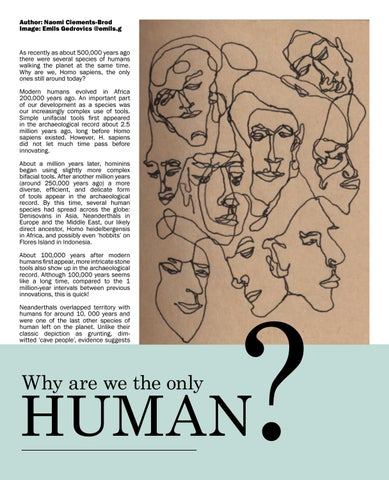
Author: Naomi Clements-Brod Image: Emils Gedrovics @emils.g As recently as about 500,000 years ago there were several species of humans walking the planet at the same time. Why are we, Homo sapiens, the only ones still around today? Modern humans evolved in Africa 200,000 years ago. An important part of our development as a species was our increasingly complex use of tools. Simple unifacial tools first appeared in the archaeological record about 2.5 million years ago, long before Homo sapiens existed. However, H. sapiens did not let much time pass before innovating. About a million years later, hominins began using slightly more complex bifacial tools. After another million years (around 250,000 years ago) a more diverse, efficient, and delicate form of tools appear in the archaeological record. By this time, several human species had spread across the globe: Denisovans in Asia, Neanderthals in Europe and the Middle East, our likely direct ancestor, Homo heidelbergensis in Africa, and possibly even ‘hobbits’ on Flores Island in Indonesia. About 100,000 years after modern humans first appear, more intricate stone tools also show up in the archaeological record. Although 100,000 years seems like a long time, compared to the 1 million-year intervals between previous innovations, this is quick! Neanderthals overlapped territory with humans for around 10, 000 years and were one of the last other species of human left on the planet. Unlike their classic depiction as grunting, dimwitted ‘cave people’, evidence suggests
Why are we the only
?
HUMAN 12
I, Science
www.isciencemag.co.uk