Book Review
Alone in the Dark Douglas Heaven reviews ‘Blindsight’ by Peter Watts
I
n February 2082, 70 years from now, 65,536 objects enter our atmosphere simultaneously, blanket the Earth in a precise latitudinal/longitudinal grid, emit radio signals for just over a minute, then burn up. This is first contact; this is Firefall. A crew of post-humans – phenotypes extending into machinery both inside and outside the body – is sent to investigate a comet in the Kuiper Belt. They are led by a vampire – one of a super-intelligent species genetically engineered back into existence. Their ship, the Captain, lets them sleep for five years, waking them instead for a rendezvous with a super-Jovian beyond the Oort cloud. So far, so Arthur C. Clarke (except for the vampires). But Blindsight is a novel scattershot with ideas, including 18 pages of appendices and 144 real-world citations. “References and remarks, to try and convince you all I’m not crazy,” is how Watts puts it. On vampire biology, for instance: “Since intersecting right angles are virtually nonexistent in nature, natural selection did not weed out the Crucifix Glitch until H. sapiens sapiens developed Euclidean architecture; by then, the trait had become fixed across H. sapiens vampiris via genetic drift, and—suddenly denied access to its prey— the entire subspecies went extinct shortly after the dawn of recorded history.” Its slowburning narrative also builds to a resolution of the Fermi paradox that involves one of the most disturbing possibilities I have ever come across.
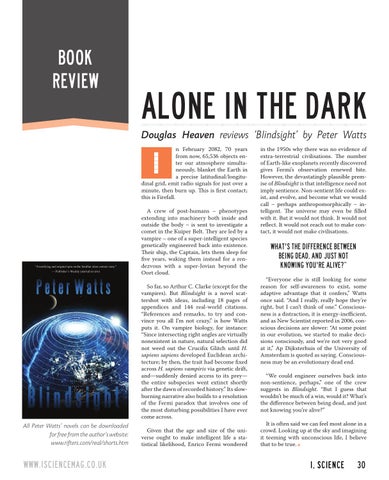
All Peter Watts’ novels can be downloaded for free from the author’s website: www.rifters.com/real/shorts.htm
www.isciencemag.co.uk
Given that the age and size of the universe ought to make intelligent life a statistical likelihood, Enrico Fermi wondered
in the 1950s why there was no evidence of extra-terrestrial civilisations. The number of Earth-like exoplanets recently discovered gives Fermi’s observation renewed bite. However, the devastatingly plausible premise of Blindsight is that intelligence need not imply sentience. Non-sentient life could exist, and evolve, and become what we would call – perhaps anthropomorphically – intelligent. The universe may even be filled with it. But it would not think. It would not reflect. It would not reach out to make contact, it would not make civilisations.
What's the difference between being dead, and just not knowing you're alive?” “Everyone else is still looking for some reason for self-awareness to exist, some adaptive advantage that it confers,” Watts once said. “And I really, really hope they’re right, but I can’t think of one.” Consciousness is a distraction, it is energy-inefficient, and as New Scientist reported in 2006, conscious decisions are slower: “At some point in our evolution, we started to make decisions consciously, and we’re not very good at it,” Ap Dijksterhuis of the University of Amsterdam is quoted as saying. Consciousness may be an evolutionary dead end. “We could engineer ourselves back into non-sentience, perhaps,” one of the crew suggests in Blindsight. “But I guess that wouldn’t be much of a win, would it? What’s the difference between being dead, and just not knowing you’re alive?” It is often said we can feel most alone in a crowd. Looking up at the sky and imagining it teeming with unconscious life, I believe that to be true.
I, Science
30