PEACE

www.irrawaddy.org TheIrrawaddy May 2015 HUMMINGBIRD CREATES A BUZZ WHY PEOPLE LOVE GOLD Art Collector Expands Horizons Naypyitaw: The Lonely Capital Dairy Farmer Turns Passion into Business History Revisited: Operation Dracula
TALKS:
HAPPENED
WHAT NEXT?
WHAT
AND
Address



lauric
maintain blood sugar& cholesteral
Heart Disease and High Blood Pressure
in easy digestion
Cancer Prevention and Treatment
Immune System
(antibacterial, anti-fungal, and anti-viral)
bone health
1. Rich in
acid that helps
2. Prevents
3. Help
4.
5.
Boost
6. Improves
diseases
liver & kidney
sagging skin, skin
& flaking
7. Prevent
affecting
8. Prevent wrinkles,
dryness
Rd.
: 85 Shin Saw Pu
San Chaung Township.
Email : purepalyg@gmail.com 100%
Centrifuged
Oil
Handphone: 099 737 724 95
Organic Extra Virgin
Coconut

TheIrrawaddy
The Irrawaddy magazine has covered Myanmar, its neighbors and Southeast Asia since 1993.
EDITOR-IN-CHIEF: Aung Zaw
EDITOR (English Edition): Kyaw Zwa Moe
ASSOCIATE EDITOR: Sandy Barron
COPY DESK: Paul Vrieze; Andrew D. Kaspar; David Kay; Feliz Solomon; Sean Gleeson
CONTRIBUTORS to this issue: Aung Zaw; Kyaw Zwa

Moe; Kyaw Phyo Tha; Yan Pai; San Yamin Aung; Yen Snaing; Thuzar; Nobel Zaw; Zarni Mann; Kyaw
Hsu Mon; Bertil Lintner; Aung Naing Oo, David Hopkins; Simon Lewis; Nyein Nyein; Brennan
O’Connor; Timo Jaworr; Claudia Sosa.
PHOTOGRAPHERS: JPaing; Sai Zaw; Hein Htet; Teza Hlaing; Steve Tickner; Timo Jaworr
LAYOUT DESIGNER: Banjong Banriankit
SENIOR MANAGER : Win Thu (Regional Office)
MANAGER: Phyo Thu Htet (Yangon Bureau)
REGIONAL HEADQUARTERS MAILING ADDRESS: The Irrawaddy, P.O. Box 242, CMU Post Office, Chiang Mai 50200, Thailand.
YANGON BUREAU : Building No
170/175, Room No
806, MGW Tower, Bo Aung Kyaw Street (Middle Block), Botataung Township, Yangon, Myanmar.
TEL: 01 388521, 01 389762
EMAIL: editors@irrawaddy.org
SALES&ADVERTISING: advertising@irrawaddy.org

SUBSCRIPTIONS: subscriptions@irrawaddy.org
PRINTER: Chotana Printing (Chiang Mai, Thailand)
PUBLISHER LICENSE : 13215047701213
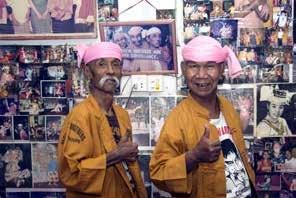
2 TheIrrawaddy May 2015 Contents 4 | In Person Cardinal Charles Maung Bo 6 | Quotes and Cartoon 8 | News Highlights 10 | In Focus 12 | Viewpoint LIFESTYLE 55 | The Collector Art enthusiast and gallery owner Ko Sid is backing local painters 58 | Mixing It Up Thxa Soe blends traditional and western sounds to lively effect 60 | Poking Fun At The Powerful The Moustache Brothers are still entertaining visitors 62 | Hummingbird Creates A Buzz A globe-trotting chef serves creative cuisine in a charming setting 64 | Backpage Yangon Saddles up
Vol.22 No.5
COVER PHOTO : Sai Zaw / The Irrawaddy
www.irrawaddy.org TheIrrawaddy May 2015 HUMMINGBIRD CREATES A BUZZ WHY PEOPLE LOVE GOLD Art Collector Expands Horizons Naypyitaw: The Lonely Capital Dairy Farmer Turns Passion into Business History Revisited: Operation Dracula PEACE TALKS: WHAT HAPPENED AND WHAT NEXT?
takes part in an International Day of Peace march in Yangon in Sept.
Woman
2014
14 | COVER Draft Signed, Its Destiny Awaits
Government and ethnic peace negotiators have signed a draft nationwide ceasefire agreement. But what does it really mean—and what’s next?
FEATURES
24 | Society: Neighborhood Watch
A determined group of Kachin youth face an uphill battle to eradicate drugs from their community
26 |
History: Operation Dracula
Seventy years ago this month, Allied forces retook Yangon from the Japanese
30 | Interview: ‘We Must Try to Make Things Better’

34 | Photo Feature: The Lonely Capital Venturing through Naypyitaw
BUSINESS
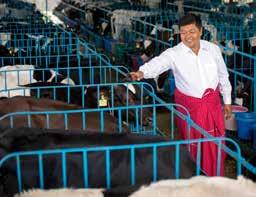
41 | Dairy: The Cows That Keep On Giving
A childhood passion for cattle has turned into a thriving dairy business for U Than Myint
46 | Interview: Gold Demand ‘Remains High’
49 | Food: Fresh Market Gains Fans
Chemical-free fruits and vegetables attract health-conscious consumers
50 | Signposts: FDI Soars
REGIONAL
52 | Counting Tigers
India’s rising number of big cats may be a victory only on paper

3 May 2015 TheIrrawaddy
P-41
P-60
P-58
P-52
How d o you feel about being named Myanmar’s first Catholic cardinal?

I did not expect to be chosen; cardinals are usually chosen from places like the Philippines and Italy where the majority of people are Catholic Christians. But the Pope of his own volition chose a cardinal from Myanmar,where the Catholic population is small. He did so with the intention of encouraging the international community to give assistance to poor, undeveloped and troubled countries. Though I am happy to be appointed as a cardinal, I also take it as an important responsibility. The sense of responsibility I feel, that I have to try and be an example for my country and my people, is stronger than the happiness the position has brought me.
What do you plan to do to improve the future of the country?
Firstly, we can’t turn a blind eye and a deaf ear to difficulties, racial and religious conflicts, the wishes of the people and particularly the recent student protests Myanmar has faced in marching toward democracy. We have to make sure we all face [these issues] in good faith. Though the majority of Myanmar’s population is Buddhist, it is a multi-faith country and I therefore want to offer my services to ensure peaceful co-existence between people of different faiths and peace between ethnic groups and the government.
Are you now closely involved in settling
In Conversation with FirstMyanmar’sCardinal
Archbishop of Yangon Charles Maung Bo was named Myanmar’s first Catholic cardinal by Pope Francis in January this year and was officially elevated by the pope in March in Rome. Cardinal Bo recently sat down with The Irrawaddy’s Yan Pai to discuss the role of religious leaders in achieving peace and promoting tolerance in Myanmar.
conflicts between the government and ethnic groups?
Generally, many members of the Kachin Independence Army (KIA) believe in the same faith as me. So I have played a part in those cases as much as I can, together with Catholic priests there. I have decided to play a part whenever there is an opportunity. For example, I took part in many discussions on Rakhine issues and so did US Ambassador to Myanmar Derek Mitchell.
I believe spiritual leaders have an important role to play in either racial or religious conflicts. Myanmar people have faith in their respective religions and listen to their respective religious leaders. I believe that it would have a great impact on people in the country if spiritual leaders met frequently and showed respect to each other. Therefore, I have put forward a plan to build an office where spiritual leaders of different faiths can meet.
What is the government’s response to the involvement of religious leaders in the Kachin conflict? Do they welcome it?
We four Catholic Christian priests, Baptist bishops and local authorities in Kachin State meet frequently. But I don’t understand why the army does not stop attacks while the government, the president, has ordered to stop the fighting with the KIA. I don’t know who is behind the central government. Neither the army nor the president can make a firm
IN PERSON 4 TheIrrawaddy May 2015
PHOTO: STEVE TICKNER / THE IRRAWADDY
Cardinal Bo in Yangon
decision. I have a suspicion that someone is secretly pulling the strings behind the president. Though it is said that we are moving toward a democracy and are enjoying freedoms, it is still difficult to find out who is pulling the strings from behind.
What do you want to say to the people about peace as a cardinal?
Conflicts have broken out and continued between ethnic groups and the government since independence. Ceasefires were reached in the early years when the military regime came to power. But ethnic armed groups still do not have trust in the central government. In addition, they have grievances. In my opinion, negotiation is the only solution. Therefore, I think credible political dialogue is critically important. Myanmar is bound to achieve peace if this happens.
You said the role of religious leaders is important in solving religious conflicts. What do you want to say about some monks taking part in religious conflicts at times?
Religion is meant to teach love and therefore does not accept violence. All religions have extremists. Christianity, Islam, Hinduism and Buddhism, all have extremists. But they are a minority. We condemn anyone with extreme views who only cares about his religion and disregards other religions. Violence will never win and never has a good ending. It is unacceptable. Love will win finally. Therefore, religious
leaders need to preach love and respect to others who do not believe in different religions. Buddhists account for 85 percent of the population in Myanmar and while most [monks] are preaching love, if there is counterproductive violence, then it is unacceptable, I would say.
Do you think there is increased violence while the country is heading toward democracy, as you said?
Previously, the military regime imposed strict censorship, from publications to communication. Now, as we begin to get a greater degree of freedom, people think they can do and say anything they please and it is democracy. So they say, write and swear as they please in dealing with people of different religions. For example, they write and swear as they please on Facebook and think it is democracy. As the entire system was paralyzed in Myanmar, it is difficult to heal in a short time. Therefore it is important that we have patience and treat each other like family members in moving toward democracy.
We have heard that you will claim back nationalized missionary schools from the government. How is this going?
It has been 50 years since missionary schools were nationalized. The educational standards of Myanmar began to fall after missionary schools were nationalized. Whether in education or the economy, decentraliza-
tion is very important. If the government decentralized the education system, we would be able to improve educational standards through cooperation between academics, local and international donors and religious personalities. But if the government continues to keep its grip, the education system will be hopeless. It should denationalize the schools.
It is now over 500 years since Christianity reached Myanmar. Looking back at history, princes were taught at those schools since the time of the monarchy. They did not take advantage; they only taught about morals and ethics. They did not persuade students to convert religion. So, the schools should be given back, I think. Last November, I said clearly that I would like to get them back if I had the chance.
How about religious freedom under the current government?
I have never faced direct disturbance and repression as regards religious freedom since the time of the government of the Burma Socialist Program Party. Even religious training has freedom. In my life, I have never been questioned if I have foreign contacts. But there is one thing. I feel we don’t have equality in terms of rights. It is rare that the government donates to Christian churches. I have never received any money [from the government] to build a church or for a mission. It is very different. We don’t even enjoy [government assistance]
proportionally. I want the government to provide a certain amount even if it is not as large as the amount for Buddhists. Compared to countries like China, Vietnam, Laos, Cambodia, Malaysia and Indonesia, we have much greater religious rights in Myanmar. When a priest is appointed by Rome, he can be elevated freely in Myanmar. And we don’t need to seek the approval of the government unlike those countries. Again, seminaries for priests can be opened freely in Myanmar.
As you met Pope Francis, did he say something specific about Myanmar?
At the elevation ceremony, Pope Francis said that although Catholic Christians are a religious minority in Myanmar, they should have the courage to speak up for the truth and denounce injustice and should be prepared to sacrifice their lives for the truth and for love if necessary.
Is there anything else that you would like to say to the people of Myanmar?
Myanmar is a multiethnic country and has the beauty of diversity, like a rainbow. I wish peace not only for Myanmar but for the entire world. Peace is a precondition for development. People in Myanmar are like family members and if they have a brotherly spirit toward each other regardless of religion, then peace will prevail. I believe the final victory is of love.
5 May 2015 TheIrrawaddy
QUOTES

—Joe Wong, a 31-year-old transgender man working with the Asia Pacific Transgender Network, speaking to Reuters about his childhood experiences. The APTN seeks to protect the rights of transgender people across the region, including in Myanmar.
—A monk at the Mahagandhayon Monastic Institution at Amarapura in a comment to CNN on the daily influx of camera-toting visitors who come to the monastery to watch the monks line up for lunch.

CARTOON 6 TheIrrawaddy May 2015
ILLUSTRATION: HARN LAY
Psst, Is This The Lucky One?
“We have to pay tea money to the township inspection officials.”
—Yangon resident Ko Win told The Irrawaddy that bribery is now the only way to get a car parking permit in the city. Brokers charge up to US$600 to ‘‘expedite the service,’’ he said.
“When you get beaten every day, you no longer feel the pain, you just feel numb.”
“Some tourists very nice, some very bad. They take photo crazily and extremely.”

Parliament Passes Population Control Bill
Lawyers Network for Journalists Formed
A bill that opponents say threatens to curb women’s reproductive rights was passed by Myanmar’s Union Parliament on April 6.
The bill contains a contested provision mandating that women wait three years between birthing children, with human rights activists and women’s advocates saying the restriction is an assault on female reproductive rights.
Deputy Attorney General U Tun Tun Oo, whose office was involved in drafting the bill, told The Irrawaddy in February that the new legislation would help improve health care services
for women in impoverished regions of the country. Though there do not appear to be punitive measures in place if the 36-month birth spacing requirement is violated, a coalition of civil society groups in December warned that children born not in line with the rules of the bill might be at risk of not being registered by local authorities.
Under the bill, regional and state governments are granted the ability to request a presidential order limiting reproductive rates if it is determined that population growth, accelerating birth rates, or rising infant or maternal mortality rates are negatively impacting regional development.
If the president approves the request, a “special region” is designated, triggering the law’s provisions, including the birth spacing restriction. —Nobel Zaw
More Student Protesters Arrested
Lawyers from across Myanmar have teamed up to create a network offering legal assistance to journalists and media agencies, in response to a surge in suits filed against members of the fourth estate.
The new Lawyers Network for Journalists and Media, launched in Yangon on April 1, comprises about 80 lawyers working in various parts of the country, and plans to extend initial services to Ayeyarwady, Magwe, Mandalay, Bago and Yangon regions.
“There has been an increase in legal charges against journalists and media agencies, and there is still a lack of legal protection for them,” said U Than Zaw Aung, a lawyer and secretary of the network. He said the new association will be able to provide legal advice and, in some cases, representation.
The group plans to carry out educational discussions for media workers and lawyers to promote awareness of Myanmar’s legislative framework regarding the media, he said.
A member of the country’s interim Press Council, U Myint Kyaw, welcomed the network, saying that it could offer muchneeded services at a time when press freedom is under threat.
“We really need that kind of group,” he said. “Since legal cases against media professionals [have increased], this kind of legal group can help advise them in legal matters or even to write news related to the Media Law.” —Zarni
Mann
in March, was arrested at her home on April 8 on charges of joining a subsequent demonstration in Yangon.
The third-year student spent the night in a Kamayut Township jail cell before being remanded to Insein Prison the following day.
Another student activist, Ma Po Po, who participated in an education reform protest that was violently dispersed in Letpadan, Bago Region,
More than 120 students and their supporters were arrested following the police crackdown at Letpadan on March 10, but 20-year-old Ma Po Po and several others managed to escape, according to her sister Ma Ei Pone, who was also arrested at Letpadan but later released.
“We are told they arrested her due to the Hledan protest,” Ma Ei Pone said, referring to the traffic junction in Yangon where protestors later gathered on the same day of the Letpadan crackdown to protest the police’s use of force.
“With her, Nanda Sitt Aung and others, altogether six people, will be [charged] in the same case,” she added.
Prior to Ma Po Po’s detention, police had arrested Ko Nanda Sit Aung and Ko Win Kyaw Moe. Authorities are still searching for Ko Kyaw Ko Ko, Ko Lin Htet Naing and others who are accused of leading the demonstration along with Ma Po Po. —Yen Snaing & Zarni Mann
NEWS
HIGHLIGHTS
PHOTO: REUTERS
Ma Po Po is seen during the student protest in March in Letpadan, Bago Region.
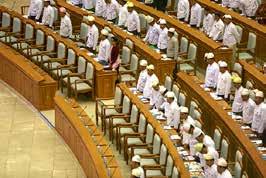
Lawmakers stand as the parliamentary speaker, unseen, enters during a Union Parliament regular session in Naypyitaw in March.
8 TheIrrawaddy May 2015
PHOTO: JPAING / THE IRRAWADDY
Six-Party Talks Are Held in Naypyitaw
of Myanmar’s biggest political players, convened in Naypyitaw on April 10.

presidential spokesman U Ye Htut, said a timetable for the next meeting had been agreed sometime after Parliament reconvenes, though no date was provided.
A six-party dialogue on constitutional reform and upcoming national elections, involving some
The meeting involving President U Thein Sein, opposition leader Daw Aung San Suu Kyi, parliamentary leaders, an ethnic representative and the Myanmar Army Commander-inChief Snr.-Gen. Min Aung Hlaing was labeled “a success” by the government.
The President’s Office, quoting
U Aye Maung, the chairman of the Rakhine National Party who was designated to represent ethnic minorities’ interests at the talks, said amendments to the country’s controversial military-drafted Constitution and elections due late this year were the primary topics addressed.
“But [the discussion was] not thorough on constitutional fixes as we will discuss during the next round of meetings. We met today because Parliament requested it. Parliament has to submit details on constitutional amendments before we discuss it at the next meeting,” he said. —The Irrawaddy
Local Recruiters Suspended After Russian Trawler Sinking
The Ministry of Transport indefinitely suspended five local seafarer recruitment agencies in April that it alleged had sent Myanmar nationals to work on the Russian fishing trawler Dalny Vostok, which sank off Russia’s fareastern coast on April 2.

Though the Department of Water Transport permits seafarer recruitment agencies, it does not allow them to send Myanmar nationals to foreign fishing trawlers.
“The ship to which they sent the sailors was not the one they said in their application,” said U Toe Myint, director of the department’s Seafarers Division. “They failed to report this to us. Even if they sent them to another ship, they would have had to report this to us and seek our approval, as well as submit relevant documents to prove that the ship is recognized by us. They failed to do all these things and that’s why we suspended them.”
A total of 161 seafarer
recruitment agencies are registered with the ministry. The suspension of the five agencies is the first of its kind.
Of the 42 Myanmar nationals aboard the Dalny Vostok when it sank, 22 were rescued. Sixteen
have been confirmed dead while four others are missing. Of the suspended agencies, Sea Rider provided the vessel with 27 sailors, while the rest were recruited by Top Chance, Asia Wave, Light Oasis and Star Global. —Thuzar
U Shwe Mann, center, speaker of the Lower House of Parliament, army commander-in-chief Snr.-Gen. Min Aung Hlaing, left, and opposition leader Daw Aung San Suu Kyi arrive for six-party talks at the Presidential Palace in Naypyitaw on April 10.
PHOTO: REUTERS
Russian fishing trawler Dalny Vostok
PHOTO: ITAR-TASS
9 May 2015 TheIrrawaddy
10 TheIrrawaddy May 2015
Hello and Goodbye
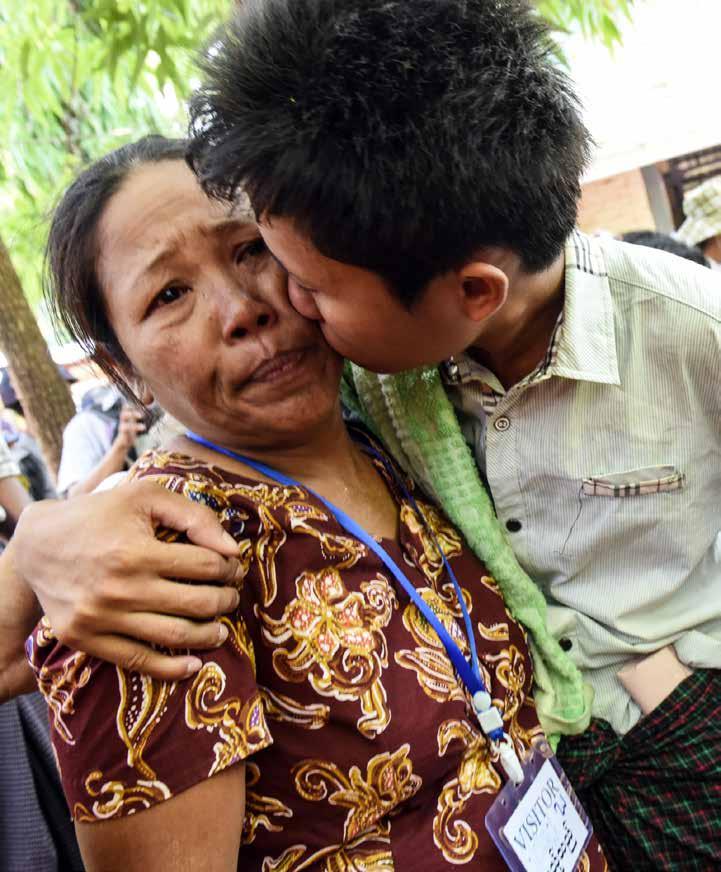
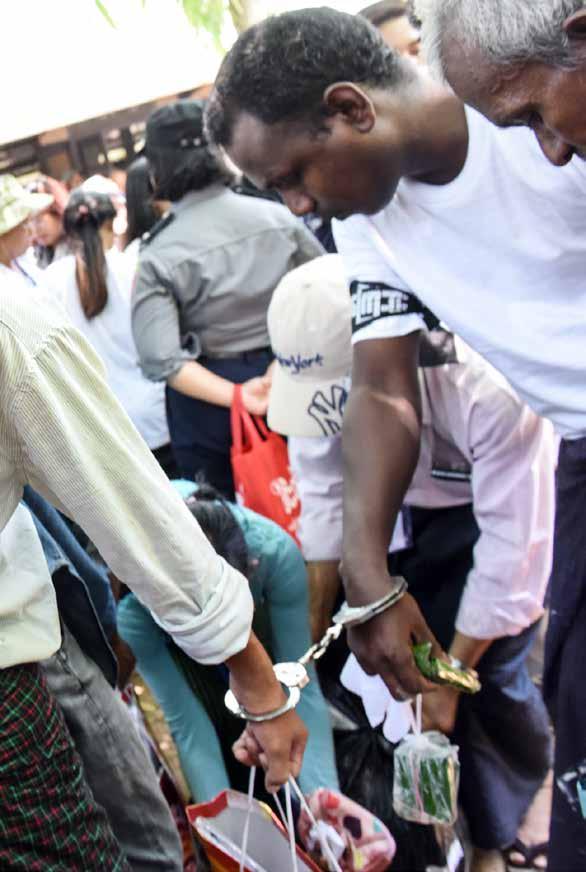
A handcuffed student kisses his mother while he is brought to Letpadan court for trial. A total of 127 people were arrested after a March 10 crackdown against student protesters. Other arrests were made later, and around half the total were released in late March. Family members are allowed very brief weekly visits to their detained relatives.
IN FOCUS
11 May 2015 TheIrrawaddy
PHOTO: SAI ZAW / THE IRRAWADDY
Intrigue and an iPad
A recent photograph on social media is the latest source of speculation over former junta leader Than Shwe
By AUNG ZAW
Is ex-senior general Than Shwe, the country’s widely feared and reviled former head of state, still pulling the strings?
As with most questions over the secretive former junta leader, the answer remains unclear.
While some skeptics and dissidents believe he is still influential, others counter that he is no longer involved in politics. What is true is that the former State Peace and Development Council (SPDC) chairman has not made a formal public appearance since late 2011.
In January 2013, Union Solidarity and Development Party vice-chairman U Htay Oo said the former senior general was in fine health and happily retired, although he continued to follow politics in the country.

“Of course, he is interested in politics as he was the leader of a country. It is certain that he wants the [political] system that he established to be successful,” U Htay Oo said at the time.
Some observers have pointed out that local journals now dare to publish articles on Snr.-Gen. Than Shwe’s past crimes, misdeeds and corruption and on his family since the political opening in Myanmar. If he was still powerful, they argue, he would have moved to stop them.
Ministers who know and respect him have previously told me that whenever there are festive ceremonies in Myanmar, many in the government, military officials and cronies still go to pay their respects to him and his
VIEWPOINT
12 TheIrrawaddy May 2015
PHOTO: REUTERS
family—now living in a lavish compound in Naypyitaw built from gas money reaped during his time as head of state.
One can still see armed officers and soldiers standing guard outside his house near Water Fountain Park.
In March, just ahead of Armed Forces Day, the exgeneral made a surprise appearance on social media. His grandson Ko Nay Shwe Thway Aung (also known as Pho La Pyae) shared a photo on his Facebook account of the former military strongman receiving instructions on how to use an iPad from his granddaughter in a well-furnished living room.

It’s difficult to confirm how recently the undated photo was taken. Many close to army sources suggest the photo was two or three years old. But aside from its date of origin, what was the motive behind its posting? Was it just to demonstrate the old man is still going strong? Or was there a deeper message?
The Old Guard’s Influence
Snr.-Gen. Than Shwe ruled the country with an iron fist before convening sham elections in 2010. He handed over power to his people—men in uniform—and handpicked former general U Thein Sein, who served as SPDC prime minister and was a general staff officer in the country’s war office in the early 1990s, as his successor.
In a clever strategic move, the former army supremo appeared to have appointed U Thein Sein as someone who wouldn’t rock the boat. He was not a fire-breathing dragon, was loyal to Snr.-Gen. Than Shwe and supported the 2008 Constitution (he was chairman of the National Convention Convening Commission) that guarantees the military’s role in national politics.
However, whether the ex-dictator himself is still influential in politics continues to be hotly debated by Myanmar political observers.
Last year, Snr.-Gen. Than Shwe, now 82, reportedly attended a funeral for the wife of ex-general U Tin Aye, the chairman of the Union Election
Commission. According to some insiders, he was healthy and—just as U Htay Oo remarked two years ago—keeping abreast with politics and current affairs.
Vice-Snr.-Gen. U Maung Aye who served as the second most powerful general in the previous regime was also there. The battle-hardened general who once served in Shan State suffered a stroke a few years ago. U Thein Sein and U Shwe Mann were also in attendance.
It was a chance for the old junta members to reconnect, although the latter two, as well as U Tin Aye, are still active in politics. Reportedly, they discussed the national election slated for later this year and Snr.-Gen. Than Shwe asked: what if the lady and her party win a majority? What will happen to us?
Dictators’ Destiny
Ahead of the elections, the fear factor will play on the minds of those junta leaders still alive today who are edgy about possible new political realities on the horizon.
When Myanmar’s strongman Gen. Ne Win resigned from the government and party he founded amid political turmoil in 1988, many believed he was still influential in steering the regime leaders to stage a coup and crush the historic democracy uprising.

After ostensibly exiting the political stage, Gen. Ne Win regularly met his former subordinates and colleagues
at home to discuss Buddhism, meditation and politics. He didn’t entirely leave politics behind.
In 1992, the former dictator asked that the chairman of the State Law and Order Restoration Council Snr.-Gen. Saw Maung, who suffered a nervous breakdown, be replaced. As a result, Snr.-Gen. Than Shwe became leader of the ruling junta.
Two years after Gen. Ne Win’s resignation, Myanmar held its first free and fair national elections in 28 years, which the National League for Democracy (NLD) won in a landslide.
But the outcome of the 1990 elections was never honored; if power was handed to the NLD, what would happen to old socialist regime leaders, including Gen. Ne Win?
Ironically, it was Snr.-Gen. Than Shwe in 2002 that ultimately sought to neutralize the influence of the former dictator, placing him under house arrest and jailing three of his grandsons for an alleged plot to overthrow the ruling regime.
Gen. Ne Win died in December the same year and his grandsons served long prison sentences. They were released in a general amnesty in 2013.
“The Royal Family” members now freely roam the town, dabble on social media and generally retain a public profile. No doubt today there is no love lost between the Ne Win and Than Shwe clans.
It may be members of the latter family that have more cause for anxiety over the future, as age creeps up on the former regime leader and the uncertain twists and turns of power and political rivalry take shape in an election year.
Whatever the real reason that Ko Nay Shwe Thway Aung posted his grandfather’s photograph, at least one implication seems clear. As long as the now reclusive ex-dictator is alive, the intrigue over his influence will continue.
13 May 2015 TheIrrawaddy
Aung Zaw is the founding editorin-chief of The Irrawaddy.
PHOTO: KO NAY SHWE THWAY AUNG / FACEBOOK
Retired Snr.-Gen. Than Shwe is seen receiving instructions on how to use an iPad from his granddaughter.
Draft Signed:
Destiny Awaits
14 TheIrrawaddy May 2015
COVER STORY
Government and ethnic peace negotiators have signed a nationwide ceasefire draft agreement after seventeen months of meetings. But what does the event really mean—and what’s next?
U Aung Naing Oo of the Myanmar Peace Center heralds a significant moment, ethnic leaders caution that the document is just a draft awaiting approval, and analyst Bertil Lintner says the core issues have yet to be discussed.
15 May 2015 TheIrrawaddy
PHOTO: REUTERS
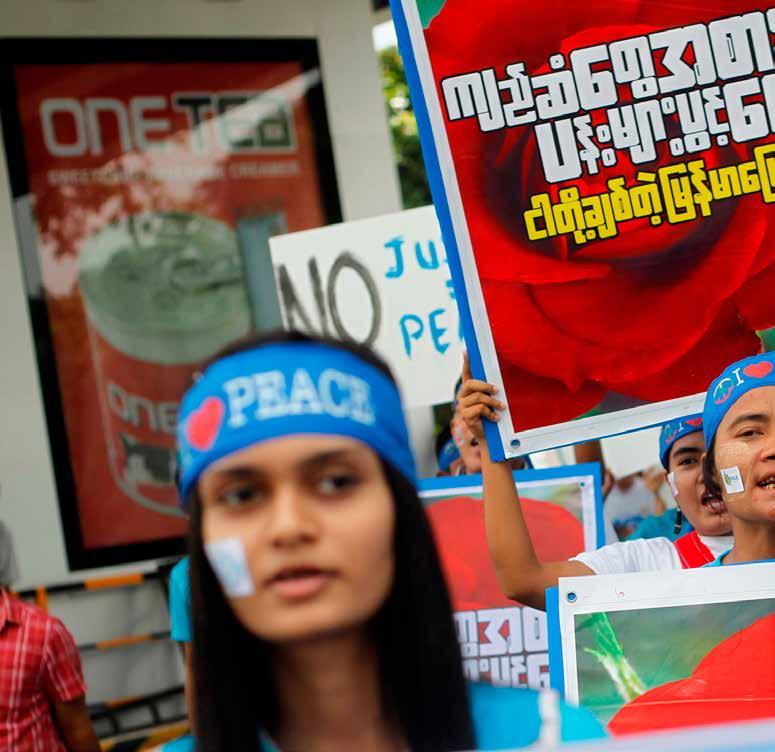
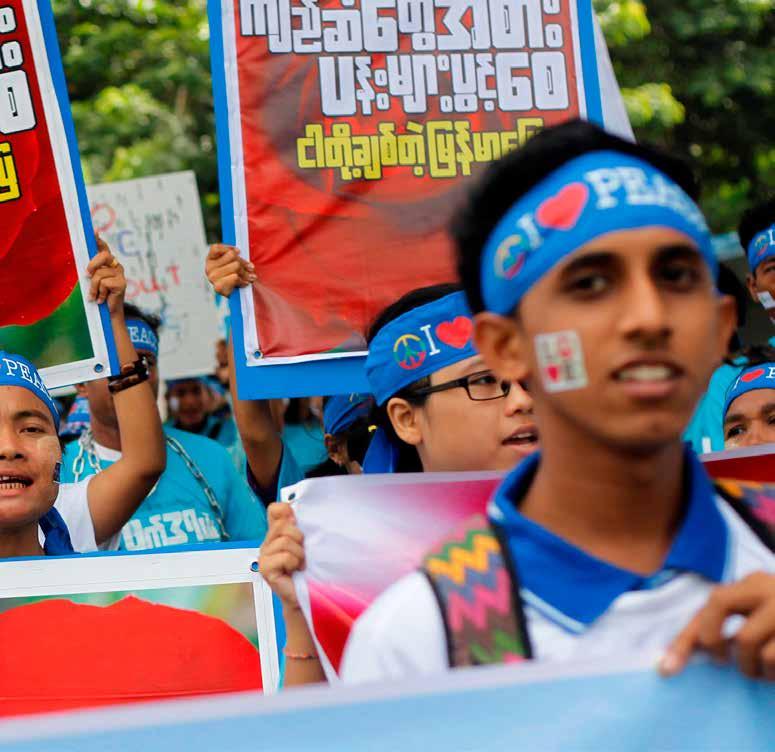
People shout for peace as they hold posters during a march celebrating the International Day of Peace in Yangon in Sept. 2014. The posters read, “We wish for flowers to bloom in place of bullets in our lovely country Myanmar.”
Long Road for ‘World’s Wordiest’ Ceasefire Text
By AUNG NAING OO
Myanmar made history a few weeks ago.
Negotiators representing the government of President U Thein Sein and the ethnic armed groups overcame the unthinkable: they concluded a protracted negotiation over a nationwide ceasefire on March 31.
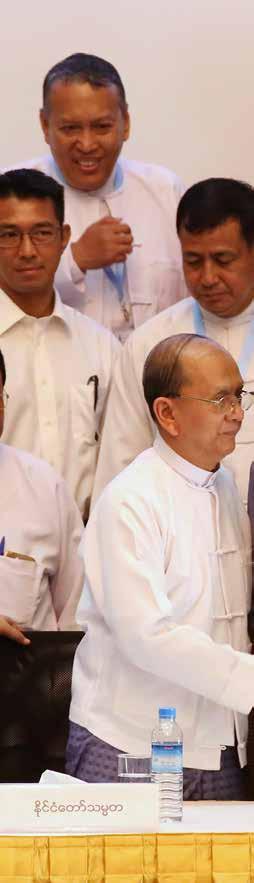
It stunned everyone, even some deep within the peace process. A few months ago, there were comments calling the process “as good as dead.” But it is now likely that the Nationwide Ceasefire Agreement (NCA) will be signed in May. Therefore, for the first time the real possibility of ending Myanmar’s 67-year history of armed conflict has emerged.
This is an incredible feat for a government whose legitimacy has constantly been called into question by opponents for its association with the previous military regime. Yet the president has resolutely stuck by the call he made for peace with ethnic armed groups a few months after assuming power in 2011. More
importantly, he has acted decisively to reach this point.
Undoubtedly, there was much skepticism and that was absolutely warranted.
Overall, the NCA process took 17 months. It required both sides to meet 22 times informally and seven times formally. The meetings took place in Myanmar as well as abroad. Beyond these meetings the technical teams representing both sides met over 200 times in preparation for formal negotiations.
Throughout the talks, fighting flared up too many times and in its worst moments threatened to derail the whole process. Political conditions outside the negotiation table also often overshadowed the dynamics of the talks.
Negotiations took place against the backdrop of larger social, economic, administrative and political reforms that Myanmar has initiated. This was further compounded by the complex web of the conflict’s history; the multiplicity of groups involved; ethnic and other grievances; diverse interests
16 TheIrrawaddy May 2015 COVER STORY
and allegiances; and the negotiating cultures involved.
A seemingly endless series of hurdles meant that it even took seven months—from September 2014 to March 2015—to prepare for the final round of talks. It took six days straight to finish most of the remaining eight items and then the negotiators needed to take a break. They resumed the bargaining for two more days at the end of March when everything was eventually wrapped up.
Critically, the president made a last minute intervention to overcome the final hurdles in the talks. Government insiders said a cabinet meeting was interrupted as a request came from the negotiation team for his involvement in concluding the last few compromises.
On March 31, he himself showed up at the Myanmar Peace Center and congratulated the negotiators from both sides. In his short speech, he said, “I was so happy I could not even sleep last night after watching the heart-felt speeches by ethnic leaders.”
‘A Political Roadmap’
On the whole, the negotiations have been multiparty although they are described as comprising only two sides. The government side has been made up of ministers, high-ranking army officers and parliamentary representatives. The ethnic participants—representing 16 armed groups—have negotiated as a team. In a country unfamiliar with compromise, it has been a constant struggle for both sides to bargain from a common position.
The agreement started out with 122 points and ended with 106 provisions under 33 headings in seven chapters.
PHOTO: REUTERS
17 May 2015 TheIrrawaddy
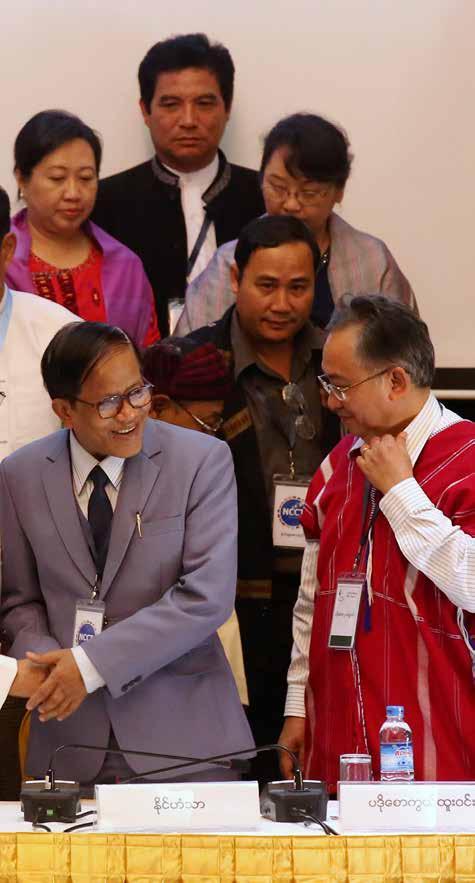
President U Thein Sein and Nai Hong Sar, leader of the Nationwide Ceasefire Coordination Team (NCCT), shake hands after signing the nationwide ceasefire draft agreement at the Myanmar Peace Center in Yangon.
It has been billed as the world’s longest and wordiest ceasefire deal. Despite being called a nationwide ceasefire agreement, it more closely resembles a political roadmap for the future of Myanmar. It is therefore no wonder it took negotiators from both sides 17 months to “grind it out.”
However, over the course of those 17 months, a negotiation first characterized by distrust has evolved into one of trust. Thus it is no surprise that there are two recurring words that appear throughout the NCA— negotiation and cooperation. They are there to ensure that the agreement, once signed, will be abided by and carried out in the spirit of accommodation and compromise.
The NCA covers many critical issues such as the formation of the Joint-Monitoring Mechanisms to monitor ceasefire violations. They will be buttressed by the Codes of Conduct and a multitude of humanitarian provisions and civilian protections.
More importantly, the NCA contains several key promises from the government, the most important of which are the guarantee of political negotiations and the eventual establishment of a democratic federal state—the long-standing and most critical demand of the ethnic groups. As such, the agreement will open the door for inclusive political negotiations in order to end the armed conflict once and for all.
The Path Forward
In reality, the NCA is just the beginning of the peace process in Myanmar. It will have to be followed by the development of a framework for political dialogue on which political negotiations will be based. The agreement sets out deadlines for these steps to be implemented; notably political negotiations must begin within 90 days of the formal signing of the nationwide ceasefire.
From here onward, the process will become even more complicated.
To date, ceasefire talks have only included the government and the
ethnic armed groups. Political parties, including opposition leader Daw Aung San Suu Kyi and other stakeholders, have not yet been included in the process. Their participation will commence in the next phase—the political framework negotiations.
The issues up for negotiation will move beyond ceasefires to wider, more complex topics such as power and wealth sharing and security reintegration.
The politics outside the peace negotiations—the upcoming election— will add more fluidity and uncertainty to the peace process. While the election is crucial for the further development of Myanmar’s young democratic processes, negotiators are deeply worried that it could have an adverse effect on the peace process.
Effectively there are only five months left to get the political negotiations underway before campaigning for the November elections begins. Having realized that there would be time constraints, the president signed a pledge in February to begin political negotiations before the election. The goal is to build a firm foundation for peace before his term is complete.
Credit must also go to the hard work and determination of all those involved in the process—particularly the government team led by Union Minister U Aung Min and the Nationwide Ceasefire Coordination Team representing the ethnic armed groups.
Myanmar is attempting an extremely difficult and ambitious undertaking. To say every step on the way to producing the final NCA draft has not been easy would be an understatement. Skepticism and destructive comments will remain. However, it appears that the negotiations to date and the resulting NCA have set the country on the right track to confront the challenges that lie ahead in the peace process.
Aung Naing Oo is the Associate Director of the Peace Dialogue Program, Myanmar Peace Center. Opinions expressed here are his own.
UNFC
The United Nationalities Federal Council said in a press release that the “approval of the NCA draft, reached between the NCCT and UPWC is not the final accepted agreement, and the final signing shall be done only after continued discussions on some topics, and if there is the required implementation.”
The UNFC said that it would like to confirm that it “would consistently endeavor for the establishment of genuine peace and the federal union, and the resolution of various problems in the country, by peaceful means through negotiation.”
Nai Hong Sar
The leader of the Nationwide Ceasefire Coordination Team (NCCT) told The Irrawaddy: “This is just a draft. There are many things we have to work on in order to receive a signed agreement. The government should have genuine political talks in order to have peace.”
18 TheIrrawaddy May 2015 COVER STORY
PHOTO: REUTERS
Ethnic Leaders’ Views
After the signing, ethnic leaders’ careful comments reflected the tough road ahead
Cheery Zahau
The likely Chin Progressive Party candidate in the next election wrote in The Irrawaddy:
“In past ceasefire talks, under the leadership of Gen. Khin Nyunt and his predecessor, Myanmar’s ethnic armed groups were not in a position to create the terms of demand and timeframe.
This time, the working group managed to advance the game in terms of timeframe, in terms of demands, and in the interpretation of the terminology used in the draft agreement. This is a major achievement that the citizens of Myanmar and the international community alike either do not understand or are ignoring.
Maj.-Gen. Gun Maw
The Kachin Independence Army’s vice chief of staff said:
“This was not a binding agreement. But it will be the basis for working towards an NCA…
“The signing of a draft single text was not going to see an immediate stop to conflict. But it will build trust and hasten the process of signing a ceasefire. Of course, we should work to reduce the fighting and both sides should show respect to one another.”
Khun Okkar
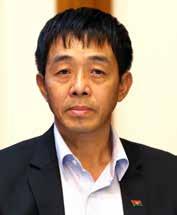
The NCCT chairman said that the NCA could not be signed while there is conflict in Kachin State and the Kokang Special Region. The agreement could only be signed when the country is “stable,” he told The Irrawaddy.
It was the ethnic armed groups that introduced the concept of political dialogue; it was from their bitter experiences that a ceasefire alone would not be enough.
This political dialoge is a space, wherein there will be wider and more inclusive participation.
In the early phases of the peace process, the government’s negotiation team was satisfied with the status quo of accepting or offering business concessions as incentives for agreeing to a ceasefire. The more cautious and sensible Myanmar observers could see that the government’s roadmap for peace was business as usual.
The game changed, however, when government negotiators, led by Minister U Aung Min, agreed to the concept of political dialogue. Myanmar's ethnic groups deserve recognition for their consistency and perseverance.”
(Speaking to DVB)
PHOTO: JPAING / THE IRRAWADDY
19 May 2015 TheIrrawaddy
PHOTO: STEVE TICKNER / THE IRRAWADDY
The Core Issues Not Addressed
By BERTIL LINTNER
The euphoria knew no bounds in certain quarters when, on March 31, it was announced that a text had been drafted for a proposed ceasefire agreement between the government and some ethnic resistance armies.
The Centre for Humanitarian Dialogue, a Swiss-based peace and reconciliation outfit, hailed it “the most comprehensive ceasefire agreement in Myanmar’s history,” if ratified, which “will set the stage for resolving the longest-running conflict in Southeast Asia.”
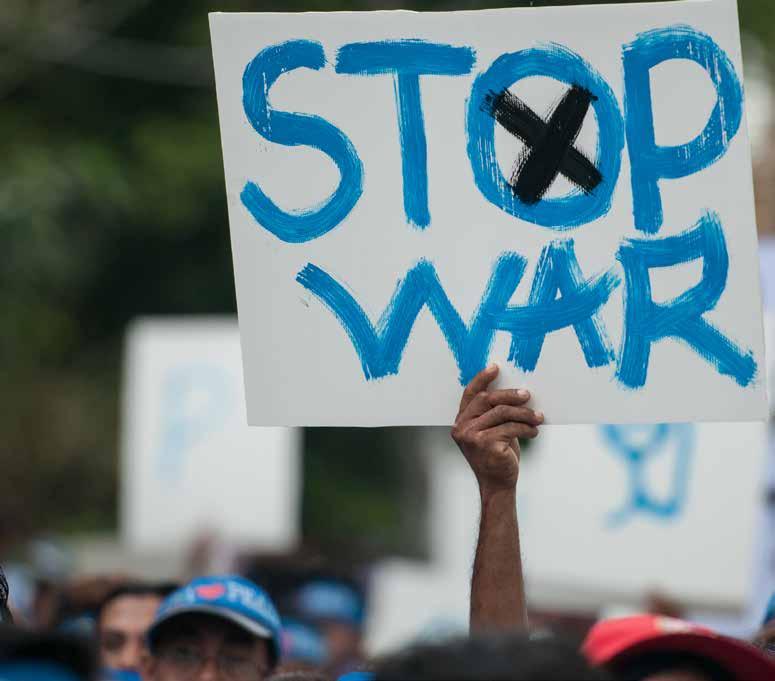
20 TheIrrawaddy May 2015
COVER STORY
A participant holds up a poster during a march against civil war to mark the International Day of Peace in Yangon in Sept. 2014.
Vijay Nambiar, special advisor on Myanmar to the Secretary General of the United Nations, also called the drafting of the proposal “historic” and UNICEF even suggested that it “could be the dawn of a new time of progress for the most disadvantaged children in Myanmar.”
More levelheaded observers pointed out that the event was nothing more than a small step in a long, hard process, and that not all groups are on board.
Nai Hong Sar, an ethnic Mon speaking for the Nationwide
Ceasefire Coordination Team (NCCT), emphasized in an interview with Voice of America’s Myanmar-language news site that the signing of a Nationwide Ceasefire Agreement (NCA) “can’t be decided by the NCCT” but only after the ethnic leaders’ summit meeting.
Leaders at the summit “might like to alter or make some addition to the agreement,” he said. “And only after deliberation and confirmation, will they be officially ready to sign the agreement.”
Khun Okkar, an ethnic Pa-O NCCT representative, said in an interview with The Irrawaddy that the NCA cannot be signed while there is conflict in Kachin State and the Kokang Special Region.
“[The NCA] can only be signed when [the country] is stable,” he said. “We will be a joke if we sign while fighting is ongoing. And other [ethnic] groups will not be satisfied.”
So much ado about nothing, then. And while the foreign peacemakers were congratulating themselves in Naypyitaw and Yangon, the reality on the ground remained depressingly familiar. Airstrikes and other attacks were continuing against Kachin and Palaung rebel forces in the north and northeast.
Conflict Continues
According to a March 29 statement issued by the Ta’ang National Liberation Army, the armed wing of the Palaung State Liberation Front, “Whilst the NCCT and the government’s Union Peacemaking Work Committee (UPWC) were holding talks for the NCA draft, the Burma Army launched offensives in northern Shan State and fierce battles continued.”
The Free Burma Rangers reported on April 1 that despite the potential ceasefire agreement, in Kachin State “incidents of aggression by the Burma Army have increased to levels not seen since initial fighting in 2011.”
In Kokang, an area in northeastern Shan State mostly inhabited by ethnic Chinese, heavy fighting also continued with the government launching airstrikes and bombarding suspected rebel positions with 155 mm Howitzers
and 122 mm truck-mounted multiple rocket launchers.
The ultimate irony is that Myanmar has seen the heaviest fighting in decades—after the present government came to power in March 2011 and opened its Myanmar Peace Center (MPC) in November 2012.

Fighting peaked in late 2012 and early 2013 with a major offensive against the Kachin Independence Army (KIA) followed this year by a massive air war in Kokang. Myanmar’s civil war has not been this intense since the government launched offensives against ethnic Karen and communist forces in the late 1980s.
Democratic Voice of Burma reported on April 4 that fighting between government troops and the Kokang rebel group, the Myanmar National Democratic Alliance Army, had tapered off “for at least a day” after the agreement on the draft NCA.
However, according to sources on the ground, that lull in the fighting had nothing to do with talks in Yangon. “The government’s side is just rearranging the deployment of its forces, and trying to solve logistical problems,” said a source close to the war in Kokang.
Fighting is expected to intensify before the rainy season sets in at the end of May as the Myanmar Army consolidates its positions and works to secure long and potentially vulnerable supply lines from the Myanmar lowlands to the warzones in the mountainous north and northeast.
Professional Peacemakers
Insights into the actual situation on the ground have never been the strong suit of the foreign peacemakers. The term “military-industrial complex” is often used to describe a network of defense contracts, flows of money and resources among individuals, institutions and various government agencies in the United States.
Myanmar now, it seems, has its own “peace-industrial complex” with an abundance of foreign NGOs, supported by massive grants from the European Union, the governments of Norway, Switzerland and Canada, and the involvement of representatives of the
21 May 2015 TheIrrawaddy
PHOTO: SAI ZAW / THE IRRAWADDY
UN as well as regional and international bodies.
“Peacemaking” has become a lucrative business in Myanmar, with little or no regard for the suffering of ordinary people in the country’s warzones. Many people working for, for instance, the MPC earn in a month what an ordinary Myanmar citizen would make in five years or more.
A foreign human rights activist familiar with the situation in the frontier areas described the foreigndominated peace industry as “a cabal of carpetbaggers and conmen whose real contribution to the peace process is shrouded in self-laudatory assessments that have no basis in reality.”
Among the many misrepresentations floated by the peace-industrial complex is that the civil war is actually about money and control of business opportunities. This attempt at depoliticizing the conflict may serve to cover up the failure of the foreign peacemakers, but it is also a very dangerous way of looking at the problem.
There has not been an ongoing civil war in Myanmar, virtually since independence in 1948, simply because some people want to control the trade in jade, precious stones or timber.
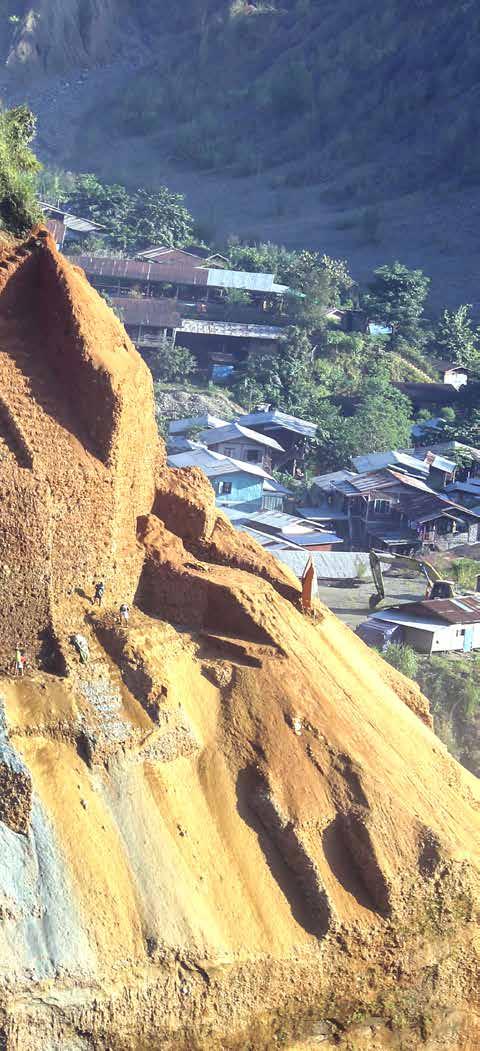
Naturally, the people living in nonBamar areas want their fair share of the natural resources in their respective regions once peace and normalcy have been restored. The government is also interested in collecting revenues from any kind of activity in the country. But the essence of the conflict since 1948 has centered on what kind of country Myanmar should be: a unitary nation or a federal union. The issues are political, not based on private business interests.
Even a well-respected news organization like IHS Jane’s issued a report on March 25 headlined “Mining industry fuels Myanmar civil conflict” which went on to claim that “jade has historically been a driver of conflict” between the Myanmar Army and the KIA.
These two forces are supposed to be battling “for control over lucrative
PHOTO: JPAING / THE IRRAWADDY
May 2015
COVER STORY
The real sticking point is politics, not resources such as the jade mines in Kachin State
mining operations” with both having “historically launched attacks on mining operations in order to reassert control over the strategic resource.”
This is complete balderdash.
No one has attacked “mining operations” which in any case are carried out by private entrepreneurs and contractors, not by the KIA or the government. Taxation on the trade, however, has provided the KIA with an income and the government gets its revenues from those contractors. This can be collected by both or either in cash or in kind. If the latter, raw jade can then be sold to generate income.
The Profits of Peace
Some foreign analysts have also suggested that those opposed to, or critical of, the NCA are holding this position because they are profiting from the war, while a peaceful solution to the conflict would put an end to their money-making activities. This is twisted logic, to say the least.
Local rebel commanders who have entered into ceasefire agreements with the government have invariably got, in return, profitable business opportunities—once they have stopped fighting.
A typical example is Zahkung Ting Ying, who once commanded a local unit of the now defunct Communist Party of Burma in eastern Kachin State. He made peace with the government in 1989, and his group immediately began exporting vast quantities of timber to China.
Today, his group is running a gun factory, capable of producing automatic rifles, pistols, revolvers and shotguns, which are sold mainly to ethnic rebel forces in India’s volatile northeastern region. With all the forest now gone, the people in the area are growing opium poppies and there is also a heroin refinery near Ting Ying’s headquarters at Pangwa.
Zahkung Ting Ying is also the only former communist who is a member of the Upper House of Myanmar’s parliament.
Karen rebel leaders, who entered into ceasefire deals with the government in January 2012, were subsequently
granted licenses to import cars from Thailand and to run other businesses in eastern and southeastern Myanmar.

The KIA, when it had a ceasefire agreement with the government from 1994, was also able to run all kinds of businesses. That arrangement ended with the outbreak of hostilities in June 2011, three months after ex-general U Thein Sein became president.
If the KIA’s, or any other ethnic resistance army’s, main interest were to make money, they should sign the NCA today.
Political Solutions
What Myanmar really needs is not hordes of foreign peacemakers, or an NCA—which will only freeze the problem, not solve it—but to address the issue of why tens of thousands of people in the non-Bamar areas of the country have resorted to decades-long armed struggle.
That would entail political talks now, not after the signing of an NCA, which many see as a trap. The ruse, or “con,” of the current agreement is that, once signed into law, the ethnic resistance armies will be neutralized.
The military has always insisted that its duty is to defend the 2008 Constitution, and every party— including the armed groups—has to pay allegiance to that charter. Political talks can then be held in the parliament, the argument goes.
With the presence of the peaceindustrial complex in the country, the military has been spared from the task of persuading the ethnic resistance armies to surrender, which is what the NCA effectively amounts to.
But if that fails, which seems likely, the foreign peacemakers can always carry on to another conflict zone in the Middle East, Africa or some other place on the globe—and leave a mess behind in Myanmar.
PHOTO: REUTERS
23 May 2015 TheIrrawaddy
The peace-industrial complex misrepresents civil war as being about money and control of business opportunities. The issues are political, not based on business interests.
Calls for peace have been heard in Myanmar for years, while war carries on. Above, in Sept. 2012, hundreds of people gathered at the bank of Inya Lake on International Day of Peace.
Neighborhood Watch
A determined group of Kachin youth face an uphill battle to eradicate drugs from their community
 By BRENNAN O’CONNOR / LASHIO, SHAN STATE
Fed up with the daily sight of drug users in their local neighborhood, Ah Zeng and other Kachin youth leaders decided to take matters into their own hands.

“At the time we didn’t have a good plan. We just didn’t like these drugs in our area,” said Ah Zeng, a resident of Block 5, a small neighborhood set on a mountain just north of Lashio in northern Shan State.
Ten Kachin youth leaders formed a small association last year called the White Group supported by the Kachin Baptist Church. They began educating other young people in their community on the dangers of using drugs. They
also began night patrols aimed at warning drug dealers and users—who often came to the mountain from other areas of Lashio to use drugs—to move on.
Support for White Group has grown, attracting many young people in the community. They planned to open a drug rehabilitation center for users in the neighborhood very soon.
However, their work has not been without its setbacks.
One night last September, several youth and village leaders confronted a known local drug dealer after he was observed meeting an addict near his home. According to Ah Zeng, two village leaders struck him on the head and he ran away. He returned shortly afterwards with his father. When the suspected dealer attacked one of the village leaders with a stick, the youth group retaliated. One member broke the man’s jaw.
Two weeks later, 10 members of the group found themselves in court, where they were ordered to pay 4 million kyat (about US$3,900) to the suspected dealer’s father in order to avoid prosecution. They were forced to borrow money from people in their local community to cover the fine and so far have only been able to pay back half the loan.
Meanwhile, the alleged dealer’s wife was recently incarcerated for using heroin, Ah Zeng said.
An Uphill Battle
The Block 5 neighborhood has long been a favorite meeting spot for drug users.
“Our village is a good place to sell and use [drugs] because there is a forest behind the Chinese temple where they can hide from police raids,” Ah Zeng said. “When the children went to school they would see needles on the street and people using drugs.”
Myanmar remains the secondlargest producer of opium in the world after Afghanistan, according to the United Nations Office on Drugs and Crime’s annual Southeast Asia Opium Survey for 2014. The overwhelming majority of poppy cultivation takes place in Shan State.
The report found that a total of 57,600 hectares in northern Myanmar was under opium poppy cultivation in 2014, compared to a low of 21,600
24 TheIrrawaddy May 2015
FEATURE
A sign warns drug users and sellers to stay away from Block 5.
hectares in 2006. It also documented spiraling rates of drug use in the region, warning that the use of opium more than doubled and the use of heroin and amphetamine-type stimulants tripled in poppy-growing areas of northern Myanmar from 2012 to 2014.

Block 5 was already infamous in Lashio as a place to buy and use drugs when U Sein Linn, a traditional ethnic Palaung doctor, moved to the area around 20 years ago.
U Sein Linn said that after the Myanmar Army built an infantry base not far from Block 5, the road to Mong Yaw—a town about two hours’ drive away with many poppy farms—was greatly improved, making it easier to transport drugs to the local community.
However, since the youth group formed last year, U Sein Linn said he had seen a visible reduction in the number of drug addicts in the area.
Zau Bawk, a pastor at the Eden Kachin Baptist Church near Block 5, is a former heroin addict. He managed to kick a 12-year addiction with the support of his family and friends and his religious faith.
With two friends, one of whom lost a brother to drugs, and the support of the Kachin Baptist Church, Zau Bawk helped establish a drug rehabilitation center for male youth about 7 miles outside of Lashio.

They used group therapy, prayer sessions and agricultural activities to help youths overcome their addiction. Zau Bawk estimated that he helped around 3,700 addicts kick the habit during the five years he served as the center’s director.
Since resigning in order to better support his family, Zau Bawk said these days the center isn’t as effective as it once was because none of the current staff have personal experience with drugs.
During his time there, when patients would seem hopeless and say they still hungered for the drug, Zau Bawk would draw on a simple, yet effective, inspiration.
“I told them that I used to be a drug user, yet I stopped,” he said.
25 May 2015 TheIrrawaddy
A heroin addict injects the drug in a field in Lashio.
It’s a pleasant-looking local laneway, but keeping Block 5 road next to a Chinese Buddhist temple free of drugs is challenging.
ALL PHOTOS: BRENNAN O`CONNOR
Operation Dracula
Seventy years ago this month, Allied forces retook Yangon from the Japanese
By DAVID HOPKINS
Soon after the first Japanese planes strafed Yangon in December 1941, Theippan Maung Wa, like other residents of the colonial capital, grew gloomily accustomed to the frequent sound of warning sirens and the subsequent dash to underground bomb shelters.
A distinguished writer who also worked for the civil service from 1929, Theippan Maung Wa kept a diary from January 1942 until his death some six months later.
“It’s only when there’s a good moon that they come and drop their bombs,” he wrote on Jan. 6. “Bright moonlight used to be something to be happy about, but not now.”
The writer, who evidently did not view the Japanese as would-be liberators, foresaw but could not avoid the violence and disorder that would grip the country.
He was murdered by bandits near Kanbalu in Sagaing Region in June 1942, only two months after writing, with eerie prescience: “In this present crisis, what everybody is afraid of is not so much the Japanese enemy, as the criminals among our own people.”
The Japanese invasion, undertaken with the symbolic assistance of Aung San’s “Thirty Comrades” who would form the nucleus of the Burma Independence Army, did not immediately herald the country’s much-hoped for independence.


Instead, Myanmar was dragged inexorably into the Second World War, becoming, as the academic Donald Seekins put it, “like grass trampled by fighting elephants.”
Hundreds of thousands of Japanese troops and Allied forces drawn from regions as diverse as Nigeria and Nepal, Canada and China, fought in Myanmar’s cities and towns, on the dry
open plains, along mountaintops and in thick jungle.
But while military and political leaders pored over strategy and geopolitical objectives, ordinary citizens, caught in a cycle of invasion, occupation and invasion, were more focused on the daily necessities of survival.
Daw Khin Myo Chit, a prominent writer who was scathing of the Japanese interlude, wrote in “The 13-Carat Diamond” of a promising family life that was shattered by the war.
“We found ourselves without a home, without jobs, in fact without anything except a mischievous toddler who was always hungry […] We were lost in the great maze of wartime life.”
Retreat
When Allied forces reclaimed Yangon from the Japanese, 70 years ago this month, it was not the fierce and bloody battle they might have expected.
Against Tokyo’s orders, Japanese commander Heitaro Kimura—who would later be hung as a war criminal
FEATURE 26 TheIrrawaddy May 2015
by the victorious Allied powers— ordered the evacuation of the bombed and battered city on April 23, 1945.
Among the first to know were the hundreds of Allied prisoners of war in Yangon Central Jail who found a handwritten note left by their Japanese captors at the compound’s main gate.
“[W]e hereby give you liberty […] to leave this place at your own will,” it read in part. “We shall continue our war effort eternally in order to get the emancipation of all Asiatic races.”
Opting to remain within the relative security of the prison walls but wary of “friendly fire,” the POWs painted the messages “JAPS GONE”
and “EXTRACT DIGIT” (wartime slang for “hurry up”) in large white letters on the jail’s roof.
Among the convoy of troops and officials that fled to Mawlamyine via Bago, shadowed by Allied bombers throughout the two-week journey, was the head of the Japanese-backed puppet government Dr. Ba Maw and the country’s future prime minister U Nu.

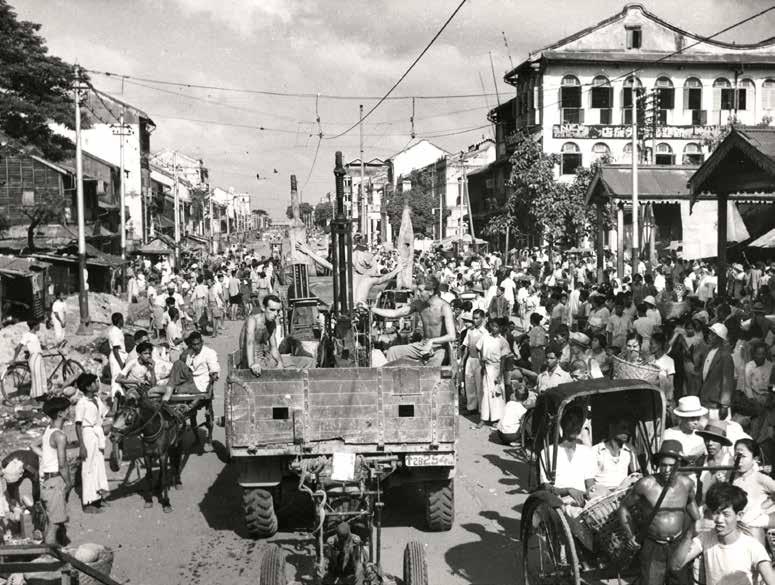
In his memoirs, Dr. Ba Maw—who would eventually escape to Japan where he lived in a Buddhist monastery before being briefly imprisoned by the Allies—claimed to have played a role in dissuading the Japanese hierarchy from defending Yangon
27 May 2015 TheIrrawaddy
Clockwise from previous page, bottom left: Airmen of the first contingent of the RAF Regiment to land in Yangon collect Japanese-issued bank notes as souvenirs with the help of a local boy, circa May 1945; light anti-aircraft guns of the RAF regiment being transported along a crowded Dalhousie Street (now Maha Bandoola Road) on the way to Mingaladon airfield, circa May 1945; landing barges unloading troops onto a beach of the Yangon River, seen from an aircraft, on May 1, 1945.
ALL PHOTOS COURTESY OF THE AUSTRALIAN WAR MEMORIAL
to the last, including a plan to turn the Shwedagon Pagoda hill into a militarized defensive post.
‘Operation Dracula’
When first devised by the supreme Allied commander in Southeast Asia Lord Louis Mountbatten in mid-1944,

the plan for an air and amphibious attack on Yangon before the next year’s monsoon season appeared ambitious. However, major Allied gains in central Myanmar under Lt.-Gen. William Slim—the same commander who had overseen the British withdrawal in 1942—meant the Yangon offensive, codenamed “Operation
Dracula,” could swing into action.
The huge invasion force that assembled near the mouth of Yangon River, including aircraft carriers, cruisers, destroyers and battleships, would make the largely unimpeded offensive appear almost anticlimactic.

With a battalion of Gurkha paratroopers sent ahead of the main

FEATURE 28 TheIrrawaddy May 2015
Clockwise from top left: An aerial view of Yangon’s damaged waterfront; Yangon Central Jail in early May 1945 where Allied prisoners of war were detained by the Japanese. Food and medical supplies descending by parachute are visible in the top right of the photograph; buildings at Yangon University damaged in attacks by Allied bomber aircraft.
force on May 1, Allied troops began landing along opposing banks of the river the following day.
By May 3, more than three years since it had fallen to the Japanese, the country’s colonial and commercial center had been reoccupied.
Although the city was spared the worst excesses of the war, much of
its infrastructure lay in tatters. Major structures including the port, the central railway station and buildings of Yangon University were damaged or destroyed.
Historical photographs show the city’s devastated dockside strewn with rubble and twisted metal. Piles of rice sat rotting on the wharves and now

useless Japanese-issued currency was scattered on the streets.
The retaking of Yangon may not loom large in the collective memory of its residents today, but various sites and structures—reconstructed, absent or neglected—evoke the period when the city stood at the crossroads of conflict, colonialism and independence.
The Botataung Pagoda, destroyed by a misguided allied air raid in November 1943, was rebuilt and today attracts worshippers of a spirit shrine dedicated to the woman who led its restoration.
The city’s central railway station, the largest in the country, was also rebuilt while the Yangon Central Jail, with its long prison wings arranged like the spokes of a wheel in the same architectural model as the notorious Insein Prison, has since been demolished.
Many of the former capital’s colonial edifices—including the famed Secretariat building that Theippan Maung Wa worked in before the war— while scarred, remain intact.
While Operation Dracula’s success did not signal the immediate end of the war in Myanmar, the Japanese occupation was effectively broken. But although the British were back and claiming, according to Lt.-Gen. Slim, that their return was welcomed “almost without exception,” the colonial project was terminal.
29 May 2015 TheIrrawaddy
Piles of rice sat rotting on the wharves and useless Japaneseissued currency was scattered on the streets.
‘We Must Try to Make Things Better’
By KYAW ZWA MOE / YANGON
Aformer second vice-chairman of the All Burma Federation of Student Unions, U Aung Din was jailed from 1989 to 1993 for participating in the pro-democracy uprising in 1988. After traveling to the United States, he worked as executive director of the US Campaign for Burma between 2003 and 2012, and was involved with the Free Burma Coalition for two years. He talks to Kyaw Zwa Moe about reforms, the evolution of the United States’ foreign policy toward Myanmar and the prospects for free and fair elections.
What is your view on changes to US foreign policy on Myanmar since the new government took power?
Many years ago, the United States policy on Myanmar focused on the human rights situation. These days, the US takes three factors into consideration. Human rights is still important, alongside economics and geopolitics. The US would like to have a government that is friendly toward it in Myanmar, while it is trying to counterbalance the rise of China in the Asia-Pacific region.
Considering these factors, they believe that their engagement policy is right. There may be unexpected difficulties and setbacks in pursuing this policy, but they will not reverse from it, they will only push ahead. At the same time, they are expecting a free and fair election in 2015. If the election is free and fair, the legislative landscape will be stronger in 2016. There will be larger democratic forces and ethnic forces in the parliament. The parliament will be stronger than it is in its current term— at least, I expect so. To make it happen, the US administration is taking steps to support the 2015 election.
From Washington’s point of view, what kind of country is Myanmar?
I recently talked with a senior figure in the US administration. He said they regard our country as a normal one. We have a government, opposition, government supporters and supporters of the opposition. There are conflicts, and sometimes violence and crackdowns, but these are quite normal in many countries. There are daily protests in his own country. [He said] they no longer regard our country as a failed state where there is conflict between the oppressed and the dictators; they regard our country as a normal state because things happening in our country are not unusual. [He said] the Myanmar government now understands that they can’t demonetize banknotes or use the army in dispersing demonstrations, and that the army can’t launch a coup, and if they do not break these rules, the international community has no reason to interfere in the country’s affairs.
At the same time, many student protesters have been arrested recently, with the government reacting in the same manner as it did 20 years ago.
The international community, including the US and UN, opposed this brutal crackdown. But their declarations only used words like “regret” and “disappointment.” No statement used the words “condemn” or “denounce.” In declarations, the choice of words expresses severity.
You mean that the international community has completely toned down its voice?
They have changed the way they think. They will engage constructively with the government. They will tell the government secretly that it is doing wrong, but they will not publicly condemn it.
What are the major achievements and failures of the reform process?
There has been the creation of institutional mechanisms. The government is responsible to the parliament; the judicial system is responsible to the president and the parliament. These institutions are not perfect, but there is a framework. This is a very good thing. The military regime in the past was responsible to nobody.
Political prisoners have been released and opposition forces including Daw Aung San Suu Kyi were able to join the political fold. There has been an emergence of civil society organizations. The government has admitted the need for internal peace and to fight poverty.
The bad things are that there are opposing factions within the government and the Union Solidarity and Development Party, even as the top leaders wish for change. The president is not decisive. There are many bad guys in the cabinet. In fact, some of the cabinet members are tarnishing the president’s dignity and he can’t take decisive action against them. Racial and religious tensions are very high and they may break out into riots.
The political atmosphere today is in accord with what was set out by
INTERVIEW
30 TheIrrawaddy May 2015
the military regime. In many ways it seems things will not change and those in charge have maintained the upper hand.
It is difficult to say that. They have divided themselves. In the past, the military was a single entity. Now it has divided between the military and the USDP. The USDP has been divided in government. Under the constitution, the president and ministers are not allowed to discharge party duties once they join the cabinet. Even if the influence of former Snr.-Gen. Than Shwe prevails, it is not that big. Now
I see some USDP members who would like to listen to the voices of the people. We need to mobilize more of them. We need to be prepared to cooperate with anyone, if they have a desire for the development of the country.
You are a former political prisoner. During your time in the US, you were very critical of the Myanmar government. How do you assess the government now?

As I became an individual activist, I took a look at both sides—the government and the democratic forces. And I
found that there are both good and bad people in the government. Previously, I thought it was full of bad guys and I was surprised to see that there are also good guys. And this is welcoming. Then I take a look at the democratic forces, which I had joined with in the past. In the past, all of them were good guys. Now, there are shades of grey in both sides.
Now is the time we need to rebuild the country. If we go on like this with these tensions, it will only delay the rebuilding of the country. We are obliged to make things better, building on the current situation. We can’t just be sitting and doing nothing but blaming. Now is the time we need to grasp any available opportunity out of the current situation and make things better. We have got breathing space, which is beneficial to both sides.
Do you see any possibility of a true civilian government in the next five to 10 years that will be elected through free and fair elections?
I think it is unlikely. We might need to wait 20 more years. I myself was a hardliner. I studied revolutions in Eastern Europe. In those cases, the dictators were toppled by public uprisings, then elected governments came to power. But those elected governments were not competent and there were corrupt persons among them. The problems left by the former dictators grew larger and the expectations of people diminished. This was followed by economic decline. Finally, people overthrew the governments they had elected themselves and the country became unstable. Egypt is the closest example. I don’t want our country to end up like that. I don’t think it is possible to scrap the entire system and build a new one. Even if a new system could be built, there is a high risk the system will return to dictatorship, like in the case of the Soviet Union.
The two sides must make compromises, coordinate and cooperate. There should not be a “winner takes all” concept any more.
U Aung Din: “There should not be a ‘winner takes all’ concept any more.”
31 May 2015 TheIrrawaddy
PHOTO: STEVE TICKNER / THE IRRAWADDY

The Lonely Capital
Timo Jaworr ventures through Naypyitaw


 By
By
FEATURE
34 TheIrrawaddy
THE IRRAWADDY ALL PHOTOS: TIMO JAWORR
Clockwise from above: A young policeman leans on a barrier on the street that leads to the Parliament complex of buildings at the heart of Naypyitaw. The Uppatasanti Paya is modeled on the Shwedagon Pagoda in Yangon, and is one foot shorter than the original. A Westerner runs along a street in the midday heat. Empty streets.


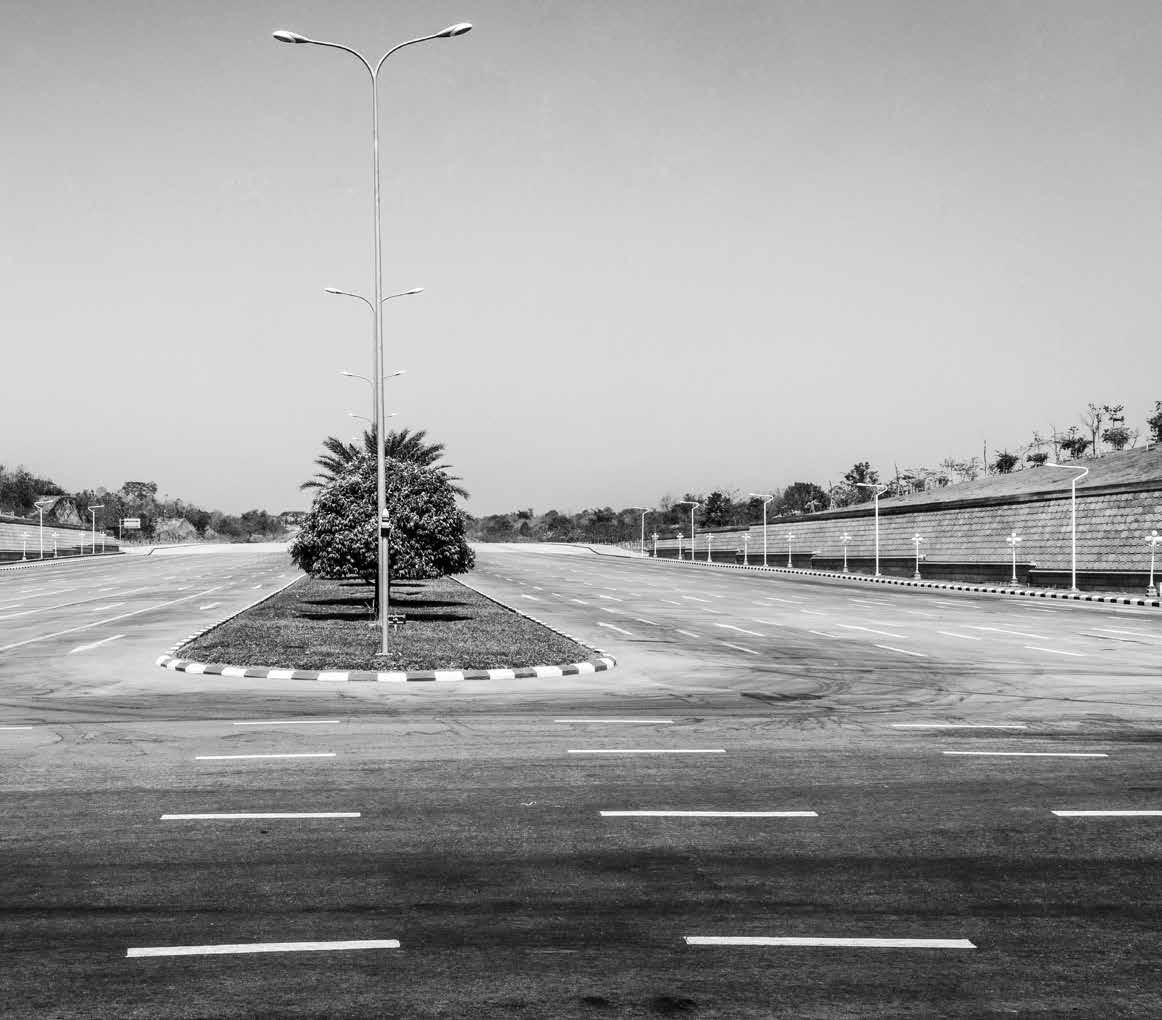
Since the fall of Bagan to Mongol invasions in the late 1200s, Myanmar has relocated its capital city at least 14 times.
Before the British made Yangon the country’s preeminent city in 1886, the capitals were always in the interior.
For hundreds of years, the central dry zone was at the heart of Bamar culture and the location for the home of its royal rulers.
So when thousands of civil servants were trucked a few hundred miles north from Yangon to the secret site of Naypyitaw on the lower edge of the dry zone in late 2005, they likely understood the symbolism.
The new capital Naypyitaw, or “Abode of Kings,” was about going back to the future.
But almost 10 years later, the job feels unfinished in a city still situated uneasily in time and space.
Sitting on former farmland devoid of historical landmarks, the city lacks a sense of tangible connection to the past.
Monumental new buildings, manicured parks and zoned areas connected by vast roads empty of traffic suggest a future that still has not arrived.
There are modern hotels, shopping malls, golf courses, parks and resorts. The internet works well. The air is fresh, the environment green.
Some call it peaceful. Others find it lonely. The throngs of people that are the lifeblood of other Asian towns are nowhere to be seen.

Our photographer wanders from here to there, looking for clues to the city’s elusive heart.

FEATURE 36 TheIrrawaddy
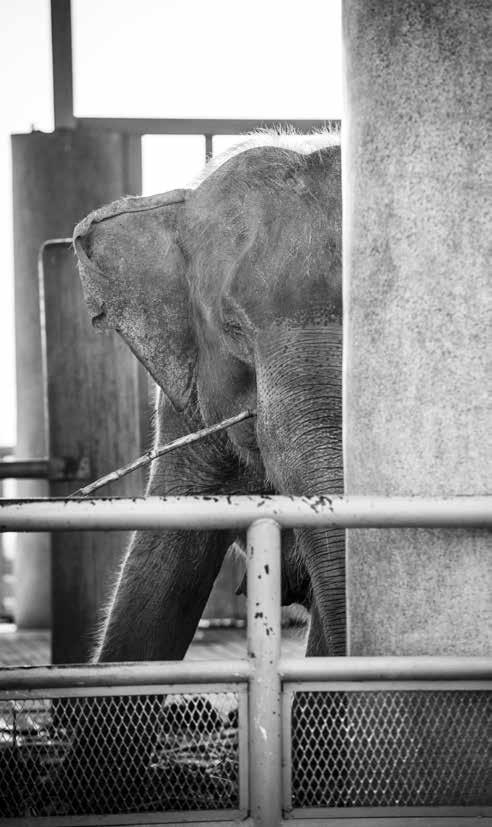
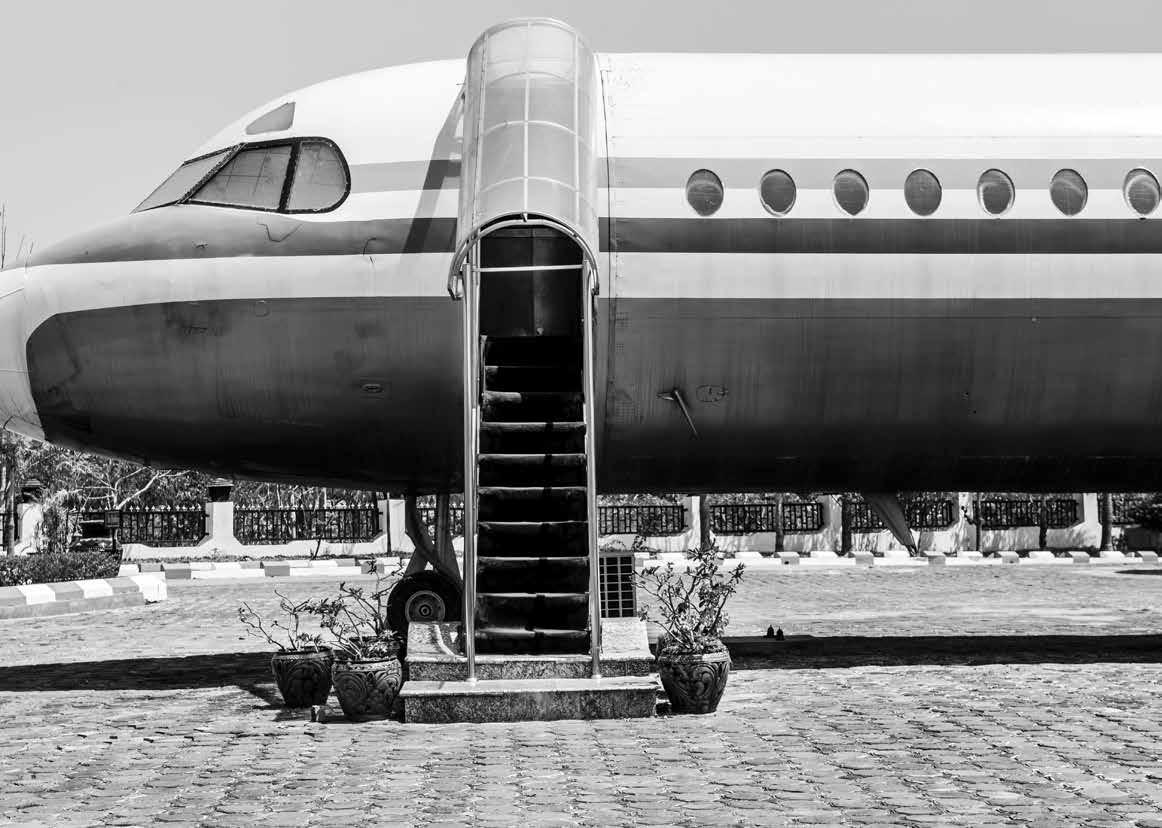
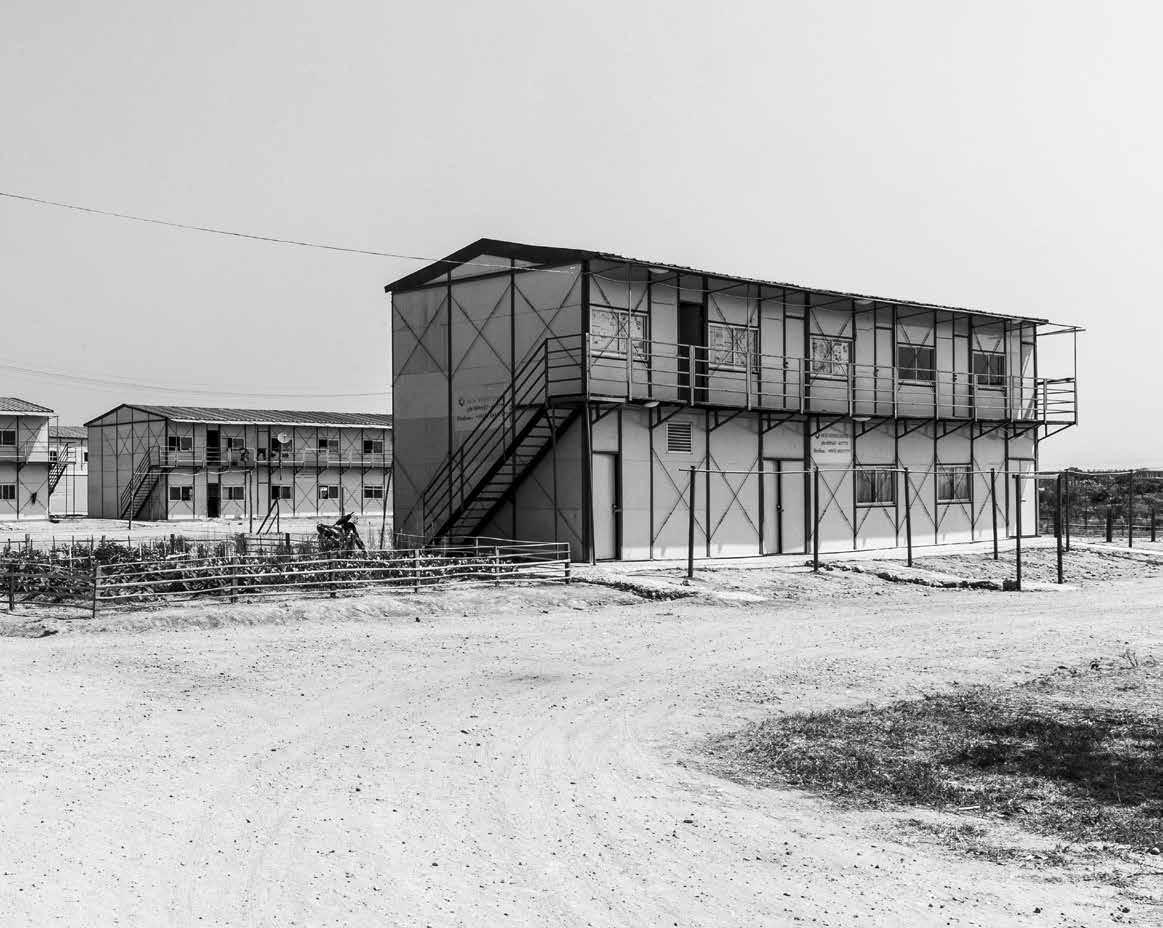
Clockwise from above: A Naypyitaw license plate. Motorists in the city travel along wide roads that are virtually empty. White elephants are chained in a pavilion at the foot of the Uppatasanti Paya. In a resort in Hotel Area 1, an old airplane is used as a restaurant. Laborers take constant care of the flowers, bushes and trees that line the city’s roads. Apartment homes for government workers.


38 TheIrrawaddy
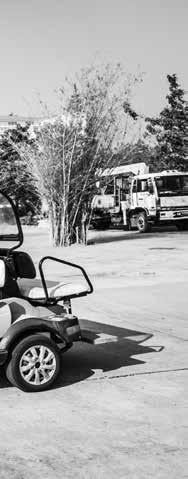
Clockwise from above, top: A female worker waters plants at a golf course. Visitors at a hotel are transported around in a buggy. Smartly dressed women use a bank machine. Policemen from various locations live in barracks for stints of a few weeks or months while they work to man the city’s large network of checkpoints. Villagers live in bamboo homes a few hundred meters from a large shopping mall.







No. 1-A / 3, 28th Street, Between 52nd x 53rd Streets, Mandalay. (One block away from Rupar Mandalar Resort) Tel: 09-910 48506, 09-500 2151 www.littlemandalay.com E-mail: littlemandalay@gmail.com ...truly Mandalay ...simply quaint...
Winner
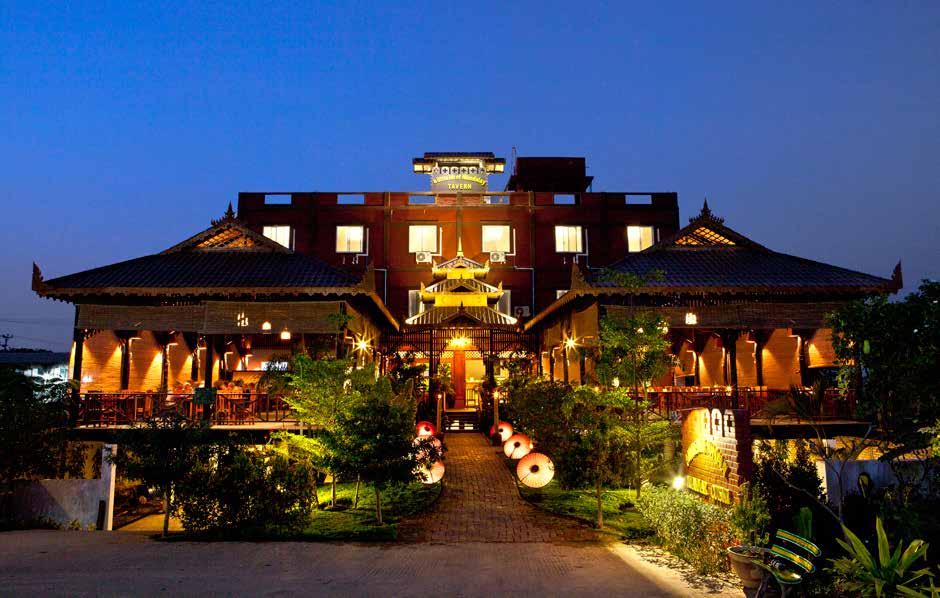
‘A little bit of Mandalay’ Tavern + Restaurant Try the taste that makes “A little bit of Mandalay” the right choice in Mandalay. • Restaurant since 2002 • Tavern with 24 Twin Rooms • Restaurant capacity 180 Pax • Myanmar and Chinese Cuisines • Home-cooked curries & more • Packed Lunch Boxes available for Cruises & late flights.
2014
of ‘Certificate of Excellence’ by TripAdvisor
GOLD: Still a favorite among consumers

THE COWS THAT KEEP ON GIVING
DAIRY PIONEER GOLD ORGANIC MARKET
Business
ALL PHOTOS: HEIN HTET / THE IRRAWADDY
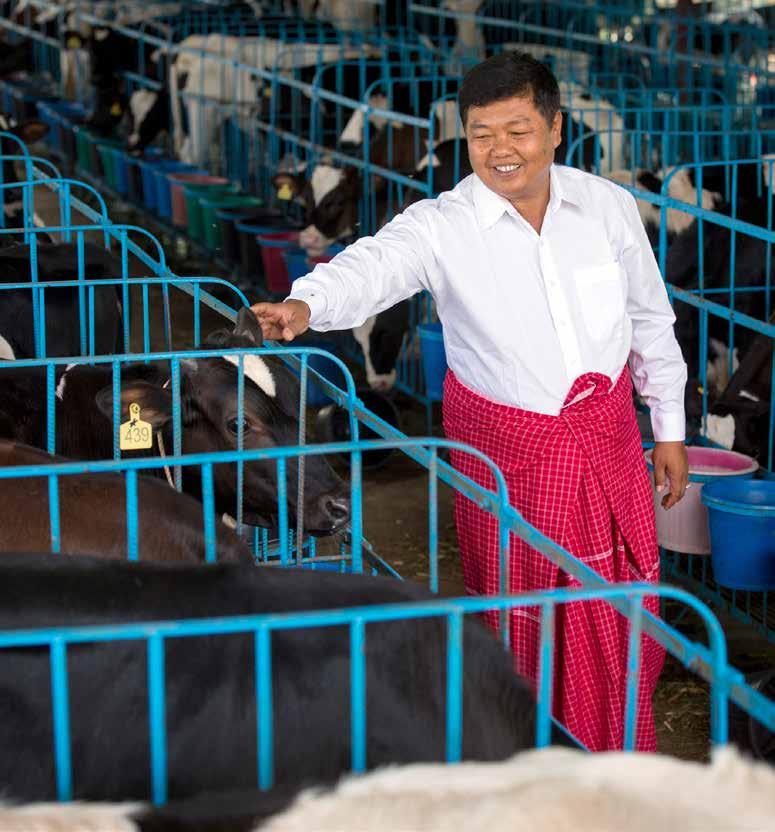
U Than Myint transformed a childhood love of cows into a thriving business.
By SAN YAMIN AUNG / YANGON
As a child, U Than Myint rarely played with toys other than a small wooden cow he had since he was four.
He bought a real cow at 14 and now, 40 years later, his affection for the animal on which he has built a successful business remains undiminished.
“Since I was young, I loved cows very much. I didn’t have other interests, I just loved to keep cows,” U Than Myint recalled, sitting in a gazebo at his
42 TheIrrawaddy May 2015
A childhood passion for cattle has turned into a thriving dairy business for U Than Myint
BUSINESS DAIRY
farm in a Yangon suburb where around 1,000 of his milking cows, a Holstein Friesian cross-breed, are housed in cattle sheds.

Born in a small village on Bilu Gyun Island near the Mon State capital of Mawlamyine, U Than Myint’s passion for cattle likely came from his grandfather, U Pho Thaung, who had kept around 100 cows in the state’s Kyaikmayaw Township.
However, after the military seized power in 1962 and sought to nationalize
farmland, U Pho Thaung decided to offload his livestock. Initially, he didn’t want his family to follow him into farming.
“He was concerned that if we were connected with farming and cows we’d be ill-fated like him,” U Than Myint said. “So I kept my first cow secretly.”
When U Pho Thaung did eventually learn of his grandson’s genuine interest in rearing cows, he happily offered advice on how best to manage and care for them.
Today, U Than Myint’s “TM Dairy Farm” is the country’s largest, distributing 3,000 one-liter bottles of milk daily with the help of 70 workers.

New Frontiers
When U Than Myint began selling fresh milk in the 1980s, he owned about six cows.
“At that time… all condensed milk houses were owned by Chinese and Indians. They didn’t raise cows like

43 May 2015 TheIrrawaddy
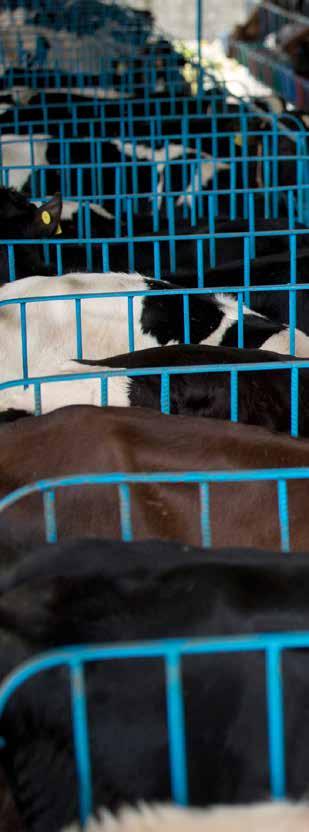
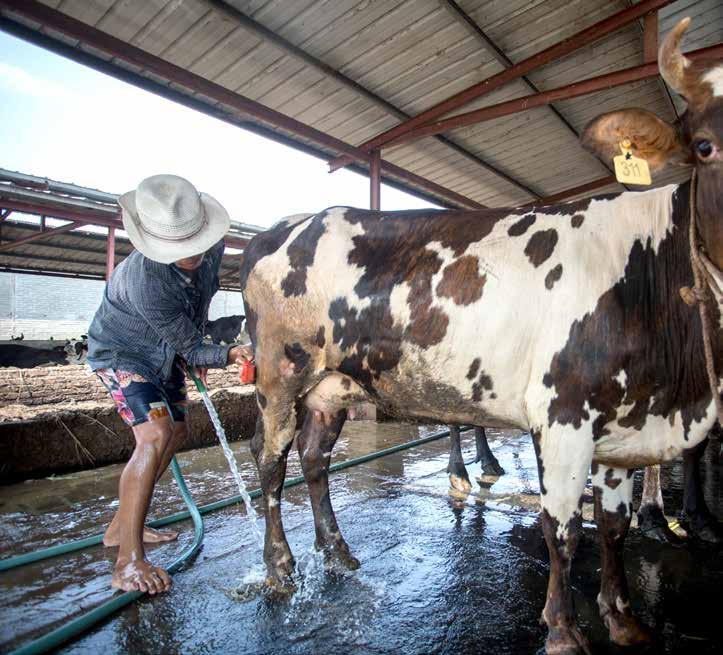
Clockwise from previous page: A worker gives a cow a bath. Grass for the cows is grown nearby. New sheds at the dairy farm.
us. They just bought milk from us and made profits from that. But we didn’t make profits like them although we devoted ourselves to keeping cows,” U Than Myint said.

His hobby would soon become a burgeoning business and in 1991, he founded a condensed milk house in Chaung Sone Township. Eight years later he owned 100 cows, but began to face challenges; the small market wasn’t meeting his supply.
“There were only two things to consider,” U Than Myint recalled. “Reduce my cows or move to a bigger market.”
Reluctant to relinquish any of his precious cattle, he made the decision to shift his operations to the then-capital Yangon.
“I wanted to develop my business and also desired to move to a metropolis so my sons could gain experience and knowledge there,” he said.
After searching for suitable farmland for nearly one year, he received the official documents granting him permission to leave his native town and move to Yangon. He and his family settled on their current property at Htauk Kyant in Mingaladon Township in 2000.
“All the other dairy farms were bigger than mine when I first arrived,” U Than Myint said. Dairy farms including the Chinese-owned Fun Hwa and Super Cow had around 400 cows.
He sold fresh milk from his car in downtown Yangon twice a day and sent condensed milk to regular customers in Mawlamyine.

In 2005, he launched pasteurized products using the brand name “TM,” his initials, and began targeting the bigger retailers like City Mart supermarkets.
Top Quality
More than 10 local dairy products, including Fun Hwa, Pyin Ma Pin, Super Cow, Walco and Silvery Pearl, were already prominent in the market at that time. As the newcomer, U Than Myint had to work hard to be competitive.
“I maintained the best quality and sold at lower prices than the others,” he claimed, adding that he used only
44 TheIrrawaddy May 2015
BUSINESS DAIRY
Clockwise from above: A worker manually milks a cow. Bottles of milk are placed in ice crates. Milk churns are set to be transported by truck to customers.
natural milk from his farm and didn’t mix his products with water, or with milk from other sources.
TM’s efforts at providing quality milk have not gone unnoticed.
Dr. Khin Maung Oo, deputy director of the Livestock Breeding and Veterinary Department under the Ministry of Livestock, Fisheries and Rural Development, said that an expert from New Zealand had recently evaluated Yangon’s local milk products. The expert, who works on a dairy cattle breeding development project between the two countries, collected a number of local dairy products in March and took them for testing in a Bangkok laboratory.
“It turned out that TM milk is the best [in quality],” Dr. Khin Maung Oo said.

U Than Myint was also awarded the President’s Excellent Performance Award in 2014 for his 40-year devotion to the dairy industry, although he said the government had not extended any assistance to cattle owners like him.
Expansion
Some 15 years since relocating to Yangon, TM Dairy Farm now boasts 1,200 cattle and U Than Myint has opened another farm in Naypyitaw, with 50 cows.
Wary of balancing the demands of his business with the welfare of his livestock, U Than Myint has continued to explore better ways to care for his animals.
With the help of one of his sons, he hit upon a more advanced type of cow shed used in the United States. While they’re not cheap at 2 billion kyat (around US$1.95 million), for U Than Myint the sheds, which house 250 cows, are worth it.
“Although my farm became the biggest one in the country, the systems we are using here are not modernized like internationally,” he said. “I’m now building a modernized cow shed. In there, I can give them better facilities and they will have more space to walk and to lie down.”
U Than Myint’s passion for the animals not only helped him win over his skeptical grandfather, but also his wife.
Daw Tin Swe said that while others may have stopped raising cows in difficult times, her husband was stubborn and would be more likely to sell the family jewels than let go of his stock.

“In 1980, I told him not to keep cows anymore because it was really tiring. We were failing our social duties since we couldn’t go out or close the farm for a day,” she said.
But his lifelong devotion is something she has grown to accept.
“He loves cows very much,” Daw Tin Swe said with a smile. “So I just leave him to do his hobby and support him.”
45 May 2015 TheIrrawaddy
Daw Tin Swe says her husband would rather sell the family jewels than let go of his stock.
Gold Demand ‘Remains High’
By KYAW HSU MON / YANGON
Purchasing gold has long been a way for Myanmar people to accrue secure savings, particularly in the absence of an efficient banking system. Today the gold market remains steady in a country with stilllimited access to financial services. U Kyaw Win is the secretary of the Myanmar Gold Entrepreneurs Association, senior vice president of the Myanmar Gold Development Public Company and the owner of the U Htone gold shop. In this interview he offers his assessment of the local gold market.
When did you start your business and what were the main early challenges?
My father [U Htone] started working in the goldsmithing industry more than 80 years ago, when he was aged 17. Gold has been our family business ever since. In 1994, I opened the first U Htone gold shop, and I opened another in 2000.
As far as I recall, when I was a high school student, the price for one tical [16.33 grams] of gold was only 200 to 300 kyat. At that time, selling gold ornaments was the only money-maker for us. But five to 10 years later, gold prices reached 3,000-4,000 kyat per tical.
Under the Burma Socialist Program Party (BSPP), there were continuous rumors about the demonetization of the kyat and gold prices were extremely volatile. People purchased a lot of gold when they heard those rumors, especially around 1985-86. At one stage, the gold market was so strongly affected that I stopped all sales in Yangon.
The government demonetized the 100, 75, 35 and 25 kyat notes in that period. People then thought they should purchase gold. Even when the military
government announced it would print new 1,000 and 5,000 kyat notes in 1995 and [2009], gold prices stayed high. Also when the government raised civil servant salaries, gold prices still increased.
When the civilian government took power, they fixed the exchange rate and gold prices stabilized. People now know how and when to invest in gold because of information in the media.
When did Myanmar people begin accruing gold for future investment?
Since the time of the royal dynasties, Myanmar people have saved gold. People have long loved to wear gold at events, as well as to save it for longterm benefit.
After the Second World War, people were even more interested in gold. Although the banking system has recently become more active, the custom of saving gold will not disappear as people still love it. It is a [savings] method that can always reap benefits.
When were gold prices at their peak?
The peak time was around the first Iraq
war in the early 1990s; world oil prices increased as well as gold prices. The price of gold increased from around US$33 to $1,900 per ounce in 2010. After 2010, gold prices declined again and are now at about US$1,100 per ounce. I don’t think prices will fall soon. Gold on the Myanmar market increased to 800,000 kyat per tical when the world price was about $1,900 per ounce. It has declined to about 680,000 kyat per tical now. But the price in Myanmar hasn’t declined as significantly as the world price, due to inflation here.
How does inflation affect the gold price?
I think it’s because of the weak

46 TheIrrawaddy May 2015
BUSINESS INTERVIEW
banking system here. In other countries, when they sell or buy property, they don’t need cash. But here, [physical] cash is essential for
everything. With more economic growth, the cash requirements are greater and inflation is also rising. We need a lot of [physical] money
The custom of saving gold won’t disappear. People love gold.
while we’re buying or selling gold. We also have different installment practices for buying property, so we need more cash flow in the market. When the government prints more money to meet requirements, inflation increases.
How is the gold production rate in Myanmar at present?
It’s possible that gold production will decline soon as current production levels are massive. It’s amazing that gold can be found in all 14 states and regions, although the production rates are different. Myanmar gold production could be among the highest in ASEAN. However, natural resources will run out sooner or later. The production of rubies, jade and gems is decreasing in Mogok and Hpakant right now. But gold production is still quite good as there are new gold plots around the country and demand remains high.

ADVERTISEMENT
ALL PHOTOS: SAI ZAW / THE IRRAWADDY
How is the gold market performing in relation to people’s spending power?
The gold market is still stable. Businessmen usually obtain gold for their savings before they start their business. For example, some usually buy gold before export season begins then later sell this gold and spend the money on their business. But [this alone] doesn’t increase demand significantly. Normally supply and demand balances. And we are surrounded by markets in countries like India, China and Bangladesh who like gold. So the market remains active, even when sales are not legal. This means that even when the domestic market is slow, the border trade can be energetic.
Do you think demand for gold will rise after the increase in government salaries in April?
Government salaries will be affected from the end of April so I can’t say right now what will happen. Some people say that the gold price will increase with increased salaries, but for me, yes, it will increase but only a very small amount. Because of the US exchange rate, the gold price has already increased even before the salary rise. If world gold prices increase, the local price will also go up, not so much because of higher demand in the local market.
Do you think the gold market might be impacted with the introduction of Myanmar’s first
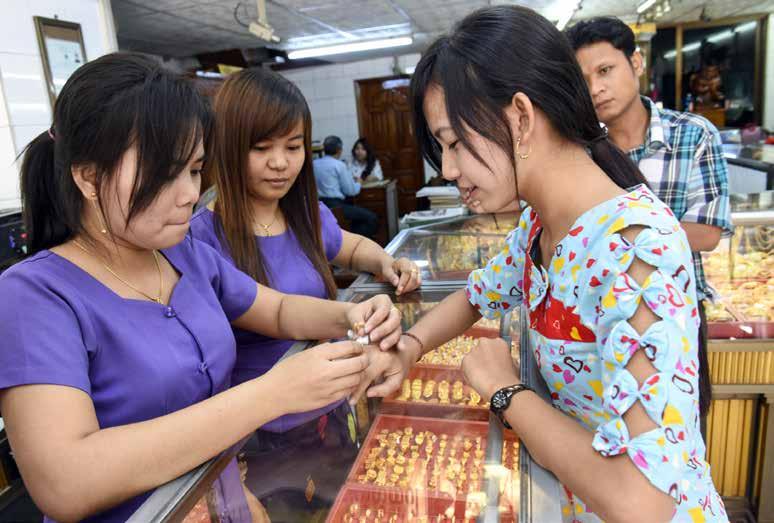
stock exchange later this year?
Recently people were strongly interested in investing in property, rather than buying gold, as the world gold price decreased over the last two years. But I don’t think people will be less interested in investing in gold due to the stock market. The gold market will also be an important part of the stock exchange, as the nature of the stock market is that it welcomes a variety of commodities. The items are different, so they will sell at different share prices. It will also take time for people to learn about the stock market, but they already know about the gold market and can even guess [future fluctuations]. That’s why the gold market won’t decline at that time.
48 TheIrrawaddy May 2015 BUSINESS INTERVIEW
Gold is still a popular investment
‘Safe Food’
Market Gains Fans
Chemical-free fruits and vegetables attract health-conscious consumers
By NYEIN NYEIN / YANGON
Only a few shops are open in Bahan Township’s unusual bazaar at 6:45 am on a Saturday, when a onceweekly market offers a rare selection of fruits and vegetables for customers concerned with food hygiene and safety.
The “Safe Food from Safe Farms” market is an initiative of the Myanmar Fruits, Flowers and Vegetable Producers and Exporters Association (MFVA) to ensure access to clean, natural and delicious produce.
The market’s dozen or so vendors don banners showing where their farms are located: Naypyitaw; Hlegu, Bago Region; Nyaung Htone, Ayeyarwady Region; Aung Pan, Pindaya and Ywar Ngan in Shan State.
U Zaw Min Tun, the manager of an organic farm in Naypyitaw owned by the Dagon International company, said that while the new market isn’t yet making much profit, he’s glad to be among

the pioneering merchants bringing organically produced food into the fold. Dagon International, which has been using organic farming methods and cultivating chemical-free crops on some 100 acres of land since 2011, supplies hotel restaurants in Naypyitaw, but those who shop at the Yangon market get a better bargain. U Zaw Min Tun said clients in the capital pay about double for the fresh, local products.
All the farms in the Safe Foods network are regularly inspected to ensure that they are chemical-free and produce natural foods through sustainable practices. The MFVA can “guarantee the safety” of all of the market’s foodstuffs, according to secretary U San Lin.
“It’s not that the vegetables sold here are one hundred percent organic,” he said, “but what we recommend here is safe food.”
Unfortunately, he added, the 33
farms in the network are not yet ready to mass produce organic foods, but they will be in time. Organic agriculture requires pure soil, seeds and water sources, which poses problems for many farmers in Myanmar whose lands are near industrial sites. “Even if the farmers don’t use chemicals, they can be affected,” U San Lin said.
The MFVA has been providing technical support since 2010 for farmers who want to go natural, but they still have a long way to go bef0re they can produce certifiable organic produce.
In the last two months, the Safe Foods market has gained in popularity.

“I am careful about eating healthy food,” said Daw Thwin, 67, who takes a daily walk in Bahan and shops at the market every Saturday. “We are reluctant to buy fruits at regular markets out of fear of chemicals, but here we don’t have to worry.”
Food safety has always been an issue in Myanmar, but consumers often have little choice when it comes to safe food at reasonable prices. Media attention to excessive chemical use has also helped make the public aware of health risks associated with certain foods.
As Daw Thwin hung around waiting for more shops to open, she had just one suggestion for making the market more successful.
“It could open earlier for the many people who get up and do exercise at Kandawgyi Park,” she recommended. Vendors said the city traffic slows things down, but they hope to be able to meet consumers’ needs.
The market is open every Saturday at Myay Padethar Kyun, near the Garden Mart and Education Center in Bahan Township.
ALL PHOTOS NYEIN NYEIN / THE IRRAWADDY
49 May 2015 TheIrrawaddy FOOD
A shopper checks out the fresh produce at the Saturday ‘Safe Food’ market.
Packages of chilli on sale at the market
A man uses his mobile phone on a bridge in central Yangon. Foreign direct investment in Myanmar grew sharply during the 2014-15 fiscal year, reaching a record US$8 billion, a more than doubling of FDI compared to the year before, according to the Myanmar Investment Commission.

“We expected $4 or 5 billion, but at the end of the fiscal year the figures have risen to a record of $8 billion,’’ said U Aung Naing Oo, directorgeneral of the Directorate of Investment and Company Administration (DICA) and a member of the Myanmar Investment Commission (MIC).
DICA figures indicate that the oil and gas sector attracted $3.2 billion in FDI; the transport and telecommunication sector saw investments rise to $1.6 billion, closely followed by manufacturing with $1.5 billion. Real estate and hotels and tourism were the fourth and fifth sectors receiving most FDI, with $780 million and $357 million respectively.
In the 2013-14 fiscal year, which ends on March 31, Myanmar attracted about $3.5 billion in FDI, half of which flowed into its labor-intensive manufacturing sector.
Singapore-listed companies comprised more than half of the investment volume in 2014-15 with a combined total of $4.2 billion, reflecting an apparent trend of managing local projects remotely from the investment haven, particularly for oil and gas projects. Hong Kong-based firms were the second-largest investors with $850 million, followed by China-registered companies with $516 million, according to the DICA. —Kyaw Hsu Mon
HAGL Seeks New Investor
Vietnamese conglomerate Hoang Anh Gia Lai (HAGL) is reportedly targeting Hong Kong and Singapore firms as it seeks a new investor for a massive real estate development on the eastern shore of Yangon’s Inya Lake.
A deal for Singapore-based Rowsley Ltd to buy a 50 percent stake in the project fell apart in April, with blame placed on Myanmar’s high levels of tax.
The companies announced the deal, which would have seen the Singapore company invest US$275 million in the mixed-use project, in February. But, in an announcement to investors on April 3, Rowsley company secretary Kannan Malini said, “The Company will not enter into the proposed joint venture as the conditions precedent under the Heads of Terms Agreement have not been satisfied,” without going into details.
HAGL said that the deal had broken down because Rowsley wanted to invest directly in HAGL’s local subsidiary Hoang Anh Gia Lai Myanmar Company Ltd, rather than investing indirectly by buying shares in the group’s Vietnamese joint stock company.
“Since the current tax rate applied to the profit from capital transfer in Myanmar is so high [40 percent], Hoang Anh Gia Lai could not accept the suggestion of Rowsley,” said the HAGL statement, signed by acting general director Vo Truong Son.
The report said the failure to reach an agreement with Rowsley would not impact the project. “The office building and hotel are still slated to open this June,” it said, “while the shopping center will likely open in September.” —Simon Lewis
Trade Deficit Jumps as Imports Rise
Myanmar’s trade deficit jumped 88 percent in the last fiscal year, state media and a commerce ministry official said in April.
Myanmar imported more than US$16 billion of goods and exports totalled more than $11
billion in the 2014-2015 fiscal year, leaving a deficit of more than $4.9 billion, the Global New Light of Myanmar reported.
A senior commerce ministry official put the previous year’s deficit at $2.6 billion.
Capital goods such as construction materials for infrastructure projects accounted for about 40 percent of imports, while fuel made up 30 percent and consumer goods 20 percent, the official said. —Reuters

50 TheIrrawaddy May 2015 FDI Soars
BUSINESS SIGNPOSTS
Workers at the Vietnam Hoang Anh Gia Lai (HAGL) construction site in Yangon in 2013.
PHOTO: REUTERS
PHOTO: REUTERS
Thai Construction Firm Looks for Projects

Thai construction giant Ch Karnchang may soon enter into infrastructure developments in Myanmar, a senior executive told the Bangkok Post newspaper.
A report published by the English-language daily in April said that the firm was conducting a feasibility study on possible investments in Myanmar, citing Vorapote Uchupaiboonvong, executive vice-president for accounting and finance.
“There are many opportunities in Myanmar, and we’re ready to take the initiative, but the study must be completed before we enter the country,” Mr. Vorapote said.
Ch Karnchang is the developer of the controversial Xayaburi hydropower dam on the Mekong River in Laos. According to the Bangkok Post, the director said the company was likely to focus its investment in Myanmar on the Yangon area.
A subsidiary of Ch Karnchang, TTW Public Company, is conducting a study on a tap water project in the Mon State capital, Mawlamyine, the report said. —Simon
Lewis
Suzuki to Enter Thilawa
Japanese automaker Suzuki will build an assembly plant in the Thilawa Special Economic Zone (SEZ), according to Japanese media.
A report from media group Nikkei said that the company had secured a 20-hectare plot of land inside the zone.
The factory would be Suzuki’s second in Myanmar. In 2013, the company restarted its Yangon factory, which assembles a small number of light trucks.
According to Nikkei, Suzuki’s new plant could begin production in 2017, employing about 300 people.
“Suzuki will assemble imported parts at the plant,” the report said. “Initial output is seen at roughly 10,000 cars a year. It could produce the Ertiga, a seven-seat compact, among other models there.” —Simon Lewis
ADVERTISEMENT 51 May 2015 TheIrrawaddy
A worker at the Thilawa SEZ project outside Yangon
PHOTO: REUTERS
Counting Tigers
India’s rising number of big cats may be a victory only on paper
By KATY DAIGLE / SUNDARBAN TIGER RESERVE, India
At first, the numbers seem impressive: India’s tiger population has gone up 30 percent in just four years. The government lauded the news as astonishing evidence of victory in conservation.
But independent scientists say such an increase—to 2,226 big cats—in so short a time doesn’t make sense.
They worry an enthusiastic new government under Prime Minister Narendra Modi is misinterpreting the numbers, trumpeting false claims of a thriving tiger population that could hurt conservation in the long run.
“The circus is not necessary,” said tiger expert K. Ullas Karanth, science director for the Wildlife Conservation Society in Asia. “All of this tom-tom’ing and arm-waving, claiming we’ve had stupendous success, is ridiculous and unscientific.”
The first numbers were released in January. Last month, the government offered details of the data.
Even as scientists begged caution in presenting the count, India’s government doubled down. Environment Minister Prakash Javadekar again boasted of a 30 percent population increase. And Prime Minister Modi rounded that up, saying tiger numbers had seen “about a 40 percent increase. Feels good to hear it!”
The Numbers Game
If only it were true. This census differs in an important way from earlier tallies: It estimates India’s entire wild tiger population, while preceding counts focused only on cats in sanctuaries and reserves.
“I’d prefer to say there are 30 percent more known tigers, rather than say there is actually an increase in tigers. We might not have counted them all earlier,” said Anurag Danda of the World Wildlife Fund in the Sundarbans, one of many groups that participated in the census.
A 30 percent increase within four years is implausible. Though tigers have high birth rates, they also have high natural death rates, and factors such as habitat loss and poaching haven’t slowed. At least 110 tigers were killed in 2011-14, barely a drop from the 118 poached in 2007-10, according to the Wildlife Protection Society of India.
Globally, experts believe the best that can be hoped for is a 50 percent increase in the world population over 10 years—a much more modest rate of growth.
Such incongruities have happened before. India claimed a 17 percent increase between 2006 and 2010, even while tiger habitats shrank by some 40 percent.
But while Danda interprets the latest numbers more conservatively than some government officials, he agrees they show that conservation efforts appear to be working: “Otherwise, how come we have so many tigers outside the tiger reserves?”
India is by far the world leader in protecting tigers, spending more resources and money than any other country. For decades it has faced immense challenges, from habitat loss and human encroachment to poaching, disease and pollution. Still, India manages to keep about 70 percent of the world’s wild tigers on less than 25 percent of the world’s tiger habitat.
That’s partly a credit to its vast rural population, which long ago learned to live in relative proximity to the secretive beasts.
If India can protect tigers, despite a human population 1.26 billion strong, that proves any country can do it, conservationists say.
“But they can’t relax. And that’s my biggest worry about this latest census and the way it’s being presented,” said Alan Rabinowitz, head of Panthera, a New York-based big-cat conservation group. “The worst outcome of that is it allows development and business interests to say, ‘We’ve been doing really well. We can pull back a bit.’”
Desperate to develop its economy and alleviate widespread poverty, India faces intense pressure to convert forests for roads or industrial use, or to allow polluting factories or mining operations near forest reserves and water supplies. Conservationists worry more of those projects will be green-lighted around tiger habitats if the cats are seen to be thriving. The government has already cut the Environment Ministry’s 2015-16 budget by almost 25 percent, with funds for tiger conservation dropping 15 percent.
Over the weekend, the Supreme Court allowed for the widening of a 10-kilometer (7-mile) road between two tiger sanctuaries in central Madhya Pradesh—work its own appointed committee warned would irreparably damage critical wildlife habitat and invite heavy traffic that might mow the animals down.
When India says it now is home to 2,226 tigers, what it is giving is an estimate — a best-guess based on a technique called index-calibration that combines small-scale cat counts and, through complex calculations, extrapolates them to a national total. Those counts are conducted by various groups— forest rangers, independent scientists, tiger charities— through various means, including photographing individual tigers and analyzing tiger droppings and paw prints.
The technique, which India adopted in 2006, is by no means perfect. An Oxford-led study published in February
REGIONAL
52 TheIrrawaddy May 2015
by the journal Methods in Ecology and Evolution suggested the data collection was too erratic for adequately predicting cat populations in areas outside census monitoring.
Scientists also question the absence of independent oversight in the government-organized census. And some say that one census every four years is not enough.
“The criticism of the census is rubbish,” said Rajesh Gopal, who headed the government’s National Tiger Conservation Authority from its
beginning in 2006 until January, when he joined the Global Tiger Forum.
“Out of the 2,226 tigers estimated in this census, we have photographic evidence for about 1,500 individuals, or 70 percent. And the statistical models are state-of-the-art. The detractors are not being very fair,” he said.
Gopal agreed, however, that the government is overstating things by saying the overall population had grown 30 percent. “These are just the numbers we know of right now. We can’t say anything beyond that.”
Conservation Efforts
Experts praise India for maintaining corridors for the tigers to move between sanctuaries and cracking down on poachers, including giving some state forest rangers the right to shoot suspected poachers on sight. Patrolling has improved in the country’s 47 tiger reserves, covering less than 2 percent of India’s total land mass, or about 53,500 square kilometers (20,700 square miles).

But India could do more, scientists say, such as establishing prey populations and anti-poaching patrols on some 300,000 square kilometers (116,000 square miles) of unprotected forest that is otherwise suitable as tiger habitat.
India’s greatest conservation strength may be its human population. Villagers long ago learned to live alongside the predators and appreciate their importance to maintaining order within an ecosystem—for example, by keeping deer populations in check so they don’t devour trees and plants. Though they are among India’s poorest people, many villagers would sooner adjust their own behavior in the forests than see the big cats disappear.
In the vast deltas of the eastern Sundarbans region, Nepal Sardar wears two faces while searching for honey— one trained to the trees and looking for bees, the other painted on a mask strapped to the back of his head staring down any tigers that might approach. The mask works, he explains, because the stealthy tigers generally prefer to attack from behind.
Another villager, Anita Mondol, echoed many others in saying she lives in terror of tigers roaming into villages and attacking livestock. The tigers will swim kilometers between islands and ambush people on land. She worries one might break through the woven-thatch roof of her hut, enter her home and carry someone away. It has happened before to villagers she knows. She is certain it will happen again.
Still, “if it weren’t for the tigers, there would be no forest,” the 41-yearold said. “And with no forest, there would be no place for us.” —Associated Press
Raja, an eight-year-old rescued Royal Bengal Tiger, rests inside South Kahayar Bari tiger rescue centre at Jaldapara Wildlife Sanctuary, about 160 km (99 miles) north of the eastern Indian city of Siliguri in Feb. 2010.
53 May 2015 TheIrrawaddy
PHOTO: REUTERS
Nightlife: Hummingbird Creates a Buzz

Lifestyle
The Collector
Art enthusiast and gallery owner Ko Sid is backing local painters to shine at home and abroad
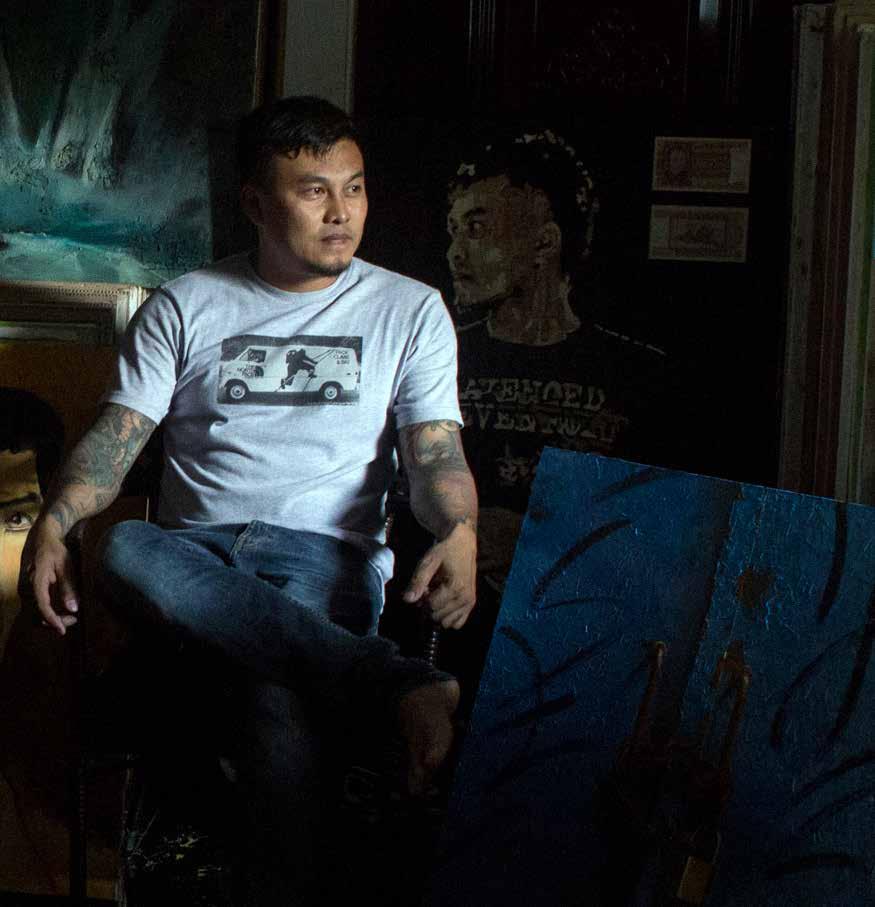 By KYAW PHYO THA / YANGON
ALL PHOTOS: HEIN HTET / THE IRRAWADDY
ART MUSIC HUMOR
Stoutly built and covered with tattoos across his arms and torso, Ko Sid, at first glance, has the imposing look of a gangster.
His haunts are not dodgy bars, however, but Yangon’s art galleries where the affable art lover is a familiar face talking to artists young and old.
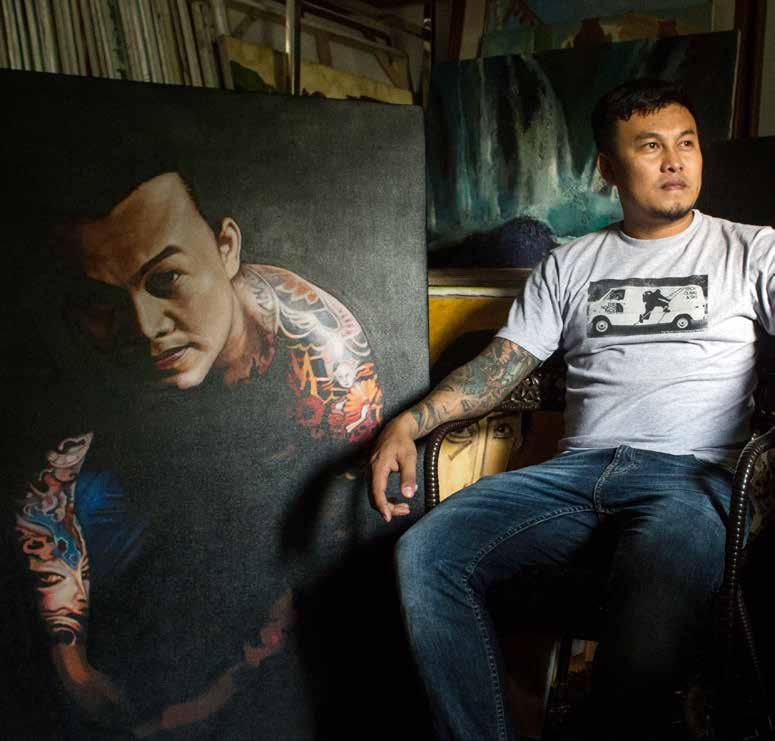
Ko Sid is one of a handful of young art collectors-cumdealers in Myanmar endeavoring to introduce the works of the country’s emerging contemporary painters to a wider local and international audience.
“After being a tattooist for three years, I made friends with lots of painters here, probably thanks to my childhood interest in art,” Ko Sid said. “I bought my first
painting in 2010 and since then, buying paintings I like has been an addiction.”
Among his more than 1,000-strong collection, now worth around US$1 million, some of his favorite works include paintings by Myanmar masters like Lun Gywe, Kin Maung Yin and Win Pe Myint.
“It’s fun to have the paintings you like,” he told The Irrawaddy during a visit to his home in a Yangon suburb. “Sixty percent of them are my favorites. Forty percent are for business.”
In his downtown “Myanmar Ink Art Gallery,” which he opened in 2011, Ko Sid regularly showcases the paintings of promising local contemporary artists such as Pho San, Khin Aung Khant and Aung Naing.
56 TheIrrawaddy May 2015 LIFESTYLE | ART
“If you want to collect the paintings of young artists, you need to have a gallery to promote their works,” he said. “It is for the survival, not only of you, but for the painters, to keep both parties doing what they want to do. I want to promote promising artists of the same generation as me.”
The veteran artist Win Pe Myint remembers Ko Sid as a young man with a great interest in art who visited him frequently over the years.
“He is a good-natured guy with a huge respect for artists and he always gives a helping hand to painters in need. I have never heard of him exploiting artists,” Win Pe Myint said.
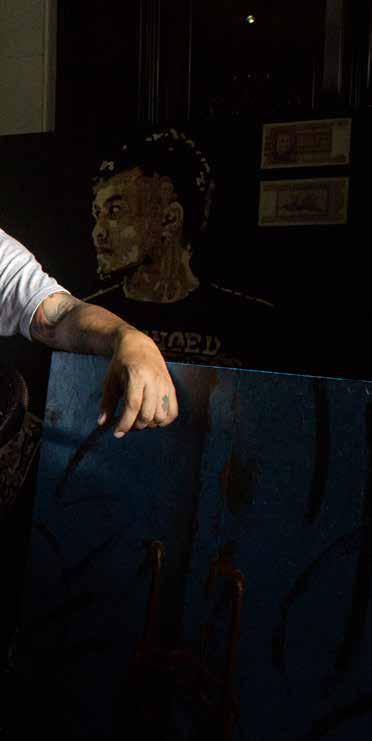
Even during the country’s long isolation under nearly five decades of military rule from 1962-2010, Myanmar
art managed to reach the outside world, sometimes with the help of art dealers who smuggled paintings out of the country.
Galleries in Chiang Mai, Hong Kong and Singapore impressed international art enthusiasts with periodic exhibitions of contemporary works from one of the most oppressed countries in the world.
Now with the gradual opening of Myanmar’s economy in recent years, the country’s contemporary art market has hit the ground running. While large art galleries and dealers remain scarce, the number of smaller galleries has been on the rise.
With more foreigners visiting Myanmar each year, uncovering the country’s true potential in the creative industries is a must, according to a report on the local art market by local consultancy firm Thura Swiss.
“Myanmar’s art business has the potential to grow exponentially, not only because of its small start, but simply because of the wealth of skills and talents of its artists,” the report said.
This is where Ko Sid comes in.
After five years dealing in art, he rarely has money in his pocket—all his earnings have gone back into building his collection.
“In this business, you can’t only look for money. You need perseverance,” he said. “But I believe all of my efforts will not be fruitless. Someday they will make a good return, when the artists I’m now promoting become prominent.”
In support of the promising young artists of today, Myanmar Ink Art Gallery is holding regular local exhibitions year-round, and is exhibiting works overseas.
From 2014, Ko Sid has been involved in international art fair exhibitions in Dubai on three occasions, becoming the first Myanmar art gallery to participate there.
“It’s a new market for Myanmar artists, compared to Hong Kong or Singapore, where there are no longer new frontiers for Myanmar paintings,” he said. “During my first trip to Dubai, people showed great interest in our paintings even though they had no idea where Myanmar was until I mentioned Daw Aung San Suu Kyi’s name.”
His willingness to explore new markets has paid off. During the latest exhibition in Dubai this year, he sold nine paintings out of 15 up for sale, mostly by emerging artists, as well as earning plenty of new contacts.
“Now I’m dreaming to have an art gallery out there,” Ko Sid said. “Even though I’m thinking of expanding to other cities, I need to build firm bases here in Myanmar and the UAE.”
Although the local art market has strengthened in recent years, Ko Sid said, there are less than a dozen serious local collectors. Buying paintings for appreciation is still in the nascent stages in Myanmar, where the country’s per capita GDP is around US$1,105, one of the lowest in East Asia and the Pacific.
“Given this trend, we could lose our country’s cultural treasures. But we see no other options yet. The current situation is still workable for artists, dealers and buyers,” he said.
57 May 2015 TheIrrawaddy
Mixing it up
By KYAW PHYO THA / YANGON
When Thxa Soe debuted with his album “Yaw Thama Hmwe” in 2006, Myanmar listeners were awed. For many, it was a revelation that traditional folk songs could be blended with Western electro music.
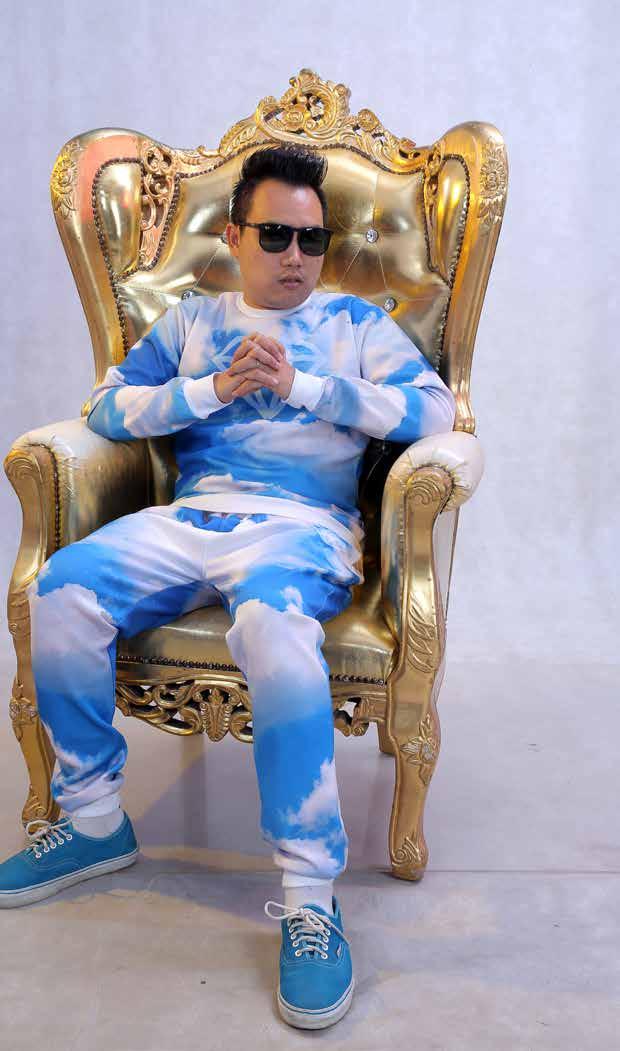

But it wasn’t so tough. Both musical forms share lively rhythms, and Thxa Soe’s lively mixes have meant his songs are embraced both among urbanites and in the countryside, where local Top 10 songs are rarely popular. The 35-year-old musician spoke with The Irrawaddy’s Kyaw Phyo Tha about his music, his views on piracy in the music industry and local artists’ obsession with doing cover songs.
How did you get the inspiration to blend traditional Myanmar folk songs and electro music?
Basically it all started with my indomitable spirit. I went to London to study music in 2001. During the classes, I hardly found any popular original Myanmar music to play. All the songs I had were covers. I felt quite ashamed [for the lack of originality].
Through reading, I learned that our local music had flourished right back to the Bagan era. I was very curious to know what kind of music they were listening to or playing then. Luckily, I had access to the British Library in London and I found some Nat Doe, a lively Myanmar traditional music with strong beats performed at Nat Pwe [traditional spiritual musical performances]. At the time, I was studying dance music. I was surprised to find that they share, in some ranges, the same tempo. Then the idea popped into my mind that it would be great to mix them. I went back to Myanmar in 2003-04 to travel upcountry, and did some more research on Nat Doe. Afterwards, I released “Yaw Thama Hmwe” [meaning “mixed”] in 2006.
That was quite revolutionary at the time. What was the response?
Some people liked it. But I was hugely criticized, too. I was labeled as “someone who ruined Myanmar traditional music.” I had never been condemned like that before. But for me, what I did was something like dressing up a Myanmar girl in Western clothes. So I have kept doing that kind of music and now I have six albums under my name.
What do you think of the music you have produced so far?
I have not changed, but people’s views have. I have earned applause from senior people from the traditional Myanmar music circle. As I’m one of the few young musicians interested in traditional music, they have even advised me on what songs I should choose. Now, I have been asked to write music for a state-level event. For example, the Minister of Immigration and Population requested last year that I write a theme song for the nationwide census gathering and for the SEA Games in 2013. Before that I was banned from performing.
You have complained a lot about pirated music albums here. What is the current situation on music piracy?
Piracy has been a cancer for the music industry here since around 2003. Even though we have tried to fight against it, we still can’t overcome the problems. We reformed the Myanmar Music Association in 2011 and organized an anti-piracy team of which I’m the secretary. So far we have seen some light at the end of the tunnel. Due to the team’s efforts, we saw a doubling of local album sales. Despite the government’s cooperation in antipiracy, it would be much better if they were more helpful.
LIFESTYLE | MUSIC
May 2015
Compared to other art forms, Myanmar music gets little international recognition. Why?
Because most of the musicians here have no shame—they sing cover songs as if they were their own.
I have been an anti-cover song artist, so many people in the industry here hate me. But the more Myanmar is exposed to the international community, the more they should be careful about what they are doing.
Basically, as an artist you must have your own creation. What mostly happens here is that people either do cover songs or take some parts of music from international hits to blend into their own. They know very well it is unethical, but they just keep doing it as it doesn’t require much effort. Plus, it is easy money.
What about your international performances? How did the audiences out there respond to your music?
Last year, I performed in Vietnam where I was invited by BBC World. In 2013, I toured in Europe. I found they liked my music. For them, this kind of mix of traditional and electro is not very strange; they already know African-techno mix music. But they responded heartily to my music as it is very lively and good to dance to.
Do you think the Myanmar music industry will leave cover songs behind some day?
I see a growing number of young artists trying to make their way with their own creations. They still can’t overcome those who make cover songs using international hits. It’s very sad. But if they keep up what they are doing, they can make it. The situation will be better, I think, probably in the next five years.
59 May 2015 TheIrrawaddy
Poking Fun at the Powerful
Famed for their fearless satire, The Moustache Brothers are still entertaining visitors from a makeshift home stage
By ZARNI MANN / MANDALAY
Just south of the heart of Myanmar’s secondlargest city, a small group of foreign tourists huddle together under a dim streetlight. Behind them is a large signboard with “Par Par Lay’s A-Nyeint Troupe” written in big blue Myanmar characters.
Lu Maw, brother of the late comedian Par Par Lay, comes outside to greet the visitors.
“While you are waiting for the show, please enjoy these,” he says, handing out laminated articles in English, French and German about the famous local comedy trio known for poking fun at those in power.
Lu Maw, Lu Zaw and Par Par Lay performed together as The Moustache Brothers for over 30 years, often attracting the ire of authorities for their satirical performances on everything from government mismanagement to the daily hardships of ordinary citizens.

The eldest of the three, Par Par Lay, passed away in 2013.
At 8:30 pm, Lu Maw invites the tourists inside his home which, by night, transforms into a small makeshift theater. Dozens of photos and posters of the comedy trio, together with bunches of Myanmar marionettes, line the living room walls.

With microphone in hand, Lu Maw introduces himself and his homeland in broken English, gesturing at a map and explaining about the country’s many ethnic groups, his favorite of which are the Karen, he says, before breaking into a Karen-style dance.
Holding a photo of US President Barack Obama embracing opposition leader Daw Aung San Suu Kyi, Lu Maw exclaims that he would like to kiss the US first lady Michelle Obama as a kind of square-up. The audience erupts in laughter.
“But you know, I didn’t get the chance since Mother Suu has already
LIFESTYLE | HUMOR
60 TheIrrawaddy May 2015
kissed President Obama again when he came here for the second time,” Lu Maw says sadly, producing another photo of the opposition leader with the president to the sound of more laughter.
The hour-long show is lively throughout, with jokes on corruption, the judicial system and the parliament, and dancing featuring Lu Zaw, his wife, sisters, nieces and even his youngest four-year-old granddaughter.
For their topical satire that often criticized the military government, the group faced the wrath of the authorities, with Par Par Lay imprisoned on several occasions. Since 2001, the trio was banned from performing in public.
Unbowed, however, they turned their small home on a nondescript Mandalay street into a tiny theater, attracting a constant trickle of expectant foreign tourists.
While government surveillance of The Moustache Brothers eased
following the by-elections in 2012, so too did the interest of local fans.
“We feel we lost some spice in our mood,” Lu Maw tells The Irrawaddy. “Before, we could throw the jokes and criticisms directly to the [local audience] where they could reach directly to the government and have some affect.”
Clockwise from previous page: Lu Maw and Lu Zaw before a show. Performers gesture to the audience from the small makeshift stage. Lu Zaw performing U Shwe Yoe, a humorous Myanmar dance often performed at donation services and religious events.
But he remains happy entertaining foreign visitors, he says, and having an outlet to show off his talents. As if to show he’s lost none of his political edge, Lu Maw holds up a placard with the words “Amend Constitution.”
“People spoke out with their desire to amend the constitution, but the government turns a deaf ear,” he says.
Since the death of Par Par Lay, the leader of The Moustache Brothers, Lu Maw and Lu Zaw have continued to perform their distinctive a-nyeint pwe—a traditional Myanmar performance combining dance, music, singing and comedy that can last up to seven hours.


Although these days, the shows miss some of Par Par Lay’s charm, they are still crammed with the same fearless and irreverent humor and insight.
“Since Par Par Lay is not here, side by side with me on stage, I always feel like something is missing,” Lu Maw says.
61 May 2015 TheIrrawaddy
ALL PHOTOS: TEZA HLAING / THE IRRAWADDY
Hummingbird creates a buzz
A globe-trotting chef serves creative cuisine in a charming setting
By CLAUDIA SOSA / YANGON
dreamt up the menu, he was most definitely doing so in Spanish. I can just picture the slender Kiwi chef in dream land, traipsing all over Latin America, taking a little guacamole from here, a little chimichurri from there, and re-creating traditional dishes using local Myanmar ingredients, along with a US$26 imported steak or two.
The menu covers everything from empanadas to ceviche, along with some creative pairings, such as salmon cubes served over a mango puree and topped with green onion. Mr. Third has been “cheffing”–as he likes to call it–for 37 years in places as diverse as Zanzibar and Belize, and as much as he loves different flavors, it all comes down to keeping things simple.
“I love the simplicity of food,” he says, and the dishes at Hummingbird excel when he heeds his own words. Take the ceviche ($7), which is classically done, initially sour, then moderately spicy and perfectly textured. In Mr. Third’s words, “It’s a very simple dish to do, but it’s a very simple dish to get wrong.” He gets it right, and his ceviche is not even the tiniest bit tough.
Similarly, the sea bass ($14) is accompanied by a remarkable beetroot risotto. Presented on a bed of chimichurri, the taste is rich but at no point overpowers the fish, and the grains are creamy, never clumpy.
Some of the most innovative pairings, however, such as the prawn and watermelon dish adorned with random bits of dried coconut, fall a little flat.
We hope you don’t mind a bit of construction,” said the pleasant female voice on the other end of the phone. I paused to wonder whether she knew I lived in Yangon. If the threat of digestive mayhem isn’t enough to dissuade me from eating at any number of street stalls,
“
there was no way some bare walls and plastic sheeting would keep me from stopping by at the much buzzed-about Hummingbird, which I visited in its pre-grand-opening iteration.

Hummingbird is named after the delicate creature known for its rapid wing movement, often found in South America. When Chef Wayne Third
Overall, though, the cuisine is solid, the dishes are beautiful to look at, and the chef has his heart in the right place. Especially when it comes to dessert. Mr. Third can talk about Latin America for hours, but you can’t get the French pastry chef out of him. Hummingbird is already doling out sumptuous chocolate tarts and lemon meringue pies, and there were whispers of in-house sorbets to come.
Hummingbird’s renovators have gone out of their way to preserve and rediscover some of the building’s original characteristics, and the
LIFESTYLE | RESTAURANT REVIEW 62 TheIrrawaddy May 2015
place offers high-ceilinged, dimly lit, leather sexiness and an open rooftop patio with great potential and charm.


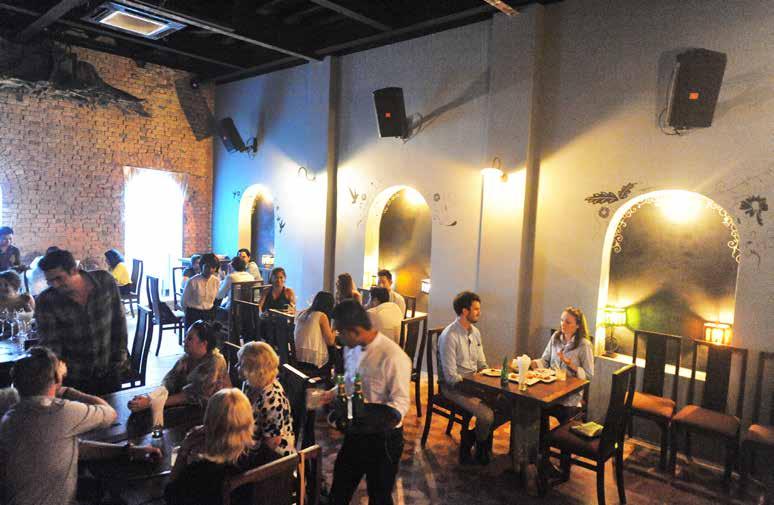
In its pre-opening appearance, it seemed to me as though the place has fused together an amalgam of Yangon’s existing successes—the font and style of Port Autonomy’s menu; the ginger beer and vodka-based cocktails that made Union such a success; and the dark, wooden and leather furniture set atop rescued colonial-era tiles at Gekko—all under one roof.
It may just be a question of finishing the renovations, but I do have to believe there’s more than one winning combination possible in Yangon, and that a place like Hummingbird can arrive at that magical combination of delight and surprise, in and out of the kitchen.

ALL PHOTOS: STEVE TICKNER / THE IRRAWADDY
63 May 2015 TheIrrawaddy
Hummingbird is located at 76 Phone Gyi Street in Yangon’s Lanmadaw Township.
Yangon saddles up
Horse riding becomes more affordable at a newly opened club
By SAN YAMIN AUNG / YANGON
Lovers of horse-riding rejoice: the country’s first public course has opened in Yangon’s Hlegu Township.

Aspiring riders with cash to splash can choose from courses catering to both novices and seasoned gallopers.
The steep cost of horses suitable for riding—around 4 million kyat (US$3,890) each—has previously kept the sport out of reach to all but the ultra-wealthy.
U Win Aung, an executive member of the Myanmar Equestrian Federation (MEF), said he hoped to
entice more people into horse riding by providing a relatively affordable option at the newly founded Kyi Thar Aye Mya Riding Club.
“There are some private riding clubs at the moment and some people raise horses out of affection for them, in some regions,” he said. “But riding courses haven’t been opened for the wider public before, because of the cost and time needed to train and keep horses.”
U Win Aung opened the course on April 4. It employs three instructors, each of whom won medals for equestrian events in the 2013 Southeast Asian Games. Training
costs 150,000 kyat (US$145) for a two-month course.
“We are also planning to offer club memberships,” U Win Aung said, adding that these will be offered once construction of a café and bar is finished.
Various forms of horse riding sank into obscurity in Myanmar after former dictator Gen. Ne Win banned horse racing, despite being an enthusiast of the sport.
During the late years of the Myanmar monarchy and during the colonial era, gambling on horse races was a popular pastime.
The new riding club is banking on a resurgence in equestrianism, offering a range of courses including dressage and show jumping in the hope of sending recruits off to compete on the world stage.
“I would like to coach my trainees to be skilled enough to send to international competitions,” said U Win Aung.
Ma Nay Chi, a 22-year-old Yangon resident beginning her training at the club, said she hoped to enter competition once she has mastered the art of horse riding.

“After I’ve finished the basic training, I will continue until I am skilled in show jumping,” she said.
An Equestrian Academy is also slated to open in Naypyitaw and Yangon at the end of the year, with the support of the International Federation for Equestrian Sports.
BACKPAGE | LEISURE
ALL PHOTOS: HEIN HTET / THE IRRAWADDY
64 TheIrrawaddy May 2015
Riders step out at the new club in Yangon
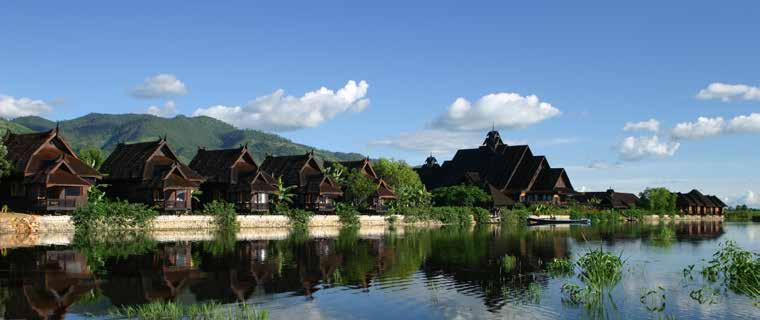





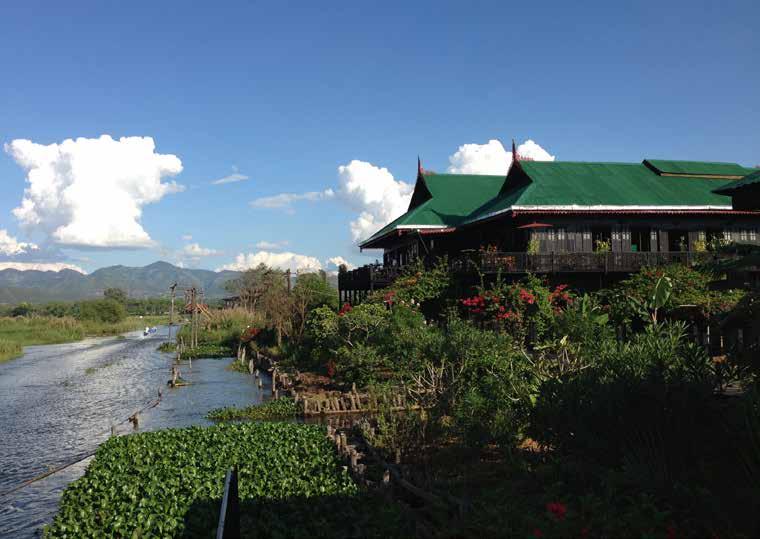




Magyizin Village, Inle Lake, Shan State, Myanmar Tel & Fax: +(95-81) 209055/ 209364/ 209365/ 209412 Mobile : (95-9) 525 1407, 525 1232 A restful retreat to nature on Inle Lake surrounded by Shan Hills Preserving our heritage to transmit to the future generation as received from ancestors Inpawkhon Village, Inle Lake, Shan State, Myanmar. Reservation: +95 - 9 4931 2970 Mobile: +95 - 9 528 1035 Email: intharheritage@gmail.com