

SPECIAL REPORT KOKANG www.irrawaddy.org
March 2015 SAVING YANGON HERITAGE ON THE LINE In Person: Pu No Than Kap Daw Khin Kyi: An Abiding Influence Tracking a Mission to Destroy Opium Crop Travel: Dawei’s Beaches and Beyond
TheIrrawaddy


TheIrrawaddy
The Irrawaddy magazine has covered Myanmar, its neighbors and Southeast Asia since 1993.

EDITOR-IN-CHIEF: Aung Zaw
EDITOR (English Edition): Kyaw Zwa Moe
ASSOCIATE EDITOR: Sandy Barron
COPY DESK: Paul Vrieze; Andrew D. Kaspar; David Kay; Feliz Solomon; Sean Gleeson

CONTRIBUTORS to this issue: Aung Zaw; Kyaw Zwa Moe; Kyaw Phyo Tha; Zarni Mann; Kyaw Hsu Mon; Yan Pai; Bertil Lintner; Marwaan Macan-Markar; William Boot; Lawi Weng; Wai Yan Hpone; Claudia Sosa; Simon Lewis; David Hopkins; Nora Swe; Neils Larsen; Nyein Nyein; Yen Snaing; Saw Yan Naing; Feliz Solomon; Sean Gleeson.
PHOTOGRAPHERS: JPaing; Sai Zaw; Hein Htet; Teza Hlaing; Steve Tickner
LAYOUT DESIGNER: Banjong Banriankit
SENIOR MANAGER : Win Thu (Regional Office)
MANAGER: Phyo Thu Htet (Yangon Bureau)
REGIONAL HEADQUARTERS MAILING ADDRESS: The Irrawaddy, P.O. Box 242, CMU Post Office, Chiang Mai 50200, Thailand.
YANGON BUREAU : Building No 170/175, Room No 806, MGW Tower, Bo Aung Kyaw Street (Middle Block), Botataung Township, Yangon, Myanmar. TEL: 01 388521, 01 389762
EMAIL: editors@irrawaddy.org
SALES&ADVERTISING: advertising@irrawaddy.org

SUBSCRIPTIONS: subscriptions@irrawaddy.org
PRINTER: Chotana Printing (Chiang Mai, Thailand)

PUBLISHER LICENSE : 13215047701213
53
A laid-back atmosphere and stunning beaches are among the charms of the southern town
56
Daw Khin Kyi’s Abiding Impact
The mother of Daw Aung San Suu Kyi was a major influence on her daughter’s life
60
Low-lying southern forests are all that stands between one of the world’s rarest birds and extinction
62
Bar With a Bite
Spicy cocktails, tasty fare and bloodred decor give The Blind Tiger an atmosphere all of its own
64
Backpage: Gokteik Viaduct
Myanma Railways is offering tourists a new travel experience over the canyon
4 TheIrrawaddy March 2015 Contents 6 | In Person Peace-building: A Chin Perspective 8 | Quotes and Cartoon 10 | News Highlights 12 | In Focus 14 | Viewpoint LIFESTYLE
| Dawei and
Beyond
|
|
Last Stand in Tanintharyi
|
|
Vol.22 No.3
MAIN PHOTO : Soe Zeya Tun / Reuters INSERT: JPaing / The Irrawaddy
SPECIAL REPORT KOKANG www.irrawaddy.org TheIrrawaddy March 2015 SAVING YANGON HERITAGE ON THE LINE In Person: Pu No Than Kap Daw Khin Kyi: An Abiding Influence Tracking a Mission to Destroy Opium Crop Travel: Dawei’s Beaches and Beyond
FEATURES
16 | Snapshot Kokang: The Unfolding of a Crisis
18 | SPECIAL REPORT Kokang: The Backstory

The Special Region in Shan State has a complex history of feuding warlords and drug production
22 | On a Mission: Destruction of Opium
In the remote mountains of northern Shan State, an ethnic armed group is taking on the drug trade
26 | Personality: Game Changer
Yangon-born Rich Cho is making his mark on US basketball and encouraging local passion for the sport

30 | Guest Column: Being Bamar


A reflection on identity, and on some of its costs
34 | COVER Saving Yangon
The clock is ticking for the city’s future
41 | Interview: Property Market ‘Still Strong’
44 | Manufacturing: Cheap Labor Comes at a Price
Myanmar has the second-lowest labor costs in the world
46 | Agriculture: Chinese Firm to Boost Rice Industry
Joint venture will provide loans and upgrade equipment
48 | Signposts: Corporate Tax Payers Get Warning
REGIONAL
50 | Sri Lanka: Shining Moment for Democracy
How the ballot box triumphed to usher in a new order
5 March 2015 TheIrrawaddy
BUSINESS
P-16
P-60
P-41
P-62
Peace-building: A Chin Perspective
President U Thein Sein’s government hoped to sign a nationwide ceasefire accord with various ethnic armed groups on Feb. 12, Union Day. Bogged down by lingering unresolved differences and imperiled by intermittent clashes between a handful of ethnic armed groups and the Myanmar Army, as with past target dates, Union Day came and went with no deal reached. Naypyitaw has signed bilateral ceasefire agreements with more than a dozen armed groups since 2011, but a nationwide deal remains elusive.
Pu No Than Kap, the chairman of the Chin Progressive Party and Chin national affairs minister for the Sagaing Region government, spoke to Kyaw Zwa Moe, the editor of The Irrawaddy English Edition, about obstacles to an agreement and the way forward.
groups all have different opinions on the matter.
For me, I accept any type of dialogue— four-party or six-party or 12-party talks and so on. I am not so rigid as to stick to only one form. The important thing is that the talks be genuine. The outcome should be fruitful for our country. Without dialogue, I don’t think we can get any results. Even the last time, when we 48 political and ethnic leaders met with the president, Daw Aung San Suu Kyi and the commander-in-chief of the military, I think we managed to have a dialogue to some extent. Each of us could share our perspectives. That, at least, is a good outcome from such a meeting.
How important is political dialogue for our country?
Why is it taking so long to sign a nationwide ceasefire agreement? What
are the major hurdles?
In my view, both ethnic groups and the government desperately want a ceasefire. However, something is wrong somewhere. I don’t want to put blame on anyone in particular. The president has taken steps and opened the door. I think ethnic groups welcome his move, because everyone accepts the fact that fighting all the time has served no one’s interests.
But the president himself has to do more. It is taking so long on the ground, I think perhaps, due to too much suspicion.
How should they dispel that suspicion and build trust?
It is the president who should and can start to make a move for a breakthrough. The government understands this and it should therefore open the door wide, not just ajar. The government and the military could declare a unilateral ceasefire, but with a time limit—for example for 15 days, or a month or three months—and say, ‘We will not
launch attacks during that period and will invite ethnic groups for political dialogue.’ Ethnic groups would certainly join it, I believe.
That is the first step toward building trust?
Even if a nationwide ceasefire accord can’t be signed right now, the government should open the door fully by declaring a unilateral ceasefire, and they should invite ethnic groups to a political dialogue during the ceasefire. It would help a lot, I think, because doing so would earn the trust of ethnic groups. They then have no reason to believe that the government does not want a ceasefire. Then the burden is on them [ethnic armed groups]. All national peoples will think that the political dialogue to which they aspire can be started when the government declares a unilateral ceasefire.
There has been a great deal of debate over what form political dialogue should take, and how many participants it should include. Daw Aung San Suu Kyi, the government and ethnic
I think all we urgently need is to start a political dialogue to solve the problems. Unless and until the political dialogue is started, we will not be able to solve this lingering problem. A mere ceasefire can’t guarantee peace. There will be gunfire anyway, either necessarily or accidentally, on this broad battleground.
Because the problem is based on national chauvinism, I think political dialogue should begin as early as possible to solve this problem. This is a chronic cancer that Myanmar has suffered for 60 years. We all know what kind of disease we are suffering from and what kind of remedy we need to cure it. Ethnic leaders know it, and especially the president knows it. But they don’t seem to apply that remedy to cure the disease.
Why do you think the government leaders don’t want to use the remedy?
We’ve been fighting for more than 60 years. Why have ethnic people taken up arms to fight the government? The government does know what the ethnic people want, doesn’t it?
Frankly speaking, I think we ethnic people made a mistake because we believed in Bogyoke Aung San and we
IN PERSON
6 TheIrrawaddy March 2015
wanted independence from Britain to set up a federal union. We believed in what Bogyoke Aung San promised to us: equality to all ethnicities in the country. But so far, his successors and their governments have not given it. In fact, the federalism we have asked for is not to separate from the country. We can’t build a federal union by coercion or political ploys. It should be built up with satisfaction, agreement and follow-through. And then, no one will want to separate from that union.
The major political parties, the government and the army are all dominated by ethnic Bamar, and as an ethnic leader, you have had to deal with them constantly since entering into politics. Do you still see Burmanization and
chauvinism? Do you still see any discrimination in dealing with authorities as well as democratic forces, including leaders like opposition leader Daw Aung San Suu Kyi?
In my view, Daw Aung San Suu Kyi does not seem to hear our voices. She may be someone who can understand us well under certain circumstances. I don’t want to talk about it.
We gained independence 60 years ago. Suppose a Chin Christian man joins the army; generally, he will not be given a promotion higher than the level of colonel. It is restricted for two reasons: the first is because he is Chin and the second is because he is Christian. We Chin people call it the two Cs factor. The question has been, is it an underlying
principle that only Bamar nationals and Buddhists can be generals?
Is it fair to say that Aung San’s successors did not fulfill his aspirations for Myanmar?

Many think that his aspirations were not fulfilled by his successors. Whatever the case may be, our view is we signed [the Panglong Agreement] because of him—we trusted him more than he should be trusted—and he died; and whenever we think about our situation, we think of him.
What if he had survived?
Who will answer the question: what if he survived? In fact, he did not. We are pragmatic.
7 March 2015 TheIrrawaddy
PHOTO: STEVE TICKNER / THE IRRAWADDY
Who’d I hit?
QUOTES
—An editorial in the Global New Light of Myanmar said high-up “fuddy-duddy, hoity-toity and jiggery-pokery” kinds of persons were an impediment to social progress and harmony.


protesting the controversial National Education Law.

ILLUSTRATION: ATH CARTOON 8 TheIrrawaddy March 2015
“Parents forgive their children, so the government should forgive the students and agree as much as they can to their demands.”
—Dr. Ashin Nyanissara, one of Myanmar’s most revered monks, in an open letter to students
“An election is not a win-win situation, so the winner will say the election is fair but the loser will say it is not fair.”
—Union Election Commission chairman U Tin Aye.
“The hoity-toity persons undertaking public service or public affairs behave as if they are benefactors of the general public and they do despise the public concerned.”

Irrawaddy
Centennial Celebrations for Gen. Aung San
Addressing the crowd, Daw Aung San Suu Kyi called for unity and responsibility among the nation’s citizens, urging them to follow in the footsteps of her father and push for peace.
Govt Backtracks on Voting Rights
Just over a week after Myanmar’s Union Parliament passed a law granting temporary identity card holders the right to vote in a constitutional referendum slated for later this year, the government revoked those rights on Feb. 11.
Adoring crowds turned out at the birthplace of the late Gen. Aung San on Feb. 13 to mark the 100th anniversary of his birth at an event attended by his daughter, opposition leader Daw Aung San Suu Kyi.
Some estimated that more than 10,000 people gathered in the small town of Nat Mauk, in Magwe Region, shuffling in from various parts of the country to honor the late independence hero, often affectionately referred to as “Bogyoke.”

“Not only the government, but also the citizens, need to fulfill their own duties,” she said, asking listeners to be discerning about leadership and to support those who “rule with love and faith.”
“Remembering my father and honoring him by trying our best to have unity, peace and honesty, to be a country with genuine democracy, is better than paying tribute at a mausoleum,” she said to the sea of flag-waving supporters.
Celebrations began in Nat Mauk on Feb. 7, with sermons by some of the nation’s most revered monks, including Sitagu Sayadaw and Ashin Sanadika. — Zarni Mann
According to a president’s office statement, temporary identity cards, popularly known as white cards, will expire on March 31.
President’s Office Director U Zaw Htay said in a Facebook post that “according to the announcement, the white card holders’ right to vote in the constitutional [referendum] is automatically revoked.”
The move came only hours after hundreds of people gathered in Yangon to protest the passage of a law on Feb. 2 that would have allowed all citizens, foreign registration card holders and white card holders over the age of 18 to vote in the national referendum.
On Feb. 16, Myanmar’s Constitutional Tribunal also ruled that the law was in violation of the Constitution—a moot point after the president’s Feb. 11 directive.
The majority of white card holders are Rohingya Muslims, residing in Myanmar’s Rakhine State, who were mostly stripped of citizenship after the passage of a 1982 law. Many were awarded white cards more than two decades ago. —Nyein Nyein
Amnesty: Investigate ‘Illegal Activity’ at Monywa
Amnesty International has called for an investigation into two international firms over their conduct in three adjoining copper mine projects, including the controversial Letpadaung mine.
A new report from Amnesty, released on Feb. 10, documented forcible evictions, health impacts and the excessive use of police force in quelling protests.
The report also suggested that Canadian company Ivanhoe Mines deliberately circumvented economic sanctions in divesting its stake in the Sabetaung and Kyisintaung copper mines, while accusing Chinese company Wanbao of directly engaging in evictions and crop destruction in collusion with authorities.
“Since its inception and throughout its various changes in ownership the Monywa project has been characterised by serious human rights abuses and a lack of transparency,” said the report. “Thousands of people have been forcibly evicted by the government with the knowledge, and in some cases the participation of foreign companies.”
The Letpadaung mine, a joint venture between the military-backed Union of Myanmar Economic Holdings Limited and Wanbao, a subsidiary of China’s state-owned defense manufacturer Norinco, has been an ongoing source of conflict between local farmers, authorities and project workers for more than two years.
“The Letpadaung mine is increasingly being perceived as a test case of the government’s commitment to its own reform process,” Meghna Abraham, Amnesty’s deputy director of global thematic issues, told The Irrawaddy. —Sean Gleeson & Saw Yan Naing

NEWS HIGHLIGHTS
10 TheIrrawaddy March 2015
Crowds of revelers gather in General Aung San’s hometown of Nat Mauk, Magwe Division on Feb. 13, 2015.
Police and villagers face off at the Letpadaung project site late last year.
PHOTO: AMNESTY INTERNATIONAL
PHOTO: TEZA HLAING / THE IRRAWADDY
Rebels Shun Union Day Pledge
Sacked Workers Seek Compensation
Over 200 people in Tanintharyi Region staged a protest against Total E&P Myanmar, the local subsidiary of global oil giant Total SA, after the mass termination of Yadana gas pipeline workers at the beginning of the year.

The head of an alliance of 16 ethnic armed groups said most of its members had declined to sign a Union Day pledge reaffirming commitments to Myanmar’s stalled nationwide ceasefire process, as the government-drafted statement failed to address key issues.
Nai Hong Sar, who heads the Nationwide Ceasefire Coordination Team (NCCT), said the so-called Deed of Commitment for Peace and National Reconciliation was “very general” and did not contain “concrete points of agreement.”
“We wanted to see clearly how he [the president] is going to set up a federal system, or even his strong commitment to doing this,
Foreign Journalists Deported
before we sign a nationwide peace agreement,” Nai Hong Sar said.
The leaders of 13 ethnic groups, including most NCCT members and representatives of the powerful United Wa State Army, were invited to attend the meeting with President U Thein Sein on Feb. 12, Union Day, during which the president called on the groups to sign the statement as a “binding promise, not a legal agreement.”
Only the Karen National Union, the Democratic Karen Benevolent Army, the Shan State Army-South and a Karen splinter group called the KNLA-Peace Council signed the pledge. —Lawi
Weng
A total of 115 skilled and manual employees working on the project for two local firms, including 104 employees of United Engineering and 11 from T&E International, were dismissed on Jan. 1. Workers and their families assembled in Kanbauk village on Feb. 10 to demand their reinstatement or an increase in the compensation offers already tabled by Total E&P.
U Khin Zaw, head of administration and human resources at United Engineering, said the workers were terminated after the company failed to win another contract for civil construction and logistical support with Total E&P.
In a statement released on Feb. 10, workers petitioned Total E&P directly, asking to either be allowed to return to work on their previous salaries for new contractors, or allowed to collect outstanding entitlements the workers claim they are owed. —Yen Snaing
Two foreign photographers were forced to leave Myanmar after documenting student protests without journalist visas, the Ministry of Information confirmed.
The two Spanish nationals, both in their 30s, were apprehended by Myanmar’s Special Branch police on Feb. 13 in Ayeyarwady Region. The pair boarded a flight out of the country the following morning.
“Immigration officials confirmed that they deported two Spanish men on Saturday,” Minister of Information U Ye Htut told The Irrawaddy on Feb. 16. “They followed the student protesters in Ayeyarwady Region and took photos [and] interviews with the protestors. When local officials inspected their passports, they came with a tourist visa not as a journalist.” —Feliz Solomon
The core group of student protesters, who began a 400-mile march from Mandalay to Yangon in January against the National Education Law, announced a pause in protests from Feb. 19 due to school exams. In mid-February, lawmakers and government officials agreed in principle to 11 amendments to the controversial law, as proposed by students and education stakeholders. The students vowed to resume their march this month if Parliament failed to pass the amended bill.
11 March 2015 TheIrrawaddy
PHOTO: MNA
PHOTO: SALAI THANT ZIN / THE IRRAWADDY
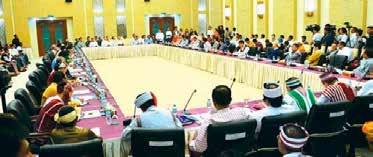
President U Thein Sein met with ethnic armed groups’ leaders at the Myanmar International Convention Center in Naypyitaw on Union Day.

12 TheIrrawaddy March 2015
IN FOCUS
Homeless
A fire in Kyee Myin Daing Township on the outskirts of Yangon ravaged the village of Ba Lote Nyunt on Feb. 16, leaving 800 local residents homeless. The township is one of three on the western bank of the Yangon River that had been slated for development under a city expansion plan. The US$8 billion project has since been shelved after a backlash over opaque tendering procedures and a lack of public input. As the hot season approaches in Myanmar, people brace for frequent fire outbreaks. The government and the fire department are still ill-equipped and underprepared to manage serious fires.

13 March 2015 TheIrrawaddy
PHOTO: THAW HEIN HTET
Living Next Door to China
How will relations evolve between Myanmar and its giant neighbor?
By AUNG ZAW
review of Chinese investment was imminent. After all, some of these projects that attracted widespread opposition had become political time bombs for Naypyitaw.
What few realize are the extent of ties, reinforced through lucrative contracts and kickbacks, between Myanmar generals and Chinese businessmen. The government has generally shown a reluctance to confront these connections and push back against unscrupulous Chinese investors.
The political dimension to antiChinese sentiment in Myanmar also cannot be overlooked. Following the crushing of the 1988 democracy uprisings in Myanmar, China became a major arms supplier and supporter of the ruling junta, filling the void left by Western nations who slapped sanctions on the repressive regime.
In many peoples’ view, it was China that propped up the junta.
However, under Myanmar’s current quasi-civilian government, policy toward Beijing is beginning to change—at least on the surface. The suspension of the Myitsone dam project seemed the first sign that a review in China policy may be on the cards.
When a New York Times editorial in January criticized China’s “wholesale looting” of Myanmar’s natural resources, the Chinese foreign ministry was quick to dismiss the charge as distorted.
However, if there was a reliable opinion poll to gauge how ordinary people in Myanmar view their giant neighbor, the results would likely be mixed.
Many Myanmar remain suspicious of Chinese investment and resent past Chinese mega projects that have had negative social and environmental impacts. Thus, a quick embrace of Japanese, South Korean and Western businesses has been evident as the country opens up.
When President U Thein Sein suspended the controversial Chinese-

led Myitsone dam project in Kachin State in September 2011, many people applauded the decision. But a more courageous and comprehensive review of controversial development projects, including Chinese-backed ventures, is needed—in consultation with local communities.
China remains Myanmar’s largest source of investment, channeling between US$14- to $20 billion into the country since 1988. The energyhungry country has poured money into hydropower projects in Myanmar’s ethnic regions, and its three major oil corporations have a strong foothold.
After the government suspended the Myitsone dam project, and following public outcry over the controversial Chinese-backed Letpadaung copper mine project, some civil society groups felt a wholesale
The political opening in Myanmar, and the courting of allies in the West, surprised Beijing. The US appointed an Ambassador, eased economic sanctions and President Barack Obama made a first historic visit to the country in 2012. The US has even allowed for limited military engagement with the once pariah state.
Beijing has also observed officials of Myanmar’s newly found American and European allies visit areas along the border with China. It is a testing time for Beijing which must be reevaluating the extent of its political influence in the country. Indeed, political and economic reforms in Myanmar since 2011 have only raised the stakes higher.
Myanmar is undergoing a strategic rebalancing that is intriguing, to say the least. Recent conflict in border areas such as Laukkai (also spelled
VIEWPOINT
14 TheIrrawaddy March 2015
Laogai), where martial law was declared last month, and the slow but steady reassertion of influence in “Chinese cities” in Myanmar, will be vital to watch. The military seems determined to assert its power and authority in areas close to the Chinese border.

Perhaps this demonstrates that the Myanmar Army now feels confident it can control ethnic ceasefire groups further south, such as the Karen and Mon, and turn its attention towards territories along the China border, where it has never fully established its presence.
This strategy runs the risk of attracting the ire of Beijing, which doesn’t want to see instability along its border. Further complicating bilateral relations between the two neighbors is the fact that some Chinese officials in
Yunnan Province remain sympathetic to certain ethnic armed groups across the border.
Beijing well understands Myanmar’s strategic importance as a gateway to the Indian Ocean and will not easily surrender influence in its smaller neighbor. Parallel oil and gas pipelines linking Rakhine State’s Kyaukphyu with Yunnan Province— now both operational— are just one example of the important ongoing economic linkages between the two countries.
In the past, Myanmar’s leaders have habitually feared China. The late Prime Minister U Nu, who held numerous meetings with Chinese leaders to settle several disputes, once publicly expressed this national anxiety in a statement after the Chinese Communist Party assumed power in 1949.
“Our tiny nation cannot have the effrontery to quarrel with any power,” he said. “And least among these, could Burma afford to quarrel with the new China?”
U Nu was quite correct. But it remains to be seen how the contemporary government, both before and after national elections slated for late-2015, will manage evolving relations with the regional superpower.
Naypyitaw could start by heeding the grievances of local communities and reassessing Chinese-bankrolled development projects that are destroying the environment. This could form the crux of a more equitable and constructive relationship with Beijing that puts people over profit.
PHOTO: JPAING / THE IRRAWADDY 15 March 2015 TheIrrawaddy
Security forces in Yangon hold back a protester attempting to break a police line near the Chinese Embassy in late December, during a protest against the death of a woman near the Chinese-backed Letpadaung copper mining project on Dec. 22.
Aung Zaw is the founding editor-inchief of The Irrawaddy.
LAUKKAI: The town of Laukkai in the Kokang Special Region was virtually deserted in mid-February as tens of thousands of refugees fled fighting between the Myanmar Army and Kokang rebel group, the Myanmar National Democratic Alliance Army (MNDAA).


Refugees fled across the border to China, and to Lashio and Mandalay in northern Myanmar.
Irrawaddy journalists found a town of abandoned buildings and vehicles riddled with bullet holes on Feb. 17 as the Myanmar Army’s 33rd Division strengthened its hold on the area.
Two people were shot and wounded when unidentified gunmen opened fire on a convoy of vehicles marked with the emblem of the Myanmar Red Cross Society.
The fighting broke out after MNDAA leader Peng Jiasheng returned to the area after a five-year absence, demanding greater rights for the Kokang people. President U Thein Sein vowed his government would “not lose an inch of Myanmar territory” and placed the region under martial law for a period of three months.
 ALL PHOTOS: JPAING / THE IRRAWADDY
16 TheIrrawaddy March 2015
Clockwise from above: Members of a Red Cross convoy leaving Laukkai assist a colleague after the convoy came under gunfire attack. A Tatmadaw shop on a downtown street. Refugees piled into the back of a truck on the convoy from Laukkai that was hit by unknown attackers.
SNAPSHOT: THE
UNFOLDING OF A CRISIS


 Kokang Territory Myanmar
soldier looks out on a deserted street in Laukkai. The town’s shops were shuttered as residents fled. A man walks past a broken fridge outside a
Kokang Territory Myanmar
soldier looks out on a deserted street in Laukkai. The town’s shops were shuttered as residents fled. A man walks past a broken fridge outside a
17 March 2015 TheIrrawaddy
Kokang: The Backstory
The site of fierce recent fighting, Shan State’s Kokang region has a complex history of feuding warlords and thriving drug production
By BERTIL LINTNER
The sudden outbreak of hostilities in northern Shan State’s remote Kokang region has taken many by surprise. Some have posted messages on social media sites saying that “those people” are not Myanmar citizens, and a government official even branded the hostilities a “Chinese invasion.”
While it is true that 90 percent of Kokang’s inhabitants are ethnic Chinese and few can speak the Myanmar language, reality is not quite that simple. The area is definitively on Myanmar’s side of the border with China, and the ethnic Kokang are one of the “135 national races” officially recognized by the government. But how did they end up in Myanmar and who are they?

The Kokang region was ceded to the British under the 1897 Beijing Convention, which may seem odd given its ethnic composition. But at that time, Yunnan was not fully controlled by the emperor in Beijing, and because of Kokang’s proximity to Hsenwi in Shan State, trade often traveled westwards rather than to the east.
But British colonial rule hardly extended east of the Salween River. The British could, at best, be described as exercising indirect rule through the British-advised saohpa, or prince, of Hsenwi—west of the river—to whom the lesser ruler of Kokang—east of the river—paid tribute.
Independent Myanmar’s government was even less successful than the
British in bringing Kokang under centralized control. Almost the entire territory was taken over by Kuomintang (KMT) forces in the early 1950s, when the Chinese com-
munists forced the nationalists to flee across the border.
Speaking the same Chinese dialect as the retreating KMT forces from Yunnan and, at least insofar as the local elite were concerned, sharing similar politics, many Kokang chieftains allied themselves with the Chinese nationalists.
Economically, the area was extremely poor. High mountains and a scarcity of water made rice cultivation almost impossible, so the people had to depend on two cash crops, which were sold or exchanged for food: tea and opium.
While tea had to be brought down to markets in Hsenwi and Lashio, opium could be sold locally. When war broke out in Shan State in the 1950s, opium became Kokang’s only viable cash crop. With its high morphine content, opium from Kokang was considered the best in the region.
SPECIAL REPORT
People displaced from Laukkai, the capital of Kokang Special Region in Shan State
18 TheIrrawaddy March 2015
Warlords and Opium
The de facto ruler of Kokang in the 1950s was Olive Yang, or Yang Jinxiu, a woman who had her own army of nearly 1,000 men. With the backing of the KMT, her influence increased and she became the first warlord—or, should one say, warlady—to send convoys of trucks loaded with opium down to the Thai border.
Olive Yang was arrested in 1961, but the Kokang warlord tradition lived on. Her elder brother Jimmy Yang, or Yang Zhensheng, continued to cooperate with the KMT in politics as well as in business. Jimmy Yang was well-educated, having attended the Shan Chiefs’ School in Taunggyi, Rangoon University and, during World War II, Chongqing University in China. He was elected MP for Kokang in 1950 and founded the East Burma Bank a few years later.
Jimmy Yang was eventually ousted by one of his local commanders, the infamous Luo Xinghan, or Lo Hsing-han, the father of Steven Law, or Tun Myint Naing—today the managing director of Asia World, one of Myanmar’s most powerful conglomerates. A native of Ta Tsu Chin village near Kokang’s border with China, Lo Hsing-han became internationally known in 1972 when US senior narcotics adviser Nelson Gross dubbed him “kingpin of the heroin traffic in Southeast Asia.”
He achieved that notoriety due to an unorthodox agreement with the thenmilitary government in Yangon. He was given the right to use all governmentcontrolled roads in Shan State for drug trafficking in return for fighting rebel groups in the area. Lo Hsing-han’s elder brother, Luo Xingguo (Lo Hsingko), was chief inspector of police in Kokang and ensured there was no local interference.
While the government had a Kokang warlord on their side in Lo Hsing-han, the communists had theirs: Peng Jiasheng and his younger brother Peng Jiafu. They had once served with Jimmy Yang’s own army, the Kokang Revolutionary Force, but were contacted by Communist Party of Burma (CPB) cadres in China in
July 1967 and promised arms and ammunition.
The rebels were no longer Olive Yang’s brigands. As part of the CPB and with support from China, the heavily armed troops took over Kokang from the KMT and its allies in 1968. But Kokang was actually of little interest to the mainstream CPB except as a base from which its forces could push down to the Myanmar lowlands.
A crucial 45-day battle between CPB forces and the Myanmar Army was fought from December 1971 to January 1972 for control of the Kunlong bridge, connecting Kokang with the land west of the Salween. The government army successfully halted the CPB’s westward advance, partly due to Lo Hsing-han’s knowledge of the local terrain.
Grateful Myanmar Army troops later helped him send opium to laboratories on the Thai border, where it was refined into heroin. It was not until 1973, when Lo Hsing-han turned against the government, that he was arrested. He was later released during a general amnesty in 1980, when Jimmy Yang was also pardoned and returned from exile in France.
The communist takeover in 1968 transformed Kokang socially and politically. The old warlords fled and the land they left behind was distributed to


PHOTO: REUTERS
A general view shows Laukkai, the once-booming capital of Myanmar’s Kokang region, in 2009. In mid-February, the town was deserted as fierce clashes took place between the Myanmar Army and the MNDAA.
19 March 2015 TheIrrawaddy
PHOTO: JPAING / THE IRRAWADDY
landless peasants. Law and order was restored after years of anarchy, but there was one major problem the CPB could not solve: Opium.
The CPB’s inability to offer local poppy farmers a viable alternative during the first years of communist rule was due in part to the difficulty of finding suitable cash crops. But following the cut-back of Chinese aid in the late 1970s, it is also plausible to assume that the communists became less interested in finding an effective substitute. Even if local farmers, at the bottom of the socio-economic ladder, could not make their fortunes from opium, the CPB’s commanders could.
One of them was Peng Jiasheng. Although he never became a party member, he commanded the CPB’s forces in Kokang and soon turned his attention to the local drug trade. According to a cable from the US embassy in Yangon, dated Sept. 1, 2009, and made public by WikiLeaks, “Peng Jiasheng has been identified by the US Drug Enforcement Agency as a major trafficker since approximately 1975.”

At about that time, independent sources say, Peng established the first heroin refinery in the area controlled by the CPB along the Chinese border. The party taxed the cultivation of poppies and the trade in raw opium in and out of its territory. But making heroin was a step too far and Peng was transferred from Kokang to party headquarters in Panghsang in the Wa area. However, he soon set up a new refinery at Wan Ho-tao in the hills east of Panghsang.
The CPB Mutiny
Ethnic tensions between the ideologically motivated, ageing Burman leadership of the CPB and the hill tribe rank-and-file of the party’s army led to an all-out mutiny. It began in Kokang in March 1989, and soon spread to other CPB areas.
By April, the entire leadership had fled to China and the CPB’s army broke up into four regional armies based along ethnic lines: The most powerful among them, the United Wa State Army (UWSA); a force in Kokang, to where Peng had returned; a force in
eastern Shan State led by Peng’s sonin-law Sai Leün (or U Sai Lin, or Lin Mingxian), and the former CPB forces at Kambaiti and Pangwa in Kachin State. The Kokang unit became known as the Myanmar National Democratic Alliance Army (MNDAA).
Shortly after the mutiny, Myanmar’s then intelligence chief Gen. Khin Nyunt sent Olive Yang, Lo Hsing-han and Aung Gyi (a Sino-Burman former officer in the Myanmar Army and one of the founders of the National League for Democracy, who later left) to Kokang to negotiate with the CPB mutineers.
Ceasefire deals were struck under which the former CPB forces were allowed to retain control over their respective areas, and maintain their own armies, in exchange for not attacking government forces. They were also permitted to engage in any

kind of business which accounted, in part, for Myanmar’s annual opium production increasing from 836 tons before the mutiny to 2,340 tons in 1995.
The 1989 mutiny saw yet another economic and social transformation of the areas along the Chinese border. Despite the CPB’s efforts at land reform, the region remained desperately poor, and Kokang was no exception. In November and December 1986, I trekked through the entire length of Kokang, crossing the Salween at the Takyiang ferry in the north and continuing on foot over the mountains down to Chinsweho on the Namting River in the south, where the Wa Hills begin.
I spent many nights in drafty mudstraw huts and also visited the small town of Tashwehtang, the hill “capital” of Kokang, which resembled rural Yunnan in pre-revolutionary days: cobbled streets lined with merchants’ houses, arch-shaped stone bridges and, outside the market area, walled-in stone mansions with wooden verandas. The market town of Laukkai in the valley below consisted of little more than a collection of ramshackle structures made from wood and bamboo.
Today, it’s a different world in Kokang. According to a recent visitor: “Laukkai is remarkable. Construction of wide new boulevards and highrise buildings—mostly hotels and entertainment complexes—is underway everywhere. The center of town is dominated by a new, neon-lit 10-storey
SPECIAL REPORT
Lo Hsing-han, the former Kokang chief who became a notorious drug lord
At a meeting in the early 1990s, Peng Jiasheng is seen third from left. His son-in-law Sai Leün (also known as U Sai Lin, or Lin Mingxian) is fifth from left. Gen. Than Shwe and Gen. Khin Nyunt are on the right.
20 TheIrrawaddy March 2015
PHOTO: REUTERS
hotel, the Huangding Guoji Binguan, or the Royal Splendor International Hotel, with streets around it lined with smaller hotels, mobile phone shops, brand-name fashion outlets and, not least, casinos.
“New SUVs and cars with ‘KK’ (Kokang) plates are in the majority but there’s also a good sprinkling of vehicles from across southwestern and central Chinese provinces. Locals and visitors are almost entirely Han Chinese, but virtually all the construction work is being undertaken by thousands of Burman laborers.”
So where did all the money come from? Drugs, of course, are one major source of income—opium, its derivative heroin and also synthetically produced methamphetamines. But also guns from China, smuggled across northern Myanmar to northeastern India, a hotbed of local, ethnic insurgencies where there is a huge demand for any kind of military hardware. The income from these pursuits financed development projects in Kokang and investment in the hotel business, retail trade, real estate and construction in other parts of the country.
Shifting Allegiances
But it was not all smooth sailing for the post-mutiny rulers of Kokang. When Gen. Khin Nyunt struck a
deal with the former CPB forces, he had favored the Peng clan over the traditional rulers of the area, the Yangs. This turned out to be a serious tactical error and the Yangs eventually rebelled against Peng Jiasheng.
A brief war was fought in Kokang in 1992, which forced Peng into temporary exile in China. But things didn’t go well for the Yangs either. In October 1994, Yang Muxian, the younger brother of the new Kokang overlord Yang Molian, was executed in Kunming for trafficking heroin to China.
Soon afterwards, Gen. Khin Nyunt and Lo Hsing-han helped broker a deal between the Pengs and the Yangs. Peng Jiasheng returned, and soon regained his position as Kokang’s strongman.
That lasted until August 2009, when the Myanmar Army moved into Kokang in an operation masterminded by Snr.-Gen. Min Aung Hlaing, then head of the military’s Bureau of Special Operations 2—and now commanderin-chief of the armed forces. More than 30,000 people were forced to flee to China, prompting protests from Chinese authorities.

The fall from grace of Peng’s mentor, Gen. Khin Nyunt, in October 2004 had no doubt made the offensive possible. Peng was deposed, fled to China, and was replaced by a local Kokang officer, Bai Suoqian, handpicked by the Myanmar military. The MNDAA
faction loyal to Bai also became a government-recognized Border Guard Force.
But Peng was plotting his comeback. It came just before Union Day this year, when fighting broke out. Bai had to be flown out of Kokang by helicopter to safety in Naypyitaw. His future remains uncertain. It also remains to be seen if the conflict in Kokang will spread to other areas in the north.
Several hundred soldiers from the Ta’ang National Liberation Army (TNLA) are reportedly fighting alongside Peng’s MNDAA in Kokang, along with a smaller contingent of troops from the Arakan Army. And it is hardly any secret that the powerful UWSA has been supplying the MNDAA with arms and ammunition.
The role of the UWSA begs the question of where China’s security services stand in this new imbroglio. The UWSA has close connections with those services and is equipped almost entirely with weapons—including surface-to-air missiles and other sophisticated hardware—obtained from China. It is hard to imagine the UWSA would have been able to supply the MNDAA with munitions without getting the green light from its Chinese mentors.
It is also obvious that a new generation of officers has taken over the MNDAA. Peng, now in his mid-80s, remains the official figurehead, while his eldest son Peng Daxun (Peng Tashun) heads the army.
Another important figure is MNDAA secretary-general Htun Myat Lin, who is married to Peng’s youngest daughter. A graduate of Mandalay’s Arts and Science University, Htun Myat Lin prefers to use his Myanmar name rather than his Chinese one and is described by close associates as “wellversed in politics.”
A wider alliance of rebel forces in the north cannot, therefore, be ruled out. But whatever the outcome of the present conflict, it will not be an easy task for anyone in power in Naypyitaw to establish some semblance of authority over Kokang. Like the Wa Hills, it is a part of the country that has never been under any central governmental control.
A lone woman carries her possessions through the deserted streets of Laukkai in midFebruary after clashes broke out in the area between the MNDAA and the government army.
21 March 2015 TheIrrawaddy
PHOTO: JPAING / THE IRRAWADDY


 Valley of Darkness: The massively deforested Pansay valley in northern Shan State is now a center for opium production.
TNLA soldiers walking over the Shwe Gas pipeline in northern Shan State. One of the army’s main grievances is that local Palaung people do not benefit from the use of their land for government projects.
Valley of Darkness: The massively deforested Pansay valley in northern Shan State is now a center for opium production.
TNLA soldiers walking over the Shwe Gas pipeline in northern Shan State. One of the army’s main grievances is that local Palaung people do not benefit from the use of their land for government projects.
FEATURE 22 TheIrrawaddy March 2015
TNLA soldiers arrest a man after he was found to
On a Mission: Destruction of Opium
In the remote mountains of northern Shan State, a small ethnic armed group is taking on the drug trade
 STORY AND IMAGES By NIELS LARSEN / NAMKHAM, SHAN STATE
After a three-day trek from their jungle base in Kutkai Township, Battalion 101 of the Ta’ang National Liberation Army (TNLA) finally reached their destination: the mountainous region around Namkham in northern Shan State that is largely under the control of the government-backed Pansay militia.
Straddling the borders of China and Kachin State, the territory is a patchwork
of poppy fields and clandestine drug laboratories; a major source of the heroin and methamphetamine that is fueling widespread drug addiction among local Palaung (also known as Ta’ang) communities.

In its annual “Southeast Asia Opium Survey,” the UN Office on Drugs and Crime warned that the use of opium more than doubled and the use of heroin and amphetamine-type stimulants tripled in poppy-growing
 possess heroin and opium. He was later freed.
ALL
23 March 2015 TheIrrawaddy
A TNLA soldier surveys opium farms in the valley below after the ethnic army entered Pansay militia territory.
PHOTOS: NIELS LARSEN
areas of northern Myanmar from 2012 to 2014.
“Our village looked like a graveyard,” a monk from a remote village close to Tar Moe Nyae in Kutkai Township said. “No men were working in the fields and the rate of robberies and domestic violence increased.”
Shan State—where the vast majority of opium poppy cultivation in Myanmar takes place—is home to an array of armed groups, including those that transformed into Border Guard Forces (BGF) under Myanmar Army control since 2009 and People’s Militia Forces (PMFs). Some of these governmentbacked militias, which often take part in military operations alongside the Myanmar Army, are reportedly heavily involved in drug production and trafficking.
Without government support, the TNLA, which is one of only two major ethnic armed groups yet to sign a ceasefire agreement with Naypyitaw,
has made drug eradication a priority. But while destroying poppy grown by independent farmers has been relatively easy, the fields in the Pansay militia’s area are a different story.
The influential Pansay militia, reportedly led by Kyaw Myint, also
known as Li Shau Yung, a state-level parliamentarian and a member of the Union Solidarity and Development Party, is said to control 20,000 acres of remote and largely deforested territory in which poppy cultivation is rife. A Myanmar Army battalion permanently


stationed in the area has apparently turned a blind eye.
“Our objective is not to destroy the headquarters of Pansay or to fight, we just [want] to destroy the opium,” explained Tar Now, deputy commander-in-chief of the 3,5004,000 strong TNLA. “We know that the Tatmadaw and the militias will never let us eradicate the poppy without a fight. So we are ready.”
Following Palaung national day celebrations on Jan. 12 in Mantong Township, the TNLA leadership resolved to launch a coordinated attack on the Pansay-controlled region, using four different battalions (400 men in total), under the leadership of Tar Now. Previous TNLA sorties in the area had been thwarted by the militia and the Myanmar Army.
At around 3 pm on Jan. 24, this reporter accompanied the lead TNLA battalion—Battalion 101—as it crossed a ridge and entered Pansay territory, engaging in a few short firefights with militiamen in the valley below.
For the rest of the afternoon and throughout the following day, TNLA soldiers set about destroying poppy fields in the valley. The group also
Soldiers commence the destruction of an opium crop in a farm in the Pansay valley.
FEATURE 24 TheIrrawaddy March 2015
A woman pleads with soldiers not to destroy her opium crop.
forced Lisu and Chinese farmers living in the valley to destroy the crops; no soldiers were observed using physically abusive methods to do this.
On the evening of Jan. 25, the Myanmar Army stepped in. An army unit based in the area fired rocketpropelled grenades from higher ground at the farms where TNLA soldiers had taken shelter for the night. The TNLA soldiers managed to escape alive, leaving terrified Lisu farmers behind.
Fighting resumed the following morning and raged for two hours, leaving several Myanmar Army soldiers dead. When the army began strafing TNLA positions with mortar fire, the ethnic armed group finally withdrew, abandoning their poppy eradication mission.


The TNLA forces were pursued by Myanmar Army units throughout the three-day journey back to their Kutkai Township headquarters. In
their attempt to intercept the ethnic armed group, the government army passed through territory controlled by other TNLA units, as well as the Shan State Army-North and the Kachin Independence Army, triggering more clashes.

Following the mission, the Battalion 101 commander, who asked that his name be withheld, resolved to return.
“We will go back there again until there is no more opium.”
A soldier stands near a charcoal oven. Many farmers have turned to charcoal production after the TNLA banned opium-growing.
After a Pansay militia uniform and cartridge was found in this house, a TNLA officer ordered the property to be burned down.
25 March 2015 TheIrrawaddy
TNLA soldiers take a break before entering Pansay militia territory.
Game Changer
Yangon-born Rich Cho is making his mark on US basketball and encouraging local passion for the sport
By DAVID HOPKINS
Rich Cho sounds laid back, but steer him onto the topic of food and he soon turns into an animated guide who can rattle off a list of where to find the best Myanmar cuisine across the US, from San Francisco to Philadelphia.
“I love it all,” said the Yangonborn son of Myanmar emigrants who made a splash a few years ago when he became the first Asian-American general manager in the history of the top professional basketball league in the US.
Mr. Cho, 49, was just three when he left Myanmar with his parents for the US in 1968. But the man who now rubs

shoulders with some of the stars of the National Basketball Association (NBA) has never lost his links to the homeland where his family has a distinguished history.

Last August Mr. Cho took time off his current job as general manager of the Charlotte Hornets team to visit relatives in Yangon and catch up with local basketball players.
That was his third trip back since his first visit here in 2004, which left a strong impression.
“It was unbelievable to see where I came from,” he told The Irrawaddy by phone from his home in North Carolina. Mr. Cho hadn’t traveled
26 TheIrrawaddy March 2015
FEATURE
Rich Cho with one of his two daughters
The Cho family in Myanmar. Rich Cho is in the center with his older sister Sanda (left), brother Chris and parents Shirley and Alan.
much as a youth, so it had been “hard to picture” Myanmar.
Isolated Yangon in 2004 felt a very long way from Washington State where Mr. Cho spent his childhood and developed an early passion for tennis, softball and basketball.

After he gained a degree in engineering and worked for a time at Boeing in Seattle, that love of sports made him decide to take a punt on a new career.
In 1995 he secured an internship with the Seattle Supersonics basketball team. Over the next 15 years he rose to become assistant general manager and also secured a law degree.
His ground-breaking appointment as general manager with the Portland Trail Blazers team in 2010 was “definitely humbling,” he said. It was also a rocky experience, lasting only around a year.
“That was a tough thing to go through [losing the job with Portland]. But that’s part of this business, the NBA. There’s a lot of volatility with the job.’’
Mr. Cho was soon recruited as general manager with the Charlotte Hornets and moved across the country to North Carolina. “Fortunately I was able to land back on my feet pretty quickly,” he said.
Family Influence
Riding the knocks, that essential immigrants’ skill, was something he had seen his parents accomplish as they worked to build a successful life in the US.

ALL PHOTOS COURTESY RICH CHO 27 March 2015 TheIrrawaddy
Rich Cho and his father Alan Cho (U Aung Aung Cho)
Former journalist U Aung Aung Cho (Alan) and Daw Nwe Nwe Yi (Shirley) left Myanmar for the US to find “a better life” after they obtained sponsorship from a church in Fort Wayne, Indiana.

They ended up settling in Seattle, Washington State, where their distinguished family pedigree, Myanmar work experience and the new university degrees they earned didn’t prevent life from often being a challenge.
“My dad had a number of odd jobs. He worked the graveyard shift at 7-Eleven for a number of years,” Rich Cho recalled. “My mom worked at a library just to make ends meet. There was a period when we were on
welfare. Like for a lot of immigrant families that come to the States, it was a tough road.”
There wasn’t much time to dwell on former times when family members had made a mark in Myanmar.
Rich Cho’s paternal grandfather, U Cho, was the first education minister in the post-independence period, a position he held until his retirement in May 1951.
U Cho visited France, Switzerland, Germany, China, England, Scotland, and the United States to study each country’s education system and published several books including “The Effect of War on Education in Burma During Japanese Occupation” in 1949.
He was also a member of the Burmese Translation Society, which was established in 1947 and was for a time chaired by Prime Minister U Nu.
U Cho died in 1966, two years before Alan and Shirley Cho and their young family departed for the US.
Rich Cho’s maternal grandfather, U Thant Gyi, was a former deputy education minister who also worked as educational attaché at the Myanmar Embassy in the United States.
Bouncing Back
U Thant Gyi would have been proud of the cultural diplomacy his grandson embraced in 2012 when he traveled to Yangon as a sports envoy sponsored by the US State Department.
Together with three other envoys, Mr. Cho held basketball workshops and clinics with young local players.
“I saw the passion that a lot of kids have for basketball, so it was really fun to be a part of,” Mr. Cho said, adding that he was surprised at the high skill level of some of the players.
The following year the NBA and the State Department sponsored 12 young Myanmar basketball players, accompanied by members of the Myanmar Basketball Federation (MBF), to take part in basketball clinics in the US. The group also attended a Charlotte Hornets home game.
Basketball is still struggling to find its way in Myanmar. There is no annual basketball competition and the game has failed to gain widespread appeal due to a lack of financial resources and mismanagement, U Maung Maung Myint of the MBF told the Irrawaddy.
But he’s hoping for better days ahead. “The younger generation must have the right to play, the time to play, a place to play,” U Maung Maung Myint said.
Rich Cho’s experience may provide an inspiration for young players. The boy from Yangon, who once washed dishes at a pancake chain and rose to head a significant NBA team, knows a thing or two about rising from humble beginnings.
28 TheIrrawaddy March 2015 FEATURE
—Wei Yan Aung and Thet Ko Ko contributed to this article.
Rich Cho (far right) with three siblings and their grandparents, including U Thant Gyi.
“I saw the passion that a lot of Myanmar kids have for basketball.”

Being Bamar
A reflection on identity, and on some of its costs
By WAI YAN HPONE / YANGON
Iused to be proud of being a Bamar. In the early part of my life, I was overwhelmed with pride for our rich culture, civilization and centuries-long history. We Bamar were a people who founded three great empires and produced warrior kings who were feared by our neighbors. In the view of the average Bamar, we were superior to any ethnic group politically, economically or culturally, and other minority groups had always looked up to us with fear and envy.
But once I began to explore beyond my childhood knowledge, I found that I had to unlearn much of it. And then the pride I had always taken in my Bamar-ness began to disintegrate, to be replaced by guilt and shame. I felt guilty and ashamed of my group because of its centuries-long oppression of Myanmar’s myriad ethnic minorities. Even though I was not directly liable for the wrongdoings of my fellow Bamar past and present, I felt I had a share in that responsibility. And the thought that justice for those transgressions has not been brought to this day made me particularly embarrassed.
Growing up in Yangon, I was shielded from the truth by the city’s relatively pluralist nature, and my naivete was aided by the selective history conveyed in school textbooks and state media. The facade of the “Golden Land” has always prevented an urbanite like myself from seeing ethnic minorities’ true lives.
What I Learned
We were taught that a country called Myanmar has existed since as early as the 11th century as a
land in which all peoples had been living “fraternally, peacefully and harmoniously.” There were times when unity faltered and we fought each other, but our relationships were fundamentally unbroken because we were “brothers.” It was because of the colonialists that we lost not just our sovereignty, but also our harmony. The colonialists used a divide-and-rule strategy to plant distrust among us, and it was all because of the British that, 130 years after they deposed of Myanmar’s last monarch, the country finds itself trapped in one of the world’s longest-running civil wars.
According to this discourse, the Bamar and other ethnic groups are real “blood brothers” who are descendants of the same family. In diversity we can see commonalities and the Bamar, as the majority ethnic group, are at the center of that diversity. As the story goes, differences are only superficial and, in essence, we are one! The military, also known as the Tatmadaw, needed to intervene in 1962 to prevent the union from breaking up. At that time, unscrupulous elements
were colluding to adopt a “federal system,” which could only lead to the disintegration of the country. This is the narrative our Bamar leaders have pushed for decades.
What I Relearned
The true history of this country is that there was never a unified nation-state before the British came. The map of Myanmar today is only a legacy of the British occupation, an arbitrary demarcation of territory with little relation to the people that live within its bounds. Many ethnic groups lived independently in their own territories and practiced different governance systems, from monarchies and fiefdoms to chieftainships. When the Bamar empire reached its peak, other ethnic peoples swore allegiance to the kingdom, but for the most part the various peoples of Myanmar coexisted amid self-determination.
In the eye of non-Bamar ethnic peoples, post-independence Myanmar has never been a union but rather a unitary state. The principles of the historic Panglong Agreement have been ignored, and the Bamar are acting as if ethnic areas were their own.
Ever since independence, successive regimes have prioritized the Bamar-ization process. A value for ethnic diversity exists in name only, and minority identities are being subsumed by that of the Bamar. Though Myanmar is a multiethnic state, Bamar culture, the Myanmar language and Buddhism represent it. Other ethnic groups, languages and religions have been systematically suppressed and assimilated into the dominant one.
GUEST COLUMN
Ever since independence, successive regimes have prioritized the Bamar-ization process
30 TheIrrawaddy March 2015
When the Panglong Agreement was not realized, many of our ethnic minorities resorted to armed struggle against the Bamar-dominated central government. As the civil war escalated, the country became increasingly militarized, giving the Tatmadaw a reason to further tighten its grip on power. In the eyes of Tatmadaw elites, Myanmar’s rebel groups are enemies of the state, justifying ruthless counterinsurgency strategies against both militants and civilian populations. For ethnic minorities, the Bamar are synonymous with the Myanmar Army, which has perpetrated numerous atrocities upon them—forced grabbing of their lands and resources, forced labor, forced relocation, murder, rape, torture, arbitrary taxation and summary execution, to name a few. Ethnic nationalities also fear their language and culture will become extinct because of bans on teaching ethnic languages at school. Many people in ethnic borderlands have never seen a Bamar like myself from Myanmar proper. The only Bamar they know is the army, an institution that has colonized their lands for decades, and has tried to cleanse their ancestral homelands of native peoples. They hate the Bamar because they hate the Myanmar Army.
Unlearned History
Those who go to government schools in Myanmar cannot see or hear the feelings of our ethnic brothers. We are taught that the Tatmadaw is the only patriotic professional army, a fighting force that has defended the country from both foreign and domestic “rebel” forces. Federalism means balkanization and it is the Tatmadaw’s time-honored mission to save the country whenever it is in crisis. The education system gave us no opportunity to explore beyond the textbooks, however, or to challenge the state’s ideologies and discourses. With the passage of Union Day last month, another governmentimposed target date for the signing of a nationwide ceasefire agreement went unmet. In my view, as long as the decision makers in the Myanmar government and Tatmadaw are not convinced that achieving peace rests upon respecting our ethnic brothers’ rights and finding justice for their deprivations, there will be no genuine peace. There is a historic phrase by Gen. Aung San: “If the Bamar get one kyat, the other ethnic groups must get one kyat respectively.” The utter failure to fulfill Aung San’s promise
has led to a sarcastic joke among ethnic minorities: “After Aung San visited the seven states, the Bamar got seven kyats but other ethnic peoples got only one kyat each.”

I want Bamar chauvinists in the Tatmadaw and the government to reflect upon their past ideologies and actions. I also want them to ask themselves whether they really want peace. We Bamar have broken promises since independence, and have consistently cheated and exploited our ethnic brothers. We are the majority—we have power and we enjoy privilege. That’s why we must show tolerance, respect and sympathy to our less dominant minority groups. Failing to do so is shameful.
Whenever I hear the grievances of my ethnic friends, I feel guilty and ashamed. As long as we cannot prove that the Bamar are a civilized, rightsrespecting people, I will not be proud of myself as a Bamar.
Wai Yan Hpone is a freelance writer and translator living in Yangon. He has worked with several local media organizations and has published two translated books. He contributes to local and international publications.
GUEST COLUMN
PHOTO: REUTERS
31 March 2015 TheIrrawaddy
People wear traditional costumes of Myanmar’s ethnic groups before the opening ceremony of the 25th Asean Summit in Naypyitaw on Nov. 12, 2014.


As a long-time native of Yangon, U Maw Lin has witnessed many changes in the former capital city.
He grew up in a flat overlooking the Sule Pagoda, in the heart of downtown, and as a child played football in Maha Bandoola Park just across the road.
From there, he and his friends would walk west, to China Town, for a bowl of noodles. For a cup of tea, they would stroll east on spacious
Saving
The clock is ticking on efforts to
By KYAW PHYO THA
pavements. These were some of the most memorable experiences of his youth.
But those days now seem a distant memory for the 56-year-old Yangonbased architect, who said that lax regulations on urban planning were threatening his native town, particularly since political and economic reforms in Myanmar since 2011.

“I can no longer imagine those kinds of walks these days, as the city
has changed a lot,” he said. “Yangon today is suffocating.”
Outside his downtown office, the wide pavements that Yangon was once famous for have shrunk by two-thirds to make way for the growing number of cars on the now traffic-clogged streets. Drivers too are complaining as commute times have dramatically increased.
A few minutes’ drive away, large public spaces that were once venues
COVER STORY 34 TheIrrawaddy March 2015
Yangon
ensure a beautiful, livable city

/ YANGON
for public events and entertainment are disappearing in the name of modern development.
In some townships, more than 1,000 people live per hectare—a number almost double that of Dhaka in Bangladesh, one of the most densely populated cities in the world, where an average of 555 people live per hectare.
“If problems like these are not tackled now… they will become very difficult to fix,” U Maw Lin warned.
Mounting Concerns
In January, an international forum on the role of heritage in sustainable development was held in Yangon in response to the challenges facing Myanmar’s largest city.
At the forum, experts pointed out that interest in heritage conservation had not yet translated into government policy. A lack of coordination among the relevant government agencies and

an absence of guidelines across the board—from building safety to zoning, land use, urban design and planning— were among the concerns raised.
The forum followed close on the heels of an open letter sent by a group of urban experts, including U Maw Lin, to President U Thein Sein requesting “urgent action” to rein in unruly urbanization projects and address the lack of “systematic urban planning controls” for the city.
35 March 2015 TheIrrawaddy
The Yangon Heritage Trust created this graphic impression of how Yangon could look.
To enforce the controls, the experts urged the president to enact the Myanmar National Building Code and Zoning Plan to ensure building safety and regulate proper restrictions on land use and building heights for developments. Both laws have existed in draft form for more than a year.
Dr. U Kyaw Lat, an advisor to Yangon City Development Committee (YCDC)’s Urban Development Affairs department, said laws and regulations to control building density were of paramount importance and called for increased public participation.

“Even though I work with YCDC, they can reject what I suggest if they are not happy with it,” he said. “Yangon Region’s chief minister is above the YCDC and he decides everything. So far, the Zoning Plan has still not been recognized by the Yangon government.”
The failure to enact urban planning legislation has undermined efforts to protect the city’s heritage and created uncertainties over building controls.
The most prominent example is an international development project in the shadow of the Shwedagon Pagoda. Although buildings within a onemile radius of the revered pagoda are supposed to be restricted to a height of 62 feet, the government reportedly approved a project proposal that included building heights above this restriction.
“I can’t think of anything more important to heritage conservation in Yangon than the protection of the Shwedagon and views of the

Shwedagon,” said U Thant Myint-U, the founder of Yangon Heritage Trust (YHT), an NGO trying to protect Yangon’s architectural heritage and lobbying for policies on heritage conservation.
“The area can very soon, without a doubt, be listed as a World Heritage Site. The proper development of the Shwedagon area can help bring billions of tourist dollars in the future. Inappropriate development will jeopardize all this,” he said.
Calls for Action
Established in 2012, YHT has intervened to stop demolitions of pre-1960 buildings in the downtown area and campaigned to stop other inappropriate new developments. At the request of the government, YHT drafted a law on urban conservation in 2013 that would help protect the city’s heritage.
Two years later, the law remains in the draft stage, and U Thant Myint-U said the government was now having to make decisions on an ad-hoc basis.

“I’m sure there are many competing interests at stake. But I think a clear regulatory framework would be best for business as well as for conservation, as it would make clear exactly what is allowed and the processes to be followed,” he said.
U Toe Aung, director of the YCDC’s Urban Planning Division, defended the time taken to implement draft legislation. He said the need to seek the opinions of different stakeholders had led to delays in enacting the zoning law.
“A law should be consistent with the existing legal framework. To make it strong, you have to review it from every angle. If it is onesided, it will not be OK,” he said.
Aside from urban conservation and heritage protection, an overhaul of the city’s

COVER STORY
/
36 TheIrrawaddy March 2015
PHOTO: STEVE TICKNER
THE IRRAWADDY
Clockwise from top: Bogalay Zay Street in downtown Yangon a YHT-led conservation project. A model and drawing of Shwedagon pagoda. A billboard for the project on display
U Toe Aung of the YCDC
ageing infrastructure is also urgently needed.
“Everything here needs to be rehabilitated; the water supply system, the road network and so on. Pipes are dilapidated. All the water pipes have to be changed,” said Suzuki Masahiko, an advisor on the Japan International Cooperation Agency’s Greater Yangon Strategic Urban Development Plan, a master plan for infrastructure projects needed to make Yangon more livable by 2040.
Mr. Suzuki said that, to date, the Myanmar government had followed less than 10 percent of the master plan JICA provided in 2013. The plan recommended initiatives such as a water supply project, pilot projects on a traffic signal system and a proposed Bus Rapid Transit (BRT) system.

The government’s focus on achieving certain short-term results is a concern.
“They asked us to submit a detailed BRT design and start construction within one year,” Mr. Suzuki said. “That’s absolutely impossible for us, [considering] funding, design and construction.”
The Yangon Region government has attempted to tackle issues such as traffic congestion with piecemeal solutions, such as placing concrete blocks on roads to segregate buses from private vehicles. The results so far have been poor.
“The election will be held at the end of the year and the central and regional governments are in a hurry to do something in response to the people’s demands,” Mr. Suzuki said.
Yangon’s challenges are many, and no one believes the task ahead is easy or should be inappropriately rushed. But on some issues, it seems clear that hurry is now needed. The delay in enacting zoning legislation is placing the city’s priceless assets in real jeopardy.


One of Asia’s great historical cities has every potential to be even greater for residents, visitors and commercial activities alike in the future. It can also lose out and become just another choking metropolis. Which will it be?

37 March 2015 TheIrrawaddy
PHOTOS: STEVE TICKNER / THE IRRAWADDY
“I can’t think of anything more important to heritage conservation in Yangon than the protection of the Shwedagon and views of the Shwedagon.”
—U Thant Myint U of the Yangon Heritage Trust
Yangon is one of three city streets that are in line for of part of the planned Dagon City 1 project near the display near the U Thaung Bo roundabout.
PHOTO: JPAING / THE IRRAWADDY
‘The Government Can’t Turn a Blind Eye’
Like many other Yangon residents, U Maw Lin is deeply worried by the unregulated, rapid urbanization that has plagued Myanmar’s former capital, especially since 2011. In December, the vice president of the Association for Myanmar Architects joined likeminded experts to send an open letter to the country’s president, requesting “urgent action” to save the city of more than 7.3 million people. U Maw Lin spoke with The Irrawaddy’s Kyaw Phyo Tha about his concerns and vision for the future of his native city.
Do you see any solutions to the unruly urbanization that is threatening Yangon?

If the central and regional governments don’t take it seriously, the problems Yangon is facing today will only deteriorate… The government may also suffer because if something negative affects the public, it damages the government’s image too.
In Yangon today, public spaces are disappearing. Traffic congestion is getting worse. The government can’t turn a blind eye. It also can’t address these issues on its own. Recommendations from experts must be welcomed as well as public participation.
We need concrete legal frameworks on land-use and zoning to deter unruly urbanization. The problems we have
today are the legacy of the government’s actions in the past, especially their mismanagement of urban planning. In some downtown areas, the population and building density is very high. If a natural disaster hits those areas, the residents have few escape routes or assembly points. That is just the tip of the iceberg. If the government doesn’t respond to these problems seriously now, Yangon will be in serious danger.
COVER STORY 38 TheIrrawaddy March 2015
How do you assess some of the government’s initiatives, like expanding the width of roads?

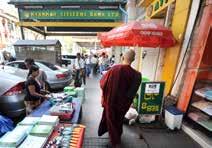
In the downtown area, they are expanding the busiest main roads by shrinking the sidewalks on both sides to provide for parking spaces. When cars stop to park in those spaces… other vehicles have to wait, causing traffic congestion.
On those shrinking sidewalks, hordes of vendors are squeezing each other out to do their trade and there is virtually no space left for people to walk. Have you seen this in other countries?
In recent years, there has been much criticism over the loss of public spaces to development projects in Yangon. Could you comment?
It’s more than clear that if there are public spaces, people appreciate and use them. Go and have a look at Maha Bandoola Park near Sule Pagoda. It’s teeming with people in the mornings and afternoons. We used to have many public spaces in Yangon. But many of them are now disappearing to make way for development, including as a result of when ministries offer tenders to businessmen.
The government should understand that making money is not always good for the wider public. They should put people’s interests first, rather than how much profit they can make out of these tenders.
Now development is underway just under the shadow of the Shwedagon Pagoda, the crown jewel of Yangon. They could have these kinds of development projects in other parts of Yangon but they want them in that prime area. They are crossing the line.
Do you think Yangon has the potential to become a “livable city” again, as it was once famous for?
Well, only when we manage to have a proper public transportation system; enact laws on land-use, zoning plans and heritage conservation; create more public spaces, and so on. If this occurs it would be likely that Yangon could restore its former status within a few decades.
For this to happen, we need support from the government. Anyone with political power must care for the people. If they don’t, they shouldn’t be in their positions. If they are only interested in making big money with businessmen, nothing good will happen to Yangon—not to mention the whole country.
Previous page: Architect U Maw Lin. Above: A man at work at his clothing repair stall on a downtown street. Left: Yangon's pavements are rapidly disappearing to make room for cars.
PHOTO: STEVE TICKNER / THE IRRAWADDY
PHOTO: SAI ZAW / THE IRRAWADDY
39 March 2015 TheIrrawaddy
PHOTO: STEVE TICKNER / THE IRRAWADDY
“Yangon Region’s chief minister... decides everything. So far, the Zoning Plan has still not been recognized.”
—Dr U Kyaw Lat

RICE: Chinese input to boost milling capacity

PROPERTY MARKET ‘STILL STRONG’

INTERVIEW LABOR RICE SIGNPOSTS
Business
ALL PHOTOS: STEVE TICKNER / THE IRRAWADDY
BUSINESS INTERVIEW
The price of real estate in Myanmar’s commercial capital has been on the rise since 2007, when the former military government lowered the property sales tax rate to 15 percent. Political and economic reforms since 2011 have failed to curb the trend, with sky-high commercial and residential rental prices in Yangon pricing out many businesses and local residents. Sai Khun Naung, the managing director of Sai Khun Naung Real Estate Company, spoke with The Irrawaddy’s Kyaw Hsu Mon on the outlook for the booming property market.
What was your experience when you first entered the real estate market in Myanmar?
I started my business in 2002 with 20 staff and targeted only commercial areas in downtown Yangon. The Asian financial crisis in 1997 had some impact on the local property market, which then began redeveloping in the years 2000-01. But the market then was not as developed, compared to now. We only had a small number of clients at that time.
How did real estate agencies like yours survive Myanmar’s banking crisis in 2003 (which began after more than a dozen deposit-taking financial firms collapsed)?
We were seriously impacted by the crisis in 2003. Many real estate agencies surrendered their businesses. But we survived because I had some clients in Shan State, my native state. At that time, many small financial groups had invested in the property market. After these groups folded, real estate agents like us were affected [as investor confidence plummeted].
Most people thought we were liars, so we had to really struggle hard to survive in the market. Money from some retired government officials was also involved in that crisis. They invested money in small financial groups like Ayeyar Myay, Thitsar Pankhin and Htoo Char. Now we no longer have these kind of small financial groups here. We are lucky. The property market has been reborn again, and we no longer have a bad name among the people.
What are the main reasons property prices have been constantly increasing in Yangon?

The major problem is that the government eased property taxes in 2007, and then didn’t ask investors where their money came from. People say that Myanmar is the best place for money laundering. So some money has come from this source. People have realized that they will definitely reap the benefits if they invest in the property market. Demand and supply are not balanced.
Can you confirm the highest land prices in Yangon? Is it true that some land is US$1,500 per square foot?
It’s true. Price depends on location. Land prices along some main roads in Yangon have reached that much, because of high demand. But now this is beginning to cool down as many wait and see how the political situation develops this year.
Do you think the government’s new property sales tax system can help reduce land prices?
Taxes are not the only answer to controlling prices. If the government wants to reduce land prices, they will have to expand Yangon. A tax increase is just a cure for the short term. The government should try to expand not only Yangon but also Mandalay. Prices will definitely come down, like they did in the imported car market. People rely on Yangon for their businesses, that’s why people prefer to stay here. But there is a lack of new housing projects in Yangon. There are many vacant lands on which to
expand projects, so we need better transportation too.
Where are the most in-demand areas of Yangon at present?
There are many good locations in Yangon, including along the main roads—Kabar Aye Pagoda Road, Pyay Road and Waizayantar Road. The new popular areas include North Dagon Township, not so far from downtown. And also East Dagon Township, which
42 TheIrrawaddy March 2015
the government should develop for the future. North Dagon Township is already developing into a commercial area. These areas will have potential on the market soon.
How does the weakness of Myanmar’s banking system affect the property market?
There are no long-term loans for buying houses here. It is related to the political situation. Political instability
is a major factor. People are fearful of when the property bubble will burst. Banks are also watching the situation with interest. As far as I know, banks may give loans at one-third of the property price. For example, if the price is worth 100 million kyat, they will loan 30 million kyat to the buyer. There are still many difficulties here, all related to the political situation.

Will the real estate bubble in Myanmar burst soon?
My personal point of view is that it won’t happen soon. There is only a small amount of foreign direct investment coming into the country, and there is also no better investment to make than in the property market right now. A lack of new housing projects here is also a factor. I don’t see many people selling property at low rates; the market is still strong. Banks are also strong, that’s why it won’t happen until three to five years from now.
43 March 2015 TheIrrawaddy
Sai Khun Naung says demand in the property market has cooled down somewhat, but the market remains robust.
Cheap Labor Comes at a Price
Myanmar has the second-lowest labor costs in the world, a study finds, but prospective foreign investors must consider reputational risks
By WILLIAM BOOT
Myanmar has been named one of the five best countries in the world for cheap labor, making it much more attractive for manufacturing investment than neighbors China and Thailand.
“Businesses with supply chains and operations in Myanmar, Bangladesh and Cambodia are benefiting from the world’s lowest labor costs,” a study by analysts Verisk Maplecroft said.
The business risk assessors’ Labor Costs Index measured a combination of wages, employment regulations, social security contributions and labor productivity to assess the costcompetitiveness of workforces in 172 countries.
Myanmar is ranked in the top five best places in the world for low labor costs by the index, which places China at 64th due to rising wages. Thailand is ranked 93rd in the index, where the higher the number the better the ranking in terms of labor competitiveness.
“China… has seen costs in the labor market rise rapidly in line with the country’s phenomenal economic progress,” Verisk Maplecroft said. “By contrast, key sourcing destinations that are increasingly replacing Chinese manufacturers in global supply chains perform very well in the index with Myanmar [ranked] (171), Bangladesh (170) and Cambodia (169) all ranked among the five lowest-cost economies.”
Myanmar’s ranking is beaten only by the small east African country of
Djibouti. The 10 highest labor-cost countries in the study are all in Europe.
However, the attractiveness for investors of setting up factories in Myanmar, Bangladesh and Cambodia is tempered by the business reputational risk factors of “poor working conditions and high levels of child labor and trafficking,” said Verisk Maplecroft.

The study said companies need to be alert to the risks associated with operating in or sourcing from low-cost locations.
While Myanmar, Bangladesh and Cambodia present low labor costs, each is rated as “extreme risk” by Verisk Maplecroft for health and safety, working conditions, child labor and human trafficking.
“Countries with low levels of socioeconomic development and inadequate environmental protections present a host of additional risks and indirect costs to business, including brand damage, investor alienation, and potential lawsuits.”
The average wage in Myanmar, Bangladesh and Cambodia is less than US$100 per month compared with $450 per month in China, according to the International Labor Organization.
“To a large extent there is a ‘necessary evil’ in this,” economist and longtime Myanmar analyst Sean Turnell told The Irrawaddy. “There is as yet no other avenue toward genuinely transformational industrial development than the traditional labor-intensive, low-productivity first step. Overwhelmingly this comes in the form of the clothing and textile industry, of course.”
Verisk Maplecroft’s senior human rights analyst, John Thompson, told The Irrawaddy that Myanmar’s lack of a minimum wage rate for most industries makes foreign investors “vulnerable to accusations of exploitative labor practices.”
The lowest paid workers in Myanmar earn only 1,700-2,000 kyat ($1.70-$2.04) per day.
“Myanmar continues to pose some of the highest labor risks in the world,” Mr. Thompson said. “As a result of generally poor working conditions, severe deficiencies in workplace inspections, and anti-union discrimination, reputational risks abound for companies sourcing from or operating in the country.
“While the country has shown improvement in labor and human rights protections since 2011, important questions remain regarding Myanmar’s ability to maintain its upwards trajectory. The next three years will be a critical period in terms of solidifying nascent reforms, much of which will give a clearer picture of the country’s long-term trajectory,” Mr. Thompson said.
Mr. Turnell added: “A labor-rights adhering Myanmar has considerable comparative advantages, especially in the production of rights-sensitive consumer goods that appeal to richer consumers, mostly but not exclusively, in the United States and the West.
“Good labor practices need not be more costly. They often greatly enhance labor productivity, while ensuring against unrest.”
Workers from Myue & Soe Garment factory stand during a protest for a salary increase in Yangon in September 2012.
44 TheIrrawaddy March 2015 BUSINESS MANUFACTURING
PHOTO: REUTERS


45 March 2015 TheIrrawaddy Magyizin Village, Inle Lake, Shan State, Myanmar Tel & Fax: +(95-81) 209055/ 209364/ 209365/ 209412 Mobile : (95-9) 525 1407, 525 1232 A restful retreat to nature on Inle Lake surrounded by Shan Hills Preserving our heritage to transmit to the future generation as received from ancestors Inpawkhon Village, Inle Lake, Shan State, Myanmar. Reservation: +95 - 9 4931 2970 Mobile: +95 - 9 528 1035 Email: intharheritage@gmail.com ADVERTISEMENT
Chinese Firm to Boost Rice Industry
Joint venture will provide loans and upgrade equipment
By KYAW HSU MON / YANGON
AMyanmar rice milling company and the Chinese firm CAMC Engineering Co. Ltd. have signed a joint venture Memorandum of Understanding (MoU) to improve the quality and capacity of rice milling operations in Myanmar, according to U Thaung Win, the secretary of the Myanmar Rice Millers Association.
Members of the Myanmar Rice Millers Association formed the Myanmar Rice Mill Company in 2012 with the aim of supporting the development of the milling industry. Both the Myanmar Rice Mill Company and its Chinese partner enter into the joint venture aiming to boost Myanmar rice exports, in part by improving the quality of its rice as well
as the milling process.
“It [the Myanmar Rice Millers Association] is only a nonprofit organization so we can’t do it [joint ventures] directly, that’s why rice millers formed the company—so that they can work with foreign companies,” said U Thaung Win, who is also the director of the Myanmar Rice Mill Company.
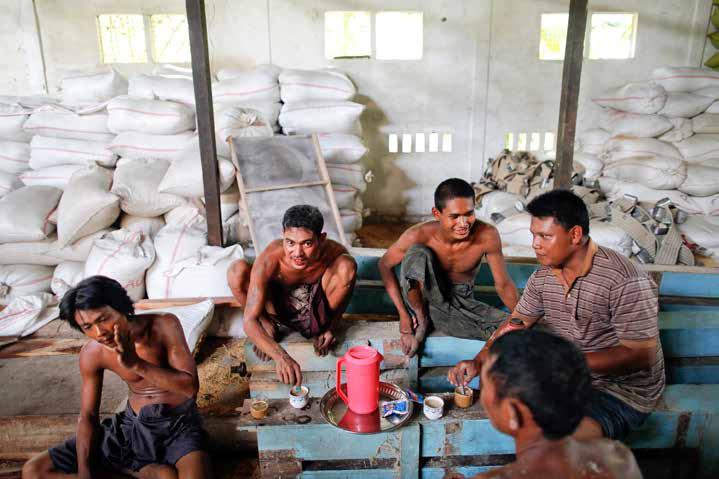
46 TheIrrawaddy March 2015 BUSINESS AGRICULTURE
Workers at a rice mill in the town of Kyaiklat in Ayeyarwady Region take a break from the day’s labor in May 2012.
PHOTO: REUTERS
“We’re going to discuss the details of how we can form the JV company in line with the Myanmar Investment Commission’s rules,” he told The Irrawaddy in February, adding that the MoU was signed late the previous month.
Under the terms of the MoU, the joint venture will also provide loans to rice millers and work to upgrade rice storage facilities that currently leave a large portion of the nation’s harvest susceptible to spoilage through exposure to humidity and other elements, U Thaung Win said.
“If we can form the JV, we will invest equal shares and we can support local rice millers. That will include loans, technical support and rice quality control,” he said.
“As we have very old mills in our country, we need technical improvements from foreign investors. We do expect that if we can control the quality of rice, the price of exported rice will also increase,” U Thaung Win said.
According to a World Bank report
in June 2014, Myanmar could increase its agricultural exports greatly if it improves the quality of rice by investing in the expansion and upgrade of domestic rice mills. The report said that since economic and political reforms began in 2011, rice exports have risen significantly, but in the past two years export volumes have leveled off at about 1.3 million tons annually.
The World Bank said much of the rice grown is of low quality and unfit for export to high-value markets such as the European Union, where Myanmar products are exempt from import tariffs under a preferential trade scheme linked to the country’s “least developed country” status.
U Chit Khaing, chairman of the Myanmar Rice Federation, said he welcomed the MoU.
“Chinese companies have been very interested to work in the rice industry for years; CAMC has also worked here for years. That’s why they have mutual understanding and believe they can improve the rice industry,” U Chit Khaing said.
“If we compare the quality of mills here and in Thailand, it’s quite different. We only have very lowquality mills in Myanmar,” he said.

The Myanmar Agribusiness Public Co. Ltd. (MAPCO), whose chairman is U Chit Khaing, is also working with a foreign firm to improve the rice industry’s competitiveness. It has entered into a joint venture with Japan’s Mitsubishi to build more rice mills, improve quality control measures and increase exports.
According to Myanmar Rice Millers Association figures, there are more than 2,000 mills nationwide, most of which operate at a capacity of 30 tons to 50 tons per day, with few mills capable of outputting at the 200to 300-ton level that is typical of more competitive rice exporters.
Myanmar’s agriculture sector is the country’s largest employer and 70 percent of all Myanmar live in rural areas, but under the previous military regime agricultural productivity languished and rice exports fell sharply compared to the 1960s.
ADVERTISEMENT 47 March 2015 TheIrrawaddy
Corporate Tax Payers Get Warning
China to Boost Yunnan Infrastructure
Myanmar’s economy is about to face stiff competition for investment from the neighboring Chinese province of Yunnan, according to an industry report.
Yunnan is currently the third poorest of China’s 31 provinces, with per capita income of only US$4,050 in 2014, oil and petrochemicals magazine ICIS reported.
The Chinese central government is spending over $24 billion in Yunnan to improve the province’s infrastructure, including 932 miles (1,500 kilometers) of new highways.
The aim is to make Yunnan a key component of Beijing’s plans for a so-called New Silk Road, analyst John Richardson said in an ICIS report on the province’s development.
In an effort to tighten up Myanmar’s loosely enforced tax system, nearly 200 domestic companies were warned in February that they faced de-registration for evasion.
The Directorate of Investment and Company Administration (DICA) said a total of 197 firms in Kayin State and Tanintharyi and Bago regions would lose their legal standing as of Feb. 28, after several years of skirting payments.
The announcement, published on the directorate’s website, instructed companies set to be delisted to contact the Myanmar Investment Commission before the end of February to settle outstanding debts and re-register.
Section 247 of the Myanmar Company Act grants the directorate authority to revoke business licenses for tax evasion.
DICA collaborates with the Internal Revenue Department (IRD) by reporting the total number of companies that applied for business licenses throughout the fiscal year. The IRD then calculates the disparity between total businesses and corporate taxpayers.
U Saw Swe, assistant director of the Yangon Division IRD corporate tax collection department, said the city alone had 4,913 companies that had yet to pay their taxes as the registration deadline neared. Some had not paid in as many as three years.—Kyaw Hsu Mon

CORRECTION: In a story titled ‘‘Hurdles and Wins for Emerging Business’’ by contributor William Boot, published in the January edition of the magazine, some information was incorrectly attributed to the Yangonbased business advisory group Consult Myanmar. In fact Consult Myanmar was not the source for any information in the story, and the contributor made an error in attribution. The Irrawaddy apologizes for the error.
“China will increasingly buy basic raw materials, such as oil and gas, from its less-developed neighbors. It will then re-export finished or semi-finished goods, such as chemicals and polymers, to these neighboring countries,” Mr. Richardson said.
Yunnan’s geographical position connects its borders directly with Vietnam, Laos and Myanmar, and via the Mekong River with Thailand and Cambodia.
In addition to the twin crude oil and gas pipelines now operating from the coast of Rakhine State into Yunnan, China is continuing negotiations with Naypyitaw to expand its oil transhipment port at Kyaukpyu, which it also wants to link to Yunnan by railway. —William Boot
‘Thousands’ of Migrant Workers in ID Scam
Thousands of forged identity cards may have been issued to Myanmar migrant workers in Thailand in return for bribes by labor agents, a report has claimed.
A Thai district administrator in Kanchanaburi Province on the Myanmar border, Sattha Khachapalayuk, has filed a complaint with Thai police in which he identified more than 400 allegedly false ID cards, the Bangkok Post reported. The complaint names local government officials in two Thai provinces who are alleged to have forged papers for migrant workers, the Post said. The allegations go back to 2006.
“[Mr. Sattha] said the documents he gave to police clearly showed 421 cards had been illegally issued although he believed there might have been tens of thousands of forged ID cases in Kanchanaburi alone,” the Post said.
The Post quoted a senior police officer saying the complaint would be forwarded to Thailand’s Public Sector Anti-Corruption Commission. —William Boot
48 TheIrrawaddy March 2015
Cashiers behind piles of kyat banknotes in a private bank in Yangon.
BUSINESS
SIGNPOSTS
PHOTO: REUTERS
Shell Inks Exploration Deal
Royal Dutch Shell and its Japanese partner Mitsui Oil Exploration Co., Ltd. (MOECO) signed an exploration and production sharing contract with state-owned firm Myanma Oil and Gas Enterprise (MOGE) in Naypyitaw in February for three offshore-water blocks.
The contract allows Shell to assess the potential of deep-water blocks AD-9 and AD-11 off Rakhine State and MD-5 off Tanintharyi Region.
Shell is the main operator, with a 90 percent stake in each of the three blocks, while MOECO will assume a 10 percent participating interest.
While global oil prices have fallen sharply since mid2014, Shell said it was delighted to pursue the opportunity to “unlock and develop” Myanmar’s energy resources.
“The three blocks offer an exciting frontier exploration opportunity to apply the advanced deep-water technical capabilities we have built up around the world over the past three decades,” Graeme Smith, VP Exploration Asia and Australia at Royal Dutch Shell, said in a statement.
The three blocks together cover some 13,048 square miles (21,000 km) with water depths ranging from 1,800 to 2,700 meters.
U Zay Yar Aung, the Minister for Energy, said oil and gas exploration was pivotal in the development of Myanmar’s energy sector and would help spur economic growth.
Kyaw Hsu Mon
Dawei Deal ‘Set for March’

Italian-Thai Development
Pcl. and Rojana Industrial Park will sign a US$1.7 billion deal this month to develop the Dawei industrial zone, the Thai government said in February.
“At the initial stage it will be an investment of around $1.7 billion,” Deputy Transport Minister Arkhom Termittayapaisit told reporters in Bangkok. Italian-Thai and Rojana will develop the first phase of the project, he said.
The project will begin with construction of an 86-mile (138-km) road from Dawei to Kanchanaburi Province.
Thailand will provide soft loans to Myanmar, to meet a budget of around US$119.23 million for the road construction. The Dawei project has been stalled for years.
 Reuters
ADVERTISEMENT 49 March 2015 TheIrrawaddy
Laborers work on a new road through the forested Tanintharyi mountains that connects the planned Dawei SEZ with Thailand.
PHOTO: JPAING / THE IRRAWADDY
Shining Moment for Democracy in Sri Lanka
How the ballot box triumphed to usher in a new order
By MARWAAN MACAN-MARKAR / COLOMBO
Cashing in on the politics of fear had become a stockin-trade for Mahinda Rajapaksa, Sri Lanka’s ruler since his first election as the allpowerful executive president in 2005. So it was hardly surprising that when the phrase “Arab Spring”
made an appearance in the political conversation weeks before the Jan. 8 presidential poll, it came with a twist.
Sri Lanka’s 15 million voters were warned that chaos would ensue if an Arab-style uprising took root on the island. There were more dark hints from the Rajapaksa camp that this was
what the opposition was seeking.
Other messages of fear popped up as the polling date neared. On Colombo street corners, large billboards appeared evoking images of civilian victims of Tamil Tigers rebels during Sri Lanka’s nearly 30-year ethnic conflict. The spread of similar imagery and ideas had served Mr. Rajapaksa well when he triumphed at the January 2010 poll to secure his second term.
The incumbent appeared to have two intentions in resurrecting a slice of history that is still a raw, unhealed national wound. One was to tap the public’s memory to win votes. After all, he was a war-winning president, whose regime had backed an onslaught by government troops to vanquish the Tigers in May 2009. The second was to serve as a warning to the country about the challengers to his incumbency: a victory for them could see a return to war.
Fortunately, the people did not fall for the fear mongering, or for the image Mr. Rajapaksa had cultivated for himself as the country’s best protector from the bogeys of international pressure, another ethnic conflict or political upheaval. A majority of the impressive 81.5 percent of voters who cast their ballots on Jan. 8 decided that it was a time for change.
In fact, the Sri Lankan autocrat was ousted due to another form of fear— the dread of an unprecedented third term for Mr. Rajapaksa that would last until 2022.
This sense of dread was of Mr. Rajapaksa’s own making. It had reared its head four years earlier, when he began using his military triumph to appear increasingly imperial,

REGIONAL | CONTRIBUTOR
PHOTO: REUTERS 50 TheIrrawaddy March 2015
Sri Lanka’s recently elected president Maithripala Sirisena waves at media as he leaves the election commission in Colombo on Jan. 9.
cultivating an aura in which HE (His Excellency), rather than the constitution, was the law. That cult of the strongman became a fertile ground of abuse and plunder for his large clan, its cronies and thugs.
Some of this was on the record, such as the state becoming completely overrun by the Rajapaksa family (who by the time of the poll already controlled over 50 percent of the national budget). Other abuses were whispered, about lawlessness, suppression and corruption moving off the scale. Even sports, such as rugby, were not spared, with Rajapaksa princelings, à la the sons of Gadaffi, muscling their way into that sector. No wonder that by the time of the poll some local commentators were saying that the country was on the cusp of becoming a “mafia state.”

This explains why there has been a palpable sense of relief on the streets of Colombo since the Sri Lankan autocrat was ousted. People don’t have to whisper any more when talking in public about the government. Outspoken journalists don’t have to look over their shoulders. The weight of fear has clearly been lifted. And only those who have lived under dictators and autocrats will know what that moment feels like.
How this came about is down to a few reasons. The most obvious was the late surprise pulled off by Mr. Rajapaksa’s opponents in unveiling their candidate, Maithripala Sirisena. The soft-spoken, colorless Mr. Sirisena had, till mid-November, been the health minister in Mr. Rajapaksa’s cabinet and the general-secretary of the incumbent’s Sri Lanka Freedom Party. His defection prompted others
from Mr. Rajapaksa’s parliamentary ranks to switch sides, resulting in Mr. Sirisena having the broadest coalition in the country’s history. And this lineup, drawn from political parties for the conservatives, leftists, Buddhist monks and religious minorities, made the “rainbow coalition” a fitting name.
Just as significant were a few clear messages that Mr. Sirisena drove home during the campaign trail of a little more than a month. These all concerned the excesses of the Rajapaksas, and clearly resonated with the 6.2 million voters (51.2 percent) who polled for Mr. Sirisena. The latter also touched a chord with his vision for the future: a country with a much weakened president who is more accountable to the parliament.
So in this age when popular uprisings to overthrow autocrats are still encouraged by some, and when the heady Arab Spring model is still flagged as relevant, the epoch-making moment in Sri Lanka is an occasion for reflection. The principal agent of change was the simple cross the voters put on their paper ballot. It was all
done with little fanfare. All it took was a couple of minutes at a polling station.
The restoration of faith in the power of the ballot was possible due to the many unsung heroes who worked for the election commission. They stood their ground in the face of intimidation from the Rajapaksa camp. They listened—as neutral civil servants should do—when poll monitors complained of abuse. It was a turnaround from the past, and it was as if they had discovered their backbone. That sea change was due to the loss of dignity they had endured under the incumbent.
But more importantly, this proud moment for Sri Lankan democracy says much of its enduring roots, going back to 1931, when the British Raj experimented with universal adult franchise in its colony. Ever since, elections have become a sine qua non in the body politic to acquire power and gain legitimacy to rule. Even autocrats see its value. Thus has Sri Lanka been spared military coups, unlike Myanmar, Thailand and Pakistan.
PHOTO: REUTERS 51 March 2015 TheIrrawaddy
Former president Mahinda Rajapaksa during his final rally ahead of the presidential election on Jan. 8.


52 The Shopping Fashion, Retail, F&B Rental Enquiries: 09-73999911, 09-73999966 Sule Plaza Beyond Pleasure Managed by Lion Myanmar Int’l Co., Ltd. No. 143/149, Sule Pagoda Road, Kyauktada Township, Yangon (Next to Central Fire Station)
Lifestyle
DAWEI AND BEYOND


A laid-back atmosphere and stunning beaches are among the charms of the southern town
By SIMON LEWIS / DAWEI
Shopping
DESTINATIONS CONSERVATION
ALL PHOTOS: SIMON LEWIS
Book Excerpt: Daw Khin Kyi’s abiding impact
Nabule beach is one of the most beautiful stretches of sand in the Dawei area.
Boys on a motorbike are racing down a dirt track toward the beach, a heavy bass thumping out from what sounds a lot like reggae wafting in the air in their trail. Nearby, a group of young Myanmar lads, some with long hair, are lounging in a bamboo shack. There’s a kind of laid-back vibe about that feels not entirely unfamiliar.
Welcome to the deep south—to the Dawei peninsula, more specifically.
Thai beach culture has yet to truly cross over to this side of the isthmus, but there are hints of what could be. The conditions to support it—white sand and a soup-warm sea—are all here.
Just maybe, this is the vanguard of a movement that will see these untouched beaches in Tanintharyi Region sporting red, green and yellow Rasta’ flags.
It is noticeable that many people speak Thai around here. Many Dawei
locals have traveled to Thailand for work, this part of Myanmar being a relative backwater, even within the region’s least dynamic economy.
That could change, though, since it is now easier than ever to get here.
A recently opened road link means that you can go from Dawei to Bangkok in a day of overland travel. This could make the beaches a useful stopover for creative visa runners, and it at least opens up this stunning area to more visitors.

South-bound
I traveled to Dawei overland from Yangon by road on a journey that took around 18 hours in total, though we broke it up along the way. Flights to the town are also available, and a train runs slowly but regularly from Mawlamyine.
There are guesthouses in Dawei town or you can stay at the Coconuts Guesthouse, managed by a Myanmar-

54 TheIrrawaddy March 2015 LIFESTYLE | DESTINATIONS
A section of the beach at Nabule, near Dawei
Motorcycles parked on the beach at San Maria Bay
French couple, around a half-hour’s drive away. It’s a less than 10-minute walk to Maung Ma Gan beach, the easiest local strand to visit.
The guesthouse has basic but comfortable rooms for around US$25 a night. Groups may pack into one of the larger bungalows for an extra charge per person. Food is served on low tables on a cozy wooden terrace and consists mainly of freshly caught seafood. The tuna, squid, prawns and variety of fish come with Myanmar salads and Thai papaya salad.
Though life is still very quiet here, an increase in tourism looks likely soon at Maung Ma Gan. There is a brand-new hotel right on the beach and others are under construction. Recently the beach was covered in litter, so if the new businesses initiate a clean-up, this could be a good thing.
From Dawei, you have the choice of more beaches to the north and the south. To the north is Nabule beach, the jewel in the crown of the region. But enjoying this extra-long stretch of white sand has a bittersweet edge, since it may not be possible for long.

This is the planned site of the $1.7 billion Dawei Special Economic Zone, a stalled project with ambitious reach that, according to recent reports, is being restarted with a new ThaiJapanese partner joining the original developer, Italian-Thai Development (ITD).
The beach is unlikely to survive intact if or when a deep-sea port,
factory zone and the terminus of a major new highway make this the dropping-off point for goods bound for Bangkok. Get here while you can.
To the south, a rented motorbike will take you to a handful of remarkable strands within a 90-minute ride.
First, there is the gorgeous curve of San Maria Bay, nestled into one side of a spit at the end of which is a pagoda built over the ocean.
The only other building anywhere near the beach is a small, rustic cafe serving tea-leaf salad and bottles of beer, mainly to fishermen whiling away the hours.
A little further south is Tayzit beach. To get here you must drive onwards through a few scenic villages and over a tough mountain pass, before you head down a sandy track and on to the beach.

Onwards to Thailand
When you’re ready to leave Dawei, it’s no trouble to arrange a ride to the border, which takes about five hours.

The road on the Myanmar side is at present an unsealed track skirting a river through the mountains. The 20,000 kyat ($20) charge for half a seat in a minivan is likely accounted for by the numerous checkpoints on the way, at each of which our driver handed over cash to men with guns (both “state” and “non-state” actors, in the current terminology).
The border crossing itself is a confusing muddle, and it is not clear what might be the best way to cross.
With a few other travelers, I asked a Thai man driving a pickup if we could jump in. He kindly obliged, and took us through a few kilometers of no-man’s land. The gravel road drops onto a four-lane blacktop road and you know you’re in Thailand.
At the Thai border checkpoint, Myanmar migrant workers form a long queue, and tourists are ushered past.
Once you’re in Thailand, bona fide reggae bars are not far away—it’s just an hour to Kanchanaburi or three hours to Bangkok by private car.
55 March 2015 TheIrrawaddy
Preparations get underway for a Buddhist festival on the Dawei peninsula
Daw Khin Kyi’s Abiding Impact
The mother of Daw Aung San Suu Kyi was a strong character in her own right and a major influence on her daughter’s life, according to this excerpt from a new book, The Burma Spring
By RENA PEDERSON
Aung San Suu Kyi’s mother is not as well known as her father, but her influence on Suu Kyi’s life should not be overlooked. While Suu Kyi inherited much of her looks, her intellect, and temperament from her father, it was her dutiful and upright mother, Daw Khin Kyi, who raised her.
When I first interviewed Suu Kyi, I deliberately asked her about her mother several times, because so much had already been written about her father but very little about her mother. What attributes did she share with her mother? “A sense of duty,” she said instantly. After some thought, she added, “Discipline… courage… determination… I think I get those qualities from both my parents.”
Her mother was a remarkable woman, she said – very strong, very strict. “She brought me up as she thought my father would have. Her strength was above normal. Sometimes I think by nature she
was braver than my father. I think my father, like me, had to learn to be brave. My mother was afraid of nothing.”
Her mother’s story begins in the Maungmya area, a rice-farming and fishing area in the southern Delta. Khin Kyi was the eighth of ten children and affectionately known in her family as “Baby.” She started out in local school, but was considered bright enough to be sent by her family to get a better education at the Kemmendine Girls’ School.
The school had been started by Baptist missionaries in the 1800s and was open to all ethnic groups. Khin Kyi did well academically, but was not able to gain admission to Rangoon University. She had her heart set on getting a college education, so she persisted and was able to gain entrance to Morton Lane Teacher Training College, another Baptist School, in Moulmein.

Khin Kyi returned to her hometown to teach at a government school, but soon became restless
Daw Khin Kyi was “afraid of nothing,” according to her
LIFESTYLE | BOOK EXCERPT
56 TheIrrawaddy March 2015
in the sleepy provincial town. Two of her older sisters had become nurses, so she went to Rangoon to be trained as a nurse at the General Hospital, an impressive three-story facility built in the Victorian style by the British, with red brick walls and distinctive yellow trim.
Khin Kyi learned fast and gained a reputation as a can-do nurse. She was the kind of woman who did not blanch at the sight of a soldier with an arm cleaved to the bone by

One busy day, a cranky patient named Aung San was admitted to the hospital. The general was exhausted and had contracted malaria while helping the Japanese take over Burma. He was only 27, but he had already gained the reputation as a hero and was serving as minister of defense. The senior staff at the hospital decided that it would not be proper to assign one of the trainees to someone of his stature, so they assigned Khin Kyi, one of the most
a machete. She stayed calm and on task even while a pregnant woman was shrieking with pain in delivery and hemorrhaging.
Even in those early days, Khin Kyi showed an interest in advancing the roles of women that would continue the rest of her life. She joined the Women’s Freedom League, which promoted women’s rights. She also transferred to a maternity hospital for a while, to gain an extra credential in midwifery. She was so valued for her skilled support in operating rooms that she was persuaded to return to the General Hospital just as war broke out in 1941.

respected members of the staff, to tend to him.
She made a point of wearing a cheerful flower in her hair every day and insisted the headstrong general follow the doctor’s orders to the letter if he wanted to get well enough to return to his post. It was just the kind of tough love that Aung San needed. He not only recovered, he fell in love. It was a rare personal detour for him. He had only recently declared to his military colleagues that it would be better for true patriots to be castrated “like oxen,” rather than risk romantic affairs that would distract them from their mission. Then he got distracted himself . . .
57 March 2015 TheIrrawaddy
Daw Khin Kyi, General Aung San and their three children daughter.
Marriage
The wedding was almost called off at the last minute. Aung San’s Japanese officers feted him with an all-night bachelor party of carousing to make up for his years of abstinence. The morning before his wedding day, he staggered home half-drunk with a couple of young beauties in hand. Khin Kyi, who was a teetotaling Baptist, got word and was not amused. She told him she was calling the wedding off. Aung San swore he would never get drunk again. She accepted him at his word and forgave him. They were married on September 6, 1942, and he kept his promise . . .
Aung San was under enormous pressure during their first years of married life. Publicly, he was serving his Japanese bosses as minister of defense. Privately, he was looking for a way to escape Japanese domination. He was determined to keep Burmese independence hopes alive. Aung San began secret meetings with the British. Had his efforts been discovered, he would have been shot by the Japanese for treason. His wife became his trusted confidante and refuge.
By the time the war ended, the family had settled into a two bedroom house at 25 Tower Lane.
The picturesque wooden structure had a reception room downstairs, where Aung San could meet with important officials. His home was always open to visitors, who could come by to talk with him at any time . . .
Aung San liked to come home for lunch to see her and the children. He was often away tending to
government matters, but when he was at home, the couple enjoyed typical domestic life in the evening. She mended and embroidered. He read. He was quite content with his wife: she humanized him.
When he traveled, Aung San took his wife with him as often as he could . . . She knew her presence allowed her husband to cope with the pressure he was under . . .
Tragedy
On the day he was assassinated, Aung San had hugged his children goodbye and headed off to work, sticking to his schedule despite warnings of danger. He had received word three days earlier that a plot against him was afoot, but he left home that day with a smile for his children. His much-wounded body was taken to Rangoon General Hospital only hours later.
When his wife received word about the attack, she rushed to the hospital, the same red-brick building where she had helped save so many lives. But it was too late to help her husband. According to reports, blood was still oozing from his wounds as she gently cradled his head in her lap. She sat silent for a long time, too deeply stunned to weep. Then, drawing on her skills as a nurse, she gently wiped away the blood and cleaned her husband’s wounds so his body could be prepared for display for mourners. Photos taken while his body lay in state show the widow Khin Kyi sitting by the side of the coffin in a plain wooden chair, her shoulders slumped in fatigue and grief. Thousands filed past his open coffin for weeks on end . . .
Moving On
Khin Kyi could not spend the rest of her life looking back. There was the pressing problem of how to support three children. A small honorarium had been awarded by the new government to each of the murdered cabinet ministers’ wives, but it was not enough to provide for ongoing expenses and the children’s education. Khin Kyi quietly made contact with the Rangoon General Hospital to see if she might resume her nursing career. But by then, Aung San’s old college classmate U Nu was serving as prime minister. He thought a more dignified position should be found for the widow of the country’s fallen leader.
Khin Kyi was named the director of the National Women and Children’s Welfare Board. As a former midwife, she was well acquainted with the difficulties that women faced in Burma and was drawn to the idea of helping them. She was subsequently elected a member of the first post-
 General Aung San and Daw Khin Kyi with their three children
LIFESTYLE | BOOK EXCERPT 58 TheIrrawaddy March 2015
Though she was a caring woman and a convivial companion with her friends, Daw Khin Kyi was a no-nonsense taskmaster with her children.
independence Parliament, helping fulfill the dream her husband had fought for. And in 1953, she was appointed Burma’s first minister of social welfare. Khin Kyi became known as an adept administrator and was often commended for her highly disciplined management skills. Her kitchen table had once again become a sounding board for
political talk, only now she was presiding.
After her husband’s death, Khin Kyi tried to establish a sense of normality for her children. She made sure they honored their father’s memory and understood they had a civic obligation as his children.
Yet Khin Kyi’s efforts to stabilize her children’s lives were interrupted by another tragedy in the spring of 1953. Her second son, Aung San Lin, who was Suu Kyi’s closest playmate, was drowned in an accident at their home on Tower Lane.


When word reached Khin Kyi, she was shocked and stricken once again. She stoically decided it was her duty to stay at her desk and finish her work before leaving to tend to yet another unfathomable family tragedy. Some people found that unusual, but they didn’t understand Khin Kyi’s deeply rooted sense of responsibility. And the pain of coming home to a dead child.
After Aung San Lin’s death, Prime Minister U Nu made it possible for Khin Kyi to move the family away from the house on Tower Lane and its mixed memories. Another house was found at an address that would later become famous: 54 University Avenue.
A steady stream of distinguished figures made their way to Khin Kyi’s home and had strong influence on the widow’s children as they grew older. U Myint Thein, a distinguished chief justice, was a loyal family friend. U Ohn, a journalist who had known Aung San and had served as ambassador to the Court of St James and Moscow, brought Suu Kyi books and gave her long lists of books to read in English and Burmese . . .
The story is told that young Suu Kyi had such an inquisitive nature that she would pester her mother with questions when she came home from work. Her mother, no doubt sensing her daughter wanted attention, made sure to answer

every question. “Never once did she say, ‘I’m too tired. Don’t go on asking me these questions,’” Suu Kyi would recall later.
Though she was a caring woman and a convivial companion with her friends, Khin Kyi was a no-nonsense taskmaster with her children. At times when she would talk about her upbringing, Suu Kyi would say she had a very Burmese relationship with her mother, which meant her mother did not discuss personal problems with her. “Parents don’t do that in a Burmese context. There is a certain reserve between the generations. Mothers of my mother’s generation just don’t have heart to heart talks with their daughters.” Her mother had been “very strict,” she acknowledged, perhaps too much so, but that discipline had often stood her in good stead in many of life’s unpleasant and unpredictable twists.
In 1960 Daw Khin Kyi was appointed ambassador to India, becoming Myanmar’s first woman ambassador, and the family moved to New Delhi. She stepped down in 1967 and returned to live a quiet life in Yangon where she died aged 76 in 1988.
General Aung San, Daw Khin Kyi and two of their children
59 March 2015 TheIrrawaddy
“The Burma Spring, Aung San Suu Kyi and the Struggle for the Soul of a Nation,” by Rena Pederson is published by Pegasus Books.
Last Stand in Tanintharyi
Low-lying southern forest lands are all that stands between one of the world’s rarest birds and extinction
By NORA SWE / YANGON
Twenty-eight years after one of the world’s rarest birds was rediscovered in Thailand, its finder Philip Round says that it has once again disappeared.
Now the Gurney’s Pitta will make a last stand in the Tanintharyi
Region of Myanmar, where its habitat is under threat from palm oil and rubber plantations.
The shy bird which lives in lowland semi-evergreen forest was first recorded for science in southern Myanmar in 1875.
In the earlier part of the twentieth century most recorded sightings were in peninsular Thailand.
For many decades the bird was unseen. It was feared lost until 1986 when Philip Round and Uthai Treesucon caught a celebrated view of the brilliant-blue and yellow markings of a male bird in Krabi Province.

The discovery made international news. Soon the Gurney’s Pitta was placed under protection. A range of Thai authorities and international and local organizations embarked on a quarter-century effort to save it.
But Mahidol University academic Philip Round has called the efforts an “utter failure. ”
The bird was now “functionally extinct ” in Thailand, he said. It has not been sighted there since February last year.
“Tragically, Gurney’s Pitta no longer has any future in Thailand… there can be no second chance, ” he wrote in a paper for the most recent edition of the Siam Society’s Natural History Bulletin.
Thailand’s failure to protect low-lying forest habitat from land
LIFESTYLE | CONSERVATION
60 TheIrrawaddy March 2015
A male Gurney's Pitta
encroachment was the chief reason for the loss, Mr. Round said.
A repeat debacle in southern Myanmar would send the Gurney’s Pitta the way of the dodo, he warned.
Vulnerable Haven
Myanmar’s long isolation after 1962 meant that little was known about the Gurney’s Pitta in this country for more than a half century.

That changed in 2003, when Birdlife International researchers created a sensation with a report which estimated that around 20,000 pairs may live in the Tanintharyi Region.
The researchers found birds were spread over a wider territory than expected but were still mainly confined to the extreme lowlands.
Conservationists celebrated the survival of the iconic species in Myanmar’s Sundaic lowland forests where it nests on the ground or in Salacca palm and forages among fallen leaves and undergrowth for earthworms, slugs and insects. The International Union for Conservation of Nature changed its listing from critically endangered, to endangered.
But Tanintharyi is not yet a safe haven for the Gurney’s Pitta or other wildlife.

Vast areas of the region’s deep forest and associated low-lying forest are still home to iconic species such as tiger, elephant, tapir, black leopard, and the Gurney’s Pitta.
The region is coming increasingly under the sights of a range of
international organizations that regard it as of global conservation importance.
The World Wildlife Fund, Birdlife International, the Smithsonian, and Flora and Fauna International (FFI) are among those seeking to influence the government and others on land and conservation policies, including protection of biodiversity hotspots such as the proposed Lenya National Park.
But Tanintharyi is also the subject of one of the biggest reallocations of land for agribusiness in the country since 2010, according to a presentation in October 2014 by U Shwe Thein of the Land Core Group.
Less than a fifth of land allocated has yet to be planted in the area the previous military government envisaged as a powerhouse of commercial palm oil plantations that would help the nation reach selfsufficiency in edible oil. It would also be a center for rubber production.
Large swathes of former forest around the Myeik to Kawthaung road have been converted to profitable palm oil and rubber plantations.
But the majority of around 40 concessionaires of land for palm oil and rubber in Tanintharyi have failed either to plant or to operate their concessions successfully as most lacked the experience, manpower or will to fulfill the government’s requirements.
That has reduced or postponed the number of land conflicts in the area so far. Meanwhile Myanmar’s palm oil plantation concessionaires are being encouraged to engage with the Roundtable on Sustainable Palm Oil, an international organization which certifies companies that adhere to a range of environmental and social standards, said Frank Momberg of FFI.
Some local companies “have shown interest in this. They see the benefits,” Mr. Momberg said.
But the melancholy fate of the Gurney’s Pitta in Thailand suggests that only extremely robust conservation measures can protect vulnerable biodiversity hotspots from commercial pressures.
Lowland forest habitat favored by the Gurney’s Pitta is “always at a premium for housing, agriculture, and plantations,” said Mr. Round.
“The bottom line is that you need to preserve large and viable contiguous areas of lowland forests,” Mr. Round told The Irrawaddy.
“It took the Thais all of 129 years to lose Gurney’s Pitta. But it could be gone from Myanmar in only another 20,” he said.
Female Gurney's Pitta
ADVERTISEMENT
ALL PHOTOS: KANIT KHANIKUL
Bar with a Bite
Spicy cocktails, tasty fare and blood-red decor give The Blind Tiger an atmosphere all of its own

 By CLAUDIA SOSA / YANGON
If you’re going to go on a date at The Blind Tiger, take someone you like. The cocktails are spicy enough that a single splash on someone’s face would burn to high heaven.
Here’s a suggestion for how to start the evening: ask the Thai mixologist, Addy, to whip you up a “Burma Strawberry.” At first, this strawberry and chili infused vodka cocktail is sweet and refreshing. It then turns punishing, with a kick
that’s strong enough to surprise but is just shy of overdone. Not for the faint of heart—or stomach—it ranks alongside Gekko’s “Horse’s Neck” as best cocktail in Yangon.
Blind Tiger owner Sophie Barry was a camerawoman for much of
LIFESTYLE | RESTAURANT REVIEW
62 TheIrrawaddy March 2015
her life before she ran the Mexicanthemed “La Cantina” in Kabul from 2009 to 2011. She later settled in Yangon to be close to her sister, and quickly realized that the Yaw Min Gyi neighborhood could do with a good bar. When she saw the former cyber café space on the ground floor of United Condo, Ms. Barry embraced the concept of a speakeasy and set out to soundproof the walls.
Visitors who arrive at the nondescript building that sits on the corner of Nawaday and Alain Pyar Road must “follow the paws” on the graffiti-filled walls of the ground floor and navigate a couple of tricky hallways before knocking on a heavy wooden door marked only by the image of a tiger smoking a cigarette.
One of the Myanmar bar staff— many of whom previously worked
in Dubai—will peep through the eyehole before welcoming guests inside. The venue itself is a mixture of dark and luxurious, with sparkly bead curtains and provocative art contrasting nicely with the Bordeaux walls and heavy wooden furniture. All in all, it’s easy to settle in for the night and allow the music and the hours to pass by.
If you are jolted back to reality by the sudden realization that the bathroom is talking to you, don’t worry: It’s not the alcohol, but speakers installed to play a looped recording about the history of speakeasies as patrons, well, take care of business.

Open until 10:30 pm, the kitchen at The Blind Tiger caters to all degrees of hunger—from the “I’ll just have a few dainty garlic shrimps with my ginger mojito” to the “I’m desperate; bring me a burger large enough to feed a small family, please.”
The half-burger, a recent addition to the menu, is still quite a mouthful, and is served on a brioche bun accompanied by a bounty of caramelized onions, bacon, your choice of cheese (camembert, blue cheese, cheddar) and a selection of sauces. It hits all the right notes
and stands out among other Yangon burger offerings, though it could have been juicier.
Other highlights on the menu include the meatballs—these are rich and flavorful—and the crab cakes, which are sublime, even if the portion size is a little too European.

Consider yourself forewarned: with its insulated, soundproofed walls that keep the outside world at bay, The Blind Tiger lends itself to arriving early, staying for dinner, losing track of time and emerging late with a fuller belly and a lighter wallet, the soul all the merrier for it.
THE BLIND TIGER is on the corner of Nawaday Street and Alain Pyar Road in South Dagon Township. Opening hours 5 pm to 1 am. Ph: 092-5091-5806

PHOTO: STEVE TICKNER / THE IRRAWADDY
63 March 2015 TheIrrawaddy
Fresh Take on Gokteik Viaduct
Myanma Railways is offering tourists a new travel experience over the dramatic canyon in Shan State
By YAN PAI / YANGON
State-owned Myanma Railways is opening up a new way for sightseers to take in one of Myanmar’s lesser-known treasures, offering the opportunity to charter a rail gang car (RGC) across the Gokteik Viaduct, a towering bridge that spans more than 2,200 feet of a canyon in western Shan State.

The RGC, which is normally used for railroad track repairs, has been modified to allow tourists to better experience the journey across the viaduct and the picturesque panorama of the surrounding Shan hills.
Myanma Railways is charging 100,000 kyat (around US$100) for a one-way trip in the 20-seat RGC, according to reports in state-run dailies last month. Sightseers are transported more than 2,200 feet
between the stations of Naung Cho to Naung Pain, located at the two ends of the viaduct.
“Foreigners are already visiting the Gokteik Viaduct by ordinary train, but they are not very satisfied,” said U Htein Win, manager of Myanma Railways No. 3 Division (Transport). “It is also dangerous for them to take pictures out of the windows. That’s why we have arranged for a special vehicle to attract them.”
Guardrails have been fixed to the RGC to ensure the safety of tourists, he said.
The bridge is located in Nawnghkio Township and is part of a set of railway tracks linking the towns of Pyin Oo Lwin, the summer capital of the former British colonial administrators of Myanmar, and Lashio, the principal town of northern Shan State. It is the tallest bridge in the country and at the time of its completion was the largest railway trestle in the world.
Construction of the bridge was overseen by Sir Arthur Rendel, an engineer for the Burma Railroad Company. Work on the bridge holding 2,260 feet of track began in 1899 and was completed around a year later. A total of 16 steel towers were built, the tallest of which is more than 800 feet high.
In line with an overall increase in the number of tourist arrivals to Myanmar over the past three years, more foreign visitors are visiting the viaduct, U Htein Win said. Around 50 foreigners visit the viaduct by train monthly. Some travelers take the train from Pyin Oo Lwin, while others begin at Lashio, he said.
“I welcome the move targeting foreign travelers. It is good for foreigners who come in groups,” said U Tin Tun Aung, chairman of the Myanmar Travel Association.
“However,” he added, “they should get a level of service equal to the amount they pay; otherwise, they will choose something else.”
The number of foreign tourists to Myanmar has risen steadily over the last three years, with over 1 million arrivals in 2012, about 2.14 million in 2013 and more than 3 million in 2014.
BACKPAGE | JOURNEYS
A view of the Gokteik Viaduct in Nawnghkio Township, Shan State
PHOTO: WIKIPEDIA
64 TheIrrawaddy March 2015
PHOTO: SAI ZAW / THE IRRAWADDY


No. 1-A / 3, 28th Street, Between 52nd x 53rd Streets, Mandalay. (One block away from Rupar Mandalar Resort) Tel: 09-910 48506, 09-500 2151 www.littlemandalay.com E-mail: littlemandalay@gmail.com ...truly Mandalay ...simply quaint...
Winner
‘A little bit of Mandalay’ Tavern + Restaurant Try the taste that makes “A little bit of Mandalay” the right choice in Mandalay. • Restaurant since 2002 • Tavern with 24 Twin Rooms • Restaurant capacity 180 Pax • Myanmar and Chinese Cuisines • Home-cooked curries & more • Packed Lunch Boxes available for Cruises & late flights.
2014
of ‘Certificate of Excellence’ by TripAdvisor

