FACTS ABOUT IEA The International Energy Agency (IEA) is an autonomous organization which works to ensure reliable, affordable and clean energy for its 29 member countries and beyond. Founded in response to the 1973/4 oil crisis, the IEA’s initial role was to help countries co-ordinate a collective response to major disruptions in oil supply through the release of emergency oil stocks to the markets. While this continues to be a key aspect of its work, the IEA has evolved and expanded. It is at the heart of global dialogue on energy, providing authoritative statistics, analysis and recommendations. Today, the IEA’s four main areas of focus are: - Energy security: Promoting diversity, efficiency and flexibility within all energy sectors; - Economic development: Ensuring the stable supply of energy to IEA member countries and promoting free markets to foster economic growth and eliminate energy poverty; - Environmental awareness: Enhancing international knowledge of options for tackling climate change; and - Engagement worldwide: Working closely with non-member countries, especially major producers and consumers, to find solutions to shared energy and environmental concerns.
seen] to earlier price declines of a similar magnitude.
was to seek out the opportunities. While challenging, low oil prices also provide opportunities for companies to increase efficiencies and for the industry as a whole to focus on projects that are sustainable in a lower oil price environment.
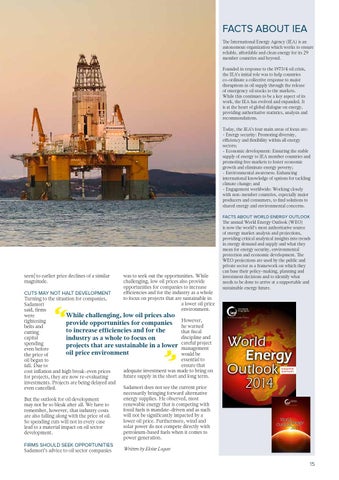
CUTS MAY NOT HALT DEVELOPMENT Turning to the situation for companies, Sadamori said, firms were While challenging, low oil prices also tightening provide opportunities for companies However, he warned belts and to increase efficiencies and for the that fiscal cutting discipline and capital industry as a whole to focus on project spending projects that are sustainable in a lower careful management even before oil price environment would be the price of essential to oil began to ensure that fall. Due to adequate investment was made to bring on cost inflation and high break-even prices future supply in the short and long term. for projects, they are now re-evaluating investments. Projects are being delayed and Sadamori does not see the current price even cancelled. necessarily bringing forward alternative energy supplies. He observed, most But the outlook for oil development renewable energy that is competing with may not be so bleak after all. We have to fossil fuels is mandate-driven and as such remember, however, that industry costs will not be significantly impacted by a are also falling along with the price of oil. lower oil price. Furthermore, wind and So spending cuts will not in every case solar power do not compete directly with lead to a material impact on oil sector petroleum-based fuels when it comes to development. power generation. FIRMS SHOULD SEEK OPPORTUNITIES Written by Eloise Logan Sadamori’s advice to oil sector companies
FACTS ABOUT WORLD ENERGY OUTLOOK The annual World Energy Outlook (WEO) is now the world’s most authoritative source of energy market analysis and projections, providing critical analytical insights into trends in energy demand and supply and what they mean for energy security, environmental protection and economic development. The WEO projections are used by the public and private sector as a framework on which they can base their policy-making, planning and investment decisions and to identify what needs to be done to arrive at a supportable and sustainable energy future.
World Energy Outlook 2014
EXECUTIVE SUMMARY
15