International Research Journal of Engineering and Technology (IRJET) Volume: 05 Issue: 06 | June 2018
www.irjet.net
e-ISSN: 2395-0056 p-ISSN: 2395-0072
Load in (N)
4. TEST RESULTS 4.1 TENSILE TEST Length Vs. Load
Load in (N)
Length in (mm)
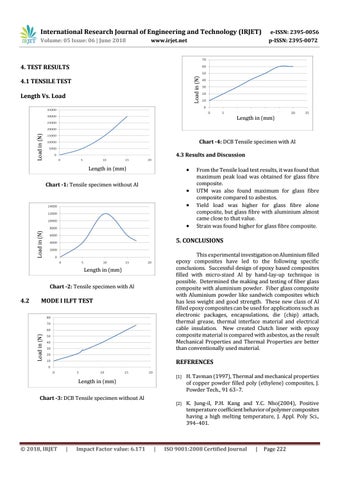
Chart -4: DCB Tensile specimen with Al 4.3 Results and Discussion Length in (mm)
Chart -1: Tensile specimen without Al
Load in (N)
5. CONCLUSIONS This experimental investigation on Aluminium filled epoxy composites have led to the following specific conclusions. Successful design of epoxy based composites filled with micro-sized Al by hand-lay-up technique is possible. Determined the making and testing of fiber glass composite with aluminium powder. Fiber glass composite with Aluminium powder like sandwich composites which has less weight and good strength. These new class of Al filled epoxy composites can be used for applications such as electronic packages, encapsulations, die (chip) attach, thermal grease, thermal interface material and electrical cable insulation. New created Clutch liner with epoxy composite material is compared with asbestos, as the result Mechanical Properties and Thermal Properties are better than conventionally used material.
Length in (mm) Chart -2: Tensile specimen with Al
MODE I ILFT TEST
Load in (N)
4.2
From the Tensile load test results, it was found that maximum peak load was obtained for glass fibre composite. UTM was also found maximum for glass fibre composite compared to asbestos. Yield load was higher for glass fibre alone composite, but glass fibre with aluminium almost came close to that value. Strain was found higher for glass fibre composite.
REFERENCES Length in (mm)
Chart -3: DCB Tensile specimen without Al
© 2018, IRJET
|
Impact Factor value: 6.171
|
[1]
H. Tavman (1997), Thermal and mechanical properties of copper powder filled poly (ethylene) composites, J. Powder Tech., 91 63–7.
[2]
K. Jung-il, P.H. Kang and Y.C. Nho(2004), Positive temperature coefficient behavior of polymer composites having a high melting temperature, J. Appl. Poly Sci., 394–401.
ISO 9001:2008 Certified Journal
|
Page 222