International Research Journal of Engineering and Technology (IRJET) Volume: 03 Issue: 07 | July-2016
www.irjet.net
e-ISSN: 2395 -0056 p-ISSN: 2395-0072
where x is the input (state variable), y is the output of the system, Ai are the different fuzzy variables used to classify the input x and Ci are the different fuzzy variables used to classify the output y. The fuzzy rule representation is linguistically based. Thus, the input x is a linguistic variable that corresponds to the state variable under consideration. Furthermore, the elements Ai are fuzzy variables that describe the input x. Correspondingly, the elements Ci are the fuzzy variables used to describe the output y. In fuzzy logic control, the term ‘‘linguistic variable’’ refers to whatever state variables the system designer is interested in. Linguistic variables that are often used in control applications include Speed, Speed Error, Position, and Derivative of Position Error. The fuzzy variable is perhaps better described as a fuzzy linguistic qualifier. Thus the fuzzy qualifier performs classification (qualification) of the linguistic variables. The fuzzy variables frequently employed include Negative Large (NL), Positive Small(PS) and Zero(ZO). Several papers in the literature use the term ‘‘fuzzy set’’ instead of ‘‘fuzzy variable’’, however; the concept remains the same. Table illustrates the difference between fuzzy variables and linguistic variables. Once the linguistic and fuzzy variables have been specified, the complete inference system can be defined. The fuzzy linguistic universe, U, is defined as the collection of all the fuzzy variables used to describe the linguistic variables.
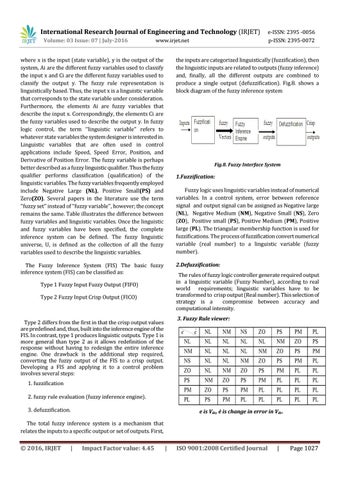
the inputs are categorized linguistically (fuzzification), then the linguistic inputs are related to outputs (fuzzy inference) and, finally, all the different outputs are combined to produce a single output (defuzzification). Fig.8. shows a block diagram of the fuzzy inference system
The Fuzzy Inference System (FIS) The basic fuzzy inference system (FIS) can be classified as:
2.Defuzzification:
Fig.8. Fuzzy Interface System
1.Fuzzification: Fuzzy logic uses linguistic variables instead of numerical variables. In a control system, error between reference signal and output signal can be assigned as Negative large (NL), Negative Medium (NM), Negative Small (NS), Zero (ZO), Positive small (PS), Positive Medium (PM), Positive large (PL). The triangular membership function is used for fuzzifications. The process of fuzzification convert numerical variable (real number) to a linguistic variable (fuzzy number).
The rules of fuzzy logic controller generate required output in a linguistic variable (Fuzzy Number), according to real world requirements; linguistic variables have to be transformed to crisp output (Real number). This selection of strategy is a compromise between accuracy and computational intensity.
Type 1 Fuzzy Input Fuzzy Output (FIFO) Type 2 Fuzzy Input Crisp Output (FICO)
3. Fuzzy Rule viewer:
Type 2 differs from the first in that the crisp output values are predefined and, thus, built into the inference engine of the FIS. In contrast, type 1 produces linguistic outputs. Type 1 is more general than type 2 as it allows redefinition of the response without having to redesign the entire inference engine. One drawback is the additional step required, converting the fuzzy output of the FIS to a crisp output. Developing a FIS and applying it to a control problem involves several steps: 1. fuzzification 2. fuzzy rule evaluation (fuzzy inference engine). 3. defuzzification.
e is Vdc, ė is change in error in Vdc.
The total fuzzy inference system is a mechanism that relates the inputs to a specific output or set of outputs. First,
© 2016, IRJET
|
Impact Factor value: 4.45
|
ISO 9001:2008 Certified Journal
|
Page 1027