En tren a la costa,
historia del Ramal Talca - Constitución.
Del valle a la costa por el río Maule From valley to coast by the Maule River
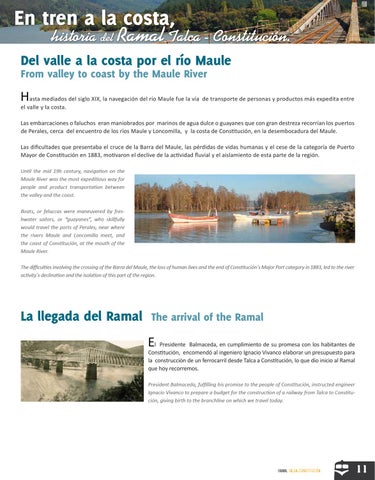
Hasta mediados del siglo XIX, la navegación del río Maule fue la vía de transporte de personas y productos más expedita entre el valle y la costa.
Las embarcaciones o faluchos eran maniobrados por marinos de agua dulce o guayanes que con gran destreza recorrían los puertos de Perales, cerca del encuentro de los ríos Maule y Loncomilla, y la costa de Constitución, en la desembocadura del Maule. Las dificultades que presentaba el cruce de la Barra del Maule, las pérdidas de vidas humanas y el cese de la categoría de Puerto Mayor de Constitución en 1883, motivaron el declive de la actividad fluvial y el aislamiento de esta parte de la región. Until the mid 19h century, navigation on the Maule River was the most expeditious way for people and product transportation between the valley and the coast. Boats, or feluccas were maneuvered by freshwater sailors, or “guayanes”, who skillfully would travel the ports of Perales, near where the rivers Maule and Loncomilla meet, and the coast of Constitución, at the mouth of the Maule River. The difficulties involving the crossing of the Barra del Maule, the loss of human lives and the end of Constitución´s Major Port category in 1883, led to the river activity´s declination and the isolation of this part of the region.
La llegada del Ramal
The arrival of the Ramal
El Presidente Balmaceda, en cumplimiento de su promesa con los habitantes de Constitución, encomendó al ingeniero Ignacio Vivanco elaborar un presupuesto para la construcción de un ferrocarril desde Talca a Constitución, lo que dio inicio al Ramal que hoy recorremos.
President Balmaceda, fulfilling his promise to the people of Constitución, instructed engineer Ignacio Vivanco to prepare a budget for the construction of a railway from Talca to Constitución, giving birth to the branchline on which we travel today.
RAMAL TALCA-CONSTITUCIÓN
11