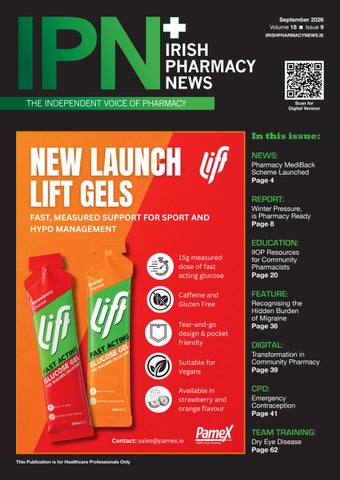
September 2026 Volume 18 Issue 9 IRISHPHARMACYNEWS.IE
THE INDEPENDENT VOICE OF PHARMACY
NEW LAUNCH LIFT GELS
Scan for Digital Version
In this issue: NEWS: Pharmacy MediBack Scheme Launched Page 4
REPORT:
FAST, MEASURED SUPPORT FOR SPORT AND HYPO MANAGEMENT
Winter Pressure, is Pharmacy Ready Page 8
EDUCATION: 15g measured dose of fast acting glucose Caffeine and Gluten Free Tear-and-go design & pocket friendly Suitable for Vegans Available in strawberry and orange flavour
Contact: sales@pamex.ie This Publication is for Healthcare Professionals Only
IIOP Resources for Community Pharmacists Page 20
FEATURE: Recognising the Hidden Burden of Migraine Page 36
DIGITAL: Transformation in Community Pharmacy Page 39
CPD: Emergency Contraception Page 41
TEAM TRAINING: Dry Eye Disease Page 62
Award winning friendly bacteria for little tummies
Science you can feel good about Most trusted & recommended brand of friendly bacteria supplements by Irish consumers. Independent survey, 500 people, Aug '25. Range contains strains with more scientific research than other UK & Irish brands. Full T&Cs at Optibac.com.
3
Contents
Foreword
Page 5: Demand for Pharmacists Expected to Rise by 28%
September traditionally marks the beginning of one of the busiest periods in the community pharmacy calendar, but this year it arrives against a very different backdrop. The role of the pharmacist continues to evolve at pace, with the profession increasingly positioned not only as a provider of medicines, but as an accessible clinical resource at the heart of primary care.
Page 6: Pharmacists at the Front of Medicines Optimisation Page 8: Winter Pressure Test: Is Community Pharmacy Ready for its Busiest Clinical Season Yet?
6
Page 16: Uniphar Reports Higher Revenue and Profits - as Pharmacy Network Expands
One message emerges particularly strongly: meaningful change takes time. Building public confidence, securing the support of other healthcare professionals, investing in pharmacy teams and ensuring that digital infrastructure keeps pace are all essential if the potential of community pharmacy is to be fully realised.
Page 39: Digital Transformation in Community Pharmacy Page 57: Pharmacist Contraception Service Moves Closer to Roll-Out
Trust is also a recurring theme elsewhere in this issue.
8
Page 64: Running a Marathon Like a Pharmacist PUBLISHER: IPN Communications Ltd. 77 Camden Street Lower, Dublin D02 XE80 Office: +353 (01) 2339121 MANAGING DIRECTOR Natalie Maginnis natalie@ipn.ie EDITOR Kelly Jo Eastwood: +44 787654 8989 kelly-jo@ipn.ie
16
Younger consumers are navigating a health landscape radically different from that experienced by previous generations. Social media, influencers and online marketplaces increasingly shape conversations around wellness, supplements, weight management and medicines. Azure Pharmaceuticals asks what “my pharmacist” means to Gen Z, while our accompanying feature examines the growing threat posed by illegal and falsified medicines and the important role pharmacists can play as a trusted filter between online claims and evidence-based healthcare. That same need for informed professional advice is evident in our fascinating feature on berberine. Professor Fabio Boylan examines the history, pharmacology and toxicology of this increasingly popular botanical alongside the developing European regulatory debate. Contributions from EFSA, the FSAI and industry provide differing perspectives on a subject likely to attract considerably more attention in the months ahead. September also brings World Pharmacists Day on 25 September. This year's theme, “Empowering pharmacists for healthier futures,” feels particularly timely.
SALES DIRECTOR Debbie Graham debbiegraham@ipn.ie +353 8727 99317 MARKETING & EDITORIAL EXECUTIVE Anna Hadfield Office: +353 (01) 2339121 Mobile: +353 89 947 7171 anna@ipn.ie
As preparations begin for the 2026/27 influenza and Covid-19 vaccination campaigns, pharmacists are also balancing the demands of the new Common Conditions Service and looking ahead to further expansion of their clinical role. In this issue, we examine winter preparedness and speak to pharmacy leaders across Northern Ireland, Scotland and Wales about their experiences of developing pharmacy-led clinical services – and the lessons Ireland can take from those journeys.
Irish pharmacy is entering a period of considerable opportunity, but greater responsibility inevitably accompanies greater scope of practice. Whether delivering vaccinations, treating common conditions, supporting responsible self-care or helping a patient determine whether something they encountered online can be trusted, the value of the pharmacist increasingly lies not simply in access to medicines, but in access to expertise.
57
That is something worth recognising – not just on World Pharmacists Day, but throughout the year.
CONTRIBUTORS Ruth Morrow | Deirdre Ní Mhórdha Professor Edna F Roche | Adam Esa Karina Vencaite Janis Morrissey Maureen Sweeney Nicola Byrne Dr Samuel Sheehan Dr Caitríona Henchion Professor Donal O’Shea Sinead O'Farrelly
DESIGN DIRECTOR Ian Stoddart Design IRISHPHARMACYNEWS.IE
Irish Pharmacy News IRISH PHARMACY is circulated to all NEWS independent, multiple Pharmacists and academics in Ireland. All rights reserved by Irish Pharmacy News. All material published in Irish Pharmacy News is copyright and no part of this magazine may be reproduced, stored in a retrieval system or transmitted in any form without written permission. IPN Communications Ltd. has taken every care in compiling the magazine to ensure that it is correct at the time of going to press, however the publishers assume no responsibility for any effects from omissions or errors.
Regulars FEATURE: ASTHMA DURING WINTER
P28
CPD: EMERGENCY CONTRACEPTION
P41
FEATURE: SEMAGLUTIDE AND CARDIOVASCULAR OUTCOMES
P46
TEAM TRAINING: DRY EYE DISEASE
P62
CLINICAL PR:
P80
@Irish_PharmNews IrishPharmacyNews
IRISHPHARMACYNEWS.IE
4
News
New Service Available from Pharmacies Community pharmacies across Ireland are beginning to offer a free unused medicine return and disposal service under the new MediBack scheme funded by the HSE. The nationwide initiative allows people to return unused, unwanted or expired medicines safely to their local community pharmacy for safe and responsible disposal. Elizabeth Lang
Pharmacy Role in BowelScreen The HSE has been working with the Irish Pharmacy Union to develop new education modules for community pharmacy teams about BowelScreen, Ireland’s free national bowel screening programme. The education modules have been developed as part of the implementation of the Community Pharmacy Agreement 2025. The agreement aims to support increased uptake of BowelScreen and acknowledges the important role that community pharmacies can play in enhancing access to public health services and health promotion. The education modules support community pharmacy teams to provide accurate information and encourage people eligible for BowelScreen to take part. The current age range is 57 to 71.
More than 1,900 community pharmacies around the country are now participating in the service which aims to protect both public health and the environment. Research previously commissioned by the Irish Pharmacy Union found that 27% of unused medicines were thrown in household bins while 6% were flushed down sinks or toilets. The research also found that two out of five people were unaware of the risks associated with incorrect disposal. Medicines that are not disposed of correctly can contaminate water systems and contribute to wider environmental and health challenges. Commenting on the launch, Elizabeth Lang of the Irish Pharmacy Union said, “Pharmacists across Ireland have long called for a national medicines return scheme and we are delighted to see MediBack launched. For the first time, Ireland will have a nationally coordinated medicines return service available through community pharmacies. This is the latest in a growing number of healthcare services being delivered through community pharmacies nationwide and is another example of how pharmacies continue to make healthcare more accessible and convenient for patients.
IRISHPHARMACYNEWS.IE
“MediBack will empower people to dispose of medicines correctly, protecting their families, their communities and the environment. Too often medicines are kept unnecessarily in homes or disposed of in ways that can pose risks to public health and the environment.
“The scheme is also a practical opportunity for patients, families and carers to review what medicines are in the home, what is no longer required and what may not be being used as intended. When returning unused medicines to their local pharmacy, people can consult with their pharmacist about their medicines, how they are taking them and whether they have any questions or concerns. That gives pharmacists a clearer picture of how medicines are being used and supports safer, more effective care for patients.”
The HSE has developed 3 education modules that are hosted on the IPU’s website for IPU members. • Module 1: Bowel Cancer • Module 2: About BowelScreen • Module 3: Supporting people to take part in BowelScreen They are available to view in 3 separate modules, or in a single module format. Together, the modules take about 25 minutes to complete. Pharmacies that opt into the BowelScreen services under the Community Pharmacy Agreement 2025 will complete the BowelScreen education modules by the end of September 2026. The HSE will continue working with the IPU to implement the Community Pharmacy Agreement 2025 and are developing a pharmacy promotional campaign. This involves the development of promotional materials on prescription bags to encourage people to talk to their community pharmacy teams about BowelScreen. The HSE will support this in-pharmacy campaign by developing an extensive public communications campaign to promote the supportive role community pharmacies can play for people who want to get support or information about BowelScreen.
News Updated Pharmacy Codes of Ethics Pharmacy organisations, regulators and educators should strengthen and regularly update their codes of ethics to reflect the rapidly evolving role of pharmacists and emerging healthcare challenges, according to a new Statement of Policy released by the International Pharmaceutical Federation (FIP). Replacing FIP's 2014 statement of professional standards in this area, the updated policy provides guidance for developing and implementing modern codes of ethics that apply to pharmacists across all areas of practice. It recognises that pharmacists' responsibilities now extend well beyond medicines supply to include patient care, research, education, leadership, regulation, public health and pharmaceutical innovation. The statement reinforces pharmacists’ ethical responsibility to exercise independent professional judgement, maintain competence through continuing professional development. The statement outlines the principles that should underpin national codes of ethics, including integrity, professional accountability, patient-centred and person-centred care, confidentiality, respect for human rights, non-discrimination and interprofessional collaboration.
5
Demand for Pharmacists Expected to Rise by 28% by 2040 Demand for pharmacists in Ireland is expected to increase by 28% between 2023 and 2040 as the profession takes on an expanding role in healthcare, the Minister for Health has confirmed. Minister for Health Jennifer Carroll MacNeill provided the projection in response to a Parliamentary Question from Deputy Pádraig O’Sullivan, who sought details on the number of pharmacy graduates registering with the Pharmaceutical Society of Ireland (PSI) and whether sufficient capacity exists within the healthcare system to absorb growing graduate numbers. According to the Minister, 388 pharmacists had registered with the PSI for the first time in 2025 as of 5 December, of whom 117 were graduates from Irish pharmacy programmes. This compared with 421 first-time registrants in 2024, including 173 national graduates; 529 in 2023, including 185 national graduates; 357 in 2022, including 156 national graduates; and 530 in 2021, of whom 144 were national graduates.
Across the five years, this represents 2,225 first-time PSI registrations, including 775 national graduates. Addressing the capacity of the healthcare system to accommodate pharmacists entering the workforce, Minister Carroll MacNeill said demand is expected to grow significantly. “It is anticipated that there will be a growing demand for pharmacists in the years ahead due to a rising and ageing population,” she said.
clinical role for the profession. According to the Minister, implementing that expansion will itself create demand for a larger pharmacy workforce. “Following on from analysis and research carried out by my Department, it is expected that the demand for pharmacists will increase by 28% between the years 2023 and 2040,” she confirmed.
The Minister also pointed to the ongoing expansion of pharmacists’ scope of practice following recommendations from the Expert Taskforce to Support the Expansion of the Role of Pharmacy.
The figures come at a significant time for the profession, with community pharmacists assuming an increasingly clinical role through services including vaccination and the Common Conditions Service, while pharmacist workforce requirements across community, hospital and other healthcare settings continue to evolve.
The Taskforce, established to examine how pharmacists could contribute more extensively to healthcare delivery, has recommended an expanded
The Department has also incorporated pharmacy into its wider workforce planning through its report on Ireland’s future health and social care workforce.
Fellowship for Professor Gallagher Congratulations to Professor Paul Gallagher who was recently awarded a FIP Fellowship at the 84th World Congress of Pharmacy and Pharmaceutical Sciences, in Montreal, Canada.
"Strong ethical frameworks are essential to address emerging ethical priorities, including the responsible use of artificial intelligence and digital health technologies, pharmacist wellbeing, conscientious objection, environmental sustainability and protection from undue commercial or organisational pressures," said Dr Betty Chaar, co-chair of the policy committee.
FIP Fellowship recognises individual members of FIP who have exhibited strong leadership internationally, distinguished themselves in the practice of pharmacy, education and/ or pharmaceutical sciences, contributed to the advancement of practice, education and/or pharmaceutical sciences, and who have served FIP. FIP Fellows may use the designation “FFIP.”
The updated statement includes recommendations for pharmacy organisations, governments and policymakers, education providers and patient organisations. It also outlines FIP's own commitments, including supporting the development and regular review of national codes of ethics, promoting ethics education, facilitating international dialogue on professional ethics and gathering global information on ethics-related activities across the profession.
Professor Gallagher was previously Head of RCSI’s School of Pharmacy. He has contributed to the reform of pharmacy education through his directorship of the National Pharmacy Internship Programme (MPharm). Before Professor Gallagher joined the RCSI in 2010, he established a pharmacy and medical centre in Dublin city centre. He is currently Professor (Practice Track) at NUS Department of Pharmacy and Pharmaceutical Sciences in Singapore.
Professor Paul Gallagher with FIP President Paul Sinclair AM
IRISHPHARMACYNEWS.IE
6
News
Pharmacists at Front of Medicines Optimisation Pharmacists should be empowered to lead evidence-based pharmaceutical product selection, including generic substitution and therapeutic interchange, to improve access to medicines, strengthen health system resilience and optimise patient outcomes, according to a new Statement of Policy released by the International Pharmaceutical Federation (FIP). Mr Daragh Connolly, Co-Chair, FIP Policy Committee
The statement, replacing FIP's 2018 policy on pharmacists' authority in pharmaceutical product selection, reflects major developments in regulatory science, the growing use of generic and biosimilar medicines, digital health technologies, medicine shortages and the increasing need for sustainable, people-centred health care. Specifically, this statement aims to: • Modernise the pharmacist’s authority, responsibility and accountability in pharmaceutical product selection across diverse health systems; • Position therapeutic interchange and substitution as essential clinical practices that support universal health coverage (UHC), equitable access to medicines, health system resilience and people centred care; • Provide globally applicable guidance that can be adapted to different regulatory, economic and resource contexts, including low and middle income countries; and • Align pharmacist led pharmaceutical product selection with value based health care, sustainability and the responsible use of medicines.
IRISHPHARMACYNEWS.IE
"Pharmacists are the healthcare professionals with the greatest expertise in medicines, making them ideally placed to lead pharmaceutical product selection," said Mr Daragh Connolly, co-chair of the policy committee. "As health systems face increasing financial pressures, medicine shortages and more complex patient needs, enabling pharmacists to practise to the full extent of their competence benefits patients and health systems alike." The policy recognises pharmaceutical product selection — including generic substitution and therapeutic interchange — as a key clinical responsibility of pharmacists. Where permitted by national legislation, pharmacists should be able to apply evidencebased clinical judgement to optimise medicine use, maintain continuity of care and support equitable access to treatment. It also distinguishes between generic substitution, biosimilar substitution, therapeutic interchange and prescriber-led switching, acknowledging that legal frameworks differ across countries. “People-centred care is a central theme throughout the policy, which calls on pharmacists to involve patients in decisions about changes to their medicines, explain the reasons for substitution or interchange, and address concerns that may affect adherence or confidence in treatment. It also highlights the importance
of collaborative practice with prescribers and other healthcare professionals to ensure safe, coordinated care,” said Mr LarsÅke Söderlund, co-chair of the policy committee. The policy also highlights the growing role of digital technologies in medicines optimisation, encouraging wider use of electronic health records, clinical decisionsupport systems and real-world evidence to improve patient safety, pharmacovigilance and continuity of care. It further recognises pharmacists' contribution to responding to medicine shortages, strengthening supply chain resilience and supporting valuebased health care. The WHO-FIP Joint Guidelines on Good Pharmacy Practice (2011) affirm the central role of pharmacists in medicines optimisation and call on governments, in collaboration with national professional organisations, to make full use of pharmacists’ expertise across health systems.6 These guidelines recognise generic substitution as part of responsible pharmacy practice. This statement builds upon that foundation while reflecting contemporary regulatory, scientific and health system developments. FIP calls on governments and policymakers to establish clear legal frameworks, align regulatory and reimbursement policies, and strengthen public confidence in generic and biosimilar medicines. It also urges pharmacy organisations, educators, healthcare funders, manufacturers and digital health developers to invest in pharmacist education, digital infrastructure and collaborative models of care that enable pharmacists to fully contribute to medicines optimisation. FIP reaffirms its commitment to supporting pharmacist-led, evidence-based pharmaceutical product selection as a means of improving patient outcomes, expanding access to medicines and strengthening sustainable healthcare systems worldwide.
Women’s Health Action Plan The Minister for Health, Jennifer Carroll MacNeill TD, has launched the Third National Women’s Health Action Plan (2026–2027) in Tallaght University Hospital, alongside a visit to the hospital’s Endometriosis Hub. The visit highlighted the significant progress being made in expanding access to specialist endometriosis care as part of the Government’s ongoing commitment to improving women’s health services. The new Action Plan sets out the next phase of work to improve access, outcomes and experiences, building on significant progress since the first Action Plan was launched in 2020. Over €180 million of additional funding has been invested in women’s health since 2020, supporting the two previous Women’s Health Action Plans. This dedicated funding has resulted in new initiatives across the country – often the first-of-their-kind, including the rollout of menopause clinics, ambulatory gynaecology services and postnatal hubs, nationwide free contraception and HRT for the symptoms of menopause and expanded endometriosis services. The Department of Health will continue to listen to, invest in and deliver for women, building on the Department’s knowledge of women’s health through research and innovation as well as spotlighting key areas including endometriosis and cardiovascular health. Measures under the Action Plan include the development of a Women’s Health Programme in General Practice, enhanced early detection and prevention initiatives for cardiovascular disease in young women, the expansion of specialist multidisciplinary eating disorder teams, and the development of mental health supports for women living with endometriosis. The Plan also provides for increased awareness and understanding of endometriosis, the expansion of the free period products scheme to additional locations, and continued growth in the number of postnatal hubs. Looking ahead, the Plan is informed by ongoing work to better understand women’s health needs across the life course, which will help inform future developments in a coherent and sustainable way.
50% 50% Over
of of thethe Irish UKpopulation populationwill willexperience experience a skin condition each year a skin condition each year
E45 Cream is clinically proven to treat dry skin conditions such as:
Dry or Itchy skin
Eczema
Dry Psoriasis
Sunburn
*Refers to E45 Cream for dry skin. E45 cream is a medicine. Always read the label.
8
Report
Winter Pressure Test: Is Community Pharmacy Ready for its Busiest Clinical Season Yet? As Ireland’s community pharmacists prepare for the 2026/27 influenza and Covid-19 vaccination campaigns, this winter brings a new dimension. Vaccination is now being delivered alongside the Common Conditions Service and an expanding clinical workload. Irish Pharmacy News examines winter readiness and speaks to pharmacy leaders in Northern Ireland, Scotland and Wales about what Ireland can learn as the profession’s role continues to grow. Autumn has long marked the beginning of one of the busiest periods in the community pharmacy calendar. Alongside the everyday demands of dispensing and medicines supply come rising numbers of patients seeking advice for coughs, colds and respiratory illness and, increasingly, a major programme of seasonal vaccination. In 2026, however, the landscape is different. Ireland’s community pharmacists enter the vaccination season having undergone one of the most significant expansions of their clinical role in recent years. The Common Conditions Service (CCS), launched earlier this year, enables trained pharmacists to assess patients and, where clinically appropriate, prescribe within national protocols for eight specified conditions: allergic rhinitis and allergic conjunctivitis, cold sores, acute infective conjunctivitis, impetigo, oral thrush, shingles, uncomplicated lower urinary tract infection and vulvovaginal thrush. The HSE continues to publish the eight national clinical protocols underpinning the service. That change forms part of a much broader shift towards community pharmacy becoming a recognised point of clinical care rather than solely a destination for medicines supply.
But winter provides an early test of that ambition.
Vaccination is Already a Major Pharmacy Service
Community pharmacists will simultaneously be dispensing medicines, administering influenza and Covid-19 vaccines, dealing with the seasonal rise in respiratory illness and delivering the relatively new Common Conditions Service.
Under the Community Pharmacy Agreement 2025, the Government noted that pharmacists were administering approximately one in every three influenza and Covid-19 vaccinations.
Matt Barclay, Chief Executive of Community Pharmacy Scotland, summed up one of the fundamental challenges when he spoke to Irish Pharmacy News (IPN). “Medicine supply will always remain critically important for community pharmacy and will always be the bedrock of what we do, but Pharmacy First has evolved the clinical role further in Scotland.” In other words, clinical services do not replace the pharmacist’s traditional responsibilities. For most pharmacy teams, they are being delivered alongside them. The question facing Irish pharmacy this winter is therefore not simply whether pharmacists are willing and capable of providing more clinical care. It is whether the workforce, vaccine supply, digital systems, funding and wider infrastructure surrounding them are developing quickly enough to support what is increasingly being asked of the sector.
The scale of delivery last season illustrates that contribution even more clearly. An HSE circular issued in March recorded approximately 472,000 influenza and 172,000 COVID-19 vaccinations administered through community pharmacy during the 2025/26 programme, accounting for approximately 36% and 33% of vaccination activity respectively. Preparations for 2026/27 are now underway. The HSE has published its pre-campaign pharmacy circular and dedicated clinical resources for the new influenza and COVID-19 vaccination programme. Participating pharmacies require a PCRS community pharmacy contract, National Cold Chain account and access to HSE PharmaVax.
service models, despite serving populations with many of the same healthcare needs. Professor Cathy Harrison, Chief Pharmaceutical Officer for Northern Ireland, began her own career in community pharmacy and told IPN that the profession has changed enormously since then. The direction of travel is away from viewing pharmacy services as isolated interventions and towards integrating pharmacy into wider healthcare pathways. Professor Harrison encapsulates that philosophy in a simple phrase: “Pharmacy with a purpose.” Using weight management as an example, she explained that the objective should not simply be to help an individual lose weight. Weight management needs to form part of a broader approach to obesity, with pharmacy included in the wider healthcare conversation. The principle applies equally to common conditions.
Of all Ireland’s neighbours, Northern Ireland arguably provides the most interesting comparison.
Rather than viewing the pharmacy as an alternative destination in isolation, the objective is to create a pathway through which an appropriate patient can receive accessible assessment and treatment in the community while capacity is released elsewhere.
Pharmacists working only miles apart on either side of the border now operate under materially different funding and
The scale that model can achieve is already evident. Northern Ireland’s Everyday Health Conditions service recorded
Northern Ireland: “Pharmacy With A Purpose”
“When we started the Common Ailments Service, the activity levels were very small….. You also have to bring practitioners with you, including GPs, nurses and reception staff, so that they support and reinforce the pharmacy service Andrew Evans, Chief Pharmaceutical Officer, Wales IRISHPHARMACYNEWS.IE
Are you looking for a vitamin D supplement that is bioavailable and effective?
Get the proven benefits of sun exposure Without worrying about your skin As you know, it is important to protect your skin when the sun is most powerful. Still, sun exposure is necessary in order for our skin to synthesize vitamin D, which contributes to a normal immune defense. If we avoid the sun or somehow prevent the UV rays from reaching our skin, it will reduce our ability to make vitamin D. It is difficult to get your full requirement of Vitamin D from diet alone. Therefore, to maintain a reasonable amount of vitamin D in your system it may be a good idea to consider taking a supplement like BioActive D-Pearls.
BioActive D-Pearls are small, soft gelatin capsules with 38 or 75 micrograms of vitamin D in each. This makes it easy for you to choose the right dose for the time of year and for your personal level of sun exposure. • the vitamin D in BioActive D-Pearls is dissolved in cold-pressed olive oil for better absorption • small capsules that are easy to swallow – or chew
Buy from www.pharmanord.ie/webshop, your local pharmacy or health food shop. Find us on social media: www.pharmanord.ie
10
Report
169,000 consultations during 2025/26 – more than 14,000 each month. Community pharmacies also provided approximately 26,000 uncomplicated UTI consultations, 25,000 emergency hormonal contraception consultations and 19,000 sore-throat consultations during the year. Those are no longer marginal services. They represent substantial volumes of patient care. Trust does not develop overnight. Professor Harrison stressed, however, that public acceptance has taken time. Patients who had traditionally contacted their GP first needed to become familiar with a different model
IRISHPHARMACYNEWS.IE
and confident in pharmacists’ education and clinical abilities. Clear communication was therefore critical – explaining what pharmacies could provide, which patients were eligible and what they could expect when they presented. The experience closely mirrors what Andrew Evans, Chief Pharmaceutical Officer for Wales, told IPN. Wales began piloting its Common Ailments Service in 2013. Looking at where the service is now, Evans said, “I think it is going really well, but it has been a long and fairly slow journey.” The challenge was not simply training pharmacists. It was changing established patient behaviour. “If you want people to
shift from thinking, ‘I need to see my GP for this,’ to going to the pharmacist instead, they need to have confidence in doing that.” Cost was one consideration in the Welsh model, Andrew explained, which is why treatment was made free at the point of care. But so too were health literacy, trust and the experience the patient received.
in a consultation room. The pharmacist assesses and treats you with the same medicines and the same sort of clinical thought process that would go into your treatment elsewhere.”
“We felt that if we were asking someone to transfer from the GP to the pharmacy, the pharmacy consultation needed to feel like the same kind of professional clinical experience.”
That experience provides an interesting comparison with Ireland, where the CCS consultation fee is set and charged by the individual pharmacy. Under the Community Pharmacy Agreement, medicines may be reimbursed through existing State schemes where applicable, but the CCS itself was established as a fee-paying consultation service.
He continued, “You go into the pharmacy and you see the pharmacist, not a counter assistant. You see the pharmacist
Andrew was cautious about commenting directly on the Irish funding structure but made the wider point that shifting
11 suitable activity into pharmacy does not leave other healthcare professionals without work. “I cannot believe there is an infinite amount of capacity in general practice. If someone with athlete’s foot is directed to their pharmacist, I do not think the GP will be left with nothing to do. There is almost certainly somebody else with a greater need who requires that appointment.” The Importance of GP Buy-In Professor Harrison also identified another factor that has helped normalise Pharmacy First in Northern Ireland: support from General Practice. Some GP practices now use recorded telephone messages advising patients that certain conditions can be assessed through their local community pharmacy. It may seem like a relatively simple intervention, but its significance should not be underestimated. The patient is no longer being told by pharmacy that pharmacy can provide the service. Their existing healthcare provider is actively directing them there. Matt described the same phenomenon in Scotland. “Having the buy-in of other healthcare professionals is important. If a GP sees somebody with a UTI and says, ‘By the way, next time you can go to your pharmacist; they’re perfectly capable of dealing with that,’ that helps.” Government advocacy and public communication matter too, he said. “If there’s a way to evidence what you do and package that up in advocacy work, that is useful too. There is nothing better than patients being their own advocates.” Patient stories demonstrating that somebody received appropriate care in pharmacy without needing to wait for a GP appointment or attend an emergency department can be particularly powerful. The ultimate result is a cultural shift. “Hopefully people now see the community pharmacist and the pharmacy team not simply as somewhere to collect medicines, but somewhere to go for clinical assessment.” That may be one of the most important challenges facing Ireland’s CCS during its first full winter. Launching a service is one thing. Changing the public’s instinctive answer to the question “Where should I go with this problem?” is quite another.
Covid: A Turning Point For Trust Professor Harrison believes the Covid-19 pandemic accelerated that cultural shift in Northern Ireland. Community pharmacies remained visible and accessible throughout the pandemic and became an integral part of their communities. That experience helped demonstrate that pharmacists could contribute far beyond medicines supply and strengthened public confidence in the profession. Vaccination itself has subsequently become one of the clearest examples of that changed relationship. During three vaccination campaigns across autumn 2025 and spring 2026, 324 Northern Ireland pharmacies administered 79,724 influenza and Covid-19 vaccinations. Ireland’s own figures tell a similar story. Community pharmacy’s approximately 644,000 flu and Covid vaccinations during the 2025/26 programme demonstrate the scale at which patients are already prepared to receive preventative healthcare from pharmacists. The opportunity now is to translate that confidence into other clinical services. Diagnostics and Antimicrobial Stewardship Northern Ireland’s sore-throat service illustrates what that next stage can look like. Following a pilot in winter 2023/24, the service was introduced into more than 400 pharmacies in December 2024. It subsequently delivered approximately 19,000 consultations in 2025/26, yet only 20% resulted in an antibiotic being supplied. Professor Harrison highlighted the value of being able to assess a patient, test where appropriate and treat within one pathway. The service is convenient for patients and can reduce pressure elsewhere, but its role in antimicrobial stewardship is equally important. As part of her work in medicines optimisation, Professor Harrison stressed that the objective is to ensure patients receive the most appropriate medicines and achieve the best possible outcomes. The Welsh experience provides further evidence of what pharmacy diagnostics can achieve. Wales introduced sore-throat test-and-treat around 2018, initially through approximately 50 pharmacies.
Patients do not simply request a throat swab. The pharmacist assesses symptoms, examines the throat and uses clinical scoring before determining whether rapid antigen testing for Group A streptococcus is appropriate. The service has grown substantially. “On average, allowing for seasonality, we are probably seeing around 5,000 consultations a month,” Evans told IPN. The model is significant because it demonstrates that expanding access does not have to mean expanding antibiotic use. Instead, putting diagnostics and clinical decision-making into pharmacy can support stewardship while providing rapid access to appropriate treatment. The Frontline View: What Pharmacists Told IPN To add a frontline perspective to the wider picture, Irish Pharmacy News asked community pharmacists involved in vaccination about their experience of last year’s campaign and the pressures they anticipate this winter. The findings are intended as a snapshot of individual pharmacy experience rather than a nationally representative survey, but several recurring themes closely reflected the capacity, supply and workforce challenges identified in IPN’s conversations with pharmacy leaders elsewhere. Every pharmacist responding had provided adult influenza, children’s nasal influenza and COVID-19 vaccination during the previous season. Most felt reasonably well informed ahead of the campaign, with 75% saying they had received sufficient information or notice to prepare and the remainder answering ‘mostly’. Supply was more problematic. Overall, 75% experienced at least some difficulty obtaining the quantities or product mix of vaccines their pharmacy required. Comments submitted to IPN suggested that timing and predictability could be as important as overall supply. One pharmacist who permitted anonymous quotation highlighted difficulties aligning pharmacy involvement in the schools programme with vaccine delivery: “Schools are ready for us in early Sept but the Cold Chain won’t supply until Late Sept/early Oct.” The pharmacist requested an earlier supply through the National Cold Chain Service and inquired whether delivery schedules could be adjusted to accommodate individual
pharmacies that repeatedly receive later delivery dates. Staffing and Capacity When pharmacists were asked to identify the greatest difficulties they experienced during vaccination season, staffing was the most frequently selected answer, cited by 63% of respondents. Half identified vaccine ordering and supply, while half selected obtaining the required quantities or product mix. Patient hesitancy, administration and record keeping, appointment management and patient eligibility questions were each identified by 38% of respondents. Cold-chain capacity was identified by 25%. Because pharmacists could select multiple answers, the findings do not represent mutually exclusive categories. Instead, they reveal the layers of work sitting behind every vaccination administered. The vaccination itself may take only a relatively short period. Delivering the service involves patient assessment, consent, eligibility checking, vaccine ordering, stock management, cold-chain requirements, record keeping and, frequently, appointment management. All of this must happen while the pharmacy continues to dispense medicines and deal with unscheduled patient demand. The experience in Scotland suggests Ireland is far from alone in confronting that problem. Asked by IPN about the pressures associated with expanding pharmacy services, Barclay described them as “universal challenges.” “The first is capacity. Community pharmacy teams are still delivering their core services while facing workforce pressures. If you have a member of the team off sick, it can cause significant issues.” Funding follows closely behind. “We have managed to redistribute some funding within our existing funding pot towards workforce and service delivery, but the minute you develop a new service it comes with new costs.” And there is a third requirement. “Then there is training and development. If you’re expanding clinical practice, that comes with structured education and supervised learning.” Those comments provide important context for the frontline experiences reported to IPN in Ireland.
IRISHPHARMACYNEWS.IE
12
Report
IPN Winter Vaccination inNumbers Numbers BOX:Survey: IPN Survey: Winter Vaccination in 100% 100% 100% 75% 63% 50% 50% 50% 5 out of 8 3 out of 8 4 out of 8
Digital Infrastructure: The Next Big Test
provided adult influenza vaccination in 2025/26 provided children’s nasal influenza vaccination provided COVID-19 vaccination experienced at least some difficulty obtaining the required vaccine quantities/product mix identified staffing as a major operational challenge identified vaccine ordering/supply as a challenge identified obtaining the required quantity/product mix as a challenge identified children aged 2–17 as the hardest group to reach rated preparedness for 2026/27 at four or five out of five expect to administer more vaccinations this season expect numbers to remain broadly similar
Staffing: The Biggest Challenge
The pressures identified by viewed in the context of how long traditional model will immediately the service existed.difficulties theydecide pharmacists are not necessarily that becoming When pharmacists were asked to identify thehas greatest experienced duringa prescriber evidence that clinical expansion is necessary. Transition takes time. “When started the Commonanswer, cited by five of the eight vaccination mostwe frequently selected cannot work. season, They are staffing evidencewas the Ailments Service, the activity levels More importantly, prescribing that capacity has to expand respondents. were very small.” And changing education has to be accompanied alongside clinical responsibility. where patients seek care, he by commissioned services Four identified vaccinewho ordering supply, while fourtime. selected the required said, inevitably takes You obtaining Reaching the Patients Need and and suitable clinicalquantities pathways or also have to bring practitioners Vaccination through which those new skills product mix. with you, including GPs, nurses can actually be deployed. The frontline responses also and reception staff, so that Scotland is already encountering Patient hesitancy, administration and record keeping, appointment management and patient identified another challenge for the they support and reinforce the the same issue. For the first coming winter. Half of respondents eligibility questions were each selected by three respondents. pharmacy service.” time, Matt said, pharmacists selected children aged two to are entering the profession with Perhaps most importantly, “One 17 years as the group was they identified had Cold-chain capacity by two. prescribing capability. thing we learned quite quickly, found most difficult to reach or encourage to receive vaccination.
and have carried into independent
sees considerable Because pharmacists could select multiple answers, the resultsofdo notHe represent mutuallyopportunity exclusive prescribing, is the importance in the new generation. “There is a A quarter identified patients eligible trust and certainty.” categories. Instead, they reveal theconfidence, layers of work sitting behind everyreal vaccination opportunityadministered. for the profession.
for Covid-19 vaccination, while They are coming out as very others highlighted people in clinical Patients being directed from Thegroups. vaccination itself may take onlyone a relatively the service involves different pharmacists frompatient the part of theshort healthperiod. service Delivering to risk This matters because pharmacistcold-chain I was when I qualified, anothervaccine need confidence the management, assessment, consent, eligibility checking, ordering,that stock pharmacy’s role in childhood hopefully better pharmacists, and will actually be there when influenza vaccination continues requirements, record keeping and,service frequently, appointment management. they can help lead the profession they arrive. to develop, including through the into the next phase.” LAIV schools programme. “They needcontinues confidencetothat when medicines and deal with All of this must happen while the pharmacy dispense But he cautioned against assuming they get there they will have a good The findings suggest that making unscheduled patient demand. that possessing the qualification experience and that the pharmacist vaccination available is only part of makes someone an experienced will actually be able to provide the the solution. The experience in Scotland suggests Ireland is far from alone in confronting problem. Asked by clinical that practitioner. service being advertised.” Parents need to know their IPN about the pressures associatedThat withobservation expandinghas pharmacy services, Barclay them as “Having thedescribed qualification is one relevance children are eligible. Schools thing, but developing the skills “universal challenges.” beyond common conditions. It need to understand how around clinical assessment, safetyapplies equally to vaccination. pharmacy participation works. netting andservices all the other elements Pharmacies sufficient staff “The first isneed capacity. Community pharmacy teams are still delivering their core while facing Prescribing: Qualification is Only of day-to-day practice takes time. and appropriate vaccine supply at workforce pressures. If you have a The member of the team off sick, it canThey cause significant issues.” Beginning will develop experience,” he the stage of the campaign when said, “and they need support and schools are ready to participate. The next major evolution time to do that.” is prescribing. Public awareness was generally Scotland has already embedded rated positively, with 63% giving Professor Harrison told IPN independent prescribing in just it a four or five out of five, but that prescribing is now being over half of its pharmacies and pharmacists still identified incorporated into pharmacists’ has an ambition for some form of opportunities for greater education in Northern Ireland, prescribing service to be available advertising and communication. while existing pharmacists in every pharmacy by 2030. continue to have opportunities to Again, the international interviews undertake prescribing training. But Matt’s experience is a useful suggest that behaviour change reminder for Ireland: workforce requires persistence rather than But she also acknowledged that transformation cannot be achieved a single campaign. Andrew said not every pharmacist who has Wales’ current activity needs to be practised for many years within the by qualification alone.
IRISHPHARMACYNEWS.IE
If there was one subject that repeatedly emerged from IPN’s conversations across the different healthcare systems, it was digital infrastructure. Professor Harrison acknowledged that Northern Ireland’s current digital landscape does not support pharmacists as effectively as it needs to. If pharmacy is to become genuinely integrated into healthcare, pharmacists must be able to exchange relevant information efficiently with GPs and other healthcare professionals. The intention under Northern Ireland’s commissioning strategy is to make substantial progress towards a connected system by the end of the decade. Professor Harrison pointed to approximately £42 million of investment supporting digital development, with the ambition of digital prescribing and a shared platform by 2029. Instead of pharmacists having to send separate letters or recommendations back to GP practices, relevant clinical information should increasingly form part of a connected pathway. Wales provides an indication of what that can look like. “Whenever you have a clinical service consultation in a pharmacy in Wales, there is an electronic system that supports it,” Andrew explained. “At the end of every consultation, the system generates an electronic letter which is sent to the patient’s GP practice.” The pharmacy record itself can also be viewed across participating pharmacies, creating an additional patientsafety mechanism. And pharmacists delivering relevant services can access a summary of the patient’s Welsh GP electronic record. “That allows them to prescribe and treat the patient more safely.” Scotland, by comparison, still has gaps. Matt said community pharmacists do not need indiscriminate access to everything held about a patient. “I’ve always said to GP colleagues that what we’re looking for is rolebased access. We’re not looking for chapter and verse on every patient, but access to the information required to treat them safely.” What is striking, he said, is that patients frequently assume that access already exists. “When I do weekend locums, patients are sometimes amazed that we
13 cannot see their full records. In my experience, most patients assume that we have access to some sort of health record.” Looking back at Scotland’s experience, digital infrastructure is one area he would tackle differently. “The first thing I would probably change is infrastructure, particularly governance, information sharing and record access.” There is a balance, however. “If we had waited until everything was perfect, we might have lost momentum.” Nevertheless, he warned that limited access to information can become a “rate-limiting step from a patient-safety perspective” for prescribing pharmacists. For Ireland, that may prove to be one of the most significant lessons from its neighbours. The greater the clinical responsibility given to pharmacists, the stronger the argument that the information infrastructure surrounding them must evolve too. What is Pharmacy Expansion Actually Trying to Achieve? There is another question that can easily become lost amid discussions about individual services. What is the ultimate objective? Is pharmacy expansion primarily about improving patient access? Relieving pressure on general practice? Prevention? Medicines optimisation? Workforce sustainability? Managing long-term conditions? Or all of these?
Matt believes answering that question early matters. “The other thing is having a clear strategic vision for what you want to achieve.” He posed the questions directly: “Is the goal better access? Workforce sustainability? Prevention? Managing long-term conditions?” Scotland has not yet moved extensively into long-termcondition management through community pharmacy prescribing, but Barclay believes clarity about the desired outcome helps determine what needs to be built around it. Ready For 2026/27? Despite the operational problems identified in the frontline snapshot, the findings do not suggest a pharmacy sector lacking confidence. Almost two-thirds of respondents rated their preparedness for the coming vaccination season at four or five out of five. Some 38% expected to administer more vaccinations during 2026/27, while half anticipated broadly similar volumes. Only a minority expected activity to fall. That distinction matters. The story emerging from the snapshot is not that pharmacists cannot cope with vaccination or do not want their clinical role to grow. Indeed, Ireland’s pharmacies have already demonstrated their ability to deliver vaccination at enormous scale. Rather, the responses identify practical pressure points – staffing, vaccine supply, product mix, ordering, administration and appointment management – that become increasingly significant as more activity moves into pharmacy.
And the experience of Northern Ireland, Wales and Scotland suggests those questions do not disappear as services mature. Instead, new ones emerge. How do you create pharmacist capacity? How do you fund the additional work? How do you integrate pharmacists into patient records?
That does not mean waiting for a perfect system before progressing. As Matt acknowledged, doing so can mean losing momentum. But it does mean recognising that authorising a new service is only the beginning. Changing patient behaviour takes time. Building clinical confidence takes time. Training a workforce takes time. Developing digital infrastructure takes time.
How do you develop the existing workforce while supporting a new generation of prescribers?
And creating genuine integration between community pharmacy, general practice and the wider health service takes time. Ireland is still at an early point in that journey.
How do you ensure GPs and other healthcare professionals actively reinforce the pharmacy pathway?
This winter will nevertheless offer one of the clearest indications yet of how the emerging model works under pressure.
And how do you convince patients that the service they once expected from their GP can safely and appropriately be delivered in their local pharmacy?
Pharmacists will move between the dispensary, vaccination chair and consultation room – supplying medicines, preventing disease, assessing common conditions and increasingly making clinical decisions that would once have taken place elsewhere.
A Journey Measured In Years, Not Months Perhaps Ireland's most important lesson is not to judge the transformation too quickly. Wales began developing the service model visible today more than a decade ago. Northern Ireland has progressively expanded Pharmacy First and is still piloting and developing additional pathways. Scotland introduced Pharmacy First in 2020 and is still working towards universal prescribing provision. Matt’s advice is therefore worth remembering. “For any country, I would say this is a journey measured in years, not months. It is not an overnight change.”
Professor Harrison does not believe that ambition is excessive. With appropriate funding, implementation and clinical pathways, she believes it is achievable. Her message for the profession is to demonstrate its value by providing excellent services that meet genuine healthcare need. Or, in her own succinct description: “Pharmacy with a purpose.” That may ultimately be the test for Ireland too. The question is no longer whether community pharmacists can do more. They already are. The question is whether the healthcare system around them can evolve quickly enough to allow them to do it well.
Safety Review Launched into Injectable Iron Medicines Over Bone Risk A European safety review has been launched into injectable iron-containing medicines following concerns over the risk of low blood phosphate levels and associated bone problems, including osteomalacia and fractures. The European Medicines Agency's Pharmacovigilance Risk Assessment Committee (PRAC) initiated the review at its latest meeting, held from 31 August to 3 September 2026. The development has also been highlighted by the Health Products Regulatory Authority (HPRA) in Ireland. Injectable iron medicines are used to treat iron deficiency and iron deficiency anaemia when oral iron is ineffective or unsuitable, or where iron levels need to be restored rapidly. Hypophosphataemia – abnormally low levels of phosphate in the blood – and hypophosphataemic osteomalacia are already recognised adverse effects of injectable iron medicines containing ferric carboxymaltose. Phosphate plays an important role in maintaining bone health, and prolonged low levels can lead to osteomalacia, which may present with symptoms including bone pain and, in some cases, fractures. PRAC noted that bone abnormalities associated with the condition may not always be visible on X-rays. The review has now been broadened beyond ferric carboxymaltose following reports of similar cases involving other injectable iron preparations. It will therefore examine all injectable iron-containing medicines. Oral iron medicines are not included, as the substantially lower quantities of iron delivered over time mean they are considered less likely to cause hypophosphataemia. PRAC will assess the risk of hypophosphataemia and related bone disorders, as well as whether existing measures designed to minimise these risks remain adequate. The Committee will also consider whether the findings affect the overall benefit-risk balance of injectable iron medicines and whether changes to their marketing authorisations are required. PRAC is the EMA committee responsible for assessing and monitoring the safety of human medicines across the EU, with Ireland represented on the committee by the HPRA.
IRISHPHARMACYNEWS.IE
14
News
World Pharmacists Day 2026: Empowering a Profession in Transformation As pharmacists across the globe prepare to mark World Pharmacists Day on 25 September, Ireland’s community pharmacy sector is undergoing one of the most significant periods of change in its history, with expanding clinical services, a growing prescribing role and new opportunities to demonstrate the profession’s contribution to healthcare. Shane O’Neill, Director of Pharmacy, Uniphar and Professor Tracy Robson, Deputy Vice Chancellor for Academic Affairs, RCSI
accessible healthcare and to highlight how Ireland has been at the forefront of expanding and evolving pharmacy services.” Fitzell said community pharmacists are increasingly recognised as an integral part of primary care, adding that Ireland’s EU Presidency provides an opportunity to share that experience with European colleagues and maintain momentum for further innovation.
year and as preparations continue for the new pharmacist-led Contraception Prescribing Service.
The theme for World Pharmacists Day 2026 is “Empowering pharmacists for healthier futures”, with the International Pharmaceutical Federation (FIP) calling for pharmacists to be given the skills, recognition and system support required to practise to their full potential. The theme has particular resonance in Ireland following the introduction of the Common Conditions Service earlier this
It also comes as Ireland holds the Presidency of the Council of the European Union, presenting an opportunity to showcase the evolving role of Irish pharmacists internationally. Irish Pharmacy Union (IPU) Secretary General Clare Fitzell said the timing is particularly significant, with health ministers and senior officials from across Europe due in Ireland towards the end of September. “It gives us a valuable opportunity to demonstrate the role pharmacists play in delivering
Enabling pharmacists to do more FIP President Paul Sinclair said empowering pharmacists goes beyond expanding their legal scope of practice. “Empowering pharmacists means equipping them with the competencies, recognition and working environments necessary to meet evolving health needs.” Pharmacists, he said, occupy a unique position between medicines supply, scientific innovation and patient care, with health systems becoming more accessible and responsive when pharmacists are enabled to use the full extent of their expertise.
Education will also feature prominently in this year’s celebrations. RCSI University of Medicine and Health Sciences has announced that Uniphar will be lead sponsor of its World Pharmacists Day event as part of a new partnership supporting pharmacy education and training. The collaboration includes support for RCSI’s Patient Centred Care Laboratory, where pharmacy students gain practical experience through simulated clinical and dispensing scenarios. Professor Tracy Robson, Deputy Vice Chancellor for Academic Affairs at RCSI, said the profession is undergoing rapid change. “Pharmacy practice and education are evolving rapidly, driven by advances in digital technologies and an expanding scope of practice.” For Irish pharmacists, World Pharmacists Day 2026 therefore arrives at an important point in the profession’s development.
Supporting Pharmacy Teams with Resource Hub United Drug’s Resource Hub continues to support pharmacy teams with practical tools, training and patient care resources United Drug continues to enhance its Resource Hub, providing pharmacists and pharmacy teams with easy access to practical resources, training and support designed to help strengthen patient care and support day-to-day practice. Available through UDW.ie, the Resource Hub was developed in response to customer feedback and brings together a wide range of tools and information in one easy-to-navigate space. The Knowledge Hub provides access to product training, webinars, podcasts and industry insights, supporting continuous learning and professional development across pharmacy teams. Step-by-step website tutorials are also available, helping customers make the most of the tools and services available through UDW.ie.
IRISHPHARMACYNEWS.IE
Pharmacies can also access a range of practical business and marketing resources designed to support activity in-store. These include category management guidance, marketing assets, ready-to-use point-of-sale kits and SOP templates, helping pharmacy teams save time, plan activity and create a more consistent experience for patients and customers. The Resource Hub is also home to UroStomaCare, United Drug's specialist support service for ostomy and urology care. Formerly known as Ostomy & Urology
Care, UroStomaCare provides pharmacists with access to education, referral pathways and patient care materials to support patients requiring specialist care. Speaking about the continued development of the Resource Hub, Michael Taylor, Head of Sales & Retail Solutions at United Drug Wholesale, said: "The UDW Resource Hub was developed around the needs of our customers. We know that pharmacy teams are managing increasingly busy workloads, so it is important that they can quickly
access practical resources, training and information that can support them in their dayto-day roles. By bringing these resources together in one place, we are helping make it easier for our customers to learn, plan and ultimately continue delivering excellent care to their patients." The UDW Resource Hub is available to United Drug Wholesale customers through UDW.ie. For more information, contact the United Drug Marketing Team at UDWMarketing@united-drug.com.
Your award winning go-to for pharmacy resources and training Designed to help you save time, upskill your team, and drive sales, the Resource Hub brings everything together in one place, including:
Driving Sales category management guidance, marketing materials, POS kits, and SOP templates.
product training, webinars, podcasts, and tutorials.
supplier product guides, referral pathways, and education resources for ostomy and urology patient support.
United, we do better
www.udw.ie | udwmarketing@united-drug.com
16
News
Uniphar Reports Higher Revenue and Profits - as Pharmacy Network Expands Uniphar has reported increased revenue and profits for the first half of 2026, with its pharmacy network growing to 512 locations as the healthcare group said it remains on track to achieve its full-year growth objectives. Uniphar Chief Executive Ger Rabbette
The results are particularly relevant to Ireland's community pharmacy sector, where Uniphar has significant interests across pharmaceutical wholesaling and retail. Its Supply Chain & Retail division recorded 5.6% organic gross profit growth during the period, while the group's retail network expanded by 30 pharmacies to 512 locations. The Dublin-headquartered healthcare services group reported revenue of ¤1.592 billion for the six months to the end of June, an increase of 7.2% from ¤1.485 billion during the same period in 2025. Profit before tax increased by 8.5% to ¤31.14 million, compared with ¤28.7 million a year earlier. The Board also declared an interim dividend of ¤0.0074 per ordinary share, representing a 4.2% increase year-on-year.
Uniphar owns the Allcare Pharmacy, Hickey's Pharmacy and McCauley Health and Beauty brands and is one of Ireland's two full-line pharmaceutical wholesalers. Elsewhere in the business, Uniphar Pharma achieved organic gross profit growth of 7%, supported by its Global Sourcing and Pharma Services activities. Uniphar Medtech delivered 9% organic gross profit growth, driven by demand across its core specialisms and expansion of its portfolio into new markets.
The group is continuing to invest in its distribution infrastructure. Final phases of new facilities in the Netherlands and UK are due to be completed this year, while Uniphar's new high-tech distribution facility in Ireland is now expected to become operational in February 2027, followed by a phased roll-out during the first half of next year. Uniphar Chief Executive Ger Rabbette said trading remained robust and the business was developing in line with expectations. “We expect to sustain this progress into the second half and remain on track to meet our growth objectives for each of our three divisions for the full year.” The group also remains confident of reaching its target of ¤200 million in EBITDA by 2028, with at least 80% of the required growth expected to be organic. The results come days after the Competition and Consumer Protection Commission announced a Phase 2 investigation into Uniphar's completed acquisition of pharmacy software provider TouchStore. The CCPC said the more detailed investigation will examine whether the transaction could result in a substantial lessening of competition in Ireland. Uniphar has said it remains confident the transaction is procompetitive and will deliver benefits for Irish community pharmacies.
HIQA Consultation The Health Information and Quality Authority (HIQA) has commenced a six-week public consultation on two draft national standards for health information; the draft National Standard for a Patient Summary and the draft National Standard for Electronic Prescriptions and Electronic Dispensations. These draft standards are revisions of existing national standards reflecting major changes in health information in Ireland and across Europe. They will support national digital strategies developed by the Department of Health and the HSE, by helping information move safely and consistently between different systems and services, contributing to safer, integrated
IRISHPHARMACYNEWS.IE
care for people using health and social care services. These standards are also necessary to meet requirements at a European level, as set out in the European Health Data Space Regulation. The draft National Standard for a Patient Summary sets out the core information needed to provide an electronic snapshot of a patient’s critical health information. This
is particularly important when healthcare professionals do not have access to a patient’s full medical record, such as during an emergency or out-of-hours consultation. A patient summary can give healthcare professionals timely access to consistent, essential information to support safe care, including when care is provided across organisational or national borders.
Asthma Society Pre-Budget 2027 The Asthma Society of Ireland has launched its Pre-Budget Submission 2027, Backing Every Breath, Building Better Care, calling on Government to take urgent action to improve asthma care and ensure that cost is never a barrier to accessing the vital treatment. Their central recommendation is the phased introduction of free Maintenance and Reliever Therapy (MART) inhalers, starting with children aged 12–17 at a cost of ¤12.1 million to the State, helping tens thousands of families access this treatment, recommended by Irish and international clinical guidelines. The launch comes alongside recent research from the Asthma Society which highlights the growing financial burden asthma places on families across Ireland. A patient survey carried out in April 2026 found that 46% of people feel asthma places a financial strain on their household and 1 in 10 (9%) said their child had gone without their prescribed asthma medication during the previous three months because they could not afford it. Current Irish and international clinical guidelines recommend Maintenance and Reliever Therapy (MART) as the preferred treatment for most people with asthma aged 12 years and older. MART uses a single combination inhaler for both daily prevention and symptom relief. Clinical evidence shows it can reduce severe asthma attacks, improve asthma control and help keep people out of hospital. The Asthma Society is therefore calling on Government to make MART inhalers free for children aged 12–17, at an estimated annual cost of ¤12.1 million. Eilís Ní Chaithnía, Chief Executive Officer of the Asthma Society of Ireland, said, “We know what the recommended treatment is. We know it reduces severe asthma attacks, improves quality of life and helps keep people out of hospital. Yet for too many families, cost is standing in the way of accessing that treatment.”
Choose Smarter. VS Junior and Teen Revive
Market Leading Kid’s Gummies
No Added Sugar
High Sugar Content
No Fillers, Binders or Artificial Colours
Contain Fillers, Binders and Artificial Colours
Optimal Forms of Vitamins & Minerals
Poor Forms of Vitamins & Minerals
091 769803
customerservice@reviveactive.com
or contact your local area sales representative
COMMERCIAL FEATURE Life Pharmacy Mulcahy’s
Growing with Life: The Mulcahy’s Life Pharmacy Story The Mulcahy’s Life Pharmacy story shows how a national network can help independent pharmacies evolve without losing the name, trust and community connection they have built. Mulcahy’s Life Pharmacy on Main Street, retaining the name that customers have known and trusted. A national network without losing the local identity For independent pharmacy owners considering joining a symbol group, one of the biggest questions can be what happens to the identity they have spent years building. What appealed to Henry about Life was the ability to benefit from a recognised national network while retaining the individual pharmacy’s own name, character and local reputation.
For Henry Murphy, joining the Life Pharmacy network offered a way to combine the strength of a national brand with the local identity, family name and goodwill that had been built up over generations. Henry, a third-generation pharmacist, is part of a family, that owns several pharmacies under the Life Pharmacy brand. His experience of the network stretches back more than 10 years, to when he first brought Life Pharmacy to Railway View Pharmacy in Macroom, Cork.More recently, in 2021, an opportunity arose to acquire two well-established pharmacies in Mallow from the Mulcahy family. Both businesses already had strong reputations for service and patient care and retaining that heritage was an important consideration for Henry.
“We were looking to keep the family name and the goodwill associated with the businesses,” he explains. “That was very important to us.” Having already seen the Life Pharmacy model work in Macroom, Henry felt confident that it could bring the right level of support to the two Mulcahy pharmacies while allowing them to retain the identity customers already knew. “We already had a pharmacy branded with Life, and that familiarity and confidence helped make the decision to bring Life on board in those two pharmacies.” Today, the two businesses operate as Mulcahy’s Life Pharmacy Mallow Primary Healthcare Centre and
“Your name stays over the door, and they don’t try to erase your history. It wasn’t just another generic Life Pharmacy - it was Mulcahy’s Life Pharmacy, and that was very important to me and the business.” Taking the heavy lifting off pharmacy owners While maintaining identity was important, Henry says the practical support offered by the Life network has been one of its biggest advantages. Over the course of his career, the role of the community pharmacist has changed dramatically, with pharmacies now delivering an increasingly broad range of clinical services.
administration and planning. This is where Henry also sees real value in the Life network. “The Life Pharmacy network does a lot of the background research and preparation for you,” he explains. “If you were independent, that would all be on you – they take a lot of that heavy lifting off your shoulders.” That support is particularly valuable as pharmacies move through an increasingly busy healthcare calendar. Flu vaccination was an early example of how community pharmacy began to take on a broader clinical role, paving the way for additional vaccination services, emergency contraception and other developments in pharmacy practice. “The help that you get from Life with regards to advertising, implementing and setting up different services really was very helpful,” he says. The network also provides reminders and prompts ahead of seasonal campaigns, helping pharmacy teams prepare rather than react.
“The type of work you’re doing and the volume of work you’re doing has increased measurably over the last 20 years,” Henry says. “It has made the practice of pharmacy more patient-orientated and more customer-orientated.”
“It can sometimes be difficult, just when you’re coming to the end of one season, to try and turn your head and refocus and reorientate to the next aspect of the healthcare calendar,” Henry explains. “They remind you or give you prompts in advance, so it helps you and your pharmacy team to prepare for that.”
But that increased responsibility also brings additional preparation,
Supporting the business behind the pharmacy For Henry, the benefits
extend beyond the clinical side of pharmacy. Marketing support, campaign planning and access to wider expertise all reduce the amount of time Henry needs to spend working out how to deliver initiatives from scratch, allowing him and his teams to stay focused on patientcentred care. He also points to the commercial benefits of being part of a larger network. “There’s the marketing fund, but also the marketing support you get from Life itself,” he says. “And there’s know-how with regards to schemes and improving your bottom-line margins, both front of counter and dispensary.” Small changes can make a meaningful difference, he explains, particularly when they improve profitability without compromising the relationship between the pharmacy and its patients. “Life shows you where little changes can improve your profitability and your ability to provide extra services in the community, without affecting your relationship with patients or customers.” For a pharmacy owner balancing clinical responsibilities with the demands of running a business, that additional perspective has been invaluable.
A two-way relationship Henry is also clear that joining a network does not mean simply accepting decisions handed down from above.
Henry recommend the move to another independent pharmacist? His answer is straightforward. “I would,” he says. “I am very happy.”
He values the opportunity for pharmacy owners to provide feedback, challenge decisions and have an open dialogue with the Life team.
He has even found himself providing advice to other independent pharmacy owners considering their options. One pharmacist who approached Henry subsequently made the move to Life and has been very happy with the decision.
“There are regular meetings, and you can feed back if you feel something could be improved or done differently.” Importantly, he says, the conversation works both ways.
“He said it just took a bit of the unnecessary weight off his back that wasn’t benefiting the patients in any way,” Henry recalls.
“You’re not always right, and they’re not always right,” he says. “But there is a forum where you can air your grievances, and they’ll explain the reason they did something a certain way.” Sometimes, he adds, that explanation changes your perspective. “Once you hear that, in some instances, you’ll be like, ‘Oh yeah, that actually makes sense.”
For Henry, the fact that Life can work for different types of pharmacy is significant.
For Henry, that open dialogue is part of what makes the relationship work.
Growing the business while staying close to the community. The commercial performance of the pharmacies has also benefited from the move.
A decision he would recommend So, almost a decade after first joining Life Pharmacy with his own business, and having subsequently brought the Mulcahy pharmacies into the network, would
“The person who came to me had a different business model or different kind of mix of practice than I would, but it still suited him to move to Life,” he says. “That was telling to me in itself – it does seem to fit a lot of different business models.”
At year-end meetings, Henry says his accountants have commented positively on the margins the pharmacies are achieving. Commercial performance matters, but for Henry, the ultimate measure is whether the pharmacies can continue providing a high standard of care to patients and communities. As a third-generation pharmacist who lives where he works, community is central to his approach. “I live where I work, so it’s important to me to maintain a standard of practice and service to the community and to our patients, near and far.” Both Macroom and Mallow have diverse populations, with
Join Life Pharmacy
Life Pharmacy is always looking to expand its community of independent pharmacists. To learn more about joining, contact Laura Garrett at lgarrett@uniphar.ie or Trish Biggane at tbiggane@uniphar.ie
a mixture of rural and urban communities, and Henry believes Life’s nationwide presence gives the network a valuable understanding of those differences. “There’s a great spread throughout the country,” he says. “It’s not pockets; it’s actually nationwide.” That broad reach, he believes, helps ensure that the network understands that pharmacies in different parts of Ireland may have different needs and priorities. Looking to the next chapter For Henry, the future of pharmacy is firmly centred on expanding the range of services available to patients. “We’re always looking to expand services and make things easier for the patient,” he says. With further developments in digital integration and pharmacy services on the horizon, he sees plenty of opportunity for community pharmacy to continue evolving. “Expansion of services is going to be the big one going forward – the thing that will provide the biggest benefit to patients on the ground.” It is a fitting outlook for a pharmacist whose own career has spanned a period of significant change in the profession. For Henry, the Life Pharmacy network provides a way to embrace that change while retaining what matters: the pharmacy’s name, its people and its connection with the community. That, perhaps, is the central lesson of the Mulcahy’s story. Joining a network does not have to mean leaving independence behind. For the right pharmacy, it can mean gaining the support, expertise and collective strength to take that independence further.
20
Influenza
Getting Ready for the Season Ahead: IIOP Resources for Community Pharmacists Content supported by the Irish Institute of Pharmacy As demand for advice on respiratory illnesses, vaccination and self-care increases, the Irish Institute of Pharmacy highlights resources, training programmes and professional networks available to support pharmacists in practice. undertake the patient assessment required before vaccination. Completion of this training programme is required before any vaccination can be supplied or administered.
Webinar –
September The Responding to an Emergency 30 Situation and 2026 Management of Anaphylaxis (RESMA) programme As parttraining of the supports to pharmacists of focuses on emergency preparedness within theahead pharmacy the autumn and winter setting, including the recognitionvaccination and management of season, the IIOP will host a webinar anaphylaxis in adults and children.
Webinar – 30 September 2026
The autumn and winter months are among the busiest periods in community pharmacy. As patients present in growing numbers with coughs, colds, sore throats and flu-like illness, pharmacists and pharmacy teams are often the first point of contact within the healthcare system. These interactions provide opportunities to support patients when they are unwell, while also promoting prevention, self-care and reinforcing important public health messages. Whether through vaccination services, the Common Conditions Service, antimicrobial stewardship activities or patient education, community pharmacists play a key role in supporting both individual and population health during the winter months. Many of the resources available through the Irish Institute of Pharmacy (IIOP) are relevant throughout the year, but they take on particular significance as pharmacists prepare for the respiratory season ahead. Vaccination Readiness Prevention remains one of the most effective ways to reduce the burden of infectious illness
IRISHPHARMACYNEWS.IE
As part of the supports to pharmacists ahead of the autumn and winter vaccination season, the in collaboration with the IIOP will host a webinar in National Immunisation Office The Administration of Influenza Vaccine training collaboration with the National (NIO), and the Irish Pharmacy Union (IPU), programme supports pharmacists in the safeproviding Immunisation Office (NIO), and the pharmacists with the latest over the winter months, and programme focuses on emergency administration of seasonal influenza vaccination and is Irish Pharmacy Unioncontinue (IPU), updates on the influenza community pharmacists preparedness within the pharmacy updated to reflect the relevant influenza season. and Covid-19 vaccination toproviding play a vitalpharmacists role in improving setting, including the recognition with the access to vaccination. and management of anaphylaxis in programmes. The session will latest updates on the influenza and adults and children. can register for these cover training recommended cohorts, Pharmacists programmes by The IIOP's vaccination training available vaccines and Covid-19 vaccination programmes. programmes support pharmacists The Administration of Influenza logging into the IIOP website, navigating to the Courses important changes from the atThe eachsession stage ofwill service delivery, Vaccine training programme cover previous season, as well as Events page from preparing the pharmacy and supportsand pharmacists in theand selecting the Vaccination Training an update on the LAIV school recommended available safe administration of seasonal assessing patients cohorts, to managing tab. vaccination programme. The rare emergency and vaccines and situations important changes influenza vaccination and is webinar is scheduled for administering vaccines safely. updated to reflect the relevant from the previous season, as wellinfluenza as Wednesday 30 to September To administer the seasonal influenza vaccine adults and season. The Delivery of a Pharmacy2026. Further details and an update on the LAIV school children aged 6 months and older, pharmacists must Based Vaccination Service Pharmacists can register for these registration information will (DPBVS) training programme The training complete programmes logging training programmes, vaccination programme. thebyrequired with a be circulated each by email, equips pharmacists to prepare into the IIOP website, navigating and a recording will webinar is scheduled for specificand validity period. should check their their premises and team for to the Courses Events page Pharmacists subsequently be available delivering a vaccination service2026. and selecting the Vaccination Wednesday 30 September certificate dates and the validity ofoneach programme the IIOP website.as and to undertake the patient Training tab. Further details and registration outlined on the Pharmaceutical Society of Ireland (PSI) assessment required before the seasonal vaccination. Completion of this information will be circulated by To administer website. of each programme as outlined influenza vaccine to adults and training programme is required on the Pharmaceutical Society of email, and a recording will children aged 6 months and older, before any vaccination can be Ireland (PSI) website. The following programmes support pharmacists in must complete the supplied or administered. subsequently be available on thepharmacists requiredmeeting training programmes, The following programmes these requirements and preparing for the support IIOP website. to an Emergency The Responding each with a specific validity period. pharmacists in meeting these influenza Situation and Management of Pharmacists shouldvaccination check their season. requirements and preparing for the Anaphylaxis (RESMA) training
certificate dates and the validity
influenza vaccination season.
Training Programme
Training Provider
Where to complete
CPR (Adults and Children)
Cardiac First Response Community Level or Heartsaver® CPR AED AHA
Contact training providers directly for details.
Parenteral Medicines Administration Training (PAMT)
Hibernian Healthcare
Register on the Hibernian Healthcare website.
Responding to an Emergency Situation and Management Of Anaphylaxis (RESMA)
Hibernian Healthcare
Register on the IIOP website.
Delivery of a Pharmacy-Based Vaccination Service (DPBVS)
Hibernian Healthcare
Register on the IIOP website.
Administration of Influenza Vaccine (2026/27)
Hibernian Healthcare
Register on the IIOP website.
Support your Customers this Cold and Flu Season Help your customers feel prepared with a trusted range of prevention, diagnostic
and home-monitoring essentials. From Hand Sanitisers and Alcohol Prep Pads to Nebulisers,
Infrared Thermometers and much more, our products are selected to support your pharmacy and help keep your customers healthy, comfortable and cared for throughout the season.
CONTACT YOUR LOCAL FLEMING MEDICAL REPRESENTATIVE OR CALL OUR OFFICE TODAY TO PLACE YOUR ORDER
Freephone: 1800 307777 Email: pharmacy@flemingmedical.ie FLEMINGMEDICAL.IE
@Medicarefirstaid
@Medicarefirstaid
22
Influenza
In addition to influenza vaccination training, pharmacists can also access dedicated IIOP programmes on the Administration of Herpes Zoster Vaccine and the Administration of Pneumococcal Polysaccharide Vaccine. These programmes support pharmacists in delivering herpes zoster and pneumococcal vaccination services in community pharmacy. Alongside vaccination services, pharmacists also play an important role in infection prevention and antimicrobial stewardship. Supporting appropriate antimicrobial use Respiratory tract infections are among the most frequent reasons patients seek advice from their community pharmacy during winter, and many of these presentations are viral rather than bacterial in nature. Preventing infection through measures such as vaccination, hand hygiene and respiratory etiquette is an important part of antimicrobial stewardship, helping to reduce the need for antibiotic treatment and supporting efforts to address antimicrobial resistance.
Given that approximately 90% of antimicrobial use in Ireland takes place in the community, the IIOP's Antimicrobial Stewardship for Community Pharmacists training programme was developed specifically to support community pharmacists. Through interactive scenarios and signposting to existing national supports, including the red/green antibiotic list, the resource is designed to build pharmacists' confidence in applying stewardship principles as a routine part of daily practice. The resource is complemented by the Infection Control and Antimicrobial Stewardship section of the IIOP Resource Hub, which brings together expert presentations, videos and additional learning materials covering infection prevention, antimicrobial resistance and stewardship.
IRISHPHARMACYNEWS.IE
uncomplicated urinary tract infection and vulvovaginal thrush. Alongside clinical assessment and management, the training also highlights the role of antimicrobial stewardship and appropriate prescribing within the service. A Season of Prevention and Stewardship
Learning Through PAMS-Net
Pharmacists with an interest in antimicrobial stewardship may also wish to engage with the Pharmacist Antimicrobial Stewardship Network (PAMS-Net), which brings together pharmacists across community, hospital and primary care settings to share practice and stay informed about developments in antimicrobial stewardship and antimicrobial resistance. Through networking opportunities, webinars and shared discussion, the network supports pharmacists in translating stewardship principles into practice and provides a valuable forum for collaboration across sectors.
Pharmacists are often the first healthcare professionals consulted and can support patients in understanding the appropriate role of antibiotics, provide reassurance and self-care advice, and reinforce public health messages around antimicrobial resistance. These everyday conversations are an important part of antimicrobial stewardship. By supporting appropriate expectations around antibiotic use and encouraging prevention strategies such as vaccination and infection control measures, pharmacists contribute to preserving the effectiveness of antimicrobials for future generations.
Across vaccination services, antimicrobial stewardship and the Common Conditions Service, a common theme emerges: the importance of prevention and stewardship in supporting better patient outcomes. Through vaccination, health promotion and infection prevention advice, pharmacists help reduce the spread and impact of seasonal illness. Through appropriate consultation, patient education and antimicrobial stewardship, they help ensure that antibiotics remain effective for the patients who need them most.
Common Conditions Service
The IIOP's training programmes, learning resources and professional networks support pharmacists in these roles throughout the year and provide valuable opportunities to prepare for the busy season ahead.
The introduction of the Common Conditions Service (CCS) has further expanded the role of community pharmacists in supporting patients with common healthcare needs by enabling them to supply certain prescription-only medicines through established clinical protocols, where this is the most appropriate option.
To stay informed about new developments and learning opportunities, pharmacists are encouraged to subscribe to the IIOP newsletter, visit the Resource Hub and Latest News sections of the IIOP website, follow the IIOP on LinkedIn and Instagram, or contact the team directly at info@iiop.ie.
To deliver the service, pharmacists complete both the Common Conditions Core Module and the accompanying Condition-Specific Modules. The service currently covers eight conditions including allergic rhinitis, cold sores, acute infective conjunctivitis, impetigo, oral thrush, shingles,
As pharmacists prepare for the busy season ahead, now is an ideal time to review training requirements, access available learning resources and engage with professional networks that support practice. Further information on all programmes and resources is available on the IIOP website.
NEW
RECOMMEND THE ALL-IN-ONE RANGE TREATS ANY COUGH AND SORE THROAT*
MEDICAL DEVICE
Also available in 250ml
COOLS THE THROAT FAST** FOOD SUPPLEMENTS *BENYLIN® All-In-One Cough & Sore Throat Syrup is a medical device for dry or chesty coughs. **BENYLIN® All-In-One Non-Medicated Lozenges are food supplements and should not be used as a substitute for a varied and balanced diet and a healthy lifestyle. ALWAYS READ THE LABEL. IE-BYL-2026-356196
PharmaConnect: Keeping Patients and the Pharmacy - in the Loop PharmaConnect gives pharmacies one connected, two-way inbox for patient communication across WhatsApp and email. Rather than staff manually sending routine updates or copying contact details between systems, PharmaConnect can automatically send the relevant patient update when a supported dispensing or account activity takes place in DispenSense or TillSense. Less admin
Automate routine updates and reduce calls, chasing and manual . messaging.
Better patient communication Keep patients informed through the channels they already use, with twoway communication.
Connected pharmacy workflows
DispenSense and TillSense trigger the right message; patient replies return to the pharmacy team.
How messaging works STEP 1
STEP 2
STEP 3
STEP 4
A supported dispensing or account activity takes place in DispenSense or TillSense.
PharmaConnect automatically sends the relevant patient update.
The patient receives the message through WhatsApp or email.
The patient can reply, and the pharmacy team can manage the conversation in PharmaConnect.
PharmaConnect web app
DispenSense integration
TillSense Integration
One shared inbox for each pharmacy’s authorised team, with patient contacts, full conversation history and audit history. Includes support for WhatsApp Business onboarding.
Supported dispensing activity can trigger - Script Ready, Owing Ready, Healthmail Script Received and Prepare Upcoming Repeat. Patient replies are returned to the pharmacy team through the connected workflow.
Supported Customer Account activity can trigger - Payment Received and Outstanding Balance. Patient replies are returned to the pharmacy team through the connected workflow.
HOW PHARMACONNECT WORKS
PRESCRIPTION UPDATES
OWINGS
Script Ready and Healthmail Script Received
Owings Ready notifications
REPEAT REMINDERS Prepare Upcoming Repeat confirmations
CUSTOMER ACCOUNTS Payment Received and Outstanding Balance
HOW IT ALL CONNECTS DispenSense
PharmaConnect
TillSense
Dispensing activity triggers supported messages
Sends messages, receives replies and keeps conversations together
Customer Account activity triggers supported messages
TWO-WAY COMMUNICATION — LIVE TODAY
Pharmacy staff continue working in DispenSense and TillSense as normal. PharmaConnect handles supported messages through WhatsApp or email and returns patient replies to the pharmacy team, reducing calls and manual messaging.
Find out more Contact Navi Group to arrange a PharmaConnect demo through your Operations Manager.
info@navi.ie | 01-4433884
26
COPD
Winter preparedness for people living with COPD Community pharmacists are uniquely positioned to act as a first line of defence for patients living with Chronic Obstructive Pulmonary Disease (COPD). As temperatures drop during autumn and winter, people with chronic lung conditions can become particularly vulnerable, with seasonal increases in circulating respiratory viruses contributing to complications, acute exacerbations and deterioration in lung function. For people with COPD, an exacerbation can have consequences extending well beyond the immediate episode. Recovery may take time and repeated exacerbations can contribute to declining health, reduced mobility and quality of life, while severe episodes may require emergency treatment or hospital admission. Winter preparedness and early intervention are therefore particularly important. As one of the most accessible healthcare professionals in the community, pharmacists are well placed to identify potential problems and reinforce the measures patients can take to protect themselves. Every prescription collection or pharmacy interaction can provide an opportunity to ask how a patient is managing, reinforce infectionprevention measures, identify changes in symptoms and check that maintenance medicines are being used correctly. By proactively encouraging vaccination uptake, recognising early symptoms and optimising daily inhaler use, pharmacy teams can play an important role in helping to prevent severe exacerbations. Vaccination and prevention Vaccination remains an important component of winter preparedness for people living with COPD. Pharmacists can use routine interactions to remind eligible patients to consider seasonal influenza, COVID-19 and RSV vaccination or boosters, as appropriate. For some patients, a conversation at the pharmacy counter may be the prompt they need to arrange vaccination, particularly if they are unsure which vaccines are recommended for them. Simple infection-control measures also remain valuable during periods of increased respiratory virus circulation. Patients can be reminded about regular handwashing with soap and water or the use of alcohol-based hand gels and encouraged to maintain good ventilation at home, including briefly opening windows to introduce fresh air.
IRISHPHARMACYNEWS.IE
Family and friends experiencing respiratory symptoms should be encouraged to postpone visits where possible and avoid close physical contact with vulnerable patients while unwell. Recognising a change in symptoms Helping patients understand what constitutes a significant change from their normal COPD symptoms is another area where community pharmacy can make a difference. Patients should be encouraged to react and respond promptly to symptoms of respiratory tract infection or deterioration in their COPD rather than waiting to see whether symptoms resolve. A noticeable increase in breathlessness, changes in coughing or sputum, or a significant change in how a patient feels may indicate an exacerbation and should prompt appropriate medical advice. Patients should also be advised to contact their GP promptly if they develop sudden flu-like symptoms such as fever, muscle aches and acute fatigue or experience a flare-up of their usual respiratory symptoms. Early recognition is particularly important because patients may sometimes normalise a gradual
deterioration in their breathing and delay seeking help. Pharmacists can also reinforce appropriate expectations around treatment, including helping to dispel misconceptions about antibiotics. Not every respiratory infection requires an antibiotic, and treatment should be guided by the patient's symptoms and clinical assessment. Making every inhaler count Winter is also an ideal time to revisit one of the fundamentals of COPD management: correct inhaler use. Even patients who have been prescribed inhalers for many years can develop problems with technique. Small errors can result in inadequate delivery of medicine to the lungs and potentially compromise symptom control. Pharmacy teams should take opportunities to confirm that patients understand which inhalers they use, when they should take them and how each device should be administered correctly. Where appropriate, asking a patient to demonstrate their technique can identify issues that might otherwise go unnoticed. Adherence should also form part of the conversation. Patients may
be tempted to rely predominantly on reliever medication when symptoms worsen, making it important to reinforce the role of their regular maintenance treatment and encourage them to follow their prescribed COPD management plan. A proactive approach to winter Seasonal transitions bring distinct environmental and infectious risks that can directly affect the wellbeing of individuals with chronic respiratory conditions. Mitigating these threats and improving quality of life requires a united and proactive approach across the healthcare team. For community pharmacists, the winter months provide repeated opportunities to reinforce a relatively small number of important messages: vaccinate, reduce infection risk, use inhalers correctly, recognise deterioration and seek help early. By combining the expertise of healthcare professionals with targeted patient education and accessible support in the community, people living with COPD can be better prepared and supported throughout the winter season. An article by COPD Support Ireland
Call for papers: make your contribution to Irish Pharmacy News Articles Research Papers Reviews Programme Descriptions Reports Case Reports Letters to editor In-depth review articles critique fundamental concepts, issues, and problems that define a field of research or practice and support advanced practitioners as well as aspiring early-year pharmacists. Practice reports share innovations on any area of practice, including delivering clinical services, pharmacy administration, or new approaches to inform and engage with patients with the aim to improving pharmacy practice. Perspective articles focus on a specific field or discipline and discuss current advances or future directions, and may include original data as well as expert insight and opinions.
Contact: Kelly Jo Eastwood at: kelly-jo@ipn.ie or Anna Hadfield anna@ipn.ie
PHARMACYNEWSIRELAND.COM
28
Asthma
Asthma during Winter – The Role of the Pharmacist Written by Ruth Morrow, Respiratory Nurse Specialist, Asthma Society of Ireland Reviewed by Mary McDonald, Patient Services Manager, Asthma Society of Ireland Ruth Morrow, Respiratory Nurse Specialist, Asthma Society of Ireland Several pathological processes contribute to symptom development:
Asthma is a heterogeneous chronic inflammatory disease of the airways, characterised by respiratory symptoms such as wheeze, shortness of breath, chest tightness and cough that vary over time and in intensity. These symptoms are associated with variable expiratory airflow limitation (GINA, 2026). Asthma affects more than 450,000 people in Ireland. Approximately 7.1% of Irish adults have asthma, and almost 900,000 people are likely to experience asthma at some point during their lifetime. Despite significant advances in our understanding of asthma pathophysiology and treatment, asthma-related mortality remains a concern, with one person dying from asthma in Ireland every five days. Although the exact cause of asthma remains unknown, a combination of genetic and environmental factors is thought to contribute to its development. Asthma symptoms can be triggered by a wide range of factors, including viral respiratory infections, allergens, exercise, air pollution, tobacco smoke and cold air. Triggers vary considerably between individuals. Winter can be particularly challenging for people with asthma due to increased exposure to respiratory viruses and the effects of cold air on the airways. Pathophysiology of Asthma The clinical features of asthma result from chronic airway inflammation and bronchial hyper-responsiveness. Exposure to triggers initiates a complex inflammatory response within the airways, leading to airway narrowing and airflow obstruction.
IRISHPHARMACYNEWS.IE
At every clinical review, healthcare professionals should: • Assess symptom burden and asthma control. • Review reliever and controller medication use.
• Bronchoconstriction: Contraction of airway smooth muscle causes narrowing of the bronchial lumen.
• Evaluate the impact of asthma on daily activities.
• Airway inflammation: Inflammatory cells including eosinophils, neutrophils, mast cells, macrophages and plasma cells infiltrate the airway walls and release inflammatory mediators.
• Assess adherence to prescribed treatment.
• Mucosal oedema: Swelling of the airway lining further reduces airway diameter.
• Explore the patient's understanding of asthma, treatment goals and concerns.
• Excess mucus production: Increased mucus secretions can obstruct smaller airways and contribute to airflow limitation.
Effective asthma management should incorporate:
As a result, asthma is not simply a disease of bronchospasm. Airflow obstruction occurs due to the combined effects of bronchoconstriction, airway inflammation, mucosal swelling and mucus hypersecretion (Figure 1).
• Check inhaler technique.
• Identify and manage treatmentrelated adverse effects. • Review and update the patient's written Asthma Action Plan.
• Patient education. • Identification and management of triggers. • Optimisation of pharmacological therapy. • Regular inhaler technique assessment.
approach to treatment, with therapy adjusted according to asthma control. Treatment can be stepped up when asthma remains uncontrolled and stepped down when good control has been maintained. Inhaled therapy remains the cornerstone of asthma treatment because it delivers medication directly to the airways, improving efficacy while reducing systemic exposure and the risk of adverse effects. Patients should be initiated on the treatment step most appropriate to the severity and frequency of their symptoms. Ongoing review is essential to determine whether treatment adjustment is required. Inhaled corticosteroids (ICS) remain the most effective anti-inflammatory controller medications available and form the foundation of asthma management. Additional therapies may be considered according to individual patient characteristics and asthma phenotype. These include:
Asthma Management
• Promotion of adherence.
• Long-acting beta2-agonists (LABAs) in combination with ICS.
The goals of asthma management are:
• Provision of a written Asthma Action Plan.
• Leukotriene receptor antagonists (LTRAs).
1. Symptom Control
• Early recognition and management of exacerbations.
• Long-acting muscarinic antagonists (LAMAs).
• Minimise symptoms and reliever use.
The overall aim is to achieve and maintain optimal asthma control using the lowest effective medication dose.
• Biologic therapies for severe asthma.
• Maintain normal activity levels and quality of life.
Pharmacological Management of Asthma
2. Risk Reduction
The Global Initiative for Asthma (GINA) recommends a stepwise
• Achieve good day-to-day asthma control.
• Reduce the risk of severe exacerbations. • Prevent progressive loss of lung function. • Minimise treatment-related adverse effects. (GINA, 2026) Assessment of asthma control should include evaluation of symptoms over the previous four weeks using validated tools such as the GINA Assessment of Asthma Control and the Asthma Control Test (ACT). Risk factors for poor outcomes should also be assessed. Figure 1. Pathology of Asthma Pathological changes in the asthmatic airway
• House dust mite sublingual immunotherapy in selected patients. Leukotriene receptor antagonists may be particularly beneficial in patients with allergic
STRONGER DEAL BETTER MARGIN*
V3 Wearable Nebuliser The ultimate in respiratory care, hands-free and easy-to-use The Medicare® V3 Nebuliser is designed with
your convenience in mind. Enjoy hands-free operation for ultimate ease and mobility, allowing you to go about your day without interruption. Powered by your phone, battery pack or USB cable, this nebuliser ensures 0.20 8ml ML/MIN flexibility and adaptability to
5
your lifestyle.
PARTICLE SIZE
FLOW RATE
MEDICINE CAPACITY
Hands-Free Hands-Free Operation Operation
Lightweight Design Design
Hands-Free Operation
Quiet Quiet Operation
MULTIPLE POWER MODES Device can be powered using your smartphone or power bank
Freephone: 1800 307777 Email: pharmacy@flemingmedical.ie FLEMINGMEDICAL.IE
@Medicarefirstaid
Lightweight
Quiet Operation
Hands-Free Operation
@Medicarefirstaid
*Please contact you Regional Sales Manager for our latest MD2008 Medicare V3 Nebuliser Offer.
Operation
L
30
Asthma
asthma, exercise-induced bronchoconstriction or cold-airtriggered symptoms. They are also licensed for allergic rhinitis, a condition affecting up to 85% of people with asthma. Anti-Inflammatory Reliever (AIR) and Maintenance and Reliever Therapy (MART) A significant change in recent GINA recommendations is the move away from short-acting beta2-agonist (SABA)-only treatment. Evidence demonstrates that SABAonly treatment does not adequately address underlying airway inflammation and is associated with an increased risk of severe exacerbations. Consequently, GINA no longer recommends SABA-only treatment for adults and adolescents with asthma.
reducing the risk of corticosteroidrelated adverse effects. Evidence suggests that increasing the dose of ICS/LABA beyond a medium dose provides limited additional clinical benefit while increasing the likelihood of adverse effects. Beasley et al. (2024) reported that medium-dose ICS/ formoterol used as Maintenance and Reliever Therapy (MART) has a more favourable efficacy and safety profile than high-dose ICS/LABA maintenance therapy combined with a short-acting beta2-agonist (SABA) reliever.
Instead, all patients should receive inhaled corticosteroid-containing treatment to reduce the risk of severe exacerbations and asthmarelated complications (GINA, 2026).
Further evidence supporting MART comes from a meta-analysis by Sobieraj et al. (2018), which included 22,524 patients aged 12 years and older and 341 children aged 4–11 years with persistent asthma. MART was associated with a significantly lower risk of asthma exacerbations compared with higher-dose ICS/LABA maintenance therapy with SABA reliever treatment.
Two approaches are now recommended:
Winter Wellness: Practical Asthma Management Tips
Anti-Inflammatory Reliever (AIR) Therapy
Winter presents additional challenges for people living with asthma due to increased exposure to respiratory viruses, cold air, indoor allergens and environmental pollutants. Pharmacists are well placed to support patients during this period through education, vaccination advice and medication optimisation.
Patients with infrequent symptoms (less than twice per month) may use low-dose ICS/formoterol as required for symptom relief. Maintenance and Reliever Therapy (MART) Patients experiencing symptoms more than twice per month should receive regular maintenance ICS/formoterol, with the same inhaler also used as the reliever medication. Patients requiring AIR therapy more than twice weekly should be reassessed, as this may indicate inadequate asthma control and the need to step up treatment. Conversely, patients who have maintained good control and remained exacerbation-free for at least 12 months may be suitable candidates for treatment step-down. Level 1 evidence demonstrates that ICS/formoterol reliever therapy provides superior protection against severe exacerbations compared with SABA reliever therapy across a wide range of asthma severities (Beasley et al., 2024). The synergistic effect of inhaled corticosteroids (ICS) and longacting beta2-agonists (LABA) has been well established (Barnes, 2002). Combining these agents enhances asthma control while allowing the use of lower corticosteroid doses, thereby
IRISHPHARMACYNEWS.IE
1. Ensure an Asthma Action Plan is in Place Every person with asthma should have a written Asthma Action Plan. An Asthma Action Plan provides clear guidance on daily asthma management, recognising worsening symptoms, adjusting treatment and knowing when to seek urgent medical attention. The plan should be reviewed regularly and updated whenever medication changes occur. Asthma Action Plans can be downloaded free of charge from www.asthma. ie and completed with the patient's healthcare professional. 2. Promote Awareness of the Asthma 5-Step Rule Patients should be familiar with the Asthma Society's 5-Step Rule , which provides practical guidance on recognising worsening asthma symptoms and taking prompt action to prevent severe exacerbations. 3. Encourage Vaccination Respiratory infections are a major trigger for asthma exacerbations. People with
asthma should be encouraged to receive recommended vaccinations, including: • Influenza vaccine • Pneumococcal vaccine • COVID-19 vaccine • Respiratory Syncytial Virus (RSV) vaccine where appropriate Pneumococcal vaccination can be administered throughout the year, while seasonal influenza, COVID-19 and RSV vaccination programmes are delivered in accordance with current National Immunisation Guidelines. 4. Reinforce Medication Adherence Patients should be encouraged to take their asthma medication exactly as prescribed and to ensure that their reliever or MART inhaler is readily available at all times. This is particularly important during winter when exposure to respiratory triggers increases. Frequent reliever use may indicate poor asthma control. Patients requiring their reliever inhaler more than twice weekly should be reviewed, as treatment adjustment may be required.
Where wind and rain trigger symptoms, keeping windows closed during adverse weather conditions may also be beneficial. Additional advice can be found in the Asthma Society's Winter Wellness Guide: https://www. asthma.ie/winter-wellness-guide 7. Recognise Other Winter Triggers Patients should be reminded that asthma symptoms may also be triggered by: • Viral respiratory infections • Indoor and outdoor air pollution • Dampness and mould • Fungal spores • Dust mites • Smoke and strong household fragrances Understanding personal triggers can help patients take preventative measures and reduce the risk of asthma flare-ups. 8. Maintain a Healthy Lifestyle A healthy lifestyle supports overall respiratory health and may contribute to improved asthma outcomes.
5. Check Inhaler Technique
Patients should be encouraged to:
Poor inhaler technique remains a significant cause of suboptimal asthma control. Community pharmacists have a key role in assessing and reinforcing correct inhaler technique at every opportunity.
• Eat a balanced and nutritious diet
Optimising technique improves medication delivery to the lungs, enhances treatment effectiveness and reduces the risk of adverse effects. Demonstration videos for all inhaler devices available in Ireland can be accessed at:https://www.asthma. ie/about-asthma/resources/inhalertechnique-videos 6. Minimise Exposure to Cold Air Cold air is a common asthma trigger. Patients should be advised to take practical measures to minimise exposure during colder weather, including: • Covering the mouth and nose with a scarf or snood when outdoors • Warming up adequately before exercise • Exercising indoors during periods of particularly cold weather • Maintaining a warm living environment • Ensuring adequate ventilation within the home
• Maintain regular physical activity • Achieve and maintain a healthy weight • Follow national guidance regarding vitamin D supplementation during the winter months 9. Signpost Patients to Asthma Society Support Services The Asthma Society of Ireland provides free support services delivered by specialist asthma nurses. Patients can: • Send a WhatsApp message to 086 059 0132 • Freephone the Asthma Adviceline on 1800 44 54 64 These services provide personalised asthma information, education and support. Healthcare professionals can refer patients to Asthma Society patient support services via: https://www. asthma.ie/health-professionals/ patient-referral/ Patients can also book an Adviceline appointment directly at: https://www.asthma.ie/book-anurse-call/ References available on request
It takes nine twelve months to make a baby Before conception, there’s a three month window where both sperm and egg health can be optimised. Why Recommend Proceive®? The world’s most advanced formulas Pure, active nutrition - no fillers or binders Highest quality nutrients Tailored for men and women Guaranteed Irish brand
Don’t Presume, Proceive® Distributed by Ocean Healthcare, 01 2968080 | orders@oceanhealthcare.ie Available through all Wholesalers
32
Feature
Closing the Gap: Supporting Visually Impaired Patients in Community Pharmacy Written by Aoife Goodwin-Boers and Dr Harriet Bennett-Lenane Aoife Goodwin-Boers is a newly qualified pharmacist. She graduated with a Master of Pharmacy from University College Cork in October 2025. She undertook this research as part of her MPharm research dissertation.
It is well documented that people with disabilities, including those who are visually impaired (VI), experience health inequalities and medication management challenges. These patients can struggle with accessing medication information, identification and administration of medication. VI has a significant impact on medication safety and to support these patients, individualised or tailored approaches are required. Community pharmacists are accessible healthcare professionals and medicines experts at the heart of the community. They are well placed to provide advice and support VI patients to improve their access to equitable health care. It is imperative that pharmacists are adequately prepared to adapt practice for these patients. A previous study (by Ellen RocheRyan and Dr Harriet BennettLenane) looked at community pharmacies from the perspective of VI patients. However, experiences or perceptions of community pharmacists on providing care to VI patients has been relatively under explored in the literature. Given the ongoing expansion of responsibilities within community pharmacy in Ireland and the substantial role community pharmacists can play in improving medication management for VI patients, we felt this was a good time to explore perceived pharmacist confidence and readiness to care for this cohort. We also wanted to obtain recommendations for practice adaptations and understand the barriers to care from practicing
IRISHPHARMACYNEWS.IE
community pharmacists in Ireland, so these could aid in development of improved guidance for pharmacists and pharmacy staff or inform educational material for undergraduate students. Our study focused on pharmacists registered with the PSI who worked in community pharmacy (either part-time or full-time). An online questionnaire was sent to eligible pharmacists in October 2024. Almost 70% of pharmacists had previous experience providing care or advice to VI patients, and over 90% believed that this cohort are at increased risk of medication harm. Ninety four percent hadn’t completed any training regarding caring for VI patients, and 69% didn’t feel that they had been provided with sufficient training and guidance to provide care to them. Pharmacists with more than 10 years’ experience reported more confidence providing care. Only 10% believed the teams they work with were adequately trained to care for VI patients. Almost two thirds of respondents didn’t know how to obtain accessible formats of medication information. Over 90% of pharmacists would welcome training to identify and guide the management of VI patients. When specifically asked whether they would like updated guidance regarding how to care for VI patients, 91.5% replied ‘yes’. When dispensing medication to VI patients, the largest proportion of pharmacists rated avoiding covering braille with the label as their main priority, followed by
Dr. Harriet Bennett-Lenane currently works as a Lecturer in Clinical Pharmaceutics in University College Cork and continues to work as a locum community pharmacist across Waterford and Cork. She is passionate about increasing the quality of care provided to visually impaired patients and works closely with Vision Ireland.
providing medication in its original packaging. The lowest number of respondents rated providing medication in a compliance aid as a main priority. Pharmacists found strong barriers to care for VI patients were patients not disclosing their VI, insufficient training on how to tailor care
for them, and busy working conditions. Open text suggestions on how to adapt practice for VI patients related to pharmacy physical layout, identification of VI patients, tailored medication dispensing practices, use of technology and communication methods.
33 Less experienced pharmacists were less confident providing care to VI patients. This suggests that confidence comes with experience but also implies that modern pharmacy education is not placing emphasis on providing students with skills and knowledge to care for patients with disabilities. Exposure to disability training appears to be sparse in university pharmacy education. Similar results have been identified internationally. Emphasis needs to be placed on improving integration of disability training into the pharmacy curricula. This study highlights the need for updated training and guidance for
community pharmacists and their teams. There was a resoundingly positive response to potential updated guidance and training. However, with pharmacists already dealing with extremely busy working conditions, some creativity in delivery is needed. Some methods could be podcasts, CPD topics, online seminars, more traditional leaflets or guidance documents and more formal micro credentials or training courses. Information campaigns encouraging patients to disclose relevant impairment or disabilities to pharmacy staff and recognition tips for staff could help to overcome this perceived barrier.
Better guidance is needed on how to provide medication information in appropriate form to VI patients. Technology and communication solutions need to be tailored to the specific needs and abilities of patients. Development of personal relationships with patients remains essential to understand and improve the experience of VI patients, ensuring the pharmacy is an inclusive environment. In conclusion, this study gave valuable insight into Irish community pharmacists’ experiences, confidence and recommendations for adapting care for VI patients. Current barriers, confidence and
knowledge deficits, and lack of relevant training were identified. Community pharmacists noted a lack of support in how to adapt their practice for VI patients, owing to a deficiency in training and guidance dissemination. Further emphasis on this topic in undergraduate pharmacy programmes and CPD training can help pharmacists provide better care to VI patients. We would like to thank the pharmacists who participated in this study, and Megan Connolly and Beatrice Bowers from Vision Ireland for their guidance and advice throughout this research.
News Boots Latest Store Opening Boots Pharmacy recently opened their latest store at Scotch Hall Shopping Centre. As the second store in the area, Boots at Scotch Hall will make it even easier for customers and patients to access trusted pharmacy care, health advice and a wide range of wellness products. The store also features a huge new beauty range, with something for every customer. This investment has created more than 40 new roles locally and reflects our continued commitment at Boots Ireland to supporting vibrant towns and communities across the country. Managing Director Stephen Watkins commented, “Congratulations to Store Manager Rita Fanning, Supervising Pharmacist Francis Murtagh and the entire team, who have worked incredibly hard to bring the store to life. Drogheda is a community that already knows and loves Boots, and I’m excited to see what this team will achieve here.”
Irish pharmacy Presents in Montréal The Irish Pharmacy Union were delighted to present recently at the International Pharmaceutical Federation (FIP) World Congress in Montréal in an early morning Member Organisation Session alongside our colleagues from the Canadian Pharmacists Association.
Susan O'Dwyer presents in Montréal
The session was entitled "Implementation of pharmacist prescribing in Irish community pharmacy practice" and was moderated by IPU President Caoimhe McAuley. IPU Head of Professional Services Dr Susan O'Dwyer shared insights into the evolving role of community pharmacy in Ireland, including policy developments, the Common Conditions Service, implementation resources, and the importance of stakeholder collaboration in driving service adoption.
IRISHPHARMACYNEWS.IE
34
News
Calls for National Shingles Vaccination Programme The Irish Pharmacy Union (IPU) has called for the introduction of a national shingles vaccination programme for adults aged 65 years and older and immunocompromised individuals. Rebecca Barry, Chair of the IPU’s Community Pharmacy Committee Complications can include postherpetic neuralgia, neurological complications and prolonged pain, which can significantly affect quality of life and, in some cases, result in a loss of independence. Rebecca Barry, Chair of the IPU’s Community Pharmacy Committee said, “Community pharmacists regularly see the impact shingles can have on patients. For some people, it is not simply a shortterm illness. The pain and other complications can continue for prolonged periods and have a very significant impact on their quality of life and independence. The IPU said the introduction of a national programme for these groups would be consistent with recommendations from the National Immunisation Advisory Committee (NIAC) and international best practice. It would also help ensure that those most at risk of serious illness and longlasting complications from shingles can access vaccination regardless of their ability to pay. Shingles (herpes zoster) can have a significant impact on patients, particularly older and more vulnerable people.
“Older people and those who are immunocompromised can be particularly vulnerable to shingles and its complications. Vaccination is a safe and effective way of reducing the risk and protecting those who are most vulnerable.” Shingles vaccination is currently available privately, including through community pharmacies, but patients must meet the cost themselves. The IPU said this can create an unnecessary barrier to vaccination and result in unequal access for those who may be most at risk.
This places Ireland out of line with many other countries. Including the UK which commenced a vaccine programme over a decade ago, as well as many EU neighbours including Germany, Spain, Greece and France. Ms Barry added, “People are already coming into pharmacies seeking shingles vaccination because they want to protect themselves. However, the cost can be significant and should not determine whether someone who is at increased risk can access vaccination. “A national programme would help ensure that access is based on clinical need rather than ability to pay. It would protect those most vulnerable to shingles, help people remain healthy and independent and potentially reduce demands on other parts of the health service.” Community pharmacists have extensive experience in delivering vaccination services and are ideally placed to support the delivery of a national shingles vaccination programme safely and effectively. The IPU is calling for the introduction of a national programme providing shingles vaccination to adults aged 65 years and older and immunocompromised individuals at the earliest opportunity.
A UCC School of Pharmacy Welcome The School of Pharmacy at University College Cork welcomed a delegation from the UNC Eshelman School of Pharmacy for a full day of discussions on education, research and practice. The UNC Eshelman School of Pharmacy, part of the University of North Carolina at Chapel Hill, is internationally recognised for excellence in pharmacy and pharmaceutical sciences. It is ranked the No. 1 School of Pharmacy in the US and fifth globally for Pharmacy & Pharmacology in the QS World University Rankings by Subject 2026.
Stephen Eckel (UNC Eshelman School of Pharmacy Associate Dean for Global Engagement); Jon Easter (UNC Eshelman School of Pharmacy Associate Dean for External Relations); Abina Crean (UCC Head of School and Pharmacy); Kim Brouwer (UNC Eshelman School of Pharmacy Interim Dean); Kieran O'Reilly (UNC Eshelman School of Pharmacy PharmD Candidate)
IRISHPHARMACYNEWS.IE
Discussions explored student exchange and experiential learning, regulatory science and medicines development, collaborative research and funding opportunities, and clinical, rural and community pharmacy practice. The visit also provided an opportunity for the delegation to meet undergraduate and PhD students, while identifying areas for future collaboration and partnership between UCC and UNC.
Herceptin in the Home Launch The Cancer Centre at CUH is the first in the country to offer Herceptin in the Home and from last month, eligible patients can self-administer their vital treatment in the comfort of their own house. Herceptin is a life-saving drug that is used to fight HER-2 positive breast cancer by stopping the cells from spreading and helping the body destroy these cells. It is a maintenance drug prescribed for people following their cancer surgery, chemotherapy or radiotherapy and patients receive it via injection every three weeks, for life. Helen O’Shea, Clinical Nurse Specialist and Project Lead explains how it works, “This programme gives people freedom to have treatment at home, and we teach them how to administer the drug themselves at CUH. They have a blood test locally at the GP and once cleared for treatment, it is delivered to them by courier, stored in the fridge and on the appointed day, they can inject themselves at any time and go about their lives. It’s ideal for women who are well used to this treatment already and we will always follow-up with phone calls to see how they are getting on.” Katie Cooke, Pharmacist, CUH added, “By bringing Herceptin directly into our patients' homes, we are giving them their time back. “This is about making treatment easier, safer and much more comfortable. It is a first for Ireland; not only is it giving patients freedom back, but it is also freeing up staff and patient capacity at CUH, so we can care for more patients faster.” The Herceptin in the Home programme has been supported by the National Cancer Control Programme (NCCP), reflecting a shared commitment to advancing innovative, patientcentred models of cancer care.
Green Ribbon
35
The Green Ribbon: making community pharmacy a safe place to talk Nicola Byrne is CEO of Shine, the national organisation supporting people affected by mental illness, their families and supporters. A registered social worker with more than 25 years’ experience across mental health practice, policy, research, service development and leadership, she is an advocate for improved mental health services, recovery, the reduction of stigma and the meaningful participation of people with lived experience in mental health policy and service development. A green ribbon is a simple symbol, but it sends an important message. Each September, Shine’s Green Ribbon Campaign brings people, workplaces and communities across Ireland together to challenge the stigma associated with mental illness. This year’s theme, Ireland in Conversation, reflects something we have learned repeatedly through our work at Shine: changing attitudes starts with people being able to talk openly and honestly about mental illness, without fear of judgement. For many people, stigma is not an abstract issue. It can influence whether they tell someone what they are experiencing, whether they seek support, how they are treated when they do, and sometimes how they come to see themselves. There has been progress in Ireland, but we should be careful not to assume the problem has been solved. St Patrick’s Mental Health Services’ 2025 national survey of 1,000 adults found that 77% believed people with mental health difficulties experience less stigma and discrimination than they did ten years ago. At the same time, 52% believed that Irish society sees being treated for a mental health difficulty as a sign of personal failure, and 32% had either experienced discrimination themselves or knew someone who had experienced it because of a mental health difficulty. Perhaps most strikingly, 47% of those who had experienced a mental health difficulty said they had not engaged with treatment because of stigma or embarrassment. Those figures tell us that greater public awareness of mental health has not, by itself, removed stigma. This is where everyday community settings matter, and community pharmacy has a particular place in that conversation. Why community pharmacy matters Pharmacists are among the most trusted healthcare professionals in Ireland. The most recent published Ipsos B&A Veracity Index 2026, found that 96% of people trusted local pharmacists to tell the truth. That trust is significant. Community
pharmacies are accessible and familiar places where people may know the same pharmacist and pharmacy team over many years. For someone living with a mental illness, a pharmacist may already be a regular point of contact through the dispensing of medication, conversations about treatment or simply through the familiarity that develops over time. This is not about expecting pharmacists to take on the role of mental health professionals. Nor should supporting Green Ribbon create an expectation that pharmacy teams identify or manage mental health crises. It is about recognising the value of ordinary interactions. Someone may come into a pharmacy to collect medication or ask about sleep, anxiety or another health concern, and a conversation may develop. How that person is received matters. Being listened to without judgement, being offered some privacy where possible, or being helped to identify an appropriate source of further support can make a difference. Pharmacists also have an increasingly important role within a healthcare system that is seeking to provide more care closer to where people live. The Community Pharmacy Agreement 2025 explicitly provides for an expanded role for community pharmacy, including greater integration with the wider health service and the development of additional community-based services. Ireland’s national mental health policy, Sharing the Vision, similarly places emphasis on person-centred care, improved access and coordination, and the development of community and primary-care mental health supports. There is a natural fit here. A more community-based health service should also be one in which people affected by mental illness can expect to be treated with the same dignity, respect and seriousness as anyone else. What does supporting Green Ribbon look like in practice? Displaying or wearing a green ribbon is a visible statement, but
Written by Nicola Byrne, CEO, Shine
the experience people have when they walk through the door is what gives that statement meaning. It can be as straightforward as using respectful language, making privacy available for sensitive conversations where possible, taking physical health concerns seriously and avoiding assumptions based on a person’s diagnosis or medication. Families and supporters also matter. They may be navigating considerable worry and uncertainty while supporting someone they care about. They too should encounter understanding and respect, while the confidentiality and autonomy of the person receiving care are protected. There is also an important workplace dimension to this. The people working behind pharmacy counters can themselves experience stress, burnout and mental health difficulties. The Pharmaceutical Society of Ireland’s 2025 workforce analysis found high levels of occupational strain among pharmacists, with 84% of respondents reporting job stress and 66% experiencing burnout. The report specifically identified a need for greater support for pharmacist wellbeing and greater awareness of mental health resources. Stress and burnout are not the same as mental illness, and we should not conflate them. But the findings do reinforce the importance of workplace cultures where people can acknowledge when they are struggling and seek support without fearing that doing so will call their professionalism or competence into question. Keeping Ireland in conversation Green Ribbon is now in its 17th year. Shine manages the campaign
as part of its national work to challenge the stigma associated with mental illness. This September, I hope pharmacies across Ireland will take part. Wear and display the green ribbon, make good signposting information available and make sure the wider pharmacy team understands what the campaign is trying to achieve. But participation does not need to be complicated. At its heart, Green Ribbon asks us to consider how we respond when mental illness becomes part of an everyday conversation. We will not end stigma through one campaign or one profession. It changes through what happens in families, workplaces, healthcare services and communities, and through the countless ordinary interactions in which people learn whether it is safe to speak or better to remain silent. Community pharmacies are woven into the life of those communities, which gives pharmacy teams a valuable part to play. A green ribbon cannot promise that every problem will be solved at the pharmacy counter. What it can communicate is something much simpler: if you are affected by mental illness, you are welcome here. You will be treated with dignity, and you do not have to hide.
IRISHPHARMACYNEWS.IE
36
Migraine
Migraine in Ireland: Recognising the Hidden Burden and the Pharmacist’s Role in Care Deirdre has been working with MAI for twelve years. Her background is in Social Care where she has worked with children and adults of varying abilities, many from disadvantaged and marginalised groups. Written by Deirdre Ní Mhórdha, Patient Support Officer, Migraine Association of Ireland (MAI) Deirdre lives with episodic migraine, where light is her main trigger and comes from a family where migraine is prevalent. She currently runs and produces patient and healthcare professional education events and leaflets, including the recently published GP Guide to Migraine Management which can be ordered by emailing info@migraine.ie.
Migraine is estimated to cost Irish businesses more than ¤250 million annually through reduced productivity and absenteeism. Individuals with migraine may lose between 1.5 and 4.5 working days each year. Introduction Migraine is one of the most common and disabling neurological conditions in Ireland, yet it remains widely misunderstood and frequently under-recognised. As one of the healthcare professionals most accessible to the public, pharmacists are uniquely positioned to support patients living with migraine and other headache disorders through advice, treatment recommendations, and timely referral when necessary. UNDERSTANDING HEADACHE DISORDERS The most common primary headache disorders seen in Ireland are migraine, tensiontype headache and new daily persistent headache. Evidence suggests that up to 90% of headache presentations in general practice can be attributed to migraine, highlighting the significant impact this condition has on individuals, healthcare services and the wider economy.
IRISHPHARMACYNEWS.IE
Primary headache disorders are conditions in their own right rather than symptoms of an underlying disease. While headaches are often perceived as minor ailments, the reality is that many patients experience substantial disability, pain, and disruption to their daily lives. WHAT IS MIGRAINE? Migraine is a complex neurological disease affecting an estimated 12-15% of the population, equivalent to approximately half a million people in Ireland. Globally, more than one billion people live with migraine, making it the most common neurological condition worldwide. The World Health Organization and Global Burden of Disease studies have consistently identified migraine as one of the leading causes of disability among people under the age of 50, particularly women. Migraine affects people of all ages, including children, although it is most prevalent during the working years of adulthood.
Migraine is a disease that can profoundly affect the quality of life, employment, education, and relationships of people living with this disease. MORE THAN JUST A HEADACHE A common misconception is that migraine is simply a severe headache. In reality, headache is only one symptom of a much broader neurological disorder. A migraine attack can last from four to 72 hours and may involve several phases, including prodrome, aura, headache, and recovery. Not every patient experiences all phases, and symptoms vary considerably between individuals. Typical migraine symptoms include: • Moderate to severe throbbing or pulsating head pain • One-sided headache, although pain can occur on both sides
THE IMPACT OF MIGRAINE IN IRELAND Migraine affects people from all backgrounds and age groups. Approximately three times more women than men are affected, largely due to hormonal influences. Genetics also play a significant role, with around 60% of people with migraine reporting a family history of the condition. The economic burden is substantial. Migraine is estimated to cost Irish businesses more than ¤250 million annually through reduced productivity and absenteeism. Individuals with migraine may lose between 1.5 and 4.5 working days each year, with many more days impacted by reduced performance during attacks. MIGRAINE TRIGGERS AND THRESHOLD THEORY The exact cause of migraine remains unknown, but researchers now understand that it involves abnormal neurological processing within the brain. Activation of the trigeminal nerve, release of inflammatory neurochemicals such as calcitonin gene-related peptide (CGRP) and altered sensory processing all contribute to migraine symptoms. Triggers do not directly cause migraine but may increase the likelihood of an attack occurring when a patient's migraine threshold is exceeded. Common triggers include: • Stress
• Nausea and vomiting
• Hormonal changes
• Dizziness or vertigo
• Skipped meals
• Sensitivity to light, sound and smells
• Sleep disturbances
• Brain fog and confusion • Visual disturbances such as flashing lights or blind spots
• Weather changes • Strong odours • Bright light
• Pins and needles or numbness
• Neck pain
• Speech difficulties or aphasia
• Alcohol
• Fatigue during recovery
Many specialists now explain migraine using the "threshold theory", where multiple triggers accumulate until an individual's threshold is crossed, resulting in an attack.
For many patients, symptoms such as nausea, cognitive impairment, dizziness or sensory sensitivity can be more disabling than the headache itself.
37 are taken too frequently, creating a cycle in which the medication intended to relieve symptoms actually contributes to ongoing headaches. Patients may present requesting repeated purchases of OTC analgesics while reporting daily or near-daily headaches, morning headaches, or headaches that return as medication wears off. Preventive treatments may appear less effective, and many patients report associated symptoms such as nausea, sleep disturbance, poor concentration, forgetfulness, anxiety, or low mood.
THE PHARMACIST'S ROLE IN MIGRAINE MANAGEMENT Community pharmacists are often the first healthcare professionals consulted by people experiencing headaches. This creates an important opportunity to identify migraine sufferers, optimise treatment, and prevent complications such as medication overuse headache (MOH). When recommending over-thecounter treatments, pharmacists should remain alert to the possibility of MOH, a secondary headache disorder caused by excessive use of acute pain medications. Patients with migraine are particularly vulnerable to this condition. Pharmacists should encourage patients to keep a migraine diary to track symptoms, triggers, medication use and treatment effectiveness. Recording patterns over time can aid diagnosis and support informed discussions with healthcare providers. LIFESTYLE ADVICE THAT MAKES A DIFFERENCE While medication remains an important part of migraine treatment, lifestyle measures can significantly reduce attack frequency and severity. A helpful framework is the SEEDS approach: Sleep: Maintain consistent sleeping and waking times, including weekends.
Exercise: Engage in regular, lowimpact physical activity such as walking, swimming or cycling. Eat: Avoid skipping meals and maintain regular food intake throughout the day. Diary: Track symptoms, triggers and medication use. Stress: Implement stressmanagement techniques wherever possible. TREATMENT OPTIONS AVAILABLE IN IRELAND Migraine management typically involves a combination of acute treatments, preventive therapies and complementary approaches. Acute treatments include: • Paracetamol • Aspirin • NSAIDs such as ibuprofen and naproxen • Triptans including sumatriptan and zolmitriptan Preventive therapies may include: • Beta blockers • Calcium channel blockers • Anti-epileptic medications • Antidepressants • CGRP-targeted therapies Complementary options include magnesium, riboflavin (vitamin B2),
coenzyme Q10, yoga, acupuncture, mindfulness and biofeedback. For selected patients with chronic migraine, specialist treatments such as Onabotulinum toxin A (Botox), occipital nerve blocks and neuromodulation devices may be appropriate. WHEN TO REFER Pharmacists should refer patients to their GP or a headache specialist if:
Pharmacists should enquire about the frequency of headache days and medication use, particularly analgesics, NSAIDs, triptans, and combination products. Patients using acute treatments more than two to three days per week, or experiencing headaches on 15 or more days per month, should be assessed for possible MOH and referred to their GP or headache specialist for further evaluation and treatment. Medications containing opioids significantly increase the chances of MOH therefore where possible, pharmacists should avoid giving opioids to patients with headache. Early recognition is crucial, as withdrawal of overused medication and implementation of an appropriate management plan can significantly improve headache control and quality of life.
• Symptoms become more frequent or severe
Referral to a GP or headache specialist should be recommended where MOH is suspected.
• Migraine occurs on eight or more days per month
CONCLUSION
• OTC treatments are ineffective • Medication overuse is suspected • Red flag symptoms are present Particular concern should be given to sudden "thunderclap" headaches, headaches following trauma, headaches accompanied by fever, rash or neck stiffness, and significant changes in headache pattern. IDENTIFYING MEDICATION OVERUSE HEADACHE One of the most important considerations for pharmacists managing patients with recurrent headaches is Medication Overuse Headache (MOH). This secondary headache disorder can develop when acute headache medications
Migraine is far more than just a headache. It is a complex neurological disease that affects hundreds of thousands of people in Ireland and remains a leading cause of disability worldwide. Through careful assessment, patient education, support with medication selection, and timely referral, pharmacists can play a pivotal role in improving outcomes for people living with migraine and reducing the considerable burden this hidden illness places on individuals, families and society. This article has been checked for Medical Accuracy by Dr. Alina Buture, Consultant Neurologist in the Mater Hospital, Dublin. Visit Migraine Ireland at www.migraine.ie
IRISHPHARMACYNEWS.IE
38
Diabetes
TESTing for Type 1 Diabetes, preventing Diabetic Ketoacidosis (DKA) Type 1 diabetes is due to auto-immune mediated destruction of the insulin producing beta cells of the pancreas. The trigger initiating this autoimmunity remains elusive, but the process is thought to happen very early in life, with the majority who will develop pancreatic autoantibodies doing so by the age of 5 years. Thereafter the progression to clinical diabetes happens at a variable rate with clinical symptoms of diabetes developing only when over 80% of the pancreas has been destroyed. Written by Professor Edna F Roche, Chair of Paediatric Endocrinology and Diabetes, Discipline of Paediatrics, Trinity College Dublin, The University of Dublin and Consultant in CHI at Tallaght
and the wider community, to encourage earlier help seeking and referral for treatment. We want people to recognise that childhood diabetes is common in Ireland and to think “could this be diabetes?”. The symptoms can be subtle and develop quickly. The acronym “TEST” is a reminder of the key diabetes symptoms:
severe Thirst... Reduced Energy...
In the past Ireland was erroneously thought to have a low incidence rate of Type 1 diabetes and for many including healthcare professionals that myth has persisted. However, Type 1 diabetes is common in Irish children, affecting approximately 1 in 500 children under the age of 15 years.1 The rate or incidence of new onset type 1 diabetes in the Irish childhood population is high, in the top 10% reported incidence worldwide, and continues to rise at a rate of 1.2% per annum. Each year over 370 children are newly diagnosed nationally (source ICDNR). The symptoms of type 1 diabetes include Polyuria, painlessly passing large volumes of urine frequently, with children often either getting up at night to pass urine or wetting the bed by the previously toilet trained child. As a result, children experience extreme thirst which is progressive, often resulting in waking multiple times at night to drink or even drinking the bathwater. Polyuria and polydipsia results in poor energy and weight loss. These symptoms can be subtle and often explained away and as a result families can be slow to come forward for help. This delay in diagnosis can lead to metabolic decompensation and the potentially fatal complication of Diabetic ketoacidosis (DKA). In
IRISHPHARMACYNEWS.IE
addition to the immediate effects of DKA with the risk of death, major morbidity and psychological stress for the child and family, it is increasingly recognised that DKA at diabetes onset leads to worsened glycaemic control and increased diabetes related complications in young adult life.3,4,5 Warning signs of DKA development include abdominal pain, vomiting, confusion and abnormal breathing due to the acidosis, often misinterpreted as a chest infection.
The care of children and young people with diabetes in Ireland has been transformed by recent continuous technological advances, particularly the introduction of continuous glucose monitoring sensors and partial hybrid closed loop insulin pump therapy. However, there is a problem with delayed diagnosis. National monitoring by the Irish Childhood Diabetes National Register (ICDNR) has shown that children in Ireland have a very high rate of DKA at diabetes diagnosis. In 2023 half of all children with new onset diabetes in Ireland presented in DKA with all its associated risks. To prevent DKA at diagnosis, the ICDNR and Diabetes Ireland want to raise awareness of childhood type 1 diabetes and its symptoms among both health professionals
Sudden weight change... (Weight Loss) Increased Toilet trips. We want people to Think Diabetes and if they recognise any of these TEST symptoms to talk to their Pharmacist or GP. A simple urine or fingerprick Test can help identify Diabetes early, prevent DKA and start these children on the road to recovery. Professor Edna F Roche is Chair of Paediatric Endocrinology and Diabetes, Discipline of Paediatrics, Trinity College Dublin, The University of Dublin and Consultant in CHI at Tallaght. Principal Investigator and Lead of the Irish Childhood Diabetes National Register. References available on request
Digital Health
39
Digital Transformation in Community Pharmacy: Building the Pharmacy of the Future Without Losing the Human Touch Community pharmacy as a sector has always evolved in response to the changing needs of the communities it serves. From the introduction of electronic reimbursement systems and the Falsified Medicines Directive to the rapid expansion of vaccination programmes and more recently, the Common Conditions Service, pharmacists have continually adapted their practice while maintaining one constant priority: improving patient care. Today, the profession finds itself at another important point in its evolution. Unlike previous changes, this transformation is not being driven by a new medicine, a legislative amendment or a new clinical service. Instead, it is being driven by changing patient expectations, increasing operational complexity and the recognition that modern healthcare requires modern ways of working. Digital transformation has become one of the most widely discussed topics in healthcare, yet it is also one of the most misunderstood. Too often it is interpreted as simply replacing paper records with electronic versions or introducing another piece of software into the pharmacy. True digital transformation is something much more meaningful. It is about redesigning pharmacy around the patient, removing unnecessary administrative burden, connecting fragmented workflows and allowing pharmacy teams to spend more of their day where they create the greatest value; providing patient care. The patient has changed Patients interact with almost every aspect of their lives digitally. Banking, shopping, travel and communication have all become more convenient, more accessible and increasingly available around the clock. Pharmacy is no exception. Patients now expect to request repeat prescriptions without lengthy telephone queues, book appointments at a time that suits them and receive timely updates throughout their medication/service journey. These expectations are not driven by technology itself; they are driven by convenience, accessibility and a desire for better experiences. More Importantly, patients are not asking for less human interaction. Community pharmacy remains one
of the most trusted professions because of the relationships built between pharmacy teams and their patients. Digital services should strengthen these relationships by removing friction from routine administrative processes, allowing pharmacists to dedicate more time to meaningful clinical conversations.
Written by Adam Esa, Superintendent Pharmacist and Taskgo health tech founder
The human interaction remains the centre of pharmacy practice. Technology should simply make it easier to deliver. Pharmacy has changed The role of the community pharmacist has expanded significantly over the past year. Especially since the introduction of CPA25, and the HSE plans to develop a shared integrated care record. Dispensing medicines remains fundamental to our profession, but today's pharmacist also delivers vaccinations, other injection administration services, medicines optimisation, and Common Conditions consultations. Community pharmacy has become an increasingly important part of Ireland's primary care infrastructure. Pharmacies are also taking part in the new MediBack scheme, bowel screening and contraception prescription extensions. Whilst these developments have created significant opportunities for improving patient outcomes, they have also increased operational complexity. Each new clinical service brings additional documentation, governance requirements, patient communications and administrative processes. Many pharmacies have responded by introducing separate systems to solve individual problems. One application manages appointments. Another records incidents. Another stores Standard Operating Procedures.
Messages arrive through email, telephone calls, online forms and messaging applications. Before long, pharmacy teams find themselves working across numerous disconnected systems throughout the day. The challenge isn't technology… it's fragmentation Most pharmacies do not suffer from a lack of technology. They suffer from too much disconnected technology. Prescription requests now arrive through an increasingly diverse range of channels. Patients may telephone the pharmacy, submit an online request, send a WhatsApp message, email, visit in person or ask a family member to order on their behalf. Each communication method often requires staff to monitor separate inboxes, answer repeated queries and manually transfer information between disconnected systems. Alongside this, governance activities, appointment scheduling, patient communications and internal administration frequently sit within entirely separate platforms. Dispensing PMR systems remain the clinical heart of community pharmacy and continue to perform that role exceptionally well. However, many have naturally evolved over decades, with
additional functionality layered on to meet changing reimbursement models, legislative requirements and regulatory obligations. They were never originally designed to manage every operational aspect of a modern healthcare organisation. The future of pharmacy is therefore unlikely to involve replacing dispensing systems. Instead, it will involve surrounding them with a modern operational layer that consolidates communication, governance, patient engagement and workflow management into one connected ecosystem. When pharmacy teams work from a single operational platform, information becomes easier to find, duplication is reduced and patients receive a more consistent experience regardless of how they choose to engage with the pharmacy. Building connected workflows One of the most significant opportunities presented by digital transformation is the ability to connect previously isolated processes. Rather than managing appointments, patient communications, governance and clinical services independently, modern pharmacies are beginning to integrate these activities into unified workflows.
IRISHPHARMACYNEWS.IE
40
Digital Health Independent penetration testing, recognised security certifications, vulnerability management programmes, secure software development practices and documented incident response procedures should all form part of the conversation. Cybersecurity should be demonstrable rather than assumed. This is particularly important because responsibility for protecting patient information ultimately rests with the pharmacy. If a significant data breach were to occur, patients will rightly look to the healthcare provider they entrusted with their information. Regulatory scrutiny, reputational damage and the impact on patient confidence will be experienced first and foremost by the pharmacy, irrespective of where the technical failure originated. For that reason, cybersecurity should be approached in exactly the same way as every other aspect of professional governance. We do not accept medicines without evidence of quality. We should apply the same principles to the digital systems that increasingly underpin patient care.
Patients experience a smoother journey. Staff no longer need to navigate multiple systems to complete simple tasks. Managers gain greater visibility over operational performance and compliance without relying on manual reporting. This creates consistency not only for patients but also for pharmacy teams. Training becomes simpler. Processes become standardised. Quality improvement becomes easier because operational data is available in real time rather than hidden across multiple platforms. Technology should not dictate how pharmacy works. It should adapt to support how pharmacy teams naturally deliver care. A new generation of pharmacy platforms Across Ireland, a new generation of pharmacy platforms is emerging to address these operational challenges.
IRISHPHARMACYNEWS.IE
Rather than focusing solely on one aspect of pharmacy, these platforms recognise that modern practice requires governance, patient communication, appointment management, clinical services and operational oversight to work together.
The next stage of digital maturity
At Taskgo, this philosophy has shaped our development from the outset.
Healthcare organisations now rely on digital systems to support almost every aspect of patient care, from communication and documentation to appointments and operational management.
As practising pharmacists ourselves, we experienced first-hand the frustration of fragmented workflows, duplicated administration and systems that solved individual problems without addressing the wider operational picture. Our objective has never been to replace existing clinical dispensing systems. Instead, it has been to provide the operational infrastructure around them, creating a connected environment that supports the entire pharmacy team while allowing pharmacists to spend more time delivering patient care. The greatest innovation is not the technology itself. It is redesigning workflows so that technology becomes almost invisible.
As pharmacies become increasingly dependent upon digital infrastructure, another important consideration naturally follows. Cybersecurity.
Protecting these systems is no longer simply an information technology responsibility. It is becoming an essential component of clinical governance and patient safety. Perhaps the most important aspect of cybersecurity, however, is not the technology itself—it is knowledge. Pharmacy teams should be empowered to understand the questions they should ask of every technology supplier they work with. Whilst many vendors rightly invest in cybersecurity and promote the security of their platforms, healthcare organisations should feel confident in requesting objective, independently verified evidence to support those claims.
As healthcare continues to digitalise, cyber resilience will become another pillar of patient safety. The pharmacies that invest in educating their teams, critically evaluating their technology partners and embedding cybersecurity into everyday governance will be best placed to protect both their patients and their profession. Looking ahead Community pharmacy has always embraced innovation when it has demonstrably improved patient care. Digital transformation represents the next natural stage in that journey. Its purpose is not to replace the personal relationships that define community pharmacy. Rather, it is to strengthen them by removing unnecessary administrative burden, connecting fragmented workflows and creating more time for clinical care. The pharmacies that will thrive over the next decade are unlikely to be those with the most technology. They will be those that use technology thoughtfully to improve access, strengthen governance, support their teams and deliver better outcomes for their patients. If we continue to place patients, not technology, at the centre of every digital decision, the future of community pharmacy is one of enormous opportunity.
CPD: Emergency Contraception Continuing Professional Development
41
Author: Dr Caitríona Henchion, Medical Director, Irish Family Planning Association (IFPA)
CPD 60 Second Summary Although commonly called “the morning after pill”, ECP can be used to prevent pregnancy up to either three or five days after an episode of unprotected sexual intercourse (UPSI), depending on the type. However, all ECPs are more effective if given as soon as possible after UPSI. The copper coil is the most effective method of EC, with a failure rate of less than 1%. It can be used up to five days after UPSI or five days after earliest possible estimated ovulation. An IUCD can remain in the uterus to provide long-term contraception or can be removed at the next period. As these are sensitive consultations, it is important to have a private consulting room available and a visible sign advertising its availability. Staff should be discreet and should not ask intimate questions where they can be overheard. Clinical guidance regarding the safe use of ECPs while breastfeeding has been recently updated. Until 2025, it was advised that breastmilk needed to be discarded for seven days after taking UPA. This has now been removed from the guidance and UPA can be safely used while breastfeeding. Depending on the circumstances, it may also be appropriate to advise the client regarding risk of STIs and the availability of testing. Pharmacists should be prepared to supply details of known screening providers and relevant services, like the HSE’s free home self-testing service, when required. UPA binds to progestogen receptors, which can cause progestogens to displace. If progestogens are already bound to the receptor, this can prevent UPA from successfully binding. If the client has taken hormonal contraception containing a progestogen within the last 5 days, the efficacy of UPA may therefore be reduced.
1. REFLECT - Before reading this module, consider the following: Will this clinical area be relevant to my practice?
knowledge gap - will this article satisfy those needs - or will more reading be required?
2. IDENTIFY - If the answer is no, I may still be interested in the area but the article may not contribute towards my continuing professional development (CPD). If the answer is yes, I should identify any knowledge gaps in the clinical area.
4. EVALUATE - Did this article meet my learning needs - and how has my practise changed as a result? Have I identified further learning needs?
3. PLAN - If I have identified a
5. WHAT NEXT - At this time you may like to record your learning for future use or assessment. Follow the
4 previous steps, log and record your findings. Published by IPN. Copies can be downloaded from www.irishpharmacytraining.ie Disclaimer: All material published is copyright, no part of this can be used in any other publication without permission of the publishers and author.
Emergency Contraception Management in Community Pharmacy Emergency contraception (EC) is a method of preventing pregnancy after sex. It can be used when contraception has failed or no contraception was used.
All ECPs work primarily by delaying or preventing ovulation. They are not effective if ovulation has already taken place and will not displace an implanted pregnancy.
There are two forms of emergency contraception: oral emergency contraceptive pills (ECPs) and copper intrauterine contraceptive devices (IUCDs).
As timing and duration of ovulation are impossible to predict with certainty, ECP should never be refused on based on the stage of the cycle. Rather, in cases where it is likely that ovulation has already occurred, clients should be advised of the increased risk of failure and of the higher efficacy of an IUCD.
The emergency contraceptive pill (ECP) Although commonly called “the morning after pill”, ECP can be used to prevent pregnancy up to either three or five days after an episode of unprotected sexual intercourse (UPSI), depending on the type. However, all ECPs are more effective if given as soon as possible after UPSI. Two types of emergency contraceptive pills (ECPs) are available from pharmacies: • Levonorgestrel (LNG), brand names: Norlevo and Prevenelle, which can be taken up to 72 hours after UPSI. • Ulipristal Acetate (UPA), Brand name: ellaOne, which can be taken up to 120 hours after UPSI. UPA remains effective for longer as it can postpone ovulation even after the Luteinising Hormone surge. It should be considered as first line in most cases.
Copper intrauterine contraceptive device (IUCD) The IUCD, also called the “copper coil”, works to prevent pregnancy either before or after ovulation. Copper is toxic to both sperm and eggs: the primary mode of action of the IUCD is to prevent fertilisation, while an inflammatory response of the endometrial lining also prevents implantation. The copper coil is the most effective method of EC, with a failure rate of less than 1%. It can be used up to five days after UPSI or five days after earliest possible estimated ovulation. An IUCD can remain in the uterus to provide long-term contraception or can be removed at the next period. If a client is considering an IUCD for emergency contraception, the pharmacist should still recommend
that they take a hormonal ECP as soon as possible. This avoids delays in accessing EC if an IUCD fitting cannot be organised within the required timeframe or if the provider is unable to fit an IUCD. Finding a provider who can fit an emergency copper IUD within the required timeframe can be difficult. The pharmacist should provide contact details for local family planning and women’s health clinics, as well as known GP providers, and advise the client of the time remaining to obtain an appointment. Emergency contraceptive consultation As these are sensitive consultations, it is important to have a private consulting room available and a visible sign advertising its availability. Staff should be discreet and should not ask intimate questions where they can be overheard. To best advise on suitable emergency contraceptive options, the pharmacist must first find out: • The date of last normal menstrual period (LMP), typical cycle length and whether the client is currently using any hormonal contraception. N.B.: hormonal contraception containing progestogens have significant interactions with UPA, more information below.
ellaOne® 30 mg film-coated tablet (ulipristal acetate). Refer to the SmPC for further information. INDICATION: Emergency contraception (EC) within 120 hours (5 days) of unprotected sexual intercourse or contraceptive failure. MARKETING AUTHORISATION HOLDER: Laboratoire HRA Pharma, 200 avenue de Paris 92320 Châtillon - France. MARKETED IN IRELAND BY: Chefaro Ireland DAC, The Sharp Building, 10-12 Hogan Place, Dublin 2, D02 TY74, Ireland. MARKETING AUTHORISATION NUMBER(S): EU/1/09/522/003. LEGAL CATEGORY: Medicinal product not subject to medical prescription. MAT-10897
42
CPD: Emergency Contraception
• The date(s) of UPSI since LMP and whether any previous ECP has been provided during the current cycle. • Whether the client has any serious illnesses and acquire a list of all current medication. This is important as liver enzyme-inducing medications can reduce efficacy of both ECPs. The efficacy of an IUCD, however, is not reduced by any medication. • Client’s Weight/BMI. Weight over 70kg or BMI over 26 appears to reduce the efficacy of LNG ECPs, while weight over 85kg or BMI over 30 may affect the efficacy of UPA. The efficacy of a copper IUD is not affected by BMI, but the expulsion rate is higher in those with raised BMI. As mentioned, there are circumstances where significant drug interactions may need to be considered before recommending ECP. However, there are few contraindications to these medications. Primarily, UPA should not be given to clients with asthma controlled by oral glucocorticoids, as it may displace glucocorticoids from their receptors and destabilise asthma control. Clinical guidance regarding the safe use of ECPs while breastfeeding has been recently
updated. Until 2025, it was advised that breastmilk needed to be discarded for seven days after taking UPA. This has now been removed from the guidance and UPA can be safely used while breastfeeding. Pharmacists should advise clients about all available methods of EC and their effectiveness. By the end of a consultation, a client should know that: • ECPs do not provide contraceptive protection for the rest of the cycle. Use of effective contraception is therefore recommended to prevent pregnancy. More information about contraception options should be provided by the pharmacist at request. • EC is not 100% effective. If the client does not have a normal period within three weeks of taking ECPs, they should take a pregnancy test and seek further advice. • If a pregnancy results, other treatment options and supports are available. Clients should be advised that they can find out more about their options by contacting a sexual and reproductive health clinic or visiting the HSE’s dedicated website for intended pregnancy, MyOptions.ie.
Depending on the circumstances, it may also be appropriate to advise the client regarding risk of STIs and the availability of testing. Pharmacists should be prepared to supply details of known screening providers and relevant services, like the HSE’s free home selftesting service, when required. Pharmacists should also be aware of myths and misinformation regarding ECPs and be prepared to dispel these during a consultation: • ECPs are safe even for women who cannot normally take hormonal contraception • ECPs do not cause abortion • ECPs can be taken as often as needed, there is no limit to the number of times they can be used. However, other methods of contraception are more reliable • ECPs have no impact on long term fertility Ulipristal Acetate (UPA) interaction with hormonal contraception UPA binds to progestogen receptors, which can cause progestogens to displace. If progestogens are already bound to the receptor, this can prevent UPA from successfully binding.
If the client has taken hormonal contraception containing a progestogen within the last 5 days, the efficacy of UPA may therefore be reduced. In this case, Levonorgestrel (LNG) may be safer to use. Off-license use of higher doses of LNG are sometimes provided, but the efficacy is unknown. The client should be advised of the higher efficacy of IUCDs. No increased dose regimen is supported for UPA. If UPA is given, the client should be advised to wait five days before starting or restarting hormonal contraception. Otherwise, the hormonal contraception could displace the UPA from the receptors, causing it to fail as an emergency contraceptive. If hormonal contraception is started after five days, the client should be advised that it will take seven days for a combined pill (nine days for Qlaira) and 48 hours for a progestogen only pill to become effective. Barrier methods, such as condoms, should be recommended as an alternative form of contraception during this time. Client reports more than one episode of UPSI since LMP If the client has had more than one episode of UPSI in the cycle,
ellaOne® 30 mg film-coated tablet (ulipristal acetate). Refer to the SmPC for further information. INDICATION: Emergency contraception (EC) within 120 hours (5 days) of unprotected sexual intercourse or contraceptive failure. MARKETING AUTHORISATION HOLDER: Laboratoire HRA Pharma, 200 avenue de Paris 92320 Châtillon - France. MARKETED IN IRELAND BY: Chefaro Ireland DAC, The Sharp Building, 10-12 Hogan Place, Dublin 2, D02 TY74, Ireland. MARKETING AUTHORISATION NUMBER(S): EU/1/09/522/003. LEGAL CATEGORY: Medicinal product not subject to medical prescription. MAT-10897
43 it is still safe to provide ECP. Neither LNG nor UPA will cause a pregnancy to displace or trigger any teratogenic effects. If the previous episode of UPSI was three weeks or more ago, a pregnancy test will rule out pregnancy from this event. However, in most cases a pregnancy test is not helpful as it cannot detect very early pregnancy and may give false reassurance. In this case, ECP should still be provided but the client should be advised of the higher risk of failure as there may already be an implanted pregnancy which the ECP will not displace. Depending on the timing of the episode in relation to timing in the cycle, it may not be suitable to provide a copper IUD. Client reports that she has already taken ECP earlier in this cycle Both ECPs act by postponing ovulation, usually by approximately five days. Therefore, there is a significant risk of pregnancy from subsequent episodes of UPSI. Because of the interactions between Progestogens and UPA, care should be taken in this situation to provide the same ECP as was previously taken.
Comparison of the two types of emergency contraceptive pill Levonorgestrel – LNG (Norlevo and Prevenelle)
Ulipristal Acetate – UPA (ellaOne)
Progestogen
Selective progesterone receptor modulator
Prevents or postpones ovulation 1.5mg as a single dose Licensed for use up to 72 hours after unprotected sexual intercourse (UPSI) Repeat dose if vomiting occurs within three hours
Prevents or postpones ovulation 30mg as a single dose Licensed for use up to 120 hours after unprotected sexual intercourse (UPSI) Repeat dose if vomiting occurs within three hours
Failure rate of 1.5 – 2.5%
Failure rate of 0.5 – 1.5% Interactions Liver enzyme inducing drugs may reduce Liver enzyme inducing drugs may reduce efficacy, double dose is occasionally used efficacy, no increased dose regimen s but this is outside the product license and approved by any guidance, IUCD is best efficacy is unknown, IUCD is best Non-enzyme inducing antibiotics have no effect on efficacy
Non-enzyme inducing antibiotics have no effect on efficacy
Drugs which increase gastric pH have no effect on LNG
Drugs which increase gastric pH, including any antacid or medication for peptic ulcer or gastro-oesophageal reflux, reduce the bioavailability of UPA, which may affect efficacy. Use LNG or omit medication on the day ECP is taken
No interactions with hormonal contraception
Interacts with progestogens in hormonal contraception with potential for reduced efficacy of both
If LNG was taken in the last 7 days, UPA may be less effective, so provide LNG again. If UPA was taken in the last 5 days, LNG could displace it causing it to fail, so provide UPA again. Child Protection and Safeguarding If a young person under 17 years old presents for emergency contraception, a child safety assessment should occur. Mandatory reporting in line with Children First Guidelines may apply. If the young person is less than 15 years old, a mandatory report needs to be made to Tusla. This requirement applies even if the ECP is not provided. If the young person is between 15 and 17 years old, there may not be a requirement to report. This is when the sexual activity was consensual, there is no more than 24 months between the young person and their partner, there is no coercion and neither person is in a position of undue influence over the other. If these conditions are not met, there is a requirement for a mandatory report to Tusla (please refer to Children First for complete guidance).
Always check hormonal contraceptive use to avoid providing incorrect EC advice Contradictions and cautions No concern with oral steroid dependent Contradicted in oral steroid dependent asthma asthma Do not use in the event of previous hypersensitivity to any listed ingredients
Do not use in the event of previous hypersensitivity to any listed ingredients
Exclude pregnancy as far as possible but LNG will not disrupt an existing pregnancy and no teratogenic effects have been demonstrated
Exclude pregnancy as far as possible but UPA will not disrupt an existing pregnancy and no teratogenic effects have been demonstrated
No restriction for women who are breastfeeding
No restriction for women who are breastfeeding
ellaOne® 30 mg film-coated tablet (ulipristal acetate). Refer to the SmPC for further information. INDICATION: Emergency contraception (EC) within 120 hours (5 days) of unprotected sexual intercourse or contraceptive failure. MARKETING AUTHORISATION HOLDER: Laboratoire HRA Pharma, 200 avenue de Paris 92320 Châtillon - France. MARKETED IN IRELAND BY: Chefaro Ireland DAC, The Sharp Building, 10-12 Hogan Place, Dublin 2, D02 TY74, Ireland. MARKETING AUTHORISATION NUMBER(S): EU/1/09/522/003. LEGAL CATEGORY: Medicinal product not subject to medical prescription. MAT-10897
44
CPD: Emergency Contraception
Case study two Anne, aged 25 attends for EC. UPSI last night. LMP 3 weeks ago, 4-week cycle and not on hormonal contraception. She also had UPSI 10 days ago and took ECP (ellaOne) at that time. Anne can have another dose of ellaOne.
CASE STUDIES Case study one Sarah, aged 20 attends for EC. LMP 3 weeks ago, 4-week cycle, not on hormonal contraception. UPSI last night but also on the day after her period finished, day 4 of cycle, no EC on that occasion.
Because ellaOne may have postponed ovulation, ovulation may now be imminent at this stage. This means Anne is at risk of pregnancy from the most recent episode of UPSI. It is again, too late for a copper IUCD as ovulation may have occurred, despite taking ellaOne. If a pregnancy occurred from the earlier episode of UPSI, UPA will neither displace that pregnancy nor cause any harmful effects. Anne should be advised that the risk of EC failure is higher as there are now 2 chances for EC failure.
Sarah can have the ECP, either type.
Contacts
Most likely, Sarah has passed ovulation, but there is a possibility that she has ovulated late, in which case the ECP would be beneficial. In the unlikely event that a pregnancy occurred from the earlier episode of UPSI, neither LNG nor UPA will displace that pregnancy or cause any harmful effects. On day 21 of cycle, it is too late to consider a copper IUCD.
The Irish Family Planning Association
Sarah should be advised that the risk of EC failure is higher if there has been more than one episode of UPSI since the last period since the ECP cannot protect against pregnancy from the earlier episode. Sarah should also be advised that in the unlikely event that pregnancy occurred from the first episode of UPSI, on day 4 of her cycle, the ECP she receives today will not be effective for this incident.
Find out more on www.ifpa.ie or call the appointment line on 0818 49 50 51. Appointments can also be made directly with the two Dublin clinics in Cathal Brugha: 01 872 7088 and Tallaght: 01 459 7685.
The Irish Family Planning Association (IFPA) provides a comprehensive range of services on a not-for-profit basis including abortion care, contraception, STI screening and treatment and specialist sexual and reproductive health counselling.
HSE MyOptions MyOptions provides information and support, including contact details for abortion services nationwide and continued pregnancy supports, through their freephone line: 1800 828 010.
ellaOne® 30 mg film-coated tablet (ulipristal acetate). Refer to the SmPC for further information. INDICATION: Emergency contraception (EC) within 120 hours (5 days) of unprotected sexual intercourse or contraceptive failure. MARKETING AUTHORISATION HOLDER: Laboratoire HRA Pharma, 200 avenue de Paris 92320 Châtillon - France. MARKETED IN IRELAND BY: Chefaro Ireland DAC, The Sharp Building, 10-12 Hogan Place, Dublin 2, D02 TY74, Ireland. MARKETING AUTHORISATION NUMBER(S): EU/1/09/522/003. LEGAL CATEGORY: Medicinal product not subject to medical prescription. MAT-10897
*Based on IQVIA sales data MAT July 2026. ~ Glasier AF, et al. Lancet. 2010;375(9714):55 5 62. Erratum in Lancet. 2014;384(9953):15 and ellaOne EU SmPC PRODUCT INFORMATION ellaOne® 30 mg film-coated tablet (ulipristal acetate). Refer to the SmPC for further information. INDICATION: Emergency contraception (EC) within 120 hours (5 days) of unprotected sexual intercourse or contraceptive failure. DOSAGE: one 30mg tablet taken orally as soon as possible, but no later than 120 hours (5 days) after unprotected intercourse or contraceptive failure. Another tablet should be taken if vomiting occurs within 3 hours of intake. Can be taken at any time during the menstrual cycle. Not recommended for women with severe hepatic impairment. CONTRAINDICATIONS: Hypersensitivity to the active substance or excipients. SPECIAL WARNINGS AND PRECAUTIONS: Occasional use only. Use reliable barrier method after use until next menstrual period. If next menstrual period is delayed >7 days or is abnormal or suggestive symptoms occur then perform pregnancy test. Consider ectopic pregnancy. If pregnancy confirmed, woman should contact their doctor. Concomitant use with EC containing levonorgestrel not recommended. Does not contraindicate the continued use of regular hormonal contraception but reliable barrier method should be used until next menstrual period. Not recommended in severe asthma treated by oral corticosteroids. Concomitant use of CYP3A4 inducers [e.g. barbiturates (including primidone and phenobarbital), phenytoin, fosphenytoin, carbamazepine, oxcarbazepine, herbal medicines containing Hypericum perforatum (St. John’s wort), rifampicin, rifabutin, griseofulvin, efavirenz, nevirapine] not recommended (may decrease efficacy of ellaOne). Long term use of ritonavir not recommended. Not recommended for women who have used enzyme-inducing drugs in the past 4 weeks. Non-hormonal emergency contraception (i.e. a copper intrauterine device (Cu-IUD)) should be considered. Contains lactose. Patients with rare hereditary problems of galactose intolerance, total lactase deficiency or glucose-galactose malabsorption should not take this medicinal product. Contains less than 1 mmol sodium (23 mg) per tablet, essentially ‘sodium free’. FERTILITY, PREGNANCY AND LACTATION: Not intended for use during existing or suspected pregnancy. Limited human data does not suggest safety concern. Does not interrupt existing pregnancy. No teratogenic potential was observed; animal data insufficient with regard to reproduction toxicity. Marketing Authorisation Holder maintains a pregnancy registry (www. hra-pregnancy-registry.com) to monitor outcomes of pregnancy in women exposed to ellaOne®. Patients and health care providers are encouraged to report any exposure. Ulipristal acetate is excreted in human breast milk; breastfeeding is not recommended for one week after intake. Breast milk should be expressed and discarded. A rapid return of fertility is likely following ellaOne use; regular contraception should be continued or initiated as soon as possible; subsequent acts of intercourse should be protected by reliable barrier method until next menstrual period. UNDESIRABLE EFFECTS: Always consult the SmPC before prescribing. Only the most common side effects and those which are rare but may be serious are listed below. Most commonly reported adverse reactions: headache, nausea, abdominal pain and dysmenorrhea. Common (≥1/100 to <1/10): mood disorders, dizziness, vomiting, abdominal discomfort, myalgia, back pain, pelvic pain, breast tenderness and fatigue. Rare (≥1/10,000 to <1/1,000): ruptured ovarian cyst. MARKETING AUTHORISATION HOLDER: Laboratoire HRA Pharma, 200 avenue de Paris 92320 Châtillon - France. MARKETED IN IRELAND BY: Chefaro Ireland DAC, The Sharp Building, 10-12 Hogan Place, Dublin 2, D02 TY74, Ireland. MARKETING AUTHORISATION NUMBER(S): EU/1/09/522/003. LEGAL CATEGORY: Medicinal product not subject to medical prescription. Adverse events should be reported. Reporting forms can be found at www.hpra.ie or email: medsafety@hpra.ie Reporting forms can be found at: www.hpra.ie or email: medsafety@hpra.ie Adverse events should also be reported to: Chefaro Ireland DAC on Freephone:+353 (0)1709 4190 or email: UKLOCustomerService@per rigo.com MAT 10672
46
Heart Health
Overview of Semaglutide and Cardiovascular Outcomes Cardiovascular (CV) disease is one of the leading causes of mortality globally with a prevalence of 19.8 million deaths in 2022, which represents 32% of deaths worldwide (WHO, 2025). CV disease is primarily driven by obesity and diabetes, through vascular stiffness, atherosclerosis and inflammation. Brown et al. (2023) found that within a cohort of 450,000, the incidence of cardiovascular events rose progressively amongst increased BMI categories, and that normal weight diabetes presents a similar risk to those with non-diabetic obesity. Additionally, this study indicated that measures of obesity and diabetes are only weakly linked with CV biomarkers, suggesting that other factors contribute to the increased risk of CV disease. This highlights the need for treatments that target the underlying disease mechanisms rather than focusing solely on metabolic risk factors. Written by Karina Vencaite Karina works as a Cardiac Physiologist in Our Lady of Lourdes Hospital, Drogheda. She has a BSc in Health Physiology and recently graduated from the MSc in Clinical Measurement Physiology in Atlantic Technological University.
One such therapeutic approach is semaglutide, or otherwise known as Ozempic, a glucagon-like peptide-1 receptor agonist (GLP-1 RA), initially developed for the treatment of type 2 diabetes and now approved for weight control. GLP-1 is a hormone primarily produced by endocrine cells within the gut and brainstem neurons in response to food consumption, and plays a role in regulating glucose metabolism (Cherney et al., 2021). GLP-1 enhances insulin release in a glucose-dependent manner, inhibits glucagon secretion, delays gastric emptying and decreases appetite. These effects are mediated through the activation of the GLP-1 receptor that is found across various tissues (Cherney et al., 2021). GLP-1 RAs, such as semaglutide, replicate the
IRISHPHARMACYNEWS.IE
action of the natural hormone and therefore are used in the treatment of diabetes and obesity. Through comparisons of various GLP-1 RAs, evidence has shown that semaglutide provides a reduction in MACE and CV mortality, suggesting that it may act as a cardioprotective agent (Wei et al., 2021). A systemic review and meta-analysis of randomised controlled trials further reported that, with regard to safety of semaglutide, it reduces the likelihood of CV adverse events without increasing the occurrence of acute kidney injury, pancreatitis or cancer (Sadraei et al., 2025). Additionally, they found that semaglutide aids in the improvement of several cardiometabolic risk factors
such as reductions in BP, lipid levels and inflammatory markers, which may partly explain the reduction in MACE. Similarly, a recent meta-analysis reported significant reduction in CV outcomes, including an 18% reduction in MACE in patients receiving semaglutide, alongside improvements in cardiometabolic parameters (Yao et al., 2025). These findings suggest that the CV benefits of semaglutide may extend beyond glycaemic control and could encompass multiple physiological mechanisms. Evidence from Cardiovascular Outcome Trials Over the past decade, several large-scale clinical trials have investigated the drugs effects on CV outcomes in patients with and without diabetes and those with obesity. As with many of the CV outcome trials, these studies primarily assessed MACE, including CV death, non-fatal MI, and non-fatal stroke. The key major trials investigating these outcomes include SUSTAIN-6 (2016), PIONEER 6 (2019), SELECT (2023), STEP-HFpEF (2023), STEP-HFpEF DM (2024), SELECT HbA1c subgroup analysis (2024) and SOUL (2025).
The SUSTAIN-6 trial was one of the first CV outcome trials to evaluate semaglutide in patients with type 2 diabetes. Marso et al. (2016) assigned 3297 patients into semaglutide and placebo groups and found that 108 of 1648 patients in the semaglutide group experienced a MACE, in comparison to 146 of 1649 of the placebo group. Similarly, the PIONEER-6 trial assessed the CV safety of oral semaglutide in 3183 patients, using similar patient populations. Husain et al. (2019) findings also reported a reduction in CV death and overall CV events, demonstrating oral semaglutide to be non-inferior to placebo when both were used alongside standard treatment. The SOUL (2025) trial expanded on the earlier findings from PIONEER 6 by investigating oral semaglutide in a similar patient population, testing the CV efficacy rather than the safety of the drug, in which they demonstrated a significant reduction in MACE (McGuire et al., 2025). More recently, the SELECT trial investigated the CV effects of semaglutide in those with obesity without diabetes. In this study, 17,604 patients were randomised to receive semaglutide or placebo, with a result of 6.5% experiencing a MACE in the semaglutide group and 8.0% in the placebo. Additionally, a mean body weight reduction of 15.2% in overweight patients (Lincoff et al., 2023). This trial also suggested that the CV benefits of semaglutide extend further than glycaemic control and can also be as a result of weight reduction and beneficial changes in cardiometabolic risk factors, as well as a decrease in visceral adipose tissue. In this trial, semaglutide produced a 37.8% reduction in high-sensitivity C-reactive protein levels, comparable to reduction previously reported with statin therapy, indicating that antiinflammatory mechanisms may contribute to semaglutides CV benefits (Asher and Houston, 2007).
Wegovy® delivers quality weight loss1,2,5 and provides cardiovascular risk reduction1,3ɬ
~21% mean weight loss1,2*Ŧ
~25%
weight loss in 1 in 31,2*¥
Safety and tolerability profile comparable to the GLP-1 RA class in general1
Wegovy® is recommended in the ESC CCS guidelines for cardiovascular risk reduction4 tThis product is subject to additional monitoring. ESC = European Society of Cardiology. CCS = Chronic Coronary Syndrome. GLP-1 RA = Glucagon Like Peptide 1 Receptor Agonist. Wegovy®t(semaglutide). Please refer to the full Summary of Product Characteristics (SmPC) before prescribing. Wegovy® 0.25 mg FlexTouch® solution for injection in pre-filled pen. Wegovy® 0.5 mg FlexTouch® solution for injection in pre-filled pen. Wegovy® 1 mg FlexTouch® solution for injection in pre-filled pen. Wegovy® 1.7 mg FlexTouch® solution for injection in pre-filled pen. Wegovy® 2.4 mg FlexTouch® solution for injection in pre-filled pen. Indication(s): Adults: Wegovy® is indicated as an adjunct to a reduced-calorie diet and increased physical activity for weight management, including weight loss and weight maintenance, in adults with an initial Body Mass Index (BMI) of ≥30 kg/m2 (Obesity) or ≥27 kg/m2 to <30 kg/m2 (overweight) in the presence of at least one weight-related comorbidity e.g. dysglycaemia (prediabetes or type 2 diabetes mellitus), hypertension, dyslipidaemia, obstructive sleep apnoea or cardiovascular disease. For trial results with respect to cardiovascular risk reduction, obesity-related heart failure, and populations studied, see section 5.1. of the Wegovy® SmPC. Adolescents: Wegovy® is indicated as an adjunct to a reduced-calorie diet and increased physical activity for weight management in adolescents ages 12 years and above with obesity* and body weight above 60 kg. Treatment with Wegovy® should be discontinued and re-evaluated if adolescent patients have not reduced their BMI by at least 5% after 12 weeks on the 2.4 mg or maximum tolerated dose. *See table 1 in the Wegovy® SmPC for BMI cut-off points for obesity by sex and age. Posology and administration: Administered once weekly at any time of the day, with or without meals. Injected subcutaneously in the abdomen, in the thigh or in the upper arm. The injection site can be changed. It should not be administered intravenously or intramuscularly. For the 7.2 mg dose, inject three doses of 2.4 mg one after each other. The injections can be administered in the same body area but should be at least 5 cm apart. Injection sites should always be rotated to reduce the risk of injection site amyloid deposits. The day of weekly administration can be changed if necessary, as long as the time between doses is at least 3 days (>72 hours). After selecting a new dosing day, once-weekly dosing should be continued. Adults: The maintenance dose of semaglutide 2.4 mg once-weekly is reached by starting with a dose of 0.25 mg. To reduce the likelihood of gastrointestinal symptoms, the dose should be escalated over a 16-week period to the maintenance dose. If needed, the dose can be increased to 7.2 mg once weekly after a minimum of 4 weeks on the 2.4 mg dose in adults with BMI ≥ 30 kg/m2 at treatment initiation. If no additional clinical improvement in body weight is observed with 7.2 mg, lower the dose to 2.4 mg once weekly. In case of significant gastrointestinal symptoms, consider delaying dose escalation or lowering to the previous dose until symptoms have improved. Adolescents: For adolescents ages 12 years and above, the same dose escalation schedule as for adults should be applied. The dose should be increased until 2.4 mg (maintenance dose) or maximum tolerated dose has been reached. Weekly doses higher than 2.4 mg are not recommended in the adolescent population. Patients with type 2 diabetes: When initiating Wegovy®, consider reducing the dose of concomitantly administered insulin or insulin secretagogues (such as sulfonylureas) to reduce the risk of hypoglycaemia. Missed dose: If a dose is missed, it should be administered as soon as possible and within 5 days after the missed dose. If more than 5 days have passed, the missed dose should be skipped, and the next dose should be administered on the regularly scheduled day. If more doses are missed, reducing the starting dose for re-initiation should be considered. Elderly: No dose adjustment is required based on age. Renal impairment: No dose adjustment is required for patients with mild or moderate renal impairment. Experience in patients with severe renal impairment is limited. Semaglutide is not recommended for use in patients with severe renal impairment (eGFR <30 mL/min/1.73m2) including patients with end-stage renal disease. Hepatic impairment: No dose adjustment is required for patients with mild or moderate hepatic impairment. Experience in patients with severe hepatic impairment is limited. Semaglutide is not recommended for use in patients with severe hepatic impairment and should be used cautiously in patients with mild or moderate hepatic impairment. Paediatrics: The safety and efficacy of semaglutide in children below 12 years of age have not been established. Contraindications: Hypersensitivity to the active substance or to any of the excipients. Special warnings and precautions for use: Cases of pulmonary aspiration have been reported in patients receiving GLP-1 receptor agonists undergoing general anaesthesia or deep sedation. Therefore, the increased risk of residual gastric content due to delayed gastric emptying should be considered prior to performing procedures with general anaesthesia or deep sedation. Use of GLP-1 receptor agonists may be associated with gastrointestinal adverse reactions. This should be considered when treating patients with impaired renal function, as nausea, vomiting, and diarrhoea may cause dehydration, which in rare cases can lead to a deterioration of renal function. Patients treated with semaglutide should be advised of the potential risk of dehydration in relation to gastrointestinal side effects and take precautions to avoid fluid depletion. Acute pancreatitis has been observed with the use
of GLP-1 receptor agonists. Patients should be informed of the characteristic symptoms of acute pancreatitis. If pancreatitis is suspected, Wegovy® should be discontinued; if confirmed, Wegovy® should not be restarted. Caution should be exercised in patients with a history of pancreatitis. In the absence of other signs and symptoms of acute pancreatitis, elevations in pancreatic enzymes alone are not predictive of acute pancreatitis. Data from epidemiological studies indicates an increased risk for nonarteritic anterior ischaemic optic neuropathy (NAION) during treatment with semaglutide. There is no identified time interval for when NAION may develop following treatment start. A sudden loss of vision should lead to ophthalmological examination and treatment with semaglutide should be discontinued if NAION is confirmed. Wegovy® should not be used as a substitute for insulin in patients with type 2 diabetes. Wegovy® should not be used in combination with other GLP-1 receptor agonist products. Patients treated with Wegovy® in combination with a sulfonylurea or insulin may have an increased risk of hypoglycaemia. The risk of hypoglycaemia can be lowered by reducing the dose of sulfonylurea or insulin when initiating treatment with a GLP-1 receptor agonist. In patients with diabetic retinopathy treated with semaglutide, an increased risk of developing diabetic retinopathy complications has been observed. Patients with diabetic retinopathy using semaglutide should be monitored closely and treated according to clinical guidelines. There is no experience with Wegovy® in patients with type 2 diabetes with uncontrolled or potentially unstable diabetic retinopathy. In these patients, treatment with Wegovy® is not recommended. Semaglutide treated patients with gastroparesis may experience more serious or severe gastrointestinal adverse events. Semaglutide should be used with caution in these patients, and semaglutide is not recommended if gastroparesis is severe. The safety and efficacy of Wegovy® has not been investigated in patients treated with other products for weight management, with type 1 diabetes, with severe renal or hepatic impairment or with congestive heart failure New York Heart Association (NYHA) class IV. Use in these patients is not recommended. There is limited experience with Wegovy® in patients aged 85 years or more, with mild or moderate hepatic impairment, with inflammatory bowel disease. Use with caution in these patients. If semaglutide is used in combination with a sulfonylurea or insulin, patients should be advised to take precautions to avoid hypoglycaemia while driving and using machines. Fertility, pregnancy and lactation: Women of childbearing potential are recommended to use contraception when treated with semaglutide. There are limited data from the use of semaglutide in pregnant women. Therefore, semaglutide should not be used during pregnancy. If a patient wishes to become pregnant, or pregnancy occurs, semaglutide should be discontinued. Semaglutide should be discontinued at least 2 months before a planned pregnancy due to the long half-life. In lactating rats, semaglutide was excreted in milk. A risk to a breast-fed child cannot be excluded. Semaglutide should not be used during breast-feeding. Effect on fertility unknown. Undesirable effects: Very common (≥1/10): Headache, vomiting, diarrhoea, constipation, nausea, abdominal pain, fatigue. Common (≥1/100 to <1/10): Hypoglycaemia in patients with type 2 diabetes, dizziness, dysgeusia, dysaesthesia, diabetic retinopathy in patients with type 2 diabetes, gastritis, gastrooesophageal reflux disease, dyspepsia, eructation, flatulence, abdominal distension, cholelithiasis, hair loss, injection site reactions. Uncommon (≥1/1,000 to <1/100): Hypotension, orthostatic hypotension, increased heart rate, acute pancreatitis, delayed gastric emptying, increased amylase, increased lipase. Rare (≥1/10,000 to <1/1,000): Anaphylactic reaction, angioedema. Very rare (<1/10 000): Non-arteritic anterior ischaemic optic neuropathy (NAION). Not known (cannot be estimated from the available data): Intestinal obstruction. The SmPC should be consulted for a full list of side effects. MA number(s): Wegovy® 0.25 mg FlexTouch® EU/1/21/1608/006. Wegovy® 0.5 mg FlexTouch® (1.5 ml cartridge) EU/1/21/1608/007. Wegovy® 0.5 mg FlexTouch® (3 ml cartridge) EU/1/21/1608/012. Wegovy® 1 mg FlexTouch® EU/1/21/1608/008. Wegovy® 1.7 mg FlexTouch® EU/1/21/1608/009. Wegovy® 2.4 mg FlexTouch® EU/1/21/1608/010. Legal category: Product subject to prescription which may not be renewed. For complete prescribing information please refer to the SmPC which is available on www.medicines.ie or by email from infoireland@novonordisk.com or from the Clinical, Medical and Regulatory Department, Novo Nordisk Limited, 1st Floor, Block A, The Crescent Building, Northwood Business Park, Santry, Dublin 9, Ireland. Date last revised: February 2026. IE26SEMO00055. tThis medicinal product is subject to additional monitoring. This will allow quick identification of new safety information. Adverse events should be reported to the Health Products Regulatory Authority. Information about adverse event reporting is available at www.hpra.ie. Adverse events should also be reported to Novo Nordisk on Tel: 01 8629700 or complaintireland@novonordisk.com.
*From baseline to week 72. Data presented here from the STEP UP trial are based on the trial product estimand, which describes the treatment effect if all people adhered to treatment, whereas the primary treatment policy estimand describes the treatment effect regardless of treatment adherence. When applying the treatment policy estimand, people treated with Wegovy® 7.2 mg achieved a superior weight loss of 18.7% vs placebo of 3.9%. The proportion of patients with a body weight reduction of ≥25% was greater with Wegovy® 7.2 mg (31.2%), vs placebo (0%).1 ɬ People living with overweight or obesity and established cardiovascular disease without diabetes. Ŧ The co-primary endpoints were percentage change in body weight and the proportion of patients with a body weight reduction of 5% or greater for Wegovy® 7.2 mg vs placebo.1 Applying the trial product estimand, the proportion of patients with a body weight reduction of ≥5% was greater with Wegovy® 7.2 mg (93.2%), vs placebo (35.7%).1 ¥Confirmatory secondary endpoint. References: 1. Wegovy® Summary of Product Characteristics www.medicines.ie 2. Wharton S, Freitas P, Hjelmesæth J, et al. Once-weekly semaglutide 7.2 mg in adults with obesity (STEP UP): a randomised, controlled, phase 3b trial. Lancet Diabetes Endocrinol. 2025; S2213-8587(25)00226-8. 3. Lincoff AM, Brown-Frandsen K, Colhoun HM, et al. Semaglutide and cardiovascular outcomes in obesity without diabetes. N Engl J Med. 2023;389(24):2221-2232 4. Vrints C, Andreotti F, Koskinas KC, et al. 2024 ESC Guidelines for the management of chronic coronary syndromes. Eur Heart J. 2024;45(36):3415-3537. 5. Hjelmesæth J, Bhat S, Garvey WT, et al. Effect of semaglutide on body composition and proximal muscle strength: the STEP UP trial. Presented at: The 61st European Association for the Study of Diabetes (EASD) Annual Meeting; September 15-19, 2025; Vienna, Austria. Wegovy® and FlexTouch® are registered trademarks of Novo Nordisk A/S. Live LighterTM is a trademark owned by Novo Nordisk A/S. March 2026; IE26SEMO00057. Novo Nordisk Limited, First Floor, Block A, The Crescent Building, Northwood Business Park, Santry, Dublin 9. D09 X8W3, Ireland. Tel: 01 8629 700, infoireland@novonordisk.com www.novonordisk.ie
48
Heart Health
On the other hand, the STEPHFpEF and STEP-HFpEF DM trials evaluated the effects of semaglutide in patients with obesity related heart failure with preserved ejection fraction, in comparison to the previous studies that focused on MACE. These trials assessed changes in the 6-minute walk test distance, therefore investigating symptom burden and functional improvement. In a non-diabetic cohort, Kosiborod et al. (2023) found that patients in the semaglutide group experienced improvements in symptoms, exercise capacity and higher weight loss, in comparison to the placebo group, as well as reduced NT-proBNP levels. In diabetic patients, Kosiborod et al. (2024) found matching results with improvements in CRP levels, 6-minute walk test distance and in quality of life. Interestingly, improvements in HF outcomes were observed despite patients with diabetes experiencing 40% less weight loss than non-diabetics. This suggests that cardioprotective effects of semaglutide may extend beyond weight loss and could also be driven by additional mechanisms such as inflammation, vascular function and cardiac metabolism (Kosiborod et al., 2024).
IRISHPHARMACYNEWS.IE
Notably, all of the trials reported a higher proportion of patients discontinuing treatment in the semaglutide groups compared to placebo due to adverse events, those mainly being gastrointestinal symptoms, including nausea, vomiting and diarrhoea. Despite this, the overall CV benefits observed suggest that these adverse effects do not outweigh the therapeutic advantages of semaglutide. Insulin Resistance Whilst GLP-1 RAs are commonly used in the treatment of type 2 diabetes and obesity, their therapeutic effects are closely linked to improvements in insulin resistance, a key underlying mechanism in both conditions, suggesting that targeting insulin resistance may be a key mechanism for the drug’s CV benefits. Insulin resistance contributes to CV disease through increased circulating free fatty acids and dyslipidaemia, reduced nitric oxide leading to endothelial dysfunction, activating inflammatory pathways and increasing sympathetic nervous system activity, collectively increasing risk of atherosclerosis and MACE (Kosmas et al., 2023). Bistola et al. (2018) indicated that insulin resistance has been associated with an increased
risk of CV disease even in those without diabetes, reinforcing its role in cardiometabolic disease. GLP-1 RAs improve insulin sensitivity through activating GLP-1 receptors on pancreatic β- cells and triggering enhanced insulin secretion and glucose uptake and so reducing hepatic glucose production and improving metabolic control (Papakonstantinou et al., 2024). This may contribute to the cardioprotective effects, including enhanced vascular function and reductions in inflammation and oxidative stress. Weight loss Semaglutide has consistently demonstrated considerable weight reduction amongst both diabetic and non-diabetic populations. Evidence suggests that weight reduction may play a substantial role in explaining the observed reduction in MACE and CV mortality. Obesity can contribute to CV disease through several mechanisms, including the accumulation of adipose tissue surrounding the heart. Epicardial adipose tissue has been shown to affect cardiac structure and function, as well impair LV relaxation leading to diastolic dysfunction, particularly in HF
patients (Pugliese et al., 2025). Additionally, obesity can promote inflammation and metabolic effects, leading to insulin resistance and eventually diabetes (Park et al., 2014). Semaglutide reduces excess adipose tissue through appetite suppression, as well as improving insulin sensitivity and metabolic regulation which may enhance lipolysis and so reduce adipose accumulation (Crispino et al., 2025). GLP-1 RAs can suppress appetite by activating the GLP-1 receptors within the hypothalamus, stimulating satiety-inducing neurons and inhibiting the appetite stimulating pathways (Papakonstantinou et al., 2024). This reduction in overall body weight can lead to reductions in cardiac workload, as obesity increases blood volume, elevated cardiac output and thus greater myocardial oxygen demand (Ashfield and Ojha, 2025). Although semaglutide has been shown to contribute to marked weight loss and beneficial changes in cardiometabolic risk factors, it is important to consider their long-term maintenance. Wilding et al. (2022) investigated changes in weight and cardiometabolic risk factors following semaglutide therapy. They found that, after a year, patients were able to
49
maintain improvements in some cardiometabolic risk factors such as cholesterol, triglycerides and CRP. These improvements occurred despite regaining weight lost during the trial, but do were less than improvements achieved during treatment, as factors such as mean systolic BP and diastolic BP reverted back to baseline levels. Additionally, they found that after a year of withdrawal from semaglutide treatment, patients regained most of their weight loss achieved during the trial. Approximately 11.6% of weight was regained among participants, reducing the overall weight loss in the trial from 17.3% to an overall loss of 5.6%. These findings suggest that although some cardiometabolic benefits may remain following treatment withdrawal, the substantial weight gain observed highlights the importance of continued therapy to sustain the full CV benefits of semaglutide. However, although weight reduction likely plays a prominent role in the CV benefits of semaglutide, it may not fully explain the observed improvements in CV outcomes. Blood pressure and Vascular effects Elevated blood pressure increases the risk of CV disease
by increasing the workload on the heart and damaging blood vessels over time, which can lead to HF. HTN increases myocardial workload by raising the resistance against which the heart must pump, leading to compensatory structural changes (Shams et al., 2025). Although GLP-1 RAs consistently reduce systolic BP by approximately 2–6 mmHg, Marx et al. (2022) argue that this reduction alone is unlikely to fully explain their cardiovascular benefits. Proposed mechanisms include natriuretic and diuretic effects, leading to increased sodium excretion, improved renal haemodynamics and reduced angiotensin II levels, which may also attenuate vascular inflammation and oxidative stress (Yu et al., 2022). Studies suggest that GLP-1 RAs may improve oxidative stress by reducing reactive oxygen species production and enhancing antioxidant defence pathways, including increased antioxidant enzymes that protect against oxidative damage (Yaribeygi et al., 2021).
activation has shown to reduce BP after several weeks of treatment, particularly in those with HTN and with effects occurring independent of weight reduction.
Cherney et al. (2021) indicate that acute semaglutide administration may lead to transient increases in BP through sympathetic nervous system activation. Whereas sustained GLP-1 receptor
Although improvements in BP and other haemodynamic parameters may contribute to CV benefits, they may not fully account for the overall benefits observed with semaglutide. Beyond these,
The SELECT trial demonstrated that semaglutide reduced mean systolic BP by 3.3mmHg across all BP categories (Lincoff et al. 2023). Kennedy et al. (2024) reported that each kilogram of weight loss is typically associated with an approximately 1 mmHg reduction in systolic BP, therefore, the weight loss achieved in the STEP trials would be expected to reduce systolic BP by around 13 mmHg, compared with the observed reduction of approximately 5 mmHg. Furthermore, Ala and Moheb Aleaba (2024) found that BP improvements were evident before significant weight loss occurred, suggesting further that mechanisms beyond weight reduction may contribute to BP regulation and CV benefits. Effects on cardiac structure and function
semaglutide may exert direct effects on cardiac structure and function. Pugliese et al. (2025) describe a correlation between excess weight, epicardial adipose tissue and LV remodelling, with changes in LV mass correlating with LV and LA volumes, contributing to diastolic dysfunction. Although these findings were reported with tirzepatide, a GIP/GLP-1 RA, they provide insight into the effects of incretin-based therapies more broadly, thus suggesting that more needs to be established with regards to semaglutide applicability. Solomon et al. (2024) conducted an echocardiographic sub study of the STEP-HFpEF Trial in order to observe effects of semaglutide on cardiac structure and function. The results demonstrated that semaglutide improved several markers of cardiac remodelling including reduction in LA volume, improvement in LV diastolic function, and changes in RV size. These effects were seen across all subgroups. Additionally, they found semaglutide to attenuate the progression of HFpEF associated remodelling, indicating that it does not just improve symptoms but also can be used as a treatment to target underlying pathophysiological mechanisms, such as adiposity and haemodynamic load.
IRISHPHARMACYNEWS.IE
NEW FORMAT VIAGRA CONNECT® (sildenafil)
MELTS ON YOUR TONGUE1 Viagra Connect® 50 mg orodispersible films ABBREVIATED PRESCRIBING INFORMATION Viagra Connect (sildenafil) 50 mg Film-Coated Tablet Viagra Connect (sildenafil) 50 mg orodispersible films Please refer to Summary of Product Characteristics (SmPC) before prescribing Indications, Dosage and Administration: Indications: Viagra Connect is indicated in adult men with erectile dysfunction, which is the inability to achieve or maintain a penile erection sufficient for satisfactory sexual performance. In order for Viagra Connect to be effective, sexual stimulation is required. Dosage and Method of use: For oral use. Film-Coated Tablets: Adults: one 50 mg tablet taken with water approx. one hour before sexual activity. Orodispersible films: 50 mg taken on an empty stomach approx. one hour before sexual activity. Orodispersible films can be taken with or without water. The maximum dosing frequency is once per day. The onset of activity may be delayed if taken with food (see SmPC Section 5.2). Patients should be advised that they may need to take Viagra Connect a number of times on different occasions (max of one 50 mg tablet/film per day), before they can achieve a penile erection satisfactory for sexual activity. If after several attempts on different dosing occasions patients are still not able to achieve a penile erection sufficient for satisfactory sexual activity, they should be advised to consult a doctor. Elderly: no dosage adjustments required (≥ 65 years old). Renal Impairment: No dosage adjustments for patients with mild to moderate renal impairment. Dosage adjustments required for those with severe renal impairment, individuals must be advised to consult their doctor before taking Viagra Connect, since a 25 mg tablet may be more suitable for them (see SmPC Section 4.4). Hepatic Impairment: Dosage adjustments required for those with mild-moderate hepatic impairment, individuals must be advised to consult their doctor before taking Viagra Connect, since a 25 mg tablet may be more suitable for them (see SmPC Section 4.4). Viagra Connect is contraindicated for patients with severe hepatic impairment (see contraindications). Presentation: Film-Coated Tablets: each tablet contains sildenafil citrate equivalent to 50 mg of sildenafil. Orodispersible films: orodispersible film contains sildenafil citrate equivalent to 50 mg of sildenafil. Contraindications: Hypersensitivity to the active substance or to any of the excipients. Co-administration with nitric oxide donors (such as amyl nitrite), nitrates, ritonavir, guanylate cyclase stimulators (such as riociguat) is contraindicated. Agents for the treatment of erectile dysfunction, including sildenafil, should not be used by those men for whom sexual activity may be inadvisable, and these patients should be referred to their doctor. This includes patients with severe cardiovascular disorders such as a recent (6 months) acute myocardial infarction (AMI) or stroke, unstable angina or severe cardiac failure. Sildenafil should not be used in patients with severe hepatic impairment, hypotension (blood pressure < 90/50 mmHg) and known hereditary degenerative retinal disorders such as retinitis pigmentosa (a minority of these patients have genetic disorders of retinal phosphodiesterases). Sildenafil is contraindicated in patients who have loss of vision in one eye because of non-arteritic anterior ischaemic optic neuropathy (NAION), regardless of whether this episode was in connection or not with previous PDE5 inhibitor exposure (see SmPC Section 4.4). Viagra Connect should not be used in patients with anatomical deformation of the penis (such as angulation, cavernosal fibrosis or Peyronie's disease). Viagra Connect is not indicated for use by women. The product is not intended for men without erectile dysfunction. This product is not intended for men under 18 years of age. Warnings and precautions: Erectile dysfunction can be associated with a number of contributing conditions, e.g. hypertension, diabetes mellitus, hypercholesterolaemia or cardiovascular disease. As a result, all men with erectile dysfunction should be advised to consult their doctor within 6 months for a clinical review of potential underlying conditions and risk factors associated with erectile dysfunction (ED). If symptoms of ED have not improved after taking Viagra Connect on several consecutive occasions, or if their erectile dysfunction worsens, the patient should be advised to consult their doctor. Cardiovascular risk factors: Since there is a degree of cardiac risk associated with sexual activity, the cardiovascular status of men should be considered prior to initiation of therapy. Agents for the treatment of erectile dysfunction, including sildenafil, are not recommended to be used by those men who with light or moderate physical activity, such as walking briskly for 20 minutes or climbing 2 flights of stairs, feel very breathless or experience chest pain. For a list of patients who are considered at low cardiovascular risk from sexual activity (see SmPC Section 4.4). Patients previously diagnosed with the following must be advised to consult with their doctor before resuming sexual activity: uncontrolled hypertension, moderate to severe valvular disease, left ventricular dysfunction, hypertrophic obstructive and other cardiomyopathies, or significant arrhythmias. Sildenafil has vasodilator properties, resulting in mild and transient decreases in blood pressure. Patients with increased susceptibility to vasodilators include those with left ventricular outflow obstruction (e.g. aortic stenosis), or those with the rare syndrome of multiple system atrophy manifesting as severely impaired autonomic control of blood pressure. Men with these conditions must not use the product without consulting a doctor. Sildenafil potentiates the hypotensive effect of nitrates (see SmPC section 4.3). Priapism: Patients who have conditions which may predispose them to priapism (such as sickle cell anaemia, multiple myeloma or leukaemia), should consult a doctor before using agents for the treatment of erectile dysfunction, including sildenafil. Prolonged erections and priapism have been occasionally reported with sildenafil in post-marketing experience. In the event of an erection that persists longer than 4 hours, the patient should seek immediate medical assistance. If priapism is not treated immediately, penile tissue damage and permanent loss of potency could result. Concomitant use with other treatments for erectile dysfunction is not recommended. Effects on vision: Patients should be advised that in the event of any sudden visual defect, they should stop taking Viagra Connect and consult a physician immediately. Concomitant use with CYP3A4 inhibitors: patients should be advised to consult a doctor before taking Viagra Connect as a 25 mg tablet may be more suitable for them. Concomitant use with alpha-blockers: Caution is advised when sildenafil is administered to patients taking an alpha-blocker, as the co-administration may lead to symptomatic hypotension in a few susceptible individuals. Thus, patients taking alpha blockers should be advised to consult their doctor before taking Viagra Connect as a 25 mg tablet may be more suitable for them (see SmPC Section 4.2 & 5.2). Treatment should be stopped if symptoms of postural hypotension occur, and patients should seek advice from their doctor on what to do. Effect on bleeding: the use of sildenafil is not recommended in those patients with history of bleeding disorders or active peptic ulceration, and should only be administered after consultation with a doctor. Renal and Hepatic impairment: Patients with hepatic or severe renal impairment (creatinine clearance < 30 mL/min), must be advised to consult their doctor before taking Viagra Connect, since a 25 mg tablet may be more suitable for them (see SmPC Section 4.2 & 5.2). Use with alcohol: Drinking excessive alcohol can temporarily reduce a man's ability to get an erection. Men should be advised not to drink large amounts of alcohol before sexual activity. Film-Coated Tablets: Lactose: The film coating of the tablet contains lactose. Viagra Connect should not be administered to men with rare hereditary problems of galactose intolerance, total lactase deficiency or glucose-galactose malabsorption. Sodium: This medicinal product contains less than 1 mmol sodium (23 mg) per tablet. Patients on low sodium diets can be informed that this medicinal product is essentially ‘sodium-free’. Interaction with other medicinal products and other forms of interaction: Effects of other medicinal products on sildenafil In vitro studies Sildenafil metabolism is principally mediated by the cytochrome P450 (CYP) isoforms 3A4 (major route) and 2C9 (minor route). Therefore, inhibitors of these isoenzymes may reduce sildenafil clearance and inducers of these isoenzymes may increase sildenafil clearance. In vivo studies Pharmacokinetic analysis of clinical trial data indicated a reduction in sildenafil clearance when co-administered with CYP3A4 inhibitors (such as ritonavir, ketoconazole, itraconazole, erythromycin, cimetidine). Although no increased incidence of adverse events was observed in these patients, with the exception of individuals taking ritonavir for which co-administration with sildenafil is contraindicated, individuals must be advised to consult their doctor before taking Viagra Connect, since a 25 mg tablet may be more suitable for them. Co-administration of the HIV protease inhibitor ritonavir, which is a highly potent P450 inhibitor, at steady state (500 mg twice daily) with sildenafil (100 mg single dose) resulted in a 300% (4-fold) increase in sildenafil Cmax and a 1,000% (11-fold) increase in sildenafil plasma AUC. At 24 hours, the
plasma levels of sildenafil were still approximately 200 ng/mL, compared to approximately 5 ng/mL when sildenafil was administered alone. This is consistent with ritonavir's marked effects on a broad range of P450 substrates. Sildenafil had no effect on ritonavir pharmacokinetics. Based on these pharmacokinetic results sildenafil should not be co-administered with ritonavir (see SmPC Section 4.3). Co-administration of the HIV protease inhibitor saquinavir, a CYP3A4 inhibitor, at steady state (1200 mg three times a day) with sildenafil (100 mg single dose) resulted in a 140% increase in sildenafil Cmax and a 210% increase in sildenafil AUC. Sildenafil had no effect on saquinavir pharmacokinetics (see SmPC Section 4.2). Stronger CYP3A4 inhibitors such as ketoconazole and itraconazole would be expected to have greater effects. When a single 100 mg dose of sildenafil was administered with erythromycin, a specific CYP3A4 inhibitor, at steady state (500 mg twice daily for 5 days), there was a 182% increase in sildenafil systemic exposure (AUC). In normal healthy male volunteers, there was no evidence of an effect of azithromycin (500 mg daily for 3 days) on the AUC, Cmax, tmax, elimination rate constant, or subsequent half-life of sildenafil or its principal circulating metabolite. Cimetidine (800 mg), a cytochrome P450 inhibitor and non-specific CYP3A4 inhibitor, caused a 56% increase in plasma sildenafil concentrations when co-administered with sildenafil (50 mg) to healthy volunteers. Grapefruit juice is a weak inhibitor of CYP3A4 gut wall metabolism and may give rise to modest increases in plasma levels of sildenafil. Single doses of antacid (magnesium hydroxide/aluminium hydroxide) did not affect the bioavailability of sildenafil. Although specific interaction studies were not conducted for all medicinal products, pharmacokinetic analysis showed no effect of concomitant treatment on sildenafil pharmacokinetics when grouped as CYP2C9 inhibitors (such as tolbutamide, warfarin, phenytoin), CYP2D6 inhibitors (such as selective serotonin reuptake inhibitors, tricyclic antidepressants), thiazide and related diuretics, loop and potassium sparing diuretics, angiotensin converting enzyme inhibitors, calcium channel blockers, beta-adrenoreceptor antagonists or inducers of CYP450 metabolism (such as rifampicin, barbiturates). In a study of healthy male volunteers, co-administration of the endothelin antagonist, bosentan (an inducer of CYP3A4 [moderate], CYP2C9 and possibly of CYP2C19) at steady state (125 mg twice a day) with sildenafil at steady state (80 mg three times a day) resulted in 62.6% and 55.4% decrease in sildenafil AUC and Cmax, respectively. Therefore, concomitant administration of strong CYP3A4 inducers, such as rifampin, is expected to cause greater decreases in plasma concentrations of sildenafil. Nicorandil is a hybrid of potassium channel activator and nitrate. Due to the nitrate component it has the potential to result in a serious interaction with sildenafil. Effects of sildenafil on other medicinal products In vitro studies Sildenafil is a weak inhibitor of the cytochrome P450 isoforms 1A2, 2C9, 2C19, 2D6, 2E1 and 3A4 (IC50 > 150 μM). Given sildenafil peak plasma concentrations of approximately 1 μM after 100 mg of sildenafil, it is unlikely that Viagra Connect will alter the clearance of substrates of these isoenzymes. There are no data on the interaction of sildenafil and non-specific phosphodiesterase inhibitors such as theophylline or dipyridamole. In vivo studies Consistent with its known effects on the nitric oxide/cGMP pathway (see SmPC Section 5.1), sildenafil was shown to potentiate the hypotensive effects of nitrates, and its co-administration with nitric oxide donors or nitrates in any form is therefore contraindicated (see SmPC Section 4.3). Preclinical studies showed additive systemic blood pressure lowering effect when PDE5 inhibitors were combined with riociguat. In clinical studies, riociguat has been shown to augment the hypotensive effects of PDE5 inhibitors. There was no evidence of favourable clinical effect of the combination in the population studied. Concomitant use of riociguat with PDE5 inhibitors, including sildenafil, is contraindicated (see SmPC Section 4.3). Concomitant administration of sildenafil to patients taking alpha-blocker therapy may lead to symptomatic hypotension in a few susceptible individuals. This is most likely to occur within 4 hours post sildenafil dosing (see SmPC Sections 4.2 and 4.4). In three specific drug-drug interaction studies, the alpha-blocker doxazosin (4 mg and 8 mg) and sildenafil (25 mg, 50 mg, or 100 mg) were administered simultaneously to patients with benign prostatic hyperplasia (BPH) stabilized on doxazosin therapy. In these study populations, mean additional reductions of supine blood pressure of 7/7 mmHg, 9/5 mmHg, and 8/4 mmHg, and mean additional reductions of standing blood pressure of 6/6 mmHg, 11/4 mmHg, and 4/5 mmHg, respectively, were observed. When sildenafil and doxazosin were administered simultaneously to patients stabilized on doxazosin therapy, there were infrequent reports of patients who experienced symptomatic postural hypotension. These reports included dizziness and light-headedness, but not syncope. No significant interactions were shown when sildenafil (50 mg) was co-administered with tolbutamide (250 mg) or warfarin (40 mg), both of which are metabolised by CYP2C9. Sildenafil (50 mg) did not potentiate the increase in bleeding time caused by acetyl salicylic acid (150 mg). Sildenafil (50 mg) did not potentiate the hypotensive effects of alcohol in healthy volunteers with mean maximum blood alcohol levels of 80 mg/dl. Pooling of the following classes of antihypertensive medication; diuretics, beta-blockers, ACE inhibitors, angiotensin II antagonists, antihypertensive medicinal products (vasodilator and centrally-acting), adrenergic neurone blockers, calcium channel blockers and alpha-adrenoceptor blockers, showed no difference in the side effect profile in patients taking sildenafil compared to placebo treatment. In a specific interaction study, where sildenafil (100 mg) was co-administered with amlodipine in hypertensive patients, there was an additional reduction on supine systolic blood pressure of 8 mmHg. The corresponding additional reduction in supine diastolic blood pressure was 7 mmHg. These additional blood pressure reductions were of a similar magnitude to those seen when sildenafil was administered alone to healthy volunteers (see SmPC Section 5.1). Sildenafil (100 mg) did not affect the steady state pharmacokinetics of the HIV protease inhibitors, saquinavir and ritonavir, both of which are CYP3A4 substrates. In healthy male volunteers sildenafil at steady state (80 mg three times a day) resulted in a 49.8% increase in bosentan AUC and a 42% increase in bosentan Cmax (125 mg two times a day). Addition of a single dose of sildenafil to sacubitril/valsartan at steady state in patients with hypertension was associated with a significantly greater blood pressure reduction compared to administration of sacubitril/valsartan alone. Therefore, caution should be exercised when sildenafil is initiated in patients treated with sacubitril/valsartan. Fertility, pregnancy and lactation: There was no effect on sperm motility or morphology after single 100 mg oral doses of sildenafil in healthy volunteers. Viagra Connect is not indicated for use by women. There are no adequate and well-controlled studies in pregnant or breast-feeding women. No relevant adverse effects were found in reproduction studies in rats and rabbits following oral administration of sildenafil. Undesirable effects: Very common (≥1/10): headache. Common (>1/100, <1/10): dizziness, visual colour distortions, visual disturbance, vison blurred, flushing, hot flush, nasal congestion, nausea, dyspepsia. For details of uncommon, rare and very rarely reported adverse events and those of unknown frequency, see SmPC. Reporting of adverse reactions: Reporting suspected adverse reactions after authorisation of the medicinal product is important. It allows continued monitoring of the benefit/risk balance of the medicinal product. Healthcare professionals are asked to report any suspected adverse reactions via HPRA Pharmacovigilance, Website: www.hpra.ie. Adverse reactions/events should also be reported to the marketing autorisation holder at the email address: pv.ireland@viatris.com or phone 0044(0)8001218267. Legal Category: Not subject to medical prescription. Supply through pharmacies only. Marketing Authorisation Numbers: PA23355/063/001-002 Marketing Authorisation Holder: Viatris Healthcare Limited, Damastown Industrial Park, Mulhuddart, Dublin 15, DUBLIN, Ireland Full prescribing information available on request from: Viatris, Dublin 17. Email : info.ie@viatris.com Date of Revision of Abbreviated Prescribing Information: 06 July 2026 Reference Number: IE-AbPI-ViagraConnect-FCT+ODF-v001
References: 1. Viagra Connect 50 mg orodispersible films Summary of Product Characteristics Feb 2026 IE-VIAC-2026-00055 DOP: July 2026
52
Heart Health
Heart Month 2026: Community Pharmacy at the Frontline of Cardiovascular Prevention Janis has worked in various leadership roles within the organisation for 25 years. Janis acts as a strategic partner to the Chief Executive, supporting delivery of the Foundation’s mission and priorities. She provides executive leadership and operational oversight for the organisation’s health promotion, prevention and patient support services. An experienced media spokesperson and advocate, Janis represents the Foundation at national level and deputises for the CEO when required. Written by Janis Morrissey, Deputy CEO & Director of Services, Irish Heart Foundation
Medicines optimisation Taking prescribed medicines as directed remains a cornerstone of cardiovascular risk reduction. Patients prescribed antihypertensives, statins, anticoagulants or diabetes medication may stop treatment because they feel well, experience side effects, or simply forget doses. The Irish Heart Foundation emphasises that patients should take medicines exactly as prescribed and discuss any concerns with their pharmacist or doctor before stopping treatment. Delivering practical lifestyle advice While medication is important, lifestyle measures remain fundamental to cardiovascular prevention. Community pharmacy teams are ideally placed to offer brief, evidence-based interventions during routine interactions.
September is Heart Month, with the Irish Heart Foundation shining a spotlight on cardiovascular disease (CVD) prevention. CVD remains one of the country's leading causes of death and disability. Just today, around 16 people will have a heart attack and 20 others will have a stroke. That’s why the Irish Heart Foundation has been here for 60 years. Here to protect the cardiovascular health of everyone in Ireland. Here to eliminate preventable death or disability. Here for every heartbeat. For community pharmacy teams, the campaign presents a real opportunity. As one of the most accessible healthcare settings, pharmacies play a vital role in helping people understand their risk, manage long-term conditions and make positive changes to protect their heart health. The importance of prevention cannot be overstated. Eighty per cent of premature heart disease and stroke can be prevented through lifestyle changes, while major risk factors such as high blood pressure, high cholesterol, smoking, diabetes, physical inactivity and unhealthy diets remain common across the population.
IRISHPHARMACYNEWS.IE
Supporting patients to know their numbers One of the most valuable contributions community pharmacy can make is helping people understand and monitor key cardiovascular risk factors. High blood pressure and high LDL cholesterol often have no symptoms, yet they significantly increase cardiovascular risk. Pharmacy-based screening provides an accessible way to identify people who may be at risk. The Irish Heart Foundation's Primary Prevention of Cardiovascular Disease 2023 report suggests pharmacist-led interventions can significantly improve blood pressure management and reduce cardiovascular risk. In 2018, the Irish Pharmacy Union and the Irish Heart Foundation collaborated on a successful pilot programme to identify previously undetected hypertension and atrial fibrillation. Pharmacy teams should encourage patients, particularly those over 40, people with diabetes, smokers, those with obesity, or anyone with a family history of heart disease or stroke, to have regular blood pressure and cholesterol checks.
Quitting smoking is the single most important thing a person can do to improve heart health, with significant reductions in cardiovascular risk beginning almost immediately after quitting. Of course, pharmacies can provide advice on supports such as nicotine replacement products. Healthy eating remains one of the strongest protective factors for heart health. In practice this means a diet rich in fruit and vegetables, wholegrains, beans, fish, nuts and seeds, while limiting foods high in salt, sugar and saturated fat. Reducing salt intake is particularly important, as excess salt contributes to raised blood pressure. The Irish Heart Foundation has a range of tasty recipes on its website to support heart-healthy eating. Physical activity is another key message with the emphasis being on ‘move more’ each day. Adults should aim for at least 150 minutes of moderate-intensity activity per week, with additional muscle-strengthening activities on two days each week. Even small increases in activity, such as walking more, taking the stairs or reducing sedentary time, can improve cardiovascular health.
Alcohol consumption, weight management, stress management and adequate sleep should also form part of routine cardiovascular prevention conversations. Knowing when to refer While community pharmacy can provide valuable screening, education and support, recognising when patients require further assessment is equally important. Patients should be encouraged to seek medical review if blood pressure readings are consistently elevated, if cholesterol results are outside recommended targets. Urgent referral is appropriate for patients presenting with warning signs such as chest pain, unexplained shortness of breath, palpitations, symptoms suggestive of stroke or transient ischaemic attack, or significantly elevated blood pressure readings. Pharmacy teams should also consider referral for people struggling with stress, anxiety or depression that may be affecting their ability to manage cardiovascular risk factors. Heart Month: a national opportunity This September, the Irish Heart Foundation's Heart Month campaign calls on people to ‘Love your Heart’. It will focus on raising awareness of cardiovascular disease and supporting people to make small, sustainable changes to reduce their risk. Community pharmacies can play an important role by promoting the Heart Month campaign and its messages. As trusted healthcare professionals embedded in local communities, pharmacy teams have a unique ability to reach people long before cardiovascular disease develops. Through screening, medicines optimisation, lifestyle support and timely referral, community pharmacy remains one of the most important partners in improving Ireland's heart health. For more information see www.irishheart.ie
News
53
World Contraception Day highlights growing role of community pharmacy World Contraception Day will be marked on Saturday, 26 September, putting the spotlight on access to contraception and informed reproductive health choices at a particularly significant time for community pharmacy in Ireland. Held annually on 26 September, World Contraception Day is a global initiative aimed at improving awareness of the contraceptive options available and enabling people to make informed decisions about their sexual and reproductive health. This year's theme, “A choice for all – agency, intention, access,” places particular emphasis on ensuring individuals have both the information and access required to make their own reproductive choices.
prescriptions as well as a range of contraceptive options. Emergency hormonal contraception is also available free through participating community pharmacies without the need for a prescription. Community pharmacy's involvement is now set to expand further through the development of the new Contraception Prescribing Service.
In Ireland, the campaign comes against a backdrop of significant changes in contraceptive provision and an expanding role for community pharmacists.
Legislation providing the legal basis for the service was signed into law earlier this year. Once operational, appropriately trained pharmacists will be able to provide repeat prescriptions for specified forms of contraception to women aged 17 years and over following an initial prescription from a GP.
The Government's Free Contraception Scheme currently provides contraception without charge to eligible people aged 17 to 35, covering GP consultations and
The measure forms part of the wider expansion of pharmacists' scope of practice and is intended to improve timely access to contraception while making
greater use of pharmacists' clinical expertise. Under the 2025 Community Pharmacy Agreement, a ¤37.50 service fee has been agreed for each continuation of a prescription for short-acting contraception provided to an eligible woman through the Free Contraception Scheme, with detailed operational guidance to accompany the launch of the service. The development places community pharmacists increasingly at the centre of women's healthcare in Ireland. Alongside dispensing prescribed contraception, pharmacists already provide advice on contraceptive options and adherence and offer direct access to emergency hormonal contraception. The forthcoming prescribing service will further strengthen that role by providing another
convenient route through which women can maintain access to their chosen contraception without requiring a GP appointment for every repeat prescription. World Contraception Day also provides an opportunity for pharmacy teams to initiate conversations around correct contraceptive use, adherence, emergency contraception and sexual health, while recognising when patients may benefit from referral to their GP or specialist sexual health services. As access to contraception continues to evolve in Ireland, World Contraception Day 2026 provides a timely reminder of the increasingly important contribution community pharmacists can make to accessible, informed and patientcentred reproductive healthcare.
IRISHPHARMACYNEWS.IE
54
Obesity/Cardio Health
Rethinking Prevention: Obesity, Cardiovascular Risk, and the Pharmacist's Role
Dr Samuel Sheehan, graduated with a medical Written by Dr Samuel Sheehan/graduated with a medical degree from University College Dublin in 2025, degree from University College Dublin in 2025, with plans to specialise in General Practice with specialPractice interest in lifestyle and preventative medicine and with plans to specialise inaGeneral Professor+ Bios Donal O’Shea, Consultant Endocrinologist, Stand Vincent’s University Hospital/ HSE Clinical Lead for Headshots with a special interest in lifestyle Obesity in Ireland/Professor of Medicine at University College Dublin with vast experience and research preventative medicine. carried out in the field of obesity treatments should be adopted in adulthood. These figures describe a population that pharmacists, in both community and hospital settings, are already seeing daily. Why obesity is a cause, not just a companion It has become common to list obesity alongside hypertension, dyslipidaemia, and diabetes as one of several cardiovascular risk factors sitting side by side, however, that framing understates its role. Obesity contributes to cardiovascular disease both directly, through the mechanical burden of excess adiposity, and indirectly, by driving the very Samuel Sheehan, graduated with with Professor Donal O’Shea is a conditions with which it is usually DrDrSamuel Sheehan, graduated a medical Professor O’SheaatisSta Consultant a medical degree from University ConsultantDonal Endocrinologist listed. The American Diabetes degree Dublin inUniversity 2025, atHospital, Collegefrom DublinUniversity in 2025, withCollege plans Vincent’s HSE University Association's 2026 Standards of Endocrinologist St Vincent’s to specialise in specialise General Practice Clinical Lead for Obesity in Ireland, Care states this plainly: obesity with plans to in General Practice HSEofClinical for Obesity in with a special interest in lifestyle and Hospital, and Professor Medicine Lead at is "a key pathophysiologic with a special interest in lifestyleIreland, and and Professor of Medicine at University preventative medicine. University College Dublin with vast driver of diabetes, other experience and research carried out preventative medicine. cardiovascular risk factors (e.g., College Dublin with vast experience and in the field of obesity. hypertension, hyperlipidemia, research carried out in the field of metabolic obesity. dysfunction-associated steatotic liver disease, and inflammatory state), and ultimately As a junior doctor working in a measurable years before it cardiovascular and kidney Dublin hospital, the past few years produces a heart attack, a disease".3 In practice, this means of observing countless patients stroke, or a diabetes diagnosis, obesity is frequently the upstream admitted for severe cardiovascular yet one that the health system, cause of the risk factors it is said disease and diabetes has been and pharmacy's role within it, to accompany, which is precisely eye-opening. The roots of these still engages with mostly after why intervening on weight can “acute” presentations were put the problem has progressed. improve several conditions down many decades earlier and September's Irish Heart Month, simultaneously rather than one at should have been identified at culminating in World Heart Day a time. an earlier stage. Preventing all on the 29th, is an opportunity to disease before it progresses explore how pharmacy, in both The same 2026 American is not yet realistic in practice, community and hospital settings, Diabetes Association Standards but it has become clear that might extend its reach further of Care puts a useful, and the last-minute rescue effort is upstream, building on the vital achievable, number on this: neither effective nor sustainable work it already does in managing a weight loss of just 5-7% of for maintaining the health of a the consequences of obesity. baseline body weight meaningfully population. It is resource-intensive, improves glycaemic control and The scale of the problem and more importantly, it denies other intermediate cardiovascular patients the quality of life that According to the Central Statistics risk markers.3 That figure matters comes with good health, along Office's 2025 Irish Health Survey, clinically because it reframes what with the downstream effects 21.5% of Irish adults are living "success" should look like in a Professor Donal O’Shea is a Consultant this has on mental wellbeing. with obesity, a figure that rises to pharmacy weight conversation. As healthcare professionals, Endocrinologist at St Vincent’s University almost 30% among those aged 55 The focus should not be on we are the safeguard of our to 64.1 There is a socioeconomic a return to a drastically lower Hospital, HSE Clinical Lead population's health, and we havefor Obesity in gradient behind that figure which weight, but explaining how a a responsibility not only toof provide Ireland, and Professor Medicine at University sadly starts young. In the HSE's modest, sustainable reduction can high-quality day-to-day care, but College Dublin with vast experience mostand recent Childhood Obesity measurably lower risk of adverse to work more closely across all cardiovascular events. It is a far research thethese field ofSurveillance obesity. Initiative, 25.4% of disciplinescarried to catchout andin treat primary school children in DEIS more realistic message to deliver conditions long before it reaches a schools were overweight or living to a patient than an implied hospital bed. with obesity, compared with target of a "normal" BMI, and it is one that pharmacists are well 16.1% in non-DEIS schools2 - a Obesity is perhaps the clearest placed to encourage at many gap that has direct implications example of this pattern. It is routine interactions. a condition that is visible and for how equitably new obesity
IRISHPHARMACYNEWS.IE
The case for acting early If obesity drives cardiovascular and metabolic risk, the next question is when we should intervene. The evidence increasingly favours earlier rather than later. In the STEP 1 trial extension, patients who lost a mean of 17.3% of their body weight on semaglutide regained roughly two-thirds of it within a year of stopping the drug, alongside a reversal of most of the accompanying improvements in blood pressure and lipids.4 This is not specific to one drug: the ADA's 2026 Standards of Care confirms that sudden discontinuation of either semaglutide or tirzepatide produces weight recurrence of onehalf to two-thirds within a year.3 This can often be viewed as motivational or behavioural, however a biological mechanism driving weight regain was demonstrated directly in 'LongTerm Persistence of Hormonal Adaptations to Weight Loss' by Sumithran et al, a study of dietinduced weight loss, which found that a year after substantial weight reduction, circulating levels of ghrelin, leptin, peptide YY, and several other appetite-regulating hormones remained significantly altered from baseline, alongside persistently elevated hunger ratings, even as participants had already begun regaining weight. The authors concluded this supports an "elevated bodyweight set point" that the body actively defends once obesity is established and that long term strategies may be needed to counteract this change to prevent weight regain.5 STEP 1 itself did not measure these hormones, but the rapid, substantial regain it observed after treatment withdrawal is consistent with this same underlying physiology. It is worth noting that weight regain in the STEP 1 extension was greater and more rapid than in a related trial, STEP 4, in which participants continued structured lifestyle support throughout the withdrawal period. That difference suggests physiology isn't the whole story and that continued lifestyle support after a drug is stopped or tapered
55 may meaningfully blunt, even if it doesn't prevent, regain, which has a direct practical implication for pharmacists supporting patients through any change in obesity pharmacotherapy and their weight loss journey.4 The clinical implication for this is significant as current pharmacological treatment for obesity increasingly looks like a long-term, possibly indefinite, therapy rather than a finite course, a position the ADA's 2026 guideline states explicitly, recommending that obesity pharmacotherapy continue beyond reaching weight goals as discontinuation "often results in recurrence of weight gain and worsening or reemergence of cardiometabolic risk factors".3 That reframes prevention and early identification as the intervention most likely to spare a patient and a health system from needing decades of ongoing pharmacological management at all. GLP-1 therapies: from weight loss to cardiovascular medicine The case for treating obesity seriously goes beyond how hard it is to reverse. The SELECT trial, which included over 17,600 adults with obesity and established cardiovascular disease but no diabetes, found that semaglutide cut major adverse cardiovascular events by 20% compared with placebo.6 A supportive finding also pointed to fewer kidney complications, though that result
wasn't formally tested for statistical significance and deserves more caution than the primary finding.6 Together, this marks a real shift: GLP-1 therapies are no longer best understood as diabetes drugs that also cause weight loss, but as cardiometabolic risk-reduction therapies in their own right. For pharmacists fielding patient questions, that distinction matters as the clinical rationale extends well beyond appearance or BMI which may be their primary goal, especially without education on the consequences of obesity in terms of cardiovascular health. What prevention is worth: the economic argument Is there an economic case for treating obesity earlier rather than later? For populationlevel prevention, yes - taxes, food labelling, and community programmes are cheap to deliver and reach almost everyone at once, so even a small average benefit adds up cheaply, and most such measures have proven cost-effective, some outright cost-saving.7 That cost benefit unfortunately doesn't carry over to medications, particularly ones that are currently available to treat obesity. GLP-1 therapies cost far more per patient and, as already discussed, likely need to be taken long-term. International healtheconomic reviews have generally judged them worth the health they deliver, but not cost-saving, and the recent analysis by the National Centre for Pharmacoeconomics (NCPE) reports that they are nearly
but not yet cost effective [8,9]. One thing likely to change this over time: like most medicines, semaglutide and tirzepatide will eventually come off patent, and cheaper generics should follow, easing the affordability pressure shaping access today. The access gap The cardiovascular benefit is only relevant to patients who can access the medication, and Ireland's current picture is stark. Liraglutide (Saxenda) remains the only weight-loss medication currently reimbursed by the HSE. Semaglutide (Ozempic/Wegovy) and tirzepatide (Mounjaro) are both under review but available only on private prescription in the meantime, at a cost of roughly ¤150 to ¤340 per month depending on drug and dose.10 Semaglutide has been made available for adolescents under the managed access programme for those with severe and complex obesity. The Mounjaro assessment found in late 2025 that funding it for everyone eligible would not be value for money at list price, though a price renegotiation is ongoing, with no HSE decision yet confirmed.11 This reflects what doctors have called, in the context of GLP-1 access more broadly, an "inverse care law" - a term coined over 50 years ago by GP Julian Tudor Hart, describing how access to effective healthcare tends to be worst precisely where it is most needed.12 Set against Ireland's own data showing this socioeconomic
gradient already present in childhood, the risk is severe for patients and families who are unable to afford these expensive drugs. Without reimbursement reform, GLP-1 therapies could widen, rather than narrow, existing health inequalities. And because current evidence suggests these medications work best as longterm therapy, the affordability barrier is not a one-off cost but a recurring one which further raises the equity concern. Pharmacists are often the first to have this cost conversation directly with patients, and are well placed to flag it as a health-system issue rather than a simple pricing one. Getting the conversation right Of course, while this evidence is useful for healthcare practitioners, none of this evidence matters if the conversation between patient and healthcare professional does not happen, or happens badly. There is evidence that counselling from a healthcare professional is associated with a greater likelihood that a patient will attempt weight loss and modify diet or activity levels, though this comes mainly from observational data that can't rule out reverse causation.13 But there is equally strong evidence that weight-related advice from healthcare providers can be experienced as stigmatising, and that stigma itself is a documented reason patients disengage from care altogether, skipping routine screenings and treatment.14 Healthcare providers, pharmacists included, are not immune to weight
IRISHPHARMACYNEWS.IE
56
Obesity/Cardio Health
bias, and research consistently shows that higher-BMI patients receive less time, less rapport, and less patient-centred communication in clinical interactions.14 A structured approach helps here. The "5As" framework - Ask, Assess, Advise, Agree, Assist - was originally developed for smoking cessation and later adapted for weight management, and has been associated with a marked increase in weight management success rates where it is used consistently in primary care.15 Adapted to a pharmacy setting, it offers a low-friction structure: asking permission to discuss weight, assessing readiness and relevant health context, advising with brief evidence-based information, agreeing realistic goals, and assisting with a concrete next step or follow-up. In practice, this can be as short as asking a patient collecting a repeat antihypertensive whether they would find it useful to talk about weight and heart health, rather than opening with an observation about their appearance or an unprompted lecture on diet. Assessing takes a moment - is this a patient already engaged with a GP-led programme, or one who has never discussed weight with any healthcare professional? Advice can then be brief and specific, for instance flagging the
IRISHPHARMACYNEWS.IE
5-7% target discussed earlier rather than an open-ended instruction to "lose weight," before agreeing a small, concrete next step and assisting with whatever comes next, whether that's a leaflet, a check-in at the next dispensing visit, or a referral. It is a script that keeps a brief pharmacy interaction from either avoiding the topic altogether or overstepping into unsolicited advice and it gives community and hospital pharmacists alike a consistent, structure for a conversation that many currently avoid for fear of getting it wrong. Medication optimisation Certain commonly prescribed medications carry a recognised weight-gain risk. Beta-blockers are one example that come with risk of weight gain while there are other options for blood pressure control - ACE inhibitors, ARBs, and calcium-channel blockers which don't carry the same effect.16 The same pattern shows up elsewhere: some insulin regimens, sulfonylureas, and longer courses of corticosteroids are all recognised weight-gain risks, often with weight-neutral or weight-favourable alternatives available instead. Identifying these substitution opportunities, and flagging patients whose medication regime may be working against their weight management goals, is a task
pharmacists are well placed to do, whether during a hospital medication reconciliation or a community medicines-use review. There is also emerging evidence for deprescribing as a positive marker of success: patients who achieve substantial weight loss through diet and lifestyle changes or GLP-1 therapies frequently become candidates for reduced doses of antihypertensive or diabetes medication, and pharmacists are typically well positioned to notice when a regime has become disproportionate to a patient's improved metabolic status.16 A structural gap worth naming The HSE's 2021 Model of Care for the Management of Overweight and Obesity places GPs, practice nurses, and the wider primary care team - as the clear lead for early identification and brief advice.18 Community pharmacists are not given an explicitly defined role within that framework, even though they arguably have more frequent, lower-friction contact with the same patients through repeat dispensing. HealthMail already gives GPs and pharmacists a routine channel for medication safety communications.17 What doesn't yet exist is a dedicated, shared protocol for coordinating weight-related messaging between GP and pharmacist, so that a
patient hears one consistent message rather than several disconnected ones. Conclusion Heart Month gives healthcare providers a reason to talk about obesity through the lens of cardiovascular risk, and the evidence supports that framing: obesity is frequently the upstream driver of the very conditions pharmacists spend much of their time managing. Obesity is difficult to reverse once established, new pharmacological treatments work best as long-term therapy rather than a cure, and access to those treatments in Ireland currently prevents a large number of patients who need them most from reaching them. Pharmacists, in both community and hospital settings, are not the sole answer to any of this. However, between structured, non-stigmatising conversations, systematic medication optimisation, equitable distribution of existing and future incretin mimetics and closer coordination with general practice, we have more leverage over longterm cardiometabolic outcomes and are well placed to reduce the disease burden of obesity across the population. References available on request
News
57
Pharmacist Contraception Service Moves Closer to Roll-Out Plans to introduce pharmacist-led repeat contraception prescribing in Irish community pharmacies have moved a step closer, following the conclusion of a PSI consultation on the education, training and regulatory requirements for the new service. The Contraception Prescribing Service will allow appropriately trained pharmacists to provide repeat prescriptions for specified forms of contraception to women aged 17 and over, following an initial prescription from a GP. Primary legislation enabling the service – the Health (Provision of Contraception Prescribing Service in Retail Pharmacy Businesses) Act 2026 – has already been signed into law. The PSI says the Department of Health, HSE and other stakeholders are now progressing the remaining legislation, clinical protocols, guidance and training required, with the service expected to be established in community pharmacies “in the coming months.” The Irish Pharmacy Union (IPU) has strongly welcomed the development. IPU spokesperson Kathy Maher described the move as a significant advance for women's healthcare and one the organisation has advocated for over many years. “This is a very positive development for women and one
that the IPU has been calling for over many years.” She added that community pharmacists are “highly trained medicines experts” who are well placed to provide the service safely and effectively. Kathy also pointed to pharmacists' established role in reproductive healthcare, including the provision of emergency contraception for more than a decade.
Kathy Maher, IPU Spokesperson
Feedback will now be considered, with a consultation report due to be published following approval by the PSI Council.
“Pharmacists have a proven track record in delivering reproductive healthcare services and improving access to care.”
Pharmacists intending to provide the service will be required to successfully complete a dedicated online training programme through the Irish Institute of Pharmacy (IIOP). The regulatory framework is being developed along similar lines to that already established for the Common Conditions Service.
Allowing women to obtain ongoing contraception directly from a community pharmacist following a structured consultation, she said, should make services more convenient, reduce barriers and support continuity of care.
The new service will initially focus on the continuation of specified forms of contraception, rather than pharmacists initiating contraception for patients who have not previously received a prescription from a GP.
Training requirements being finalised
The legislation encompasses short-acting reversible contraception, including products such as the oral contraceptive pill, transdermal patch and vaginal ring.
The PSI's public consultation on proposed Education and Training Rules and revised guidelines for the service ran from 10 August until 2 September 2026.
The development represents another significant expansion of
community pharmacy's clinical role following the introduction of the Common Conditions Service earlier this year. The PSI currently states that the Contraception Prescribing Service is expected to be introduced later in 2026, although an exact commencement date has not yet been announced.
IPHA Appoints New Chief Executive The Irish Pharmaceutical Healthcare Association (IPHA) has announced the appointment of Shane Ryan as its new Chief Executive. He took up the role on 1 September 2026, succeeding Oliver O’Connor, who has led the organisation for the past 12 years. Shane brings more than 25 years of experience in the pharmaceutical and healthcare sector. Most recently, he served as General Manager of Takeda Ireland, a role he held for more than seven years as part of a 16-year career with the company. Prior to joining Takeda, he held senior positions with Lilly and Servier.
IPHA's new Chief Executive Shane Ryan
Throughout his career, Shane has been a strong advocate for Ireland’s biopharmaceutical sector and its contribution to discovering, developing and delivering innovative medicines to patients. He has built extensive partnerships across the healthcare ecosystem, working closely with healthcare professionals, policymakers and patient organisations to improve patient outcomes. Most recently, as President of IPHA, he led the successful negotiations of the four-
year Framework Agreement on the Pricing and Supply of Medicines, concluded in March 2026. Commenting on the appointment, Caitriona Duggan, Country Director, Amgen Ireland and incoming IPHA President, said: “Shane brings a wealth of experience and leadership at a pivotal time for both the pharmaceutical industry and Ireland’s healthcare system. While the sector continues to navigate geopolitical uncertainty and evolving global trade dynamics, significant opportunities lie ahead to translate Ireland’s position as a global life sciences leader into better outcomes for patients. The implementation of the new IPHA Agreement will support faster, fairer and more predictable access to innovative medicines. At
the same time, advances in areas such as artificial intelligence, new drug development approaches and advanced therapies are transforming healthcare. Ireland’s Presidency of the Council of the European Union provides a unique opportunity to advance Europe’s competitiveness agenda, while the forthcoming National Life Sciences Strategy will help shape the sector’s future at home. Shane’s appointment therefore provides continuity, stability and a deep understanding of the challenges and opportunities facing our industry. His proven leadership and commitment to partnership working will ensure IPHA continues to champion innovation, competitiveness and improved patient care. I look forward to working closely with him in his new role.”
IRISHPHARMACYNEWS.IE
58
Ataxia
Every Month Still Matters: Skyclarys Approval Must Now Become Real Access for People with Friedreich’s Ataxia For most people, an administrative delay means inconvenience or frustration. For somebody living with Friedreich’s ataxia, it can mean something more permanent: further loss of balance, mobility, handwriting, speech, swallowing ability or independence. Written by Maureen Sweeney, Ataxia Foundation Ireland
independence or maintaining clearer communication with family and friends. Prolonging life also adds to the possibility of being available should more effective drugs come on the scene.
The decision should not be attributed to any one factor. Scientific evidence, unmet need, commercial negotiation and sustained advocacy all formed part of the story.
That is what patients and families mean when they talk about buying time.
The human case behind the numbers
From European approval to an Irish decision
diabetes are also common. There are around 200 people living with FA in Ireland.
The HSE’s decision to reimburse Skyclarys, the first licensed treatment specifically for Friedreich’s ataxia (FA), is therefore a landmark for patients and families in Ireland. The decision followed a substantially improved commercial offer from Biogen after intensive negotiations, alongside a sustained campaign by people living with FA, their families, Ataxia Foundation Ireland and supporters. But the question now is no longer whether Skyclarys should be funded. It is how quickly, clearly and fairly eligible patients can begin receiving it. The HSE has confirmed that administrative arrangements with Biogen are still being finalised. That work is necessary for a high-cost specialist medicine, but it must not become a new bottleneck. For people with FA, every month still matters. A progressive disease that does not pause FA is a rare inherited neurodegenerative condition caused by changes in the FXN gene, which reduce levels of frataxin, a protein important to the function of nerve cells and the heart. The condition can affect coordination, balance, strength, speech and swallowing, while cardiac complications and
IRISHPHARMACYNEWS.IE
This is not a condition in which people can simply wait for a better moment. FA progresses whether a reimbursement application is being reviewed, a protocol is being developed or an administrative system is being updated. That makes the implementation of an effective treatment more than an administrative exercise.
European authorisation and Irish reimbursement are separate processes. Skyclarys received EU approval in 2024, but the subsequent Irish assessment was considerably more difficult. The NCPE completed its assessment in December 2025 and recommended that omaveloxolone not be considered for reimbursement. The HSE Drugs Group subsequently reached the same broad conclusion, despite referring to the Rare Diseases Technology Review Committee (RDTRC) who were firmly in favour.
What Skyclarys can — and cannot — do
That position has now changed.
Skyclarys, also known as omaveloxolone, is authorised in the EU for adults and adolescents aged 16 and over with FA. Its significance is that it may slow disease progression rather than simply manage individual symptoms.
The HSE has said the final decision followed a substantially improved financial offer from Biogen and that, had the same terms previously considered by the Drugs Group remained in place, it would have reached the same negative position.
It is not a cure. It cannot reverse damage that has already occurred or remove the need for cardiac care, physiotherapy, occupational therapy, speech and language support and symptom management. The clinical evidence has also recognised limitations and uncertainties, including the relatively small patient population studied. Nevertheless, evidence indicates that omaveloxolone can slow aspects of functional decline. In a progressive disease, that matters enormously. Slowing deterioration may mean retaining the ability to walk for longer, continuing education or employment, delaying additional assistance, preserving
That distinction is important. Reimbursement decisions must consider value for money, evidence and the sustainability of the health service. But rare diseases present particular challenges: patient numbers are small, clinical trials are necessarily limited, and the consequences of doing nothing can be substantial. The final decision reflects a different balance of those considerations. It also followed years of determined advocacy. Patients and families made the consequences of delay visible, while patient organisations continued to engage with decisionmakers and challenge the barriers they encountered.
For families, the debate was never simply about a price per patient. Emily Felix, from Co Kilkenny, was diagnosed with FA at 12 and became one of the prominent voices in the campaign for access. Her advocacy included protests outside Leinster House and legal action seeking movement on the reimbursement process. Craig Coady, from Cork, knows the consequences of FA at their most devastating. He lost his 13-year-old son Rory to FA-related heart complications. His older son Paudie, who is now 16, is also living with the condition. These experiences explain why the phrase “every month matters” is more than a campaign slogan. For a progressive disease, time has clinical value. Approval is not the same as access The next stage is therefore crucial. The HSE has said it will progress the remaining administrative arrangements quickly. Those arrangements will need to translate a national reimbursement decision into something patients can actually experience: clear eligibility criteria, prescribing pathways, reimbursement processes, supply arrangements, dispensing and appropriate clinical monitoring. For an individual with Friedreich’s ataxia, reimbursement should mean that, once they have been assessed as eligible by their specialist team, the cost of Skyclarys is met through the HSE’s agreed reimbursement pathway rather than being an unaffordable private expense. It should mean a clear route from neurology review to prescription, supply and ongoing support — not a further battle to establish entitlement.
59 Starting Skyclarys will also involve appropriate clinical follow-up. The medicine’s product information recommends blood tests before treatment begins, including liver-function tests, and regular monitoring thereafter; liver tests are generally required monthly during the first three months, with periodic monitoring after that. Cholesterol measures and a heartrelated blood marker, BNP, are also assessed before treatment and monitored as clinically indicated. Ireland already has experience of delivering high-cost medicines through Managed Access Protocols and other specialist reimbursement arrangements. The HSE’s existing systems demonstrate that complex medicines can be introduced with defined criteria and specialist oversight. The lesson should be simple: complexity should be managed by the system, not transferred to the patient.
Eligible patients should not have to discover for themselves where their prescription will originate, which pharmacy will dispense the medicine, whether another reimbursement application is required, what monitoring is involved or whom to contact if problems arise. What pharmacists should understand For community pharmacists, Skyclarys should not be viewed simply as another item on the High-Tech Scheme. FA patients may already be managing medicines for spasticity, neuropathic pain, cardiac problems or diabetes, alongside physiotherapy and other supports. Skyclarys brings its own prescribing, monitoring and interaction considerations and is initiated under specialist supervision.
There are also practical issues that matter enormously to patients: swallowing difficulties, reduced dexterity, communication difficulties, repeat prescriptions, continuity of supply and coordination between hospital specialists, GPs, families and pharmacies.
The FA community has shown itself to be informed, organised, persistent and capable of making a compelling case. Nobody should want that community to have to mount another campaign simply to ensure that an agreed reimbursement decision becomes real access.
A pharmacist who understands the progression of FA can make a significant difference simply by ensuring that treatment remains accessible, consistent and manageable.
The responsibility now sits with the health service, manufacturers, clinicians and the wider pharmacy system to make the process work.
A new responsibility The reimbursement decision deserves to be recognised as a significant achievement. A medicine previously recommended against reimbursement is now to be funded, following changed commercial circumstances and a changed balance of considerations. But approval is not the end of the story.
Skyclarys is not a cure. It cannot restore abilities already lost. Its potential value lies in slowing what may come next. Ireland has now agreed to fund that possibility. The next test is whether the health service can deliver it without losing more of that precious commodity to avoidable delay. For people living with Friedreich’s ataxia, every month still matters. www.afi.ie
IRISHPHARMACYNEWS.IE
More than medicine. A Partner+ in your Pharmacy. Maximise the value of quality over-thecounter and prescription products, with a flexible Pharmacy rewards program designed around you. No matter the size of your Pharmacy, Rowex Partner+ has you covered.
Contact us today to help find the right Rowex Partner+ package for your Pharmacy
1800 83 20 83
Newtown, Bantry, Co. Cork, P75 V009, Ireland. November 2025 | CCF No.: 27379
Flexible rewards Consistent service Maintaining personal relationships with our customers is important to us. That’s why, whether it’s in person or over the phone, you always have a dedicated representative who truly knows Updated v4 your business. Retail contact
Telesales contact
Tom Egan 087 2896738
Breda Kelleher 085 8530435
Mary Hynes 087 9884447
Rita Healy 085 8530784
Donal Kennedy 087 9087145
Breda Kelleher 085 8530435
Martin Rowe 087 9821463
Jeanne-Marie Barrett 085 8530784
Peter Hughes 087 68701407
Jeanne-Marie Barrett 085 8530784 Rita Healy 085 8530784
Call your Rowex representative today to discuss Rowex Partner+
November 2025 | CCF No.: 27379
Topic Team Training – Dry Eye Disease A community pharmacy environment that fosters teamwork ensured high levels of consumer satisfaction. This series of articles is designed for you to use as guide to assist your team in focusing on meeting ongoing CPD targets and to identify any training needs in order to keep the knowledge and skills of you and your team up to date. conjunctivitis, careful questioning is important. Establish how long symptoms have been present, whether one or both eyes are affected and whether there are obvious triggers. Ask about contact lenses, screen use, current medication and relevant underlying medical conditions. OTC management For uncomplicated dry eye, artificial tears and ocular lubricants are the mainstay of treatment and are available as drops, gels, ointments and sprays.
The below information, considerations and checklist provides support to enable you to run a team training session and identify opportunities for learning within the topic of Dry Eye Disease. Dry Eye Disease (DED) is one of the most common eye conditions encountered in community pharmacy, making it important that all members of the pharmacy team can recognise its typical presentation, provide appropriate advice and identify patients who require referral. DED – also known as dry eye syndrome or keratoconjunctivitis sicca – is a multifactorial condition affecting the tear film and ocular surface. It can cause discomfort, visual disturbance and tear film instability and, in some cases, inflammation and damage to the ocular surface. It is estimated to affect 10–30% of adults aged over 40, with prevalence increasing with age. Women are more frequently affected, particularly as a result of hormonal factors including menopause, pregnancy and oral contraceptive use. Who is at risk? A number of underlying conditions are associated with an increased risk of dry eye. These include rheumatoid arthritis, Sjögren syndrome and lupus, as well as
diabetes, thyroid eye disease and structural eyelid problems. Medicines should also be considered when taking a history. Antihistamines, decongestants, antidepressants, beta-blockers and diuretics are among the medicines that can reduce tear production and contribute to symptoms. Lifestyle and environmental factors are increasingly important. Prolonged screen use, contact lenses, smoking, air conditioning, central heating and exposure to dry or windy conditions can all contribute to or exacerbate symptoms. Recognising dry eye Patients may not necessarily present asking for treatment for "dry eye". They may instead complain that their eyes feel gritty, irritated, sore or tired. Typical symptoms usually affect both eyes and include dryness, grittiness, burning or soreness, redness, sticky eyelids on waking and intermittent blurred vision. Perhaps counterintuitively, patients can also experience watery eyes, as irritation of the ocular surface can trigger reflex tearing. Symptoms may become progressively worse throughout the day. Because some of these symptoms overlap with allergic and infective
Consider: Who is most likely to experience dry eye, including older adults, women, contact-lens wearers and frequent screen users Medical conditions and medicines that may contribute to or exacerbate symptoms The typical signs and symptoms of dry eye and how these may differ from other common eye conditions Environmental and lifestyle factors that may be contributing to symptoms
62 | IRISHPHARMACYNEWS.IE
Product selection should take account of the severity and frequency of symptoms. Preservative-free preparations are particularly appropriate for people requiring frequent application and for contact-lens wearers, as preservatives themselves may contribute to irritation. Thicker gels and ointments provide longer-lasting lubrication and can be particularly useful at night for patients experiencing significant morning dryness. Correct use is just as important as product selection. Patients may use lubricating drops inconsistently or discontinue them when symptoms temporarily improve. Explain that dry eye can be a chronic condition and that regular application may be required to maintain symptom control. Don't forget self-care Simple measures can make a considerable difference. For patients spending long periods looking at screens, recommend the Key Points: Check your pharmacy team are aware and understand the following key points: Are able to recognise the common presenting symptoms of dry eye Understand that watery eyes can be a symptom of dry eye Are aware of the different OTC options, including artificial tears, preservative-free drops, gels and ointments Understand when preservative-free preparations may be preferable
20-20-20 rule: every 20 minutes, look approximately 20 feet away for at least 20 seconds. Other measures include taking regular screen breaks, using a humidifier in dry indoor environments, avoiding smoke and direct strong airflow and considering wraparound glasses outdoors to reduce tear evaporation. Contact-lens wearers may need to reduce wearing time, consider daily disposable lenses or use appropriate rewetting drops. Know when to refer Pharmacy teams should be particularly alert to presentations inconsistent with uncomplicated dry eye. Severe eye pain, significant redness, loss or deterioration of vision, photophobia or symptoms affecting only one eye require referral to the pharmacist and potentially urgent medical or ophthalmology assessment. Patients whose symptoms remain persistent or troublesome despite appropriate OTC treatment should also be referred for further assessment. More severe DED may require specialist treatment, including prescription therapies such as ciclosporin or corticosteroid eye drops. Actions: Train the team to ask appropriate questions about duration, symptoms, one or both eyes, contact lenses, medicines and underlying conditions Ensure staff are familiar with the range of dry-eye preparations available within the pharmacy and the differences between drops, gels and ointments Educate the team on correct use of ocular lubricants so they can confidently demonstrate and explain their use to patients Ensure staff can advise on measures including the 20-20-20 screen rule, avoiding direct airflow and improving humidity Encourage the team to consider whether a patient's medicines could be contributing to dry-eye symptoms and to refer to the pharmacist where appropriate
Call for papers: make your contribution to Irish Pharmacy News Articles Research Papers Reviews Programme Descriptions Reports Case Reports Letters to editor In-depth review articles critique fundamental concepts, issues, and problems that define a field of research or practice and support advanced practitioners as well as aspiring early-year pharmacists. Practice reports share innovations on any area of practice, including delivering clinical services, pharmacy administration, or new approaches to inform and engage with patients with the aim to improving pharmacy practice. Perspective articles focus on a specific field or discipline and discuss current advances or future directions, and may include original data as well as expert insight and opinions.
Contact: Kelly Jo Eastwood at: kelly-jo@ipn.ie or Anna Hadfield anna@ipn.ie
PHARMACYNEWSIRELAND.COM
64
Sport Health
Running a Marathon Like a Pharmacist: What Training for Dublin 2026 Has Taught Me In October this year I'll stand on the start line of the Dublin Marathon chasing one of the biggest goals I've ever set myself: breaking three hours for the marathon. Written by Sinead O'Farrelly, Pharmacist
gel or supplement doesn't agree with you is 20 kilometres into a marathon. Everything you plan to use on race day should already have been tested repeatedly during long training runs. Fuel properly One area where marathon preparation has changed dramatically over recent years is carbohydrate intake. During my own long runs I practise my race-day nutrition every week, taking carbohydrate gels regularly alongside fluids to train both my muscles and my gut. Many runners worry about "taking too many gels," but under-fuelling is actually one of the most common reasons runners hit the wall late in a marathon. Hydration is equally important.
People often assume marathon training is simply about running more miles. As both a pharmacist and a runner, I've learned that success is built just as much on recovery, nutrition, injury prevention and making sensible healthcare decisions as it is on the training itself. Working as a pharmacist while preparing for a marathon has been fascinating because the two worlds overlap far more than I ever expected. Every week I advise patients about medicines, hydration and managing illness, while at the same time making many of those decisions myself as an athlete. Whether you're preparing for your first marathon or aiming for a personal best, here are some of the biggest lessons I've learned. Respect recovery as much as training One of the biggest mistakes runners make is believing improvement comes from training harder. In reality, improvement happens when your body adapts after training. This marathon block has included weeks of over 100 kilometres of running, two quality sessions each
IRISHPHARMACYNEWS.IE
week, long runs approaching 32 kilometres and strength training alongside full-time work. There have been weeks where I have felt incredibly strong and others where every run has felt difficult. Earlier this year, after racing a half marathon, my recovery completely stalled. My heart rate variability remained low, my watch constantly told me I wasn't recovered and my perceived effort increased despite reducing my mileage. My instinct was to push harder. Instead, I backed off. I reduced my weekly mileage, prioritised sleep, kept my gym work light and reminded myself that recovery isn't lost fitness it's part of the training. Within a few weeks my energy returned and my sessions started feeling controlled again. Sometimes the smartest training session is the one you don't do. Be careful with painkillers One question pharmacists are often asked is whether it's okay to take ibuprofen before a race. For most runners, the answer is no. Long-distance running already places considerable stress on the kidneys through dehydration
and reduced blood flow during exercise. NSAIDs such as ibuprofen or naproxen can further reduce kidney blood flow, increasing the risk of acute kidney injury particularly during prolonged endurance events. They may also increase the risk of gastrointestinal irritation and bleeding. If pain is significant enough that you feel you need antiinflammatory medication simply to complete a run or race, it's worth asking whether you should be running that day at all. Paracetamol may be appropriate in some circumstances, but persistent pain deserves assessment rather than simply masking symptoms. Nothing new on race week This is probably the simplest advice I can give. Don't try new gels. Don't start new supplements. Don't take unfamiliar medicines unless advised by a healthcare professional. Every runner's stomach behaves differently during prolonged exercise. The last place you want to discover that a new energy
Over-drinking plain water can be just as problematic as dehydration, particularly during long races. Depending on weather conditions and sweat losses, electrolytecontaining drinks may help replace sodium lost through sweat and reduce the risk of exerciseassociated hyponatraemia. Training through illness As pharmacists we regularly advise patients about coughs, colds and hay fever. For runners, timing matters. A simple cold may not stop training altogether, but fever, chest symptoms, significant breathlessness or feeling generally unwell should never be ignored. Equally, race week isn't the time to start taking unfamiliar cold remedies that may leave you drowsy or affect hydration. If you have asthma or another long-term medical condition, ensure your medicines are optimised well before race day. Don't wait until the week of your marathon to realise your inhaler has expired. Listen to your body not just your watch Modern GPS watches provide
65 incredible information about training load, recovery and heart rate variability. I use mine every day. But I've also learned they don't know everything. Sometimes your watch says you're recovered while your legs say otherwise. Other times it insists you need more recovery when you're ready to train. The data is useful, but it should support your decisions rather than make them. Learning to recognise genuine fatigue versus normal training tiredness is one of the most valuable skills any runner can develop.
Questions worth asking your pharmacist Your community pharmacist can help with much more than blister plasters. Before race day it's worth discussing:
• When an injury or illness needs medical assessment rather than self-treatment. More than just running Sineads is only five weeks into a sixteen-week marathon block.
• Whether any of your regular medicines could affect exercise, hydration or heat tolerance.
There are still plenty of difficult sessions ahead, early mornings, tired legs and inevitable setbacks.
• Safe pain relief options.
But if marathon training has reinforced one lesson, it's that consistency always beats perfection.
• Managing asthma during endurance events. • Hay fever treatment that won't leave you feeling drowsy. • Gastrointestinal symptoms during long-distance running.
As pharmacists we encourage patients to make small, sustainable decisions that improve their long-term health.
• Safe use of electrolyte products and sports supplements.
Marathon training follows exactly the same principle.
It's not about one perfect run. It's about making hundreds of good decisions over many months and arriving on the start line healthy enough to enjoy the journey. Sinead is a newly qualified pharmacist with a background in elite sport and am currently training for the 2026 Dublin Marathon, where she hopes to break the three-hour barrier. Combining my experience as both a pharmacist and an endurance runner has given me a unique perspective on training, recovery and evidence-based healthcare. She is passionate about promoting the role of pharmacists in supporting runners and helping people make informed decisions about medicines, nutrition and their overall health.
News
New Appointment at NCCP The Health Service Executive (HSE) has announced the appointment of Professor Deborah McNamara as National Director of the National Cancer Control Programme (NCCP). Professor McNamara is a Consultant General and Colorectal Surgeon at Beaumont Hospital, Dublin, and Clinical Professor at RCSI University of Medicine and Health Sciences. Professor McNamara is Immediate Past-President of RCSI and has held senior clinical, professional and national leadership roles spanning surgical practice, healthcare improvement, education and the development of health services in Ireland. Her career has combined frontline patient care with leadership at hospital and national level. Professor McNamara served as Programme Director of the National Higher Surgical Training Programme in General Surgery from 2010 to 2013 and as Clinical Director for Surgery at Beaumont Hospital from 2014 to 2017. From 2017 to 2024, Professor McNamara served as Co-Lead of the National Clinical Programme for Surgery, where she led and contributed to major healthcare improvement initiatives across the Irish health service. Her work included programmes focused on patient safety, operating theatre efficiency and emergency surgery, together with the development and implementation of national models of care, clinical guidelines and care pathways. A recognised academic and researcher, Professor McNamara's work has received national and international recognition. Her experience brings together clinical practice, medical education, professional leadership and the design and delivery of healthcare improvement at national scale.
Professor Deborah McNamara
Speaking following her appointment, Professor McNamara set out her priorities for the NCCP: “My aim is to build on the strong foundations of the NCCP and provide national leadership for cancer control within Ireland’s regionalised health service.
expertise to support the regions in their responsibility to provide highquality, equitable care.
“The NCCP team will continue to work alongside the extraordinary clinical workforce delivering cancer care across Ireland, using our
“Working in collaboration, we will help support the Department of Health’s development of an ambitious new National Cancer
Strategy which places patients and their families at its heart - spanning prevention, diagnosis, qualityassured treatment and survivorship, and focused ultimately on better outcomes for everyone affected by cancer in Ireland.”
IRISHPHARMACYNEWS.IE
66
Medicines
Fake Medicines, Real Risks: Pharmacy’s Role in an Online World As younger consumers increasingly turn online for health information and products, the growth in illegal and falsified medicines entering Ireland highlights a new challenge for community pharmacy. Beyond supplying medicines, pharmacists have an increasingly important role in helping patients distinguish between credible health information, legitimate products and potentially dangerous online offers. The way consumers discover, research and purchase health products is changing rapidly.
1,582 units the previous year. A significant proportion were being imported for personal use.
Social media, influencers and online communities have created an environment in which information about medicines, supplements, weight management and performance-enhancing products can reach consumers long before they speak to a healthcare professional.
The popularity of medicines used in weight management has created fertile ground for illegal sellers. This is particularly concerning where consumers encounter products through social media advertisements or websites that appear professional and legitimate.
For community pharmacists, this presents both a challenge and an opportunity. The ease with which health products can now be found online means the distinction between a regulated medicine, an unlicensed product and an outright falsified medicine may not always be obvious to consumers. Recent Irish enforcement figures demonstrate the scale of the problem. In 2025, the Health Products Regulatory Authority (HPRA) detained 763,027 dosage units of illegal and falsified medicines, contained within almost 14,000 individual packages. Each package was associated with a separate purchase by a member of the public. Although the overall number of dosage units detained was lower than in 2024, the number of individual consignments increased by 180%, suggesting a significant rise in consumers making individual online purchases. Weight-loss medicines in the spotlight Perhaps most striking has been the growth in products presented as GLP-1 medicines. The HPRA recorded 48,752 units presented as GLP-1 products in 2025, compared with just
IRISHPHARMACYNEWS.IE
In 2025 alone, the HPRA shut down or amended 4,762 websites, e-commerce listings and social media pages associated with illegal medicines. The danger is not simply that a consumer may receive something different from the branded product they believe they have purchased. Medicines sourced outside the regulated supply chain may contain too much, too little or none of the stated active ingredient. They may contain entirely different ingredients or potentially harmful substances. Storage, manufacture, labelling and expiry conditions may also be impossible to verify. As HPRA Compliance Manager Jennifer McCartan warned when announcing the 2025 figures: “Sourcing prescription medicines outside of a registered pharmacy and without appropriate medical supervision poses a significant risk to your health.” The HPRA stresses that the quality, safety and origin of medicines obtained through unauthorised channels cannot be assured. When fake looks legitimate One of the difficulties facing consumers is the increasing sophistication of illegal online sellers.
Fraudulent websites and social media advertisements can imitate legitimate healthcare businesses and even misuse regulatory branding. The HPRA has previously warned about websites and advertisements falsely claiming that products are recommended or endorsed by the regulator. The HPRA does not endorse individual health products or brands. For consumers, there is therefore an important distinction between purchasing medicines online and purchasing them from an authorised online supplier. In Ireland, prescription medicines cannot legally be sold online. Nonprescription medicines can be sold online by registered pharmacies and other registered retailers, but suppliers must be included on the PSI's Internet Supply List and display the EU common logo. Consumers should click that logo and verify that the retailer appears on the appropriate national register rather than relying on the presence of the image alone. Pharmacists as the trusted filter This is where community pharmacy may have a particularly important role. The challenge is no longer simply providing accurate information when a patient presents with a prescription or asks for an OTC recommendation. Increasingly, pharmacists may encounter patients who arrive with information – and sometimes products – discovered elsewhere. A conversation may begin with a medicine seen on TikTok, an influencer discussing weight loss, a supplement promoted for performance or longevity, or
a website offering access to a prescription medicine without the inconvenience of seeing a healthcare professional. Rather than dismissing those conversations, pharmacists have an opportunity to provide something the online environment often cannot: independent, individualised and clinically informed advice. Questions such as Is this a legitimate medicine? Is it authorised? Could it interact with something I'm already taking? Is the claim supported by evidence? Is this website genuine? provide opportunities to reinforce pharmacy's role as a trusted source. That may be particularly important for younger adults. Azure Pharmaceuticals' consumer research found that 18–24-yearolds were six times more likely to be open to purchasing OTC medicines online than people aged over 65, while 44% described their relationship with their pharmacy as only “moderate”. Those findings should not be interpreted as evidence that younger consumers are disproportionately purchasing illegal medicines; the HPRA figures do not provide an age breakdown. But together they highlight why building health literacy and trusted relationships with younger consumers matters. As healthcare increasingly intersects with social media, e-commerce and wellness culture, the community pharmacist may have a new role to play: not simply as the person who supplies a medicine, but as the professional who helps patients decide which information – and which products – they can trust.
Health App
67
What does “my pharmacist” mean to Gen Z? Contributed by Azure Pharmaceuticals For decades, community pharmacy has been built on relationships. Many people have a “my pharmacist”. They return to the same pharmacy, often know the staff by name and value the reassurance that comes with familiarity. Traditionally, that relationship has largely been built around moments of need: a prescription to fill, an illness to treat, a symptom to discuss or advice to seek. But for Gen Z, are those still the moments that define their relationship with pharmacy, or is something broader beginning to shape it? Our recent national consumer research on over-the-counter (OTC) medicines provides some relevant indicators. When asked how they would describe their relationship with their pharmacy, 44% of the Gen Z 18–24-year-old cohort described it as only “moderate”. That compares with much stronger relationships among older age groups. There may also be a more human explanation for some of this. For many younger adults, their relationship with pharmacy may still be partly mediated through their parents or, in many households, read Mum. It may be Mum who knows which medicine to buy, what worked the last time somebody was sick and, indeed, which pharmacy the family uses. At what point does someone move from being part of their parents' relationship with a pharmacy to developing one of their own? Perhaps there is an opportunity for pharmacy to help that transition by engaging younger adults directly and helping them become more confident managing their own health.
After all, today's 20-yearold relying on Mum may be tomorrow's 30-year-old managing the healthcare needs of a family. But as younger consumers make more of those decisions themselves, where do they turn? Our research provides another indicator. Younger adults are considerably more open to buying OTC medicines online than older consumers—six times more likely than those aged over 65. These findings don't necessarily mean younger consumers value pharmacists less. Perhaps something bigger is at play. Changing relationship with health It may not simply be how younger consumers access healthcare that is changing, but how they think about health itself. Products such as vitamins and protein supplements can be an entry point into a much broader conversation about wellbeing, performance, prevention and optimisation. Creatine is an obvious example. Once associated primarily with bodybuilding, it has moved firmly into mainstream conversations around fitness, performance and wellbeing. Social media feeds are increasingly populated by discussion of supplements such as ashwagandha and berberine, alongside products promising improvements in sleep, energy, focus, recovery, weight management or longevity. Whatever the merits of individual trends, collectively they point towards a changing relationship with health.
The question for pharmacy is whether it is sufficiently part of that conversation.
Which raises an important question: who is helping younger consumers make sense of all this?
There may be a commercial opportunity here, particularly when we consider the potential relationship between OTC and wider health and beauty purchasing. But there may be an even greater professional opportunity.
Perhaps this is an area where pharmacy could enter the conversation.
Could pharmacy become the trusted voice? At the more concerning end of this changing landscape is the willingness of some consumers to move beyond established retail channels, sourcing medicines and other substances directly online. In 2025, the HPRA detained more than 763,000 dosage units of illegal or falsified medicines in almost 14,000 individual packages, each associated with a separate purchase by a member of the public. That represented a 180% increase in individual consignments compared with 2024. Products falsely marketed as GLP1 weight-loss drugs increased particularly dramatically, from 1,582 units detained in 2024 to 48,752 in 2025. These figures don't tell us the age of purchasers or demonstrate widespread use of unlicensed peptides among younger people. But they do point to consumers looking outside the regulated healthcare system for products associated with weight, appearance, performance and wellbeing. Alongside that sits the emerging online conversation around socalled “research peptides” and substances promoted for muscle growth, recovery, fat loss and other performance or aesthetic purposes.
What does the evidence say? Is this product regulated? What is largely marketing? Are there interactions or risks? And should I be cautious about something promoted through social media or sold by an unfamiliar website? For younger consumers, TikTok, Instagram, podcasts, influencers and online communities may increasingly be where the health question originates. Pharmacy has an opportunity to become somewhere they go to test the answer. Perhaps that is the bigger opportunity behind creatine, ashwagandha, berberine or whatever comes next. Not necessarily to sell every trending product, but to establish the pharmacist as a credible, accessible and non-judgemental source who can help younger consumers navigate them. A different kind of loyalty? The opportunity may not be to persuade Gen Z to recreate the pharmacy relationship of previous generations. It may be to build one that reflects the way they live, communicate and think about their health today. For a generation confronted with more health information, claims and products than any before it, having a trusted person to help make sense of it all could become increasingly valuable. Perhaps that is what “my pharmacist” looks like for Gen Z.
IRISHPHARMACYNEWS.IE
Strengthening rural healthcare through reliability Why Lavelles Pharmacy chose BD Rowa again after 23 years In Belmullet Co. Mayo, on Ireland's rugged west coast, healthcare has always been personal. Since opening its doors in 1955, Lavelles Pharmacy has served generations of local families, earning a reputation for going above and beyond for its community. Today, that commitment continues under the leadership of Damian and Olivia Lavelle. As BD Rowa celebrates 30 years of innovation in pharmacy automation, Lavelles Pharmacy offers a powerful example of how reliable technology can help rural pharmacies continue delivering exceptional patient care. A partnership that has proven the test of time Olivia has worked alongside pharmacy automation for more than two decades. Her first BD RowaTM robot remained in service for an extraordinary 23 years, supporting the pharmacy through increasing workloads while maintaining accuracy and efficiency. When the time came to upgrade, the decision was simple.
We know you, you know us," Olivia explains. "Why would you move away from something that works?"
For Olivia, the decision was about more than technology. It was about the confidence that comes from working with a trusted partner whose service and support have consistently delivered over the years. Delivering confidence in every prescription Operating in one of Ireland's most remote regions brings unique challenges, particularly when it comes to recruiting and retaining skilled pharmacy staff. For Lavelles Pharmacy, the BD RowaTM Vmax has become an essential part of the team. Olivia estimates the system provides the equivalent productivity of two highly
bd.com/rowa BD, the BD Logo, BD Rowa and BD Rowa™ Vmax robot and BD Rowa™ EasyLoad are trademarks of Becton, Dickinson and Company or its affiliates. All other trademarks are the property of their respective owners. © 2026 BD. All rights reserved. Jun-2026, BD-176218
efficient technicians, helping the pharmacy maintain continuity of care while operating with a lean workforce.
monthly payment structure removes the burden of a substantial upfront investment.
Just as importantly, it provides reassurance in the dispensing process.
She believes the model makes automation more accessible for independent pharmacy owners and the next generation of pharmacists. "It's 100% the way forward."
The risk of a serious dispensing error and the consequences that could follow are virtually non-existent," she says. Creating more time for care For Olivia, the greatest value of automation lies in the time it gives back.
More than 70 years after first opening its doors, Lavelle's Pharmacy continues to combine community values with modern technology. Their decision to choose BD Rowa again after 23 years demonstrates a simple truth: reliable automation doesn't just improve workflows. It creates the capacity to deliver better care for generations to come.
By taking over repetitive dispensing tasks, the BD RowaTM Vmax allows the team to focus more on patient-facing services, including vaccinations, blood pressure monitoring, weight management support and day-to-day healthcare advice. In a rural community, where access to healthcare services can be limited, that additional capacity makes a tangible difference. "I've always been doing minor consultations," she says. "That's what community pharmacy is about." Investing in the future Another factor behind Lavelle's Pharmacy's decision to upgrade was BD RowaTM Clever Pay, which transforms a significant capital investment into a predictable monthly operating expense. "You don't feel like you've just bought a house," she explains, highlighting how BD RowaTM CleverPay’s
If you are looking to upgrade your pharmacy, please reach out to Peter Ferguson at Peter.Ferguson@bd.com to schedule an appointment and discuss how BD Rowa can help you in your automation journey
Want to get in touch? Scan here!
Becton Dickinson Dispensing UK Ltd, 1030 Winnersh Triangle, Eskdale Road, Winnersh, RG41 5TS, UK., Tel. +44 0800 031 8636, Email: rowa-uk@bd.com, bd.com/rowa
70
Berberine
Berberine: History, Chemistry, Pharmacology, Toxicology, and the Emerging EU Regulatory Controversy Written by Professor Fabio Boylan
3. Plants Containing Berberine
Associate Professor in Pharmacognosy - School of Pharmacy and Pharmaceutical Sciences, Trinity College Dublin
Berberine occurs widely across several unrelated plant families. It is most abundant in the roots, rhizomes, stem bark and bark of the genus Berberis (Berberidaceae) – some 450–500 species – which remains its principal natural source. Berberis vulgaris (Barberry) bark can contain up to 8% total alkaloids, of which berberine makes up 5% of the dry bark (Neag et al., 2018). Other major sources include:
Associate Academic Director NatPro - Trinity Natural Products Centre Honorary Professor at KazNMU Kazakh National Medical University
Berberis aristata (tree turmeric) – root and bark, widely used in Ayurvedic medicine and a principal source in EU food supplements; Berberis aquifolium / Mahonia aquifolium (Oregon grape) – root;
1. History of Berberine Berberine has been used medicinally for roughly 3,000 years, well before it was ever isolated as a pure chemical. The earliest documented reference to a berberine-containing plant, Berberis vulgaris, used as a blood-purifying remedy, appears on Assyrian clay tablets from the library of Ashurbanipal, dated to around 650 BC. From there the alkaloid became a mainstay of Ayurvedic, Traditional Chinese, and Middle Eastern folk medicine, used against infections, inflammation, jaundice, and gastrointestinal disorders (Neag et al., 2018). Its chemical isolation history is considerably messier. In 1824, Hüttenschmidt isolated a yellow compound from the Jamaica cabbage tree and named it "jamaicine." Two years later, Chevallier and Pellet isolated a substance from Xanthoxylon they called "xanthopicrite," later shown to be the same molecule. The name "berberine" only became fixed following work by Buchner and Herberger, who isolated a pure yellow alkaloid from Berberis vulgaris bark in 1830. Further independent isolations followed from goldenseal (Hydrastis canadensis) and related species over the following decades – a fairly typical pattern in nineteenth-century natural product chemistry, where the same compound was repeatedly
IRISHPHARMACYNEWS.IE
"rediscovered" in different plants before anyone established that it was, in fact, the same structure (American Chemical Society, 2022; Greathouse & Rigler, 1940). Kametani and coworkers achieved total synthesis of berberine, as the iodide salt, in 1969, finally confirming the structure with certainty. Berberine-containing preparations first ran into regulatory trouble in the twentieth century. In 1978, Rhizoma Coptidis was implicated in neonatal jaundice and kernicterus in infants with glucose-6-phosphate dehydrogenase (G6PD) deficiency, prompting a ban in Singapore that was only lifted decades later, once the underlying evidence had been re-evaluated. 2. Chemical Structure Berberine (CAS 2086-831; PubChem CID 2353) is a quaternary ammonium isoquinoline alkaloid of the protoberberine subclass, with the molecular formula C20H18NO4+ and a molar mass of 336.4 g/mol as the cation (National Center for Biotechnology Information, 2026). It is most commonly supplied and marketed as the chloride or sulfate salt. Structurally, it consists of a tetracyclic, largely planar and aromatic ring system – classically described as a 5,6-dihydrodibenzo[a,g] quinolizinium skeleton – carrying
a methylenedioxy bridge (–O– CH2–O–) on one terminal aromatic ring and two methoxy substituents on the other. The positive charge sits permanently on the quaternary bridgehead nitrogen, so berberine is a naturally occurring cation rather than a basic amine. That single structural fact explains a good deal of its pharmacokinetics: poor membrane permeability and low oral bioavailability both trace back to it. The compound itself is a yellow crystalline solid (melting point ~145°C) with strong yellow fluorescence under UV light, a property that has historically been put to use both as a textile dye and as a histological stain. Figure 1. Berberine structure
Hydrastis canadensis (goldenseal) – rhizome and root, a historically important North American source; Coptis spp. (C. chinensis, C. japonica, C. teeta, C. trifolia) – rhizome, known in Traditional Chinese Medicine as huanglian; Phellodendron amurense (Amur cork tree) – bark (huangbai); Chelidonium majus (greater celandine) – aerial parts; Coscinium fenestratum, Tinospora cordifolia, Argemone mexicana, Eschscholzia californica, and Xanthorhiza simplicissima – additional, less commercially prominent sources.
71 EFSA's current safety assessment covers exactly these species and plant parts (GOV.UK Committee on Toxicity, 2026). Manufacturerreported use levels for EU food supplements, compiled by EFSA from the Mintel Global New Products Database, show berberine doses of up to 1 g/day – considerably higher, and taken far more chronically, than in typical traditional preparations of the same plants. 4. Chemistry Biosynthetically, berberine belongs to the benzylisoquinoline alkaloid (BIA) family, derived from L-tyrosine via the central intermediate (S)-reticuline. The berberine bridge enzyme (BBE), a flavin adenine dinucleotide (FAD)dependent oxidase, converts the N-methyl group of reticuline into the characteristic one-carbon "berberine bridge," yielding (S)scoulerine; subsequent oxidative cyclisation and aromatisation steps then produce the fully conjugated, cationic protoberberine skeleton. A 2024 study found that Coptis (order Ranunculales) and Phellodendron (order Sapindales) evolved this same bridge-forming step independently, using entirely different enzyme families: the classical FAD-dependent BBE in Coptis, versus an NAD(P) H-dependent monooxygenase (CYP71BG29) in Phellodendron (Zhichao Xu et al., 2024). From a physicochemical standpoint, the permanent quaternary charge leaves berberine with very limited aqueous solubility in its free-base form (as the hydrochloride salt, solubility is only about 1:500 in water) and poor passive membrane permeability. Oral bioavailability in humans is correspondingly low, commonly cited at below 5%, due to restricted intestinal absorption, active efflux by P-glycoprotein, and extensive first-pass hepatic and intestinal metabolism (demethylation and glucuronidation). Apparent systemic exposure at typical oral supplement doses is therefore much lower than the administered dose suggests, even though tissue concentrations in the gut wall and liver can run considerably higher. 5. Pharmacology Berberine is pharmacologically multitarget: it acts on a broad network of intracellular targets rather than a single receptor. Its most consistently reported mechanism is activation of AMPactivated protein kinase (AMPK), a central regulator of cellular energy metabolism that underlies many of its reported effects on glucose and lipid handling, mitochondrial biogenesis (via the AMPK/PGC-1α/SIRT1 axis), and
adipose tissue browning (Sun et al., 2024; Mbara et al., 2025). It also modulates NF-κB, STAT3, MAPK and NLRP3 inflammasome signalling, which underlies reported anti-inflammatory and immunomodulatory effects, and it remodels gut microbiota composition – typically lowering the Firmicutes-to-Bacteroidetes ratio, raising short-chain fatty acid (particularly butyrate) production, and reducing circulating lipopolysaccharide. Given how little of an oral dose actually reaches systemic circulation, these gut-level effects are thought to contribute substantially to berberine's overall metabolic action (Adel-Mehraban et al., 2023). Antimicrobial activity was historically the first pharmacological property to be exploited clinically. Berberine shows broad-spectrum action against bacteria, fungi, protozoa and some viruses, and there is growing interest in its ability to reverse multidrug efflux-mediated antimicrobial resistance. Preclinical and early clinical evidence also points to antineoplastic, hepatoprotective/ anti-fibrotic, cardioprotective and neuroprotective activity across a wide range of disease models (Zhu et al., 2025; Mbara et al., 2025). On the clinical evidence specifically: a 2023 umbrella review synthesising 11 meta-analyses of randomised controlled trials from 2013–2022 found generally lowto-moderate certainty evidence for modest benefits on glycaemic control, lipid profile, and some
gastrointestinal endpoints. Several of the underlying reviews noted synergistic glucose- and lipidlowering effects when berberine is combined with metformin, likely via convergent AMPK activation and further gut microbiota remodelling (Li et al., 2023). The pharmacological literature overall is extensive and mechanistically coherent, but the clinical evidence is still constrained by small trial sizes and heterogeneous preparations and dosing – and, as the next section covers, by safety and interaction data that lag well behind the volume of efficacy research. Oral bioavailability is typically below 1%, owing to low aqueous solubility, active intestinal P-glycoprotein efflux, and extensive first-pass metabolism. Despite the low plasma levels this produces, berberine still accumulates effectively in highly perfused tissues such as the liver, kidneys and adipose tissue, which is where most of its metabolic effects appear to be exerted (Ai et al., 2021). 6. Human Toxicology The most common adverse effects of berberine in humans are dose-dependent gastrointestinal symptoms – diarrhoea, cramping, constipation – generally mild to moderate. More serious concerns identified in the literature and in recent regulatory review include: Drug interactions: berberine inhibits cytochrome P450 enzymes, principally
CYP3A4 and CYP2D6, and P-glycoprotein, raising plasma concentrations of co-administered substrates including statins, calcium channel blockers, cyclosporine, digoxin and warfarin, and increasing hypoglycaemia risk when combined with metformin or sulfonylureas. Neonatal and G6PD-related risk: berberine displaces bilirubin from plasma protein binding sites and can cause kernicterus in neonates, particularly those with G6PD deficiency – the basis of the 1978 Singapore ban on Rhizoma Coptidis ("From Prejudice to Evidence," 2015) – and case reports document acute haemolytic anaemia following berberine supplementation in G6PDdeficient adults (Society of Hospital Medicine, 2021). Reproductive toxicity: berberine crosses the placenta and shows uterotonic potential in animal and case-level human data; it is generally considered contraindicated in pregnancy and breastfeeding. Genotoxicity and carcinogenicity signals: in vitro assays have found evidence of gene mutation and chromosomal damage, and a two-year rodent bioassay linked goldenseal-derived berberine to carcinogenic activity in the liver – findings now central to the EFSA assessment ('No safe intake' level for berberine, NutraIngredients, 2026).
IRISHPHARMACYNEWS.IE
72
Berberine On 29 January 2026, EFSA's Panel on Nutrition, Novel Foods and Food Allergens (NDA) endorsed a 195-page draft scientific opinion covering Berberis aquifolium, B. aristata, B. vulgaris, Chelidonium majus, Coptis japonica, C. teeta, C. trifolia, Coscinium fenestratum, Hydrastis canadensis and Phellodendron amurense, together with a wide range of structurally related protoberberine alkaloids that commonly co-occur with berberine – including berberastine, berberrubine, columbamine, coptisine, jatrorrhizine and palmatine – on the basis that these share enough structural similarity to warrant joint consideration (GOV.UK Committee on Toxicity, 2026).
Idiosyncratic hepatotoxicity: Chelidonium majus preparations specifically have been linked to idiosyncratic herb-induced liver injury in humans, and no susceptible subgroup or safe threshold dose has yet been identified. Put together, the toxicological picture is of a compound with a long history of apparently tolerable traditional use at modest, typically short-term doses, but with several plausible, mechanistically grounded safety signals that
become more concerning at the higher, chronic doses now common in food supplements. 7. The EFSA View The current European regulatory assessment of berberine began with a 2019 opinion from the French Agency for Food, Environmental and Occupational Health & Safety (ANSES), which flagged gastrointestinal disorders, hypoglycaemia, hypotension and drug interactions associated with berberine-containing food
supplements. The European Commission then mandated the European Food Safety Authority (EFSA), under Article 8(2) of Regulation (EC) No 1925/2006, to assess the safety of preparations from a defined list of berberinecontaining plant species. EFSA published its assessment protocol in 2023 and ran a formal call for data from stakeholders, with a registration deadline of August 2023 and a data submission deadline of January 2024 (EFSA, 2023a, 2023b).
Comment: European Federation of Health Product Manufacturers (EHPM) The European Federation of Health Product Manufacturers (EHPM), which represents approximately 1,600 manufacturers, distributors and raw material producers across 17 European countries, has challenged aspects of EFSA's draft assessment of berberine and called for a more proportionate approach to evaluating its safety. In its formal response to EFSA's public consultation, EHPM argues that the assessment does not sufficiently distinguish between hazard identification and the actual level of risk posed under real-world conditions of use. It also cautions against extrapolating findings from isolated berberine or particular botanical species across all berberine-containing preparations, given differences in plant species, preparations, exposure and metabolism. The organisation also questions the weight given to laboratory findings. While acknowledging that in vitro genotoxicity signals warrant further investigation, EHPM says confirmation in vivo remains inconsistent and inconclusive. It highlights berberine's very low oral bioavailability and argues that biological relevance and realistic consumer exposure should form a greater part of the assessment. EHPM also points to a wider body of human evidence, including more than 70 randomised controlled trials. Its submission highlights a 2026 multicentre trial in 337 participants in which 1g of berberine daily for six months showed no excess risk of adverse events compared with placebo. Rather than broad restrictions, EHPM supports what it describes as “proportionate risk management”, arguing that potential medicine interactions and risks to vulnerable groups could be addressed through targeted warnings, contraindications and medical supervision. EHPM concludes that further studies are required to clarify the outstanding genotoxicity and mutagenicity questions, but argues that the evidence currently available does not establish a significant risk from berberine-containing plants under common food-supplement conditions of use.
IRISHPHARMACYNEWS.IE
The central finding, and the one with the most consequence, is that EFSA cannot currently establish a safe human intake level for any of the assessed berberine-containing plant preparations. The Panel cites in vitro genotoxicity signals requiring in vivo confirmation, carcinogenic activity identified in a rodent bioassay, idiosyncratic hepatotoxicity linked to Chelidonium majus, and, most importantly, a near-total absence of repeated-dose toxicity studies conducted to modern OECD/ GLP standards, alongside poorly characterised human exposure data (Food Compliance International, 2026). The Panel also declined to extrapolate results from one plant preparation to another, even where berberine content is similar, citing distinct full alkaloid profiles and variable, often unquantified "unknown fractions" across different botanical extracts. A public consultation on the draft opinion ran from 2 March to 4 May 2026, including a targeted stakeholder meeting with food business representatives in April, and the final opinion is expected later in the year. EFSA's conclusion carries no legal force on its own – it is a scientific risk assessment, not a risk-management decision – but a finalised "no safe level" opinion would give the European Commission and Member States a much stronger legal basis for introducing maximum permitted levels or an outright prohibition under the EU botanicals framework. Some Member States have already moved ahead of the EU-wide outcome: Sweden and Greece are reported to have prohibited berberine in food supplements, and Belgium has set a 10 mg/day maximum level (Freyr Solutions, 2026). 8. The EHPM View The European Federation of Associations of Health Product Manufacturers (EHPM) is the main
73 Comment: European Food Safety Authority We will now consider the extensive input received during the public consultation. Once we have done this, we will finalise our assessment and publish it likely towards the end of this year or first months of next year. As for all our assessments, we will publish all comments received in the public consultation and how we addressed them. Our draft assessments can always change depending on the input received during public consultations. Our assessment will be used by EU legislators who will take it into account when they discuss regulations that ensure consumers remain safe. Since the assessment is still draft, we would not comment on our final conclusions.
EU-level trade body representing the food supplement industry. Its long-standing position, articulated by its leadership since at least 2012, is that EFSA's evidentiary framework for botanicals systematically underweights documented traditional use as a form of evidence. EHPM regards this as producing an inconsistent regulatory landscape, in which medicinal claims for the same plant material can rely on traditionaluse evidence alone under the Traditional Herbal Medicinal Products Directive (THMPD), while equivalent food-supplement health claims cannot ("EU herbal science review is 'way forward': EHPM, NutraIngredients, 2012). The organisation formalised this position in its 2021 proposal on botanical health claims, arguing for a more proportionate, traditionaluse-inclusive evidentiary standard (EHPM, 2021). On the berberine dossier specifically, EHPM engaged directly with EFSA's process: it participated in the formal call for data and acted as a datapooling mechanism through which member companies could jointly submit toxicological and use-pattern information, given the Panel's requirement for preparation-specific rather than generic "berberine content" data (CEHTRA, 2026). At its inaugural Food Supplement Summit in mid-2026, EHPM and allied bodies such as Food Supplements
Europe raised concerns that an unqualified "no safe intake level" conclusion – driven primarily by the absence of modern repeateddose toxicology studies rather than by positive, quantified evidence of harm at realistic consumption levels – risks a de facto prohibition of ingredients with decades of apparently well-tolerated consumer use. They called instead for a more calibrated, proportionate approach to setting maximum permitted levels across the botanicals sector generally (NutraIngredients, 2026, July 9).
use, to the very large mechanistic and preclinical pharmacological literature, and to the comparatively limited signal of serious harm in real-world consumer use. Its argument is that EFSA's framework creates a structural asymmetry, where almost any botanical lacking modern GLP toxicology – which describes the great majority of traditional plant medicines – can be found formally "unsafe" by default rather than by demonstrated hazard (EFSA reopens the botanicals dossier, FoodTimes, 2026).
9. Comparing the EFSA and EHPM Views: Assessing the Conflict
I think EFSA's specific concerns are genuine and wellgrounded: in vitro genotoxicity, a rodent carcinogenicity signal, documented idiosyncratic hepatotoxicity for Chelidonium majus, well-characterised CYP3A4/P-glycoprotein-mediated drug interactions, and the bilirubindisplacement/kernicterus risk in vulnerable populations are each supported by peer-reviewed findings, not manufactured or exaggerated. It's also true that modern supplement doses – up to 1 g/day, taken chronically for metabolic indications – genuinely diverge from the shorter-term, typically lower-dose pattern of traditional use, which weakens "long traditional use" as a safety argument on its own. At the same time, EHPM has a fair point: "a safe intake level could not be established" is not the same statement as "demonstrated
How should we read the disagreement between EFSA and industry bodies like EHPM? I don't think it's a simple factual dispute so much as two evidentiary philosophies pulling in different directions. EFSA's Article 8(2) mandate applies a hazardand data-sufficiency-driven precautionary standard: where the modern toxicological data needed to establish a safe intake level – principally OECD/GLPcompliant repeated-dose studies – simply don't exist, the Panel's default position is that a safe level cannot be established, more or less regardless of how long or how extensively a substance has been used traditionally. EHPM, by contrast, wants greater formal credit given to centuries of traditional and ethnobotanical
Comment: Food Safety Authority of Ireland Food supplements containing berberine are currently available on the Irish market, with no specific Irish or EU legislation prohibiting their sale or setting maximum permitted levels. However, as with all food supplements, products placed on the market must comply with general food law requirements and be safe for consumers. The Food Safety Authority of Ireland (FSAI) is closely following the ongoing European assessment of berberine. EFSA's draft scientific opinion identified concerns including potential genotoxicity, possible interactions with medicinal products and gaps in the available safety data. On the evidence assessed to date, EFSA concluded that it was not possible to establish a safe intake level for berberine-containing plant preparations. Pending the outcome of that assessment, the FSAI advises consumers to exercise caution. Pregnant or breastfeeding women, children and people taking prescription medicines should seek advice from an appropriate healthcare professional before using berberine-containing products. Those taking medicines should discuss their use with their doctor or pharmacist. For community pharmacists, the FSAI advises remaining aware of the emerging safety concerns identified through the EU assessment and considering the potential for interactions with medicines when advising patients. The FSAI will continue to monitor developments. EFSA's final opinion, followed by risk-management discussions involving the European Commission and Member States, will inform any future regulatory measures, which could potentially include restrictions or prohibition of berberine in foods or food supplements.
harmful at typical use levels," and that distinction matters in basic risk-assessment methodology. The Panel's own refusal to extrapolate findings across differently characterised plant preparations arguably cuts against a blanket restriction too, since it implies that individual, well-characterised preparations could in principle be shown to carry materially lower risk once preparation-specific dossiers are submitted. Resolving this doesn't actually rest with EFSA – its role stops at scientific risk assessment, not risk management, and the consequential decisions on maximum permitted levels, restriction or prohibition sit with the European Commission and Member States. What happens next will likely depend less on the abstract merits of either position and more on two concrete factors: whether industry can generate and submit the specific repeated-dose toxicological and chemical-characterisation data EFSA has identified as missing before the opinion is finalised, and how proportionately regulators translate a "data insufficient" scientific conclusion into binding market measures. 10. Plants Containing Berberine: Toxicological Challenges Related to Synergistic and Antagonistic Effects A central complication running through both the EFSA assessment and the wider toxicological literature is that berberine essentially never occurs alone in plant material. It coexists with a suite of structurally related protoberberine alkaloids – berberastine, berberrubine, columbamine, coptisine, jatrorrhizine, palmatine and others – as well as nonalkaloid constituents, so the pharmacological and toxicological profile of a whole-plant preparation can't be reliably predicted from its berberine content alone. This is exactly the reasoning behind EFSA's refusal to extrapolate across differently characterised preparations. The clearest documented example of beneficial, matrix-dependent synergy comes from Stermitz and colleagues, who found that several Berberis species coproduce 5′-methoxyhydnocarpin (5′-MHC), a flavonolignan with no antibacterial activity of its own that potentiates berberine's antibacterial action against Staphylococcus aureus by up to roughly 2,500-fold, by inhibiting the bacterial NorA multidrug efflux pump that would otherwise extrude berberine from the cell (Stermitz et al., 2000a, 2000b). A comparable efflux-inhibition
IRISHPHARMACYNEWS.IE
74
Berberine
Comment: Irish Health Trade Association The Irish Health Trade Association (IHTA) says berberine supplements are widely available both in stores and online in Ireland and have been growing in popularity. While berberine cannot be marketed with unauthorised health claims, the botanical has traditionally been associated with appetite and weight management and has attracted considerable media attention, including being referred to as “Nature's Ozempic”. The IHTA has expressed concerns about EFSA's draft conclusions, arguing that they present an unbalanced interpretation of the scientific evidence. According to the Association, uncertainties and gaps remain within the available evidence and these should not, in themselves, justify restrictions or additional warnings. The Association argues that any regulatory action should be proportionate and supported by evidence demonstrating risk. It notes that, as a matter of industry practice, people taking medication, pregnant or breastfeeding women and children are advised to seek healthcare professional advice before taking supplements. The IHTA says an EU restriction on berberine would be a significant concern for the sector, particularly given the botanical's history of use. It argues that restrictions introduced without sufficient consideration of that history could unnecessarily reduce consumer choice and access to products used to support health maintenance. IHTA members currently manufacture, distribute or sell berberine-containing products. The Association expects EFSA to consider the responses submitted during consultation before finalising its assessment.
synergy has been shown between goldenseal extract constituents and berberine against resistant S. aureus (Ettefagh et al., 2011), and berberine has separately been shown to reverse efflux-pumpmediated multidrug resistance in Candida albicans. Related work identified silybin, the main constituent of milk thistle (Silybum marianum), as a similar bacterial efflux-pump inhibitor (Stermitz et al., 2000b) – which matters practically, since berberinesilymarin combination products are now sold commercially for cardiometabolic health. This kind of plant-matrix or formulation-level synergy could plausibly increase systemic exposure to berberine itself, via reduced efflux, and by extension to co-administered pharmaceuticals sharing the same transporter and CYP3A4 metabolic pathways – a possibility that remains largely unquantified in the current literature (Ball et al., 2006). On the antagonistic side, several co-occurring alkaloids carry independent toxicological signals of their own. Sanguinarine and chelerythrine, present in
Chelidonium majus alongside berberine and coptisine, have separately been flagged for genotoxicity concern by EFSA's Panel on Additives and Products or Substances used in Animal Feed (FEEDAP), and their presence may compound – or, depending on relative concentration, potentially offset – the net toxicity of a whole-plant preparation relative to isolated berberine (GOV.UK Committee on Toxicity, 2026). Batch-to-batch and species-tospecies variability in the largely uncharacterised "unknown fraction" of commercial plant extracts adds a further layer of unpredictability: products nominally standardised only to berberine content may differ substantially in their overall toxicological profile. This matrix complexity is probably the main reason both EFSA and independent toxicologists have called for fully characterised, preparation-specific safety dossiers – validated alkaloid fingerprint, confirmed botanical traceability – rather than generic berberine-content labelling.
11. Future Perspectives and Conclusion A few developments will likely shape where berberine research and regulation goes from here. EFSA's finalised opinion, expected later in 2026, will materially affect EU market access. Historical precedent with other alkaloids subject to similar scrutiny – yohimbine, synephrine – suggests a calibrated maximum permitted level is a more likely eventual outcome than an outright EU-wide ban, though national divergence in the interim, as already seen in Sweden, Greece and Belgium, will probably continue. Closing the specific data gaps EFSA has identified – repeated-dose OECD/ GLP-compliant toxicology studies, full alkaloid characterisation, better human exposure data – is now the clearest practical route by which industry could support continued market access for individual, wellcharacterised preparations, and it is well within the sector's capability given adequate investment and coordination through bodies like EHPM. On the pharmacological side, berberine's poor intrinsic
bioavailability continues to drive active research into nanoparticulate and phospholipidcomplex formulations, structural analogues, and rational combination therapies, notably with metformin and with silymarin. These hold genuine promise for metabolic disease, but the accompanying drug-interaction and systemic-exposure risks will need to be formally characterised rather than inferred from mechanistic plausibility alone. Berberine, in short, is a chemically well-defined, mechanistically well-studied, pharmacologically multitarget alkaloid with a genuinely long history of traditional use and a substantial, still-growing clinical and preclinical evidence base for metabolic, antimicrobial and other indications. At the same time, the current European regulatory assessment has surfaced real, unresolved uncertainty about its safety at the higher, more chronic doses typical of modern food supplements – uncertainty made harder to resolve by the chemical complexity of the whole-plant preparations it is actually sold. I don't think the disagreement between EFSA's precautionary, data-sufficiency-driven opinion and EHPM's traditional-useinclusive, proportionality-focused position will be settled by argument. It will be settled by whether the missing toxicological data actually gets generated, and by how the Commission and Member States choose to translate scientific uncertainty into regulatory measures. Either way, berberine is a useful test case for how the EU squares centuries of botanical tradition with the evidentiary demands of modern food-supplement risk assessment, and the outcome is likely to set a precedent for other alkaloidcontaining botanicals facing the same scrutiny. References available on request
NEWS - HSE Launches Five-year Sepsis Strategy In December 2022, Sophie Lanigan (16) contracted sepsis after a bacterial infection. Within 24 hours, Sophie’s condition deteriorated and she was rushed to CHI Temple Street, where she was given blood transfusions and put on a ventilator. The medication that was needed to save Sophie’s life caused a lack of blood supply to her hands and feet, and as a result in January 2023, Sophie’s four limbs had to be amputated. Sophie says, “I’ve had to relearn everything: writing, using my phone, brushing my hair. All the everyday things that you don’t think about. It’s been hard, but I’ve learned a lot, and with the support of my family and friends, I’ve learned to adapt. I visited Dáil Éireann recently to help raise awareness of sepsis and will continue to do so. Everybody should be aware of the signs and symptoms of sepsis.” Sophie shared her story at the launch of the HSE’s Action on Sepsis 2026-2030. The strategy will focus on key areas including prevention, improvements in support for survivors, improving treatment, knowledge, research and governance. Last year there were almost twelve thousand cases of sepsis and septic shock in Irish hospitals, a rise in cases from 2024. The mortality rate from cases last year stood at 21.2%. *Globally, it is estimated 20% of deaths are caused by sepsis. Helping to launch the report Minster for Health, Jennifer Carroll MacNeill TD said: “Sepsis is one of the biggest challenges facing healthcare in Ireland, and across the world. I am delighted to launch the Action on Sepsis strategy and to recognise the work in improving standards in sepsis treatment, guidelines and in raising vital awareness of the signs and symptoms of sepsis both within the healthcare profession, and among the general public.”
IRISHPHARMACYNEWS.IE
Atrial Fibrillation
75
Pulsed Field Ablation for Atrial Fibrillation: Insights from Clinical Experience Incorporating Three- Dimensional Electro-Anatomical Mapping Through Representative Cases Written by Dr Fahima Rosli, Cardiology SHO, Tipperary University Hospital, Clonmel, Dr Greg Douglas, Cardiology Specialist Registrar, Tipperary University Hospital, Clonmel and Prof Usama Boles MB, BCH, MSc, PhD, FRCPI, FEHRA, FESC, FHRS - Consultant Cardiologist and Electrophysiologist Ass Professor School of Medicine and Life Sciences, Limerick University, Senior Lecturer RCSI, Dublin Summary: The integration of 3D-EAM in PFA may increase procedural complexity but provides invaluable anatomical and electrophysiological information. This may prove most useful in redo procedures, complex anatomy, and non-PV arrhythmias. While routine PVI can be performed using a predominantly fluoroscopic workflow, 3D-EAM may facilitate targeted ablation and reduce reliance on fluoroscopy in selected cases. Prospective studies are required to determine whether mapping-guided PFA improves lesion durability, procedural efficiency and long-term clinical outcomes. Case series presentation: This represents clinical cases describing the integration of PFA with 3D-EAM during catheter ablation for AF. The objective is to demonstrate practical applications of hybrid workflow across a range of routine and complex clinical scenarios. Introduction Atrial fibrillation (AF) is a common cardiac arrhythmia that shown through recent global disease studies estimate around 52.5 million to 59.7 million population worldwide, with prevalence estimatation of 11% in adults > 65 years old in Ireland.1,2, 25
Catheter ablation has evolved into the cornerstone treatment of AF in which it offers a better longterm control and symptom relief Dr Fahima Rosli Dr Greg Douglas Professor Usama Boles than anti-arrhythmic medication in Professor Usama Boles Professor Usama Boles Professor Usama Boles selected patients.1-3 Early catheter Dr Fahima Rasoli Dr Greg Douglas Consultant Dr Fahima Rasoli Rasoli Dr Greg Douglas ConsultantConsultant Cardiologist and Cardiologis ablation strategies focused on Fahima the Dr Dr Greg Douglas Cardiologist and Fundamentals and Mechanism efficacy and SHO, safety of PVI using rates of successful PVI, with a Cardiology Tipperary Cardiology SpecialistElectrophysiologist, Registrar, Electrophysiologist, Tip right atrium. Subsequent work Cardiology SHO, Tipperary Cardiology Specialist Registrar, Tipperary Cardiology SHO, Tipperary Cardiology Specialist Registrar, Electrophysiologist, Tipperary of PFA favorable safety profile and a low this non-thermal energy source of identified the pulmonary veins as University Hospital, Clonmel Tipperary University Hospital, University Hospital 5-14 University Hospital, Clonmel Tipperary University Hospital, Hospital, University Hospital incidence of esophageal injury PFA. As clinical experience with Tipperary University Hospital, Clonmel University University Hospital PFA is Clonmel a non-thermal ablation important sources of AF initiation, 6-13 Ass. Professor School o and pulmonary vein stenosis. Clonmel Ass. Professor School of Medicine PFA has expanded, integration modality with distinct biophysical Clonmel Ass. Professor School Med cementing left atrial PVI as the Transient phrenic nerve injury has of with three-dimensional electroand Life Science, Limer and Life Science, Limerick properties and apparent cornerstone of AF ablation.4 been reported, although persistent and Life Science, Limerick anatomical mapping (3D-EAM) and tissue selectivity. PFA delivers University University injury is uncommon. electrogram-based assessment Pulsed Field Ablation (PFA) is a University PFA has high-energy electrical pulses also been associated with shorter non-thermal ablation modality that produce irreversible has increasingly been explored procedure and ablation times electroporation, resulting in that has comparable efficacy to to facilitate catheter positioning compared with conventional disruption of cell membranes and conventional thermal ablation, and confirmation of electrical thermal ablation, contributing 5-7 17,19,21,24 subsequent cell death. with a favorable safety profile isolation. The combination to its potential advantages in and reduced risk of injury to of PFA with other readily available procedural efficiency and Myocardial tissue appears collateral structures. electrophysiology (EP) laboratory patient tolerability.6,7,11–14 particularly susceptible to this technologies may offer further effect, allowing effective PVI while Strategies for Pulse We present series of cases to potentially reducing injury to advantages in procedural Field Ablation illustrate the clinical utility of adjacent non-cardiac tissues.6-10 workflow, efficiency and safety. integrating 3D-EAM with PFA Here, we present case series Early clinical implementation across a range of representative AF Compared with radiofrequency demonstrating the integration of PFA relied predominantly on ablation scenarios, including routine (RF) ablation, PFA produces of PFA with complementary EP fluoroscopic imaging to facilitate PVI, complex pulmonary vein tissue injury rapidly and can technologies to address potential catheter positioning and PVI.28 (PV) anatomy, PV reconnection, achieve PVI within a relatively limitations of a predominantly Early clinical experience with organised atrial tachyarrhythmias short procedural time. Clinical PFA demonstrated the feasibility, imaging-based workflow. studies have demonstrated high and fluoroscopy reduction.
IRISHPHARMACYNEWS.IE
was confirmed by integrated three-dimensional voltage mapping criteria, demonstrating wid
76
antral circumferential ablation (WACA) with acute PV isolation confirmed by demonstration o
Atrial bidirectional Fibrillation conduction block.
CLINICAL CASE STUDIES Case 1
A standard PFA protocol using the FARAPULSE™️ system (Boston Scientific) was performed for paroxysmal AF, targeting each PV with four energy applications per vein (two in the basket configuration and two in the flower configuration), in accordance with the manufacturer’s recommended protocol. Each application consists Fig. 1. Three-dimensional electro-anatomical mapping before and after pulsed field ablation. To of 5 pulses over 2.5 seconds.
The hybrid approach, integrating panel: 3D-EAM of the left atrium (LA), showing voltage maps before (upper row) and after (lowe a 3D-EAM system, enabled row) bilateral wide antral circumferential ablation. A, posteroanterior view; B, left lateral view; C precise visualisation of the FARAWAVE™ catheter electrodes, right lateral view. Lower panel: fluoroscopic image demonstrating PFA catheter orientation (left facilitating accurate antral lesion delivery. Procedural success was and corresponding 3D-EAM showing the PFA catheter positioned at the right superior PV (right confirmed by integrated threedimensional voltage mapping criteria, demonstrating wide antral circumferential ablation (WACA) with acute PV isolation confirmed by demonstration of bidirectional Case 2 conduction block. Case 2
Pulmonary Veins (PVs) and posterior wall isolation were performed using PFA for persistent AF
Pulmonary Veins (PVs) and Posterior wall isolation was achieved with four PFA applications delivered using th posterior wall isolation were performed using PFA for persistent AF. Posterior wall FARAWAVE™ catheter in the flower configuration (two superior and two inferior). 3D-EAM isolation was achieved with four Fig. 1. Three-dimensional electro-anatomical mapping before and after pulsed field ablation. Top panel: 3D-EAM PFA applications delivered using demonstrated of the left atriummarked (LA), showing voltage maps before (upper row) and after (lower bilateral wide reduction in bipolar voltage across the row) posterior wall,antral with homogeneou the FARAWAVE™️ catheter in circumferential ablation. A, posteroanterior view; B, left lateral view; C, right lateral view. Lower panel: fluoroscopic the flower configuration (two demonstrating PFA catheter orientation (left) and corresponding showing the PFA catheter redimage coloration representing absent recorded voltage. 3D-EAM Complete posterior wallpositioned isolation wa superior and two inferior). 3D-EAM at the right superior PV (right) demonstrated marked reduction subsequently confirmed by demonstration of electrical block. in bipolar voltage across the posterior wall, with homogeneous red coloration representing absent recorded voltage. Complete posterior wall isolation was subsequently confirmed by demonstration of electrical block.
Fig. 2. 3D-EAM demonstrating post-ablation voltage changes across the posterior wall. Upper panel: A, pre-ablation LA voltage map demonstrating heterogeneous posterior wall voltage. B, post-ablation LA voltage map demonstrating marked reduction “isolation” in bipolar voltage across the posterior wall, with homogeneous red coloration representing absent recorded voltage. Lower panel: 3D-EAM accurately localising the FARAWAVE™ PFA catheter. Inset: corresponding fluoroscopic image demonstrating PFA catheter position
IRISHPHARMACYNEWS.IE
visualization of the multielectrode FARAWAVE™ catheter, facilitating accurate localization of the residual conduction and targeted supplementary ablation.
77 Case 3 PV and posterior wall isolation were successfully achieved using PFA, with electrograms confirming bidirectional conduction block. Post-ablation 3D-EAM identified persistent conduction at the anterior aspect of the right superior PV, necessitating additional PFA applications to achieve complete electrical isolation. Integration of the 3D-EAM system enabled precise Case 4 visualisation of the multielectrode FARAWAVE™️ catheter, facilitating Additional PFA resulted in the termination of peri-mitral atrial flutter. Local activation time accurate localisation of the residual conduction and targeted supplementary ablation. mapping using the three-dimensional electro-anatomical mapping system confirmed the Case 4
arrhythmia mechanism and enabled precise localization of the FARAWAVE™ catheter within the
Additional PFA resulted in the termination of peri-mitral peri-mitral region. A single targeted PFA application successfully restored normal sinus rhythm. atrial flutter. Local activation Fig. Re-isolation of of a PV following PFA. (A, C) PFA. 3D-EAM demonstrating residual PV conduction residual following PV Fig. 3.3.Re-isolation a carina PV carina following (A, C) 3D-EAM demonstrating time mapping using the threeSubsequent bidirectional block, demonstrating that the initial PFA, withassessment FARAWAVE™ confirmed catheter positioning at the carina conduction for further ablation. (B, D) Intracardiac electrograms dimensional electro-anatomical conduction following initial PFA, with FARAWAVE™ catheter positioning at the carina for further demonstrating PV potentials before further PFA (red arrows) and their disappearance following ablation, confirming mapping system confirmed integration of three-dimensional mapping facilitated efficient lesion delivery. PVI (green arrows) in Panel B the arrhythmia mechanism and ablation. (B, D) Intracardiac electrograms demonstrating PV potentials before further PFA (red enabled precise localisation arrows) and their disappearance following ablation, confirming PVI (green arrows) in Panel B. of the FARAWAVE™️ catheter within the peri-mitral region. A single targeted PFA application successfully restored normal sinus rhythm. Subsequent assessment confirmed bidirectional conduction block, demonstrating that the integration of threedimensional mapping facilitated efficient lesion delivery.
Fig. 4. Termination of peri-mitral Case 5 atrial flutter following PFA. Top left: fluoroscopic image demonstrating the PFA catheter positioned at Integration of CARTO UNIVU™ provided real-time three-dimensional visualization of t the mitral isthmus in the flower configuration. Top right: left FARAWAVE™ catheter, facilitating catheter localization with reducing reliance on fluoroscop anterior oblique view showing whilst allowing precise PFA delivery [26]. complete electrical isolation of the mitral isthmus, demonstrated by a homogeneous grey area on voltage-based 3D-EAM following ablation. Lower panel: local activation map demonstrating Fig. 4. Termination of peri-mitral atrial flutter following PFA. Top left: fluoroscopic image the location of the multielectrode FARAPULSE™ PFA catheter at the demonstrating the PFA catheter positioned at the mitral isthmus in the flower configuration. Top mitral isthmus. The corresponding right: left anterior oblique view showing complete electrical isolation of the mitral isthmus, electrogram demonstrates termination of atrial flutter to sinus demonstrated by a homogeneous grey area on voltage-based 3D-EAM following ablation. Lower rhythm following PFA application Case 5
panel: local activation map demonstrating the location of the multielectrode FARAPULSE™ PFA catheter at the mitral isthmus. The corresponding electrogram demonstrates termination of atrial flutter to sinus rhythm following PFA application.
Integration of CARTO UNIVU™ provided real-time threedimensional visualisation of the FARAWAVE™ catheter, facilitating catheter localisation with reducing reliance on fluoroscopy, whilst allowing precise PFA delivery.26
Fig. 5. Fluoroscopic and three-dimensional electro-anatomical visualisation of the FARAWAVE™ PFA catheter. A, fluoroscopic image demonstrating the FARAWAVE™ catheter in the basket configuration positioned in the left inferior PV. B, fluoroscopic image demonstrating the FARAWAVE™ catheter in the flower configuration positioned in the right superior PV. C, CARTOUNIVU™ visualisation of the FARAWAVE™ catheter in the basket configuration. D, CARTOUNIVU™ visualisation of the FARAWAVE™ catheter in the flower configuration
Fig. 5. Fluoroscopic and three-dimensional electro-anatomical visualisation of the FARAWAVE IRISHPHARMACYNEWS.IE PFA catheter. A, fluoroscopic image demonstrating the FARAWAVE™ catheter in the bask configuration positioned in the left inferior PV. B, fluoroscopic image demonstrating t
CARTO™ three-dimensional mapping system, facilitating precise catheter navigation and le
78
delivery.
Atrial Fibrillation
Case 6 PFA integrated with 3D-EAM was successfully performed in a patient with a common left PV ostium. Acute PVI was achieved despite the atypical PV anatomy. The common left PV ostium, identified on pre-procedural computed tomography of the LA, was accurately reproduced on the CARTO™️ three-dimensional mapping system, facilitating precise catheter navigation and lesion delivery. Fig. 6. Electro-anatomical voltage mapping before and after pulsed field ablation. (A) LA electroanatomical voltage map before ablation. (B) Post-ablation map demonstrating low-voltage areas at the PV ostia following PFA using a 31-mm FARAPULSE™ catheter
Case 7 Case 7 In a re-do procedure, 3D-EAM
identified residual conduction n a re-do procedure, 3D-EAM identified residual conduction consistent with reconnection of the
Fig. 6. Electro-anatomical voltage mapping before and after pulsed field ablation. (A) LA elec
consistent with reconnection of the
left inferior facilitating targeted eft inferior PV PV facilitating targeted repeat PFA. anatomical voltage map before ablation. (B) Post-ablation map demonstrating low-voltage a repeat PFA.
at the PV ostia following PFA using a 31-mm FARAPULSE™ catheter. challenges for catheter orientation and lesion deployment, as it may be difficult to appreciate he relationship between the PV and LA from fluoroscopy alone.26 The integration of pre-procedural CT with 3D-EAM facilitated catheter orientation and lesion deployment while maintaining circumferential ablation around the common venous trunk. Such an approach highlights the value of integration of multimodality imaging in cases where there are anatomical variants.
This case series also highlights a potential further application of PFA with 3D-EAM in more complex arrhythmia substrates. Local activation time mapping enabled characterisation of an organised atrial arrhythmia and to identify the isthmus of peri-mitral atrial flutter, allowing successful arrhythmia termination with a single targeted PFA application. This illustrates how 3D-EAM can shift PFA 7. Electro-anatomical mapping of left-sided PV reconnection and subsequent PFA. (A) Posteroanterior and (B) Fig. 7.Fig. Electro-anatomical mapping of left-sided PV reconnection and subsequent PFA. from (A)an anatomical towards a left lateral views demonstrating reconnection of the left inferior pulmonary vein (LIPV) and the location of subsequent mechanistic strategy for atrial PFA. Following bidirectional was confirmed by demonstration of entrance of andthe exit left blockinferior pulmonary Posteroanterior andablation, (B) left lateralPVI views demonstrating reconnection arrhythmia ablation.
vein (LIPV) and the location of subsequent PFA. Following ablation, bidirectional PVI The wasintegration of 3D-EAM with PFA tachyarrhythmias, and reducing treated pulmonary veins. PFA Discussion offers a further potential advantage onfirmed by demonstration of entrance and exposure. exit block. fluoroscopy with 3D-EAM provides a visual in the form of reduced fluoroscopy The cases presented in this series illustrate the complementary role of 3D-EAM during PFA, extending its application beyond routine PVI. Beyond routine PVI, 3D-EAM is valuable in confirming lesion durability, identifying residual PV conduction, facilitating ablation in complex PV anatomy, guiding treatment of organised atrial
IRISHPHARMACYNEWS.IE
11-14, 26
One important application demonstrated in these cases is the identification and treatment of PV reconnection. Although acute PVI is achieved in most patients undergoing PFA, recurrent atrial arrhythmia may be associated with reconnection or recovery of conduction across previously
representation of LA substrate and can identify areas of preserved voltage within previously ablated areas.26-27
The combination of PFA and 3D-EAM is particularly useful in patients with complex PV anatomy. For example, common left PV ostium can present
time. The ability to reconstruct the LA and visualise the catheter position may reduce reliance on repeated fluoroscopy, especially in non-conventional anatomy. This case series highlights the value of 3D-EAM beyond simply a reduction in fluoroscopy time. 3D-EAM provides invaluable anatomical and electrophysiological information.
events. Minor complications, including hematoma (2.44%), occurred in 3.9% of cases [11-14]. The subsequent MANIFEST-17K registry provided a substantially larger assessment of the PFA
79
catheter, including 17,642 patients from 106 centers as illustrated in table 2 [11-12]. MANIFEST-PF (n=1,758) [11]
MANIFEST-17K (n=17,642) [12]
Supporting Literatures
Transient phrenic nerve paresis
0.46%
0.06%
Cerebrovascular accident
0.39%
0.12%
Pericardial tamponade
0.97%
0.36%
Minor vascular complication
3.28%
2.20%
Studies evaluating arrhythmia substrate, lesion durability and advanced PFA strategies. The systematic assessment of lesion durability and substrate-guided ablation may translate the procedural advantages of PFA into improved long-term arrhythmia outcomes, while maintaining or reducing procedural time and complications.
Table 2: Comparison of selected adverse events reported in MANFEST-PF and MANIFEST-17K Table registries. 2: Comparison of selected adverse events reported in MANFEST-PF and MANIFEST-17K registries These data provide significant reassurance regarding the safety of PFA, particularly with respect
Author,
Objective Study designs to complications relating to surrounding structures. Some adverse events are not specific to the year The safety PFA isused an important energyofsource and are inherent in any catheter ablation procedure. Furthermore, the consideration. PFA uses irreversible emergence to of cause complications such injury as coronary artery spasm and hemolysis-induced renal failure electroporation myocardial To determine and preferentially tissue, highlights thatacts PFAon hasmyocardial its own energy-specific and procedure-specific complications. whether 3D in contrast to conventional thermal injury. Studies demonstrate a favorable safety profile electro- suggests a possible The comparison of the MANIFEST-PF and MANIFEST-17K registries with low complication rates, in comparison to anatomical Prospective thermal techniques. Thelearning MANIFEST-PF registry evolving procedural curve. The reduction in complication rates is notable and may reflect mapping adds observational provided real-world data from 1,758 patients increasing operator experience, refinement of workflows, and greaterprocedural familiarity with systems or PFAstudy comparing across 24 centers, reporting successful PVI in[11-12]. 99.9% of patients. No esophageal Badertscher clinical benefit PFA procedures complications or persistent phrenic nerve injury et al., 2024 during PFA for performed with were observed. Major adverse events occurred AF, particularly 3D-EAM versus in 1.6% of patients, with stroke (0.39%) and pericardial tamponade (0.97%) representing by allowing without the main major adverse events. Minor assessment of mapping. complications, including hematoma (2.44%), lesion occurred in 3.9% of cases.11-14 formation and PVI.
The subsequent MANIFEST-17K registry provided a substantially larger assessment of the PFA catheter, including 17,642 patients from 106 centers as illustrated in table 2.11-12 These data provide significant reassurance regarding the safety of PFA, particularly with respect to complications relating to surrounding structures. Some adverse events are not specific to the energy source used and are inherent in any catheter ablation procedure. Furthermore, the emergence of complications such as coronary artery spasm and hemolysisinduced renal failure highlights that PFA has its own energy-specific and procedure-specific complications. The comparison of the MANIFEST-PF and MANIFEST-17K registries suggests a possible evolving procedural learning curve. The reduction in complication rates is notable and may reflect increasing operator experience, refinement of workflows, and greater familiarity with PFA systems.11-12
Kerley & Keane, 2025
To investigate the clinical utility of highdensity 3DEAM during PFA, including detection of residual conduction and assessment of lesion durability.
Okumura et al., 2026 – PERSISTPWI
To determine whether posterior-wall isolation adds clinical benefit to PVI when performed using PFA in persistent AF, while using 3D mapping to assess lesion completeness.
Conclusion The case series highlights the role of 3D-EAM in the broader PFA workflow. PFA can be performed relatively rapidly simply using a fluoroscopic workflow in straightforward PVI. Electro-anatomical mapping provides significant information in a wide range of scenarios, as highlighted by the cases presented. The integration of 3D-EAM in PFA may increase procedural complexity but provides invaluable Electro-anatomical and arrhythmia substrates information. This may prove most useful in redo procedures, complex anatomy, and non-PV arrhythmias. While routine PVI can be performed using a predominantly fluoroscopic workflow, 3D-EAM may facilitate targeted ablation and reduce reliance on fluoroscopy in selected cases. procedural efficiency and long-term clinical outcomes. Integrated Mapping and PFA technology are introduced recently contributing to efficacy and safety of complex AF ablation procedures.
References available on request
Results
Conclusion
3D-EAM was associated with differences in procedural characteristics and enabled electrophysiological assessment of PVI. The study demonstrated the feasibility of integrating mapping into PFA but did not establish superiority for long-term clinical outcomes. Early PV reconnection was identified in 7/74 patients (9%), involving 2.4% of Observational PVs; right superior cohort study; PVs accounted for n=74 symptomatic AF 6/7 reconnections. Posterior-wall patients undergoing PFA reconnection with systematic occurred in 3/55 patients (5.5%), pre- and postwhile mitral-isthmus ablation 3Dreconnection EAM. occurred in 6/14 (30%). Freedom from atrial arrhythmia at 1 year was 78.4%. Multicenter, open-label randomized Ongoing; no outcome controlled trial, results yet. The approximately primary endpoint is 500 patients, freedom from PVI versus PVI clinically meaningful + PWI. Pre- and treatment failure after post-ablation 3D an 8-week blanking mapping is period. Secondary mandated, with endpoints include AF structured burden, quality of life rhythm and safety. monitoring through 12 months.
3D-EAM is feasible during PFA and may provide useful anatomical and electrophysiological information; however, randomized studies are required to determine whether mapping improves procedural efficiency, lesion durability or clinical outcomes.
High-density 3DEAM can identify residual conduction not apparent from the ablation catheter alone and may improve assessment of lesion integrity. These findings support prospective evaluation of systematic remapping and substrate-guided PFA.
This study will provide important randomized evidence regarding whether PFAenabled posteriorwall isolation improves outcomes beyond PVI alone, while simultaneously assessing lesion completeness using 3D mapping.
IRISHPHARMACYNEWS.IE
80
Clinical Profiles
EXDENSUR (DEPEMOKIMAB) APPROVED BY THE EUROPEAN COMMISSION FOR SEVERE ASTHMA WITH TYPE 2 INFLAMMATION AND CHRONIC RHINOSINUSITIS WITH NASAL POLYPS GSK Ireland announces that the European Commission has approved Exdensur (depemokimab) in two indications: • as add-on maintenance treatment for severe asthma with type 2 inflammation characterised by blood eosinophil count in adults and adolescents 12 years and older who are inadequately controlled despite high dose inhaled corticosteroids (ICS) plus another asthma controller; • as an add-on therapy with intranasal corticosteroids for the treatment of adult patients with severe CRSwNP for whom therapy with systemic corticosteroids and/or surgery do not provide adequate disease control. The approval is based on data from the SWIFT and ANCHOR phase III trials, which showed sustained efficacy with a twiceyearly dosing regimen for depemokimab. Each of the four trials met their primary or coprimary endpoints with statistically significant and clinically meaningful results, comparing the addition of depemokimab to standard of care versus standard of care alone. GSK Ireland confirms that in August 2026 an application was submitted to the Corporate Pharmaceutical Unit (CPU) and the National Centre for Pharmacoeconomics (NCPE) in Ireland for reimbursement consideration for Exdensur as an add on treatment for severe asthma with type 2 inflammation and chronic rhinosinusitis with nasal polyps.
welcome ongoing progress between all stakeholders to ensure equitable and sustainable access for the people who need it.” Kaivan Khavandi, SVP, Global Head, Respiratory, Immunology & Inflammation R&D, GSK, said: “The approval of Exdensur (depemokimab) in the EU means there is now an innovative ultralong-acting option that offers sustained efficacy over 6 months to protect patients from severe asthma exacerbations and the debilitating symptoms associated with CRSwNP. Exdensur (depemokimab) may help redefine care for the millions of patients living with these persistent and burdensome conditions, supporting them in achieving their treatment goals with just two doses a year.” HRB FUNDS TWO INTERNATIONAL SURGICAL TRIALS SUPPORTED BY RCSI NATIONAL SURGICAL RESEARCH SUPPORT CENTRE The Health Research Board (HRB) has awarded funding for two international surgical studies through its Investigator-Led Clinical Trials (ILCT) Programme, marking the first time surgical trials have been supported by the HRB. Both awards were secured in collaboration with the RCSI National Surgical Research Support Centre (NSRSC). Ireland's national coordinating hub for surgical clinical trials, the NSRSC worked closely with investigators throughout the funding application process, are co-applicants on the award and will oversee the implementation of both studies across participating hospital sites nationwide.
Professor Richard Costello, Consultant Respiratory Physician, Beaumont Hospital, said: “This is a new era in innovation in asthma care. Exdensur (depemokimab) promises to be a highly effective solution for patients with severe asthma by reducing the burden of medication use and providing meaningful clinical outcomes.”
Professor Stewart Walsh, Professor of Vascular Surgery, Head of the Discipline of Surgery at University of Galway and former Clinical Lead of the NSRSC, is the national lead for the WARRIORS trial, an international study led by Imperial College London. The trial will investigate whether earlier surgical intervention for women with aortic aneurysms can improve patient outcomes. Working in partnership with the University of Galway, the NSRSC will support the delivery of the study across four Irish hospital sites.
Eilís Ní Chaithnía, CEO, Asthma Society of Ireland, said: "From a patient perspective, timely access to licensed treatment options is an important part of improving quality of life and long-term health outcomes. While this medicine is already authorised for use, eligible Irish patients will eventually benefit from it, following the NCPE appraisal and when reimbursement arrangements are in place. We
A second ILCT award has been secured by Mr Oliver Boughton and Mr Rajiv Merchant, Consultant Orthopaedic surgeons at Children's Health Ireland, who will lead the Irish arm of the Op Non-Stop trial. Led internationally by Alder Hey Children's NHS Foundation trust and the University of Oxford, the study will examine optimal surgical management strategies for
IRISHPHARMACYNEWS.IE
children with Perthes disease. The NSRSC will support the opening of the trial across Irish paediatric orthopaedic centres, to enable participation in a clinical trial for children with this rare disease. Dr Anne-Marie Byrne, Operations Director NSRSC, said: “Recognition of the importance of surgical trials and support from the HRB through these awards represent a significant milestone for surgical research in Ireland and highlight the impact the NSRSC has in enabling high-quality, collaborative surgical studies” Established in 2022 by Professor Walsh and Dr Byrne, the NSRSC has grown into a national resource supporting surgical research across Ireland, with 14 active multi-site studies currently in development or delivery. Earlier this year, RCSI announced a ¤1.2 million investment in the centre to further strengthen this national surgical research infrastructure. The centre is continuing to expand its national reach through the development of the Irish Surgical Trials and Research (I-STAR) Network and appointed Professor Shirley Potter, Consultant Plastic and Reconstructive Surgeon, St James’s Hospital, Clinical Professor at the UCD School of Medicine, National Training Programme Director for Plastic, Reconstructive and Aesthetic Surgery at RCSI as the new Clinical Director, supporting its mission to increase patient access to innovative surgical studies and strengthen Ireland's position in international clinical research. MOVING BEYOND TECHNOLOGY New IMR report records engagement with 679 industry organisations across all 26 counties and warns that digital readiness will determine how quickly manufacturers turn AI and automation into commercial value.
Irish manufacturers are moving from testing advanced technologies towards implementing them in their operations, but the strength of their digital foundations will determine how quickly AI and automation deliver value on the factory floor, according to a new report from Irish Manufacturing Research. IMR’s 2025 End of Year Report records engagement with 679 industry organisations through 704 engagements across all 26 counties. Outcomes captured through 31 client impact statements project almost ¤18 million in economic value, comprising ¤13 million in additional revenue and ¤5 million in cost savings. The same statements identified 32 jobs created or safeguarded and projected reductions of 197 tCO2e. “The debate about whether AI and automation matter is over. Manufacturers can see the opportunity,” said Barry Kennedy, CEO of Irish Manufacturing Research. “The question now is whether they have the digital infrastructure, skills and implementation capability to turn that opportunity into real commercial value. Technology alone will not transform a factory. The data, systems and people around it must also be ready.” The findings point to a wider shift within Irish manufacturing, as businesses focus increasingly on moving technologies beyond isolated trials and into real operational environments. This transition is also increasing demand for new skills. During 2025, IMR delivered 811 training days, with 363 participants from 107 companies developing capabilities needed within a rapidly changing manufacturing environment.
Melanie Horkan (HR Manager, IMR), Maurice O'Connell (COO, IMR), Gina Horan (CFO, IMR) and Barry Kennedy (CEO, IMR)
81 Kennedy said the next phase of industrial competitiveness would be shaped by how effectively manufacturers translate investment into implementation.
Almost four in ten (39%) say overweight and obesity are things men struggle to talk about openly. While not all men associate overweight with shame, one in four (25%) do, rising to almost one in three (32%) among men aged 45-54.
“Ireland has a real opportunity to lead in advanced manufacturing, but speed alone is not enough. Companies need the right foundations and the right support to make technology work within their operations.
The findings indicate that, although obesity is increasingly recognised as a chronic disease, many men may still see overweight and obesity through the lens of personal responsibility, judgement and embarrassment.
“The manufacturers that get this right will be better positioned to improve productivity, build resilience and compete successfully in increasingly complex global markets.” The IMR 2025 End of Year Report outlines the organisation’s work with industry across digitalisation, automation, sustainability, skills development and advanced manufacturing innovation. MATER PRIVATE NETWORK FIRST IN EUROPE TO JOIN FARADIGM TRIAL OF NEXTGENERATION AF ABLATION TECHNOLOGY Mater Private Network has announced its participation in the FARADIGM clinical trial, a global study evaluating the safety and effectiveness of Boston Scientific's FaraFlex™ Mapping and Pulsed Field Ablation Catheter for the treatment of patients with paroxysmal and persistent atrial fibrillation (AF). Mater Private Network is among the first centres worldwide to participate in the study, and the first in Europe to use the integrated mapping and pulsed field ablation technology. The FARADIGM trial combines high-density cardiac mapping with pulsed field ablation, enabling physicians to map the heart's electrical activity in greater detail before delivering targeted therapy. By integrating mapping and treatment into a single platform, the technology has the potential to support more personalised treatment planning and greater procedural precision for patients with complex cardiac arrhythmias. Irish involvement in the global trial will be led by Prof. Gábor Széplaki, Head of Cardiac Electrophysiology at Mater Private Network in Dublin, who is a member of the study steering committee. Atrial fibrillation is the most common sustained cardiac arrhythmia, affecting an estimated 12.9 million people across Europe. Left untreated, it significantly increases the risk of stroke, heart failure and other cardiovascular complications, making continued innovation in treatment an important priority for clinicians and healthcare systems alike.
Mater Private Network first in Europe to join FARADIGM trial of next-generation AF Ablation Technology Commenting on the trial, Prof. Gábor Széplaki said: “Mater Private Network has a longstanding commitment to advancing the treatment of cardiac arrhythmias through clinical research and innovation. Being among the first centres globally to participate in the FARADIGM trial, and the first in Europe to use this technology, reflects our commitment to ensuring patients have access to the latest developments in electrophysiology. “Atrial fibrillation affects millions of people worldwide and can substantially raise the risk of stroke and heart failure if left untreated. Integrating detailed cardiac mapping with pulsed field ablation will allow us to map the heart's electrical activity in greater detail, creating the potential to deliver a more precise, targeted, and ultimately more effective treatment to our patients. As a hospital, we pride ourselves in being a leader in cardiovascular medicine and research, and we are proud to contribute to the international evidence base evaluating this promising technology.” Should the FARADIGM trial demonstrate favourable safety and effectiveness outcomes, the technology could help expand treatment options for patients with both paroxysmal and persistent AF, while supporting more precise and individualised ablation procedures. The study represents an important step in the continued evolution of pulsed field ablation, an emerging technology that has transformed the field of cardiac electrophysiology in recent years. Mater Private Network's participation further strengthens
its role within an international network of leading centres helping to evaluate next-generation cardiovascular technologies and shape future standards of care for patients with atrial fibrillation. As Ireland's leading provider of specialist cardiovascular services, Mater Private Network continues to invest in advanced technologies, multidisciplinary expertise and international clinical research, reinforcing its position as a leader in cardiovascular medicine and research and ensuring patients have early access to the latest evidence-based treatments. RESEARCH POINTS TO STIGMA AND CULTURAL NORMS PREVENTING MEN FROM TALKING OPENLY ABOUT OVERWEIGHT AND OBESITY Research conducted by Ipsos B&A on behalf of Novo Nordisk Ireland has revealed that stigma, shame and some aspects of everyday culture in Ireland may be making it harder for men to talk openly about overweight and obesity, with almost nine in ten men (87%) saying people living with overweight experience stigma. The nationally representative research of 1,563 adults examined attitudes to overweight and obesity in Ireland, with a particular focus on men (n=761). It explored stigma, cultural influences, the gap between men’s openness to healthcare support and the action they are taking. The research identified a clear support gap between men's willingness to seek help and the action they are taking. Almost three in four men (74%) say they would be willing to speak to their GP about losing weight, yet just over one in four (27%) have actually done so. Stigma remains an issue for men living with overweight and obesity.
Prof. Carel Le Roux said, "Obesity is now considered a complex chronic disease, yet it is still often viewed through the lens of willpower or personal responsibility. When the disease of obesity is linked with shame or personal failure, conversations can become much harder to have. This research shows that many men are open to support but may still be trying to manage the disease on their own. Reducing stigma and making it easier for men to talk openly, without judgement or embarrassment, is an important step in helping people seek appropriate healthcare, advice and support.” The research also points to aspects of everyday culture in Ireland, including pub culture and socialising norms around sport, food and humour, as factors that can shape how men experience and talk about overweight and obesity. One in three men (33%) identify these culturally specific aspects as triggers for weight gain, while 41% of women also recognise these aspects as a barrier for men. Commenting on the findings, Dr Colm Galligan, Medical Affairs Director, Novo Nordisk Ireland said, “These findings show that for many men in Ireland, they want support to address weightrelated concerns, however stigma, and sometimes shame, may be preventing them from seeking support. Obesity is a complex chronic health condition, and we need to move beyond outdated ideas of willpower or personal failure. Spouses or partners can play a key role in encouraging men they care about to take the first step towards appropriate healthcare advice and to seek support without judgement.” While stigma and embarrassment may make conversations about overweight and obesity more difficult, partners and family members can play an important role in encouraging positive action. Almost half of men (45%) say a spouse or partner is the person they would be most likely to listen to for advice about
IRISHPHARMACYNEWS.IE
82
Clinical Profiles
overweight and obesity, ahead of a close friend (38%) or a wider group of friends (21%). The findings point to a clear support gap; while many men recognise obesity stigma and say they are willing to seek help, far fewer have spoken to a healthcare professional. Conversations around overweight and obesity need to move beyond calories, diets and willpower to address the social and cultural factors that influence how men experience and discuss the condition. This suggests a need for more empathetic, stigma-free communication that reframes obesity as a complex health issue rather than personal failings, while also recognising the role that trusted relationships may play in encouraging men to seek support. MEDMARK SECURES STRATEGIC INVESTMENT FROM PHOENIX EQUITY PARTNERS TO ACCELERATE GROWTH AND EXPANSION Medmark, Ireland’s largest and most established occupational healthcare provider, today announced a significant strategic investment from Phoenix Equity Partners (“Phoenix”). The investment will support the company's next phase of growth, expansion and innovation across the island of Ireland.
Dr. Robert Ryan, CEO, Medmark with Paul O’Grady, Deputy CEO, Medmark
The investment represents a major milestone for Medmark following a period of sustained expansion. Founded in 1987, Medmark supports more than half a million employees nationwide through a comprehensive range of occupational health, health screening, workplace medical assessment and employee wellbeing services. Operating from nine locations across the island of Ireland, the company is the market leader in occupational health, serving public and private sector organisations of all sizes and helping employers to create safer and healthier workplaces. The partnership with Phoenix will enable Medmark to accelerate a number of strategic initiatives already underway across the business. This includes expanding its clinical and operational teams, investing further in technology and digital health platforms, enhancing customer reporting and service delivery capabilities, and broadening its geographic reach. The investment will also support Medmark in pursuing complementary acquisition opportunities and developing new services to meet the evolving occupational health and workplace wellbeing needs of employers across Ireland. As employee health becomes an increasingly important priority for businesses and public sector organisations, Medmark is well positioned to help employers manage health-related risk, support employee participation and productivity, and deliver wider health, wellness and economic benefits, while maintaining the
clinician-led approach and culture that have underpinned the company's success to date. Dr Robert Ryan and Paul O'Grady will continue to lead Medmark's day-to-day operations and strategic direction. Phoenix will support the business through board-level involvement, capital investment and access to operational expertise to help accelerate growth and development initiatives. Commenting on the investment, Dr Robert Ryan, CEO, Medmark, said: "This investment represents a landmark moment for Medmark and reflects the exceptional progress our team has made in recent years. What is particularly exciting about this next chapter is not only the opportunity to continue growing our business, but also to deepen the impact we have on the lives of those we serve. “Medmark's strength has always been rooted in the expertise, dedication and professionalism of our clinical and non-clinical teams. Together, we are uniquely positioned to support employers in creating healthier workplaces, help employees optimise their health and wellbeing, and assist individuals in managing health challenges while remaining active, productive and fulfilled in their professional lives. “As demand continues to grow for occupational health, health screening and health surveillance services, we see significant opportunities to expand our contribution and continue delivering meaningful value for employees, employers, healthcare professionals and society more broadly, while ensuring the quality, clinical excellence, customer service and values that define Medmark remain unchanged. I would like to thank Clearwater, our corporate finance advisers, for their advice and support throughout this process." Phoenix is the UK’s leading mid-market backer of founderentrepreneur-owned businesses, having successfully worked with 60 founders over the last two decades. Their philosophy is rooted in nurturing founders, their teams, and the entrepreneurial businesses and cultures they have built. Barry Robinson, Partner at Phoenix Equity Partners, said: “From our first meeting with Robert and Paul, we have been hugely impressed by the market leading business they have built. At the core of their success has been a clear
IRISHPHARMACYNEWS.IE
and consistent focus on clinical excellence over many years, supported by an outstanding and people centric culture. “Each of our investments is underpinned by deep sector research and a strong belief in the founders’ vision, and we believe Medmark is well placed to benefit from growing demand for occupational health and workplace wellbeing services across Ireland. “We are really excited to be partnering with Robert, Paul and the wider management team to support Medmark on the next stage of its growth journey.” NEW CONTINUOUS GLUCOSE MONITOR WHICH PREDICTS OVERNIGHT HYPOGLYCAEMIA NAMED ON HSE PREFERRED SENSOR LIST A IN REPUBLIC OF IRELAND A new continuous glucose monitor (CGM) that can predict overnight hypoglycaemia for adults with diabetes has been named on the HSE preferred sensor list A for HCPs in the Republic of Ireland. The device is available to people with type 1 diabetes who do not use insulin pumps. Roche Diagnostics’ Accu-Chek SmartGuide is designed to help adults with diabetes predict dangerous blood glucose levels, forecasting glucose levels up to 30 minutes and two hours ahead, as well as overnight for up to seven hours. A water-resistant sensor worn on the back of the upper arm sends readings to a smartphone app every five minutes, helping people stay informed and take action before hypoglycaemia or hyperglycaemia occurs. The addition of Accu-Chek SmartGuide CGM to the HSE preferred sensors list signifies that the device has been deemed among the best value options for both HCPs and patients. Dr Tomás Griffin, Consultant in Diabetes, Endocrinology and General Internal Medicine at Galway University Hospitals, said: "It is encouraging to see continued innovation and greater choice in continuous glucose monitoring for people living with diabetes. Diabetes management requires daily attention, and CGM can reduce some of that burden by providing timely information on glucose levels, trends, and, in some systems, predictions of where glucose levels may be headed. “No single device will suit everyone. People differ in their clinical needs, lifestyles,
83 preferences, digital confidence and the features they value most. Having access to a wider range of CGM options allows people, together with their healthcare professionals, to choose the system that best meets their individual needs. Greater choice can support more personalised diabetes care, improve confidence in day-to-day decision-making and help people manage their glucose levels while maintaining their quality of life." Accu-Chek SmartGuide was made available under reimbursement for people living with type 1 diabetes in the Republic of Ireland in February this year. It is estimated that around 300,000 people in the Republic of Ireland are living with diabetes, and while continuous glucose monitoring has transformed care in recent years, many still struggle to keep their blood sugar within a healthy range. Low blood sugar episodes, known as hypoglycaemia, are particularly common in people with type 1 diabetes and can be especially dangerous during sleep, when warning signs may go unnoticed. Research suggests that between 2–5% of deaths in people under 40 with type 1 diabetes are linked to nighttime hypoglycaemia, making early detection and prevention critical. Peter Hampson, Head of Medical Affairs at Roche Diagnostics UK & Ireland, said: “For many people living with diabetes, the fear of blood sugar dropping overnight is a constant worry. This technology helps remove some of that uncertainty by predicting potential lows before they happen, giving people greater confidence and peace of mind in their dayto-day lives. Roche Diagnostics is incredibly proud to be helping people feel safer and more in control of their diabetes." The news follows Roche Diagnostics’ integration of the Accu-Chek SmartGuide and Accu-Chek SmartGuide Predict apps into the mySugr app, which now has more than seven million registered accounts worldwide. The integration brings users’ glucose data, predictive insights and diabetes management tools together in one platform, making it easier to access and manage this information in one place. HSE AND ATU MAYO LOOKING OUT FOR STUDENTS ON WORLD SUICIDE PREVENTION AWARENESS DAY THIS SEPTEMBER The 10th of September 2026 marks ‘World Suicide Prevention Day’ and the HSE has teamed up with lecturers and staff in Atlantic
‘Supporting Student Wellbeing’ L-R Siobhan McBrearty, Resource Officer for Suicide Prevention, HSE; Rev. Daniel Caldwell, Chaplain, ATU; Dr Justin Kerr, Vice-President, ATU Mayo Campus; Sean Conneely, Senior Health Promotion Officer, HSE; and Jennifer Corbett, Mental Health and Wellbeing Project Officer, ATU Technological University (ATU) Mayo campus to raise awareness and learn new skills around suicide prevention. The initiative is led by Seán Conneely, Senior Health Promotion Officer, HSE West and North West, Rev Daniel Caldwell, Chaplain ATU and Jennifer Corbett, Mental Health and Well-being Project Officer ATU, and is supported by the HSE National Office for Suicide Prevention (NOSP). The need for accessible mental health support for students has never been more important. The Union of Students in Ireland (USI) National Report on Student Mental Health in Third Level Education (2019) found that students were experiencing extremely severe levels of anxiety (38%), depression (30%) and stress (17%). The report also found that almost one-third (32%) of students had received a formal diagnosis of a mental health difficulty at some point in their lives. Mental health is everybody’s business and ATU lecturers and staff are uniquely placed to play an important role in supporting student wellbeing. While lecturers and staff are not expected to be mental health professionals, they can provide a vital first point of contact offering a listening
ear, recognising when a student may need additional support, and signposting them to the appropriate mental health and wellbeing services available. Let’s Talk About Suicide is a free online suicide prevention training programme from the HSE (https:// traininghub.nosp.ie/). It helps people to develop their skills to keep others safe from suicide. It helps identify people who may be at risk, to confidently broach the subject of suicide and connect them with resources that can help them stay safe. ATU lecturers who have completed the online training have also received a resource pack containing further information to help signpost students to additional support services. Seán Conneely said, “The response from the ATU has been fantastic. Lecturers and staff were very interested in the initiative and when talking to them I could see that they really cared about their students and were eager to learn more about suicide prevention and mental health”. Feedback from participating staff has also been very positive. One ATU staff member that completed the programme said it highlighted “key features when talking to
someone showing the signs of considering suicide”. Jennifer Corbett said, “By building the confidence and awareness of staff, ATU can strengthen a whole-university approach to student wellbeing and help ensure that students feel supported, connected and able to access help when they need it.” Following the success of the pilot programme in ATU Mayo Campus and the overwhelmingly positive feedback received, plans are now underway to roll out the programme across ATU’s other campuses. Dr Justin Kerr, Vice-President, Mayo Campus said, “I was delighted to support the pilot of the Let's Talk About Suicide on the ATU, Mayo campus. Partnership with the HSE West and North West, ATU Mental Health Project Office and the National Office for Suicide Prevention demonstrates the importance of interagency working. I look forward to this initiative being rolled out across ATU.” While this initiative involved ATU lecturers, anyone over the age of 18 years can complete this free online course available from ‘https://traininghub.nosp.ie/’. For further information on mental health supports visit www.westbewell.ie.
IRISHPHARMACYNEWS.IE
info@pharmaplus.ie www.pharmaplus.ie