October 2026 Volume 18 Issue 10 IRISHPHARMACYNEWS.IE
THE INDEPENDENT VOICE OF PHARMACY
Scan for Digital Version
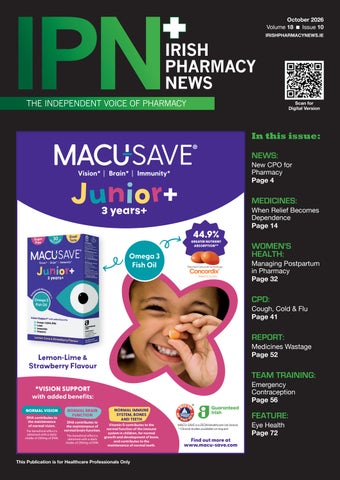
In this issue: NEWS: New CPO for Pharmacy Page 4
MEDICINES:
44.9%
GREATER NUTRIENT ABSORPTION** **
Patented Concordix technology.
When Relief Becomes Dependence Page 14
WOMEN'S HEALTH: Managing Postpartum in Pharmacy Page 32
CPD: Cough, Cold & Flu Page 41
REPORT: Medicines Wastage Page 52
TEAM TRAINING: Emergency Contraception Page 56
*VISION SUPPORT with added benefits: NORMAL VISION DHA contributes to the maintenance of normal vision. The beneficial effect is obtained with a daily intake of 250mg of DHA.
NORMAL BRAIN FUNCTION DHA contributes to the maintenance of normal brain function. The beneficial effect is obtained with a daily intake of 250mg of DHA.
NORMAL IMMUNE SYSTEM, BONES AND TEETH Vitamin D contributes to the normal function of the immune system in children, for normal growth and development of bone, and contributes to the maintenance of normal teeth.
This Publication is for Healthcare Professionals Only
FEATURE: MACU-SAVE is a ZEON Healthcare Ltd. brand. **Clinical studies available on request
Find out more at www.macu-save.com
Eye Health Page 72
Small in size, rich in nutrition, great in taste. No Online PCRS Approval Required
High protein, low volume ONS comparison Fresubin® PRO COMPACT Drink
Fortisip® Compact Protein1
Volume (ml)
125
125
Energy (kcal)
300
306
Protein (g)
18 (24% energy)
18.3 (24% energy)
Leucine (g)
1.8
1.6–1.7 (depending on flavour)
Vitamin D (µg)
6.3
2.6
Calcium (mg)
438
438
Fresubin® PRO COMPACT Drink and Fortisip® Compact Protein are low volume ONS (125ml) with the same energy density (2.4 kcal/ml) and protein content (24% energy from protein)
Scan the QR code to order samples Intended for use in Republic of Ireland ONS- Oral Nutritional Supplement
IE-FreONS-2600008 | Date of Preparation: February 2026
3
Contents
Foreword
Page 5: McCabes Welcome O’Doherty’s Pharmacy to the Family
There is a recurring theme running through this month's Irish Pharmacy News: community pharmacy is changing, and increasingly the question is not whether pharmacists can contribute more to patient care, but whether the structures around them are evolving quickly enough to allow them to do so.
Page 6: Caitríona Duggan New IPHA President Page 8: EU Health Ministers Target Faster Medicines Access and Clinical Trials Page 12: World Pharmacists Day: Celebrating a Profession
5
We see that expanding role throughout this issue. Our special report on the development of contraception services in community pharmacy considers what bringing care closer to women could mean in practice. Pharmacy has enormous potential to remove some of the barriers created by GP access, working hours and geography, but accessibility alone is not enough. Privacy, awareness, inclusivity and, importantly, pharmacy capacity will all determine how successfully these services translate from policy into everyday patient care.
Page 14: When Pain Relief Becomes Dependence Page 22: The Wellness Market in Women’s Health Page 28: Contraception Closer to Home: Can Pharmacy Transform Access for Women?
8
Page 52: The ¤37.5 Million Cost of Medicines Waste PUBLISHER: IPN Communications Ltd. 77 Camden Street Lower, Dublin D02 XE80 Office: +353 (01) 2339121 MANAGING DIRECTOR Natalie Maginnis natalie@ipn.ie EDITOR Kelly Jo Eastwood: +44 787654 8989 kelly-jo@ipn.ie
12
Those themes continue throughout our Women's Health focus. We look at endometriosis, pelvic health and pain during menopause, while Dr Richard Duffy of the Rotunda Hospital discusses postpartum psychosis and the potentially crucial role of a pharmacist who knows a woman well enough to recognise that something simply isn't right. Elsewhere, our special report examining problematic use of OTC codeine-containing medicines raises another important issue. Recognising a patient who may need help is one thing; having an appropriate pathway through which that person can receive it is another. It is a powerful example of why expanding pharmacists' responsibilities must be accompanied by practical referral pathways and wider integration with the health service. And perhaps we cannot discuss an expanding role for pharmacists without also discussing the team around them. Stephen Conlan asks what the future should look like for Ireland's pharmacy technicians as pharmacists spend increasing amounts of time delivering clinical services. It is a workforce conversation that is likely to become increasingly important.
SALES DIRECTOR Debbie Graham debbiegraham@ipn.ie +353 8727 99317 MARKETING & EDITORIAL EXECUTIVE Anna Hadfield Office: +353 (01) 2339121 Mobile: +353 89 947 7171 anna@ipn.ie
That question feels particularly timely as we report on the appointment of Ireland's new Chief Pharmaceutical Officer. At a point when the profession is taking on an increasingly clinical role within the health service, strong pharmacy leadership at national level has arguably never been more important.
14
Taken together, these stories illustrate a profession at an important point in its evolution. The opportunity for community pharmacy is considerable. But if we want pharmacists to do more, we must also ensure they have the time, teams, pathways and infrastructure that allow them to do it well. I hope you enjoy the issue.
CONTRIBUTORS Stephen Conlan | Aoife Ní Eochaidh Dearbhail Ormond | Susan Stone Dr Cathal O’Connor | Niamh Walsh Maeve Cope | Nikolina Budimlija Justin Blake | Dr. Matthew Lynch Dr Deirdre Forde Mr Mohammed Ali Jahan Dr Aisling O’Leary Sarah Benson
DESIGN DIRECTOR Ian Stoddart Design
IRISHPHARMACYNEWS.IE
Irish Pharmacy News IRISH PHARMACY is circulated to all NEWS independent, multiple Pharmacists and academics in Ireland. All rights reserved by Irish Pharmacy News. All material published in Irish Pharmacy News is copyright and no part of this magazine may be reproduced, stored in a retrieval system or transmitted in any form without written permission. IPN Communications Ltd. has taken every care in compiling the magazine to ensure that it is correct at the time of going to press, however the publishers assume no responsibility for any effects from omissions or errors.
Regulars CPD: COUGH, COLD & FLU
P41
FEATURE: IRRITABLE BOWEL SYNDROME
P48
WINTER HEALTH: STREP THROAT
P64
FEATURE: FOOT CONDITIONS
P76
CLINICAL PR:
P80
@Irish_PharmNews IrishPharmacyNews
IRISHPHARMACYNEWS.IE
4
News
Cora O’Connell Appointed Ireland’s Chief Pharmaceutical Officer Cora O’Connell has been appointed Ireland’s new Chief Pharmaceutical Officer (CPO), marking a significant development for the pharmacy profession and strengthening pharmacy representation at the highest levels of health policy. Chief Pharmaceutical Officer Cora O'Connell
pharmacy practice continues to expand. The Department has previously outlined an ambition for the CPO to contribute to the development of a strategic plan for pharmaceutical care in Ireland, ensuring pharmacy expertise is represented in areas including health promotion, diagnosis and prescribing, point-of-care testing, medicines optimisation and future clinical pathway design.
The appointment was highlighted by Minister for Health Jennifer Carroll MacNeill as part of World Pharmacists Day, with the new role set to provide strategic leadership for pharmacy and medicines policy across the Irish health service.
policy, support continued innovation and help ensure pharmacists are fully integrated into the delivery of patient-centred care across the healthcare system.
Welcoming the development, Minister Carroll MacNeill described the appointment as an important step forward for pharmacy in Ireland and one which reflects the Government's commitment to strengthening the profession's contribution to healthcare.
The appointment follows a longrunning call for the restoration of a Chief Pharmaceutical Officer within the Department of Health. Ireland previously had a comparable role until around 2013, while Chief Pharmaceutical Officers are established within health departments in Northern Ireland, England, Scotland and Wales.
Ms O’Connell will provide strategic leadership to advance pharmacy
The importance of the position has increased as the scope of
Ms O'Connell brings significant experience of pharmacy policy and professional development to the position. In her previous work with the Pharmaceutical Society of Ireland (PSI), she contributed to major workforce initiatives, including the Pharmacy Workforce Survey Analysis, and was involved in pharmacy education and accreditation work. Irish Pharmacy News will speak exclusively with Cora O'Connell for our November issue, exploring her priorities as Ireland's new Chief Pharmaceutical Officer, her vision for the future of the profession and what the new role could mean for pharmacists and patients.
Pharmacist’s Role in Heart Health During the first EU Screening Week, from 28 September to 4 October 2026, community pharmacists across Europe are highlighting how simple checks, such as measuring blood pressure, can help people understand their cardiovascular health. EU Screening Week is part of the European Commission’s Know Your Numbers campaign and the broader EU Safe Hearts Plan. The aim is simple: encourage people to know key health numbers and better understand their risk of cardiovascular disease. Across Europe, pharmacies are already providing a growing range of screening and prevention services. As part of EU Screening Week, PGEU member organisations are showcasing community pharmacy initiatives, illustrating how pharmacists are
IRISHPHARMACYNEWS.IE
helping detect health risks and bringing preventive healthcare closer to local communities. The message is clear: “Know your numbers. Your pharmacist can help.” To mark World Heart Day, PGEU has released a new video showing how a simple blood pressure check can take place in a community pharmacy. Community pharmacists are already playing an important role in prevention across Europe. Screening services are available in 24 EU countries, according to a
recent study on the development of community pharmacy services. Prevention and screening services in community pharmacies should be recognised and integrated into national and European cardiovascular health strategies, supported by appropriate remuneration and clear referral pathways. Pharmacists should also have the training, tools and access to relevant health information needed to work effectively with other healthcare professionals and ensure that people identified as being at risk receive a clear next step.
Suicide Prevention Day Minister for Mental Health, Mary Butler TD, marked World Suicide Prevention Day 2026, reaffirming the Government's commitment to reducing suicide and selfharm through the implementation of Ireland's Strategy to Reduce Suicide and Self-harm: Connecting for Life 2026-2035. World Suicide Prevention Day, held annually on 10 September, is coordinated by the International Association for Suicide Prevention in partnership with the World Health Organisation. The global theme for 2026, and the final year of the three-year campaign, is "Changing the Narrative on Suicide", with the call to action "Start the Conversation." The theme encourages people, communities, organisations and governments to challenge stigma, foster open and compassionate conversations about suicide, and create environments where people feel supported to seek help when they need it. In May this year, the Government launched Connecting for Life 20262035, Ireland's new ten-year, whole-of-government strategy to reduce suicide and selfharm. The strategy sets out an ambitious vision of an Ireland where fewer lives are lost to suicide and where people have timely access to the supports they need. It includes a target to reduce the national suicide rate to 7 per 100,000 population or below by 2035 and places a strong emphasis on prevention, early intervention, crisis response, stigma reduction and support for those bereaved by suicide. On World Suicide Prevention Day 2026, Minister Butler and Professor Philip Dodd, Deputy Chief Medical Officer at the Department of Health, spoke at a conference hosted by Samaritans Waterford to mark the branch's 50th anniversary. The Department of Health, the Health Service Executive (HSE) and partner organisations are developing the first implementation plan for Connecting for Life 2026-2035. Covering the period 2026-2028, it will set out specific actions across Government, the HSE and partner organisations to drive progress in reducing suicide and self-harm.
News Professional Recognition in Pharmacy The International Pharmaceutical Federation (FIP) is calling for stronger and more consistent systems to recognise pharmacists’ advanced and specialist expertise with the publication of a new White Paper on credentialing and professional recognition in pharmacy. The paper sets out eight guiding principles for developing credible credentialing programmes that recognise demonstrated competencies, support professional development and strengthen the pharmacy workforce. It emphasises that professional advancement extends beyond clinical practice to areas including advocacy, education, health policy, pharmaceutical manufacturing, regulatory science and research. “There is no single model of credentialing that will fit every healthcare system. What is needed is a shared foundation of principles that can be adapted to national circumstances while maintaining quality, credibility, transparency and a clear focus on patient care,” said Ms Bronwyn Clark, co-chair of the white paper taskforce and chief executive officer of the Australian Pharmacy Council. As pharmacists increasingly take on advanced and specialised roles across healthcare systems, there is a growing need for credentialing and professional recognition systems to validate competence, support career progression, assure quality, and strengthen public confidence in the profession. We know significant variation exists globally in the terminology, standards, and approaches used to recognise advanced and specialist pharmacy practice. In response to a mandate from the International Pharmaceutical Federation (FIP) Council, this White Paper explores current approaches to credentialing and professional recognition and provides a global framework to support the development, advancement, and use of credentialing systems worldwide. Drawing on existing FIP resources, member consultation, and international case studies, it identifies key principles and recommendations to support credible, flexible, and sustainable systems that can be adapted to national contexts.
5
High Hopes for Pharmacy in Budget 2027 The Irish Pharmacy Union (IPU) has called on Government to use the current statutory review of community pharmacy fees to establish a transparent and evidence-based framework for assessing the cost of delivering State-funded pharmacy services, and to make appropriate provision in Budget 2027 for the outcome of that review. Community pharmacy fees are reviewed under the Public Service Pay and Pensions Act 2017, with the current statutory review having commenced. The IPU says there should be greater clarity and transparency around how changes in the cost of delivering contracted services are assessed as part of the statutory review process. The Union is calling for a clear, evidence-based framework that consistently considers changes in key cost drivers, including workforce costs, inflation, regulatory requirements, digital transformation, and other costs associated with delivering Statefunded pharmacy services, which have significantly increased in recent years. Commenting, IPU President, Caoimhe McAuley said, “Community pharmacies operate in a unique environment. The State
determines the remuneration for the vast majority of medicines dispensed through community pharmacy, while pharmacies have very limited ability to respond to increases in the cost of delivering those services.
Pharmacy owners need to be able to plan, invest in their teams, adopt new technology and develop the additional services Government increasingly wants delivered through community pharmacy.”
Approximately 81% of dispensing activity in community pharmacy is funded through State schemes and, unlike businesses that can adjust their prices in response to rising costs, pharmacies are largely price takers for this significant proportion of their activity.
Ms McAuley concluded, “Community pharmacy has demonstrated its willingness and capability to take on a much greater role in delivering healthcare within local communities. But that expanded role must be built on a sustainable foundation.
“That makes the statutory review process critically important. We need a clear and transparent framework that allows both Government and pharmacy contractors to understand how changes in the cost of providing State-funded services will be assessed and, where appropriate, reflected in remuneration.”
“Budget 2027 should make appropriate provision for the outcome of the current statutory review and ensure that the remuneration framework properly reflects the resources required to deliver safe, sustainable and high-quality pharmacy services to patients.”
McCabes Welcome O’Doherty’s Pharmacy to the Family As part of their continued growth and investment in the McCabes Pharmacy network, the team recently confirmed that O’Doherty’s Pharmacy in Milltown, Co. Kerry, has joined McCabes Pharmacy. This marks another important step in strengthening their presence across Ireland and growing their network of community pharmacies to 112 and the third in Co Kerry. Now they have welcomed the O’Doherty’s Pharmacy team, led by Superintendent Pharmacist Anne Sheahan Casey and Gerry Casey, to the McCabes Pharmacy family. The pharmacy has been serving the Milltown community for the last 50 years, building strong relationships with patients and a reputation for high-quality, patientcentred care, values that strongly align with our own. Commenting on the announcement, Brian O'Keeffe Managing Director of McCabes Pharmacy, said, “The addition of O’Doherty’s Pharmacy to the McCabes Pharmacy network represents another important milestone in our continued growth across Ireland. We are delighted to welcome a pharmacy with such strong roots in the Milltown community, having served patients
in the area for the last 50 years. The team has built an excellent reputation for professional, patientcentred care, and we look forward to supporting them as part of the McCabes Pharmacy and wider PHX Ireland Group. As we continue to grow our network, maintaining continuity of care and preserving the strong relationships between our pharmacy teams and their local communities remains a key priority.” Anne Sheahan Casey, Supervising Pharmacist at O’Doherty’s Pharmacy, said, “Joining McCabes Pharmacy marks an exciting new chapter for our pharmacy and our team. We have built strong relationships with our patients and the wider Milltown community over many years, and it was important to us that this local focus and commitment to patient care would continue. Being part of a larger pharmacy group gives our team access to additional support and resources, while allowing us to continue
providing the personal service our patients know and trust. We’re looking forward to this next chapter and the opportunities it will bring.”
Brian O'Keeffe Managing Director of McCabes Pharmacy wit O’Doherty’s Pharmacy Superintendent Pharmacist Anne Sheahan Casey & Gerry Casey
IRISHPHARMACYNEWS.IE
6
News
Caitríona Duggan New IPHA President
Bowel Screen
The Board of the Irish Pharmaceutical Healthcare Association (IPHA), which represents the research-based biopharmaceutical industry in Ireland, has appointed Caitríona Duggan as its President for a two-year term.
The HSE and Irish Pharmacy Union (IPU) are encouraging people aged 57–71 to talk to their community pharmacy team about taking part in BowelScreen, Ireland’s free bowel screening programme.
IPHA President, Caitríona Duggan believe timely access to the latest medicines and treatments is essential to an effective health service. The research also found that 78% support greater Government investment in adult vaccination programmes.
Caitríona has worked with Amgen Ireland for 20 years and has been its Country Director since 2018. She has also played an active role in IPHA for the past decade. Eimear Caslin, General Manager of GSK Ireland, has been appointed Vice-President. Caitríona takes up the presidency at an important moment for patients, healthcare, and Ireland’s life-sciences sector. Ireland is holding the Presidency of the Council of the European Union, is preparing for the publication of the Government’s Life Sciences Strategy and is implementing the new Framework Agreement on Pricing and Supply of Medicines. The appointment coincides with new nationally representative research, commissioned by IPHA and conducted by Ipsos B&A, which found that 90% of people
It found that 87% believe pharmaceutical companies make an important contribution to Ireland’s economy and society, while 89% believe the EU should regard the pharmaceutical industry as vital to public health and jobs. Eight in ten respondents believe geopolitical developments are affecting the pharmaceutical sector, underlining the importance of a resilient medicines ecosystem in Ireland and across Europe. Commenting on her appointment, Caitríona Duggan, President of IPHA, said, “I am taking on the IPHA presidency with a clear ambition: that Ireland should be a country where patients can benefit from medical innovation in a timely way, supported by a strong and globally competitive life sciences sector. Our member companies are deeply committed to Ireland and proud of what industry and the country have achieved together through investment, research, innovation and manufacturing.
As scientific advances accelerate and the global environment evolves, we are determined to build on that success and ensure Ireland remains at the forefront of healthcare innovation. “Timely access to medicines and vaccines is not an abstract policy objective. It can materially affect health outcomes and quality of life. Our shared responsibility is to ensure that innovation with meaningful clinical value can reach patients through pathways that are timely, evidence-led, and sustainable. “Government, the HSE, patient organisations, healthcare professionals, the HPRA, the NCPE and industry each have distinct roles. By working constructively together, we can strengthen the pathway from scientific progress to high-quality patient care, while supporting a resilient and sustainable medicines system. “The new Framework Agreement, Ireland’s EU Presidency and the forthcoming Life Sciences Strategy give us an important opportunity to act. My priority as President will be to build strong partnerships around common objectives: better outcomes for patients, a resilient healthcare system, and an Ireland that remains a compelling place to research, develop and manufacture the medicines of the future.”
Pharmacy Self-Care Award Exemplary community pharmacy initiatives that empower people to take greater control of their health will be recognised through a new FIP self-care award, launched by the International Pharmaceutical Federation (FIP) on World Pharmacists Day, under the theme “Empowering pharmacists for healthier futures.” “Self-care is one of the ways the pharmacy profession can empower communities for healthier futures. Through this new award, we want to shine a light on the innovative work taking place in community pharmacies around the world and recognise initiatives that are making a measurable difference to people’s knowledge, confidence and ability to manage their health,” said FIP chief executive officer Dr Catherine Duggan. The award will be presented for the first time at the 85th FIP World Congress of Pharmacy and Pharmaceutical Sciences in Kuala
IRISHPHARMACYNEWS.IE
Lumpur, Malaysia, under the theme “Bridging worlds: Global knowledge, local realities and better care.” The 2027 congress will also provide an opportunity for FIP to launch The FIP Kuala Lumpur Declaration on self-care, discuss progress on the World Health Organization-FIP guidelines on self-care, and highlight global efforts to embed pharmacy as a key contributor to universal health coverage through primary health care. This award will focus on community pharmacy initiatives across areas including
respiratory health, seasonal allergies, digestive wellness, pain management, prevention and wellbeing. Initiatives will be expected to demonstrate measurable impact in strengthening health literacy, building confidence, and enabling patients and the public to make informed healthcare decisions. Further details, including the official name and award criteria, will be announced in the coming months, with expressions of interest expected to open soon thereafter.
As part of the Community Pharmacy Agreement 2025, the HSE and Irish Pharmacy Union (IPU) have worked together to deliver training and education on BowelScreen to pharmacy teams. Promotion of BowelScreen in pharmacies will start in October, with over 1,500 pharmacies nationwide taking part in the initiative to increase the uptake of BowelScreen. The National Cancer Registry Ireland Annual Statistical Report 2026 highlights that bowel cancer incidence and mortality have declined in both men and women between 1994 and 2023. It also highlights trends that are consistent with the impact of BowelScreen, including earlier diagnosis and the detection and removal of pre-cancerous changes before cancer develops. From October, participating pharmacy teams will attach a promotional sticker to prescription bags for people in the eligible age range of 57–71 years. The sticker will encourage people to talk to their pharmacy teams about BowelScreen. It has a freephone number and a QR code so people can check that they are registered for BowelScreen. Susan O’Donnell, Professional Services Pharmacist, Irish Pharmacy Union said: “Your community pharmacy team is here to help. Two thirds of all adults in Ireland live within 2 kilometres of a pharmacy so you are never too far away from the help and advice you need. We are delighted to be playing our part in informing people about BowelScreen and working to encourage more people to do the test. Screening is a positive step you can take to look after your health and we can make that easier by explaining how the test works and answering your questions.”
Reduce tiredness and fatigue Everyday life can be quite exhausting but BioActive Q10 can help you in a natural way. The combination of the vitamin-like compound coenzyme Q10 and vitamin B2 that contributes to normal cellular energy turnover is the perfect boost
when your batteries are low. BioActive Q10’s good absorption and bioavailability are documented in multiple scientific studies, which is why it is the leading Q10 brand on the market.
Scan to learn more
The Original Q10 preparation Sign up to receive the latest information about health and food supplements based on science. Sign up here: www.pharmanord.ie
8
News
EU Health Ministers Target Faster Medicines Access and Clinical Trials
Voice for Cancer Patients
Boosting Europe's capacity to develop and manufacture medicines, accelerating clinical trials and improving patient access to innovative treatments were among the key issues discussed as EU health ministers gathered in Dublin under Ireland's Presidency of the Council of the European Union.
The first all-island residential training programme for cancer patient advocates took place in the UCD Conway Institute in University College Dublin (UCD) last month.
EMA Executive Director Emer Cooke
Presidency to advance several major European health files. Alongside the Biotech Act, priorities include simplifying regulations governing medical devices and in-vitro diagnostic medical devices, strengthening Europe's resilience and lifesciences ecosystem and improving access to medicines and medical technology.
Minister for Health Jennifer Carroll MacNeill chaired the informal meeting of EU health ministers, held in Dublin on 30 September and 1 October, which brought together ministers from EU Member States and European Free Trade Association (EFTA) countries alongside senior representatives from the European Commission, World Health Organization (WHO) and European Medicines Agency (EMA).
Minister Carroll MacNeill has previously identified speeding up clinical trials and fast-tracking innovative therapies as priorities during Ireland's Presidency, with improved clinical trial infrastructure potentially enabling patients in smaller countries such as Ireland to participate in larger European studies. The issue also forms part of a wider European debate around competitiveness in life sciences, including ensuring that Europe remains an attractive location for pharmaceutical research, development and manufacturing. EMA Executive Director Emer Cooke said work to provide faster access to medicines is already progressing through the reform of EU pharmaceutical legislation.
Discussions focused on population health, innovation, life sciences and health competitiveness, including how greater European cooperation can strengthen health systems while improving access to medicines, medical technologies and innovative care.
Speaking in Dublin, she said the EMA is committed to improving access and highlighted the Irish Presidency's work on the Biotech Act, particularly its potential impact on clinical trials and bringing innovation to patients more quickly.
A major focus for the Irish Presidency is improving Europe's environment for clinical research and biotechnology.
The EMA is also preparing for additional responsibilities arising from pharmaceutical legislation, medical-device regulation and the Biotech Act, with greater digitalisation, streamlined processes and the use of artificial intelligence among the approaches being explored to improve regulatory efficiency.
The proposed European Biotech Act forms a key element of this work, with Ireland seeking progress on measures designed to strengthen innovation and competitiveness and support the safe development of biotechnology across Europe.
IRISHPHARMACYNEWS.IE
The Dublin discussions come as Ireland seeks to use its six-month
Preventive healthcare was another significant focus of the meeting, including cardiovascular disease and opportunities to strengthen early detection. The EU is progressing work around cardiovascular health, with screening for major risk factors including high blood pressure, cholesterol and blood glucose among the areas under consideration as part of efforts to encourage earlier identification and intervention. The meeting also examined how health systems can move towards more integrated, preventive, community and home-based models of care, improving continuity while helping health services respond to increasing demand. The Irish Presidency has highlighted investment in health research, biotechnology, digital transformation, data and new models of care as areas where EU cooperation could support both better patient outcomes and Europe's wider competitiveness. Ireland assumed the Presidency of the Council of the European Union on 1 July and will hold it until the end of December 2026. A formal meeting of EU Health Ministers later in the year will provide a further opportunity to progress the legislative and policy priorities being advanced during the Presidency, including measures intended to strengthen Europe's health and life-sciences environment and ultimately improve patients' access to medicines, technologies and innovative treatments.
The VOICE-Ireland (Vision On Information, Confidence and Engagement) programme, of which the Irish Cancer Society is a funder, bridges the gap between biomedical research, clinical research, and patient advocacy across Ireland and Northern Ireland. A total of 13 patient advocates from across the island of Ireland took part in the fully funded residential programme, which consisted of talks from academics and interactive lab sessions led by cancer researchers. Driven by the All-Island Cancer Research Institute (AICRI) and led by patient advocates since 2024, VOICE-Ireland has been developed alongside the Patient Voice in Cancer Research and the Northern Ireland Cancer Research Consumer Forum. It is the first residential cancer patient advocate training programme to be delivered on the island of Ireland. The patient advocates who took part have praised the programme as ‘mind-blowing’ and ‘life-changing’. VOICE-Ireland is supported by key funding and community partners including All-Island Cancer Research Institute, AICRIstart, Breakthrough Cancer Research, the Irish Cancer Society, Precision Oncology Ireland, All-Ireland Cancer Liquid Biopsies Consortium (CLuB), PPI Ignite Network, the Higher Education Authority, the North South Research Programme, and Taighde Éireann – Research Ireland. Elizabeth Osagie-Alli, a breast cancer survivor and patient advocate from Co. Cork, said, “In my experience, professors, academics and researchers find it difficult to come down to the level that patients are at, but they did come to our level during VOICE-Ireland. They really wanted to learn from us as patients advocates and people with lived experience of cancer.”
Available in packs of 7s , 14s & 28s. Medicinal product not subject to medical prescription. For further information refer to SPC available at www.hpra.ie Adverse events should be reported. Reporting forms and information can be found on the HPRA website (www.hpra.ie) or by emailing adverse.event.ireland@sandoz.com Marketing Authorisation Holder : Rowex Ltd., trading as Sandoz. Further information and SPC are available from: Rowex Ltd., trading as Sandoz, Regus City Gate, Building 1000, Units 1201 & 1202, City Gate, Mahon, Cork, T12 W7CV. Freephone 1800 83 20 83. E-mail: mi.ireland@sandoz.com MLR ID: MLR-0239-IE Date of prep: (09.2026)
10
Report
Behind the Dispensary: The Future of Ireland's Pharmacy Technicians I recently stumbled across a video on TikTok showing the seemingly endless collection of small jobs that keep a dispensary running: changing label rolls, refilling printers, restocking vials, replacing claim forms (if you know, you know!), and replenishing sundry items that nobody particularly notices… until they run out. The caption jokingly credited the work to the “dispensary fairies”. Written by Stephen Conlan, Pharmacy Technician and Dispensary Manager at Remedi CarePlus, IFSC
services and other clinical responsibilities continues to broaden the pharmacist’s scope of care. The Community Pharmacy Agreement 2025 also envisages broader pharmacy involvement in BowelScreen, sexual health, medicines optimisation and digital healthcare, with further developments in contraception services on the horizon. It made me laugh because the tasks were instantly recognisable as odd jobs typically picked up by pharmacy technicians, alongside the considerably less fairy-like business of dispensing prescriptions, resolving stock issues, navigating claims and managing a busy dispensary workflow. Yet, for a professional role so embedded in the day-today running of a pharmacy, what technicians do can be surprisingly misunderstood. Having worked in community pharmacy for over ten years, there’s a particular conversation that crops up again and again. After helping a patient with a query, I’m asked when I’m going to “move on” to become a pharmacist, a doctor, or a counsellor (and once, even a politician!). The sentiment is kind, but the assumption behind it is interesting: that being a pharmacy technician must surely be a stepping stone towards the “real career”. Being a pharmacy technician is a rewarding career in its own right, and one that I’m certainly proud of. However, interactions like this say so much about how the profession is perceived and raise a bigger question about how our skills and experience can be used to their full potential. Pharmacy is changing. What about its workforce? Community pharmacy in Ireland is changing rapidly. The introduction of the Common Conditions Service has brought pharmacist assessment and prescribing into everyday community practice, while the expansion of vaccination
IRISHPHARMACYNEWS.IE
These are welcome changes, making greater use of our pharmacists’ clinical expertise and increasing access to healthcare, but work in the dispensary does not politely pause while the pharmacist takes a consultation. Prescriptions continue to arrive, phones continue to ring, shortages need resolving and patients still need their medicines. Expanding pharmacists’ clinical capacity requires a parallel conversation about the team supporting them. The Community Pharmacy Agreement recognises the importance of developing the pharmacy team through education and professional resources. BowelScreen, for example, specifically involves upskilling team members to help identify eligible patients, provide information and support participation. A profession with room to grow Technicians already undertake substantial responsibility in community pharmacy, including dispensing, stock management, claims reimbursement, monitored dosage systems, controlleddrug processing and dispensary workflow, depending on their experience and workplace. While their role has evolved considerably, its regulatory framework has been somewhat less enthusiastic about keeping up. Ireland has no statutory register for pharmacy technicians, no legislative definition of the role and the qualification is not standardised nationally. The PSI's Workforce Intelligence Report recommended the development of a national strategy examining technicians'
future scope, regulation, qualifications, and workforce planning. Responding to a request for comment, a PSI spokesperson confirmed that the development of the technician role remains a long-term workstream led by the Department of Health. The spokesperson also acknowledged that previous PSI reports have identified technicians as potential key enablers of greater efficiencies within pharmacies, for patients’ benefit. With community pharmacy services continuing to expand, how can the workforce supporting them develop alongside them? This isn’t an abstract question about professional status. It's about what pharmacy technicians could safely contribute to the future pharmacy workforce. Development doesn’t just mean transferring additional duties because the dispensary is busy. Any new responsibilities have to be appropriate, clearly defined, and supported by the necessary training and professional framework. Accuracy checking is a useful example. The current IPU Pharmacy Technician course includes accuracy checking alongside medicines reconciliation, dispensing, pharmacy law, pharmacology and pharmaceutical stock management. In Great Britain, appropriately trained pharmacy technicians can already progress into defined accuracychecking roles. Importantly, this operates within a regulatory framework: pharmacy technicians, like pharmacists, must be registered with the General Pharmaceutical Council and meet defined standards. Northern Ireland works differently, although movement towards the regulation and registration of pharmacy technicians there is ongoing. There’s no reason we couldn’t explore a similar route for the role in Ireland, whereby educated and regulated pharmacy technicians could assume greater responsibility for defined technical aspects of the dispensing process, where appropriate. Done properly, this could allow pharmacists to dedicate more of their time to clinical assessment and direct patient care. Of
course, developing the role of the technician can’t be a plaster on workforce pressure. Any expansion of responsibility needs confidence from pharmacists, patients, and technicians themselves about where that responsibility begins and ends, matched by clear standards of education, assessment, regulation and accountability. We can't argue that pharmacy technicians are skilled professionals capable of greater responsibility while accepting a system where the title tells patients little about the standards behind it. Technicians deserve a defined career pathway that recognises their expertise and allows them to progress without leaving the profession. This job isn’t always a stepping stone. A voice for the future Technicians themselves must participate in shaping what comes next. On World Pharmacy Technician Day, 20 October 2026, plans are underway to relaunch the Irish Association of Pharmacy Technicians with a renewed focus on professional representation, education, development and advocacy. The relaunch will take place at Technological University of the Shannon's Athlone campus, with further updates available on Instagram @irishcommunitypharmtech. The ambition isn't just to ask for more responsibility, but to contribute to defining the education, standards, accountability and professional structures necessary to take them on safely. Maybe it's time to retire the “dispensary fairy”, because the work that keeps a pharmacy moving does not happen by magic. Behind it are skilled people who know their dispensaries, their communities and their medicines; people who anticipate problems, manage workflow and prevent small issues from becoming bigger ones. Pharmacy technicians have spent years working behind the scenes to keep community pharmacy moving forward. As the sector enters its next chapter, it's time that our profession moves forward with it.
UroStomaCare Ireland’s No. 1 Provider of Stoma & Continence Care Products
Over
Sourcing from over
Cutting an average of
products
leading manufacturers
bags per week
Dedicated customer care team
UroStomaCare Hub on UDW.ie
3000
Contact us www.udw.ie T: 01 463 2347
35
10,000 48
hour emergency order turnaround
12
News
World Pharmacists Day: Celebrating a Profession at the Heart of Healthcare Change Marked globally on 25 September, this year's World Pharmacists Day took place under the theme “Empowering Pharmacists for Healthier Futures”, highlighting the importance of enabling pharmacists to use their skills and expertise to meet changing healthcare needs. In Ireland, the celebrations came during one of the most significant periods of change for community pharmacy in recent years, with the rollout of new clinical services and an increasingly prominent role for pharmacists in prevention, treatment and health promotion.
Minister for Health Jennifer Carroll MacNeill marking World Pharmacists Day in the Dáil play an even greater role in meeting Ireland's healthcare needs.”
Community pharmacy also received recognition in Dáil Éireann, where statements marking World Pharmacists Week on 24 September saw Ministers and TDs highlight the contribution of pharmacists to accessible, patientcentred healthcare. The discussion referenced developments including the Common Conditions Service, expanded vaccination services, MediBack and women's health services, alongside the profession's broader contribution to prevention, medicines stewardship and improving access to healthcare. The developments reflect the rapid evolution taking place across the sector. More than 95% of community pharmacies are now participating in the Common Conditions Service, while more than 1,550 pharmacies have signed up to support the National BowelScreen Programme. Pharmacists have also recently been empowered to administer pneumococcal vaccination as part of the national immunisation programme.
According to the Irish Pharmacy Union (IPU), Ireland's 1,912 community pharmacies are visited by approximately 2.14 million adults every week, placing pharmacists among the country's most accessible healthcare professionals. Speaking on World Pharmacists Day, IPU President Caoimhe McAuley said the occasion provided an opportunity to recognise the “dedication, professionalism and expertise” of pharmacists working in communities across Ireland. “Community pharmacy is evolving, with pharmacists taking on a broader clinical role and patients increasingly able to access more services and care through their local pharmacy,” she said. “This is improving access to care, providing services closer to home and creating additional capacity across the health service.”
The IPU also hosted an “Empowering Pharmacists for Healthier Futures” event in Dublin, bringing together representatives from the Department of Health, HSE, PSI, practising community pharmacists and other healthcare stakeholders to discuss progress and future opportunities for patient care.
McCabes Pharmacy gave all their pharmacists a thank you card and a Just Eat voucher as a small token of their appreciation
Members of the Irish Pharmaceutical Healthcare Association's Self-Care Strategy Group were among those attending, highlighting the complementary role of responsible self-care in bringing healthcare closer to patients and helping people manage common ailments with support from their pharmacist.
Globally, the International Pharmaceutical Federation (FIP) said the 2026 theme reflects the need for pharmacists to have the skills, recognition and system support required to practise to their full potential, strengthening access to care and helping create more resilient and sustainable health systems.
Pharmacy teams and organisations around the country also used the occasion to recognise pharmacists at local level. McCabes Pharmacy paid tribute to its pharmacists for the expertise, reassurance and everyday care they provide to patients, describing the often small interactions between pharmacists and their communities as those which can “make all the difference”.
For Irish pharmacy, that message appears particularly timely. With prescribing, vaccination, contraception, screening support and medicines services continuing to broaden the profession's contribution, World Pharmacists Day 2026 celebrated not only what pharmacists already deliver — but the increasingly central role they are being asked to play in the future of healthcare.
Ms McAuley said the progress demonstrated what could be achieved through collaboration between pharmacists, policymakers, health service leaders and regulators, but stressed the importance of maintaining momentum. “Pharmacists have the skills, accessibility, and willingness to do more,” she said. “With continued investment and the appropriate resources, community pharmacy can deliver additional services, increase healthcare capacity, and Irish Pharmacy Union President Caoimhe McAuley would like to wish pharmacists and pharmacy teams a very happy World Pharmacists Day
IRISHPHARMACYNEWS.IE
To mark World Pharmacists Day last Friday, members of IPHA’s Self-Care Strategy Group joined colleagues and stakeholders at an event hosted by the Irish Pharmacy Union (IPU), highlighting the importance of empowering pharmacists who play a critical role in our communities. Pictured from left to right: Yvonne Jones, IPHA, Niall O’Shea, Haleon, Caoimhe Mc Auley, President, IPU, Niall Faul, Perrigo, Clare Fitzell IPU and Dylan Whiley, Perrigo.
News
13
Navi Group partners with Hygie31, bringing European scale and expertise to Irish independent pharmacy Navi Group has entered a long-term partnership with Hygie31, one of Europe’s leading independent pharmacy groups. Navi pharmacies now have the scale and expertise of one of Europe’s largest independent buying groups behind them, and access to specialist retail pharmacy knowledge built across more than 3,900 pharmacies in France, Spain and Italy. Navi Group has agreed a longterm partnership with Hygie31, a pan-European healthcare and independent pharmacy group headquartered in Toulouse. The partnership combines Navi’s deep knowledge of Irish community pharmacy with the scale, buying power and specialist expertise of a group that Is dedicated to growing and protecting independent pharmacies across Europe. For pharmacies working with Navi, the day-to-day stays the same, with all the same faces in place. Navi remains an Irish company, headquartered in Dublin, and John Carroll, who founded the business in 2009, continues as Chief Executive. The Navi management team and customer-facing teams, from account management and operations to IT support, customer service and marketing, all remain in place and continue to deliver the best-in-class support that independent pharmacy relies on. What changes is the scale, knowledge and investment standing behind them. About Hygie31 Hygie31 grew out of Pharmacie Lafayette and its “Health for All” approach, which is built on wide choice, good advice and better access to care. The group now has a combined turnover of ¤5 billion and is affiliated with more than 3,900 independent pharmacies across France, Spain and Italy. This includes more than 440 Pharmacie Lafayette pharmacies in France, and networks of 430 pharmacies in Spain and 610 in Italy. Its activities span pharmacy and opticians’ networks, digital and e-commerce, medical equipment, training, data and procurement. Pharmacies in the Hygie31 network stay owned and run by their own pharmacists. Hygie31’s role is to give them the central support, buying power and expertise that would normally only be available to a large pharmacy chain, so they can compete on equal terms while remaining independent. It is the same principle Navi has built its business on in Ireland, and it is the foundation of the partnership.
“Hygie31 and Navi Group share a common strategic vision of preserving pharmacists’ ownership independence and strong local roots, while also significantly strengthening their operational competitiveness,” said John Carroll. “This partnership is about taking the capabilities Navi has built in Ireland and combining them with significant international expertise, investment and best practice to create even greater value for our pharmacy customers.” A European head office behind every Navi pharmacy At the heart of Hygie31 is a head office operating at significant scale, with large specialist teams dedicated entirely to retail pharmacy performance. Their expertise covers pricing strategy, store layout and merchandising, category management, promotions, own-label ranges, staff training and the use of data to drive commercial decisions. It is knowledge refined across thousands of pharmacies in three countries, and the kind of capability no independent pharmacy could build on its own.
Through the partnership, Navi can now draw directly on that expertise and put it to work for Irish pharmacies, adapted by the Navi team for Irish regulation, reimbursement and practice. What it means for pharmacies in the Navi network or wishing to join Better buying. The combined scale of the group opens up Europeanlevel relationships with generics manufacturers and front-of-shop suppliers, giving Navi pharmacies a stronger position on price, range and supply. Better technology. Greater capacity to invest means Navi’s managed pharmacy services, including Axium, TouchPlus, DispenSense, TillSense and iGnite360, will be supported by greater capacity for future development and investment, alongside new work on loyalty, EPOS, ordering and customer communication. Better retail performance. Pharmacies will be able to draw on proven approaches to category management, front-of-shop layout, promotions and staff development,
Pascal Fontaine, Hervé Jouves, John Caroll, and Leigh Herron
backed by AI and data insight into what drives performance. More efficient operations. More efficient buying, smarter systems and clearer insight all add up to a pharmacy that runs better, freeing pharmacists and their teams to spend more time with patients. For pharmacies considering Navi Pharmacies joining Navi will benefit from the same trusted local team, now backed by the scale, knowledge and investment of one of Europe’s leading independent pharmacy groups. For independent pharmacists looking to strengthen their business while staying independent, there has never been a better time to talk to Navi. To find out more, contact: Philip Morrissey - email: philipmorrissey@navi.ie Phone:087-4416072
IRISHPHARMACYNEWS.IE
14
Medicines
When Pain Relief Becomes Dependence: Can Community Pharmacy Intervene Earlier? More than 10 million combination painkiller tablets containing codeine were obtained through Northern Ireland pharmacies in 2024. Now, a major three-year research project at Ulster University is examining whether community pharmacists could play a greater role in identifying problematic use before it develops into dependence – and, crucially, what should happen when they do. Irish Pharmacy News spoke to researchers Dr Kingston Rajiah and Dr Aaron Courtenay about the evidence gap, the absence of clear referral pathways and their ambition to develop a practical intervention that works in real-world community pharmacy. Dr Ahmed Abuelhana, Dr Kingston Rajiah, Mr Andrew Sprinks, Dr Aaron Courtenay
The proposed approach will then be tested using behavioural research methods, while the team investigates potential referral pathways and practical supporting tools. Digital solutions could ultimately form part of that package, but Rajiah emphasises that the research is not about developing an app or imposing a predetermined technological solution. “We are not exclusively thinking only about digital support. We are looking at different pathways.”
For many patients, it begins entirely legitimately. An injury. Dental pain. A persistent headache. Back pain that is proving difficult to manage. An over-the-counter codeinecontaining painkiller provides relief and, when used appropriately and for a short period, codeine remains an effective medicine. But for some people, the pattern changes. The medicine that was initially taken to manage genuine pain becomes something they begin using more regularly. The underlying pain may persist, tolerance may develop or the person may simply find it increasingly difficult to manage without the medicine. “Somebody who is starting it completely legitimately for pain may end up becoming dependent,” Dr Kingston Rajiah, Lecturer in Clinical Pharmacy and Pharmacy Practice at Ulster University, tells Irish Pharmacy News. It is the space between those two points – appropriate use and
IRISHPHARMACYNEWS.IE
established dependence – that researchers at Ulster University's School of Pharmacy and Pharmaceutical Sciences want to understand. A new three-year project, Community Pharmacy Intervention Pathways for Over-The-Counter Codeine Dependence, launched in September and will investigate how community pharmacy teams can be better equipped to recognise potential dependence, initiate sensitive conversations and connect patients with appropriate support. Funded by the Northern Pharmacies Limited Trust Fund (NPLTF), the research is being led by Dr Rajiah alongside Dr Aaron Courtenay and Dr Ahmed Abuelhana. The timing is significant. Figures from the Department of Health in Northern Ireland show that approximately 10.4 million combination painkiller tablets were obtained by community pharmacies in Northern Ireland during 2024 – 6.9% more than the previous year.
But Dr Rajiah is careful about what that figure does – and does not – tell us. “Right now we don't know how big the problem will be,” he says. “One of the important points is that we don't yet have the detailed Northern Ireland pharmacy-level evidence we need.” That evidence gap is precisely where the research begins. Understanding What is Actually Happening Rather than starting from an assumption about the prevalence or nature of OTC codeine dependence, the Ulster team intends first to establish what is currently happening within community pharmacy. “Codeine is an effective painkiller and used appropriately, but it can also cause dependence,” says Dr Rajiah. The researchers will speak both to pharmacists and to people with relevant lived experience before using those findings to develop an intervention and associated training.
Ultimately, the question is much broader: what would an effective, practical community pharmacy pathway for OTC codeine dependence actually look like? Pharmacists can identify the problem – but what happens next? It is here that one of the most interesting issues for community pharmacy emerges. The research is not predicated on the idea that pharmacists are currently failing to identify inappropriate use. Quite the opposite. Dr Aaron Courtenay, Senior Lecturer in Clinical Pharmacy and Academic Research Lead at Ulster University, says the evidence generally suggests that Northern Ireland's community pharmacists already provide safe and effective support. “On the whole and on balance, we find that community pharmacies are good at supporting these patients.” OTC codeine combination medicines are supplied under pharmacist supervision. Pharmacy students at Ulster are taught that their sale should involve a conversation to establish whether the medicine is suitable and appropriate.
15 Dr Aaron Courtenay
or refuse a medicine, the conversation could potentially explore why the patient continues to need it. “What is the underlying reason the patient is reaching for these medicines in the first instance?” is the question Dr Courtenay believes needs to be considered. For some patients, that could lead to a wider discussion about chronic pain management, alternative treatments or nonpharmacological approaches such as physiotherapy. The ultimate objective would be to intervene while the patient's medicine use is becoming concerning rather than waiting until dependence is firmly established. The Importance of Trust
The difficulty comes when that conversation raises genuine concern.
from community pharmacy into appropriate addiction or specialist services could be feasible.
“One of the challenges that we have is there’s no referral pathways and there’s limited actions as to what those pharmacists can do in that moment,” Dr Courtenay explains.
But creating such a pathway is not simply a matter of giving pharmacists a telephone number.
At present, the principal route is essentially back to general practice. “At the moment… really the only direct referral is back to their GP for support.” That creates an obvious difficulty at a time when accessing a GP appointment may itself be challenging. Northern Ireland does have community addiction services, which Courtenay speaks positively about, and the research team has established contact with consultants working within those services through the Department of Health. For someone who has already developed significant codeine dependence, these services may represent a more appropriate destination. “For those patients who have become codeine dependent, that is probably a better place for those patients to be supported.” An existing community pharmacy pilot in East Antrim could also provide important learning. The Ulster team has been engaging with the Department of Health and hopes the pilot may help establish whether direct referral
Capacity, funding and appropriate support within the services receiving those referrals would all have to be considered. Moving Intervention Upstream Perhaps the more ambitious element of the project, however, is the possibility of intervening before a patient reaches the point at which specialist addiction treatment is required. “Ideally… we have situations where patients aren't in this position in the first instance,” says Dr Courtenay. The researchers broadly see two groups. There are people who have already developed codeine dependence and may require specialist healthcare or addiction support. But there are also patients whose medicine use is beginning to change – and it is here that community pharmacy may have a particularly important opportunity. A pharmacist may recognise repeated requests for a codeinecontaining medicine, increasing frequency of use or an ongoing pain problem that has never been adequately addressed. Rather than viewing the encounter simply as a decision to supply
There is another reason researchers believe community pharmacy may be particularly well placed to do this. Pharmacists frequently know their patients. Unlike an isolated interaction with an unfamiliar healthcare professional, the pharmacist may have seen the same person over months or years and be able to recognise a changing pattern. “They have excellent relations with their customers and the patients that they work with,” says Dr Courtenay. “These are quality, trusted relationships that the majority of patients have with their local community pharmacy teams.” For many people, community pharmacy is also their first point of contact with healthcare. That accessibility creates an opportunity, but it also means conversations around dependence have to be handled carefully. People may not recognise that their medicine use has become problematic. Others may be ashamed or fearful of being labelled as having an addiction. The original reason for taking the medicine may have been entirely legitimate. The research therefore places considerable emphasis on nonjudgemental intervention. As Dr Rajiah explains: “People may begin using these medicines appropriately for pain and only gradually find that their pattern of use has changed.”
The objective is to provide support without judgement and enable people to access appropriate care as early as possible. Difficult Conversations at the Pharmacy Counter That trusted relationship does not necessarily make conversations about potential dependence easy. Community pharmacist and project researcher Andy Sprinks has seen first-hand how use of a codeinecontaining medicine can change over time. “Codeine-containing painkillers are medicines that many people will have used at some point, often for a genuine need such as an injury or short-term pain,” he says. “But for some people, what starts as taking a medicine for pain can gradually become something they feel they cannot manage without. As a community pharmacist, I’ve seen first-hand how difficult these conversations can be.” For Andrew, this is one of the reasons why the research needs to result in practical support that pharmacy teams can use in everyday practice. “This research is about understanding the scale of the problem and finding practical ways for pharmacy teams to spot the signs earlier, have those difficult conversations and help people access the right support, while ensuring those who genuinely need pain relief can continue to access it safely.” Designing Something that Works Now Any proposed solution will also have to contend with the realities of Northern Ireland's current healthcare infrastructure. Digital integration remains an important limitation. Dr Courtenay explains that community pharmacy remains relatively disconnected from some of the patient-information systems available elsewhere within primary and secondary care. “Our primary care and our secondary care sectors are somewhat distinct,” he says. “In community pharmacy, they are still separate and distant from that.” That leaves researchers effectively designing for two environments simultaneously: the integrated healthcare system they might ideally like to see in the future and the system pharmacists are actually working within today. “We want a project that is going to be impactful now and useful
IRISHPHARMACYNEWS.IE
16
Medicines What would Success Look Like? When the project concludes in 2029, the researchers do not want its primary output to be an academic paper sitting on a shelf. Dr Rajiah envisages a package of practical interventions. That could include pharmacist training, patient-facing information, practical resources, structured signposting, guidance supporting earlier intervention and – crucially – clearer referral pathways. “A structured way of referring people, signposting to the right people, and guidance provided in the earlier stage,” is how he describes the ambition. There appears to be appetite for that work. Dr Courtenay says the project has engagement both from community pharmacy and the Department of Health.
Dr Kingston Rajiah
“We're certainly open to collaboration,” he says. “Our experience in the area of research is that having partners working on projects only strengthens.”
in the context that we have,” Dr Courtenay says. “It's as much about identifying what would be the ideal solution as finding what is a current solution to the environment that we find ourselves in.”
For Irish community pharmacy more broadly, the project could therefore provide valuable evidence about an issue that does not stop at jurisdictional boundaries. Education – For Pharmacists and Patients
Is There an All-Island Opportunity?
The responsibility does not rest solely with pharmacists.
Although the project is based in Northern Ireland, its findings could have wider relevance.
Dr Courtenay believes greater patient and public awareness could also play a role.
The Republic of Ireland has also faced longstanding questions around the appropriate supply of non-prescription codeinecontaining medicines, including previous mystery-shopping work undertaken by the Pharmaceutical Society of Ireland. The regulatory and healthcare structures north and south of the border are different, but everyday community pharmacy practice also has considerable similarities. Pharmacists themselves frequently move between jurisdictions and may hold registration with the PSI, Pharmaceutical Society of Northern Ireland and General Pharmaceutical Council. Asked whether the research could eventually provide opportunities for cross-border collaboration, Dr Courtenay is receptive.
IRISHPHARMACYNEWS.IE
Advertising for codeine-containing medicines is already subject to significant restrictions, he notes, meaning the bigger opportunity may lie in public-health messaging. “The strongest potential opportunity here is probably through an educational campaign or public health campaign.” But awareness without somewhere to seek help has obvious limitations. Any campaign encouraging people to recognise problematic medicine use would need to be accompanied by access to healthcare professionals who can advise them and a clear route to appropriate follow-up.
Dr Ahmed Abuelhana
“There is will and buy-in from the Department of Health. There is will and buy-in from community pharmacies across Northern Ireland.” The Northern Pharmacies Limited Trust Fund, which is funding the research, similarly says the project can help build the evidence required to improve patient care
and demonstrate the contribution pharmacists can make in addressing codeine dependence. The research team also intends to share findings as the project progresses rather than waiting until August 2029. “As and when we can get information out, we plan to get as much as we can out early.” Ultimately, however, Dr Courtenay's measure of success is refreshingly practical. “In three years' time, if we're in a position to say, look, here's the toolkit, here is the evidence, and here is the evidence to show that community pharmacy has made a positive impact and can make a positive impact, I think we'll see this as a job well done and a success.” For community pharmacists, that could mean the difference between recognising that a patient has a problem and actually having somewhere meaningful to take that conversation next. And perhaps even more importantly, it could provide an opportunity to have that conversation early enough that dependence never becomes established in the first place.
Paracetamol
Recommend Ireland’s no.1 selling Children’s Pain medicine* Calpol 120 mg/5 ml Sugar Free Infant Oral Suspension. Calpol Six Pus 250 mg/5 ml Sugar/Colour Free Oral Suspension Composition: Calpol 120 mg/5 ml Sugar Free: 120 mg paracetamol in each 5 ml. Calpol Six Pus 250 mg/5 ml Sugar/Colour Free: 250 mg paracetamol in each 5 ml Indications: For the relief of headache, migraine, neuralgia, toothache and teething pains, sore throat, influenza, feverishness and feverish colds. Dosage: Calpol 120 mg/5 ml Sugar Free Infant: Infants aged 2-3 months: 1. Post-vaccination fever and 2. Other causes of Pain and Fever (if baby weighs over 4 kg and was born after 37 weeks). Dose: 2.5 ml. If necessary, after 4-6 hours, give a second 2.5 ml dose. Do not give to babies less than 2 months of age; Do not give more than 2 doses unless your doctor or nurse has advised otherwise; Leave at least 4 hours between doses; If further doses are needed, talk to your doctor or pharmacist. Children aged 3 months – 6 years: 3 – 6 months: 2.5 ml (4 times in 24 hours). 6 – 24 months: 5 ml (4 times in 24 hours). 2 – 4 years: 7.5ml (5 ml + 2.5 ml) (4 times in 24 hours). 4 – 6 years: 10ml (5 ml + 5 ml) (4 times in 24 hours). Calpol Six Pus 250 mg/5 ml Sugar/Colour Free: Do not give to children under 6 years of age. Children aged 6 years – 12 years: 6 – 8 years: One 5 ml spoonful (large end) (4 times in 24 hours). 8 – 10 years: One 5 ml spoonful (large end) and one 2.5 ml spoonful (small end) (4 times in 24 hours). 10 - 12 years: Two 5 ml spoonful (large end) (4 times in 24 hours). Children aged 12 – 16 years: Two – three 5ml spoonfuls (large end) up to 4 times a day. Adults and children over 16 years: Two – four 5ml spoonfuls (large end) up to 4 times a day. Do not give more than 4 doses in any 24-hour period; Leave at least 4 hours between doses; Do not give this medicine to your child for more than 3 days without speaking to your doctor or pharmacist. It is important to shake the bottle for at least 10 seconds before use. Renal impairment: It is recommended, when giving paracetamol to patients with renal impairment, to reduce the dose and to increase the minimum interval between each administration to at least 6 hours unless directed otherwise by a physician. Recommended dose for adults with renal impairment (Calpol Six Plus product only): Glomerular filtration rate: 10-50 ml/min: 500mg (10ml) every six hours; Glomerular filtration rate: less than 10ml/min: 500mg (10ml) ever eight hours. Patients should be advised to contact their healthcare professional before use. Hepatic impairment: In patients with hepatic impairment or Gilbert’s Syndrome, the dose should be reduced or the dosing interval prolonged. Patients should be advised to contact their healthcare professional before use. Calpol Six Plus only: For adults, the daily dose should not exceed 2g per day unless otherwise directed by a physician. The Elderly: Experience has indicated that normal adult dosage is usually appropriate. However, in frail, immobile, elderly subjects or in elderly patients with renal or hepatic impairment, a reduction in the amount or frequency of dosing may be appropriate. For certain patient groups, a reduced maximum daily dose should be considered: Patients who are underweight (for adults, those under 50kg); Chronic alcoholism; Dehydration; Chronic malnutrition. These patients should be advised to contact their healthcare professional before use. For adults the maximum daily dose should not exceed 60mg/kg/day (up to 2g per day). Contra-indications: Hypersensitivity to the active substance or to any of the excipients. Special warnings and precautions for use: Paracetamol should be administered with caution under the following circumstances: Hepatic impairment; Chronic alcoholism; Renal impairment (GFR≤50ml/min); Gilbert’s Syndrome (familial non-haemolytic jaundice); Concomitant treatment with medicinal products affecting hepatic function; Glucose-6-phosphate dehydrogenase deficiency; Haemolytic anaemia; Glutathione deficiency; Dehydration; Chronic malnutrition; Patients who are underweight (for adults, those under 50 kg); Elderly. In general, medicinal products containing paracetamol should be taken for only a few days without the advice of a physician or dentist and not at high doses. If high fever or signs of secondary infection occur or if symptoms persist for longer than 3 days, a physician should be consulted. Prolonged or frequent use is discouraged. Patients should be advised not to take other paracetamol containing products concurrently. Taking multiple daily doses in one administration can severely damage the liver; in such case medical assistance should be sought immediately. Cases of high anion gap metabolic acidosis (HAGMA) due to pyroglutamic acidosis have been reported in patients with severe illness such as severe renal impairment and sepsis, or in patients with malnutrition or other sources of glutathione deficiency (e.g. chronic alcoholism) who were treated with paracetamol at therapeutic dose for a prolonged period or a combination of paracetamol and flucloxacillin. If HAGMA due to pyroglutamic acidosis is suspected, prompt discontinuation of paracetamol and close monitoring, is recommended. The measurement of urinary 5-oxoproline may be useful to identify pyroglutamic acidosis as underlying cause of HAGMA in patients with multiple risk factors. Serious skin reactions such as acute generalized exanthematous pustulosis (AGEP), Stevens - Johnson syndrome (SJS), and toxic epidermal necrolysis (TEN), have been reported very rarely in patients receiving paracetamol. Patients should be informed about the signs of serious skin reactions and use of the drug should be discontinued at the first appearance of skin rash or any other sign of hypersensitivity. Calpol Infant contains the following excipients which have recognised effects: Carmoisine (E122) which may cause allergic reactions; Methyl parahydroxybenzoate (E218), Propyl parahydroxybenzoate (E216), Ethyl parahydroxybenzoate (E214) which may cause allergic reactions (possibly delayed); This medicine contains less than 1 mmol sodium (23 mg) per 5ml, that is to say essentially ‘sodium-free’; This medicine contains 14.32mg propylene glycol (E1520) in each 5ml dose, which is equivalent to 2.86mg/ml. ; This medicine contains 0.16mg benzyl alcohol in each tablet. High volumes should be used with caution and only if necessary, especially in subjects who are pregnant or breastfeeding, or subjects with liver or kidney impairment because of the risk of accumulation and toxicity (metabolic acidosis); This medicine contains 0.00071mg of alcohol (ethanol) in each 5ml which is equivalent to 0.000142 mg/ml. The amount in 5 ml is equivalent to less than 1ml beer or 1 ml wine. The small amount of alcohol in this medicine will not have any noticeable effects; Due to the sorbitol (E420) and maltitol (E965) content of this product, patients with rare hereditary problems of fructose intolerance should not take this medicine. Sorbitol and maltitol may cause gastrointestinal discomfort and have a mild laxative effect. Calorific value 2.3kcal/g maltitol. Calpol Six Plus contains 2.04g Maltitol and 1.4g Sorbitol per 5ml. Sorbitol and maltitol may cause gastrointestinal discomfort and have a mild laxative effect. Patients with hereditary problems of fructose intolerance (HFI) should not take/be given this medicine. Calorific value 2.3kcal/g maltitol. Methyl and propyl parahydroxybenzoates may cause allergic reactions (possibly delayed). Contains less than 1 mmol sodium (23 mg) per 5ml, that is to say essentially ‘sodium-free’. This medicine contains 20.92mg propylene glycol (E1520) in each 5ml dose, which is equivalent to 4.18mg/ml. This medicine contains 0.05mg benzyl alcohol in each tablet. High volumes should be used with caution and only if necessary, especially in subjects who are pregnant or breastfeeding, or subjects with liver or kidney impairment because of the risk of accumulation and toxicity (metabolic acidosis). This medicine contains 0.00075mg of alcohol (ethanol) in each 5ml which is equivalent to 0.00015 mg/ml. The amount in 5 ml is equivalent to less than 1ml beer or 1 ml wine. The small amount of alcohol in this medicine will not have any noticeable effects. Undesirable effects: Blood and lymphatic system disorders: Not known – Agranulocytosis, Haemolytic anaemia, Thrombocytopenic purpura. Immune system disorders: Rare – Hypersensitivity. Not known - Anaphylactic reaction. Hepatobiliary disorders: Not known - Hepatic function abnormal, Hepatic necrosis. Skin and subcutaneous tissue disorders: Rare – Rash. Not known - Fixed eruption, Rash pruritic, Urticaria.Renal and urinary disorders: Uncommon - Nephropathy toxic. Not known - Renal papillary necrosis (after prolonged administration). Investigations: Not known - Transaminases increased. Metabolism and nutrition disorders: Not known - High anion gap metabolic acidosis. Liver damage has been reported after daily ingestion of excessive amounts of paracetamol. A review of a group of patients with chronic active hepatitis failed to reveal differences in the abnormalities of liver function in those who were long-term users of paracetamol nor was the control of the disease improved after paracetamol withdrawal. Low level transaminase elevations may occur in some patients taking labelled doses of paracetamol; these elevations are not accompanied with liver failure and usually resolve with continued therapy or discontinuation of paracetamol. Very rare cases of serious skin reactions have been reported. High anion gap metabolic acidosis. Cases of high anion gap metabolic acidosis due to pyroglutamic acidosis have been observed in patients with risk factors using paracetamol. Pyroglutamic acidosis may occur as a consequence of low glutathione levels in these patients. MAH: JNTL Consumer Health I (Ireland) Ltd., Block 5, Hight Street, Tallaght. Dublin 24, Ireland. MA Number: PA23490/003/004, PA 23490/003/003. Date of last revision of text: February 2025 Products not subject to medical prescription. Supply through non-pharmacy and pharmacy outlets. Further information available upon request from JNTL Consumer Health I (Ireland) Ltd.,
IE-CAL-2026-348060
* Based on IQVIA Value & Volume Sales, MAT June 2026.
18
Endometriosis
Recognising Endometriosis Earlier: The Role of Community Pharmacy Endometriosis affects one in seven women and girls in Ireland. Yet for many, reaching appropriate diagnosis and care remains a long and complicated journey. Written by Dearbhail Ormond, Board Director, Endo Ireland & frendo founder
Are they causing you to miss school, college or work? Are they preventing exercise, social activities, sleep, caring responsibilities or normal daily activities? 2. Is your usual pain relief adequately controlling the pain? Repeated requests for analgesia, or pain that persists despite overthe-counter treatment, warrant further conversation. 3. Do you experience pain at other times in the month? Symptoms occurring outside menstruation are important to capture. 4. Do you experience bowel, bladder, back or pelvic symptoms that seem to change at different points in your cycle?
That journey often begins years before someone reaches a specialist waiting list. Symptoms may have been normalised or investigated separately, without anyone joining the dots for a long time. Community pharmacists are in a particularly important position to notice something that can easily be missed elsewhere: a pattern. It might be a teenager whose parent regularly comes in looking for pain relief. A woman returning because the medication she’s taking is no longer adequately controlling her pain or she is experiencing further illness. Someone asking for help with bloating, constipation or nausea who also experiences pelvic or lower back pain. Or a patient who mentions that she regularly misses work or school because of her symptoms. None of these presentations alone confirms endometriosis. But if we look at them together, and particularly when they recur, they can often warrant a conversation. My own journey My symptoms began when I was around 15. They were severe gastro symptoms to begin with, extreme stomach pain where I would pass out. Over the years, I experienced significant pain and a range of symptoms that were not always viewed as part of the same clinical picture.
IRISHPHARMACYNEWS.IE
Like many people living with chronic pain, I also became very good at functioning around it. You adjust your plans, work, social life and expectations. You are conditioned to put up with it and essentially hide it. What is profoundly abnormal gradually becomes your normal. It took approximately two decades before I was eventually diagnosed with stage 4 endometriosis. I have since undergone four surgeries. Looking back, I don't think there was one single symptom somebody needed to identify. What needed to be recognised was the pattern: significant recurring pain, symptoms affecting different parts of my body, and an increasing impact on my ability to live normally.
Pelvic pain and painful menstruation are common symptoms, but endometriosis can present much more broadly. Pharmacy teams may encounter patients experiencing lower abdominal, pelvic or back pain; heavy bleeding; pain during or after sex; bowel symptoms including constipation, diarrhoea, bloating or painful bowel movements; urinary symptoms; nausea; significant fatigue; fertility difficulties and pain at other points in the cycle. Some patients experience symptoms throughout the month. This matters because when symptoms are repeatedly considered in isolation, the underlying pattern can be missed.
That is why I believe asking about the impact of symptoms can sometimes reveal more than simply asking someone how painful they are.
A patient may seek advice for pain relief on one occasion, bowel symptoms on another and fatigue or nausea at another time without necessarily making the connection herself.
Endometriosis is more than menstrual pain
Community pharmacists can help connect those dots.
Endometriosis is a chronic inflammatory, systemic condition in which tissue similar to the lining of the uterus grows elsewhere in the body. Symptoms and their severity vary significantly between each person, and the extent of disease does not necessarily correspond with the amount of pain someone experiences.
Five useful questions Pharmacists do not need to diagnose endometriosis to make a difference. A few simple questions can help establish whether further assessment may be appropriate. 1. How much are these symptoms affecting your normal life?
Looking across body systems can help identify a pattern that may otherwise be missed. 5. Have you discussed the overall pattern of these symptoms with your GP? A patient may have mentioned individual symptoms at different appointments without ever presenting the complete picture. This can be particularly important for younger patients. A teenager repeatedly missing school because of pain, or a parent regularly seeking help for severe symptoms, should not automatically be reassured that this is simply something she has to endure. What can pharmacists do today? Patients will often come into a pharmacy because they need immediate symptom relief. Appropriate analgesia, including paracetamol and NSAIDs such as ibuprofen where suitable, may help manage endometriosisrelated pain. Heat therapy can also provide relief for some people. But managing today's pain should not become a substitute for investigating recurring, debilitating symptoms. Encouraging someone to track their symptoms can be extremely valuable. That record should ideally extend beyond dates of menstruation to include pain
19 location and severity, bleeding, bowel and bladder symptoms, fatigue, medication use and, importantly, the effect symptoms have on everyday life. This gives both the patient and their healthcare professional a clearer picture over time. Sometimes the most important intervention is validation One of the themes we continue to hear from people with endometriosis is that symptoms have been normalised or minimised. Community pharmacists can help change that experience. A pharmacist does not need to tell someone, "I think you have endometriosis." Instead, it may be as simple as saying: "Pain that is affecting your life this much is worth investigating." or "You've mentioned several symptoms that keep recurring. It would be worth discussing the overall pattern with your GP." At Endo Ireland, we believe we need a healthcare system that listens earlier, connects symptoms across the whole body and treats patient-reported experience as meaningful clinical evidence. Community pharmacy can be an important part of that. When should further assessment be encouraged? Further assessment should be considered where symptoms are persistent or recurring, particularly when: • pain regularly prevents normal activities;
"I regularly miss two days of work." "I vomit because of the pain." "I can't carry out my normal activities when this happens." Those statements can communicate the severity and impact of symptoms in a way that a pain score alone may not.
These developments are welcome.
What has changed in Ireland?
Endo Ireland continues to hear from patients experiencing lengthy waits, fragmented care and difficulty navigating between general and specialist services. A diagnosis does not necessarily mean someone has entered a coordinated treatment pathway. Patients may then face further waits for specialist review, surgery, pain management, pelvic health support and follow-up.
• school, university or work is being missed;
There has been important progress in recent years.
• appropriate over-the-counter pain relief is not adequately controlling symptoms;
Ireland's first National Framework for the Management of Endometriosis was formally launched in October 2025, establishing a defined clinical pathway from primary care through certain regional specialist services to complex tertiary care.
• someone is repeatedly seeking analgesia; • pelvic, back or abdominal pain occurs at other times in the month; • bowel or bladder symptoms appear to follow a cyclical pattern; • there is pain during or after sex; • there are fertility concerns; or • symptoms are significantly affecting relationships, education, employment or quality of life. It can also help patients to describe the impact on their life, rather than pain alone, when speaking to their GP.
Specialist services are also expected to be expanded, with regional endometriosis services and complex-care centres aimed to form part of the national model.
One particularly important principle within the Framework is presumed diagnosis. A patient presenting with symptoms consistent with endometriosis can be managed on that presumption rather than having to wait for definitive surgical confirmation before treatment begins. A definitive diagnosis is also not required for a GP to refer a patient to specialist services. This represents an important shift towards earlier treatment and towards recognising women as reliable narrators of their own symptoms and body.
However, a pathway on paper must translate into a pathway that patients can consistently access.
Ireland also still needs better national visibility of the complete endometriosis patient journey. We need clear data on referrals, waiting times, specialist capacity, regional access, treatment, followup and patient outcomes. Without this, it is difficult to measure whether investment and service developments are translating into meaningful improvements in patients' lives. A healthcare professional patients already trust Community pharmacists are among the most accessible
healthcare professionals in Ireland. That accessibility creates an important opportunity. The role of pharmacy is not to diagnose endometriosis at the counter. It is to recognise when recurring symptoms deserve another look, provide safe symptom-management advice, validate what the patient is experiencing and encourage appropriate further assessment. For the woman returning for pain relief again, or the parent trying to help a teenager whose symptoms are repeatedly keeping her home from school, one thoughtful question can alter the direction of the conversation: "How much is this affecting your normal life?" If the answer is significantly, we should take that seriously. Earlier listening, earlier recognition and earlier access to appropriate care can change the trajectory of someone's life with endometriosis. Further information, support and tracking: Endo Ireland HSE Endometriosis Services frendo app is a free endometriosis tracking tool
IRISHPHARMACYNEWS.IE
20
News
Reign’s CarePlus Pharmacy opens in Ashbourne Navi Group is delighted to welcome Reign’s CarePlus Pharmacy in Ashbourne, Co. Meath, as the newest member of the CarePlus franchise network. Led by Albin K Mathew and his team, the newly opened pharmacy brings together local ownership with the connected technology, commercial support and operational expertise of the Navi Group ecosystem.
Navi Group Head Office Team & Reign's CarePlus Pharmacy Team
Reign's was a greenfield site, with the new pharmacy now sitting proudly at Unit 2, Coach Drive, Milltown, Ashbourne, Co. Meath, with Albin K Mathew at the helm, along with his fantastic team. The team at Reign's have adopted the full Navi ecosystem of products and services, making their day to day operations seamless and efficient. That means one partner across the whole business. Axium brings group buying power, with negotiated pricing and better terms and availability, while franchise support drives retail performance through category management and optimised ranges. At the
IRISHPHARMACYNEWS.IE
centre is a connected pharmacy platform - DispenSense, TillSense, PharmaConnect and PharmaService - running on one data set, so everything stays connected around the patient. iGnite360 then turns that data into business intelligence, supported by business reviews, benchmarking, account management and field support, so every decision is backed by real insight. Each CarePlus Pharmacy is supported with regularly updated planograms storewide to help with merchandising and margin boosting. Macro reviews and planograms are built from each pharmacy's own EPOS data rather than a national average, and opt-in bi-monthly promotions let owners choose their own lines and
quantities. It is a franchise that respects independence: owners keep their local brand and their own decisions, while gaining national scale. That is backed by structured store visits from an Operations Manager with a clear action plan, marketing support across campaigns, social media, digital screens and local events, HR support, training through Our Academy, and regular legislation and compliance updates. From group purchasing and tailored retail planning to connected pharmacy technology,
Leigh Herron, CFO & Managing Director at Navi Group, and Albin K Mathew, Superintendent Pharmacist at Reign's CarePlus Pharmacy
business insight, marketing, training and compliance support, Reign’s CarePlus Pharmacy has access to the tools and expertise needed to build a strong, sustainable local pharmacy business, while retaining the independence to serve its community in its own way. Get in touch at navi.ie.
CCS provides a range of products for the treatment and prevention of foot problems as well as everyday care. RECOMMENDED BY THE No. 1 SWEDISH PODIATRIST ASSOCIATION
No. 1
Foot Cream in the UK*
EXPERT FORMULAS SINCE 1979 THE RANGE INCLUDES: Foot Pro All-In-One Cream, Foot Care Cream (No.1 Foot Cream in the UK*) Warming Foot Cream and Cracked Heel Repair *Beauty & heel footcare category (Nielsen UK 12M end 10/2024)
Ocean Healthcare Email: orders@oceanhealthcare.ie
| Tel: 01 2968080
22
Wellness
The biggest wellness trend of 2026 is arriving at your counter "The longevity boom was built on male data and male protocols. That era is ending — and the first place most Irish women will bring their questions isn't a longevity clinic. It's the pharmacy counter." Written by Susan Stone About the author: Susan Stone is a broadcaster and founder of It's a Jungle, a health exploration company examining the people, science and ideas shaping how we feel alive. With over 20 years in broadcasting including RTÉ and Channel 4, her recent work includes RTÉ features on women's health and longevity, with interviews including Dr Jennifer Garrison and Dr Vonda Wright. Find her work at itsajungle.tv.
counter at no cost to the customer: "bones are built from impact," biomechanical stress converted into the signal telling osteoblasts to lay down bone, starting as small as landing harder off the bottom stair. "There is never an age or skill level when your body will not respond to the positive stress you put on it." You know this woman. Mid-forties, hasn't slept past 3am in months, and somewhere between the paracetamol and the till she asks about something she saw online — a supplement, a hormone, a word she's half-remembered from a podcast. She isn't looking for a diagnosis. She wants someone qualified who'll give her three honest minutes. There are about to be many more of her, asking stranger questions. The Global Wellness Summit's 2026 trends report puts it bluntly: longevity science has been built on male bodies and male protocols, and that era is ending. Research — and serious money — is pivoting to women's healthspan, with the ovary recast as what ovarianageing researcher Dr Jennifer Garrison calls "command central" for how women age. Watch the humble AMH test. Today, women buy it to ask how long they have to start a family. In the US, a San Diego start-up already turns the same bloodwork into an "ovarian age clock." I'm not a pharmacist or a doctor; I'm a health explorer who's spent two years interviewing the scientists behind this shift for RTÉ. Everything I've learned says it reaches Irish women through you first — the most accessible health professional in the country.
IRISHPHARMACYNEWS.IE
The ovary as command central When I sat down with Dr Jennifer Garrison, the neuroscientist anchoring much of this shift, she dismantled the textbook framing in a sentence: ovaries "are not just egg factories — they are actually important for health throughout a woman's life." She calls them "the architects of health in female bodies" and, more strikingly, "a pacemaker for aging" — organs in constant chemical conversation with, in her words, "your brain… your heart… your bones… your skin… your muscles." Then the detail that reframes everything: ovaries age functionally "at least two and a half times the rate of the rest of the tissues in a female body." By the late twenties or early thirties, she notes drily, "the medical community already considers your ovaries geriatric." Because they maintain health everywhere, that early decline accelerates ageing system-wide — her explanation for one of medicine's strangest asymmetries: women live longer than men, yet spend more of those years in poor health. The stakes are counter-level, not cosmic. Past a certain age, Garrison told me, "if you break a bone, your risk of death in the next year skyrockets" — annual
osteoporotic fractures rival breast cancer diagnoses — and cardiovascular risk climbs steeply after menopause. Which recasts the woman at your counter: perimenopause isn't a symptommanagement errand. It may be the most consequential health window of her adult life. The body keeps the score If Garrison gave this shift its theory, Dr Vonda Wright gave it a diagnosis. In 2024 the orthopaedic surgeon and colleagues published a Climacteric paper naming what clinics had watched for decades without a label — the musculoskeletal syndrome of menopause: over 70% of women experience musculoskeletal symptoms through the transition; roughly a quarter are disabled by them. You've met this syndrome, even if she hasn't: the customer buying a joint supplement for the shoulder that seized up out of nowhere, convinced it's "just age." When we spoke, Wright reframed the picture in one line: "Women are winning the longevity race anyway… five to seven years longer than men. But what we're not doing is living as well." Her career-long target is the fatalism — the myth "that aging is an inevitable decline from vitality to frailty." Her advice translates to the
Here's the detail I can't resist. Wright calls bone "the conductor… telling everybody what to do." Garrison, unprompted, used the same word for ovaries — "conductors of a symphony." A surgeon and a neuroscientist, two organs women are told to ignore, one shared metaphor: the forgotten parts are running the orchestra. The molecule pharmacists already know Remember the woman from the opening, awake at 3am? Her question usually lands here first — and your training holds an answer most prescribers were never shown. In midlife women's forums, micronised progesterone is polarising: doctors say it doesn't help sleep; women swear it does. The published evidence sides, cautiously, with the women. A 2021 systematic review and metaanalysis in the Journal of Clinical Endocrinology and Metabolism — nine randomised trials, nearly four hundred participants — found oral micronised progesterone shortened time to fall asleep on objective measures and improved self-reported sleep versus placebo. Modest effects, small trials, honest caveats. But "modest, measurable improvement in RCTs" is a very different sentence from "doesn't work."
NEW
Gentle Fibre. Daily Support. 5g Per Serving
Acacia Fibre PHGG Green Banana Powder
Fibre Complex contains a blend of 3 gentle fibres to help you get more fibre every day without the fuss.
091 769803
customerservice@reviveactive.com
Or contact your local area sales representative.
24
Wellness
The mechanism is yours already. First-pass hepatic metabolism converts a fraction of the oral dose to allopregnanolone, a neurosteroid acting at the GABA-A receptor — the same target as benzodiazepines and z-drugs. Hence the counselling pearl: transdermal and vaginal routes skip the first pass, and with it the sedative metabolite — and the HRT patch contains no progesterone at all. It was never going to help her sleep; the bedtime capsule might. Add the practical layer — bedtime dosing, next-morning grogginess at higher study doses (100–300mg), dizziness on night waking — and a three-minute conversation delivers more pharmacological literacy than most of what she's read online. Dose and suitability stay with her prescriber; the understanding can start with you. Meanwhile, in Ireland: the year nobody would call simple If the longevity pivot is the global story, Ireland ran its own experiment in demand meeting the counter. The free HRT arrangement is sixteen months old, and pharmacy teams will remember it arrived the hard way: a January start date that slipped to June amid a public standoff, an IPU that withheld endorsement until a fortnight before launch over a ¤5 dispensing fee — pointedly less than the ¤6.50 paid under the contraception scheme, on top of fees frozen since the FEMPI-era cuts. Then, grievances lodged and a fee review promised, the profession showed up anyway: roughly 87% of pharmacies signed on at launch; by December over 1,800 were participating and more than 170,000 women had accessed free HRT. Add recurring Estradot shortages — and the unpaid GP-phone-call shift substitution law turns them into — and "landmark scheme" and "extra workload" have both been true at once. Demand is unlikely to flatten. Last November, the FDA removed the black-box warnings from HRT products — warnings Garrison describes as "alarming… and inaccurate," breeding what she calls "trepidation around prescribing from a legal and a liability standpoint." Her deeper point lands at formulation level: the infamous WHI trial tested conjugated equine oestrogens and a synthetic progestin — "a pharmaceutical that mimics progesterone but was not progesterone." As she puts it: "The benefits, the risks — they're completely different." A 23-year moratorium built partly on a formulation mix-up.
IRISHPHARMACYNEWS.IE
To be precise: the FDA's move changes American labels — product by product, and not the endometrial warning on oestrogenalone products. Irish licensing is unchanged, and HRT still needs a prescription from a GP, nurse or midwife prescriber. What changes here is the conversation — the woman who's read that "the warnings were wrong all along" will need someone to translate. That, too, will be you.
is who helps her navigate: an algorithm optimised to sell to her, or a clinician she can reach without an appointment, standing behind the most accessed counter in Irish primary care. After two years talking to the scientists building this field, here's what strikes me most: everything they hope for — evidence over marketing, prevention over crisis,
women understanding their own biology — already has a delivery mechanism in every town and village in Ireland. It's understaffed, under-fee'd, and it showed up anyway. The women's longevity revolution doesn't need a new profession. It needs three good minutes with the one that's already there. References available on request
The gold rush and the filter Every trend brings merchandise, and this one arrives in waves: menopause gummies, "hormonebalancing" blends, GLP-1 "support" capsules, NAD+ creams, ovarian-age reports. Garrison — a trained chemist before she was a neuroscientist — was withering about the worst of it. "Natural is a marketing term," she told me. "It's meaningless." Her core complaint is one pharmacists will recognise: supplements aren't held to medicines standards — notified to the FSAI as foods, never authorised as medicines — with, in her words, "no standards for actually proving that the ingredients you say are there are there, in the amounts you say." People treat supplements "as some sort of shortcut to health," she says, without registering the possible net negative — contamination, or "taxing your liver and your kidneys" metabolising megadoses the body can't use. On the GLP-1 "support" supplements on Irish shelves, she was blunter still — while stressing the drugs themselves aren't her field: the prescription medicines mimic levels "thousands of times higher" than anything endogenous — "no supplement is going to mimic that. It's a marketing ploy." But here's what she didn't say: that supplements are worthless. "If you're deficient in something, you absolutely should supplement it." High-quality products exist; the question is who helps a woman tell the difference. Not the influencer selling her the ¤60 blend. The professional standing beside the shelf — who can steer her to the ¤12 product with evidence behind it, or to the GP conversation the gummy was quietly replacing. That's not a threat to the pharmacy's front of shop. It's the argument for it. The trusted navigator Back to the woman from the opening — she's still there, and the trend is coming whether Irish healthcare is ready or not. The tests will get slicker, the supplements will multiply, the headlines will arrive faster than the guidance. The real question
At the counter: four conversations you'll have this year 1. The at-home test result. She hands you an "ovarian reserve" report bought online. Worth knowing: AMH indicates egg quantity, but is a poor predictor of natural fertility and only a rough guide to menopause timing — a low number is a conversation-starter for her GP, not a verdict. What it can't tell her matters more than what it can. 2. The ¤60 supplement question. "Does this menopause blend work?" The honest frame: no supplement is proven effective for menopause symptoms such as hot flushes; supplementing a confirmed deficiency is a different, legitimate matter. Red flags to name: "natural," "hormone-balancing," proprietary blends, GLP-1 "support." 3. The HRT expectations gap. "I read the warnings were wrong all along." What changed: US labels, following a rereading of the evidence. What didn't: Irish licensing, the need for a prescription, or individualised risk — her history, her call with her prescriber. 4. The patch-vs-capsule sleep question. "My friend's patch does nothing for her sleep — why would a capsule?" Her friend's patch is oestradiol (or oestradiol plus a synthetic progestogen) — it contains no progesterone. Oral micronised progesterone converts via the liver to a sedating metabolite; vaginal or transdermal routes skip that step. Bedtime dosing, expect possible morning grogginess; doses are the prescriber's territory.
28
Contraception Report
Contraception Closer to Home: Can Pharmacy Transform Access for Women? The expansion of contraception services into community pharmacy marks another significant development in the evolution of pharmacist-led care in Ireland. For women, it has the potential to remove some of the practical barriers that continue to restrict access to contraception. But widening access also brings questions around inclusion, privacy, public awareness and pharmacy capacity. Irish Pharmacy News speaks to sexual health and women's health advocates, alongside the pharmacy profession, about what the change could mean in practice. Reaching women who face the greatest barriers The accessibility of Ireland's community pharmacy network could be particularly significant for women whose circumstances make traditional healthcare appointments difficult. People in rural communities, students living away from home and those working full-time are among the groups Fiona believes could benefit from pharmacy access. Corrinne Hasson, Executive Director, NWC
Fiona Finn
31% of women surveyed had experienced barriers accessing the Free Contraception Scheme Ireland's Free Contraception Scheme has represented a significant shift in access to reproductive healthcare, removing the financial cost of contraception for eligible people. Yet cost is only one barrier. Research cited by Fiona Finn, Chief Executive of the Sexual Health Centre, found that 31% of women surveyed had experienced barriers to accessing the Free Contraception Scheme, with eligibility restrictions, difficulty accessing a GP and a lack of accessible information among the issues identified. The scheme currently covers those aged 17 to 35 who meet its residency requirements, leaving some groups outside its scope. Migrant women have also reported lower awareness alongside language and cultural barriers, while GP access can be particularly challenging for people living in rural communities. Against that background, the introduction of the new Contraception Prescribing Service through community pharmacy has the potential to
IRISHPHARMACYNEWS.IE
address an important part of the access problem. Fiona describes the development as "very welcome". "Community pharmacies are highly accessible and are easier to access than GP services, particularly for people who may struggle to secure a GP appointment or attend during working hours," she says. Allowing pharmacists to continue prescriptions for specified forms of contraception following an initial GP prescription can reduce the need for repeat appointments and make ongoing contraception more convenient. However, Fiona stresses that pharmacy should expand the routes through which women receive care rather than replace existing services. Women must continue to have access to GPs and other appropriately trained healthcare professionals where initial assessment, contraceptive changes, side effects, complex clinical needs or longer-acting contraception require them.
For others, however, the barriers are more complex. Corrinne Hasson, Executive Director of the National Women's Council, says the organisation "wholeheartedly" welcomes pharmacist prescribing for contraception. NWC research identified GP access as a significant obstacle to the Free Contraception Scheme. For migrant women this can include not having a GP or finding the healthcare system difficult to navigate, while rural and disabled women can experience practical difficulties attending appointments. Women experiencing domestic violence or coercive control may encounter yet another set of obstacles. "So pharmacist prescribing may certainly support women in these situations to access contraception more readily," Corrinne says. But simply relocating a service does not automatically make it accessible to everyone. Traveller women, disabled women and trans people participating in research also identified bias and stigma from healthcare professionals as barriers. Corrinne argues that expansion should therefore be accompanied by gender-sensitivity training incorporating areas including anti-racism, anti-bias, LGBTIQ+ inclusion and cultural competency. Fiona makes a similar point. For marginalised communities, she says, accessibility must
be accompanied by "culturally competent, inclusive, and non-judgemental care", allowing pharmacy to become a trusted setting rather than simply another location from which healthcare is provided. Access does not end with availability There are also practical questions about how consistently the service will be available. Eligibility restrictions within the wider Free Contraception Scheme remain. In addition, participatingpharmacy availability, geographical differences, public awareness and access to an appropriate private consultation space could all affect the patient experience. Privacy will be particularly important. "Contraception is highly personal healthcare, and people need to feel confident that they can discuss their sexual and reproductive health without being overheard, judged, or subjected to unnecessary questioning," says Fiona. Appropriate private consultation rooms, robust confidentiality and data-protection procedures, and an inclusive approach to patient interactions will therefore be fundamental. Public awareness presents another challenge. A service cannot improve access if the people intended to benefit from it do not know that it exists, understand their eligibility or know what a pharmacist can provide. Fiona would like to see a national awareness campaign, with information available in multiple languages and accessible formats and clear communication around both the scope and limitations of the pharmacy service. What does expansion mean inside the pharmacy? For community pharmacy, however, increased clinical responsibility brings another question: capacity.
29
“New services can't just be added indefinitely to an already busy community pharmacy without considering where the time and workforce to deliver them safely will come from” – Stephen Conlan, Remedi IFSC Pharmacy Stephen Conlan, Pharmacy Technician at Remedi IFSC Pharmacy, welcomes the expansion but argues that the impact cannot be considered solely in terms of the pharmacist delivering the consultation. "Pharmacists taking on more clinical services inevitably impacts the whole pharmacy team," he says. "Time spent in consultations is time when the pharmacist is less available for the workflow of a busy dispensary, so other team members need to be able to work confidently and competently around that." Stephen believes this makes the role of experienced pharmacy technicians increasingly important. Technicians can assume appropriate responsibility for managing prescriptions through the dispensing process, stock and operational issues and recognising circumstances requiring pharmacist involvement, freeing the pharmacist to dedicate appropriate time to clinical services while maintaining a safe and efficient dispensary.
There are also numerous ways in which technicians can support the contraception service itself without crossing into areas requiring clinical judgement. Managing appointments and workflow, preparing consultation rooms and documentation, supporting administration and helping patients navigate towards the appropriate service are all potential contributions. "Making better use of the skills technicians already have can give pharmacists the capacity to offer these new services without adding further pressure to their existing workload," Stephen says. A wider workforce conversation That raises a broader question about whether pharmacy practice can continue expanding without the pharmacy workforce evolving alongside it. Stephen believes it is becoming increasingly difficult to discuss expanding pharmacists' clinical responsibilities without simultaneously considering the future role of pharmacy technicians.
Technicians are already extensively involved in community dispensaries, he says, but considerable variation remains in education, responsibilities and recognition. "As community pharmacy evolves, I think there is a strong case for clearer standards around education and scope of practice, for a wider conversation around the future recognition and regulation of pharmacy technicians." Capacity, he believes, is perhaps the biggest practical issue. "New services can't just be added indefinitely to an already busy community pharmacy without considering where the time and workforce to deliver them safely will come from." Designated consultation time, appropriate staffing and sufficiently trained technicians able to manage more of the dispensary workflow will all be necessary if new services are to become sustainable rather than simply additional demands on pharmacists. Training should also involve the wider team. Technicians may not make clinical decisions, but they need enough understanding of the service to communicate appropriately with patients, understand the pathway and recognise when pharmacist intervention is required. A gateway to broader sexual healthcare? The contraception service may ultimately have significance beyond contraception itself. Finn believes community pharmacy has considerable potential to become a more
important access point for sexual and reproductive healthcare. Pharmacists already have an established role through emergency contraception. Future opportunities, she suggests, could include greater signposting and referral for STI and HIV testing, wider availability of accessible STI testing options and rapid HIV testing through pharmacies, alongside free condoms and lubricants and sexual-health information. But the underlying principle should remain one of integrated care. Pharmacy should complement rather than replace general practice, specialist sexual-health services and community provision. The expansion of contraception services therefore represents more than another addition to the community pharmacy service list. For women, it offers the prospect of accessing an essential element of healthcare in a familiar setting, without some of the appointment and accessibility barriers they may currently encounter. For pharmacy, it is another demonstration of what an increasingly clinical community service could look like. But its success will depend not simply on whether pharmacists can provide the service. It will depend on whether women know it exists, whether all those who need contraception can access appropriate care, whether consultations are private and inclusive — and whether pharmacy teams are given the capacity, training and workforce structures required to deliver it well.
IRISHPHARMACYNEWS.IE
30
Menopause
Joining the Dots: Pain in Menopause Joint pain, frozen shoulder, migraine and unexplained aches can all feature during the menopausal transition, yet many women may not connect their symptoms with changing hormones. Ahead of World Menopause Day on 18 October, Dr Deirdre Forde, Secretary of the Menopause Society of Ireland, tells Irish Pharmacy News why community pharmacists are ideally placed to recognise the pattern. Dr Deirdre Forde, Secretary of the Menopause Society of Ireland
night sweats and menopausal insomnia can create a cycle in which disturbed sleep further compounds symptoms. Questions about mood, energy, brain fog and — importantly — changes in menstrual regularity can help build a much broader picture of what the woman is experiencing. Medication use should also be explored. “Exactly how many days a week are you taking this pain medication?” is a question Dr Forde encourages pharmacists to ask. Frequent or prolonged use of OTC analgesics warrants review, while regular treatment of headaches raises the possibility of medication-overuse headache.
unexpected symptom, making it very easy to miss the connection to changing hormone levels.” Hot flushes and night sweats may be among the symptoms most readily associated with menopause, but for many women in midlife, pain can become an unexpected and sometimes debilitating part of the transition. The presentation can be remarkably varied. Women may describe a frozen shoulder, hip pain at night, stiff or painful ankles on waking, plantar fasciitis, knee pain or declining mobility. Others experience burning, throbbing or stabbing sensations. Dr Deirdre Forde, Secretary of the Menopause Society of Ireland, says fluctuating levels of oestrogen and progesterone can contribute to the experience of pain during midlife, while conditions including fibromyalgia, rheumatoid arthritis, temporomandibular disorder, IBS and low back pain have been associated with low circulating oestrogen levels. Yet pain may not immediately prompt a woman to think about menopause. “Roughly 70% to 77% of women report musculoskeletal pain, joint stiffness or muscle aches during perimenopause and menopause,” says Dr Forde. “Over a third – 34% – of women experience pain as an
IRISHPHARMACYNEWS.IE
Instead, widespread aches may be attributed to stress, poor posture, ageing or general wear and tear. Other less-recognised symptoms can also be missed. Dr Forde points to new-onset migraine in midlife, which women may simply describe as a “hormonal headache”, alongside symptoms such as crawling or itchy skin, itchy ears and burning tongue. A pharmacy opportunity to join the dots For community pharmacists, repeated requests for OTC pain relief can provide an opportunity to look beyond the immediate symptom. Dr Forde recommends an empathetic but structured conversation. “Where exactly is the pain, and does it move?” can help establish whether a woman is experiencing migrating joint pain, particularly involving the hands, knees, shoulders or hips. Timing also matters. Pharmacists can ask how long symptoms have been present and whether they are worse at particular times of day, alongside questions about numbness, tingling or burning sensations. Sleep can provide another important clue. Poor sleep can exacerbate chronic pain, while
A complete medication and supplement history may also identify interactions or medicines potentially contributing to muscle or joint symptoms. Menopause – but not always menopause Recognising a possible hormonal connection should not mean assuming that every new pain experienced by a woman in her 40s or 50s is menopausal.
requiring medical assessment include unusual bleeding, severe psychological distress, severe persistent headaches, sudden severe fatigue or worsening joint swelling. Movement matters Lifestyle also has an important role. International Menopause Society recommendations highlighted by Dr Forde advocate regular physical activity, including at least 150 minutes of moderateintensity exercise each week, with two additional weekly resistance sessions potentially providing further benefit. Maintaining physical and mental activity alongside a healthy diet and other positive lifestyle measures can contribute to wider health during and beyond the menopausal transition. “I didn't realise I was perimenopausal” For Dr Forde, the issue is personal as well as professional. “I really didn't realise that I was perimenopausal in my 40s,” she recalls.
Where the pattern suggests a relationship with the menopausal transition, Dr Forde recommends referral to the woman's GP or a menopause specialist to discuss appropriate management and whether HRT may be suitable.
While balancing a busy career and young children, she repeatedly attended physiotherapy for neck and shoulder pain. At one point, knee pain became so severe that she could not climb the stairs normally and instead had to walk sideways. Her wrists and elbows were frequently strapped in an effort to manage the pain.
Pharmacists should equally remain alert to symptoms requiring further investigation, including signs suggestive of autoimmune or other underlying conditions.
It wasn't until around the age of 49, when severe day and night sweats led her to seek HRT, that she made the connection. “The pain miraculously disappeared.”
Dr Forde describes this as helping women “connect the dots”. A woman may present separately with fatigue, anxiety, poor sleep and pain without realising that the symptoms have emerged alongside changes to her menstrual cycle. A pharmacist who sees the complete picture may be able to prompt a conversation she has not yet considered.
Looking back, Dr Forde wishes she had understood the menopausal transition much earlier and recognised that changes to periods accompanied by feeling markedly different physically or emotionally warranted a conversation with her GP.
Medication review can help establish whether treatment side effects could be contributing to symptoms, while red flags
Her message to pharmacists is therefore strikingly simple: “Look at the age profile of the lady in front of you and always have menopause and perimenopause in the back of your mind.”
30% more
Powerful*
1
A dual active formula with a clinically proven combination of ingredients
Recommend for fast relief of tough pain Paracetamol/Caffeine
Learn More FOR PHARMACISTS ONLY *vs standard paracetamol. References: 1. Laska EM et al. JAMA 1984; 251(13): 1711-1718. Product Information: Please consult the summary of product characteristics for full product information. Panadol Extra 500mg/65mg Soluble Effervescent Tablets (paracetamol, caffeine). Indications: Relief of mild to moderate pain including rheumatism, neuralgia, musculoskeletal disorders, headache, symptoms of colds and flu, fever, toothache and menstrual pain. Dosage: Dissolve in at least half a tumbler of water. Adults and children 16 years and over: 2 tablets up to 4 times a day. Do not exceed 8 tablets in 24 hours. You may need a lower dose if you are underweight (<50kg), malnourished, dehydrated or if you have alcohol problems. Children aged 12-15 years: 1 tablet up to 4 times a day. Do not exceed 4 tablets in 24 hours. Do not give to children under 12 years. Minimum dosing interval: 4 hours. Contraindications: Hypersensitivity to paracetamol, caffeine or any ingredients. Precautions: Do not use with other paracetamol-containing products. Use with caution in patients with risk factors for hepatotoxicity including low body weight (<50 Kg), renal and hepatic impairment, chronic alcoholism, concomitant intake of hepatotoxic drugs, sepsis and in acute and chronic malnutrition, as well as those taking drugs that induce hepatic enzymes and in conditions which may predispose to glutathione deficiency. Review doses at clinically appropriate intervals and monitor patients for the emergence of new risk factors for hepatotoxicity which may require dose adjustment. Those with diagnosed liver or kidney impairment must seek medical advice before use. Caution, regarding paracetamol, if used at therapeutic doses for a prolonged period or administered concomitantly with flucloxacillin due to increased risk of high anion gap metabolic acidosis (HAGMA), particularly in patients with severe renal impairment, sepsis, malnutrition and other sources of glutathione deficiency (e.g. chronic alcoholism). If suspected, discontinue use promptly and monitor closely, including measurement of urinary 5-oxoproline. Avoid excessive caffeine intake. Prolonged use except under medical supervision may be harmful. Do not exceed the stated dose. If high fever, or signs of secondary infection occur or if symptoms persist for longer than 3 days, consult your doctor. Each tablet contains 427mg sodium, take into consideration for patients on a sodium-controlled diet. Each tablet contains 50mg sorbitol powder, those with rare hereditary problems of fructose intolerance should not take this medicine. Side effects: See SPC for full details. (Paracetamol) Very rare: Thrombocytopenia, anaphylaxis, cutaneous hypersensitivity reactions including skin rash, angioedema, Stevens-Johnson syndrome, Toxic Epidermal Necrolysis, bronchospasm, hepatic dysfunction. Not known: High anion gap metabolic acidosis. (Caffeine) Frequency unknown: Nervousness, dizziness. insomnia, restlessness, anxiety, irritability, gastrointestinal disturbances and palpitations. Legal Category: Supply through pharmacy only. MA Number: PA 678/39/10. MA Holder: Haleon Ireland Limited, Clocherane, Youghal Road, Dungarvan, Co. Waterford, X35 Y983, Ireland. Text prepared: Sept 2026. Additional information is available upon request. Contains paracetamol. Always read the label/leaflet. Trade marks are owned by or licensed to the Haleon group of companies. PM-IE-PAN-26-00033
32
Postpartum
When Motherhood Becomes an Emergency Recognising postpartum psychosis and the vital role of community pharmacy Postpartum psychosis is rare, affecting approximately one to two women in every 1,000 births, but when it occurs it can develop with alarming speed. Dr Richard Duffy, Consultant Perinatal Psychiatrist and Head of Department at the Rotunda Hospital, speaks to Irish Pharmacy News about recognising the warning signs, balancing mental health treatment during pregnancy and why community pharmacists can provide a crucial safety net during the vulnerable weeks following birth. Richard Duffy, Consultant Psychiatrist
The distinction again comes back to the person's grasp of reality.
agitation, irritability and insomnia. However, the condition can progress rapidly towards a loss of connection with reality.
A patient experiencing OCD may recognise that a thought is irrational but feel unable to stop thinking about it. In postpartum psychosis, that insight may disappear.
A woman may hear voices or occasionally see things that are not there. She may become confused or develop unusual beliefs about herself or her baby. Extreme changes in mood can also occur. “Sometimes they can be elated where they feel amazing. They might think the baby has special powers. They might think they have special powers,” says Dr Duffy.
For most new mothers, disrupted sleep, emotional upheaval and periods of anxiety can be an expected part of the weeks following childbirth. Yet occasionally, changes in mood and behaviour signal something much more serious. Postpartum psychosis usually develops within the first four to six weeks following delivery. Although considerably rarer than postnatal depression or the “baby blues”, its rapid progression makes early recognition essential. “When it happens, it really is like an emergency,” explains Dr Richard Duffy, Consultant Perinatal Psychiatrist and Head of Department at the Rotunda Hospital. Dr Duffy works with women who have pre-existing mental health conditions as well as those who develop difficulties during pregnancy or following birth. The Rotunda’s multidisciplinary perinatal mental health service generally continues to support women until one year postpartum and can also provide preconception counselling. Losing touch with reality The early presentation of postpartum psychosis may include
IRISHPHARMACYNEWS.IE
At other times, the same woman may become profoundly depressed, with her presentation potentially changing dramatically within hours. It is this loss of reality that helps distinguish postpartum psychosis from postnatal depression. “With postnatal depression, there is usually still a connection with reality, although reality can take on a very negative tone,” Dr Duffy explains. Postnatal depression also typically has a more gradual onset. Postpartum psychosis can move extraordinarily quickly. “Within two or three days of postpartum psychosis, it’s very clear this person is not themselves.” That speed has important consequences for healthcare professionals. While a short delay in recognising postnatal depression is undesirable, Dr Duffy stresses that a week-long delay in postpartum psychosis can present a very different level of concern. Anxiety, OCD – or psychosis? Diagnosis is not always straightforward. Severe anxiety combined with several nights without sleep can sometimes resemble the early stages of postpartum psychosis. OCD can also cause extremely distressing thoughts.
“It’s the reality grasp that’s lost in the postpartum psychosis,” says Dr Duffy. There is another potentially life-threatening differential diagnosis: delirium. A woman who appears agitated, confused and detached from reality may have an underlying physical cause, including infection or sepsis associated with retained products of conception. Abnormal vital signs, sweating or appearing physically unwell should therefore raise suspicion that the presentation may not be primarily psychiatric. This is also why, where urgent assessment is necessary, a general hospital emergency department can be preferable to a standalone psychiatric facility: it allows both psychiatric and potential physical causes to be investigated.
Who is most at risk? One of the most significant risk factors is a history of bipolar affective disorder, particularly bipolar I disorder. Women who have previously experienced mania, required hospitalisation or lost contact with reality during an episode can be at substantially increased risk. A previous episode of postpartum psychosis and a family history of the condition are also important risk factors. Other factors, including limited support and obstetric complications, may contribute to risk to a lesser extent. The period immediately following delivery is particularly important. “A woman is more likely to be admitted in the three weeks following delivery than any other time in her life,” Dr Duffy says. Medication in pregnancy: balancing two sets of risks Community pharmacists are frequently approached by women concerned about taking psychiatric medication during pregnancy.
33 For example, a new mother entering a pharmacy with her baby and expressing a fixed belief that the baby is possessed would warrant immediate concern. Depending on the circumstances, contacting emergency services and family members may be necessary where there is an immediate safety risk.
Women who wish to breastfeed can certainly do so, but Dr Duffy encourages flexibility. If cluster feeding or frequent waking results in significant sleep deprivation, mixed feeding may need to be considered, particularly in a woman known to be vulnerable to postpartum psychosis.
Others are considerably subtler.
Recovery can be remarkably good
Dr Duffy advises pharmacists to be alert to profound insomnia, racing thoughts, unusually rapid speech, jumping between topics, significant agitation or restlessness, irritability and dramatic mood changes.
The seriousness of postpartum psychosis makes the other side of Dr Duffy's message particularly important: women can recover extremely well.
There is one further interaction Dr Duffy would like pharmacists to consider carefully.
“A big change in personality” can itself be significant.
“This is lovely. This is why it’s worth doing my job,” he says when discussing recovery.
For women taking antipsychotics, mood stabilisers or more complicated medication regimens, specialist preconception counselling can provide an opportunity to consider treatment before pregnancy.
healthcare. Pharmacists may have known a woman for years and can therefore recognise something that might be missed during a brief interaction with a healthcare professional unfamiliar with her usual personality.
Dr Duffy believes one of the most important messages is that medication decisions should not be viewed as a simple choice between taking a drug and accepting risk or stopping the drug and eliminating risk.
Some warning signs are obvious: hearing voices, confusion, disorientation or expressing highly unusual beliefs.
The risks associated with treatment need to be balanced against the consequences of significant mental illness during pregnancy or the postpartum period. “You balance those risks.” Lithium is one example where the discussion has become more nuanced as evidence has evolved. Historical concern regarding Ebstein’s anomaly has been revised as further evidence has emerged. While an increased risk remains, Dr Duffy emphasises that the absolute risk is small and must be considered alongside the patient's risk of relapse if effective treatment is withdrawn. His message when a woman discovers she is pregnant is particularly clear: “There’s no medication that you discontinue in a panic fashion.” Even where sodium valproate is involved, Dr Duffy says the appropriate response is urgent specialist advice rather than abrupt, unsupervised discontinuation. The pharmacist who notices something is wrong Community pharmacy occupies an unusual position in maternal
Repeated pharmacy visits seeking reassurance may also provide a clue. A woman may repeatedly report that something is wrong or ask pharmacy staff to check something. The key is recognising a clear departure from that woman's normal behaviour, particularly during the first few weeks after delivery. Don't tell her to see the GP next week When postpartum psychosis is genuinely suspected, the response needs to reflect its urgency. The advice to make a routine GP appointment later in the week may simply not be enough. “Can you go to your GP today? Can you go to the emergency department?” is closer to the level of urgency required, says Dr Duffy. There may even be circumstances in which calling an ambulance is appropriate.
Women can move from being severely unwell and requiring inpatient care to making a full recovery. “People tend to make a very full recovery.” In some cases, improvement can occur surprisingly quickly. Medication is not necessarily lifelong either. Dr Duffy says evidence generally supports treatment for around six months to a year, although individual circumstances vary and some women may discontinue earlier with appropriate monitoring. Breastfeeding, medication and protecting sleep For women taking antipsychotics, the breastfeeding conversation extends beyond how much medication passes into breast milk. Quetiapine and olanzapine, for example, may be compatible with breastfeeding in appropriate circumstances. But Dr Duffy says another practical issue can sometimes be overlooked: sedation. “The problem is the sedation level.” A woman exclusively breastfeeding and attempting night feeds shortly after taking a sedating medicine may struggle to do so safely. This feeds into one of Dr Duffy's most important preventive messages for women at increased risk of postpartum psychosis: “Protecting sleep is one of the most important things.” Partners may be encouraged to take time off where possible and families can develop a plan before delivery that allows the mother to obtain adequate sleep.
A final message for pharmacy
A pregnant woman with bipolar disorder may have undergone extensive discussion with her specialist team and jointly decided that remaining on medication presents the safest balance of risks. Encountering alarm when presenting that prescription at the pharmacy can undermine confidence in an already difficult decision. “I totally understand why pharmacists do it, but it’s the tone,” he says. The prescription needs to be considered within the woman's wider clinical picture rather than viewing the medicine in isolation. Similarly, a woman presenting in the first weeks after delivery saying she feels depressed—or asking about restarting an SSRI or using St John's wort—may warrant further conversation. Someone developing postpartum psychosis may describe the experience as depression simply because she has no other language for what she is experiencing. For Dr Duffy, the pharmacy message is therefore one of awareness rather than diagnosis. “Anytime someone’s coming in in that first four, six weeks after delivery, that they’ve had a mental health decline it is worth having post-partum psychosis in mind as a potential cause.” Postpartum psychosis remains rare. But when it occurs, it is an emergency. Community pharmacists do not need to diagnose it. What they can do is notice that a woman is markedly different, recognise when something does not fit the expected postnatal picture and ensure she receives urgent assessment. And alongside that vigilance should come reassurance for women and families confronting the diagnosis. As Dr Duffy emphasises: “People tend to make a very full recovery.”
IRISHPHARMACYNEWS.IE
34
Breast Care
Breast concerns at the pharmacy counter: practical support from first symptom to treatment For many patients, the community pharmacy is the first accessible place to mention a breast concern. They may ask for pain relief while worried about a persistent tender area, seek advice about HRT and breastcancer risk, or mention a new lump while collecting a prescription. Written by Mr Mohammed Ali Jahan, MB ChB, FRCS (Ed), FRCS (Gen Surg), PhD Consultant Oncoplastic Breast Surgeon and Clinical Director, Blackrock Health Breast Programme
New breast changes: when to refer Most breast symptoms are not caused by cancer, but new or unexplained changes require assessment. These include: After diagnosis, patients may return for help understanding surgery, chemotherapy or endocrine treatment, or for support with side effects. Pharmacists are not expected to diagnose breast disease, but they can: • Listen without judgement • Establish what has changed and for how long • Recognise red flags • Avoid false reassurance • Encourage timely assessment • Check medicines and interactions • Provide clear safety-netting advice Start with focused questions
• A new lump or persistent focal thickening • A lump or swelling in the armpit • A change in breast size or shape • Skin dimpling, tethering or persistent redness • New nipple inversion or a change in nipple position • Spontaneous, particularly bloodstained, nipple discharge • A persistent rash or eczema-like change affecting the nipple Advise prompt assessment with the GP or relevant breast assessment service. Patients should not wait for routine screening, monitor symptoms indefinitely or repeatedly use over-the-counter treatments without review.
• What has changed, and when did it start?
If they are unsure how to access care, help identify the appropriate local route and explain what information to provide when booking.
• Is it in one breast or both?
Escalate urgently when needed
• Is there a lump, skin or nipple change, discharge, pain or armpit swelling?
Advise urgent medical assessment when the change is rapidly developing or associated with:
A short, structured consultation can clarify concern:
• Is it persistent, worsening or associated with fever or feeling unwell? • Has the patient contacted a GP, breast clinic or oncology team? • Are they taking HRT, hormonal contraception, endocrine therapy, anticoagulants or complementary medicines? Document or communicate relevant details according to local practice, particularly when referral is advised.
IRISHPHARMACYNEWS.IE
• Marked skin inflammation • Ulceration • Significant swelling • Severe pain • Systemic illness If the patient is acutely unwell, has severe infection symptoms or appears clinically unstable, direct them to urgent medical care or emergency services according to local protocols.
Safety-net clearly
• Persists
A supportive, well-fitting bra and simple analgesia, where appropriate, may help. Before recommending an analgesic, check for:
• Enlarges
• Contraindications
• Recurs
• Allergies
• Becomes more painful
• Pregnancy
• Is joined by a lump, nipple discharge, skin change or armpit swelling
• Renal or gastrointestinal disease
Tell patients to seek further medical advice if the change:
• Medicine interactions
This applies even if an initial assessment is reassuring.
Ask whether symptoms began after a change in hormonal medication.
Do not overlook men
Clarify whether the pain is:
Male breast cancer is uncommon, but a new one-sided lump, nipple inversion, discharge, ulceration or other persistent change requires assessment. Do not automatically attribute a male breast lump to hormonal change or benign enlargement.
• Diffuse or confined to one persistent focal area
Screening is not the same as symptomatic assessment
Persistent focal or worsening pain, or pain accompanied by another breast change, should be assessed by a GP or breast service rather than managed solely with analgesia.
Breast screening is for people without symptoms and aims to detect cancer before it becomes clinically apparent. A screening invitation is not the correct pathway for investigating a new lump or other breast change. A previous normal mammogram does not rule out a new problem. Ask whether the patient is: • Attending routine screening • Reporting a new symptom If there is a symptom, advise clinical assessment even after a recent normal mammogram or before an upcoming screening appointment. Depending on age and findings, assessment may include mammography, ultrasound or both, with biopsy when indicated. If the patient has already been referred, encourage attendance and advise them to report any worsening while waiting. Breast pain: reassure, but do not dismiss Breast pain is common and, when it is the only symptom, rarely indicates cancer. It may be cyclical, affect both breasts or fluctuate with hormonal changes.
• Worsening or stable • Associated with a lump, nipple discharge, skin change or armpit swelling
Consider infection Redness, increasing tenderness, warmth, fever or systemic illness may indicate infection and require timely medical review. Advise urgent assessment if symptoms are severe, rapidly worsening or associated with feeling faint, confusion or significant illness. Breastfeeding patients with possible mastitis should receive appropriate clinical advice, particularly if symptoms do not improve promptly with initial measures. Advise medical assessment if pain: • Does not settle • Repeatedly returns in the same location • Develops alongside a lump or other change Temporary relief from analgesia does not remove the need for assessment when symptoms persist or change. HRT and breast-cancer risk Pharmacists can help correct both undue alarm and false
35 Supporting patients during and after treatment
• New nipple inversion or a persistent nipple rash
Pharmacy support remains important after surgery and during systemic treatment. Endocrine therapy may cause:
• Skin dimpling, tethering, ulceration or persistent redness
• Hot flushes
• A persistent unilateral symptom despite initial self-care
• Joint or muscular discomfort • Disturbed sleep • Fatigue • Vaginal dryness • Sexual-health difficulties Acknowledge these problems and help patients seek appropriate support rather than stopping treatment without advice. reassurance. HRT-related breastcancer risk depends on:
• Breast-conserving surgery or mastectomy
• The preparation
• Immediate or delayed reconstruction
• Duration of treatment • Individual risk Combined HRT can slightly increase risk, particularly with longer use. Decisions should balance potential risks against the benefits of treating menopausal symptoms and improving quality of life.
• Chemotherapy • Endocrine treatment • Treatment effects on daily life
At relevant interactions: • Ask whether treatment is being taken as prescribed • Explore missed doses without judgement • Check prescription, over-thecounter and complementary medicines • Identify possible interactions or contraindications
When discussing HRT, clarify:
More extensive treatment is not necessarily better. For suitable patients, breast-conserving surgery followed by radiotherapy may provide outcomes equivalent to mastectomy.
• What the patient is taking
The pharmacist’s role
• How long they have taken it
Do not advise patients to stop prescribed HRT abruptly without discussing it with the prescriber.
Do not recommend a treatment option without access to the patient’s imaging, pathology and multidisciplinary discussion. Instead, help clarify priorities, check understanding and prepare questions for the breast team:
• Advise contact with the breast or oncology team if symptoms are troublesome
Encourage review with the GP or menopause clinician if they:
• Are the cancer outcomes equivalent?
• Are worried about risk
• Will radiotherapy be required?
• Have developed a breast symptom
• How will each option affect recovery and body image?
• Whether it was recently started or changed
• Suggest practical measures appropriate to the treatment and the patient’s health
• Reinforce that treatment should not be stopped or altered without clinical advice Refer promptly to the treating team if side effects are severe, persistent, worsening or affecting daily function, or if the patient is considering stopping treatment. Recognise urgent treatmentrelated symptoms
• A change in breast size or shape
• Any new breast change in a man Advise same-day or urgent assessment when there is: • Fever or systemic illness with breast redness, warmth or increasing tenderness • Rapidly worsening swelling, pain or skin inflammation • Significant bleeding, ulceration or severe pain • A serious treatment-related symptom such as severe breathlessness, chest pain, confusion, collapse or a severe allergic reaction When referring, explain: • What the patient should do next • How soon they should do it • Which symptoms should prompt escalation Ask patients to seek further advice if symptoms persist or change, even after reassurance or a normal screening result. Community pharmacists offer trusted, accessible support throughout the patient pathway. A brief conversation may reassure someone with a common benign symptom, prompt timely assessment of a concerning change or help a patient prepare for a complex treatment decision.
• Chest pain
The guiding principle is simple: listen carefully, reassure proportionately, make the referral threshold clear and provide actionable safety-netting.
• Severe breathlessness
Short biography
• How might treatment affect work, caring responsibilities, sexual health or physical activity?
• Sudden neurological symptoms
• Is there time for another discussion or a second opinion?
• Marked dehydration
• Who should the patient contact if they change their mind or develop concerns?
• Signs of serious infection Refer for prompt clinical assessment when a patient reports:
Supporting treatment decisions
If a patient appears confused, is considering refusing or delaying treatment, or reports a significant new symptom, refer them back to the breast or oncology team.
After diagnosis, patients often need to absorb complex information quickly. They may ask about:
Good decision support enables an informed choice; it does not direct the patient.
Mr Mohammed Ali Jahan is a Consultant Oncoplastic Breast Surgeon and Clinical Director of the Blackrock Health Breast Programme. He has more than two decades’ experience as a consultant breast surgeon and has previously served as a Breast Screening Director and Head of Breast Services. He led the service design and implementation of the multidisciplinary Blackrock Health Breast Programme. His interests include rapid symptomatic assessment, oncoplastic and reconstructive breast surgery, multidisciplinary cancer care and services for people at increased familial or genetic risk.
• Are unsure whether the regimen remains appropriate Consider family history A family history of breast cancer does not automatically prevent HRT use, although it may warrant more detailed risk assessment. Encourage discussion of personal and family history with the GP or menopause clinician. Formal familial-risk or genetic assessment may be appropriate when several relatives have been affected, particularly at younger ages, or when the family includes ovarian, pancreatic, prostate or male breast cancer.
• What is the likelihood of further surgery? • What are the expected shortand long-term side effects?
Urgent medical advice is required for:
• Severe allergic reaction • Uncontrolled vomiting • High fever Quick referral checklist
• A new breast or armpit lump • Persistent focal thickening or focal pain • Spontaneous, especially bloodstained, nipple discharge
IRISHPHARMACYNEWS.IE
36
Pelvic Health
The Symptom Behind the Purchase: How Community Pharmacy Can Open the Door to Better Pelvic Health A woman walks into her local pharmacy looking for continence pads. Another asks for something for constipation. Someone else needs a vaginal moisturiser, while another is worried that she has yet another urinary tract infection. Written by Aoife Ní Eochaidh, Clinical Specialist Pelvic Health Physiotherapist and Founder of Home Health Routines A pelvic-health physiotherapist can assess how the pelvic-floor muscles are functioning and develop an individual rehabilitation programme. Importantly, this involves much more than handing someone a sheet of generic exercises. Menopause: look beyond dryness Pharmacists have an increasingly important role in women's health during perimenopause and menopause. These may appear to be completely separate conversations. But sometimes there is a common thread that is easy to miss: the pelvic floor. For many women, the community pharmacy is one of the most accessible points of healthcare. Women may speak to their pharmacist long before they mention urinary leakage, pelvic pressure, painful sex or bowel problems to their GP or physiotherapist. That places pharmacists and pharmacy teams in a particularly valuable position — not to diagnose pelvic-floor conditions, but to recognise when there may be more behind the symptom and to help women take the next step. Pelvic health is a lifelong issue The pelvic floor is a group of muscles and supporting tissues at the base of the pelvis. It supports the bladder, bowel and reproductive organs and plays an important role in bladder and bowel control, sexual function and pelvic-organ support. Like any other part of the body, however, the pelvic floor can become weak, injured, poorly coordinated or excessively tense. Symptoms can occur at any age, although there are particular stages in a woman's life when pelvicfloor problems may become more noticeable — during pregnancy, following childbirth and around menopause.
IRISHPHARMACYNEWS.IE
One of the biggest difficulties I see clinically is that women often assume their symptoms are simply something they have to put up with. “I've had children, so of course I leak.” “I'm getting older — isn't this normal?” “My mother had a prolapse, so I suppose I'll have one too.” These symptoms may be common, but common does not mean inevitable, and it certainly does not mean untreatable. Pregnancy and childbirth: recovery deserves attention Pregnancy places increasing load on the pelvic floor, while childbirth can stretch or injure muscles, connective tissue and nerves. After having a baby, women may experience urinary leakage, bowelcontrol difficulties, heaviness or pressure in the vagina, discomfort during sex or simply a sense that their pelvic floor is not working as it did before pregnancy.
A woman may initially present looking for a lubricant or vaginal moisturiser because of dryness or discomfort. But a sensitive conversation may uncover urinary urgency, recurrent urinary symptoms, leakage, discomfort during intercourse or a feeling of vaginal heaviness. Hormonal changes associated with menopause can affect vaginal and urinary tissues, and pelvicfloor symptoms may become more apparent at this stage of life. Vaginal moisturisers and lubricants available through pharmacies can be extremely useful for some women, while other women may benefit from discussing vaginal oestrogen or other treatments with their GP. But pain during sex should not automatically be attributed to vaginal dryness. Pelvic-floor muscle dysfunction can also contribute to pain, and this is an important area where appropriate assessment and referral can make a significant difference. The myth of “just do more pelvic-floor exercises”
Too often women are reassured that this is simply “part of having a baby”.
Perhaps the most common advice women receive is: “You need to do your pelvic-floor exercises.”
Some symptoms will improve during normal recovery, but persistent problems deserve attention. Women should not feel that they have to wait until leakage becomes severe or prolapse substantially affects their quality of life before asking for help.
Pelvic-floor muscle training can be extremely effective. It is recommended as a firstline conservative treatment for conditions including stress and mixed urinary incontinence, and it can help women with symptoms of pelvic-organ prolapse.
However, more squeezing is not always the answer. The pelvic floor has to be able to contract, relax, coordinate and respond appropriately to pressure. Some women cannot generate an effective contraction. Others unknowingly compensate with their abdominal, buttock or thigh muscles. Some women have pelvic-floor muscles that are already excessively tense and have difficulty relaxing them. A woman with pelvic pain or pain during intercourse, for example, may need to learn how to relax and coordinate her pelvic floor rather than simply performing repeated strengthening exercises. This is why reaching out to a pelvic or women’s health physiotherapist is so important. Pelvic Floor rehabilitation will involve bringing back muscle plumpness, volume, thickens, strength, fitness and automatic movement, to improve symptoms and get the muscles doing again what they are designed to do. What might the pharmacist hear? The opportunity often comes from listening to the language women use at the counter. A woman buying continence pads may say, “It's only when I run or sneeze.” Someone looking for cystitis treatment may say, “The tests often come back negative, but I constantly feel that I need to go.” A customer buying laxatives may admit that she strains every day or never feels completely empty after opening her bowels. Someone seeking menopause advice may quietly mention that sex has become painful. Another woman might describe “a strange pressure down below” or tell you that it fee ls as though “something is coming down”. These small comments can provide an opportunity for a much more valuable conversation. Five pelvic-health questions every pharmacy team can ask A few sensitive questions can help identify when a customer may benefit from further assessment:
Preservative-free NOT ALL DRY EYE DROPS HAVE CLINICALLY PROVEN EFFICACY
THEALOZ DUO DOES! Phosphate-free Hypotonic Osmoprotective
Relative change in Tear Film Thickness (%)
Thealoz® Duo relieves the signs and symptoms of Dry Eye Disease1
130
# # #
*
120
#
#
* 110
*
#
100 0 0
20
40
60
80
100
120
140
160
180
200 220 240
Timepoint (minutes) Thealoz ® Duo
# * Significant change from baseline
Sodium chloride
Sodium hyaluronate
p<0.0001 n=60 patients
See the difference:
EUROPE’S
TOP 100 PHARMACY PRODUCTS
2025/2026
1 drop of Thealoz® Duo lasts for up to 4 hours1
DRY EYE The increase in TFT with Thealoz® Duo was significantly eatment of mild DROPnon-infectious allergic or inflammatory conjunctival diseases. Posology: The recommended dosa longer than with HA (p<0,01). With Thealoz® Duo the effect remained over 240 min.in order to avoid of 14 days. Gradual tapering off up to one administration every other day statistically may be significant recommended bstance or to any of the excipients; Known glucocorticosteroid-induced ocular hypertension and other forms of oc pt when combined with specific chemiotherapeutic agents for herpes virus), conjunctivitis with ulcerative keratitis years Products Educating vitis and purulent blepharitis, stye 150 and herpes may be masked or aggravated by anti-inflammatory that are 100% of knowledge & infection that & empowering preservative free expertise in eye care professionals glucocorticoids are excreted in breast milk and may cause suppression of growth or of endogenous corticosteroid ourstinging. eyes Cort fants cannot be excluded. Undesirable effects: Hydrocortisone: Eye disorders: Not let’s known:open Burning, ticosteroids. Eye disorders: Not known: Allergic and hypersensitivity reactions, delayed wound healing, posterior uveitis, changes in corneal thickness, crystalline keratopathy, blurred vision. Cases of corneal calcification have b 2
Reference: 1. Schmidl D1, Schmetterer L et al. Tear film thickness after treatment with artificial tears in patients with moderate dry eye disease. Cornea. 2015 Apr;34(4):421-6. 2: 8. 2. IQVIA Consumer Health Customized Insights for the period 2024, volume and value sales in Euros PUB, limited to IQVIA CHC3 07A3 Artificial Tears and Ocular Lubricants, reflecting estimates of real-world activity in these countries: Austria, Belgium, Bulgaria, Croatia, Czech Republic, Estonia, Finland, France, Germany, Greece, Hungary, Ireland, Italy, Latvia, Lithuania, Netherlands, Norway, Poland, Portugal, Romania, Russia, Saudi Arabia, Serbia, Slovakia, Slovenia, South Africa, Spain, Sweden, Switzerland, UAE (United Arab Emirates), UK. Copyright IQVIA. All rights reserved. TP25015
38
Pelvic Health
1. “Has this been happening for long?”
A useful follow-up question, where appropriate, is:
Persistent or recurring symptoms deserve more attention than a once-off problem.
“Did these symptoms begin during pregnancy, after having a baby or around menopause?”
2. “Do you ever leak urine when you cough, sneeze, exercise or when you suddenly need to go?”
The aim is not for the pharmacist to diagnose the problem. It is to recognise when a symptom may be part of a wider pelvic-health issue and help the woman access appropriate support.
This can help uncover stress or urgency-related bladder symptoms that women may otherwise dismiss as normal. 3. “Have you noticed any pressure, heaviness or a feeling of a bulge in the vagina?” Women do not always recognise these as possible symptoms of pelvic-organ prolapse. 4. “Do you regularly have to strain to empty your bowel, or feel that you haven't emptied completely?” Constipation and difficulty evacuating can be closely linked with pelvic-floor function. 5. “Have you ever reached out to a pelvic or women’s health physiotherapist? This simple question can open the door to the lady accessing the care to manage and treat symptoms that have been bothersome for years.” This simple question can open the door to appropriate assessment, particularly for women who have been managing symptoms alone for months or years.
It may take only one question for a woman to realise that the symptom she has been quietly managing for years is something she can actually seek help for. Constipation matters too Bladder symptoms tend to dominate conversations about pelvic health, but bowel health is just as important. Persistent constipation and repeated straining increase pressure through the pelvic floor and can contribute to pelvic-floor symptoms and prolapse. Conversely, pelvic-floor coordination problems can make it difficult for some women to empty their bowels effectively. A woman who repeatedly purchases laxatives may therefore benefit from a wider conversation about her bowel habits, fluid intake, diet, straining and whether she experiences vaginal pressure or incomplete emptying. For pharmacists, treating the immediate constipation remains
important — but recognising when recurring symptoms may warrant further investigation can be equally valuable. When should woman be encouraged to reach out to a pelvic or women’s health physiotherapist? Persistent urinary leakage, urgency, difficulty emptying the bladder, bowel-control problems, chronic constipation accompanied by difficulty evacuating, pelvic pressure or vaginal bulging, pelvic pain and persistent pain during intercourse are all good reasons to encourage a woman to discuss her symptoms with an appropriate healthcare professional. A pelvic-health physiotherapist may form part of that care pathway alongside a GP, continence specialist, gynaecologist, urogynaecologist or other healthcare professional depending on the symptoms involved. There are also situations where medical assessment should take priority. Blood in the urine, recurrent or unexplained urinary infections, postmenopausal vaginal bleeding, significant new pelvic pain, unexplained bleeding or concerning systemic symptoms should not simply be attributed to pelvic-floor dysfunction. The pharmacist's role is not to make the diagnosis. It is to recognise that the conversation may need to go further.
Pharmacy can help normalise the conversation Through my previous work with Meagher’s Pharmacy and other Pharmacies in Ireland and in the UK, I have seen the enormous potential pharmacies have to raise awareness of pelvic health. The pharmacy is familiar. It is accessible. And importantly, it does not carry the same psychological barrier that attending a pelvic-health clinic for the first time can carry for some women. Pharmacies can help make pelvic health more visible through staff education, information campaigns, women's-health events, pharmacy websites and social media, trusted online resources and clear referral or signposting pathways to pelvic-health professionals. They can also help change the language surrounding these problems. Instead of, “That's normal after childbirth,” we can say, “That's common after childbirth, but there are treatments that may help.” Instead of, “You're at that age now,” we can say, “We see this frequently around menopause, but you don't necessarily have to live with it.” And instead of simply saying, “Do your pelvic floor exercises’, we can ask, ‘Have you ever reached out to a pelvic or women’s health physiotherapist, for retraining of your pelvic floor muscles?” That small change in language can be powerful. Digital resources can be particularly valuable as they are convenient, affordable, no prior knowledge of pelvic floor training is needed and no in person internal examination is required and they help women understand their bodies, follow an appropriate guided routine to fully train their pelvic floor effectively, privately, all from the comfort of home, on any device, phone, tablet or laptop. Community pharmacies are ideally placed to become part of that pathway. Sometimes the most important intervention at the pharmacy counter is not the product that leaves in the bag. It is the conversation that finally gives a woman permission to say: “Actually, this has been bothering me for quite a while. Can I do something about it?” And very often, the answer is yes. Aoife Ní Eochaidh with Oonagh O’Hagan, Managing Director of Meagher’s Pharmacy Group
IRISHPHARMACYNEWS.IE
Wegovy® delivers quality weight loss1,2,5 and provides cardiovascular risk reduction1,3ɬ
~21% mean weight loss1,2*Ŧ
~25%
weight loss in 1 in 31,2*¥
Safety and tolerability profile comparable to the GLP-1 RA class in general1
Wegovy® is recommended in the ESC CCS guidelines for cardiovascular risk reduction4 tThis product is subject to additional monitoring. ESC = European Society of Cardiology. CCS = Chronic Coronary Syndrome. GLP-1 RA = Glucagon Like Peptide 1 Receptor Agonist. Wegovy®t(semaglutide). Please refer to the full Summary of Product Characteristics (SmPC) before prescribing. Wegovy® 0.25 mg FlexTouch® solution for injection in pre-filled pen. Wegovy® 0.5 mg FlexTouch® solution for injection in pre-filled pen. Wegovy® 1 mg FlexTouch® solution for injection in pre-filled pen. Wegovy® 1.7 mg FlexTouch® solution for injection in pre-filled pen. Wegovy® 2.4 mg FlexTouch® solution for injection in pre-filled pen. Indication(s): Adults: Wegovy® is indicated as an adjunct to a reduced-calorie diet and increased physical activity for weight management, including weight loss and weight maintenance, in adults with an initial Body Mass Index (BMI) of ≥30 kg/m2 (Obesity) or ≥27 kg/m2 to <30 kg/m2 (overweight) in the presence of at least one weight-related comorbidity e.g. dysglycaemia (prediabetes or type 2 diabetes mellitus), hypertension, dyslipidaemia, obstructive sleep apnoea or cardiovascular disease. For trial results with respect to cardiovascular risk reduction, obesity-related heart failure, and populations studied, see section 5.1. of the Wegovy® SmPC. Adolescents: Wegovy® is indicated as an adjunct to a reduced-calorie diet and increased physical activity for weight management in adolescents ages 12 years and above with obesity* and body weight above 60 kg. Treatment with Wegovy® should be discontinued and re-evaluated if adolescent patients have not reduced their BMI by at least 5% after 12 weeks on the 2.4 mg or maximum tolerated dose. *See table 1 in the Wegovy® SmPC for BMI cut-off points for obesity by sex and age. Posology and administration: Administered once weekly at any time of the day, with or without meals. Injected subcutaneously in the abdomen, in the thigh or in the upper arm. The injection site can be changed. It should not be administered intravenously or intramuscularly. For the 7.2 mg dose, inject three doses of 2.4 mg one after each other. The injections can be administered in the same body area but should be at least 5 cm apart. Injection sites should always be rotated to reduce the risk of injection site amyloid deposits. The day of weekly administration can be changed if necessary, as long as the time between doses is at least 3 days (>72 hours). After selecting a new dosing day, once-weekly dosing should be continued. Adults: The maintenance dose of semaglutide 2.4 mg once-weekly is reached by starting with a dose of 0.25 mg. To reduce the likelihood of gastrointestinal symptoms, the dose should be escalated over a 16-week period to the maintenance dose. If needed, the dose can be increased to 7.2 mg once weekly after a minimum of 4 weeks on the 2.4 mg dose in adults with BMI ≥ 30 kg/m2 at treatment initiation. If no additional clinical improvement in body weight is observed with 7.2 mg, lower the dose to 2.4 mg once weekly. In case of significant gastrointestinal symptoms, consider delaying dose escalation or lowering to the previous dose until symptoms have improved. Adolescents: For adolescents ages 12 years and above, the same dose escalation schedule as for adults should be applied. The dose should be increased until 2.4 mg (maintenance dose) or maximum tolerated dose has been reached. Weekly doses higher than 2.4 mg are not recommended in the adolescent population. Patients with type 2 diabetes: When initiating Wegovy®, consider reducing the dose of concomitantly administered insulin or insulin secretagogues (such as sulfonylureas) to reduce the risk of hypoglycaemia. Missed dose: If a dose is missed, it should be administered as soon as possible and within 5 days after the missed dose. If more than 5 days have passed, the missed dose should be skipped, and the next dose should be administered on the regularly scheduled day. If more doses are missed, reducing the starting dose for re-initiation should be considered. Elderly: No dose adjustment is required based on age. Renal impairment: No dose adjustment is required for patients with mild or moderate renal impairment. Experience in patients with severe renal impairment is limited. Semaglutide is not recommended for use in patients with severe renal impairment (eGFR <30 mL/min/1.73m2) including patients with end-stage renal disease. Hepatic impairment: No dose adjustment is required for patients with mild or moderate hepatic impairment. Experience in patients with severe hepatic impairment is limited. Semaglutide is not recommended for use in patients with severe hepatic impairment and should be used cautiously in patients with mild or moderate hepatic impairment. Paediatrics: The safety and efficacy of semaglutide in children below 12 years of age have not been established. Contraindications: Hypersensitivity to the active substance or to any of the excipients. Special warnings and precautions for use: Cases of pulmonary aspiration have been reported in patients receiving GLP-1 receptor agonists undergoing general anaesthesia or deep sedation. Therefore, the increased risk of residual gastric content due to delayed gastric emptying should be considered prior to performing procedures with general anaesthesia or deep sedation. Use of GLP-1 receptor agonists may be associated with gastrointestinal adverse reactions. This should be considered when treating patients with impaired renal function, as nausea, vomiting, and diarrhoea may cause dehydration, which in rare cases can lead to a deterioration of renal function. Patients treated with semaglutide should be advised of the potential risk of dehydration in relation to gastrointestinal side effects and take precautions to avoid fluid depletion. Acute pancreatitis has been observed with the use
of GLP-1 receptor agonists. Patients should be informed of the characteristic symptoms of acute pancreatitis. If pancreatitis is suspected, Wegovy® should be discontinued; if confirmed, Wegovy® should not be restarted. Caution should be exercised in patients with a history of pancreatitis. In the absence of other signs and symptoms of acute pancreatitis, elevations in pancreatic enzymes alone are not predictive of acute pancreatitis. Data from epidemiological studies indicates an increased risk for nonarteritic anterior ischaemic optic neuropathy (NAION) during treatment with semaglutide. There is no identified time interval for when NAION may develop following treatment start. A sudden loss of vision should lead to ophthalmological examination and treatment with semaglutide should be discontinued if NAION is confirmed. Wegovy® should not be used as a substitute for insulin in patients with type 2 diabetes. Wegovy® should not be used in combination with other GLP-1 receptor agonist products. Patients treated with Wegovy® in combination with a sulfonylurea or insulin may have an increased risk of hypoglycaemia. The risk of hypoglycaemia can be lowered by reducing the dose of sulfonylurea or insulin when initiating treatment with a GLP-1 receptor agonist. In patients with diabetic retinopathy treated with semaglutide, an increased risk of developing diabetic retinopathy complications has been observed. Patients with diabetic retinopathy using semaglutide should be monitored closely and treated according to clinical guidelines. There is no experience with Wegovy® in patients with type 2 diabetes with uncontrolled or potentially unstable diabetic retinopathy. In these patients, treatment with Wegovy® is not recommended. Semaglutide treated patients with gastroparesis may experience more serious or severe gastrointestinal adverse events. Semaglutide should be used with caution in these patients, and semaglutide is not recommended if gastroparesis is severe. The safety and efficacy of Wegovy® has not been investigated in patients treated with other products for weight management, with type 1 diabetes, with severe renal or hepatic impairment or with congestive heart failure New York Heart Association (NYHA) class IV. Use in these patients is not recommended. There is limited experience with Wegovy® in patients aged 85 years or more, with mild or moderate hepatic impairment, with inflammatory bowel disease. Use with caution in these patients. If semaglutide is used in combination with a sulfonylurea or insulin, patients should be advised to take precautions to avoid hypoglycaemia while driving and using machines. Fertility, pregnancy and lactation: Women of childbearing potential are recommended to use contraception when treated with semaglutide. There are limited data from the use of semaglutide in pregnant women. Therefore, semaglutide should not be used during pregnancy. If a patient wishes to become pregnant, or pregnancy occurs, semaglutide should be discontinued. Semaglutide should be discontinued at least 2 months before a planned pregnancy due to the long half-life. In lactating rats, semaglutide was excreted in milk. A risk to a breast-fed child cannot be excluded. Semaglutide should not be used during breast-feeding. Effect on fertility unknown. Undesirable effects: Very common (≥1/10): Headache, vomiting, diarrhoea, constipation, nausea, abdominal pain, fatigue. Common (≥1/100 to <1/10): Hypoglycaemia in patients with type 2 diabetes, dizziness, dysgeusia, dysaesthesia, diabetic retinopathy in patients with type 2 diabetes, gastritis, gastrooesophageal reflux disease, dyspepsia, eructation, flatulence, abdominal distension, cholelithiasis, hair loss, injection site reactions. Uncommon (≥1/1,000 to <1/100): Hypotension, orthostatic hypotension, increased heart rate, acute pancreatitis, delayed gastric emptying, increased amylase, increased lipase. Rare (≥1/10,000 to <1/1,000): Anaphylactic reaction, angioedema. Very rare (<1/10 000): Non-arteritic anterior ischaemic optic neuropathy (NAION). Not known (cannot be estimated from the available data): Intestinal obstruction. The SmPC should be consulted for a full list of side effects. MA number(s): Wegovy® 0.25 mg FlexTouch® EU/1/21/1608/006. Wegovy® 0.5 mg FlexTouch® (1.5 ml cartridge) EU/1/21/1608/007. Wegovy® 0.5 mg FlexTouch® (3 ml cartridge) EU/1/21/1608/012. Wegovy® 1 mg FlexTouch® EU/1/21/1608/008. Wegovy® 1.7 mg FlexTouch® EU/1/21/1608/009. Wegovy® 2.4 mg FlexTouch® EU/1/21/1608/010. Legal category: Product subject to prescription which may not be renewed. For complete prescribing information please refer to the SmPC which is available on www.medicines.ie or by email from infoireland@novonordisk.com or from the Clinical, Medical and Regulatory Department, Novo Nordisk Limited, 1st Floor, Block A, The Crescent Building, Northwood Business Park, Santry, Dublin 9, Ireland. Date last revised: February 2026. IE26SEMO00055. tThis medicinal product is subject to additional monitoring. This will allow quick identification of new safety information. Adverse events should be reported to the Health Products Regulatory Authority. Information about adverse event reporting is available at www.hpra.ie. Adverse events should also be reported to Novo Nordisk on Tel: 01 8629700 or complaintireland@novonordisk.com.
*From baseline to week 72. Data presented here from the STEP UP trial are based on the trial product estimand, which describes the treatment effect if all people adhered to treatment, whereas the primary treatment policy estimand describes the treatment effect regardless of treatment adherence. When applying the treatment policy estimand, people treated with Wegovy® 7.2 mg achieved a superior weight loss of 18.7% vs placebo of 3.9%. The proportion of patients with a body weight reduction of ≥25% was greater with Wegovy® 7.2 mg (31.2%), vs placebo (0%).1 ɬ People living with overweight or obesity and established cardiovascular disease without diabetes. Ŧ The co-primary endpoints were percentage change in body weight and the proportion of patients with a body weight reduction of 5% or greater for Wegovy® 7.2 mg vs placebo.1 Applying the trial product estimand, the proportion of patients with a body weight reduction of ≥5% was greater with Wegovy® 7.2 mg (93.2%), vs placebo (35.7%).1 ¥Confirmatory secondary endpoint. References: 1. Wegovy® Summary of Product Characteristics www.medicines.ie 2. Wharton S, Freitas P, Hjelmesæth J, et al. Once-weekly semaglutide 7.2 mg in adults with obesity (STEP UP): a randomised, controlled, phase 3b trial. Lancet Diabetes Endocrinol. 2025; S2213-8587(25)00226-8. 3. Lincoff AM, Brown-Frandsen K, Colhoun HM, et al. Semaglutide and cardiovascular outcomes in obesity without diabetes. N Engl J Med. 2023;389(24):2221-2232 4. Vrints C, Andreotti F, Koskinas KC, et al. 2024 ESC Guidelines for the management of chronic coronary syndromes. Eur Heart J. 2024;45(36):3415-3537. 5. Hjelmesæth J, Bhat S, Garvey WT, et al. Effect of semaglutide on body composition and proximal muscle strength: the STEP UP trial. Presented at: The 61st European Association for the Study of Diabetes (EASD) Annual Meeting; September 15-19, 2025; Vienna, Austria. Wegovy® and FlexTouch® are registered trademarks of Novo Nordisk A/S. Live LighterTM is a trademark owned by Novo Nordisk A/S. March 2026; IE26SEMO00057. Novo Nordisk Limited, First Floor, Block A, The Crescent Building, Northwood Business Park, Santry, Dublin 9. D09 X8W3, Ireland. Tel: 01 8629 700, infoireland@novonordisk.com www.novonordisk.ie
Recover Well This Tummy Bug Season Electrolyte for hydration**
Gut-Friendly Bacteria
Electrolytes to rehydrate and replace essential minerals Gut friendly bacteria to help restore balance in the digestive system Suitable for the whole family from aged 3+
Suitable for Age
3+ years
MyPro DiaCare is a ZEON Healthcare Brand. *Carbohydrate electrolyte solution which enhances the absorption of water during physical exercise.
Email: info@pharmed.ie Phone: (044) 93 96188
Find out more at www.myprofamily.com
CPD: Cough, Cold & Flu
41
Author: Maeve Cope MPSI Support Pharmacist at McCabes Malahide SC
Continuing Professional Development
CPD
Maeve Cope MPSI is a registered pharmacist working as a Support Pharmacist at McCabes Pharmacy. Her location is based at the Malahide Shopping Centre (SC) branch in County Dublin, Ireland
60 Second Summary
1. REFLECT - Before reading this module, consider the following: Will this clinical area be relevant to my practice?
knowledge gap - will this article satisfy those needs - or will more reading be required?
2. IDENTIFY - If the answer is no, I may still be interested in the area but the article may not contribute towards my continuing professional development (CPD). If the answer is yes, I should identify any knowledge gaps in the clinical area.
4. EVALUATE - Did this article meet my learning needs - and how has my practise changed as a result? Have I identified further learning needs?
Management of seasonal cold and flu accounts for a substantial influx of patient presentations in community pharmacy during the autumn and winter months. As national influenza and COVID-19 vaccination campaigns commence, pharmacy teams are preparing for a corresponding surge in demand for OTC respiratory remedies across the general public. In commuter-hub pharmacies, where high volumes of daily train and bus commuters seek rapid symptomatic relief to prevent workplace disruption, the demand for an immediate ‘quick-fix’ intervention is particularly relevant. However, evidencebased management of acute respiratory ailments extends far beyond simply dispensing an OTC analgesic, cough syrup, or decongestant. It requires structured clinical triage, patient education on viral disease trajectories, and proactive antimicrobial stewardship.
3. PLAN - If I have identified a
Published by IPN. Copies can be downloaded from www.irishpharmacytraining.ie Disclaimer: All material published is copyright, no part of this can be used in any other publication without permission of the publishers and author. Broncho 5 in 1 has no editorial oversight of the CPD programmes included in these modules.
Managing Cough, Cold, & Flu in Community Pharmacy: Tailoring Clinical Care for the Young Adult Demographic Learning Objectives 1. Evaluate common winter respiratory presentations (e.g., chesty cough, post-nasal drip, congestion), tailoring evidencebased OTC choices based on active ingredients, mechanisms of action, and safety profiles. 2. Identify risks associated with inaccurate OTC medication management, including rebound nasal congestion, multi-agent drug duplication, and contraindicated decongestant use.
Furthermore, pharmacy teams must adapt clinical communication strategies to overcome language barriers, low health literacy, and socioeconomic constraints, ensuring safe and equitable OTC self-care across all patient demographics. As accessible primary care providers, the pharmacist’s role in managing winter respiratory ailments extends to identifying clinical red flags, facilitating appropriate referral for high-risk cohorts, and fostering patient autonomy in safe self-care.
5. WHAT NEXT - At this time you may like to record your learning for future use or assessment. Follow the
4 previous steps, log and record your findings.
3. Execute clinical triage to protect vulnerable patient cohorts (e.g., pregnant women, older adults, asthmatics, cardiovascular patients) through seasonal influenza/COVID-19 vaccination, infection control, and awareness of post-viral sequelae (Long COVID). 4. Recognse clinical red flag symptoms and treatment failure triggers that mandate immediate GP or emergency medical referral. Primary Presentations & Demand Drivers in the Community Pharmacy The Commuter Demographic In community pharmacies nationwide, young working
adults and commuters represent one of the highest-volume presentation cohorts during the autumn and winter months. Several socioeconomic and environmental drivers dictate this frequent reliance on primary care pharmacy access: High workplace demands and a reluctance to take sick leave pushes patients to seek immediate symptomatic relief to maintain daily functionality. High-density public transit commutes (train and bus routes) combined with open-plan office environments foster rapid viral cross-transmission across population clusters.
Excessive mucus builds up and drips down the back of the throat, triggering the cough-reflex. 2. Productive Chesty Cough: Deep chest tightness accompanied by thick, hypersecreted bronchial mucus that is difficult to clear. 3. Post-Viral Malaise & Sinus Congestion: Generalised fatigue, muscle aches, sinus pressure, and head fullness (‘feeling run down’). Patient Demand vs. Clinical Appropriateness
Rather than presenting with isolated symptoms, patients frequently present with complex, overlapping symptom clusters during counter consultations:
Managing patient expectations is often a bigger hurdle than managing their physical symptoms. Driven by seasonal advertising and past habits, patients routinely enter the pharmacy already mind-set on purchasing a specific brand name; such as Exputex (carbocisteine); Benylin Day & Night; Sudafed (pseudoephedrine); or Actifed. They frequently overlook whether a product actually worked for them in previous years or if its active ingredients even match their current presentation.
1. Post-Nasal Drip: Frequently described by patients as a lingering throat ‘tickle’ or persistent nocturnal cough.
Furthermore, while patients understand that antibiotics are prescription-only medicines, many present seeking guidance
As easily accessible primary care providers, community pharmacies serve as the convenient first line of contact or ‘stop-off’ for quick-fix remedies en route to or from work. Common Symptom Clusters
A SIMPLE WAY TO RELIEVE ANY COUGH AND SORE THROAT * *Associated with a cold.
Broncho 5 in 1 Multi-Symptom Cough Pastilles is a medical device in accordance with Directive 93/42/EEC, used to relieve any cough (dry and chesty) associated with a cold, as well as related sore throat, hoarseness and throat dryness. Adults and adolescents from 12 years of age: 1-2 pastilles up to 4 times daily (maximum daily dose 8 pastilles). Not recommended for children under 12 years of age. Always read the instructions for use. MAT-16745
42
CPD: Cough, Cold & Flu
on whether they should visit their GP for an antibiotic. They often misinterpret normal viral progression - such as discolored sputum or a cough persisting beyond 7 days - as a sign of a secondary bacterial infection requiring prescription intervention.
WWHAM Framework
Pharmacist Referral Triggers
WHO is the patient?
Pregnancy or breastfeeding. High-risk cohorts: Neonates/ infants (<3 months), frail elderly, immunocompromised, or chemotherapy patients.
When a patient arrives convinced they need a specific brand or are on the verge of booking an unnecessary GP appointment, stepping in to redirect their care presents a significant daily triage challenge. However, it also provides a vital opportunity for proactive pharmacist intervention: Navigating Brand Bias: Patients often select brandname multi-ingredient products based on commercial advertising rather than active ingredient suitability. This significantly increases the risk of taking redundant, duplicated, or contraindicated APIs. Antibiotic Stewardship: Patients can misinterpret persistent post-viral symptoms (such as colored sputum or a cough lasting >10 days) as signs of a bacterial infection. Pharmacists must proactively manage these expectations, explaining normal viral timelines (where a postviral cough routinely lasts 2–3 weeks) and educating patients on why antibiotics are clinically ineffective against viral pathogens. Structured Triage & Consultation Frameworks Standardising the consultation process allows pharmacy teams to efficiently assess symptom severity, guide appropriate OTC selection, and identify red-flag indicators that require medical intervention. In high-volume community settings, counter staff are often the first point of contact. Standardizing the triage process across the entire pharmacy team ensures patient safety, prevents accidental drug duplication, and reinforces evidence-based care. Because non-pharmacist counter staff handle the majority of initial cold and flu inquiries, continuous floor training is essential. Pharmacists must establish robust internal protocols governing when a counter sale must be referred directly to the pharmacist. Preventing Multi-Agent OTC Stacking A primary objective of structured OTC triage is preventing multiagent drug duplication (OTC
High-risk comorbidities: Uncontrolled hypertension, severe asthma/COPD, cardiovascular disease, renal failure. Patients on narrow therapeutic index drugs (e.g., Warfarin, DOACs, Lithium, Anticonvulsants). WHAT are the symptoms?
Fever: Persistent high fever (>38.5°C) or any fever in young children/infants. Respiratory distress: Shortness of breath, wheezing, stridor, or pleuritic chest pain. Red flags: blood in sputum, severe unilateral sinus pain with facial swelling, difficulty swallowing, or confusion/slurred speech.
HOW long have symptoms been present? (if <7 days, acute)
Symptoms persisting beyond 10–14 days without improvement. Recurrent chest infections or symptoms that initially improved but have suddenly worsened (suspected secondary bacterial infection). Topical decongestant spray use exceeding 5–7 days
ACTIONS taken (treatment effective/non-effective)
Failure of appropriately dosed OTC remedies after 5–7 days. Patient requesting a second or third multi-symptom product (risk of multi-agent stacking).
MEDICATION (all regular medication, including supplements)
Patients taking TCAs, MAOIs, or antihypertensives, with sympathomimetics Multiple paracetamol remedies Sedatives with drowsy antihistamines
stacking), where patients unknowingly co-ingest multiple brand-name remedies sharing identical active pharmaceutical ingredients. Uncovering these overlapping purchases during consultation is critical to prevent severe clinical adverse effects: Analgesics: Co-ingesting multiple hot-drink sachets or branded combination products with standard analgesics carries a direct risk of accidental paracetamol toxicity.
Decongestants: Combining oral decongestants (such as pseudoephedrine) across different multi-symptom brands can trigger severe tachycardia, palpitations, and hypertensive spikes. Antihistamines: Stacking first-generation antihistamines dramatically increases central anticholinergic burden, leading to excessive sedation, urinary retention, and cognitive impairment.
Promoting Self-Care & NonPharmacological Interventions Evidence-based self-care forms the foundation of acute respiratory management. Emphasis on nonpharmacological interventions can support physiological clearance and symptom reduction alongside or in place of OTC medications: Nasal Hygiene & Irrigation: Isotonic or hypertonic saline nasal sprays and rinses (e.g., NeilMed Sinus Rinse) mechanically clear inflammatory mediators, allergen debris, and excess mucus from nasal passages. Saline irrigation provides significant relief for post-nasal drip and sinus congestion without the risk of rebound congestion. Steam Inhalation & Moisture Therapy: Inhaling warm steam helps humidify dried mucosal membranes and loosen thick bronchial secretions. Optimised Hydration: Encouraging fluid intake (2–3 liters daily) maintains systemic hydration, facilitating mucociliary clearance and lowering sputum viscosity. Elevated Head Positioning: Advising patients to sleep with an extra pillow elevates the pharyngeal plane, reducing nocturnal post-nasal pooling and minimising tickly cough paroxysms. Respiratory Virus Differential Differentiating common respiratory pathogens during counter triage is essential for guiding self-care versus isolation and medical referral. A common cold typically features a gradual onset with prominent nasal congestion, sneezing, and little to no fever. In contrast, influenza presents abruptly with high fever (38 40°C), severe muscle aches, intense fatigue, and a dry cough that can leave patients bedridden for days. COVID-19 presents more variably, often combining upper respiratory congestion with persistent fatigue, systemic aches, and occasionally a loss of taste or smell or progressive dyspnea. Under current Health Service Executive (HSE) framework guidelines, routine testing is no longer mandatory for every individual who is symptomatic. However, testing remains a valuable tool, particularly in those individuals who in teract with high-risk or immunocompromised persons.
A SIMPLE WAY TO RELIEVE ANY COUGH AND SORE THROAT * *Associated with a cold.
Broncho 5 in 1 Multi-Symptom Cough Pastilles is a medical device in accordance with Directive 93/42/EEC, used to relieve any cough (dry and chesty) associated with a cold, as well as related sore throat, hoarseness and throat dryness. Adults and adolescents from 12 years of age: 1-2 pastilles up to 4 times daily (maximum daily dose 8 pastilles). Not recommended for children under 12 years of age. Always read the instructions for use. MAT-16745
43 Product
Active Ingredient(s
Indication / Mechanism
Key Patient Counseling & Contraindications
Exputex
Carbocisteine 250mg / 5mL
Liquefies viscous phlegm in chesty coughs
Safe for diabetics (sugarfree). Exercise caution in patients with a history of peptic ulcer disease.
Benylin Day & Night
Day: Paracetamol 500mg, Pseudoephedrine HCl 60mg
Combination daytime relief from sinus pain/ congestion and night-time sedating relief.
Paracetamol ceiling check: Ensure no co-administration with paracetamol-containing products.
Night: Paracetamol 500mg, Diphenhydramine HCl 25mg
Sudafed (Oral)
Bronchostop (Syrup / Pastilles)
Pseudoephedrine HCl 60mg
Contraindicated in severe hypertension/ cardiovascular disease. Decongests nasal and sinus passages via vasoconstriction.
Avoid late evening doses (insomnia). Limit systemic use where local nasal sprays (e.g., Xylometazoline) may suffice short-term (<7 days).
Thyme Herb Extract + Any Cough (Dry or Marshmallow Root Extract Chesty): Dual-action formulation where Marshmallow root acts as a demulcent to soothe pharyngeal irritation, and Thyme provides mild antispasmodic, expectorant action.
Useful when patients present with a mixed or poorly defined cough. Alcohol-free and nondrowsy formulation. Traditional herbal medicinal product (THMP). Hypersensitivity to Lamiaceae family plants. Pregnancy/breastfeeding (due to lack of safety data)
Actifed (Tablets / Syrup) Pseudoephedrine HCl (60mg) + Triprolidine HCl (2.5mg)
Nasal Congestion For post-nasal drip & Post-Nasal Drip: causing a nocturnal tickly vasoconstriction paired cough in young adults. with a 1st-generation antihistamine to dry upper respiratory secretions.
Warn patients about potential drowsiness from triprolidine. Severe hypertension or coronary artery disease. Uncontrolled hyperthyroidism. MAOI therapy within 14 days. Angle-closure glaucoma.
Nytol / Nightol
Diphenhydramine HCl 25mg or 50mg
The core HSE advice remains consistent: symptomatic patients should stay at home and avoid contact with others until 48 hours after their major symptoms have substantially resolved.
Sedating antihistamine for temporary sleep disturbances caused by cough/cold.
Vaccine Uptake & Addressing Hesitancy Community pharmacy walkin vaccination services play a vital role in national public health campaigns. Pharmacy
Advise on residual sedation/grogginess the next morning. Not for driving or operating machinery.
teams frequently encounter the misconception among healthy adults that seasonal influenza and COVID-19 booster vaccines are only necessary for older or at-risk groups.
Pharmacists should frame vaccination conversations around key clinical and public health pillars: 1. Herd Protection & Family Vulnerability: Highlight that vaccination reduces viral shedding, protecting vulnerable family members, elderly relatives, and immunocompromised colleagues. 2. Presenteeism & Sick Leave Reduction: Emphasise that vaccination significantly reduces disease severity, preventing lost working days and prolonged post-viral fatigue. 3. Walk-in Convenience: Promoting accessible, low-barrier vaccination in community pharmacy maximises coverage across busy commuter demographics. Protecting Vulnerable Cohorts & Public Health Initiatives Seasonal Vitamin D Supplementation In line with Irish public health recommendations, community pharmacists should proactively advise daily Vitamin D supplementation (400 IU / 10 mcg) for all adults from September through March. Beyond its established role in musculoskeletal health, Vitamin D supports mucosal immune function during peak winter virus season and contributes to patients’ overall well-being during winter. Infection Control & Pharmacy Hygiene Pharmacy consultation spaces require rigorous hygiene standards during winter campaigns: Respiratory Etiquette: Promoting "Catch it, Bin it, Kill it" protocols for symptomatic patients entering the premises. Environmental Hygiene: Regular sanitisation of consultation counter surfaces and payment terminals between patient interactions. Staff Protection: Maintaining high standards of hand hygiene and wearing protective masks if necessary during consultations. Beyond Acute Infection: Post-COVID-19 Condition (Long COVID) Beyond managing acute winter presentations, primary care clinicians must remain vigilant for lingering multi-systemic complications following viral infection. Post-COVID-19
A SIMPLE WAY TO RELIEVE ANY COUGH AND SORE THROAT * *Associated with a cold.
Broncho 5 in 1 Multi-Symptom Cough Pastilles is a medical device in accordance with Directive 93/42/EEC, used to relieve any cough (dry and chesty) associated with a cold, as well as related sore throat, hoarseness and throat dryness. Adults and adolescents from 12 years of age: 1-2 pastilles up to 4 times daily (maximum daily dose 8 pastilles). Not recommended for children under 12 years of age. Always read the instructions for use. MAT-16745
44
CPD: Cough, Cold & Flu Clinical Management: Strongly advise against cough suppressants (e.g., dextromethorphan or pholcodine derivatives). Suppressing the cough reflex in an asthmatic patient causes phlegm to pool in narrowed airways, increasing the risk of airway obstruction, bronchospasm, and secondary lower respiratory infection. Recommendations: Exputex (carbocisteine 250mg/5mL) to reduce mucus viscosity and facilitate expectoration without suppressing his physiological cough reflex.
Condition, commonly known as Long COVID, presents a growing challenge across all demographic cohorts, irrespective of age or initial disease severity. As defined by the World Health Organisation (WHO): "Post COVID-19 Condition occurs in individuals with a history of probable or confirmed SARSCoV-2 infection, usually 3 months from the onset of COVID-19 with symptoms that last for at least 2 months and cannot be explained by an alternative diagnosis." While most patients report lingering fatigue, shortness of breath, or 'brain fog', Long COVID can affect almost any part of the body, causing a wide range of nerve, heart, and metabolic symptoms Epidemiological Impact & Primary Care Considerations Prevalence: Estimates indicate that 10–20% of individuals infected with SARS-CoV-2 experience persistent symptoms meeting criteria for Long COVID. Across the WHO European Region, this represents over 17 million affected individuals from the first two years of the pandemic alone. Community Pharmacy Role: Pharmacy teams are frequently the first point of contact for patients presenting
with persistent non-resolving fatigue, post-exertional malaise, or chronic cough weeks after an acute viral illness. Distinguishing self-limiting post-viral cough from systemic sequelae or secondary bacterial complications is a critical triage function. Case Studies Case Study 1: Patient: Aoife, 28-year-old office worker. Presentation: Reports a ‘tickly cough’ that worsens at night when lying down, along with constant throat clearing. She had a cold 10 days ago; the nasal blockage cleared, but she ‘can't shake the throat tickle’. She asks for a cough syrup or suppressant to stop the cough. Pharmacist Assessment: Presentation is classic post-nasal drip following an acute upper respiratory tract infection (URTI). No red flags (fever, hemoptysis, shortness of breath). Clinical Management: Explain to Aoife that standard cough syrups will only provide brief, superficial soothing because the cough isn't coming from her lungs or lower airway—it is being triggered from above by mucus irritating her throat. Reassure her that post-viral coughs routinely persist for 2 to
3 weeks without requiring GP intervention or antibiotics Recommendations: Actifed Syrup/Tablets (Pseudoephedrine + Triprolidine) short-term to dry up upper respiratory secretions and suppress the nocturnal cough reflex. Suggest sleeping with an extra pillow to elevate her head and hypertonic saline nasal spray before bed. Case Study 2: Patient: Liam, 34-year-old accountant. Presentation: Complains of a heavy, chesty cough with thick white phlegm for 4 days. He has a history of mild asthma (prescribed a Ventolin / salbutamol reliever inhaler, which he uses "occasionally"). He feels ‘run down’ and wants a quick suppressant so he can present at a work conference tomorrow. Pharmacist Assessment: Productive chesty cough secondary to a viral upper respiratory infection. Before recommending treatment, the pharmacist audits his asthma control: Liam confirms no wheezing, no nocturnal breathlessness, and no increased reliever inhaler use (used less than twice this week). There are no systemic red flags present (afebrile, normal breathing rate, no pleuritic pain or hemoptysis).
Emphasise fluid intake (2–3L water daily) to naturally thin bronchial secretions. Advise him to keep his salbutamol inhaler accessible and set clear referral boundaries: if he develops wheezing, shortness of breath, or needs his reliever inhaler more than twice a week, he must contact his GP. Case Study 3: The Nasal Decongestant Overuse Risk Patient: Sean, 22-year-old university student. Presentation: Asks for his third bottle of Xylometazoline nasal spray (Otrivine) in three weeks. He states his nose is completely blocked again as soon as the spray wears off. Pharmacist Assessment: Suspected Rhinitis Medicamentosa (rebound hyperemic congestion) secondary to prolonged use of topical alpha-adrenergic agonists beyond 5–7 days. Clinical Management: Explain the physiological mechanism of rebound congestion to Sean, clarifying that his current blockage is driven by spray overuse rather than the original viral infection. Instruct Sean to taper off the spray (e.g., discontinuing use in one nostril at a time to maintain partial nasal airflow, or stopping completely). Recommendations: an isotonic saline nasal rinse to soothe irritated mucosa and suggest an OTC intranasal corticosteroid (or GP referral if appropriate) to manage withdrawal inflammation. References available on request
A SIMPLE WAY TO RELIEVE ANY COUGH AND SORE THROAT * *Associated with a cold.
Broncho 5 in 1 Multi-Symptom Cough Pastilles is a medical device in accordance with Directive 93/42/EEC, used to relieve any cough (dry and chesty) associated with a cold, as well as related sore throat, hoarseness and throat dryness. Adults and adolescents from 12 years of age: 1-2 pastilles up to 4 times daily (maximum daily dose 8 pastilles). Not recommended for children under 12 years of age. Always read the instructions for use. MAT-16745
A SIMPLE WAY TO RELIEVE ANY COUGH * AND SORE THROAT
*Associated with a cold. Broncho 5 in 1 Multi-Symptom Cough Pastilles is a medical device in accordance with Directive 93/42/EEC, used to relieve any cough (dry and chesty) associated with a cold, as well as related sore throat, hoarseness and throat dryness. Adults and adolescents from 12 years of age: 1-2 pastilles up to 4 times daily (maximum daily dose 8 pastilles). Not recommended for children under 12 years of age. Always read the instructions for use. MAT-16745
46
Digestion
The Gut Microbiome: An Emerging Conversation in Women’s Midlife Health As understanding of the gut microbiome continues to evolve, digestive health has become an increasingly important part of the wellbeing conversation. For community pharmacists, this growing consumer interest presents an opportunity to provide informed advice and help customers navigate an expanding range of guthealth products. Exploring the microbiome during perimenopause Symprove has been the subject of more than a decade of published clinical research, with recent research turning attention towards women experiencing perimenopause. A recent 12-week, single-arm real-world evidence pilot study explored the impact of daily Symprove supplementation on quality of life and symptom burden in women experiencing perimenopausal symptoms. Women were recruited through a menopause-focused digital community and received 70ml of Symprove each day. Outcomes were assessed at baseline and at weeks four, eight and 12 using validated patientreported measures.
One area attracting particular interest is women’s health during perimenopause. While hot flushes and changes to the menstrual cycle are perhaps the most widely recognised symptoms, perimenopause can involve a much broader range of physical and psychological changes – including gastrointestinal symptoms, disrupted sleep and changes that can affect overall quality of life. Emerging research is also exploring the potential relationship between hormonal changes and the gut microbiome, creating growing interest in microbiometargeted approaches during this stage of life. Among the products available to consumers is Symprove, a waterbased, multi-strain live-bacteria food supplement designed to support gut and digestive health. A different approach to live bacteria One of Symprove’s distinguishing characteristics is its water-based delivery system.
IRISHPHARMACYNEWS.IE
The stomach can present a challenging environment for live bacterial cultures because of its acidity and digestive processes. Symprove is designed to help protect its live bacteria during their journey through the stomach and is taken first thing in the morning on an empty stomach, before food and drink stimulate digestion. The formulation contains four live and active bacterial strains – Lactobacillus rhamnosus, Enterococcus lactis, Lactobacillus acidophilus and Lactobacillus plantarum – with each recommended 70ml daily dose providing 10 billion live bacteria. For adults, the recommended dose is 70ml each morning on an empty stomach, at least 10 minutes before eating or drinking. The bottle should be shaken thoroughly before use and refrigerated once opened. Symprove is also gluten-free, with its gluten-free certification verified by the Coeliac Society of Ireland and inclusion on the Society’s approved foods list.
The primary outcome was change in menopause-specific quality of life, measured using the Menopause-Specific Quality of Life (MENQOL) questionnaire. Researchers also assessed gastrointestinal and overall symptom burden, sleep regularity and individual MENQOL domains covering vasomotor, psychosocial, physical and sexual symptoms. What did the study find? The intention-to-treat population comprised 197 women at baseline and 140 at week 12. Mean total MENQOL score improved from 4.52 at baseline to 2.44 after 12 weeks, representing a mean change of -2.07. According to the study, 84% of participants achieved a clinically meaningful improvement, defined as a reduction of at least one point. Gastrointestinal symptom burden decreased by 63%, while overall symptom burden decreased by 52%. Sleep regularity improved by 15% during the study period. The researchers reported that improvements were also observed in exploratory analyses among women both using and not using HRT. Adherence was high, with 89.3% of participants achieving at least 75% use, and Symprove was reported to be generally well tolerated.
Importantly, the results should be considered in the context of the study design. This was a singlearm real-world pilot rather than a randomised controlled trial. The findings therefore demonstrate an association between daily Symprove supplementation and the improvements observed rather than establishing that supplementation caused them. Nevertheless, the findings add an interesting dimension to the evolving discussion around the gut microbiome and women’s health. The authors concluded that daily supplementation was associated with improvements across menopause-specific quality of life, gastrointestinal symptoms, overall symptom burden and sleep regularity. Supporting customers in community pharmacy With consumers increasingly interested in digestive wellbeing and the microbiome, community pharmacy teams are ideally positioned to provide balanced advice and help customers make informed choices. For those choosing Symprove, consistency is important. The recommended adult dose is 70ml every morning on an empty stomach, with at least 10 minutes before eating or drinking. The range is available in Original, Strawberry & Raspberry, Mango & Passionfruit and Pineapple, with four-week, weekly and individual on-the-go formats available. The individual daily bottles offer a particularly convenient option for travel because they do not require measuring or refrigeration and are suitable for hand luggage. As research continues to investigate the complex relationship between the microbiome and wider health, gut health is likely to remain an important consumer conversation. For pharmacists, understanding both the products available and the developing evidence behind them can help ensure that conversation remains informed, appropriate and evidence-led.
Find your balance with Symprove Symprove is a liquid based digestive health supplement, formulated with billions of live, active bacteria to help rebalance your gut microbiome. Support gut health through every stage of menopause with Symprove. A healthy microbiome can help support digestion, reduce bloating and promote everyday wellbeing.
Targets Bloating Cramping Constipation
Scan to learn more Symprove.ie
48
IBS
Women’s Health - Irritable Bowel Syndrome (IBS) in women Irritable bowel syndrome (IBS) is one of the most common digestive complaints among the general population, affecting roughly 10-15% of adults worldwide. Women are twice as likely to be diagnosed with IBS as men. The typical age of onset is between 20 and 40 years. Written by Niamh Walsh, MPSI Niamh has been a Community Pharmacist for the past 18 years. She is also a qualified nutrition and lifestyle coach with a special interest in gut health, and a yoga teacher.
Signs and symptoms Signs and symptoms of IBS include abdominal pain, cramps, bloating, flatulence, constipation and/or diarrhoea. As there is no single definitive test for IBS, diagnosis is made based on the presence of specific symptoms, after ruling out other conditions including coeliac disease, inflammatory bowel disease (Ulcerative colitis and Crohn’s disease) and bowel cancer. Subtypes of IBS There are 3 subtypes of IBS: IBS-C, which is constipation predominant; IBS-D, which is diarrhoea predominant; and IBS-M, which is alternating constipation and diarrhoea. Diagnosis According to the Rome IV diagnostic criteria1, IBS is characterised by recurrent abdominal pain for, on average, at least one day per week in the last three months, associated with two or more of the following: • Symptoms related to defaecation • Symptoms associated with a change in stool frequency
IRISHPHARMACYNEWS.IE
• Symptoms associated with a change in form (appearance) of stool IBS is referred to as a syndrome as it is characterised by the presence of symptoms without any underlying disease. Red flags for referral It is important to note that selfdiagnosis is not recommended, and a general practitioner should always be consulted to confirm IBS. Red flag signs and symptoms requiring urgent referral include the presence of blood in stools or bleeding from the rectum, sudden or unexplained weight loss, onset after age 50 with new or changing symptoms, fever or persistent vomiting, family history of bowel cancer, fever, and nighttime symptoms that wake you from sleep2. Underlying causes IBS involves problems with motility (movement of digested food through the intestines) and visceral hypersensitivity (how the brain interprets signals from the intestinal nerves), leading to abdominal pain, changes in bowel pattern and other symptoms. It is often very debilitating and can
have a profound impact on the daily lives of those affected by it. Although no single cause has been identified, it is thought that previous bowel infections such as gastroenteritis and repeated antibiotic use can contribute to long-term gut sensitivity and disrupt normal bowel movements. Irritable bowel syndrome presentation and triggers tend to vary from individual to individual, meaning a very personalised approach is required when managing symptoms.
being killed. However, still to this day, the body responds to stressful events in the same way. As the brain cannot distinguish between real or perceived threats, when a person experiences stress, particularly chronic stress, this fight or flight response is activated in the body by the sympathetic nervous system, triggering a cascade of events, effectively shutting off digestion as the body is flooded with adrenaline and attempts to deal with the stressful event.
Common triggers
Dietary triggers of IBS
Stress, caffeine, alcohol, fatty and fried foods, fizzy drinks, and hormonal changes such as those that happen during menstruation, perimenopause and menopause are some commonly reported triggers of IBS symptoms. This can vary widely from person to person, again highlighting the need for a personalised approach to management.
As mentioned previously, certain foods and drinks can trigger symptoms in IBS, including fatty and fried foods, caffeine, alcohol and fizzy drinks. A common dietary management strategy used in IBS is the low FODMAP (FructoOligo-Di- and Monosaccharide and Polyols) diet. FODMAPs are a group of foods high in specific carbohydrates that are poorly digested when they reach the gut, and are instead fermented, resulting in painful bloating, gas, abdominal cramps and constipation and/or diarrhoea. This approach involves following a diet that is low in FODMAP foods for a period, known as the elimination phase, which is typically 6 weeks before a gradual reintroduction phase over 6-12 weeks to help identify trigger foods. Finally, a personalisation phase, which aims to create a long-term, balanced eating plan that maximises food variety while keeping symptoms under control. Well-tolerated foods are reincorporated back into the regular diet, limiting only the specific groups that cause discomfort3. It is important to note that the low FODMAP diet should only be followed in conjunction with a registered dietitian or nutritional therapist who can help identify trigger foods and support the individual through the three phases.
How stress can trigger IBS Did you know that the gut has its own nervous system, known as the enteric nervous system? The gut and brain are in constant communication via an information highway called the gut-brain axis. Signals travel between the brain and the gut via the vagus nerve, which is why the gut is often referred to as ‘the second brain’. The vagus nerve is the largest cranial nerve in the body. Vagus meaning ‘wandering’ in Latin, it runs from the brainstem down through the neck, chest and abdomen. It is a major part of the parasympathetic nervous system, responsible for the body’s ‘rest and digest’ state and helps to regulate digestion and heart rate. From an evolutionary perspective, this two-way communication system has been a very useful adaptation by the body. When our hunter-gatherer ancestors would go out in search of food and were chased by a predator, the ‘fight or flight’ response was activated, directing blood flow away from the gut and digestion and instead sending it to the arms and legs, allowing them to flee and avoid
Hormonal changes and IBS Hormonal changes can significantly impact irritable bowel syndrome, which likely explains why women are twice as likely as
Blissel® is indicated for treating the symptoms of vaginal atrophy due to oestrogen deficiency in postmenopausal women.1 First and only mucoadhesive estriol gel formulation. Cools, moisturizes and hydrates.2 Stays in place allowing retention and penetration of estriol. Rapid action to help soothe symptoms of VA/GSM.2
BLISSEL® (ESTRIOL 50 micrograms/1g) VAGINAL GEL PRESCRIBING INFORMATION: Please refer to Summary of Product Characteristics (SmPC) before prescribing. ACTIVE INGREDIENT: 1g vaginal gel contains 50 micrograms estriol. INDICATIONS: Treatment of symptoms of vaginal atrophy due to estrogen deficiency in postmenopausal women. DOSAGE AND ADMINISTRATION: Use the lowest effective dose for the shortest duration. Treatment initiation or reinstitution: One applicator-dose per day for 3 weeks at bedtime. Only initiate local estrogen therapy for symptoms that adversely affect quality of life. Take a complete personal and family medical history. Use this, and the contraindications and warnings for use, to guide physical (including pelvic and breast) examination. Treat vaginal infections before starting therapy. Maintenance treatment: One applicator-dose twice weekly emptied into vagina at bedtime. Evaluation: Evaluate treatment continuation after 12 weeks. Conduct periodic check-ups and investigations, adapted to the individual, including mammography, in accordance with accepted screening practices. Advise of breast changes that should be reported. Appraise the risks and benefits at least annually and continue only if the benefit outweighs the risk. Administer a missed dose as soon as remembered. Skip doses 12 hours or more overdue and administer the next dose at the normal time. Administration: Empty dose-marked applicator into vagina in accordance with instructions in the information leaflet. CONTRAINDICATIONS: Known, past or suspected breast cancer, known or suspected estrogen-dependent malignant tumour, undiagnosed genital bleeding, untreated endometrial hyperplasia, previous idiopathic or current venous thromboembolism, active or recent arterial thromboembolic disease, known thrombophilic disorders, acute liver disease or a history of liver disease as long as liver function tests have failed to return to normal, porphyria, hypersensitivity to the active substance or to any of the excipients. Discontinue immediately if a contraindication is discovered and in cases of jaundice or deterioration in liver function, significant increase in blood pressure, new onset of migraine-type headache or pregnancy. SPECIAL WARNINGS AND PRECAUTIONS: Do not combine with estrogen preparations for systemic treatment. Intravaginal applicator may cause minor local trauma, especially in women with serious vaginal atrophy. Excipients may cause allergic reactions (possibly delayed). Close supervision of patients with current, previous, or where the condition has been aggravated during pregnancy, or previous hormone treatment: Leiomyoma or endometriosis, risk factors for thromboembolic disorders or estrogen-dependent tumours, hypertension, liver disorders, diabetes mellitus with or without vascular involvement, cholelithiasis, migraine or (severe) headache, systemic lupus erythematosus, history of endometrial hyperplasia, epilepsy, asthma, otosclerosis. Addition of a progestogen is not recommended. Endometrial safety of long-term (> one year), or repeated use of, vaginal oestrogen is uncertain so treatment should be reviewed at least annually. Investigate breakthrough bleeding or spotting occurring at any time on therapy to exclude endometrial malignancy. Caution in women who have undergone hysterectomy because of endometriosis, especially if there is residual endometriosis. Risks associated with systemic HRT apply to a lesser extent for vaginally applied oestrogens but they should be considered in case of long term or repeated use. Epidemiological evidence from a large meta-analysis suggests no increase in risk of breast cancer in women with no history of breast cancer taking low dose vaginally applied oestrogens. It is unknown if low dose vaginal oestrogens stimulate recurrence of breast cancer. Increased risk of ovarian cancer, venous thromboembolism (VTE), coronary artery disease and ischaemic stroke associated with systemic HRT. Generally recognised risk factors for VTE include use of estrogens, older age, major surgery, prolonged immobilisation, obesity (BMI > 30 kg/m2), pregnancy/postpartum period,
systemic lupus erythematosus and cancer. No consensus about the possible role of varicose veins in VTE. Estrogens with systemic effects may cause fluid retention or increase of plasma triglycerides. Therefore, careful observation of patients with heart diseases or impaired renal function or with pre-existing hypertriglyceridemia during the first weeks of treatment is recommended. No systemic effects expected with Blissel low dose estriol vaginal gel. Careful observation in severe renal insufficiency as levels of circulating estriol may be increased. INTERACTIONS: No interaction studies have been performed. Due to vaginal administration, and minimal systemic absorption, no clinically relevant interactions are expected. Consider interactions with other locally applied vaginal treatments. FERTILITY, PREGNANCY, LACTATION: No fertility data available. Not indicated during pregnancy. Withdraw treatment immediately if pregnancy occurs. No data available on exposed pregnancies. Not indicated during lactation. DRIVING: No influence on ability to drive and use machines. UNDESIRABLE EFFECTS: Very common: None. Common: Pruritus genital, application site pruritus, pruritus. Consult SmPC in relation to less common side effects and class effects associated with systemic HRT. PHARMACEUTICAL PRECAUTIONS: Store below 25°C. LEGAL CATEGORY: POM. MARKETING AUTHORISATION HOLDER: Italfarmaco S.A., San Rafael 3, 28108 Alcobendas (Madrid), Spain. Marketed and distributed in Ireland by Consilient Health (Ireland) Ltd, Block 2A Richview Office Park, Clonskeagh, Dublin 14, D14 Y045. E-mail: irishoffice@consilienthealth.com. Price: www.consilienthealth.ie/our-medicines/ Pack size: 30g Marketing Authorisation Number: PA2102/001/001
Adverse events should be reported Reporting forms and information can be found at http://www.hpra.ie/homepage/medicines/safety-information/reporting- suspected-side-effects. Adverse events should also be reported to Consilient Health (Ireland) Ltd, Block 2A Richview Office Park, Clonskeagh, Dublin 14, D14 Y045 or drugsafety@consilienthealth.com
Information about this product, including adverse reactions, precautions, contraindications, and method of use can be found at https://www.hpra.ie/img/ uploaded/swedocuments/Licence_PA2102-001-001_09082022145537.pdf Job bag: IE-BLS-158(5) Date of Preparation August 2025. Job bag: IE-BLS-624(1) Date of Preparation September 2026.
1. Blissel 50 micrograms/g vaginal gel. Summary of product characteristics. 2. Låzaro-Carrasco de la Fuente J, et al. J Menopausal Med. 2022;28(2):60-69.
50
IBS
men to experience IBS, and notice flare-ups of symptoms at key life stages, including menstruation, pregnancy, perimenopause and menopause4,5,6. There are several hormones thought to be responsible for this. • Oestrogen and Progesterone: The gut contains numerous receptors for sex hormones. Fluctuations alter how quickly food moves through the digestive tract, change gut permeability, and increase visceral sensitivity to pain. • Serotonin: Oestrogen influences serotonin, a key neurotransmitter that regulates gut motility and bowel sensations. • Prostaglandins: Chemical compounds that trigger uterine contractions during menstruation can also affect the bowels, causing increased cramps, diarrhoea, and bloating.
IRISHPHARMACYNEWS.IE
Key Phases of Hormonal Fluctuation • Menstrual Cycle: Symptoms often worsen during the premenstrual and luteal phases when oestrogen and progesterone drop, or during menses when prostaglandins spike. • Pregnancy: Shifting hormone levels can either ease or aggravate IBS symptoms depending on the individual. • Menopause: Declining oestrogen and progesterone levels during perimenopause and menopause can slow gut transit time, alter the gut microbiome, and trigger new or worse bouts of constipation, diarrhoea, and bloating. Over-the-counter medications that may help IBS symptoms Pharmacists are qualified to recommend over-the-counter medication that may help alleviate
symptoms in IBS patients and identify red flags for referral. Some OTC medicines that can play a part in the management of IBS symptoms include: - bulk-forming laxatives, stimulant laxatives, osmotic laxatives to help with constipation - antidiarrhoeal medication loperamide to stop diarrhoea - antispasmodics to help with abdominal spasms and cramps - peppermint oil capsules to reduce trapped wind and bloating - probiotics such as to help rebalance beneficial bacteria in the gut, reduce bloating and diarrhoea Lifestyle and other advice Community pharmacists can also offer lifestyle advice to patients who suffer from IBS, including stress management approaches such as journaling and meditation, prioritising sleep, and gentle
movement including walking and yoga. There are some studies which have shown that practising yoga can significantly reduce IBS symptom severity, lower stress, and improve quality of life7. Where appropriate, pharmacists can also play an important role in referral or signposting to appropriate healthcare professionals, including GPs, gastroenterologists, dietitians and nutritional therapists. Conclusion IBS is often a debilitating condition and can severely impact the quality of life of those affected by it, in particular women as they navigate different stages of their life. Pharmacists can play a significant role in helping patients with IBS to manage their symptoms by recommending OTC medications, offering lifestyle advice and signposting to other relevant supports and healthcare professionals. References available on request
Nothing makes you shine like a confident smile. Start today and feel the difference
And nothing supports your oral health like clinically proven probiotics. Promote healthy gums and teeth with BioGaia® Prodentis ® lozenges – the world’s most researched probiotic for oral health. BioGaia® Prodentis ® Confident smiles, supported by science.
52
Medicines Waste
An audit of waste medicines in community pharmacies in Ireland Dr. Matthew Lynch and Dr. Aisling O’Leary summarise the key findings from an audit conducted in community pharmacy in Ireland with data gathered by four students, students Zlata Gerasimova, Neil Devlin, Arun Katheri and John Syjo, in the final year of their undergraduate pharmacy programme in the School of Pharmacy, RCSI.
Dr. Matthew Lynch
Dr. Aisling O’Leary
Medicines, an essential component of modern healthcare, play a vital role in maintaining and restoring health, yet their production, use, distribution and disposal generate significant environmental pollutants. Medicine consumption has increased over recent decades, driven by the rising prevalence of chronic and age-related conditions, as well as evolving prescribing practices, clinical guidelines, and rising patient-driven medicines’ consumption. Medication waste is defined as any pharmaceutical product that remains unused or is not fully consumed during the entire pharmaceutical supply chain. According to global estimates, between 3-50% of medications remain unused with around 40% of that being preventable. The manufacture, distribution and disposal of these products contribute substantially to greenhouse gas emissions, making unused medicines an avoidable source of environmental burden. Medication waste also represents a misuse of financial resources for healthcare that could otherwise have been allocated to more effective patient care.
is a compelling need to better understand the scale and sources of medicines waste in Ireland. A recent audit conducted in four community pharmacies quantified the amount of patient-returned medicines and pharmacygenerated medication waste, the reasons contributing to the generation of the waste medicines and its estimated value. This audit would appear to be the first formal study conducted in Ireland focusing on medication waste generated in community pharmacies.
It is estimated that approximately 29,000 kg of medicines remain unused or expire annually in Ireland. Internationally, formal audits of medicines waste in community pharmacies have been conducted in several European countries and in Australia and New Zealand. Given the growing recognition of the environmental impact of healthcare waste, there
IRISHPHARMACYNEWS.IE
The audit was conducted by four students in suburban pharmacies in fulfilment of their Year 5 Master of Pharmacy practice placement programme requirements. Over the four-week audit period, of the total medication waste recorded, 90% were prescription medicines and 10% were OTC products. The majority of wasted medicines were attributable to patient-returned medicines (72%), while 28% were categorised as pharmacy-generated. For patient returns, patient death was cited as the most common reason (21%). This was particularly relevant to medicines prescribed in anticipation of end-of-life symptoms, although selfdiscontinuation by patients and general non-adherence when taken together resulted in a higher proportion of medication accumulation (26%). For pharmacy-generated waste, the most common reasons for disposal were blister pack amendments following treatment changes
(31.3%), expired medicines (26.5%), and medicines left uncollected by patients (15.7%). It was apparent that blister packs were particularly problematic
of a wider problem i.e. the best way to deal with medicines waste is to prevent unnecessary medicines from becoming waste in the first place.
Across the four pharmacies, medicines worth an estimated ¤6,049 were wasted during the audit period, with close to ¤5000 generated from patient returns, of which prescription medicines made up almost all of the financial value (98%). In terms of categories of medicines, the main contributors to costs were systemic hormonal preparations excluding sex hormones and insulins, at ¤2,005.59 (33.2%) and medicines for treating nervous system conditions, at ¤1,337.76 (22.1%). Although solid oral dosage forms, including tablets and capsules, accounted for the majority of waste items (75%), they represented some 36% (¤2,150.92) of the total estimated economic burden. In contrast, injectable solutions comprised 8.7% of items, but had a substantially higher per-item cost, contributing to 46.4% (¤2,804.30) of the total cost.
From a prescribing perspective, a reduction in unnecessary and excessive prescribing is required with particular attention to be given to end-of-life prescribing. It is acknowledged that there is a fine balance to be considered between ensuring adequate end-of-life symptom control and avoiding oversupply and subsequent waste. It is also important for regular reviews of repeat and ‘as-required’ prescriptions as they contribute to waste accumulation, hence the use of deprescribing and medicines optimisation initiatives where appropriate, are advocated.
Based on the audit findings, the mean estimated value of medicines waste per pharmacy was ¤19,662.11 annually (52 weeks). Applying the estimated annual value generated in this audit to all community pharmacies, the annualised average value of medicines waste per pharmacy equates to a potential national economic burden in the region of ¤37.52 million. However, this estimated figure provides an indication of the likely scale of the problem, rather than a precise national measurement. This is due to the small scale of the audit which was confined to four pharmacies, conducted over a limited four-week period and all were suburban pharmacies. There may be substantial differences between regions, seasons, patient populations and dispensing volumes. However, it does provide an indication of the healthcare resources that are likely being lost to medication waste that could otherwise be redirected to patient care, should tailored waste reduction strategies be introduced. What is apparent from the findings of this audit is that the generation of medication waste is a symptom
It is difficult to postulate the many and varied reasons for patient selfdiscontinuation or non-adherence, as patients may discontinue taking some medicines for a variety of secondary reasons, such as perceived lack of benefit or side effects. Given their critical role in preventing adverse health outcomes, improving adherence to medicines is essential to maximise therapeutic benefit and minimise medication waste. Pharmacists have a key role to play in this. While a very small proportion of returned medicines were antibiotics, no liquid antibiotics were returned suggesting that patients may be disposing of leftover liquid antibiotics through household sanitary systems, which poses environmental risks and may contribute to antimicrobial resistance. For pharmacy-generated waste, the most frequently documented cause was blisterpack amendments (31%). The need to discard blister packs after treatment changes represents a significant source of preventable waste, highlighting the need to critically re-evaluate the dispensing of medicines in blister-packs in practice. Expired medicines was the second most common cause of pharmacy-generated waste (27%), while prescriptions remaining uncollected by patients also represented a significant proportion (15.7%). The latter was likely driven by the routine practice of preparing prescriptions
53 prior to patient request, frequently prompted by prescriptions being transmitted to the pharmacy through Healthmail. This emphasises the need to adopt work flow processes that prevent generation of repeat prescriptions without checking their necessity, to avoid preparing medicines that patients may not necessarily need. The Royal Pharmaceutical Society (now called Royal College of Pharmacy) Greener Pharmacy Guide highlighted repeat dispensing as an opportunity to prevent avoidable medicines waste generation. Therefore, the introduction of a practice requesting patients to routinely confirm the need for each item on their repeat prescriptions at the point of it being ordered or supplied, needs to be considered. Waste prevention is at the heart of addressing the problems associated with the generation of medication waste and aligns with the Sustainable Development Goals. Proposed revisions to EU pharmaceutical legislation, prioritising stronger environmental protection through improved enforcement of existing requirements to address the ecological impact of medicines may assist in addressing the problem. Responsible disposal of medicines is predicated upon the availability of nationally funded take back schemes, as not all waste is preventable. Therefore, proper collection and safe disposal of unused medicines are essential to limit environmental contamination. The recent introduction of the Mediback Scheme on July 1st 2026 in Ireland for returning unused and expired medicines for community pharmacies is to be welcomed. This is a free, national medicine-return and disposal service allowing members of the public to bring unused and outof-date medicines to community pharmacies nationwide, where they are collected and safely disposed of through an HSE-procured
service. The national launch was announced on August 28th 2026. The scheme is designed to avoid accumulation of unused medicines in homes, prevent inappropriate disposal of medicines through household waste and consequently avoid environmental contamination as a result of this disposal. In recognition of the inappropriate disposal of unused or expired household medicines in many EU countries, an international symposium on ‘Minimising the Ecological and Economic Burden of Medication Waste in Europe’ involving experts from 15 of the 27 EU countries was convened in Brussels in June 2025. To address the challenges, the symposium culminated in the adoption of the Brussels Declaration on the Responsible Disposal of Unused and Expired Medications in Europe. The Declaration calls for immediate, coordinated Europe-wide action to close policy gaps, empower citizens, and strengthen the sustainability of European healthcare systems. This recommends a three-pronged strategy to address the problem as follows: a) coordinated awareness campaigns targeting patients and citizens, b) clear and standardised graphical symbols on medicine packaging and c) national information platforms for safe disposal guidance. Among the innovative initiatives discussed was the potential re-use of returned medicines, but there are significant challenges to this, not least the Falsified Medicines Directive. In conclusion, the audit results show that medications returned by patients accounted for the greatest proportion of waste, both in volume and cost. Waste generated within pharmacies was primarily linked to prescription changes requiring blister pack
Figure 1 – examples of returned blister packs for disposal
alterations and to expired stock. When extrapolated nationally, the financial impact of this wasted medication appears substantial. These findings highlight the need to implement the proposed national scheme to ensure the safe disposal of unavoidable waste, supported by strategies aligned with those outlined in the Brussels Declaration. Further research is needed to more comprehensively assess medicines waste in Ireland, drawing on a larger and more diverse sample of both community and hospital pharmacies to better understand its scale and underlying causes. Such evidence would inform the development of targeted prevention strategies for key stakeholders across the medicines’ lifecycle, without compromising patient safety
or quality of care. Adopting a more sustainable framework for medicines use would not only reduce environmental harm but also enhance resource efficiency and improve patient care. Human health and environmental health are deeply interconnected, and coordinated action is essential to safeguard both. Acknowledgements The dedication and commitment of the four MPharm students, Zlata Gerasimova, Neil Devlin, Arun Katheri and John Syjo is warmly acknowledged, as is the engagement and support of their preceptors in the four participating community pharmacies. The input of Stephen Walsh, MPSI to the drafting of the published article in the Irish Journal of Medical Science is also acknowledged. The full article, published in the Irish Journal of Medical Science, can be accessed at https://doi. org/10.1007/s11845-026-04436-6
All-Island Stroke Conference 2026, October 19th Join the Irish Heart Foundation in person for an all-Island conference on stroke taking place on Monday 19th October 2026 in Croke Park, Dublin, bringing together healthcare professionals from across Ireland and Northern Ireland to reflect on past achievements, examine current practice, and the future of stroke care. Emphasising interprofessional teamwork, the conference welcomes clinicians, researchers, rehabilitation specialists, policymakers and community partners to learn from one another and foster integrated approaches to stroke prevention, acute care and life after stroke. Confirmed speakers include Professor Joseph Harbison, Associate Professor of Medical Gerontology, TCD, and Clinical Lead of the Irish National Audit of Stroke; Joan McCormack, Cardiovascular Programme Audit Manager, National Office of Clinical Audit; Professor Avril Drummond, Professor of Rehabilitation, Loughborough University and, Professor Michael McBride, Chief Medical Officer for Northern Ireland. The Irish Heart Foundation is organising the event working with partners north and south including the Northern Ireland Multidisciplinary Association of Stroke Teams (NIMAST), the Stroke Association of Northern Ireland, Northern Ireland Chest, Heart and Stroke (NICHS), Cork Stroke Support and Croí. This is a unique opportunity for learning and discussing new developments in stroke and includes the opportunity for Abstract submissions and Poster presentations, with a deadline for submission of 31st July 2026. For further details and to register for the event please visit www.irishheart.ie
IRISHPHARMACYNEWS.IE
54
News
Is Your Pharmacy's Onboarding Process Fit for Purpose A Practical Guide for Pharmacy Owners and Managers A new pharmacy technician starts on Monday. They have their qualification. They may have years of experience in another pharmacy. They are motivated, keen to learn and determined to make a good impression. But they are also nervous. They are entering a completely new environment, with different people, systems, software, procedures, workflows and expectations. Even an experienced technician can feel like a beginner when they walk into a new pharmacy. Written by Jessica Egerton, Pharmacy Standard SOPs are essential, but SOPs alone are not an onboarding system One of the common approaches to onboarding is to hand a new employee a folder of SOPs, ask them to read them and sign that they have done so. SOPs are essential, but reading and signing a document isn’t the same as learning how to apply it. Yet, in many pharmacies, onboarding can amount to little more than a quick tour, an introduction to the team, a large folder of SOPs and being told to “ask if you need anything”. *Then the dispensary gets busy.* The new technician is given something straightforward to do while the experienced team gets on with the workload. This is understandable. Community pharmacy is busy, and there is rarely a spare pair of hands available to provide dedicated training. But it raises an important question: Does your pharmacy’s onboarding process actually prepare new technicians for the role? The gap between being qualified and being workplace ready. Formal education provides pharmacy technicians with an important foundation of knowledge and skills. However, education and workplace-specific training are not the same thing. A technician therefore doesn’t arrive knowing how your pharmacy operates simply because they are qualified. I’ve seen this repeatedly throughout my career in community pharmacy. I’ve seen experienced technicians, including those with many years behind them, start in a new pharmacy and become overwhelmed by the amount of new information they are expected to absorb. There is often an assumption that an experienced technician will simply “pick it up”.
IRISHPHARMACYNEWS.IE
Good onboarding needs to move beyond information being given to someone. It needs to help them understand, apply and revisit that information in the context of their actual role. There is another potential problem: inconsistency One person may explain a process one way, while another member of the team says it should be done differently. For a new technician, this can be incredibly confusing. A clear and consistent approach means everyone understands the agreed process, where information can be found and who is responsible for supporting the technician’s development. Poor onboarding isn’t simply a training issue. It can become an efficiency issue.
• Training goes beyond simply reading and signing SOPs. • There is a consistent approach to important processes across the team. • The technician knows where to go when they don’t know the answer. • There is a clear approach to areas such as PCRS claims and other pharmacy-specific processes. • There are planned check-ins during the onboarding period. • Progress towards independence is reviewed. • Someone has clear responsibility for supporting the technician’s development. • Training continues beyond the first few weeks. If you couldn’t answer “yes” to each point, that doesn’t necessarily mean your pharmacy has a poor onboarding process. It may simply highlight an opportunity to make your existing approach more structured, consistent and practical. What does good onboarding actually look like? Good onboarding doesn’t have to mean taking an experienced member of staff away from the dispensary for hours every day. It means having a framework.
When a new employee takes longer to become confident and independent, the pressure on existing staff can continue for longer. For pharmacy owners and managers already managing staffing, workload and the dayto-day demands of running a pharmacy, having a structured approach to onboarding can make a significant difference.
Prepare - Have a clear induction structure in place before the new technician arrives. Know what they need to understand initially and what can be introduced gradually.
A quick onboarding health check
Train - Combine written information with practical learning, demonstrations and supervised experience.
If a new pharmacy technician started tomorrow, could you confidently answer “yes” to the following? • We have a structured induction plan. • The technician knows what is expected of them during their first few weeks. • Key pharmacy processes are documented in a practical and accessible way.
Orient - Give them the opportunity to understand the pharmacy, the team, their role and expectations without overwhelming them with everything at once.
Check in - Don’t wait until there is a problem. Build in planned opportunities to ask how the technician is progressing, identify gaps and address questions. Develop - Onboarding shouldn’t end after the first week. As confidence develops,
responsibilities can increase and the technician can gradually work towards greater independence. Bridging the gap with Pharmacy Standard The gap between formal education and the practical reality of working in community pharmacy is what led to the creation of Pharmacy Standard. Developed from more than 15 years of community pharmacy experience, Pharmacy Standard is built around a simple principle: Pharmacy teams need practical resources that reflect the reality of the pharmacy floor. The first resource, the Technician Survival Guide, was created to help technicians navigate the transition into community pharmacy with practical information they can refer back to throughout their development. The Manager Toolkit approaches onboarding from the other side, providing managers with a structured framework to support the induction and development of new technicians. But these are only the beginning Pharmacy Standard is building a growing suite of specialised resources, practical training and tools for pharmacy technicians, managers and pharmacy ownerssupporting teams not just through induction, but throughout their development. The aim is simple: to bridge the gap between education and practice, complementing formal learning with practical, real-world support. Give new technicians the opportunity to succeed If there is one thing I would change about how pharmacies approach onboarding, it would be this: Give new technicians a real opportunity to shine. Those first few months can have a huge impact on confidence, engagement and development. That is the standard Pharmacy Standard is working towards.
News
55
Navi Group celebrates 100th DispenSense and 150th TillSense installations Navi Group has reached two major milestones, completing its 100th DispenSense installation at Reign’s CarePlus Pharmacy in Ashbourne, Co. Meath, and its 150th TillSense installation at Dowling’s Pharmacy in Waterford. Together, these installations reflect growing demand for connected pharmacy technology that helps teams work more efficiently, improve patient service and gain clearer control of business performance. Being part of Navi Group’s connected technology systems is about making your day to day life in the pharmacy easier, more profitable and more efficient. About DispenSense DispenSense is the connected PMR platform at the heart of the pharmacy, bringing prescription management, clinical workflow, stock and supply visibility, and claims and compliance together in one patient record. Healthmail for electronic script exchange and the Eligibility Checker for real-time scheme validation are built in. DispenSense also links directly with TillSense, PharmaConnect, PharmaService and iGnite360. The result is fewer errors, safer clinical decisions and more time for patient care. The Script Scheduler feature built into the systems puts every repeat cycle on one shared calendar: set the cycle up once per patient and DispenSense drafts each repeat and puts it in your Inbox on the day you choose to prepare it, with the prescription attached. Heavy days are visible in advance so you can staff accordingly, overdue repeats are flagged, and a repeat can be dragged to another day in seconds. No paper diary, no spreadsheet, no relying on memory. Whether your main pain point is getting your claims right
each month to avoid missing payments, planning ahead for script collection, remote access to your PMR system or locating dispensed scripts during a busy shift, DispenSense is the solution for you. About TillSense TillSense is Navi’s EPOS and retail management system, giving full visibility of front of shop and the till. A managed price file reduces manual pricing errors, order management improves stock control and availability, and builtin promotions and loyalty help drive footfall and repeat custom. Retail analytics feed straight into iGnite360 – Navi’s business intelligence solution – so owners can see sales, margin and category performance clearly and benchmark against the wider market. How they work together When a pharmacy has both DispenSense and TillSense is when operational efficiency is truly at its best, with integrated features like Script Finder, PharmaConnect and iGnite360. This helps pharmacy teams manage prescription storage and retrieve prescriptions from designated locations the moment a patient arrives to collect, and integrated patient messaging set by actions completed on your PMR. The result is better-organised storage, faster retrieval, enhanced
Navi Group has reached a major milestone, completing its 100th DispenSense installation at Reign’s CarePlus Pharmacy in Ashbourne medication accuracy, reduced wastage and happier patients, with real-time reporting and analytics that support regulatory compliance.
Get in touch now by email at info@navi.ie or head to navi.ie to read customer testimonials, check out our features and book a demo.
Impact of Eczema in Children New research from Trinity College Dublin has documented the significant impact of severe eczema on a child’s height, and has also shown, for the first time in a controlled study, that the right treatment can help improve growth. The study investigating the effect of a drug commonly used to treat eczema, also known as atopic dermatitis (AD), has been published in the peer-reviewed Journal of the American Academy of Dermatology. The study of 123 children focused on growth and bone biomarkers in 6 to 11-yearolds with severe eczema. It found that children who had severe AD and growth restriction and received a targeted biologic drug, dupilumab, grew more than those with similar AD and growth restriction who did not receive the
treatment. The findings imply that early and effective treatment of children with severe eczema could have lifelong implications for a child’s growth. The research was undertaken by Alan Irvine, Professor of Dermatology in Trinity’s School of Medicine, in collaboration with researchers from Regeneron and Sanofi, companies that had conducted clinical trials of dupilumab for eczema. This drug is now approved and widely used in clinic settings worldwide for the treatment of eczema.
“Eczema is the commonest skin disorder in children worldwide. It is typically an itchy and painful rash that interferes with sleep and has a very significant impact on quality of life in affected children,” explains Professor Irvine.
“These findings are good news for children living with eczema. Effective treatment of eczema not only improves the skin, but it may also help children grow at a more normal rate and support healthy bone development.
“Children who live with severe eczema often have delayed growth that is poorly understood but is thought to be due to a combination of factors including the energy needed to maintain inflammation, sleep disruption and possibly the effects of steroid treatments for the condition.
“We don’t yet know what is behind this improved growth rate. It may be that reducing chronic inflammation helps the body grow or it may be because better sleep, thanks to improved itch, supports growth. Further research is needed to understand the mechanisms at play.”
IRISHPHARMACYNEWS.IE
Topic Team Training – Emergency Contraception: Supporting Customers with Confidence Following on from the September issue Continuing Professional Development on the Pharmacy Role in Emergency Contraception, this 5-Minute Learning Module is designed to enhance the community pharmacy team understanding and ask further questions as to how you can support and advise patients. including the customer's last normal menstrual period and usual cycle length; when UPSI occurred; current hormonal contraception; previous EC use during the cycle; medical conditions and medicines; and weight/BMI. These factors can influence the most appropriate EC option. Important Messages Customers should understand that taking an ECP does not provide contraceptive protection for the remainder of the cycle. After completing this module, you should recognise the different types of emergency contraceptives available, indications and suitability for patients that may present to the pharmacy and appropriate advice and counselling to be given for each. A community pharmacy environment that fosters teamwork ensured high levels of consumer satisfaction. This series of articles is designed for you to use as guide to assist your team in focusing on meeting ongoing CPD targets and to identify any training needs in order to keep the knowledge and skills of you and your team up to date. Emergency contraception can prevent pregnancy following unprotected sexual intercourse (UPSI) or when contraception has failed. There are two forms: oral emergency contraceptive pills (ECPs) and the copper intrauterine contraceptive device (IUCD). Although ECP is commonly referred to as the “morning after pill”, this can be misleading. Depending on the product, it may be used for up to three or five days following UPSI — although treatment is more effective the sooner it is taken.
Know the options Two types of ECP are available through pharmacies. Levonorgestrel (LNG), including Norlevo and Prevenelle, can be taken up to 72 hours after UPSI. Ulipristal acetate (UPA), available as ellaOne, can be taken up to 120 hours after UPSI and should be considered first-line in most cases. Both work primarily by delaying or preventing ovulation. They do not terminate an established pregnancy and are ineffective if ovulation has already occurred. The copper IUCD, or copper coil, is the most effective form of emergency contraception, with a failure rate of less than 1%. It can be used up to five days following UPSI or five days after the earliest estimated ovulation and can subsequently remain in place for ongoing contraception. Creating the right environment Requests for EC should always be handled sensitively. Customers may be anxious or embarrassed, so discretion from the first point of contact is essential. During the consultation, the pharmacist will need information
Consider: Reflect on the following in assessing your own knowledge and your team’s training: Is your knowledge up to date on all methods of emergency contraception? Are you aware of all cases where referral to GP or sexual health clinic are required? Do you know what advice should be given to all patients provided with emergency contraception? Have you details of sources for further support that may be required, either for STIs or crisis situations? Are you confident explaining the options for ongoing contraception?
56 | IRISHPHARMACYNEWS.IE
EC is also not 100% effective. If the customer has not had a normal period within three weeks of taking an ECP, they should take a pregnancy test and seek further advice. Depending upon the circumstances, discussion around STI risk and testing may also be appropriate. Pharmacy teams should therefore know how to direct customers to local screening services and the HSE's free home STI testing service. Medicine and contraception history matters. Liver enzyme-inducing medicines can reduce the effectiveness of both types of ECP, whereas the
Key Points: Always refer requests for emergency contraception directly to the pharmacist – no exceptions. Be able to explain the consultation process clearly if patients ask what to expect. Understand the differences between the emergency contraception options available and when each is most appropriate. Be familiar with the relevant SOP sections that cover emergency contraception supply. Maintain strict confidentiality at all times when handling requests for EHC. Communicate with professionalism, empathy, and sensitivity in every patient interaction.
effectiveness of a copper IUCD is not reduced by medicines. UPA also interacts with progestogens found in hormonal contraception. If UPA is supplied, the customer should wait five days before starting or restarting hormonal contraception. Additional barrier contraception will then be required while the regular contraceptive becomes effective. Updated guidance also means UPA can now be used while breastfeeding without the previous recommendation to discard breastmilk for seven days. Safeguarding matters A young person under 17 requesting EC requires a childsafety assessment. For a child under 15, a mandatory report to Tusla is required, even if ECP is not supplied. For those aged 15–17, whether reporting is required depends upon factors including consent, age difference, coercion and undue influence. Pharmacy teams should be familiar with Children First guidance and their pharmacy's safeguarding procedures.
Actions: Keep your knowledge current on all methods of EHC that can be supplied from the pharmacy. Review contraindications, drug interactions, and side effects regularly so you can advise confidently. Know the decision points for recommending one method over another (e.g., time since UPSI, BMI, drug interactions, breastfeeding). Deliver and document regular team training on EHC, with assessment to confirm understanding. Have a clear SOP in place and ensure all staff follow it consistently. Use a structured consultation tool – such as a questionnaire or assessment form – to guide patient discussions and ensure key safety questions are covered.
*Based on IQVIA sales data MAT July 2026. ~ Glasier AF, et al. Lancet. 2010;375(9714):55 5 62. Erratum in Lancet. 2014;384(9953):15 and ellaOne EU SmPC PRODUCT INFORMATION ellaOne® 30 mg film-coated tablet (ulipristal acetate). Refer to the SmPC for further information. INDICATION: Emergency contraception (EC) within 120 hours (5 days) of unprotected sexual intercourse or contraceptive failure. DOSAGE: one 30mg tablet taken orally as soon as possible, but no later than 120 hours (5 days) after unprotected intercourse or contraceptive failure. Another tablet should be taken if vomiting occurs within 3 hours of intake. Can be taken at any time during the menstrual cycle. Not recommended for women with severe hepatic impairment. CONTRAINDICATIONS: Hypersensitivity to the active substance or excipients. SPECIAL WARNINGS AND PRECAUTIONS: Occasional use only. Use reliable barrier method after use until next menstrual period. If next menstrual period is delayed >7 days or is abnormal or suggestive symptoms occur then perform pregnancy test. Consider ectopic pregnancy. If pregnancy confirmed, woman should contact their doctor. Concomitant use with EC containing levonorgestrel not recommended. Does not contraindicate the continued use of regular hormonal contraception but reliable barrier method should be used until next menstrual period. Not recommended in severe asthma treated by oral corticosteroids. Concomitant use of CYP3A4 inducers [e.g. barbiturates (including primidone and phenobarbital), phenytoin, fosphenytoin, carbamazepine, oxcarbazepine, herbal medicines containing Hypericum perforatum (St. John’s wort), rifampicin, rifabutin, griseofulvin, efavirenz, nevirapine] not recommended (may decrease efficacy of ellaOne). Long term use of ritonavir not recommended. Not recommended for women who have used enzyme-inducing drugs in the past 4 weeks. Non-hormonal emergency contraception (i.e. a copper intrauterine device (Cu-IUD)) should be considered. Contains lactose. Patients with rare hereditary problems of galactose intolerance, total lactase deficiency or glucose-galactose malabsorption should not take this medicinal product. Contains less than 1 mmol sodium (23 mg) per tablet, essentially ‘sodium free’. FERTILITY, PREGNANCY AND LACTATION: Not intended for use during existing or suspected pregnancy. Limited human data does not suggest safety concern. Does not interrupt existing pregnancy. No teratogenic potential was observed; animal data insufficient with regard to reproduction toxicity. Marketing Authorisation Holder maintains a pregnancy registry (www. hra-pregnancy-registry.com) to monitor outcomes of pregnancy in women exposed to ellaOne®. Patients and health care providers are encouraged to report any exposure. Ulipristal acetate is excreted in human breast milk; breastfeeding is not recommended for one week after intake. Breast milk should be expressed and discarded. A rapid return of fertility is likely following ellaOne use; regular contraception should be continued or initiated as soon as possible; subsequent acts of intercourse should be protected by reliable barrier method until next menstrual period. UNDESIRABLE EFFECTS: Always consult the SmPC before prescribing. Only the most common side effects and those which are rare but may be serious are listed below. Most commonly reported adverse reactions: headache, nausea, abdominal pain and dysmenorrhea. Common (≥1/100 to <1/10): mood disorders, dizziness, vomiting, abdominal discomfort, myalgia, back pain, pelvic pain, breast tenderness and fatigue. Rare (≥1/10,000 to <1/1,000): ruptured ovarian cyst. MARKETING AUTHORISATION HOLDER: Laboratoire HRA Pharma, 200 avenue de Paris 92320 Châtillon - France. MARKETED IN IRELAND BY: Chefaro Ireland DAC, The Sharp Building, 10-12 Hogan Place, Dublin 2, D02 TY74, Ireland. MARKETING AUTHORISATION NUMBER(S): EU/1/09/522/003. LEGAL CATEGORY: Medicinal product not subject to medical prescription. Adverse events should be reported. Reporting forms can be found at www.hpra.ie or email: medsafety@hpra.ie Reporting forms can be found at: www.hpra.ie or email: medsafety@hpra.ie Adverse events should also be reported to: Chefaro Ireland DAC on Freephone:+353 (0)1709 4190 or email: UKLOCustomerService@per rigo.com MAT 10672
58
Winter Ailments
Merchandising for Cough, Cold & Flu With the winter season just around the corner, now is the time for community pharmacists and their teams, to be promoting the message that consumers should visit them first, for advice and treatment of common winter ailments. Engage with those ‘at-risk’ Using Self-Care and targeted campaigns as a tool to drive footfall to the pharmacy also gives you the perfect opportunity to engage with those people who are most at risk of flu. For people aged 65 and over and those with long-term health conditions, including diabetes and kidney disease, flu can be particularly dangerous. If you feel that a customer falls into one of those categories, it might be worth advising them to book in for a flu jab as soon as possible to reduce their risk. Remind them that your pharmacy can offer this service, particularly if they are eligible for a free vaccine.
The Government has previously stated that the range of medicines provided without a prescription will continue to expand as part of the drive towards a National Health Service that promotes self-care and greater public choice. However, self-medication may not be appropriate for every patient in view of preexisting medical conditions or because of interactions with other prescription and non- prescription medications. This reinforces the importance of pharmacists, who have been trained to ask the right questions so they can give appropriate advice. It has been previously revealed that treatment results for common ailments such as coughs and sore throats were equally good regardless of whether patients were treated at a pharmacy, A&E or GP practice, highlighting community pharmacy as a solution to the increasing burden on a stretched health service. Emphasis of Self-Care Research indicates that, despite good intentions, many people
IRISHPHARMACYNEWS.IE
do not know how to self-treat conditions such as coughs and colds and therefore visit their GP or A&E for advice. Visiting pharmacy as an alternative could save up to 950,000 GP consultations every year. Pharmacies need to be aware of the crucial role they can play in educating customers about relieving symptoms of minor winter ailments. Self care is a healthcare philosophy which emphasises the role of ordinary people in taking ownership of their health and wellbeing and includes taking actions to prevent and decrease the likelihood of disease and to restore health after illness or injury. It is the first step and first choice for Irish people who are taking an increasingly active role in their healthcare and looking to improve their health and wellbeing. The role of community pharmacists is pivotal to the successful development of self care and its more widespread adoption, according to the Irish Pharmacy Union (IPU) and the
Irish Pharmaceutical Healthcare Association (IPHA), who, at the end of last year, launched a self care awareness campaign, entitled ‘Be Well this Winter – Think Pharmacy’. The campaign was rolled out through the extensive deployment of social media, as well as a series of posters displayed nationwide in retail pharmacies. Winter campaigns are frequently run on an annual basis by many major pharmaceutical companies, encouraging customers to selfcare when suffering from colds, flu, sore throats and other associated symptoms. It is important therefore that pharmacists are aware of these and educated in the key, core messages. Preparing monthly displays about particular subjects, or a dedicated winter health display could be a perfect opportunity to promote self-care for colds, coughs and other winter ailments. Look out for printed leaflets and booklets that can be displayed on a healthy living pharmacy display table and handed out to customers or attached to prescription bags.
If someone has a lot of symptoms and asks for advice on what medicines to take, it might be worth recommending an OTC medicine that can treat a number of symptoms e.g. temperature and muscle aches at once. However, it’s important to remind them not to ‘double dose’ on paracetamol or ibuprofen if the flu medication also contains these. Efficient Merchandising The cough and cold season could also provide the perfect opportunity to reorganise fixtures in your pharmacy with a clear merchandising plan featuring beacon brands in both the P and GSL sections. You really need to think about the winter season and make a proper planogram, that provides a merchandising tool on a tablet, so that any member of staff can scan the fixture and see what it should look like. Make sure that you feature the national bestsellers, as these beacon brands act as visual clues for customers and direct them to the products they are looking for. There needs to be some offers that make the pharmacy look competitive and it is crucial that staff are trained to provide advice on seasonal ailments and OTC products. Staff should also deliver public health messages by reminding customers to have a flu jab (see Panel) and, for example,
IRELAND’s
SELLING
To Breathe Free
Act on congestion
*
† Based on IQVIA Unit Sales MAT Jun 26 IE-SUD-2026-347925 Non-Drowsy Sudafed Decongestant 60 mg Film-Coated Tablets. Composition: Each Film-Coated Tablet contains Pseudoephedrine hydrochloride 60.0 mg. Indications: This medicine is a decongestant of the mucous membranes of the upper respiratory tract, especially the nasal mucosa and sinuses and is indicated for the symptomatic relief of nasal congestion in conditions such as allergic rhinitis, vasomotor rhinitis, the common cold and influenza. Dosage: Tablets: Adults and Children aged 12 years and over: The usual dose is 1 tablet (60 mg) every four to six hours, up to four times a day. Maximum daily dose: 240 mg pseudoephedrine. Children under 12 years: This medicine is contraindicated in children under the age of 12 years. Use in the Elderly: There have been no specific studies of this medicine in the elderly. Experience has indicated that normal adult dosage is appropriate. Hepatic Dysfunction: Caution should be exercised when administering this medicine to patients with severe hepatic impairment. Renal Dysfunction: Caution should be exercised when administering this medicine to patients with mild to moderate renal impairment. Contra-Indications: This medicine is contra-indicated in individuals with known hypersensitivity to pseudoephedrine or any of the excipients. This medicine is contra-indicated in individuals who are taking or have taken monoamine oxidase inhibitors (MAOIs) within the preceding two weeks. The concomitant use of pseudoephedrine and this type of product may cause a rise in blood pressure and/or hypertensive crisis This medicine is contra-indicated in individuals with cardiovascular disease including hypertension, and in those who are taking beta blockers. This medicine is contraindicated in individuals who have diabetes mellitus, phaeochromocytoma, hyperthyroidism, closed angle glaucoma, or severe acute or chronic kidney disease / renal failure impairment. This medicine is contra-indicated in individuals at risk of developing respiratory failure. This medicine is contraindicated in individuals who are currently taking other sympathomimetic decongestants. This medicine is contra-indicated in children under 12 years of age. Special Warnings and Special Precautions for Use: Although pseudoephedrine has virtually no pressor effects in normotensive patients, this medicine should be used with caution in patients taking antihypertensive agents, tricyclic antidepressants, or other sympathomimetic agents (such as appetite suppressants and amphetamine-like psychostimulants) The effects of a single dose on the blood pressure of these patients should be observed before recommending repeated or unsupervised treatment. The physician or pharmacist should check that sympathomimetic containing preparations are not simultaneously administered by several routes i.e. orally and topically (nasal, aural and eye preparations). If any of the following occur, this medicine should be stopped: Hallucinations, Restlessness, Sleep disturbances. Severe Skin reactions: Severe skin reactions such as acute generalized exanthematous pustulosis (AGEP) may occur with pseudoephedrine-containing products. This acute pustular eruption may occur within the first 2 days of treatment, with fever, and numerous, small, mostly nonfollicular pustules arising on a widespread oedematous erythema and mainly localized on the skin folds, trunk, and upper extremities. Patients should be carefully monitored. If signs and symptoms such as pyrexia, erythema, or many small pustules are observed, administration of this medicine should be discontinued and appropriate measures taken if needed. Ischaemic colitis: Some cases of ischaemic colitis have been reported with pseudoephedrine. Pseudoephedrine should be discontinued and medical advice sought if sudden abdominal pain, rectal bleeding or other symptoms of ischaemic colitis develop. Ischaemic optic neuropathy: Cases of ischaemic optic neuropathy have been reported with pseudoephedrine. Pseudoephedrine should be discontinued if sudden loss of vision or decreased visual acuity such as scotoma occurs. Posterior reversible encephalopathy syndrome (PRES) and reversible cerebral vasoconstriction syndrome (RCVS). Cases of PRES and RCVS have been reported with the use of pseudoephedrine-containing products. The risk is increased in patients with severe or uncontrolled hypertension, or with severe acute or chronic kidney disease/renal failure. Pseudoephedrine should be discontinued and immediate medical assistance sought if the following symptoms occur: sudden severe headache or thunderclap headache, nausea, vomiting, confusion, seizures and/or visual disturbances. Most reported cases of PRES and RCVS resolved following discontinuation and appropriate treatment. There have been no specific studies of this medicine in patients with hepatic and/or renal dysfunction. Caution should be exercised when using the product in the presence of severe hepatic impairment or mild to moderate renal impairment. Patients with difficulty in urination and/or enlargement of the prostate should be advised to consult a physician before using this product. Patients with thyroid disease who are receiving thyroid hormones should not take pseudoephedrine unless directed by a physician. Use with caution in occlusive vascular disease. This product may act as a cerebral stimulant giving rise to hyperpyrexia, tremor and epileptiform convulsions. Care should be taken when used in epileptic patients. Pseudoephedrine may induce positive results in certain anti-doping tests. This product contains lactose. Tablets: Patients with rare hereditary problems of galactose intolerance, the Lapp lactose deficiency or glucose-galactose malabsorption should not take this medicine. This medicine contains Ponceau 4R (E124) which may cause allergic reactions. This medicine contains Methyl Hydroxybenzoate (E218) which may cause allergic reactions (Possibly delayed). This medicine contains 3.73 mg propylene glycol in each 5ml. This medicine contains less than 1 mmol sodium (23 mg) per 5 ml, that is to say essentially ‘sodium-free’. This medicine contains 0.00007 mg benzyl alcohol in each 5 ml dose. Benzyl alcohol may cause allergic reactions. This medicine must be used with caution in patients with renal or hepatic impairment, or in patients who are pregnant or breast-feeding, because of the risk of accumulation and toxicity (metabolic acidosis). This medicine contains 5mg sodium benzoate in each 5 ml dose. Undesirable Effects: Immune System Disorders Not known Hypersensitivity – cross sensitivity may occur with other sympathomimetics Psychiatric Disorders Common Insomnia, Nervousness Rare Hallucination Not known Agitation, Anxiety, Delusion, Euphoric mood, Hallucination, visual, Irritability, Restlessness, Sleep disorder Nervous System Disorders Very common Headache Common Dizziness Not known Cerebrovascular accident (stroke without known pre-existing risk factors), Paraesthesia, Posterior reversible encephalopathy syndrome (PRES) / Reversible cerebral vasoconstriction syndrome Psychomotor hyperactivity, Somnolence, Tremor Eye Disorders Not known Ischaemic optic neuropathy Cardiac Disorders Not known Arrhythmia, Myocardial infarction/Myocardial ischaemia, Palpitations, Tachycardia Vascular Disorders Not known Hypertension Gastrointestinal Disorders Common Dry mouth, Nausea Not known Ischaemic colitis, Vomiting Skin and Subcutaneous Tissue Disorders Not known Angioedema, Pruritus, Rash, Severe skin reactions, including acute generalised exanthematous pustulosis (AGEP) Renal and urinary Disorders Not known Dysuria, Urinary retention (in male patients in whom prostatic enlargement could have been an important predisposing factor). MA holder: JNTL Consumer Health I (Ireland) Ltd. Block 5, Hight Street, Tallaght, Dublin 24, Ireland. PA number: PA23490/034/002. Products not subject to prescription. Full prescribing information available upon request. Supply through pharmacies only. Date of revision of text: Tablets August 2024. Sudafed 0.1% w/v Nasal Spray Solution. Composition: Contains 0.1% w/v Xylometazoline Hydrochloride. Each metered spray (0.14 ml) delivers 140 micrograms of xylometazoline hydrocholoride. Indications: Sudafed Nasal Spray is indicated for the symptomatic relief of nasal congestion associated with the common cold, influenza, sinusitis, allergic and non-allergic rhinitis, and other upper respiratory tract allergies. Dosage: Adults and children 12 years and over: Nasal. One spray to be expressed into each nostril 2-3 times daily, as necessary. Maximum daily dose: 3 Sprays per nostril. Do not exceed the stated dose. Use for more than seven consecutive days is not recommended. Children aged 6 to 12 years: Nasal. One spray to be expressed into each nostril 2-3 times daily, as necessary. Maximum daily dose: 3 Sprays per nostril. Do not exceed the stated dose. Consult a doctor or pharmacist before use. Use only when simple measures have failed to bring adequate relief. Use for more than five consecutive days is not recommended. Children under 6 years: Do not give SUDAFED decongestant Nasal Spray to children under 6 years of age The Elderly: Experience has indicated that normal adult dosage is appropriate. Hepatic/renal dysfunction: Normal adult dosage is appropriate. Contraindications: Sudafed Nasal Spray is contra-indicated in individuals with known hypersensitivity to the product or any of its constituents. Sudafed Nasal Spray is contraindicated in individuals who are taking or have taken, monoamine oxidase inhibitors within the preceding two weeks. Sudafed Nasal Spray is contraindicated in individuals with hypophysectomy or surgery exposing dura mater. Sudafed Nasal Spray is contraindicated for use in children under the age of 6 years. Special warnings and precautions for use: Patients with long QT syndrome treated with xylometazoline may be at increased risk of serious ventricular arrhythmias. There is minimal systemic absorption with topically applied imidazoline sympathomimetics such as xylometazoline, however, Sudafed Nasal Spray should be used with caution in patients suffering coronary artery disease, hypertension, hyperthyroidism or diabetes mellitus. This medicine is intended for short-term use onl. Prolonged treatment may lead to reactive hyperemia of the nasal mucosa. This rebound effect may lead to nasal congestion or nasal obstruction during continued use or after discontinuation, resulting in repeated or even continuous use of the medicine by the patient. Benzalkonium chloride may cause irritation or swelling inside the nose, especially if used for a long time. Sorbitol E420 – Patients with rare hereditary problems of fructose intolerance should not take this medicine. Children aged 6 to 12 years: Consult a doctor or pharmacist before using this product. Do not use with other cough and cold medicines. Undesirable Effects: Nervous System Disorders Not known Burning sensation mucosal Respiratory, Thoracic and Mediastinal Disorders Uncommon Epistaxis Not known Nasal discomfort, Nasal dryness, Nasal pruritus, Rhinalgia, Sneezing General Disorders and Administration Site Conditions Not known Rebound effect. MA holder: JNTL Consumer Health I (Ireland) Ltd. Block 5, Hight Street, Tallaght, Dublin 24, Ireland. PA number: PA23490/012/001 Product not subject to prescription. Full prescribing information available upon request. Supply through pharmacies only. Date of revision of text: May 2024. Non-Drowsy Sudaplus Tablets. Composition: Each tablet contains 30mg Pseudoephedrine Hydrochloride and 500mg Paracetamol. Indications: Symptomatic relief of nasal congestion when combined with fever and/or pain such as, sore throat, sinus pain or headache in the common cold or influenza. Dosage: Adults and Children aged 16 years and over: Two tablets to be taken every four to six hours up to four times daily as required for relief of symptoms. Maximum daily dose: 8 tablets (240 mg pseudoephedrine and 4 g paracetamol). Children aged 12 to 15 years: One tablet every four to six hours, up to four times a day. Maximum daily dose: 4 tablets (i.e. 120 mg pseudoephedrine hydrochloride, 2 g paracetamol). Children under 12 years: This medicine is contraindicated in children under the age of 12 years. Hepatic Impairment: In patients with hepatic impairment or Gilbert’s Syndrome, the dose should be reduced or the dosing interval prolonged. The daily dose should not exceed 2g paracetamol/day unless direct ed by a physician. Renal Impairment: Caution should be exercised when administering this medicine to patients with mild to moderate renal impairment. It is recommended, when giving paracetamol to patients with renal impairment, to reduce the dose and to increase the minimum interval between each administration to at least 6 hours unless directed otherwise by a physician. Adults: Glomerular filtration rate: 10-50 ml/min: 500mg every six hours; Glomerular filtration rate: less than 10ml/min: 500mg every eight hours. Use in the Elderly Experience has indicated that normal adult dosage is usually appropriate. However, in frail, immobile, elderly subjects or in elderly patients with renal or hepatic impairment, a reduction in the amount or frequency of dosing may be appropriate. The maximum daily dose should not exceed 60mg/kg/day (up to a maximum of 2g paracetamol per day) in the following situations, unless directed by a physician: Weight less than 50kg, Chronic alcoholism, Dehydration, Chronic malnutrition. Duration of use: Patients should be advised not to use this product for more than 5 days and to seek medical advice if symptoms persist. Contra-Indications: Hypersensitivity to paracetamol, pseudoephedrine or to any of the other excipients. This product is contra-indicated in patients with: Cardiovascular disease including hypertension, Diabetes mellitus, Phaeochromocytoma, Hyperthyroidism, Closed angle glaucoma, Severe acute or chronic kidney disease/renal failure This product should not be used concomitantly with: Monoamine oxidase inhibitors (MAOI’s) or within 14 days of stopping MAOIs. The concomitant use of pseudoephedrine and these products may cause a rise in blood pressure and/or hypertensive crisis; Other sympathomimetic decongestants; Beta-blockers This medicine is contraindicated in patients at risk of developing respiratory failure. This medicine is contraindicated in children under 12 years of age. Special Warnings and Precautions for Use: Paracetamol: Paracetamol should be administered with caution under the following circumstances: Hepatic impairment, Chronic alcoholism, Renal impairment (GFR ≤ 50ml/min), Gilberts syndrome (familial non-haemolytic jaundice), Concomitant treatment with medicinal products affecting hepatic function, Glucose-6-phosphate dehydrogenase deficiency, Haemolytic anaemia, Glutathione deficiency, Dehydration, Chronic malnutrition, Weight less than 50kg, Elderly patients. In general, medicinal products containing paracetamol should be taken for only a few days without the advice of a physician or dentist and not at high doses. If high fever or signs of secondary infection occur or if symptoms persist for longer than 3 days, a physician should be consulted. Prolonged or frequent use is discouraged. Patients should be advised not to take other paracetamol-containing products concurrently. Taking multiple daily doses in one administration can severely damage the liver. In such cases, medical assistance should be sought immediately. The hazards of overdose are greater in those with non-cirrhotic alcoholic liver disease. Cases of high anion gap metabolic acidosis (HAGMA) due to pyroglutamic acidosis have been reported in patients with severe illness such as severe renal impairment and sepsis, or in patients with malnutrition or other sources of glutathione deficiency (e.g. chronic alcoholism) who were treated with paracetamol at therapeutic dose for a prolonged period or a combination of paracetamol and flucloxacillin. If HAGMA due to pyroglutamic acidosis is suspected, prompt discontinuation of paracetamol and close monitoring, is recommended. The measurement of urinary 5-oxoproline may be useful to identify pyroglutamic acidosis as underlying cause of HAGMA in patients with multiple risk factors. Serious skin reactions such as acute generalised exanthematous pustulosis (AGEP), Stevens-Johnson syndrome (SJS), and toxic epidermal necrolysis (TEN), have been reported very rarely in patients receiving paracetamol. Patients should be informed about the signs of serious skin reactions and use of the product should be discontinued at the first appearance of skin rash or any other sign of hypersensitivity. Pseudoephedrine: Although pseudoephedrine has virtually no pressor effects in normotensive patients, this medicine should be used with caution in patients taking antihypertensive agents, tricyclic antidepressants or other sympathomimetic agents (such as appetite suppressants and amphetamine-like psychostimulants). The effects of a single dose on the blood pressure of these patients should be observed before recommending repeated or unsupervised treatment. The physician or pharmacist should check that sympathomimetic containing preparations are not simultaneously administered by several routes i.e. orally and topically (nasal, aural and eye preparations). Patients with difficulty in urination and/or enlargement of the prostate should be advised to consult a physician before using this product Patients with thyroid disease who are receiving thyroid hormones should not take pseudoephedrine unless directed by a physician. A variety of allergic skin reactions, with or without systemic features such as bronchospasm, angioedema have been reported following use of pseudoephedrine. Severe Skin reactions: Severe skin reactions such as acute generalized exanthematous pustulosis (AGEP) may occur with pseudoephedrine-containing products. This acute pustular eruption may occur within the first 2 days of treatment, with fever, and numerous, small, mostly non-follicular pustules arising on a widespread oedematous erythema and mainly localized on the skin folds, trunk, and upper extremities. Patients should be carefully monitored. If signs and symptoms such as pyrexia, erythema, or many small pustules are observed, administration of this medicine should be discontinued and appropriate measures taken if needed. Ischaemic colitis: Some cases of ischaemic colitis have been reported with pseudoephedrine. Pseudoephedrine should be discontinued and medical advice sought if sudden abdominal pain, rectal bleeding or other symptoms of ischaemic colitis develop. Ischaemic optic neuropathy Cases of ischaemic optic neuropathy have been reported with pseudoephedrine. Pseudoephedrine should be discontinued if sudden loss of vision or decreased visual acuity such as scotoma occurs. Posterior reversible encephalopathy syndrome (PRES) and reversible cerebral vasoconstriction syndrome (RCVS): Cases of PRES and RCVS have been reported with the use of pseudoephedrine-containing products (see section 4.8). The risk is increased in patients with severe or uncontrolled hypertension, or with severe acute or chronic kidney disease/renal failure. Pseudoephedrine should be discontinued and immediate medical assistance sought if the following symptoms occur: sudden severe headache or thunderclap headache, nausea, vomiting, confusion, seizures and/or visual disturbances. Most reported cases of PRES and RCVS resolved following discontinuation and appropriate treatment. This product may act as a cerebral stimulant giving rise to hyperpyrexia, tremor and epileptiform convulsions. Care should be taken when used in epileptic patients. If any of the following occur, this product should be stopped: Hallucinations, Restlessness, Sleep disturbances. Use with caution in occlusive vascular disease. Pseudoephedrine may induce positive results in certain anti-doping tests. Risks of abuse: Pseudoephedrine carries the risk of abuse. Increased doses may ultimately produce toxicity. Continuous use can lead to tolerance resulting in an increased risk of overdosing. The recommended maximum dose and treatment duration should not be exceeded. Undesirable Effects: Blood and Lymphatic System Disorders – Paracetamol - Not known – Agranulocytosis, Haemolytic anaemia, Thrombocytopenic purpura Immune System Disorders - Paracetamol - Not known Anaphylactic reaction. Pseudoephedrine and Paracetamol single actives – Rare - Hypersensitivity, (cross-sensitivity may occur with other sympathomimetics). Psychiatric Disorders – Pseudoephedrine – Common – Insomnia, Nervousness; Rare – Hallucination; Not known Agitation, Anxiety, Delusion, Euphoric mood, Hallucination, visual, Irritability, Restlessness, Sleep disorder. Nervous System Disorders - Pseudoephedrine – Very common – Headache; Common – Dizziness; Not known - Psychomotor hyperactivity, Somnolence, Cerebrovascular accident, Paraesthesia, Posterior reversible encephalopathy syndrome (PRES), Reversible cerebral vasoconstriction syndrome (RCVS), Tremor. Eye Disorders – Pseudoephedrine – Not known - Ischaemic optic neuropathy. Cardiac Disorders - Pseudoephedrine Not known - Arrhythmia, Myocardial infarction/ Myocardial ischaemia, Palpitations, Tachycardia. Vascular Disorders - Pseudoephedrine – Not known- Hypertension. Gastrointestinal Disorders - Pseudoephedrine - Common Dry mouth, Nausea Pseudoephedrine / Paracetamol combination – nit known - Abdominal pain, Diarrhoea; Pseudoephedrine - Not known - Vomiting, Ischaemic colitis Hepatobiliary Disorders Paracetamol - Not known - Hepatic function abnormal, Hepatic necrosis. Skin and Subcutaneous Tissue Disorders Pseudoephedrine - Not known - Severe skin reactions, including acute generalised exanthematous pustulosis (AGEP) Paracetamol - Not known - Fixed eruption, Rash pruritic, Urticaria Pseudoephedrine / Paracetamol combination - Not known - Angioedema, Pruritus; Pseudoephedrine and Paracetamol single actives - Rare - Rash Renal and Urinary Disorders Paracetamol - Uncommon - Nephropathy toxic; Pseudoephedrine - Not known - Dysuria, Urinary retention (in men - prostatic enlargement could have been an important predisposing factor); Paracetamol – Not known - Renal papillary necrosis (after prolonged administration) Investigations - Paracetamol - Not known - Transaminases increased Metabolism and nutrition Disorders Paracetamol - Not known - High anion gap metabolic acidosis. No differences between adult and paediatric safety profiles have been identified. Liver damage has been reported after daily ingestion of excessive amounts of paracetamol. A review of a group of patients with chronic active hepatitis failed to reveal differences in the abnormalities of liver function in those who were long-term users of paracetamol nor was the control of their disease improved after paracetamol withdrawal. Low level transaminase elevations may occur in some patients taking therapeutic doses of paracetamol; these elevations are not accompanied with liver failure and usually resolve with continued therapy or discontinuation of paracetamol. Very rare cases of serious skin reactions have been reported. High anion gap metabolic acidosis: Cases of high anion gap metabolic acidosis due to pyroglutamic acidosis have been observed in patients with risk factors using paracetamol. Pyroglutamic acidosis may occur as a consequence of low glutathione levels in these patients. MAH: JNTL Consumer Health I (Ireland) Ltd, Block 5, High Street, Tallaght, Dublin 24, Ireland. MA Number: PA23490/021/001. Date of revision: March 2025. Product not subject to medical prescription. Supply through pharmacies only. Full prescribing information available upon request from JNTL Consumer Health I (Ireland) Ltd. Sudafed Plus 1 mg/ml + 50 mg/ml nasal spray, solution. Composition: Each ml of nasal spray, solution, contains 1 mg xylometazoline hydrochloride and 50 mg dexpanthenol. One spray contains 0.1 ml of nasal spray, solution, containing 0.1 mg xylometazoline hydrochloride and 5.0 mg dexpanthenol. Indications: Sudafed Plus 1 mg/ml + 50 mg/ml nasal spray, solution is indicated: for reducing the swelling of the nasal mucosa in rhinitis and as supportive treatment for healing mucous membrane lesions, - for relief in vasomotor rhinitis (rhinitis vasomotorica), for the treatment of nasal respiratory obstruction after nasal surgery. Sudafed Plus 1 mg/ml + 50 mg/ml nasal spray, solution is indicated in adults and children aged 6 years and older. Dosage: Adults and children aged 6 years and olderThe usual dose of Sudafed Plus 1 mg/ml + 50 mg/ml nasal spray, solution is one spray into each nostril up to 3 times a day as needed. The dosage depends on individual sensitivity and clinical efficacy. Duration of treatment is limited to 7 days unless otherwise instructed by the doctor. Repeated use is possible only after a break of several days. Do not exceed the recommended dose. For hygienic reasons and to avoid infections, each spray bottle should only be used by the same person. Paediatric population: The administration of the product in children under 12 years of age should be supervised by an adult. If after 3 days of treatment, no improvement or worsening of the symptoms is observed, the clinical situation should be re-evaluated. Regarding the duration of treatment in children, a doctor should always be consulted. Sudafed Plus 1 mg/ml + 50 mg/ml nasal spray, solution is contraindicated in children under 6 years of age. For nasal use. Contraindications: Hypersensitivity to the active substances or to any of the excipients. Dry inflammation of the nasal mucosa (rhinitis sicca). History of transsphenoidal hypophysectomy or other surgical interventions which expose the dura mater. Sudafed Plus 1 mg/ml + 50 mg/ml nasal spray, solution is contraindicated in children under 6 years of age. Special warnings and precautions for us e: This medicinal product may be used only after a careful assessment of the risks and benefits in cases of: patients being treated with monoamine oxidase inhibitors (MAOIs) and other drugs which potentially increase blood pressure, increased intraocular pressure, especially narrow-angle glaucoma, - serious heart and circulatory diseases (e.g. coronary heart disease, hypertension), phaeochromocytoma, metabolic disorders (e.g., hyperthyroidism, diabetes), porphyria, prostate hyperplasia. Patients with long QT syndrome treated with xylometazoline may be at increased risk of serious ventricular arrhythmias. Use during chronic rhinitis may only be carried out under medical supervision owing to the danger of the atrophy of the nasal mucosa. The prolonged use and overdose of decongestant sympathomimetics in particular may lead to reactive hyperaemia of the nasal mucosa. This rebound effect causes narrowing of the airways, with the consequence that the patient repeatedly uses the medicinal product until its use becomes permanent. The consequences are chronic swelling (rhinitis medicamentosa) or even atrophy of the nasal mucosa. In less severe cases consideration can be given to discontinuing the use of the sympathomimetic in one nostril initially and after the symptoms have abated changing to the other side in order to maintain at least part of the nasal respiration. Direct contact of the medicinal product with the eyes should be avoided. In case of misuse or use of excessive amounts of the spray, the absorption of xylometazoline can cause systemic adverse effects, particularly in children (cardiovascular and neurological adverse effects). Undesirable effects: Immune system Disorders - Uncommon hypersensitivity reaction (angioedema, skin rash, pruritus) Psychiatric disorders – Very rare - restlessness, insomnia, hallucinations (primarily in children) Nervous system disorders – Very rare - fatigue (drowsiness, sedation), headache, convulsions (especially in children) Cardiac disorders - Rare - palpitations, tachycardia, hypertension; Very rare - arrhythmias Respiratory, thoracic and mediastinal disorders – Very rare - rebound congestion, nosebleed; Not known - Sneezing, burning and dryness of the nasal mucosa. MAH: JNTL Consumer Health I (Ireland) Ltd, Block 5, High Street, Tallaght, Dublin 24, Ireland. MA Number: PA23490/042/001. Date of revision: October 2025. Product not subject to medical prescription. Supply through pharmacies only. Full prescribing information available upon request from JNTL Consumer Health I (Ireland) Ltd.
* Summary of Product Characteristics for Non-Drowsy Sudafed Decongestant Tablets, Non-Drowsy Sudaplus Tablets, Sudafed 0.1% w/v Nasal Spray Solution, Sudafed Plus Nasal Spray 1mg/ml + 50 mg/ml Nasal Spray Solution
60
Winter Ailments
when selling cough medicine finding out if the customer is a smoker and whether they would like help to quit. They won’t necessarily think the water tablets they are taking for their blood pressure are important but they could react with the decongestant in a cold remedy and cause problems. This could be a cue for the pharmacist to check through their medication records to ensure they are getting appropriate advice. AILMENT OVERVIEW Common Cold The common cold is a condition that is prevalent in the community and is associated with a variety of symptoms. Typically, it is an acute, self-limiting viral infection of the upper respiratory tract that is most frequently caused by rhinoviruses. Symptoms commonly associated with the common cold include coughing, nasal congestion, low-grade fever, and fatigue, usually presenting 1 to 2 days after exposure. Generally, most symptoms subside within 7 to 10 days, although some symptoms can persist for up to 3 weeks. The common cold is often mistaken for the flu. The flu is caused by the influenza virus, classified as type A, B, or C. Types A and B affect humans, with type A generating more severe symptoms. The influenza virus can be dangerous in older people and in those patients who are immunocompromised. Nevertheless, people with influenza are sicker than those experiencing common cold symptoms and commonly manifest such signs and symptoms as temperatures greater than 102°F, chills, headaches, myalgia, and malaise. Sore Throat Sore throat is a hallmark symptom of both viral and bacterial infections of the upper respiratory tract. Sore throat is a self-limiting complaint, resolving within three days in 40% of sufferers and within one week in 85% of people - even in those cases with a bacterial aetiology. The key symptom of sore throat is pain at the back of the mouth, which can vary from localised mild discomfort to intense pain on swallowing. For sore throat sufferers presenting in pharmacy, regular use of paracetamol or ibuprofen-based products can be recommended to relieve pain (soluble analgesics can be gargled to provide targeted
pain relief). Customers can also be advised to use simple mouthwashes at frequent intervals (e.g. warm, salty water) until the discomfort and swelling subsides. Sucking pastilles or lozenges stimulates saliva secretion, which lubricates the throat, and many throat sweets also contain soothing ingredients, such as glycerine and honey, to help relieve irritation. Nasal Congestion Nasal congestion is a blocked, stuffy or bunged-up feeling in the nose. Depending on the cause, it can last a short while (a few days) or can be persistent. In adults and children it is usually an annoying symptom rather than a serious one. In babies, however, a blocked-up nose may make it difficult to breathe or feed. Some of the causes of nasal congestion include: • Infections: the common cold and other respiratory tract infections, including influenza (flu) and sinusitis. • Allergies, including hay fever. • Persistent rhinitis. Sinusitis The sinuses are small, air-filled spaces inside the cheekbones and forehead which drain into the nose. Sinusitis means inflammation of a sinus. Most bouts of sinusitis are caused by an infection. Most cases of sinusitis are acute (lasting 1-4 weeks) but some may go on to a more persistent (chronic) sinusitis. The symptoms of sinusitis are mainly nasal congestion, and pain in the area of the affected sinus. This is most commonly in the forehead or cheeks on one or both sides of the nose. The pain may be worse on bending down. Other symptoms which may occur are dizziness and fever. Sinusitis is usually treated with painkillers and decongestants. Indigestion The holidays aren’t the holidays without an overload of food. Indigestion can cause heartburn, nausea and discomfort or even pain in the chest shortly after eating. Overthe-counter remedies can relieve the pain, but those getting regular bouts or experiencing other symptoms such as loss of weight, persistent vomiting, difficulty swallowing or blood in their vomit or stool, should be referred.
Medication Summary: Decongestants - These help to reduce nasal congestion by constricting the dilated blood vessels in the nasal mucosa. This reduces swelling and oedema of the nasal mucosa, making it easier to breathe. Decongestants are not suitable for pregnant and breast-feeding women and patients with hypertension. Nasal sprays and oral tablets should not be used concurrently. Oral analgesics - Analgesics and antipyretics help to reduce pain and fever associated with sore throats and colds. Ibuprofen also reduces inflammation, which can help if sinuses are inflamed. Paracetamol and ibuprofen can be used in conjunction with one another but should be taken two to three hours apart for maximum benefit. Combination products - Can contain ingredients such as a decongestant, analgesic, cough suppressant, antihistamine or an expectorant. These can be used up to their maximum dose for up to seven days unless they contain sedating antihistamines, when they should only be used for up to three days. Antihistamines work by drying up nasal secretions and should be used with a decongestant as they are relatively ineffective on their own. They can also cause drowsiness, so are often found in combination products to aid insomnia associated with having a cold. Inhalants, vapour rubs and saline products - Inhalants work by helping to clear the nasal passages, while steam inhalation will help ease nasal congestion by loosening mucus. Saline preparations relieve congestion by helping to liquefy mucous secretions. Inhalants, rubs and saline products can be used daily until symptoms are cleared. They can be used as an alternative by patients who cannot tolerate decongestants. Sore throat treatments - Most sore throats are caused by a viral rather than a bacterial infection, so don’t need antibiotics. Medicated lozenges or anaesthetic sprays can help relieve the symptoms of sore throat. Gargling regularly with an antibacterial mouthwash or warm, salty water can reduce any swelling and inflammation, while sucking pastilles or lozenges will stimulate saliva secretion to lubricate the throat and help relieve irritation. Cold sore treatments - Cold sores usually clear up without treatment within seven to 10 days but antiviral creams, such as aciclovir or penciclovir, can be used to ease symptoms and speed up the healing time. Antiviral tablets are generally more effective than creams at treating severe cold sores, but are usually only prescribed in more intractable cases. Patches that contain a hydrocolloid gel can be placed over the cold sore to hide the affected area while it heals.
IRISHPHARMACYNEWS.IE
BENYLIN DAY & NIGHT TABLETS FOR 24 HOUR COLD & FLU RELIEF Benylin Day & Night Tablets, 500mg/60mg tablets and 500/25mg film-coated Tablets. Composition: Each white (day) tablet contains Paracetamol 500 mg, Pseudoephedrine Hydrochloride 60 mg. Each blue (night) tablet contains Paracetamol 500 mg Diphenhydramine Hydrochloride 25 mg. Indications: For the short-term symptomatic treatment of nasal and sinus congestion associated with daytime symptoms of cold and flu such as pain, headache and/or fever when in combination with bedtime symptoms which are causing difficulty in getting to sleep. Dosage: Adults and Adolescents over 15 years: Four tablets should be taken daily. One white tablet to be taken every 4 to 6 hours during the day (one tablet in the morning, at midday and in the afternoon). Do not take more than 3 white day-time tablets in 24 hours. One blue tablet to be taken at night. Do not take the night-time tablets during the day. Patients should consult their doctor or pharmacist if symptoms persist for more than 3 days or worsen. Children and adolescents under 15 years. Not recommended for children and adolescents under 15 years. Elderly: Experience has indicated that normal adult dosage is usually appropriate. However, in frail, immobile, elderly subjects or in elderly patients with renal or hepatic impairment, a reduction in the amount or frequency of dosing may be appropriate. The maximum daily dose should not exceed 60mg/kg/day (up to a maximum of 2g paracetamol per day) in the following situations, unless directed by a physician: Weight less than 50kg; Chronic alcoholism; Dehydration; Chronic malnutrition. Hepatic impairment: In patients with hepatic impairment or Gilbert’s Syndrome, the dose should be reduced or the dosing interval prolonged. The daily dose should not exceed 2g paracetamol/day unless directed by a physician. Renal impairment: Caution should be exercised when administering Benylin Day & Night to patients with mild to moderate renal impairment. It is recommended, when giving paracetamol to patients with renal impairment, to reduce the dose and to increase the minimum interval between each administration to at least 6 hours unless directed otherwise by a physician. Recommended Dose for Adults with Renal Impairment: Glomerular filtration rate10-50 ml/min: 500 mg every 6 hours. Glomerular filtration rate <10ml/min: 500 mg every 8 hours: Contraindications: contraindicated in patients with: Hypersensitivity to paracetamol, pseudoephedrine, diphenhydramine or any of the excipients. Concomitant use of other sympathomimetic decongestants, beta-blockers or monoamine oxidase inhibitors (MAOIs), or within 14 days of stopping MAOI treatment. The concomitant use of MAOIs may cause a rise in blood pressure and/or hypertensive crisis. Cardiovascular disease including hypertension. Diabetes mellitus. Phaeochromocytoma, Hyperthyroidism, Severe renal impairment, Urinary retention in patients at risk of developing respiratory failure, Severe acute or chronic kidney disease /renal failure. Special warnings and precautions for use: Paracetamol should be administered with caution under the following circumstances: Hepatic impairment; Chronic alcoholism; Renal impairment (GFR ≤ 50ml/min); Gilberts syndrome (familial non-haemolytic jaundice); Concomitant treatment with medicinal products affecting hepatic function; Glucose-6-phosphate dehydrogenase deficiency; Haemolytic anaemia; Glutathione deficiency; Dehydration; Chronic malnutrition; Weight less than 50kg; Elderly patients. Hepatotoxicity at therapeutic dose of paracetamol. Cases of paracetamol induced hepatotoxicity, including fatal cases, have been reported in patients taking paracetamol at doses within the therapeutic range. These cases were reported in patients with one or more risk factors for hepatotoxicity including low body weight (<50 Kg), renal and hepatic impairment, chronic alcoholism, concomitant intake of hepatotoxic drugs and in acute and chronic malnutrition (low reserves of hepatic glutathione). Paracetamol should be administered with caution to patients with these risk factors. Caution is also advised in patients on concomitant treatment with drugs that induce hepatic enzymes and in conditions which may predispose to glutathione deficiency. Doses of paracetamol should be reviewed at clinically appropriate intervals and patients should be monitored for emergence of new risk factors for hepatotoxicity which may warrant dosage adjustment. Prolonged or frequent use is discouraged. Paracetamol overdose warning: Taking more than the recommended dose (overdose) may result in severe liver damage. In case of overdose, medical help should be sought immediately. Urgent medical attention is critical for adults as well as for children even if you do not notice any signs or symptoms. Patients should be advised not to take other paracetamol-containing products concurrently. Taking multiple daily doses in one administration can severely damage the liver. In such cases, medical assistance should be sought immediately. Caution should be exercised when using the product in the presence of severe hepatic impairment or moderate to severe renal impairment (particularly if accompanied by cardiovascular disease). The hazards of overdose are greater in those with non-cirrhotic alcoholic liver disease. Patients with hepatic disease should consult a doctor before use. Alcohol Warning: Chronic alcohol users should ask their physician whether they should take paracetamol. In general, medicinal products contains paracetamol should be taken for only a few days without the advice of a physician or dentist and not at high doses. If high fever or signs of secondary infection occur or if symptoms persist for longer than 3 days, a physician should be consulted. Hypersensitivity reactions, including skin rashes, angioedema and anaphylaxis have been reported very rarely with paracetamol (see Section 4.8). Serious skin reactions such as acute generalised exanthematous pustulosis (AGEP), Stevens-Johnson syndrome (SJS), Toxic epidermal necrolysis (TEN) and drug reaction with eosinophilia and systemic symptoms (DRESS) have been reported very rarely in patients receiving paracetamol. Patients should be informed about the signs of serious skin reactions and use of the drug should be discontinued at the first appearance of skin rash or any other sign of hypersensitivity. Ischaemic colitis: Some cases of ischaemic colitis have been reported with pseudoephedrine. Pseudoephedrine should be discontinued and medical advice sought if sudden abdominal pain, rectal bleeding or other symptoms of ischaemic colitis develop. Severe skin reactions such as acute generalized exanthematous pustulosis (AGEP) may occur with pseudoephedrine-containing products. This acute pustular eruption may occur within the first 2 days of treatment, with fever, and numerous, small, mostly non-follicular pustules arising on a widespread oedematous erythema and mainly localized on the skin folds, trunk, and upper extremities. Patients should be carefully monitored. If signs and symptoms such as pyrexia, erythema, or many small pustules are observed, administration of this medicine should be discontinued and appropriate measures taken if needed. Ischaemic optic neuropathy: Cases of ischaemic optic neuropathy have been reported with pseudoephedrine. Pseudoephedrine should be discontinued if sudden loss of vision or decreased visual acuity such as scotoma occurs. Although pseudoephedrine has virtually no pressor effects in normotensive patients, this medicine should be used with caution in patients taking antihypertensive agents, tricyclic antidepressants or other sympathomimetic agents (such as appetite suppressants and amphetamine-like psychostimulants). The effects of a single dose on the blood pressure of these patients should be observed before recommending repeated or unsupervised treatment. Posterior reversible encephalopathy syndrome (PRES) and reversible cerebral vasoconstriction syndrome (RCVS). Cases of PRES and RCVS have been reported with the use of pseudoephedrine containing products. The risk is increased in patients with severe or uncontrolled hypertension, or with severe acute or chronic kidney disease/renal failure. Pseudoephedrine should be discontinued and immediate medical assistance sought if the following symptoms occur: sudden severe headache or thunderclap headache, nausea, vomiting, confusion, seizures and/or visual disturbances. Most reported cases of PRES and RCVS resolved following discontinuation and appropriate treatment. This product is contraindicated for use in patients with pre-existing cardiovascular disease, particularly those with coronary heart disease and hypertension (see section 4.3). This product is contraindicated for use in patients with thyroid disease, diabetes, glaucoma and, severe renal impairment. Patients with difficulty in urination and/or enlargement of the prostate, should be advised to consult a physician before using pseudoephedrine. This product may act as a cerebral stimulant giving rise to hyperpyrexia, tremor and epileptiform convulsions. Care should be taken when used in epileptic patients. If any of the following occur, this product should be stopped: Hallucinations; Restlessness; Sleep disturbances. Use with caution in occlusive vascular disease. Pseudoephedrine may induce positive results in certain anti-doping tests. Risks of abuse: Pseudoephedrine carries the risk of abuse. Increased doses may ultimately produce toxicity. Continuous use can lead to tolerance resulting in an increased risk of overdosing. The recommended maximum dose and treatment duration should not be exceeded. Diphenhydramine may enhance the sedative effects of central nervous system depressants including alcohol, sedatives, and tranquilizers. While taking this product, avoid alcoholic beverages and consult a healthcare professional prior to taking with central nervous system depressants. Patients with the following conditions should be advised to consult a physician before using diphenhydramine: a respiratory condition such as emphysema, chronic bronchitis, or acute or chronic bronchial asthma; prostate hyperplasia with urinary retention. Concomitant use of other products containing paracetamol or decongestants with Benylin Day & Night could lead to overdosage and should, therefore, be avoided. Night time tablets only: May cause drowsiness. Patients should be advised not to drive or operate machinery if affected. Alcoholic drink should be avoided. Night time tablets only: Patients should be advised not to use with any other product containing Diphenhydramine. The stated dose should not be exceeded. Use in patients with congenital long QT-syndrome should be avoided. The concurrent use of medicinal products, which also prolong the QT interval or result in hypokalemia should be avoided. Cases of high anion gap metabolic acidosis (HAGMA) due to pyroglutamic acidosis have been reported in patients with severe illness such as severe renal impairment and, sepsis, or in patients with malnutrition or other sources of glutathione deficiency (e.g. chronic alcoholism) who were treated with paracetamol at therapeutic dose for a prolonged period or combination of paracetamol and flucloxacillin. If HAGMA due to pyroglutamic acidosis is suspected, prompt discontinuation of paracetamol and close monitoring is recommended. The measurement of urinary 5-oxoproline may be useful to identify pyroglutamic acidosis as underlying cause of HAGMA in patients with multiple risk factors. Immediate medical advice should be sought in an event of an overdose, even if you feel well. Immediate medical advice should be sought in an event of an overdose, because of the risk of irreversible liver damage. Do not take with any other paracetamol containing products. Do not use with any other product containing diphenhydramine, even one used on skin. Use when only clearly necessary. This medicine contains less than 1 mmol sodium (23 mg) per dose, that is to say essentially ‘sodium-free’. If symptoms persist or get worse, or if new symptoms occur, patients should stop use and consult a physician. Undesirable effects: Immune system disorders: Not known Anaphylactic reaction, hypersensitivity. Investigations: Not known Blood pressure increased; transaminases increased. Psychiatric disorders: Not known Anxiety, confusional state, euphoric mood, hallucination, hallucination visual, restlessness, irritability. Nervous system disorders: Not known: Agitation, coordination abnormal, convulsion, headache, paraesthesia, psychomotor hyperactivity, sedation, sleep disturbances, tremor, somnolence, Posterior Reversible Encephalopathy Syndrome, Reversible Cerebral Vasoconstriction Syndrome. Eye disorders: Not known Blurred vision, Ischaemic optic neuropathy. Ear and labyrinth disorders: Not known Tinnitus. Cardiac disorders: Not known Palpitations, tachycardia, arrhythmia, myocardial infarction. Vascular disorders: Not known Hypotension. Respiratory, thoracic and mediastinal disorders: Not known Chest discomfort, dry throat, nasal dryness, dyspnoea. Gastrointestinal disorders: Not known Abdominal pain, constipation, diarrhoea, dyspepsia, vomiting Ischaemic colitis. Skin and subcutaneous tissue disorders: Not known Rash, pruritus, rash pruritic, urticaria, Angiodema, Serious skin reactions, including acute generalised exanthematous pustulosis (AGEP). Renal and urinary disorders: Not known Urinary retention, dysuria. Blood and the lymphatic system disorders: Not known Blood disorders, blood dyscrasias such as thrombocytopenia and agranulocytosis have been reported following paracetamol use but were not necessarily causally related to the drug. Hepato-biliary disorders: Not known Liver dysfunction. Metabolism and nutrition disorders: Not known High anion gap metabolic acidosis. MAH: JNTL Consumer Health I (Ireland) Ltd. Block 5, High Street, Tallaght, Dublin 24, Ireland. MA Number: PA 23490/006/001. Date of revision of text: March 2025. Product not subject to medical prescription. Supply through pharmacies only. Full prescribing information available upon request IE-BYL-2026-344425
62
First Aid
Focusing on Winter First Aid Whether you love it or hate it, winter brings with it a number of health and safety considerations. As winters get increasingly cold, the importance of proper preparation becomes even greater. Get ready for outdoor activities with appropriate first aid provisions and take precautions to stay warm whenever you face the elements. Here are some steps that pharmacists should tell patients to follow in treating cuts at home: • Rinse a cut with cool water • Wash around the cut with soap; avoid getting soap into the wound • Remove dirt and debris from the wound with tweezers; clean the tweezers with rubbing alcohol before using them • Apply direct pressure with a clean gauze pad to a bleeding cut • Treat the cut with antibiotic ointment • Cover the cut with a bandage (deeper cuts may require a butterfly bandage) • Do not pick at a scab while a cut is healing Treating Bruises Taking precautions to keep warm during the winter helps to prevent colds and the flu and can even help to prevent more serious health problems like strokes, heart attacks, pneumonia and depression. Some people are more at risk in cold weather. These are: • Low-income individuals • Individuals with a disability • Those suffering from long-term health conditions • People over the age of 65 • Children under the age of 5 • Those with a mental health condition • Pregnant people To help customers make sure they, and their First Aid kit are ready for winter, here are some things to consider: • They should have a First Aid kit on hand that is stocked with the appropriate items. • Take the necessary precautions to keep warm when out in the cold. • Be aware of any potential weather-related risks, such as hypothermia or frostbite.
IRISHPHARMACYNEWS.IE
• Review their knowledge of First Aid in case of an emergency. Hypothermia is a serious decrease in body temperature below 35°C (normal body temperature is approximately 37°C). It is a medical emergency that requires hospital treatment. Signs of hypothermia include: • Shivering, cold and pale skin which may turn blue or grey on dark skin tones (particularly visible on palms and soles of the feet). • Slurred speech • Slow breathing • Fatigue and confusion. Other signs of hypothermia can include loss of coordination, clumsiness, memory problems, and a decrease in the body’s overall energy. Hypothermia can be caused by a number of factors, such as not wearing sufficient clothing in cold weather, remaining outdoors for too long, falling into cold water, having wet clothes, or living in a cold house – particularly those living alone. Cuts, scrapes, and bruises are among the most common injuries, and no family member is safe from minor accidents. Fortunately, these
injuries usually can be treated at home without a doctor visit. Pharmacists need to be able to advise patients on how to treat these injuries if medical attention is not necessary, as well as to counsel patients as to when they should seek medical attention. Scrapes (or abrasions) are wounds in which layers of skin are scraped or torn. The most common sites for scrapes are the hands, elbows, and knees. These injuries often are the result of a fall. Although the scrapes may ooze blood, bleeding does not always occur. Objects penetrating the skin cause cuts (or lacerations). Depending on the depth, cuts often will bleed. Bruises are the result of hard contact with a person or an object. The impact causes an injury to the tissue beneath the skin, and blood from the injury settles near the skin. Bruises usually start out looking red, then within a few hours turn blue or purple, and finally appear yellow as they fade. Treating Cuts and Scrapes Minor scrapes and cuts are easily treated at home with basic wound-care or first-aid supplies. Because cuts can happen at any time, every home should have tweezers, gauze pads, bandages, and antibiotic ointment.
Although bruises can be painful, treatment is limited. The best care for bruises involves rest and ice. Ice stops blood flow to the injury site, thus limiting the size of the bruise. Rest allows the site to heal. Here are some further guidelines for patients for treating bruises at home: • Apply ice packs or cold compresses as soon as possible • Reapply ice packs every hour for 10-15 minutes during the first day, if needed • With bruised legs or feet, elevate the legs as much as possible during the first day • Take acetaminophen, if needed, for pain; do not take aspirin • With large bruises, limit activity during the first day • Use heat packs after 48 hours to promote healing Here are some signs that bruises need medical attention: • The bruise swells • The bruise does not start to fade within a week • The bruise occurs easily or for no obvious reason
64
Strep Throat
Sore Throat VS Strep Throat? The throat is a muscular tube that begins behind the nose and ends in the neck. The term 'sore throat' describes the symptom of pain at the back of the mouth. Four regions are principally involved: the pharynx, the larynx, the tonsils and (rarely) the epiglottis. Acute sore throat is commonly caused by a viral or bacterial infection. It is often associated with the common cold. The highest incidence is in children and young adults, with 50% of cases occurring in people aged 5–24 years. Symptoms are self-limiting and can last for around 1 week. The majority of sore throats do not require referral to the GP and antibiotics do not significantly improve the outcomes. Therefore, pharmacists have an important role in managing sore throat. Explanation, reassurance, and symptomatic treatment is frequently all that is necessary when a person presents with a sore throat. However, there is still an important role in checking the need for referral when certain warning signs or symptoms are present. The degree of throat discomfort can range from itch to severe pain. Sore throats are often associated with other symptoms such as fever and headache. Cough, rhinorrhoea and hoarseness are uncommon with bacterial infection and may be suggestive of a viral cause.
be required. Agranulocytosis (a marked decrease in the numbers of circulating granulocytes) is a rare complication associated with some medications. Agranulocytosis can present as a sore throat. Medicines known to cause this adverse event include carbimazole and cytotoxic agents. Any patient taking these agents and presenting with a sore throat should be referred to their GP immediately. Glandular fever is one viral cause of sore throat that often produces marked discomfort and may cause dysphagia. It is caused by the Epstein-Barr virus and its peak incidence is among adolescents and young adults. The signs and symptoms often mimic those of streptococcal sore throat. It is characterised by pharyngitis, fever and fatigue. Referral to the GP is necessary for an accurate diagnosis. Complications Complications include otitis media and parapharyngeal abscess.
The patient should be admitted immediately to hospital if they have stridor, breathing difficulty, or dehydration. The person should be advised to seek follow up if: • symptoms have not improved after 3 or 4 days of antibiotic therapy • pain does not improve after 3 days, and/or there is fever over 38.3°C • it becomes difficult to swallow saliva or liquids, if any difficulty in breathing develops, or if there is any one-sided neck or throat swelling • if the person is taking a diseasemodifying anti-rheumatic drug (DMARD), carbimazole, is on chemotherapy, has known or suspected leukaemia, asplenia, aplastic anaemia or HIV/AIDS or is taking an immunosuppressive drug following a transplant.
Corticosteroid inhalers can cause hoarseness and candidal infections of the throat and mouth. If suspected, check that the patient is rinsing their mouth after using their inhaler and check their inhaler technique. Referral to their GP may
IRISHPHARMACYNEWS.IE
• take regular paracetamol or ibuprofen to relieve the pain and fever • avoid hot drinks and food to avoid exacerbating the pain • take adequate fluids to avoid dehydration • use simple mouthwashes, e.g. warm salty water at frequent intervals until the discomfort and swelling subside. Treatment • Ibuprofen and paracetamol can be used as an antipyretic and/or analgesic. • Some patients may wish to try medicated lozenges containing either a local anaesthetic, a non-steroidal anti-inflammatory drug (NSAID) or an antiseptic for symptomatic relief.
Symptoms
Throat Appearance
Healthy Throat
A healthy throat should not cause pain or difficulty swallowing
A healthy throat is usually consistently pink and shiny. Some people may have noticeable pink tissue on either side of the back of their throat, which is usually the tonsils.
Sore Throat
Cough, runny nose, or hoarseness that changes the sound of a person’s voice. Some people may also have conjunctivitis or pink eye symptoms. Most people’s symptoms subside within a week or two, but are usually mild and not accompanied by a high fever.
Redness or mild swelling
Strep Throat
Fast onset with pain when swallowing, fever greater than 101°F (38°C), swollen tonsils, and swollen lymph nodes.
Swollen, very red tonsils and/or white, patchy areas on the tonsils or in the back of the throat. Sometimes, the throat may be red with moderate swelling.
Drugs which can cause blood disorders such as neutropenia, agranulocytosis and thrombocytopenia can lead to infection and sore throat. These include cytotoxic drugs and carbimazole. Refer patients with an accompanying fever to their GP to rule out more serious systemic causes including COVID-19.
Patients should be advised to:
Condition
Conditions associated with sore throat that are not normally lifethreatening include: common cold and influenza. Less common causes of sore throat include HIV. Physical irritation of the throat may occur due to gastro-oesophageal reflux disease or cigarette smoke.
Management
50 % 50% 50% Over
of the UK population will experience of of the Irish population will experience the UK population will experience a skin condition each year a skin condition each year a skin condition each year
E45 Cream is clinically proven to treat dry skin conditions such as:
Dry or Dry or Itchy skin Itchy skin
Eczema Eczema
Dry Psoriasis Dry Psoriasis
Sunburn Sunburn
*Refers to E45 Cream for dry skin. E45 cream is a medicine. Always read the label.
01 296 8080
orders@oceanhealthcare.ie
www.oceanhealthcare.ie
66
Winter Skin
Managing Winter Skin Winter is a difficult season for skin, but it is also a season in which simple advice can make a meaningful difference. Cold air, low humidity, wind exposure and indoor heating all increase transepidermal water loss and leave the skin barrier more vulnerable to irritation. Patients notice this as dryness, tightness, roughness, itch and stinging. For some, this is a nuisance. For others, particularly those with pre-existing inflammatory dermatoses, winter acts as a reliable trigger for relapse. Written by Dr Cathal O’Connor The choice of product matters less than consistent use, but richer creams and ointments are generally more effective than lotions in colder months. Lotions are often better tolerated cosmetically, but they may be insufficient for significant dryness. Advice should be practical: apply a moisturiser after bathing, reapply to exposed areas during the day, and use heavier preparations at night if needed. Fingertips, hands, lips, and shins often require special attention.
A useful starting point is to separate dry skin from dermatitis, also known as eczema. In everyday practice the two are often blurred together, but they are not the same thing. Dry skin is a barrier problem and emollients are a treatment for dry skin (Figure 1). Atopic dermatitis, by contrast, is an inflammatory skin disease (Figure 2). Dryness often accompanies it, and treating that dryness is important, but emollients do not treat the underlying inflammation of atopic dermatitis. That distinction matters because patients are frequently told to “just keep moisturising,” even when what they actually need is anti-inflammatory treatment. This is particularly important in Figure 1 Xerosis
IRISHPHARMACYNEWS.IE
pharmacy settings, where patients often present early in a flare. If a person with atopic dermatitis has itchy, red, inflamed skin, the central problem is inflammation. Emollients may reduce dryness, improve comfort and support the barrier, but they are supportive care, not definitive treatment for the dermatitis itself. If clinicians are imprecise about this, patients can be left with the impression that treatment has failed because they did not find the right moisturiser, when in fact the flare needed appropriate antiinflammatory therapy. For patients with uncomplicated winter xerosis, emollients remain the cornerstone of management. In these cases, the aim is to reduce water loss, soften scale and improve symptoms such as roughness, tightness and mild itch.
Patients also benefit from being told what not to do. Hot showers, fragranced shower gels, vigorous exfoliation and “active” skincare routines commonly make winter skin worse. A short lukewarm shower followed by prompt moisturiser application is a far better strategy than repeated washing and intermittent emollient use. Many patients over-cleanse because tight, dry skin feels unclean or flaky; in reality, they are often perpetuating the barrier damage. A gentle unfragranced cleanser used sparingly is usually enough. Hand dermatitis is one of the most frequent winter complaints seen in practice. Cold weather, repeated washing, alcohol hand gel and wet work combine to produce dryness, irritation and, in many cases, overt eczema of the hands. Again, the distinction is important. If the hands
are simply dry, emollients may be enough. If they are red, inflamed, scaling, fissured and itchy, emollients alone are inadequate. These patients often need a topical anti-inflammatory treatment in addition to protective skin care. Practical measures include avoiding harsh soaps, drying carefully after washing, moisturising immediately afterwards and using protective gloves for wet tasks where appropriate. In atopic dermatitis, winter management should focus on early recognition of inflammation and prompt treatment, rather than over-reliance on moisturisers. This is where messaging often needs correcting. Emollients can help the dry component of atopic skin, and regular use may reduce discomfort and barrier stress, but they should not be presented as though they are treating the eczema itself. The disease process in atopic dermatitis is inflammatory, and when visible dermatitis is present it requires an anti-inflammatory approach, most often with topical corticosteroids or topical calcineurin inhibitors depending on the site and clinical context. Patients who rely on emollients alone during a true flare often remain symptomatic for longer and may end up scratching to the point of excoriation, lichenification or secondary infection. Figure 2 Atopic dermatitis with erythema, lichenification, and excoriations
68
Winter Skin
Figure 3 The recipe for prescribing topical anti-inflammatory therapy for atopic dermatitis
It is important to use a correct approach (Figure 3), to not advise to use ‘sparingly’ or ‘thinly’, and to not to advise short term use as the eczema will not be treated. This distinction also helps address steroid anxiety. Many patients (and unfortunately many healthcare professionals) are incorrectly wary of topical corticosteroids and may repeatedly substitute emollients in an effort to avoid them. Inaccurate advice from healthcare professionals often compounds the misinformation. That usually leads to undertreated disease. It is more honest and clinically useful to explain that moisturisers help dryness, while anti-inflammatory treatment addresses the active dermatitis. Once inflammation is controlled, ongoing skin care can then be used to manage xerosis and reduce irritant burden. In other words, moisturiser has a role, but it should not be oversold. Other inflammatory conditions also tend to worsen in winter. Psoriasis may flare as natural ultraviolet exposure drops and the skin becomes drier. Emollients can reduce scale and improve comfort, but they are not primary treatment for psoriasis any more than they are for eczema. They work best as an adjunct to disease-directed therapy. Rosacea often becomes more symptomatic because of wind exposure and rapid temperature changes between outdoors and heated interiors.
Here, a bland skincare routine and protection from environmental triggers are often more helpful than adding multiple products. Seborrhoeic dermatitis may also worsen, particularly on the face and scalp, requiring patients to continue or restart targeted antiinflammatory treatment rather than simply intensifying moisturiser use. Older adults deserve particular mention because asteatotic eczema is so common in winter and is often undertreated. These patients may present with very dry, cracked lower legs and significant itch, sometimes dismissed as “just dry skin.” In reality, there is often a clear inflammatory component. Emollients are important where xerosis is prominent, but if there is established eczema, treatment should again be directed
at the inflammation as well as the dryness. There is also a role for pharmacists and clinicians in recognising when a patient’s “winter skin” may actually be contact dermatitis. Fragrances, preservatives, essential oils and heavily marketed “repair” products are frequent culprits, especially when applied to an already impaired barrier. Patients often escalate product use as symptoms worsen, which can create a cycle of irritation. A stripped-back regimen is usually better: one bland cleanser, one bland moisturiser for dry skin, and a specific antiinflammatory treatment where there is actual dermatitis. Managing skin conditions in winter is therefore not about choosing the right emollient. It is about making
accurate distinctions. Emollients treat dry skin. They support the barrier. They improve comfort. But they do not treat the inflammatory process of inflammatory skin disease. When winter dryness and winter eczema are separated properly in clinical advice, patients are more likely to use the right treatment at the right time, and outcomes are better as a result. Dr Cathal O’Connor works as a consultant dermatologist in Cork and is dual-trained as a consultant paediatrician. He has over 100 academic publications, is author of several dermatology textbook chapters, and has a special interest in paediatric dermatology, with primary research interests including inflammatory skin disease including atopic dermatitis, and genetic skin disease.
News
New Irish Eczema Study Living with atopic dermatitis, often called eczema, can be much more than having dry or itchy skin. For people with moderate-to-severe eczema, symptoms can affect sleep, comfort, confidence, work, school and everyday life. A new Irish study, REVEAL-AD, published in JEADV Clinical Practice in 2026, set out to better understand how many people with moderate-to-severe eczema are being seen in public hospital dermatology clinics in Ireland, and how the condition is affecting them. Why this matters Until now, there has been limited Irish information on people with more severe eczema who are being cared for in specialist public dermatology services. Having local information is important because it
IRISHPHARMACYNEWS.IE
helps show the real-life impact of eczema in Ireland and can support conversations about care, services and treatment needs. What the study found Between August 2021 and March 2022, the researchers estimated that around 1,141 people with moderate-to-severe eczema were being seen in public hospital dermatology clinics in Ireland. This number appears lower than might be expected when compared to the prevalence in other European countries. It suggests that some
people with more severe eczema may be either receiving care elsewhere, waiting for specialist care, or may not be accessing specialist care at all. The study also found that, for many people attending clinic, eczema had a clear impact on their quality of life. Around 30% of patients who had previously been described as having “moderate” eczema had severe eczema on the day of their study visit. The authors concluded that this may have been due to flares/fluctuations over time,
or a new eczema severity that requires treatment re-evaluation by healthcare professionals. What this could mean for people with Eczema REVEAL-AD adds important Irish evidence on the burden of moderate-to-severe eczema. It highlights the need to recognise how much eczema can affect people’s lives, and the importance of helping people access the right care and treatment support at the right time.
Advertorial
69
FROM THERMAL SPRING TO PHARMACY SHELF: DISCOVER AVÈNE For more than 30 years, Eau Thermale Avène has been dedicated to caring for sensitive skin, combining dermatological expertise with a unique heritage that begins in the small village of Avène in the South of France. Interested in finding out more about Avène? Contact your Eurosales International representative to discover the range and discuss the opportunities for your pharmacy. Adrian O’Driscoll Tel: 087 763 6914 Email: adrian@eurosalesinternational.ie Area: Clare, Limerick, Tipperary, Galway, Mayo Tracy Byrne Tel: 086 234 4408 Email: tracyb@eurosalesinternational.ie Area: Cavan, Leitrim, Longford, Louth, Meath, Monaghan, Roscommon, Sligo, Westmeath Suzanne Traynor Tel: 087 176 0321 Email: suzannet@eurosalesinternational.ie Area: Dublin Jenny Vernal Tel: 087 777 0882 Email: jenny@eurosalesinternational.ie Area: Carlow, Kildare, Kilkenny, Laois, Offaly, Waterford, Wexford, Wicklow Ali Mulcahy Tel: 087 210 5126 Email: ali@eurosalesinternational.ie Area: Cork, Kerry
At the heart of every Avène story is Avène Thermal Spring Water, naturally sourced and recognised for its soothing properties. It’s this connection between dermatology, sensitive skin expertise and the pharmacy channel that continues to shape the brand today. Among its best-known products is Cicalfate+ Restorative Protective Cream, a much-loved Avène staple designed to soothe and protect irritated skin, with a formula clinically proven to support skin barrier repair*. Beyond Cicalfate+, Avène offers a comprehensive dermo-cosmetic portfolio spanning hydration,
sensitive skin, blemish-prone skin, sun protection and more — providing solutions across a broad spectrum of skincare needs. For Irish pharmacies, discovering and accessing the Avène portfolio is now even easier through the brand’s partnership with Eurosales International. With an experienced sales team working directly with pharmacies across Ireland, Eurosales International provides a local point of contact for Avène — helping pharmacy teams discover the portfolio, identify the right ranges for their customers and access
ongoing support and training. The partnership also provides a streamlined distribution route, helping to make ordering and delivery quicker and easier. Eurosales International’s sales team also provide support with merchandising and in store point of sale solutions to elevate the brands in store presence.
Clodagh Birney Tel: 0044 7748 113044 Email: clodagh@eurosalesinternational.ie Area: Donegal and Northern Ireland *248 subjects, 2 applications per day for 21 days. Supporting skin repair at 48h. IE-ETA-10-26-2600001 – Oct 2026
Together, Avène and Eurosales International are making it simpler for more Irish pharmacies — and ultimately more customers — to discover a brand with dermatological expertise at its heart.
IRISHPHARMACYNEWS.IE
70
Winter Skin
Managing the Itch: A Practical Role for Community Pharmacy From insect bites and hives to contact dermatitis and dry, irritated skin, pruritus is a common reason for customers to seek advice in community pharmacy. While most cases are minor and self-limiting, identifying the likely trigger – and recognising when an itch warrants further investigation – can help pharmacy teams recommend appropriate relief and provide important reassurance.
Itching, or pruritus, is an extremely common symptom, but the reason behind it is not always immediately obvious. It may be localised to one small area of skin or affect multiple parts of the body and can occur with or without an obvious rash. Common causes include dry or irritated skin, allergic reactions, insect bites and stings, hives and contact dermatitis. Fungal infections, eczema, scabies and other dermatological conditions can also cause itching. Hormonal changes can play a role too, with itchy skin commonly experienced during pregnancy and following menopause. Less commonly, generalised persistent pruritus can be associated with underlying conditions affecting the thyroid, liver or kidneys. This makes the community pharmacy consultation particularly valuable. Rather than treating “itch” as a single condition, establishing what may be driving the symptom can help determine whether self-care is appropriate or further assessment is required. Asking the right questions The location, duration and appearance of the affected skin provide useful starting points.
IRISHPHARMACYNEWS.IE
Pharmacy teams can establish when the itching began, whether it is localised or widespread and whether there is an accompanying rash, redness, swelling, broken skin or other visible change. Recent exposure to potential triggers can provide further clues. New skincare products, soaps, detergents, jewellery or clothing may point towards contact dermatitis, while outdoor activity or travel could suggest an insect bite or sting. It is also important to establish whether anyone else in the household is experiencing itching, particularly where an infectious or parasitic cause could be possible. Medication history and underlying health conditions should also be considered, particularly when the itch is persistent, widespread or unexplained. Breaking the itch-scratch cycle For many minor skin complaints, the temptation to scratch can become part of the problem. Scratching may provide momentary relief but can further damage and irritate the skin, potentially intensifying the itch and creating an ongoing itch-scratch cycle. Repeated scratching can
also break the skin and increase the risk of secondary infection.
affects the whole body without an obvious explanation.
Simple self-care advice can therefore make a meaningful difference.
A new or concerning rash, lump or swelling also warrants further investigation. Other circumstances – including signs of infection, significant skin damage or symptoms suggesting a severe allergic reaction – may require more urgent assessment.
Customers can be advised to pat or gently tap itchy skin rather than scratch it and to use a cool damp towel to soothe the affected area. Keeping fingernails short and smooth can reduce damage if scratching does occur. Cooler, shorter showers or baths may also help. Hot water can aggravate dry and itchy skin, while perfumed soaps, deodorants and fragranced moisturisers can cause further irritation in susceptible individuals. Loose cotton clothing may be preferable to tight clothing or irritating fabrics, while regular use of an unperfumed moisturiser or emollient can help when dryness is contributing to symptoms. Knowing when to refer Although itching is usually not a sign of anything serious, persistent or unexplained symptoms should not simply be repeatedly self-treated. Customers should be referred for medical assessment when itching does not improve with appropriate self-care, keeps returning or
The wider clinical picture remains important. Persistent generalised itching without an obvious dermatological cause can occasionally indicate an underlying systemic condition and should therefore be investigated rather than masked indefinitely with symptomatic treatment. For community pharmacy teams, the objective is consequently not simply to stop an itch, but to understand enough about the presentation to recommend appropriate treatment, offer practical skincare advice and recognise the customer whose symptoms require further investigation. With accessible advice and a range of OTC treatment options available, community pharmacy remains a natural first port of call for patients seeking relief from one of the most common – and often most frustrating – skin complaints.
Pruridene 1mg/g Gel Dimetindene maleate
NEW
Itch has a new enemy New Topical Anti-histamine with local anaesthetic properties. Abbreviated Prescribing Information for Pruridene can be found below.. The Summary of Product Characteristics and Patient Information Leaflet can be found at www.hpra.ie
Abbreviated Prescribing Information Product Name: Pruridene 1mg/g Gel. Active Ingedient: Each gram of gel contains 1 mg dimetindene maleate. Presentation: Gel. Colourless, clear to slightly opalescent homogeneous gel. Indications: Indicated in adults, the elderly and children aged 2 years or over for the short-term symptomatic relief of pruritus associated with minor inflammatory skin conditions, such as bites, stings, hives, and contact dermatitis. Posology and method of administration: Children, adults, elderly Pruridene Gel should be applied in a thin layer to the affected and itchy area of the skin 2-4 times a day. The patient should be advised to see a doctor if there is no improvement or worsening after using Pruridene Gel for 3 days. The maximum duration of treatment without consulting a doctor is 7 days. Paediatric population. Not to be used in children under 2 years of age. Avoid use to large areas of skin in younger children (see section 4.4). Method of administration. Cutaneous use. Occlusive dressings ort bandages should not be used with this product. Contraindications: Hypersensitivity to the active substance or to any of the excipients. Special warnings and precautions for use: Pruridene Gel should not be used on large areas of the skin, particularly if broken, especially in children and pregnant or breastfeeding women. In case Pruridene Gel be applied to large areas of skin, prolonged exposure of treated areas to sunlight should be avoided. Excipients This medicinal product contains 0.05 mg benzalkonium chloride in each g of gel. Benzalkonium chloride may irritate the skin. Use during pregnancy and lactation is not expected to be associated with harmful effects to the mother as cutaneous absorption of benzalkonium chloride is minimal. However, this medicine should not be applied to the breasts including nipples if the patient is breast-feeding because the baby may take it in with milk. Not for application to mucosa. This medicinal product contains 150 mg propylene glycol in each g of gel. Propylene glycol may cause skin irritation. Undesirable effects: The most frequently reported adverse reactions during treatment are mild and transient skin reactions at the application site. Skin and subcutaneous tissue disorders. Not known: skin burning sensation, dry skin, allergic dermatitis. Reporting suspected adverse reactions after authorisation of the medicinal product is important. Healthcare professionals are asked to report any suspected adverse reactions via HPRA Pharmacovigilance, Website: www.hpra.ie. Legal Category: P. Marketing Authorisation Holder: Citrine Healthcare Limited, Orchard Road, Clondalkin, Dublin 22, D22 V4H1, Ireland. Marketing Authorisation Number: PA23214/002/001. Date of Preparation: March 2026. Adverse events should be reported. Reporting forms and information can be found on the HPRA website (www.hpra.ie). Adverse events should also be reported to Citrine Healthcare Ltd – info@citrinehealthcare.com; 01-4457206
CIT-AD-PRG-01
Protect the skin you’re in www.citrinehealthcare.com
72
Dry Eye
Dry Eye in Winter: Practical Advice for Community Pharmacists Dry eye is a common complaint in community pharmacy and winter can make it noticeably worse. Patients may come in asking for “something for sore eyes”, “red eye drops” or simply saying that their eyes feel gritty and uncomfortable. Written by Nikolina Budimlija, MD, MSHM - Consultant Ophthalmologist
a change in vision should prompt further assessment rather than simply recommending lubricating drops. Practical measures to recommend Sometimes the simplest advice is the most useful. Encourage patients to reduce direct exposure to heating and avoid sitting directly in front of a heater or fan. When using screens, taking regular breaks and making a conscious effort to blink fully can help.
For many people, this can be managed with some simple advice and an appropriate lubricant. But it is also useful to recognise when “dry eye” may not be the whole story and the patient needs further assessment. Why does dry eye get worse in winter? Winter brings together several triggers for dry eye. Cold, windy weather can increase tear evaporation, while indoor heating creates warm, dry air that can also dry the surface of the eye. Spending more time indoors can mean more screen time and we tend to blink less when concentrating on phones, tablets or computers. Some people also notice symptoms when moving between cold outdoor air and centrally heated buildings. Other common factors include contact lens wear, smoking or exposure to smoke, poor sleep and certain medications. Antidepressants, some blood pressure medicines and antihistamines, for example, can contribute to dry-eye symptoms in some people. It is worth remembering that dry eye does not always feel “dry”. Patients may describe burning, grittiness, tired eyes,
IRISHPHARMACYNEWS.IE
fluctuating vision or a sensation that something is in the eye. Interestingly, watering can also be a symptom. When the eye surface becomes irritated, it can produce reflex tears which do not necessarily provide the same long-lasting protection as a healthy tear film. What can the pharmacist do? A few simple questions can be very helpful: What do the symptoms feel like? Gritty, burning, tired or intermittently blurred eyes may fit with dry eye. Is it one eye or both? Dry eye usually affects both eyes, although symptoms do not have to be identical. How long has it been going on? A mild, intermittent problem is different from persistent or progressively worsening symptoms. Does the patient wear contact lenses? Contact lens wearers need a little more caution, particularly if there is redness, pain or reduced vision. Are there any other symptoms? Pain, significant light sensitivity, marked redness, discharge or
Outside, sunglasses or glasses can provide some protection from cold wind.
be more effective for people with persistent symptoms. Patients should also be reminded not to touch the tip of the bottle or vial against the eye, eyelid or fingers and to follow the storage and discard instructions for the particular product. What about “red eye” drops? This is an important distinction at the pharmacy counter. A patient asking for something to “take the redness away” may not actually need a redness-relieving product. Drops designed primarily to make the eye look whiter do not address the underlying dry-eye problem and are not a substitute for lubrication.
Good eyelid hygiene can also be helpful, particularly in patients who have crusting, irritated eyelids or symptoms suggestive of blepharitis.
If the redness is accompanied by dryness, burning or grittiness, it is better to explore the cause and consider an appropriate lubricant rather than simply treating the appearance of the eye.
For contact lens wearers, taking a break from lenses and using glasses for a period can make a significant difference.
When should the patient be referred?
Choosing an eye drop There is no single “best” artificial tear for everyone. A useful way to think about the options is drop, gel or ointment. Simple liquid lubricants are often a good starting point for mild symptoms and daytime use. If symptoms are more persistent, a thicker gel may provide longerlasting relief, although it can cause some temporary blurring. Ointments are generally better suited to night-time use because they are thicker and can blur vision. If someone needs drops frequently, particularly several times a day, a preservative-free preparation is often preferable. Preservatives can irritate the ocular surface in some people when used repeatedly. It is also worth checking how the patient is actually using their drops. Some people only use them when their eyes become very uncomfortable. Regular use can
This is probably the most important part of the pharmacist's role. A patient with mild, typical dryeye symptoms can often be supported in pharmacy. However, further assessment is appropriate if symptoms persist despite sensible self-care and lubricants, particularly if they are becoming more frequent or affecting daily activities. Patients should be referred for assessment if there is a change in vision, persistent or significant redness, substantial pain, marked light sensitivity or symptoms affecting only one eye without an obvious explanation. Contact lens wearers with a painful or very red eye require particular caution because corneal infection needs to be excluded. Sudden visual loss, significant eye pain, severe photophobia, a significant eye injury or a foreign body that cannot easily be removed requires urgent assessment rather than treatment as simple dry eye.
st drop be eye
for
ere dr
y
ECUL AR WEI L G O
H
M
SUPERIOR HYDRATION 1
LONG LASTING COMFORT 2
OL
EASY TO USE, PRECISE, CONTROLLED DOSING 3
HT
HIG
HA
HA
HI G
H
HT
M
s
ev
yet
Our
Soothing Relief for Persistent and Severe Dry Eyes.
ECUL AR W E
CONTACT LENS COMPATIBLE
REFERENCES: 1. Müller-Lierheim, W. G. K. (2020). Why Chain Length of Hyaluronan in Eye Drops Matters. Diagnostics, 10(8), 511. 2. Semp, D., Dutta, D. and Wolffsohn, J.S., 2023. The clinical efficacy of higher molecular weight sodium hyaluronate in artificial tears: A randomised clinical trial. Investigative Ophthalmology & Visual Science, 64(8), pp.3970-3970. 3. Instructions for use, Hylo Forte eye drops, 0.2% Sodium Hyaluronate.
1800 816 005 info@scopeeyecare.com
IG
74
AMD
Getting Sight of Age-Related Macular Degeneration Pharmacists cannot stop the progressive loss in central vision that comes with age-related macular degeneration, but they can help patients understand the treatment options. Age-related macular degeneration (AMD) is a chronic disease leading to progressive central vision loss. The symptom of central vision loss is due to the fact that the damaged macula is in the centre of the retina. Patients with AMD may be unable to recognise faces, read, or drive a vehicle.
characterised by abnormal blood vessels that grow underneath the retina. The condition gets worse as these faulty blood vessels leak fluid in the back of the eye. This may lead to swelling and damage of the macula, the part of the retina that lets you see colour and maintain sharp vision.
AMD is the most common cause of sight loss in people over the age of 50 in Ireland and it's estimated that 7% of Irish people over 50 years of age are living with AMD. On account of our ageing population, the number of people in Ireland affected by this condition is expected to increase.
A healthy retina is a dry retina. If this fluid isn’t controlled, central vision will gradually get worse, leading to difficulty doing everyday activities such as reading, recognising faces and driving.
Symptoms of AMD include decreased central vision, central scotoma, and metamorphopsia. Scotoma is an area of partially diminished vision surrounded by a field of normal or well-preserved vision. Metamorphopsia is a visual defect that causes people to see objects in a distorted manner; straight objects appear wavy or curvy. Patients will complain of distorted vision, lack of bright colours, or blurred vision. There are 2 types of macular degeneration: dry and wet. All AMD begins as “dry.” In some cases, it progresses to “wet,” which is a more severe form characterised by abnormal blood vessel growth that produces fluid in the retina. Wet age-related macular degeneration (wet AMD) is the leading cause of severe vision loss and legal blindness in people over the age of 65 in North America, Europe, Australia and Asia. Dry macular degeneration, also known as the nonexudative form, is more common and found in approximately 90% of AMD patients. The onset of dry AMD is subacute. Management of dry AMD includes attempts to prevent progression to and frequent monitoring for the development of wet macular degeneration Wet (also known as exudative or neovascular) macular degeneration occurs in about 10% of AMD patients. It is the more acute form and more likely to cause vision loss. Wet AMD (age-related macular degeneration) is a chronic, degenerative condition
IRISHPHARMACYNEWS.IE
The leaky blood vessels are caused by an excess of a tiny protein called vascular endothelial growth factor (VEGF). Most eye doctors agree that the best way to control these tiny proteins is with an anti-VEGF treatment. Treatments that help control fluid and stop blood vessels from leaking may slow the progression of wet macular degeneration. What are the symptoms? • Gaps or dark spots (like a smudge on glasses) may appear in their vision, especially first thing in the morning. Objects in front of them might change shape, size or colour or seem to move or disappear. • Colours can fade. • Sufferers may find bright light glaring and uncomfortable or find it difficult to adapt when moving from dark to light environments. • Words might disappear when they are reading. • Straight lines such as door frames and lampposts may appear distorted or bent. In Dry AMD symptoms are often mild, such as needing stronger glasses or better lighting for reading. When progression to Wet AMD occurs, the patient may notice the onset of blurring of reading vision with distortion (due to fluid or blood under the macula). Sometimes patients are unaware until they take a moment to cover or close one eye at a time. At this stage, the progression can be rapid and patients should seek help promptly from their eye doctor.
Amsler Grid
Amsler Grid An Amsler Grid is a simple test designed to pick up symptoms of Wet AMD. However, it is not a substitute for an eye examination. The patient checks each eye separately with reading glasses on. If they notice new blurring or distortion of the lines on the grid this could indicate the presence of Wet AMD and they should be examined promptly by their eye doctor. Causes The exact cause of AMD is unknown. However, extensive research efforts over the last decade are playing an important role in uncovering some of the clues as to what may be causing the disease. Researchers know that certain genes can cause AMD, but they don’t know what triggers the gene. While AMD can be inherited, many lifestyle choices can make progression of the disease worse. Some risk factors that are believed to increase the chances
of developing AMD include being over the age of 50 and having a family history of AMD. Having high blood pressure, a poor diet or being overweight are also thought to be risk factors for this condition. Because the exact causes of AMD are not yet known, some people may develop AMD even in the absence of these risk factors. Age-Related Studies (AREDS1 and AREDS2) have shown that a combination of vitamins and antioxidants may help reduce the risk of progression of Early AMD to late-stage AMD. The recommendations include supplements containing vitamins C and E, zinc, copper, lutein and zeaxanthin. Further information resources: • The Irish College of Ophthalmologists www.eyedoctors.ie • The Macular Society www.macularsociety.org • Retina International also has an international AMD toolkit on their website
FOOD SUPPLEMENT FOR EYE HEALTH** FOR EVERY GENERATION
NEW
MACU-SAVE GOLD+ is proud to contribute to the Macular Society**
90% of eye care professionals said they
would recommend *** for children with high screen exposure***
*Macu-Save 30, 90 and GOLD+ contain Vitamin B2, which helps to maintain normal vision. Macu-Save Junior+ contains DHA which contributes to the maintenance of normal vision. **The Macular Society is a charity registered in England and Wales 1001198, Scotland SC042015 ** ***Study conducted on 86 eye care professionals at 100% Optical 2026 ***
76
Foot Care
Dublin Marathon: What Pharmacists Need to Know about Runners’ Feet As the Dublin Marathon approaches, community pharmacists are likely to see more runners looking for help with foot and lower limb problems. Some will have relatively straightforward issues such as blisters or damaged toenails. Others will arrive with heel or Achilles pain and one overriding concern. Can I keep running? Written by Justin Blake, Podiatrist
discover that a new shoe creates pressure after 20 kilometres. Black toenails and nail trauma
That distinction matters. Treating the symptom may help someone get through the next few days, but persistent or worsening pain can indicate that the demands being placed on the foot or lower limb have exceeded its current capacity. For pharmacists, the useful question is therefore not only what can help today, but whether the runner can safely continue training and when further assessment is appropriate. Blisters Blisters are among the most predictable problems during marathon preparation. Long runs mean prolonged friction, heat and moisture inside the shoe. Poorly fitting footwear, sock choice and changes in running volume can all contribute. An intact blister that is not significantly affecting function can usually be protected and monitored. Reducing friction and keeping the area clean and covered may be sufficient. The picture changes if there is increasing redness, warmth, swelling, discharge or escalating pain. These can indicate infection and warrant further assessment. Extra caution is appropriate in people with diabetes, impaired circulation, neuropathy or other conditions affecting healing. Runners should also be discouraged from experimenting with unfamiliar footwear or socks immediately before the marathon. Race week is a poor time to
IRISHPHARMACYNEWS.IE
A black toenail after distance running is usually caused by repetitive trauma and bleeding beneath the nail. It is often blamed on shoes being too small, but the problem can also occur when the foot repeatedly moves forward within a shoe or when the toes contact the upper over thousands of steps. Minor nail discolouration without significant pain may require little intervention. A very painful nail, substantial swelling, suspected infection or significant trauma deserves assessment. Footwear deserves attention if the problem keeps returning. Simply buying a larger shoe is not always the answer. The shoe needs adequate space around the toes while still holding the foot securely. Heel pain needs more than a label Heel pain is frequently described as plantar fasciitis, but not every painful heel has the same cause. One useful way to explain persistent heel pain to runners is through the relationship between load and capacity. Marathon training progressively increases the demands placed on the foot. Problems can develop when those demands rise faster than the tissues’ ability to tolerate them. A classic example is the runner who increases weekly distance, adds a faster session and completes a longer weekend run within a short period. Pain appears, so they stop for several days. It settles, they return immediately to their previous training level and the pain comes back. Rest may reduce symptoms, but it does not automatically increase the tissue’s capacity to tolerate running.
Persistent heel pain, pain that is becoming more severe, marked tenderness, swelling or pain that significantly alters walking or running warrants assessment rather than repeated self treatment.
normally, spreading redness or suspected infection, neurological symptoms, vascular concerns, an acute traumatic injury or pain that continues to worsen despite reduced activity.
Achilles pain and the temptation to run through it
A pharmacist does not need to establish the precise biomechanical diagnosis before referring. Recognising that the presentation has moved beyond appropriate self management is enough.
Achilles symptoms are another common problem as training volume increases. Runners may describe stiffness when getting out of bed, discomfort during the first few minutes of activity or pain after a run. Some find that the tendon feels better once they warm up and assume this means the problem has resolved.
The final weeks before the marathon
That can be misleading.
The final days before a marathon are not the time for dramatic alterations to footwear, insoles or running technique. Equipment that has worked during the longer training runs is generally a safer choice than something unfamiliar bought at the marathon expo.
Tendon symptoms often fluctuate with activity. The fact that pain settles during a run does not necessarily mean the tendon is tolerating the overall training load well. This is particularly relevant when someone asks for analgesia primarily to allow them to continue training. Pain relief has a role, but reducing pain is not the same as restoring tissue capacity. A runner repeatedly relying on medication to complete training should be encouraged to have the underlying problem assessed. Sudden severe posterior ankle pain, a popping sensation, substantial weakness or difficulty pushing off requires prompt assessment for a possible Achilles rupture. When pain may be something more significant Not every running injury is a soft tissue overload problem. Increasingly localised bone pain, pain with weight bearing, swelling or symptoms that begin to occur at rest can raise suspicion of a bone stress injury. Continuing to run through a suspected stress injury can turn a relatively manageable problem into a much longer interruption. Other reasons for referral include significant or unexplained swelling, inability to weight bear
As race day approaches, runners often become anxious about every ache and start making changes. This is when sensible advice matters.
Minor foot problems should also be dealt with early. A small area of friction that is manageable after five kilometres can become a significant problem over 42.2 kilometres. Most importantly, runners should understand that pain is information. It does not always mean they must stop running completely, but repeatedly suppressing symptoms without understanding why they are occurring is rarely a good long term strategy. For community pharmacists, that creates an important role around marathon season. They can help runners manage straightforward problems appropriately, recognise when the presentation requires more than self care, and direct them for further assessment when necessary. About the author Justin Blake BSc (Hons) is a podiatrist specialising in musculoskeletal podiatry and clinical biomechanics at Justin Blake Podiatry in Dundalk. His work focuses on lower limb injury, biomechanics, rehabilitation and footwear.
Explore the full Profitlines portfolio on Profitlines.ie, our range of products is right at your fingertips – shop quickly, easily and anytime online.
Great Benefits for Members to ordering online:
Quick and easy ordering
Over
4,000
Online special offers
Re-Ordering function
consumer products
To get your unique log-in, contact Profitlines.ecommerce@united-drug.com
78
Report
Every conversation counts The role of pharmacists in responding to domestic violence and abuse Across Ireland, pharmacists are among the most accessible and trusted healthcare professionals in our communities. Every day, women visit pharmacies seeking advice, treatment, reassurance and support. What may be less visible is that some of these women are also living with domestic violence and abuse, including coercive control. Written by Sarah Benson, CEO Women’s Aid
with obvious injuries. Instead, pharmacists may notice indicators such as:
Women's Aid recognises domestic violence and abuse as both a serious human rights violation and a major public health issue. The health impacts extend far beyond physical injury. Women subjected to abuse are more likely to experience depression, anxiety, suicidal ideation, substance misuse, cardiovascular disease, stroke, sexual and reproductive health problems, and barriers to accessing healthcare. Domestic abuse can also cause significant and lasting harm to children and young people. The prevalence of abuse means that healthcare professionals are likely to encounter women who are being subjected to domestic violence and abuse, whether they know it or not. One in three women are subjected to psychological, physical and/or sexual abuse from an intimate partner during their lifetime. In 2025 alone, Women's Aid received 37,790 contacts through our 24hr National Freephone Helpline and face-to-face support services. For pharmacists, understanding the signs of abuse and knowing how to respond can make a profound difference. Looking beyond physical injury Domestic abuse is often misunderstood as only physical violence. However, coercive control underpins most, if not all, forms of domestic abuse. Coercive control is a persistent pattern of controlling, coercive and threatening behaviour by a current or former partner. It is designed to entrap a woman, restricting her freedom, autonomy and ability to make choices about her own life. Women being subjected to coercive control may not present
IRISHPHARMACYNEWS.IE
• A partner who insists on speaking on her behalf or refuses to leave her alone during consultations. • Signs of anxiety, distress or fear when discussing personal matters. • Repeated requests for emergency contraception, sleep aids, pain relief or treatments related to stress-related health concerns.
compassionately and without judgement when concerns arise.
Building confidence through training
A simple, supportive response can communicate that the woman is believed, that the abuse is not her fault, and that help is available.
Recognising abuse is only part of the picture. Healthcare professionals consistently tell us that they want to help but may feel uncertain about what to say or do.
Many pharmacies now have private consultation rooms or confidential spaces that can provide an important opportunity for a woman to speak safely. If a pharmacist is concerned that a woman may be being subjected to abuse, and it is safe and appropriate to do so, offering a private space can be an important first step. For some women, having access to a confidential room may be the first opportunity they have had to speak without being overheard or monitored.
• Concerns about finances, access to medication or control over personal spending.
These spaces can also be used to support a woman to contact specialist services directly. A woman may wish to make a call to the Women's Aid 24hr National Freephone Helpline from a private location, or she may simply want information about her options that she can take away with her.
• A woman appearing isolated from family, friends or sources of support.
Know the referral pathway: Women's Aid 24hr National Freephone Helpline
Women's Aid identifies signs of coercive control that can include being isolated from family and friends, having everyday activities monitored, being prevented from accessing support or healthcare services, being repeatedly put down, having finances controlled, or being subjected to humiliating or degrading treatment.
One of the most important things a pharmacist can do is know where to signpost women for specialist support.
• Difficulty attending healthcare appointments independently.
The importance of safe conversations Healthcare professionals are particularly well positioned to support women because they are often a trusted contact and, outside of family and friends, may be the first or only person a woman confides in. Victimsurvivors of domestic violence and abuse often have increased contact with healthcare services, creating important opportunities for support and intervention. For pharmacists, this does not mean becoming a specialist domestic abuse support worker. Rather, it means responding safely,
The Women's Aid 24hr National Freephone Helpline is available on 1800 341 900 and provides confidential support, information and options to women affected by domestic violence and abuse. Information on local domestic violence and abuse services can also be found on www.womensaid.ie or on www.safeireland.ie. Pharmacists do not need to have all the answers. A referral to a specialist service can help ensure that women receive expert support, safety planning and information tailored to their circumstances. Having helpline information readily available within the pharmacy, particularly in confidential consultation areas, can make access easier for women who may not be able to search for support safely themselves.
To address this, the Women's Aid Centre for Learning and Practice Development provides specialist training designed to strengthen domestic abuse-informed responses across services. Drawing on years of frontline experience, survivor-informed practice, and national and international evidence, the training equips professionals with the knowledge and skills to respond safely and effectively. The accredited Understanding and Responding Effectively to Coercive Control programme includes self-paced eLearning modules covering the harms and impacts of coercive control on adults, children and young people, followed by a live practice session. The programme is grounded in trauma-informed practice and focuses on understanding perpetrators' use of power and control, responding safely, understanding risk, signposting appropriately and supporting selfcare for professionals. Women's Aid's OARS framework supports participants to develop: • Openness to the possibility of domestic violence and abuse. • Appropriate approaches to asking questions. • Responses aligned with their professional role. • Effective signposting, safety awareness and self-care. As healthcare professionals working at the heart of local communities, pharmacists have a unique opportunity to contribute to safety, support and prevention. Sometimes, the most important intervention is not a prescription, but a conversation, a private space, a listening ear, and a phone number that opens the door to specialist help. Because every safe response matters, and every conversation has the potential to support a woman's journey towards safety and freedom.
Dedicated to Healing With generations of experience and a comprehensive gynaecological portfolio, the future of women’s health has never looked better. Innovation and researching original drug molecules have played a key role in the company’s strategy ever since we were founded in 1901. Date of Preparation: October 2026 | IE-GRIE-2600004
Photos posed by models.
80
Clinical Profiles
MELODY TRIAL OFFERS HOPE OF MORE PERSONALISED TREATMENT FOR PEOPLE WITH ADVANCED BREAST CANCER A new clinical trial exploring a more personalised approach to treating advanced breast cancer opens for recruitment in early October 2026, marking another step forward in access to precision cancer care in Ireland. The trial offers eligible patients the opportunity to take part in research that could help shape the future of cancer care in Ireland. The trial was developed through Dr Emer Lynch’s Breakthrough Clinical Cancer Research Fellowship, with Professor Roisin Connolly, Director of Cancer Research at UCC, acting as her supervisor. The fellowship provided protected time to develop the study and build Dr Lynch’s expertise in clinical research. Her research looks at the genetic makeup of breast cancer and the bacteria and other microbes associated with it, to better understand how the disease changes over time and responds to treatment. With a plan to work over the next two years with 50 women in the Cork and Kerry region, the MELODY Trial will be delivered at the CUH/UCC Cancer Centre at Cork University Hospital. Dr Emer Lynch, Breakthrough Clinical Cancer Research Fellow at UCC, now a Consultant Medical Oncologist at Cork University Hospital, explained the approach, “It will investigate the use of a simple blood test, known as a liquid biopsy, to identify genetic changes in cancer cells. The aim is to provide clinicians with additional information about an individual’s cancer which could help inform more personalised treatment decisions. “In recent years, there have been many advances in tumour gene testing. Up until now in Ireland, we have only been able to do this type of testing on tumour tissue biopsies, which can be timeconsuming and is invasive for patients, but we now know that many genetic alterations can be detected in blood tests instead. Some alterations occur after exposure to a specific treatment, so this trial will allow us, as physicians, to see what is working and what might be indicated for future treatments. So too will it allow us to understand why some patients respond to certain treatments, whilst others do not.” Precision Oncology aims to tailor treatment to the specific characteristics of an individual’s cancer, including the genetic changes in cancer cells. For this to be possible, researchers need to
IRISHPHARMACYNEWS.IE
better understand the biology of each cancer and how it changes and responds to treatment. The MELODY trial will explore whether liquid biopsy testing can help provide this additional information. Unlike a traditional tissue biopsy, which requires a sample of the tumour, a liquid biopsy uses a blood sample to detect genetic material released by cancer cells. The study will examine how this approach compares with existing tissuebased testing and explore its cost-effectiveness and patients’ experiences of taking part. Liquid testing of this kind is not currently available in routine public care in Ireland, making the study an opportunity to explore its potential role in supporting more personalised cancer care. A key feature of the study is its patientcentred approach, with patient and public involvement (PPI) informing the trial's design to help ensure it is accessible and meaningful for those taking part. The research has also been supported through a collaborative funding model involving Breakthrough Cancer Research, the Breast Cancer Research Foundation, the Health Research Board and industry partners, underscoring the importance of sustained investment in clinical research infrastructure and innovation. Dr Emer Lynch continued, “I am incredibly grateful to Breakthrough Cancer Research for the support provided through my Clinical Research Fellowship. This clinical trial would not have reached this stage without the support of Breakthrough Cancer Research. Their investment has given me protected time, training and opportunity to develop this research and, most importantly, to bring it to the point where it can make a difference for patients. “It is incredibly exciting to see now that work translate into a clinical trial that patients can participate in. We hope that MELODY will help us better understand advanced breast cancer and explore how liquid biopsy testing could support more personalised treatment in the future. We want clinical research to be accessible to as many patients as possible and, importantly, to become an integrated part of cancer care.” Orla Dolan, CEO of Breakthrough Cancer Research, said, “Behind every cancer breakthrough is a person: a researcher asking a new question, a patient willing to take part, and ultimately someone whose life could be changed by what we learn. Research is the bridge between an idea and a new
possibility for patients. But getting there takes time, expertise and investment, and not every research project progresses to a trial. “That makes reaching this point with MELODY a really significant achievement. Through our support for Dr Emer Lynch’s Clinical Research Fellowship, we are not only helping to advance an important area of breast cancer research but also investing in the next generation of researchers and clinicians who will translate research into clinical practice for the benefit of cancer patients. “For a patient eligible to participate in a clinical trial, being offered the opportunity can be incredibly significant. It can mean access to an approach that would otherwise not be available to them, while also helping researchers learn more that could benefit many more people living with cancer in the future. We are incredibly excited to see where MELODY can lead.” Those interested in learning more about the MELODY trial are encouraged to contact uccctg@ucc.ie or discuss it with their Medical Oncologist at Cork University Hospital. SURVEY HIGHLIGHTS THE SCOPE OF MENTAL HEALTH DIFFICULTIES AMONG STUDENTS, WITH GROWING CONCERNS AROUND THE IMPACTS OF SOCIAL MEDIA A 2026 survey of secondary school guidance counsellors has found that anxiety continues to be the most prevalent mental health concern facing students, with emerging issues such as the impacts of social media and AI and a rise in self-harm becoming increasingly more concerning. The survey was conducted by Walk in My Shoes, the national youth awareness-raising and education initiative of St Patrick’s Mental Health Services. Findings revealed that anxiety is the most prevalent mental health difficulty noted by guidance counsellors among students (cited by 94% of respondents), followed by self-harming behaviours and suicidal ideation (cited by 61% of respondents), and low mood and depression (cited by 55% of respondents). Other frequently cited difficulties included loneliness and social isolation (39%); eating disorders or disordered eating behaviour (39%); and bullying (30%). Nearly one in two respondents to the survey (48%) also cited ADHD as a common issue contributing to mental health difficulties among young people.
This is the second year that Walk in My Shoes has conducted this survey among Irish guidance counsellors, the purpose of which is to identify the prevalence of different types of mental health concerns among young people as recognised by guidance counsellors; to explore current initiatives and strategies in place in schools to support students; and to inform additional resources and training for teachers and school staff to help support students’ mental health within the school environment. In addition to existing mental health concerns, 2026 survey findings also revealed a high prevalence of emerging behavioural trends among students. Some 66% of respondents said they have noticed new or emerging, and potentially harmful, behavioural trends over the past year, with the most commonly cited trends noted as excessive or harmful social media or online use; increased misogynistic behaviours; increased withdrawal from social interactions and lack of social skills; and increased school avoidance. The ever-growing impact of digital technologies is of particular concern among school staff, with 100% of survey respondents saying they believe technology such as social media and AI has affected student wellbeing. All survey respondents also believe that these technologies have affected students’ learning; approximately 50% of respondents noted a lack of focus and poor concentration among students as a result of social media and digital technologies. In line with these findings, St Patrick’s Mental Health Services’ annual survey of 1,000 adults across Ireland, due for full release next month, show that eight in 10 adults link social media to mental health difficulties in children, with three in four parents worried about their child’s mental health. Schools are doing important work every day to support students, and it is essential that they are equipped with the necessary resources, knowledge and support to respond to these challenges. By working together across schools, families, communities and services, we can support young people to better navigate these challenges and protect their mental health and wellbeing.” The survey also reinforced the importance of the school environment in fostering positive mental health among students. Some 91% of respondents noted that they find the mental health programmes and initiatives
81 currently used in their school somewhat or very effective. At the same time, respondents also called for more supports and training for staff; more time allocation for guidance counselling sessions; increased opportunities for one-toone time with students; and more practical resources to support mental health within schools. The publication of these findings comes ahead of the upcoming Walk in My Shoes and Willow Grove Adolescent Unit webinar series for school staff, which was launched in late 2025 in response to findings from the first survey conducted. Topics for this year’s Webinar Series are informed by 2026 survey findings and will include anxiety, low mood, eating disorders, self-esteem and body image, social media, grief and loss, and exam stress. STATE-OF-THE-ART FACILITY OPENS IN BALDOYLE Irish-owned specialty pharmaceutical company Xeolas Pharmaceuticals has officially opened its new state-of-the-art facility in Baldoyle, Dublin, further strengthening its ability to develop and manufacture patient-friendly medicines for both domestic and international markets. The new facility brings together pharmaceutical research, development, manufacturing
and regulatory capabilities and has been designed to support Xeolas’ continued growth. The site and surrounding location offer significant potential for future expansion as global demand grows for innovative treatments addressing unmet patient needs. Founded in Ireland in 2007 by pharmacist and pharmaceutical executive Damien Flynn, Xeolas now employs more than 100 people. The company specialises in reimagining proven medicines to create smarter, patient-centric reformulations, particularly for patient groups whose needs may be overlooked by traditional drug-development models. Xeolas is already present in 21 countries worldwide which will continue to grow as it brings to market the pipeline which consists of over 25 products with many at a late stage of development. Damien Flynn, Founder and Chief Executive Officer of Xeolas Pharmaceuticals, said: “The opening of our new facility is an important milestone for Xeolas and reflects the ambition, expertise and commitment of our entire team. The progress we have made as a company has been driven by the quality of our people and the depth of scientific, clinical, regulatory and commercial expertise we have in our team. This new facility gives them the capacity to advance more innovative medicines
from development through to commercial supply, while creating a strong platform for our next phase of growth. “Our focus is firmly on patients. By building on established medicines and existing clinical evidence, we can move faster and reduce development risk while delivering meaningful new treatment options for people with unmet needs.” Leo McAdams, Head of Advanced Manufacturing, Construction and Lifesciences at Enterprise Ireland said, “Xeolas Pharmaceuticals is at the forefront of innovation in the pharma sector, developing and enhancing medicines to meet patient needs in this critical sector. I’d like to congratulate the team on today’s new office opening. Supporting Irish companies with the ambition to scale globally is a key priority for Enterprise Ireland and we look forward to working closely with Xeolas to optimise their full international growth potential, creating and sustaining jobs here in Ireland.” NEW CONTINUOUS GLUCOSE MONITOR WHICH PREDICTS OVERNIGHT HYPOGLYCAEMIA NAMED ON HSE PREFERRED SENSOR LIST A IN REPUBLIC OF IRELAND A new continuous glucose monitor (CGM) that can predict overnight hypoglycaemia for adults with diabetes has been named on the HSE preferred sensor list A for HCPs in the Republic of Ireland. The device is available to people with type 1 diabetes who do not use insulin pumps. Roche Diagnostics’ Accu-Chek SmartGuide is designed to help adults with diabetes predict dangerous blood glucose levels, forecasting glucose levels up to 30 minutes and two hours ahead, as well as overnight for up to seven hours. A water-resistant sensor worn on the back of the upper arm sends readings to a smartphone app every five minutes, helping people stay informed and take action before hypoglycaemia or hyperglycaemia occurs. The addition of Accu-Chek SmartGuide CGM to the HSE preferred sensors list signifies that the device has been deemed among the best value options for both HCPs and patients. Dr Tomás Griffin, Consultant in Diabetes, Endocrinology and General Internal Medicine at Galway University Hospitals, said:
Pictured at the launch of Irish-owned specialty pharmaceutical company Xeolas Pharmaceutical's brand-new state-of-the-art facility in Baldoyle, Dublin were Dolores Lynch, Chief Operations Officer, Andrew Broderick, Chief Commercial Officer, Damien Flynn, Founder and Chief Executive Officer, Dr. Dennis McDaid, Chief Scientific Officer and Joanne Weldon, Chief Financial Officer
"It is encouraging to see continued innovation and greater choice in continuous glucose monitoring for people living with diabetes. Diabetes management requires daily attention, and CGM
can reduce some of that burden by providing timely information on glucose levels, trends, and, in some systems, predictions of where glucose levels may be headed. “No single device will suit everyone. People differ in their clinical needs, lifestyles, preferences, digital confidence and the features they value most. Having access to a wider range of CGM options allows people, together with their healthcare professionals, to choose the system that best meets their individual needs. Greater choice can support more personalised diabetes care, improve confidence in day-to-day decision-making and help people manage their glucose levels while maintaining their quality of life." Accu-Chek SmartGuide was made available under reimbursement for people living with type 1 diabetes in the Republic of Ireland in February this year. It is estimated that around 300,000 people in the Republic of Ireland are living with diabetes, and while continuous glucose monitoring has transformed care in recent years, many still struggle to keep their blood sugar within a healthy range. Low blood sugar episodes, known as hypoglycaemia, are particularly common in people with type 1 diabetes and can be especially dangerous during sleep, when warning signs may go unnoticed. Research suggests that between 2–5% of deaths in people under 40 with type 1 diabetes are linked to nighttime hypoglycaemia, making early detection and prevention critical. Peter Hampson, Head of Medical Affairs at Roche Diagnostics UK & Ireland, said: “For many people living with diabetes, the fear of blood sugar dropping overnight is a constant worry. This technology helps remove some of that uncertainty by predicting potential lows before they happen, giving people greater confidence and peace of mind in their day-to-day lives. Roche Diagnostics is incredibly proud to be helping people feel safer and more in control of their diabetes." The news follows Roche Diagnostics’ integration of the Accu-Chek SmartGuide and Accu-Chek SmartGuide Predict apps into the mySugr app, which now has more than seven million registered accounts worldwide. The integration brings users’ glucose data, predictive insights and diabetes management tools together in one platform, making it easier to access and manage this information in one place.
IRISHPHARMACYNEWS.IE
82
Clinical Profiles
JOHNSON & JOHNSON AND MYELOMA IRELAND LAUNCH THE 2026 ‘MILES FOR MYELOMA’ CHALLENGE IN CORK Johnson & Johnson (J&J) staff have taken their first steps in the 2026 ‘Miles for Myeloma’ challenge, launched in partnership with Myeloma Ireland at J&J’s biopharmaceutical site in Ringaskiddy, Cork. J&J employees from Ringaskiddy and the commercial organisation in Dublin are walking, running, cycling and swimming to clock up miles and raise awareness for the multiple myeloma community. Myeloma is a form of blood cancer. The challenge is part of J&J’s wider partnership with Myeloma Ireland to raise awareness of multiple myeloma and support people living with the disease nationwide. Earlier this year J&J was lead sponsor of Myeloma Ireland’s gold-medal-winning ‘Rooted in Resilience’ garden at Bloom 2026 inspired by the journeys of more than 2,000 people living with multiple myeloma in Ireland. Myeloma Ireland is the charity in Ireland dedicated to supporting people affected by multiple myeloma and related conditions through education, advocacy and practical support. Its longstanding partnership with J&J reflects a shared ongoing commitment to supporting people affected by myeloma.
Visit www.myeloma.ie to learn more, donate or sign up for the Miles for Myeloma challenge. SEPSIS SURVIVOR SOPHIE URGES AWARENESS OF THE SIGNS AND SYMPTOMS OF SEPSIS AS HSE LAUNCHES NEW FIVE-YEAR SEPSIS STRATEGY In December 2022, Sophie Lanigan (16) contracted sepsis after a bacterial infection. Within 24 hours, Sophie’s condition deteriorated and she was rushed to CHI Temple Street, where she was given blood transfusions and put on a ventilator. The medication that was needed to save Sophie’s life caused a lack of blood supply to her hands and feet, and as a result in January 2023, Sophie’s four limbs had to be amputated. Sophie shared her story at the launch of the HSE’s Action on Sepsis 2026-2030. The strategy will focus on key areas including prevention, improvements in support for survivors, improving treatment, knowledge, research and governance. Last year there were almost twelve thousand cases of sepsis and septic shock in Irish hospitals, a rise in cases from 2024. The mortality rate from cases last year stood at 21.2%. *Globally, it is estimated 20% of deaths are caused by sepsis. Sepsis is a potentially lifethreatening complication that
Pictured at the launch of the HSE’s Action on Sepsis strategy Keith, Laura and Sophie Lanigan, Minister for Health Jennifer Carroll MacNeill TD, Anne O’Connor, HSE CEO and Dr Colm Henry, Chief Clinical Officer, HSE can hide behind any infection. It can affect anyone of any age and can lead to rapid deterioration in health. Sepsis is treatable if it is identified and treated early. Without quick treatment, sepsis can lead to multiple organ failure and death. If you suspect you or someone you know has sepsis, seek urgent medical care and always ask, ‘Could it be Sepsis?’ Helping to launch the report Minster for Health, Jennifer Carroll MacNeill TD said: “Sepsis is one of the biggest challenges facing healthcare in Ireland, and across the world. I am delighted to launch the Action on Sepsis strategy and to recognise the work in improving standards in sepsis treatment, guidelines and in raising vital awareness of the signs and
symptoms of sepsis both within the healthcare profession, and among the general public.” The five-year strategy is grounded in Irish data and international best practice. It builds on the work to improve sepsis treatment and awareness since the establishment of the National Clinical Programme (NCP) for sepsis in 2014. Signs and symptoms of sepsis Signs and symptoms of sepsis in adults (including maternity) are: S - slurred speech, new confusion, too sick to communicate, drowsiness E - extreme shivering, muscle aches, fever P - has not passed urine in the last 12 hours and does not feel like passing urine S - shortness of breath, lips tinged with blue, feels like your heart is racing, dizzy when you sit or stand I - I feel like I'm going to die S - skin mottled and discoloured, new rash that is still visible when pressed on with a clear glass (glass test). The signs and symptoms of sepsis in children are: • Very fast breathing • Fits or convulsions • Mottled skin (irregular colour), bluish or pale • A rash that does not fade when you press it • Unusually cold when you touch them wake • Unusually cold when you touch them
Launching the 2026 ‘Miles for Myeloma’ challenge at J&J Ringaskiddy. J&J's partnership with Myeloma Ireland spans key initiatives throughout the year, including Myeloma Ireland’s gold-medal-winning ‘Rooted in Resilience’ garden at Bloom 2026.
IRISHPHARMACYNEWS.IE
• Has had no pee for more than 12 hours.
0 0 1 C I M DYNIAN AT E T O DAY NOM
The Dynamic 100 is a network of the most influential professional in the Irish pharmacy industry who act as ambassadors and role models for their peers, colleagues and the rising stars of tomorrow within Community Pharmacy.
Dynamic
How to enter: Please submit 250-800 words, describing how you/they have achieved something special,
gone above and beyond or behaved dynamically.
We also require a high-resolution photograph of the entrant for print publication. Each entry must be within the pharmacy industry.
Pharmacists have continued to provide a first-class service in the face of adversity, with each pharmacy team displaying the highest levels of resilience, determination, and courage. And now the time has come to reward that resilience. That determination. That courage… Nominations are sought from across the pharmacy profession in Ireland. anna@ipn.ie or Kelly-jo@ipn.ie Email nomination(s) to aoife@ipn.ie DEADLINE MONDAY 2nd OCTOBER2026 DEADLINE MONDAY 2ND NOVEMBER,
GETS TO WORK
2x FASTER
*
ETS
TO WORK
T
ONE *
HA
NP
AL
G
2X FASTE R A R A C E TA M O
L
AVAILABLE FROM PHARMACY *Based on absorption data when compared to standard paracetamol tablets. To verify contact: verify@perrigo.com Solpa-Extra 500mg/65mg Soluble Tablets contains paracetamol and caffeine. For the treatment of mild to moderate pain. Adults and adolescents over 16 years: 1-2 tablets dissolved in water every 4-6 hours. Max 8 tablets a day. Adolescents aged 12-15 years: 1 tablet dissolved in water every 4-6 hours. Max 4 tablets a day. Not suitable for children under 12 years. Contraindications: Hypersensitivity to the ingredients. Precautions: Particular caution needed under certain circumstances and medical advice sought for renal or hepatic impairment, Gilbert’s Syndrome, chronic alcoholism, glucose-6-phosphatedehydrogenase deficiency, haemolytic anaemia, glutathione deficiency, malnutrition or dehydration, the elderly, patients weighing less than 50kg. Precautions needed in asthmatic patients sensitive to acetylsalicylic acid, patients on a controlled sodium diet and with rare hereditary problems of fructose intolerance. Patients should be advised not to take other paracetamol containing products concurrently. Immediate medical advice should be sought in the event of overdose even if the patient feels well because the risk of irreversible liver damage. Excessive intake of caffeine should be avoided while taking this product. Interactions: warfarin and other coumarin, other medicines following the same metabolic pathway, cholestyramine, probenecid, chloramphenicol, metoclopramide, domperidone, sedatives, tranquilizers, flucloxacillin and some decongestants. Pregnancy and lactation: Not recommended during pregnancy and breastfeeding. Side effects: Rare: allergies. Very rare: thrombocytopenia, anaphylaxis, bronchospasm, hepatic dysfunction, cutaneous hypersensitivity reactions, very serious skin reactions, TEN, drug-induced dermatitis, SJS, AGEP, sterile pyuria. Unknown: nervousness, dizziness, neutropenia, leukopenia. Further information is available in the SmPC. Product not subject to medical prescription. PA 1186/017/001. MAH: Chefaro Ireland DAC, The Sharp Building, Hogan Place, Dublin 2, Ireland. Date of preparation: Feb 2023. SPC: https://www.medicines.ie/medicines/solpa-extra-soluble-tablets-33783/spc MAT9346