March 2021 Volume 13 Issue 3 PHARMACYNEWSIRELAND.COM
THE INDEPENDENT VOICE OF PHARMACY
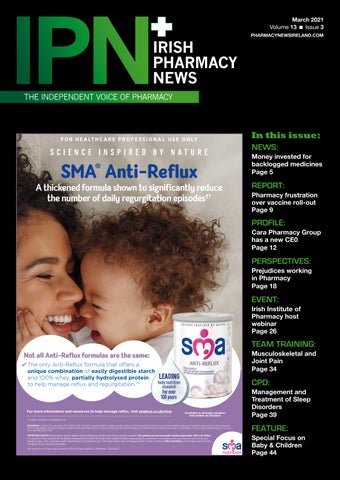
F O R H E A LT H C A R E P R O F E S S I O N A L U S E O N LY
SMA® Anti-Reflux
A thickened formula shown to significantly reduce the number of daily regurgitation episodes†1
In this issue: NEWS: Money invested for backlogged medicines Page 5
REPORT: Pharmacy frustration over vaccine roll-out Page 9
PROFILE: Cara Pharmacy Group has a new CE0 Page 12
PERSPECTIVES: Prejudices working in Pharmacy Page 18
EVENT: Irish Institute of Pharmacy host webinar Page 26
TEAM TRAINING: Musculoskeletal and Joint Pain Page 34
Not all Anti-Reflux formulas are the same: The only Anti-Reflux formula that offers a unique combination of easily digestible starch LEADING and 100% whey, partially hydrolysed protein, baby nutrition to help manage reflux and regurgitation.1-6 research
CPD:
For over 100 years
For more information and resources to help manage reflux, visit smahcp.co.uk/nice
Available in all major retailers and online via Amazon
Management and Treatment of Sleep Disorders Page 39
†p<0.0001, compared to a standard formula. REFERENCES: 1. Indrio F, et al. Nutrients 2017, 9, 1181. 2. SMA® Anti-Reflux datacard (2020). Available at www.smahcp.co.uk 3. Aptamil Anti-Reflux and Cow & Gate Anti-Reflux datacards. Available at www.nutricia.co.uk Accessed Dec 2020. 4. Hipp Organic anti-reflux datacard. Available at http://www.hipp4hcps.co.uk. Accessed Dec 2020. 5. Enfamil AR datacard. Available at https://www.hcp.nutramigen.co.uk/s/enfamil-ar Accessed Dec 2020. 6. Billeaud C et al. Eur J Clin Nutr 1990;44:577-583.
FEATURE:
IMPORTANT NOTICE: Breast milk is best for babies and breastfeeding should continue for as long as possible. This product must be used under medical supervision. SMA® Anti-Reflux is a special formula intended for the dietary management of bottle-fed babies when significant reflux (regurgitation) is a problem. It is suitable as the sole source of nutrition up to 6 months of age, and in conjunction with solid food up to 12 months of age. If the baby’s reflux does not improve within 2 weeks of starting SMA® Anti-Reflux, or if the baby fails to thrive, the family doctor should be consulted.
Special Focus on Baby & Children Page 44
SMA® Nutrition UK and Ireland ®Reg. Trademark Société des Produits Nestlé S.A. DENWHS016 ZTC5211/01/21
Enabling people with depression to feel, think and do better1
Brintellix is indicated for the treatment of major depressive episodes in adults1 Brintellix® (vortioxetine) film-coated tablets Prescribing information: Please refer to the full Summary of Product Characteristics (SPC) before prescribing, particularly in relation to side effects, precautions and contraindications.Presentation: Tablets containing 5, 10, 15 or 20mg of vortioxetine (as the hydrobromide). Indication: Treatment of major depressive episodes in adults. Dosage: 10mg once daily. Dose may be increased to a maximum of 20mg daily or reduced to 5mg if necessary. After depressive symptoms resolve, treatment for at least 6 months is recommended. Can be taken with or without food. Elderly (≥65 years): Initial dosage is 5mg once daily. Caution advised if using doses above 10mg daily as data are limited. Children and adolescents (<18 years): Not recommended as safety and efficacy not established. Cytochrome P450 inhibitors and inducers: Consider a dose reduction of vortioxetine if a strong CYP2D6 inhibitor is added. Consider a dose adjustment if a broad CYP450 inducer is added to treatment. Renal or hepatic impairment: No dose adjustment is needed, however exercise caution given that these subpopulations are vulnerable and data on the use of Brintellix is limited. Contraindications: Hypersensitivity to the active substance or excipients. Concomitant use with non-selective, monoamine oxidase inhibitors (MAOIs) or selective MAO-A inhibitors (e.g. moclobemide). Fertility, pregnancy and lactation: Should only be administered to pregnant women if the expected benefits outweigh the potential risk to the foetus. Limited data on the use of vortioxetine in pregnant women. Animal studies have shown reproductive toxicity. Use of SSRIs in pregnancy, particularly in late pregnancy, may increase the risk of persistent pulmonary hypertension in the newborn (PPHN). It is expected that vortioxetine will be excreted into human milk, and a risk to the breastfeeding child cannot be excluded. Animal data showed no effect on fertility, sperm quality or mating performance. Human case reports with some SSRIs have shown that an effect on sperm quality is reversible. Impact on human fertility has not been observed so far. Warnings & Precautions: Closely supervise patients, especially those at high risk, for suiciderelated behaviours during first few weeks of treatment and during dose changes. Use with caution in patients: at risk of hyponatraemia; with a history of mania/hypomania; aggression/agitation; undergoing ECT; with unstable epilepsy (discontinue if seizures begin for the first time or increase in frequency); with bleeding tendencies/disorders, taking anticoagulants or medicines affecting platelet function; in patients on lithium or tryptophan; with increased intraocular pressure, or those at risk of acute narrow angle glaucoma. Monitor patients for appearance of serotonin syndrome or neuroleptic malignant syndrome and discontinue if occurs. Patients may experience feelings of aggression, anger, agitation and irritability. Patients/caregivers should seek medical advice if such behaviour emerges or aggravates. Brintellix tablets contain sodium (<1mmol/tablet). Drug interactions: Alcoholic drinks not advisable. Vortioxetine is extensively metabolised in the liver, primarily through oxidation catalysed by CYP2D6 and to a minor extent CYP3A4/5 and CYP2C9. Potential for interactions with: MAOIs, MAO-A and MAO-B inhibitors; serotonergic medicines (e.g. triptans or tramadol); St John’s wort; products which may lower the seizure threshold, e.g. antidepressants (tricyclic, SSRIs, SNRIs), neuroleptics (phenothiazines, thioxanthenes and butyrophenones), mefloquine or bupropion. Depending on individual patient response, a lower dose of vortioxetine may be considered if strong CYP2D6 inhibitor (e.g. bupropion, quinidine, fluoxetine, paroxetine) is added to vortioxetine treatment. Additionally, these effects may be greater in patients who are poor metabolisers of CYP2D6. A dose adjustment may be considered if a broad
cytochrome P450 inducer (e.g. rifampicin, carbamazepine, phenytoin) is added to vortioxetine treatment. There have been reports of false positive results in urine enzyme immunoassays for methadone in patients taking vortioxetine. Exercise caution in interpreting positive drug screen results. Effects on ability to drive and operate machines: No or negligible influence however, as dizziness has been reported, use caution at the start of treatment or when the dose is changed. Adverse events: The most common adverse reaction is nausea, which is usually mild or moderate, transient and occurs within the first two weeks of treatment. The following have been reported in clinical trials and during post-marketing use: Very common (≥1/10 patients); nausea. Common (≥1/100 to <1/10); abnormal dreams, dizziness, diarrhoea, constipation, vomiting, pruritus, including generalised pruritus. Uncommon (≥1/1,000 to <1/100); flushing, night sweats. Rare (≥1/10,000 to <1/1,000); mydriasis (which may lead to acute narrow-angle glaucoma). Not known (from post-marketing reports); anaphylactic reaction, hyponatraemia, insomnia, agitation, aggression, serotonin syndrome, haemorrhage (including contusion, ecchymosis, epistaxis, gastrointestinal or vaginal bleeding), angioedema, urticaria, rash. Sexual dysfunction: The 20mg dose of vortioxetine was associated with an increase in sexual dysfunction. Class effect: Studies in patients ≥50 years of age, show an increased risk of bone fractures in patients receiving SSRIs and TCAs. Not known if relevant to vortioxetine. Prescribers should consult the full SPC in relation to other side effects. Overdose: Management consisting of treating clinical symptoms and relevant monitoring. Legal category: POM, for non-renewable supply. Brintellix Tablets, blisters of: 5mg (EU/1/13/891/002) 28 tablets. 10mg (EU/1/13/891/010) 28 tablets. 15mg (EU/1/13/891/019) 28 tablets. 20mg (EU/1/13/891/028) 28 tablets. Further information available from: Lundbeck Ireland Ltd, 4045 Kingswood Road, Citywest Business Park, Co. Dublin. Tel: 01 468 9800. Date of last revision of PI: July 2020. Reference: IE-BRIN-0214. Brintellix® is a Registered Trade Mark. Job number: IE-BRIN-0223 Date of preparation: July 2020 Reference: 1. Brintellix Summary of Product Characteristics. Available at https://www.medicines.ie/medicines/brintellix-10-mg-film-coated-tablets-34817/smpc (Accessed: July 2020). Adverse events should be reported. Reporting forms and information can be found at www.hpra.ie. Adverse events should also be reported to Lundbeck on: 01 468 9800 Email: SafetyLuIreland@lundbeck.com
3
Contents
Foreword
Page 4: LloydsPharmacy celebrate recognition award
Donegal pharmacists have written to Minister for Health Stephen Donnelly calling for increased supports for the profession and an acceleration in their involvement in the vaccination rollout.
Page 6: Grogan’s Pharmacy offer sweet treats
Their appeal comes amid what continues to be an extremely challenging time for pharmacy staff on the frontline, as pharmacists report that Covid positive patients are frequently attending pharmacies in person. Read more about this on page 22.
Page 8: Value of Pharmacist-led Medicines Reconcilliation
6
In continuing a look at the vaccination issue, on page 9 Niamh Cahill reports on what can only be described as growing frustration by Ireland’s community pharmacists at the slow pace of progress.
Page 9: Vaccine roll-out disaster spells frustration for community pharmacists
Darragh O’Loughlin, Secretary General of the Irish Pharmacy Union (IPU) says that in reality, the “arrival of vaccines shouldn’t have taken us all by surprise.”
Page 14: Jerusalema craze sweeps Ireland Page 18: Prejudice experiences in Pharmacy
14
Page 22: Donegal Pharmacists write letter to Minister for Health
In other news, the industry has welcomed back a very familiar face. On page 12 we reveal that Patrick McCormack is the face behind the new owners of the Cara Pharmacy Group, which went into examinership last year.
Page 28: ¤3.5bn increase in health service funding PUBLISHER: IPN Communications Ireland Ltd. Clifton House, Fitzwilliam Street Lower, Dublin 2 00353 (01) 6690562
22
MANAGING DIRECTOR Natalie Maginnis n-maginnis@btconnect.com EDITOR Kelly Jo Eastwood: 00353 (87)737 6308 kelly-jo@ipn.ie ADVERTISING EXECUTIVE Amy Evans: amy@ipn.ie CONTRIBUTORS
Michelle Henning Dr Victor Henning Dr Kevin McCarthy Niamh Cahill Elaine Lillis Fathima Kara Professor Colm O’Morain Aaron Koay
DESIGN DIRECTOR Ian Stoddart Design
PHARMACYNEWSIRELAND.COM @Irish_PharmNews
“There is a strong feeling that a lot of the plans we’re waiting for now could have been developed before the vaccines arrived and we could have had greater clarity around what we are doing, despite when we do it being dependent on vaccine supply. That wasn’t clear until recently,” he adds.
28
On page 16 Aaron Koay talks in uncomfortable detail about the remaining existence of racism and prejudices still being experienced by pharmacists and pharmacy students here. His report makes excellent and necessary reading and forces questions to be asked, such as ‘does silence make us all accomplices?’ It is widely reported that 10% - 15% of the population suffers from insomnia. However, the Covid-19 pandemic has led to an increase in people presenting with insomnia disorder. Changes to working environments, schedules, lifestyles, has led to a dysregulation of the sleep wake cycle. In our Continuing Professional Development module this issue, Breege Leddy presents a fantastic overview as to the management and treatment of sleep disorders. I hope you enjoy the issue.
Irish Pharmacy IRISH News is PHARMACY circulated to all NEWS independent, multiple Pharmacists and academics in Ireland. All rights reserved by Irish Pharmacy News. All material published in Irish Pharmacy News is copyright and no part of this magazine may be reproduced, stored in a retrieval system or transmitted in any form without written permission. IPN Communications Ltd. has taken every care in compiling the magazine to ensure that it is correct at the time of going to press, however the publishers assume no responsibility for any effects from omissions or errors.
Regulars TEAM TRAINING: MUSCULOSKELETAL HEALTH
P34
CPD: SLEEP DISORDERS
P39
SPECIAL FOCUS: BABY AND CHILDREN
P44
FEATURE: HEARTBURN
P64
CLINICAL PR:
P82
IrishPharmacyNews
PHARMACYNEWSIRELAND.COM
4
News
Foundation laid for Pharmacy Digital Health A large proportion of pharmacy schools and faculties do not yet offer digital health education or training, according to the findings of a survey by the International Pharmaceutical Federation (FIP) published recently. The findings are presented in a new report “FIP digital health in pharmacy education: Developing a digitally enabled pharmaceutical workforce”. The survey, which was completed by 1,060 pharmacy schools, faculty members, students and practitioner groups from 91 countries, also found that many practitioners are lacking familiarity with emerging digital health technologies such as blockchain, bots, digital medicines and artificial intelligence, and only a small fraction of these respondents had received continuous educational development on digital health. Irish pharmacist Paul Fahey, who is a member of the FIP Technology Forum assisted in engaging with the project.
Ireland's Paul Fahey, Pharmacist and member of the FIP Technology Forum
“With increased complexity of health conditions and ageing populations, digital health can be the key to many unmet needs in health services. A capable and digitally enabled pharmaceutical workforce is required to make use of the full potential of digital health,” said Aukje Mantel-Teeuwisse, chair of the report group. She added, “Pharmacy education is at the centre of accelerating the uptake of digital health
technologies in pharmaceutical care by educating the current and future pharmaceutical workforce.” However, schools and faculties reported a lack of experts and resources needed for digital health education. The report describes digital health education initiatives from pharmacy schools and faculties from around the world and outlines a number of “ways forward”. “Pharmacists historically have embraced information technologies. This report lays the foundation of our current status in pharmacy education for us to build upon. I hope this report and its findings will inspire pharmacy schools to develop and implement lectures or courses in their own curricula, and national and regional professional organisations to equip the pharmaceutical workforce with the necessary digital health knowledge and skills,” Professor Mantel-Teeuwisse said. FIP will be developing a global competency framework for digital health in pharmacy education and this will facilitate national, regional and global implementation of FIP Development Goal 20 (digital health).
Pharmaceutical Society approves Training The PSI has approved the HSE National Immunisation Office (NIO) training for the COVID-19 vaccination programme. Completion of this training will allow pharmacists who are experienced vaccinators to participate in the initial phase of the national COVID-19 Vaccination Programme, which involves delivering vaccines in vaccination centres within the structure of a vaccination team. The NIO training is available through HSEland - the Health Service Executive's online learning and development portal. Pharmacists have been delivering influenza vaccination in pharmacies since 2011. Pharmacists who have participated in the most recent flu vaccination season and who vaccinated patients in the last twelve months are considered experienced vaccinators and are eligible for the training. To participate, they must also be up-to-date in CPR training, responding to anaphylaxis and responding to an emergency situation and management of anaphylaxis (RESMA).
At present, the NIO training covers the Comirnaty (Pfizer/ Biontech) and Moderna COVID-19 vaccines, the vaccines currently being used in the initial roll-out phase of the national vaccination programme. However, the PSI confirms that it is ready to examine the further training requirements for pharmacists as other vaccines are included in the national vaccination programme to facilitate pharmacists’ continuing, and increasing, participation.
PHARMACYNEWSIRELAND.COM
Further vaccines, such as the Astra Zeneca vaccine, currently undergoing regulatory assessment, are expected to be the focus when the national vaccination programme is extended to the mass-vaccination stage involving primary care services such as GPs and community pharmacists. The PSI is currently participating in a Working Group with the HSE and the Irish Pharmacy Union to facilitate and support this wider roll-out across the community pharmacy sector.
Pharmacists welcome Cancer Plan Community pharmacists across Ireland, and indeed Europe, have welcome the ambitions set forward in Europe’s Beating Cancer Plan adopted by the European Commission. European community pharmacists offer their support for the implementation of the Plan’s objectives in primary care and are committed to take up an enhanced role in providing quality, convenient and affordable access to professional healthcare services within their domains of expertise. The Pharmaceutical Group of the European Union (PGEU) President Alain Delgutte stated, “We are very pleased to see this ambitious plan for Europe which aims to tackle the entire disease pathway of cancer. The structural involvement of primary healthcare in the implementation of this plan at European, national, regional and local level will be vital to reach its objectives effectively and make sure that EU citizens can receive quality healthcare services in an accessible and affordable manner.” “Community pharmacies work at the heart of local communities and are already providing a wide range of professional services related to cancer prevention, early detection, treatment and in improving people’s quality of life as highlighted in our recent best practice paper. They are highly accessible to the public, which makes community pharmacy uniquely placed to support the Cancer Plan’s missions to enhance health literacy on cancer risks and determinants and improve health promotion. This is already an essential part of community pharmacists’ core mission to maximising the benefits of medicinal therapies and health outcomes of their patients in close co-operation with other health and social services in the community. “Community pharmacists advise patients on the importance of immunisation, identify and remind target groups for vaccination, and of course dispense and advise on vaccines. In some European countries pharmacists also contribute to immunisation programmes for HPV and/or Hepatitis B vaccines in pharmacies as a complementary service.”
News Medicine Shortages The Health Products Regulatory Authority (HPRA) has been notified of a shortage of the following products: • Cytotec 200mcg Tablet – PA0822/118/001 • Glycopyrronium bromide 200mcg/ml Solution for Injection – PA0857/001/001 • Isoptin 40mg Film Coated Tablet – PA2010/003/001 • Parox 10mg Film Coated Tablet – PA0711052/003 • Vfend 200mg Powder for Solution for Infusion – EU/1/02/212/025 • Voriconazole 200mg Powder for Solution for Infusion – PA2059/020/001 The following shortages have been resolved and supply has resumed to the Irish market: • Abstral 300mcg Sublingual Tablet – PA2288/004/004 • Genotropin Miniquick 2mg Powder and Solvent for Solution for Injection – PA0822/128/012 • Neurostil 100mg Capsule – PA0749/164/001 Fraudulent Email The HPRA has become aware of a fraudulent email purporting to be from the HPRA falsely stating that their bank account details have changed. The fraudulent email has come from the domain @hpra-ie.com. HPRA is advising stakeholders to block this email address. “We wish to advise stakeholders that HPRA bank details have not changed. Our bank details are always provided in the Payment of Fees Instructions on our website. “Please note that email correspondence from the HPRA is always sent from an email address ending in @hpra.ie. “Should you have any queries, please do not hesitate to contact the Accounts Department at the Health Products Regulatory Authority at accounts@hpra.ie,” they state on their website.
5
Recognition Award LloydsPharmacy were delighted to have recently won the ‘Retail Excellence’ Award at this year’s InBUSINESS Recognition Awards! Lorraine Brophy, Head of Sales & Retail Operations, LloydsPharmacy “This award recognises our colleagues relentless dedication and commitment, delivering excellent customer service and patient care throughout communities in Ireland,” said a LloydsPharmacy spokesperson. “Our Head of Sales & Retail Operations, Lorraine Brophy, would like to take this opportunity to congratulate and thank each and every LloydsPharmacy colleague for making this happen,” they added.
¤30m released for ‘backlogged’ medicines Patients are to get access to more of the latest treatment options following the release of an estimated €30 million aimed at clearing a ‘backlog’ of new medicines, according to the Irish Pharmaceutical Healthcare Association (IPHA) which represents the international originator biopharmaceutical industry. The move comes in addition to the industry agreeing to roll over an extension to the existing four-year supply Agreement with the State. The 15 ‘backlogged’ new medicines are to treat patients with a range of diseases, including lung cancer, renal cell carcinoma, urethral carcinoma, leukaemia, Parkinson’s disease and chronic migraine. A number of the medicines have already been approved by the Executive Management Team of the Health Service Executive (HSE). The HSE is planning their rollout. The funding move is the first impact of the Government’s decision to allocate ¤50 million for new medicines in Budget 2021. Since July 2019, approvals for new medicines, deemed by the HSE’s Drugs Group to be clinically sound and economically cost-effective, has slowed significantly due to a lack of funding. That caused a build-up, or ‘backlog’, of over 20 approved but unfunded medicines. The result was that more than
11,000 patients experienced delays accessing vital treatments. As part of a six-month extension to the supply Agreement agreed in July, the HSE agreed to reimburse some of these new medicines using savings from price cuts agreed by IPHA member companies on other medicines. Then, in October, the Government announced ¤50 million in funding for new medicines this year. The ¤30 million released comes at a time aligned to the latest extension, or ‘rollover’, to the Agreement accounts for a portion of that ¤50 million fund. After Budget 2021, IPHA said the new funding would be a “gamechanger” for thousands of patients. The fast approval by the HSE, along with cooperation between industry and the State, mean that patient impact is materialising. The new extension will run until the end of July, with a review by the end of April. In May, formal negotiations on a new
supply agreement will begin. If the State needs more time, we are open to extending the rollover beyond the end of July to the end of September. Paul Reid, President of IPHA, said: “We have agreed to roll over the extension to the existing Agreement for three reasons. We wanted to give thousands of patients access to the latest treatments by attaching a specific funding amount to medicines we know they need. We wanted to help the State to manage the pandemic by giving them time and space, without the burden of negotiating a new Agreement right now with the industry. We wanted to secure the supply of medicines to the health services, especially during Covid, through the governance framework the extension provides. All of this trends towards the start of negotiations on a new supply Agreement during the extension’s timeframe. This is an arrangement that works for everyone – for patients, for industry and for the State.”
Meanwhile, IPHA has also come out to state that ‘now is the time for collaboration and free movement on Covid-19 vaccines supply.’ “We are taking major steps forward, enabled by the efforts of the biopharmaceutical industry, in partnership with academia, regulators and governments around the world,” they have said in a statement. “The manufacture of medicines and vaccines can be scattered across territories and countries and, often, across sites. Global supply chains are vital, whether for moving ingredients of medicines and vaccines or the finished products. “Now is not the time for vaccine protectionism.”
PHARMACYNEWSIRELAND.COM
6
News
Sweet Script from Grogan’s Pharmacy Grogan’s Pharmacy in Dingle has just discovered a sweet cure to beat the Covid blues - they’re prescribing doses of Kit-Kat twice a day to relieve the pain of lockdown. Donald Grogan, Owner and Pharmacist of Grogan’s Pharmacy, Dingle
Grogan’s pharmacy in Dingle is prescribing customers ‘Kitkat Lockdown Relief’ advising all customers to “take one twice daily to relieve the pain of lockdown”. Irish musician and broadcast presenter Muireann Nic Amhlaoibh was one such patient to receive the chocolatey cure, and she took to Twitter to voice her pleasure at the initiative. The pharmacy received praise online for attempting to cheer people up on the Dingle Peninsula.
Irish Pharmacy endorses PGEU Report Community pharmacists in Ireland have strongly endorsed the Pharmaceutical Group of European Union (PGEU) statement that community pharmacy has been an indispensable element of the Covid-19 response. IPU Secretary General Darragh O’Loughlin says it is welcome that PGEU specifically cites the role Irish pharmacies will play in mass vaccination campaigns for Covid-19. In the statement published by the British Medical Journal Alain Delgutte, PGEU President, and Duarte Santos, PGEU Past President, say the COVID-19 pandemic “has taught Europe’s healthcare systems several important lessons. One of them is the need for effective organisation and deployment of primary healthcare to ensure the continuity of care within our communities. In this ongoing COVID-19 pandemic, the network of pharmacies near people’s homes is playing a vital role in supporting local communities.” Mr O’Loughlin said, “We cannot endorse this statement more forcefully. Irish pharmacists have more than stepped up to
the plate in ensuring our communities continued to receive vital face-to-face healthcare for the past year while many other healthcare services were unavailable. Our commitment to our patients is again to the fore as we work to ensure that pharmacies are enabled to play an important role in the COVID-19 vaccination campaign. “It is also very useful to have a European perspective on how pharmacists’ role in supporting people could be extended further. As my colleagues in PGEU state, many European countries have introduced changes in legislation to expand the role of pharmacists and have also secured additional funds to empower pharmacists in their vital work on the frontline against COVID-19. “Similar to other countries, Irish pharmacists can now renew repeat prescriptions for medications and the electronic
transfer of prescriptions to pharmacies has been enabled. However, we can do more and must follow the example of other countries. For example, in Scotland, pharmacists have been empowered through the extension of the Minor Ailment Service and increased access to Emergency Care Summary Data.” Mr O’Loughlin concluded by saying that he echoes the words of the PGEU statement, which say, “Amid these challenges it is vital to maximise the use of community pharmacy practice to meet patients’ needs and maintain continuity of services. Community pharmacy has demonstrated its value for patients and healthcare systems during this crisis and is ready to further expand this contribution as part of sustainable collaboration models with other healthcare professions in the community.” Turn to page 24 for the full report.
Clinical Pharmacy Workshop Registration for the online European Society Clinical Pharmacy (ESCP) Spring workshop (26th & 27th of April 2021) has now opened. The theme of the conference is “Malabsorption and malnutrition- a challenge for clinical pharmacists.” Malnutrition is common and can be caused by malabsorption, decreased nutrient intake, or hypermetabolism due to illness or injury. It is associated with a longer hospital stay, increased morbidity and mortality, increased incidence of infection, poor wound healing and decreased immune competence. Pharmacists can play an important role in taking care of those patients together with nurses, physicians and dieticians. Learn more by visiting www.escpweb.org/Zurich
PHARMACYNEWSIRELAND.COM
Obesity Policy and Action Plan The Department of Health has published an Implementation Progress Report on “A Healthy Weight for Ireland”, Ireland’s national Obesity Policy and Action Plan (OPAP). Originally launched in September 2016, the Obesity Policy and Action Plan was developed in recognition of the growing need for a co-ordinated policy response to the increasing problem of obesity in Ireland and the increasing burden placed on individuals and society. The Policy covers a 10-year period up to 2025 and aims to reverse obesity trends, prevent associated health complications and reduce overall burden for individuals, families, the health system, and the wider society and economy. This most recent Report outlines progress made and actions taken across the 60 action areas of the OPAP, from September 2016 to the end of 2019. The actions described involve input from a wide range of stakeholders, which illustrates the multisectoral and cross-governmental nature of the Obesity Policy and Action Plan. Significant achievements highlighted in the Progress Report are: • The introduction of a SugarSweetened Drinks Tax, which commenced on 1st May 2018. • The appointment of a National Clinical Lead for Obesity in the HSE, with work advanced on the development of a Model of Care for the management of overweight and obesity. • The publication of new Healthy Eating Guidelines, Food Pyramid and supporting resources (recently complemented by the Healthy Eating Guidelines for 1-4 year olds). • The development of Nutrition Standards for schools. Recent statistics indicate that the levels of overweight and obesity have stabilised. The Childhood Obesity Surveillance Initiative Report published in October 2020 found reduced levels of overweight and obesity in primary school children. However, the levels remain too high, and within the global figures there are areas of particular difficulty, including in socially-deprived sections of the population.
Your patients deserve a meter that’s more than just good enough.
8.9
Free Upgrade Now! Help them get more guidance.
Upgrade your patients to the OneTouch Verio Reflect® meter today. The only meter that gives them guidance with Blood Sugar Mentor™ messages to help them know what those numbers mean and what they can do about them. To find out more about meter visit: OneTouch Ireland on YouTube channel or website www.myOneTouch.ie
To order FOC meters, please email LifeScan directly: ukicommercials@lifescan.com Always use the current numerical result for immediate treatment decisions and consult a healthcare professional before making changes to a diabetes care plan. Always read and follow the label. © 2020 LifeScan IP Holdings, LLC. Trademarks are used under license by LifeScan IP Holdings, LLC. All rights reserved. CA-VRF-2000076 (20-032)
8
News
Value of pharmacist-led medicines reconciliation A toolkit for medicines reconciliation, released recently, is the latest resource produced to support pharmacists in improving patient safety and contribute to the World Health Organization’s (WHO’s) third Global Patient Safety Challenge — “Medication without harm”. Under this programme of change, the WHO lists care transitions as one of three priority areas that need effective action in order to protect patients. Catherine Duggan, CEO, FIP
minimise errors and optimise medicines use, resulting in positive impacts on patient, clinical and economic outcomes. Medicines reconciliation should be practised in every healthcare setting,” said International Pharmaceutical Federation (FIP) CEO Catherine Duggan.
Transitions of care can potentially lead to patient harm due to unintentional changes in medication or poor communication. A recent Cochrane review, for example, found that 55.9% of patients are at risk of having one or more medication discrepancies at transitions of care. Such medication discrepancies can lead
to secondary illnesses, hospital admissions and even deaths. “Medicines reconciliation represents a key service across all transitions of care and, when led by pharmacists, is effective in reducing medication-related harm to patients. With this service, pharmacists can apply their medicines expertise to
FIP’s toolkit on medicines reconciliation outlines the principles and important processes that pharmacists should follow when providing this professional service. It summarises the definitions, impact and procedures for the implementation of pharmacist-led medicines reconciliation in both community and hospital healthcare settings, and offers a set of tools to support practice. FIP will be hosting a free webinar on medicines reconciliation, based on the toolkit, next month.
Insights for Pharmacy United Drug online webinars have been sharing invaluable insights for Pharmacy including topics on the Covid-19 vaccination programme and essential floor planning for Retail Pharmacy. The United Drug webinar series has been teaming with invaluable knowledge to provide Industry insights and support to Pharmacy over the past year. Most recently in February, they welcomed Mr. John O'Byrne MPSI (Acting Head of Pharmacy from Tallaght University Hospital) and Denis O'Driscoll MPSI (Superintendent Pharmacist at McKesson Ireland) for a special webinar which addressed the upcoming Covid-19 vaccine roll out for pharmacies throughout Ireland. In addition, they also welcomed Mary Magner (United Drug Category Manager) in March to discuss Macro Floor Planning in the hope of soon returning to a “new norm” for retail pharmacies.
The Covid-19 webinar gave pharmacies an insight into the experiences of the vaccine rollout within Tallaght Hospital. Mr O’Bryne presented a detailed overview of the planning, organisation and administration that was required to successfully implement the programme. In addition to this, he also addressed the challenges that accompanied this roll-out from a hospital standpoint. Following this, Denis O'Driscoll MPSI repositioned the process of the vaccine programme from a pharmacy perspective. Addressing key requirements such as storing, administration, potential challenges ahead and staff training, this
PHARMACYNEWSIRELAND.COM
overview was greatly received by pharmacies all over Ireland. In early March, Mary Magner presented Macrofloor planning with an opportunity for pharmacies to look at their retail layout with fresh eyes and also take learnings from this most unusual past year. If you have any questions in relation to the above webinars, please contact our event organisers from United Drug Marketing: Lucia Onofri, Brand and Trade Marketing Manager, lucia. mariaonofri@united-drug.com and Jennifer Morrin, Senior Marketing Executive, jennifer.morrin@united-drug.com
¤1.3m for psychotic disorders RCSI University of Medicine and Health Sciences has received a ¤1.3 million grant from Wellcome to further develop a blood test that can predict whether a person is likely to develop a psychotic disorder years later. The researchers had previously analysed blood samples taken from people at clinical high risk of psychosis. These individuals were followed up for several years to see who did and did not develop a psychotic disorder. After assessing the proteins in blood samples and using machine learning to analyse this data, the scientists were able to find patterns of proteins in the early blood samples that could predict who did and did not develop a psychotic disorder at follow-up. The most accurate test was based on the 10 most predictive proteins. It correctly identified those who would go on to develop a psychotic disorder in 93% of high-risk cases, and it correctly identified those who would not in 80% of cases. The grant will now enable the researchers to determine if this test is similarly accurate at predicting who will develop a psychotic disorder from other international groups of clinical high risk individuals. The ultimate goal is to develop a commercially-available test for use in clinical practice so people can be treated earlier and more effectively. “Wellcome’s support will enable us to further expand our research and directly benefit patients,” said Professor David Cotter, a professor of molecular psychiatry at RCSI, consultant psychiatrist in Beaumont Hospital, Dublin and investigator at FutureNeuro, the SFI research centre for chronic and rare neurological diseases. “Ideally, we would like to prevent psychotic disorders, but that requires being able to accurately identify who is most at risk. This grant will allow us to study these markers in other people at high risk of psychosis to confirm our previous findings.”
Frustration with a Capital
‘F’
Report
9
Community Pharmacy vaccination roll-out in Ireland hits all the low notes as Pharmacists struggle to feel utilised. Niamh Cahill reports. Up to 15th February more than 280,000 Covid-19 vaccines had been administered in Ireland. The vast majority of those vaccinated to date are residents of long-term residential care facilities and healthcare workers.
The HSE plans to invite community pharmacists to participate in mass vaccination centres, of which there will be 37 nationally, at a rate of ¤70 per hour “on the basis of defined seasonal commitments”.
While data on the number of pharmacists and pharmacy staff vaccinated is unknown, it is believed to be low.
According to Darragh O’Loughlin, Secretary General of the Irish Pharmacy Union (IPU), talks between the union, the Pharmaceutical Society of Ireland (PSI) and the Department of Health are ongoing.
The HSE forecasts that a total of 1.2 million vaccines will be supplied in Ireland by the end of March. Around four million vaccines are expected to arrive here in April, May and June.
O’Loughlin was unable to put a deadline on talks, saying that the “operational plan on how the service will work in pharmacies” remained under discussion.
The supply increases cannot come quick enough for pharmacists as frustration mounts at the slow pace of progress.
“We are pushing to conclude talks as fast as possible but at the same time we respect the fact that the people we are dealing with have multiple other things to be dealing with.”
The question on everyone’s lips is: “When will we be vaccinated and when will we start vaccinating?” Engaging in Talks What is known is that pharmacists are permitted to vaccinate adults up to the age of 69 in their own pharmacies or in suitable, alternative premises. GPs are currently vaccinating the over 70s using the mRNA Pfizer/BioNTech and Moderna vaccines. This age grouping is expected be vaccinated by mid-May. Remuneration rates have been agreed and pharmacists will be paid the same as GPs for their contribution to the programme. Pharmacists will most likely administer the AstraZeneca and other viral vector vaccines, which are less fragile than mRNA vaccines.
"The question on everyone’s lips is, ‘When will we be vaccinated and when will I start vaccinating?"
Yet while recognising that health officials are time-poor, he feels that more planning could have occurred before the arrival of vaccines in December. “There is a lot of frustration among pharmacists that this is happening very slowly. The arrival of vaccines shouldn’t have taken us all by surprise,” he says. “There is a strong feeling that a lot of the plans we’re waiting for now could have been developed before the vaccines arrived and we could have had greater clarity around what we are doing, despite when we do it being dependent on vaccine supply. That wasn’t clear until recently.” The issues under discussion include the introduction of a software package to allow pharmacists to record vaccinations, training, logistics, booking systems and “identifying cohorts of patients” for vaccination. All of these issues, he says, have yet “to be ironed out”. Quality Medicines According to O’Loughlin, there will be a role for community pharmacists in vaccination centres as vaccinators and in medication management, “managing the vaccine from a quality medicines use point of view”. “Then pharmacists will be vaccinating in community pharmacies where we think the bulk of pharmacy vaccinations will happen and some pharmacies will establish their own vaccination clinics.” Vaccines are being administered in line with the vaccine allocation priority groups list. People aged 65-69 are the fifth group from the top of the list.
PHARMACYNEWSIRELAND.COM
10
Report Rory O’Donnell of O’Donnell’s Pharmacy in Donegal
It is likely that pharmacists will receive the AstraZeneca vaccine, which is administered in two doses 12 weeks apart, except for patients considered ‘high risk’, who will receive their second dose after six weeks. Patients aged 65-69 who receive the AstraZeneca vaccine will receive their second dose after six weeks.
"That (the HSE portal system) has been a disaster. It is virtually un-useable" Ahead of them are residents in long-term residential care facilities, healthcare workers, people over 70 and healthcare workers not in direct patient contact. It is unclear yet whether or not pharmacists will begin vaccinating the under 70s before the vaccination of other priority groups have been completed. “Pharmacists would like to start giving the vaccine earlier than May but I don’t expect that they will,” says O’Loughlin. “Listening to the Department of Health talking about when the vaccine will be arriving in significant quantities we hear now that we could have four million vaccines arriving into Ireland across April, May and June. That’s when I expect pharmacists to start vaccinating. At the moment everything is being held up by the limited supply of vaccines that have been available.” But he warned that the rollout could come under severe public pressure if vaccines are not administered as soon as possible after their arrival into the State. Up to 15th February the HSE had administered 94 per cent of available vaccines. “It’s going to be slower than might have been anticipated in the over 70s age group in the beginning and GPs will be very busy doing that age group until the beginning of the summer. It’s very important that pharmacies be able to start vaccinating with AstraZeneca before then, as it makes no sense to hold pharmacies back and prevent them from vaccinating while the GPs do the over 70s. If pharmacists aren’t allowed to start vaccinating when the AstraZeneca vaccines are available the public will wonder why they are not being vaccinated just because GPs are busy doing the over 70s.” According to the HSE, it is working closely with the IPU and PSI as part of working group
PHARMACYNEWSIRELAND.COM
to “put in place an appropriate model and guidance for the involvement of pharmacist in the vaccination programme.” The group is working to ensure that community pharmacists are trained and supported to provide Covid-19 vaccination services safely and conveniently at community level, a spokesperson for the PSI advised. Registration Portal The HSE registration portal allowing pharmacists and their teams to register for vaccination recently went live to the relief of many. But almost immediately problems arose. According to Donegal Pharmacists Rory O’Donnell, the system caused much confusion. “That has been nothing but a disaster. It’s practically un-useable. Eventually the IPU issued guidance to explain how to use it.” According to O’Loughlin, a small number of pharmacists have been issued with vaccination appointments since the portal opened. Pharmacists, he says, will likely be called for vaccination at local hospitals and healthcare facilities. “Some of those appointments are going out but we don’t think many of those pharmacists have yet been vaccinated. We need a lot more clarity on that.” O’Donnell and his pharmacist colleague were invited for vaccination with the Pfizer/BioNTech vaccine after receiving a call from a local nursing home, which had leftover vaccines. “But we’re the absolute exception. We’re very lucky,” he says. The majority of his colleagues in Donegal have yet to be vaccinated and are, he says, incredibly frustrated regarding the lack of vaccinations for pharmacists and pharmacy teams.
The dosing regimen means that it is highly likely many pharmacy staff will not be fully vaccinated by the time they begin administering Covid-19 vaccines to patients. According to Jack Shanahan, Pharmacist at Haven Pharmacy Shanahan’s, Castleisland, Co Kerry, most of the pharmacists in his locality are unvaccinated. “This is concerning for pharmacists. Most would like to be vaccinated before they start administering vaccines, that would be a given really,” he says. Vaccination Training There are about 6,000 pharmacists on the PSI register, which includes pharmacists working in industry, hospital and other settings. In community pharmacy there are about 3,500 pharmacists. O’Loughlin expects that between 2,000 and 3,000 of those will become Covid-19 vaccinators. More than 1,300 pharmacies provided an influenza vaccination service last winter, but, he says, “a lot more pharmacists want to do the Covid vaccination that didn’t do flu vaccinations”. The PSI and the Irish Institute of Pharmacy (IIOP) site have information on vaccination training, but pharmacists are calling for more uncomplicated pathways to training, according to O’Loughlin. “There are so many different places that pharmacists have to go to put it all together we would like to see a simple pathway, that’s what pharmacists are asking us for, a simple straightforward pathway so they can identify what training they need and work through those requirements so they know they will be approved by the PSI to start vaccinating.” Under PSI rules, pharmacists can vaccinate if they are “experienced vaccinators”. This means those who would have vaccinated individuals in the influenza season just past. Pharmacist then undergo training on the specific vaccine they will be administering. According to Shanahan, this takes about a few hours and covers the consent process, when not to administer, advice that should be given to the patients and information around making up the vaccine, as the AstraZeneca vaccine has to be reconstituted, unlike the annual flu vaccine which comes prepared in syringes. The PSI recently approved the HSE National Immunisation Office (NIO) training which allows current pharmacist vaccinators to participate in the initial phase of the national programmes, delivering vaccines in vaccination centres within the structure of a vaccination team.
11 At present, the approved NIO training covers the Comirnaty (Pfizer/BioNTech) and Moderna Covid-19 vaccines.
Peter McElwee of McElwee’s totalhealth Pharmacies, Mountmellick and Portlaoise
The PSI is currently evaluating additional training which will, when approved, facilitate pharmacist vaccinators to supply and administer the AstraZeneca vaccine. Vaccine Clinics Despite the huge level of uncertainty surrounding the campaign, some pharmacists have already established vaccine clinics and invested significant amounts in real estate in advance of the rollout. Pharmacist Peter McElwee is owner and managing director of McElwee totalhealth Pharmacies in Mountmellick and Portlaoise. He runs three shops and six pharmacists but has still managed to find the time to transform a premises attached to his outlet at O’Connell Square, Mountmellick into a vaccination clinic.
“The fact the pharmacy team has not yet been vaccinated is a serious bugbear”
He has repainted the interior, erected outdoor signage and indoor signage and hopes pharmacists can begin vaccinating well before the over 70s age group is due to be completed in mid-May. “Really I was demonstrating that we are capable of doing this, ” he says, adding that the clinic will allow for four people to be “in house at any one time.” “All my pharmacists have volunteered their services to the HSE previously to say we would be available to local vaccination centres,” he says.
All of his premises recently underwent a health and safety inspection and received a 100 per cent result and report that procedures were excellent. He believes this is down to the investments made in protecting staff and customers, and strict virus control measures.
“We’re willing and capable, so frustrated might be right. I’ve not been called for my own vaccine yet and our staff need to be vaccinated too.”
“I spent ¤30,000 on three counters in each shop that are fully glassed because I felt as a priority the staff needed to feel safe coming to work.
“Thankfully, we’ve been lucky, We’ve only had one member of staff who had active Covid in the three shops so far.” Pharmacists Gillian and Barry McKeon of Old County life Pharmacy in Crumlin, Dublin have also been busy. They have refurbished an adjacent property, breaking through to the new premises from their existing pharmacy in order to connect the vaccination clinic to IT software systems. The team has been vaccinating for 10 years and used another, separate premises to administer flu vaccinations last winter. Pharmacist Gillian McKeon says the fact that their team has yet to be vaccinated is a “serious bugbear”. According to O’Loughlin, these examples are evidence that “everybody wants to put their shoulder to the wheel and help Ireland get out of this”. Shanahan says pharmacists are now quite anxious to get going. “We know the vaccines are in the country and we are all scratching our heads wondering why aren’t we getting started,” he says. But despite the uncertainty and frustration, vaccines represent “the light at the end of the tunnel,” O’Loughlin believes. “Once we get up and running I would hope that by September the vast majority of the population will have been vaccinated, assuming we put the programme in place; nothing ever got finished that didn’t get started. “For as long as Covid vaccines are needed pharmacists will be involved.”
PHARMACYNEWSIRELAND.COM
12
News
Patrick fills the Script for Cara One of the more familiar faces within the community pharmacy sector in Ireland, Patrick McCormack has returned to the frontline. on many fronts following a period of uncertainty for staff, customers and suppliers. He said they now plan to put a major emphasis on further developing the business. He also said it is a source of ‘great satisfaction’ to be able to say more than 150 jobs have been secured. Cara Pharmacy Group went into examinership in September of last year, following a High Court application by Elm Corporate Credit DAC, Cara Pharmacy’s largest and only secured creditor.
Former Sam McCauley Managing Director, Patrick McCormack, recently emerged as the surprise head of Renrew, who have taken on Cara Pharmacy Group following examinership last year
The Cara Pharmacy Group says more than 150 jobs from Cork to Donegal have been secured following a High Court decision to approve a plan allowing the group exit examinership. The Pharmacy Group has been acquired by Renrew Limited, which is headed up by former industry giant Patrick McCormack. It is
believed that more than ¤14 million will be invested in the group. Patrick began his retail career in Sligo. He has 30 years’ experience in the retail pharmacy sector. He has previously been CEO of the Sam McCauley Pharmacy group for more than 10 years. He began his retail career as a
teenager working with his uncle and aunt Denis and Kay Feehily in their grocery store on the Mail Coach Road in Sligo and has strong family connections in Sligo and Donegal. He welcomed the High Court decision and said the outcome and the decision made by Mr Justice Denis McDonald allows progress
Judge, Mr Justice Denis McDonald issued a written judgment at the end of February on the termination agreement negotiated with two former directors of the group, Ramona Nicholas, a former presenter of RTÉ’s Dragons’ Den, and her husband Canice Nicholas, with Renrew Ltd. IPN spoke to Patrick who expressed his delight at being back at the coalface of retail pharmacy again. He said that he has spent the first month talking to every team member in Cara and visiting all the stores and has been overwhelmed with the positive response he has received. “We have an amazing team with amazing talent across the group and I am really looking forward to working with them to steady the ship and to grow and expand our business.”
Ireland continues to invest in Medicines Minister for Health Stephen Donnelly was questioned recently on the status of the additional funding of €50m provided for new medicines as part of Budget 2021. Deputy Brendan Griffin asked in a Dail debate which way the funding was being allocated. In answering, Minister Donnelly stated, “The additional funding will allow the HSE to provide access to medicines which have been recommended by the HSE Drugs Group, on the basis of efficacy and value for money, and
ultimately provide more medicines to Irish citizens.”
Year
New Medicines
New indications of existing medicines
Total approvals
2019
31
5
36
2020
10
13
23
2021 (as of 16th Feb)
9
7
18*
As a country, said Mr Donnelly, Ireland invests heavily in medicines, to the tune of over ¤2bn annually. The number of new medicines approved for
reimbursement by the HSE from 2019 to date (as of 16th February) was detailed as below. He also confirmed that there has been a number of key changes in the HSE assessment process of medicines within the confines of
the 2013 Health Act. These have included changes to the HSE Drugs Group, whose membership has been expanded and in June 2018, the HSE Leadership appointed a Technology Review Committee for Rare Diseases.
* Includes expanded reimbursement of Duodopa and provisions for availability under the community drugs schemes of intranasal naloxone (Nyxoid) for the management of opiod overdose.
PHARMACYNEWSIRELAND.COM
United Drug Wholesale
Continuously expanding our unlicensed medicines range Over 1200 products listed and an average of 30+ new lines added each month.
All products listed on request
Easy to request non-stocked lines via our new product request form
Turnaround time as low as 48 hours for emergency orders
www.udw.ie Tel: 01 463 2410
A McKesson Group
14
News
Pharmacists put on their Dancing Shoes There won’t be many across Ireland who haven’t heard of the latest craze sweeping the world - the Jerusalema Dance Challenge. This dance trend began in February of last year in south west Africa, where an Angolan dance troupe, Fenómenos do Semba, recorded themselves dancing along to the song Jerusalema. This was then uploaded to social media, and took off as a dance challenge across the world and the rest, as they say, is history! It landed on Irish shores in early February this year with An Garda Síochána accepting the challenge from their Swiss counterparts. Such were the positive vibes and feel-good factor generated by watching the dance challenge, Daly’s Pharmacy Naas decided to join forces with The Basin Street Centre Professional Counselling and Psychotherapy Services to attempt their own version! The participants were rounded up and the music system and drone were organised. All that was left to do was to start practicing! Under
the excellent tutelage of Janet Ward, the Clarins Consultant at Daly’s, who doubles as a dance teacher in her spare time, the team got to work. Time was tight, with 24 hours from inception to execution, the team pulled it off with aplomb!
1
The challenge was extended by Daly’s to the business community of Naas and many businesses have rose to it. Also taking part was McGoey Pharmacy located in Ardee, Co. Louth whilst McElwee's totalhealth Pharmacy Group added a new twist, literally. Pharmacist Dermot Donaghy had some hidden dance moves just waiting to shine.
2
Staff from all three outlets in Portlaoise and Mountmellick joined in the craic. Pharmacist Peter McElwee owns the family run business begun by his dad Jim who also makes a special appearance.
3 4
5
1: Daly’s Pharmacy team Naas 2&3: McElwee’s totalhealth Pharmacy 4: Howard Pharmacy, Moycullen, Galway 5: McGoey Pharmacy Ardee
6% will refuse vaccine, says survey Just 6% of people will refuse to get vaccinated for Covid-19, according to the results of the latest tracker survey by Ipsos MRBI for the Irish Pharmaceutical Healthcare Association (IPHA) which represents the international research-based biopharmaceutical industry. Over three in four people, or 77%, say they will take a Covid-19 vaccine while 15% are unsure. The rest of the sample, or 2%*, say they have already been immunised against Covid-19. The figures show a two-point rise in the number of people who will get vaccinated since the last tracker survey taken in the first half of January. The number of people who will not get inoculated has dropped by one point while the undecided cohort has fallen by three points. As many women as men, or 77%, said they will take a Covid-19 vaccine.
The age group most likely to take a Covid-19 vaccine are the over-65s, with 93% intending to get inoculated. In the group aged between 55 and 64, 84% say they will get vaccinated. Of the 6% of people overall who said they will not take a Covid-19 vaccine, this level was highest among 25 to 34-year-olds, at 12%. Oliver O’Connor, Chief Executive of IPHA, said, “The speed at which Covid-19 vaccine breakthroughs are happening is unprecedented. They have been enabled by science, by rigorous and efficient clinical assessment, and by the collaboration of expert
PHARMACYNEWSIRELAND.COM
teams across territories and between disciplines. The effort is aided by over-lapping phases of clinical trials, by government subsidies in research and production and by manufacturing ‘at risk’ by companies.
and effective vaccines in record time, it is working around the clock to produce enough doses to meet global demand. Collaboration has been our currency during the pandemic. Let’s keep working together to see it through.”
“The goal is to vaccinate as much of the population as possible, as quickly as possible. Because of viral mutations, modified vaccines are already in development. The scaling of global production capacity is complex, expensive and risky. So, too, is the scaling of logistics and distribution capacity. Just as the biopharmaceutical industry stepped up to the challenge of finding safe
During Covid-19, the originator biopharmaceutical industry continues to manufacture medicines and supply them to patients, search for Covid-19 vaccines and treatments, help local charities, hospitals and voluntary groups, and create significant economic value through exports, jobs and tax revenue.
NEW
TREATS HEARTBURN AND ACID REFLUX. ONE TABLET PER DAY. LASTS 24 HOURS. AVAILABLE IN PACKS OF 7s AND 14s. Marketed by
CCF:22656 Date of preparation: (10-19)
ABBREVIATED PRESCRIBING INFORMATION Product Name: Emazole Control 20 mg Gastro-Resistant Tablets Composition: Each tablet contains 20 mg esomeprazole (as magnesium dihydrate). Description: Light pink oval film coated tablet. Indication(s): Proton Pump Inhibitor (PPI): Short-term treatment of reflux symptoms (e.g. heartburn and acid regurgitation) in adults. Dosage: Swallow tablets whole with liquid, do not chew or crush. Disperse in half a glass of non-carbonated water if difficulty in swallowing. Stir until tablets disintegrate, drink liquid with pellets immediately or within 15 min, or administer through a gastric tube. Do not chew or crush pellets. Adults: The recommended dose is 20 mg esomeprazole (one tablet) per day. It might be necessary to take the tablets for 2-3 consecutive days to achieve improvement of symptoms. Duration of treatment is up to 2 weeks. Once complete relief of symptoms has occurred, treatment should be discontinued. If no symptom relief is obtained within 2 weeks of continuous treatment, the patient should be instructed to consult a doctor. Elderly (≥ 65 years old): As per adults. Paediatric population (< 18 years): Not recommended. No relevant use in this group in the indication: “short-term treatment of reflux symptoms (e.g., heartburn and acid regurgitation)”. Severe impaired renal function: Caution. Severe liver impairment: 20 mg max daily dose. Contraindications: Hypersensitivity to esomeprazole, substituted benzimidazoles or any of the excipients. Not with nelfinavir. Warnings and Precautions for Use: On demand treatment: Contact a physician if symptoms change in character. In the presence of any alarm symptom (e.g. significant unintentional weight loss, recurrent vomiting, dysphagia, haematemesis or melaena) and when gastric ulcer is suspected or present, malignancy should be excluded, as treatment with esomeprazole may alleviate symptoms and delay diagnosis. Treatment with proton pump inhibitors (PPIs) may lead to a slightly increased risk of gastrointestinal infections such as Salmonella and Campylobacter and in hospitalised patients, also possibly Clostridium difficile. Patients should consult their doctor before taking this medicinal product if they are due to have an endoscopy or urea breath test. Absorption of vitamin B12 may be reduced due to hypo- or achlorhydria. Not recommended for long-term use as the following may also occur: Hypomagnesaemia; Risk of fracture. Consider stopping Emazole Control in cases of Subacute cutaneous lupus erythematosus (SCLE) accompanied by arthralgia. Interference with laboratory tests: Increased Chromogranin A (CgA) level may interfere with investigations for neuroendocrine tumours. To avoid this interference, Emazole Control treatment should be stopped for at least 5 days before CgA measurements. If CgA and gastrin levels have not returned to reference range after initial measurement, measurements should be repeated 14 days after cessation of PPI treatment. Contains glucose and sucrose. Interactions: Effect of esomeprazole on other drugs: Co-administration with atazanavir is not recommended. If the combination of atazanavir with a PPI is judged unavoidable, close clinical monitoring is recommended in combination with an increase in the dose of atazanavir to 400 mg with 100 mg of ritonavir; esomeprazole 20 mg should not be exceeded. Esomeprazole is a CYP2C19 inhibitor. When starting or ending treatment with esomeprazole, the potential for interactions with drugs metabolised through CYP2C19 should be considered. Serum levels of cilostazol, cisapride, tacrolimus, methotrexate may be increased. An interaction is observed between clopidogrel and esomeprazole, but the clinical relevance is uncertain. As a precaution, concomitant use of esomeprazole and clopidogrel should be discouraged. Gastric acid suppression by PPIs increase or decrease absorption of drugs with pH dependent absorption (decreased absorption of ketoconazole, itraconazole); esomeprazole inhibits CYP2C19 metabolising enzyme and could increase plasma concentrations of diazepam, citalopram, imipramine, clomipramine, phenytoin (monitor plasma levels of phenytoin), etc. resulting in need of a dose reduction; monitor INR when given with warfarin or similar. Caution as absorption of digoxin can increase. Effect of other drugs on esomeprazole: CYP2C19 and CYP3A4 inhibitors (clarithromycin, voriconazole) may increase the esomeprazole exposure. Dose adjustment not regularly required, except in severe hepatic impairment and long-term use. CYP2C19 and/or CYP3A4 inducers (rifampicin and St. John’s wort) may lead to decreased esomeprazole serum levels by increasing the esomeprazole metabolism. Pregnancy and Lactation: Caution in pregnancy due to lack of clinical data. No studies in lactating women, therefore, not recommended during breast-feeding. Ability to Drive and Use Machinery: Minor influence on the ability to drive or use machines. Adverse reactions such as dizziness (uncommon) and blurred vision (rare) have been reported. If affected, patients should not drive or use machines. Undesirable Effects: Common: Headache, abdominal pain, constipation, diarrhoea, flatulence, nausea/vomiting, fundic gland polyps (benign). Uncommon: Peripheral oedema, insomnia, dizziness, paraesthesia, somnolence, vertigo, dry mouth, increased liver enzymes, dermatitis, pruritis, rash, urticaria, fracture of the hip, wrist or spine. For other side effects refer to the SPC. Marketing Authorisation Holder: IQ Pharmatek Ltd., Gurtnafleur, Old Waterford Road, Clonmel, Co. Tipperary. Marketing Authorisation Number: PA 22777/001/001. Further information and SPC are available from: Rowex Ltd, Bantry, Co. Cork. Freephone: 1800 304 400 Fax: 027 50417. E-mail rowex@rowa-pharma.ie Legal Category: Not subject to medical prescription. Date of Preparation: September 2019 Adverse events should be reported. Reporting forms and information can be found on the HPRA website (www.hpra.ie) or by emailing medsafety@hpra.ie or by emailing Rowex pv@rowa-pharma.ie
16
News
Pharmacy warned of Exempt Medical Product Delays Pharmacists have been warned that sourcing exempt medical products (EMPs) through an operator in the United Kingdom could take longer than usual following Brexit.
The HSE wrote to pharmacists in February regarding the sourcing of EMPs from the UK, outlining that “in the interest of maintaining continuity of care for patients, careful management of the sourcing of EMPs is important.” According to pharmacists, Brexit has so far had very little impact on the supply of pharmaceutical products in Ireland. Kerry based pharmacist Jack Shanahan said that because drug shortages have been an issue for many years now, “it’s hard to know what’s Brexit related and what’s not”. “Some drugs that were never short before are now suddenly short and hard to get. But the key part of it is we are solving problems regarding shortages.”
“We are now in mid-February and there are no major issues regarding supply.” The HSE letter relates specifically to the sourcing of EMPs from the UK “in light of its status as a third country”. It was circulated to pharmacists on 11th February by Shaun Flanagan of the HSE Primary Care Reimbursement Service (PCRS). “In light of the recently changed status of the UK to a third country, pharmacists should be aware that the timelines for receiving EMPs sourced from the UK may vary across the authorised operators that they use,” the letter states. “In the event that a pharmacist has concerns in relation to the expected timeline for receiving
“In light of the recently changed status of the UK to a third country, pharmacists should be aware that the timelines for receiving EMPs sourced from the UK may vary across the authorised operators that they use” an EMP through an authorised operator, consideration should be given to sourcing the EMP through an alternative authorised operator who may be in a position to source the requested EMP within a shorter timeline.” EMPs are sought by pharmacists when a medical practitioner requests one for a patient. EMPs sourced from the UK and outside the EU, but not Northern Ireland, must be sourced through an “authorised operator”, the letter states.
Pharmacy Scholarship Online Event University College Cork Pharmacy Society recently held the "Perrigo Scholarships Information Evening" to promote and inform the BPharm students of UCC about this exciting, new opportunity organised by the society in collaboration with Perrigo Company Ltd and The School of Pharmacy. It offers a ¤750 scholarship to one student in each of the current BPharm years. The event was a rousing success with peak attendance of one hundred and ten. (Perhaps it was best the event could only be held online as few in-person venues would have been able to accommodate such numbers)! The event was hosted by Jack Murray and Elaine Cullinane, Chairperson and Finance Officer of the Pharmacy Society. Mr. Paul Hatton, National Field Sales Controller of Perrigo kicked off the event and provided the students with a superb insight into the work
of Perrigo, particularly how they liaise with community pharmacies across the country, and the various career opportunities the company has for pharmacists. Mr. Hatton provided the attendees with an appreciation of the retail/ business aspect of pharmacy, which as Professor Griffin rightly pointed out the current pharmacy curriculum does not address and thus Mr. Hatton’s presentation gifted the students with something truly invaluable. Jack and Elaine then presented details of the scholarship to the students. Their presentation was designed to answer questions
PHARMACYNEWSIRELAND.COM
surrounding the scholarship, from “Where did the idea come from?” to “How do I apply?”. They outlined how this scholarship is different from the rest. It is not based on academia or their CV. It does not involve the composition of an essay. Instead, students are to prepare a 2-3minute video on the topic “A Pharmacy Student’s Wellness Toolbox.” BPharm students can enter by enrolling on the Canvas Course via the link provided in an email circulated by the School of Pharmacy on Monday the 8th February.
Asthma Inhalers and Devices The “Asthma Inhalers and Devices” poster has been updated by the respiratory team at CHI at Tallaght and Tallaght University Hospital, which aims to improve communication between asthma patients and their Healthcare Professionals. The diversity of asthma medications on the Irish market can often cause confusion amongst asthma patients. In addition, many asthma patients don’t bring their asthma medications to their Healthcare Professional appointments. To combat this challenge the “Asthma Inhalers and Devices” poster was developed to help patients better communicate with their Healthcare Professional; about their current inhaler asthma treatment, making communication easier and more accurate for all involved. The poster is available to download free of charge from asthma.ie and a hard copy can be requested by emailing reception@asthma.ie or by calling 01 554 9207. Earlier this year, the Asthma Society of Ireland, in collaboration with HSE Social Inclusion South East Community Healthcare and Pavee Point Traveller and Roma Centre, launched their Asthma Education Inclusion project, providing culturally appropriate, literacy friendly resources and materials for Roma, Refugees, People Seeking International Protection and the Traveller community. The aim of this project is to improve the respiratory health of these communities by developing literacy friendly information resources to support intercultural health workers and healthcare professionals to communicate key messages relating to asthma to their client groups. These resources include: ‘Top Tips for Asthma Management,’ providing ten tips for asthma management and outlines what an asthma attack is and the steps to follow when someone is having an asthma attack (5 Step Rule); An educational ‘5 Step Rule’ animation video outlining what an asthma attack is and what to do if someone is experiencing an attack; An asthma educational video, featuring Consultant Respiratory Physician Professor Stephen Lane; ‘Traveller, Asthma, COPD & COVID-19; Living with Coronavirus.’
Lower acquisition cost vs Metoject® Pre Filled Syringe1
SELFHealthcare INJECT Self Inject Device from Accord
platelets, liver enzymes, bilirubin, serum albumin, chest x-ray and renal function tests. If clinically confirmed before methotrexate is administered. Contains less than 1 mmol sodium (23 mg) per dose, ABBREVIATED PRESCRIBING INFORMATION indicated, exclude tuberculosis and hepatitis. During therapy (at least once a month during the first six i.e. essentially “sodium free”. Methotrexate has minor or moderate influence on ability to drive and Please refer to the Summary of Product Characteristics (SmPC) before prescribing Methofill (Methotrexate) 7.5mg, 10mg, 12.5mg, 15mg, 17.5mg, 20mg, 22.5mg, 25mg, months and every three months thereafter): Examine mouth and throat for mucosal changes. use machines. Pregnancy and Lactation: Methotrexate is teratogenic. Contraindicated in 27.5mg and 30mg, solution for injection in pre-filled injector. Presentation: Each pre-filled Complete blood count with differential and platelets. Profound drop in white-cell or platelet counts pregnancy and lactation. It has been reported that methotrexate treatment could lead to abortion. 1 Advise patients to Women getting pregnant during therapy should receive medical counselling about risk of adverse indicates immediate withdrawal of treatment and appropriate supportive therapy. injector contains 7.5, 10, 12.5, 15, 17.5, 20, 22.5, 25, 27.5 or 30 mg methotrexate. Indications: Active rheumatoid arthritis in adults. Polyarthritic forms of severe, active juvenile report signs and symptoms of infection. Monitor patients taking haematotoxic medicinal products reactions for the child. Effective contraception (women and men) is required during treatment and idiopathic arthritis, when response to nonsteroidal anti-inflammatory drugs (NSAIDs) is inadequate. (e.g. leflunomide) closely with blood count and platelets. Liver function tests: Do not start treatment for at least 6 months thereafter. Adverse events include: Adverse events which could be tests orAlcohol liver biopsy Stop treatment abnormalities develop. Severe recalcitrant disabling psoriasis, Prescribing not adequately responsive to other therapy such as if abnormality of liver function serious include: Common: Leukopenia, thrombopenia, pneumonia, interstitial Encephalopathy / Leukoencephalopathy have been reported in oncologic impairment. abuse.present. Severe renal impairmentif(creatinine clearance less than considered 20 ml/ consultation. Information Treatment may beinrecommenced if liver function returns toSerious, normal.acute Evaluate need for liverUlcers biopsyofin phototherapy, PUVA, and retinoids, and severe psoriatic arthritis in adults. to 22.5mg, moderate25mg, Crohn’ssolution alveolitis/pneumonitis oftenless associated withsodium eosinophilia, pancytopenia, than 1 mmol (23 mg)Uncommon: per dose, i.e. Pharyngitis, essentially “sodium free”. min). Pre-existing blood dyscrasias. or chronic infections. oral cavity and patients. Contains Methofill 7.5mg, 10mg, 15mg, Mild 20mg, for injection increases transaminases have beenPregnancy, reported. Consider dose reduction disease alone or in combination with corticosteroids in adults refractory or intolerant to thiopurines. psoriasis therapy. Temporary precipitation of diabetes mellitus, pancreatitis, fibrosis and fatty causes degeneration of the liver, Confirm absence of pregnancy beforecirrhosis, treatment. Methotrexate embryotoxicity, known activein gastrointestinal ulcer disease. breast-feeding. Concurrent vaccination pre-filled injector or discontinuation in the case of a constant increase in liver-related enzymes. Additional hepatotoxic Dosage and Administration: Adults withPlease rheumatoid arthritis: Recommended initial dose is 7.5mg renal impairment, gastrointestinal ulcers and bleeding. Rare: Pericarditis, pericardial effusion, with live vaccines. Warnings and Precautions: Clearly inform patients that therapy should abortion and foetal defects and affects spermatogenesis and oogenesis. These effects appear refer to the Summary of Product Characteristics (SPC) before prescribing. be taken unless andSupervise consumption of so alcohol should of methotrexate once weekly, administered subcutaneously. May be increased gradually by 2.5mg medicinal products shouldbenotadministered pericardial thromboembolic events, pulmonary fibrosis, be reversible on discontinuing therapy. Effective contraception shouldpneumocystis be used duringcarini once aclearly week,necessary not every day. patients that signs of possible toxic totamponade, avoided. Monitor closely reactions in patients hepatotoxic The same per week. Weekly dose of 25mg should notIndications: be exceeded.Active Doses exceedingarthritis 20mg/week arePolyarthritic associatedformsbe acute and hepatitis, renal failure,thereafter. anuria,Discuss anaphylactic shock, allergic vasculitis, for at least six months risk of effects on reproduction with effects or adverse are taking detectedother and evaluated withproducts. minimal delay. Treatmentpneumonia, should treatment rheumatoid in adults. of severe, active juvenileliver enzymes of childbearing potential and theirVery partners. minor or moderate be initiated andsimultaneous supervised byadministration physicians withofknowledge and products. experience in conjunctivitis, use of patients idiopathic arthritis, when response nonsteroidal anti-inflammatory (NSAIDs) be taken intois account with the haematotoxic with significant increase in toxicity. Response to treatment expected afterto approximately 4 – 8 shoulddrugs sepsis, hypogammaglobulinaemia. rare:Methotrexate Acute aseptichasmeningitis, lymphoma, influence on ability to drive and use machines. Fertility, Pregnancy & Lactation: antimetabolite therapy. Possibility of severe/fatal toxic reactions, patients should be fully inadequate. Severe recalcitrant disabling psoriasis, not adequately responsive to other therapy weeks. Upon achieving therapeutically desired result, reduce dose gradually to lowest effective Monitor renal function. Where renal function may be compromised (e.g. the elderly), monitor more agranulocytosis, convulsions, paralysis, retinopathy, haematemesis, toxic megacolon, hepatic failure, informed by physician of risks and recommended safety measures. Before beginning or Pregnancy: such as phototherapy, and retinoids, forms and severe psoriatic arthritis in adults. Mild to when Contraindicated. Women getting pregnant(Lyell’s during syndrome), therapy shouldlymphoproliferative receive medical frequently particularly concomitant medicinal products affect the elimination of methotrexate, maintenance dose. Children and adolescents below 16 years PUVA, with polyarthritic of juvenile Stevens-Johnson syndrome, toxic epidermal necrolysis 2 or in combination with corticosteroids in adults refractory or reinstituting treatment: Complete count Dehydration with differential platelets, liver enzymes, moderatearea Crohn’ s disease alone counselling about risk of adverse reactions for the child. Effectivetoxicity, contraception is required lead to impairment of blood blood formation. mayand also intensify cannot be treated with this cause kidney damage or can idiopathic arthritis: Children with body surface below 0.75m disorders, bone marrow suppression. Frequency unknown: Pulmonary pulmonary alveolar bilirubin, serum albumin, chestforx-ray and renaloffunction tests. If clinically indicated, exclude intolerant to thiopurines. Dosage and Administration: Adults with rheumatoid arthritis: duringhepatotoxicity, treatment and for at least 6 months thereafter. Breast-feeding: Contraindicated. Fertility: methotrexate toxicity. Respiratory system: Be alert symptoms lung function impairment. product. Recommended dose 10 - 15mg/m² body surface area (BSA)/once weekly by subcutaneous haermorrhage, renal toxicity, neurotoxicity, leukoencephalopathy, encephalopathy, 2initial dose is 7.5mg of methotrexate once weekly, administered tuberculosis and hepatitis. During therapy (at least once a month during the first six months and Recommended Advise women who wish to become pregnant to consult a genetic counselling centre. Men injection. Weekly dosage may be increased to 20mg/m BSA/once weekly. Increase monitoring Pulmonary effects require quick diagnosis and discontinuation of methotrexate. Pulmonary osteonecrosis of jaw (secondary to lymphoproliferative disorders). Other Very Common adverse three monthscough) thereafter): mouthpneumonitis and throat foroccurring mucosal during changes. Complete Mayspecialist be increased by 2.5mg per week. Weekly dose of 25mg should dry every should seekdyspepsia, advice about sperm loss preservation beforeabdominal starting therapy. Effects symptoms (especially non-productive or aExamine non-specific frequency if dose increased. Refer patientssubcutaneously. to rheumatology in gradually the treatment of children/ events: Stomatitis, nausea, of appetite, pain, Undesirable abnormal liver function count with platelets.lesion Profound in white-cell or platelet counts(increased be not exceeded. Doses exceeding 20mg/week are associated significant increase in mayblood include: Adverse which could be considered serious: Common: Leukopenia, pneumonia, therapy be indicative of adifferential potentiallyand dangerous anddrop require interruption of tests adolescents. Use in children < 3 years ofnotage recommended. Psoriasis vulgaris and psoriatic withmethotrexate ALAT, ASAT,events alkaline phosphatase and bilirubin). Other Common adverse events: toxicity. Response to treatment expected after approximately 4 – 8 weeks. Upon achieving indicates immediate withdrawal of treatment and appropriate supportive therapy. Advise interstitial alveolitis/pneumonitis often associated with eosinophilia, Uncommon: arthritis: Administer test dose of 5 – 10mg parenterally, one week prior to therapy to detect treatment and careful investigation. Acute or chronic interstitial pneumonitis, often associated with Anaemia, headache, tiredness, drowsiness, oral ulcers, diarrhoea, exanthema, erythema, pruritus. therapeutically desired result, reduce dose gradually to lowest effective maintenance dose. patients to report signs and symptoms of infection. Monitor patients taking haematotoxic Pancytopenia, precipitation of diabetes mellitus, renal impairment, Rare: Pericarditis, idiosyncratic adverse reactions. Recommended initial dose 7.5mg once weekly subcutaneously. blood eosinophilia may occur and deaths have been reported. This lesion can occur at all dosages. See SPC for details of other adverse events. Shelf Life: 24 months. Pack size: 7.5mg/0.15ml; Children and adolescents below 16 years with polyarthritic forms of juvenile idiopathic arthritis: medicinal products (e.g. leflunomide) closely with blood count and platelets. Liver function pericardial effusion, pulmonary fibrosis, gastrointestinal ulcers, acute hepatitis, renal failure, Increase dose gradually. Do not exceed weekly dose of 25mg. Doses exceeding 20mg per week are Pulmonary alveolar haemorrhage has been reported with methotrexate used in rheumatologic and 10mg/0.20ml; 12.5mg/0.25ml;15mg/0.30ml;17.5mg/0.35ml; 20mg/0.40ml; 22.5mg/0.45ml; Children with body surface area below 0.75m2 can not be treated with this product. tests: Do not start treatment if abnormality of liver function present. Stop treatment if anuria, anaphylactic shock, Very rare: Lymphoma, agranulocytosis, convulsions, paralysis, associated with significant increase in toxicity. Response to treatment expected after approximately related indications. This event may be associated with vasculitis and other comorbidities. Prompt 25mg/0.50ml; 27.5ml/0.55ml; 30mg/0.60ml. Marketing Authorisation Holder (MAH): Accord Recommended dose 10 - 15mg/m² body surface area (BSA)/once weekly by subcutaneous abnormalities develop. Treatment may be recommenced if liver function returns to normal. retinopathy, haematemesis, toxic megacolon, hepatic failure, Stevens-Johnson syndrome, investigations when aleveolar is suspected 2 – 6 weeks. Upon achieving therapeutically desired result, reduce dose gradually to lowest effective Healthcare Ireland Limited,necrolysis Euro House, Businessthromboembolic Park, Little Island, Cork,Other T45 K857, Ireland. MA 2 Evaluate need forpulmonary liver biopsy in psoriasishaemorrhage therapy. Temporary increasestoinconfirm transaminases have toxic epidermal (Lyell’Euro s syndrome), events. Very Common injection. Weekly dosage may be increased to 20mg/m body surface area/once should weekly.be considered the diagnosis. Methotrexate may impairAdditional responsehepatotoxic to vaccination and affect result immunological maintenance dose. Increase dose as necessary butmonitoring do not exceed maximum recommended weekly to rheumatology 2315/060/002, 003, 004, 005, 006, 007, loss 008,of009, 010, 011. Legal Category: POM. reported. medicinal products andofconsumption of alcoholNumber: should PA adverse events: Stomatitis, dyspepsia, nausea, appetite, elevated transaminases, Other Full Increase frequency if dose increased. Refer patients specialist in been caution needed in presence of inactive, chronicininfections (e.g. other herpeshepatotoxic zoster, products. dose of 25mg. Exceptionally a higher dose be clinically justified, butUse should not exceed a of tests. prescribingCommon information including SPC, is thrombopenia, available on request fromtiredness, Accord Healthcare be avoided. Monitor liver enzymes closely patients taking adverse events: the Anaemia, headache, drowsiness,Ltd, oralEuro the might treatment of children/adolescents. in children < 3 years age notParticular recommended. tuberculosis, hepatitis B or C). Vaccination using live vaccines must not be performed. Malignant maximum weekly dose of 30mg. Crohn’s Disease: Induction treatment 25mg/week subcutaneously. House, Little Island, Co. Cork, Tel: 021-4619040 or www.accord-healthcare.ie/products. Adverse Psoriasis vulgaris and psoriatic arthritis: Administer test dose of 5 – 10mg parenterally, one Monitor renal function. Where renal function may be compromised (e.g. the elderly), monitor ulcers, diarrhoea, exanthema, erythema, pruritus. See SPC for details of other adverse events. Response to treatment expected after approximately 8 to 12 weeks. Maintenance treatment 15mg/ lymphomas may occur in which case therapy must be discontinued. Concomitant administration of reactions can be reported to Medical Information at Accord Healthcare Ltd. via E-mail: medinfo@ week prior to therapy to detect idiosyncratic adverse reactions. Recommended initial dose more frequently particularly when concomitant medicinal products affect the elimination of Pack Size and NHS Price: 7.5mg/0.15ml x 1 £13.37; 10mg/0.2ml x 1 £13.76; 12.5mg/0.25ml folate has beenmethotrexate, reported to cause causekidney acutedamage megaloblastic pancytopenia. induced Respiratory week subcutaneously. Renal impairment: Use with caution. SeeIncrease SPC fordose dosegradually. adjustments based on weekly accord-healthcare.com or Tel: +44(0)1271385257. or can lead to impairmentRadiation of blood formation. £14.85; 15mg/0.3ml £14.91; 17.5mg/0.35ml £15.75; 20mg/0.4ml £16.06; 22.5mg/0.45ml 7.5mg subcutaneously. Do not exceed doseantagonists of 25mg. Doses and sun-burn reappear (recall-reaction). lesions can exacerbate during UV-requireDate creatinine clearance. Hepatic impairment: Use with great if atareall,associated in patients significant of API: March system: Be alert for symptoms ofPsoriatic lung function impairment. Pulmonary effects quickof Generation £16.61; 25mg/0.5ml £16.63;2019 27.5mg/0.55ml £17.00; 30mg/0.6ml £17.06 Legal Category: exceeding 20mgcaution, per week withwith significant increase dermatitis in toxicity. Response to can current or previous liver disease, especiallytreatment if due toexpected alcohol.after If bilirubin is > 5mg/dl (85.5Upon µmol/l), and desired simultaneous administration of methotrexate. Methotrexate eliminationmay is reduced UK&IE/MET/0027/06-18(1) diagnosis and discontinuation of methotrexate. Methotrexate impair response to POM Further information is available from: Accord-UK LTD, Whiddon Valley, Barnstaple, approximately 2 – 6 weeks. achievingirradiation therapeutically vaccinationspace and affect result of immunological tests. Particular neededforin presence of Devon, EX32 8NS. Marketing Authorisation Numbers: PL 20075/0493, 0505-0513 Date result, reduce dose gradually to lowest Third effective maintenance dose. Increase dose as necessary in patients with a third distribution (ascites, pleural effusions) requiring carefulcaution monitoring methotrexate is contraindicated. Elderly patients: Consider dose reduction. distribution space chronic infections (e.g. herpes zoster, tuberculosis, B or C). Vaccination using of PI Preparation: March 2018 Job Bag Number: UK&IE/MET/0007/06-17(3) butprolonged, do not exceeddose maximum recommended weekly dosemay of 25mg. a higher dose inactive, toxicity and dose reduction or discontinuation of methotrexate. Pleural effusionshepatitis and ascites should (pleural effusions, ascites): Half-life can be reduction or discontinuation be Exceptionally live vaccines must not be Diarrhoea performed. and Malignant lymphomas may require occur. Concomitant might be clinically justified, but should not exceed aSevere maximum of 30mg. Crohn’ required. Contraindications: Hypersensitivity to methotrexate or any of the excipients. liverweekly bedose drained prior tos initiation of methotrexate. ulcerative stomatitis administration of folate antagonists has been reported to cause acute Disease: Induction treatment 25mg/week subcutaneously. Response to treatment expected impairment. Alcohol abuse. Severe renal impairment (creatinine clearance less than 30 ml/min). Pre- interruption of therapy. Products containing folic acid, folinic acid or derivatives may decreasemegaloblasticAdverse events should be reported. Reporting forms and information Adverse events should be reported. Reporting forms and Radiation inducedshould dermatitis and sun-burn can reappear (recall-reaction). approximately to 12 weeks. treatment 15mg/week. Renal impairment: effectiveness. Treatment ofpancytopenia. psoriasis with methotrexate be restricted to severe recalcitrant, existing blood dyscrasias. Serious, acute orafter chronic infections.8 Ulcers of oralMaintenance cavity and known active can be foundcanonbethefound HPRAatwebsite (www.hpra.ie), Psoriatic lesions can exacerbate duringofUV-irradiation administration of with caution.Concurrent Hepatic impairment: withlivegreat caution, if disabling at all, in patients information www.mhra.gov.uk/yellowcard psoriasiswith not adequately responsive to other forms therapy andand onlysimultaneous when diagnosis gastrointestinal ulcer disease. Pregnancy, Use breast-feeding. vaccinationUsewith vaccines. or by e-mailing medsafety@hpra.ie. methotrexate. Methotrexate elimination is reduced in patients with a third distribution space significant current or previous liver disease, especially if due to alcohol. If bilirubin is > 5mg/dl Warnings and Precautions: Clearly inform patients that therapy should be administered once a established by biopsy and/or after dermatological consultation. Encephalopathy / Adverse alsotobeMedical reported to pleural effusions). Diarrhoea andMethotrexate ulcerative stomatitis canreported require interruption of Adverse events contraindicated. Elderly patients: dose reduction. Third have(ascites, shouldevents also beshould reported Information Leukoencephalopathy been reported in oncologic patients. has been to week, not every day. Supervise patients so(85.5 thatµmol/l), signs ofmethotrexate possible toxicis effects or adverse reactions areConsider Accord-UK Ltd on 01271 385257. distribution space (pleural effusions, ascites): Half-life can be prolonged, dose reduction or therapy. Products containing folic acid, folinic acid or derivatives may decrease effectiveness. detected and evaluated with minimal delay. Treatment should be initiated and supervised by cause oligospermia, menstrual dysfunction and amenorrhoea in humans, during and for a short via email: medinfo@accord-healthcare.com or tel: 0044 (0)1271 385257. discontinuation may be required. Contraindications: Hypersensitivity. Severe liver Treatment of psoriasis only when diagnosis established by biopsy and/or after dermatological physicians with knowledge and experience in use of antimetabolite therapy. Possibility of severe/ period after cessation of therapy and to cause impaired fertility during its administration. These fatal toxic reactions, patients should be fully informed by physician of risks and recommended safety effects appear to be reversible on discontinuing therapy. The absence of pregnancy should be measures. Before beginning or reinstituting treatment: Complete blood count with andPark, Little Island, Cork, T45 K857. Phone: 021 461 90 40 Actavis Ireland, Euro House, Eurodifferential Business
Methofill® could save 10% on prescribing costs vs Metoject®
References: 1. Monthly Index of Medical Specialties (MIMS) www.mims.ie online, February 2018 Accord Healthcare Ireland Ltd, Euro House, Euro Business Park, Little Island, Cork, T45 K857. Phone: 021 461 90 40 Date of Preparation: April 2018 UK&IE/MET/0012/04-18 References: 1. www.hse.ie July 2018
Date of Preparation: May 2019 UK&IE/MET/0012/04-18(2)
SELF INJECT
www.methofill.co.uk
Autoimmune www.accord-healthcare.ie
18
News
Prescriptions and prejudices: Pharmacy students’ experiences of racism “Can I talk to someone who actually speaks English?” “Of course, just one second there.” My mind was a blur. We were always taught to be patientcentred and professional, so I stayed small and quiet, reluctant to refuse such belittlement. I was raging, my eyes were welling up, but I didn’t say a word. I didn’t want to make a scene. I had only started the position but I knew I wasn’t incompetent – my faults were that I have an accent and that I wasn’t experienced enough to know the product for which the customer was asking. Between long hours of studying and placements, pharmacy can be a difficult course at the best of times. For students of colour, this can be exacerbated by instances of racism. I interviewed eleven other pharmacy students of colour on their experiences in college, placement, workplace and beyond, as we sail the pharmacy journey in Ireland.
micro-aggressions. “I often find myself having to defend or clarify my identity as an Irish person. The question of ‘where are you from’ is almost always followed by a variation of ‘where are you really from’; the implication being that I must justify my Irishness somehow,” a pharmacy student and person of colour born and raised in Ireland said. Cutting to the core, they stated that as racism is often hard to determine, it is often left unchallenged. Similarly, another student noted that racism they had experienced in college or on work placement manifested itself mostly in “sideways glances and comments”. What about Educators?
Let’s start with college; an environment that, in an ideal world, should nourish students and promote inclusivity and growth. Asked whether they had experienced racism during the course of their degree, one student said they had “no such experience in college at all” and that they “could not have asked for a more welcoming and inclusive group of Irish friends”. Indeed, many expressed support and friendship from their pharmacy pals, while some attributed their support network to small cliques, sometimes a formation with other students of other ethnicities and cultural backgrounds. One international student cited a “very positive experience with my [Irish] classmates… despite often [lacking] knowledge of a vast majority of foreign culture, [they] would actually seek to understand by showing genuine curiosity and asking appropriate questions…” They attributed their positive experience to the “welcoming and inclusive nature of the Irish people”.
What about our educators? One student told me they could “confidently say” that the faculty of the School of Pharmacy had been “very kind and openminded in light of [their] experiences”, and that their tutor had always stood in their corner. “I can confirm that most of the lecturers are overall considerate in both group and one-on-one encounters,” the student said. A hijab-wearing student who faced challenges while looking to carry out a summer research project abroad recalled the support she received from a lecturer. Her offer for an Erasmus place at a reputable French university would have required her to comply with its laboratory rules to remove her hijab. She decided to turn down the offer, but cited that one of the professors responsible for organising international research experiences for pharmacy students was “really nice and supportive” to her. “[They] basically supported me and told the Academic Registry.” An email sent by Academic Registry outlined that they “understand and support [the student’s] decision to withdraw… We hope to find a solution and avoid a situation like [theirs] going forward.”
Where racism was experienced, it most frequently took the form of
However, another student outlined a different experience in which a
*Disclaimer: this is not going to be comfortable. The highs and lows of college
PHARMACYNEWSIRELAND.COM
lecturer “made an inappropriate comment toward me in the middle of the lecture and there was just an uncomfortable silence with a few people giggling…I was very disappointed with the lecturer and my fellow students. I had never felt more alone in college.” The student said they pointed out to the lecturer that their comment was “not funny or appropriate”, with another student of minority background commenting that the
19 The question of ‘where are you from’ is almost “always followed by a variation of ‘where are you really from’; the implication being that I must justify my Irishness somehow.
of placements, dispersed throughout the five-year M.Pharm. programmes. The experiences of students on placement were mixed; some stated that they were treated kindly and no different from anyone else, while others described experiencing or witnessing discrimination. Speaking about their placement in a global giant pharma based in Dublin, a student described that despite the “diversity and inclusion” flag the company waves, they did not find any coworker who shared the same ethnicity. They did, however, report that “everything turned out fine in the end” despite their initial apprehension. In contrast, another student described their experience on placement in a community pharmacy as “horrific”: “The supervisor didn’t like me so she rarely interacted with me, the technicians would again look at me in disgust. It was often horrific and I often spent time in the bathroom crying about it as I came there as [a] student to learn but rather humiliated and saddened, and I felt it was because [of] the colour of my skin.” Asked if they reported this to Affiliation for Pharmacy Practice Experiential Learning (APPEL), the student said: “I didn’t want to cause a fuss…I just wanted to finish up the placement and never go back there again.”
lecturer should apologise, which has not yet happened. Similarly, another student expressed that humour can sometimes serve as a vehicle for prejudices, referring to a “joke” made about the Traveller community by a pharmacy lecturer. Working on placement Pharmacy students are required to undertake three blocks
Aside from managing and governing pharmacy placements of the five-year M.Pharm. programmes in Ireland, APPEL also supports both students and supervisors during placements. In their respective handbooks, APPEL urges both parties to report the occurrence of any critical incident, defined as “any actual or alleged event or situation that creates a significant risk of substantial or serious harm to the physical or mental health, safety, or well-being of a student”. When I asked the students I spoke to if they would be comfortable bringing up their experiences of racism to their colleagues, tutor, School or APPEL, their responses were split almost down the middle. Most who said that they would
”
make a report expressed that they haven’t experienced racism that required such escalation but that they might feel comfortable to if the situation arose, with one student saying that they felt College had dealt well with instances of racism in the past, but that more work needs to be done. On the other hand, one student who said they wouldn’t feel comfortable discussing their experience of racism outlined: “Many of my colleagues are kind, generous, sincere people but I wouldn’t expect them to understand racism the way that it is experienced by people of colour…there is also the fear of judgement; the fear that they may see you are too sensitive, that you are being overdramatic, that your problems are not serious.” Another student who reported experiencing an issue in the past said they would feel “not at all” comfortable raising it, expressing that they felt their concerns would not be taken seriously. Community pharmacy highly prides itself on its public accessibility and free health consultation. Nonetheless, its public-facing setting can come with a price for the safety and wellbeing of the pharmacy staff; discrimination, abuse and violence from patients and customers, in particular. Experiencing negative treatment as a pharmacy staff member is near-universal, but for students on placement who have been subjected to racism, it cuts particularly deep. One student reported being actively “overlooked” in circumstances where they found their customers or patients preferred to be served by their “white co-worker”, while another said that “some customers were less likely to talk to a foreign staff member or pharmacist if there is other staff from that country available”. Racism manifesting through microaggressions also surfaced on placement, with one student recalling customers being “shocked” that they spoke fluent English. “I don’t think people understand that these comments are inherently racist as they suggest that someone who looks like me can’t be educated or speak English fluently.”
PHARMACYNEWSIRELAND.COM
20
News
“ Someone needs to step up to
protect the welfare of those who feel marginalised within the pharmacy environment.”
Racially Targeted Assault
Since the beginning of the Covid-19 pandemic, an increasing number of raciallytargeted assaults towards people who appear to have an Asian background have been reported worldwide. “Some customers were not so friendly to Asian staff”, the student said, recounting an instance in which a customer said to the pharmacist that Asian people only eat animals like bats, though the student further stated that the pharmacist “stood up and told the customer that it was a misconception”. While dispensary staff catch a quick break in the middle of the day, racism doesn’t. “They said immigrants were making them racist,” a student recalled an overheard conversation. “They said with disdain and resentment that they’re here to exploit the health system.” A student also reported a “really bad experience” while they were on their way home from placement when “someone tried to spit at [them] and chased [them] down the street”. Moving forward “Put the Patient First” is the first Code of Conduct for pharmacists, which states that they “must not allow [their] personal views to jeopardise or compromise patient care”. Nonetheless, evidence shows that healthcare workers who are racist, either consciously or not, can provide less quality patient care to those of ethnic minority background, thereby negatively impacting their health outcomes. Education is key to overcoming prejudice. Trinity may introduce a new Black Studies elective module as early as next year, following a petition led by two Trinity students, which was launched in response to the murder of George Floyd. Pharmacy students in Trinity, however, are unlikely to reap the benefits. As it stands, the rigorously accredited M.Pharm. Programme in Trinity does not offer students flexibility to tailor their learning from the outset; all modules are prescribed. A black pharmacy student commented: “Racial bias in practice and in
community pharmacy is something that is barely taught, touched on and/or reflected upon in our course…the course is very rigid in nature…there could be room for revision and addition of an aspect similar to that of the Trinity’s Black Studies module.” Asked if they think that ethnic diversity is present amongst lecturers and in the bigger pharmacy or healthcare picture in Ireland, the resounding response was a simple “No”. Certainly, it will only take a few Google searches to uncover the fact there is a serious lack of leadership voice that can effectively represent the ethnic minority community in pharmacy, be it in academia, regulation, leadership, retail pharmacy businesses or other clinical settings. Simply because, well, ethnically, it’s a pretty homogenous circle. “Most supervising/ superintendent pharmacists or pharmacy managers I know are white. Non-white pharmacists are doing locuming a lot more,” one student said, while another outlined: “I feel that the majority of senior lectures are Caucasian. However, throughout my time on placement I have interacted with many healthcare professionals who are not white… more work needs to be done in college to reflect the workplace.” Another student agreed that there was a lack of diversity but acknowledged that people of other ethnicities have only arrived in Ireland in the past few decades and thought that “more people from different ethnicities are qualifying as pharmacists every year”. In February, the NHS announced that it would put new rules in place to allow health providers in the UK to refuse non-emergency care to patients who are discriminatory on the basis of sex and race – discretions that currently only cover violence or aggression. Among the students I spoke to, the majority would welcome similar initiatives in Ireland. “There should be no onus on anyone to tolerate racism – it is derogatory and belittling,” one said, while another student said that “a lot of people in power are white and don’t realise the impact of enduring racist remarks and behaviour. There is no reason for me to endure this
PHARMACYNEWSIRELAND.COM
behaviour and try to help someone who doesn’t even respect my existence.” A different student, however, opposed the idea as they thought it would go against the Hippocratic Oath. Another student stated that they would understand if their colleagues choose to refuse non-critical care to racist patients, but they firmly believed that “a person’s personality should never come into question when their life and health is involved, even if they are of questionable morals”. Looking back at a core reading we had to study in our fourth year, the Dignity At Work Policy: For the Health Service published by the HSE over a decade ago back in 2009, consideration of racism is given little attention. The term race appeared twice on page six, where discrimination based on race was included under the term harrassment. There was no further explicit engagement with racism thereafter. “It almost feels like they wanted to cover their own back so putting everything under harassment was one way about it,” one student said. Since most pharmacists in Ireland are employed in the private sector, one could only hope that effective and robust mechanisms are somehow enforced there to protect those who have a different skin colour. The Pharmaceutical Society of Ireland (PSI), the regulator of the pharmacist profession in Ireland, recently proposed amendments to the registration rules that, if passed, will see pharmacists from countries outside the EU able to register to practice in Ireland more easily if they meet certain prerequisites. The move came as part of initiatives to “meet potential and real challenges arising in the context of the Covid-19 emergency and will be linked for the duration of the emergency”. This could potentially result in a further increase of pharmacists that don’t share the skin colour as most of their colleagues. Coupled with universities’ recruitment of more international students, someone needs to step up to protect the welfare of those who feel marginalised within the pharmacy environment. However, it can be difficult to put faith in leaders who don’t have experiences of racial discrimination. As one student said: “Feelings of ‘otherness’ can be ambiguous and hard to grasp for people who have not been in the same position.” The Department of Justice and Equality announced in June that a new independent anti-racism committee is being formed to set out a new action plan against
racism in Ireland. With foreign residents and people of colour comprising a significant proportion of the Irish healthcare workforce, it will be interesting to see if and how their concerns will be acknowledged and addressed. Personal Reflection On personal reflection, I’ve often asked myself if I could have acted differently, or if there was more I could have done, in circumstances where I had to face racism headon. My experience in a different pharmacy was impacted by a patient who made blatantly racist remarks towards me every week they came in. I didn’t tell anyone at work. I tried to ignore it, maintaining my composure, lowering my head, walking to the back of the dispensary whenever the patient came in, or taking a bathroom break. This time, I didn’t just make myself small; I made myself invisible. “Out of their sight, out of their mind,” I thought; at least that made me feel like I was somehow in control of my circumstances. Deep down, however, I knew that wasn’t right and even worse, my own silence made me an accomplice. Come Monday, it was time again for my little self-hiding ritual – but I had had enough. I decided that I wouldn’t let shame hold me back yet another time, so I told my supervisor about the patient’s racism. To my surprise, they confronted the patient directly. The supervisor’s response made me feel extremely valued and protected, as a student and also a human being. One should never underestimate the difference a supportive environment can make. Whether it’s a supervisor who stands up to a patient, a lecturer who supports a student at a difficult time, or a friend who points out that a joke isn’t actually funny, instances of solidarity stand out in our memories. Now, it’s time to build on them.
Written by Aaron Koay, Pharmacist and PhD student, Trinity College Dublin This article first appeared in Trinity News
DON’T WAIT UNTIL OSTEOPOROSIS STRIKES AGAIN Rebuild bone before it breaks again—with Movymia®1
MOVYMIA®: THE NEW TERIPARATIDE BIOSIMILAR FROM CLONMEL HEALTHCARE
RELIABLE: Movymia®’s quality, safety and efficacy is highly similar to its reference product1,2,* EFFECTIVE: Anabolic MoA effectively rebuilds bone through the stimulation of osteoblasts1,3 AFFORDABLE: Allows more eligible patients to benefit due to its cost advantage4,5 RE-USABLE: One high quality reuseable pen for the entire treatment period1 MOVYMIA 20 MICROGRAMS/80 MICROLITERS SOLUTION FOR INJECTION Each dose of 80 microliters contains 20 micrograms of teriparatide. One cartridge of 2.4 ml of solution contains 600 micrograms of teriparatide (corresponding to 250 micrograms per ml). Presentation: Glass cartridge. Indications: Movymia is indicated in adults. Treatment of osteoporosis in postmenopausal women and men at increased risk of fracture. In postmenopausal women, a significant reduction in the incidence of vertebral and non-vertebral fractures but not hip fractures has been demonstrated. Treatment of osteoporosis associated with sustained systemic glucocorticoid therapy in women and men at increased risk for fracture. Dosage: The recommended dose is 20 micrograms administered once daily. Patients should receive calcium and vitamin D supplements if dietary intake is inadequate. The maximum total duration of treatment is 24 months. The 24 month course should not be repeated over a patient’s lifetime. Following cessation of teriparatide therapy, patients may be continued on other osteoporosis therapies. Teriparatide must not be used in severe renal impairment. Use with caution in moderate renal impairment and impaired hepatic function. Teriparatide should not be used in paediatric patients (less than 18 years), or young adults with open epiphyses. Method of administration: Movymia should be administered once daily by subcutaneous injection in the thigh or abdomen. It should be administered exclusively with the Movymia Pen reusable, multidose medicine delivery system and the injection needles which are listed as compatible in the instructions provided with the pen. The pen and injection needles are not included with Movymia. However, for treatment initiation a cartridge and pen pack should be used. Movymia must not be used with any other pen. Patients must be trained to use the proper injection techniques. Contraindications: Hypersensitivity to the active substance or excipients. Pregnancy and Breast-feeding. Pre-existing hypercalcaemia, severe renal impairment, metabolic bone diseases other than primary osteoporosis or glucocorticoid-induced osteoporosis, unexplained elevations of alkaline phosphatase, prior external beam or implant radiation therapy to the skeleton, patients with skeletal malignancies or bone metastases. Warnings and precautions: In normocalcaemic patients, slight and transient elevations of serum calcium concentrations have been observed following teriparatide injection. Serum calcium concentrations reach a maximum between 4 and 6 hours and return to baseline by 16 to 24 hours after each dose of teriparatide. Therefore, if blood samples for serum calcium measurements are taken, this should be done at least 16 hours after the most recent teriparatide injection. Routine calcium monitoring during therapy is not required. Teriparatide may cause small increases in urinary calcium excretion, but the incidence of hypercalciuria did not differ from that in the placebo-treated patients in clinical trials. Teriparatide should be used with caution in patients with active or recent urolithiasis because of the potential to exacerbate this condition. In short-term clinical studies with teriparatide, isolated episodes of transient orthostatic hypotension were observed. Typically, an event began within 4 hours of dosing and spontaneously resolved within a few minutes to a few hours. When transient orthostatic hypotension occurred, it happened within the first several doses, was relieved by placing subjects in a reclining position, and did not preclude continued treatment. Caution should be exercised in patients with moderate renal impairment. Experience in the younger adult population, including premenopausal women, is limited. Treatment should only be initiated if the benefit clearly outweighs risks in this population. Women of childbearing potential should use effective methods of contraception during use of teriparatide. If pregnancy occurs, teriparatide should be discontinued. The recommended treatment time of 24 months should not be exceeded. Contains sodium. Interactions: Digoxin, digitalis. Fertility, pregnancy and lactation: Women of childbearing potential should use effective methods of contraception during use of teriparatide. If pregnancy occurs, Movymia should be discontinued. Movymia is contraindicated for use during pregnancy and breast-feeding. The effect of teriparatide on human foetal development has not been studied. The potential risk for humans is unknown. Driving and operation of machinery: Teriparatide has no or negligible influence on the ability to drive and use machines. Transient, orthostatic hypotension or dizziness was observed in some patients. These patients should refrain from driving or the use of machines until symptoms have subsided. Undesirable effects: Nausea, pain in limb, headache, dizziness. Refer to Summary of Product Characteristics for other adverse effects. Pack size: 1. Reporting of suspected adverse reactions: Reporting suspected adverse reactions after authorisation of the medicinal product is important. It allows continued monitoring of the benefit/risk balance of the medicinal product. Healthcare professionals are asked to report any suspected adverse reactions via HPRA Pharmacovigilance, Earlsfort Terrace, IRL - Dublin 2; Tel: +353 1 6764971; Fax: +353 1 6762517. Website: www.hpra.ie; E-mail: medsafety@hpra.ie. Marketing authorisation holder: STADA Arzneimittel AG, Stadastrasse 2-18, 61118 Bad Vilbel, German. Marketing authorisation number: EU/1/16/1161/001-003. Medicinal product subject to medical prescription. Date last revised: July 2019. 1. Movymia® SmPC. 2. Movymia® EPAR – public assessment report, available at: https://www.ema.europa.eu/documents/assessment-report/movymia-epar-public-assessment-report_en.pdf 3. Brixen KT et al. Basic Clin Pharmacol Toxicol. 200494(6):260–70. 4. Lyman GH et al. N Engl J Med. 2018378(21):2036–2044. 5. Janjigian YY et al. Future Oncol. 201814(23):2403–2414.* Forsteo®
October 2019. 2019/ADV/TER/122H
22
News
Donegal Pharmacists ‘Drained’ Donegal Pharmacists write letter to Minister for Health Stephen Donnelly Donegal pharmacists have written to Minister for Health Stephen Donnelly calling for increased supports for the profession and an acceleration in their involvement in the vaccination rollout. Their appeal comes amid what continues to be an extremely challenging time for pharmacy staff on the frontline, as pharmacists report that Covid positive patients are frequently attending pharmacies in person. According to Rory O’Donnell, a Donegal based pharmacist who signed the letter along with the vast majority of his colleagues in the county, pharmacists are “emotionally, physically and financially drained”. Because of this they took the decision, with the support of
local TDs, who engaged with pharmacists on the matter in a Zoom call a few weeks ago, to highlight their situation to Government. Pharmacists, the majority of whom have yet to be vaccinated, are eager to begin vaccinating the public in pharmacies and are frustrated at the lack of progress on this, as talks between health officials and representatives at the IPU and PSI continue. “Practically every Donegal pharmacist signed a joint letter to the Minister. The main focus of that was to get ourselves and our teams vaccinated. Secondly, it referred to the rollout of vaccinations through pharmacies and thirdly we called for more supports,” explained O’Donnell.
“We are emotionally, physically and financially drained from the constant barrage at the counter and the difficult cases. People are not themselves. We are not seeing the best of folks, the best of people’s behaviour or attitudes these days. This lockdown is tough on people. Unfortunately, frontline staff are bearing the brunt of that and it’s a major problem. “An example of that is you have people going to the Covid hubs and being diagnosed there where they are told to go home and isolate for two weeks and what do they do? They come to the pharmacy, in person, with a prescription.” O’Donnell paid tribute to the HSE, both at local and national level, for attempting to address the problem by reminding people
with symptoms and/or who are a confirmed case to isolate immediately and avoid going to their pharmacy and GP. Despite their best efforts however, he said it remains an issue, adding that “it’s been a major problem for some of my colleagues.” Jack Shanahan, pharmacist at Haven Pharmacy Shanahan’s, Castleisland, Co Kerry confirmed that on a number of occasions Covid-positive patients had entered his pharmacy. Other pharmacists have also reported being forced to refuse entry to known confirmed Covid-19 positive cases. At the time of going to press Donegal pharmacists had yet to receive a response from the Minister to their letter.
Pharmacy Prescribe Kindness Pharmacists across Ireland recently took part in ‘Random Acts of Kindness Day’ which took place on February 17th. The mission of The Random Acts of Kindness Foundation is to make kindness the norm™ in our schools, workplaces, homes and communities. Every year it grows in popularity. Pictured here is Frank from Cara Pharmacy in Cavan. It was also his birthday in early February and the Cavan team treated him to a goody bag of sweets and treats to show their appreciation for his hard work and guidance over one of the toughest years in pharmacy. Also pictured is Boots Ireland Pharmacy Technician, Nicky, recently went above and beyond for a young patient who had been discharged from a local hospital. The medicines required for this patient were difficult to source, and their supply involved applying for HSE scheme eligibility and a lot of background administration. However, this is just one of many cases where nothing is too difficult for Nicky and she goes out of her way on regular basis to ensure every patient is looked after at Boots.
Update to Vaccine Allocation Strategy The Minister for Health, Stephen Donnelly TD has announced an update to Ireland’s Covid-19 Vaccine Allocation Strategy. The Government approved the Provisional Vaccine Allocation Strategy on 8 December last year. It was noted at the time that the Strategy would be kept under review and amended as a result of changes to existing evidence and/or the epidemiological situation. In comprising the initial Vaccine Allocation Strategy, the NIAC listed several conditions associated with increased risk of severe disease and death. In the intervening period, national and international evidence has become available which has enabled a more detailed analysis of underlying conditions that may increase the risk of developing severe disease or death. NIAC has now been able to more comprehensively identify those medical conditions and to distinguish between those which place a person at very high or high risk of severe disease if they contract the virus. Medical conditions and the magnitude of the risk they pose will continue to be monitored and periodically reviewed. Minister Donnelly said, “Accelerating the vaccination of those with certain pre-existing conditions is consistent with the advice given to Member States by the ECDC. The NIAC continues to monitor data around this disease and indeed emerging data on effectiveness of vaccines on a rolling basis.”
PHARMACYNEWSIRELAND.COM
Now reclassified as over-the-counter pharmacy only medicine Order from
United Drug & Uniphar Available in
4 & 8 tablet pack sizes For more information please contact one of the following members of the sales team:
VIAGRA CONNECT® (Sildenafil) Name of product: VIAGRA CONNECT 50 mg film-coated tablets Active ingredient: sildenafil. Supply classification: Pharmacy only. Indications: For erectile dysfunction in adult men. Dosage and Method of use: Adults: one 50 mg tablet taken with water approx. one hour before sexual activity. The maximum dosing frequency is once per day. the onset of activity may be delayed if taken with food. Patients should be advised that they may need to take Viagra Connect a number of times on different occasions (max of one 50 mg tablet per day), before they can achieve a penile erection satisfactory for sexual activity. If patients are still not able to achieve a sufficient penile erection they should be advised to consult a doctor. Elderly: no dosage adjustments required (≥ 65 years old). Renal Impairment: No dosage adjustments for patients with mild to moderate renal impairment. Dosage adjustments required for those with severe renal impairment, see SmPC. Hepatic Impairment: Dosage adjustments required for those with mild-moderate hepatic impairment, see SmPC. Viagra Connect in contraindicated for patients with severe hepatic impairment (see contraindications). Use in patients taking other medicinal products: individuals receiving concomitant treatment with CYP3A4 inhibitors must be advised to consult their doctor before taking Viagra Connect, dosing adjustments may be required, see SmPC. Patients receiving alpha blocker treatment should be stabilised on therapy prior to initiating sildenafil treatment and must be advised to consult their doctor before taking Viagra Connect as dosing adjustments may be required, see SmPC. Side Effects: The most commonly reported adverse reactions in clinical studies among sildenafil treated patients were headache, flushing, dyspepsia, nasal congestion, dizziness, nausea, hot flush, visual disturbance, cyanopsia and vision blurred. For full list of side effects see SmPC section 4.8. Warnings and Precautions: Erectile dysfunction can be associated with a number of contributing conditions, e.g. hypertension, diabetes mellitus, hypercholesterolaemia or cardiovascular disease. As a result, all men with erectile dysfunction should be advised to consult their doctor within 6 months for a clinical review of potential underlying conditions and risk factors associated with erectile dysfunction (ED). If symptoms of ED have not improved after taking Viagra Connect on several consecutive occasions, or if their erectile dysfunction worsens, the patient should be advised to consult their doctor. Cardiovascular risk factors: Since there is a degree of cardiac risk associated with sexual activity, the cardiovascular status of men should be considered prior to initiation of therapy. Agents for the treatment of erectile dysfunction, including sildenafil, are not recommended to be used by those men who with light or moderate physical activity, such as walking briskly for 20 minutes or climbing 2 flights of stairs, feel very breathless or experience chest pain. For a list of patients who are considered at low cardiovascular risk from sexual activity see SmPC. Patients previously diagnosed with the following must be advised to consult with their doctor before resuming sexual activity: uncontrolled hypertension, moderate to severe valvular disease, left ventricular dysfunction, hypertrophic obstructive and other cardiomyopathies, or significant arrhythmias. Sildenafil has vasodilator properties, resulting in mild and transient decreases in blood pressure. Patients with increased susceptibility to vasodilators include those with left ventricular outflow obstruction (e.g. aortic stenosis), or those with the rare syndrome of multiple system atrophy manifesting as severely impaired autonomic control of blood pressure. Priapism: Patients who have conditions which may predispose them to priapism (such as sickle cell anaemia, multiple myeloma or leukaemia), should consult a doctor before using agents for the treatment of erectile dysfunction, including sildenafil. Prolonged erections and priapism have been occasionally reported with sildenafil in post-marketing experience. In the event of an erection that persists longer than 4 hours, the patient should seek immediate
087 188 1350
Keith Duggan West of Ireland
086 220 1539
Brendan Dunne Dublin/Leinster
087 260 0160
Michael Green Munster/South Leinster
087 646 9695
medical assistance. Concomitant use with other treatments for erectile dysfunction is not recommended. Effects on vision: Patients should be advised that in the event of any sudden visual defect, they should stop taking Viagra Connect and consult a physician immediately. Concomitant use with CYP3A4 inhibitors: patients should be advised to consult a doctor before taking Viagra Connect as a 25 mg tablet may be more suitable for them. Concomitant use with alpha-blockers: Caution is advised when sildenafil is administered to patients taking an alpha-blocker, as the co-administration may lead to symptomatic hypotension in a few susceptible individuals. This is most likely to occur within 4 hours post sildenafil dosing. In order to minimise the potential for developing postural hypotension, patients should be hemodynamically stable on alpha-blocker therapy prior to initiating sildenafil treatment. Thus, patients taking alpha blockers should be advised to consult their doctor before taking Viagra Connect. Treatment should be stopped if symptoms of postural hypotension occur, and patients should seek advice from their doctor on what to do. Effect on bleeding: the use of sildenafil is not recommended in those patients with history of bleeding disorders or active peptic ulceration, and should only be administered after consultation with a doctor. Hepatic impairment: Patients with hepatic or renal impairment must be advised to consult their doctor before taking Viagra Connect., since a 25 mg tablet may be more suitable for them. Lactose: The film coating of the tablet contains lactose. Viagra Connect should not be administered to men with rare hereditary problems of galactose intolerance, total lactase deficiency or glucose-galactose malabsorption. Sodium: This medicinal product contains less than 1 mmol sodium (23 mg) per tablet. Patients on low sodium diets can be informed that this medicinal product is essentially ‘sodium-free’. Use with alcohol: Drinking excessive alcohol can temporarily reduce a man’s ability to get an erection. Men should be advised not to drink large amounts of alcohol before sexual activity. Contraindications: Hypersensitivity to the active substance or to any of the excipients. coadministration with nitric oxide donors (such as amyl nitrite, nitrates, ritonavir guanylate cyclase stimulators, such as riociguatis contraindicated. Agents for the treatment of erectile dysfunction, including sildenafil, should not be used by those men for whom sexual activity may be inadvisable, and these patients should be referred to their doctor. This includes patients with severe cardiovascular disorders such as a recent (6 months) acute myocardial infarction (AMI) or stroke, unstable angina or severe cardiac failure. Sildenafil should not be used in patients with severe hepatic impairment, hypotension (blood pressure < 90/50 mmHg) and known hereditary degenerative retinal disorders such as retinitis pigmentosa (a minority of these patients have genetic disorders of retinal phosphodiesterases). Sildenafil is contraindicated in patients who have loss of vision in one eye because of non-arteritic anterior ischaemic optic neuropathy (NAION), regardless of whether this episode was in connection or not with previous PDE5 inhibitor exposure. Viagra Connect should not be used in patients with anatomical deformation of the penis (such as angulation, cavernosal fibrosis or Peyronie’s disease). Viagra Connect is not indicated for use by women. The product is not intended for men without erectile dysfunction. This product is not intended for men under 18 years of age. Legal Category: Product not subject to medical prescription Marketing Authorisation Number: PA0822/234/001 Marketing Authorisation Holder: Pfizer Healthcare Ireland, 9 Riverwalk, Citywest Business Campus, Dublin 24, Ireland. For further information on this medicine please contact: Pfizer Medical Information on 1800 633 363. For queries regarding product availability please contact: Viatris Newenham Court, Northern Cross, Malahide Road, Dublin 17. Phone number: +353 1 871 1600. Date: 01/2021. Ref: VC 1_0
Brought to you by VIATRIS of Unit 35, Baldoyle Industrial Estate, Dublin. PP-VCO-IRL-0057 | Date of preparation: January 2021
James O’Connor Sales Manager
24
News
Pharmacy the ‘Indispensable’ The ongoing covid-19 crisis has taught Europe’s healthcare systems several important lessons. One of them is the need for effective organisation and deployment of primary healthcare to ensure the continuity of care within our communities. In this ongoing Covid-19 pandemic, the network of pharmacies near people’s homes is playing a vital role in supporting local communities. Community pharmacists are trained to provide high-quality reliable information to the public, and avoid unnecessary concerns, while relieving pressure on the rest of the healthcare system. They have been accessible 24/7, even during lockdowns, and have arranged home delivery services for the most vulnerable people to ensure continued access to treatments. As recommended by the OECD, many European countries have introduced changes in legislation to expand the role of pharmacists and relieve pressure on the rest of the healthcare system.1,2 Some countries have also secured additional funds to empower pharmacists in their vital work on the frontline against covid-19. At the onset of the crisis, several countries implemented measures to guarantee the continuity of treatment for patients with chronic conditions and reduce the number of non-essential visits to primary care surgeries or hospitals. This was done by giving pharmacists the opportunity to renew repeat prescriptions for chronic medications and enabling the electronic transfer of prescriptions to pharmacies where this had not been implemented yet. In several countries, this also included the extension of the pharmacist’s scope to provide alternative solutions for occurring medicine shortages. In countries such as France, Portugal, and Spain, community pharmacies have also been
granted extended powers to dispense certain medicines which before were only accessible via hospitals. According to a Portuguese study commissioned to measure the value generated by this intervention, the survey respondents revealed an increased satisfaction level with the service provided by community pharmacies, compared to hospital pharmacies in every evaluated category: opening hours, waiting time, privacy, availability of the pharmacist and overall experience of the service. The study also shows that, in a post-pandemic scenario, 91% would choose to keep this service provided by the community pharmacy.3 Throughout the crisis, community pharmacists have been the first line of advice, treatment, and referral for many European citizens on common ailments, successfully preventing unnecessary visits to emergency rooms. In Scotland, pharmacists have been empowered in this role during the covid-19 pandemic through the extension of the Minor Ailment Service and increased access to Emergency Care Summary Data.4 The NHS Pharmacy First Service allows community pharmacies to give people expert help for treating
conditions such as sore throats, earache, and cold sores, along with common clinical conditions such as urinary tract infections. Pharmacy teams will offer advice, treatment, or referral to other healthcare teams if required. In order to help pharmacies cope with increased pressures from the coronavirus, community pharmacies were also provided with additional funding.5 Pharmacists know their patients and their families very well across generations and understand their social context and needs. They can combine technical knowledge with the “human touch”, to provide personalized healthcare. This makes their role in providing accessible patient-centred care within their communities more critical than ever, especially for the vulnerable groups in society. Examples from the covid-19 crisis include the extended delivery services of medicines from pharmacies to vulnerable patients’ homes and the support for victims of domestic violence observed during lockdowns. In countries such as Greece, the Netherlands, and Spain, community pharmacists have activated protocols to help those victims. It enables women who are in a situation of risk or danger to their physical, psychological and / or sexual integrity, to approach their trusted pharmacy and request a “Mask 19”. This code will then trigger the needed care protocol for these victims. Another challenge healthcare systems have been faced with is the risk of a possible “twindemic” of both the seasonal flu and covid-19. In order to achieve a
high uptake of the flu vaccination while ensuring that immunisation services can continue to be delivered safely and accessibly in the middle of a pandemic, healthcare systems have also granted expanded powers to community pharmacists in relation to dispensing and administering flu vaccinations. These include the supply of flu vaccines to at risk groups without the prior need for a prescription such as in Belgium and the launch of expanded pharmacist-delivered flu vaccination programmes and pilots in Germany, Greece, Ireland, Italy, and Portugal. Also for the roll-out of mass vaccination campaigns for covid-19, countries such as Ireland and the United Kingdom will make use of the accessible network of pharmacies to assist in the administration of vaccines in the community. Amid these challenges it is vital to maximise the use of community pharmacy practice to meet patients’ needs and maintain continuity of services. Community pharmacy has demonstrated its value for patients and healthcare systems during this crisis and is ready to further expand this contribution as part of sustainable collaboration models with other healthcare professions in the community. Alain Delgutte, PGEU President and member of the National Council of the French Chamber of Pharmacists (ONP) Duarte Santos, PGEU Past President and member of the Board of the National Association of Pharmacies in Portugal (ANF) References available on request
C
M
Y
CM
MY
CY
CMY
K
® *
26
News
Building a Mentoring Mindset in Pharmacy The Irish Institute of Pharmacy (IIOP) recently held entitled ‘Building a Mentoring Mindset in Pharmacy’ webinar to engage in conversation with community pharmacists about their role within this arena. Sarah Chambers, IIOP ePortfolio Project Lead
The aim of the Pilot is to empower pharmacists new to the register to take control of their professional development (CPD) and realise the benefits of reflective practice. This Pilot Programme will also provide pharmacists who have attended the IIOP Mentoring Skills Workshops with an opportunity to put their skills into practice.
Recently, the IIOP launched a mentoring pilot programme. Over the past 18 months, the IIOP have delivered Mentorship Skills workshops which have been very positively received. Mentoring is an important component of professional development and personal growth. It is a supportive, nurturing relationship; a sounding board that enables someone through a transition in learning. Through the sharing of skills, knowledge and expertise, the mentee is empowered to develop their full potential. The relationship may cover a wide variety of contexts, and when successful, it benefits all partners; the mentor, the mentee, the profession and ultimately patients.
Welcoming those who had registered to the webinar was Sarah Chambers, IIOP ePortfolio Project Lead. “This is an area I am really passionate about,” she said. “Mentoring is something we are all going to have to do together. We (at the IIOP) really want to start a conversation with the pharmacy profession about this,” she added. The webinar had many opportunities for engagement.
feel that we all have huge levels of experience and there is great scope for us to do more of that.” The IIOP have held a number of ‘In Conversation’ webinars to date and as Rachel explained to the over 100 participants of the mentoring event, they provide an opportunity to bring pharmacists into the conversations being held. What is Mentoring? Mentoring is an important component of professional development and growth and as Dr Clarke highlighted, “It is a supportive, nurturing relationship; a sounding board that enables someone to transition in learning. “Through the sharing of skills, knowledge and expertise, the mentee is empowered to develop to their full potential,” she added.
Dr Rachel Clarke, Executive Coach & Capability Consultant, IIOP
The Minister of State for Mental Health and Older People, Mary Butler T.D., has announced a new public consultation on the ongoing review of the Mental Health Act 2001.
Speaking on the development of the legislation, Minister Butler said, “The review of the Act, being led by the Department of Health has been ongoing for the past several years, and since producing a first version
of draft heads to amend the Act in July 2019 has carried out extensive engagement with the Mental Health Commission and the HSE. The Act sets out the care and treatment of some of our most vulnerable in society. Furthermore, it is a considerably large and very complex piece of legislation with over 120 sections. It has taken time to ensure that the Act and its review, and the impact of any legislative changes on service
PHARMACYNEWSIRELAND.COM
The 'Study of Heart Disease and Immunity After Covid-19 in Ireland', also known as the SETANTA study, is set to be the first research study of its kind in Ireland. Over the next 6 months, researchers will invite a sample of 100 patients who have recovered from the Covid-19 virus to participate in a cardiac screening to determine what proportion of those could have long-term changes in their heart muscle.
The study will be carried out by expert cardiology research teams at the Cardiovascular Research Institute (CVRI) Dublin.
Consultation on the Mental Health Act The public consultation will provide an opportunity for key stakeholders, including people who have used the mental health services and their families to inform the review prior to publication of draft legislation to update the Act in full.
A new research study is set to take place of people who have had Covid-19 in Ireland this year. The study, which will be carried out at the newly established Cardiovascular Research Institute Dublin (CVRI), will examine and determine the long-term impact of the Covid-19 virus on people's heart health.
The research has been designed to help identify any significant or lingering side effects associated with the Covid-19 virus and to help compile data that can be used to adapt clinical practice to best manage the longer-term impacts of the virus.
Joining Sarah was Dr Rachel Clark is Executive Coach & Capability Consultant with the IIOP and Anne-Marie De Frein, Deputy Chief Pharmacist with the National Cancer Control Programme. With an extensive background working across community pharmacy and hospital pharmacy, specifically within the aseptic compounding remit, Anne Marie commented that “there is a great ethos amongst the profession of pharmacy to share ideas and learn from each other. Not just within the training sense but I
Irish Study on Heart Health
users, were properly and fully considered. The review has also had to take account of new and emerging legislation, including the Assisted Decision Making (Capacity) Act 2015 and any interdependencies or interactions with the 2001 Act. We are preparing legislation that is person centred and which takes a human rights approach to the care and treatment of mental health service users.”
Lead by the Director of Cardiology at the Mater Private Hospital Dublin, Professor Robert Byrne, The CVRI Dublin combines the expertise of a world-class team of 30 cardiology consultants and specialist clinical researchers to provide a continuous source of innovation, knowledge and discovery in the field of cardiology. The study, co-funded by the Mater Private Hospital Dublin and the RCSI, is expected to be complete in 2022. Over the next five years, it is the ambition of the CVRI to embark on further research in the key areas of patient-focused independent / investigatorinitiated studies; outcomes research and innovations in medical device therapy. Further information is available on the website www.cvridublin.ie
Celebrating Celebrating women women for for over over 10 10 years years this this
Women's Day
PROVEN PROVEN
Treats & prevents BV Treats & prevents BV Relieves abnormal discharge Relieves abnormal discharge Relieves unpleasant odour Relieves unpleasant odour Restores natural pH Restores natural pH Can be used with antibiotics Can be used with antibiotics
Immediate relief from vaginal dryness Immediate relief from vaginal dryness Each application lasts 3 days Each application lasts 3 days Contains 78.82% w/w purified water Contains 78.82% w/w purified water Non-hormonal Non-hormonal Available in 3, 6 and 12 pack. Available in 3, 6 and 12 pack.
Order Order through through your your Intrapharma Intrapharma Rep Rep Date of preparation: Feb 2021 PR_REG_REL_IE_022101 Date of preparation: Feb 2021 PR_REG_REL_IE_022101
28
News
Unprecedented ¤3.5bn increase in health service funding The National Service Plan for the HSE, detailing how it will spend the €20.623bn allocated to it for 2021, has been published as Irish Pharmacy News was going to press. The financial allocation represents an increase of €3.5bn or 21% on the 2020 National Service Plan. Mr Paul Reid, CEO, HSE
provide healthcare, and we intend to use the best of the changes coupled with the new investment to sustainably transform how we deliver healthcare in Ireland.”
Within the extra ¤3.5bn for operating costs, some ¤1.68bn is for Covid-19 spending. The remaining ¤1.8bn extra represents an underlying increase of 10.6% in health spending compared to last year, well ahead of the average annual increase of 7.3% received across the years 2016-2020. ¤1.1bn of this additional investment is to deliver permanent and enduring improvements in healthcare arising from the Sláintecare reform programme. The remaining ¤0.7bn of this
underlying (ie non-COVID) increase is to cover the increased costs of providing existing levels of service which have increased due to demographic changes and various cost increases. Mr Paul Reid, CEO, HSE said, “This significant investment represents the trust that the Government and the public have placed in us after a year in which our staff have gone above and beyond to do all they can to keep people safe and healthy. The last 12 months have brought very rapid changes in how we
The National Service Plan is the annual document setting out the type and volume of health and personal social services to be provided by the HSE in 2021, in line with priorities set out by the Minister for Health, and the longer-term transformation agenda for health and social care services in Ireland. In particular, this year, it sets out how a number of key Sláintecare reforms will be progressed. The plan provides for additional spending to improve many services including those in the areas of cancer, maternity and mental health. It provides for an addition of 16,000 staff above December 2019 employment
levels including over 1,100 medical and dental staff, more than 3,500 nurses and midwives and 4,000 health and social care professionals. It details programmes of work from improving patient safety and keeping the population healthy and well, to supporting people living at home with lifelong conditions. The Plan outlines reform measures and their expected impacts in 2021 which include: enhancing primary preventive services and partnerships reforming our services to better support our growing and ageing population delivering care as close to the patient as possible through enhancing primary and community care increasing capacity & reforming scheduled / planned care mainstreaming appropriate Sláintecare Integration Fund projects improving access to mental health services supporting the reform of disability services.
McGreals are taking ‘Steps’ Pharmacy Group McGreals are taking ‘steps’ in more ways than one. They recently announced that they have secured planning permission for a pharmacy, medical centre, retail units and accommodation on the old Chadwicks/Ashgrove auctions site at Jigginstown, Naas with work to commence very soon. Pharmacist Kilian McGreal says, “We would like to thank the community for their continued support, without them none of this would be possible.
Says a team statement, “This challenge has been a huge mental and physical health boost for us all over a month that was a little lacking on the positivity front!
“A huge amount of work has been put into not only the design of the building, but also engaging with GPs and healthcare providers to ensure the services which are most needed are available in the Naas area.”
“Once again the weather is not on our side. But let’s get out there, feel the wind and rain on our faces, and relish getting home and dry again, knowing that we have done something good for ourselves and something very special for the children and families at LauraLynn.”
Elsewhere, the 140 member strong group are giving it one last push for our 280,000 step challenge.
PHARMACYNEWSIRELAND.COM
To make a donation please follow the link below. https://www.facebook.com/ donate/253298042928170/
Darunavir Krka Krka
• Krka‘s over over 65 65 years years of of continued continuedcommitment commitment to the treatment of infections. (1) treatment of infections. (1) • Similar size size and and shape shape of oftablets tabletsas asreference reference darunavir. darunavir. (2, (2, 3) 3) • Darunavir Darunavir Krka Krka isis therapeutically therapeuticallyequivalent equivalent with the reference reference darunavir. darunavir.(4) (4)
Composition: Each film-coated tablets contains 800 darunavir. Therapeutic indications, posology Composition: Each film-coated tablets contains 800 mgmg of of darunavir. Therapeutic indications, posology andmethod method administration: Treatment Human Immunodeficiency Virus (HIV) infection: Taken and ofof administration: Treatment of of Human Immunodeficiency Virus (HIV) infection: Taken in in combination with a low dose of ritonavir and other anti-HIV medicines. Adults dose who have taken combination with a low dose of ritonavir and other anti-HIV medicines. Adults dose who have taken an-antiretroviral medicines before: 600 Darunavir Krka with ritonavir twice daily 1 tablet of 800 tiretroviral medicines before: 600 mgmg Darunavir Krka with 100100 mgmg ritonavir twice daily or 1ortablet of 800 mg 2 tablets 400 mg Darunavir Krka with ritonavir once daily. Adults dose who have taken mg oror 2 tablets ofof 400 mg Darunavir Krka with 100100 mgmg ritonavir once daily. Adults dose who have notnot taken antiretroviral medicines before: 1 tablet 800 2 tablets of 400 Darunavir Krka with antiretroviral medicines before: 1 tablet of of 800 mgmg or or 2 tablets of 400 mgmg Darunavir Krka with 100100 mgmg rito-ritonavir once daily. Dose forfor children of of 3 years of of age and above, weighing at least 15 kg or more than 45 kg navir once daily. Dose children 3 years age and above, weighing at least 15 kg or more than 45 kg who have not taken antiretroviral medicines before: Between 15 and 30 kg: 600600 mgmg Darunavir Krka with 100100 who have not taken antiretroviral medicines before: Between 15 and 30 kg: Darunavir Krka with mg ritonavir once daily. More than 4040 kg:kg: 600 mgmg Darunavir Krka with 100100 mgmg ritonavir twice daily or 1ortablet mg ritonavir once daily. More than 600 Darunavir Krka with ritonavir twice daily 1 tablet ofof 800 mg oror 2 tablets ofof 400 mgmg Darunavir Krka with 100100 mgmg ritonavir once daily. Taken with food, swallow 800 mg 2 tablets 400 Darunavir Krka with ritonavir once daily. Taken with food, swallow with milk. Contraindications: Hypersensitivity to to darunavir andand to any of the excipients, witheither eitherwater wateroror milk. Contraindications: Hypersensitivity darunavir to any of the excipients, and severe liver disease. Special information about some of of thethe ingredients: Intolerance to some sugars, and severe liver disease. Special information about some ingredients: Intolerance to some sugars, contact your doctor before taking this medicinal product. Special precautions andand warnings: Avoid taking contact your doctor before taking this medicinal product. Special precautions warnings: Avoid taking inincases of: severe liver disease; diabetes or impaired kidney function; have haemophilia, risk of bleeding; cases of: severe liver disease; diabetes or impaired kidney function; have haemophilia, risk of bleeding; allergic sulphonamides (e.g. used to to treat certain infections); develop skinskin rash; notice anyany musculoskelallergictoto sulphonamides (e.g. used treat certain infections); develop rash; notice musculoskeletal etc. Interactions with other medicinal products and other form of medicines: If taking: etalproblems problems etc. Interactions with other medicinal products and other form of medicines: If taking: Phenobarbital, (to(to prevent seizures); Dexamethasone (corticosteroid); Efavirenz (HIV(HIV infection); Phenobarbital,phenytoin phenytoin prevent seizures); Dexamethasone (corticosteroid); Efavirenz infection); Boceprevir (hepatitis C infection); rifabutin (tuberculosis medicines); Saquinavir (HIV(HIV infection); Boceprevir (hepatitis C infection);Rifapentine, Rifapentine, rifabutin (tuberculosis medicines); Saquinavir infection); Amlodipine, diltiazem, disopyramide, carvedilol, felodipine, flecainide, lidocaine, metoprolol, mexiletine, ni- niAmlodipine, diltiazem, disopyramide, carvedilol, felodipine, flecainide, lidocaine, metoprolol, mexiletine, fedipine, nicardipine, propafenone, timolol, verapamil (for(for heart disease); Apixaban, edoxaban, rivaroxaban, fedipine, nicardipine, propafenone, timolol, verapamil heart disease); Apixaban, edoxaban, rivaroxaban, warfarin thinners); Oestrogen-based hormonal contraceptives andand hormonal replacement therapy; warfarin(blood (blood thinners); Oestrogen-based hormonal contraceptives hormonal replacement therapy; Ethinylestradiol/drospirenone; Atorvastatin, pravastatin, rosuvastatin (control cholesterol levels); ClarithroEthinylestradiol/drospirenone; Atorvastatin, pravastatin, rosuvastatin (control cholesterol levels); Clarithromycin (antibiotic); Ciclosporin, everolimus, tacrolimus, sirolimus (for(for dampening down your immune system); mycin (antibiotic); Ciclosporin, everolimus, tacrolimus, sirolimus dampening down your immune system); Corticosteroids budesonide, fluticasone, mometasone, prednisone, triamcinolone; Corticosteroids(e.g. (e.g.bethametasone, bethametasone, budesonide, fluticasone, mometasone, prednisone, triamcinolone; Buprenorphine/naloxone (opioid dependence medicines); Salmeterol (asthma medicine); Artemether/lumeBuprenorphine/naloxone (opioid dependence medicines); Salmeterol (asthma medicine); Artemether/lumefantrine (malaria drugs); Dasatinib, everolimus, irinotecan, nilotinib, vinblastine, vincristine (to (to treat cancer); fantrine (malaria drugs); Dasatinib, everolimus, irinotecan, nilotinib, vinblastine, vincristine treat cancer); Sildenafil, tadalafil, vardenafil (for erectile dysfunction or or heart andand lung disorder called pulmonary arterial Sildenafil, tadalafil, vardenafil (for erectile dysfunction heart lung disorder called pulmonary arterial hypertension); Glecaprevir/pibrentasvir, simeprevir ( for hepatitis C infection); Fentanyl, oxycodone, tramahypertension); Glecaprevir/pibrentasvir, simeprevir ( for hepatitis C infection); Fentanyl, oxycodone, tramadol Fesoterodine, solifenacin (urologic disorders). This is not a complete list list of medicines. dol(pain (painreducers); reducers); Fesoterodine, solifenacin (urologic disorders). This is not a complete of medicines. These drugs may have an effect on Darunavir Krka. Children and adolescents: Darunavir Krka is not for use in in These drugs may have an effect on Darunavir Krka. Children and adolescents: Darunavir Krka is not for use children younger than 3 years of of age or or weighing less than 15 15 kg.kg. Pregnancy andand breast-feeding: Pregnant children younger than 3 years age weighing less than Pregnancy breast-feeding: Pregnant ororbreast-feeding mothers should not take Darunavir Krka with ritonavir and cobicistat unless specifically breast-feeding mothers should not take Darunavir Krka with ritonavir and cobicistat unless specifically directed byby the doctor. Recommended that HIVHIV infected women must notnot breast-feed their infants because directed the doctor. Recommended that infected women must breast-feed their infants because ofofboth of of your baby becoming infected with HIVHIV through your breast milk andand unknown boththe thepossibility possibility your baby becoming infected with through your breast milk unknown medicine effects on your baby. Possible side effects: Very Common: Diarrhoea. Common: Vomiting, nausea, medicine effects on your baby. Possible side effects: Very Common: Diarrhoea. Common: Vomiting, nausea, abdominal pain oror distension, dyspepsia, flatulence; headache, tiredness, dizziness, drowsiness, numbness, abdominal pain distension, dyspepsia, flatulence; headache, tiredness, dizziness, drowsiness, numbness, tingling oror pain in in hands oror feet, loss of of strength, difficulty falling asleep. Other sideside effects: Unknown andand tingling pain hands feet, loss strength, difficulty falling asleep. Other effects: Unknown very inin the bottles: 3030 film coated tablets of of 800800 mgmg Darunavir. Legal category: Prescripveryrare. rare.Contents Contents the bottles: film coated tablets Darunavir. Legal category: Prescription only medicine. Revised date: July, 2020. Marketing authorisation holder: KRKA, d.d., Novo mesto, tion only medicine. Revised date: July, 2020. Marketing authorisation holder: KRKA, d.d., Novo mesto, Šmarješka cesta 6, 8501 Novo mesto, Slovenia. Market authorisation number: 800 mg: EU/1/17/1249/009 30 Šmarješka cesta 6, 8501 Novo mesto, Slovenia. Market authorisation number: 800 mg: EU/1/17/1249/009 30 film-coated tablets; Further information is available on request. film-coated tablets; Further information is available on request.
09/2020, Ireland, 96201-2020, RB/KS.
Why Darunavir Darunavir Krka? Krka?
darunavir darunavir
09/2020, Ireland, 96201-2020, RB/KS.
Film-coated tablets, tablets,800 800mg mg Film-coated
30
Diabetes
Insulin pumps in diabetes care in Ireland Written by Dr Katarzyna Gajewska, Lecturer, Department of Public Health and Epidemiology, RCSI
Dr Katarzyna Gajewska, Lecturer, Department of Public Health and Epidemiology, RCSI
Prevalence and uptake of CSII To assess the uptake of insulin pump therapy in Ireland, we had to estimate the prevalence of T1D in Ireland first - there is no diabetes registry in Ireland and this data was unavailable. We used the Irish Health Service Executive Primary Care Reimbursement Service (HSE-PCRS) national pharmacy claims database data from the years 2011-16 and selected definition criteria based
People living with chronic conditions in Ireland have their medicines fully reimbursed through the Long-Term Illness Scheme, which significantly reduces their health-related out-of-pocket expenses. Irish people living with either type 1 or type 2 diabetes, have almost all of their medicines reimbursed, including the costs associated with modern technology used to better manage and control diabetes: insulin pump therapy (or Continuous Subcutaneous Insulin Infusion – CSII) and continuous glucose monitoring (CGM). Ireland is in the minority of countries worldwide, that offers almost full reimbursement of costs associated with chronic conditions (together with, for example, France, or the UK etc.), thus people with diabetes in Ireland may consider themselves lucky. The reimbursement, however, does not mean that the majority of the type 1 diabetes (T1D) population uses the best available treatments. Insulin pump therapy is accepted as an effective and safe method of insulin delivery for people with T1D of all ages, and is recommended as a firstchoice treatment for pre-school children. Many systematic reviews and meta-analyses suggest that the better accuracy of insulin delivery in CSII provides better treatment outcomes (blood-sugar control, reduced risk of developing
diabetes-related complications), reduces the frequency of and time spent in hypoglycaemia, is cost-effective, and increases the quality of life when compared with the most popular treatment – Multiple Daily Injections (MDI). But anecdotal observation, discussions with people living with diabetes, patient advocates and healthcare professionals (HCP), gave me an impression that CSII is not frequently used in Ireland. Thus, together with my supervisors: Prof. Seamus Sreenan (Clinician, Consultant Endocrinologist), Prof. Kathleen Bennett (Epidemiologist), and Dr. Regien Biesma (Public Health Specialist), we aimed to investigate the uptake and access to CSII by adults with type 1 diabetes in Ireland as part of the HRB funded SPHeRE (Structured Population and Health-services Research Education) doctoral thesis conducted in RCSI: University of Medicine and Health Sciences in 2015-2020.
PHARMACYNEWSIRELAND.COM
Figure 1
on the prescribed prescriptions. Those who met our definition criteria were assessed as prevalent cases. The methodology of this epidemiological study is better described in the original article1. Of 20,081 people meeting the “T1D” criteria in 2016, the majority (85%) were adults (n=17,053). Of the adult population, only 6.8% used CSII, and the uptake varied from as low as 2% (Co. Roscommon) to 9.6% in Co. Kildare and Wicklow. Irish data (6.8%) suggests under-utilization of CSII in people over 18 in Ireland (Figure 1). When comparing with other countries where the reimbursement is offered, uptake in adults has been reported to vary from 9.4% in Scotland, to 15% in England and Italy (data from 2017), 21% in Denmark (in one region),
31 22% in Sweden (data from 2015), and 37% in Germany (2017). In the United States (US), the uptake of CSII is reported as high as 58% in the clinics involved in the T1D Exchange registry.2
Figure 2
Uptake of CSII is generally lower in adults than in children and adolescents, and Irish data are no different - the uptake of CSII was five-fold higher (34.7%) in the paediatric population than in adults. It also varied significantly from 12.6% in Co. Mayo to 53.7% in Co. Meath. The uptake of CSII in children and adolescents in Ireland is similar to that in the UK where it was reported as 35.7% (England and Wales, 2019 Scotland, 2017), but still lower than in other “Western” countries. The highest uptake of CSII in children and adolescents was observed in Slovenia (74%), with Sweden, Germany and Denmark also having > 50% uptake. The evidence from the US T1D Exchange registry suggests an uptake of 60% in the paediatric population in 20142 (Figure 2). Availability of CSII in diabetes clinics The reasons behind the underutilization in adults are partly associated with poor access to insulin pump therapy across the country, and centralisation of type 1 diabetes services in Dublin. According to the survey of all Irish adult diabetes clinics conducted in 2018, one-third of Irish diabetes clinics (n=15) do not provide any type of support for patients willing to commence CSII or those who are using pumps. Based on the survey findings, access to CSII was unavailable for 11% of adults with type 1 diabetes, and uptake was usually higher in the counties where training to commence CSII was offered. However, fewer than half of the diabetes clinics in Ireland offer training to commence CSII, and even in these clinics the uptake of CSII is still low when compared to other countries’ national data. Those clinics were usually based in, and around Dublin, hence, the highest uptake was observed in the East of Ireland. Except for Co. Galway, the clinics in the West of Ireland (Co. Limerick, Kerry, Greater Cork) were not offering CSII support in 2018. In Co. Galway the uptake was relatively high – mainly due to sufficient resources (i.e. the level of WTE for endocrinologists in one clinic is the highest in Ireland)3. Barriers to accessing pumps: “postcode lottery” The barriers and enablers to accessing insulin pump therapy by adults were explored through
semi-structured interviews with HCPs, key stakeholders, policymakers, patient advocates and pharma reps, and through focus groups with people living with diabetes (PwD) in areas of high and low uptake of CSII. This qualitative study provided deeper insight into the determinants of the uptake in Ireland. Firstly, all discussions highlighted inequality in accessing CSII in Ireland mainly related to a place where a PwD lives. There was general agreement among participants that the uptake of CSII is low in Ireland, and that the “postcode lottery”, understood as an unequal provision of services, exists. This postcode lottery ensues. If you live in the right place you get the best care, if you live in the wrong place you get screwed (Key Stakeholder 1). This inequality was “frustrating” for all participants and it was “obvious” that low uptake is caused by the lack of local access to CSII: participants from the areas of low uptake have to travel, pay and spend their time to access care; thus, it requires significant motivation and willingness. The
awareness of such solutions is also lower in areas of low uptake. If there is only one clinic in the county, and it is not offering insulin pump therapy, their choice of diabetes team or consultant is limited. They can only access CSII privately, and overall they have to put much more effort to access CSII much more than those living in areas where access to CSII is easier more available. The “Conceptual Framework of accessing diabetes-related technology” presents four main themes consisting of 18 categories. More detailed description available in Acta Diabetologica, 58, 93–105 (2021). https://doi.org/10.1007/ s00592- 020-01595-5, or by e-mail request (katarzynagajewska@rcsi. com). The overarching themes were (from the least frequently discussed to the most): awareness, structure, capacity and impact of an individual. The role of individual preferences The main conclusion of this study is that if the structure of the health-service is insufficient (e.g., lack of standardized criteria or a
referral pathway) and the quality of care and HCP expertise in this area is not standardized (CSII not always included in specialist training), and if capacity is poor (e.g., under-resourced clinics), CSII uptake appears to be impacted by individuals (HCP and patients): their interest, leadership skills, willingness and motivation. These factors may make the regional differences in accessing diabetesrelated technology and the quality of care more evident. Moreover, according to the vast majority of participants, endocrinologists are “the gatekeepers” to accessing CSII. HCP and their attitude toward it as gatekeepers is absolutely huge if they don’t see the need for pump therapy, then it is going to be very challenging for you to get your hands on a pump. So, they are a key barrier or facilitator. Some consultants are very supportive and others not so much. (Key stakeholder 2). The “gatekeeping” may partially be explained by the fact that a specialist who provides diabetes care in Ireland is also (mainly!) trained in endocrinology, and
PHARMACYNEWSIRELAND.COM
32
Diabetes Dr Kataryzna Gajewska with Primary Supervisor Professor Seamus Sreenan at the European Association for the Study of Diabetes (EASD) meeting in Berlin 2018
Grove (Department of Geography, NUIG Maynooth) for their help in data mapping, and the Irish Endocrine Society for the travel grants to disseminate the findings to the international audience. References: 1) Gajewska KA, Biesma R, Sreenan S, Bennett K. Prevalence and incidence of type 1 diabetes in Ireland: a retrospective cross-sectional study using a national pharmacy claims data from 2016; BMJ Open 2020;10:e032916 .
a lot depends on the personal interest of the HCP. I am not really a diabetes guy, I am more of an endocrinology guy (Key Stakeholder 3). Specialists who are more interested in endocrinology than diabetes were seen as less likely to offer CSII. Lack of interest in CSII, and leadership skills were a HCP-related barrier to CSII provision: If a consultant has no interest in insulin pump or never trained, or an endocrinologist who has no experience in that and has no interest in developing it, it will never develop (Key Stakeholder 4). “Fighting” for access There was a consensus among all participants, that the main barrier to CSII from the PwD side was the lack of willingness to do so, or a lack of interest in diabetes. Some of them “don’t want to be attached” to anything, or report that CSII does not suit their lifestyle and needs, and this preference should be respected. The lack of initiative and motivation to consider CSII might sometimes be determined by poor empowerment, diabetes stigma or even burnout, or just no strong motivation and capacity to “fight”. There was agreement among all PwD in this study that they have to fight to access technology, in particular in rural areas. I went into XXX (consultant) and I was like: “it’s as simple as this, I’m not leaving until you give me a letter to go to the YYY (clinic offering CSII)”. I said “I’m done with injections” like (Key Stakeholder 5). Other
ways of “fighting” included: “being vocal”; contacting politicians; involving media and government to “push” hospital management. All participants agreed, however, that adult PwD were generally ess effective in advocating for the use of CSII than parents of children with diabetes, who were “more concerned with getting the best available treatment for their children”. The uptake of CSII in paediatric patients might be higher in children than in adults due to better awareness of its benefits, and available policy documents (i.e. the pediatric model of care for CSII that prioritise access to insulin pump therapy for children under five). Reliable information about CSII should be provided to PwD in Ireland to enable them to make an informed decision regarding commencing CSII. Other facilitating aspects included: individual respectful cooperation between diabetes teams and patients, better access to diabetes education, standardized “criteria” to commence CSII, and awareness.
Insulin Pumps available in Ireland
PHARMACYNEWSIRELAND.COM
To conclude, this PhD research contributes to the scarce evidence on access to CSII (or any other complex diabetes technology) for adult people living with diabetes. Although technological advancements in diabetes are well-known and influence the quality of diabetes care and the lives of PwD, uptake is limited by lack of individual motivation and interest, health system structural issues, service capacity, awareness and PwD demand. The results of this study may inform HCP and policy-makers regarding gaps in the delivery of diabetes care, and suggest solutions to reduce the disparities in health service provision in the countries where reimbursement of diabetes technology is offered. Such steps may include the development of national guidelines, models of care, standardized HCP straining, diabetes education, and structured approaches to provide equal access to CSII across the country.
2) Gajewska KA, Bennett K, Biesma R, Sreenan S. Low uptake of continuous subcutaneous insulin infusion therapy in people with type 1 diabetes in Ireland: a retrospective crosssectional study. BMC Endocr Disord 20, 92 (2020). https://doi. org/10.1186
This research was funded by the Health Research Board (HRB) SPHeRE/2013/1. We would like to thank Diabetes Ireland for their support in data collection, Prof. Ronan Foley and Mrs. Hannah
5) Policy brief: The uptake of insulin pump therapy by people with type 1 diabetes in Ireland: do we meet expectations? https://www. sphereprogramme.ie/resources/ policy-briefs/
3) Gajewska KA, Biesma R, Bennett K, Sreenan S. Availability of and access to continuous subcutaneous insulin infusion therapy for adults with type 1 diabetes in Ireland. Acta Diabetol 57, 875–882 (2020). https://doi.org/10.1007/s00592020-01497-6 4) Gajewska KA, Biesma R, Bennett K, Sreenan S. Barriers and facilitators to accessing insulin pump therapy by adults with type 1 diabetes mellitus: a qualitative study. Acta Diabetol 58, 93–105 (2021). https://doi.org/10.1007/s00592020-01595-5
On-site COVID-19 antigen testing in 15 minutes Reduce the spread and keep Ireland working safely with accessible testing for all workers Now with easier specimen collection for improved accessibility
CLINITEST Rapid COVID-19 Test Results presented in 15 minutes from a simple nasal swab. No specialised equipment required – the test can be administered anywhere, anytime by a suitable medical professional. Find out how we can support you, email: info@cruinn.ie
Simple Nasal Swab No specialised equipment required
Rapid testing, reliable results Accurate results in only 15 minutes Negative Result
On-site testing for workforce safety Deployable for on-site testing where you need it most.
Positive Result
Topic Team Training – Muscle and Joint Pain A community pharmacy environment that fosters teamwork ensured high levels of consumer satisfaction. This series of articles is designed for you to use as guide to assist your team in focusing on meeting ongoing CPD targets and to identify any training needs in order to keep the knowledge and skills of you and your team up to date. prescription medications, there are many over-the-counter options available to pharmacy patients.
flexibility. Heat therapy can relax and soothe muscles and heal damaged tissue.
These include:
Cold therapy (cryotherapy) works by reducing blood flow to a particular area, which can significantly reduce inflammation and swelling that causes pain, especially around a joint or a tendon. It can temporarily reduce nerve activity, which can also relieve pain.
• painkillers, such as paracetamol • non-steroidal anti-inflammatory drugs, such as aspirin or ibuprofen tablets • topical gels, creams, roll-ons, massage balms and patches that can be applied locally to the painful joint • heat pads, heated rice pads or hot-water bottles The below information, considerations and checklist provides support to enable you to run a team training session and identify opportunities for learning within the topic of Muscle and Joint Pain. Muscle and joint pain strikes people of all ages. Broadly defined as suffering from aches, pains, and swelling, it can be a debilitating condition that affects a person’s mobility and sleep. At its worst, it can negatively affect their quality of life. The good news is that community pharmacists offer patients a plethora of oral and topical medications, as well as various supports and aids, to treat the many conditions that cause muscle and joint pain. What is muscle and joint pain? There are many causes for this type of pain, including injuries, poor posture, and disease. It can impact a particular area, or can also present as referred pain. Joint pain and stiffness is commonly caused by fractures, sprains and arthritis (such as rheumatoid or osteoarthritis), while muscle pain often results from impact injuries, overstretching, overuse, and strains. Injuries to the tendons that join muscle to bone are another
common source of pain, as are ligament sprains, which normally result from over-stretching or the twisting of a joint. How is this type of pain treated? No two patients will respond in the same way to one, or a combination of muscle and joint pain relief therapies. The Irish Society of Chartered Physiotherapists lists some of the most common therapies for alleviating muscle and joint pain as manual techniques (manipulation, traction or mobilisation), soft tissue techniques (massage, trigger point therapy, and acupressure), stretching and strengthening exercises, electrotherapy, hydrotherapy, and posture therapy. According to Arthritis Research UK, prescription analgesics, steroid tablets and steroid injections may be prescribed to some patients. What can pharmacists offer? Patients who suffer from muscle and joint pain - whether it’s chronic or acute - are advised to treat it immediately. Various types of joint pain can be considered for management in the pharmacy setting. Aside from dispensing
Consider: The benefits of the various available OTC treatments and therapies and their indicated use How to recognise different types of musculoskeletal pain The limitations and benefits of OTC medicines The importance of exercise and warm-up/cool-down techniques for everyone Lifestyle issues that may be impacting on recovery When to refer customers to the pharmacist
34 | PHARMACYNEWSIRELAND.COM
• various supports, braces, sleeves and walking aids. Hot and cold pain relief products in the form of gels, creams, roll-on lotions and patches, can provide targeted, relief and help to relax stiff and sore muscles and joints by boosting blood flow to the affected area. Heat therapy works by improving circulation and blood flow to a particular area due to increased temperature. Increasing the temperature of the afflicted area even slightly can soothe discomfort and increase muscle
Key Points: Check your pharmacy team are aware and understand the following key points: Is the pharmacy team fully trained on the indications and benefits of all products for muscle and joint pain? How are pain relief products (oral and topical) displayed in the pharmacy? Do we make the most of the potential for linked sales (e.g. oral and topical analgesics, food supplements, complementary therapies, support bandages) Am I up to date with the latest guidance on osteoarthritis from NICE? Am I aware which preparations NICE recommends first-line? Are we clear on when to use heat and when to use cold treatment in cases of joint injury?
Pharmacies should stock a variety of topical products for local symptomatic pain relief, for example products containing diclofenac which can reduce inflammation and act as an analgesic. When diclofenac is applied to the skin as a gel, it is absorbed into the skin and then moves deeper into areas of the body where there is inflammation (for example, the muscle). Using a topical product means that the total amount of diclofenac in the body remains low. This in turn means less likelihood of any side-effect to the medicine. Patients should be advised not to use diclofenac gel more than 4 times in any 24-hour period.
Actions: Ensure support staff understand the following key points: The causes of joint pain, including the various types of injury and arthritis What types of joint pain can be considered for management in the pharmacy Which customers should be referred to the pharmacist The appropriate use of hot and cold in cases of joint injury The use of the PRICE method The importance of not taking certain oral analgesics for longer than three days without referral Questions to ask the customer The role of dietary supplements (e.g. fish oils, glucosamine, chondroitin)
Diclofenac Sodium Teva 2% w/w gel Concentrates relief deep at the source by absorbing into the skin to fight pain and inflammation
New
Helps aid recovery from acute strains
Applied directly to the source of pain
Relieves pain and inflammation
Dic-IE-00001. Date of Preparation: January 2021. Digital Office Centre Swords, Suite 101-103, Balheary Demense, Balheary Road Swords, Co Dublin, K67E5A0, Ireland
Adverse events should be reported. Reporting forms and information can be found at www.hpra.ie. Adverse events should also be reported to Teva UK Limited on +44 (0) 207 540 7117 or medinfo@tevauk.com Please refer to the Summary of Product Characteristics (SmPC) for full details of Prescribing Information. Diclofenac Sodium Teva 2% w/w gel Abbreviated Prescribing Information. Presentation: White to almost white, homogeneous gel. 1g of gel contains diclofenac as 23.2mg diclofenac diethylamine corresponding to 20mg of diclofenac sodium. Indications: Local symptomatic treatment of pain in acute strains, sprains or contusions following blunt trauma. For short term treatment only. Dosage and administration: For cutaneous use. Apply to affected parts of the body thinly and gently rub into skin. Wash hands after application unless area to be treated. Allow gel to dry on skin before applying bandages. Adults and adolescents aged 14 years and over: depending on the size of the affected site, apply a cherry to walnut size quantity 2 times a day (preferably morning and evening). Should not be used for longer than 1 week without medical advice. Children: no data in children and adolescents under 14 years of age. Elderly: no dosage adjustment required. Monitor patient carefully. Renal and hepatic impairment: no dosage adjustment required. Contraindications: Hypersensitivity to active substances or excipients; patients with a history of hypersensitivity reactions such as asthma, bronchospasmus, urticaria, acute rhinitis in response to acetylsalicylic acid or non- steroidal anti-inflammatory drugs (NSAIDs); open injuries, inflammations or infections of the skin as well as on eczema or mucous membranes; in the last trimester of pregnancy; in children and adolescents under 14 years of age. Precautions and warnings: Systemic undesirable effects cannot be excluded if applied on larger areas of skin over a prolonged period of time. Must only be applied to intact, not diseased or injured skin. Must not come into contact with eyes and oral mucous membranes. Must not be taken orally. May be used with non-occlusive bandages, but not with airtight occlusive dressing. Consult doctor if symptoms worsen or do not improve after 3-5 days. Patients suffering from asthma, hay fever, swelling of nasal mucous membranes (so called nasal polyps) or chronic obstructive pulmonary disease, chronic respiratory infections (particularly associated with hay fever-like symptoms), and patients with hypersensitivity to painkillers and anti-rheumatic medicinal products of all kinds are rather at risk to asthma attacks (so called analgesic intolerance / analgesic asthma), to local skin or mucous membrane swelling (so-called quincke edema) or to urticaria than other patients when treated with Diclofenac Sodium Teva 2% w/w Gel. In these patients, Diclofenac Sodium Teva 2% w/w Gel may only be used under certain precautions (emergency preparedness) and direct medical supervision. The same applies for patients who are also allergic to other substances e.g. with skin reactions, itching or urticaria. Discontinue treatment if skin rash occurs. Photosensitivity can occur with the appearance of skin reactions after exposition to sunlight. Avoid children coming into contact to the skin areas where the gel has been applied. Contains butylhydroxytoluene which may cause local skin reactions or irritation to the eyes and mucous membranes. Contains fragrance with benzyl alcohol (0.15mg/g), citral, citronellol, coumarin, eugenol, farnesol, geraniol, d-limonene and linalool which may cause allergic reactions. In addition, benzyl alcohol may cause mild local irritation. Interactions: None known. Pregnancy and lactation: Should not be used during first and second trimester unless clearly necessary. Contraindicated during third trimester. Should only be used during breast-feeding under advice from a healthcare professional and should not be applied on the breasts, nor elsewhere on large areas of skin for a prolonged period of time. Effects on ability to drive and use machines: No or negligible influence. Adverse reactions: Hypersensitivity, angioedema, dermatitis bullous, Common: dermatitis (including contact dermatitis), skin rash, erythema, eczema, pruritus. Consult the Summary of Product Characteristics in relation to other side effects. Overdose: Wash skin with water where applied. If ingested, apply general therapeutic measures normally adopted to treat poisoning with non-steroidal anti-inflammatory medicinal products. Gastric lavage and use of activated charcoal should be considered. Legal category: Pharmacy. Marketing Authorisation Number: PA1986/093/002. Marketing Authorisation Holder: Teva B.V., Swensweg 5, 2031GA Haarlem, Netherlands. Job Code: MED-IE-00010. Date of Preparation: January 2021.
36
Advertorial
Have You Discovered Nootropics? Written by Dr Sarah Brewer
Nootropics is one of the most exciting areas of nutritional medicine, and involves taking a ‘smart’ supplement to enhance brain function and mental performance. The word nootropic was first used in the early 1970s, and is derived from the Greek nous, referring to the mind or intellect, and tropos meaning to bend or change. As well as improving your ability to learn and recall, a nootropic also aims to help you think more clearly. While nootropics won’t turn you into a genius overnight, they may help you become more productive and resilient to stress. Did you know? If you’ve ever drunk a cup of strong coffee as a stimulant to stay awake, or taken a B vitamin complex to boost your energy levels, then you have already practiced nootropics. Nootropic herbs are usually blended together with omega-3 fatty acids and key vitamins, minerals and amino acids that are known to enhance brain function. These combinations are known as ‘stacks’ and taking them is known as ‘stacking’ – terms borrowed from the world of elite sports nutrition. But do they actually work? The most effective herbal nootropic Bacopa monnieri has the best evidence as a natural nootropic. It contains at least 12 unique antioxidants, known as bacosides, which reduce inflammation, protect brain cells from damage, increase cerebral blood flow and boost the production of brain communication chemicals (neurotransmitters). Preclinical studies show Bacopa monnieri can increase the number and density of branches (dendrites) through which brain cells communicate, as well as enhancing the number of linkages (synapses) – especially in the amygdala, a part of the brain involved in memory and learning.i In one study, 17 healthy volunteers took part in stressful multitasking activities and showed positive improvements in speed of letter searching and attention tasks, as well as improvements in mood, reduced stress hormone levels and less anxiety. Effects were seen within one to two hours of use.ii In another study involving 81 older Australians, Bacopa significantly improved verbal learning and memory recall when assessed after 12 weeks of treatment at a dose of 300mg per day, compared with placebo.iii
Omega-3s Fish were traditionally known as brain food, as they are rich in two omega-3 fatty acids, DHA and EPA, which have vital roles in the brain. DHA is incorporated into neuronal membranes, helping to keep them fluid so electrical and chemical messages can pass rapidly from one brain cell to another. EPA is involved in the synthesis and activity of neurotransmitters such as dopamine and serotonin, which regulate mood. EPA also has anti-inflammatory actions, which may protect brain cells from degeneration. Did you know? Fish obtain their DHA and EPA oils from the marine micro-algae on which they feed. Supplements that supply these key omega-3 oils from algae are now available for those following a plant-based diet or who are allergic to fish. The results from 28 trials involving over 6,700 people with mild memory complaints showed that consuming DHA and EPA daily improved memory function in older adults.iv Even in healthy, older adults without memory problems, taking omega-3 supplements for six months improved memory and recall of object locations better than placebo.v Oxford scientists have also found that omega-3 fish oil and B vitamins work together and may even slow the progression of brain shrinkage in people with Alzheimer’s disease. Over the course of two years, brain scans found that taking B vitamins slowed the rate of brain shrinking by 40% compared with placebo – but only if high blood levels of omega-3 fatty acids were also present. The suggestion that Alzheimer’s-related brain shrinkage might be slowed through dietary intervention was hailed as a major breakthrough in dementia prevention.vi Nootropic vitamins and minerals A number of vitamins and minerals contribute to a healthy nervous system and the reduction of tiredness and fatigue. Among the B vitamins, B5 (pantothenic
PHARMACYNEWSIRELAND.COM
acid) contributes to normal mental performance, while vitamins B1, B3, B6, B12 biotin and folate contribute to normal psychological function. These key vitamins are also needed for energy production in brain cells and to improve mood and clarity of thought. Even vitamin D is now known to be important for memory, and is involved in regulating synthesis of the ‘happy’ brain chemical serotonin. What’s more, low vitamin D levels may increase the risk of cognitive decline in older people.vii Among the minerals, iodine, iron and zinc are also needed to support cognitive function, while iron and magnesium help to reduce tiredness and fatigue. Nootropic amino acids Amino acids are the building blocks used to make proteins, but some have their own nootropic effects through interactions with brain receptors. L-theanine is an amino acid found in tea which has a natural calming effect to reduce stress and ‘jitteriness’. Some other amino acids may also be included in nootropic supplements such as l-tyrosine building blocks for making the brain messenger, dopamine. Nootropic supplements Some supplements combine the best nootropic nutrients in a single package. Healthspan’s Love Your Brain pack contains complementary B vitamins and omega-3, as well as the Bacopa monnieri natural nootropic, in three daily capsules. N.B. If you have a health condition or are taking prescribed medicines, always seek medical advice before taking any supplement as
interactions can occur. Do not take supplements if you are pregnant or breastfeeding, unless advised by your own doctor. References i
Vollala VR et al. Enhancement of basolateral amygdaloid neuronal dendritic arborization following Bacopa monniera extract treatment in adult rats. Clinics (Sao Paulo). 2011; 66(4): 663–671. https://www.ncbi.nlm.nih.gov/ pmc/articles/PMC3093798/
ii
Benson S et al. An acute, double-blind, placebo-controlled cross-over study of 320 mg and 640 mg doses of Bacopa monnieri (CDRI 08) on multitasking stress reactivity and mood. Phytother Res. 2014;28(4):551-9. https://pubmed. ncbi.nlm.nih.gov/23788517/
iii Morgan A, Stevens J. Does Bacopa monnieri improve memory performance in older persons? Results of a randomized, placebo-controlled, double-blind trial. J Altern Complement Med. 2010;16(7):753-9. https://www. ncbi.nlm.nih.gov/pubmed/20590480 iv
Yurko-Mauro K et al. Docosahexaenoic acid and adult memory: a systematic review and meta-analysis. PLoS One. 2015;10(3):e0120391 https://pubmed. ncbi.nlm.nih.gov/25786262/
v
Kulzow N et al. Impact of Omega-3 Fatty Acid Supplementation on Memory Functions in Healthy Older Adults. J Alzheimers Dis. 2016;51(3):71325. https://pubmed.ncbi.nlm.nih. gov/26890759/
vi
Jerneren F et al. Brain atrophy in cognitively impaired elderly: the importance of long-chain ω-3 fatty acids and B vitamin status in a randomized controlled trial. Am J Clin Nutr. 2015; 102(1):215–221, http://ajcn.nutrition.org/ content/102/1/215.abstract
vii
‘Vitamin D and cognition in older adults’: updated international recommendations. J Int Med 2014. 277(1):45-57 https://onlinelibrary.wiley. com/doi/full/10.1111/joim.12279
73%* of consumers are likely to buy from Love your range
3 essential supplements in a single pack
Handy calendar packaging to improve compliance and repurchase
Convenient daily tear strips; perfect on-the-go
Stand out shelf presence with clearly communicated health benefit
*Independent research indicates that on average 73% of existing supplement users are either very likely or fairly likely to buy products from the Love Your range.
Contact information: Wholefoods are an approved wholesaler for Healthspan
Wholefoods Wholesale, Unit 3, Kylemore Ind Est, Killen Road, D10 To order please call: 01 6262315 sales@wholefoods.ie
IRELAND’S No.1
Sleep AId BRAND CLINICALLY
PROVEN
CAN HELP YOU GET A GOOD NIGHT’S SLEEP *To verfiy contact verify@perrigo.com. Based on IQVIA sales data. Nytol One-A-Night 50 mg Tablets contains diphenhydramine hydrochloride. A symptomatic aid to the relief of temporary sleep disturbance in adults. Adults: One tablet to be taken 20 minutes before going to bed, or as directed by a physician. Do not exceed the maximum dose of one tablet in 24 hours. Elderly patients or patients with liver or kidney problems should consult their doctor before taking this medicine. Children under 18 years: Not recommended. The product should not be taken for more than 7 days without consulting a doctor. Contraindications: hypersensitivity to the active substance or to any of the excipients, stenosing peptic ulcer, pyloroduodenal obstruction, phaeochromocytoma, known acquired or congenital QT interval prolongation, known risk factors for QT interval prolongation. Special warnings and precautions: pregnancy/lactation, renal and hepatic impairment, myasthenia gravis, epilepsy or seizure disorders, narrow-angle glaucoma, prostatic hypertrophy, urinary retention, asthma, bronchitis, COPD. Patients should be advised to promptly report any cardiac symptoms. Tolerance and / or dependence may develop with continuous use. Do not take for more than 7 consecutive nights without consulting a doctor. Should not be used in patients currently receiving MAO inhibitors (MAOI) or patients who have received treatment with MAOIs within the last two weeks Use in the elderly should be avoided. Avoid concomitant use of alcohol or other antihistamine-containing preparations. Do not drive or operate machines. Cases of abuse and dependence were reported in adolescents or young adults for recreational use and/or in patients with psychiatric disorders and/or history of abuse disorders. Contains lactose. May suppress the cutaneous histamine response to allergen extracts and should be stopped several days before skin testing. Interactions: Alcohol, CNS depressants, MAO inhibitors, anticholinergic drugs (e.g. atropine, tricyclic antidepressants), metoprolol and venlafaxine, CYP2D6 inhibitors, Class Ia and Class III anti-arrhythmics. Side effects: sedation, drowsiness, disturbance in attention, unsteadiness, dizziness, thrombocytopenia, hypersensitivity reactions, confusion, paradoxical excitation, convulsions, headache, paraesthesia, dyskinesias, blurred vision, tachycardia, palpitations, thickening of bronchial secretions, dry mouth, gastrointestinal disturbance, muscle twitching, urinary difficulty, urinary retention, fatigue. Legal classification: P: PA1186/016/001 MAH: Chefaro Ireland DAC. The Sharp Building. Hogan Place. Dublin 2. Ireland. RRP (ex. VAT): 20s €7.99. SPC: https://www.medicines.ie/medicines/nytol-one-a-night-50-mg-tablets-34889/smpc IRE NYT 2021 09
CPD: Sleep Disorders Continuing Professional Development
CPD 60 Second Summary It is widely reported that 10% - 15% of the population suffers from insomnia. However, COVID-19 pandemic has led to an increase in people presenting with insomnia disorder. Changes to working environments, schedules, lifestyles, has led to a dysregulation of the sleep wake cycle. Historically there have been three major classification systems for sleep disorders. These are (1) International Classification of Sleep Disorders (ICSD), (2) Diagnostic and Statistical Manual of Mental Disorders (DMS) and (3) American Psychiatric Association and the International Classification of Diseases (ICD). Insomnia is diagnosed based on clinical history. Overnight polysomnography is not indicated as part of the diagnosis. Insomnia can be (a) Acute or (b) Chronic. Women are twice as likely to suffer from insomnia, individuals with a history of shift work, older adults, post-menopausal women, those with a medical or psychiatric condition and even those from a lower socio-economic background are at greater risk. There is a well-established, bidirectional link between insomnia and mental health disorders. Sleep problems are some of the most prevalent complaints in patients with a major depressive disorder, with as many as 84% reporting insomnia. It is important to note that various sleep disorders may present with similar symptoms or daytime consequences and these can also occur in association with insomnia. Such sleep disorders may include Obstructive Sleep Apnoea Syndrome (OSAS) and Restless Legs Syndrome (RLS) as well as other disorders outlines in the ICSD.
39
AUTHORS: Breege Leddy, RPSGT, CBT-I Specialist Breege qualified as a clinical physiologist in 2005. She gained the international RPSGT sleep qualification in 2008 and completed a CPD in Behavioural Sleep Medicine in 2012 (University of Glasgow). She also worked as a senior sleep physiologist in Bon Secours Hospital and was manager of Clinical Physiology, Mater Private Hospital until Feb 2020. In 2013 Breege founded the first ever dedicated insomnia clinic in Ireland. The clinic has locations in Dublin (Cremore Clinic) and Cavan (McDaids Pharmacy), as well as an online service. Breege is a member of the executive committee of The Irish Sleep Society, a member of AASM (American Academy of Sleep Medicine) and the Society of Behavioural Sleep Medicine.
1. REFLECT - Before reading this module, consider the following: Will this clinical area be relevant to my practice?
knowledge gap - will this article satisfy those needs - or will more reading be required?
2. IDENTIFY - If the answer is no, I may still be interested in the area but the article may not contribute towards my continuing professional development (CPD). If the answer is yes, I should identify any knowledge gaps in the clinical area.
4. EVALUATE - Did this article meet my learning needs - and how has my practise changed as a result?Have I identified further learning needs?
3. PLAN - If I have identified a
5. WHAT NEXT - At this time you may like to record your learning for future use or assessment. Follow the
4 previous steps, log and record your findings. Published by IPN. Copies can be downloaded from www.irishpharmacytraining.ie Disclaimer: All material published is copyright, no part of this can be used in any other publication without permission of the publishers and author. Nytol has no editorial oversight of the CPD programmes included in these modules.
Community Pharmacy Management of Sleep Disorders It is widely reported that 10% 15% of the population suffers from insomnia. However, COVID-19 pandemic has led to an increase in people presenting with insomnia disorder. Changes to working environments, schedules, lifestyles, has led to a dysregulation of the sleep wake cycle. Financial strains and worries around our health have all lead to increased levels of anxiety. These are all perpetuating factors in the development of insomnia. The Insomnia Clinic has seen an increase of 44% in people requiring treatment for chronic insomnia since the start of the pandemic. Types of sleep disorders Historically there have been three major classification systems for sleep disorders. These are (1) International Classification of Sleep Disorders (ICSD), (2) Diagnostic and Statistical Manual of Mental Disorders (DMS) and (3) American Psychiatric Association and the International Classification of Diseases (ICD). In total there are over 80 sleep disorders with insomnia being the most common. Insomnia Insomnia is diagnosed based on clinical history. Overnight
polysomnography is not indicated as part of the diagnosis. Insomnia can be (a) Acute or (b) Chronic. Acute (short term/transient) insomnia is a common complaint, and a stressor can usually be identified. The insomnia complaint usually subsides once the stressor is eliminated. Prevalence of acute insomnia is generally between 30-50 % of the population (pre COVID-19). Those who report being ‘light sleepers’ appear to have an increased risk of developing chronic insomnia as does prior episodes of acute insomnia. Chronic Insomnia, according to the ‘European guidelines for the diagnosis and treatment of Insomnia,’ is defined as one or more of the following: (1) Difficulty initiating sleep (2) Difficulty maintaining sleep (3) Early awakenings (4) Resistance to going to bed. The reported sleep/ wake complaints occur despite adequate opportunity for sleep. The sleep disturbance and daytime consequences must occur at least 3 times per week and must have been present for at least 3 months. The sleep/wake difficulty is not explained by another sleep disorder.
Daytime impairments must also be present and may include cognitive impairment (poor concentration, poor short-term memory), fatigue, low mood, reduced motivation, irritability, impaired social functioning, muscle tension, headaches, GI issues, palpitations, and a reduced quality of life. Concerns or dissatisfaction with sleep can also develop as can distress or anxiety around sleep. Most individuals suffering from insomnia will not describe excessive daytime sleepiness (EDS). In fact, they may report not being able to even nap during the day or report that they “never feel sleepy.’’ Hypervigilance and hyperarousal during sleep is a common feature of the insomniac’s sleep. It is also important to note that a patient’s sleep complaint can change over time and they can also experience periods of normal sleep in between these problem periods. Chronic insomnia can occur in isolation or comorbidly with a mental disorder, medical condition, or substance abuse. Insomnia can be a risk factor for road traffic accidents, psychiatric disorders, and cardiovascular disorders. Sufferers will usually
IRE NYT 2020 60
ders. Sufferers will usually develop anxiety around their sleep problem and the subsequent me consequences. Low mood is commonly reported as the problem progresses.
40
CPD: Sleep Disorders Fig 1 Microanalysis of insomnia adapted from Insomnia: Psychological Assessment and Management, Charles Morin
Dysfunctionsal Cognitions Worry about sleep loss, daytime consequences, unrealistic expectations
Arousal
Maladaptive Habits
Emotional
Excessive time in bed
Cognitive
Napping
Physiological
Irregular sleep schedules
Insomnia Model Spielman’s 3P model shows how acute insomnia occurs and how it develops into chronic insomnia. This is done by identifying Predisposing factors, Precipitating factors, and Perpetuating factors. Predisposing factors can increase one’s risk of an insomnia disorder, precipitating factors can trigger a bout of acute insomnia and perpetuating factors or maladaptive behaviours will lead to chronic insomnia due to conditioned behaviour responses.
Consequences Mood disturbances Performance impairment Fatigue
Microanalysis of insomnia adapted from Insomnia: Psychological Assessment and gement, Charles Morin.
develop anxiety around their sleep problem and the subsequent daytime consequences. Low actors mood is commonly reported as the problem progresses.
In recent times, employment stresses are playing an increased role in the development of an insomnia disorder. Bereavement, relationship issues, or any kind of life changes have the potential to cause an insomnia disorder. Since the start of COVID-19 pandemic worries and anxiety around health have played a huge role in the increase of insomnia. Those with chronic pain disorders also have higher rates of insomnia. Insomnia can occur in any age group.
Risk Factors
post-menopausal women, those Insomnia and Mental Health with a medical or psychiatric Women are twice as likely to suffer There behaviours is a well-established, condition and even thoseor maladaptive a bout of acute insomnia and perpetuating factors will lead to chronic from insomnia, individuals with a bidirectional link between insomnia from a lower socio-economic insomnia due to older conditioned behaviour history of shift work, adults, backgroundresponses. are at greater risk. and mental health disorders.
en are twice as likely to suffer from insomnia, individuals with a history of shift work, older , post-menopausal women, those with a medical or psychiatric condition and even those from er socio-economic background are at greater risk. In recent times, employment stresses are g an increased role in the development of an insomnia disorder. Bereavement, relationship Predisposing Precipitating , or any kind of life changes have the potential to cause an insomnia disorder. Since the start of D-19 pandemic worries and anxiety around health have played traits a huge role in the increase of • Biological • Medical illness nia. Those with chronic pain disorders also have higher rates of insomnia. Insomnia can occur • Psychiological traits • Psychiatric illness age group.
• Social factors
• Stressful life event
Perpetuating • Excessive Time in Bed • Napping • Conditioning
mnia Model
man’s 3P model shows how acute insomnia occurs and how it develops into chronic insomnia. done by identifying Predisposing factors, Precipitating factors, and Perpetuating factors. posing factors can increase one’s risk of an insomnia disorder, precipitating factors can trigger
Fig 2. The classic 1987 rendition of Spielman’s 3P Model of Insomnia adapted from Kryger, Roth, Dement. Principle and Practices of Sleep Medicine 6th Edition, 82,769.
Fig 2. The classic 1987 rendition of Spielman’s 3P Model of Insomnia adapted from Kryger, Roth, Dement. Principle and Practices of Sleep Medicine 6th Edition, 82,769.
Insomnia and Mental Health
There is a well-established, bidirectional link between insomnia and mental health disorders. Slee IRE NYT 2020 60 problems are some of the most prevalent complaints in patients with a major depressive disorde
41 Sleep problems are some of the most prevalent complaints in patients with a major depressive disorder, with as many as 84% reporting insomnia. Hypersomnia can also be reported to a much lesser degree and is more common in younger patients. Majority of patients will report that their insomnia started before the depression. Studies show that people with insomnia are 1.97 to 6.3 times more likely to develop an anxiety disorder than people without insomnia. A very recent study among U.S. army service members showed that subjects with significant insomnia symptoms were 3.5 times more likely to report suicide related ideation and approximately 3 times more likely to report thoughts of death and thoughts of suicide. Patients with Post Traumatic Stress Disorders (PTSD) report insomnia as well as nightmare disorder. Treating insomnia disorder alongside the mental health disorder is an important part of the management of the mental health disorder. Management of Insomnia Management of insomnia can differ depending on the disorder being acute or chronic. The pharmacist can play a vital role in the management of acute insomnia and when to advise the patient to see a GP as the disorder becomes chronic or if short -term treatments are unsuccessful. Management of Acute Insomnia Sleep Hygiene Sleep hygiene education is readily available and is intended to provide information about lifestyle (exercise, diet, caffeine & alcohol use) and bedroom environmental factors (temperature, noise, light) to promote better sleep. It can also include relaxation recommendations as well as information on smart device use. Sleep hygiene can be helpful to those who are experiencing acute insomnia and can help stop the development of bad sleep habits. However, it’s vital to state that sleep hygiene is not indicated for the treatment of any sleep disorder. If an individual is practicing good sleep hygiene and is still not sleeping well it is crucial that they seek medical
advice and get a proper diagnosis. Pharmacists should have adequate knowledge of sleep hygiene and be able to advise the patient on these good sleep habits. Pharmacological Intervention The Clinical Practice Guideline for the Pharmacologic Treatment of Chronic Insomnia in Adults: An American Academy of Sleep Medicine Clinical Practice Guideline states that for the estimated 3.5% to 7% of individuals receiving prescription medication for sleep disturbance, significant knowledge gaps and anxieties about the proper usage of these agents exists among the prescribers. Physicians and other health care providers have consistently expressed reservations about the use of medications to treat insomnia. Concerns regarding safety and dependency are key issues. However, they also note a lack of awareness and/or availability of alternative treatments. Many favour an initial approach of treating associated comorbidities and advising good sleep hygiene. An ever-increasing amount of data makes it clear that the latter approach is very often unsuccessful leaving providers feeling compelled to prescribe medications. There have been several meta-analyses of the efficacy of benzodiazepines and benzodiazepine receptor agonists that show the effectiveness in short term treatment of insomnia (≤ 4 weeks). Only a few randomized controlled trials have evaluated the efficacy of antidepressants as a treatment in insomnia. Both benzodiazepines and benzodiazepine receptor agonists may be used in the short term if the first line treatment (CBT-I) is ineffective or unavailable. Reported adverse effects of these medications include dependency, rebound insomnia upon withdrawal, cognitive impairment, falls/fractures, parasomnias, and driving impairment and motor vehicle accidents. The risks associated with use of these agents are clearly increased not only in the elderly but also when they are used in dosages in excess of those recommended, or when combined with other psychoactive agents. Patients should be
discouraged from taking hypnotics if they waken during the night. Diphenhydramine Hydrochloride is an antihistamine which is indicated as a symptomatic aid to the relief of temporary sleep disturbance in adults and while not a long-term solution can be helpful for those suffering from acute insomnia and for use up to 7 days. The pharmacist can recommend this when appropriate. Melatonin is available on prescription in Ireland and is recommended for people over 55 years old. It is indicated for use in Circadian Rhythm Disorders (e.g., jet lag, shift work disorder, delayed sleep phase syndrome). It should be noted it is not recommended for the treatment of insomnia because of low efficacy. Chinese herbal medicines, acupuncture, aromatherapy, reflexology, homeopathy, meditation, and yoga are not recommended for the treatment of insomnia. Management of Chronic Insomnia Cognitive Behavioural Therapy for Insomnia (CBT-I) The 1st line treatment for the treatment of chronic insomnia is Cognitive Behavioural Therapy for insomnia (CBT-I). CBT-I is an evidence based, structured programme that targets a patient’s unrealistic sleep expectations, misconceptions about the cause of the insomnia, distorted perception about the consequences of insomnia, faulty beliefs about sleep promoting practices, and other sleep disturbing thoughts. It also addresses the sleep incompatible behaviours and habits of the insomniac. The elements within the programme include cognitive therapy, sleep hygiene, sleep restriction therapy, stimulus control therapy, relaxation training, and mindfulness-based interventions. The treatment has a success rate of around 80%. Unfortunately, access to CBT-I in Ireland is limited with few trained practitioners. Pharmacological Intervention Although pharmacological intervention should only be considered as a short-term
treatment, it’s role must be considered when CBT-I is not available or if CBT-I has not been successful. Clinical assessment and careful evaluation of risks versus benefits should be made on an individual basis. Other Sleep Disorders that may present in pharmacy It is important to note that various sleep disorders may present with similar symptoms or daytime consequences and these can also occur in association with insomnia. Such sleep disorders may include Obstructive Sleep Apnoea Syndrome (OSAS) and Restless Legs Syndrome (RLS) as well as other disorders outlines in the ICSD. Obstructive Sleep Apnoea Syndrome (OSA) OSA is characterized by repetitive episodes of complete or partial upper airway obstruction during sleep. These episodes last a minimum of 10 seconds, there is an associated reduction in blood oxygen levels and can terminate with a brief arousal from sleep. Sleep architecture and sleep quality are greatly affected and can lead to excessive daytime sleepiness (EDS). The individual may not even be aware this is occurring and can more often be noticed by the bed partners who report snoring between apnoea’s. International data indicates that OSA occurs in 3% to 7% of the population. OSA can occur in all age groups. Diagnosis of OSA is determined by overnight polysomnography. Severity can be mild, moderate, or severe and is determined by an Apnoea Hypopnea Index (AHI). An AHI of < 5 indicates normal respiration during sleep, an AHI of 5 – 14 indicates Mild OSA, an AHI of 1529 indicates Moderate OSA and an AHI of >30 indicated Severe OSA. Consequences of non-treatment of OSA include hypertension, stroke, diabetes, road traffic accidents, ischemic heart disease and poor quality of life. Risk Factors Obesity is a major risk factor, with estimations that approximately 60% of moderate to severe OSA is attributed to obesity. Risk
IRE NYT 2020 60
structural abnormalities e.g., tonsillar hypertrophy, macroglossia, receding jaw or nasal obstruction. In men an increasing neck circumference can increase risk. OSA risk increases in postmenopausal women. Endocrine disorders such as acromegaly and hypothyroidism are risk factors. OSA can also be42 common in Down Syndrome. CPD: Sleep Disorders
Daytime symptoms
Night time symptoms
Clinical Features
• EDS • Fatigue • Neurocognitive dysfunction • Personality changes • Depression • Automatic behaviour
• Snoring/snorting • Witnessed apnea • Restless sleep • Nocturia/enuresis • Night time sweating • Unpleasant dreams/nightmares • Recurrent arousals from sleep • Morning headache • Impotence • Nocturnal choking/gasping
• Narrowed upper airway/craniofacial/ retrognathia • Systemic hypertension • Obesity • Cardiac arrhythmias
Figure 3. Major Symptoms and Clinical Features associated with OSAS. Adapted from Irish Sleep Society, Practice Management Support Document 2015, 2nd Edition
Figure 3. Major Symptoms and Clinical Features associated with OSAS. Adapted from Irish Sleep Society, Practice Management Support Document 2015, 2nd Edition. PLMS are characterised by a first line treatment for snoring References repetitive leg movements during and mild OSA. They are not International Classifications airway structural abnormalities non-REM sleep. Overnight recommended for moderate to Once a diagnosis is made by nocturnal treatmentpolysomnography options will be is prescribed of Sleep Disorders (ICSD), 3rd e.g., tonsillar hypertrophy, required for severepolysomnography OSA patients. macroglossia, receding jaw or the diagnosis of PLMS. depending on severity and the cause of the OSA. The most common treatment option is Continuous Edition. Weight loss programmes can nasal obstruction. In men an Positive Airway Pressure (CPAP). These devices continuous air pressure Risk Factors through the nose or European guidelines for the be beneficial as push part ofathe increasing neck circumference can diagnosis and treatment of management of OSA wheretoweigh the noserisk. andOSA mouth via a mask. Optimal pressure needs be titrated to eliminate apnoea’s and increase risk increases insomnia, J Sleep Research. (2017) RLS can be primary or secondary. gain is a contributing factor. in postmenopausal women. eliminate daytime symptoms. CPAP needs to be used at all times during sleep as it is a preventative 26, 675-700. There will be a strong positive Endocrine disorders such as treatment not a cure. family history in primary RLS and Sleeping medications should be acromegaly and and hypothyroidism Irish Sleep Society, Practice tends to have younger onset avoided in patients with are risk factors. OSA can also be Management Support Document, of symptoms. suspected OSA or untreated Other treatments include mandibular advancement devices which need to be fitted by a specialist common in Down Syndrome. 2015, Version 2. OSA as they can exacerbate their orthodontist. Oral devices can be considered as a first line treatment for snoring and mild OSA. They Females have an increased risk. respiratory compromise. Management of OSAS Vargas, I., Perlis, M., Grander, are not recommended for moderate to severe OSA patients. Secondary RLS can be caused M., Gencarelli, A., Waliuddin, by precipitating factors such as, Restless Legs Syndrome (RLS) Once a diagnosis is made by K., Zandberg, l., Klingaman, E., pregnancy, deficiency, nocturnalloss polysomnography Weight programmes can be beneficial as part of the management of OSAiron where weigh gain is a Goddschmied, J., Gehrman, P., Restless Legs Syndrome (RLS) chronic renal failure, certain treatment options will be contributing factor. Brown, G., Thase, M., Insomnia is a sensorimotor disorder medication, (antihistamines, prescribed depending on severity Symptoms and Suicide- Related characterised by a complaint of and the cause of the OSA. The antidepressants, and dopamine Ideation in U.S. Army Service Sleeping medications should be avoided in patients with suspected OSA or untreated OSA as they a strong urge to move the legs. most common treatment option receptor antagonists) and Members. Behavioral Sleep Patients will describe an intense can exacerbate theirAirway respiratory compromise. is Continuous Positive prolonged immobility. Medicine, 2020, 18, 820- 836. creeping sensation in the lower Pressure (CPAP). These devices Management of RLS push a continuous air pressure Restless Legs Syndrome (RLS). extremities, particularly in the Sateia, M., Buysse, D., Krystal, evening and during the night. through the nose or the nose A., Neubauer, D., Heald, J., Patient education and support Sensations will only occur characterised during and mouth via aSyndrome mask. Optimal Restless Legs (RLS) is a sensorimotor disorder by a complaint of a strong Clinical Practice Guideline for are needed as RLS is a complex periods of rest. The only way to pressure needs to be titrated to Pharmacologic Treatment urge to move theand legs. Patients will describe an intense sensation in the lower extremities, the lifelong disorder. Any iron relieve this sensation is tocreeping move eliminate apnoea’s eliminate of Chronic Insomnia in Adults: should be treated. the legs. is prevalent in will onlydeficiencies particularly in the CPAP evening and during the RLS night. Sensations occur during periods of rest. TheAn American Academy of Sleep daytime symptoms. needs Pharmacological treatment in 0.6% and 15% of the population. to be used at all times during sleep Medicine Clinical Practice particular, dopaminergic agents are Guideline. Journal of Clinical Sleep Prevalence of RLS increases with as it is a preventative treatment the most efficacious treatments. age. Prevalence can increase to and not a cure. Medicine, (2017) 13, 2, 307-349. Certain antihistamines that can 27% in pregnant women. Clinical be used for short term insomnia Other treatments include history is usually sufficient to may worsen the RLS due to their mandibular advancement diagnose RLS. anticholinergic effect. To date devices which need to be fitted there are no nonpharmacological RLS is closely associated with by a specialist orthodontist. Oral treatments for RLS. periodic limb movements (PLMS). devices can be considered as increases as weight increases.
Management OSASby upper OSA can also beof caused
IRE NYT 2020 60
DON’T LET PAIN HOLD YOU BACK
ESSENTIAL INFORMATION *To verify contact verify@perrigo.com Solpa-Extra 500mg/65mg Soluble Tablets contain paracetamol and caffeine. For the treatment of mild to moderate pain. Adults and children over 16 years: 1-2 tablets dissolved in water every 4-6 hours. Max 8 tablets a day. Children 12-15 years: 1 tablet disolved in water every 4-6 hours. Max 4 tablets a day. Not suitable for children under 12 years. Contraindications: Hypersensitivity to the ingredients. Precautions: Particular caution needed under certain circumstances, such as renal or hepatic impairment, chronic alcoholism and malnutrition or dehydration. Precautions needed in asthmatic patients sensitive to acetylsalicylic acid, patients on a controlled sodium diet and with rare hereditary problems of fructose intolerance. Patients should be advised not to take other paracetamol containing products concurrently. Pregnancy and lactation: Not recommended during pregnancy and breastfeeding. Side effects: Rare: allergies. Very rare: thrombocytopenia, anaphylaxis, bronchospasm, hepatic dysfunction, cutaneous hypersentitivity reactions. Unknown: nervousness, dizziness. Further information is available in the SmPC. PA 1186/017/001. P. MAH: Chefaro Ireland DAC, The Sharp Building, Hogan Place, Dublin 2, Ireland. Date of preparation: July 2020. Not subject to medical prescription. IRE SOL1 2020 37
INFANT FOCUS: CHILDHOOD PAIN
The Three P’s
Dr Kevin McCarthy talks about managing pain in children in the pharmacy setting – within a biopsychological framework
Written by Dr Kevin McCarthy, MB BCh BAO PhD FCARCSI FFPMCAI, Clinical Senior Lecturer, Paediatrics, School of Medicine, Trinity College Dublin
A
cute and persistent pain in children are best managed within a biopsychosocial framework.
One way of approaching this is to think of it as “3P’s”: pharmacological, psychological, and physical/physiological. Even pain after a surgery like tonsillectomy can be formulated like this: the use of regular simple analgesia
(pharmacological), the use of cold, e.g. ice lollies (physical), and distraction, e.g. playing video games (psychological), illustrate how such an approach can provide effective acute pain management. Medications are “one leg of a stool”, and consideration must always be given to the other domains prior to escalating pharmacological management, either increasing the dose or adding another medication. Children’s nervous systems are different than adults and for the most part, pain is short-lived because of very strong anti-inflammatory responses (think of it like a very robust sprinkler system to suppress fires). This may mean that sometimes pain is under-treated with no obvious short-term consequences. However, under-treated pain in childhood can lead to changes in subsequent pain responses that can persist into adulthood. That said, where medication is concerned, the mantra will be familiar to many: “right drug, right dose, shortest duration necessary”. It is also worth emphasizing that with pain, there is something generating it and something transmitting/amplifying it: where possible, target the source, i.e. where
there may be inflammation, use antiinflammatory agents such as NSAIDs. The following is a brief outline of what may be used for mild self-limiting conditions likely managed in primary care, more intermediate conditions seen in secondary care, followed by more persistent or complex pain presentations managed in tertiary care. I have followed this with brief commentary that is a synthesis of current literature and clinical experience. As in many other contexts, the lack of high-quality evidence and off-label use of most medications in paediatrics makes it difficult to make robust recommendations.
MILD SELF-LIMITING CONDITIONS IN PRIMARY CARE Analgesics may be administered regularly for the first 24 hours and on an ‘as needed’ or PRN basis thereafter. These measures may be augmented further by the use of physical measures or topical agents, e.g. heat/cold, topical agents and/or massage, position, and techniques such as distraction. Simple/OTC analgesics: Paracetamol 15mg/kg/ (max. 75mg/kg/day or 5 doses dose every 4-6 hours PO (max. 30mg/kg/day Ibuprofen 7.5mg/kg/ dose every 6 hours PO or 4 doses)
44 | PHARMACYNEWSIRELAND.COM
More More than than aa Distribution Distribution Company Company
International International Skincare, Skincare, Gifting Gifting & & Lifestyle Lifestyle Brands Brands Supporting Supporting you you in in Sell Sell Out Out
Incentives Incentives Online Assets Online Assets Business Plan Business Plan Expert Training Expert Training Increased Margins Increased Margins Social Media posts Social Media posts Irish owned business Irish owned business Over 30 years experience Over 30 years experience Attractive Opening Packages Attractive Opening Packages Public Relations & Marketing Support Public Relations & Marketing Support
OUR OUR BRANDS: BRANDS:
Unit 18B Rosemount Business Park Unit 18B Rosemount Business Park Dublin 11 D11 XY71 Ballycoolin Road Blanchardstown Ballycoolin Road Blanchardstown Dublin 11 D11 XY71
+353 18222711 +353 18222711
sales@gadistribution.ie sales@gadistribution.ie
INFANT FOCUS: CHILDHOOD PAIN
MODERATE ACUTE PAIN POST-DISCHARGE FROM SECONDARY CARE
LONGER-TERM PERSISTENT OR COMPLEX PAIN IN TERTIARY CARE:
Similar dosing of OTC agents, but given regularly every 6 hours ‘on the dot’. We expect that tissue healing can take up to two weeks. Pain will be more intense initially and then rapidly improve. Regular, ‘round the clock’, administration is to allow normal activities (i.e. eating, sleeping, toileting) to resume, as a withdrawn child may not overtly complain of pain while eating or sleeping poorly due to pain. If regular NSAIDs are being administered for longer than one week, it may be necessary to consider gastric protection, especially if there are other risk factors. Adjunct analgesics or opioids may have been commenced, but with the expectation of self-tapering. If treatment is required beyond the initial prescription, this should be flagged to the original prescriber and may require follow-up by a pain service for a short period. Opioids prescribed for children for use following discharge from hospital frequently go unused, therefore providing advice about safe storage and disposal of unused doses of opioids would be prudent.
In brief, the longer that pain persists, the more it becomes about the central nervous system amplifying or maintaining it, and the less it is about tissue injury or peripheral inflammation, although it may still be present. Strategies shift to target central sensitization in addition to peripheral pain generators. General considerations would include no longer using regular or ‘round the clock’ paracetamol and reserving it for the acute pain of specific events or procedures. For rheumatological conditions, this also may mean switching from non-selective NSAIDs to selective COX-2 inhibitors. For oncology and haematology, this may mean the longer term use of adjuvants and opioids, which may also now require management of drug-induced side effects, e.g opioid-induced constipation. Longterm use of opioids may be associated with opioid tolerance. Strategies to circumvent tolerance include opioid rotation to a different opioid agonist or the use of adjuvants such as α2 agonists or NMDA antagonists.
Adjuvant Analgesics:
Opioid Agonists:
Clonidine 1mCg/kg every 6-8 hours PO
Tramadol 1 mg/kg up to every 6 hours PO PRN
Gabapentin 5mg/kg every 8 hours PO
Morphine 100-200 mCg/kg every 6 hours PO PRN
Chronic or persistent pain without an identifiable cause is now termed a ‘primary pain’ condition, i.e. the pain is a disease in its own right. In general, in primary pain conditions, the emphasis is on non-pharmacological therapeutic modalities. However, there is still some evidence to support pharmacological and nutraceutical therapies in some specific contexts, eg. probiotics in
46 | PHARMACYNEWSIRELAND.COM
recurrent abdominal pain or Vitamin D supplementation in children with chronic headache or musculoskeletal pain. Vitamin C prophylaxis has been shown to reduce the frequency of Complex Regional Pain Syndrome (CRPS) in at-risk adult patients, reduce opioid requirements, and reduce the incidence and severity of post-herpetic neuralgia. Along with vitamins C and D, the same principle applies to magnesium supplementation in the context of pain: low levels are associated with pain, therefore we assume that supplementation and normalization of serum levels should be beneficial. However, robust data is lacking at present. The use of tricyclic, or other, antidepressants for chronic pain should ideally be following consultation with a specialist in paediatric pain, paediatric palliative care, or child psychiatry. Children on such medication may require periodic ECGs to monitor QT interval. Adjuvant Analgesics: Tricyclic Antidepressant: Amitriptyline 0.1-0.5mg/kg nocte (Typically start at 5mg, increase in 5mg increments and max. dose of 25mg).
NON-STEROIDAL ANTI-INFLAMMATORY DRUGS (NSAIDS) The analgesic dose of several NSAIDs is less than the anti-inflammatory or anti-pyretic dose, so if solely for pain relief, it is feasible to give smaller doses more frequently. Where pain and fever co-exist, it is reasonable to default to the advice and dosing that one would
INFANT FOCUS: CHILDHOOD PAIN give for managing a fever e.g. 6-hourly paracetamol dovetailed with 8-hourly ibuprofen. In contrast, where there is definite tissue injury as a source of pain, e.g. after surgery, pharmacokinetic modelling has suggested there is greater benefit from the co-administration of paracetamol and ibuprofen regularly every six hours (while remaining within the daily maximum dose) rather than dovetailing the two agents as one would typically do to manage a fever. NSAIDs are often underprescribed and under-administered due to concerns about side effects. NSAIDs are not usually recommended for analgesia in neonates and infants less than 3 months of age and it is unlikely they would be prescribed in an outpatient setting for infants below 6 months of age. A small number (<5%) of children with moderate to severe asthma and nasal polyps are susceptible to NSAID-exacerbated respiratory disease. The majority of asthmatic children are not sensitive to NSAIDs and should not be denied their benefits.
GABAPENTINOIDS (GABAPENBTIN & PREGABALIN) The use of gabapentinoids for postsurgical and chronic pain has mirrored their use for similar indications in adults. Currently, there is not the same level of evidence to support their long-term use. These agents are also perceived as being relatively benign, which appears to be a consideration in assessing the risk-benefit ratio of prescribing them. However, as with several other anti-epileptics, there are reports of changes in mood and of suicidal ideation when prescribed to adolescents. Anecdotally, this is more common with
Pregabalin. It is therefore of utmost importance that when used for pain, the indication and efficacy are under regular review to screen for such side effects.
α2-AGONISTS Clonidine is used as an adjunct in an inpatient setting to augment the effect of opioids and local anaesthetics. α2agonists attenuate the side effects of opioid withdrawal. They may also be used for speculative dose-sparing effects upon opioid use over the longer term. The effects on the sympathetic nervous system (similar to β-blockers) may also be beneficial in conditions like CRPS where sympathetic over-activation may be contributing to pain.
OPIOID AGONISTS The ‘best’ opioid agonist is the one which is providing the best analgesia at the lowest dose and with the fewest side effects. It is unlikely that opioids would be initiated in an outpatient setting without some prior evidence of safe exposure in a monitored environment. Opioid-induced respiratory depression (OIRD) is rare in children but obviously potentially devastating should it occur. Drug errors or iatrogenic overdose are an important cause of OIRD. In the remaining cases, three distinct patterns are seen: morphine administration in patients with renal impairment; codeine use in patients with the cytochrome P4502D6 (CYP2D6) gene polymorphism associated with ultra-rapid metaboliser phenotype; and opioid use in patients after adenotonsillectomy for obstructive sleep apnoea. Codeine should
only be used children over 12 years of age for acute pain, and not at all in children below 18 years of age undergoing adenotonsillectomy for obstructive sleep apnoea. Tramadol and morphine have been proposed as alternatives to codeine for postoperative analgesia at home. Tramadol is also metabolised by cytochrome P4502D6 and is subject to variations in pharmacokinetics due to polymorphisms of CYP2D, although respiratory depression has not been reported at doses used in clinical practice. An additional note of caution for opioids (and paracetamol) is dosing based on actual body weight in children with a high Body Mass Index (BMI), that may lead to an overestimation and a ‘staggered overdose’. Dose adjustment towards lean body weight should be considered in these children, with follow-up assessment to ensure adequate analgesia.
TOPICAL AGENTS Topical NSAIDs may be used in chronic musculoskeletal pain, although studies of efficacy in children are lacking. A sparing effect on the consumption of oral NSAIDs may be desirable. Topical ibuprofen is licensed for children over 12 years of age and topical diclofenac for children over 14 years of age. For peripheral neuropathic pain, the use of topical TRPV1 agonists may not be tolerated by children due to the burning sensation they produce. An alternative is 1-2% menthol in aqeous cream, which is a TRPM8 agonist and produces a cooling sensation which is usually better-tolerated.
INFANT FOCUS: NEWS
Supplements in Children Growing children, especially those who don’t eat a varied diet, sometimes don’t get enough vitamins A and C. It can also be difficult to get enough vitamin D through food alone for them. That is why it’s important pharmacy teams are knowledgeable and educated about vitamin supplements and what advice to give to parents. Vitamin A is important for babies and young children, and some may not be getting enough. It strengthens their immune system, can help their vision in dim light, and keeps skin healthy. Good sources of vitamin A include: • dairy products • fortified fat spreads • carrots, sweet potatoes, swede and mangoes • dark green vegetables, such as spinach, cabbage and broccoli Vitamin supplements containing vitamins A and C are recommended for babies and children aged 6 months to 5 years old, unless they're getting more than 500ml (about a pint) of infant formula a day.
Vitamin C Vitamin C is important for children's general health and immune system. It can also help their body absorb iron. Good sources of vitamin C include: • oranges • kiwi fruit • strawberries • broccoli • tomatoes • peppers Multivitamins are often sought by new parents to ensure that baby has all the nutrients they need for the best start, no matter if breast or bottle fed. Vitamin D The health promotion message really is hitting
home with parents that this is an essential part of a new baby regimen. Probiotics have surged in popularity in recent years and are often endorsed by pharmacist recommendations in cases of poor health or to support recovery after antibiotic therapy. With respect to healthy lifestyle advice, pharmacy colleagues who are parents can empathise that we’re all aware of the healthy eating advice that can be followed for children. However, the worry that goes along with making sure they eat something, even if it’s not the “right” thing is very stark for any parent and so it is important to offer this advice in a non-judgemental way. This is where continued relationship building with patients that is the cornerstone of pharmacy practice becomes invaluable. Knowing that you have advice to give and really understanding your customer so that you know when and how to deliver it is key.
PHARMACYNEWSIRELAND.COM | 47
INFANT FOCUS: NEWS
Declines in IQ of Young People A study has found that adolescents who frequently use cannabis may experience a decline in Intelligence Quotient (IQ) over time. The findings of the research provide further insight into the harmful neurological and cognitive effects of frequent cannabis use on young people. Professor Mary Cannon, Professor of Psychiatric Epidemiology and Youth Mental Health, RCSI
until age 18 on average although one study followed the young people until age 38. “Previous research tells us that young people who use cannabis frequently have worse outcomes in life than their peers and are at increased risk for serious mental illnesses like schizophrenia. Loss of IQ points early in life could have significant effects on performance in school and college and later employment prospects,” commented senior author on the paper Professor Mary Cannon, Professor of Psychiatric Epidemiology and Youth Mental Health, RCSI. “Cannabis use during youth is of great concern as the developing brain may be particularly susceptible to harm during this period. The findings of this study help us to further understand this important public health issue,” said Dr Emmet Power, Clinical Research Fellow at RCSI and first author on the study. The paper, led by researchers at RCSI University of Medicine and Health Sciences, is published in Psychological Medicine. The results revealed that there were declines of approximately 2 IQ points over time in those who use cannabis frequently compared to those who didn’t use cannabis. Further analysis suggested that this decline in IQ points was primarily related to reduction in verbal IQ.
The research involved systematic review and statistical analysis on seven longitudinal studies involving 808 young people who used cannabis at least weekly for a minimum of 6 months and 5308 young people who did not use cannabis. In order to be included in the analysis each study had to have a baseline IQ score prior to starting cannabis use and another IQ score at follow-up. The young people were followed up
The study was carried out by researchers from the Department of Psychiatry, RCSI and Beaumont Hospital, Dublin (Prof Mary Cannon, Dr Emmet Power, Sophie Sabherwal, Dr Colm Healy, Dr Aisling O’Neill and Professor David Cotter). The research was funded by a YouLead Collaborative Doctoral Award from the Health Research Board (Ireland) and a European Research Council Consolidator Award.
New Study on Nappy Rash A new clinical studyi conducted by the University of Utah Hospital's Neonatal Intensive Care Unit (NICU) in Salt Lake City, US, reveals that implementation of new perineal skin care guidelines, along with use of WaterWipes® reduced overall nappy rash incidence in premature babies by 17% and severe nappy rash by over a third (35%). Duration of severe nappy rash was also shortened by more than half (57%) - 3.5 days per 100 patient-days. Published in Adv in Neonatal Care, the robust, independent year-long study amongst 1,070 premature babies, is an important milestone in the management of perineal skincare. Nappy rash remains prevalent in NICUs, despite studies documenting an understanding of prevention and treatment among healthcare professionals.iv Many NICUs lack a standardised approach to perineal skin carev as skin assessment and reporting of nappy rash is often inconsistent - leading to underestimations in the prevalence of nappy rash and challenges in monitoring improvements in care. The high nappy rash incidence at the
University of Utah's NICU (46%) called for the development of a prevention focused guideline to address inconsistent skincare management. All infants, especially premature babies, have a less effective skin barrier function compared to that of older children and adults. The epidermis and stratum corneum are thinner and underdeveloped and therefore more susceptible to permeability and dryness. As a result, premature babies' skin is far more delicate and vulnerable; requiring special care and protection. Choice of baby wipe products is crucial when it comes to supporting perineal skin health. The researchers identified that some baby wipe
48 | PHARMACYNEWSIRELAND.COM
brands contain additives that can aggravate sensitive skin, without the parent or caregiver's knowledge.ix WaterWipes, the world's purest baby wipes that are now 100% biodegradable, are a non-medicated baby wipe containing just two ingredients - 99.9% ultra-pure water and a drop of fruit extract to help maintain skin integrity. Following a review of scientific literature, a team of independent experts at the Skin Health Alliance has validated that WaterWipes are purer than cotton wool and water. References on request
A New Approach to Nutrition in Pregnancy Proceive provides nutritional support tailored for each Trimester
& OMEGA 3
Proceive , award winning Irish brand Supported by National Advertising For POS & eTraining contact Ocean Healthcare 01 269 8080
Available from Ocean Healthcare, United Drug & Uniphar
INFANT FOCUS: COMMON CONDITIONS
Get to Grips with Common Ailments
The pharmacy is often the first point of call for parents when it comes to identifying common complaints which present in children
M
any minor ailments, such as the common cold and fever, can be treated quickly and conveniently with over-the-counter medicines available in community pharmacies.
COLDS It’s normal for a child to have eight or more colds a year. This is because there are hundreds of different cold viruses and young children have no immunity to any of them as they’ve never had them before. Gradually they build up immunity and get fewer colds. Most colds get better in five to seven days. Here are some suggestions on advice to offers parents about how to ease the symptoms in a child: • Increase the amount of fluid the child normally drinks. • Saline nose drops can help loosen dried nasal secretions and relieve a stuffy nose. There are many of these to choose from such as Nasosal and Sterimar. • If a child has a fever, pain or discomfort, paracetamol or ibuprofen can help. Encourage the whole family to wash their hands regularly to stop the cold spreading. • Nasal decongestants can make stuffiness worse. Never use them for more than two or three days and not in children under the age of 12.
EAR INFECTIONS Most pharmacists have been confronted by a parent whose child has an apparent ear infection, usually otitis media. The parent understandably wants to relieve the child’s pain. Pharmacists and their teams should understand various facts about the condition in order to answer the parent’s questions. Otitis media is an infection of the middle ear and can be further classified into 3 forms according to symptoms and degrees of severity. These include acute otitis media (AOM), otitis media with effusion (OME), and chronic suppurative otitis media (CSOM). Ear infections are common in babies and small children. They often follow a cold and sometimes cause a temperature. A
child may pull or rub at an ear, but babies can’t always tell where pain is coming from and may just cry and seem uncomfortable. If a child has earache but is otherwise well, advise paracetamol or ibuprofen for 12-24 hours. Parent should not put any oil, eardrops or cotton buds into the child’s ear. In general any pain in the ear indicates the possibility of an infection and parents should see their GP who may give a prescription for ear drops to reduce the inflammation and pain. Most ear infections are caused by viruses, which can’t be treated with antibiotics. They will just get better by themselves. After an ear infection a child may have a problem hearing for two to six weeks. If the problem lasts for any longer than this, refer to their GP.
ALLERGIES Children can be affected by hay fever symptoms as a result of pollen spread well into the autumn season. Children with hay fever typically present to the pharmacy with itchy and watery eyes as well as a blocked nose. Pharmacists should be able to distinguish between a common cold and an allergy by offering an allergy test which will also help them to treat the symptoms effectively. If the child does have hay fever, pharmacists can recommend antihistamines to help alleviate the sneezing, runny nose and eye irritation.
ECZEMA If a GP has confirmed that a child has eczema, a pharmacist can provide treatment advice. It is important you assess the child’s skin and investigate the patient history and previously used treatments. Emollients can be recommended which should be applied generously at least three times a day. You can offer emollients over the counter but do make parents aware of the emollient ranges that are available on prescription. An eczema tracker (a diary the parents complete at home) can be useful.
SORE THROATS Sore throat (also called pharyngitis) is typically caused by a viral or bacterial
50 | PHARMACYNEWSIRELAND.COM
infection. An estimated 200 to 300 different strains of virus cause colds and sore throat.1 In up to 90% of cases, sore throat is caused by viruses linked to the common cold or flu. The other 10% of cases result from bacterial infections or some other medical condition. The bacteria that most commonly cause sore throat are streptococci. Infection with streptococcal bacteria is commonly called strep throat. Sore throats are often caused by viral illnesses such as colds or flu. A child’s throat may be dry and sore for a day or two before a cold starts. Paracetamol or ibuprofen can be given to reduce the pain. Most sore throats clear up after a few days. If a child has a sore throat for more than four days, has a high temperature and is generally unwell, or is unable to swallow fluids or saliva, refer to their GP.
COUGHS Children under the age of 6, and particularly under age 2, are at an especially high risk during cold and flu season. Whilst it is known that antibiotics won’t help when it comes to clearing up an infection, there are steps pharmacists can advise parents to take to help their child feel better while their immune system battles the virus. Advise on keeping the child hydrated to help reduce cold and flu symptoms and make them feel better. Fevers can result in dehydration. Children suffering with the cold or flu may not feel as thirsty as they normally would, and they may be uncomfortable when drinking, so it’s important to encourage them to drink plenty of fluids. Medicated nasal sprays aren’t recommended for young children. Fortunately, there are several easy ways to clear up a stuffy nose without medication. Use a cool-mist humidifier in the child’s room. This will help break up mucus. Another option is using a saline nasal spray or drops, which makes thin mucus easier to blow out or remove with a bulb syringe. This is especially helpful before feeding and bedtime.
MAM Easy Start Self-Sterilising Bottle.
Look! The bottle that babies love! Parents are demanding and we at MAM are too. That’s why we develop products that are unique in design and function, like the MAM Easy Start bottle. 94% of babies accept the MAM Skin Soft™ teat1 and the bottle has a self-sterilising feature and vented base which helps to reduce colic, so parents can feel confident and babies feel good. 1
Market research 2010-2020, tested with 1,572 babies. Field study, Austria 2011, tested with 73 mothers of colicky babies / Market research, USA 2010, tested with 35 mothers of colicky babies.
2
Self-sterilising in 3 easy steps:
Teat
1. Fill with 20ml of water
2. Put the bottle parts together
3. Heat in the microwave for 3 minutes
Order Now from your Eurosales International Sales Representative or telephone now on 01 405 0900 / 01 450 7771
INFANT FOCUS: BREASTFEEDING
Pharmacy Role in Diet and Breastfeeding Michelle and Dr Victor Henning give pharmacists and pharmacy teams an insight into the Role of Pregnancy Diet and Breastfeeding in Preventing Chronic Diseases
I Michelle Henning Michelle is a certified Nutrition & Health Coach, writer, and graduate of the Irish Institute of Nutrition & Health. Her articles have been featured in WIRED Magazine, Pathways to Family Wellness, BabyCenter, and many other outlets
n our new book Grow Healthy Babies (https://www. growhealthybabies.com), my husband Dr Victor Henning and I explore evidence-based strategies which allow expecting parents to reduce their children’s risk of developing asthma, eczema, and allergies. A healthy microbiome is key to preventing these chronic conditions, as the microbiome helps to “program” the baby’s immune system via the thymus and balancing the Th1/Th2 response. Thus, two of the strategies for establishing a healthy microbiome focus on the mother’s diet during pregnancy and prolonged breastfeeding after birth. (In this excerpt, the scientific references have been removed due to space constraints - but they are available in the book).
PREGNANCY DIET: FIBRE AND FERMENTED FOODS
Dr Victor Henning Victor is an award-winning scientist, Fellow of the Royal Society of Arts, and founder of Mendeley, a leading scientific collaboration platform. He is a former Adjunct Associate Professor at the Free University of Amsterdam, has published in peer-reviewed scientific journals, and has been featured in The New York Times and The Guardian.
Eating a good variety of plant-based foods provides expecting mothers with a broad range of nutrients and fibre, which increases their microbiome diversity and thus also their baby’s. Gut bacteria transform fibre into short-chain fatty acids (SCFAs) which are highly antiinflammatory. Several studies have found that mothers who ate a high-fibre diet during pregnancy had increased blood levels of the SCFA acetate and decreased blood markers of inflammation. This had profound effects on their babies’ health. Their asthma risk was 50 percent lower, and the high-fibre diet had delivered positive epigenetic changes in the babies’ lungs: genes that trigger allergic airway diseases had been suppressed. The easiest - and perhaps tastiest - way to consume lots of fibre is to follow the Mediterranean diet, which is inspired by
52 | PHARMACYNEWSIRELAND.COM
the traditional eating habits of Greece, southern Italy, and Spain: Fish, fresh vegetables and herbs, beans and other legumes, accompanied by whole grain bread, olive oil, and perhaps some nuts and fruits for dessert. The Mediterranean diet includes only small amounts of meat, dairy, and eggs. As such, it provides a good amount of fibre as well as plenty of healthy fats and other important nutrients which are often deficient in pregnancy. The Mediterranean diet has welldocumented effects on lowering the risk of heart disease, cancer, Parkinson’s disease, and Alzheimer’s disease - and protecting babies from asthma and allergies. A study in Spain tracked the health of 460 children from before birth to six years of age. The children whose mothers adhered closely to the Mediterranean diet had a 40 percent
Help your customers break the habit this Lent
Acts fast and lasts for hours* *based on 25% reduction in cravings at nearly 3 hours Nicorette Icy white 4mg Medicated Chewing Gum. For the treatment of tobacco dependence by relieving nicotine craving and withdrawal symptoms, thereby facilitating smoking cessation in smokers motivated to quit. Helping smokers temporarily abstain from smoking . In smokers currently unable or not ready to stop smoking abruptly. Gum may also be used as part of a programme to reduce smoking prior to stopping completely.. Dosage: Smoking cessation: The gum should be used whenever there is an urge to smoke. Not more than 15 pieces of the chewing gum may be used each day. If not successful after 12 weeks the patient should be encouraged to make a fresh attempt to stop smoking. Temporary Abstinence: See full prescribing information. Gradual cessation: See full prescribing information. Contraindications: Use in non-smokers, Use in persons hypersensitive to nicotine or any ingredient in the formulation. Special Warnings and Precautions: The benefits of quitting smoking outweigh any risks associated with correctly administered NRT. A risk-benefit assessment should be made by an appropriate healthcare professional for patients with the following conditions: - Cardiovascular disease: Dependent smokers with a recent myocardial infarction, unstable or worsening angina including Prinzmetal’s angina, severe cardiac arrhythmias, recent cerebrovascular accident, and/or who suffer with uncontrolled hypertension should be encouraged to stop smoking with non-pharmacological interventions (such as counselling). If this fails, Nicorette Gum may be considered but as data on safety in this patient group are limited, initiation should only be under close medical supervision. Renal and hepatic impairment: Use with caution in patients with moderate to severe hepatic impairment and/or severe renal impairment as the clearance of nicotine or its metabolites may be decreased with the potential for increased adverse effects. Gastrointestinal Disease: Nicotine may exacerbate symptoms in patients suffering from oesophagitis, gastric or peptic ulcers and NRT preparations should be used with caution in these conditions. Phaeochromocytoma and uncontrolled hyperthyroidism: Nicotine, both from NRT and smoking, causes the release of catecholamines from the adrenal medulla. Therefore, Nicorette should be used with caution in patients with uncontrolled hyperthyroidism or pheochromocytoma. - Diabetes Mellitus. Patients with diabetes mellitus should be advised to monitor their blood sugar levels more closely than usual when smoking is stopped and NRT is initiated, as reductions in nicotine-induced catecholamine release can affect carbohydrate metabolism. Patients with diabetes mellitus may require lower doses of insulin as a result of smoking cessation. - Smokers who wear dentures may experience difficulties in chewing Nicorette Gum. The chewing gum may stick to and may in rare cases damage dentures. Transferred dependence: Nicotine in any dose form is capable of inducing a dependence syndrome after chronic use and is highly toxic after acute use. However, dependence with Nicorette Gum is a rare side-effect and is both less harmful and easier to break than smoking dependence. Danger in children: Doses of nicotine tolerated by smokers can produce severe toxicity in children that may be fatal. Products containing nicotine should not be left where they may be handled or ingested by children.. Undesirable Effects: See full prescribing information for full list of undesirable effects. Immune System Disorders: Hypersensitivity - Common Anaphylactic reaction - Not known. Psychiatric Disorders – Abnormal Dreams – Uncommon. Nervous System Disorders: Headache - Very Common, Burning sensation, Dysgeusia, Paraesthesia – Common. Eye Disorders: Blurred Vision, Lacrimation increased – Common. Cardiac Disorders: Palpitations, Tachycardia - Not known. Vascular Disorders: Flushing, Hypertension – Uncommon. Respiratory, Thoracic and Mediastinal Disorders: Cough, Throat irritation - Very common. Bronchospasm, Dysphonia, Dyspnoea, Nasal Congestion, Sneezing, Throat tightness – Uncommon. Gastrointestinal Disorders: Hiccups, Nausea - Very common. Abdominal pain: Diarrhoea, Dry mouth, Dyspepsia, Flatulence, Salivary hypersecretion, Stomatitis, Vomiting – Common. Eructation Glossitis, Oral mucosal blistering and exfoliation, Paraesthesia oral – Uncommon. Dysphagia, Hypoaesthesia oral, Retching – Rare. Dry throat, Gastrointestinal discomfort Lip pain - Not known. Skin and Subcutaneous Tissue: Hyperhidrosis, Pruritus, Rash, Urticaria Disorders – Uncommon. Erythema - Not known. Musculoskeletal and Connective Tissue Disorders: Pain in jaw – Uncommon. Muscle tightness - Not known. General Disorders and Administration Site Conditions: Fatigue – Common. Asthenia, Chest discomfort and pain, Malaise – Uncommon. Allergic reactions including angioedema - Rare. MA Holder: Johnson & Johnson (Ireland) Limited, Airton Road, Tallaght, Dublin 24, Ireland. MA Number: PA 330/37/9 Date of Revision of the Text: June 2018. Legal Category: Products not subject to medical prescription. Further information available upon request from Johnson & Johnson (Ireland) Ltd. IRE/NI/20-4096
NEW
P20 SUNCARE FOR KIDS
A touch of care, a world of protection As parents, we all want to keep our children healthy and safe – wherever they are and whatever sort of fun they’re having. Protection from the potentially harmful rays of the sun is an important part of this care, and P20 provides it with category-leading protection and a hypoallergenic, dermatologist-tested formulation.
Specifically for children Protects up to 10 hours Up to 3 hours in the water
Order Now from Your Sales Representative or Phone 01 405 0900 / 01 450 7771 Protection without compromise
INFANT FOCUS: BREASTFEEDING
milk produced during the day stimulates the baby and makes it more active, while breast milk produced in the evening makes the baby sleepy by releasing more relaxing hormones like melatonin and GABA. One of the least known, but most important, functions of breastfeeding is to keep sharing the mother’s immune system with the newborn baby. By relying on their mother’s immune system shared through breast milk, babies can save precious energy fighting off infections and focus on growing instead. Thanks to this function as your baby’s on-call immune system, exclusive breastfeeding for at least four to six months can save lives. It reduces the risk of serious stomach and lung infections by about 50 percent. These infections are the most common causes of hospitalisation and death in newborns, and accordingly, exclusive breastfeeding for four to six months cuts the risk of infant hospitalisation and death in half! lower risk of allergies and a roughly 70–75 percent lower chance of developing asthma. Another way to boost the microbiome and levels of SCFAs is to eat yoghurt. Our gut bacteria digest the yoghurt’s lactose into the SCFAs butyrate, propionate, and acetate. When buying yoghurt, ensure that it contains live probiotic bacteria. These probiotic bacteria usually Lactobacillus bulgaricus and Streptococcus thermophilus - support the digestion of lactose and even alleviate lactose intolerance. This benefit is lost in heat-treated, pasteurised yoghurt. There is strong evidence that feeding toddlers yoghurt is a good eczema and allergy prevention strategy. Three studies in Switzerland, Japan, and New Zealand found that children who regularly ate yoghurt in their first year of life had a 30–70 percent lower risk of eczema and a 40–85 percent reduced risk of allergies. There was a dose-response relationship: eating more yoghurt resulted in stronger protection against eczema and allergies. The strongest protection was found when children consumed yoghurt more than once a week between the age of six to twelve months. However, most “children’s yoghurts” and fruit-flavoured yoghurts are laden with shocking amounts of sugar - about two to three teaspoons per portion. It’s better to choose natural, unsweetened yoghurt and throw in some fresh fruit, berries, and a drizzle of maple syrup to make it more appealing to children. Another great way of increasing the number of beneficial gut bacteria is to consume fermented vegetables like
pickles and sauerkraut, and fermented drinks like kefir and kombucha. Humans have used fermentation for thousands of years to preserve food and add texture and flavour. Fermented foods are teeming with dozens of different species of beneficial microbes—about a billion bacteria per gram or millilitre, which means about 15 billion per tablespoon.
THE MANY BENEFITS OF BREASTFEEDING Breast milk is a marvel, finely tuned over millions of years of evolution. In fact, based on hundreds of medical studies, breastfeeding is one of the best gifts mothers can give to their child for their long-term health and development That is why the World Health Organization recommends exclusive breastfeeding for at least six months and supplemental breastfeeding until age two. Breastfeeding helps babies’ sensory and cognitive development, protects them against infectious and chronic diseases, reduces their risk of dying due to common childhood illnesses, and has many other long-term psychological and neurological benefits. How does breast milk accomplish this? For starters, it contains an optimal and complete mix of nutrients - essential fatty acids and amino acids, carbs, proteins, vitamins, minerals, and more. The composition of breast milk is always changing and is highly tailored to the needs of the individual child - for example, breast milk for baby boys has more fat and protein, while breast milk for baby girls has more calcium. Breast
Breast milk is literally a “living” fluid. It contains over 700 different strains of beneficial bacteria and the very specific prebiotic fibres (oligosaccharides) needed to feed them. The composition of these beneficial bacteria changes over the first six months of breastfeeding, which suggests that different kinds of microbes might be important for the baby’s health at different stages of development. Breast milk is the primary way of giving a baby a healthy microbiome. Medical researchers all over the world have investigated whether breastfeeding can prevent asthma, eczema, and allergies. The answer is a resounding YES: Overall, they find that exclusive breastfeeding for at least three to four months lowers the risk of these atopic diseases by around 30–40 percent and even more if there is a family history of atopy. These benefits appear to be lasting for life. Unsurprisingly, breastfeeding also helps to prevent other chronic diseases, especially inflammatory conditions of the gut and digestive system. Breastfed children are just half as likely to suffer from painful inflammatory bowel diseases like ulcerative colitis and Crohn’s disease later in life. If a baby is still being breastfed when gluten is first introduced into the baby’s diet, the risk of celiac disease is cut in half. Further, because the microbiome modulates our insulin resistance and how we store fat, breastfed children are 10–20 percent less likely to become obese, and 20–40 percent less likely to become diabetic later in life. Breastfeeding also dramatically reduces children’s cancer risk. Reviews by Israeli and British researchers have found that
PHARMACYNEWSIRELAND.COM | 55
INFANT FOCUS: BREASTFEEDING
breastfeeding for six months or longer reduces the risk of the three most common childhood cancers - leukaemia, Hodgkin’s lymphoma, and neuroblastoma - by 20 percent, 25 percent, and 40 percent, respectively. One of the reasons is that a certain chemical called Alpha1H, which only occurs in breast milk, helps to break up and dissolve tumours in the body. Alpha1H is so effective at killing tumours that scientists are now racing to turn it into an anti-cancer drug more effective than chemotherapy but without the nasty side effects.
IF BREASTFEEDING ISN’T AN OPTION: PROBIOTICS, PREBIOTICS, AND HYDROLYSED FORMULA If breastfeeding is not an option, certain formula choices can still boost a baby’s
chances of good health. It’s crucial that the formula contains both the added fatty acids DHA and ARA. These are vitally important to a baby’s brain development, and studies show optimal effects when the ratio of DHA to ARA is between 1:1 and 1:1.5 (slightly more ARA than DHA, similar to breast milk). Choosing formula that contains both probiotics and prebiotic fibre is a good strategy for preventing chronic diseases. There is strong evidence that giving babies probiotics from birth can strongly reduce their risk of asthma, eczema, and allergies. The most effective probiotic bacteria are L. rhamnosus, L. paracasei, B. longum, B. lactis, and B. breve. Likewise, prebiotic fibre has strong protective effects against atopic diseases by fostering the growth of a healthy microbiome. Clinical trials in Italy and the Ukraine found that babies who received prebiotic-enriched formula had around 50 percent less eczema, about 66 percent less asthma, and 72–85 percent fewer allergic food and skin reactions than babies who were fed regular formula.
Another effective allergy prevention method is choosing hydrolysed formula instead of regular formula. In hydrolysed formula, the cow’s milk protein has already been broken down, either partially or fully. For preventing allergies, both varieties—partially or fully hydrolysed— appear to work equally well. A recent meta-analysis that combined the results of eight medical trials found that babies who received hydrolysed whey formula, instead of regular cow’s milk formula, were around 37–38 percent less likely to develop eczema and allergies.
CONCLUSION These are but two of the many evidencebased strategies to reduce a baby's risk of chronic diseases which we explore, in greater detail, in the Grow Healthy Babies. Guidance by health professionals such as yourselves is invaluable to helping new parents navigate the jungle of contradictory medical advice on the internet and make healthier choices for themselves and their baby.
INFANT FOCUS: NEWS
Pregnancy Healthy Eating App Researchers at University College Dublin have helped the National Maternity Hospital (NMH) launched a new healthy eating app for pregnant women. Hollestic provides up to a 100 recipes for healthy meal and snacks, all scientifically backed, with the aim of aiding women achieve optimum nutrition during and post pregnancy. Each of the easy-to-use recipes is approved by researchers at the UCD Perinatal Research Centre and NMH dietitians. “The Hollestic app is a lovely, real example of how clinical research has translated into a valuable resource for all our pregnant women,” said Professor Fionnuala McAuliffe, Director of the UCD Perinatal Research Centre and consultant obstetrician at the NMH. “Certainly in the current climate, apps like this have an even more important role to play as assess to dietitians and antenatal classes continue to be restricted by COVID19”. The app was trialled in an internationally recognised, randomised control study of over 500 pregnant women at the NMH, after which it was upgraded to include more imagery, top tips for pregnancy and as well as a baby size tracker. Dr Eileen O'Brien, Senior dietitian at the NMH, said that the app is designed to "equip women with easy and nourishing recipes, which are enjoyable to cook", and was a direct result of collaborative work between mums, dietitians, obstetricians, and midwives.
"With the ever-increasing amount of pregnancy and nutritional advice available and the added challenges posed by COVID19, choosing three healthy meals and two to three snacks can be overwhelming, especially for new mums. “Hollestic aims to act as a guide, support and motivator for women and their families, helping to ensure dietary needs are met during pregnancy and giving baby the best nutritional start in life," she added. There is strong evidence to suggest that what
56 | PHARMACYNEWSIRELAND.COM
a woman consumes in pregnancy has life-long effects on her child. An ideal diet for pregnancy includes a balance of wholegrain carbohydrates, a variety of fruit and vegetables, lean protein sources (including red meat for iron and oily fish for omega 3), at least three sources of calcium-rich foods and limited confectionary. Two supplements are necessary to include daily; 400µg folic acid and 10µg (400IU) vitamin D.
INFANT FOCUS: BABY SKIN
Skin to Skin
Meaghers Pharmacy Superintendent Pharmacist Elaine Lillis presents an overview of some of the more common baby skin conditions presenting in store
I
nfants can develop many types of skin conditions shortly after they are born. A lot of the most common skin problems infants experience can be dealt with in the pharmacy. Three of the most common skin problems affecting infants are nappy rash, eczema and cradle cap. Below is a run through of each of these conditions and includes advice and product recommendations that can be made in the pharmacy to assist with both treatment and prevention. It is also important to identify times where referral to a GP will be necessary.
ECZEMA Eczema and dermatitis are often used interchangeably to describe several conditions that cause the skin to become dry, itchy, inflamed or irritated. There are a number of different types of eczema but the term is most often used to refer to atopic eczema (also called atopic dermatitis). Atopic eczema is a very common, non-contagious chronic inflammatory skin condition which usually starts in infancy, affecting up to 20% of children. Approximately 80% of children affected develop it before the age of 6 years. Although it can settle in late childhood and adolescence, the prevalence in young adults up to 26 years of age is still 5–15%.
Infants with atopic eczema usually have periods when symptoms are less noticeable, as well as periods when symptoms become more severe (flareups). The likelihood of flare-ups can be reduced by identifying and avoiding common triggers of eczema. These may include: • Clothing - Babies should be dressed in lightweight clothing, avoiding harsh synthetic materials and wearing cotton where possible. • Heat - Bedrooms should be kept cool as heat and sweating can exacerbate and trigger eczema. • Detergents and Soaps. Use a sensitive, non-biological washing powder when washing baby’s clothes/sheets/blankets etc. Soap free products should be used when bathing. • Homes – these should be kept clean and clear of dust, mould, damp and animal hair as these are all potential triggers for eczema. Avoid having anybody smoke in the home. Symptoms of eczema include red, dry skin, which can sometimes weep, become blistered, crusted and thickened. Although atopic eczema can affect any
Written by Elaine Lillis, Superintendent Pharmacist, Meaghers Pharmacy Group
The exact cause of eczema is unknown. Researchers do know that children who develop eczema do so because of a combination of genes and environmental triggers. It has been found that children who come from families with a history of atopic dermatitis, asthma, or hay fever (known as the atopic triad) are more likely to develop atopic dermatitis.
PHARMACYNEWSIRELAND.COM | 57
INFANT FOCUS: BABY SKIN
To clear Mild Nappy Rash & Prevent Further Reoccurrences • Wet or dirty nappies should be changed as soon as possible. • The whole nappy area should be cleaned gently but thoroughly, wiping from front to back. Water or fragrance-free and alcohol-free baby wipes should be used. • The baby’s skin should be dried gently after washing them – vigorous rubbing should be avoided. • Nappies should be left off for as long and as often as possible to let fresh air get to their skin. • Soap, bubble bath or lotions should be avoided. Talcum powder should not be used as it contains ingredients that could irritate a baby's skin. part of the body, it most often affects the hands, insides of the elbows, backs of the knees and the face and scalp in infants and children. The main symptom of eczema however is the itch, which may cause disturbed sleep and irritability. While there is no cure for eczema, treatment can help to relieve the symptoms and many cases improve over time. The type of treatment a baby needs depends on the severity of their symptoms. For mild eczema, a moisturising cream/ emollient should be applied to the skin at least twice daily. Moisturisers should be gently smoothed in rather than rubbed. If using after a bath, the cream should be applied to the babies skin while it is still damp. Examples of suitable moisturisers include Child’s Farm Baby Moisturiser and La Roche-Posay Likipar Balm AP, which is safe to use on new-borns. Other alternatives include aqueous cream and silcocks base, which can double up as a substitute for soaps. Steroid creams or ointments can be used to control flare-ups, when the skin is red and itchy. These creams should only be applied to the areas of skin that are affected and only while the flare-up is present. Hydrocortisone 1% can be used
for milder flare-ups. Occasionally, a stronger steroid cream will be required which must be prescribed by a doctor. If using a steroid cream, this should be applied first, with the emollient applied as the top layer. Anti-histamines can sometimes be given, particularly if the itch is affecting the infant’s sleep. Occasionally, infections develop on top of an eczema rash. If the rash presents with any yellow-coloured crusting and scabbing, oozy skin, blisters or pus the infant should be referred to a GP who will most likely prescribe an antibiotic. Babies fingernails should be cut short to minimise damage from scratching and reduce the risk of infection. Parents could also be advised to put cotton gloves or socks on the infant when sleeping.
NAPPY RASH Nappy rash is one of the most common skin conditions in infants, thought to affect up to a third of nappy-wearing babies at any given time. It occurs most often in babies aged 3-15 months. Nappy rash can mean anything from slight redness on your baby’s bottom, to a full scale breakout of sore blisters and pimples. Nappy rash can be caused by a number of factors, including a combination of excess moisture, warmth, urine, faeces and friction in a baby’s nappy. Babies with sensitive skin and pre-existing skin conditions such as atopic eczema or dermatitis are more prone to developing nappy rash. Most nappy rashes are mild and babies will usually feel no pain or discomfort. However, some nappy rashes are more severe and can be caused by a fungal or bacterial infection. The symptoms of the rash will vary based on its severity.
58 | PHARMACYNEWSIRELAND.COM
If a child has mild nappy rash, a small part of their nappy area will be covered in a pink or red rash, usually made up of small spots or blotches. However, they should feel well and will only experience a stinging sensation when passing urine or faeces. Mild nappy rash can usually be treated with a simple skin care routine, which includes applying a thin layer of a barrier cream at each nappy change to protect the baby’s skin. Barrier creams available include; Bepanthan Ointment, Sudocrem Care and Protect and La Roche Posay Cicaplast Baume B5. The following steps will also help to clear mild nappy rash and prevent further reoccurrences; • Wet or dirty nappies should be changed as soon as possible. • The whole nappy area should be cleaned gently but thoroughly, wiping from front to back. Water or fragrancefree and alcohol-free baby wipes should be used. • The baby’s skin should be dried gently after washing them – vigorous rubbing should be avoided. • Nappies should be left off for as long and as often as possible to let fresh air get to their skin. • Soap, bubble bath or lotions should be avoided. Talcum powder should not be used as it contains ingredients that could irritate a baby's skin. For more severe nappy rash, a mild topical steroid such as hydrocortisone cream may be recommended or prescribed. In this case, a thin layer should be applied, prior to applying a barrier cream, until the rash has cleared. Steroid creams should not be used for longer than 7 days. Fungal nappy rashes may occur when the skin is in prolonged contact with faeces
Nappy Rash?
Time to ecommend Caldesene. Caldesene prevents and treats nappy rash.
TENDER CARE AT
Every Change
For topical use only. Cleanse and dry the affected area before applying. A copy of the summary of product characteristics is available upon request. The active ingredient in Caldesene Medicated Powder is Calcium Undecylenate 10% w/w, 20g, 55g, 100g pack size. For supply through general sale. PA 126/152/1 PA Holder: Clonmel Healthcare Ltd., Waterford Road, Clonmel, Co. Tipperary. Date Prepared: October 2019. 2019/ADV/CAL/112H
INFANT FOCUS: BABY SKIN
and urine, as this can create a perfect environment for the growth of the yeast Candida. Symptoms of a fungal nappy rash include severe, bright red elevated patches with fine peripheral scale in the nappy region, especially in the skin folds around the groin and tops of the thighs. There may also be a presence of Vesicles (like a small, raised cyst or fluid-filled blister) and pustules around the rash. Fungal nappy rash will usually last three days or more, despite home treatments. In this case, a topical antifungal cream should be recommended. Examples of over the counter anti-fungal creams include Canesten Cream (1% Clotrimazole) and Daktarin Cream (2% Miconazole). Antifungal creams should be used until the rash has cleared and for 7-10 days after. In some rare cases, a nappy rash can become infected with bacteria. This can make a baby’s skin significantly more painful and can be distressing for them. Symptoms of a bacterial infection can include: irritated and reddened skin, a collections of pus (which may ooze) and/ or lesions (areas of damaged tissue). A bacterial infection usually requires treatment with antibiotics, which will be prescribed by a doctor.
CRADLE CAP Cradle cap is the name given to seborrhoeic dermatitis that affects the scalp in babies and young children. Cradle cap appears as yellowish, greasy scaly
patches. It is a very common, harmless condition that does not usually itch or cause any discomfort to the baby. Cradle cap is seen most commonly in babies during their first three months and tends to last a few weeks or months. It usually clears up by the time the child is two years old, although in rare cases children can have cradle cap for a lot longer. The cause of cradle cap is not clear, although it may be linked to overactive sebaceous glands, which are glands in the skin that produce an oily substance called sebum. The excess sebum causes old skin cells to stick to the scalp, instead of drying up and falling off as they would normally do. Research has found that babies who get cradle cap often have family members with allergy-type conditions, such as asthma and eczema. There is also a possibility that a child who has cradle cap may have other types of seborrhoeic dermatitis, such as dandruff, when they are older. Symptoms of cradle cap include: • greasy yellow patches on the scalp • the affected skin area appears red • scales and flakes on the scalp • yellow crusts on the scalp Cradle cap is usually not pruritic and infants are otherwise generally well. Cradle cap requires no specific treatment, and will eventually clear up on its own.
However, gently washing the baby's hair and scalp may prevent a build-up of the scale. To loosen the crust, a small amount of oil such as olive oil or coconut oil can be massaged into the scalp and left on for 30 minutes. A soft baby brush or cloth can be used to gently remove any loose particles. Following this, the hair should be washed with a mild baby shampoo which will help to remove any scales that remain attached to the scalp. Alternatively, a special shampoo, e.g. Capasal therapeutic shampoo, can be used to treat the cradle cap. Capasal shampoo contains salicylic acid, coconut oil and distilled coal tar. These active ingredients loosen and detach scales from the scalp, moisturise and soften the scalp, relieve itching and help restore skin homeostasis. To use, a small amount of the shampoo should be massaged into the scalp and left for a few minutes. As much of the lather as possible should be removed with the hands as this will take the scales with it. The hair should then be rinsed. If the cradle cap becomes inflamed or infected, a course of antibiotics or an antifungal cream or shampoo, such as ketoconazole, may be prescribed by a doctor. They may also prescribe a mild steroid cream such as hydrocortisone for an inflamed rash. Cradle cap is benign and self-limiting. It usually resolves without intervention over the course of weeks to several months. If it persists beyond 12 months, the diagnosis should be reconsidered and patients should be referred to their GP.
INFANT FOCUS: NEWS
Adequate health surveillance for children with Down syndrome Researchers at the Department of Paediatrics at Trinity’s School of Medicine and Children’s Health Ireland (CHI) at Tallaght University Hospital have established a unique ‘one-stop’ health surveillance clinic for children with Down syndrome. Down syndrome (or Trisomy 21) is the most common chromosomal abnormality, making up 8% of all registered such cases Europe-wide. In Ireland, one baby with Down syndrome is born out of 444 live births, that is about 110 babies each year. Management of this condition has improved over the decades, in part due to the implementation of healthcare programmes that are designed to improve both life expectancy and quality of life for those with Down syndrome. Clinicians in CHI in Tallaght who look after patients with Down syndrome noted that many of the services for patients in the Mid-Leinster area were largely provided by non-statutory bodies. This is because traditionally, care had
been provided by religious and charitable organisations who were dedicated to a single type of disability, resulting in the access to and coordination of services being both variable and fraught with logistical difficulties.
surveillance clinics catering for 270 children with Down syndrome. This clinic involved care by a clinical nurse specialist, as well as same day appointments with audiology and phlebotomy.
Researchers at CHI, Tallaght had an ambitious aim; for 100% of children with Down syndrome at CHI Tallaght to receive care that was in accordance with the detailed Irish and UK guidelines. The collaborative group included Clinical Nurse Specialist Fiona McGrane, who was instrumental in setting up the new service. With financial support from the National Children’s Hospital Foundation and the National Children’s Research Centre, the group set up twice monthly ‘one stop’ multidisciplinary health
The Trinity and CHI Tallaght research team undertook a research audit of the service and found that compliance to guidelines improved with each iteration of the clinic. Parental satisfaction was 100% when surveyed, and there are now plans to expand the clinic to include Nutrition & Dietetics and Play Therapy, as well as to include interdisciplinary services such as cardiology, respiratory and mental health in due course.
60 | PHARMACYNEWSIRELAND.COM
News New Research on Smoking New research shows that people diagnosed with a genetic condition, called alpha-1 antitrypsin deficiency (AATD), are far more likely to stop smoking and therefore prevent the development of lung disease. The study was led by researchers from RCSI University of Medicine and Health Science.
61
Marking Rare Disease Day The Irish Pharmaceutical Healthcare Association (IPHA) has urged industry and policymakers to work together to protect the intellectual property (IP) framework that spurs new medicines development. IPHA has urged industry and policymakers to work together to protect the IP framework that spurs new medicines development
It is estimated that 265,000 people on the island of Ireland are affected by either severe or moderate AATD, but the vast majority of people with AATD have not been diagnosed. Previously, it was assumed that only people with severe AATD were at risk of lung disease. Recent Irish research has shown that people with the far more common moderate form of AATD are also at risk of lung disease if they are smokers. With the smoking rate in the general population in Ireland at 17%, this means there are approximately 45,000 current smokers with either severe or moderate AATD who are at increased risk of lung damage due to cigarettes. According to the latest figures from the national targeted detection programme for AATD based at RCSI Beaumont Hospital, 90% of these smokers with AATD remain undiagnosed. The researchers surveyed patients enrolled in the National AATD Registry with a questionnaire relating to demographics, parental smoking history, personal smoking history, AATD awareness and personal medical history. Of the 293 respondents, 58 reported being smokers at the time of their AATD diagnosis. Their subsequent reported quit rate was 70.7%. “We hope this study will lead to increased testing for AATD, with more people being diagnosed and choosing to stop or completely avoid smoking in order to prevent lung disease from developing,” said Dr Tomás Carroll, senior lecturer at RCSI and the study’s corresponding author. “People with AATD who use electronic cigarettes are also potentially at risk, but more research is needed.”
The call comes as the world marked Rare Disease Day on February 28th - an annual event the draws attention to the experience of patients with rare conditions.
IPHA called for the protection of IP rights which spur the development of new treatments and cures for unmet medical needs, including rare diseases.
About 300,000 people in Ireland are affected by a rare disease. There are over 300 million people living with one or more of over 6,000 rare diseases around the world. About 72% of rare diseases are genetic and 70% of those genetic start in childhood.
Two IP rights are at risk under the European Commission’s recent Pharmaceutical Strategy - the Paediatric Medicines Regulation, adopted in 2007, and the Orphan Medicinal Products Regulation, adopted in 2000.
A disease defined as rare in Europe when it affects fewer than one in 2,000 people.
Under the Paediatric Medicines Regulation, over 260 medicines have been developed for children, with an increase of 50% in clinical
trials between 2007 and 2016. Under the Orphan Medicinal Products Regulation, more medicines have arrived for rare diseases. In 2000, there were just eight orphan medicines. By 2018, that number had climbed to 164. If these rights are weakened, new medicines development will slow, leaving medical needs, in both children and adults, unmet. IPHA urged policymakers, in Dublin and Brussels, to join the industry in supporting innovators' rights to the knowhow that drives scientific breakthroughs.
HSE launches three-year Corporate Plan The HSE has launched its three-year Corporate Plan. The plan has been developed by the Board of the HSE, endorsed by the Minister of Health and is based on extensive research and consultation with staff, stakeholders and the public. Ciarán Devane, Chair of the HSE Board said, “I am delighted on behalf of the board to present the HSE Corporate Plan 20212024. While this plan is coming at a unique time, where we have faced unprecedented challenges, we know we have the right ingredients for success- we have a dedicated staff, supportive and caring communities and strong partnerships with our stakeholders. “The Corporate Plan priorities and goals have been developed to enhance the progress of the Sláintecare vision. The Corporate Plan Focuses on 6 key objectives.*
These Objectives are consistent with Sláintecare, our 10 year vision to transform Ireland’s health and social care services.” Paul Reid, CEO, HSE added, “Our Corporate Plan comes at a time of significant challenge for all those working in healthcare. Despite these challenges we are determined to turn this plan in to real action, to make improvements and to build and to enhance the progress of the Sláintecare vision. “This plan seeks to accelerate the digitisation of our health service to improve access, support process
improvements, and drive value for money. It is informed by the Programme for Government, the need to reform and improve our health services, the wider COVID-19 environment; the HSE Pandemic Plan and feedback from the consultation process. “The Plan also wants to bring continued progress in many key areas of service delivery, such as women’s health and maternity care, which require our focus and commitment to improvement and are important to our patients and service users.”
PHARMACYNEWSIRELAND.COM
62
Infection Control
Why handwashing is important in Pharmacy Proper handwashing is one of the best ways to prevent spreading viruses, like the coronavirus (Covid-19) and the flu. However, as we all take measures to curb the spread of Covid-19, there has been a dramatic increase in patients presenting to us in pharmacies seeking treatment for dry skin on their hands. Written by Jane Fleming MPSI, Supervising Pharmacist, Murphy’s Pharmacy, Midleton
Skin Structure Firstly, lets have a quick look at the structure of our skin - the body largest organ. It is a protective barrier against pathogens and helps to maintain body temperature. The skin is made-up of three layers: 1. Epidermis (the outermost layer)
Frequent handwashing and the use of alcohol sanitisers strip the skin of moisture and leave it dry, sore and red. In more severe cases, fissures can develop where the skin has cracked. This condition is known as irritant contact dermatitis and is a form of eczema. So, how can we protect our skin while protecting ourselves from the coronavirus? Emollients are a well-known and effective treatment for dry skin conditions, including irritant contact dermatitis. When applied correctly they play a vital role in re-establishing healthy, intact skin. Providing advice on the correct treatment and helping patients filter through the large selection of over-the-counter emollients is becoming an even more important role for p harmacy teams.
2. Dermis (the middle layer of the skin): This layer provides a variety of functions including sweat regulation and oil production. It is the location of the hair follicles, blood vessels and nerve endings. 3. Subcutaneous fat layer: This fat layer helps to regulate body temperature and connects the dermis to the muscles and bones. The cumulative effect of constant handwashing and chronic exposure to irritants like alcohol can disrupt the stratum corneum in our epidermis and allow penetration of irritants into the deeper layers of the skin. Immune reactions can result leading to inflammation, and increased water loss from the skin leads to dryness, itching and cracking. Unfortunately, people prone to existing skin conditions such as eczema are even more likely to develop irritant dermatitis. It is even more important for them to be gentle with their hands after washing.
Mainstay Treatment Moisturisers or emollients really are the mainstay in the treatment of contact irritant dermatitis. They contain a variety of ingredients that form an oily layer on the surface of the skin. This prevents water loss from your skin, keeping it hydrated. Furthermore, histamine release is reduced and lipid synthesis is stimulated helping to reduce inflammation. There are a number of emollient formulations including creams, lotions, soap substitutes and ointments. There is no ‘best’ emollient response can differ greatly from patient to patient. In general, oilbased products tend to be more effective at replenishing the skin’s moisture but are less popular due to the lasting greasy residues on the patient’s skin. Often a combination of products are used where a ‘lighter’ product can be applied during the day and a thicker, more moisturising product applied at night. There are many different emollient formulations available, each containing a number of different ingredients. Types of emollients: 1. Lotions are an emulsion of oil in water. Lotions contain more water than oil so are less moisturising than creams. They spread easily and so are useful for hairy areas or when quick absorption is required. Examples include E45 lotion and Aveeno lotion. 2. Creams - another emulsion of water and oil with a higher oil content than lotions. These are thicker and more moisturising
than lotions. They are not greasy and are suitable for daytime use. Examples include Relife Relizema cream, E45 cream, Neutrogena hand cream, Aveeno cream, Diprobase cream and Oilatum cream. 3. Ointments - often a cosmetically unacceptable product for most as these are stiff and greasy, although they provide an excellent barrier on the skin to prevent water loss and so aid skin barrier repair. They are particularly useful for dry, thick, scaly areas. Patients may consider using these at night. Examples include Diprobase ointment, Epaderm ointment. 4. Soap substitutes - An alternative to traditional soaps, these are effective at cleansing while helping to prevent further drying of the skin and reducing itching. They do not elevate the skin’s pH as traditional soaps do and do not contain fragrances and detergents, which can dry and irritate the skin. Examples include E45 emollient wash cream. Simple tips when applying emollients: • When washing your hands use tepid, not hot water. • Pat your hands dry after washing, rather than rubbing. • Apply your emollient or moisturiser. Keep a small hand cream in your pocket & aim to apply this every 1-2 hours if you can. • Apply the emollient gently in the direction of the hair growth. Vigorous rubbing may block hair follicles, causing inflammation (folliculitis) and trigger itching. • Apply to all areas of the hands, not just dry patches. • An ointment may be used at night if a heavier emollient is required. Cotton gloves may be handy here to prevent your bedclothes getting greasy. • Continue using your emollient after your skin has improved to prevent a flare up if continuous handwashing is still being practised.
PHARMACYNEWSIRELAND.COM
PROTECT PROTECT YOUR YOUR HEALTH HEALTH & & TAKE TAKE CARE CARE OF OF YOUR YOUR SKIN SKIN
THE FIRST INNOVATIVE DUAL FUNCTION THE FIRST INNOVATIVE DUAL FUNCTION HAND SANITISER TO PROTECT FROM VIRUSES & BACTERIA HAND SANITISER TO PROTECT FROM VIRUSES & BACTERIA WHILE NOURISHING THE SKIN WHILE NOURISHING THE SKIN
SHAKE IT SHAKE IT
SPRAY 3ML SPRAY 3ML
RUB FOR 30 SEC RUB FOR 30 SEC
ENJOY! ENJOY!
NAOS COMMITMENT ! NAOS COMMITMENT !
100% OF THE PROFITS made by the sale of thisOF product arePROFITS donated to NGOs 100% THE madeand by the foundations workingare to prevent sale of this product donatedepidemics. to NGOs and foundations working to prevent epidemics.
NEW from BIODERMA NEW from BIODERMA AVAILABLE FROM UNIPHAR LINKUP AND FROM BIODERMA REPRESENTATIVES AVAILABLE FROM UNIPHAR LINKUP AND FROM BIODERMA REPRESENTATIVES Contact us at: (0)1 559 0905 or information@ie.naos.com Contact us at: (0)1 559 0905 or information@ie.naos.com For more information visit www.bioderma.ie For more information visit www.bioderma.ie
Pharmacy Management of Heartburn
H
eartburn typically presents as burning sensation in the chest, just behind the breastbone directly after eating, following exercise, at night or when lying down. It is caused by acid travelling from the stomach, up the oesophagus and toward the back of mouth. Dysmotility of the lower oesophageal sphincter facilitates the regurgitation of gastric content and/or acid. Heartburn is a symptom that may be caused by a variety of underlying conditions such as: Gastro-oesophageal reflux disease (GORD) Peptic Ulcer Disease Barrett’s Oesophagus Oesophagitis Oesophageal adenocarcinoma Heart Disease Gallstones Hiatal Hernia Gastroparesis Pleuritis or costochondritis Anxiety
RECOGNISING GORD
Written by Katie Mulrooney, Support Pharmacist, O’Sheas Pharmacy, Kilkenny
GORD is a prevalent and chronic condition in which reflux of the contents of the stomach into the oesophagus results in a range of symptoms, that disrupt physical, social and emotional
64 | PHARMACYNEWSIRELAND.COM
well-being. Patients initially start out experiencing mild refluxassociated symptoms such as hiccups, burping, belching and mild heartburn once or twice a week. Over time, as the underlying condition develops a rise in the severity and frequency of these symptoms is seen which typically has a negative interference on daily life. The World Health Organisation defines self-care as “the ability of individuals, families and communities to promote health, prevent disease, maintain health, and to cope with illness and disability with or without the support of a healthcare provide.” Symptom self-management is a key feature of the treatment for a wide range of underlying health conditions associated with heartburn. Adequate patient counselling or appropriate signposting to trusted sources of information can empower patients to make informed decisions that may benefit their health and well-being.
When a patient typically presents in the pharmacy seeking an OTC ailment a mixture of open and closed questions can be used to elucidate if it is safe to recommend treatment based on the presenting symptoms, the potential underlying cause and/or the presence of any red flags that warrant GP referral. In accordance with The World Gastroenterology Organisation those who present to the pharmacy seeking symptomatic relief from heartburn or reflux that do not require GP referral should be offered lifestyle advice as first-line therapy. There are three classes of (OTC) medication that may be offered in addition to relieve symptoms, these include Alginates, Proton Pump Inhibitors and H2-antagonists.
LIFESTYLE ADVICE Weight Loss For overweight or obese patients that experience heartburn or acid reflux the World Gastroenterology Organisation recommends weight loss as the single most important
PANADOL EXTRA SOLUBLE RELIEVES TOUGH PAIN Dual active formula provides up to 30% more powerful pain relief than standard paracetamol1 Suitable for elderly patients* Gentle on the stomach and non-drowsy* Soluble relief for tough pain, including headaches, period pain and dental pain
RECOMMEND FOR FAST RELIEF OF TOUGH PAIN
Paracetamol/caffeine
*when used as directed/always read the label before use 1. Laska EM et al. JAMA 1984; 251(13): 1711-1718 Product Information: Please consult the summary of product characteristics for full product information. Panadol Extra 500mg/65mg Soluble Effervescent Tablets, paracetamol 500mg, caffeine 65mg. Indications: Relief of mild to moderate pain including rheumatism, neuralgia, musculoskeletal disorders, headache, symptoms of colds and flu, fever, toothache and menstrual pain. Dosage: Adults and children 16 years and over: 2 tablets up to 4 times a day. Do not exceed 8 tablets in 24 hours. You may need a lower dose if you are underweight (<50kg), malnourished, dehydrated or if you have alcohol problems. Children aged 12-15 years: 1 tablet up to 4 times a day. Do not exceed 4 tablets in 24 hours. Do not give to children under 12 years. Minimum dosing interval: 4 hours. Contraindications: Hypersensitivity to paracetamol, caffeine or any ingredients. Precautions: Avoid concurrent use with other paracetamol-containing products. Diagnosed liver of kidney impairment. Patients on concomitant treatment with drugs that induce hepatic enzymes. Patients with depleted glutathione levels or chronic alcoholism or sepsis. Avoid excessive caffeine intake. Caution in those with hereditary sugar intolerance or on a low sodium diet. Should not be used in pregnancy or lactation without medical advice. Do not exceed the stated dose. Prolonged use except under medical supervision may be harmful. If high fever, or signs of secondary infection occur or if symptoms persist for longer than 3 days, consult your doctor. Side effects: See SPC for full details. All very rare: Thrombocytopenia, hypersensitivity reactions including anaphylaxis and skin rash, angioedema, Stevens-Johnson syndrome, Toxic Epidermal Necrolysis, bronchospasm, hepatic dysfunction. Frequency unknown: Nervousness, dizziness. When combined with dietary caffeine intake, higher doses of caffeine may increase potential for caffeine related adverse events such as insomnia, restlessness, anxiety, irritability, headaches, GI disturbances and palpitations. Overdose: Immediate medical advice should be sought in the event of an overdose, even if symptoms of overdose are not present. Legal Category: Supply through pharmacy only. MA Number: PA 678/39/10. MA Holder: GlaxoSmithKline Consumer Healthcare (Ireland) Limited, 12 Riverwalk, Citywest Business Campus, Dublin 24. Additional information is available upon request. Text prepared: June 2020. Contains paracetamol. Always read the label/leaflet. PM-IE-PAN-20-00028.
lifestyle measure they can take to reduce their symptoms and improve their quality of life. Weight loss that results a decrease of waist circumference has been shown to improve severity and frequency of symptoms of GORD and reduce the exposure of the oesophagus to acid. Patients presenting with obesity have a higher risk of developing complications of GORD such as erosive esophagitis, Barrett’s oesophagus and oesophageal adenocarcinoma. Avoiding certain foods and drinks Coffee, alcohol, carbonated drinks, chocolate, mint, fried or fatty foods, tomato products, garlic, onions, spicy food, citrus fruit or juice and caffeinated drinks or supplements are known to trigger heartburn. Maintaining a daily record of food or liquids consumed alongside the frequency and timing of subsequent exacerbations of heartburn could be recommended to each patient as means to identify their own individual triggers. Avoid eating or drinking three hours before going to bed Remaining upright with a relaxed posture until food is digested has been shown to reduce the incidence of heartburn. Patients should be reminded to not lie down until food has been fully digested. A number of studies have found that eating smaller, more frequent meals throughout the day, with the main meal of the day at lunchtime rather than in the evening to be of benefit. Smoking cessation Aside from reducing heartburn, smoking cessation can have immediate health benefits and economic rewards. Cigarette smoking has been shown to prolong acid clearance, reduce lower oesophageal sphincter pressure and decrease salivary bicarbonate secretion increasing a patient’s susceptibility to experience acid reflux or heartburn. Smokers cough is a common side effect of this habit. Coughing and can increase intra-abdominal pressure offering an ideal potential opportunity for the exacerbation of symptoms.
no more than 11 standards drinks per week for women and no more than 17 standard drinks per week for men. No more than 6 standard units should be consumed on any one occasion with 2 to 3 alcoholfree days per week. Consuming alcohol in moderation, in line with national guidelines or eliminating alcohol entirely is recommended to reduce the severity and frequency of the exacerbation of symptoms of GORD such as heartburn. Elevate the head of the bed Raising the head of the bed by 20-25cm using bricks or blocks may be of benefit for patients experiencing heartburn at night. Adding pillows to raise the head is not recommended as an alternative because it can increase pressure placed on the abdomen. Instructing patients to lie on their left side has been reported to help achieve a better night’s sleep for nocturnal heartburn sufferers.
and surfing are associated with an increased risk of reflux during or shortly after participation. Certain sporting activities such as regular aerobic exercise of moderate intensity have been inversely associated with symptoms of GORD. Personalised advice may be offered to patients based on their own experiences and hobbies.
heartburn, uncomfortable bloating, flatulence and painful trapped wind. A typical antacid formulation combines two or more antacid salts with or without an alginate. A pharmacologically inert antifoaming agent such as dimeticone may be present in antacids formulations that claim to reduce bloating or flatulence.
Reduce stress
Antacids and Antacid-Alginate combination products remain active in the stomach for a short period of time. At least four daily doses, between meals and at night time are required to achieve effective symptomatic relief in a 24-hour period.
Stress is a known trigger for heartburn. The burden of illness, particularly when symptoms are uncontrolled can negatively impact on a patient’s everyday life. Aside from the interruption when performing daily tasks such as eating, exercise or sleeping, GORD can have a negative impact on a person’s wellbeing and their perceived level of stress. When offering lifestyle advice to patients, the stress management is a key counselling point in order to achieve optimal treatment of the condition.
Tight-fitting clothing such as belts, shapewear, tight pants, jeans or constraining clothing place pressure on the abdomen forcing the acid and food in the stomach to be pushed up toward the oesophagus.
When choosing the appropriate agent to relieve heartburn symptoms the main focus should be directed toward the nature, severity, and frequency of the symptoms in the presenting patient.
Avoid exercise two hours after eating
ANTACIDS
Alginate-antacid combination products have been shown to provide superior relief heartburn to antacids alone. When an alginate reaches the gastric lumen it reacts rapidly with the hydrochloric acid present to form a pH neutral raft of alginic acid gel. The raft floats to the top of the stomach and prevents acid, bile and pepsin from refluxing into the oesophagus. In severe cases, if subsequent reflux were to occur, the alginic raft would act as a demulcent. In-vitro studies have also shown bile and pepsin may become entrapped within this gel like structure, offering further protection to the oesophagus from the reflux of gastric content.
Heartburn may be worse after exercising, patients should wait at least two hours after they have finished a meal before they engage in physical activity. Sporting activities that are associated with a stooped posture such as swimming, cycling, powerlifting
Antacids are basic compounds that act locally in the stomach by neutralising hydrochloric secretions in the gastric content. They are typically licensed as combination products to provide short-term intermittent relief from symptoms of indigestion,
Guidelines for OTC treatment of GORD developed by the World Gastroenterology Organisation recommend Antacids or AntacidAlginate combination products may be recommended to patients who present with heartburn that occurs less than twice per week.
OTC Licensed Medicinal Product Rennie® 680mg/80mg Chewable Tablets (Peppermint or Spearmint flavour) Rennie® Sugar Free 680mg/80mg Chewable Tablet Rennie® Orange 500mg Chewable Tablet Rennie® Deflatine 680mg/80mg/25mg Chewable Tablet
Active Ingredients Calcium Carbonate and Magnesium Carbonate Calcium Carbonate and Magnesium Carbonate Calcium Carbonate and Magnesium Carbonate Calcium Carbonate, Magnesium carbonate and Simeticone (anti-foaming agent) Magnesium Hydroxide Aluminium Oxide, hydrated Aluminium Hydroxide Magnesium Hydroxide Aluminium Hydroxide Magnesium Hydroxide Simeticone Aluminium Hydroxide Magnesium Hydroxide Simeticone Calcium Carbonate, Magnesium Carbonate, Sodium Hydrogen Carbonate Aspirin (analgesic), Sodium Hydrogen Carbonate and Citric Acid
Avoid wearing tight fitting clothing
Drug Class Antacid
Pharmacological therapy
Maalox 400mg/400mg Chewable Tablets Maalox 200mg/175mg per 5ml Oral Suspension Maalox Plus 200mg/200mg/25mg Chewable Tablets
Maalox Plus 200mg/175mg/25mg per 5ml Oral Suspension
Moderate or Eliminate Alcohol consumption
Bisodol Antacid 522mg/68mg/64mg Chewable Tablets
Alcohol intake can exacerbate the symptoms of GORD and damage the oesophageal mucosa.
Alka-Seltzer 324mg/1744mg/965mg Effervescent Tablets
Alcohol stimulates gastrin secretion, increasing the amount of acid to be released into the stomach. It may also reduce the pressure of the lower oesophageal sphincter leading to its spontaneous relaxation, impairing oesophageal motility and slowing down gastric emptying. The weekly low-risk alcohol guidelines in Ireland recommend
Drug Class OTC Licensed Medicinal Product Antacid and Acidex 500mg/267mg/160mg per 10ml Oral Suspension Alginate Gaviscon Liquid (two different flavours: Peppermint or Aniseed) 500mg/267mg/160mg per 10ml Oral Suspension Gaviscon Advance 1000mg/200mg/800mg per 10ml Oral Suspension Gaviscon Advance 500mg/100mg Chewable Tablets Gaviscon Extra 250mg/106.5mg/187.5mg Chewable Tablet Gaviscon 250mg/133.5mg/80mg Chewable Tablets (Available in Peppermint and Strawberry Flavour) Gaviscon Extra Liquid Sachets Peppermint Flavour 500mg/213mg/325mg per 10ml Oral Suspension
66 | PHARMACYNEWSIRELAND.COM
Active Ingredients Sodium Alginate, Sodium Bicarbonate and Calcium Carbonate Sodium Alginate, Sodium Bicarbonate and Calcium Carbonate Sodium Alginate, Potassium Hydrogen Carbonate and Calcium Carbonate Sodium Alginate and Potassium Bicarbonate Sodium Alginate, Sodium Bicarbonate and Calcium Carbonate Sodium alginate, Sodium Hydrogen Carbonate and Calcium Carbonate Sodium alginate, Sodium bicarbonate and Calcium carbonate
The guidelines outline these OTC remedies should be taken once a week or less. If an improvement in symptoms is not seen after 7 days, the patient should be recommended to return to the pharmacy or GP for advice. Antacids may alter the acidity of the stomach, which may impair the rate and degree of absorption of other drugs if taken concomitantly. Calcium salts may reduce the absorption of other medications such as tetracycline or quinolone antibiotics, cardiac glycosides and levothyroxine by forming a complex with these products. Patients can overcome this potential challenge by taking medication 1-2 hours before antacids are to be administered or wait 4-6 hours after antacids have been consumed. Each salt contributes to the pharmaceutical properties of each product such as their strength and ability to reduce acid, duration of effect and adverse effects. Maalox 200mg/175mg per 5ml Oral Suspension combines the fast and short acting salt Magnesium hydroxide alongside the slow-acting Aluminium hydroxide creating a product with a quick onset of action and increased buffering time. Aluminium hydroxide can result in constipation and may delay gastric emptying. Magnesium hydroxide is known to induce diarrhoea. The combination of two salts with different side-effect profiles strikes a balance, reducing the potential gastrointestinal adverse effects that may arise. When recommending an Antacid to an elderly patient, formulations that may result in constipation should be avoided. Sodium salts are high soluble and may be absorbed into the bloodstream. Patients that require a restricted daily sodium intake should avoid formulations containing these salts. Calcium Carbonate is a rapidly acting salt. Products formulated using this compound should only be recommended for a short-term duration of treatment as sideeffects of long-term use include rebound acid secretion and metabolic alkalosis. When supplying a patient with any medicinal product, it is imperative that they are instructed how to use the product safely. In comparison with PPIs and H2-antagonists, antacids have the least favourable safety profile. They have a higher number of contraindications and interactions. A full list of contraindications and potential drug interactions is available in the Summary of Product Characteristics of each individual formulation.
H2-antagonist
H2-ANTAGONIST
Drug Class H2-antagonist
OTC Licensed Product Pepcid AC®10mg Film-coated Tablet
Famotidine is the sole pharmaceutical from this drug class available on the pharmacy counter in Irish pharmacies. Pepcid AC is licensed for the short-term symptomatic relief and prevention of heartburn, indigestion and excess acid that manifest at mealtime and at night. Famotidine limits the production of gastric acid by competitively and reversibly binding to H2 receptors of the parietal cells of the stomach. The recommended dosing pattern is one tablet to be taken 15 minutes before a meal to prevent reflux or at the onset of symptoms. The maximum dose is 20mg for a period of two weeks. To prevent nocturnal heartburn, one tablet may be taken one hour before Proton Pump Inhibitors the evening meal. The duration of effect of Pepcid AC is 9 hours during the day and up to 12 hours at night. Repeat dosing can rapidly lead to the development of tolerance in this drug class. In a study carried out by Miner et al. 2006 the gastric acid control ability of famotidine was compared with omeprazole in subjects who experienced frequent heartburn over a 14 day period. The 32 participants, aged 18-70 were randomly assigned to one of six treatment sequences which included three treatment regimens: Omeprazole 20 mg once daily, Famotidine 10 mg twice a day or Famotidine 20 mg twice a day over a two week period. Gastric pH monitoring was carried out at baseline (day 0) and on treatment days 1, 3, 7 and 14. The results of this study showed that both doses of famotidine initially showed a similar level of gastric acid control to omeprazole. As the study progressed a rapid decline in the control of acid secretion by Famotidine was observed from day three onwards. Of the three agents studied, Omeprazole achieved optimal control of acid secretion. In contrast to antacid formulations, Famotidine interacts with a small number of medications. Famotidine
Active Ingredients Famotidine
is unsuitable for patients with severe renal impairment. Special caution should be taken when dealing with patients suffering from haemodialysis as this medication may reduce the efficacy of the phosphate binder calcium carbonate. It does not interact with the Cytochrome P450linked drug metabolising enzyme system. Please consult the SPC for Pepcid AC to find a full list of drug interactions and contra-indications.
PROTON PUMP INHIBITORS PPIs are generally well tolerated, the most common adverse reactions include diarrhoea, headache, nausea, abdominal pain and constipation. They are licensed for a two week treatment period, if symptoms of heartburn do not improve or subside at the end of this 14 day period, GP referral is advised. This class of medication is administered orally an enteric coated tablet or capsule. They be activated upon administration to exert their therapeutic effect. The sulfinyl moiety found the benzimidazole pharmacophore of Pantoprazole, Omeprazole and Esomeprazole must undergo two protonations and a spontaneous rearrangement reaction to form a chemically reactive sulfenamide or sulfenic acid derivative. Once activated, the PPI irreversibly binds to the H+,K+ ATPase enzyme of the parietal cells of the stomach to inhibit basal and stimulated acid secretion. This irreversible binding contributes to the highly potent and long acting pharmacological properties of this drug class. The body must synthesise a new H+,K+ ATPase enzyme to resume gastric acid secretion Despite having a plasma half-life of 1-2 hours, the pharmacological effect of PPIs can last up to 36 hours. It can take up to three days of treatment for all proton pumps in the stomach to be inhibited and reach a steady state. Repeated
daily dosing is required to achieve the optimal therapeutic effect. Patients should take this medication at the same time each day, one hour before the largest meal of the day. The maximum effect of therapy is typically seen after 5 days. The Medication Management Programme found that there are no significant differences in clinical efficacy between PPIs when considered at equivalent doses. Their PPI of choice for the treatment of GORD is pantoprazole due to its favourable cost, adverse effect and drug interaction profile. Pantoprazole, Omeprazole and Esomeprazole are the three OTC licensed PPIs in Ireland, each at a dose of 20mg. In accordance with NICE guidelines both Esomeprazole and Omeprazole OTC formulations are licensed at a full (standard) daily dose. 40mg of Pantoprazole is the clinically equivalent daily dose of 20mg of Omeprazole. To avoid drug-drug interactions patients should be questioned at the point of sale about their medical history to identify contraindications and prevent drug-drug interactions. Special consideration should be taken when elderly patients present due to the increased likelihood of polypharmacy and higher risk of drug adverse reactions. Treatment with PPIS may increase the risk of gastrointestinal infections by pathogens Salmonella, Campylobacter and Clostridium difficile. Esomeprazole and Clopidogrel are each metabolised by CYP2C19, while the significance of the potential interaction between these two agents has not been fully established, co-administration is not recommended by the product license of Nexium Control®. Please consult each individual product SPC for a full list of drug interactions and contra-indications.
Drug Class OTC Licensed Product Proton Pump Nexium Control® 20mg Gastro-resistant tablet Inhibitor Emazole Control® 20mg Gastro-resistant tablet Nexium Control® 20mg Gastro-resistant capsule Losec Control® 20mg Gastro-resistant tablet Pantoloc Control®20mg Gastro-resistant tablet Pantozol Control® 20mg Gastro-resistant tablet Pantup Relief®20mg Gastro-resistant tablet Controloc Control® 20mg Gastro-resistant tablet Somac Control®20mg Gastro-resistant tablet
Active Ingredient Esomeprazole Esomeprazole Esomeprazole Omeprazole Pantoprazole Pantoprazole Pantoprazole Pantoprazole Pantoprazole
PHARMACYNEWSIRELAND.COM | 67
The Helicobacter pylori revolution Written by Professor Colm O’Moráin, National Clinical Lead in Gastroenterology & Hepatology, RCPI/HSE Emeritus Professor of Medicine Tallaght University Hospital/Trinity College of Dublin Consultant Gastroenterologist, Beacon Hospital
I
ntroduction - The discovery of Helicobacter pylori (H. pylori) in 1983 by the Australian doctors Barry Marshall and Robert Warren has led to a paradigm shift in medicine.1 The Australians were awarded the Nobel Prize for Medicine in 2005. I was fortunate to be involved in the H. pylori field from the beginning. A multi-disciplinary team comprising a microbiologist (Prof. C. Keane), pathologist (Prof. E. Sweeney) along with junior staff (G. Coughlan, H. Humphries, D. Gilligan and D. McKenna) in the Meath and Adelaide Hospitals and Trinity College Dublin first described, in the Lancet in 1987, that eradication of H pylori cured duodenal ulcer.2 Warren and Marshall, a year later, also in the Lancet, confirmed our observation.3 Prior to this discovery, long term acid suppression or surgery was the preferred treatment. H. pylori is the most common pathogen in the world and affects billions of people worldwide.
Figure 1. Distribution of Helicobacter pylori infection and disease phenotype.
Pathophysiology Since its discovery, H. pylori has been found not only to cause peptic ulcer but also gastric cancer and gastric lymphoma.4 H. pylori is the most identifiable and treatable cause of non-ulcer dyspepsia. Non-ulcer dyspepsia describes patients who have dyspeptic symptoms but on endoscopy do not have an ulcer. H. pylori, when present, always induces an inflammatory response in the gastric mucosa. The infection is acquired in childhood and persists throughout life unless efforts are made to eradicate the bacteria. Man is the only host and the bacterium is transmitted via the oral-oral or the oral-faecal route. Parents can transmit the infection to the infant. In the underdeveloped world it is largely transmitted by the oral-faecal route due to increased intestinal transit time allowing the bacteria to survive in the environment, in combination with poorer sanitation. When the antrum of the stomach is the predominant site of infection, this is associated with the development of duodenal ulcers. These patients have high gastrin levels which act on the parietal cell to increase acid secretion resulting in excess acid production (Figure 1). In contrast, patients who have a
Figure 1
pan gastritis (affecting both antrum and body), will develop atrophy of the gastric mucosa predisposing to the development of intestinal metaplasia and subsequent dysplasia and gastric cancer.5 Gastric cancer usually occurs in the 7th or 8th decade which gives the opportunity to intervene.6 This has given rise to public health initiatives to screen for and treat H. pylori before the above cascade begins. These initiatives have been performed in countries with high incidence of gastric cancer, such as China, Taiwan and Japan. Even in Europe there are certain areas with a high incidence of gastric cancer, such as the Baltic States (Estonia, Latvia, and Lithuania). I am involved in a pilot study to investigate whether screening and treating H pylori reduces gastric cancer mortality.7 Diagnosis The diagnosis of H. pylori can be made invasively (Endoscopy) or non-invasively (Urea breath test, stool antigen test). Most guidelines recommend a ‘test and treat’ approach to patients with dyspepsia.8 Endoscopy is reserved for patients over the age of 55
68 | PHARMACYNEWSIRELAND.COM
or those with alarm symptoms from both the antrum and the (weight loss, melaena, anaemia, body, however it can be influenced and dysphagia). The European by PPI therapy and the presence society2.ofTreatment Gastrointestinal of blood. pylori The urea breath test to Figure Algorithm for Helicobacter eradication Endoscopy (ESGE) recommend detect the presence of taking biopsies from the antrum, Helicobacter is dependent on the incisura and body to assess the First Line Therapy urease activity of the bacteria. In topography of the gastritis and Bismuth 240mg BD, Metronidazole 400mg to determine there are 14 dayifBismuth basedsubtle quadruple therapythis test the fasting patient ingests 500mg TDS, 40m radio-labelled C13 urea and if Esomperazole the changes in the mucosa relating to 9 bacterium is present it will split the cascade of gastric carcinoma. the ingested urea to ammonia Biopsies can also be taken for and CO2. The CO2 is absorbed culture and sensitivity. The rapid Second Line Therapy and excreted in the breath. The urease test (CLO test) is based Levofloxacin 500mg OD, Amoxicillin 500mg Q on an enzyme the 14 day secreted Levofloxacin by based triple therapystool antigen test detects the presence of the bacteria in a 40mg BD bacteria (urease) which changes stool sample. For these tests to the pH and colour of a media be reliable it is important that which the biopsies are placed in patients areTherapy off PPIs for at least 2 and give a result before the patient Third Line weeks and if testing for success leaves the Endoscopy suite. This Rifabutin 300mg OD, Amoxicillin 500mg QD test is improved by taking biopsy 14 day Rifabutin baseda triple therapy of treatment should be delayed 40mg BD
Culture & Sensitivity
Consider referral to H. pylori reference centre in recurrent treatment failure. Do not repeat a failed t
Now available from ADVANZ PHARMA
LEVETIRACETAM 100MG/ML ORAL SOLUTION 300ML ORAL SOLUTION WITH 10ML SYRINGE
38.6% SAVING VS KEPPRA 100MG/ML ORAL SOLUTION1 Cost comparison of ADVANZ PHARMA’s Levetiracetam Thame 100mg/ml oral solution and Keppra 100mg/ml oral solution
Product
Keppra 100mg/ml oral solution IMF1
ADVANZ PHARMA's Levetiracetam Thame 100mg/ml oral solution
Cost Saving
% Saving
Levetiracetam 100mg/ml oral solution
€ 52.03
€ 31.97
€ 20.06
38.55%
PRESCRIBING INFORMATION Levetiracetam 100mg/ml oral solution (levetiracetam)
Presentation: Each ml of oral solution contains 100mg Levetiracetam. Indication: Monotherapy in the treatment of partial onset seizures in adults and adolescents from 16 years of age with newly diagnosed epilepsy. As adjunctive therapy: In the treatment of partial onset seizures in adults, adolescents, children and infants from 1 month of age with epilepsy, in the treatment of myoclonic seizures in adults and adolescents from 12 years of age with Juvenile Myoclonic Epilepsy and in the treatment of primary generalised tonic-clonic seizures in adults and adolescents from 12 years of age with Idiopathic Generalised Epilepsy. Dosage and administration: Route of administration: Oral. Adults: monotherapy: 250mg twice daily which should be increase to 500mg twice daily after two weeks. The dose can be further increased by 250mg twice daily every two weeks depending upon the clinical response. Add-on therapy: 500mg twice daily. Can be increased up to 1500mg twice daily. Dose changes can be made in 500mg twice daily increases or decreases every two to four weeks. Paediatric population: monotherapy: The safety and efficacy have not been established. Add-on therapy: 10mg/kg twice daily, can be increased up to 30mg/kg twice daily. Dose changes should not exceed increases or decreases of 10mg/kg twice daily every two weeks. The lowest effective dose should be used. Elderly: Adjustment of the dose is recommended in patients with compromised renal function. Renal impairment: daily dose must be individualized. Hepatic impairment: 50% reduction of the daily maintenance dose is recommended when the creatinine clearance is <60ml/min/1.73m2. Contraindications: Hypersensitivity to the active substance or other pyrrolidone derivatives or to any of the excipients. Precautions and warnings: Renal impairment, patients with suicidal ideation and behaviors, depression or behavior emerge. Psychotic symptoms, irritability and aggressiveness. Patients are advised not to drive
Reference:
1. Data on file Levetiracetam 100mg/ml oral solution June 2020 ADV/LVI/PM/0006
Date of Preparation - February 2021
or use machines until it is established that their ability to perform such activities is not affected. Interactions: Methotrexate, macrogol. Pregnancy and lactation: can be used during pregnancy, if after careful assessment it is considered clinically needed. Breast-feeding is not recommended. Undesirable effects: Nasopharyngitis, somnolence, headache, anorexia, depression, hostility/aggression, anxiety, insomnia, nervousness/irritability, convulsion, balance disorder, dizziness, lethargy, tremor, vertigo, cough, abdominal pain, diarrhea, dyspepsia, vomiting, nausea, rash, asthenia/fatigue, infection, suicide attempt, suicidal ideation, pancreatitis, hepatic failure, acute kidney injury. (Please refer to the Summary of Product Characteristics for detailed information) Overdose: Symptoms and signs: Somnolence, agitation, aggression, depressed level of consciousness, respiratory depression and coma. Management: stomach may be emptied by gastric lavage or by induction of emesis. There is no specific antidote for levetiracetam. Treatment will be symptomatic and may include haemodialysis Legal category: POM Marketing Authorisation Number: PA22697/012/001 Marketing Authorisation Holder: Syri Pharma Limited t/a Thame Laboratories Floor 0, 1 WML, 1 Windmill Lane, Dublin 2, D02 F206, Ireland. (Distributed by Advanz Pharma Ltd in Ireland) Date of preparation: September 2020 [ADV/LVI/PI/0001] Adverse events should be reported. Reporting forms and information can be found at www.hpra.ie. Adverse events should also be reported to Syri Pharma Medical Information via telephone on 00 44 330 1359 422 or via e-mail at medinfo@syripharma.com
good levels of compliance. These resistance rates in Ireland would include the complexity and suggest this figure of 15% has duration of treatment. It is also been surpassed and questions important that the physician is the ongoing use of Clarithromycin motivated to ensure eradication as first line therapy. For any is confirmed and the patient is successful eradication treatment sufficiently informed to empower can be predicted if the cure rate him or her to achieve high levels for susceptible and resistant Treatment of compliance. Compliance is also strains is known. contingent on medication regimes The treatment used at the outset Antimicrobial resistance is that are simple, safe, tolerable involved Bismuth which is a based on culture using gradient and efficacious. The opportunity mucosal protective agent which susceptibility testing and to improve compliance exists at also has antibacterial properties. Agar dilution methods. These every point of contact between the There have been significant phenotype assays offer the patient and the medical services. improvements in treatment since opportunity to assess minimal Experts and opinion leaders in the 1987 but continues to involve inhibitory concentrations (MIC) field can play a role by ensuring several antibiotics. The advent of the antibiotics. More recently, that physicians are educated and of proton pump inhibitors (PPIs) different polymerase chain motivated enough to encourage made a significant contribution reaction (PCR) tests have been and support compliance with H. to the treatment of H pylori. developed for clarithromycin and pylori eradication therapy. Both Treatment from the outset has levofloxacin. These techniques patients and physicians need to been empirical and not based on allow assessment of point be aware of the importance of culture and sensitivity. The current mutations responsible for the bacterium in causing disease. treatment regimen of H. pylori antibiotic resistance. Molecular The importance of the doctor has evolved to the current triple techniques are faster and can patient relationship is paramount. therapy which involves three drugs be used in smaller laboratories. Pragmatic strategies that may twice a day for two weeks. The Another advantage is that it is be of assistance may come in recommended first line therapy being developed for assessment the form of poly pills, combined Figure 1. Distribution of Helicobacter pylori infection and disease phenotype. in Ireland consists of a PPI, of antibiotic sensitivity in stool Blister Packs, adjuvant therapies Amoxicillin and Clarithromycin. and modified release compounds. samples. Although ideal, some This treatment initially Colleagues such as pharmacists studies have evaluated the cost demonstrated an efficacy of >80%. and nurse specialists can also effectiveness of susceptibility However, more recently treatment play an important role and should guided treatment and have has not been as effective. There be actively engaged. Structured achieved contradictory results. The are several explanations for the aftercare and follow up offers evidence is limited to support the decrease in efficiency of triple the best chance for ensuring generalised use of susceptibility therapy; compliance, high gastric compliance and subsequent guided therapy for H pylori acidity, high bacterial load and eradication of the H. pylori eradication in routine clinical bacterial strains that are resistant pathogen.10 practice. It is recommended to clarithromycin. that susceptibility rests are Resistance performed routinely even before Compliance first line therapy in reference The European Medicines Agency Patients should have the treatment centres with an interest in H (EMA) provides recommendations explained to them by a healthcare pylori management. The most in treating bacterial infections in profession as failure to complete successful treatment should be terms of resistant rates. A rate of a course of treatment will more based on sensitivity testing on resistance <10% would suggest than likely result in resistant cultured samples from individual antibiotic susceptibility with strains evolving. Compliance with patients.11 While individualised inconsistent susceptibility between therapy has been identified as the culture based treatment for most 10-15%. As resistance rates rise single most important factor in H. remains aspirational, its use is above 15% susceptibility rates fall pylori eradication. Poorer levels increasing in reference centres below acceptable levels. In terms of compliance with therapy are who manage complex multi-drug of H. pylori treatment, a threshold associated with significantly lower resistant cases. Empirical therapy of 15% was therefore agreed upon levels of eradication. Numerous remains the standard of care for to define regions of high and low Figure 2. Treatment Algorithm for Helicobacter pylori eradication factors can contribute to achieving Clarithromycin resistance. Recent most treating H. pylori. for 4-8 weeks post eradication therapy. New developments in molecular techniques may give rise to an accurate antibiogram which could be used to determine a personalised approach to treatment.
First Line Therapy 14 day Bismuth based quadruple therapy
Bismuth 240mg BD, Metronidazole 400mg TDS, Tetracycline 500mg TDS, Esomperazole 40mg BD
Triple Therapy If Clarithromycin is to be employed, and the patient has a sensitive strain, the duration of therapy should for 14 days. Triple therapy would involve Clarithromycin 500mg twice a day (BD), and Amoxicillin 500mg four times a day (QID) to ensure adequate minimal inhibitory concentration (MIC) levels. Esomeprazole 40mg BD should be given to ensure maximal acid suppression. The antibiotics are taken after food but Esomeprazole should be given in the fasting state, first thing in the morning and 12 hours later to ensure maximal efficacy (proton pump most active in fasting state). Esomeprazole or Rabeprazole are the preferred PPI in Europe as the prevalence of PPI extensive metabolisers is high. H. pylori is more likely to be in a non replicative state when gastric pH is low (pH 3-6). By raising the pH, bacteria enter the replicative state and become more susceptible to antibiotic therapy. Quadruple Therapy The preferred first line treatment in Ireland would be Bismuthbased quadruple therapy including Bismuth, Metronidazole, Tetracycline and Esomeprazole (Figure 2). Bismuth has made a comeback as it has antibacterial properties and may assist in overcoming Metronidazole resistance. Metronidazole resistance in H pylori treatment has previously been recognised in the Irish population. However, we know that Metronidazole resistance in vitro may not correlate to the in vivo state as it can be overcome by higher doses (400mg TDS) and for longer duration of treatment (2 weeks). This treatment regimen has until now been limited by the availability of Bismuth in Ireland; however this has improved more recently. Tetracycline is given at a dose of 500mg three times a day. Together this regimen has achieved eradication rates of over 90%. If Bismuth is not available, an alternative antibiotic such as Amoxicillin can be substituted. Rescue Therapy
Second Line Therapy Levofloxacin 500mg OD, Amoxicillin 500mg QDS, Esomperazole 40mg BD
14 day Levofloxacin based triple therapy
Third Line Therapy Rifabutin 300mg OD, Amoxicillin 500mg QDS, Esomeprazole 40mg BD
14 day Rifabutin based triple therapy
Should the first line treatment be unsuccessful, a fluoroquinolone based triple therapy should be considered. It is important not to use the same treatment regimen again as it is likely to be unsuccessful due to acquired antibiotic resistance. Recent findings indicating that fluorquinolones such as Levofloxacin, or more recently Moxifloxacin or Sitafloxacin, seem to be efficacious alternatives to standard triple or quadruple
Culture & Sensitivity Consider referral to H. pylori reference centre in recurrent treatment failure. Do not repeat a failed therapy.
70 | PHARMACYNEWSIRELAND.COM
Figure 2
therapy and may be used as rescue regimens.12 Levofloxacin has remarkable in vitro activity against the bacteria. Moreover, Levofloxacin retains its activity in vitro when H pylori strains are resistant to Clarithromycin and Metronidazole. These encouraging results have been confirmed in vivo showing most patients with dual resistance are eradicated with Levofloxacin containing regimes. The European Pharmacovigilance Risk Assessment Committee (PRAC) recently assessed the impact of irreversible longstanding disabling reactions affecting the nervous and musculoskeletal system and the impact this might have on the benefit risk ratio of this drug group. It is recommended not to use fluorquinolones for the treatment of mild or self limiting infections and to use them only when recommended antibiotics are not effective or not tolerated. However, the recommendation is to use Levofloxacin only as a rescue therapy when first line treatment has failed. It is important to recognise that H. plyori is a chronic infection that triggers serious complications such as peptic ulcer, possibly with complications such as haemorrhage or gastric cancer. H pylori resistance to Levofloxacin is increasing and it is important to monitor this. The recommended dose of Levofloxacin in rescue triple therapy is 500mg daily combined with Amoxicillin 500mg QID and Esomeprazole 40mg BD. Rifabutin is an antibiotic commonly used to treat Mycobacterium Avium and Mycobacterium Intercellulare in human immunodeficiency virus (HIV) infected patients. The in vitro sensitivity of H. pylori is high and does not share resistance to Clarithromycin, Metronidazole or Levofloxacin.13 Resistance is only found when high doses are used for the extended duration of time that is required for the treatment of Mycobacterium. Resistance rates of H. pylori to Rifabutin are very low. A recent meta-analysis of Rifabutin, Amoxicillin and PPI used as rescue treatment reported an eradication rate of 83%.14 Side Effects of Treatment Side-effects of treatment can occur but are usually transient and mild. Patients should be counselled in advance about these potential
side effects but encouraged to complete the course of treatment. Some of these side effects can be overcome by the addition of a probiotic. A transient increase in antibiotic resistance to certain bacteria is observed immediately after treatment. However the susceptibility to the antibiotic is restored to the basal state within 2 months after H pylori eradication treatment. There is a significant short term perturbation of gut Microbiota after H pylori eradication. However the diversity of the gut Microbiota is fully restored several months after eradication therapy is complete.15 European Helicobacter Registry The European Helicobacter Registry (HPEU) was established in 2013 under the guidance of Professor Javier Gisbert and by a scientific committee on which I serve. The HPEU Registry brings together information of real clinical practice of 30 European countries including Ireland.16 Over 30,000 patients are registered. The most recent publication from the HPEU shows the management of H pylori is extremely heterogeneous across Europe with over 100 different 1st line regimens employed (17). Triple therapy prescriptions have decreased to less than 50% especially in regions with high clarithromycin resistance. Over 90% eradication rates were observed with 14 day quadruple therapy. From 2013 to 2018 the observed shift to longer treatment duration, higher acid inhibition and better compliance increased the effectiveness of treatment. The most common errors observed are the persistence with standard triple therapy when it is ineffective, treatment duration of only 7-10 days, low dose PPI, and repeating ineffective treatment regimens, and not to emphasise compliance or to check eradication success post treatment. The current national coordinator for Ireland is Professor Sinead Smith (SMITHSI@tcd.ie). European Helicobacter and Microbiota Study Group (EHMSG) The European Helicobacter and Microbiota Study Group (EHMSG) formed in 1987, of which I was a founding member. We have developed guidelines on who, how and when to treat patients with Helicobacter pylori infection. The
most recent addition Maastricht V, the fifth in the series, was published in Gut in 2016 and was the most cited paper in that year.8 Currently the 6th Maastricht consensus guidelines are being formulated and should be published later this year. Future Trends Acid suppression is a fundamental component of eradication therapy. The more potent and longer duration of acid suppression results in high rates of eradication. A new innovative approach to reduce gastric acid secretion further has been the introduction of the H+K+ATPase blockers called potassium competitive acid blockers (P-CABs), which block the potassium exchange channel of the proton pump resulting in a very fast competitive reversible inhibition of acid secretion.18 A P-CAB offers a very rapid and greater elevation of intragastric pH compared to standard PPIs. These drugs have been approved in the Asia-Pacific region with promising results. Data from trials in the Asia-Pacific region show that Vonaprazan-based triple therapy was superior to PPI based standard triple therapy.19 This represents an exciting prospect. A vaccine against Helicobacter pylori would be a powerful tool for preventing gastric adenocarcinoma. However, notwithstanding a proof-ofconcept that vaccination can protect children from acquisition of H. pylori infection, there are currently no advanced vaccine candidates with only a single vaccine in Phase I clinical trial.20 Further, the development of a vaccine against H. pylori is not a current strategic priority of major pharmaceutical companies despite the large global disease burden. Conclusion Helicobacter pylori remains a major public health concern. Screening could be considered for detection, eradication and prevention of further serious complications. Treatments have evolved and need to be informed by local resistance rates. Compliance is a key component of treatment success and should be emphasised. The treatments outlined above will result in better eradication rates if correctly adhered to.
References 1) Marshall BJ, Warren JR. Unidentified curved bacilli in the stomach of patients with gastritis and peptic ulceration. Lancet 1984; 1: 13111315. 2) Coghlan JG, Humphries H, Dooley C. et al. Campylobacter pylori and recurrence of duodenal ulcers— a 12-month follow-up study. Lancet 1987; 330; 8568: 1109-1111. 3) Marshall BJ, Warren JR, Blincow ED et al. Prospective double-blind trial of duodenal ulcer relapse after eradication of campylobacter pylori. Lancet 1988; 332 ; 8626–8627: 14371442. 4) Kuipers EJ. Helicobacter pylori and the risk and management of associated diseases: gastritis, ulcer disease, atrophic gastritis and gastric cancer. Alimentary Pharmacology & Therapeutics 1997; 11: 71-88 5) Correa P. Helicobacter pylori and gastric carcinogenesis. The American Journal of Surgical Pathology. 1995 ;19 Suppl 1:S37-43. 6) O'Connor, A., O'Morain, C. & Ford, A. Population screening and treatment of Helicobacter pylori infection. Nat Rev Gastroenterol Hepatol 14, 230–240 (2017). 7) Leja M, Park JY, Murillo R, et al. Multicentric randomised study of Helicobacter pylori eradication and pepsinogen testing for prevention of gastric cancer mortality: the GISTAR study. BMJ Open 2017; 7. 8) Malfertheiner P, Megraud F, O'Morain CA on behalf of the European Helicobacter and Microbiota Study Group and Consensus panel, et al. Management of Helicobacter pylori infection—the Maastricht V/Florence Consensus Report. Gut 2017;66:6-30 9) Pimentel-Nunes, P, Libânio, D, Marcos-Pinto, R. Management of epithelial precancerous conditions and lesions in the stomach (MAPS II): European Society of Gastrointestinal Endoscopy (ESGE), European Helicobacter and Microbiota Study Group (EHMSG), European Society of Pathology (ESP), and Sociedade Portuguesa de Endoscopia Digestiva (SPED) guideline update 2019. Endoscopy 2019; 51(04): 365 – 388 10) O’Connor JPA, Taneike I, O’Morain C. Review: Improving compliance with Helicobacter pylori eradication therapy: when and how? Therapeutic Advances in Gastroenterology. September 2009:273-279. 11) Gisbert JP. Empirical or susceptibility-guided treatment for Helicobacter pylori infection? A comprehensive review. Therapeutic Advances in Gastroenterology. January 2020. 12) Gisbert JP. Optimization Strategies Aimed to Increase the Efficacy of Helicobacter pylori Eradication Therapies with Quinolones. Molecules. 2020; 25(21):5084. 13) Gisbert JP. Rifabutin for the Treatment of Helicobacter pylori Infection: A Review. Pathogens. 2021; 10(1):15. 14) Gingold-Belfer, R., Niv, Y., Levi, Z. et al. Rifabutin triple therapy for first-line and rescue treatment of Helicobacter pylori infection: A systematic review and meta-analysis. Journal of Gastroenterology and Hepatology 2020. 15) O'Connor, A, Furuta, T, Gisbert, JP, O'Morain, C. Review – Treatment of Helicobacter pylori infection 2020. Helicobacter. 2020; 25(Suppl. 1):e12743 16) McNicholl, AG, O’Morain, CA, Megraud, F et al. As Scientific Committee of the Hp-Eureg on Behalf of the National Coordinators. Protocol of the European Registry on the management of Helicobacter pylori infection (Hp-EuReg). Helicobacter. 2019; 24:e12630. 17) Nyssen OP, Bordin D, Tepes B On behalf of the Hp-EuReg Investigators, et al. European Registry on Helicobacter pylori management (Hp-EuReg): patterns and trends in first-line empirical eradication prescription and outcomes of 5 years and 21 533 patients. Gut 2021; 70: 40-54. 18) O'Morain, NR, Dore, MP, O'Connor, AJP, Gisbert, JP, O'Morain, CA. Treatment of Helicobacter pylori infection in 2018. Helicobacter. 2018; 23(Suppl. 1):e12519 19) Shinozaki S, Kobayashi Y, Osawa H et al. Effectiveness and Safety of Vonoprazan versus Proton Pump Inhibitors for Second-Line Helicobacter pylori Eradication Therapy: Systematic Review and Meta-Analysis. Digestion 2020. 20) Sutton P, Boag JM. Status of vaccine research and development for Helicobacter pylori. Vaccine 2019; 37; 50: 7295-7299.
PHARMACYNEWSIRELAND.COM | 71
72
News
All Ireland MS Research Network launched Researchers at RCSI University of Medicine and Health Sciences, NUI Galway and Queen’s University Belfast have today launched the All-Ireland MS Research Network. Dr Claire McCoy, RCSI School of Pharmacy and Biomolecular Sciences and FutureNeuro
The All-Ireland MS Research Network will be the largest collaboration of multiple sclerosis researchers across the island of Ireland, providing a unique opportunity for scientists, clinicians and people with mulitple sclerosis in Ireland to accelerate MS research, going from the patient to the bench and bringing discovery research forward to benefit the patient. The network holds potential to limit the progression of MS, to train future generations of MS researchers and to contribute to global MS research. Multiple sclerosis is one of the most common causes of neurological disability in young people and is increasing in incidence and prevalence around the world. Currently, there are
approximately 13,500 people on the island of Ireland living with MS (4,500 in Northern Ireland and 9,000 in the Republic of Ireland). The goals of the All-Ireland MS Research Network are to: • Deliver cutting-edge research in multiple sclerosis that focuses on limiting disease progression • Train the next generations of leaders in multiple sclerosis research • Communicate multiple sclerosis research activities and discoveries to the public, research community and key stakeholders • Collaborate on multiple sclerosis research programmes nationally and internationally to achieve the mission of the network
The network’s founding investigators are Dr Claire McCoy, RCSI; Dr Una FitzGerald and Dr Jill McMahon, NUI Galway; and Professor Denise Fitzgerald, Dr Alerie Guzman de la Fuente and Dr Yvonne Dombrowski, Queen’s University Belfast. Together, they have reached out to dozens of multi-disciplinary multiple sclerosis researchers across the island of Ireland, drawn from hospitals, MS day-care centres, universities, and from those who have multiple sclerosis. Dr Claire McCoy, RCSI School of Pharmacy and Biomolecular Sciences and FutureNeuro, said, “The founding members have worked tirelessly over the last 12 months to define the AllIreland MS Research Network's goals, aspirations and research mission. We firmly believe that closer collaborations and sharing of ideas and expertise across the network will lead to exciting discoveries that better explain multiple sclerosis pathology and symptoms, and that could be the basis of new approaches to MS disease management. The network will facilitate excellence in new multiple sclerosis research discoveries that might otherwise not happen.”
Brain implant awarded ¤4.4m An ambitious project that will draw on neuroscience, computer engineering and synthetic biology to develop a ‘living brain implant’ that senses and treats impending epilepsy seizures has been awarded €4.4m in EU funding. FutureNeuro researchers based at RCSI University of Medicine and Health Sciences and Waterford Institute of Technology have secured funding under the EU Future and Emerging Technologies (FET) programme to lead a frontier collaborative research project to build an implantable personalised seizure monitor and drug-release device. Professor Sasitharan Balasubramaniam, an investigator in FutureNeuro and
Director of TSSG Centre in WIT, will lead the project. The programme will capitalise on a breakthrough discovery by RCSI collaborators Professors Jochen Prehn and David Henshall, who found that increases in transfer RNA (tRNA) fragments precede seizure onset in some patients. By understanding the role of tRNA in predicting seizure onset, the multidisciplinary
PHARMACYNEWSIRELAND.COM
team of researchers will aim to develop a biological brain implant that will detect spikes in tRNA and respond with a seizuresuppressing treatment. The project, called PRIME (Personalised Living Cell Synthetic Computing Circuit for Sensing and Treating Neurological Disorders), was awarded funding of ¤4.4m under the EU's Future and Emerging Technologies (FET) programme.
Approval of EU Drugs Strategy Frank Feighan TD, Minister of State for Public Health, Wellbeing and the National Drugs Strategy, has welcomed approval by the European Council of the new EU Drugs Strategy 2021-2025. The strategy sets out the political framework and priorities for EU drug policy in the period 2021-2025. It reaffirms the commitment of EU Member States to an evidence-based, comprehensive and balanced approach to drugs, with the preservation of human rights at its core. The strategy includes a new, dedicated chapter on addressing drug related harms, so as to prevent or reduce the health and social risks for drug users. This includes measures to reduce the incidence of drug-related infectious diseases, to prevent overdoses and drug-related deaths and to provide alternatives to coercive sanctions.” Minister Feighan commented, “I welcome the new focus on the health needs of people who use drugs in the EU strategy, which mirrors the health-led approach in our national strategy, Reducing Harming, Supporting Recovery. Ireland strongly advocated for the inclusion of harm reduction in the strategy, along with traditional policies to reduce the supply and the demand for drugs.” Minister Feighan highlighted the emphasis in the strategy on alternatives to coercive sanctions for people who use drugs. He said: “Ireland is developing the health diversion programme as an alternative to criminal sanctions, that treats drug use as first and foremost as a public health issue. I welcome the opportunity to share outcomes and identify best practice on alternatives to coercive sanctions with other Member States.” “The EU Drugs Strategy commits to protect and support people who use drugs from negative health outcomes. This includes the use innovative harm-reduction measures to reach high-risk populations, such as supervised drug consumption facilities. It will also strengthen effective measures to prevent drug overdoses and other related deaths.”
GI Conditions
73
Treatment of Lower GI Conditions IRRITABLE BOWEL SYNDROME
The inflammation which occurs, and which leads to diarrhoea decreases the functional capability of the GI tract resulting in a decrease in nutrient uptake. In severe cases the patient may become malnourished.
Written by Fathima Kara, Pharmacist, Reidy’s Pharmacy
Inflammatory Bowel Disease (IBD) is an umbrella term referring to ulcerative colitis (UC) and Crohn’s disease. Both are chronic relapsing disorders and show CROHN’S DISEASE simple, asymptomatic perianal great variability in symptoms, fistulae. Metronidazole or severity, and complications. The Crohn’s disease is characterised Ciprofloxacin may improve most widely accepted theory of by bloody a transmural (entire bowel symptoms of fistulating IBD is that it results from defective More than 90% of patients report diarrhoea often accompanied with urgency,Crohn’s More than 90% of patients report bloody diarrhoea often accompanied wall) granulomatous inflammation disease with while urgency, some fistulae may immunosuppression which is passage mucous crampy abdominal pain. can occur anywhere in the geneticallyof predisposed causing an which require exploration and local passage of mucous and and crampy abdominal pain. GI tract but most commonly in the overly aggressive response to the drainage. Fistulae may close ileum,fragile colon, or both. leads Unlike to UCrectal bleeding, In UC, the colonic mucosa becomes which however lifecontents of the gut lumen. spontaneously in some patients In UC, the colonic mucosa becomes fragile which leads to rectal bleeding, however lifethe inflammation seen in Crohn’s due to bowel rest when threatening bleeding is rare. Bleeding associated with diarrhoea may produce anaemia IBDs are intermittent and chronic diseaseassociated is not confined to the nutrition is provided by the threatening bleeding is rare. Bleeding with diarrhoea may produce anaemia and symptom severity can vary mucosa but loss affects theaentire parenteral route. which will be exacerbated by further iron and decreased absorption of folate. during relapse often which will beand exacerbated by further iron loss and a decreased absorption of folate. bowel wall. decrease or disappear during • Haemorrhage: While bleeding The inflammation which occurs, and which leads to diarrhoea decreases the functional of normal gut are remission. The most common is frequently in ulcerative The inflammation which occurs,Areas and which leads to diarrhoea decreases theseen functional interspersed with areas of symptom associated with IBD is colitis, major life-threatening capability of the GI tract resulting in a decrease in nutrient uptake. In severe cases the diseased intestine known as capability of the GI tract resulting in a decrease in nutrient uptake.haemorrhage In severe cases the in diarrhoea. Definitive diagnosis is uncommon segmental inflammation or patient may become malnourished. is obtained following radiology, either form of IBD. patient may become malnourished. skip lesions. endoscopy, biochemical and • Toxic Megacolon: More bacteriological tests. The degree of inflammation may commonly associated with cause thickening of the muscle severe UC when the colon is UC leading to the narrowing of the gut dilated more than 6cm in the left Ulcerative colitis only affects lumen and possible obstruction colon or more than 12cm in the the colon and rectum involving which is accompanied by a caecum. Distension of the colon continuous inflammation of the feeling of an abdominal mass with is caused by loss of motility mucosal lining. supplementary pain. through inflammation, diarrhoea-induced hypokalaemia More than 90% of patients COMPLICATIONS and occasionally, by the use report bloody diarrhoea often of opiates. accompanied with urgency, Complications of IBD may be passage of mucous and crampy classified as gastro-intestinal of Extra-intestinal: abdominal pain. extra-intestinal. • Osteoporosis and osteomalacia: In UC, the colonic mucosa Gastro-intestinal: Osteoporosis and vitamin D becomes fragile which leads to deficiency are common in • Fistula: Channels that can form rectal bleeding, however lifeIBD which is a cause of between the bowel and the threatening bleeding is rare. secondary osteoporosis. skin or between the bowel and Bleeding associated with diarrhoea another organ e.g., the bladder. • Eye Disease: Iritis is the most may produce anaemia which will They occur more commonly common eye complaint and is be exacerbated by further iron in Crohn’s disease. Treatment characterise by blurred vision, loss and a decreased absorption may not be necessary for of folate. pain, and photophobia.
Table Table of of disease disease classificationclassification- UC: UC: Symptoms Symptoms
• Anaemia: Iron deficiency and anaemia of chronic disease are the commonest causes of anaemia in IBD, though folate and vitamin B12 deficiency occur.
DIAGNOSIS Diagnosis is confirmed by clinical evaluation and a combination of investigations. Initial investigations include: • Full Blood Count (FBC) • Urea and electrolytes (U&Es) • Liver Function Tests (LFTs) Endoscopy is the most useful investigative tool for IBD, enabling visualisation of the intestinal mucosa and allowing mucosal biopsy. The characteristic mucosal inflammation seen at colonoscopy enables a reasonably sure diagnosis of UC to be made before biopsy results are available. Colonoscopy is valuable in the investigation of Crohn’s disease, enabling visualisation and biopsy of patchily distributes colonic disease; it often reveals characteristic terminal ileal involvement.
Extent Extent of of inflammation inflammation and and main symptoms main symptoms Prostitis: Prostitis: bleeding, bleeding, pain, pain, and and tenesmus tenesmus Left-Sided: Left-Sided: bloody bloody diarrhoea, diarrhoea, cramps, cramps, pain pain and and weight weight loss loss
Involvement Involvement in in the the colon colon
Severity Severity
Limited Limited to to rectum rectum
Clinical Clinical remission remission
Asymptomatic Asymptomatic
TREATMENT
Limited Limited to to the the portion portion of of the the colon colon distal distal to to the the splenic splenic flexure flexure
Mild Mild
Extensive Extensive (including (including pancolitis) pancolitis)
Extends Extends proximal proximal to to the splenic the splenic flexure, flexure, with with the the transverse transverse colon in extensive colon in extensive colitis colitis and and the the entire entire colon in pancolitis colon in pancolitis
Severe Severe
Usually Usually less less than than 4 4 bowel bowel movements movements per per day day with with or or without without rectal rectal bleeding bleeding More More than than 6 6 bowel bowel movements movements per per day day with with systemic systemic signs signs such such as as fever, fever, tachycardia, tachycardia, and and anaemia anaemia
Drug treatment can be placed into the following five categories:
For almost forty years the mainstay of drug treatment for IBD was sulphasalazine and corticosteroids. These together with improvements in fluid and electrolyte therapy, reduced the mortality of IBD significantly.
1) Anti-inflammatory drugs (Aminosalicylates, Corticosteroids) 2) Drugs affecting the immune response (Methotrexate, TNF inhibitors)
PHARMACYNEWSIRELAND.COM
74
GI Conditions
GASTRO-INTESTINAL Fistula: Channels that can form between the bowel and the skin or between the bowel and another organ e.g., the bladder. They occur more commonly in Crohn’s disease. Treatment may not be necessary for simple, asymptomatic perianal fistulae. Metronidazole or Ciprofloxacin may improve symptoms of fistulating Crohn’s disease while some fistulae may require exploration and local drainage. Fistulae may close spontaneously in some patients due to bowel rest when nutrition is provided by the parenteral route. Haemorrhage: While bleeding is frequently seen in ulcerative colitis, major life-threatening haemorrhage is uncommon in either form of IBD. Toxic Megacolon: More commonly associated with severe UC when the colon is dilated more than 6cm in the left colon or more than 12cm in the caecum. Distension of the colon is caused by loss of motility through inflammation, diarrhoeainduced hypokalaemia and occasionally, by the use of opiates. EXTRA-INTESTINAL Osteoporosis and osteomalacia: Osteoporosis and vitamin D deficiency are common in IBD which is a cause of secondary osteoporosis. Eye Disease: Iritis is the most common eye complaint and is characterise by blurred vision, pain, and photophobia. Anaemia: Iron deficiency and anaemia of chronic disease are the commonest causes of anaemia in IBD, though folate and vitamin B12 deficiency occur. 3) Antibiotics (Metronidazole, Ciprofloxacin) 4) Supportive therapies 5) Other therapies
ANTI-INFLAMMATORY DRUGS Aminosalicylates (ASAs):
Crohn’s Crohn’s disease: disease:
5-ASA is available. Mesalazine is tolerated in 80% of patients who are intolerant to Sulphasalazine. Mesalazine has been associated with renal toxicity in some patients. Therefore, its use is contraindicated in patients with renal impairment. The main role of ASAs is inducing remission in mild to moderate UC and for maintaining remission in UC.
route, methotrexate can induce remission. To maintain remission, 15mg subcutaneously or 10-25mg orally once weekly may be used. The gastro-intestinal side-effects of methotrexate can be avoided or reduced by supplementation with folic acid. Folic acid is given at a dose of 5mg once weekly on a different day to methotrexate.
Little absorption of Sulphasalazine TNF Inhibitors: Adalimumab takes place in the upper GI ® (Humira ) is a fully human Crohn’s disease is characterised by a transmural (entire bowel wall) granulomatous tract, but on reaching colon, Crohn’s disease is the characterised by a transmural granulomatous Doses of greater than(entire 4g/day bowel orally wall) monoclonal antibody that is less microbial activity which splits the azooccur anywhere in the GI tract but most commonly in the ileum, inflammation frequently associated antibody may be needed to treat activebut most inflammation which can can occur anywhere in the GI tract commonly in thewith ileum, bond, liberating sulphapyridine formation and hypersensitivity disease, combined with topical disease Unlike UC the inflammation seen in Crohn’s is not confined to the colon, or both. and 5-aminosalicylic acid (5seen in Crohn’s disease is not confined the colon, or both. Unlike UC the inflammation reactions than chimeric to monoclonal therapy (e.g. suppositories) ASA). Sulphapyridine is rapidly mucosa but affects the entire bowel wall. antibodies e.g. infliximab. It and greater than 2g/day in mucosa but affects the and completely absorbed intoentire the bowel wall. is licensed for the treatment maintaining remission. systemic circulation and is an inert of Crohn’s disease as well as Areas of normal gut are interspersed with areas of diseased intestine known as segmental carrier. responsible theinterspersed Drugs with affecting theof immune Areas Itofisnormal gutforare areas diseased intestine knownwith asmoderately segmental adult patients dose-related effects and many of response: inflammation or lesions. to severe active UC who have inflammation or skip skip lesions. the non-dose-related effects and is had inadequate response to devoid of anti-inflammatory activity. Methotrexate: Has been used in conventional therapies including The degree of inflammation may cause thickening of the muscle leading unresponsive Therefore the active principal The degree of inflammation mayCrohn’s causedisease thickening of the to musclecorticosteroids. leading to to the the narrowing narrowing of of thopurineswhich to induce and maintain of Sulphasalazine necessary to obstruction the gut lumen and possible is accompanied by a feeling of an abdominal the gut lumen possible obstruction is of accompanied a feeling isofadministered an abdominal remission.which At doses 25mg given by treat IBD is 5-ASAand i.e Mesalazine. Adalimumab mass supplementary Olsalazine a dimerpain. of once per week via subcutaneous subcutaneously at an induction mass with with(Dipentum®), supplementary pain.
Table Table of of pathophysiology pathophysiology of of UC UC and and Crohn’s Crohn’s disease: disease: Parameter Parameter Location Location Distribution Distribution
Ulcerative Ulcerative Colitis Colitis Colon Colon and and rectum rectum Mucosal. Mucosal. Continuous Continuous
Bowel Bowel Wall Wall
Shortening Shortening of of colon colon
Strictures Strictures Abdominal Abdominal Mass Mass Perianal Perianal disease disease Bloody Bloody diarrhoea diarrhoea Fistulae Fistulae
Very Very Rare Rare Very Very Rare Rare Very Very Rare Rare 90-100% 90-100% No No
Complications: Complications:
Crohn’s Crohn’s disease disease Mouth Mouth to to anus anus Transmural. Transmural. Segmental, Segmental, focal focal Ridged, Ridged, fibrotic fibrotic and and oedematous oedematous Common Common Common Common 30-50% 30-50% 50% 50% Common Common
Complications PHARMACYNEWSIRELAND.COM Complications of of IBD IBD may may be be classified classified as as gastro-intestinal gastro-intestinal of of extra-intestinal. extra-intestinal.
dose of 160mg at week 0, 8-mg at week 2, followed by a 40mg dose every two weeks. Antibiotics: Antibiotics have an important role in treating secondary complications in IBD such as abscess and bacterial overgrowth. Metronidazole can improve symptoms of fistulating Crohn’s. There is no evidence to support the use of antibiotics in UC. Ciprofloxacin orally is given at a dose of 500mg twice daily, it may cause tendon weakness, which is aggravated by steroids.
SUPPORTING THERAPIES: Supportive therapies are often used in addition to ani-inflammatory drugs in the treatment of IBD. Anti-diarrhoeals: A distressing feature of IBD is diarrhoea and may be alleviated using loperamide for example. The dose of Loperamide is usually one to two capsules (2-4mg) initially followed by one capsule three times daily to a maximum daily dose of five capsules (10mg). Laxatives: These are useful in IBD patients who may suffer from constipation, particularly those suffering from proctitis. Osmotic laxatives are not absorbed and will soften stools by increasing the amount of water in the bowel, making stools easier to pass. An example of an osmotic laxative is lactulose whose dose can range from 15-45mls daily.
76
GI Conditions
Analgesics: Pain relief usually follows a reduction in inflammation but when analgesia is requires, paracetamol is the medication of choice. NSAID’s should be avoided as these can precipitate flare-ups because of an effect on the intestinal mucosal lining. Nutrition: A balanced, healthy diet is usually advised and there is uncertainty as to whether excluding certain foods from the diet benefits IBD. Probiotics: Probiotics may have benefits in maintenance and treatment of UC. ALflorex® is a brand containing Bifidobacterium 35624 culture which occurs naturally in the gut and is a family of bacterium given by mother to baby at birth. Each capsule contains 1 billion live bacteria at the time of manufacture. The recommended dose is one capsule daily.
OTHER THERAPIES: There have been reports in medical literature of self-treatment with complementary and alternative medicines by IBD sufferers which include traditional Chinese medicine and turmeric. These patients should be counselled about potential problems such as direct toxicity of some herbal remedies and possible drug interactions between herbal and conventional drugs.
once daily dose is more effective but may result in more side-effects. For distal disease, topical aminosaicylates e.g. suppositories and enemas with or without oral treatment may be used. However oral aminosalicylates may not be as effective as combined treatment. Corticosteroids are not suitable for maintenance therapy so once remission has been achieved, steroids should be reduced and stopped. If remission cannot be achieved, then surgery may be necessary. Crohn’s disease: The most important contribution to prevent relapse in Crohn’s disease in patients who smoke is for them to stop. Smoking cessation is associated with a 65% reduction in the risk of relapse. NICE guidelines state to consider azathioprine to maintain remission in people who have not previously received it. Methotrexate can be considered to maintain remission only in people who needed methotrexate to induce remission or have tried but did not tolerate azathioprine for maintenance.
HAEMORRHOIDS
discomfort of incomplete evacuation of bowel movements may be present if prolapse occurs with straining and in people with large haemorrhoids. Haemorrhoids are classed as internal or external: • Internal haemorrhoids are usually painless unless they become strangulated. • External haemorrhoids can be itchy or painful.
PRACTICAL ADVICE To minimise constipation and straining the following lifestyle advice should be provided: • Increase daily fibre with an aim of 25-30g of insoluble fibre. • Increase fluid intake with an aim of 6-8 glasses of fluid daily. • Avoid excessive caffeine intake to promote soft, bulky, regular stools. Patients should also be advised to: • Discourage straining during defecation, which can exacerbate symptoms of haemorrhoids. • Keep the anal area clean and free of irritant faecal matter by using moist toilet wipes.
Haemorrhoids are abnormally swollen vascular mucosal cushions DANGER SYMPTOMS that are present in the anal canal. Other causes of rectal bleeding Painless bright rectal bleeding is need to befor ruled out. The following The main role of ASAs is inducing in mild to moderate UC and maintaining theremission most common symptom of conditions may give rise to rectal MAINTAINING REMISSION internal haemorrhoids and often remission in UC. The main role of ASAs is inducing remission in mild to moderatebleeding: UC and for maintaining occurs after defecation. Bleeding TheLong-term main rolemaintenance of ASAs is inducing remission in mild to moderate UC and for maintaining UC: can present as streaks on the toilet remission in UC. recommended. therapy is generally 1) Colorectal remission in UC. than 4g/day orally Doses of greater be needed to treat active disease,malignancy: combinedRefer with papermay to blood dripping into Aminosalicylates are effective in the those aged 40 years and older the toilet. topical therapy (e.g. thanto 2g/day in maintaining remission. Doses of greater thansuppositories) 4g/day orallyand maygreater be needed treat active disease, combined maintenance of remission UC there is rectal bleeding with and Doses of greater thanof4g/day orally may be needed to treat activeifchange disease, combined with and a once-daily dosing regimen in bowel habit persisting Other symptoms include anal itch, in maintaining topical therapy (e.g. suppositories) and greater than 2g/day remission. should considered. Patients longer than remission. six weeks. In topicalbetherapy (e.g. suppositories) and and greater than 2g/day in maintaining irritation, soiling. preference should be considered, patients aged 60 years and older, and it should be explained that a preparations rectal bleeding or change in A feeling ofaccording rectal fullness, Table of Mesalazine based to release system:
Table of Mesalazine based preparations according to release system: Table of Mesalazine Modified Release based preparations System according to release system: Site of release Salofalk® Coated Terminal ileum and colon Modified Release System with Eudragit L 100 Site of release Modified Release System Site of release resin, delayed release above Salofalk® Coated with Eudragit L 100 Terminal ileum and colon Salofalk® Coated with Eudragit L 100 Terminal ileum and colon pH6 resin, delayed release above resin, delayed release above Pentasa® Microgranules coated with Duodenum, jejunum, ileum pH6 pH6 ethycelulose membrane and colon jejunum, ileum Pentasa® Microgranules coated with Duodenum, Pentasa® Microgranules coated with Duodenum, jejunum, ileum Mexavant XL® Multi-matrix Terminal ethycelulose system, membrane and colonileum and colon ethycelulose membrane and colon delayed release above pH7 Mexavant XL® Multi-matrix system, Terminal ileum and colon Mexavant XL® Multi-matrix system, Terminal ileum and colon delayed release above pH7 delayed release above pH7 Prodrugs: Prodrugs: Prodrugs: Drug System Site of release Dipentum® Two molecules of 5-ASA Colon Drug System Site of release Drug System Site of release (olsalazine) joined by an azo Dipentum® Two molecules of 5-ASA Colon Dipentum® Two molecules of 5-ASA Colon bond and cleaved (olsalazine) joined by by enteric an azo (olsalazine) joined by an azo bacteria bond and cleaved by enteric bond and cleaved by enteric bacteria bacteria Drugs affecting the immune response: PHARMACYNEWSIRELAND.COM Drugs affecting the immune response: Drugs affecting the immune response:
bowel habit presenting for more than six weeks requires referral. 2) Ulcer: Refer if any suspected internal bleeding- the blood would be darker in appearance and would appear to be mixed with the stool. 3) Anal Fissure: Rectal bleeding also occurs with anal fissure but there would be acute localised pain whilst the motion is passed. It is appropriate to recommend those with the following symptoms: • Abdominal pain • Rectal mucus • Night-time diarrhoea for several nights In addition to other causes of rectal bleeding, it is important to rule out other causes of pruritus ani which may be caused by local dermatitis or irritation or by threadworm.
TREATMENT Treatment depends on the classification of haemorrhoids and severity of symptoms. Laxatives: Beneficial effect of laxatives in the form of fibre e.g. Fybogel® sachets for improving symptoms of haemorrhoids, especially bleeding. The aim is to ensure the stools are soft and easy to pass. Topical haemorrhoids preparations: These may be used to provide short-term relief. It is important to advise that they only provide symptomatic relief and do not cure haemorrhoids. There are a range of products available including cream, ointment, and suppository formulations. There is no evidence that any preparation is more effective than another. The choice should be based on the risk of adverse effects and the person’s symptoms and preference. Local anaesthetics: These are used to relieve pain associated with haemorrhoids. They may cause sensitisation of the peri-anal skin, therefore should only be used for short periods only. Cinchocaine is contained in Scheriproct® ointment. Topical corticosteroids: Topical corticosteroids e.g. hydrocortisone are combined with local anaesthetics an soothing agents in some preparations. They are limited to seven days’ use only. Anusol®HC ointment and suppositories are not recommended for use in patients under 18 years of age. Sources 1) NICPLD https://www.nicpld.org/online/ ibd/#m1-gastrointestinal_tract_activity 2) NICPLD https://www.nicpld.org/online/ ma-gi/#m1-haemorrhoids_piles-overview-1 3) Mayo Clinic https://www.mayoclinic.org/ diseases-conditions/inflammatory-boweldisease/symptoms-causes/syc-20353315
Your Name. Our Expertise. Enhance your sales capabilities and grow your business. Our experienced team offers Marketing, IT, affordable Store Development and Management Support, to help you with your day-to-day operation.
We will help you plan your future.
Contact Jerry McDonnell 087 715 5034 to discuss how we can help.
EW
N
Accurate Fingertip Bluetooth Pulse Oximeter Sp02 & Pulse Rate results in 10 seconds
Alarm alert function. Plethysmogram: See and hear heartbeat. Rotatable screen with 4 direction display.
Transfers results to the Medicare
Transfers results to LifeSense App via Bluetooth. your device via Bluetooth
Medicare LifeSense App - Available on Google Play & Apple App Store
Measure, Save, Track & Share your Results
1800 307777
FLEMINGMEDICAL.IE
Finance
79
Corporate Cash - Extracting Funds Tax Efficiently The question of how best to extract corporate cash is one I get asked a lot. There are many options available and the implications of which option you invest in is crucial to understand. Knowing your options allows you to make informed choices and show why your hard earned money should work for you to prevent an erosion of value over the long term.
Corporate Cash - Extracting Funds Tax Efficiently
Is your business cash an asset or requirement in liquid form and on top of this a separate near liquid a liability? This might sound like a Moore CFP™ is a Certified The question ofonehow best to extract one I get asked a lot. There are many options reserve should corporate be accessible cash isColm strange question but criteria Financial Planner with Moore in the case of any sudden for defining a liability is something Wealth Management. They have available and the implications of each these is crucial to understand. Knowing your options emergency need.of Once thesechoices that consumes income. In a low been advising pharmacists for over two sets of funds are ring fenced interest rate environment and allows you to make informed choices and show why your hard money should work for you to 20 years. They earned can be contacted some thought can be given to with large bank deposits built up on 086-8603953. For more see what we will term “surplus cash” prevent aninflation erosion value over the long term. the impact of overof time www.mwm.ie and these are the funds I am means these funds are losing referring to in this article. money. Over ten years at 2.5%
Is youryour business cash an asset or a liability? This might sound like a strange question but one criteria for inflation purchasing power Salary/Bonus decreases definingbya 22.3% liability is something that income. In a low interest rate environment and with large Finding the consumes right renumeration Conventional wisdom would package for you will depend bank deposits built up the impact of inflation over time means these funds are losing money. Over ten suggest that any business on your own particular lifestyle should its working capital your circumstance’s yearskeep at 2.5% inflation purchasing and power decreases by 22.3%
€ Value Over Time
needs. Maximising the amount of tax you extract at 20% band is a starting point and in this regard if you are married and have a spouse who is not employed elsewhere or even full time elsewhere then having them officially employed by the business makes sense as this increases the tax bracket at the lower rate from ¤44,300 to ¤70,600. Even if your spouse is employed elsewhere it makes sense from a long term planning perspective to have them on the books for a nominal amount of salary to build up a record of service which can be invaluable when it comes to exiting your business.
€12,000 €10,000 €8,000 €6,000 €4,000 €2,000
Employing your Children
€-
This is an area that is frequently overlooked. As a business owner you can potentially employ your own children from age 14 and pay them an appropriate salary for the work done. A child can earn up to ¤8,000 tax free and up to ¤10,000 before USC is applied. Conventional wisdom would suggest that any business should keep its working capital requirement in Rather than the business owner extracting cash as their own liquid form and on top of this a separate near liquid reserve should be accessible in the case of any sudden salary and paying tax on it, for to help paywe college emergency need. Once these two sets of funds are ring fenced some thought can beexample given to what willfees, why not have your child on the Retain Profits within term “surplus cash” and these are the funds I am referring to in this article. books and be more tax efficient.
2021 2022 2023 2024 2025 2026 2027 2028 2029 2030 2031
Extracting Profit from a Company
company subject to Corporation tax at 12.5% with potential for further surcharge of 20% on on undistributed income within 18 months and captial gains tax on the sale of shares at 33%
Salary/Bonus
Withdraw as salary or Withdraw as employer dividend which will result pension to company in Income Tax, USC and pension with tax relief for PRSI as high as 52% along the business and no with employers PRSI. Income Tax, PRSI or USC
Company Pension Contribution Level The annual allowances from revenue are very generous with circa 100% of salary allowed from age 45 onwards increasing to 200% of salary as you approach age 60 depending on how much you have contributed to date. With the benefit of tax relief on contributions at 12.5% and no income tax on the transfer to your
PHARMACYNEWSIRELAND.COM
Finance
80
pension this is an extremely tax efficient method to extract cash and allow these funds to grow tax free in a policy that can be accessed from age 50 onwards. The earlier you fund a pension the more you benefit from both tax free growth and time in the market to maximise returns. Maximum Funding How much you can contribute to your pension is a function of four main inputs • Age • Service to Date • Salary • Retirement Age
who has 20 years of employment history, salary of ¤75,000 and a current fund of ¤250,000. By using a revenue approved maximum funding calculator we can determine that she can make a lump sum backdated for unused pension allowances of ¤511,764. These are funds that can be extracted from the business with tax relief and then grow tax free in a fund to allow for extraction when she decides to retire.
the funds in the business you need to then look at a strategy for investing the surplus funds Most insurance companies now offer corporate savings contracts for regular contributions and lump sums. There are offerings in the market which have a 101% allocation of your money invested to offset the 1% government stamp duty on such contracts. These can offer an excellent medium to long term inflation beating alternative for surplus cash. With these you should be looking for the best fund managers over the longer term who can offer a variety of risk adjusted portfolios to suit all risk levels and time frames.
described as the Opportunity Cost of inaction. Capital Protected Investments
There are also options for medium to long term savings The more service (paid for companies which are more employment) you have the more in the deposit alternative space, you can contribute. This is why the potential returns may not be previously I said that you should guaranteed or be lower than pure have your spouse employed for fund-based investments but a nominal amount as each year have capital protection built in of service builds up a credit that so you know regardless of can be used in the calculation. It market performance your funds Accumulating Funds for does not matter that past salary are protected. Business Exit was low, it only the salary level when you run the calculation that I will touch briefly on this as it an It is about time is factored in. So when clients area that warrants a full article wish to use a spouses pension The right option for you will but business owners must be to extract cash they can have depend on clearly identifying very careful when keeping funds an increased salary for a short how much cash is available for in the business for the purpose period of time to produce the investment and for how long of retirement relief which allows Consequences of Inaction best outcome. This is one of these funds can be committed under certain conditions the the big advantages of company Below you see in monetary terms for in line with your risk profile. extraction of up to ¤750,000 tax pensions, just because you have the consequences of inaction Looking for shorter term deposit free on sale of qualifying assets not contributed to your maximum when you compare leaving alternatives is much more difficult in the business. Revenue look allowance in one year means you funds on deposit to a low risk as time is the predominant factor very carefully at what ‘qualifying do not lose the ability to fund for fund generating 2% per annum in reducing risk in equity-based assets’ are used in this calculation that year retrospectively like a above inflation with a 1% annual Here you see in monetary and the consequences of inaction whenfunds. you Over compare leaving 5 to 7 year periods andpercentage cash surplus to terms requirements personal pension with operates on may not qualify under what are management charge. there is no timeframe where risk fund generating 2% per annum above inflation with a 1% annuala afunds use it oron losedeposit it choice. to a low 60/40 equity bond portfolio has quite vague trading asset rules. The difference over 10 years is ever lost money. Equities while Many are surprisedcharge. when they see the money invested in a low risk management Investment Options if you retain volatile in the short term do trend what they can contribute for back inflation beating fund is 42% the funds on your books upwards over time and the time dated service. Take the following ahead of the funds you took no in the market factor cannot be example of a 50 year old female If you decide you want to leave action with. This can best be overstated in terms of its impact on risk. The historical evidence is clear, funds left in equity markets for an appropriate amount of time will yield returns especially compared to inaction.
€ REAL VALUE
€12,000
Advice is crucial
€11,042
€10,000 €8,000 €6,000
€7,763
€4,000 €2,000 €-
Left on Deposit
Low Risk Investment
There is a lot to consider and with this in mind having a Certified Financial Planner assist you in this endeavour is crucial. An independent appraisal to establish if you have surplus cash is the first step, next a risk analysis should be completed to clearly define the investment parameters and from there a variety of options can be discussed. What is clear is that there is also a risk and a cost to holding cash both in real terms now with negative interest rates and also with the erosion of the value of money over time. All of these factors should be considered when making your decision.
PHARMACYNEWSIRELAND.COM The difference over 10 years is the money invested in a low risk inflation beating fund is 42% ahead of the
funds you took no action with. This can best be described as the Opportunity Cost of inaction.
€16,000,000,000,000
TRILLION
That’s what it cost to get stock markets back off the ground in 2020. While the world dealt with an unprecedented crisis, stock markets rose. This is the main reason portfolios increased in value last year. This level of intervention is not sustainable and this accumulated risk has rolled into 2021.
Get in touch with Kieran or Colm for a FREE and confidential pension review. www.mwm.ie colm@mwm.ie
086 860 39 53
|
kieran@mwm.ie
086 380 18 68
Moore Wealth Management Limited trading as Moore Wealth Management is Regulated by the Central Bank of Ireland Reg number 55195
82
Clinical R&D
EC APPROVES JOINT CONTROL OF RECIPHARM The European Commission has approved, under the EU Merger Regulation, the acquisition of joint control of Recipharm of Sweden by EQT Fund Management of Luxembourg, Zentricity Holding of Sweden and Cajelo Invest of Cyprus. Recipharm provides contract development and manufacturing organization (CDMO) services, as well as packaging and logistics services to the pharmaceutical industry, globally. The Commission assessed the overlaps which arise between the companies' product offers. In particular, the Commission assessed the horizontal overlaps with respect to the CDMO services. It also assessed the vertical relationships with respect to the provision of CDMO services upstream and the supply of FDPs and care products downstream, as well as in the distribution of chemicals and cosmetic ingredients upstream and in the provision of CDMO services downstream. The Commission concluded that the proposed transaction would raise no competition concerns, since there would be no change in market dynamics, given the low market shares of all of the companies concerned in all of the markets under consideration. The transaction was examined under the simplified merger review procedure. SINGLE-SHOT JANSSEN COVID-19 VACCINE CANDIDATE MET PRIMARY ENDPOINTS Johnson & Johnson (NYSE: JNJ) (the Company) has announced topline efficacy and safety data from the Phase 3 ENSEMBLE clinical trial,1 showing that the investigational single-dose COVID-19 vaccine in development at its Janssen Pharmaceutical Companies met all primary and key secondary endpoints.1 The topline safety and efficacy data are based on 43,783 participants accruing 468 symptomatic cases of COVID-19.1 The Phase 3 ENSEMBLE study is designed to evaluate the efficacy and safety of the Janssen COVID-19 vaccine candidate in protecting moderate to severe COVID-19, with co-primary endpoints of 14 days and 28 days following vaccination.2 Among all participants from different geographies and including those infected with an emerging viral
variant, Janssen’s COVID-19 vaccine candidate was 66% effective overall in preventing moderate to severe COVID-19, 28 days after vaccination.1 The onset of protection was observed as early as day 14.1 The level of protection against moderate to severe COVID-19 infection was 72% in the United States, 66% in Latin America and 57% in South Africa, 28 days post-vaccination.1 “Johnson & Johnson embarked on the global effort to combat the COVID-19 pandemic a year ago, and has brought the full force of our capabilities, as well as tremendous public-private partnerships, to enable the development of a single-shot vaccine. Our goal all along has been to create a simple, effective solution for the largest number of people possible, and to have maximum impact to help end the pandemic,” said Alex Gorsky, Chairman, Board of Directors and Chief Executive Officer, Johnson & Johnson. “We’re proud to have reached this critical milestone and our commitment to address this global health crisis continues with urgency for everyone, everywhere.” Prevention of severe disease; protection against COVID-19related hospitalisation and death The vaccine candidate was 85 percent effective1 in preventing severe disease across all regions studied,2 28 days after vaccination in all adults 18 years and older.1 Efficacy against severe disease increased over time with no cases in vaccinated participants reported after day 49.1 The Janssen COVID-19 vaccine candidate showed complete protection against COVID-19related hospitalisation and death, 28 days post-vaccination.1 There was a clear effect of the vaccine on COVID-19 cases requiring medical intervention (hospitalisation, ICU admission, mechanical ventilation, extracorporeal membrane oxygenation (ECMO)), with no reported cases among participants who had received the Janssen COVID-19 vaccine, 28 days post-vaccination.1 “This is a significant milestone in the journey that we began at Johnson & Johnson at the onset of the pandemic and represents a very promising development in the response to COVID-19,” said Leisha Daly Senior Director Government Affairs & Policy for Johnson & Johnson Supply Chain EMEA. “With the ultimate goal of relieving the pressures being felt by healthcare systems around
PHARMACYNEWSIRELAND.COM
the world, the one-shot vaccine has huge potential to tackle the challenges being faced globally. It is compatible with our existing distribution channels and will be shipped using the same cold chain technologies we use to transport other innovative medicines, allowing us to reach as many people as possible.” “These topline results with a single-shot COVID-19 vaccine candidate represent a promising moment. The potential to significantly reduce the burden of severe disease, by providing an effective and well-tolerated vaccine with just one immunisation, is a critical component of the global public health response,” said Paul Stoffels, M.D., Vice Chairman of the Executive Committee and Chief Scientific Officer, Johnson & Johnson. “A one-shot vaccine is considered by the World Health Organization to be the best option in pandemic settings, enhancing access, distribution and compliance. Eighty-five percent efficacy in preventing severe COVID-19 disease and prevention of COVID-19-related medical interventions will potentially protect hundreds of millions of people from serious and fatal outcomes of COVID-19. It also offers the hope of helping ease the huge burden placed on healthcare systems and communities.” JAZZ PHARMACEUTICALS ACQUIRES GW PHARMACEUTICALS Dublin's Jazz Pharmaceutical's has bought a cannabis focused drug company for ¤6 billion. In the "largest cannabis deal" of all time, the Irish company have agreed to acquire GW Pharmaceuticals for the huge sum ($7.2 billion) in a cash and share deal. Jazz Pharmaceutical is based in the capital and they have a manufacturing plant in Athlone. They manufacture products for sleep disorders and use in oncology treatments. Jazz has an array of medications for cancer and other conditions and diseases, but is best known for its high-priced narcolepsy treatment Xyrem. Bruce Cozadd, chairman and CEO, said: "We are joining two teams that share a passion for, and track record of, developing differentiated therapies that advance science and transform the lives of patients. "We look forward to welcoming the GW team to Jazz to build an even stronger company."
Cannabis and cannabis-derived products have become more popular in Ireland in recent years. Last month Health Minister Stephen Donnelly shared that the HSE Service Plan for 2021 includes a Medicinal Cannabis Access Programme. Due to medical research and development of products like CBD oils, doctors can now prescribe these to treat medical conditions. GW is a UK-based company which specialises in cannabis research and product development. They are in the early stages of research and development for medical purposes despite its long history of recreational use. They are the first company to make a drug derived from cannabis that has been approved for usage in the US. The medicine, called Epidiolex, treats symptoms in children with severe epilepsy. GW is also in late-stage trials for another cannabis-based product to treat multiple sclerosis, and is working on candidates for autism and schizophrenia. EDWARDS LIFESCIENCES – GREAT PLACE TO WORK Edwards Lifesciences Corporation, global leader in patient-focused innovations for structural heart disease and critical care monitoring, headquartered in Irvine, California (USA), has announced it has received for the first time the Great Place to Work® certification in Ireland. Edwards established operations in Ireland in 2018 and employs 165 people at a facility in the Shannon Free Zone. The company will soon open a new plant in Castletroy, Limerick, with the intention to create up to 600 jobs in the coming years. At the new plant, employees will be responsible for the manufacture of breakthrough innovative heart valve therapies and life-saving medical technologies. This Great Place to Work® certification is based on the scores obtained from a survey conducted among employees to measure their trust in management, and their feelings about their jobs and their colleagues. According to this Trust Index® Employee Survey, 84% of the employees feel proud of what they do and consider their job meaningful. Additionally, 93% feel good about the ways they contribute to the community.
Our Ournew newUDConsumer.com UDConsumer.comwebsite website carries carriesthe thefull fullproduct productoffering offeringfrom from Blackhall, Blackhall,Intrapharma Intrapharmaand andPemberton, Pemberton, all allavailable availableat atthe thetouch touchof ofaabutton. button. Available Available
24 24//77
Great GreatBenefits Benefitsto toordering orderingonline: online: • •Quick Quickand andeasy easyordering ordering • •Over Over1,800 1,800consumer consumerproduct product • •Online OnlineSpecial SpecialOffers Offers • •Re-ordering Re-orderingfunction function
• •Supporting Supportingyour yourbusiness business online onlineand andin-store in-storewith with exclusive exclusiveaccess accesstotoour our Training TrainingHub Hubmaterials materials and andMarketing MarketingHub Hubassets assets
To Toget getyour yourunique uniquelog-in, log-in,contact contactudcecommerce@united-drug.com udcecommerce@united-drug.com
www.udconsumer.com www.udconsumer.com
30 30
% of infants experience symptoms of regurgitation
1
WHY MEDICATE? TRY NUTRITION FIRST.
For bottle-fed infants with frequent regurgitation
ESPGHAN
*
March 2018
RECOMMENDS
a stepped-care approach...
REVIEW the feeding history. REDUCE the feed volumes by trialling smaller, more frequent feeds (while maintaining an appropriate daily total).
TRIAL a thickened formula. Aptamil Anti-Reflux is a thickened formula for the dietary management of reflux and regurgitation in bottlefed infants
Clinically proven to reduce infant regurgitation episodes by
78%
2
AVAILABLE IN RETAIL AND PHARMACY OUTLETS * European Society for Pediatric Gastroenterology, Hepatology, and Nutrition References: 1. Vandenplas Y et al., J Pediatr Gastroenterol Nutr 2015; 61(5): 531–537. 2. Wenzl TG et al. Pediatrics 2003;111:e355-9. IMPORTANT NOTICE: Aptamil Anti Reflux is a food for special medical purposes for the dietary management of frequent reflux and regurgitation. It should only be used under medical supervision, after full consideration of the feeding options available including breastfeeding. This product should not be used in combination with antacids or other thickeners and is not suitable for premature infants. Suitable for use as the sole source of nutrition for infants from birth and as part of a balanced diet from 6 months.
Ireland: www.nutricia.ie FOR HEALTHCARE PROFESSIONAL USE ONLY.
Northern Ireland: www.nutricia.co.uk December 2020