26 minute read
Clinical R&D

MICHALA FISCHER-HANSEN TO JOIN THE BOARD OF ABACUS MEDICINE
Abacus Medicine A/S is again strengthening its Board of Directors as Michala FischerHansen will join as a new member. She is nominated by the two main shareholders in Abacus Medicine, which are Wagner Family Holding and Chr. Augustinus Fabrikker. Michala Fischer-Hansen is currently Executive Vice President at Falck, where she is also a member of the Executive Management. “With Michala Fischer-Hansen’s international profile, a great understanding of our industry and her experience with commercial effectiveness, marketing, pharma economics and market access, she is the right profile to contribute to the Abacus Medicine Group’s continued growth,” says Flemming Wagner, CEO and founder of Abacus Medicine. Before joining Falck in 2019, Michala Fischer-Hansen had a 19-year commercial career at Novo Nordisk, i.a. as VP and General Manager for Novo Nordisk operations in Australia and New Zealand. Earlier, Michala also served as Corporate Vice President heading up the commercial global rollout of a new insulin portfolio of brands and Senior Director of Marketing Effectiveness at Novo Nordisk Inc. in the US. Michala Fischer-Hansen has previously served as Vice Chairman of the Board of the World Diabetes Foundation as well as previous elected member of the Board of Medicines Australia. Abacus Medicine A/S will invite all shareholders to an extraordinary general meeting as soon as possible. With the addition of Michala Fischer-Hansen, the Board of Directors of Abacus Medicine A/S will consist of Niels Smedegaard (Chairman), Anders K. Bønding, Michala Fischer-Hansen, Jens Albert Harsaae, Mark Johnston, Troels Peter Troelsen, and Flemming Wagner.
ALZECURE'S ALZHEIMER'S PROJECT RECEIVES APPROVAL TO START NEXT CLINICAL PHASE I STUDY WITH ACD856
AlzeCure Pharma AB (publ) (FN STO: ALZCUR), a pharmaceutical company that develops a broad portfolio of candidate drugs for diseases affecting the central nervous system, with projects in both Alzheimer's disease and pain, has announced that the company has received approval from the regulatory authorities in Sweden to begin the next clinical phase I study (multiple ascending dose, MAD) with the candidate drug ACD856 focused on Alzheimer's disease. The MAD Phase I study is AlzeCure's third clinical study with ACD856, the lead candidate drug within the company's NeuroRestore platform. ACD856 is being developed as a symptomrelieving treatment for disease states where the cognitive ability is impaired, such as in Alzheimer's disease. The primary study goal is to evaluate ACD856's tolerability and safety after repeated dosing, as well as to examine early signals on brain activity. The substances in the NeuroRestore platform stimulate several important signaling pathways in the brain, which, among other things, leads to improved cognition. Preclinical studies have shown that AlzeCure's candidate drugs strengthen the communication between nerve cells and improve cognitive ability including memory functions. "I'm very pleased that we have all regulatory approvals in place to be able to start the next study with ACD856. This means we will be able to start the MAD study during the fall, which is in line with our previously communicated goals," said Johan Sandin, CSO at AlzeCure Pharma. "This is a statement of strength that shows that AlzeCure continues to deliver according to plan," said Martin Jönsson, CEO of AlzeCure Pharma AB. "Diseases with cognitive disorders, and especially Alzheimer's disease, are areas with high need of new, more effective treatments and I am very much looking forward to the continued development of this important candidate drug."
DUPIXENT® (DUPILUMAB) PIVOTAL TRIAL MEETS ALL PRIMARY AND SECONDARY ENDPOINTS
A pivotal Phase 3 trial evaluating Dupixent® (dupilumab) for the treatment of children aged 6 months to 5 years with moderateto-severe atopic dermatitis, a chronic type 2 inflammatory disease, met its primary and all secondary endpoints. The data show adding Dupixent to standard of care topical corticosteroids (TCS) significantly reduced overall disease severity and improved skin clearance, itch, and health-related quality of life measures at 16 weeks compared to TCS alone. Dupixent is the first biologic medicine to show positive results in this young population and remains the only approved biologic medicine in patients 6 years and older with uncontrolled moderate-to-severe atopic dermatitis. The data reinforce the wellestablished efficacy and safety profile of Dupixent in other age groups including a lower observed rate of skin infection in the Dupixent group compared with placebo. During the 16week treatment period Dupixent patients were 50% less likely to experience a skin infection (12% Dupixent, 24% placebo), and the total number of infections was nearly 70% lower (11 Dupixent, 34 placebo). These results add to the extensive LIBERTY AD clinical program – the largest Phase 3 clinical trial program in atopic dermatitis involving approximately 3,500 children, adolescents, and adults to date.
Atopic dermatitis is a chronic type 2 inflammatory disease, with the age of onset younger than 5 years in 85-90% of patients. The debilitating symptoms that infants and young children with moderate-to-severe atopic dermatitis experience often continue through adulthood and include intense, persistent itch and skin lesions that can cover much of the body, resulting in skin dryness, cracking, redness or darkening, crusting and oozing – along with increased risk of skin infections. Moderate-to-severe atopic dermatitis significantly impacts the life of a young child, their parents and caregivers, including their mood, sleep patterns, and quality of life. In addition, the underlying type 2 inflammation involved in atopic dermatitis can contribute to the development of other atopic diseases, like asthma, that may also appear throughout a person's life.
Patients received Dupixent every four weeks (200 mg or 300 mg, based on body weight) plus TCS or TCS alone (placebo). The primary endpoints assessed the proportion of patients achieving an Investigator's Global Assessment (IGA) score of 0 (clear) or 1 (almost clear) and 75% improvement in Eczema Area and Severity Index (EASI-75). The prespecified primary analysis showed that at 16 weeks patients treated with Dupixent: • 28% achieved clear or almostclear skin compared to 4% with placebo (p=<0.0001), the primary endpoint. • 53% achieved 75% or greater overall disease improvement from baseline compared to 11% with placebo (p=<0.0001), the co-primary endpoint outside of the U.S. • 70% average improvement from baseline in EASI compared to 20% improvement with placebo (p=<0.0001). • 49% average improvement from baseline in itch compared to 2% improvement in placebo (p<0.0001). • Significantly improved measures of observed patient outcomes (including sleep, skin pain and health-related quality of life), as well as caregiver-reported health-related quality of life. The trial demonstrated similar safety results to the known safety profile of Dupixent in atopic dermatitis. For the 16-week treatment period, overall rates of adverse events (AEs) were 64% for Dupixent and 74% for placebo. Most common AEs and AEs of special interest included nasopharyngitis (8% Dupixent, 9% placebo), upper respiratory tract infection (6% Dupixent, 8% placebo) and conjunctivitis (5% Dupixent, 0% placebo), herpes viral infections (6% Dupixent, 5% placebo) and injection site reactions (2% Dupixent, 3% placebo).
ORION CORPORATION AND ALLIGATOR BIOSCIENCE ANNOUNCE IMMUNOONCOLOGY RESEARCH COLLABORATION AND LICENSE AGREEMENT
Orion Corporation and Alligator Bioscience (Nasdaq Stockholm: ATORX) have announced that they have entered into a research collaboration and license agreement to discover and develop together new bispecific antibody cancer therapeutics. The research collaboration is focused on the discovery of novel bispecific antibodies directed towards immuno-oncology targets selected by Orion. The agreement covers an option to develop three bispecific antibodies. The agreement calls for Alligator Bioscience to employ its proprietary phage display libraries and RUBY™ bispecific platform to develop immuno-oncology product candidates based on design criteria identified by Orion. During the research period of the
collaboration, Alligator Bioscience will receive an upfront payment and research support payments. Should Orion trigger its option to continue development and commercialization of the product candidates, Alligator Bioscience would be eligible for development, approval and sales milestone payments for all three projects in addition to royalties. Outi Vaarala, Senior Vice President, R&D, Orion, said: "We are particularly pleased with this collaboration with Alligator Bioscience to develop new immuno-oncology treatments mobilizing the immune system to eliminate cancer cells. Bispecific antibodies provide as a tool many advantages for the next generation immuno-oncology treatments with improved efficacy, particularly in the cancer patients who do not respond to the present available therapeutics." "We are excited to enter into this collaborative research program which combines Alligator Bioscience's expertise in antibody discovery and immuno-oncology development with Orion's insights into novel immuno-oncology approaches," said Søren Bregenholt, CEO of Alligator Bioscience. Bregenholt continued, "This agreement validates that Alligator Bioscience's extensive range of phage display libraries and our RUBY bispecific platform offer a solid foundation to identify and develop high quality first-in-class therapeutic antibodies with excellent manufacturability characteristics."
SKIN CELLS FROM FRONTOTEMPORAL DEMENTIA PATIENTS MAY PROVE USEFUL IN REVEALING DISEASE MECHANISMS AND IN BIOMARKER AND DRUG RESEARCH
A new study from the University of Eastern Finland suggests that skin fibroblasts from frontotemporal dementia patients may be useful in investigating underlying disease mechanisms as well as in biomarker and drug research. Frontotemporal dementia (FTD) is the second most common cause of dementia in the working age population. The most common genetic cause of FTD is the C9orf72 hexanucleotide repeat expansion. This expansion is exceptionally common in Finnish FTD patients. Currently, there are no efficient therapies for FTD, it is challenging to diagnose, and the disease mechanisms remain largely unclear. The new study explored whether skin cells from FTD patients, obtained through skin biopsy performed at Kuopio University Hospital, show specific cell pathological hallmarks or functional alterations compared to healthy individuals, which could promote better understanding of molecular mechanisms of FTD and be useful in the discovery of novel biomarkers or in testing drug effects. Both C9orf72 repeat expansion carriers and patients with sporadic FTD, for whom the underlying cause of disease is unknown, were included in the study. Cell pathological changes related to the C9orf72 repeat expansion have not been widely described in other cells than neurons so far. In the present study, skin fibroblasts of FTD patients carrying the C9orf72 expansion were found to contain pathological RNA foci in the nuclei, which were derived from the expanded repeat sequence. These findings indicate that skin fibroblasts of carriers of the C9orf72 expansion partially show similar pathological changes to those found in the brain. Thus, patient skin cell cultures may possess potential, for example, as platforms for testing drug effects when screening compounds that could prevent formation of the abnormal RNA foci and the subsequent pathological dipeptide repeat (DPR) proteins derived from these abnormal RNAs. The brains of FTD patients typically also show other pathological protein inclusions. The present study showed that in the skin fibroblasts of both sporadic and C9orf72 expansioncarrying FTD patients, there were substantially more and larger p62 protein-containing vesicles than in the healthy control fibroblasts. Accumulation of p62 could be a sign of defective ability of the cells to degrade proteins, but defects in the function of the main cellular protein degradation routes, the proteasomes or autophagosomes, were not detected in this study. On the other hand, the present findings raise the question whether the increased number and size of p62 vesicles in skin fibroblasts could be utilised as disease biomarkers in the diagnostics of FTD. The current study also revealed that skin fibroblasts from both sporadic and C9orf72 expansion-carrying FTD patients displayed a significantly weaker energy metabolism. These changes were detected in assays where the basal respiration and ATP-mediated energy production by the cells' power plants, the mitochondria, were measured. Because the defective energy metabolism and the changes in p62 vesicles were detected in both sporadic and C9orf72 expansion-carrying patients, these pathological alterations may represent common pathological changes in FTD patients regardless of their genetic background. The changes observed in the skin fibroblasts are partially similar to those observed in the brain of FTD patients. In the Haapasalo Lab, FTD patient-derived skin cells have also been utilised to generate iPSCs and further differentiated to different types of brain cells, such as neurons and microglia. Examination of these cells is currently ongoing. The study, published in Molecular Neurobiology, is part of the research activities of the FinFTD Research Network bringing together Finnish basic and clinical FTD researchers. The research, aiming at clarifying disease pathomechanisms and identifying novel biomarker or therapeutic targets using FTD patientderived skin and neuronal cells, is supported by the FiNeFTD consortium grant from the Academy of Finland to Annakaisa Haapasalo and Prof. Anne Remes from the University of Oulu. Research article: Leskelä S*, Hoffmann D*, Rostalski H, Huber N, Wittrahm R, Hartikainen P, Korhonen V, Leinonen V, Hiltunen M, Solje M, Remes AM, Haapasalo A. FTLD Patient–Derived Fibroblasts Show Defective Mitochondrial Function and Accumulation of p62. Mol Neurobiol ERLEADA® (APALUTAMIDE)
APPROVED FOR REIMBURSEMENT IN IRELAND FOR ADULT MEN WITH NON-METASTATIC CASTRATION-RESISTANT PROSTATE CANCER WHO ARE AT HIGH RISK OF DEVELOPING METASTATIC DISEASE
The Janssen Pharmaceutical Companies of Johnson & Johnson today announced that ERLEADA® (apalutamide), a next generation oral androgen receptor inhibitor, has been granted reimbursement in Ireland for the treatment of adult men with non-metastatic castrationresistant prostate cancer (nmCRPC) who are at high risk of developing metastatic disease. Data from the pivotal Phase 3 SPARTAN study undertaken ahead of approval, assessed the efficacy and safety of apalutamide plus androgen deprivation therapy (ADT) versus placebo plus ADT in patients with nmCRPC who had a rapidly rising prostate specific antigen (PSA) level despite receiving continuous ADT. Findings from the study showed that apalutamide plus ADT, significantly reduced the risk of developing distant metastasis or death (metastasis free survival [MFS]) by 72 percent, compared to placebo in combination with ADT (HR = 0.28; 95% CI, 0.230.35; P < 0.001). The median MFS was improved by over two years (40.5 months vs. 16.2 months) in patients with nmCRPC whose PSA is rapidly rising.1 “Delaying the development of metastases is a key goal in the treatment of prostate cancer. Once cancer spreads, it can become less responsive to treatment and can worsen the patient’s prognosis,” said Professor John McCaffrey, Consultant Medical Oncologist at the Mater Misericordiae University Hospital, Dublin. “The availability of apalutamide, which can increase time without metastases is a welcome development in the treatment of patients with prostate cancer.” “We are delighted with today’s announcement of the reimbursement of apalutamide, and we are pleased that we can now offer patients with high risk non-metastatic castrationresistant prostate cancer a new treatment option,” said Dr Bríd Seoighe, Head of Medical Affairs, Janssen Science Ireland UC. “At Janssen we believe that bringing medicines to patients at earlier stages of disease is vital to the patients living with the disease and their families.” The most common Grade 3/4 treatment-emergent adverse events in the SPARTAN study were hypertension (14.3 percent vs. 11.8 percent), rash (5.2 percent vs. 0.3 percent), fall (1.7 percent vs. 0.8 percent) and fracture (2.7 percent vs. 0.8 percent). Treatment discontinuation due to adverse events was 11 percent in the apalutamide arm compared to 7 percent in the placebo arm. Rates of serious adverse events were similar in the apalutamide in combination with ADT arm versus placebo in combination with ADT arm (25 percent vs. 23 percent respectively).
Employee benefits will be more important to our industry than ever before!
Attracting and retaining employees has become a huge challenge to the pharmaceutical and healthcare industry. Many employers do not have the budget available to increase salaries or pay for private healthcare for everyone to encourage people back into the sector. We spoke with Mia Shepherd of HSF health plan, a health cash plan operating in Ireland since 1949 to understand why many of their customers describe them as the “best kept secret” and how they are supporting employees and employers after such a period of change. Mia explained that HSF health plan, is well established and have been working alongside employers in Ireland since 1949, partnering with organisations such as; HSE, Boots and Adrian Dunne. Mia explained that employees quickly attribute a value to having HSF health plan, as they are able to claim for costs, such as dental check-ups, hygienist visits, eye tests, glasses, contact lenses, GP appointments and prescriptions putting money back in their pockets for these everyday healthcare costs. From an employer perspective, we know many people will be working with a restricted or even no budget for supporting their employees physical and emotional wellbeing. An advantage here is that HSF health plan’s health cash plans can be offered as a voluntary benefit at no cost to the employer (but at a discounted rate for the employee) or as an employer funded benefit, starting ¤2.37 per week for a family plan. Many employers will highlight these plans within their recruitment material, with family or single person cover available this benefit can become available to their family increasing the appeal to those seeking to have cover for them too. “Many employees will be amongst those on what are now in many circumstances long waiting lists for consultations, scans or tests causing anxiety and in some cases delaying any treatment which might be necessary. HSF health plan’s policyholders have been able to use their policy to claim for the costs of medical tests privately (a GP referral isn’t required by HSF health plan), empowering them access these often costly medical expenses and providing them with peace of mind. We know that many people in the healthcare industry work here from abroad and would travel abroad to access this treatment, causing disruption and possibly even putting them in a position where they do no return to work for the employer afterwards. “Also included within our health plans or purchased as a standalone service are video and telephone consultations with GP’s, Counselling and Emotional Wellbeing support and a telephone legal advice service, ensuring that people can easily access help 24 hours a day. “We have partnered with many organisations within the Healthcare Sector, and being able to provide a telephone number to a group of employees to contact the counselling service has been invaluable to some of the HR Practitioners we work with. For employees, being able to schedule appointments around shifts and their own commitments is important and decreases disruption to the business there may be otherwise. “We also know that employers are keen to demonstrate that they partner with the right organisations. HSF health plan is the trading company of the charity The Hospital Saturday Fund. In 2020 The Hospital Saturday Fund made grants totalling ¤1.8m to charities in Ireland and the UK. More information can be found on their website The Hospital Saturday Fund. “All profits made by HSF health plan are channelled to The Hospital Saturday Fund. This allows us to support medicallyassociated charities and individuals in the form of grants. “All those who join HSF health plan, just by belonging, are making a contribution to the important work of the charity, not something which usually happens when an insurance policy is taken out.” Paul Jackson, Chief Executive, The Hospital Saturday Fund.” A short video can be reviewed at https://vimeo. com/552812633/529020478d For more information about HSF health plans, please contact Mia Shepherd, National Sales Manager, Ireland on 00353 8776 90732 or via email: mia.shepherd@hsf.ie
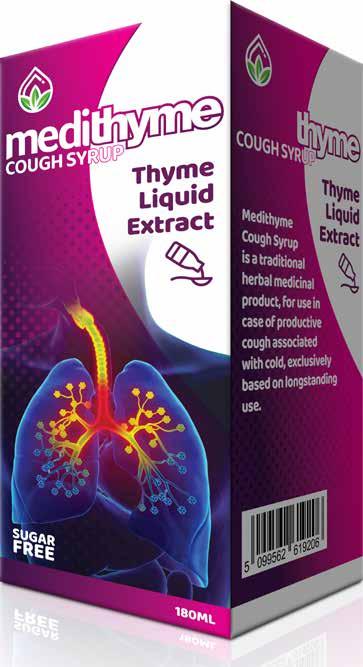
Clonmel Healthcare add Medithyme Cough Syrup to their portfolio of products for Cough and Cold
Clonmel Healthcare is delighted to announce the launch of Medithyme Cough Syrup; a traditional herbal medicinal product containing thyme liquid extract, which can be used as an aid to facilitate coughing up phlegm (expectorant) in productive cough* associated with cold. Medithyme is a traditional herbal medicinal product. Medithyme is: Sugar free Suitable for vegans Gluten free
The recommended dose is: Children from 12 years and adults: 15 ml, 4 times per day. Shelf life of 5 years; Use within 6 months of opening. Available in 180ml bottle. A copy of the summary of product characteristics is available upon request. Please contact Clonmel Healthcare on 01-6204000 if you require any additional information.
*Medithyme Cough Syrup is a traditional herbal medicinal product, for use in case of productive cough associated with cold, exclusively based on longstanding use. For supply through general sale. TR 126/319/001. TR Holder: Clonmel Healthcare Ltd., Clonmel, Co. Tipperary. Date prepared: August 2021. 2021/ADV/MED/083H.
NOW YOU CAN Give them more
TALZENNA is a proven alternative to chemotherapy* that provides patients with greater effi cacy in a convenient, once-daily oral dose1
LONGER MEDIAN PROGRESSION-FREE SURVIVAL (PFS)
TALZENNA signifi cantly prolonged median PFS vs chemotherapy: 8.6 months vs 5.6 months (HR=0.54 [95% CI: 0.41-0.71]; P<0.0001)1
DOUBLED OBJECTIVE RESPONSE RATE (ORR)
ORR for TALZENNA was 62.6% (95% CI: 55.8-69.0) vs 27.2% (95% CI: 19.3-36.3) with chemotherapy (OR=4.99 [95% CI: 2.93-8.83]; P<0.0001)1†‡
CONVENIENT DOSING
TALZENNA provides convenient, once-daily oral dosing, with or without food1
Indication: TALZENNA is indicated as monotherapy for the treatment of adult patients with germline BRCA1/2-mutations, who have HER2-negative locally advanced or metastatic breast cancer. Patients should have been previously treated with an anthracycline and/or taxane in the (neo)adjuvant, locally advanced or metastatic setting unless patients were not suitable for these treatments (see section 5.1 of full SmPC). Patients with hormone receptor (HR)positive breast cancer should have been treated with a prior endocrine-based therapy, or be considered unsuitable for endocrine-based therapy.
CI=confi dence interval; gBRCA=germline breast cancer susceptibility gene; HER2-=human epidermal growth factor receptor 2 negative; HR=hazard ratio; HR+=hormone receptor-positive; OR=odds ratio; RECIST=Response Evaluation Criteria in Solid Tumors. * Capecitabine, eribulin, gemcitabine, or vinorelbine. † Conducted in the intent-to-treat population with measurable disease at baseline.
Per RECIST v1.1, confi rmation of response was not required.1 ‡ ORR is the proportion of patients who have a partial or complete response to treatment.
Reference: 1. TALZENNA Summary of Product Characteristics.
PRESCRIBING INFORMATION
▼This medicinal product is subject to additional monitoring. This will allow quick identification of new safety information. Healthcare professionals are asked to report any suspected adverse reactions. Refer to section 4.8 of the SPC for how to report adverse reactions. Talzenna®▼0.25 mg and 1 mg hard capsules IE Prescribing Information: Before prescribing Talzenna (talazoparib) please refer to the full Summary of Product Characteristics (SmPC). Presentation: Each 0.25 mg hard capsule contains talazoparib tosylate equivalent to 0.25 mg talazoparib. Each 1 mg hard capsule contains talazoparib tosylate equivalent to 1 mg talazoparib. Indications: Talzenna is indicated as monotherapy for the treatment of adult patients with germline BRCA1/2-mutations, who have HER2-negative locally advanced or metastatic breast cancer. Patients should have been previously treated with an anthracycline and/or a taxane in the (neo)adjuvant, locally advanced or metastatic setting unless patients were not suitable for these treatments. Patients with hormone receptor (HR)-positive breast cancer should have been treated with a prior endocrine-based therapy, or be considered unsuitable for endocrine-based therapy. Dosage and Administration: Treatment should be initiated and supervised by a physician experienced in the use of anticancer medicinal products. Patients should be selected for the treatment of breast cancer with Talzenna based on the presence of deleterious or suspected deleterious germline BRCA mutations determined by an experienced laboratory using a validated test method. Genetic counselling for patients with BRCA mutations should be performed according to local regulations, as applicable. The recommended dose is 1 mg talazoparib once daily. Patients should be treated until disease progression or unacceptable toxicity occurs. Complete blood count should be obtained prior to starting Talzenna therapy and monitored monthly and as clinically indicated. To manage adverse drug reactions, interruption of treatment or dose reduction based on severity and clinical presentation should be considered (see SmPC section 4.2). Special populations: Hepatic impairment: See SmPC section 4.2. No dose adjustment is required for patients with mild, moderate or severe hepatic impairment. Renal impairment: See SmPC section 4.2. No dose adjustment is required for patients with mild renal impairment. For patients with moderate renal impairment, the recommended starting dose of Talzenna is 0.75 mg once daily. For patients with severe renal impairment, the recommended starting dose of Talzenna is 0.5 mg once daily. Talzenna has not been studied in patients with CrCL < 15 mL/min or patients requiring haemodialysis. Elderly: No dose adjustment is necessary in elderly (≥ 65 years of age) patients. Paediatric population: The safety and efficacy of Talzenna in children and adolescents < 18 years of age have not been established. Method of administration: Talzenna is for oral use. To avoid contact with the capsule content, the capsules should be swallowed whole, and must not be opened or dissolved. They can be taken with or without food (See SmPC section 5.2). Contraindications: Hypersensitivity to the active substance or to any of the excipients. Breast-feeding. Special Warnings and Precautions: Myelosuppression: Myelosuppression consisting of anaemia, leucopenia/ neutropenia, and/or thrombocytopenia, have been reported in patients treated with talazoparib (see section 4.8). Talazoparib should not be started until patients have recovered from haematological toxicity caused by previous therapy (≤ Grade 1). Precautions should be taken to routinely monitor haematology parameters and signs and symptoms associated with anaemia, leucopenia/neutropenia, and/or thrombocytopenia in patients receiving talazoparib. If such events occur, dose modifications (reduction or interruption) are recommended. Supportive care with or without blood and/or platelet transfusions and/or administration of colony stimulating factors may be used as appropriate. Myelodysplastic syndrome/Acute myeloid leukaemia: Myelodysplastic syndrome/Acute Myeloid Leukaemia (MDS/AML) have been reported in patients who received poly (adenosine diphosphate-ribose) polymerase (PARP) inhibitors, including talazoparib. Overall, MDS/AML has been reported in 2 out of 584 (0.3%) solid tumour patients treated with talazoparib in clinical studies. Potential contributing factors for the development of MDS/AML include previous platinum-containing chemotherapy, other DNA damaging agents or radiotherapy. Complete blood counts should be obtained at baseline and monitored monthly for signs of haematologic toxicity during treatment. If MDS/AML is confirmed, talazoparib should be discontinued. Contraception in women of childbearing potential: Talazoparib was clastogenic in an in vitro chromosomal aberration assay in human peripheral blood lymphocytes and in an in vivo bone marrow micronucleus assay in rats but not mutagenic in Ames assay (see section 5.3), and may cause foetal harm when administered to a pregnant woman. Pregnant women should be advised of the potential risk to the foetus (see section 4.6). Women of childbearing potential should not become pregnant while receiving Talzenna and should not be pregnant at the beginning of treatment. A pregnancy test should be performed on all women of childbearing potential prior to treatment. A highly effective method of contraception is required for female patients during treatment with Talzenna, and for at least 7 months after completing therapy. Since the use of hormonal contraception is not recommended in patients with breast cancer, two non-hormonal and complementary contraception methods should be used. Male patients with female partners of reproductive potential or pregnant partners should be advised to use effective contraception (even after vasectomy), during treatment with Talzenna and for at least 4 months after the final dose. Interactions: Talazoparib is a substrate for drug transporters P-gp and Breast Cancer Resistance Protein (BCRP) and it is mainly eliminated by renal clearance as unchanged compound. Concomitant treatment with inhibitors of P-glycoprotein (P-gp): Strong inhibitors of P-gp may lead to increased talazoparib exposure. Concomitant use of strong P-gp inhibitors (including but not limited to amiodarone, carvedilol, clarithromycin, cobicistat, darunavir, dronedarone, erythromycin, indinavir, itraconazole, ketoconazole, lapatinib, lopinavir, propafenone, quinidine, ranolazine, ritonavir, saquinavir, telaprevir, tipranavir, and verapamil) during treatment with talazoparib should be avoided. Co-administration should only be considered after careful evaluation of the potential benefits and risks. If co-administration with a strong P-gp inhibitor is unavoidable, the Talzenna dose should be reduced to 0.75 mg once daily. When the strong P-gp inhibitor is discontinued, the Talzenna dose should be increased (after 3-5 half-lives of the P-gp inhibitor) to the dose used prior to the initiation of the strong P-gp inhibitor. No talazoparib dose adjustments are required when co administered with rifampin. However, the effect of other P-gp inducers on talazoparib exposure has not been studied. Other P-gp inducers (including but not limited to carbamazepine, phenytoin, and St. John’s wort) may decrease talazoparib exposure. BCRP inhibitors: The effect of BCRP inhibitors on PK of talazoparib has not been studied in vivo. Co-administration of talazoparib with BCRP inhibitors may increase talazoparib exposure. Concomitant use of strong BCRP inhibitors (including but not limited to curcumin and cyclosporine) should be avoided. If co administration of strong BCRP inhibitors cannot be avoided, patient should be monitored for potential increased adverse reactions. Effect of acid-reducing agents: Population PK analysis indicates that co-administration of acid-reducing agents including proton pump inhibitors and histamine receptor 2 antagonists (H2RA), or other acid reducing agents had no significant impact on the absorption of talazoparib. Systemic hormonal contraception: Drug-drug interaction studies between talazoparib and oral contraceptives have not been conducted. Fertility, pregnancy and lactation: Fertility: There is no information on fertility in patients. Based on non-clinical findings in testes (partially reversible) and ovary (reversible), Talzenna may impair fertility in males of reproductive potential. Women of childbearing potential should not become pregnant while receiving Talzenna and should not be pregnant at the beginning of treatment. A pregnancy test should be performed on all women of childbearing potential prior to treatment. Women of childbearing potential must use highly effective forms of contraception prior to starting treatment with talazoparib, during treatment, and for 7 months after stopping treatment with talazoparib. Since the use of hormonal contraception is not recommended in patients with breast cancer, two non-hormonal and complementary contraception methods should be used. Male patients with female partners of reproductive potential or pregnant partners should be advised to use effective contraception (even after vasectomy) during treatment with Talzenna, and for at least 4 months after the final. Pregnancy: There are no data from the use of Talzenna in pregnant women. Studies in animals have shown embryo foetal toxicity. Talzenna may cause foetal harm when administered to a pregnant woman. Talzenna is not recommended during pregnancy or for women of childbearing potential not using contraception. Breast-feeding: It is unknown whether talazoparib is excreted in human breast milk. A risk to breast-fed children cannot be excluded and therefore breast-feeding is not recommended during treatment with Talzenna and for at least 1 month after the final dose. Undesirable Effects: The overall safety profile of Talzenna is based on pooled data from 494 patients who received talazoparib at 1 mg daily in clinical studies for solid tumours, including 286 patients from a randomised Phase 3 study with germline BRCA-mutated (gBRCAm), HER2-negative locally advanced or metastatic breast cancer and 83 patients from a nonrandomised Phase 2 study in patients with germline BRCA-mutated locally advanced or metastatic breast cancer. The most common (≥ 25%) adverse reactions in patients receiving talazoparib in these clinical studies were fatigue (57.1%), anaemia (49.6%), nausea (44.3%), neutropenia (30.2%), thrombocytopenia (29.6%), and headache (26.5%). The most common (≥ 10%) Grade ≥ 3 adverse reactions of talazoparib were anaemia (35.2%), neutropenia (17.4%), and thrombocytopenia (16.8%). Dose modifications (dose reductions or dose interruptions) due to any adverse reaction occurred in 62.3% of patients receiving Talzenna. The most common adverse reactions leading to dose modifications were anaemia (33.0%), neutropenia (15.8%), and thrombocytopenia (13.4%). Permanent discontinuation due to an adverse reaction occurred in 3.6% of patients receiving Talzenna. The median duration of exposure was 5.4 months (range 0.03-61.1). Very common adverse reactions (>1/10) are Thrombocytopenia, Anaemia, Neutropenia, Leucopenia, Decreased appetite, Dizziness, Headache, Vomiting, Diarrhoea, Nausea, Abdominal pain, Alopecia and Fatigue. Commonly reported adverse reactions (>1/100 to <1/10), are Lymphopenia, Dysgeusia, Stomatitis and Dyspepsia. Refer to SmPC section 4.8 for further information on side effects. Legal Category: Product subject to prescription which may not be renewed (A): S1A. Marketing Authorisation Number: Talzenna 0.25 mg hard capsules – EU/1/19/1377/001-004; Talzenna 1 mg hard capsules – EU/1/19/1377/005-006. Marketing Authorisation Holder: Pfizer Europe MA EEIG, Boulevard de la Plaine 17, 1050 Bruxelles, Belgium. For further information on this medicine please contact: Pfizer Medical Information on 1800 633 363 or at medical.information@pfizer.com. For queries regarding product availability please contact: Pfizer Healthcare Ireland, Pfizer Building 9, Riverwalk, National Digital Park, Citywest Business Campus, Dublin 24 + 353 1 4676500. Date of Preparation: 05/2021 Ref: TE 2_0
