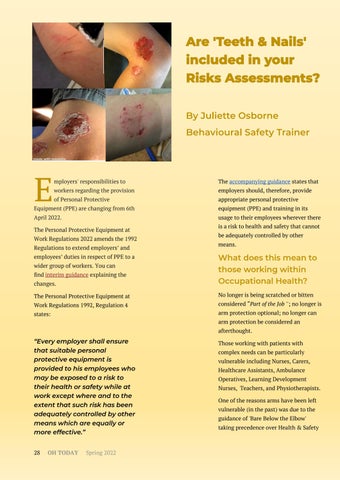
Are 'Teeth & Nails' included in your Risks Assessments? By Juliette Osborne Behavioural Safety Trainer
E
mployers' responsibilities to
The accompanying guidance states that
workers regarding the provision
employers should, therefore, provide
of Personal Protective
appropriate personal protective
Equipment (PPE) are changing from 6th
equipment (PPE) and training in its
April 2022.
usage to their employees wherever there
The Personal Protective Equipment at Work Regulations 2022 amends the 1992 Regulations to extend employers’ and
is a risk to health and safety that cannot be adequately controlled by other
means.
changes.
What does this mean to those working within Occupational Health?
The Personal Protective Equipment at
No longer is being scratched or bitten
Work Regulations 1992, Regulation 4
considered “Part of the Job ''; no longer is
states:
arm protection optional; no longer can
employees’ duties in respect of PPE to a wider group of workers. You can find interim guidance explaining the
arm protection be considered an afterthought.
“Every employer shall ensure that suitable personal protective equipment is provided to his employees who may be exposed to a risk to their health or safety while at work except where and to the extent that such risk has been adequately controlled by other means which are equally or more effective.” 28
OH TODAY
Spring 2022
Those working with patients with complex needs can be particularly vulnerable including Nurses, Carers, Healthcare Assistants, Ambulance Operatives, Learning Development Nurses, Teachers, and Physiotherapists. One of the reasons arms have been left vulnerable (in the past) was due to the guidance of 'Bare Below the Elbow' taking precedence over Health & Safety