WHAT’S UP WITH SWISS PRIVATE BANKS?
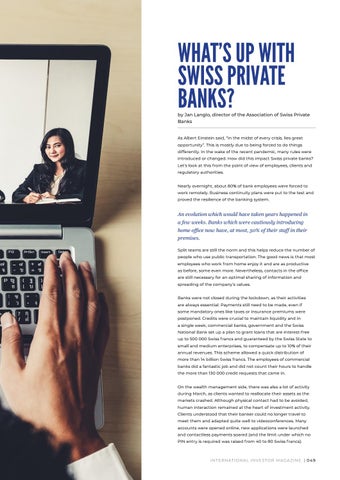
by Jan Langlo, director of the Association of Swiss Private Banks As Albert Einstein said, “in the midst of every crisis, lies great opportunity”. This is mostly due to being forced to do things differently. In the wake of the recent pandemic, many rules were introduced or changed. How did this impact Swiss private banks? Let’s look at this from the point of view of employees, clients and regulatory authorities. Nearly overnight, about 80% of bank employees were forced to work remotely. Business continuity plans were put to the test and proved the resilience of the banking system.
An evolution which would have taken years happened in a few weeks. Banks which were cautiously introducing home office now have, at most, 50% of their staff in their premises. Split teams are still the norm and this helps reduce the number of people who use public transportation. The good news is that most employees who work from home enjoy it and are as productive as before, some even more. Nevertheless, contacts in the office are still necessary for an optimal sharing of information and spreading of the company’s values. Banks were not closed during the lockdown, as their activities are always essential. Payments still need to be made, even if some mandatory ones like taxes or insurance premiums were postponed. Credits were crucial to maintain liquidity and in a single week, commercial banks, government and the Swiss National Bank set up a plan to grant loans that are interest-free up to 500 000 Swiss francs and guaranteed by the Swiss State to small and medium enterprises, to compensate up to 10% of their annual revenues. This scheme allowed a quick distribution of more than 14 billion Swiss francs. The employees of commercial banks did a fantastic job and did not count their hours to handle the more than 130 000 credit requests that came in. On the wealth management side, there was also a lot of activity during March, as clients wanted to reallocate their assets as the markets crashed. Although physical contact had to be avoided, human interaction remained at the heart of investment activity. Clients understood that their banker could no longer travel to meet them and adapted quite well to videoconferences. Many accounts were opened online, new applications were launched and contactless payments soared (and the limit under which no PIN entry is required was raised from 40 to 80 Swiss francs).
I N T ER N AT I ON AL I NVESTOR MAGAZ INE | 0 49