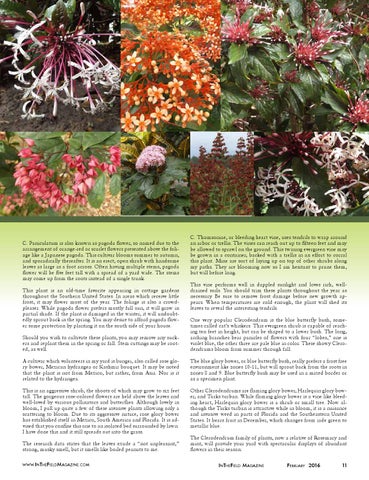
C. Paniculatum is also known as pagoda flower, so named due to the arrangement of orange-red or scarlet flowers presented above the foliage like a Japanese pagoda. This cultivar blooms summer to autumn, and sporadically thereafter. It is an erect, open shrub with handsome leaves as large as a foot across. Often having multiple stems, pagoda flower will be five feet tall with a spread of a yard wide. The stems may come up from the roots instead of a single trunk. This plant is an old-time favorite appearing in cottage gardens throughout the Southern United States. In areas which receive little frost, it may flower most of the year. The foliage is also a crowdpleaser. While pagoda flower prefers mostly full sun, it will grow in partial shade. If the plant is damaged in the winter, it will undoubtedly sprout back in the spring. You may desire to afford pagoda flower some protection by planting it on the south side of your house.
C. Thomsoniae, or bleeding heart vine, uses tendrils to wrap around an arbor or trellis. The vines can reach out up to fifteen feet and may be allowed to sprawl on the ground. This twining evergreen vine may be grown in a container, backed with a trellis in an effort to corral this plant. Mine are sort of laying up on top of other shrubs along my paths. They are blooming now so I am hesitant to prune them, but will before long. This vine performs well in dappled sunlight and loves rich, welldrained soils. You should trim these plants throughout the year as necessary. Be sure to remove frost damage before new growth appears. When temperatures are cold enough, the plant will shed its leaves to reveal the interesting tendrils.
Should you wish to cultivate these plants, you may remove any suckers and replant them in the spring or fall. Stem cuttings may be rooted, as well.
One very popular Clerodendrum is the blue butterfly bush, sometimes called cat’s whiskers. This evergreen shrub is capable of reaching ten feet in height, but can be shaped to a lower bush. The long, arching branches bear panicles of flowers with four “lobes,” one is violet blue, the other three are pale blue in color. These showy Clerodendrums bloom from summer through fall.
A cultivar which volunteers in my yard is bungei, also called rose glory bower, Mexican hydrangea or Kashmir bouquet. It may be noted that the plant is not from Mexico, but rather, from Asia. Nor is it related to the hydrangea.
The blue glory bower, or blue butterfly bush, really prefers a frost free environment like zones 10-11, but will sprout back from the roots in zones 8 and 9. Blue butterfly bush may be used in a mixed border or as a specimen plant.
This is an aggressive shrub, the shoots of which may grow to six feet tall. The gorgeous rose-colored flowers are held above the leaves and well-loved by various pollinators and butterflies. Although lovely in bloom, I pull up quite a few of these invasive plants allowing only a scattering to bloom. Due to its aggressive nature, rose glory bower has established itself in Mexico, South America and Florida. It is advised that you confine this one to an isolated bed surrounded by lawn. I have done this and it still spreads out into the grass.
Other Clerodendrums are flaming glory bower, Harlequin glory bower, and Turks turban. While flaming glory bower is a vine like bleeding heart, Harlequin glory bower is a shrub or small tree. Now although the Turks turban is attractive while in bloom, it is a nuisance and invasive weed in parts of Florida and the Southeastern United States. It bears fruit in December, which changes from jade green to metallic blue.
The research data states that the leaves exude a “not unpleasant,” strong, musky smell, but it smells like boiled peanuts to me. WWW.INTHEFIELDMAGAZINE.COM
The Clerodendrum family of plants, now a relative of Rosemary and mint, will provide your yard with spectacular displays of abundant flowers in their season. INTHEFIELD MAGAZINE
February 2016
11