Naturally Amazing Activities OVERWINTERING INSECTS By Sean Green
Our tropical climate in Florida provides a terrific home for overwintering insects. Some insects even migrate here from other states to overwinter. Insects can overwinter in any of several life stages (eggs, pupae, adult). Finding overwintering insects can be like a treasure hunt if you don’t recognize the species. This month’s activity is the exploration and observation of overwintering insects. Watching immature insects develop into an adult can be especially fascinating. Some insects are active while others remain inactive during hibernation periods. You will be surprised with the variety of insects that can be found in the wintertime in Florida, and for some of us, it can be more exciting than the theme parks that attract winter visitors.
Materials: •
Appropriate Clothing
• Habitat Container (Jar, plastic critter box, Tupperware) • Container Top (old nylon stockings, plastic lid with air holes) •
Substrate (soil, moss, sand)
•
Rubber Bands
•
Knife / Pruning Shears
Where to find winter insects: Acorns provide both shelter and nutrition for some insects. Gather acorns from under the oak trees and place them in a container of water. Acorns that float are likely to have insects inside. You may find an Acorn Weevil or an Acorn Moth or one of a number of ants or fly species. Galls are warty growth structures (usually round) you see on trees and shrubs and range in size from that of a pea to as large as a basketball depending on the species that created it. They are often created by
54 INTHEFIELD MAGAZINE
February 2011
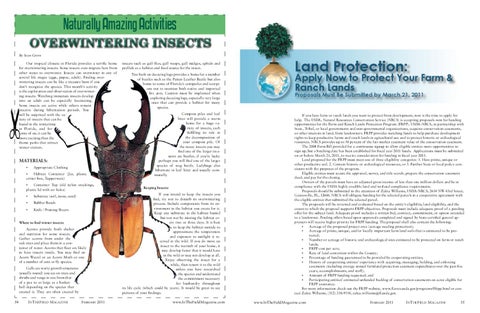
insects such as gall flies, gall wasps, gall midges, aphids and psyllids as a habitat and food source for the insect. Tree bark on decaying logs provides a home for a number of beetles such as the Patten Leather Beetle but also home to some of Florida’s centipedes and scorpions not to mention both native and imported fire ants. Caution must be implanted when exploring decaying logs, especially very large ones that can provide a habitat for many species. Compost piles and leaf litter will provide a warm home for a huge variety of insects, each fulfilling its role in the decomposition of your compost pile. Of the many insects you may find one of the larger treasures are beetles, if you’re lucky perhaps you will find one of the larger species of stag beetle. Ladybugs also hibernate in leaf litter and usually communally. Keeping Insects: If you intend to keep the insects you find, try not to disturb its overwintering process. Include components from its environment in the habitat you create for it. Keep any substrate in the habitat humid but not wet by misting the habitat every two or three days. It is best to keep the habitat outside to approximate the temperature and exposure to sunlight it received in the wild. If you do move an insect to the warmth of your home, it may develop faster that it would have in the wild or may not develop at all. Enjoy observing the insect for a while, then return it to the wild unless you have researched the species and understand the commitment necessary for husbandry throughout its life cycle (which could be years). It would be great to see pictures of your findings.
www.InTheFieldMagazine.com
Land Protection:
Apply Now to Protect Your Farm & Ranch Lands Proposals Must Be Submitted by March 21, 2011
If you have farm or ranch lands you want to protect from development, now is the time to apply for help. The USDA, Natural Resources Conservation Service (NRCS) is accepting proposals now for funding opportunities for the Farm and Ranch Lands Protection Program (FRPP). USDA-NRCS, in partnership with State, Tribal, or local governments and non-governmental organizations, acquires conservation easements, or other interests in land, from landowners. FRPP provides matching funds to help purchase development rights to keep productive farms and ranch lands in agricultural use and to protect historic or archeological resources. NRCS provides up to 50 percent of the fair market easement value of the conservation easement. The 2008 Farm Bill provided for a continuous signup to allow eligible entities more opportunities to sign up, but a batching date has been established for fiscal year 2011 funds. Applications must be submitted on or before March 21, 2011, to receive consideration for funding in fiscal year 2011. Land proposed for the FRPP must meet one of three eligibility categories: 1. Have prime, unique or other productive soil. 2. Contain historic or archeological resources, or 3. Further State or local policy consistent with the purposes of the program. Eligible entities must secure the appraisal, survey, and title search, prepare the conservation easement deed, and pay for the closing. Owners of the parcels must have an adjusted gross income of less than one million dollars and be in compliance with the USDA highly erodible land and wetland compliance requirements. Proposals should be submitted to the attention of Zakia Williams, USDA-NRCS, 2614 NW 43rd Street, Gainesville, FL, 32606. NRCS will obligate funding for the selected parcels in a cooperative agreement with the eligible entities that submitted the selected parcel. The proposals will be reviewed and evaluated based on the entity’s eligibility, land eligibility, and the extent to which the proposal supports FRPP objectives. Proposals must include adequate proof of a pending offer for the subject land. Adequate proof includes a written bid, contract, commitment, or option extended to a landowner. Pending offers based upon appraisals completed and signed by State-certified general appraisers will receive higher priority for FRPP funding. The proposal shall also contain the following: • Acreage of the proposed project area (acreage needing protection); • Acreage of prime, unique, and/or locally important farm land soils that is estimated to be protected; • Number or acreage of historic and archaeological sites estimated to be protected on farm or ranch lands; • FRPP cost per acre; • Rate of land conversion within the County; • Percentage of funding guaranteed to be provided by cooperating entities; • History of cooperating entities’ experience with acquiring, managing, holding, and enforcing easements (including average annual farmland protection easement expenditures over the past five years, accomplishments, and staff); • Amount of FRPP funding requested; and • Participating entities’ estimated unfunded backlog of conservation easements on acres eligible for FRPP assistance. For more information check out the FRPP website, www.fl.nrcs.usda.gov/programs/flfrpp.html or contact Zakia Williams, (352) 338-9554, zakia.williams@fl.usda.gov.
www.InTheFieldMagazine.com
February 2011
INTHEFIELD MAGAZINE 55