VOLUME 10 | ISSUE 2 | DECEMBER 2014
Thematic issue on WATER RESEARCH IN THE MEDITERRANEAN Damià Barceló (editor)
Volume 10 | Issue 2 | December 2014
OPEN ACCESS JOURNAL
A2
Self-portrait, 1908
©Francisco Urrutia
www.cat-science.cat http://revistes.iec.cat/contributions/
FRONT COVER
BACK COVER
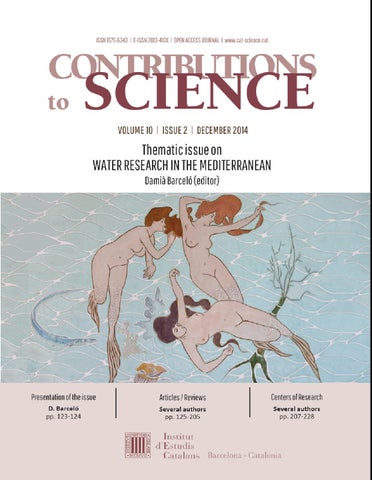
The Garden of the Mermaids. Ramon Casas painted in 1904 the walls of the Fonda España dining room with a recreation of the sea bottom, where imagination and reality combine in exquisite harmony. He “planted” a garden to house his Sirens, adding fish, cephalopods, and crustaceans with a background of light colors and waves in movement. At the top, a frieze with waves reminds us of the Great Wave by Katsushika Hokusai. The Fonda España (now Hotel España) was a refurbished hotel next to La Rambla, in Barcelona. Casas was trying to “steal” from the sea a handful of mermaids (or sirens) for whom he had to invent a garden. He overcame the challenge with love and care, so the mermaids would not be homesick. The young, gracile half-women creatures, and with finned human legs instead of the usual fish tails, were to be accompanied by other marine beings in their natural environment, the Mediterranean Sea, the Mare Nostrum (“our sea”) of the Romans. Thus, he let his imagination fly, and sgraffitoed this garden that he created for his lovely inventions. This issue of Contributions to Science, coordinated by Prof. Damià Barceló, is devoted enterely to the water management in the Mediterranean Sea. The journal considers it is appropriated for this topic to be accompanied by Ramon Casas’ beautiful marine creatures. The whole series of pictures in this issue were especially made for the journal by excellent photographer Francisco Urrutia.
Ramon Casas i Carbó has been qualified as the painter of Catalan Modernism. He is a universal Catalan due to his work, recognised and admired everywhere. Born and died in Barcelona, Casas was a multifaceted artist: painter, poster-painter, draughtsman, portraitist, graphic designer, and caricaturist. In all these areas he acquired fame, prestige, and recognition during his lifetime, something not many artists achieve. The concept of Catalan Modernism is evident in his posters and postcards. In the dining room of the Hotel España, where The Garden of the Mermaids is found, we can contemplate an impressive mural, under a coffered skylight which breaks down the natural light into coloured rays. Contributions to Science, issue by issue, offers in its back cover a small homage to people of the Catalan Countries who dedicated their inventiveness, wisdom and time to their passion, and who are universally known. We have published already a short biography of Rafael Guastavino Moreno (Valencia; 1842–1908), Ramon Casanova Danés (Campdevànol, Catalonia; 1892–1968), and Margalida Comas Camps (Alaior, Minorca; 1892–1972). In this issue we bring Ramon Casas (Barcelona; 1866–1932; see pp. 229-234). Casas was a multifaceted artist of Modernism, who designed those wonderful creatures from the sea that Catalans love the most: the Mediterranean (for the Romans, and for us, Mare Nostrum, "our see").
Volume 10 | Issue 2 | December 2014
Editorial Board
EDITOR-IN-CHIEF Ricard Guerrero
Biological Sciences Section, IEC
ASSOCIATE EDITOR Salvador Alegret
ASSOCIATE EDITOR Ramon Gomis
Science and Technology Section, IEC
Biological Sciences Section, IEC
EDITORIAL BOARD The Science and Technology and Biological Sciences Sections:
Joaquim Agulló, Technical University of Catalonia • Josep Amat, Technical University of Catalonia • Francesc Asensi, University of Valencia • Damià Barceló, Spanish National Research Council (Barcelona) • Carles Bas, Institute of Marine Sciences-CSIC (Barcelona) • Pilar Bayer, University of Barcelona • Xavier Bellés, Spanish National Research Council (Barcelona) • Jaume Bertranpetit, Pompeu Fabra University (Barcelona) • Eduard Bonet, ESADE (Barcelona) • Joaquim Casal, Technical University of Catalonia • Alícia Casals, Technical University of Catalonia • Josep Castells, University of Barcelona • Jacint Corbella, University of Barcelona • Jordi Corominas, Technical University of Catalonia • Michel Delseny, University of Perpinyà • Josep M. Domènech, Autonomous University of Barcelona • Mercè Durfort, University of Barcelona • Marta Estrada, Institute of Marine Sciences-CSIC (Barcelona) • Gabriel Ferraté, Technical University of Catalonia • Ramon Folch, Institute for Catalan Studies • Màrius Foz, Autonomous University of Barcelona • Jesús A. Garcia-Sevilla, University of the Balearic Islands • Lluís Garcia-Sevilla, Autonomous University of Barcelona • Joan Genescà, National Autonomous University of Mexico • Evarist Giné, University of Connecticut (USA) • Joan Girbau, Autonomous University of Barcelona • Pilar González-Duarte, Autonomous University of Barcelona • Francesc González-Sastre, Autonomous University of Barcelona • Joaquim Gosálbez, University of Barcelona • Albert Gras, University of Alacant • Gonzalo Halffter, National Polytechnic Institute (Mexico) • Lluís Jofre, Technical University of Catalonia • Joan Jofre, University of Barcelona • David Jou, Autonomous University of Barcelona • Ramon Lapiedra, University of Valencia • Àngel Llàcer, Hospital Clinic of Valencia • Josep Enric Llebot, Autonomous University of Barcelona • Jordi Lleonart, Spanish National Research Council (Barcelona) • Xavier Llimona, University of Barcelona • Antoni Lloret, Institute for Catalan Studies • Abel Mariné, University of Barcelona • Joan Massagué, Memorial Sloan-Kettering Cancer Center, New York (USA) • Federico Mayor-Zaragoza, Foundation for a Culture of Peace (Madrid) • Adélio Machado, University of Porto (Portugal) • Gabriel Navarro, University of Valencia • Jaume Pagès, Technical University of Catalonia • Ramon Parés, University of Barcelona • Àngel Pellicer, New York University (USA) • Juli Peretó, University of Valencia • F.Xavier Pi-Sunyer, Harvard University (USA) • Norberto Piccinini, Politecnico di Torino (Italy) • Jaume Porta, University of Lleida • Pere Puigdomènech, Spanish National Research Council (Barcelona) • Jorge-Óscar Rabassa, National University of La Plata (Argentina) • Pere Roca, University of Barcelona • Joan Rodés, University of Barcelona • Joandomènec Ros, University of Barcelona • Xavier Roselló, Technical University of Catalonia • Claude Roux, University of AixMarseille III (France) • Pere Santanach, University of Barcelona • Francesc Serra, Autonomous University of Barcelona • David Serrat, University of Barcelona • Boris P. Sobolev, Russian Academy of Sciences, Moscow, Russia • Carles Solà, Autonomous University of Barcelona • Joan Antoni Solans, Technical University of Catalonia • Rolf Tarrach, University of Luxembourg • Jaume Terradas, Autonomous University of Barcelona • Antoni Torre, Obra Cultural de l’Alguer • Josep Vaquer, University of Barcelona • Josep Vigo, University of Barcelona • Miquel Vilardell, Autonomous University of Barcelona • Jordi Vives, Hospital Clinic of Barcelona
Volume 10 | Issue 2 | December 2014
©Francisco Urrutia
Contents
PRESENTATION OF THE ISSUE Barceló D
123
Risk-based management of Mediterranean water resources under multiple stressors
ARTICLES Kuzmanovic M, Ginebreda A, Barceló D
125
Risk assessment and prioritization of pollutants in continental Mediterranean waters based on hazard quotients
Petrovic M, Verlicchi P
135
Water treatment plants and pharmaceutical residues in Catalonia and Italy
Masiá A, Picó Y, Calliera M, Capri E, Lamastra L, Ferrari F
151
Integrated forecasting models of pesticide concentrations and environmental monitoring campaigns
RESEARCH REVIEWS Sabater S, Muñoz I, García-Berthou E, Barceló D
161
Multiple stressors in Mediterranean freshwater ecosystems: The Llobregat River as a paradigm
Mas-Pla J, Ghiglieri G, Uras G
171
Seawater intrusion and coastal groundwater resources management. Examples from two Mediterranean regions: Catalonia and Sardinia
Farré M, Thomaidis NS
185
Perfluoroalkyl substances in Mediterranean aquatic environments: Catalonia and Greece
Navarro-Ortega A, Sabater S, Barceló D
193
Scarcity and multiple stressors in the Mediterranean water resources: The SCARCE and GLOBAQUA research projects
FORUM AND FOCUS Sabater S, Acuña V, Batalla RJ, Balcázar JL, Borrego C, et al.
207
Water research in the Mediterranean: challenges and perspectives. The Catalan Institute for Water Research (ICRA)
Christodoulou S, Michael C, Kostarelos K, Kassinos S, Dionysiou D, Fatta-Kassinos D
221
Nireas, International Water Research Center (Nireas-IWRC) of the University of Cyprus
Chica C
229
HISTORICAL CORNER
©Francisco Urrutia
Ramon Casas (1866–1932), portrait of a time
PRESENTATION OF THE ISSUE Institut d’Estudis Catalans, Barcelona, Catalonia
OPENAACCESS
www.cat-science.cat
CONTRIB SCI 10:123-124 (2014) doi:10.2436/20.7010.01.196
Risk-based management of Mediterranean water resources under multiple stressors Damià Barceló Water and Soil Quality Research Group, Department of Environmental Chemistry, IDAEA, CSIC, Barcelona, Spain. And Catalan Institute for Water Research (ICRA), Girona, Catalonia
Correspondence: Damià Barceló Water and Soil Quality Research Group Department of Environmental Chemistry IDAEA, CSIC Jordi Girona, 18-26 08034 Barcelona, Catalonia
©Francisco Urrutia
Damia.Barcelo@idaea.csic.es
Water has become a precious resource on which the well-being and survival of future generations critically depends. Around the world, there are many warnings that human water use exceeds supportable levels. Groundwater depletion, low or non-existing river flows, and worsening contamination are among the more palpable indicators. Consequently, issues relating to water, such as quality, quantity, availability, planning and management, must be confronted, now and in the future. Most freshwater systems in Europe are threatened by a variety of stressors, including organic and inorganic pollution, geomorphological alterations, changes in land use, climate variability and change, water abstraction, invasive species, and presence of pathogens. Despite their diverse nature, all of these stressors adversely impact organisms and ecosystems, and ultimately threaten the quality and biological diversity of European water bodies. In addition to the environmental consequences, there are important economic ones as well. Most ecosystems are exposed simultaneously to several stressors. In some cases, stressors act independently of each other whereas in others their interactions lead to synergistic/antagonistic effects, either directly (acting on the same target) or indirectly (acting on different targets). Although multiple-stress scenarios can have deleterious effects on freshwater ecosystems, most studies have examined only the effects of single stressors on the chemical and ecological status of water bodies and on ecosystem functioning. These studies include investigations of so-called emerging contaminants, which have been detected in most rivers and, with their negative effects on water quality, degrade both biodiversity and ecosystem services. Some stressors, such as water scarcity, can limit biodiversity and economic activities in entire regions. In addition to being a stressor on its own, water scarcity can drive the effects of other stressors acting upon river ecosystems. The intermittency in water flow has negative implications for hydrologic connectivity, biodiversity, water quality, and river ecosystem functioning. Water scarcity can amplify the effects of water pollution by reducing the natural diluting capacity of rivers. Interactions between stressors also may be exacerbated by climate change. For instance, warmer temperatures and reduced
Keywords: risk-based management · water resources · stressors in freshwater · Mediterranean river basins · freshwater ISSN (print): 1575-6343 e-ISSN: 2013-410X
CONTRIBUTIONS to SCIENCE 10:123-124 (2014)
Water resources in the Mediterranean
river flows will likely increase the physiological burden of pollution on the aquatic biota, and biological feedback between stressors (e.g., climate change and nutrient pollution) may produce unexpected outcomes. The degradation of drainage basins, the destruction of natural habitats, the over-exploitation of fish populations and other natural resources, and the establishment of invasive species may give rise to synergistic effects, especially during periods of water shortage. The effects of these stressors are very relevant for the chemical and ecological status of water bodies, as well as for the sustainability of the ecosystem services they provide. Water scarcity is a key stressor in the Mediterranean basin, which is characterized by highly variable river flows and the periodic occurrence of low flows and even no-flows. Climate change will increase the frequency and magnitude of extreme events. Although extremes are part of the normal hydrologic behavior of Mediterranean rivers, in many of them there is already a consistent trend towards decreased discharge. In this special issue of Contributions to Science we have compiled nine different articles covering the most relevant issues concerning stressors in Mediterranean river basins. One of the articles refers to the Spanish-funded project SCARCE and to the EU-funded project GLOBAQUA, which addresses water scarcity in Europe. These two projects inspired the current issue. To solve problems related to water scarcity, they assess and predict the effects on water quantity and quality in European river basins under various global climate change scenarios. The continuous exchange of information between scientists and river basin authorities will allow the findings of the two projects to be put into practice. A second article focuses on the Llobregat River, as a clear example of a Mediterranean river suffering from multiple stressors, such as nutrient excess, organic pollution as well as
www.cat-science.cat
water scarcity. The Llobregat is under constant stress due to a low a mean water flow of 14 m3/s and the relatively large population of 3 million people living in the vicinity of its highly industrialized basin. Four different articles cover the issue of emerging contaminants, including perflurorinated chemicals, pharmaceuticals, and pesticides, with respect to Mediterranean water resources. The joint contributions of authors from Catalonia and Greece, and Catalonia, Valencia, and Italy provide a Mediterranean assessment of the risk to river waters posed by emerging contaminants. In another article, the prioritization of organic pollutants in Mediterranean waters is addressed. Finally, there are two articles from well-established water-research institutes in the Mediterranean region: the Catalan Institute for Water Research (ICRA), and the International Water Research Centre (Nireas-WRC); the latter being based in Cyprus. The mission of both institutes is to solve Mediterranean water problems, including water scarcity, water treatment and reuse, desalination, and impacts on a multistressed ecosystem. The information provided in the nine articles should be of interest to a broad readership, as a Mediterranean-like cli足 mate also prevails in much of California, in parts of Western and South Australia, in southwestern South Africa, in sections of Central Asia, and in parts of central coastal Chile. These geographic regions are similarly confronted with water scarcity and its associated risks. Last but not least, I would like to thank the authors for their contributions, which have made this special issue of Contributions to Science a very remarkable and fruitful compilation of the latest scientific knowledge on water re足 search in the Mediterranean. I would also like to express my gratitude to the Institute for Catalan Studies for funding this (special) thematic issue.
124
CONTRIBUTIONS to SCIENCE 10:123-124 (2014)
ARTICLE Institut d’Estudis Catalans, Barcelona, Catalonia
OPENAACCESS
CONTRIB SCI 10:125-134 (2014) doi:10.2436/20.7010.01.197
*Correspondence: Damià Barceló Water and Soil Quality Research Group Department of Environmental Chemistry IDAEA-CSIC Jordi Girona, 18-26 08034 Barcelona, Catalonia
www.cat-science.cat
Risk assessment and prioritization of pollutants in continental Mediterranean waters based on hazard quotients Maja Kuzmanovic,1 Antoni Ginebreda,1 Damià Barceló1,2* Water and Soil Quality Research Group, Department of Environmental Chemistry, IDAEA-CSIC, Barcelona, Catalonia. 2Catalan Institute for Water Research (ICRA), Girona, Catalonia 1
©Francisco Urrutia
E-mail: Damia.Barcelo@idaea.csic.es
Summary. The input of chemical pollutants into the aquatic environment is growing but their potential adverse effects on the ecosystem still remain largely unknown. Therefore the development of appropriate risk assessment procedures capable to provide a prioritization of potential pollutants becomes necessary. Here we identify priority compounds specific to Mediterranean rivers and compare them to those found in other rivers worldwide. To this purpose hazard quotients (HQ) defined as the ratio of measured environmental concentration (MEC) to predicted non effect concentration (PNEC) referred to different trophic levels were calculated for different compounds selected from different existing prioritization schemes, as well as 15 priority substances identified under the Water Framework Directive (WFD) and compared for cases of Mediterranean vs. North European and USA rivers. [Contrib Sci 10:125-134 (2014)]
Introduction Pollution is recognized nowadays as one of the major threats to aquatic systems [28]. Although most of these chemical compounds are present at low concentrations, many of them may raise serious toxicological concerns [26]. In the European Union (EU) there are more than 100,000 registered chemicals listed by EINECS (The European Inventory of Existing Commercial Chemical Substances) of which 30,000 to 70,000 may be considered of common industrial and/or domestic use. Depending on their physico-chemical properties,
amounts produced and mode of use many of these compounds may enter the natural waters through sewage water discharge, surface runoff from agricultural fields, atmosphere deposition, accidental spills, etc. On the other hand, many of these compounds are not properly eliminated by conventional wastewater treatment plants and are being continuously released as a part of the effluent. Given the huge number of chemicals potentially released into the environment and existing time and budget constrains there is a need to prioritize chemicals in order to optimize monitoring efforts, as well as to provide appropriate and scientifically sound
Keywords: pollutants · risk assessment · ecotoxicity · hazard index · prioritization of pollutants ISSN (print): 1575-6343 e-ISSN: 2013-410X
CONTRIBUTIONS to SCIENCE 10:125-134 (2014)
Prioritization of pollutants
information to both legislators and water managers. This is the purpose aimed by the environmental risk assessment process [27]. Considering current legislation, in the European Union, the big upturn in aquatic environment protection was made by the introduction of the Water Framework Directive (WFD) that was established in 2000 and aimed to achieve good ecological and good chemical status of European surface waters by the year of 2015. Using combined monitoring- and modeling-based priority setting scheme, WFD identifies a list of 33 priority substances that pose a significant risk to the EU aquatic environment [11] and 8 other hazardous substances from previous legislation. The lists of priority and hazardous substances include contaminants that have been long recognized as dangerous, especially for the human health and are regulated mainly on the basis of persistence, bioaccumulation and toxicity properties (PBT). In order to achieve good chemical status, water bodies of the EU member states must meet the environmental quality standards (EQS) [10] (i.e., to keep the levels of concentrations of these compounds below the EQS). Furthermore, it is expected to update and review the list of priority substances every 4 years. In this context, recently the European Commission has updated the list of priority substances by adding 15 new candidates. EU member states are obliged to identify pollutants of regional or local importance and provide EQS, monitoring schemes and regulatory measures for them. This means that member states need to decide which are the candidate substances for further investigation and which are the substances to be then declared as river basin specific pollutants [23]. Due to specific bio-geographical and socio-economic conditions of different areas, diverse sets of compounds can be used, resulting in entirely different pollution patterns. Due to specific climate, agriculture, industry and urbanization density of the Mediterranean region and the Iberian Peninsula as its representative, it is likely to expect distinct pollution of Mediterranean rivers compared to other geographical areas. Moreover, chemicals that are being monitored on a regular basis are only a small fraction of all the chemicals present in the environment [9]. Many unregulated, emerging contaminants are being discovered which may have a significant impact on aquatic ecosystems and require special attention. Examples of compounds that have emerged recently as particularly relevant are pharmaceuticals and personal care products, polar pesticides, natural toxins, biocides, perfluorinated compounds, and nanomaterials [22]. Albeit, they are usually present in very low concentrations from pg/l to ng/l because of the improvement of analytical techniques, numwww.cat-science.cat
ber and frequency of detections of emerging contaminants have increased [20]. Emerging environmental contaminants are not necessarily new chemicals, but the substances that have often been long time present in the environment and whose potentially adverse effects on human health and environment are only now being noted [23]. Thus, it becomes clear that it is necessary to evaluate the risk of emerging contaminants and if it is proven that some of them cause harmful effects to either, or both ecosystem and human health, to include them into the monitoring and regulation programs. Still, given the large number of chemical compounds released into the environment annually, it is not possible to conduct risk assessments for all emerging and existing chemicals. Moreover, not all the compounds that are present in the environment pose the significant risk to aquatic ecosystems or human health. This has led to the development of schemes for prioritizing compounds based on their potential risk in order to direct the monitoring efforts towards the important compounds only. The assessment of whether a particular compound is a pollutant is based upon an understanding of its exposure (i.e., its input, distribution and fate in a defined system) and of the effects that the compound has on organisms, including humans, due to its presence in the system [26]. A priority chemical is one that, because of its importance, however defined, should be examined with greater urgency and in preference to other chemicals. One approach for identifying potentially dangerous compounds is long-term screening of the environment for a large set of chemicals together with an assessment of the potential toxicity of the observed concentrations, which can be done by using measured or predicted effect concentrations for standard test species [27]. Generally, the (eco)toxicity of a given pollutant is determined by standardized tests, with the use of selected model organisms and toxicity endpoints, such as lethality in algae, Daphnia sp. and fish so that different trophic levels are covered as recommended by the WFD [11]. It is important to note that, in nature, organisms are exposed not to isolated chemicals but to complex mixtures of many chemicals at different concentrations. The individual components might be present at concentrations too low to raise concern but additive or even synergistic effects may occur that may result in higher toxicity of single compounds [26]. The most frequently used concepts for mixture ecotoxicity prediction are concentration addition (CA) and independent action (IA). Both models are used to calculate mixture toxicity based on the toxicity and concentration of individual constituents of the mixture and assume that all the components of the mixture 126
CONTRIBUTIONS to SCIENCE 10:125-134 (2014)
Kuzmanovic et al.
affect the same endpoint. The CA model assumes that all compounds have similar modes of action, while the IA model assumes that components of the mixture affect different systems of the organism [2]. However, neither CA of IA takes into account possible synergistic and antagonistic effects of mixtures. In this work we review several prioritization schemes that included emerging contaminants into prioritization and are focused on the risk of organic chemicals to aquatic systems. We have highlighted the contaminants that were multiple proposed as important aquatic contaminants according to these prioritization schemes and conducted the prioritization exercise using those compounds as our “contaminant pool” for prioritization. Advantageously, hazard quotients (HQ) can be used to quantify risk and subsequently determine the rank associated to each pollutant. From the foregoing considerations, the aim of the present exercise can be summarized as follows to identify the priority compounds specific to the Mediterranean aquatic system and to compare them with those found in other rivers worldwide.
Review of selected prioritization schemes Many schemes for prioritizing chemicals according to their importance as aquatic contaminants have been developed [14] and here are summarized in Table 1. Most of them are based on the PBT criteria of the chemical combined with a quantity of that chemical in the environment [14]. Common drawback to these schemes are that they use different preselected chemicals, different ranking criteria and
in most cases subjective judgment to make the decision for pre selection of compounds or giving the specific weight to different criteria. In general, most of prioritization schemes follow the same order. The first step is the pre-selection of the chemicals for the prioritization. For the selection of chemicals it is important to identify the reasons for the prioritization. The pre-selection of chemicals may be done according to existing legislation and monitoring data or by identification of sources and pressures [22]. The second step involves the exposure and toxicity estimation. The exposure of each contaminant can be determined by the potential of its emission into the environment, emission data, its persistence in a given system, distance between source and potentially endangered recipients, mechanisms of transport, etc. The exposure can be determined on the basis of monitoring data (i.e., environmental occurrence data) [15]. In the case of lack of monitoring data, the exposure can be estimated in the predictive way by different models, which use the information about the chemical’s production quantity, frequency of its release to the environment, and predictions of its persistence and mobility in the environment [6]. Considering prioritization for the purpose of environmental protection, the toxicity of the chemical is usually determined by in vivo toxicity tests for standard test species (algae, Daphnia sp. and fish). The concentration of the chemical that provokes harmful effect or lethality of test species is measured. The most common is the usage of the half maximal effective concentration (EC50) or the half lethal concentration (LC50) as indicators of acute toxicity. Acute toxicity tests measure the dose of chemical that, after short-term exposure,
Table 1. Prioritization schemes with focus on aquatic environment, adapted from [11] Preselected compounds
Criteria
Results
Ref.
78 compounds of “high concern”
PBT properties; estimated exposure levels
Chlorpyrifos, ametryn, dichloufluanid, prometryn, chlorothalonil, cyanazine, trifluralin, atrazine…
[16]
100 pharmaceuticals, personal care products and endocrine disruptors
Occurrence; treatment in water treatment plants; ecological effects; health effects
Mestranol, bisphenol A, AHTN, TDIP, estrone, tri(2-butoxyethyl) phosphate, celestolide, ethylhexyl methoxycinnamate, musk xylene, musk ambrette, bezafibrate, propylparaben, linuron, HHCB, atorvastatin, lindane, 17β-estradiol, etc.
[17]
250 compounds (WFD, relevant substances for river Rhine, measured in Swiss waters)
Potential occurrence in the water phase
Pentachlorophenol, PFOA, PFOS, azithromycin, ofloxacin, clarithromycin, erythromycin, roxithromycin, fluconazole diatrizoate, pentachlorobenzene…
[18]
500 classical (WFD) and emerging organic contaminants
Frequency and extent of exceedance of PNEC (predicted no-effect concentration)
Diazinon, azoxystrobin, terbuthylazine, heptachlor endosulfan I, 4,4’DDD, diuron, DEHP, irgarol, 2,4’-DDD, alachlor, pyrene, endosulfan II, PCB-180, 4,4’-DDE, heptachlor epoxide B…
[3]
Chemicals of Japanese Pollutant Release and Transfer Register (PRTR)
Human health; environmental effects
Dichlorvos, arsenic, cobalt and berilyum compounds, disulfoton, fenitrothion, parathion, diazinon, antimony compounds, chlorpyrifosmethyl, etc.
[19]
www.cat-science.cat
127
CONTRIBUTIONS to SCIENCE 10:125-134 (2014)
Prioritization of pollutants
provokes certain endpoint effect (mortality, immobility, growth stagnation, etc.) in the test species. Conversely, chronic toxicity data refer to the dose of the chemical that provokes certain effect in the species after longer time exposure. Chronic exposure is especially important when considering chemicals that are present in the environment in low concentrations like emerging contaminants. Some of the chemicals that are present in low concentrations in the environment might be very persistent or might have been introduced into environment continuously and may cause unexpected long term effects [1]. However, chronic toxicity data is less common. Hence, predictive methodologies can be used to estimate toxicity data gaps. Chemical toxicity can be estimated by the quantitative structure-activity relationships (QSARs) [21]. The last step includes procedures or models for calculating the comparable risk of chemicals and final ranking or grouping the chemicals according to their risk.
Methods For this comparative prioritization exercise, by literature review of aforementioned prioritization works, we selected 22 compounds that were multiple proposed as important pollutants according to different prioritization schemes, as well as 15 new compounds of the WFD list of priority substances. Therefore the list of selected compounds contains both classical and emerging contaminants. For Northern Europe and the USA, the mean and maximum MEC of compounds in river water were collected from the literature: the Elbe, Wesee, Aller, and Ems Rivers [16], over 100 European rivers from 27 European Countries [19] and 139 streams across 30 states in North America [25]. For the Iberian rivers (Ebro and Llobregat) data were obtained from the SCARCE-Consolider project database and literature [5]. Ecotoxicity data for standard test species were obtained from EPA’s (US Environmental Protection Agency) ECOTOX database and the Footprint Pesticide Properties Database, or in the case of lack of test data were estimated by ECOSAR™. In the case of multiple data for the same compound, the lowest toxicity values were used. Collected data are summarized in Table 2. The QSARs from ECOSAR are used for aquatic toxicity prediction based on the similarity of structures to chemicals for which the aquatic toxicity measured data exist. Toxicity estimations are based on mathematical relationships between the octanol-water partition coefficient (Kow) values and the corresponding measured toxicity. Since 1981, the US EPA has successfully applied QSARs to predict the aquatic toxicity www.cat-science.cat
of new industrial chemicals in the absence of test data [24]. However, it needs to be taken into account that the toxicity of those compounds with few data available can be underestimated, which might lead to errors in this kind of comparative exercises. Hazard quotients (HQ) have been calculated for three standard test species corresponding to three different trophic levels, as recommended by the WFD. HQ are defined as the ratio of predicted or measured environmental concentrations and their chronic toxicity, usually expressed as non-observed effect concentrations (NOEC) or predicted no effect concentration (PNEC) values [3,4,7]. When NOEC values were not available, EC50 or LC50 values from standard ecotoxicological tests can be used after correction by an assessment factor [11] intended to extrapolate from acute to chronic toxicity. For the calculation of HQ we used ratio of MEC and estimated PNEC values from acute data EC50 divided by an assessment factor of 1000 as recommended by WFD (Eq. 1). HQi =
MECi ; EC50i or LC50i (Equation 1) PNECi = 1000 PNECi 1000
By ranking the HQ we identify the most relevant pollutants for each trophic level and for Iberian rivers (with Ebro and Llobregat rivers as representatives) and for North American and North European rivers.
Results and Discussion Environmental occurrence of selected compounds. The occurrence of selected compounds in water samples from the Iberian Peninsula (SCARCE-Consolider Project Database) and [5], North Europe [19,25] and USA [16] data are illustrated in Fig. 1 and Fig. 2. Of the selected compounds, perfluorooctane sulfonic acid (PFOS) has the highest concentrations in Iberian rives. It is followed by pesticide imazalil, which might be the consequence of its extensive use in Mediterranean agriculture as it is mostly used as citrus fungicide. Citrus fruits are one of the predominant crops grown in the Mediterranean coast of Iberian Peninsula. High levels of plasticizer bisphenol A are present, probably due to high industrialization of this area. Two pharmaceuticals are found in high concentrations, anti-inflammatory diclofenac and antibiotic azithromycin. Considering the high concentrations of pharmaceuticals, it is possible to conclude that wastewater treatment plants are not efficient enough for the removal of pharmaceuticals 128
CONTRIBUTIONS to SCIENCE 10:125-134 (2014)
Kuzmanovic et al.
Table 2. Modeled (ECOSAR) and measured toxicity of selected compounds ECOSAR Acute toxicity- EC50 (mg/l) Compound
CAS number
Aclonifen
074070-46-5
1.075
1.815
Azithromycin
083905-01-5
1.874
Bifenox
042576-02-3
Bisphenol A
000080-05-7
Buprofezin Chlorothalonil
Algae
Daphnia
Fish
TEST Acute toxicity-EC50 (mg/l) Algae
Daphnia
1.852
0.47
1.2
0.67
3.023
18.822
1.971
3.066
19.827
1.266
4.183
2.534
-
0.35
0.67
1.331
5.237
1.284
2.7
7.75
4.6
069327-76-0
273
1.525
2.172
2.1
0.42
0.33
001897-45-6
6.503
4.624
6.982
0.007
0.028
0.008
Cyanazine
021725-46-2
0.121
30.167
44.869
0.2
42
4
Cybutryne
028159-98-0
0.025
3.682
2.123
0.001
5.3
0.75
Cypermethrin
052315-07-8
0.009
0.000835
0.00125
0.1
Diazinon
000333-41-5
1.372
0.00123
0.276
6.4
Dichlorvos
000062-73-7
2.01
0.03
14.811
5.8
Diclofenac
015307-86-5
41.41
25.754
37.655
-
22.43
-
Dicofol
000115-32-2
0.1
0.053
0.05
0.075
0.2
0.124
Dieldrin
000060-57-1
0.18
0.055
0.214
0,1
0.25
0.001
Endrin
000072-20-8
0.18
0.055
0.054
0.18
0.004
-
Erythromycin
000114-07-8
6.369
8.617
46.882
0.02
113.07
-
Estrone
000053-16-7
8.74
2.184
3.834
8.74
2.184
-
Fenitrothion
000122-14-5
2.845
0.002
0.544
0.495
0.007
1.3
Heptachlor
000076-44-8
0.102
0.023
0.022
0.027
0.078
0.007
Heptachlor epoxide
001024-57-3
0.483
0.34
0.353
200
0.24
0.02
HBCDD
025637-99-4
0.024
0.004
0.004
-
0.0032
-
Imazalil
035554-44-0
0.121
0.594
0.656
0.87
3.1
1.48
Lindane
000058-89-9
2.761
1.565
2.238
2.5
0.516
0.022
Linuron
000330-55-2
0.144
3.61
12.442
0.016
0.12
3
Methidathion
000950-37-8
1.051
0.004
2.851
-
0.006
0.001
Methoxychlor
000072-43-5
0.348
0.115
0.144
0.6
0.001
0.052
Parathionmethyl
000298-00-0
5.967
0.004
1.087
3
0.007
2.7
PFOS
001763-23-1
32.647
16.916
23.664
-
37.36
-
Prochloraz
067747-09-5
0.15
0.734
0.789
0.0055
4.3
1.5
Prometryn
007287-19-6
0.034
5.606
3.973
0.002
9.7
2.9
Pyrene
000129-00-0
0.656
0.287
0.386
0.015
0.004
-
Pyripoxyphene
095737-68-1
0.392
0.136
0.172
0.15
0.4
0.27
Quinoxyfen
124495-18-7
0.3
0.098
0.123
0.027
0.08
0.27
Terbutryn
000886-50-0
0.033
5.336
3.701
0.002
7.1
0.82
Trichlorfon
000052-68-6
0.11
0.041
19.951
10
-
0.7
Ethinyl estradiol
000057-63-6
3.671
0.98
1.296
0.84
-
-
Estradiol
000050-28-2
4.299
1.129
1.578
4.299
2,4’ DDD
000053-19-0
0.232
0.019
0.087
0.232
0.001 -
2.87 -
Fish
0.001 3.1 0.1
-
(-): Data not available.
www.cat-science.cat
129
CONTRIBUTIONS to SCIENCE 10:125-134 (2014)
Contrib Sci
Prioritization of pollutants
Fig. 1. Occurrence of selected compounds in Iberian rivers.
Measured vs. modeled toxicity. Acute toxicity data of each compound for algae, Daphnia sp. and fish is presented in Table 2. In cases of lack of test data, toxicity was estimated by ECOSAR™ tool. Measured acute toxicity data were collected from open literature and compared to those modeled by ECOSAR™. The values of measured and modeled concentrations of selected compounds were proven to be in the
Contrib Sci
from the wastewater. Compared to other selected compounds, high concentrations of pharmaceutical erythromycin (1.71 µg/l) and hormone 17alpha-ethinylestradiol (0.831 µg/l) are measured in the USA river waters [16]. Overall, the differences observed in the occurrence of compounds confirm the need for area specific prioritization of potential pollutants.
Fig. 2. Occurrence of selected compounds in USA and North European rivers.
www.cat-science.cat
130
CONTRIBUTIONS to SCIENCE 10:125-134 (2014)
Kuzmanovic et al.
Table 3. Ranked compounds according to HQ for algae, Daphnia sp. and fish in Iberian rivers Rank
Compound
HQ Algae
Compound
HQ Daphnia sp.
Compound
HQ Fish
1
Prometryn
21.500
Diazinon
35.700
Dieldrin
15.000
2
Prochloraz
15.200
Methoxychlor
20.000
Heptachlor
5.8570
3
Terbutryn
11.700
Endrin
3.7500
Dicofol
0.7822
4
Heptachlor
1.5185
Pyrene
2.5750
Imazalil
0.4612
5
Dicofol
1.2933
Heptachlor
0.5256
Methoxychlor
0.3846
6
Erythromycin
0.9250
Fenitrothion
0.4900
Pyripoxyphen
0.3688
7
Imazalil
0.7847
Dicofol
0.4850
Endrin
0.2777
8
Pyrene
0.6866
Parathion-methyl
0.2857
Bisphenol A
0.1411
9
Pyripoxyphen
0.6640
Pyripoxyphen
0.2490
PFOS
0.1145
10
Bisphenol A
0.2405
Imazalil
0.2202
Prochloraz
0.0557
11
Dieldrin
0.1500
PFOS
0.1601
Buprofezin
0.0424
12
Endrin
0.0833
Bisphenol A
0.0838
Terbutryn
0.0285
13
PFOS
0.0829
Dieldrin
0.0600
Pyrene
0.0266
14
Azithromycin
0.0779
Azithromycin
0.0501
Prometryn
0.0148
15
Methoxychlor
0.0333
Buprofezin
0.0333
Diazinon
0.0115
16
Fenitrothion
0.0069
Prochloraz
0.0194
Azithromycin
0.0077
17
Buprofezin
0.0066
Diclofenac
0.0064
Estradiol
0.0049
18
Diazinon
0.0056
Prometryn
0.0044
Diclofenac
0.0044
19
Diclofenac
0.0039
Estrone
0.0033
Fenitrothion
0.0026
20
Ethinyl estradiol
0.0026
Terbutryn
0.0033
Estrone
0.0019
21
Estradiol
0.0018
Estradiol
0.0026
Ethinyl estradiol
0.0017
22
Estrone
0.0008
Ethinyl estradiol
0.0022
Parathion-methyl
0.0007
23
Parathion-methyl
0.0006
Erythromycin
0.0002
Erythromycin
0.0004
same orders of magnitude and therefore for this risk assessment and prioritization purpose both types of data were used. Risk based prioritization. In general, HQ higher than 1 indicate potential risk. We used assessed chronic toxicity (PNEC) by applying an assessment factor of 1000 to EC50 or LC50 acute toxicity data as recommended by the WFD [11]. Before applying an assessment factor none of the compounds’ HQ was higher than one. It must be taken into account that an assessment factor so high might lead to overstimation of risk. Also, we can conclude that acute risk from selected compounds is not likely due to low concentrations of these compounds. The results of chronic toxicity assessment show that, in Iberian rivers, hazard quotients higher than one are for 22% of selected compounds for algae, 17% www.cat-science.cat
131
for Daphnia sp. and 9% for fish (Table 3). However, other adverse properties (e.g., endocrine disruption, bioaccumulation, etc.) of chemicals besides their toxicity may be present but are not included in this kind of risk estimation. Comparing the risk expressed by HQ, the highest risk to algae, daphnia and fish is posed by pesticides, which are mostly on the top of the ranking list. The compounds that pose the highest risk for green algae are, as expected, herbicides (prometryn, terbutryn), fungicide (prochloraz), insecticides (heptachlor, dicofol). HQ of pesticide imazalil is ranked high on the list (HQ = 0.8) which might be the consequence of its extensive use in Mediterranean agriculture as citrus fungicide. The macrolide antibiotic erythromycin is following on the list. For Daphnia sp. and fish, erythromycin is found at the bottom of the ranking list. Diazinon, methoxychlor, endrin and pyrene are the compounds of potential risk for Daphnia sp., and insecticides CONTRIBUTIONS to SCIENCE 10:125-134 (2014)
Prioritization of pollutants
Table 4. Ranked compounds according to HQ for algae, Daphnia sp. and fish in North Europe and USA rivers Rank
Compound
Algae
Compound
Daphnia sp.
Compound
Fish
1
Prometryn
250
Diazinon
1000.0
Methidathion
20.00
2
Erythromycin
85.00
Fenitrothion
242.85
Dieldrin
7.000
3
Terbutryn
20.00
Methoxychlor
20.00
Lindane
5.000
4
Chlorothalonil
4.714
Pyrene
11.50
Chlorothalonil
4.125
5
Fenitrothion
3.434
Dichlorvos
10.00
Dichlorvos
3.000
6
Linuron
3.125
Parathion-methyl
7.1429
Heptachlor
2.857
7
Pyrene
3.066
Methidathion
3.3333
Fenitrothion
1.307
8
Cyanazine
1.00
Chlorothalonil
1.1786
Ethinyl-estradiol
0.6412
9
Ethiny-lestradiol
0.9893
Endrin
1.0000
HepCl epoxide*
0.5000
10
Heptachlor
0.7407
Ethinyl-estradiol
0.8480
Methoxychlor
0.3846
11
Diazinon
0.1563
Linuron
0.4167
Diazinon
0.3226
12
Dieldrin
0.0700
2,4’ DDD
0.3158
Prometryn
0.1724
13
Bisphenol A
0.0637
Heptachlor
0.2564
Pyrene
0.1192
14
Dichlorvos
0.0517
Lindane
0.2132
Endrin
0.0741
15
Lindane
0.0440
Prometryn
0.0515
2,4’ DDD
0.0690
16
Methoxychlor
0.0333
HepCl epoxide*
0.0417
Estradiol
0.0589
17
2,4’ DDD
0.0259
Estrone
0.0371
Cyanazine
0.0500
18
Endrin
0.0222
Estradiol
0.0324
Terbutryn
0.0488
19
Estradiol
0.0216
Dieldrin
0.0280
Bisphenol A
0.0374
20
Methidathion
0.0190
Bisphenol A
0.0222
Erythromycin
0.0363
21
Parathion-methyl
0.0167
Erythromycin
0.0150
Estrone
0.0211
22
Azithromycin
0.0147
Azithromycin
0.0095
Parathion-methyl
0.0185
23
Estrone
0.0093
PFOS
0.0065
Linuron
0.0167
24
PFOS
0.0034
Terbutryn
0.0056
PFOS
0.0046
25
Diclofenac
0.0011
Cyanazine
0.0048
Azithromycin
0.0015
26
HepCl epoxide*
0.0001
Diclofenac
0.0018
Diclofenac
0.0012
*Heptachlor epoxide.
such as dieldrin and heptachlor for fish. Pharmaceuticals diclofenac and azithromycin were also at the bottom of the lists for all three species. However, even though pharmaceuticals are designed to affect the human body or, in the case of www.cat-science.cat
veterinary use, animals, they might have unexpected effects to other species in the environment. Moreover, estrone and estradiol are ranked very low at all lists but it does not mean that they should be disregarded and declared as safe because 132
CONTRIBUTIONS to SCIENCE 10:125-134 (2014)
Kuzmanovic et al.
they are known to be endocrine disruptors and cause reproductive disruption in wild fish populations [12]. For the USA and North European rivers, compounds with HQ > 1 are having 31% of compounds for algae, 35% for Daphnia sp. and 27% for fish (Table 4). Pharmaceutical erythromycin ranks second on the list for algae. Different production volume and consumption of this pharmaceutical in the USA, compared to Spain, is the reason for the detection of higher concentrations of erythromycin in USA river water [16], which results in higher ranking according to its very high hazard quotient (algae HQ = 85) compared to Iberian Rivers (algae HQ = 0.925). Again, pesticides rank the highest for all three species, followed by pyrene and etinylestradiol due to its higher concentrations in river water in USA [16]. Imazalil, which is found in high concentration in Iberian rivers, was not evaluated for these rivers since no data regarding its occurrence were available. Herbicide linuron and fungicide chlorothalonil are two potentially dangerous compounds for algae in this group of rivers; however, data concerning their occurrence in Iberian rivers were lacking and therefore were not included in the evaluation for those rivers. The differences on the lists of ranked compounds are due to different occurrence patterns of compounds in those rivers.
heptachlor or endrin, which are recognized pollutants and banned in many countries. In general, pesticides ranked the highest for all three test species and for both Iberian and USA and North European rivers. Compounds of highest potential for causing toxic effects in case of algae were mostly herbicides and fungicides (prometryn, prochloraz, terbutryn, heptachlor and dicofol). For Daphnia sp., compounds with potential risk were: diazinon, methoxychlor, endrin and pyrene, and for fish, dieldrin and heptachlor. For the North European and USA rivers, the group results were different for several compounds. Pharmaceutical erythromycin ranked second for algae (HQ = 85), it did not show HQ > 1 for Iberian rivers (HQ = 0.93), but also ranked high compared to other compounds.
Conclusions
References
Comparison between the occurrence of pollutants in Mediterranean (Iberian) and Northern Europe and USA rivers is not always possible because the lack of data for some compounds. From the data we compiled, differences are noticeable and might be explained in terms of different usages associated to certain specific economic activities, different treatment in wastewater plants, hydrogeochemistry of river water, hydrological regime (i.e., drought seasons), climatological conditions, land use differences etc. They result on specific lists of priority compounds that are relevant from the management point of view and must be taken into consideration in connection with the WFD implementation. Homogenous experimental toxicity data for the same species, same test time and same endpoint were not always available. Modeled ECOSAR™ toxicity data were used in these cases. The comparison of modeled and measured data showed that the levels of measured and modeled concentrations are in the same order of magnitude and therefore for this risk assessment and prioritization purpose both types of data can be used. Considering HQs, note that, in Iberian rivers, emerging contaminants pose similar risk to pesticides such as linuron,
1. Arnot JA, Mackay D, Webster E, Southwood JM (2006) Screening level risk assessment model for chemical fate and effects in the environment. Environ Sci Technol 40:2316-2323 2. Backhaus T, Faust M (2012) Predictive environmental risk assessment of chemical mixtures: A conceptual framework. Environ Sci Technol 46:2564-2573 3. Bound JP, Voulvoulis N (2006) Predicted and measured concentrations for selected pharmaceuticals in UK rivers: Implications for risk assessment. Water Res 40:2885-2892 4. Castiglioni S, Fanelli R, Calamari D, Bagnati R, Zuccato E (2004) Methodological approaches for studying pharmaceuticals in the environment by comparing predicted and measured concentrations in River Po, Italy. Reg Toxicol Pharm 39:25-32 5. Claver A, Ormad P, Rodríguez L, Ovelleiro JL (2006) Study of the presence of pesticides in surface waters in the Ebro river basin (Spain). Chemosphere 64:1437-1443 6. Cohen Hubal EA, Richard AM, Shah I, Gallagher J, Kavlock R, Blancato J, Edwards SW (2010) Exposure science and the U.S. EPA national center for computational toxicology. J Expos Sci Env Epid 20:231-236 7. Cooper ER, Siewicki TC, Phillips K (2008) Preliminary risk assessment database and risk ranking of pharmaceuticals in the environment. Sci Total Environ 398:26-33 8. Daginnus K, Gottardo S, Payá-Pérez A, Whitehouse P, Wilkinson H, Zaldivar J-M (2011) A model-based prioritisation exercise for the European Water Framework Directive. Int J Environ Res Public Health 8:435-455 9. Daughton CG, Ternes TA (1999) Pharmaceuticals and personal care products in the environment: Agents of subtle change? Environ Health Persp 107:907-938
www.cat-science.cat
133
Acknowledgments. This study has been financially supported by the EU through the FP7 project GLOBAQUA (Grant Agreement No. 605629) and by the Spanish Ministry of Economy and Competitiveness [project Consolider-Ingenio 2010 SCARCE CSD2009-00065], and was partly supported by the Generalitat de Catalunya (Consolidated Research Group: Water and Soil Quality Unit 2009-SGR-965). M. Kuzmanovic acknowledges AGAUR fellowship from the Generalitat de Catalunya.
Competing interests. None declared.
CONTRIBUTIONS to SCIENCE 10:125-134 (2014)
Prioritization of pollutants
10. European Commission (2008) Directive 2008/105/EC of the European Parliament and of the council of 16 December 2008 on environmental quality standards in the field of water policy, amending and subsequently repealing Council Directives 82/176/EEC, 83/513/EEC, 84/156/ EEC, 84/491/EEC, 86/280/EEC and amending Directive 2000/60/EC. O.J. of European Union, European Parliament and of the Council 2008, pp 84-97 11. European Commission (2000) Directive 2000/60/EC of the European Parliament and of the Council of 23 October 2000 establishing a framework for Community action in the field of water policy. O.J. of European Union 2000, pp 1-73 12. Filby AL, Neuparth T, Thorpe KL, Owen R, Galloway TS, Tyler CR (2007) Health impacts of estrogens in the environment, considering complex mixture effects. Environ Health Persp 115:1704-1710 13. Goetz CW, Stamm C, Fenner K, Singer H, Schaerer M, Hollender J (2010) Targeting aquatic microcontaminants for monitoring: exposure categorization and application to the Swiss situation. Environ Sci Pollut Res 17:341-354 14. Guillén D, Ginebreda A, Farré M, Darbra RM, Petrovic M, Gros M, Barceló D (2012) Prioritization of chemicals in the aquatic environment based on risk assessment: Analytical, modeling and regulatory perspective. Sci Total Environ 440:236-252 15. Johnson AC, Ternes T, Williams RJ, Sumpter JP (2008) Assessing the concentrations of polar organic microcontaminants from point sources in the aquatic environment: Measure or model? Environ Sci Technol 42: 5390-5399 16. Kolpin DW, Furlong ET, Meyer MT, Thurman EM, Zaugg SD, Barber LB, Buxton HT (2002) Pharmaceuticals, hormones, and other organic wastewater contaminants in U.S. streams, 1999-2000: A national reconnaissance. Environ Sci Technology 36:1202-1211 17. Kumar A, Xagoraraki I (2010) Pharmaceuticals, personal care products and endocrine-disrupting chemicals in U.S. surface and finished drinking waters: A proposed ranking system. Sci Total Environ 408:5972-5989 18. Lerche D, Matsuzaki SY, Sorensen PB, Carlsen L, Nielsen OJ (2004) Ranking of chemical substances based on the Japanese Pollutant Release and Transfer Register using partial order theory and random linear extensions. Chemosphere 55:1005-1025
www.cat-science.cat
19. Loos R, Gawlik BM, Locoro G, Rimaviciute E, Contini S, Bidoglio G (2009) EU-wide survey of polar organic persistent pollutants in European river waters. Environ Pollut 157: 561-568 20. Murray KE, Thomas SM, Bodour AA (2010) Prioritizing research for trace pollutants and emerging contaminants in the freshwater environment. Environ Pollut 158:3462-3471 21. Pedersen HJ, Kudsk P, Helweg A (1995) Adsorption and ED50 values of five soil-applied herbicides. Pestic Sci 44:131-136 22. Petrovic M, Ginebreda A, Acuna V, Batalla RJ, Elosegi A, Guasch H, López de Alda M, Marcé R, Muñoz I, Navarro-Ortega A, Navarro E, Vericat D, Sabater S, Barceló D (2011) Combined scenarios of chemical and ecological quality under water scarcity in Mediterranean rivers. Trac-Trends Anal Chem 30:1269-1278 23. Piha H, Dulio V, Hanke G (2010) Workshop report: River basin-specific pollutants–identification and monitoring. Publications Office of the European Union, Luxemburg, doi:10.2788/45790 24. Sanderson H, Johnson DJ, Wilson CJ, Brain RA, Solomon KR (2003) Probabilistic hazard assessment of environmentally occurring pharmaceuticals toxicity to fish, daphnids and algae by ECOSAR screening. Toxicol Lett 144:383-395 25. Schäfer RB, von der Ohe PC, Kühne R, Schüürmann G, Liess M (2011) Occurrence and toxicity of 331 organic pollutants in large rivers of north Germany over a decade (1994 to 2004). Environ Sci Techn 45:6167-6174 26. Schwarzenbach RP, Escher BI, Fenner K, Hofstetter TB, Johnson CA, von Gunten U, Wehrli B (2006) The challenge of micropollutants in aquatic systems. Science 313:1072-1077 27. von der Ohe PC, Dulio V, Slobodnik J, De Deckere E, Kühne R, Ebert R-U, Ginebreda A, De Cooman W, Schüürmann G, Brack W (2011) A new risk assessment approach for the prioritization of 500 classical and emerging organic microcontaminants as potential river basin specific pollutants under the European Water Framework Directive. Sci Total Environ 409:2064-2077 28. Vörösmarty CJ, McIntyre PB, Gessner MO, Dudgeon D, Prusevich A, Green P, Glidden S, Bunn SE, Sullivan CA, Liermann CR, Davies PM (2010) Global threats to human water security and river biodiversity. Nature 467:555-561
134
CONTRIBUTIONS to SCIENCE 10:125-134 (2014)
ARTICLE Institut d’Estudis Catalans, Barcelona, Catalonia
OPENAACCESS
CONTRIB SCI 10:135-150 (2014) doi:10.2436/20.7010.01.198
www.cat-science.cat
Water treatment plants and pharmaceutical residues in Catalonia and Italy Mira Petrovic,1,2 Paola Verlicchi3,4*
*Correspondence: Paola Verlicchi Department of Engineering University of Ferrara Via G. Saragat 1 44122 Ferrara, Italy
Catalan Institute for Water Research (ICRA), Technological Park of the University of Girona, Girona, Catalonia. 2Institució Catalana de Recerca i Estudis Avançats (ICREA), Barcelona, Catalonia. 3Department of Engineering, University of Ferrara, Ferrara, Italy. 4 Terra&Acqua Tech Technopole of the University of Ferrara, Ferrara, Italy 1
©Francisco Urrutia
E-mail: paola.verlicchi@unife.it
Summary. This study analyses the occurrence of commonly administered pharmaceuticals in urban and treated wastewater and surface waters in Catalonia and Italy, reviewing recently published investigations. The reported removal efficiencies in common municipal wastewater treatment plants are also discussed and pharmaceutical load discharged after these treatments are analysed. Finally, environmental risk posed by the presence of some of these compounds in surface water is discussed, and a case study highlighting the issue of pharmaceutical residues in the environment is presented. [Contrib Sci 10:135-150 (2014)]
Introduction Over the last 15 years, as the annual consumption of pharmaceutical compounds (PhCs) has increased worldwide, increasing attention has been focused on their presence in different aquatic environments in many countries. Antibiotics, analgesics and anti-inflammatories, beta-blockers, lipid regulators, beta-agonists, hormones, antineoplastics, and iodinated contrast media (ICM) are some of the most commonly administered therapeutic and diagnosis classes of drugs.
Consequently, they are the ones most often studied by researchers. After administration, the active substances of medications are metabolized by the body, but only to a certain extent. The unmetabolized portion is excreted, largely in the urine and to a lesser extent in the faeces, unchanged, as a mixture of metabolites; alternatively, they may be conjugated by the attachment of an inactivating compound. This makes sewage and treated wastewater by far the greatest source of human PhCs that reach the surface water, whether
Keywords: pharmaceutical residues · environmental risk · surface water · wastewater · water treatment plants ISSN (print): 1575-6343 e-ISSN: 2013-410X
CONTRIBUTIONS to SCIENCE 10:135-150 (2014)
Water treatment plants
after excretion or through inappropriate disposal. Additional sources of residues of active compounds in the environment are effluents from livestock farms (e.g., PhCs such as tylosin, oleandomycin and spiramycin are used as animal growth promoters) and wastewater from the pharmaceutical industry. The pharmaceuticals detected with high frequencies in surface water are generally those administered in greater quantities, but many exceptions occur. In fact, some compounds (e.g., the antibiotic amoxicillin) are consumed in large amounts but are not detected in the environment because of their rapid degradation. Conversely, drugs used in smaller quantities (e.g., the psychiatric drug and antiepileptic carbamazepine and the lipid regulator clofibric acid) are found in relatively high concentrations in receiving water bodies. The concentrations of PhCs in wastewater and treated effluent, i.e., the effluent from wastewater treatment plants (WWTPs), generally range from several ng/l to hundreds of µg/l, with few exceptions. This has led to these contaminants being described as “micro-pollutants.” The difficulties in the detection and monitoring of micropollutants are mainly due to the sophisticated analytical techniques and instrumentation required, the timeconsuming methodologies and the high costs involved. One of the first PhC monitoring campaigns in Italy was carried out by researchers from the Milan Istituto Mario Negri, in 2000 [34]. In that work, “major environmental contaminants” were identified for the first time, based on their consumption and theoretical loads, ubiquity in surface water, persistence and toxicity, after which methods to measure these compounds in the environment were devised. The selected PhCs were detected in many of the samples obtained from surface water (Po, Lambro and Adda rivers), river sediments, and waterworks in Milan, Varese and Lodi. In the years that followed, other Italian research groups carried out investigations on different aquatic environments: rivers and lakes, WWTP influents and effluents, hospital effluents, groundwater and tap water. The aims of those studies were: to (i) evaluate the occurrence of common PhCs; (ii) analyze the removal efficiencies of common WWTPs; (iii) suggest the best treatment sequence and operational conditions for optimal removal, and (iv) assess the environmental risk posed by the presence of PhC residues. Within this framework, in this article we describe the occurrence of common PhCs in different water environments in both Italy and Catalonia and report the removal efficiencies achieved for most compounds in municipal WWTPs recently investigated in these areas. We also discuss the potential environmental risks posed by the presence www.cat-science.cat
of these compounds in surface water. Finally, we present a case study that highlights the findings to date. Note that current legislation in neither Italy nor Catalonia includes WWTP effluent limits for PhC concentrations (µg/l) or loads (g/year), although the health authorities in both countries are carrying out investigations aimed at identifying the most critical (target) compounds.
Investigation areas: Catalonia and Italy Catalonia. The results reported here are taken from several previously published studies on the occurrence and distribution of PhCs in several Catalonian WWTPs, mainly in the Llobregat River basin (Fig. 1) and in the Barcelona metropolitan areas treating urban wastewaters from the city of Barcelona. The other investigated Catalonian WWTPs are situated in Girona and in the Ebro River basin and treat urban wastewater from Lleida and Tortosa. We have also included the results of several studies reporting PhC levels in other Catalonian WWTPs, but due to confidentiality agreements they must remain anonymous. Italy. The main Italian investigations described herein were carried out in: surface waters, including (i) the Po, Adda, Lambro, Olona and Arno Rivers; (ii) Lake Maggiore and some of its tributaries, Lakes Vico and Bracciano; (iii) canals in the Po Valley surface water network, which are generally used for irrigation needs from May to October; (iv) the raw influent and treated effluents from 10 municipal WWTPs, mostly in northern Italy; (v) rivers and their sediments, and (vi) effluents from hospital of different sizes (number of beds). The map in Fig. 2 shows most of the sampling sites. In some investigations, the confidential nature of the information provided prevented us from identifying the precise sites of the experimental campaigns.
The behaviour of PhCs in different aquatic environments PhCs comprise a wide spectrum of highly active substances designed to interact with biological receptors in humans and animals. They are generally grouped into therapeutic classes according to their physiological activity. However, these compounds, even if they belong to the same therapeutic class, may have very different chemical structures and physico chemical properties, resulting in very different behaviors dur136
CONTRIBUTIONS to SCIENCE 10:135-150 (2014)
Contrib Sci
Petrovic and Verlicchi
Fig. 1. Map showing the location of the Llobregat River basin in Catalonia, and several of the WWTPs investigated.
ing wastewater treatment. Moreover, many PhCs, including erythromycin, cyclophosphamide, naproxen and sulfamethoxazole, can persist in the environment for a year or more. Clofibric acid, for example, a metabolite of clofibrate, has an estimated environmental persistence of 21 years and is still detectable in lakes and rivers although the parent compound was withdrawn from the market long ago. The complex behaviour of pharmaceuticals in the sewage network and during subsequent wastewater treatment correlates with the nature of their molecular structure, which may contain concomitant acidic and basic functional groups, as in the case of ciprofloxacin. These molecules may therefore be considered as neutral, cationic, anionic or zwitterionic, according to the particular environmental conditions, which will consequently affect their behaviour. Hence, a working knowledge of the physicochemical properties of PhCs allows a (rough) prediction of the processes occurring during their passage through WWTPs. These processes may involve sorption onto solids, biodegradation or chemical transformation. After their discharge into a surface water body, residual PhCs may be subjected to photolysis and photodegradation, which may reduce their environmental impact [18]. www.cat-science.cat
137
The PhCs monitored in the experimental campaigns described in this article were generally selected according to the following criteria: high consumption in the study area, widespread occurrence in raw urban wastewater and treated effluent throughout the world, and the availability of analytical methods. They mainly comprised members of the following therapeutic classes: analgesics and anti-inflammatories, antibiotics, antidiabetics, anti-hypertensives, beta-blockers, diuretics, lipid regulators, psychiatric drugs, receptor antagonists, hormones, beta-agonists, anti足neo足plastics, topical products, antiseptics, and contrast agents. However, it is very difficult to obtain data pertaining to national or regional consumption of these compounds, as figures generally refer only to the sales of each active compound or therapeutic class.
Common municipal wastewater treatment plants Domestic (also known as urban) wastewaters are generally subjected to a treatment sequence consisting of preliminary treatments (screening, grit removal, oil and grease removal), CONTRIBUTIONS to SCIENCE 10:135-150 (2014)
Contrib Sci
Water treatment plants
Fig. 2. Map of Italy showing the locations of most of the investigated WWTPs (left), and a map of the most-investigated area, including the surface water sampling points (right).
Activated sludge treatment is the most extensively employed secondary step in the processing of both urban wastewaters from small and large communities and industrial effluents. It consists mainly of flocculating microorganisms held in suspension and contact with wastewater in a mixed aerated tank. The so-called conventional activated sludge system consists of a biological reactor (where the activated sludge may develop and grow) followed by a secondary clarifier. The biological reactor may consist of one or more com-
Contrib Sci
a primary gravity settling step (this step is sometimes omitted), secondary biological treatment (usually activated sludge systems) and tertiary treatments, sometimes including advanced methods (chemical coagulation, flocculation, sedimentation, activated carbon filtration, disinfection and/or chemical oxidation). The scheme in Fig. 3 shows the sequences generally adopted for raw wastewater and the resulting sludge, as well as the main routes by which pharmaceuticals originally intended for human use are released into the environment.
Fig. 3. Main PhC contamination routes in the water cycle and the sequence usually adopted for the treatment of domestic wastewaters.
www.cat-science.cat
138
CONTRIBUTIONS to SCIENCE 10:135-150 (2014)
Petrovic and Verlicchi
partments (Fig. 3). Multiple compartments provide different operational conditions, namely aerobic and anaerobic, and thereby enable the removal of C, N and P. The main physical and biochemical processes occurring within the activated sludge process are adsorption, absorption, flocculation, oxidation, reduction and sedimentation. Degradation of the organic compounds in the influent wastewater by the biological reactor is mainly brought about by biochemical reactions (anabolic, catabolic and co-metabolic reactions), performed by the microorganisms suspended in the liquid, which flourish as these reactions take place. Organic compounds subject to biodegradation include not only lipids, proteins and carbohydrates, which are present in concentrations of the order of mg/l, but also micro-pollutants (i.e., pharmaceuticals and personal care products), which are generally detected at ng/l or µg/l concentrations. After enough time for the appropriate biochemical reactions has elapsed, the mixed liquor is transferred to a settling tank (secondary clarifier) to allow gravity separation of the suspended solids (in the form of floc particles) from the treated effluent. Some of the settled solids are returned to the biological reactor (return activated sludge) in order to maintain its desired biomass concentration (about 3–4 g/l), and the remainder, considered as waste (so-called excess sludge), is subjected to thickening by the removal of a portion of the liquid fraction in order to increase the solid content. Through the processes of stabilization, dewatering, drying and combustion, both the water and organic fractions are considerably reduced, and the processed solids (treated or digested sludge) are then suitable for reuse or disposal.
Occurrence in different aquatic environments The following figures report WWTP influent and effluent concentrations of common PhCs in the investigated full-scale plants in Catalonia and Italy. Compounds are reported in descending order of concentration detected in the water. Generally, the analysis refers to 24-hour composite water samples in order to provide a concentration representative of the sampling day.
WWTP influents in Italy and Catalonia The concentration ranges of common PhCs reported in the raw influent to 10 Italian municipal WWTPs are shown in Fig. 4A, www.cat-science.cat
139
and the detected levels in influent waters to nine WWTPs in Catalonia are presented in Fig. 4B. In Italy, the compound with the highest maximum concentration was the anti-inflammatory ibuprofen (about 10 µg/l), followed by the analgesics/ anti-inflammatories diclofenac, naproxen, acetaminophen and mefenamic acid, the antibiotics ciprofloxacin and ofloxacin, the beta-blocker atenolol, the anti-hypertensive hydrochlorothiazide, and the psychiatric drug carbamazepine. Ibuprofen, hydrochlorothiazide and atenolol were always detected at concentrations >1 µg/l. This finding is consistent with the fact that most of these compounds are consumed for prolonged periods, and in some cases year round (in particular atenolol, hydrochlorothiazide and carbamazepine). The maximum concentrations of 25 of the other investigated compounds were between 100 and 950 ng/l, and those of the remaining 24 were between 1 and 99 ng/l. In another full-scale WWTP (data not shown), the raw influent concentrations of PhCs were significantly lower than those reported in Fig. 4A. In a study of 42 selected PhCs at this plant, all displayed influent concentrations <0.7 µg/l [15]. However, this was reportedly due to their dilution by infiltration of groundwater into the sewer system. In Catalonia, non-steroidal anti-inflammatory drugs (NSAIDs) had the highest influent concentrations at the investigated WWTPs, as was expected due to their high level of consumption. Naproxen, ketoprofen and diclofenac were detected in all the samples at concentrations above the µg/l level. Typically, this group of drugs accounted for roughly 65% of all the therapeutic agents analyzed in the influents. Lower, but still significant, concentrations of lipid-modifying agents (including fibrates and statins), antibiotics (ciprofloxacin, ofloxacin), diuretics (hydrochlorothiazide) and beta-blockers (atenolol) were also detected in the Catalonian WWTP influents. Other compounds typically present at high concentrations were carbamazepine, glibenclamide and sulfonamide antibiotics. A further 25 compounds were detected at levels reaching the range of 100–900 ng/l.
WWTP effluents in Italy and Catalonia The concentration ranges of the investigated compounds in the secondary effluents of full-scale conventional municipal WWTPs in Italy are shown in Fig. 5A. The compounds are reported according to their descending order of concentration. The highest concentrations detected were 5.5 µg/l (diclofenac), 5.22 µg/l (naproxen) and 4.76 µg/l (gemfibrozil, a lipid regulator). For another six compounds, namely the diuretic CONTRIBUTIONS to SCIENCE 10:135-150 (2014)
Water treatment plants
A
Contrib Sci
B
Fig. 4. (A) Concentration ranges of common PhCs in the raw influents of Italian municipal WWTPs. Data from [3,8,22,26,35,36]. (B) Concentration ranges of common PhCs in the raw influents of municipal WWTPs in Catalonia. Data from [11,15,16,23].
furosemide, the anti-hypertensive hydrochlorothiazide, the psychiatric drug carbamazepine, the beta-blocker atenolol, and the antibiotics ciprofloxacin and ofloxacin, the maximum values were >1 µg/l. The maximum concentrations of 28 other investigated compounds were between 100 and 950 ng/l, 17 were between 1 and 99 ng/l, and seven <1 ng/l. The analgesics ibuprofen (0.18 µg/l) and acetaminophen (0.058 µg/l), www.cat-science.cat
detected at the highest concentrations in the WWTP influent, thus belonged to the second and third groups, respectively, in the secondary effluent. In the Catalonian WWTP effluents, the compounds found at the highest concentrations were iodinated X-ray contrast agent (iopromide), followed by the diuretics hydrochlorothiazide and furosemide, the NSAIDs ibuprofen and diclofenac, 140
CONTRIBUTIONS to SCIENCE 10:135-150 (2014)
Petrovic and Verlicchi
A
Contrib Sci
B
Fig. 5. (A) Concentration ranges of common PhCs in the effluents of Italian municipal WWTPs. Data from [1,2,3,6,22,26,35,36]. (B) Concentration ranges for common PhCs in the effluents of municipal WWTPs in Catalonia. Data from [11,15,16,23].
the lipid regulator gemfibrozil, and the histamine H2-receptor antagonist ranitidine (Fig. 5B). However, the concentrations detected varied substantially, depending on the removal efficiency of the WWTP and/or the physicochemical properties of the compounds in question. Overall, the compounds detected and their concentrations were very similar to those found in Italian WWTPs. www.cat-science.cat
141
Observed removal efficiencies in conventional municipal WWTPs The removal efficiencies from the liquid phase evaluated in five Italian WWTPs and six Catalonian WWTPs treating domestic wastewater are reported in Fig. 6A according to the schematic in Fig. 1. The removal efficiency for each PhC may CONTRIBUTIONS to SCIENCE 10:135-150 (2014)
Water treatment plants
A
Contrib Sci
B
Fig. 6. (A) Variability of the removal efficiencies for common PhCs in full-scale Italian WWTPs. Data from [5,6,31,35,36]. (B) Variability of the removal efficiencies for common PhCs in full-scale Catalonian WWTPs. Data from [11,15,16,23].
vary over a wide range due to many factors affecting the different removal mechanisms that occur within the WWTP, namely biodegradation, adsorption onto sludge and chemical reactions, as discussed in [27]. The most important factors affecting removal efficiency are related to operational conditions (mainly hydraulic retention time, sludge retention time, pH, redox conditions, biomass concentration in the aeration tank), environmental conditions (mainly temperature) and biological reactor configuwww.cat-science.cat
rations (number and shape of the compartments and feeding mode). In addition, the removal efficiencies in summer and winter may differ. According to Castiglioni et al. [7], PhCs can be grossly divided into three groups: those with higher removal efficiencies in summer than in winter, which include amoxicillin (median about 75% in winter and 10% in summer), atenolol (10% and 55%), bezafibrate (15% and 87%), enalapril (18% and 100%), furosemide (8% and 54 %), ibuprofen (38% and 93%), 142
CONTRIBUTIONS to SCIENCE 10:135-150 (2014)
Petrovic and Verlicchi
ranitidine (39% and 84%) and sulfamethoxazole (17% and 71%); those with fairly uniform removal over the course of the year, including ciprofloxacin (60%), hydrochlorothiazide (30%) and ofloxacin (50%); and a third group with negligible removal in both seasons (carbamazepine, clarithromycin, erythromycin, lincomycin, salbutamol, spiramycin and estrone). In general, the removal efficiencies for the different compounds are higher under aerobic than anaerobic conditions in the biological reactor. The PhC removal achieved in conventional municipal WWTPs that feature activated sludge as secondary treatment is illustrated in Fig. 6. In many WWTPs a final disinfection step consists of the addition of sodium hypochlorite (NaClO), but its overall effect on PhC removal is quite modest. Zuccato et al. [36] found that the effect of NaClO addition varies depending on the compound, greatly improving the removal of ranitidine, diazepam and hydrochlorothiazide, but only modestly improving that of ciprofloxacin, vancomycin, ofloxacin, furosemide and lincomycin, and having little effect on the overall removal of salbutamol, atenolol, atorvastatin and bezafibrate.
Occasionally, negative removal efficiencies have been reported. While for some compounds this phenomenon is clearly ascribable either to the presence of deconjugates that interfere with biological transformation of the deconjugated compounds or to the release of PhC sorbed onto the particulate matter and dissolving after biological treatment, for others mechanism is unknown and requires investigation. However, note that at the low level of concentrations of some PhCs detected in the influent and secondary effluent, instrumentation errors may lead to their apparent release during their passage through the treatment plant. Polishing treatments can further reduce the residual PhC content in final effluents. As suggested by Verlicchi et al. [31], in small communities in particular, a final treatment by means of constructed wetlands (horizontal subsurface flow beds) can be useful to this effect. The data reported in Fig. 6A and 6B only pertain to the water phase, and thus PhC occurrence only in the influent and the effluent. However, as some compounds may be removed by sorption onto sludge, the calculation of the overall
Table 1. Fraction discharged with the effluent, sorbed onto sludge and removed during treatment. Modified from [15] Compounds
www.cat-science.cat
Effluent (%)
Sorbed onto sludge (%)
Removed (%)
Ketoprofen
21
79
Naproxen
13
83
Diclofenac
64
Bezafibrate
27
73
Gemfibrozil
39
61
Atorvastatin
42
2
56
Lorazepam
48
3
49
Carbamazepine
73
2.5
24.5
Ranitidine
12
88
Trimethoprim
40
60
Metronidazole
20
80
Clarithromycin
48.5
Azithromycin
56
44
Atenolol
40
60
Sotalol
56
44
Salbutamol
31
69
Furosemide
24
2
66
Hydrochlorothiazide
55
1.5
43.5
Enalapril
6
Glibenclamide
24
1
3
35
48.5
94 4
143
72
CONTRIBUTIONS to SCIENCE 10:135-150 (2014)
Water treatment plants
removal efficiency of a WWTP has to take into account also the solid phase. Nonetheless, very few investigations have attempted to evaluate PhC occurrence in sludge. Indeed, in Italy, only Jelic et al. [15] analyzed sludge samples, evaluating the fraction (with respect to the influent load) discharged with the liquid effluent, sorbed onto sludge and removed during treatment. Their results (Table 1) clearly show that the quantity of the selected compounds removed by sorption is generally quite modest.
PhC loads To evaluate the impact of a treated effluent in a surface water body, daily average loads are considered. In this study, these were generally lower in treated water than in untreated wastewater, with some exceptions. Indeed, in some cases, spiramycin and erythromycin were more abundant in effluents than in influents, as they can bind to particles and suspended solids from which they are later released. Table 2 lists the minimum and maximum loads of commonly administered PhCs, expressed as mg/day/1000 inhabitants, reported for the investigated Italian WWTPs (of different nominal sizes) employing the treatment sequence shown in Fig. 1. Castiglioni et al. [7] compared the winter and summer loads of the Varese Olona WWTP. They monitored eight common pharmaceuticals belonging to five therapeutic classes. The differences in the concentrations of these drugs were not statistically significant: in particular, loads of atenolol, furosemide, hydrochlorothiazide and ranitidine were comparable in the two seasons, while for ibuprofen, ciprofloxacin, ofloxacin and sulfamethoxazole the loads were higher in summer than in winter. This result is consistent with the consumption pattern, which remains constant throughout the year for beta-blockers (atenolol), diuretics (furosemide and hydrochlorothiazide) and antiulcer drugs (ranitidine), but features seasonal peaks in winter for antibiotics (ciprofloxacin, ofloxacin and sulfamethoxazole) and anti-inflammatories (ibuprofen).
Surface water Researchers in Italy have investigated various aquatic environments: major rivers (the Po in north and the Arno in central Italy); tributaries (Adda, Lambro and Olona) [4,34–36]; surface water network canals [1,23]; mountain rivers; Lake www.cat-science.cat
Maggiore [19], and drinking (tap) water [9,19,34]. Rivers were investigated at different sampling points along their course, downstream of both the inlets of the main influents and of the major towns. Data are reported in Fig. 7A. The right-hand panel of Fig. 2 shows the main sites investigated by the different experimental campaigns; the different symbols indicate the different investigations. Po River. The Po is the longest river in Italy (652 km), running from the western Alps to the Adriatic Sea. It collects wastewater from a catchment area of about 71,000 km2 in the most densely populated and industrialized region of Italy (about 18 million inhabitants) and sewage from about half of all the livestock farms in Italy. The average and maximum flow rates at Pontelagoscuro (Ferrara, 50 km from the Adriatic Sea) are, respectively, 1500 and 10,300 m3/s. All the major towns and livestock farms along the Po are equipped with secondary WWTPs. Arno River. The Arno is the fifth largest river in Italy. It flows through Tuscany (central Italy) and out into the Tyrrhenian Sea. It is 241 km long and its catchment area is 8247 km2. The Arno River is fast-flowing due to the nature of the land along which its waters flow (marlstone and impervious clay, with the exception of a short stretch of its tributary, the Elsa), and the average amount of water that flows through its outlet to the sea varies greatly (between 6 and >2200 m3/s). Despite their very different characteristics, PhC concentrations generally increased from source to mouth in both rivers, exhibiting peaks corresponding to input from the main cities along their length (Turin, Piacenza, Cremona, Parma). This is particularly evident in the case of antibiotics [4,35], due to the high load of these pollutants entering the surface water along with the treated effluent from municipal WWTPs. The most abundant compounds in the Po River were ciprofloxacin, lincomycin and vancomycin, whose average concentrations ranged from 5 to 10 ng/l. In the Arno River, the highest average concentrations were those of ciprofloxacin and clarithromycin, at about 20 ng/l. The monitoring campaign conducted by Calamari et al. [4] showed that pollutant loads from Milan, carried by a tributary (Lambro River), contribute little to the contamination of the Po River, presumably due to the comparatively lower flow rate and load of the Lambro (mean flow rate equal to 5 m3/s) than of the Po (about 1000 m3/s at the mixing zone with the Lambro River). Results from the same study by Calamari et al. [4] pro144
CONTRIBUTIONS to SCIENCE 10:135-150 (2014)
Petrovic and Verlicchi
Table 2. Minimum and maximum daily loads of the investigated compounds in Italian and Catalonian full-scale WWTP effluents. The data are expressed in mg/day/1000 inhabitants Italy Class Analgesics/Anti-inflammatories
Antibiotics
Compound
Catalonia
Min.
Max.
Min.
Diclofenac
82
181
24
140
Max.
Ibuprofen
ND
162
33
153
Indomethacin
ND
28
ND
35
Ketoprofen
5.6
93
2
94
Mefenamic acid
ND
191
ND
13
Naproxen
ND
68
5.7
347
Propyphenazone
ND
12
4
23
Azithromycin
15.2
47.7
5.6
7.9
Ciprofloxacin
8.5
271
3.5
256
Clarithromycin
ND
500
1.6
11
Erythromycin
ND
161
9
17
Lincomycin
0.5
183
ND
14
Metronidazole
5.3
49
0.08
28
Ofloxacin
4.9
268
ND
65
Roxithromycin
ND
8
ND
5,4
Spiramycin
9
418
–
–
Sulfamethoxazole
ND
304
11
22
Trimethoprim
ND
27
4
25
Antidiabetics
Glibenclamide
ND
16
1
6,1
Antihypertensives
Enalapril
ND
58
0,05
21
Hydrochlorothiazide
50
745
21
345
Atenolol
38.1
966
122
126
Metoprolol
52
63.4
ND
18
Sotalol
33
93
12
29
Timolol
1.8
3.3
ND
0.8
Diuretics
Furosemide
4.9
644
11
122
Lipid regulators
Bezafibrate
ND
79
1
74
Clofibric acid
ND
18
ND
2
Gemfibrozil
19
31
134
465
Carbamazepine
ND
422
15
122
Diazepam
ND
2.3
0.06
0.8
Beta-blockers
Psychiatric drugs
Lorazepam
15.7
34
1.5
18
Receptor antagonists
Ranitidine
6.7
266
3.5
56
Hormones
Estrone
ND
20
–
–
Beta-agonists
Salbutamol
2
8
0.3
2.1
Antineoplastics
Cyclophosphamide
ND
1
–
–
ND: non determinated.
vide several insights into the concentrations of veterinary vs. human pharmaceuticals. These authors found that the former were invariably lower, albeit with the exceptions of salbutamol, detected at Cremona, Casalmaggiore and Pieve in www.cat-science.cat
145
concentrations of 1.3–1.9 mg/l, and lincomycin. Salbutamol is used as bronchodilator in humans, but is also a popular, albeit illegal, anabolic agent for animals. The large amount of this drug detected in areas with a high density of livestock CONTRIBUTIONS to SCIENCE 10:135-150 (2014)
Water treatment plants
farming would appear to indicate a considerable contribution resulting from its illegal use, particularly as higher doses are needed to trigger anabolic activity than the bronchodilator effect. The high concentrations of lincomycin in the same area, despite a drop in its sales for human consumption, strongly suggest that it too is being used extensively in veterinary medicine. Comparing the loads of antibiotics detected at various distances from the sources of the two rivers, Zuccato et al. [35] found that, in the Po River (flow rate of 600–1000 m3/s), these totalled roughly 1.2 kg/day at about 200–300 km, 5.8 kg/day at 380 km and 4.2 kg/day at about 400 km. In the Arno River (average flow rate of 10 m3/s), total loads increased substantially from source to mouth, reaching around 130 g/day, considerably lower than in the Po. Based on data collected by Zuccato et al. [35], the most abundant antibiotics detected in the Arno River were ciprofloxacin, clarithromycin and erythromycin (average concentration 20 ng/l). Veterinary antibiotics were generally undetectable. Loos et al. [19] investigated the occurrence of several common PhCs in other natural aquatic environments in Northern Italy, namely Lake Maggiore (Varese), rivers and mountain rivers, as well as in the tap water sourced from the lake. Lake Maggiore receives municipal, agricultural and industrial discharges, both directly and via its tributary rivers. Carbamazepine, gemfibrozil and bezafibrate were detected at almost the same concentrations in the tap water as in Lake Maggiore water, indicating that they are poorly removed by the sand filtration and chlorination used in the Lake Maggiore waterworks that produce some of the local drinking water. In the tap water produced from groundwater, lower levels of these substances were detected. The levels of bezafibrate detected in Lake Maggiore were in the same range as those found in rainwater samples collected nearby, specifically at concentrations up to 0.0008 µg/l. Al Aukidy et al. [1], who compared the dilution effect in two case studies in which the dilution factors (corresponding to the ratio between the river flow rate and the WWTP effluent flow rate) differed, specifically 91 and 1, found that the concentrations of PhCs downstream of the point of treated effluent emission correlated strictly with the dilution in the mixing zone between the discharged effluent and the receiving water body. They determined that the hydrodynamic characteristics of the receiving water body thereby contributed to mitigating the risks posed by the presence of toxic compounds. The dilution capacity can therefore be considered of prime importance in reducing and controlling the toxicological effects of PhCs released into the environment. www.cat-science.cat
Moreover, further degradation of residual PhCs can still occur in surface water bodies once the treated effluent leaves the WWTP. In fact, as mentioned above, if a substance is light-sensitive, photodecomposition may contribute to its further removal once in the environment. Phototransformation readily occurs in clear surface water, with the effectiveness of this process strictly correlating with the intensity and frequency of available light [2,18]. Nonetheless, this process may be affected by other variables, specifically pH, water hardness, location, season and latitude [17,33]. With regard to river sediments, among the investigated pharmaceuticals, some have also been detected in the river sediments examined in Italy, in particular erythromycin (400– 630 ng/kg in the Lambro and Po rivers), ibuprofen (220 ng/kg in Lambro River), ranitidine (150–410 ng/kg in the Lambro and Po rivers), spiramycin (380–2900 ng/kg in the Lambro, Po and Adda rivers) and tylosin (130–2640 ng/kg in the Lambro and Po Rivers). In Catalonia, the Llobregat River is a typical Mediterranean river, with a fluctuating flow and under severe pressure due to the industrial and agricultural activities as well as the dense population that characterize the region. In the Llobregat River basin (NE Spain) the mean annual precipitation is 3330 Hm3 and the annual average discharge is 693 Hm3. The average monthly flow registered since the year 2000 shows peaks of roughly 100 m3/s and minimum values of 1 m3/s (relative standard error: 124%). In addition, the Llobregat River receives the effluents discharged from more than 55 WWTPs; these effluents may contribute almost 100% of the total flow in some segments of the river, especially in periods of drought. Accordingly, high levels of organic contaminants are detectable along the river, in rising concentrations downstream of WWTPs and populated settlements. In all monitoring studies to date, the PhCs detected in the Llobregat River closely match those identified by the Spanish National Health System as those most consumed. However, their concentrations vary widely, depending on the sampling time and hydrological conditions (water flow and consequently dilution factor). Generally, the NSAIDs ibuprofen, ketoprofen acetaminophen and diclofenac; the lipid regulator gemfibrozil; betablockers atenolol, metoprolol and sotalol; the antibiotic trimethroprim, and the psychiatric drugs lorazepam and carbamazepine were the compounds detected at the highest concentrations in the Llobregat River. The concentrations in most of the samples analyzed were in the range of 10–300 ng/l (Fig. 7B) and the contamination load increased down146
CONTRIBUTIONS to SCIENCE 10:135-150 (2014)
Petrovic and Verlicchi
A
Contrib Sci
B
Fig. 7. (A) Variability in the PhC concentration ranges in Italian surface waters. (B) Concentration ranges (ng/l) of some of the most representative PhCs measured in the Llobregat River at Sant Joan Despí (Barcelona).
stream along the river. However, in some hot spots, such as the Rubí Creek and a canal receiving overspill from the most contaminated fractions of the river, the levels were occasionally much higher. For example, in their study of the occurrence of 28 multi-class pharmaceuticals in this area, L������������������������������������������������������� ó������������������������������������������������������ pez-Rold���������������������������������������������� á��������������������������������������������� n et al. [20] detected the highest concentrations for the β-blockers metoprolol (8042 ng/l) and sotalol
www.cat-science.cat
147
(788 ng/l), the antibiotic ofloxacin (1904 ng/l) and the lipid regulator gemfibrozil (1014 ng/l) at two sites (a canal receiving waters from the Anoia River and the Sant Feliu WWTP and Rubí Creek). However, the waters of these bodies have been diverted so that they reach the river at locations close to its mouth, downstream of the Sant Joan Despí WWTP inlet, to protect the quality of the source water.
CONTRIBUTIONS to SCIENCE 10:135-150 (2014)
Water treatment plants
García-Galán et al. [10] also investigated the Llobregat River focusing on the occurrence of sulfonamide antibiotics in its lower reaches. Sulfamethoxazole, sulfapyridine, sulfamethazine and sulfamethizole were the compounds most frequently detected, with maximum concentrations of 2482 ng/l for sulfamethazine and 4297 ng/l for sulfamethoxazole. However, median concentrations were <50 ng/l, except for some outlying values at the sampling site near the mouth of the Llobregat River.
Environmental risk posed by PhCs in effluent, surface water and drinking water The risks posed by the occurrence of PhCs in water correlates with their potential adverse effects on aquatic organisms and are often evaluated by means of the risk quotient (RQ), a ratio of the maximum measured (or predicted) concentration of a compound and its predicted no-effect concentration in water. In the Po Valley, Al Aukidy et al. [1] assessed the RQ using the secondary effluent and corresponding surface water in two different case studies: (i) effluent from a large WWTP discharged into a receiving water body with a resulting dilution factor of 91, and (ii) effluent from a mediumsized WWTP discharging into a small receiving water body, resulting in a dilution factor of 1. They found that sulfamethoxazole, clarithromycin and azithromycin had the highest high RQs and were, therefore, the most critical compounds. In fact, according to the risk ranking system proposed by Hernando et al. [13], these compounds pose a high environmental risk (RQ > 1): sulfamethoxazole and clarithromycin in the two WWTP effluents investigated and in one receiving water body, and azithromycin in the effluent of one WWTP and its receiving canal B. Moreover, a medium risk (RQ in the range 0.1–1) was detected for sulfamethoxazole and clarithromycin in canal A, and azithromycin in effluent A. According to Zuccato et al. [30], PhC concentrations measured in drinking water may give rise to human exposure in the ng /day range, corresponding to 3–4 orders of magnitude lower than those producing a pharmacological effect. Although risk arising from acute exposure can therefore be regarded as unlikely, the possible effects of life-long exposures remain to be determined. The predicted no-effect concentrations of effluents and sludge are not the only factors that need to be taken into account, as there is another source of risk: antibiotic-resistant bacteria (ARB) and genes coding for antbiotic resistance www.cat-science.cat
(ARG). The levels of ARG and ARB have been found to be several orders of magnitude higher in raw WWTP influents than in treated effluents, but due to their high bacterial content, digested sludge also represents a significant route of environmental contamination [21]. As reported in the literature, the percentage of antibiotics showing resistance is generally higher in treated wastewater effluent than in river water, but the latter increases downstream of a WWTP [14]. WWTPs can therefore play a vital role in the elimination or spread of ARB and ARG, as the treatment systems and their operational conditions are likely to influence their fate [24]. However, treated effluents with trace amounts of ARGs and ARBs discharged into rivers or streams can undoubtedly add to environmental contamination. In a comparison of release loads of ARGs and ARBs, Munir et al. [21] showed that the land application of biosolids from WWTPs is, by far, the greatest source of entry into the natural environment. Further research is necessary to determine how to reduce the spread of these bacteria.
Best strategies for managing and treating hospital effluents (Case Study) Hospital effluents are one of the main sources of PhCs released into the environment, not only because of the treatments performed and pharmaceuticals administered and excreted within these facilities, but also due to the research and laboratory activities they house. Indeed, hospital effluents contain a wide spectrum of toxic substances, including medicines and their metabolites, chemicals, heavy metals, disinfectants sterilization agents, radioactive markers, and iodinated contrast agents used for diagnosis, which are generally present at concentrations of µg/l. According to a recent investigation carried out in Italy and elsewhere, these wastewaters should be earmarked for special consideration. In fact, the concentrations of common PhCs in hospital effluents, including antibiotics, analgesics, anti-inflammatory drugs and iodinated contrast agents, are several orders of magnitude higher than in raw urban wastewater, as noted by Verlicchi et al. [32]. In legal terms, however, currently there is no distinction made between urban and hospital wastewaters, and, despite their potentially hazardous loads, hospital effluent are generally discharged directly into the public sewage network and conveyed for co-treatment at the nearest municipal WWTP. In response to this problem, guidelines for the management and treatment of hospital effluents were recently drawn up by an Italian research group from the Uni148
CONTRIBUTIONS to SCIENCE 10:135-150 (2014)
Contrib Sci
Petrovic and Verlicchi
Fig. 8. Schematic of the new WWTP plant treating the effluent from the 900-bed hospital near Ferrara (in operation since July 2011).
versity of Ferrara Department of Engineering [25,30], based on their experience of a purpose-built WWTP designed to treat the effluents from a new hospital complex (900 beds) in Ferrara, in addition to a small amount of urban wastewater. This plant has been in operation since July 2011 and consists of a multi-barrier system, including advanced biological treatment (a membrane bioreactor), and advanced oxidation processes (ozonation followed by UV irradiation) to enhance the removal of the different micro-pollutants by biological, chemical and physical means and to guarantee good separation between the solid and liquid phases. A schematic of the completed WWTP is shown in Fig. 8.
Conclusions Even if a treated effluent is discharged into a receiving body characterized by a high flow rate, PhC concentrations do not appear to be reduced to an acceptable environmental risk level. Hence, further measures are needed, including source control of the most critical compounds and enhancement of PhC removal by appropriately upgrading existing WWTPs. In this regard, although natural processes are often effective in removing many micro-pollutants, some effluent-derived contaminants seem to be resistant to biodegradation. These persistent polar pollutants require further study aimed at limiting the risks they pose to the environment and to human healt. Competing interests. None declared.
www.cat-science.cat
149
References 1. Al Aukidy M, Verlicchi P, Jelic A, Petrovic M, Barceló D (2012) Monitoring release of pharmaceutical compounds: occurrence and environmental risk assessment of two WWTP effluents and their receiving bodies in the Po Valley, Italy. Sci Tot Environ 438:15-25 2. Andreozzi R, Raffaele M, Nicklas P (2003). Pharmaceuticals in STP effluents and their solar photodegradation in aquatic environment. Chemosphere 50:1319-1330 doi:10.1016/S0045-6535(02)00769-5 3. Baronti C, Curini R, D’Ascenzo G, Di Corcia A, Gentili A, Samperi R (2000) Monitoring natural and synthetic estrogens and activated sludge sewage treatment plants and in a receiving river water. Environ Sci Technol 34:5059-5066 doi:10.1021/es001359q 4. Calamari D, Zuccato E, Castiglioni S, Bagnati R, Fanelli R (2003) Strategic survey of therapeutic drugs in the rivers Po and Lambro in northern Italy. Environ Sci Technol 37:1241-1248 doi:10.1021/es020158e 5. Carucci A, Cappai G, Piredda M (2006) Biodegradability and toxicity of pharmaceuticals in biological wastewater treatment plants. J Environ Sci Health A 41:1831-1842 doi:10.1080/10934520600779000 6. Castiglioni S, Bagnati R, Calamari D, Fanelli R, Zuccato E (2005) A �������� multiresidue analytical method using solid-phase extraction and high-pressure liquid chromatography tandem mass spectrometry to measure pharmaceuticals of different therapeutic classes in urban wastewaters. J Chromatogr A 1092:206-215 doi:10.1016/j.chroma.2005.07.012 7. Castiglioni S, Bagnati R, Fanelli R, Pomati F, Calamari D, Zuccato E (2006) Removal of pharmaceuticals in sewage treatment plants in Italy. Environ Sci Technol 40:357-363 doi:10.1021/es050991m 8. Conti F, Cottica D, Negri S, Perissi A, Stella S (2011) Pharmaceuticals removal from urban wastewater by means of biological and physicalchemical treatments in full scale plants. Proc. VI EWRA International Symposium Water Engineering and management in a Changing Environment, Catania, Italy 9. Galletti A (2010) Pharmaceutical compounds in waters. Investigations on hospital effluents as a source of environmental contamination and on their treatability. PhD Thesis University of Ferrara 10. García-Galán MJ, Villagrasa M, Díaz-Cruz MS, Barceló D (2010) Lc-Qqlit MS analysis of nine sulfonamides and one of their acetylated metabo-
CONTRIBUTIONS to SCIENCE 10:135-150 (2014)
Water treatment plants
lites in the Llobregat River basin. Quantitative determination and qualitative evaluation by IDA experiments. Anal Bioanal Chem 397:13251334 doi:10.1007/s00216-010-3630-y 11. Gros M, Petrović M, Barceló D (2007) Wastewater treatment plants as a pathway for aquatic contamination by pharmaceuticals in the Ebro river basin (northeast Spain). Environ Toxicol Chemistry 26:1553-1562 doi:10.1897/06-495R.1 12. Gros M, Petrović M, Ginebreda A, Barceló D (2010) Removal of pharmaceuticals during wastewater treatment and environmental risk assessment using hazard indexes. Environ Int 36:15-26 doi:10.1016/j.envint.2009.09.002 13. Hernando MD, Mezcua M, Fernandez-Alba AR, Barceló D (2006) Environmental risk assessment of pharmaceutical residues in wastewater effluents, surface waters and sediments. Talanta 69:334-42 doi:10.1016/j.talanta.2005.09.037 14. Iwane T, Urase T, Yamamoto K (2001) Possible impact of treated wastewater discharge on incidence of antibiotic resistant bacteria in river water. Water Sci Technol 43:91-99 15. Jelic A, Fatone F, Di Fabio S, Petrovic M, Cecchi F, Barcelo D (2012) Trac����� ing pharmaceuticals in a municipal plant for integrated wastewater and organic solid waste treatment. Sci Tot Enviro 433:352-361 doi:10.1016/j. scitotenv.2012.06.059 16. Jelic A, Gros M, Ginebreda A, Céspedes-Sánchez R, Ventura F, Petrovic M, Barcelo D (2011) Occurrence, partition and removal of pharmaceuticals in sewage water and sludge during wastewater treatment. Water Res 45:1165-1176 doi:10.1016/j.watres.2010.11.010 17. Kallenborn R, Fick J, Lindberg R, Moe M, Nielsen KM, Tysklind M, Vasskog T (2008) Pharmaceutical residues in Northern European environments: consequences and perspectives. In: Kümmerer K (ed), Pharmaceuticals in the Environment. Sources, Fate, Effects and Risk, 3rd ed. Springer, Berlin, pp.61-74 doi:10.1007/978-3-540-74664-5_5 18. Kummerer K (2009) Antibiotics in the aquatic environment –A review– Part I. Chemosphere 75:417-439 doi:10.1016/j.chemosphere.2008. 11.086 19. Loos R, Wollgast J, Huber T, Hanke G (2007) Polar herbicides, pharmaceutical products, perfluorooctanesulfonate (PFOS), perfluorooctanoate (PFOA) and nonylphenol and its carboxylates and ethoxylates in surface and tap waters around Lake Maggiore in Northern Italy. Anal Bioanal Chem 387:1469-78 doi:10.1007/s00216-006-1036-7 20. López-Roldán R, de Alda ML, Gros M, Petrovic M, Martín-Alonso J, Barceló D (2010) Advanced monitoring of pharmaceuticals and estrogens in the Llobregat River basin (Spain) by liquid chromatography-triple quadrupole-tandem mass spectrometry in combination with ultra performance liquid chromatography-time of flight-mass spectrometry. Chemosphere 80:1337-1344 doi:10.1016/j.chemosphere.2010.06.042 21. Munir M, Wong K, Xagoraraki I (2011) Release of antibiotic resistant bacteria and genes in the effluent and biosolids of five wastewater utilities in Michigan. Water Res 45:681-693 doi:10.1016/j.watres.2010.08.033 22. Paxéus N (2004) Removal of selected non-steroidal anti-inflammatory drugs (NSAIDs), gemfibrozil, carbamazepine, β-blockers, trimethoprime and triclosan in conventional wastewater treatment plants in EU countries and their discharge to the aquatic environment. Water Sci Technol 50:253-260
www.cat-science.cat
23. Radjenović J, Petrović M, Barceló D (2009) Fate and distribution of pharmaceuticals in wastewater and sewage sludge of the conventional activated sludge (CAS) and advanced membrane bioreactor (MBR) treatment. Water Res 43:831-841 doi:10.1016/j.watres.2008.11.043 24. Rizzo L, Fiorentino A, Anselmo A (2012) ��������������������������������� Effect of solar radiation on multidrug resistant E. coli strains and antibiotic mixture photodegradation in wastewater polluted stream. Sci Total Environ 427-428:263-268 doi:10.1016/j.scitotenv.2012.03.062 25. Santos LHMLM, Gros M, Rodriguez-Mozaz S, Delerue-Matos C, Pena A, Barceló D, Montenegro MCBSH (2013) Contribution of hospital effluents to the load of pharmaceuticals in urban wastewaters: identification of ecologically relevant pharmaceuticals. Sci Total Environ 461-462:302316 doi:10.1016/j.scitotenv.2013.04.077 26. Verlicchi P, Al Aukidy M, Galletti A, Petrovic M, Barceló D (2012) Hospital effluent: Investigation of the concentrations and distribution of pharmaceuticals and environmental risk assessment. Sci Tot Environ 430:109118 doi:10.1016/j.scitotenv.2012.04.055 27. Verlicchi P, Al Aukidy M, Jelic A, Petrović M, Barceló D.(2014). Comparison of measured and predicted concentrations of selected pharmaceuticals in wastewater and surface water: A case study of a catchment area in the Po Valley (Italy). Sci Tot Environ 470-471:844-854 28. Verlicchi P, Al Aukidy M, Zambello E (2012) Occurrence �������������������������� of pharmaceutical compounds in urban wastewater: Removal, mass load and environmental risk after a secondary treatment-A review. Sci Total Environ 429:123-155 doi:10.1016/j.scitotenv.2012.04.028 29. Verlicchi P, Galletti A, Al Aukidy M (2013) Hospital wastewaters: qualiquantitative characterization and strategies for their management and treatment. In: Sharma SK, Sanghi R (eds.). Wastewater reuse and management, Springer, Heidelberg, Berlin 30. Verlicchi P, Galletti A, Masotti L (2010) Management ����������������������������� of hospital wastewaters: the case of the effluent of a large hospital situated in a small town. Water Sci Technol 61:2507-2519 doi:10.2166/wst.2010.138. 31. Verlicchi P, Galletti A, Petrovic M, Barceló D, Al Aukidy, Zambello E (2013) Removal of selected pharmaceuticals from domestic wastewater in an activated sludge system followed by a horizontal subsurface flow bed – Analysis of their respective contributions. Sci Total Environ 454-455:411425 doi:10.1016/j.scitotenv.2013.03.044 32. Verlicchi P, Galletti A, Petrovic M, Barceló D (2010) Hospital effluents as a source of emerging pollutants: an overview of micropollutants and sustainable treatment options. J Hydrol 389:416-428 doi:10.1016/j.jhydrol.2010.06.005 33. Werner JJ, Arnold WA, McNeill K (2006) Water hardness as a photochemical parameter: tetracycline photolysis as a function of calcium concentration, magnesium concentration, and pH. Environ Sci Technol 40:7236-7241 doi:10.1021/es060337m 34. Zuccato E, Calamari D, Natangelo M, Fanelli R (2000) Presence of therapeutic drugs in the environment. Lancet 355:1789-1790 doi:10.1016/ S0140-6736(00)02270-4 35. Zuccato E, Castiglioni S, Bagnati R, Melis M, Fanelli R (2010) Source, occurrence and fate of antibiotics in the Italian aquatic environment. J Haz Mat 179:1042-1048 doi:10.1016/j.jhazmat.2010.03.110 36. Zuccato E, Castiglioni S, Mazzini R (2009) Environmental pollution by drug residues. Environ Eng 7-8:353-357
150
CONTRIBUTIONS to SCIENCE 10:135-150 (2014)
ARTICLE Institut d’Estudis Catalans, Barcelona, Catalonia
OPENAACCESS
CONTRIB SCI 10:151-160 (2014) doi:10.2436/20.7010.01.199
*Correspondence: Ana Masiá-Reyes Department of Preventive Medicine Faculty of Pharmacy University of Valencia Av. Vicent Andrés Estellés, s/n 46100 Burjassot, València
©Francisco Urrutia
E-mail: ana.masia@uv.es
www.cat-science.cat
Integrated forecasting models of pesticide concentrations and environmental monitoring campaigns Ana Masiá,1* Yolanda Picó,1 Maura Calliera,2 Ettore Capri,2 Lucrezia Lamastra,3 Federico Ferrari4 Food and Environmental Safety Research Group, Department of Preventive Medicine, Faculty of Pharmacy, University of Valencia, Valencia, Spain. 2OPERA research center, Università Cattolica del Sacro Cuore, Piacenza, Italy. 3Institute of Agricultural and Environmental Chemistry, Università Cattolica del Sacro Cuore, Piacenza, Italy. 4 Aeiforia srl, Fidenza, Italy 1
Summary. By integrating agri-environmental databases, mathematical models and geographic information systems, maps showing the potential vulnerability of soils to the leaching of plant protection products can be generated. However, these forecasts may not be subsequently corroborated by monitoring data. Here we present a case study based on glyphosate in Lombardy (Italy) and triazine herbicides in the Autonomous Community of Valencia (Spain). Glyphosate was found in the groundwater of Lombardy, despite modeling results clearly indicating the non-potential risk of groundwater contamination. Among the triazine herbicides in Valencia, simazine, although present in surface waters, was not found in groundwaters, contrary to its expected behavior as a potential leachate. The discrepancy in the behavior of glyphosate can be explained by infiltration and point contamination sources, and the absence of simazine by the facility of its degradation. Our study highlights the importance of integrating monitoring modeling and mapping approaches to improve knowledge and to obtain quality data. [Contrib Sci 10:151-160 (2014)]
Introduction The new European Union (EU) regulation 1107/2009 on the placing of plant protection products on the market replaces Directive 91/414 and provides a comprehensive risk assessment procedure to be applied before each active substance can be authorized for use and marketing. In addition, the Groundwater Daughter Directive (2006/118/EC) and the Wa-
ter Framework Directive (WFD 2000/60/EC) establish a legal framework to protect and restore clean water in sufficient quantity across Europe. Specifically, in accordance with Article 17, the WFD establishes EU-wide quality standards for nitrates and pesticides that must be met to comply with “good groundwater chemical status.” The goal of the WFD is to reach a coherent and integrated approach to water management across the EU, including surface waters. Directive
Keywords: pesticides · glyphosate · triazines · geographical information systems (GIS) · monitoring data ISSN (print): 1575-6343 e-ISSN: 2013-410X
CONTRIBUTIONS to SCIENCE 10:151-160 (2014)
Pesticide concentration calculation
2008/105/EC and, more recently, Directive 2013/39/EU set limits on the concentrations of priority substances in surface waters, including atrazine, diuron, isoproturon and simazine. To evaluate the chemical status of water bodies, the WFD introduced criteria establishing a list of priority substances and priority hazardous substances, for which specific measures such as quality standards and emission controls must be taken in order to reduce or eliminate emissions, discharges and losses. Plant protection products (PPPs) are released directly into the environment and are, therefore, an obvious target for monitoring activities. One of the shortcomings of the legal framework concerning pesticides is that the actual use phase, which is a key element for the determination of the overall risks posed by these chemicals, is not sufficiently addressed. To achieve a more sustainable use of pesticides, in 2009 the European Parliament approved Directive 128, regarding the Sustainable Use of Pesticides (2009/128/EC), proposed measures for the determination of the overall risks that pesticides pose with respect to the use-phase of their life-cycles. The aims of the Directive are to improve the methods and tools of pesticide evaluation and to develop innovative approaches that will inform the policy-making process for sustainable development, thereby addressing this deficiency. In this legal framework, monitoring should assume an important role in environmental risk management for chemicals. However, there are a number of different drivers that complicate the planning of PPP monitoring campaigns. In Italy, monitoring and environmental control are guaranteed by a large number of institutional bodies. Each region, through its environment protection agency (ARPA) applies its monitoring plan by carrying out sampling and analysis, and collecting information at the local level. The data are then annually delivered to the national authority, which coordinates the overall monitoring plans and provides technical protocols, data processing and statistical assessment. Systematic pesticide monitoring for environmental purposes was carried out at the time of this study in 85% of Italian regions. In general, there was a gradual increase in the coverage and significance of the surveys. However, the creation of a national framework on the presence of pesticides has been hindered by differences between regions with respect to the extension of the monitoring network, the frequency of sampling and the number of target substances. However, efforts at improvement are on-going. In Spain, pesticides in surface and groundwater are monitored by the hydrographic confederations of each river basin, which in turn depend on the Ministry of Agriculture, Food and Environment [26]. Consequently, both the netwww.cat-science.cat
works and the protocols needed to monitor pesticides included in the WFD are well-established. However, in both Spain and Italy, these networks face challenges regarding seasonal and temporal sampling frequency, given that, unless many samples are collected within a defined period of time, the results might not be representative. Conversely, tests aimed at detecting typical conditions may miss evidence of problems that only occur infrequently. For PPPs, the current trend is to manage the risk not only at the level of registration and control (by monitoring residues) but also at the territory level. This is clearly evident in the WFD, which refers to the management of chemical risks at the level of river basins, such as the identification of vulnerable areas, and in the Directive for the sustainable use of PPPs, in which the main objective is the reduction of risk during the use-phase of these substances. To overcome these problems, the use of simulation models coupled with a geographical information system (GIS) has been proposed as a valuable tool to predict the pollution risk and to prevent contamination [1,6,8]. This is an effective approach for the regional-scale evaluation of herbicides leaching into groundwater and can guide decision-making regarding protection from and the prevention of pollution. Some regions of Italy and Spain have started projects aimed at identifying the driving forces of the processes involved in pesticide movement. They have therefore developed tools to simulate the behavior of pesticide at different scales. Applications include defining pesticide use permissions (or restrictions) at a regional level, planning monitoring programs and optimizing the study budget by focusing sampling on the areas where higher pesticide concentrations are likely to be found.
Material and methods Studied areas. Agriculture in the plains areas of Lombardy and northern Italy is more intensive than almost anywhere else in the world. Accordingly, preserving water quality and aquatic ecosystems is of high priority. An early definition of critical environmental areas was carried out through a preliminary recognition survey at a scale of 1:250,000 based on a combined analysis of the environmental factors that can contribute to groundwater contamination, including the intrinsic vulnerability of aquifers, the loads of anthropogenic origin imposed on the territory, the pressure on groundwater quality and the chemical quality of the water. Regarding the pressure exerted by pesticides, already in 1997, ERSAF (Ente Regionale Servizi Agricoltura e Foreste) de152
CONTRIBUTIONS to SCIENCE 10:151-160 (2014)
Masiá et al.
veloped SuSAP (Supplying Sustainable Agriculture Production), a decision support system, developed in a GIS environment, that takes into account the protective capacity of the soil, the loads distributed, the spatial distribution of crops, irrigation practices and the chemical and physical properties of the compounds under investigation. The integration of an agri-environmental database and a mathematical model within a GIS (Arc/Info GIS) allows mapping of the potential vulnerability of soils to PPP leaching. The Autonomous Community of Valencia (ACV, Spain) produces the majority of the oranges and tangerines consumed locally and much of those exported to Europe and other countries. During the 2010–2011, citrus production exceeded 3 106 tons, of which approximately 2.8 105 tons were destined for export. This intensive agricultural activity constitutes a non-point pollution source that threats surface and groundwater quality, both of which are used to supply the population with drinking water. In the ACV, 65% of the population is supplied with groundwater and the rest with surface water. The inappropriate use of herbicides in this area results in the contamination of surface and groundwater. Although herbicides are normally less toxic for humans than other pesticide families, their inclusion in priority lists of monitoring programs is of great importance to obtain comprehensive knowledge of groundwater pollution, as these compounds have been the main pesticide contaminants in groundwater. In addition, the herbicides diuron, atrazine, simazine, terbuthylazine and terbumeton have been detected in surface waters and in some wells in the ACV, with similar reports from other countries [5,18,20,24]. Therefore, studies at the regional level are warranted. Several models integrated in an Arc/Infor GIS have been applied in citrus-growing areas of the ACV to evaluate and rank the potential leaching risk of the most frequently applied herbicides [9,10,17]. However, the limitations of Arc/Info GIS maps should be noted. Even if they constitute an important contribution to identifying areas where the potential risk of leaching is higher, they assume that a treatment with one active ingredient involves a single crop throughout the area under investigation. Therefore, at present, there is no real mapping of vulnerabilities to pesticides, although good maps for the evaluation of nitrate vulnerability have been produced and they provide useful information for a preliminary investigation. This limitation highlights the need to develop decision support systems that integrate different forecasting models for the calculation of surface water or groundwater pesticide concentrations with information derived from environmental monitoring campaigns. www.cat-science.cat
153
An interesting example is that of the active ingredient glyphosate. Based on the results of many studies and reports, glyphosate was determined to have little propensity to leach into groundwater. Despite being one of the best-selling substances in Italy, where it was designated as a priority substance for both surface and groundwater, glyphosate monitoring was initiated for the first time only in 2005, and only in the Lombardy region, by the regional ARPA. Additional examples are triazines (terbumeton, atrazine, propazine, simazine and terbuthylazine) and ureas (diuron and isoproturon), which are the most commonly used herbicides in Spain, together with glyphosate and diquat. Triazines and ureas are among the most frequently detected herbicides due to their high mobility in the soil-water environment. Once pesticides come in contact with this environment, these compounds can be degraded via different pathways into a variety of transformation products (TPs). Although TPs are usually less active and harmless than their parent compounds, they can still have a certain degree of toxicity. Because of their polarity, they normally have a higher mobility in the soil-water environment and can reach groundwater more easily than their parent compounds. Therefore, the inclusion of relevant TPs in the analytical methodology applied in water monitoring programs is necessary to provide a realistic overview of pesticide pollution. Modeling results noted the leaching potential of terbu meton, and simazine, which because of their high mobility pose a high pollution risk. According to the simulated attenuation factor for terbumeton, up to 58% of the applied herbicide may leach out into the surrounding aquatic medium. By contrast, terbuthylazine and diuron are strongly adsorbed by the soil and within 99% of the study area posed a risk below the minimum value. A theoretical ranking of the highest to lowest risk, as determined from this model was: terbumeton > propazine > simazine > atrazine > terbuthylazine > diuron > isoproturon > glyphosate. However, as noted above, the experimental data obtained from monitoring studies are not always in agreement with the established ranking. The physicochemical characteristics of all the herbicides covered in these examples and their leaching potential are listed in Table 1. Potential glyphosate groundwater contami nation in Lombardy (northern Italy). Glyphosate (N-(phosphonomethyl)glycine, C3H8NO5P) is the world’s largest-selling herbicide. It is used in agriculture and forestry, orchards, viniculture, horticulture in private gardens and on non-cultivated areas, such as railway tracks, roadsides, and public squares. Its agricultural use comprises, besides preCONTRIBUTIONS to SCIENCE 10:151-160 (2014)
Pesticide concentration calculation
Table 1. Herbicide properties Herbicide
T1/2* (days)
Koc** (ml/g)
GUS
Leaching risk
Terbumeton
300
158
4.46
High
Propazine
35–231
8910
3.84
High
Simazine
60
130
3.35
High
Atrazine
17–271
501
3.30
High
Terbuthylazine
60
250
2.85
Moderate
Diuron
90
480
2.58
Moderate
Isoproturon
30
316
2.07
Moderate
Glyphosate
47
24,000
–0.64
Low
*T1/2: pesticide half-life. **Koc: pesticide sorption coefficient. GUS: groundwater ubiquity score.
emergence weed control, pre-and post-harvest applications to facilitate the harvest and to control volunteer crops, respectively. The application rates of glyphosate for weed control range from a few hundred g/ha to several kg/ha [2]. The mobility, and hence the leachability, of glyphosate in soil depends on its inactivation in soil, which is a function of its relatively fast degradation and its sorption. These two processes can be very different from soil to soil, but compared with other pesticides the sorption characteristics of glyphosate in soil are unique [3]. Studies on glyphosate that focused on its mobility and leaching from agricultural soils concluded that both are mainly governed by macropore flow [3,34]. Transport by soil particles (colloidal transport) of strongly adsorbed pesticides, such as glyphosate, through macropores (preferential flow) has been demonstrated. A slight increase in the otherwise low leachability of glyphosate in soils where preferential flow is a significant process, such as in many structured clayey soils, was, therefore, predicted. A decisive condition is a heavy rainfall event shortly after glyphosate application; by contrast, vegetation, tillage and phosphate concentration have little or no effect on the transport of glyphosate into drainage systems by preferential flows. Rather, leaching is limited in uniform, non-structured soils, without macropores, such as in sandy soil. The risk of contamination persists, however, in sandy oxide-poor soils in which there is a shallow groundwater table [3]. The strong, but not fully understood, soil dependency indicates that determination of glyphosate sorption, and hence leachability, in a certain soil is not simple as it seems to depend on several soil characteristics such as mineralogical composition (mineral types, contents and crystallinity), pH, phosphate content and maybe soil organic matter content [3]. Subsequent to glyphosate application for www.cat-science.cat
weed control and in new agricultural systems, notably glyphosate-tolerant crops [2,25], glyphosate and its degradation product AMPA were often detected in surface waters and partially in groundwater [4,30]. In a survey in Lombardy in 2007, glyphosate was found in 65 of the 154 surface water samples collected in 53 monitoring sites. In 33.8% of the positive samples the concentration was >0.1 µg/l; in 2008, glyphosate was detected in 37 of the 205 surface water samples collected in 48 monitoring sites, with 34.1% of the positive samples having concentrations >0.1 µg/l. Otherwise, monitoring did not detect glyphosate exceeding the legal limit of >0.1 µg/l in the groundwater of Lombardy in 2005, 2006 and 2009. Glyphosate concentrations above the drinking water limit were detected only in some groundwater monitoring sites during May 2007 monitoring campaign, when 84 samples were collected from 57 selected wells. All the contaminated wells are located in the south east part of the region (Fig. 1 and Table 2). In summary, taking into account the state of knowledge with respect to the mobility and leaching of glyphosate from agricultural soils as described above, the finding of the active ingredient glyphosate can be explained by several causes/hypothesis such as point source contamination, chemical-physical properties of the soil, competition with inorganic phosphate for sorption sites, macropore flow; (shallow groundwater), inflow of surface water or bank filtrate. In contrast to Lombardy, contamination by glyphosate was detected in only 4% of the wells analyzed in the provinces of Lodi, Cremona, and Mantova. These results show an extremely localized contamination. Therefore, the aim of this study was to clarify the causes of glyphosate contamination (concentrations ≥0.1 µg/l) of groundwater using site inspection and evaluation together with water sample collection 154
CONTRIBUTIONS to SCIENCE 10:151-160 (2014)
and analysis. Parallel samples from contaminated sites and from surrounding areas where piezometers were available were collected to assess residue concentrations of glyphosate, characterize the water, and investigate possible different analytical methods. In general, the groundwater-flow direction was either known or it was deducible on the basis of scientific expert assessment. However, neither the hydrological connectivity between the treated areas and the aquifer accessed by a well nor the solute travel time from the surface to the aquifer were known. Sampling campaigns to collect groundwater from the contaminated wells were organized from November 2010 to January 2011. All of the monitored wells are part of the monitoring network of ARPA Lombardy. Samples were collected in polypropylene bottles (1000 ml) and immediately stored in an insulated container chilled using ice packs for transport to the laboratory within 12 h. The samples were stored in a laboratory freezer for a maximum of 2 weeks and then extracted using an analytical method based on the one described by Hanake et al. [19]. An HPLC-MS Thermo MSQ (single quadrupole ESI/APCI) with autosampler was used to confirm the identity of the samples analyzed and quantified using a highperformance liquid chromatography with fluorescence detection system. Due to the low recovery in natural water, a purification step using a strong anion exchange chromatographic technique was added. Monitoring of herbicides in waters of the Auto nomous Community of Valencia. Triazine compounds are inhibitors of electron transport in photosynthesis and are often used as the basis for various herbicides s, such as atrazine, propazine, simazine, terbuthylazine and tebumeton. As herbicides, triazines may be used alone or in combination with other herbicidal active ingredients to increase the weed control spectrum. Tolerant plants metabolize the active ingredient, whereas susceptible plants do not. Triazines are some of the oldest herbicides, with research initiated on
Contrib Sci
Masiá et al.
Fig. 1. Map of the studied area in Italy.
their weed control properties at the beginning of the decade of 1950. Some of their uses are classified as restricted because of groundwater and surface water concerns. Urea herbicides are generally used for weed control in agricultural and non-agricultural practices and, like the triazines, inhibit photosynthesis. They can be very unrelenting in the environment and are often detected in drinking water. The topography of the ACV is largely flat, and the climate is mainly Mediterranean semiarid and mesothermic. Average annual precipitation ranges from 391 to 584 mm, with intensive rain during October (80–110 mm) and dry summers (6– 13 mm in July). The temperature ranges from a minimum of 4°C in January to a maximum of 36°C in July. Most of the soils are calcareous fluvisols with heavy textures in deeper horizons. There are also large areas of calcisols (petric and haplic) containing low levels of organic matter and a high calcium carbonate content; their textures are lighter than those of
Table 2. Monitoring results compared with those of ARPA. Data in µg/l Monitoring site
Date
Glyphosate ARPA*
Glyphosate UCSC**
Date
Site 1
10.05.2007
0.9
< loq
28.11.2010
Site 2
22.05.2007
0.2
0.252
28.11.2010
Site 3
08.05.2007
0.2
0.163
30.11.2010
Site 4
05.06.2007
0.7
0.525
16.10.2010
Site 5
06.06.2007
1.2
1.375
12.01.2011
* Agenzia Regionale per la Protezione dell’Ambiente. ** Università Cattolica del Sacro Cuore.
www.cat-science.cat
155
CONTRIBUTIONS to SCIENCE 10:151-160 (2014)
the fluvisols. Less frequent are the luvisol soils, which are favored by citrus farmers. The heavy textures in the deeper horizons of these soils protect the aquifers from non-point source pollution. Regosols and arenosols, with their light textures and low organic matter contents, are also found in the region, but they are not important in citrus-growing areas. The study area (Fig. 2) was selected because it is the only area in the ACV for which both vulnerability maps [8] and data on several monitoring campaigns [20] are available. There are several studies on the presence of triazines, ureas, and other pesticide families in the surface water, groundwater, and air of the ACV. Pesticide concentrations in groundwater depend on many factors, such as crop and soil type, weather, season, degradation rates in the environment, the physical and chemical characteristics of the pesticide, the application rate, and management practices. In the ACV, one of the most important citrus cultivation sites of Southern Europe, the presence and changes over time of pesticide residues in groundwater have been monitored. Several wells representing the different types of aquifers present in this area were monitored during two sampling periods, in 2000 and 2003 [20]. In 2000, 50 pesticides and TPs were included in the monitoring. In 2003, the analyses focused on the compounds most frequently detected in the previous monitoring, mainly herbicides and their TPs. Simazine, terbuthylazine, terbumeton, terbutryn and diuron were frequently found at concentrations ≥ 0.1 µg/l in most of the samples collected during both sampling periods. There are also data on the pesticides present in the inhalable fraction of particulate matter 10 µm or less in diameter (PM10) in stations located in this area. The herbicide terbuthylazine and its metabolites appeared in 75% and 31–60% of the samples, respectively [7]. In this study, a large group of triazines and ureas were monitored in 2012 in superficial waters of the Turia River basin, the most important river of the area, and in groundwaters from two representative wells: well 1, located in Carcaixent, and subject to extensive citrus crop activity, and well 2, located in Alboraia. The sampling campaign was carried out from the end of September to the first of October. Atrazine, deisopropylatrazine, deethylatrazine, propazine, simazine, terbumeton, deethyl-terbumeton, deethyl-terbuthylazine, terbuthylazine-2-hydroxy, terbutryn, diuron and isoproturon were monitored. Twenty-five water samples were collected in clean amber glass bottles from the middle of the river’s width. Before sample collection, each bottle was thoroughly rinsed with MilliQ water and then with the same water to be collected. www.cat-science.cat
Contrib Sci
Pesticide concentration calculation
Fig. 2. Location of the studied area in Spain.
All samples were transported to the laboratory (located in Valencia, Spain) in hermetic boxes cooled with ice. In the laboratory, the water samples were stored at 4°C within 24 h to avoid degradation and pre-treated during the 5 subsequent days. Before the analysis, the water samples were vacuum-filtered through 1-μm glass-fiber filters followed by 0.45-μm nylon membrane filters (VWR, Barcelona, Spain). The method used for water extraction was based on the off-line solid phase extraction (SPE) procedure [27]. Briefly, water samples (200 ml) were vacuum-passed through the SPE column (Oasis HLB SPE cartridge 200 mg sorbent/6 ml cartridge, Waters, Milford, MA, USA). The cartridges were dried under vacuum for 10 min and the analytes were eluted with 10 ml of dichloromethane-methanol (50:50, v/v). The extracts were evaporated to dryness and reconstituted with 1 ml of methanol. For chromatographic separation and determination, an HP1200 series liquid chromatograph coupled to an Agilent 6410 triple quadrupole (QQQ) mass spectrometer equipped with an electrospray ionization (ESI) interface was used. Operation in multiple reaction monitoring provided higher sensitivity and selectivity. The data were processed using a MassHunter Workstation Software for qualitative and quantitative analysis (AGL Sciences, Tokyo, Japan). 156
CONTRIBUTIONS to SCIENCE 10:151-160 (2014)
Masiá et al.
Table 3. Herbicides detected in surface waters in 2012. Data in ng/l Compounds TRIAZINES
Min.
Max.
Mean1
Mean2
Freq. (%)
Atrazine
< LOD
< LOD
< LOD
< LOD
–
Deisopropylatrazine
< LOD
< LOD
< LOD
< LOD
–
1.38
3.95
0.79
2.50
73
Propazine
< LOD
< LOD
< LOD
< LOD
–
Simazine
13.89
13.89
0.63
13.89
5
Terbumeton
< LOD
< LOD
< LOD
< LOD
–
Deethyl-terbumeton
1.43
6.76
0.45
3.29
14
Terbuthylazine
4.01
8.15
2.12
6.14
41
Deethyl-terbuthylazine
10.65
14.86
0.48
12.76
9
Terbuthylazine-2-hydroxy
1.77
7.83
0.75
3.81
36
Terbutryn
4.98
4.98
0.00
4.98
5
< LOD
< LOD
< LOD
< LOD
–
3.39
3.53
0.15
3.46
9
Deethylatrazine
UREAS Diuron Isoproturon
LOD = limit of detection. 1 Mean value considering not detected as zero. 2 Mean value of those samples that presented the pesticide.
Results
Discussion
Italy. The results for the four wells are summarized in Table 2. They confirm the findings of the ARPA obtained during the 2007 monitoring campaign, in which the persistence of groundwater contamination by glyphosate was demonstrated. The results of the analytical method adopted in this study were comparable with those obtained using the ARPA method, particularly regarding the limit of quantification (LOQ) and recovery values. The data for the four wells provided evidence of the existence of localized hot spots of contamination in the area. However, the analysis of water from additional wells in the same catchment where glyphosate was not detected confirmed that groundwater contamination is not generalized.
Glyphosate, as showed in different studies, is a strongly sorptive and rapidly degrading compound. On the basis of its sorption properties and given its high adsorption constants (Koc or Kf values) it can be considered immobile in soil [34]. The chemical-physical characteristics are supported by the groundwater monitoring results showing a low-level occurrence of glyphosate in Europe [34]. However, in Catalonia the detected concentrations were above the legal limit of 0.1 µg/l [30]. Together with the chemical-physical properties of the active ingredient, which affect its leaching and degradation capacities, the results of the monitoring campaign will help to shed light on the processes that may be responsible for well contamination. Site inspections and evaluations through different approaches are useful to define the susceptibility and the vulnerability of wells to contamination. Vulnerability is the probability of a pollution event occurring, and it is a part of the risk assessment processes. At present, in Lombardy, mapping of the vulnerabilities to pesticides has yet to be carried out, but there are good intrinsic vulnerabil-
Spain. The results obtained for the surface water and groundwater samples are shown in Tables 2 and 3. They confirm the previous findings determined for this area, in which several triazines and ureas were detected in surface waters (indicative of their use in the area). www.cat-science.cat
157
CONTRIBUTIONS to SCIENCE 10:151-160 (2014)
Pesticide concentration calculation
ity maps for the evaluation of nitrate vulnerability. These maps can provide useful information for a preliminary investigation. The intrinsic vulnerabilities of the selected aquifers are defined using index-based methods in which different variables are empirically combined to produce a vulnerability index. In Lombardy, the index is obtained by integrating data on the hydrogeological vulnerability and soil protective capacity towards groundwater. The latter describes the soil’s ability to control the transport of soluble pollutants from deep percolation waters into subsurface water resources and is a key element for assessing the vulnerabilities of aquifers. Soil properties that could influence the soil protective capacity are permeability, depth of the shallow groundwater, particle size, pH, and caption exchange capacity, used as an indicator of the buffering capacity of soils. The hydrogeological vulnerability of an aquifer is essentially linked to the possibility of penetration and propagation of any pollutant in the aquifer itself. The ability of a deposit to be penetrated by a possible pollutant is based on several factors including the thickness and lithology of the unsaturated level [28]. All the contaminated sites examined in this study are situated in southeast of Lombardy, an area characterized by different levels of intrinsic vulnerability, including a high level. The potential vulnerability maps for glyphosate were developed by the regional decision support system, in a GIS environment. They take into account the protective capacity of the soil, the loads distributed, the spatial distribution of crops, irrigation practices and the chemical and physical properties of the compounds under investigation, none of which exceeded the threshold limit except glyphosate. The hydrological vulnerability and in particular the depth to the water table play a key role in the case of glyphosate. For surface water samples analyzed in Valencia Community, the most detected compounds regarding their frequency were deethylatrazine, terbuthylazine and terbuthylazine2-hydroxy. The maximum concentration was detected for simazine (13.89 ng/l) and deethyl-terbuthylazine (14.86 ng/l), but their average concentrations never surpassed the 100 ng/l limit established for individual concentrations in drinking water according to EU legislation (2006/118/EC). Note that TPs appear in higher concentrations than the parent compounds because of their long degradation process. In addition, the use of terbuthylazine has increased because it is a substitute for atrazine, a persistent groundwater contaminant banned in the EU in 2004. However, due to its long halflife atrazine may still be present in the environment. In Spain, the hydrographic confederations have not developed pesticide vulnerability maps, but those existing for niwww.cat-science.cat
trates [26] provide a general idea of the risk of leaching as a function of soil type. A GIS-attenuation factor/retardation factor model to assess the risk of herbicide leaching in the southern part of the studied area, mostly devoted to a citrus orchard, was also evaluated [8]. The resulting maps identify areas of potential risk in terms of herbicide leaching, with the highest risk posed by terbumeton, bromazil and simazine herbicides. However, the results of the monitoring campaigns carried out in this study agree only partly with the simulation. In the groundwater samples analyzed, atrazine, terbumeton and terbuthylazine were always detected. The degradation product of terbumeton, deethyl-terbumeton, was always found at higher concentrations than the parent compound. However, in contrast to its predicted behavior as a potential leachate, simazine, although present in surface water, was not detected, perhaps because it is readily degraded under environmental conditions.
Conclusions A study was developed to investigate the groundwater concentrations of glyphosate ≼0.1 ¾g/l at monitoring sites in southeastern Lombardy. To clarify the causes, site inspection, well status, and site evaluations at areas surrounding wells were carried out and local authorities or the owners of the wells contacted regarding the results, which showed: (i) Glyphosate contamination was confirmed at three of the four previously contaminated wells. The findings are comparable with those obtained by ARPA during its 2007 monitoring campaign and confirm the persistence of the contamination. The extreme locations of the three contaminated wells underlines the non-agricultural source of the contamination. (ii) The data at the site 4 well were not confirmed, but the well conditions and the adopted management options in areas close to the well could explain the previous contamination. However, the four analyzed wells seem to be mainly contaminated by point sources originating from losses of herbicide near farm houses or from the cleaning of sprayers and trucks in the proximity of the wells. Moreover, the water may have been polluted via the surface waters by bank filtration or infiltration during artificial groundwater recharge, resulting in polluted surface water and unrelated to the active ingredient. (iii) Some of the sampled wells did not meet the requirements for groundwater-quality wells. In general, the condi158
CONTRIBUTIONS to SCIENCE 10:151-160 (2014)
Masiá et al.
tions and positions of the wells were not suitable for the collection of groundwater-quality samples for the assessment of contamination caused by trace levels of PPPs. A similar study was developed to investigate the findings of triazine and urea herbicides in groundwater of the ACV. The behavior of simazine was other than expected from the vulnerability maps because it is a potential leachate. How ever, it was detected only in surface water and not in groundwater. Compounds with less leaching potential, such as atrazine or terbuthylazine, were present in groundwater as expected. The concentrations of atrazine metabolites were higher than those of the parent compound, both in surface and in groundwater. The use of atrazine was banned in the EU in 2004 and atrazine was finally retired from the market in 2007 (Decision 2004/248/CE); thus, the presence of this pesticide represents illegal continuation of its use, slow propagation from a reservoir to the water system, and/or its long persistence. Vulnerability studies have increasingly become an essential part of groundwater protection strategies in the WFD and could represent a valuable tool in environmental management. The analyzed wells differed in their vulnerability although the results obtained in this study were apparently independent of the vulnerability of the soil. This observation confirmed either point source contamination or the infiltration of contaminated surface water as the main cause of the findings in groundwater and the importance of integrating monitoring data and model predictions to underline specific problems linked to poor agricultural practices and territory specificities. The two studies presented in this article were conducted in two different countries and their results highlight the discrepancy between modeling and monitoring. They also demonstrate the importance of integrating the two approaches to alert decision makers to the need to identify the causes of contamination and then make the most appropriate choices, whether a greater investment in knowledge of the area and quality production data or the application of appropriate mitigation measures. Acknowledgements. This work was partly supported by the Spanish Ministry of Economy and Competitiveness through the projects SCARCE (Consolider-Ingenio CSD2009-00065) and EFAMED (CGL2011-29703-C02-02). Competing interests. None declared.
www.cat-science.cat
159
References 1. Akbar TA, Lin H, De Groote J (2011) Development and evaluation of GISbased ArcPRZM-3 system for spatial modeling of groundwater vulnerability to pesticide contamination. Comput Geosci 37:822-830 doi:10.1016/j.cageo.2011.01.011 2. Baylis AD (2000) Why glyphosate is a global herbicide: strengths, weaknesses and prospects. Pest Manag Sci 56:299-308 doi:10.1002/ (SICI)1526-4998(200004)56:4<299::AID-PS144>3.0.CO;2-K 3. Borggaard OK, Gimsing AL (2008) Fate of glyphosate in soil and the possibility of leaching to ground and surface waters: a review. Pest Manag Sci 64:441-456 doi:10.1002/ps.1512 4. Botta F, Lavison G, Couturier G, Alliot F, Moreau-Guigon E, Fauchon N, Guery B, Chevreuil M, Blanchoud H (2009) Transfer of glyphosate and its degradate AMPA to surface waters through urban sewerage systems. Chemosphere 77:133-139 doi:10.1016/j.chemosphere.2009.05.008 5. Bottoni P, Grenni P, Lucentini L, Barra Caracciolo A (2013) Terbuthylazine and other triazines in Italian water resources. Microchem J 107:136-142 doi:10.1016/j.microc.2012.06.011 6. Cornelis C, Schoeters G, Kellen E, Buntinx F, Zeegers M (2009) Development of a GIS-based indicator for environmental pesticide exposure and its application to a Belgian case-control study on bladder cancer. Int J Hyg Envir Heal 212:172-185 doi:10.1016/j.ijheh.2008.06.001 7. Coscollà C, Hart E, Pastor A, Yusà V (2013) LC-MS characterization of contemporary pesticides in PM10 of Valencia Region, Spain. Atmos Environ 77:394-403 doi:10.1016/j.atmosenv.2013.05.022 8. De Paz JM, Rubio JL (2006) Application of a GIS-AF/RF model to assess the risk of herbicide leaching in a citrus-growing area of the Valencia Community, Spain. Sci Total Environ 371:44-54 doi:10.1016/j.scitotenv.2006.07.018 9. De Paz, JM, Sánchez J, Visconti F (2006) Combined use of GIS and environmental indicators for assessment of chemical, physical and biological soil degradation in a Spanish Mediterranean region. J Environ Manage 79:150-162 doi:0.1016/j.jenvman.2005.06.002 10. Dick RE, Quinn JP (1995) Glyphosate-degrading isolates from environmental samples: occurrence and pathways of degradation. Appl Microbiol Biotechnol 43:545-550 doi:10.1007/BF00218464 11. Directive 2000/60/EC of the European Parliament and of the Council of 23 October 2000 establishing a framework for Community action in the field of water policy. OJ L327 22.12.2000:1-73 12. Directive 2006/118/EC of the European Parliament and of the Council of 12 December 2006 on the protection of groundwater against pollution and deterioration (Daughter to 2000/60/EC). OJ L372 27.12.2006:19-31 13. Directive 2008/105/EC of the European Parliament and of the Council on environmental quality standards in the field of water policy, amending and subsequently repealing Council Directives 82/176/EEC, 83/513/ EEC, 84/156/EEC, 84/491/EEC, 86/280/EEC and amending Directive 2000/60/EC of the European Parliament and of the Council. OJ L 348 24.12.2008:84-97 14. Directives 82/176/EEC, 83/513/EEC, 84/156/EEC, 84/491/EEC, 86/280/ EEC and amending Directive 2000/60/EC of the European Parliament and of the Council. OJ L348 24.12.2008:84-97 15. Directive 2013/39/EU of the European Parliament and of the Council of 12 August 2013 amending Directives 2000/60/EC and 2008/105/EC as regards priority substances in the field of water policy. OJ L226 24.08.2013:1-17 16. Directive 2009/128/EC of the European Parliament and of the council of 21 October 2009 establishing a framework for Community action to achieve the sustainable use of pesticides. OJ L309 24.11.2009:71-86
CONTRIBUTIONS to SCIENCE 10:151-160 (2014)
Pesticide concentration calculation
17. Ferrer J, Pérez-Martín MA, Jiménez S, Estrela T, Andreu J (2012) GISbased models for water quantity and quality assessment in the Júcar River Basin, Spain, including climate change effects. Sci Total Environ 440:42-59 doi:10.1016/j.scitotenv.2012.08.032 18. García-Galán MJ, Díaz-Cruz MS, Barceló D (2010) Determination of triazines and their metabolites in environmental samples using molecularly imprinted polymer extraction, pressurized liquid extraction and LC–tandem mass spectrometry. J Hydrol 383:30-38 doi:10.1016/j.jhydrol.2009.09.025 19. Hanke I, Singer H, Hollender J (2008) Ultratrace-level determination of glyphosate, aminomethylphosphonic acid and glufosinate in natural waters by solid-phase extraction followed by liquid chromatography– tandem mass spectrometry: performance tuning of derivatization, enrichment and detection. Anal Bioanal Chem 391:2265-2276 doi:10.1007/s00216-008-2134-5 20. Hernández F, Marín JM, Pozo OJ, Sancho JV, López FJ, Morell I (2008) Pesticide residues and transformation products in groundwater from a Spanish agricultural region on the Mediterranean Coast. Int J Environ An Chem 88:409-424 21. ISPRA Definizione delle liste di priorità per la progettazione del monitoraggio delle acque di cui al D. Lgs 152/2006 e s.m.i. (71/2011) ISBN: 97888-448-0507-4 22. ISPRA Residui di prodotti fitosanitari nelle acque 2005-2006 (2008) Rapporti /2008 ISBN: 978-88-448-0373-5 23. ISPRA Monitoraggio nazionale dei pesticidi nelle acque. Dati 2007-2008 Rapporti 114/2010 ISBN: 978-88-448-0446-6 24. Jurado A, Vàzquez-Suñé E, Carrera J, López de Alda M, Pujades E, Barceló D (2012) Emerging organic contaminants in groundwater in Spain: a review of sources, recent occurrence and fate in a European context. Sci Total Environ 440:82-94 doi:10.1016/j.scitotenv.2012.08.029 25. Kannan K, Ridal J, Struger J (2006) Pesticides in the Great Lakes. In: Hites RA (ed) Handbook of Environmental Chemistry 5, Persistent Organic Pollutants in the Great Lakes. Ronald A. Hites, Springer-Verlag Publishers, pp 151-200 26. Magrama (2014) Confederaciones Hidrográficas. Spanish Ministry of Agriculture, Food and Environment. 31 January 2014 [Online] Available at: http://www.magrama.gob.es/es/ministerio/funciones-estructura/organizacion-organismos/organismos-publicos/confederaciones-hidrograficas/default.aspx
www.cat-science.cat
27. Masiá A, Ibáñez M, Blasco C, Sancho JV, Picó Y Hernández F (2013) Combined use of liquid chromatography triple quadrupole mass spectrometry and liquid chromatography quadrupole time-of-flight mass spectrometry in systematic screening of pesticides and other contaminants in water samples. Anal Chim Acta 761:117-127 doi:10.1016/j. aca.2012.11.032 28. Regione Lombardia – D. G. Reti e Servizi di Pubblica Utilità – U. O. Regolazione del Mercato e Programmazione Programma di Tutela e Uso delle Acque – Allegato 10 “Definizione delle zone vulnerabili da nitratidi origine agricola e da prodotti fitosanitari” in http://www.reti.regione.lombardia.it 29. Regulation (EC) No 1107/2009 of the European Parliament and of the Council of 21 October 2009 concerning the placing of plant protection products on the market and repealing Council Directives 79/117/EEC and 91/414/EEC. OJ L309 24.11.2009:1-50 30. Sanchís J, Kantiani L, Llorca M, Rubio F, Ginebreda A, Fraile J, Garrido T, Farré M (2012) Determination of glyphosate in groundwater samples using an ultrasensitive immunoassay and confirmation by on-line solidphase extraction followed by liquid chromatography coupled to tandem mass spectrometry. Anal Bioanal Chemi 402:2335-2345 doi: 10.1007/ s00216-011-5541-y 31. Shinabarger DL, Braymer HD (1986) Glyphosate catabolism by Pseudomonas sp. strain PG2982. J Bacteriol 168:702-707 32. Skark C, Zullei-Seibert N, Wilme U, Gatzemann U, Schlett C (2004) Contribution of non agricultural pesticides to pesticide load in surface water. Pest Manage Sci 60:525-530 doi:10.1002/ps.844 33. Suoli e paesaggi della provincia di Cremona, 2004, ERSAF - Ente Regionale per i Servizi all’Agricoltura e alle Foreste. Regione Lombardia, Via Copernico,38 20125 Milano www.ersaf.lombardia.it /servizi/pubblicazioni 34. Vereecken H (2005) Mobility and leaching of glyphosate: a review. Pest Manage Sci 61:1139-1151 doi:10.1002/ps.1122
160
CONTRIBUTIONS to SCIENCE 10:151-160 (2014)
RESEARCH REVIEWS Institut d’Estudis Catalans, Barcelona, Catalonia
OPENAACCESS
CONTRIB SCI 10:161-169 (2014) doi:10.2436/20.7010.01.200
www.cat-science.cat
Multiple stressors in Mediterranean freshwater ecosystems: The Llobregat River as a paradigm Sergi Sabater,1,2* Isabel Muñoz,3 Emili García-Berthou,2 Damià Barceló1,4
*Correspondence: Sergi Sabater Institute of Aquatic Ecology University of Girona Montilivi Campus 17071 Girona, Catalonia
Catalan Institute for Water Research (ICRA), Girona, Catalonia. 2GRECO, Institute of Aquatic Ecology, University of Girona, Girona, Catalonia. 3Department of Ecology, University of Barcelona, Barcelona, Catalonia. 4Water and Soil Quality Research Group, Department of Environmental Chemistry, IDAEA-CSIC, Barcelona, Catalonia 1
©Francisco Urrutia
E-mail: sergi.sabater@udg.edu
Summary. Hydrological modifications drive other ecological stressors of freshwater ecosystems and interact with them. The present paper examines the relevance of hydrological disturbances resulting from global change by presenting the case of the Llobregat River, a highly disturbed system in NE Spain. The Llobregat is a clear example of a Mediterranean river suffering from multiple stressors. Both the distribution and abundance of organisms and ecosystem functioning as a whole are greatly determined by water scarcity, water salinity, nutrient concentration, and organic (and inorganic) pollution. Structural drought exacerbates these problems, as the capacity to dilute pollutants is compromised. Controlling water abstraction and limiting nutrient and pollutant inputs downstream are essential to the structural and functional recovery of biological communities and to maximizing the ecosystem services provided by the Llobregat River. [Contrib Sci 10:161-169 (2014)]
Introduction In most of the world’s watercourses, dramatic modifications have occurred as a consequence of their intensive use by human societies. Pollution, water abstraction, riparian simplification, bank alteration, straightening of watercourses, dam construction, and species introduction are widespread perturbations of river ecosystems. These human-driven altera-
tions are among the global changes that in most cases do not occur independently, but mostly as combined or multiple interacting factors, so-called multiple stressors. Natural variations may co-occur with those due to human activities, with either similar or different modes of action on ecosystems. In the Mediterranean Basin and in many arid and semi-arid areas, natural variations in climate lead to summer drought but also to extreme flooding. The natural variability of
Keywords: multiple stressors · nutrient excess · organic pollution · water scarcity · global change ISSN (print): 1575-6343 e-ISSN: 2013-410X
CONTRIBUTIONS to SCIENCE 10:161-169 (2014)
Contrib Sci
Stressors in Mediterranean freshwater
Fig. 1. Hierarchy of effects in multiple stress situations. The biological compartment and ecosystem functioning underlie all related and subsidiary stressors.
climate enhances the potential impact of water withdrawal on river ecosystems. The ratio between water demand and available water resources in the Iberian Peninsula ranges from 30% to more than 200% of the total resources in the Mediterranean basin [34]. Together, the resulting scarce water flow impedes essential ecosystem processes, therefore affecting both the structure (e.g., species richness and composition, biomass, trophic web structure) and the function of river ecosystems (e.g., productivity, use of organic matter, processing efficiency). An alteration of natural hydrological conditions is one of the most important stressors in terms of its prevalence compared to other stressors (Fig. 1). Altering the normal hydrological pattern includes reducing the strength and frequency of flooding and of meander migration, abnormally extending the periods of hydrological stability, and lowering the incidence of post-disturbance succession [25]. Associated with hydrological alterations is the transformation of the habitat character of rivers from lotic (running waters) to lentic (standing waters) [34]. Lentification may promote higher water temperature and great evaporative losses [18], with multiple effects on the biota [40]. These examples emphasize that the occurrence of multiple stressors in a given system is not simply additive. The energy associated with disturbances is related to their intensity and frequency, which are inversely related [18,43]. Effects of disturbance depend on the associated energy and its spatial and temporal scales [39]. Moreover, hydrological modifications drive several others, or at least enhance their effects. The present paper demonstrates the relevance of hydrology www.cat-science.cat
through the case of the Llobregat River, a highly disturbed system in NE Spain [35]. Here, we summarize and build on several other contributions detailing the responses of the Llobregat River biota to multiple stressors [26,36].
The Llobregat River: main stressors The Llobregat is a Mediterranean river with a strong rainfalldriven regime [24]. The river has a mean annual discharge of 14 m3/s (Fig. 2A), although monthly averages range from <2 to 130 m3/s. The diel water flow rate is even more variable (Fig. 2B). The hydrological year 2007-2008 was one of the driest years recently recorded, as 86% of the time the river carried less than the average water flow. During that year, flash flood episodes reaching 100–180 m3/s occurred such that flow returned very quickly to the baseline. The Llobregat watershed has an industrial character, particularly in its middle and lower parts. Dams and derivation channels regulate water flow. Because of these structures, large sections remain practically devoid of water during extended periods [27]. The waters of the Llobregat River are used for irrigation, industry (tannery, textile, chemical, pulp and paper), and as drinking water for the densely populated watershed. These pressures on water resources and water scarcity triggered the monitoring of the river many years ago, including some components of its biological communities. Consequently, the Llobregat is now one of the best studied rivers in the Mediterranean Basin [35]. 162
CONTRIBUTIONS to SCIENCE 10:161-169 (2014)
Sabater et al.
Contrib Sci
Fig. 2. Water flow dynamics in the Llobregat River (NE Spain) close to its mouth. (A) Monthly average flow rates between 1968 and 2008. (B) Daily average flow rates in 2007–2008, during a remarkably dry period (data: Catalan Water Agency data base).
The upper-middle part of the Llobregat catchment shows evaporite-bearing geological formations, mining, and industrial activities related to potash exploitation, and therefore increasing sodium and potassium chloride concentrations in the water. In the 1990s, major infrastructural works, including wastewater treatment plants (WWTP) and a brine collector that collected and transported mining wastewater to the sea, helped to improve the ecological quality of the river, but the water quality of the middle and lower parts of the main river and some of the tributaries is still poor, due to the dense human occupation and the agglomeration of industrial facilities. Furthermore, the lower summer discharge intensifies the effects of organic matter inputs into the river coming from the WWTP. www.cat-science.cat
163
Farming and urban settlements have caused extensive pollution of both surface and ground waters. The quality and quantity of the river and riparian habitats are poor in extended stretches. Particularly in the lower part of the Llobregat, the natural riparian vegetation has disappeared and only stands of the invasive giant reed (Arundo donax) are present. In the lower Llobregat, the aquifers are overexploited, and since the river dries out every summer, seawater has intruded the aquifer [8]. The water quality is poor in the lower part of the river, where pollutants such as perfluorates, pesticides, and pharmaceuticals [15,16,31] co-occur with nutrient excess, high water conductivity, and extensive habitat alteration. The effects are described below for three different situations affecting the main groups of organisms occurring in the Llobregat. CONTRIBUTIONS to SCIENCE 10:161-169 (2014)
Stressors in Mediterranean freshwater
Hydrological changes and pollution effects on fish The pollutant burden on fish from the Llobregat is well known, particularly regarding organic chemicals such as pesticides, surfactants, and plasticizers [29–32], as well as heavy metals and metalloids, which are present in substantial amounts both in the headwaters and lowlands. Severe pollution has caused frequent fish kills during the last century and even in recent years (Table 1), but these kills are probably less frequent nowadays because of the development of numerous WWTPs by the Catalan Water Agency (ACA). Organic pollutants (mainly alkylphenolic compounds) have recently been shown to have endocrine-disrupting effects on the fauna of the Llobregat, evidenced by the induction of plasma vitellogenin in male carp (Cyprinus carpio) and the occurrence of intersex individuals [38]. Overall, fish abundance is very low in the lowermost reaches of the Llobregat (electrofishing passes often yield no captured fish), probably due to the chronic effects of pollution. By contrast, the effects of the massive regulation and water abstraction in the Llobregat have been largely ignored, although they are probably enormous. The Llobregat is a highly fragmented river, with a few very large dams and doz-
ens of many small weirs for hydroelectric, irrigation, or supply purposes. This regulation is likely to affect fish populations by impeding migration and colonization, changing the flow and thermal regimes, and degrading habitats. An example of the effects of this disruption is that the eel (Anguilla anguilla), which has historically been present throughout most of the basin, is now largely absent in most of it and is instead confined to the delta and river mouth. Another species previously widespread in the basin and now almost gone is the chub (Squalius laietanus). This large cyprinid prefers pools and the water column as a microhabitat; it is thus highly likely to be affected by water regulation and abstraction and changes in its spawning grounds. The spawning grounds of many native fish such as brown trout (Salmo trutta), redfin barbel (Barbus haasi), and chub, which have lithophilic reproduction and thus require coarse substrata for spawning, have probably been altered below large dams such as the La Baells, Sant Ponç or La Llosa del Cavall. However, this aspect has not been formally studied. Invasive species are another strong pressure on native fish assemblages in the Llobregat. As in other Iberian river basins [7], the Llobregat currently has a higher number of introduced species than native ones, with the introduced species dominating many stretches. The ecological impact of
Table 1. Fish kills recorded in the Llobregat river basin Date
Locality
Number of dead fish and main species
Suspected cause
Ref.
November 1933
Sallent
?
Chemical pollution after drains
22
11-12 December 1957
?
?
Chemical pollution after drains resuming drought
20
January 1967
Manresa
8,000 kg
Oil spill
21
7 July 1998
Guardiola de Berguedà and Cercs
> 24,000 fish; Salmo trutta, Barbus haasi, Cyprinus carpio
Drought in the river due to water abstraction to a canal for hydroelectrical generation
2,10
June 1999
Sant Vicenç de Castellet
Several hundreds; Barbus sp.
Hydrogen peroxide and sodium carbonate
11
October 2001
Sant Boi de Llobregat
400 fish
Chemical spill
9
January 2002
Martorell
Several hundreds; Cyprinus carpio
Surfactant
12
April 2002
Berga
A few thousands; Salmo trutta
Discharge of hypolymnetic water from La Baells reservoir
42
8 May 2002
Monistrol de Montserrat
Several thousands; Barbus sp., Cyprinus carpio
Dye spill
26
November 2006
Anoia stream, between Sant Pere de Riudebitlles and Torrelavit
About 600 fish; Barbus sp., Cyprinus carpio
Chemical spill
26
www.cat-science.cat
164
CONTRIBUTIONS to SCIENCE 10:161-169 (2014)
Sabater et al.
these invasive species have not been studied in the Llobregat, but implications for a few species are known from other rivers in the region. For instance, the European catfish (Silurus glanis), introduced into the Llobregat in the last few years through the La Baells reservoir [4], has been shown to affect native fish and waterbirds in the Ter and Ebro river basins, while mosquitofish (Gambusia holbrooki) is known to impact the endemic, endangered cyprinodont Aphanius iberus [3]. The illegal stocking of exotic species is not well controlled and still frequent in Spain; it has resulted in the introduction of other, unnoticed species, such as fish parasites and zebra mussels (Dreissena polymorpha). In October 2011, zebra mussels were reported in the La Baells reservoir and their expansion will certainly have enormous economic impacts throughout the basin, which supplies water to the Barcelona region.
Links between environmental factors and structure and function of benthic communities: the role of priority and emerging compounds The biological communities living in fluvial systems reflect the historical and current effects of the combined impacts of chemical, physical, and biological stressors. The effects of stressors may be additive, but synergistic interactions between natural stressors and toxicants are common phenomena in river ecosystems, mainly in industrialized countries. These interactions make it difficult to understand the effects of mixtures and establish definitive relationships between disturbances and ecosystem integrity. Over 43 million organic and inorganic compounds are commercially available, which can be released into fluvial systems and remain in sediment. Information about their occurrence and effects on organisms and ecosystems is not yet available and risk assessments have not been conducted. A subset of them (e.g., 33 compounds classified as priority substances by the Water Framework Directive) have been evaluated, classified, and finally included in the priority substance list. Estimation of the overall bulk loads of organic compounds (131 compounds) in the Llobregat show the following rank order: pharmaceuticals > alkylphenols > pesticides > illicit drugs >> estrogens [19]. Several works [5,28,33] have described the multiple toxic effects of priority and emerging compounds on benthic communities in the Llobregat. This approach is based on using multivariate techniques to assess disturbances and determine potential relationships between chemical stressors and www.cat-science.cat
165
the functional and structural composition of benthic communities. Of the 22 pesticides from seven chemical families in water and sediment, mainly triazines affect the composition of diatom biofilms [33], while conductivity and nutrients are the main factors determining macroinvertebrate distribution. Regarding functional biofilm characteristics, the percentage of variance explained by pesticides and physical and chemical variables differs among the biofilm metrics. Chlorophyll-a and photosynthetic efficiency are influenced mainly by the presence of pesticides, while bacterial extracellular enzymatic activities associated with the heterotrophic biofilm compartment are affected mainly by water temperature and sulfate content. Fauna and biofilm differ in their responses to pesticides, indicating that the influence of the detected compounds depends on the target organisms. Of the 20 chemicals determined, only 15% are insecticides and the rest herbicides, which are nearly always present in higher concentrations. Muùoz et al. [28] determined a potential causal association between the concentration of some pharmaceuticals and the abundance and biomass of several benthic invertebrates. Their multivariate analysis showed that the concentration of some anti-inflammatories (indomethacin and ibuprofen) and β-blockers (propanolol) correlates with higher densities and biomass of midges and worms. These results have been confirmed in laboratory conditions [23] and sediment exposure experiments [41]. Higher concentrations of pharmaceutical downstream increase the toxicological risk on communities, as was observed by Ginebreda et al. [16], who studied hazard quotient indices and their relationship with diversity indices. Areas of no risk were only observed in a few sites of the middle part of the river and in upstream tributaries. Brix et al. [5] described that alkylphenolic compounds (APCs) played a role in the distribution of benthic communities in the Llobregat. APCs have shown a downward trend in the Llobregat over the last decade. Although the maximum allowable concentrations defined in the European Union’s environmental quality standard (EQS) for nonylphenol and octylphenol have not been exceeded, there is still a potential risk of estrogenic activity. The hydrophobic metabolites of APCs may associate with organic matter in sediments and suspended particulate matter, where they interact with the lipid content of organisms, thus becoming more hazardous to the organisms in these habitats and providing a potential path for bioaccumulation and transference through the food web. Both diatom and macroinvertebrate communities show significant sensitivity to APCs that slightly change with the exposure medium, such as water vs. sediment. Other enviCONTRIBUTIONS to SCIENCE 10:161-169 (2014)
Stressors in Mediterranean freshwater
Table 2. Effects of alkylphenolic compounds (APCs) on benthic communities in the Llobregat River, expressed as percentages of partial variance explained by significant physico-chemical groups of variables. Data from multivariate redundancy analyses. Adapted from [5] Relative abundance of diatoms
Invertebrate density
APCs in water
6%, soluble reactive phosphorous 17%, nonylphenol di-ether carboxylate (NP2EC) and nonylphenol (NP)
17%, conductivity and soluble reactive phosphorous 9%, Nonylphenol mono-ether carboxylate (NP1EC)
APCs in sediment
8%, soluble reactive phosphorous and temperature 16%, nonylphenol mono-ether carboxylate (NP1EC)
28%, conductivity and temperature 2% sum of the nonylphenol ethoxylates
Community response to multiple stressors: dynamics of cyanobacterial mats and geosmin production Geosmin is a bicyclic terpenoid by-product (4,8a-dimethyldecahydronaphthalene-4a-ol) produced by cyanobacteria and actinomycetes characteristic of wet soil and standing waters. Cyanobacteria are the main producers of geosmin in standing or slow-flowing waters, but its production only occurs under particular conditions. When present, geosmin produces an earthy-musty odor that can be perceived at very low concentrations (ca. 4 ng/l) by humans consuming the water. Its elimination requires additional water treatment before consumption and therefore significantly increases the cost of water purification. Recorded geosmin concentrations in the Llobregat have reached up to 190 ng/l (Fig. 3) and follow a remarkable seasonal pattern, with the highest values being recorded in late winter and spring. The mass blooms of cyanobacteria coincides with peaks of the odorous metabolite geosmin in the Llobregat, suggesting that the ecological mechanisms behind its production are linked to cyanobacterial growth. Cyanobacterial toxins and odor/taste metabolites may be regulated by complex environmental factors affecting the physiological state and www.cat-science.cat
growth stage of the responsible species. In physiological terms, geosmin synthesis might be interpreted as a mechanism for dissipating excess carbon during growth. Synthesis of geosmin in culture has been linked to changes in cell growth caused by nutrient deficiency, as well as during the lag phase of growth, when the population is not at its optimum density. Benthic cyanobacterial mass growth in the Llobregat starts in early January and lasts until the end of May. Benthic cyanobacteria develop largely in littoral areas or immediately downstream of dams, where waters are shallow and slowmoving (Fig. 4). A few species dominate; the filamentous cyanobacteria Oscillatoria limosa and Oscillatoria tenuis account for >90% of the abundance in the mat, while other non-cyanobacteria, such as Vaucheria sp. and a few diatoms, form part of the cyanobacterial mat. The occurrence of these masses is seasonal. Cyanobacterial masses progressively grow in thickness and extension, covering up to 70% of the
Contrib Sci
ronmental variables, such as conductivity and soluble reactive phosphorous, also contribute partly to the variance of the invertebrate density distribution along the river (Table 2). In the studies referred to above, the identified relationships can be tentatively interpreted as cause-and-effect. In the case of pharmaceuticals, complementary experiments have confirmed several links. In other cases, the proportion of unexplained variance is high for both communities, demonstrating the potential importance of other stressors for species distribution along the pollution gradient in the Llobregat.
Fig. 3. Historical records of geosmin dissolved in water between 1998 and 2003. Data were obtained from Aig端es Ter-Llobregat (ATLL) at the Abrera drinking water plant.
166
CONTRIBUTIONS to SCIENCE 10:161-169 (2014)
Contrib Sci
Sabater et al.
Fig. 4. Mass growth of benthic cyanobacteria in the Llobregat. (A) Areas of the river covered by cyanobacterial masses. (B) Oscillatoriaforming species as seen under a light microscope. (C) Attached masses. (D) Drifting masses.
total riverbed surface area. Their growth starts in shallow areas of the river (where current velocity is not much higher than 1 cm/s) and progressively extends towards the riffle zones (absent, however, in areas with fast currents). Significant fractions of the attached mats become unattached and free-floating and consequently drift downstream to colonize further areas below. Cyanobacterial mass growth terminates when the waters become warmer and flow increases (usually towards the end of May). At that time, a community of green algae dominated by Cladophora replaces the cyanobacterial mats. The periods when cyanobacteria prevail are characterized by high light availability and low water flow (0.25 to 0.27 m3/s), moderate water temperature, and high phosphorus and lower dissolved inorganic nitrogen levels (lower N/P ratios) [36]. Chlorophyll-a concentrations in the attached and freefloating cyanobacterial mats range from 200 to 500 mg/m2 for most of the period and correlates positively with water nutrient content. The masses have a lower geosmin concentration in the attached mats (0.55–0.97 ng/mg dry weight) www.cat-science.cat
167
than in the drifting free-floating mats (5.25–4.96 ng/mg dry weight), its concentration correlating with cell density [36]. These drifting masses have a very high density of meiofaunal organisms [14]. Chironomidae, Tardigrada, Oligochaeta, and, particularly, Nematoda account for a large number of individuals in these masses. The conditions favoring the development of cyanobacterial masses in the Llobregat and their production of geosmin are low turbulence, full light availability, nutrient-rich conditions, and imbalanced N/P availability (low availability of nitrogen, low N/P ratios). These complete a favorable environment for the mass development of benthic cyanobacteria in the Llobregat, which achieve chlorophyll concentrations (200–500 mg/m2) commonly recorded in eutrophic situations. The occurrence of huge cyanobacterial masses and geosmin cannot be understood without the conjoint stressors occurring in the river. Avoiding them would require a more strict control of nutrient inputs derived from diffuse and local sources, as well as hydrological restoration of the CONTRIBUTIONS to SCIENCE 10:161-169 (2014)
Stressors in Mediterranean freshwater
river (including removal of unused dams and the maintenance of water in the channel).
Concluding remarks The Llobregat is a clear example of a Mediterranean river suffering from multiple stressor conditions [20,22]. It has been overexploited over the last decades, such that physical and chemical pressures constrain community diversity and species distribution along the basin [1,21]. Organism distribution is mainly determined by water scarcity, water salinity, nutrient concentration, and organic (and heavy metal) pollution. The result is a general decrease in diversity in the middle and lower parts of the main course and in the most important tributaries, where only the most tolerant species and invasive species are present. The continuous presence of weirs and reservoirs alters the distribution of the biological communities and threatens their role in river functioning. Moreover, the introduction of tolerant, non-native species adds further pressure on native species and their potential recovery. Dry conditions, common in late spring and summer, exacerbate these problems, with some reaches of the suffering low flow conditions, thereby decreasing the capacity to dilute pollution, mainly from WWTPs. Still, some reaches in the river’s headwaters maintain biological communities with high diversity. Analyses of this set of environmental indicators, grouped in biological data, ecotoxicological responses, physico-chemical characterization, and river hydromorphology, and their interactions should be part of the risk assessment procedure at Llobregat basin and site-specific scales [17]. It would provide valuable data for decision-making processed aimed at establishing management measures and programs for the more efficient monitoring of the Llobregat. Under the scenario of rising land use changes and water scarcity in Mediterranean systems, major alterations in flu vial biodiversity compromise ecosystem integrity. In heavily managed rivers, such as the Llobregat, maintaining headwater ecosystem integrity and recovering hydrological continuity as much as possible will allow river recovery. Controlling water abstraction and limiting nutrient and pollutant inputs downstream are essential for the structural and functional recovery of biological communities and for maximizing the ecosystem services produced by the river. Acknowledgements. This work has received a grant from the European Community 7th Framework Programme under grant agreement No. 603629-ENV-2013-6.2.1-Globaqua.
www.cat-science.cat
Competing interests. None declared.
References 1. 324.cat (09.11.2006) Medi Ambient investiga la mort d’uns 600 peixos en un tram del riu Anoia. [Online] Available at: http://www.ccma. cat/324/Medi-Ambient-investiga-la-mort-duns-600-peixos-en-un-tramdel-riu-Anoia/noticia/16432/ 2. 324.cat (9.11.2006) Es demanen 2 anys de presó per la mort de més de 10,000 peixos al riu Llobregat el 1998. [Online] Available at: http://www. ccma.cat/324/Es-demanen-2-anys-de-preso-per-la-mort-de-mes-de10000-peixos-al-riu-Llobregat-el-1998/noticia/51683/ 3. Alcaraz C, García-Berthou E (2007) Life history variation of invasive mosquitofish (Gambusia holbrooki) along a salinity gradient. Biol Conserv 139:83-92 doi:10.1016/j.biocon.2007.06.006 4. Benejam L, Carol J, Benito J, García-Berthou E (2007) On the spread of the European catfish (Silurus glanis) in the Iberian Peninsula: first record in the Llobregat river basin. Limnetica 26:169-171 5. Brix R, López-Doval J, Ricart M, Guash H, de Alda ML, Muñoz I, Orendt C, Romaní AM, Sabater S, Barceló D (2012) Establishing potential links between the presence of alkylphenolic compounds and the benthic community in a European river basin. Environ Sci Pollut Res 19:934-945 doi:10.1007/s11356-011-0527-z 6. Céspedes R, Lacorte S, Raldúa D, Ginebreda A, Barceló D, Piña B (2005) Distribution of endocrine disruptors in the Llobregat River basin (Catalonia, NE Spain). Chemosphere 61:1710-1719 doi:10.1016/j.chemosphere.2005.03.082 7. Clavero M, García-Berthou E (2006) Homogenization dynamics and introduction routes of invasive freshwater fish in the Iberian Peninsula. Ecol Appl 16:2313-2324 doi:10.1890/1051-0761(2006)016%5B2313:HD AIRO%5D2.0.CO;2 8. Custodio E (2012) Low Llobregat aquifers: intensive development, salinization, contamination, and management. In: Sabater S, Ginebreda A, Barceló D (eds.) The Llobregat: the story of a polluted Mediterranean river. Springer, Berlin, pp 27-49 doi:10.1007/698_2011_138 9. El País (01.11.2001) Alerta en Sant Boi por la aparición de una densa espuma en el Llobregat. [Online] Available at: http://www.elpais.com/ articulo/cataluna/Alerta/Sant/Boi/aparicion/densa/espuma/Llobregat/ elpepiautcat/20011101elpcat_1/Tes 10. El País (09.07.1998) Expediente a una empresa por la muerte de miles de peces en el río Llobregat. [Online] Available at: http://www.elpais. com/articulo/sociedad/CATALUNA/BENJAC_/EMPRESA/Expediente/ empresa/muerte/miles/peces/rio/Llobregat/elpepisoc/ 19980709elpepisoc_15/Tes 11. El País (11.06.1999) Aparecen centenares de peces muertos en el cauce del río Llobregat. [Online] Available at: http://www.elpais.com/articulo/ cataluna/ESPANA/CATALUNA/JUNTA_DE_AGUAS_DE_CATALUNA/Aparecen/centenares/peces/muertos/cauce/rio/Llobregat/ elpepiautcat/19990611elpcat_25/Tes 12. El País (16.01.2002) Un vertido de detergente causa una mortandad de peces en el Llobregat. [Online] Available at: http://www.elpais.com/articulo/cataluna/vertido/detergente/causa/mortandad/peces/Llobregat/elpepiautcat/20020116elpcat_18/Tes 13. García-Berthou E, Boix D, Clavero M (2007) Non-indigenous animal species naturalized in Iberian inland waters. In: Gherardi F (ed) Biological invaders in inland waters: profiles, distribution, and threats. Springer, Dordrecht pp 123-140 doi:10.1007/978-1-4020-6029-8_6 14. Gaudes A, Sabater S, Vilalta E, Muñoz I (2006) The nematode community in cyanobacterial biofilms in the river Llobregat, Spain. Nematology 8:909-920 doi:10.1163/156854106779799169
168
CONTRIBUTIONS to SCIENCE 10:161-169 (2014)
Sabater et al.
15. Ginebreda A, Barata C, Barceló D (2012) Risk assessment of pollutants in the Llobregat River basin. In: Sabater S, Ginebreda A, Barceló D (eds.) The Llobregat: the story of a polluted Mediterranean River. Springer, Berlin, pp. 263-296 doi:10.1007/698_2012_142 16. Ginebreda A, Muñoz I, de Alda ML, Brix R, López-Doval J, Barceló D (2010) Environmental risk assessment of pharmaceuticals in rivers: relationships between hazard indexes and aquatic macroinvertebrate diversity indexes in the Llobregat River (NE Spain). Environ Int 36:153-162 doi:10.1016/j.envint.2009.10.003 17. Gottardo S, Semezin E, Giove S, Zabeo AQ, Critto A, de Zwart D, Ginebreda A, von der Ohe PC, Marcomini A (2011) Integrated Risk Assessment for WFD Ecological Status classification applied to Llobregat river basin (Spain). Part II — Evaluation process applied to five environmental Lines of Evidence. Sci Total Environ 409:4681-4692 doi:10.1016/j.scitotenv.2011.07.050 18. Hamilton SK, Bunn SE, Thoms M, Marshall JC (2005) Persistence of aquatic refugia between flow pulses in a dryland river system (Cooper Creek, Australia). Limnol Oceanogr 50:743-754 doi:10.4319/ lo.2005.50.3.0743 19. Köck-Schulmeyer M, Ginebreda A, Postigo C, López-Serna R, Pérez S, Brix R, Llorca M, de Alda ML, Petrović M, Munné A, Tirapu L, Barceló D (2011) Wastewater reuse in Mediterranean semi-arid areas: The impact of discharges of tertiary treated sewage on the load of polar micro pollutants in the Llobregat river (NE Spain). Chemosphere 82:670-678 doi: 10.1016/j.chemosphere.2010.11.005 20. La Vanguardia (04.01.1958) Los problemas del Llobregat. [Online] Available at: http://hemeroteca.lavanguardia.com/preview/1958/01/04/pagina-35/32748495/pdf.html 21. La Vanguardia (28.01.1967) Mortandad de peces en el río Llobregat. [Online] Available at: http://hemeroteca.lavanguardia.com/preview/1967/01/28/pagina-23/34340604/pdf.html 22. La Vanguardia (30.11.1933) Nueva contaminación de las aguas del río Llobregat. [Online] Available at: http://hemeroteca.lavanguardia.com/ preview/1933/11/30/pagina-17/33181124/pdf.html 23. López-Doval JC, Kukkonen JV, Rodrigo P, Muñoz I (2012) Effects of indomethacin and propranolol on Chironomus riparius and Physella (Costatella) acuta. Ecotoxicol Environ Saf 78:110-115 doi:10.1016/j. ecoenv.2011.11.004 24. Marcé R, Honey-Rosés J, Manzano A, Moragas L, Catllar B, Sabater S (2012) The effect of multiple stressors on biological communities in the Llobregat. In: Sabater S, Ginebreda A, Barceló D (Eds). The Llobregat: The Story of a Polluted Mediterranean River, Hdb Env Chem 21:1-26 doi 10.1007/698_2012_152 25. Margalef R (1997) Our biosphere. Ecology Institute, Oldendorf 26. Muñoz I, García-Berthou E, Sabater S (2012) The effects of multiple stressors on biological communities in the Llobregat. In: Sabater S, Ginebreda A, Barceló D (eds.) The Llobregat: the story of a polluted Mediterranean River. Springer, Berlin, pp. 93-116 27. Muñoz I, Prat N (1994) A comparison between different biological water quality indexes in the Llobregat basin (NE Spain). Verh Internat Verein Limnol 25:1945-1949 28. Muñoz I, López-Doval JC, Ricart M, Villagrasa M, Brix R, Geiszinger A, Ginebreda A, Guasch H, de Alda MJ, Romaní AM, Sabater S, Barceló D (2009) Bridging levels of pharmaceuticals in river water with biological community structure in the Llobregat river basin (NE Spain). Environ Toxicol Chem 2:2706-2714 doi:10.1897/08-486.1 29. Peré-Trepat E, Ginebreda A, Tauler R (2007) Comparison of different multiway methods for the analysis of geographical metal distributions in fish, sediments and river waters in Catalonia. Chemometr Intell Lab Syst 88:69-83 doi:10.1016/j.chemolab.2006.09.009
www.cat-science.cat
169
30. Peré-Trepat E, Olivella L, Ginebreda A, Caixach J, Tauler R (2006) Chemometrics modelling of organic contaminants in fish and sediment river samples. Sci Total Environ 371:223-237 doi:10.1016/j.scitotenv.2006.04.005 31. Petrovic M, Barceló D (2012) Inputs of pharmaceuticals and endocrine disrupting compounds in the Llobregat River basin. In: Sabater S, Ginebreda A, Barceló D (eds) The Llobregat: the story of a polluted Mediterranean river. Springer, Berlin, pp 151-166 32. Petrovic M, Solé M, López De Alda MJ, Barceló D (2002) Endocrine disruptors in sewage treatment plants, receiving river waters, and sediments: integration of chemical analysis and biological effects on feral carp. Environ Toxicol Chem 21:2146-2156 33. Ricart M, Guasch H, Barceló D, Brix R, Conceição MH, Geiszinger A, de Alda ML, López-Doval JC, Muñoz I, Romaní AM, Villagrasa M, Sabater S (2010) Primary and complex stressors in polluted Mediterranean rivers: pesticide effects on biological communities. J Hydrol 383:52-61 doi:10.1016/j.jhydrol.2009.08.014 34. Sabater S (2008) Alterations of the global water cycle and their effects on river structure, function and services. Freshwater Rev 1:75-88 doi:10.1608/FRJ-1.1.5 35. Sabater S, Ginebreda A, Barceló D (eds) (2012) The Llobregat: The story of a polluted Mediterranean river. Hdb Env Chem. Springer‐Verlag, Berlin, Heidelberg doi:10.1007/978-3-642-30939-7 36. Sabater S, Vilalta E, Gaudes A, Guasch H, Muñoz I, Romaní AM (2003) Ecological implications of mass growth of benthic cyanobacteria in rivers. Aquat Microb Ecol 32: 175-184 doi:10.3354/ame032175 37. Solé M, Barceló D, Porte C (2002) Seasonal variation of plasmatic and hepatic vitellogenin and EROD activity in carp, Cyprinus carpio, in relation to sewage treatment plants. Aquat Tox 60:233-248 doi:10.1016/ S0166-445X(02)00009-7 38. Solé M, Raldua D, Piferrer F, Barceló D, Porte C (2003) Feminization of wild carp, Cyprinus carpio, in a polluted environment: plasma steroid hormones, gonadal morphology and xenobiotic metabolizing system. Comp Biochem Physiol C Toxicol Pharmacol 136:145-156 doi:10.1016/ S1532-0456(03)00192-3 39. Stevenson RJ, Sabater S (2010) Understanding global change in river ecosystems: Science to support policy in a changing world. Hydrobiologia 657:3-18 40. Strayer DL (2006) Challenges for freshwater invertebrate conservation. J Am Benthol Soc 25:271-287 doi: 10.1899/0887-3593(2006)25[271:CFF IC]2.0.CO;2 41. Tuikka AI, Schmitt C, Höss S, Bandow N, von der Ohe PC, de Zwart D, de Deckere E, Streck G, Mothes S, van Hattum B, Kocan A, Brix R, Brack W, Barceló D, Sormunen AJ, Kukkonen JV (2011) Toxicity assessment of sediments from three European river basins using a sediment contact test battery. Ecotoxicol Environ Saf 74:123-131 doi:10.1016/j.ecoenv.2010.08.038 42. Vilaweb (25.04.2002) Una central d’Endesa provoca una mortaldat de peixos al Llobregat. [Online] Available at: http://www.vilaweb.cat/noticia/500664/20020425/central-dendesa-provoca-mortaldat-peixos-llobregat.html 43. Vitousek PM, Aber JD, Howarth RW, Likens GE, Matson PA, Schindler DW, Schlesinger WH, Tilman D (1997) Human alteration of the global nitrogen cycle: sources and consequences. Ecol Appl 7:737-750 doi:10.1890/1051-0761(1997)007[0737:HAOTGN]2.0.CO;2
CONTRIBUTIONS to SCIENCE 10:161-169 (2014)
RESEARCH REVIEWS Institut d’Estudis Catalans, Barcelona, Catalonia
OPENAACCESS
CONTRIB SCI 10:171-184 (2014) doi:10.2436/20.7010.01.201
*Correspondence: Josep Mas-Pla Institut Català de Recerca de l’Aigua Àrea de Recursos i Ecosistemes Parc Científic i Tecnològic de la UdG Emili Grahit, 101 17003 Girona, Catalonia
©Francisco Urrutia
E-mail: jmas@icra.cat
www.cat-science.cat
Seawater intrusion and coastal groundwater resources management. Examples from two Mediterranean regions: Catalonia and Sardinia Josep Mas-Pla,1,2* Giorgio Ghiglieri,3 Gabriele Uras4 Institut Català de Recerca de l’Aigua (ICRA), Girona, Catalonia. 2Grup de Geologia Aplicada i Ambiental (GAiA), Centre de Geologia i Cartografia Ambiental (Geocamb), Dept. Ciències Ambientals, Universitat de Girona, Girona, Catalonia. 3Dipartimento di Scienze Chimiche e Geologiche, Laboratorio TeleGis, Università degli Studi di Cagliari, Caglari, Italy. 4Dipartimento di Ingegneria Civile, Ambientale e Architettura, Università degli Studi di Cagliari, Cagliari, Italy 1
Summary. Seawater intrusion is a natural phenomenon that allows the encroachment of saline water into aquifers. Nevertheless, many human actions along the coastline, in particular groundwater withdrawal, enhance this process and finally cause the salinization of groundwater resources. Here we review the hydrogeological basis of seawater intrusion and describe specific cases in Catalonia and Sardinia, as examples of environmental problems and water management actions. We emphasize the origin of salinization and the hydrogeological details of each case, as well as the solutions that have been implemented to prevent groundwater salinization. [Contrib Sci 10:171-184 (2014)]
Introduction For centuries, groundwater resources have been strategic aspects of the socio-economic development of coastal areas. Agriculture, urban development, and industrial growth have benefited from the availability of both surface water and groundwater. Nevertheless, because of the scarcity of stream discharge and the easy availability of groundwater on most of
the coastal plains subsurface resources have become crucial to satisfy human water needs. In arid areas, such as those along the Mediterranean coast line, the exploitation of groundwater has enhanced the water supply, especially during the last century, when the development of high efficiency pumps were able to provide enough water meet demand [43]. Moreover, access to groundwater resources boosted economic growth by increasing crop planting and extending
Keywords: seawater intrusion · salinity · coastal groundwater · water management · Sardinia ISSN (print): 1575-6343 e-ISSN: 2013-410X
CONTRIBUTIONS to SCIENCE 10:171-184 (2014)
Seawater intrusion
urban areas. Touristic activities started in the decade of 1960 and were based on an arguable model that led to urban sprawl (mostly in previously small villages with limited infrastructure) and did not consider environmental issues such as water resources management in their planning requirements. Therefore, high water consumption was usually not a limiting factor: wells were drilled and surface water was diverted to fulfill these seasonal needs. The impact of this rapid and severe exploitation of water resources is a loss of water availability and quality. Today, this is a major managing concern in attempts to guarantee a supply while preserving the hydrological and environmental status of surface water bodies and the quality of groundwater, as defined by European directives (e.g., Water Framework Directive, Directive 2000/60/EC; and Groundwater Directive, Directive 2006/118/CE). Among the distinct processes that contribute to the deterioration of coastal water resources, seawater intrusion into aquifers is probably the most common process affecting Mediterranean groundwater resources. This situation has challenged the sustainable development of coastal areas, as stated by the United Nations Environmental Programme, such as the Mediterranean Action Plans (http://www.unepmap.org/), which in its Protocol on Integrated Coastal Zone Management in the Mediterranean (2008) explicitly express concern regarding seawater intrusion. In general terms, seawater intrusion is the occurrence of seawater in fresh groundwater. This wedge of saltwater inland from the coast line is a product of the distinct densities of saltwater and freshwater. In addition to the density ratio, aquifer properties, such as hydraulic conductivity, and the groundwater hydraulic gradient near the coastline, determine the geometry and extent of the intrusion wedge. However, this natural process can be made worse by human activities. Groundwater withdrawal in coastal aquifers lowers the water table (or the piezometric surface) in the vicinity of the shoreline below sea level, allowing the interface between seawater and freshwater to advance inland [14]. All coastal aquifers around the world suffer from seawater intrusion [1] to some degree. However, in many cases, after years or decades of exploitation their water resources have become useless to meet human needs. Other human pressures, such as gravel and sand mining from streambeds, and alluvial formations also contribute to the salinization of water resources [45]. Seawater intrusion obliges all coastal areas to search for alternative resources while aquifers recover, if possible, their quality. These alternatives usually involve long-distance wawww.cat-science.cat
ter transfers between basins, finding deeper good-quality groundwater levels (which may also be vulnerable to future salinization), or building desalination plants. However, while the latter partially solve the problem of freshwater availability, they raise other issues regarding water prices, energy costs and environmental concerns. Here we review the fundamentals of seawater intrusion into coastal aquifers, the effects of groundwater withdrawal on its development and inland progress, and the consequent deterioration of groundwater quality. Although salinization is, sadly, a widespread problem (Fig. 1), we limit our examples to two Mediterranean locations, the Catalan coastline and the island of Sardinia, to describe the extent and particularities of seawater intrusion, its present status in these locations, recent management actions, and future threats based on demographic growth, land-use changes (such as increasing urbanization), and seawater rises due to climate change.
Some fundamental aspects of seawater intrusion in aquifers Geological controls. The occurrence of seawater intrusion in a particular coastal region depends on its geology. Aquifer lithology and structure will determine the region’s hydrogeological behavior and therefore the balance between groundwater flow from the continent to the sea and the buoyancy effect of freshwater on seawater along the immediate coastline. Coasts with crystalline rocks, whether igneous or metamorphic (i.e., those whose porosity is basically due to fractures), will typically have lower hydraulic conductivity values, such that seawater intrusion will be restricted. Nevertheless, the effect of pumping will enhance seawater encroachment, especially if flow takes place along fractures as preferential flow lines. This may create deeply penetrating seawater wedges. Furthermore, coasts on sedimentary consolidated rocks offer a large variety of potential seawater intrusion scenarios. From the occurrence of fine-grained layers (clay, silt) of low hydraulic conductivity to the outcropping of carbonate formations (with well-developed karst), the extent of the intrusion wedge may significantly vary as a function of the stratigraphic sequence, its structure, and its hydrogeological behavior. Carbonate formations are extremely common along the Mediterranean coast [24]. Their porosity is organized in cavities whose volume may extend over several orders of magnitude. Karstification may naturally allow a profound inland intrusion of seawater, which will become even worse if 172
CONTRIBUTIONS to SCIENCE 10:171-184 (2014)
Contrib Sci
Mas-Pla et al.
Fig. 1. Main seawater intrusion sites along the Mediterranean coast, according to the EEA (2006) report “The changing faces of Europe’s coastal areas”. The map clearly shows a common threat to groundwater resources. Despite it is not shown in the map, the density of seawater intrusion affected areas is similar all along the coast of the northern, eastern and southern rims of the Mediterranean basin.
pumping takes place near the shore. Conversely, carbonate coasts may also include submarine springs, in which freshwater flows through preferential paths via a series of well-connected cavities and/or fractures and then discharges into the sea. The effects of seawater intrusions on human water needs are most obvious in deltaic areas. Deltas mainly consist of unconsolidated sediments and typically show a complex stratigraphic architecture defined by recent (Holocene) sealevel oscillations. Their stratigraphy determines both vertical and lateral heterogeneities that depend on the history of the combined balance between river dynamics, sea processes, and eustatic changes. Because of their flat topography, deltas have been ideal sites for human activities and development. This implies intensive water use and, therefore, enhanced seawater intrusion. Examples can be found in the delta regions of the major Mediterranean rivers, including the Nile, Po, Rhône, and Ebre, and on thousands of smaller drainage basins located in coastal massifs whose streams create seaside plains using the transported sediments. Furthermore, the equilibrium between inland and coastal processes gives rise to wetlands, as areas of great ecological and environmental value, that strongly depend on the local groundwater flow system. Seawater intrusions induced by the over-exploitation of groundwater may severely damage the balance between water resources and ecosystems.
plicity, assumes that the two liquids are immiscible. This is certainly not the case, as they are indeed miscible and a transition zone between pure seawater and freshwater is accordingly established. Aquifer heterogeneity and hydrodynamic dispersion will determine the shape of this transition zone. Nevertheless, all common approximations that estimate the location and shape of the seawater-freshwater border are based on the Ghyben-Herzberg formula and its subsequent improvements by many authors [15,16,30]. The work by Badon Ghyben [5] and by Herzberg [38] is based on a conceptual model that assumes static equilibrium of freshwater with stationary seawater, a horizontal flow in the aquifer, and a sharp interface. Under these conditions, the weight of a column water of freshwater extending from the water table to the interface is balanced by a column of saltwater extending from sea level to the same depth on the interface (Fig. 2), expressed as:
Hydrological features of seawater intrusion. The contact between freshwater and seawater has been usually represented as a sharp interface that, for the sake of sim-
where β is the density contrast parameter; which for ρs = 1.025 g/cm3, and ρf = 1.0 g/cm3, yields a linear relationship zs = 40 zf. Therefore, the natural interface mimics the shape of
www.cat-science.cat
173
= ρ s gzs ρ f g ( zs + z f
)
where, ρ is the water density, g is the acceleration due to gravity, zs is the depth of the interface from the sea level, zf is the elevation of the water table above the sea level, and s and f stand for seawater and freshwater, respectively. Solving for the interface depth
= zs
ρf
= z β zf ( ρs + ρ f ) f
CONTRIBUTIONS to SCIENCE 10:171-184 (2014)
Contrib Sci
Seawater intrusion
Fig. 2. Scheme showing seawater intrusion phenomena, with the location of the salinity wedge (interface) below the coastline indicating two distinct hydraulic conditions: left, a natural scenario, and right, the effects of a pumping well. Variables Zf and Zs correspond to the water table elevation and the interface depth, respectively. L indicates the location of the wedge toe (see text for explanation). On the right side, a pumping well produces a cone of depression that still does not generate seawater intrusion. If the cone radius (r) reaches the wedge toe, seawater will flow into the well and salinize both its discharge and the coastal side of the capture area.
the water table, and its location below sea level at a given distance from the coast line is 40 times below the height of the water table above it. Its maximum depth is limited by the lower boundary of the aquifer. However, this simple relationship ignores the vertical flow component near the interface and the seepage face above sea level that develops in phreatic aquifers [59]. Indeed, the distance from the coastline (L, in Fig. 2) that represents the extent of salter intrusion is a decisive factor in the management of a coastal aquifers, which under natural conditions are controlled by continental groundwater flow. The drawdown caused by wells and their intense use interferes with and reduces the natural flow, thus generating a saline up-coning below the wells. This vertical rising of the interface towards the pumping well screen [15] finally increases the volume of the aquifer affected by salinization. The Ghyben-Herzberg formula is the basis for other estimations, including rainfall recharge and pumping near the shore. The effect of pumping wells on the regional flow field in a coastal aquifer and, more importantly, the shape and position of the interface in steady, essentially horizontal freshwater flow were taken into account in the work of Strack [60]. In this approach the critical pumping rate for a single well that retains the seawater wedge at a location far enough www.cat-science.cat
from the capture zone of the well can be estimated. An increase beyond the critical pumping rate will bring the wedge closer to the well and thus increase the risk of well salinization. Following Strack’s approach, other authors have developed analytical solutions to solve for more complex hydrogeological scenarios in coastal areas [18,19,47,53,54]. However, if we consider the interface as a transition zone, the quality of the withdrawn water is likely to decline even before the point predicted by the analytical models. The effect of mixing under stationary conditions due to salt diffusion in a confined aquifer, also known as Henry’s problem, reveals the importance of other, density-related phenomena—and the oversimplification of model based on a sharp interface—on the understanding of seawater intrusion. Pool and Carrera [57] showed that previous approaches based on a sharp-interface and static salt water underestimated the critical pumping rate and overestimated landward seawater penetration. Therefore, because of salt dispersion across the interface the actual seawater intrusion wedge shape will deviate from the predictions of simple, commonly used analytical solutions. The effect of wells on the seawater interface necessitates external actions to influence groundwater balance and to modify the hydraulic head distribution near the shore such 174
CONTRIBUTIONS to SCIENCE 10:171-184 (2014)
Mas-Pla et al.
that the intrusion of seawater is contained. Enhancing water infiltration, whether by artificial recharge at the surface or injecting water, and restricting the pumping rates are among the common approaches used to control and restrict the landward advance of the interface [42]. However, these are not always feasible, as alternative water volumes, such as reclaimed wastewater, and land-use changes may be required, or water demand cannot be fulfilled from other areas or sources. In this case, the use of seawater barriers, based on a controlled management of the water levels using pumping wells, injection wells, or even both type of them, represent successful and viable ways to efficiently reduce seawater intrusion when other options are not possible [56].
Examples of seawater intrusion in western Mediterranean aquifers Seawater intrusion at the Catalan coast: Extent, impacts and remediation actions. The Catalonian population is highly concentrated along the shore line. Whether due to urban development, especially in Barcelona and Tarragona, in the past, the more recent expansion of tourist activities all along the coastline, or to agricultural uses, groundwater exploitation has induced seawater intrusion for many decades. Most of it concentrates on fluvio-deltaic areas, as such of those of the Muga, Fluvià, Ter, Tordera, Besós, Llobregat, Gaià and Francolí Rivers and, finally, the Ebre Delta coastal system, (Fig. 3). Seawater intrusion in other hydrogeological formations, such as carbonatic rock aquifers, also occurs in Catalonia, for example, in the Montgrí, Garraf and Vandellós massifs [26,48]. Moreover, mobilization of connate or brackish water located in aquitards and low permeability formations may also be removed under the influence of pumping and cause the additional salinization of groundwater [13,44]. The most paradigmatic cases, however, mainly involve deltaic areas. They have the common initial scenario in which severe groundwater withdrawal for urban, industrial, or agricultural use induces high salinity in the groundwater. This forces managers to look for alternative water supplies but also to implement actions to satisfy human demand while protecting groundwater resources and restrain the advance of seawater encroachment. The Muga and Fluvià fluvio-deltaic areas. Located in the northeastern part of Catalonia (Girona province), the intense groundwater exploitation in the common deltaic www.cat-science.cat
175
area of the Muga and Fluvià Rivers is linked to the touristic development of villages such as Roses and Cadaqués and to the urban sprawl of Empuriabrava, during the decade of 1970. As a result, seawater intrusion affected the unconfined and leaky aquifer that constitutes this deltaic formation [4]. Wells were placed in a leaky aquifer at an approximate distance of 3 km from the coastline. The withdrawal rates during the summer months increased from 0.31 Hm3 in 1976 to 0.43 Hm3 in 1986. By the time groundwater exploitation had stopped, in 1986, the chloride concentration in the water had increased to > 1,500 mg/l, making it unsuitable for urban supply [46]. To address this situation, while drilling more wells was rejected by the local administration, an existing irrigation channel was modified and used to divert water from the middle course of the Muga River, at a distance of 20 km from the coast. The Muga River discharge is regulated by the Boadella dam as the main supply for domestic demand and agriculture as well [33,55]. This solution is still in use, which highlights the need for detailed hydrological planning in the Muga basin to fulfill both agricultural and urban demand. Nevertheless, during the summer of 1999, demand could only be met by the additional use of groundwater [64]. After years of well rest, groundwater levels and quality had recovered in the leaky aquifer, and groundwater resources are now suitable for contributing to high demand peaks. The Tordera Delta area and the first desalination plant in use. The history of this area is similar to that the Muga area: larger groundwater withdrawal associated with the growth of urban touristic areas whose water needs added to the already existing agricultural demand. Enduring groundwater levels below sea level in both the unconfined and deeper leaky aquifer layers, even several kilometers inland, were responsible for the drying out of the Tordera watercourse and the salinization of groundwater resources (Fig. 4). Furthermore, nitrate pollution from fertilization practices and several episodes of organic compound pollution from nearby industrial activity jeopardized the urban use of the Tordera Delta’s groundwater resources [21]. Because of this generalized loss of groundwater quality, the Tordera area was the recipient of the first desalination plant in Catalonia. It was designed to supply an initial annual volume of 10 Hm3 (2003) and able to reach up to 20 Hm3 in subsequent phases, which have not yet been implemented. Ten capture wells drilled into the sedimentary materials of the Tordera Delta and with a depth of 130–180 m are located at a short distance from the beach. Mean electrical conCONTRIBUTIONS to SCIENCE 10:171-184 (2014)
Contrib Sci
Seawater intrusion
Fig. 3. Location of the described seawater intrusion case studies in Catalonia. A land-use map serves as a background reference to illustrate the intense urban and agricultural development along the coast line (source: Departament de Medi Ambient i Habitatge de la Generalitat de Catalunya, data from 2002).
ductivity (EC) is set at âˆź50 mS/cm (slightly higher than the usual seawater EC), although in some wells the EC was as low as 42 mS/cm during the first year of activity, raising concern about the hydrogeological origin of the captured groundwater [52]. The Llobregat Delta area and water supply to the Barcelona metropolitan area. The Llobregat Delta aquifer system is a well-known example of seawater intrusion. Groundwater exploitation in the delta area started in the 19th century to meet the needs of local agricultural activities, which are still economically important, and to supply residents of Barcelona. In the decade of 1960, the industrial development around Barcelona heightened the demand for Llobregat Delta groundwater resources. The result was significant seawater intrusion at all aquifer levels, driven by huge depression cones extending 25 m below sea level [62]. Seawater encroachment in the Llobregat Delta has been well www.cat-science.cat
investigated and described in many publications [23,25, 28,40]. Groundwater is still a major resource for agricultural and industrial activities, and it constitutes a major emer gency reserve to supply the urban population. Because of the strategic interest of groundwater and the importance of protecting it from exploitation, several actions have been undertaken to increase its recharge, improve its quality and reduce the extent of salinization within the aquifer, which covers about one third of the delta surface. These actions, led by local administrations as well as the user community (Comunitat d’Usuaris del Delta del Llobregat), include the following [49]: (a) Enhance artificial recharge from the Llobregat River itself through periodic scarification and removal of the silty layers deposited in the riverbed. This action is being conducted at the upper part of the delta, upstream from the main exploitation wells (the annual infiltration is ~14.5 Hm3). 176
CONTRIBUTIONS to SCIENCE 10:171-184 (2014)
Contrib Sci
Mas-Pla et al.
Fig. 4. Groundwater withdrawal near the coastline causes other impacts on the hydrological system in addition to seawater intrusion. The dry streambed of the Tordera River, near its mouth, is the result of the intense drawdown produced by pumping wells, which are also responsible for seawater intrusion in this area. This scene is common in many Catalan rivers (e.g. Muga, Ridaura, Foix, Gaià, Francolí) during the summer months and it persists until autumn rainfall events contribute to runoff and aquifer recharge.
(b) Injection of surplus treated surface water into the aquifer in order to increase water levels and improve groundwater quality. (Annual recharge oscillates between 5 and 15 Hm3).
high levels and the injection rates contain further seawater intrusion while also recharging water flows inland to the exploitation wells [50,51].
(c) Recharge from three ponds located in the upper part of the delta, with a total capacity of 6.3 Hm3/year. These ponds are fed by surface water from the Llobregat River but they may also receive inputs from the Barcelona wastewater treatment plant, located in the delta area.
These efforts to reduce seawater intrusion in the Llobregat Delta are a valuable example of knowledge, investment and joint collaboration between administration agencies and users. The joint management of surface water and groundwater, the reuse of reclaimed water, and the implementation of engineering solutions are preserving groundwater resources, and improving their quality while also attaining several environmental goals, such as coastal wetland preservation, and securing traditional (agricultural) land-use within an intensely urbanized environment.
(d) The most important action is the creation of a hydraulic barrier to control seawater intrusion, which is expected to steadily increase in the near future [63]. The hydraulic barrier consists of a series of wells that will be able to inject 15,000 m3 of treated wastewater/day. Before its injection, the reclaimed water is subjected to a tertiary treatment consisting of ballasted coagulation-flocculation, decantation, filtration and disinfection. Wells have been drilled at a depth of 70 m and they penetrate the complete thickness of the aquifer. Since the initiation of this action, in 2007, the chloride content has decreased progressively. The injected flow rate maintains head levels 1–3 m above sea level. Together, the www.cat-science.cat
177
Tarragona area water resources and conflicts with industrial uses. The concentrated exploitation of water resources in the Camp de Tarragona due to urban and industrial uses created a huge salinity plume extending almost 10 km inland [13]. The geology of the area consists of the alluvial terraces of the Francolí River and the alluvialfan-like deposits of Plio-Quaternary age, which constitute CONTRIBUTIONS to SCIENCE 10:171-184 (2014)
Seawater intrusion
the main aquifer. At greater depth, Miocene conglomerates and Mesozoic carbonate formations constitute a fractured basement that shapes the geometry of the uppermost formations [31]. Salinity distribution in the area is highly variable. Salinity is highest in the Plio-Quaternary formations, where it depends on the exploitation intensity and on the sedimentary heterogeneity of this aquifer [22]. Water balances result in a deficit of about 14–18 Hm3, which is compensated by seawater intrusion, especially in the area between Salou and Tarragona [41]. Groundwater chloride concentration in this area were as high as 9 g/l in the decade of 1970. However, after the major investments made in the decade of 1980, a surplus of surface water resulting from greater irrigation efficiency in the Ebre Delta region enable the transfer of water from the Ebre River (∼80 km southward) to the Camp de Tarragona [27]. An annual average of 121.6 Hm3, which covers 67% of the present demand, has highly reduced groundwater extraction and has lowered its salinity to < 1g/l. Salinity in the aquifer basement is mainly due to the overall low discharge of this system towards the Mediterranean, such that seawater intrusion develops naturally. The Ebre Delta and its ecological, socio-economic and environmental fragility. Lowland coastal areas are especially vulnerable to water balances, which finally affect their quality. The hydrology of the Ebre Delta region is controlled by inputs from the Ebre River discharge, irrigation returns from the intense agricultural activity (rice) all along its surface and from the dense network of irrigation channels and the equilibrium with seawater, whether along the river channel or the subsurface. The Ebre Delta is relatively recent. Most of its development took place during the last few centuries, related to climate change and deforestation. The delta constitutes a multi-layer aquifer system. The upper sand layer (6–8m thick) encloses rests of ancient lagoons and marshes as a result of delta progradation. It therefore encloses saline and hypersaline areas where groundwater salinities are usually >120 g/l. Groundwater withdrawal from this water-table aquifer is nil; yet a few wells at 50–80m depth, located in the main sedimentary body of the delta, provide water of appropriate salinity to allow aquaculture [13]. The shallowness of the carbonate basement in the inland areas of the delta permit an upward freshwater flux that appears as springs (locally named “ullals”) that form small ponds whose salinity depends on the degree of mixing between this flux and the Quaternary aquifer resources [32]. www.cat-science.cat
Seawater intrusion in the Ebre Delta is thus limited to natural processes. However, the actual salinity balance in the delta groundwater resources reflects the weak equilibrium among geological features, the salinity of the river’s surface water and irrigation practices. In fact, the Ebre River’s salinity is due to inputs from the whole basin and, in the lower parts of the river, from the highly variable saltwater wedge, which under low flow conditions may penetrate the channel mouth upstream to Amposta (~25 km) or even to Tortosa (~35 km) [39,58]. This salinity allows lateral seawater encroachment into the alluvial aquifer [13]. Given these conditions, adequate management of the Ebre River discharge is essential to maintain the hydrological dynamics and water quality of the delta area and to preserve the socio-economic structure of its land but also its ecological value.
The salinization issue affecting Sardinia Like most Italian coastal areas, saltwater intrusions along the coasts of Sardinia are generally attributed to the over-exploitation of aquifers [7]. The needs of a growing population, especially in summer, conflict with the reduced meteoric water resources available to fulfill the peak demands of residents and tourists. The use of groundwater depresses the hydraulic head and allow the movement of saltwater inland. The development of new urban areas and the expansion of traditional settlements have occurred in tandem with the loss of agricultural areas of primary interest such that conflicts regarding the allocation of water resources often arise between users [7,34]. The natural balance between the relationships of surface water and groundwater with the sea has been turned upside down. Because of poor management, the salinity of coastal waters has increased, which in turn has affected soils because of irrigation or the capillary rise of saltwater from water-table aquifers. This has forced farmers to forego the planting of valuable crops and to instead invest in those more resistant to salinity or, in the worst case, to abandon the land entirely [9]. As reported in the literature and based on a summary of research projects, groundwater salinization is ongoing in several areas (Fig. 5). Some of the most relevant locations affected by seawater intrusion are described in the following. Asinara gulf. The Porto Torres and Turritana plains lie in the middle of the Asinara Gulf (NW Sardinia, Italy). The Porto Torres plain area covers 35 km2 and includes the town of Porto Torres. In the decade of 1960, industrial development trans178
CONTRIBUTIONS to SCIENCE 10:171-184 (2014)
formed Porto Torres from a fishing port into a manufacturing town. The size of the town’s population increased rapidly. Together with the industrial demand for water this has increased the pressure on the supply of freshwater. Since the decade of 1970, ~25% of the town’s drinking water supply has been provided from a system of wells, half of which are in continuous use in order to supply water at a rate of 40 l/s [37]. The most important coastal aquifer in terms of the local freshwater supply is located in the carbonate rocks of the Miocene succession. However, it is increasingly being degraded by salinization (2600–5000 µS/cm), mainly associated with intense groundwater over-exploitation [37]. Geochemical data strongly suggest that seawater encroachment is the major cause of the salinization. Over-exploitation of the aquifer is clearly evident near the coastline and has forced the water table to below sea level. The Turritana plain area runs parallel to the coast for about 20 km, mainly in the Sorso municipality and with only a small part under the Sassari municipality. Overlooking the Gulf of Asinara is the natural seaside resort of Sassari. Until recently, the land was used chiefly for agricultural activities along the coast and main river valleys, but urbanization has been rapidly expanding. Several tourist resorts and the related infrastructure have been built along coastal roads, especially in the Gulf’s eastern part, beyond the Silis River. Nonetheless, despite urban growth, the natural environment has not been compromised to any great extent, perhaps because of the more famous and better organized tourist centers located nearby. The area consists of a long narrow strip of flat land that runs parallel to the coastline. It gently slopes to the northwest and along its eastern and southern edges are bordered by a series of a weakly terraced reliefs never exceeding 400 m above sea level. Isopotential contour lines seem to closely follow the local morphological features, with good local continuity between the phreatic aquifer within the Aeolian complex or the alluvial sediments along the main rivers and the aquifer occurring within the uppermost permeable layers of the Miocene sequence. This local continuity might explain the low salinity of the phreatic aquifers in the valley (about 1 g/l) and the fact that it does not seem to be caused by seawater encroachment. Progressively, nearer the coastline, salinity increases to ~1.5 g/l. In the central area of the inland plain, salinity reaches a peak of 4 g/l [20], which is likely attributable to water leaching from the fractured marl layers. As for the confined aquifers, saline intrusion has been detected near the coast, but only in deeply drilled wells that have probably reached the freshwater-seawater interface [3]. www.cat-science.cat
179
Contrib Sci
Mas-Pla et al.
Fig. 5. Location of the Sardinian areas affected by saltwater intrusion.
Nurra District. The Nurra district is located in the northwestern part of Sardinia, in Sassari Province. It is part of the hydrogeological basin underlying the Calich coastal lagoon. The two major sectors that comprise the district are the flatlands of the Alghero plain, in the north, and the rolling landscape that extends from Alghero to Villanova Monteleone, in the south. Due to intensive human activities and recent climatic changes, the Nurra district has become vulnerable to desertification [34,35]. Its aquifers have long been exploited, mainly for agricultural use but also for industrial and civil purposes. The high concentration of year-round residents, the seasonal population in the coastal zone and the intense agricultural activity on the territory have led to a relevant increase in water demand. While demand is generally satisfied by surface water collected in two reservoirs, during some yearly periods and/or in dry years, available freshwater resources are exceeded. During those critical periods, groundwater is the only CONTRIBUTIONS to SCIENCE 10:171-184 (2014)
Seawater intrusion
alternative and thus constitutes a strategic water resource. Groundwater is exploited using deep boreholes in different aquifers, which can attain discharges as high as 145 l/s. The extensive exploitation of the Nurra aquifers and the consequent deterioration in water quality highlight the need for improved water management practices. The main aquifer derives from the Mesozoic carbonate successions and has a yield that varies between 20–145 l/s. The direction of groundwater flow from this aquifer is strictly controlled by structural deformations and weathering processes [36]. Hydrochemical data indicate that salinization in the Nurra basin comes from various sources, even though most of the acquired salinity can be traced to sodium and chloride inputs that are mainly due to the interactions between water and rock. Nevertheless, seawater intrusion is not the culprit in the salinization of the area’s groundwater [35,36]. Muravera Plain. The Muravera coastal plain is located in southeastern Sardinia and was formed by the Flumendosa River, the island’s second largest river. The economy of the area, which is also of major environmental interest, relies heavily on agriculture and, along the coast, tourism as well as aquaculture [2,6]. The plain consists of Pleistocene and Holocene alluvium up to a few hundred meters thick and overlaying the metamorphic and granitic Paleozoic bedrock outcroppings at its edges. At least two aquifers have been identified in the plain: a shallow, highly productive phreatic aquifer and a deep confined aquifer. The former lies just beneath the surface (1–2 m) and has traditionally been exploited by farmers, who abstract groundwater from the wide-diameter wells, which are no more than 4–6 m deep. The thickness of this aquifer decreases progressively, from 15–20 m upstream to 4–5 m near the sea,. The two aquifers are separated by a clay layer ranging in thickness from a few meters to several tens of meters [2,6]. The natural hydrodynamic equilibrium between the groundwater and surface water flowing into the Flumendosa River and some of its channels, on the one hand, and seawater, on the other, has been deeply modified by humans [8]. The river and some of its main tributaries were dammed upstream, so that the natural recharge of the coastal aquifers has now decreased significantly, and the mouth channels, which once drained groundwater, now contain salt water coming directly from the sea. Furthermore, phreatic and deep aquifers are being increasingly exploited through wells that are being excavated and drilled to meet the ever-growing water demand for agriculture and domestic uses, mainly www.cat-science.cat
in summer. This situation has been exacerbated by the recurrent drought conditions on the island in recent years. The shallow aquifer is contaminated by brackish waters, resulting in an EC as high as 3,000–6,000 µS/cm. EC peaks as high as 8,000 µS/cm have been measured in the area as a whole (extending from the sea up to the town of Muravera). Groundwater in the deep aquifer also has a high salinity but the extent of contamination has yet to be clearly defined. However, in the same area where the high salinity of the shallow aquifer has been recorded, conductivity logs also show contamination of the deep aquifer, but the chlorine content is much higher and conductivity increases sharply with depth, reaching 20,000–25,000 µS/cm [2,6]. Oristano Plain. The studied site is a large area of North Campidano, located in the province of Oristano. Its borders are the reclaimed Mar’e Foghe swamp to the north, the mountainous hills of Monte Arci and Monti Ferru to the east and the Sinis Peninsula to the west. The southern border is vague, running from the Cirras zone, between St. Giusta pond and the reclaimed land in Sassu (Arborea). The plain is nearly level, with an average height of 10 m above sea level but also depressed areas that in the past were completely reclaimed marshes. The topography is thus essentially flat, with the monotony broken only in the north and northeast by hill formations representing the last spurs of the volcanic mountains of Monti Ferru. The area’s three ponds (Santa Giusta, Cabras and Mistras ponds) are of fundamental importance to the hydrological balance, together with the Tirso River, whose flow has been altered by the new Omodeo dam, located ~50 miles from the mouth; the regulatory action of the dam has caused a substantial decrease in surface and subsurface runoff, thus also greatly impacting the flow of groundwater. The Oristano plain is next to a rift valley filled by Tertiary alluvial materials related to the evolution of the hydrographic network of the Tirso River and partly by materials transported via the rivers that descend from the slopes of Monte Arci. After intense volcanism of calc-alkaline character and the deposition of marine and continental sediments, the rift was completely filled. The last phase of sedimentation occurred during the Quaternary and was characterized by a succession of fluvial, lacustrine, marine and marsh deposits. The quaternary layer is therefore very thick, about a few hundred meters. In the study area there are a shallow unconfined aquifer and an underlying multi-layered aquifer system, confined and semiconfined. The unconfined aquifer is set on the sandy-pebbly alluvial soils, which represent the last part of the filling due to the hydrographic network of the Tirso River. This 180
CONTRIBUTIONS to SCIENCE 10:171-184 (2014)
Mas-Pla et al.
aquifer is fed mainly by the recharge of losing streams, by the drainage of the numerous canals and by effective infiltration. The configuration of the area’s complex hydrographic network is deceptive and hides the areal continuity of the aquifer. According to the available stratigraphic data, a silt-clay level 1–2 m thick occurs at an average depth of 10 m and forms the impervious aquifer bed [11]. The multi-layered aquifer system is also the product of floods and consists of gravelly-sandy Pleistocene alluvial soils intercalated with silty-clay horizons. Groundwater is found at variable depths and, due to the discontinuity of the confining layers, is characterized by varying degrees of artesian flow from area to area. Because of incorrect well development, the confined or semiconfined aquifers now essentially communicate with each other and with the shallow phreatic aquifer. An analysis of the equipotential lines [10,11,17] show an eastwest average flow direction in both aquifers. In the shallow aquifer there are two drainage areas, south of the Santa Giusta pond and east of the Cabras pond. In the underlying confined aquifer, the drainage areas are east and west of the Cabras pond and in the urbanized area of Oristano. EC maps show high values in the piezometric depressions of the phreatic aquifer, with values ranging between 5000– 10,000 µS/cm and a peak of 24,000 µS/cm in the area surrounding Cabras pond, between 2000–3500 µS/cm in the area lying southeast to northwest of the Santa Giusta pond and in north-northwest of Oristano. The average EC values are lower in the underlying confined aquifer than in the one above, between 2000–4500 µS/cm in the area surrounding the Cabras pond, about 2500 µS/cm southeast of Santa Giusta pond, 2000–3000 µS/cm south of Simaxis and about 2000 µS/cm east of Massama [17]. Overall, in the Oristano plain, significant groundwater over-exploitation and the deficiency of active recharge have triggered seawater intrusion processes [10,11]. Capoterra Plain. The coastal aquifer system of the Santa Lucia River alluvial plain is situated in the southern part of the Campidano graben. The plain is bordered to the east by a natural lagoon of brackish water, a large area given over to saltpans that are divided into numerous evaporation ponds, and by the sea. The western edge of the plain is limited by granite hills. The area has undergone profound transformations due to the ever-increasing expansion of agricultural and industrial activities. Water demand has risen accordingly [61]. The coastal system consists essentially of two alluvial formations. The oldest one, dating back to the Plio-Pleistocene, www.cat-science.cat
181
forms an outcrop in the foothills and is composed of coarse, strongly weathered material that has undergone intensive soil genesis. The younger formations (Holocene) consist of a larger gently sloping fan that extends, down to the Santa Gilla Lagoon and the Gulf of Cagliari. The recent alluvium is underlain by a clay layer, below which lies a multilayer semi- or locally confined aquifer. Groundwater occurs in sand and gravel layers with interbedded clay lenses of recent alluvial deposits, while the ancient terraced alluvia are practically impermeable [12]. The aquifer system consists of a shallow, phreatic aquifer and a deeper, multilayer, semi- or locally confined aquifer. The equipotential contour lines show that both aquifers are recharged laterally from the western border by groundwater coming from granite bedrock. Supply probably occurs through preferential pathways due to widespread fracturing of the medium. In both aquifers there is a depression of the water table surface to below the mean sea level. This depression is located in the central part of the plain, where the overexploitation of water resources is the result of the high density of agricultural and industrial activities. The numerous shoddily built wells have caused the intercommunication of the two aquifers at several points and therefore mixing of their groundwaters. The plain is affected by sea-spray, which deposits considerable amounts of sodium and chlorine on the soils, thus altering the quality of the supply waters. Sodium and chlorine are also deposited through atmospheric precipitations. The vicinity of the sea has facilitated seawater intrusion, both in the phreatic and confined aquifers, thereby increasing the saline content of the plain’s groundwater [12]. Other phenomena, both natural and anthropogenic, overlap with seawater encroachment to further modify the chemical composition of the waters supplying the aquifer system. This is especially the case for the phreatic aquifer. Of major significance in relation to the salinization of groundwater in the plain is the presence of the Contivecchi saltworks. Transport of the salts that deposit on the soil surface, whether from the saltworks or from the salt stocked on its grounds and near the evaporation ponds, has been included in the spray component that has been factored into the hydrogeological model. The evaporation of rainfall and irrigation waters during the summer leads to the redissolving of the salts deposited on the soil. Of particular importance is the recirculation of irrigation waters abstracted through drilled wells from the confined aquifer. In summer, when irrigation demands increase significantly, the salt concentration of the phreatic CONTRIBUTIONS to SCIENCE 10:171-184 (2014)
Seawater intrusion
aquifer diminishes. This has been attributed to the effects of dilution by irrigation waters abstracted through drilled wells from the deeper aquifer, which is of lower salinity than the shallow aquifer.
Final remarks As described in this article, seawater intrusion exerts intense pressure on groundwater resources along Mediterranean coasts. Despite their specific hydrogeological settings, both Catalonia and Sardinia must cope with the over-exploitation of their groundwater because of the increased water demand to supply agricultural, industrial and domestic uses. Urban needs, which increase further during the summer months, when tourism peaks, increases groundwater withdrawal and enhances seawater intrusion. Decreasing water availability and the deteriorating water quality caused by excessive and irrational water consumption may restrain the future development of local agricultural, industrial and tourist activities, leading to adverse social and economic repercussions. The Ebre Delta is unique in the sense that the management of its surface water has limited the natural advance of the saline wedge in the river itself and within the aquifer. These environmental degradation processes can be brought under control and reversed by means of targeted interventions and by the adoption of appropriate policies for effective water resources management. Water transfers and technological solutions, such as desalination plants and hydraulic barriers, have been applied to deliver freshwater to users and, directly or indirectly, to avoid further aquifer salinization. The decrease of groundwater pumping rates is only possible when alternative sources, for instance, surface water exist; yet this also alters water balance in the basins of origin. In environmental terms, technological solutions require a surplus of energy and desalination plants necessitate the subsequent treatment of the resulting brines and operational waste products. On the positive side, both recharge and the construction of hydraulic barriers allow the reclamation of water and can spare freshwater resources. Nonetheless, preserving freshwater resources from seawater intrusion while, at the same time, satisfying water demand comes with high economic costs that will increase the price of water. Finally, by the end of the 21st century, water scarcity linked to climate (global) change processes will further challenge water managers in Mediterranean coastal areas. River and aquifer discharge to the ocean will certainly decrease, facilitating the advance of salinization under continuous www.cat-science.cat
pumping pressures. Lowlands will also suffer from the rise in sea level, thus affecting wetlands but also villages, tourist resorts, crops, etc. The needed solutions must foresee the effects of climate change and will inevitably lead to the extremely rigorous management of water resources in terms of efficiency and reuse. Competing interests. None declared.
References 1. Abarca E, Post V (2010) Saltwater and freshwater interactions in coastal aquifers. Hydrogeol J 18. Special Issue doi:10.1007/s10040-009-0561-9 2. Ardau F, Balia R, Barbieri G, Barrocu G, Gavaudò E, Ghiglieri G (2002) Recent developments in hydrogeological research in the Muravera coastal plain (SE Sardinia, Italy). Proceedings of the 17th Salt-Water Intrusion Meeting (SWIM17, Delft, The Netherlands):456-460 3. Ardau F, Ghiglieri G, Vernier A (1994) Salination of a coastal aquifer of the Turritana Plain: an important factor conditioning land planning use. Proceedings of the 13th Salt-Water Intrusion Meeting (SWIM13, Villasimius, Sardinia):335-342 4. Bach J (1992) L’ambient hidrogeològic de la plana litoral de l’Alt Empordà (NE de Catalunya). Ph.D. Dissertation, Universitat Autònoma de Barcelona 5. Badon-Ghyben W (1888) Nota in verband met de voorgenomen putboring nabij Amsterdam (Notes on the probable results of well drilling near Amsterdam). Tijdschrift van het Koninklijk Instituut van Ingenieurs, The Hague, 1888:8-22 6. Balia R, Ardau F, Barrocu G, Gavaudò E, Ranieri G (2009) Assessment of the Capoterra coastal plain (southern Sardinia, Italy) by means of hydrogeological and geophysical studies. Hydrogeol J 17:981-997 doi:10.1007/ s10040-008-0405-z 7. Barbieri G, Barrocu G (1984) Consequences of overexploitating coastal aquifers in areas of touristic development in south - eastern Sardinia (Italy). Proceedings of the 5th Int Conf on Water Res Plan and Manag Water in the Year 2000 (Athens, Greece):1-12 8. Barbieri G, Barrocu G, Poledrini C, Uras G (1983) Salt ���������������������� intrusion phenomena in the south-east coast of Sardinia. Geologia Applicata ed Idrogeologia 18:315-323 9. Barrocu G (2008) Aquifer salinization and water resources management in coastal areas. In: G.Migiros, G. Stamatis, G. Stournaras (eds.) Proceedings of the 8th Int Hydrogeology Congress of Greece & 3rd Workshop on Fissured Rocks Hydrology, The Geological Society of Greece (Athens):1-16 10. Barrocu G, Ghiglieri G (2011) Valutazione del rischio di salinizzazione dei suoli e di intrusione marina nelle aree costiere delle regioni meridionali in relazione agli usi irrigui. Gestione Risorse Idriche INEA:3-158 11. Barrocu G, Ghiglieri G, Uras G (1995) Intrusione salina e vulnerabilità degli acquiferi costieri nella piana di Oristano (Sardegna Centro‐ Occidentale). Proceedings of the Convegno gestione irrigua in ambiente Mediterraneo, 1383 GNDCI-Cnr U.O. 4. 12., Oristano, Italia. 12. Barrocu G, Sciabica MG, Uras G, Paniconi C, Gallo C (2000) Modelling of saltwater intrusion in the Capoterra coastal aquifer system (Sardinia). Project “Development of water resource management tools for problems of seawater intrusion and contamination of fresh-water resources in coastal aquifers” (AVI-95-CT-73 – EC Avicenna initiative). Ed. K. Walraevens, pp 215-222
182
CONTRIBUTIONS to SCIENCE 10:171-184 (2014)
Mas-Pla et al.
13. Bayó A, Loaso C, Aragonés JM, Custodio E (1993) Marine intrusion and brackish water in coastal aquifers in southern Catalonia and Castelló (Spain): A brief survey of actual problems and circumstances. In: CIMNE: Study and Modelling of Saltwater Intrusion into Aquifers (SWIM12):741-766 14. Bear J (1972) Dynamics of fluids in porous media. Dover Publications, New York doi:10.1097/00010694-197508000-00022 15. Bear J (1979) Hydraulics of groundwater. McGraw-Hill, New York doi:10.1016/0309-1708(80)90046-9 16. Bear J, Cheng AHD (2010) Modeling groundwater flow and contaminant transport. Springer, New York doi:10.1007/978-1-4020-6682-5 17. Cau P, Lecca G, Muscas L, Barrocu G, Uras G (2002) Saltwater intrusion in the plain of Oristano (Sardinia). Proceedings of the 17th Salt-Water Intrusion Meeting (SWIM17, Delft, The Netherlands):435-444 18. Cheng AHD, Halhal D, Naji A, Ouazar D (2000) Pumping optimization in saltwater-intruded coastal aquifers. Water Resour Res 36:2155-2165 doi:10.1029/2000WR900149 19. Cheng AHD, Ouazar D (1999) Analytical solutions. In: Bear J. (ed) Saltwater intrusion in coastal aquifers—Concepts, methods and practices. Kluwer Academic, Norwell 20. Chessa G, Lostrangio D (2006) Valutazione della qualità delle risorse idriche sotterranee nelle aree costiere: la piana Turritana [Online] Available at: http://www.ambientediritto.it/dottrina/Politiche%20 energetiche%20ambientali/politiche%20e.a/valutazione_qualita_ chessa_lostrangio.htm 21. Costa C, Niñerola JM (1998) Contaminación por dioxanos y regeneración del acuífero aluvial del río Tordera (Cataluña). In: ITGE y AIH/GE, La contaminación de las aguas subterráneas: Un problema pendiente, pp 231-238 22. Custodio E (1981) Evaluación y causas de la contaminación por invasión de agua marina en los acuíferos de la costa peninsular y en las áreas insulares. Jornadas sobre Análisis y evolución de la contaminación de las aguas subterráneas en España, Barcelona, pp 447-503 23. Custodio E (1987) Sea-water intrusion in the Llobregat delta, near Barcelona (Catalonia, Spain). UNESCO, Groundwater Problems in Coastals Areas, Stud Hydrol 45:436-463 24. Custodio E (2010) Coastal aquifers of Europe: an overview. Hydrogeol J 18:269-280 doi:10.1007/s10040-009-0496-1 25. Custodio E, Cacho F, Peláez MD (1976) Problemática de la intrusión marina en los acuíferos del Delta del Llobregat. Segunda Asamblea Nacional de Geodesia y Geofísica, Inst. Geofísico y Catastral de Madrid, pp 2069-2101 26. Custodio E, Pascual X, Bosch M, Bayó A (1986) Sea water intrusion in coastal carbonate formations in Catalonia, Spain. Proceedings of the 9th Salt Water Intrusion Meeting (SWIM9, Delft, the Netherlands), pp 147164 27. Dolz J, Armengol J (2011) Els recursos hídrics a Catalunya: dades i conceptes bàsics. Cambra de Comerç de Barcelona, Diputació de Barcelona 28. Domènech J, Batista E, Bayó A, Custodio E (1983) Some aspects of seawater intrusion in Catalonia (Spain). Proceedings of the 8th Salt Water Intrusion Meeting (SWIM8, Bari, Italy) 29. EEA (2006) The changing faces of Europe’s coastal areas. European Environment Agency Report No 6/2006 30. FCHIS (2009) Hidrogeología. Conceptos básicos de hidrología subterránea. Comisión Docente de la Fundación Centro Internacional de Hidrología Subterránea 31. Garrido Schneider EA (2003) Estado actual y evolución de la intrusión marina en los acuíferos costeros del litoral septentrional de Tarragona (España). In: IGME, Tecnología de la intrusión de mar en acuíferos costeros: Países Mediterráneos (TIAC-2003), pp 19-28
www.cat-science.cat
183
32. Garrido Schneider EA (2003) Estado actual y evolución de la intrusión marina en los acuíferos costeros del litoral meridional de Tarragona (España). In: IGME, Tecnología de la intrusión de mar en acuíferos costeros: Países Mediterráneos (TIAC-2003):29-38 33. Genís N (1987) L’aigua a la badia de Roses. Consorci de la Costa Brava 34. Ghiglieri G, Barbieri G, Vernier A (2006) Studio sulla gestione sostenibile delle risorse idriche: dall’analisi conoscitiva alle strategie di salvaguardia e tutela. ENEA (ed) 35. Ghiglieri G, Oggiano G, Fidelibus D, Barbieri G, Vernier A, Tamiru A (2009) Hydrogeology of the Nurra Region, Sardinia (Italy): basement – cover influences on groundwater occurrence and hydrogeochemistry. Hydrogeol J, 17:447-466 doi:10.1007/s10040-008-0369-z 36. Ghiglieri G, Barbieri G, Vernier A, Carletti A, Demurtas N, Pinna R, Pittalis D (2009) Potential risks of nitrate pollution in aquifers from agricultural practices in the Nurra region, northwestern Sardinia, Italy. J Hydrol 379:339-350 doi:10.1016/j.jhydrol.2009.10.020 37. Ghiglieri G, Carletti A, Pittalis D (2012) Analysis of salinization processes in the coastal carbonate aquifer of Porto Torres (NW Sardinia, Italy). J Hydrol 432-433:43-51 doi:10.1016/j.jhydrol.2012.02.016 38. Herzberg A (1901) Die Wasserversorgung einiger Nordseebder (The water supply of parts of the North Sea coast in Germany). Z Gasbeleucht Wasserversorg 44:815-819 39. Ibáñez C, Pont D, Prat N (1997) Characterization of the Ebre and Rhone estuaries: A basis for defining and classifying salt-wedge estuaries. Limnol Oceanogr 42:89-101 doi:10.4319/lo.1997.42.1.0089 40. Iribar V, Custodio E (1992) Advancement of seawater intrusion in the Llobregat delta aquifer. In: Custodio E, Galofre A (eds.) SWIM Study and Modeling of Saltwater intrusion into Aquifers. CIMNE-UPC, Barcelona 41. ITGE (1989) Campo de Tarragona. Serie: Manuales de utilización de acuíferos. Instituto Tecnológico Geominero de España, Madrid 42. Kruse E, Mas-Pla J (2009) Procesos hidrogeológicos y calidad del agua en acuíferos litorales. In: Mas-Pla J, Zuppi GM (eds.) Gestión ambiental integrada de las zonas costeras. Rubes Editorial, Barcelona 43. Llamas Madurga MR (2006) La contribución de los avances científicos a la solución de las crisis del agua. Rev R Acad Cienc Exact Fís Nat 100:175-186 44. Manzano M, Custodio E, Loosli H, Cabrera MC, Riera X, Custodio J (2001) Palaeowater in coastal aquifers of Spain. In: Edmunds WM, Milne CJ (eds.) Palaeowaters in Coastal Europe: evolution of groundwater since the late Pleistocene. Special Publications Geological Society, London doi:10.1144/GSL.SP.2001.189.01.08 45. Mas-Pla J, Montaner J, Solà J (1999a) Groundwater resources and quality variations due to gravel mining in coastal streams. J Hydrol 216:197-213 46. Mas-Pla J, Bach J, Viñals E, Trilla J, Estalrich J (1999) Salinization processes in a coastal leaky aquifer (Alt Empordà, NE Spain). Phys Chem Earth Pt B 24:337-341 47. Mas-Pla J, Rodríguez-Florit A, Zamorano M, Roqué C, Menció A, Brusi D (2013) Anticipating the effects of groundwater withdrawal on seawater intrusion and soil settlement in urban coastal areas. Hydrol Process 27:2352-2366 doi:10.1002/hyp.9377 48. Montaner J, Viñals E (2011) Hidrogeologia del massís del Montgrí. In: Montaner J (ed.) El flux hidrogeològic de la plana litoral del Baix Ter. Publicacions Càtedra d’Ecosistemes Litorals Meditarrani, Girona 49. Ortuño F, Niñerola JM, Armenter JL, Molinero J (2009) La barrera hidráulica contra la intrusión marina y la recarga artificial en el acuífero del Llobregat (Barcelona, España). Boletín Geológico y Minero, 120(2):235-250 50. Ortuño F, Molinero J, Custodio E, Juárez I, Garrido T, Fraile J (2010) Seawater intrusion barrier in the deltaic Llobregat aquifer (Barcelona, Spain): performance and pilot phase results. Proceedings of the 21st Salt Water Intrusion Meeting (SWIM21, San Miguel, Azores, Portugal), pp 135-138
CONTRIBUTIONS to SCIENCE 10:171-184 (2014)
Seawater intrusion
51. Ortuño F, Molinero J, Garrido T, Custodio E (2012) Seawater injection barrier recharge with advanced reclaimed water at Llobregat delta aquifer (Spain). Water Sc Technol 66:2083-2089 doi:10.2166/ wst.2012.423 52. Otero N, Soler A, Corp RM, Mas-Pla J, García-Solsona E, Masqué P (2011) Origin and evolution of groundwater collected by a desalination plant (Tordera, Spain): a multi-isotopic approach. J Hydrol 397:37-46 doi:10.1016/j.jhydrol.2010.11.020 53. Park CH, Aral MM (2004) Multi-objective optimization of pumping rates and well placement in coastal aquifers. J Hydrol 290:80-99 doi:10.1016/j. jhydrol.2003.11.025 54. Park N, Cui L, Shi L (2009) Analytical design curves to maximize pumping or minimize injection in coastal aquifers. Ground Water 47:797-805 doi:10.1111/j.1745-6584.2009.00589.x 55. Pla-Giribert N, Mas-Pla J (1998) Análisis de los recursos hidrológicos destinados al abastecimiento de la Costa Brava norte. Tecnología del Agua 178:59-66 56. Pool M, Carrera J (2010) Dynamics of negative hydraulic barriers to prevent seawater intrusion. Hydrogeol J 18:95-105 doi:10.1007/s10040009-0516-1 57. Pool M, Carrera J (2011) A correction factor to account for mixing in Ghyben-Herzberg and critical pumping rate approximations of seawater intrusion in coastal aquifers. Water Resour Res 47:W05506 doi:10.1029/2010WR010256
www.cat-science.cat
58. Prat N, Ibàñez C (2003) Avaluació crítica del Pla Hidrològic Nacional i proposta per a una gestió sostenible de l’aigua del Baix Ebre. Institut d’Estudis Catalans, Secció de Ciències Biològiques, Barcelona 59. Ségol G (1994) Classic Groundwater Simulations. Proving and Improving Numerical Models. Prentice-Hall, NJ, USA 60. Strack ODL (1976) A single-potential solution for regional interface problems in coastal aquifers. Water Resour Res 12:1165-1174 doi:10.1029/WR012i006p01165 61. Vázquez-Suñé E, Abarca E, Carrera J, Capino B, Gámez D, Pool M, Simó T, Nogués A, Casamitjana A, Niñerola JM, Ibáñez X, Godé L (2004) Groundwater flow and saltwater intrusion modeling of the low Valley and Llobregat Delta aquifers. Proceedings of the 18th Salt Water Intrusion Meeting (SWIM18, Cartagena, Spain):693-705 62. Vázquez-Suñé E, Abarca E, Carrera J, Capino B, Gámez D, Pool M, Simó T, Batlle F, Niñerola JM, Ibáñez X (2006) Groundwater modelling as a tool for the European Water Framework Directive (WFD) application: the Llobregat case. Phys Chem Earth 31:1015-1029 doi:10.1016/j. pce.2006.07.008 63. Uras G (1991) Notizie preliminari sull’acquifero del rio S. Lucia – Sardegna meridionale. Atti Conv “Ricerca e protezione delle risorse idriche sotterranee delle aree montuose” II (Brescia, Italy), pp 297-309 64. Ventura M, Ribas A, Saurí D (2000) Gestión del agua y conflictividad social en la cuenca del río Muga (Alt Empordà). Geographicalia 38: 55-70
184
CONTRIBUTIONS to SCIENCE 10:171-184 (2014)
RESEARCH REVIEWS Institut d’Estudis Catalans, Barcelona, Catalonia
OPENAACCESS
CONTRIB SCI 10:185-192 (2014) doi:10.2436/20.7010.01.202
*Correspondence: Marinel·la Farré Department of Environmental Chemistry IDAEA, CSIC Jordi Girona, 18-26 08034 Barcelona, Catalonia
www.cat-science.cat
Perfluoroalkyl substances in Mediterranean aquatic environments: Catalonia and Greece Marinel·la Farré,1* Nikolaos S. Thomaidis2 Department of Environmental Chemistry, Institute of Environmental Assessment and Water Studies, IDAEA (CSIC) Barcelona, Catalonia. 2Laboratory of Analytical Chemistry, Department of Chemistry, National and Kapodistrian University of Athens, Athens, Greece 1
©Francisco Urrutia
E-mail: mfuqam@cid.csic.es
Summary. Perfluorinated alkyl substances (PFASs) are industrial chemicals that have been widely used for more than 60 years. However, during the last decade, concern about their occurrence in the environment has arisen due to the high resistance of these compounds to degradation, bioaccumulation attached to proteins, and bio-magnification through the food chain. In addition, some PFASs can impair different metabolic functions, thus posing a risk to human health, especially during the early stages of life. Despite recent scientific and regulatory attention, most of the data available thus far on PFASs come from studies of perfluorooctane sulfonate (PFOS) and perfluorooctanoic acid (PFOA), although both compounds have largely been replaced by other shorterbut also longer-chain compounds, some of which can be degraded to PFOA and PFOS. PFASs spread in the environment via the aquatic cycle, where they reach drinking water, one of the main routes of human exposure to these contaminants. The Mediterranean region, with its dry summers and periodic floods, is particularly sensitive to water contamination. This article examines current knowledge on the presence of PFASs in the environments of two typical Mediterranean regions, Catalonia and Greece. [Contrib Sci 10:185-192 (2014)]
Introduction Per- and polyfluorinated substances (PFASs) have been manufactured since the decade of 1950. Due to the strong bonds between carbon and fluorine atoms, these compounds are highly stable. In addition, some of them are both hydrophobic and oleophobic and are therefore used in many industrial
applications, including as stain repellents, textile, paints, waxes, polishes, electronics, adhesives, and in food packaging. For decades, the most commonly produced PFASs were perfluorooctane sulfonate (PFOS) and their salts (Fig. 1), used in components of fire-fighting foam concentrates, and perfluorooctanoic acid (PFOA), used as an emulsifier in industrial applications and in the production of fluoropolymers such as
Keywords: perfluorinated alkyl substances · wastewater · sludge · river and coastal sediments · river and coastal biota
ISSN (print): 1575-6343 e-ISSN: 2013-410X
CONTRIBUTIONS to SCIENCE 10:185-192 (2014)
Contrib Sci
Perfluoroalkyl substances
Fig. 1. The structure of the most common PFASs.
polytetrafluoroethylene. PFOS and PFOA, as well as other perfluorocarboxylic acids, are stable degradation products and/or metabolites of neutral PFASs, such as fluorotelomer alcohols, perfluorinated sulfonamides, and perfluorinated sulfonamide ethanols. Because of their widespread use in different industrial and domestic applications, PFASs enter the environment through direct and indirect sources. Direct sources include point source discharges. Indirect sources involve effluents and, because of their incomplete removal from wastewater, emissions at wastewater treatment plants (WWTPs). In general, the concentration of PFOS and PFOA in WWTP effluents is higher than in the influent probably because both are released from their neutral precursors. An important source of PFASs is sewage sludge produced in WWTPs, in which PFASs are present in concentrations ranging from ng/g to μg/g. Sewage sludge is used in land restoration and in agricultural lands, thereby releasing PFASs and other contaminants into the environment and serving as a potential indirect source of PFASs in humans, through the consumption of crops, air-borne transport, surface water, and ground water draining from these sites [3,16,21,38]. Moreover, PFASs in sludge-amended soil can be mobilized by rainfall [11], reaching phreatic waters. www.cat-science.cat
For these reasons and given the strong resistance of PFASs to degradation, these compounds are widespread around the world, in water, soils, and, because of their high affinity to low molecular weight proteins, biota [24]. Bioaccumulation results in biomagnification through the food chain, in particular through the aquatic food chain finally arriving to humans by dust inhalation, dietary sources, and drinking water [12,22]. Moreover, PFASs can be transported by long-range environmental transport, reaching areas as remote as the Arctic [19,27,29,36] and the Antarctic [26,31]. Currently, PFASs are considered as emerging organic contaminants. Although most of them have not been regulated, actions aimed at the reduction or elimination of PFOS and PFOA emissions were recently initiated. In 2006, the US Environmental Protection Agency (EPA) and the eight major PFAS-producing companies launched the “PFOA Stewardship Program” to phase out global emissions by 2015 [34]. In 2010, PFOS became controlled across Europe by inclusion under the Persistent Organic Pollutant (POP) Regulation (EC 850/2004), under the Stockholm Convention for the global regulation of production and use [32]. PFASs will also need authorization within the Registration, Evaluation, Authorisation and Restriction of Chemicals (REACH) regulation [4]. In 186
CONTRIBUTIONS to SCIENCE 10:185-192 (2014)
Farré and Thomaidis
2009, the EPA’s Office of Water (OW) established Provisional Health Advisories (PHA) maximum concentration values for PFOA and PFOS in drinking water, which are a major sources of human exposure [6,28]. PHA values are 0.4 µg/l for PFOA and 0.2 µg/l for PFOS [33]. To protect the environment against PFASs contamination, their presence in different environmental compartments and their fates and behaviors must be assessed, especially the new congeners that have replaced PFOS and PFOA. In the following, we provide a summary of the recent data on PFASs in two typical Mediterranean environments: Catalonia and Greece. Special attention is paid to emerging short- and longer-chain PFASs and the temporal trends of this group of contaminants.
Waste water treatment plants: the main sources of PFASs in the aquatic environment Clarke et al. [3] ranked different groups of organic contaminants commonly found in sewage sludge with respect to their potential agricultural significance. PFASs scored highest among the group of 11 compounds, based on their persistence in soil (>6 months), their potential accumulation in the food chain of humans, their potential bioaccumulation, and their potential soil ecotoxicity [3]. In their 2011 study in Catalonia, Llorca et al. [16] investigated the presence of PFASs in sewage sludge from five WWTPs along the Llobregat river. Compounds with carbon chains of ten carbons and longer were detected at lower concentrations (ng/g levels or below). However, the concentrations of perfluorocarboxylic acids ranged from 0.4 to 30.3 ng/g. PFOA, perfluorononanoic acid (PFNA), perfluorodecanoate (PFDA), and perfluorododecanoate (PFDoA) were detected in all the samples at concentrations >1.0 ng/g. PFOA was present in high concentrations, most likely due to the biodegradation of other long-chain congeners currently in use [8,15]. Concentrations of PFOA ranged from 0.3 to 10.7 n/g, and those of PFOS from 53 to 121 ng/g. Gómez-Canela et al. [10] studied the occurrence and fate of five PFASs in sewage sludge from 15 WWTPs in Catalonia. Their results were in agreement with those of Llorca et al. [16], as PFASs were detected in all samples, and the concentrations of total PFASs ranged from 0.28 to 5.20 ng/g dry weight (dw), with a prevalence of PFOS. Because PFASs cannot be completely eliminated during conventional wastewater treatment works, treated effluents are one of the main inputs into natural waters. Sánchez-Avila www.cat-science.cat
187
et al. [25] studied the content of PFASs in the effluent of a WWTP located on the Llobregat river, in a highly industrialized and populated area. WWTP effluent values were <0.77 ng/l for perfluorobutanoic acid (PFBS), <0.03 ng/l for perfluorohexanesulfonic acid (PFHxS), 14.1 ng/l for PFOS, 61.9 ng/l for PFOA, and <0.06 ng/l for PFNA (Table 1). The levels of these compounds were higher in the effluent water than in the surface water of the river. The PFASs discharged into the river through WWTP effluents arrive to potable water treatment plants and thus to humans through tap water. WWTP processes also redistribute some of the PFASs from influent water to sludge. In another study, Llorca et al. [17] analyzed the treated effluents of five WWTPs in Spain, including some plants located in Catalonia. The compound profiles were similar for the different WWTPs in Spain, with PFBA, PFOS, and PFOA being the most frequent compounds and those with the highest concentrations. However, these higher concentrations were detected closer to industrialized areas than to densely populated areas. That study also compared the results obtained in Spain with those from a series of WWTPs in Germany. The compound profiles in the two countries differed. While in Germany the more frequent analytes were those with short carbon chains, in Spain eight-carbon-chain compounds were the most frequently detected (PFOA in 63% and PFOS in 46% of analyzed samples). Unlike in German samples, PFNA and PFDA were also detected (with maximum concentrations of 213 ng/l). Arvaniti et al. [2] developed an analytical method for the determination of 18 PFASs in the dissolved and particulate phases of wastewater (raw and treated) and in dewatered sewage sludge. The 18 PFASs consisted of ten perfluoroalkyl carboxylate acids (C5-C14), five perfluoroalkylsulfonates (C4C10), and three perfluoroalkylsulfonamides (PFOSA, N-MeFOSA, N-EtFOSA). The method was applied to influents, effluents, and sludge from two WWTPs in Greece: Plant A in Athens, receiving 80% domestic wastewater and 20% industrial wastewater, and Plant B in Mytilene, Lesbos Island, which receives only domestic wastewater [1]. Two sampling campaigns were performed, in September 2009 and February 2010, at both plants. In the influent wastewater, PFPeA, PFOA, and PFOS were detected in all samples; PFHpA, PFUdA and PFHxS in seven, seven, and six out of 24 samples, respectively; and PFNA and PFHxA in 5 and 4 samples, respectively. PFDA, PFDoA, PFTrDA, PFTeDA, PFHpS, PFDS, and PFOSA were detected sporadically whereas PFBS, N-MeFOSA, and N-EtFOSA were below the detection limit for all wastewater samples analyzed. In the WWTP of Mytilene, PFTrDA had the CONTRIBUTIONS to SCIENCE 10:185-192 (2014)
www.cat-science.cat
L’Albufera de Valencia, Spain
10 Compounds
188
Conasauga River, Altamaha River and streams and ponds of Dalton(Georgia, USA)
Rivers: Tone, Arakawa, Tama (Tokyo, Japan)
Rivers from Northern of China
WWTPs from Hong Kong • Plant (A) and (B): secondary treatment by activated sludge method • Plant (C): chemically enhanced primary treatment
WWTPs from Zürich, Switzerland (2008)
PFOS
7 Compounds
19 Compounds
17 Compounds
Other countries
2 WWTPs from Greece (2009-2010)
6 Compounds
18 Compounds
Ebro River (Garcia and Mora) Francolí River Cortiella River(Spain)
14 Compounds
Greece
WWTPs from Catalonia, Spain (2010)
Catalonia
Origin
18 Compounds
No of PFAS
Digested sewage sludge
Sludge
Surface river water
Surface river water
Surface river
Influents
Sediment
Surface river water
Sewage sludge (n=5)
Matrices
PFNA = 0.5-23 ng/g PFDA = 0.3-15.2 ng/g PFUnA = 0.4-7.8 ng/g PFDoA = 0.6-8.6 ng/g PFTrA = 0.2-19 ng/g
PFNA = < MLOD – 4.9 ng/L PFDA = < MLOD – 5.7 ng/L
PFOS = 0.2 – 368 ng/L PFDA = 0.1 – 160 ng/L
PFDA = <0.5-33.5 ng/L PFUdA = <0.1-55.2 ng/L PFDoA = <0.9-82.6 ng/L PFTrDA = <0.7-453 ng/L PFTeDA = <0.4-18.8 ng/L
PFNA = < MLOD – 1.24 ng/g ip-PFNA = < MLOD – 1.52 ng/g
PFOS = MLOQ – 5.88 ng/L FOSA = MLOQ – 0.20 ng/L
PFNA = 1.0-2.4 ng/g dw PFDoA = 2.7-11.3 ng/g dw PFTeA = <MLOQ-5.0 ng/g dw PFHxDA = <MLOQ-4.9 ng/g dw PFDA = 6.1-23.5 ng/g dw
∑PFCAs = 16.9-21.6 ng/g dw (PFOA = 5.0-9.1 ng/g dw) (PFOA>PFDoA >PFHxA>PFNA>PFHpA) PFOS = 117-670 ng/g dw
PFBA = 3.1-111.4 ng/g PFPeA = 0.5-10.1 ng/g PFHxA = 0.3-27.8 ng/g PFHpA = 0.4-4 ng/g PFOA = 1.3-15.7 ng/g
PFOS = < MLOD – 31 ng/L PFOA = 0.43 – 82 ng/L PFHpA = < MLOD – 35 ng/L
PFOS = 0.5 – 58 ng/L
PFOA = 2.6 – 1280 ng/L PFNA = 0.6 – 456 ng/L
PFPeA = <1.7-106 ng/L PFHxA = <0.4-3.6 ng/L PFHpA = <0.6-8.6 ng/L PFOA = <0.7-20.7 ng/L PFNA = <0.8-3.4 ng/L
PFPeA = < MLOD – 0.02 ng/g PFHxA = < MLOQ – 0.10 ng/g PFHpA = < MLOQ – 0.95 ng/g PFOA = 0.03 – 10.9 ng/g
PFHpA = MLOQ – 3.38 ng/L PFHxS = MLOQ – 0.78 ng/L
PFBA = <MLOD-22.6 ng/g dw PFPeA = <MLOQ-17.2 ng/g dw PFHxA = <MLOD-4.8 ng/g dw PFHpA = <MLOQ-4.5 ng/g dw PFOA = 7.0-30.3 ng/g dw
Results
Table 1. Levels of PFASs reported in Mediterranean areas of Greece and Spain in comparison to other countries
6:2 FTUCA = 2.1-3.4 ng/g dw 8:2 FTUCA = 5.4-14.8 ng/g dw FOSA = 2–5 ng/g dw
PFTeA = 0.2-46 ng/g PFBS = 0.6-6.4 ng/g PFHpS = 106.6 ng/g (one sample) PFOS = 3.1-7304.9 ng/g
PFDoA = < MLOD – 0.29 ng/L PFHxS = < MLOD – 5.8 ng/L
PFUdA = 0.1 – 117 ng/L FOSA = 10.7 – 420 ng/L
PFHxS = <0.2-20.7 ng/L PFHpS = <0.1-19.6 ng/L PFOS = <1.0-26.3 ng/L PFDS = <0.5-107.4 ng/L PFOSA <0.1-14.0 ng/L
PFOS = 0.10 – 4.80 ng/g PFDA = < MLOD – 1.25 ng/g PFDS = < MLOD – 2.00 ng/g
PFDA = MLOQ – 0.82 ng/L PFOA = MLOQ – 24.9 ng/L PFNA = MLOQ – 0.64 ng/L
PFOS = 53-121.1 ng/g dw PFDS = <MLOD-7.5 ng/g dw FOSA = <MLOD-10.7 ng/g dw PFODA = <MLOD-0.9 ng/g dw PFBS = <MLOD-7.6 ng/g dw
[38]
[37]
[36]
[35]
[34]
[27]
[28]
[19]
[3]
Ref.
Perfluoroalkyl substances
CONTRIBUTIONS to SCIENCE 10:185-192 (2014)
Farré and Thomaidis
highest mean and maximum concentrations: 75.7 and 453.0 ng/l respectively. The mean concentrations of PFPeA in the influents of the Athens and Mytilene WWTPs were 26.7 and 24.8 ng/l respectively. The mean concentrations of PFOA and PFOS in the influents did not exceed 16.5 and 13.4 ng/l (in Plant A), respectively, with lower levels (<4.2 ng/l) of both compounds in Plant B. The average daily loads of PFASs were as high as 18,960 mg/day for PFPeA in the WWTP of Athens and 1022 mg/day for PFTrDA in the WWTP of Mytilene. Normalization of the daily loads in the WWTP of Mytilene to the number of served inhabitants yielded 0.02 ± 0.06 mg PFHxA and 14.2 ± 34.7 mg PFTrDA per day and per 1000 habitants. In treated wastewater, PFPeA was the dominating compound and it was found in all samples. The highest mean and maximum concentrations were measured in Plant A, 76.0 and 209.4 ng/l, respectively. Maximum PFOA and PFOS concentrations were 34.0 and 21.0 ng/l (both in Athens) respectively. The levels of all other PFASs were <62.4 ng/l (PFTeDA, in the Athens WWTP). The concentrations of PFPeA detected in the Greek WWTPs were higher than those in Spain (Table 1). An analysis of the distribution of PFASs between particulate and dissolved phases showed that eight out of 15 detected PFASs were mainly in the dissolved phases of the influent and effluent wastewater [1] whereas PFDoA, PFTeDA, PFHpS, PFDS, and PFOSA were detected only in the particulate phase and PFPeA and PFTrDA mainly in the particulate phase. As in previous studies, mean negative removal efficiencies were calculated for PFPeA and PFOA, while no clear trends were determined for PFOS, PFHxA, PFHpA, and PFUdA [1]. The PFASs concentrations in the sludge from the Greek WWTPs are reported in Table 1. In dewatered sludge samples, PFOS was the dominant analyte from both WWTPs. The highest mean and maximum concentrations were 6.7 ng/g dry weight (PFOS in Athens) and 45.2 ng/g dry weight (PFPeA in Athens), respectively. PFOA concentrations in sewage sludge did not exceed 19.4 ng/g dw (Athens WWTP). Generally, PFASs concentrations in the dewatered sludge were slightly higher in Plant A than in Plant B [1]. Table 1 summarizes different works reporting concentrations in sewage sludge and environmental matrices from Catalonia and Greece, in comparison to other countries.
Occurrence of PFASs in surface water The first work to report concentrations of PFASs in Catalan rivers (the Ebro River at Garcia and Mora, and the Francolí and Cortiella rivers) was carried out in 2008 by Ericson et al. www.cat-science.cat
189
[6]. PFHpA, PFHxS, PFOA, PFNA, PFOS, PFOSA, and PFDA were the predominant compounds detected in an area near Tarragona. At these locations, the concentrations were 0.19– 25 ng/l (including PFOA and PFOS). In 2010, Sánchez-Ávila et al. [25] reported the presence of five PFASs (PFBS, PFHxS, PFOS, PFOA, PFNA) in different Catalan rivers (Muga, Fluvià, Ter, Besòs, Llobregat, and Ebro). In that study, the concentrations discharged into the rivers by WWTPs and the spatial distributions of these compounds were also assessed. The concentrations of selected PFASs in the river water at the sampling sites were in the range of 2.24–21.9 ng/l, with rivers identified as the major route of transport of these compounds into the sea. In agreement with previous work, PFOS and PFOA were the predominant compounds, with maximum concentrations of ~9 ng/l in the Llobregat and Ter rivers in areas with high industrial and urban pressures. The concentrations reported in that study were comparable to those measured in the waters of other rivers in other industrialized areas in Europe. Nevertheless, the compound profiles were quite different from those of other European countries such as Germany, where in surface water PFOA is generally found at higher concentrations than PFOS [28]. However, the study of Sánchez-Avila et al. [25] examined only a limited number of compounds. Picó et al. [23] reported the spatial distributions of PFASs in water and sediments from the L’Albufera Natural Park (Valencia, Spain), which has a characteristic Mediterranean climate. The most frequent compounds were PFOS and PFOA, with concentrations of 0.94–58.1 ng/l and 0.99–120 ng/l, respectively. However, in sediments, the concentrations of PFOS were higher than those of PFOA, which could be attributed to differences in their physicochemical properties. The presence of these compounds showed an important spatial distribution and they were widespread along all sampling sites, in agreement with data reported for other European rivers. However, Mediterranean rivers are strongly affected by climate episodes, such as first-flush, which can resuspend contaminants contained in the sediments. As expected, higher concentrations were found near the mouths of the rivers accessed by heavily populated and industrialized areas. PFHpA had the highest concentration, 30 ng/l. Recent concentration patterns have shown that, in general, the more frequent compounds, and those at higher concentrations, are short-chain PFASs. This is consistent with the replacement of the more persistent long-chain PFASs by new, shortchain ones. In a recent study, Llorca et al. [17] compared the presence of 21 PFASs in water along the entire water cycle, both in Spain and in Germany. An analysis of the 24 surface CONTRIBUTIONS to SCIENCE 10:185-192 (2014)
Perfluoroalkyl substances
water samples from different Spanish rivers showed that PFBA (70% of the samples), PFOA (63%), and PFOS (46%) were the most frequent compounds, followed by PFPeA, PFHxA, and PFHpA. Just one of the 24 Spanish surface waters samples was free of all the studied compounds. Another sample had an extremely high concentration of PFOS (2709 ng/l). However, this concentration level is still 10 times lower than the proposed maximum allowable concentration for PFOS and its derivative salts in inland surfaces (32,000 ng/l), established in 2012 by the European Commission [37]. Note that shorter-carbon-chain compounds, including PFBA, PFHxA, and PFHpA, were found in all samples from both countries, based on the replacement of PFOS and PFOA. However, PFOS and PFOA were still found in surface waters from Germany and Spain, the consequence of their long-term stability and poor degradability. Nonetheless, short-chain PFASs were the prevalent compounds in German samples whereas PFOS and PFOA were the most frequent analytes found in Spain. PFOS was detected in 46% and PFOA in 63% of the surface waters samples from Spain. These results are in agreement with studies showing that shorter-chain PFASs are predominant in urban and industrial areas, and longer chain PFASs in the fine-grained sediments from major depositional basins [20]. The progressive increase in contamination by short-chain PFASs has also become apparent. In a recent study, Flores et al. [7] evaluated the occurrence of PFOS and PFOA in river waters from Catalonia and the removal of both contaminants by advanced water treatments in drinking water production. Despite focusing only on these two compounds, their results confirmed the presence of the more persistent PFASs. Although the use and production of these two compounds has almost ceased completely, due to their high resistance to degradation and as end products of other PFASs still in use, PFOS and PFOA continue to be detected at high concentrations in surface waters and sediments. Consistent with their physicochemical characteristics, PFOA is mainly found in water, and PFOS in sediments. Sediments. Very few studies have assessed the content of PFAS in the sediments of Catalan rivers. In the study of Picó et al. [23], the presence of PFASs was investigated at different sites in L’Albufera de Valencia. Concentrations ranged from the mass limit of detection (MLOD) to 10.9 ng/g. Again, the prevalent compounds were PFOA and PFOS. In that study, the distribution of PFASs between water and sediments was demonstrated. In the Cantabrian Sea samples analyzed by www.cat-science.cat
Gómez et al. [9], the concentrations in sediment river samples were below the MLOD in most cases. River and coastal biota. Data on the occurrence of PFASs in biota from Catalan rivers are lacking. However, within the project Consolider-SCARCE, the concentrations of these compounds in fish from different Spanish rivers, including the Ebro River, were determined. The more recalcitrant compounds (PFOS and PFOA) were detected at higher median concentrations, 22.6 and 23.6 ng/kg wet weight (ww) for PFOA and PFOS, respectively. PFOS was present in almost all the samples (89%). In some extreme cases, PFOS was present in concentrations as high as 530 ng/g ww in fish species at the top of the aquatic trophic chain, such as wels catfish (Silurus glanis). These results indicate biomagnification through the aquatic food chain. Moreover, despite legislation limiting their use and production in the EU, eight-carbon-chain compounds are still prevalent in the environment. The results were in agreement with those of Domingo et al. [5], who measured the concentrations of 13 PFASs in fish and shellfish collected at Catalan coastal areas near the Ebro Delta. The highest mean concentration (2.70 ng/g ww) was that of PFOS, which was detected in all species except mussels. High concentrations of PFOA (mean, 0.074 ng/g ww) were detected in prawn and hake (0.098 and 0.091 ng/g ww, respectively). The above-described method of Thomaidis et al. (unpublished results) for the determination of 18 PFASs (ten carboxylic acid, five sulfonates, and three sulfonamides, as already described) was applied to determine the levels of these compounds in sea bass and sea bream samples from aquaculture facilities rom various sites in the Greek marine environment. PFHpA, PFOA, PFUnA, PFTrDA, PFOS, N-EtFOSA were the most frequently detected compounds, although their levels never exceeded 2 ng/g wet weight (PFOA and N-EtFOSA).
Conclusions This review highlights the widespread occurrence of PFASs in the Mediterranean aquatic environment. The effluents of WWTPs are the main diffuse sources of PFASs in the aquatic environment of Greece and Catalonia. Short-chain PFASs have a wider distribution and are present at generally higher levels, consistent with the gradual replacement of long-chain PFASs by (mainly) PFPeA. Studies on the occurrence of PFASS in sediments and biota, as well as in drinking water and foodstuff, are scarce but urgently needed. 190
CONTRIBUTIONS to SCIENCE 10:185-192 (2014)
Farré and Thomaidis
Acknowledgements. The authors acknowledge the financial support of the Spanish Ministry of Science and Innovation through the project SCARCE (Consolider Ingenio 2010 CSD2009-00065). Competing interests. None declared.
References 1. Arvaniti OS, Ventouri EI, Stasinakis AS, Thomaidis NS (2012) Occurrence of different classes of perfluorinated compounds in Greek wastewater treatment plants and determination of their solid-water distribution coefficients. J Hazard Mater 239-240:24-31. doi:10.1016/j.jhazmat.2012.02.015 2. Arvaniti OS, Asimakopoulos AG, Dasenaki ME, Ventouri EI, Stasinakis AS, Thomaidis NS (2014) Simultaneous determination of eighteen perfluorinated compounds in dissolved and particulate phases of wastewater, and in sewage sludge by liquid chromatography-tandem mass spectrometry (LC-MS/MS). Anal Methods 6:1341-1349. doi:10.1039/ C3AY42015A 3. Clarke BO, Smith SR (2011) Review of “emerging” organic contaminants in biosolids and assessment of international research priorities for the agricultural use of biosolids. Environ Int 37:226-247. doi:10.1016/j.envint.2010.06.004 4. Directive 96/23/EC concerning the performance of analytical methods and the interpretation of results (2002) OJ L221 17.08.2002:8-36 5. Domingo JL, Ericson-Jogsten I, Perelló G, Nadal M, van Bavel B, Kärrman A (2012) Human exposure to perfluorinated compounds in Catalonia, Spain: Contribution of drinking water and fish and shellfish. J Agri Food Chem 60:4408-4415. doi:10.1021/jf300355c 6. Ericson I, Nadal M, van Bavel B, Lindström G, Domingo JL (2008) Levels of perfluorochemicals in water samples from Catalonia, Spain: is drinking water a significant contribution to human exposure? Environ Sci Pollut Res 15:614-619. doi:10.1007/s11356-008-0040-1 7. Flores C, Ventura F, Martín-Alonso J, Caixach J (2013) Occurrence of perfluorooctanesulfonate (PFOS) and perfluorooctanoate (PFOA) in N.E. Spanish surface waters and their removal in a drinking water treatment plant that combines conventional and advanced treatments in parallel lines. Sci Total Environ 461-462:618-626. doi:10.1016/j.scitotenv.2013.05.026 8. Frömel T, Knepper TP (2010) Biodegradation of fluorinated alkyl substances. Rev Environ Cont T 208:161-177. doi:10.1007/978-1-44196880-7_3 9. Gómez C, Vicente J, Echavarri-Erasun B, Porte C, Lacorte S (2011) Occurrence of perfluorinated compounds in water, sediment and mussels from the Cantabrian Sea (North Spain). Marine Poll Bull 62:948-955. doi:10.1016/j.marpolbul.2011.02.049 10. Gómez-Canela C, Barth JAC, Lacorte S (2012) Occurrence and fate of perfluorinated compounds in sewage sludge from Spain and Germany. Environ Sci Pollut Res 19:4109-4119. doi:10.1007/s11356-012-1078-7 11. Gottschall N, Topp E, Edwards M, Russel P, Payne M, Kleywegt S, Curnoe W, Lapen DR (2010) Polybrominated diphenyl ethers, perfluorinated alkylated substances, and metals in tile drainage and groundwater following applications of municipal biosolids to agricultural fields. Sci Total Environ 408:873-883. doi:10.1016/j.scitotenv.2009.10.063 12. Kantiani L, Llorca M, Sanchís J, Farré M, Barceló D (2010) Emerging food contaminants: a review. Anal Bioanal Chem 398:2413-2427. doi:10.1007/s00216-010-3944-9 13. Konwick BJ, Tomy GT, Ismail N, Peterson JT, Fauver RJ, Higginbotham D, Fisk AT (2008) Concentrations and patterns of perfluoroalkyl acids in
www.cat-science.cat
191
Georgia, USA surface waters near and distant to a major use source. Environ Toxicol Chem 27:2011-2018. doi:10.1897/07-659.1 14. Kunacheva C, Tanaka S, Fujii S, Boontanon SK, Musirat C, Wongwattana T, Shivakoti BR (2011) Mass flows of perfluorinated compounds (PFCs) in central wastewater treatment plants of industrial zones in Thailand. Chemosphere 83:737-744. doi:10.1016/j.chemosphere.2011.02.059 15. Lee H, Deon J, Mabury SA (2010) Biodegradation of polyfluoroalkyl phosphates as a source of perfluorinated acids to the environment. Environ Sci Technol 44:3305-3310. doi:10.1021/es9028183 16. Llorca M, Farré M, Picó Y, Barceló D (2011) Analysis of perfluorinated compounds in sewage sludge by pressurized solvent extraction followed by liquid chromatography-mass spectrometry. J Chromatogr A 1218: 4840-4846. doi:10.1016/j.chroma.2011.01.085 17. Llorca M, Farré M, Picó Y, Müller J, Knepper TP, Barceló D (2012) Analysis of perfluoroalkyl substances in waters from Germany and Spain. Sci Total Environ 431:139-150. doi:10.1016/j.scitotenv.2012.05.011 18. Ma R, Shih K (2010) Perfluorochemicals in wastewater treatment plants and sediments in Hong Kong. Environ Pollut 158:1354-1362. doi:10.1016/j.envpol.2010.01.013 19. Martin JW, Smithwick MM, Braune BM, Hoekstra PF, Muir DCG, Mabury SA (2005) Identification of long-chain perfluorinated acids in biota from the Canadian Arctic. Environ Sci Technol 38:373-380. doi:10.1021/ es034727+ 20. Myers AL, Mabury SA (2010) Fate of fluorotelomer acids in a soil-water microcosm. Environ Toxicol Chem 29:1689-1695. doi:10.1002/etc.211 21. Navarro I, Sanz P, Martínez MA (2011) Analysis of perfluorinated alkyl substances in Spanish sewage sludge by liquid chromatography-tandem mass spectrometry. Anal Bioanal Chem 400:1277-1286. doi:10.1007/ s00216-011-4655-6 22. Picó Y, Farré M, Llorca M, Barceló D (2010) Perfluorinated compounds in food: a global perspective. Crit Rev Food Sci Nutr 51:605-625. doi:10.1080/10408391003721727 23. Picó Y, Blasco C, Farré M, Barceló D (2012) Occurrence of perfluorinated compounds in water and sediment of L’Albufera Natural Park (València, Spain). Environ Sci Pollut Res 19:946-957. doi:10.1007/s11356-0110560-y 24. Prevedouros K, Cousins IT, Buck RC, Korzeniowski SH (2006) Sources, fate and transport of perfluorocarboxylates. Environ Sci Technol 40:3244. doi:10.1021/es0512475 25. Sánchez-Avila JJ, Meyer J, Lacorte S (2010) Spatial distribution and sources of perfluorochemicals in the NW Mediterranean coastal waters (Catalonia, Spain). Environ Pollut 158:2833-2840. doi:10.1016/j.envpol.2010.06.022 26. Schiavone A, Corsolini S, Kannan K, Tao L, Trivelpiece W, Torres D Jr, Focardi S (2009) Perfluorinated contaminants in fur seal pups and penguin eggs from South Shetland, Antarctica. Sci Total Environ 407:3899-3904. doi:10.1016/j.scitotenv.2008.12.058 27. Shoeib M, Harner T, Vlahos P (2006) Perfluorinated chemicals in the Arctic atmosphere. Environ Sci Technol 40:7577-7583. doi:10.1021/es0618999 28. Skutlarek D, Exner M, Färber H (2006) Perfluorinated surfactants in surface and drinking waters. Environ Sci Pollut Res 13:299-307. doi:10.1065/ espr2006.07.326 29. Sonne C (2010) Health effects from long-range transported contaminants in Arctic top predators: an integrated review based on studies of polar bears and relevant model species. Environ Int 36:461-491. doi:10.1016/j.envint.2010.03.002 30. Takazawa Y, Nishino T, Sasaki Y, Yamashita H, Suzuki N, Tanabe K, Shibata Y (2009) Occurrence and distribution of perfluorooctane sulfonate and perfluorooctanoic acid in the rivers of Tokyo. Water Air Soil Pollut 202:57-67. doi:10.1007/s11270-008-9958-7
CONTRIBUTIONS to SCIENCE 10:185-192 (2014)
Perfluoroalkyl substances
31. Tao L1, Kannan K, Kajiwara N, Costa MM, Fillmann G, Takahashi S, Tanabe S (2006) Perfluorooctane sulfonate and related fluorochemicals in albatrosses, elephant seals, penguins, and polar skuas from the southern ocean. Environ Sci Technol 40:7642-7648. doi:X174 32. UNEP, New POPs SC-4/17: Listing of perfluorooctane sulfonic acid, its salts and perfluorooctanesulfonyl fluoride (2010) In: United Nations Environment Programme: Stockholm Convention on Persistent Organic Pollutants. Geneva, Switzerland, pp 8-10 33. USEPA, Provisional Health Advisories (PHA) for PFOA and PFOS (2009) Environmental Protection Agency [Online] Available at: [http://www. epa.gov/oppt/pfoa/pubs/pfoainfo.html ] 34. USEPA, 2010/15 Stewardship Program (2006) Environmental Protection Agency [Online] Available at: [http://www.epa.gov/oppt/pfoa/pubs/ stewardship/index.html] 35. Wang T, Khim JS, Chen C, Naile JE, Lu Y, Kannan K, Park J, Luo W, Jiao W, Hu W, Giesy JP (2011) Perfluorinated compounds in surface waters from Northern China: Comparison to level of industrialization. Environ Int 42:37-46. doi:10.1016/j.envint.2011.03.023
www.cat-science.cat
36. Wania F (2007) A global mass balance analysis of the source of perfluorocarboxylic acids in the Arctic Ocean. Environ Sci Technol 41:4529-4535 37. Water Framework Directive: Proposal for a Directive of the European Parliament and of the Council amending Directives 2000/60/EC and 2008/150/EC as regards priority substances in the field of water policy (2012) European Commission 38. Yoo H, Washington JW, Jenkins TM, Ellington JJ (2011) Quantitative determination of perfluorochemicals and fluorotelomer alcohols in plants from biosolid-amended fields using LC/MS/MS and GC/MS. Environ Sci Technol 45:7985-7990. doi:10.1021/es102972m 39. Zhang T, Sun H, Gerecke AC, Kannan K, Müller CE, Alder AC (2010) Comparison of two extraction methods for the analysis of per- and polyfluorinated chemicals in digested sewage sludge. J Chromatogr A 1217:50265034. doi:10.1016/j.chroma.2010.05.061
192
CONTRIBUTIONS to SCIENCE 10:185-192 (2014)
RESEARCH REVIEWS Institut d’Estudis Catalans, Barcelona, Catalonia
OPENAACCESS
CONTRIB SCI 10:193-205 (2014) doi:10.2436/20.7010.01.203
*Correspondence: Alícia Navarro-Ortega Department of Environmental Chemistry IDAEA, CSIC Jordi Girona, 18-26 08034 Barcelona, Catalonia Tel. +34-934006100 ext 5312
www.cat-science.cat
Scarcity and multiple stressors in the Mediterranean water resources: The SCARCE and GLOBAQUA research projects Alícia Navarro-Ortega,1* Sergi Sabater,2,3 Damià Barceló1 ,2 Water and Soil Quality Research Group, Department of Environmental Chemistry, IDAEA, CSIC, Barcelona, Catalonia. 2 Catalan Institute for Water Research (ICRA), Girona, Catalonia. 3 Institute of Aquatic Ecology, University of Girona, Girona, Catalonia 1
©Francisco Urrutia
E-mail: alicia.navarro@idaea.csic.es
Summary. The Mediterranean basin is one of the regions of the world most vulnerable to global change and one of the “hot spots” for predicted problems in water availability. Current climate change models forecast that the Mediterranean region will register increased summer drought and stronger rainfall events. Since freshwater ecosystems deliver important services to society, water scarcity affects both ecosystems and humans. ������������������������������������������������������������������������������� Within this context, two different research projects have assembled a multidis� ciplinary team of leading scientists in the fields of hydrology, chemistry, ecology, ecotox� icology, economy, sociology, engineering, and modeling to study the interaction of multiple stressors with respect to pressure on water resources. SCARCE (2009-2014), with the full title of “Assessing and predicting effects on water quantity and quality in Iberian Rivers caused by global change,” focuses on the Mediterranean river basins of the Iberian Peninsula. GLOBAQUA (2014-2019), with the full title “Managing the effects of multiple stressors on aquatic ecosystems under water scarcity,” expands the area of concern to several Mediterranean basins in Europe. Both research projects link basic research aspects with management practices and policy implications in a single framework. SCARCE is funded by the Spanish Ministry of Economy and Competitiveness through the Consolider-Ingenio 2010 program (CSD2009-00065), whereas GLOBAQUA has the financial support of the European Communities 7th Framework Programme, under Grant Agreement No. 603629-ENV-2013-6.2.1-Globaqua. [Contrib Sci 10:193-205 (2014)]
Introduction Water is the most essential of all natural resources. Water and water-related services are major components of human
well-being and critical factors in the socio-economic develop� ment of Europe. Nowadays, freshwater ecosystems are un� der threat due to a great variety of stressors with potentially deleterious effects, including organic and inorganic pollution,
Keywords: water scarcity · Mediterranean basin · global change · interdisciplinarity · knowledge transfer ISSN (print): 1575-6343 e-ISSN: 2013-410X
CONTRIBUTIONS to SCIENCE 10:193-205 (2014)
SCARCE and GLOBAQUA
geomorphological alterations, land cover change, water ab� straction, invasive species and pathogens, and water scarcity [32]. Most of our current knowledge is based on the effects of single stressors on chemical and ecological status [19] and ecosystem functionality. However, this has limited our capac� ity to understand ecosystem responses to multiple stressors. Water scarcity is defined as a structural, persistent drought affecting resources and aquatic ecosystems, with im� plications for water quality and societal needs. It occurs when water demand exceeds water resources exploitable under sustainable conditions [27]. It can be a stressor on its own because of its structural nature but it can also drive the ef� fects of other stressors, for example, increasing the concen� trations of pollutants in rivers because of the constant input of pollution in the setting of decreasing water availability [25]. Water scarcity is therefore a key stressor because of its direct and indirect effects in terms of the chemical and eco� logical status of water, but also in terms of sustaining of eco� system services [14]. Water scarcity is one of the main problems faced by many societies in the 21st century. Water use has been growing at more than twice the rate of population increase in the last century, while resources are dwindling or, at most, have re� mained constant. Although water scarcity is an integral part of the Mediterranean environment, exponential demographic growth, climate change, and pollution together threaten the delicate balance established over many years. In the Medi� terranean, as a semi-arid region marked by highly variable river flows, including the occurrence of low flows, water scar� city is a natural condition. In addition, the Mediterranean ba� sin is one of the world’s most sensitive areas regarding the possible consequences of climate change [4] and one of the most impacted regions because of human demand for water. Climate change places further pressure on the region’s water resources, with rising temperatures, more frequent droughts, unpredictable rainfall patterns, and higher flood frequency [16]. Despite the uncertainties involved in these projections, it is highly probable that water availability will be reduced in Mediterranean areas as a consequence of increased temper� atures and decreased and more variable precipitation [6]. These alterations probably will not be limited to the Mediter� ranean region itself but also to all areas of the world with a Mediterranean-type climate. An additional concern besides the consequences of global warming is the overexploitation of water resources in arid and semiarid regions. While the percentage of water consumption with respect to total avail� able resources is only 7.4% in the northern Iberian Peninsula, which is characterized by an Atlantic climate, it is as high 55% www.cat-science.cat
and, according to some estimates, even 224% in Mediterra� nean basins. Some climatic and hydrological models predict that the percentage of areas in Europe with serious water stress could increase from the current 19% to 34–36% in 2070 [28]. Hydrological models also indicate a shared re� sponsibility among the effects due to climate change and those that are directly related to the anthropogenic overex� ploitation of natural resources, with implications for future resource availability. Although it is the consequences of water scarcity that af� fect human interests that largely motivate our concern, wa� ter scarcity also has implications on hydrological resources and systems connectivity, as well as negative side-effects on biodiversity, water quality, and river ecosystem functioning. The temporal interruption of water flow is common in Medi� terranean rivers but scarcity causes an increase in the fre� quency and length of these episodes, which in turn increases the natural effects of water intermittence such that ecosys� tem resistance capacity is overwhelmed. The chemical quali� ty of water will be affected, as higher nutrient and pollutant concentrations are expected under lower water flows. The discharge of point sources of contamination into rivers with� out the necessary dilution provokes both an increase in the contaminants and a decrease in dissolved oxygen. The effects of water scarcity on drainage networks range from hydrologi� cal irregularities to variations in geomorphological dynamics (higher channel incision, habitat simplification). Biological communities respond to harsher environmental conditions with lower diversity, the arrival of invasive species, and a lower efficiency of biological processes (nutrient uptake, pri� mary production, decomposition, etc.). The delivery of eco� system services to society, as described in the Millennium Ecosystem Assessment [21], may be affected by effects of water scarcity on ecosystem functioning. Services such as the improvement of water quality, the provisioning of water for drinking or irrigation purposes, and protection against floods become endangered. In summary, water scarcity is not only a simple matter of available resources to fulfill human needs. Rather, the good quality of natural systems is also essential to guaranteeing their viability and functioning. Ignoring this as� pect threatens not only their existence but also the quality of the services they are expected to deliver. With rapid population growth, environmental degrada� tion, and climate change, it is no longer possible to satisfy water demand solely by increasing the supply, which was the traditional water policy response in the Mediterranean. To� day, water supply-and-demand management requires limit� ing losses and inappropriate use while ensuring more effi� 194
CONTRIBUTIONS to SCIENCE 10:193-205 (2014)
cient use. This involves a shift in attitude for decision-makers, who for decades have sought to increase supplies through the construction of dams and by large-scale well-drilling. These actions reflect the incomplete information relied upon by water authorities to implement long-term strategies aimed at mitigating the deleterious effects of global change. They are also the consequence of gaps in our knowledge on effects of multiple stressors, especially within the frame of increasing water scarcity [5,26]. To properly address the ef� fect of stressors in policy terms, a coordinated research effort that considers multiple perspectives is needed. A range of national and EU-funded research projects and policies such as the EU Water Framework Directive (WFD) are directly or indirectly supporting water- and climate-related actions. Two projects initiated as part of this effort assembled multidisciplinary teams of scientists in the fields of hydrology, chemistry, ecology, ecotoxicology, economy, sociology, engi� neering and modeling to carry out the research necessary to understand the interactions of multiple stressors in exerting strong pressures on water resources. The aim of both pro� jects is to improve current management practices and poli� cies by identifying the main drawbacks and alternatives (Fig. 1). The SCARCE project focused on the Mediterranean river basins of the Iberian Peninsula while the GLOBAQUA project, which can be considered as a follow up project, targets sev� eral Mediterranean basins of various European countries. Both projects, SCARCE and GLOBAQUA, are coordinated by one of our institutes, the Water and Soil Quality Research Group of the Institute of Environmental Assessment and Wa� ter Research of the Spanish Council for Scientific Research of Barcelona (IDAEA-CSIC).
The SCARCE project As one of the Consolider-Ingenio 2010 projects (Spanish Ministry of Economy and Competitiveness), SCARCE, with the full title “Assessing and predicting effects on water quan� tity and quality in Iberian Rivers caused by global change,” was a 5-year project that was initiated in December 2009. A consortium was assembled, consisting of a multidisciplinary team from 11 partner Spanish institutions and the active in� volvement of water authorities, river basin managers, and other relevant agents as stakeholders. Scientific manage� ment of the project was tasked to the IDAEA-CSIC. The vari� ous disciplines contributing to the project ranged from hy� drology, geomorphology, ecology, chemistry, and ecotoxicol� ogy to engineering, modeling, and economics. www.cat-science.cat
195
Contrib Sci
Navarro-Ortega et al.
Fig. 1. Conceptual links considered in the projects.
SCARCE had two complementary objectives: (i) to tackle basic research questions in order to define the long-term pat� terns and mechanisms that operate in hydrology, sedimen� tary processes, water quality, habitat dynamics, and the eco� system structure and functioning of Mediterranean basins and (ii) to determine the effects of climate and the human footprint on the ecosystem services of selected river basins, in recognition of the urgent need to implement and eventu� ally redefine the River Basin Management Plans as mandated by the WFD. Therefore, SCARCE emphasized linking basic re� search and management practices within a single framework [22]. SCARCE structure. SCARCE was structured across 10 thematic Work Packages (WPs) that coordinate the various scientific goals (Fig. 2). The WPs dealed with data collection (WP DATA), hydrology (WP HYDROL), sediment transport and river channel morphology (WP MORPH), chemical and bio� logical quality (WP QUALITY), ecosystem processes (WP PRO� CONTRIBUTIONS to SCIENCE 10:193-205 (2014)
Contrib Sci
SCARCE and GLOBAQUA
CESS), modeling (WP UPSCALE), socio-economic scenarios (WP ECONOMY), ecosystem services (WP SERVICES), river management (WP FRAME), and coordination (WP MANAGE). All of these could be classified under one or more of the three defined main topics (Data Mining, Field and Lab Re� search, and Upscaling and Integration). The exceptions were WP MANAGE, which dealed with project coordination, dis� semination, and training activities, and WP FRAME, whose main objective was the transfer of all the findings to the stakeholders and policy-makers for their future application in the management of river basins. The Science Steering Com� mittee coordinated and monitored the progress of the work carried out in each research line and the External Advisory Committee ensures the social and political feasibility of the proposed management methods. SCARCE worked on four different spatial scales: micro� scale, mesoscale, water body, and catchment. The work in each WP took place at one or several of these scales. WPs www.cat-science.cat
Fig. 2. SCARCE project structure and interaction between WPs.
collecting new data (HYDROL, MORPH, QUALITY, and PRO� CESS) mostly operated at micro and mesoscales (from m2 to km2). The analyses carried out by the other WPs (UPSCALE, ECONOMY, SERVICES, and FRAME) examined responses at higher scales. SCARCE applied a multidisciplinary cross-scale approach combining data mining with field-based research in several representative basins in Spain. Study basins. Three representative basins in the Medi� terranean Iberian Peninsula region, where water scarcity is the main problem, and one Atlantic Iberian Peninsula basin included in the Mediterranean climate region have been se� lected to obtain a complete Mediterranean perspective and an expanded vision of the implications of water scarcity in the Iberian Peninsula. The selected basins were the Ebro, Llo� bregat, Jucar, and Guadalquivir (Fig. 3). They were selected for their characteristics but also considering their previous inclusion in other European and national projects, which in� 196
CONTRIBUTIONS to SCIENCE 10:193-205 (2014)
Navarro-Ortega et al.
basin is agricultural land, making it one of the most irrigated areas in Spain; lately, however, increasing industrial and ur� ban pressures have come from five main industrial cities [7,23]. It is an appropriate site for carrying out specific and controlled experiments as extensive data are already availa� ble from river basin authorities, who are open to collaborat� ing with the project. By contrast, the Llobregat is a small basin, but with a larg� er population than the Ebro basin. Consequently, it is under heavy anthropogenic pressure and receives extensive urban and industrial wastewater discharges as well as surface run� off from agricultural areas that cannot be diluted by its natu� ral flow. From the hydrological point of view, this is a typical Mediterranean river: its flow is highly variable as a result of seasonal differences in rainfall. Periodic floods and droughts lead to frequent morphological variations in the river bed. The river is heavily managed in its lower course, and water that once ran to the sea is now pumped upstream to increase natural flow, recharge the delta wetlands, and control seawa� ter intrusion. It is thus an illustrative example of an over-ex� ploited river [11]. With a similar, typically Mediterranean hydrology, the Ju�
Contrib Sci
creased the amount of data available and allowed a better and more detailed study of river processes. In these four basins, several studies have taken place in order to answer the integrated questions that have been put forward in SCARCE. Based on the use of both surface and groundwater resources, the selected basins encompass a rich set of socio-ecological conditions (forested mountainous areas, highly populated watersheds relying on water trans� fers, agricultural areas, and industrial clusters) and a com� plete geographic coverage, thus allowing an evaluation of the Iberian situation with respect to the combined effects of mul� tiple stressors on ecosystems and humans. The wide cover� age of Mediterranean characteristics in the four basins will facilitate the transfer of knowledge generated in the project to all Mediterranean basins. The Ebro River basin is the largest Mediterranean Spanish basin. It was chosen because of its highly variable hydrology, with high peaks but also water scarcity, depending on the season. It has a complex hydrological regime, as it receives water from tributaries under contrasting climates, ranging from snow-fed Pyrenean rivers to more typical Mediterranean tributaries in the southern part of the basin. Most of the Ebro
Fig. 3. The four river basins studied in SCARCE and the selected monitoring sites.
www.cat-science.cat
197
CONTRIBUTIONS to SCIENCE 10:193-205 (2014)
SCARCE and GLOBAQUA
car is also a small basin in which agriculture accounts for nearly 80% of water demand (1,394 Hm3 y–1 for 200,000 Ha of irrigated crops). However, whereas agricultural demand ap� pears to have stabilized or is decreasing, urban/industrial de� mand is forecasted to rise [9,24]. The human population liv� ing in the basin (over 1 million people) makes intensive use of the available water, with demand often exceeding supply [9]. Finally, the Guadalquivir is a large basin with a Mediter� ranean climate but in its lowest part it is also influenced by the Atlantic Ocean. More than 7 million people live in the basin, 60% of them in cities; 30% of urban and industrial sew� age is poured untreated into the Guadalquivir [20]. More than 700,000 Ha of the basin are devoted to agriculture, es� pecially the production of rice, olives, and fruits. The river is navigable as far as Seville (a major inland port about 90 km upriver), resulting in serious erosion and pollution problems. The Guadalquivir basin is one of the most diverse in Europe, as it harbors almost half of the plant species on the continent and most of those in the North African region. An extensive network of 77 sampling sites has been es� tablished in the four selected river basins and two extensive monitoring campaigns have taken place, the first one in Octo� ber 2010, during a period of high flow, and the second one in October 2011, when flow was low-medium. These sampling sites covered the most highly impacted areas and were therefore appropriate for chemical, hydrological, morpho� logical, and ecological analyses. They also included reference sites in river sections where the water quality was expected to be high. All the WP field studies that have been performed consider all or some of these sampling sites. The basic re� search element of the field-based study was the kilometerscale river reach, including the river channel, the alluvial plain, and associated groundwater, as well as the river reach� es downstream from dams. At this scale, the impacts of global change on several processes affecting freshwater ecosystem services could be evaluated: nutrient processing and contam� inant retention, sediment transport, community assembling, and habitat integrity, etc. Different mathematical models were then used to scale up the results from the river basins studied to the whole Mediterranean region in Spain. Informa� tion from the project was regularly updated and available at the SCARCE Website [http://www.scarceconsolider.es]. Work undertaken. Under WP DATA, contacts with water agencies have been established and data have been collected in all the basins, pre-processed, and compiled in a common database. This database also comprised all data generated in the project thus far, mainly related to the field work com� www.cat-science.cat
pleted in 2010 and 2011. The collected data included water quality (both chemical and biological parameters), hydrology (long data-series across the basins), and cartographic infor� mation (land uses, impacts, and flooding areas). The data se� ries from water authorities have been assessed to determine ecotoxicologial risks due to global change [18]. Several cli� matic change scenarios (meteorological and hydrological) have already been analyzed, processed, and used in different studies [25]. Flagship sites have been determined for use in calibrating the models. WP HYDROL dealed with processes taking place at a small to medium scale. The emphasis thus far has been on hydroas well as geo-chemical characterizations in saturated soils/ sediments, with the aim of evaluating the fate of contami� nants (both inorganic and organic). Laboratory experiments in tanks were conducted to characterize the amount of mix� ing, and consequently the interactions, caused by temporal variations in water flow. A number of batch tests have been carried out under controlled batch conditions to determine whether different micropollutants are degraded under cer� tain redox conditions [3]. Finally, a probabilistic approach to evaluate the potential risk of hydrological practices related to water supply systems based on the use of fault trees has been devised. The proposed methodology allowed the inte� grated inclusion of the uncertainty coming from very differ� ent fields (hydrology, chemistry, biology, medicine, social sci� ences, and economics) [8]. The consequences of the artificial recharging of aquifers in a site located at the Llobregat River basin (batch test and field applications) have been studied, as well as the time dependent interaction between hydrogeo� logical and health components in health risk predictions [17]. WP MORPH has undertaken an extensive field campaign to characterize key hydraulic, sedimentary, and vegetation parameters at the 77 selected sites along the four represent� ative basins. The data have been used to derive information on the active and full channel and on associated flow depth and shear stress, by means of hydraulic modeling. Long-term changes in river morphology were assessed by analyzing available air-photos series. As a second step, seven sites (the Esera, Isabena, Algars, Ribera Salada, and Cabriel rivers) have been selected for the analysis of morphosedimentary dy� namics and sediment transport and for the construction of hydraulic, sediment transport, and habitat models. These sites were labeled as reference and modified and were repre� sentative of climate and degree of flow regulation in each of the basins. Impacts on channel and riparian corridor have been assessed during field surveys, including impacts on lon� gitudinal and lateral connectivity (e.g., dams, dykes, riprap, 198
CONTRIBUTIONS to SCIENCE 10:193-205 (2014)
Navarro-Ortega et al.
weirs, culverts, and other man-made structures) [30], artifi� cial changes in the channel platform, and adjustments of the river bed (i.e., degradation/aggradation) [31]. Within WP4 QUALITY, two extensive sampling campaigns (low-medium and high flow) have been undertaken. A total of 77 samples of water, 75 sediments, and 63 pools of fish were collected for chemical characterization together with water and sludge from 13 wastewater treatment plants (WWTPs). The levels of over 250 compounds, priority (polycylic aromatic hydrocarbons, organochlorine pesticides, and alkylphenols) and emerging contaminants (pharmaceuticals, drugs of abuse, personal care products, polar pesticides, perfluorinat� ed compounds, endocrine disrupting compounds, halogenat� ed flame retardants, and nanoparticles), have been deter� mined using validated established advanced analytical tech� niques and newly developed methods based on gas chroma� tography-tandem mass spectrometry and liquid chromatogra� phy-tandem and hybrid mass spectrometry [12,15]. The in� vertebrate community has been sampled in each basin along a toxicity gradient. The habitat (fine sediment) and sites were the same as those sampled in the chemical characterization, which allowed the identification of potential relationships be� tween the concentrations of the various compounds and the organisms. The parameters analyzed in the invertebrate com� munity were: density, biomass, species composition, and bio� chemical markers (lipid concentrations and oxidative en� zymes). Estimations of environmental risk in the studied ba� sins for invertebrates have been obtained using historical data (obtained from water agencies) on priority compounds and biological indexes [13]. WP PROCESS has followed a twofold approach. First, in an attempt to gather summary data on river ecosystem process� es across multiple sites, experiments on the decomposition of organic matter (poplar tongue depressors) have been per� formed at all 77 reaches included in the project. The results have been analyzed by multivariate statistics to discern the main environmental factors governing the spatial patterns of wood breakdown in wet years [1]. Second, experiments ad� dressing the effects of: (a) irrigation on litter breakdown, (b) dams on nutrient dynamics and river metabolism, and (c) WWTP effluents on river ecosystem functioning have been conducted. Advances have been made in conceptualizing a mechanistic model of river ecosystem functioning. WP UPSCALE implemented external models of dynamic vegetation and inorganic nitrogen, yielding TETIS-SCARCE [10]. A new, user-friendly interface and new abilities of the model have also been developed. The rainfall-runoff model TETIS has been calibrated and validated in the basins of the www.cat-science.cat
199
Júcar, Siurana, Ésera, and Llobregat rivers, with satisfactory results obtained for calibration and validation processes. A new aspect was the modeling of the emerging pollutant di� clofenac using the GREAT-ER model for the Llobregat River basin. Bed-load transport models in a large regulated gravel bed river (lower Ebro River) have been evaluated as well. Fi� nally, the Aquatool DSS-Júcar has been calibrated and vali� dated for the quantity and quality modules (SIMGES and GESCAL, respectively). For the Aquatool DSS-Llobregat, the aim was the development and calibration of detailed water quality models and determinations of salt balances in the zones of influence of the salt mines in the Llobregat and Cardener rivers. Initial simulations have focused on the water quality in drought episodes and validation of the models for the period 2007–2011. WP ECONOMY focused on the social and economic ef� fects induced by the alteration of ecosystems, as a conse� quence of global and climate change processes. In close rela� tionship with other WPs, its tasks were based on the ecosys� tem services approach. To assess the current contribution of aquatic ecosystems to society and to anticipate possible al� teration due to climate change, five case studies have been established (Anoia, Arga, Noguera de Tor, Júcar, and Gua� dalquivir) to achieve a socioeconomic appraisal of ecosystem services. Field trips, the development of deliberative scenar� ios with respect to ecosystem services, and the creation of a questionnaire on social perception have been completed. Preliminary results confirm the usefulness of an ecosystem services approach in addressing the complex relationships between society and ecosystems. The research carried out thus far can be considered as a solid first step in future refine� ments and extensions of the ecosystem services approach, especially in relation to the application of models carried out by the WP SERVICES. WP SERVICES has implemented the InVEST model in the Llobregat basin, which was selected as a pilot basin to adapt the model to Mediterranean conditions, with the aim of as� sessing the impact of climate change on the delivery of key hydrological ecosystem services. One example was estima� tion of the service “water provisioning.” This service has been calculated using the terrestrial module InVEST, with the main considerations being precipitation, evapotranspiration, and human demand [2]. Accordingly, water provisioning, waste treatment, and sediment retention services were selected among the whole set of considered services to be used in the developing phase of the model. This model was also devel� oped for the Ebro River basin; other ecosystem services, such as erosion control and water purification, were included. A CONTRIBUTIONS to SCIENCE 10:193-205 (2014)
SCARCE and GLOBAQUA
non-monetary valuation technique has been implemented in the Ebro basin for the service water provisioning. The supplyto-demand ratio has been used as a metric to assign value to this service and to characterize the effects of management scale, climate extremes, and potential mitigation measures on water scarcity issues along the basin [29]. Two different exercises on the effects of climate extremes and climate change have been performed at the Llobregat basin: the first on the effects of climate extremes (dryer and wetter years of the series 1960–2010), and the second on the effects of cli� mate change conditions (scenarios of the A2 and B1 climate change models). WP FRAME has developed several activities related to the communication of achievements of the project to riverbasin management authorities and end-users. A large num� ber of researchers, end-users, stakeholders, and manage� ment authorities participated in the kick-off meeting of the project and in the subsequent international conferences that have been organized once a year within the framework of SCARCE. There has been a high level of interest for the objectives of the project and significant feedback for updat� ing research needs at the basin level. Collaborations be� tween members of SCARCE and the water/agencies authori� ties have continued during the 5 years of the project. Thus, a number of meetings have been held with several water agencies and water authorities of the basins to inform them about developments useful for their management activities. These meetings were requested after a preliminary informa� tive meeting with river managers and officials from the Spanish Ministry of Agriculture, Food and Environment. A survey has been submitted to management authorities, pol� icy-makers, stakeholders, and end-users to identify the knowledge that is necessary to generate new scientific man� agement tools. Thus far, four special issues containing pa� pers from the first to fourth International Conferences have been already published in Environmental Science and Pollution Research (Environ Sci Pollut R 19:915-1042). Science of the Total Environment (Sci Total Environ 440:1-320; Sci Total Environ 503-504:1-328) and Journal of Hazardous Materials (J Hazard Mater 263:1-265). A fifth one, with papers from the final SCARCE International Conference, is in Science of the Total Environment.
The GLOBAQUA project As one of the last FP7 projects (European Commission), GLOBAQUA is a 5-year project (February 2014–January 2019) www.cat-science.cat
and a follow up of the SCARCE project. The consortium is composed of 22 European partners from eight countries (in� cluding one SME) and two non-EU partners from Morocco and Canada. The institutional experience of the consortium covers a broad range of disciplines: chemistry, biology, ecol� ogy, geomorphology, hydrology, economics and sociology, including hydrological, biophysical, and ecological modeling, socio-economics and governance science, knowledge broker� age, and policy advocacy. Scientific management of the pro� ject is carried out by IDAEA-CSIC. The GLOBAQUA team in� cludes practitioners and policy-makers (Stakeholder Panel) who will ensure that the project is highly relevant to the needs of end-users. By bringing together researchers with strong international experience and end-users with key ex� pertise in the region, a critical mass of experience and knowl� edge will be mobilized to carry out project activities. The partnership is a result of the cooperation of several initia� tives, existing networks, and research projects. GLOBAQUA has two major complementary objectives. The first deals with fundamental research questions: improve� ment of our knowledge of the relationships between multiple stressors, identifying potentially synergistic linkages, and as� sessing how these interactions might determine changes in the chemical and ecological status. Special attention will be paid to the role of water scarcity as a central stressor and to the relationships between biota (different level of biological organization) and stressors. This envisages a holistic approach ranging from assessments of the effects on water quality, or� ganisms, and ecosystems to those on socio-economical re� gional development. A broader aim is to establish cause-effect relationships between multiple levels using integrative mod� eling. The second objective addresses the urgent need to im� prove water management practice and policies by taking into consideration the influence of multiple stressors. This aspect is relevant to the WFD (2000/60/EC) and other related regula� tions. The objective will be achieved by analyzing current policies as well as scenarios of alternative management prac� tices and policies [22b]. GLOBAQUA structure. To answer the integrated ques� tions posed within GLOBAQUA, a cross-scale approach will be applied in several representative basins. The basic research element will be the kilometer-scale river reach, including the river channel, the alluvial plain, and associated groundwater. GLOBAQUA relies on a strong interdisciplinary team to facili� tate knowledge transfer between researchers and stakehold� ers. The project is organized into 14 highly integrated WPs grouped in five main Modules (Fig. 4): 200
CONTRIBUTIONS to SCIENCE 10:193-205 (2014)
Contrib Sci
Navarro-Ortega et al.
Fig. 4. GLOBAQUA project structure and interaction between WPs.
Module STRESSORS. The goal is to understand the mecha� nisms behind the multiple stressors acting in each case study: WP1-DATA will collect existing data from basin authorities and previous research projects and gather experimental data generated within the project. WP2-SCENARIOS will generate climatic, socioeconomic, and land-use scenarios to provide drivers for impact modeling. Its results will set the boundary conditions for the subsequent modeling WPs. WP3-HYDROL, WP4-GEOMORPH, and WP5-QUALITYCHEM will analyze sur� face and groundwater hydrological patterns, sediment and pollutant transport, and the quality of the physical habitat and the fate of inorganic and organic pollutants, respectively. Module RECEPTORS. The effects of the stressors on biodiver� sity (WP6-BIOL) and ecosystem functioning (WP7-ECOSYS� TEM) will be analyzed. Research will be based on manipula� tive laboratory experiments using artificial streams, reachscale measurements, and basin-scale surveys, with the aim of understanding the effects of single and multiple stressors at different scales and to establish models dealing with the data at either the reach or basin scale. Results at the lab and reach scales will be used to feed mechanistic models at the reach scale, whereas basin-scale results will be used in statis� tical integrative models at the basin scale. Module IMPLICATIONS. WP8-SERVICES will integrate the in� formation generated by WP6-BIOL and WP7-ECOSYSTEM on www.cat-science.cat
201
the effects of stressors on receptors (biodiversity and eco� system functioning) into integrative models at the reach or basin scales. These models will therefore relate changes in stressors to changes in diversity and ecosystem functioning and, in turn, with ecosystem services in biophysical terms. WP9-SOCIOECON will characterize the socioeconomic set� ting of the case-study basins to support the ecosystem ser� vices valuation performed by WP10-VALUATION. Finally, the impact of the changes in ecosystem services in economic terms on socioeconomic development will be assessed by WP10-VALUATION. This will help to identify the environmen� tally and socioeconomically sustainable management of wa� ter resources. Module ENVIRONMENTAL MANAGEMENT. Two WPs will deal with relevant issues associated with the impact of multi� ple stressors on water quality, quantity, and ecosystems, as well as on the potential implementation of the major findings on European policy. Therefore, WP11-INTEGRATION will de� velop a model framework to assess scenarios affecting the availability, quality, and demand of water at the European scale. This WP will integrate the most relevant results of the previous WPs in other modules to define a manageable per� spective on the multi-stressor consequences for European river basins. The implications of the stressors interactions and the opportunities for related policy-making will be ana� lyzed by WP12-POLICY. Therefore, this WP is defined as the CONTRIBUTIONS to SCIENCE 10:193-205 (2014)
SCARCE and GLOBAQUA
interface between the scientific results obtained all along the project and policy definition and development. Module PROJECT COORDINATION AND DISSEMINATION. These WPs (WP13-DISSEMINATION and WP14-MANAGE) will run for the entire duration of the project to guarantee: (i) communication of the results to specific target groups (re� searchers, policy-makers, water managers, land planners, etc.) and stimulation of their use through relations with stakeholders and end-users, training programs for different end-users, and screening of IPR potential, and (ii) efficient co� ordination of all activities, day-to-day technical management, overall financial and administrative management of the GLOBAQUA consortium, and cooperation with stakeholder and scientific panels. Study basins. Three representative basins from the Med� iterranean European region, where water scarcity is the main problem, as well as one Southern Mediterranean basin (North Africa), have been selected to obtain a complete Med� iterranean perspective and an expanded vision of the water scarcity implications. To achieve a full European dimension, one Alpine and one UK river basin, where scarcity is a grow� ing issue, also have been included among the case studies. Based on the use of both surface and groundwater resources, the six selected basins encompass a rich set of socio-ecologi� cal conditions (forested mountainous areas, highly populated watersheds relying on water transfers, agricultural areas, and industrial clusters) and complete geographic coverage. Their analysis will provide important information on the combined effects of multiple stressors on ecosystems and humans in Europe. The effects of multiple stressors on water availability and quality and on the chemical and ecological status of water will be examined, and the existing dysfunctions identified. A specific set of stressors will be targeted at each basin to il� lustrate different management scenarios. The selected river basins for GLOBAQUA are: Ebro (Spain), Sava (Slovenia, Croa� tia, Bosnia and Herzegovina and Serbia), Evrotas (Greece), Souss Massa (Morocco), Anglian (UK) and Adige (Italy) (Fig. 5). In four of them (Adige, Sava, Ebro, and Evrotas), extensive field work will be done to collect information on different stressors (pollution, pathogens, invasive species, geomorpho� logical and flow regime alterations), while in two of them (An� glian river basin district and Souss Massa) the existing data will be used to evaluate different management scenarios. The selection of the Ebro River basin as a focus of study was discussed in the section on the SCARCE project. A similar www.cat-science.cat
case is Sava, the largest tributary of the Danube. It was cho� sen due to the strong collaboration among all the countries included in its basin and because it is a cross-border river. Although the pressures are similar to those on the Ebro, the hydrology is less variable such that the influence of climate can be studied by comparing these two basins. Unlike these basins, the Evrotas (one of the major rivers of the Pelopon� nese) was chosen as a river that flows free without dams and almost no industrial pressure. Nonetheless, it suffers from water abstraction due to agricultural practices and the ex� tremely dry climate, which causes desiccation in some areas. In contrast to the Ebro and Sava rivers, the amount of preexisting data is very small. A similar basin is Souss Massa, in which socioeconomic studies rather than fieldwork will be carried out to obtain the perspective of a non European Med� iterranean basin. The other basin in which similar studies will be carried out is the Anglian, which belongs to the driest part of the UK and will add the perspective of a non Mediterra� nean river to the project. Finally, the Adige (Italy) has been added to extend the climatic conditions to mountainous ones characterized by glacier melting and pressures related to tourism and to hydropower production. The case study work will start with the collection of exist� ing data to understand the relation between stressors and biological status. The most appropriate river reaches will be identified with respect to data gaps, water scarcity, main stressors, and/or specific ecosystem services to society. Spe� cific controlled field experiments will be performed to fulfill the specific objectives previously outlined. For instance, the interaction between chemical and physical stressors will be assessed by gathering information under different hydrologi� cal conditions (high and low flows) from the different recep� tors in river segments downstream of the discharge of WWT� Ps. Other specific controlled field experiments will be defined to assess the interaction between physical and chemical stressors and their effects on different receptors in river seg� ments downstream from reservoirs and downstream from WWTPs. General information from the case-study basins will be gathered by means of simultaneous field sampling cam� paigns that include the Modules STRESSORS and RECEPTORS, thus guaranteeing the integration of methods and approach� es. Joint field exercises will be organized to obtain quality data for the analysis of potential and real relationships be� tween stressors and responses at the species and ecosystem levels. This information will be used to generate consistent scenarios for ecosystem goods and services, socioeconomic and environmental changes, and to assist in policy-making. The sharing of experiences and results between the case 202
CONTRIBUTIONS to SCIENCE 10:193-205 (2014)
Contrib Sci
Navarro-Ortega et al.
Fig. 5. The six basins studied in GLOBAQUA.
studies and regular dialogue with stakeholders, through workshops and other meetings, will facilitate comparisons between case studies. The impacts of multiple stressors on several processes affecting freshwater ecosystems, their functioning and uses (e.g., flood mitigation, habitat integrity, sediment transport, community assembling, nutrient pro� cessing, and contaminant depletion capability) will be evalu� ated. Field research will consider: (i) hydrological episodes relevant to the project, such as seasonal droughts or flash floods, and (ii) sensitive areas affected by multiple stressors. Every site study will serve as a landmark in issues related to multiple stressors at a European scale (pollution, susceptibil� ity to climate change, invasive species, etc.).
Final remarks The SCARCE and GLOBAQUA projects are fully complemen� tary in their aim of addressing the fundamental need to link the multiple stressors giving rise to water scarcity with the implementation of the appropriate policies in European river basins. They bring together a large group of researchers, stakeholders, and policy-makers across a wide range of disci� plines. This challenge is met by communication tools includ� ing an Internet Platform for data exchange but also many www.cat-science.cat
203
scientific meetings among the various groups. The structure of the projects into WPs allows the sharing of responsibilities between researchers who are specialists in their respective fields. The work performed by the different WPs takes place at different scales. The achievement of an overall good status of European water bodies until 2015 (according to the WFD timetable demands) poses a crucial challenge not only to wa� ter management agents but also to policy-makers, the scien� tific community, and society in general. Management ap� proaches to tackle EU water challenges will only work in the framework of cross-border actions integrating all relevant stakeholders and by making use of cutting-edge scientific knowledge. SCARCE has started to establish the necessary links between science and the operational policy- and deci� sion-makers and actively involves authorities, agents, and (public) water suppliers as well as relevant stakeholders on a Spanish regional scale. This scale will be extended at the Eu� ropean level with GLOBAQUA. Both projects develop proposals for cost-effective pro� grams of measures (PoM) dedicated to case studies of river basins. Since the selected basins are representative water� sheds in water-stressed areas in Europe and cover a wide range of socio-ecological conditions, the projects results and PoM will be adaptable and transferable to other European river basins and other areas (South Mediterranean). They will CONTRIBUTIONS to SCIENCE 10:193-205 (2014)
SCARCE and GLOBAQUA
therefore contribute to achieving an optimal approach to challenges in water management. The added value of this collaboration lies in the possibility of addressing the problems arising from water scarcity and multiple stressors/pressures and their effects on ecosystem services, and from the overall effects of global change. Taking into account the interaction between all main environmental compartments and processes involved, a complete picture of the situation will be obtained, with possible solutions visual� ized at different levels. Other benefits are mutual enrichment and methodological knowledge transfer. Overall, the synergy of the different groups arises from their different areas of ex� pertise, which together provide a holistic picture of the prob� lem, as well as potential solutions. Acknowledgements. This work has been supported by the Spanish Ministry of Economy and Competitiveness through the project SCARCE of Consolider-Ingenio 2010 program (CSD2009-00065). It has also received funding from the European Communities 7th Framework Programme under Grant Agreement No. 603629-ENV-2013-6.2.1-Globaqua. This work has been partly supported by the Generalitat de Catalunya (Consolidated Re� search Group: Water and Soil Quality Unit 2009-SGR-965). Special thanks are due to all partners of the SCARCE and GLOBAQUA consortium and the peer review panels for ensuring quality results and fruitful collaboration within the projects. Competing interests. None declared.
References 1. Aristi I, Díez JR, Larrañaga A, Navarro-Ortega A, Barceló D, Elosegi A (2012) Assessing the effects of multiple stressors on the functioning of Mediterranean rivers using poplar wood breakdown. Sci Total Environ 440:272-279 doi:10.1016/j.scitotenv.2012.06.040 2. Bangash RF, Passuello A, Sánchez-Canales M, Terrado M, López A, Elorza FJ, Ziv G, Acuña V, Schuhmacher M (2013) Ecosystem services in Mediterranean river basin: Climate change impact on water provisioning and erosion control. Sci Total Environ 458-460:246-255 doi:10.1016/j. scitotenv.2013.04.025 3. Barbieri M, Carrera J, Ayora C, Sánchez-Vila X, Licha T, Nödler K, Osorio V, Pérez S, Köck-Schulmeyer M, López de Alda M, Barceló D (2012) Formation of diclofenac and sulfamethoxazole reversible transformation products in aquifer material under denitrifying conditions: Batch experiments. Sci Total Environ 426:256-263 doi:10.1016/j.scitotenv.2012.02.058 4. Barceló D, Sabater S (2010) Water quality and assessment under scarcity: Prospects and challenges in Mediterranean watersheds. J Hydrol 383:14 doi:10.1016/j.jhydrol.2010.01.010 5. Baron JS, Poff NL, Angermeier PL, Dahm CN, Gleick PH, Hairston NG Jr., Jackson RB, Johnston CA, Richter BG, Steinman AD (2002) Meeting ecological and societal needs for freshwater. Ecol Appl 12:1247-1260 6. Calbó J (2010) Water scarcity in the Mediterranean. In: Sabater S, Barceló D (eds) The Handbook of Environmental Chemistry. SpringerVerlag, Berlin doi:10.1007/978-3-642-03971-3 7. CHE (2008) “Confederación Hidrográfica del Ebro.” Accessed January 29 [Online ] Available at: http://www.chebro.es
www.cat-science.cat
8. de Barros FPJ, Bolster D, Sánchez-Vila X, Nowak W (2011) A divide and conquer approach to cope with uncertainty, human health risk and decision making in contaminant hydrology. Water Res Res 47:W05508 doi:10.1029/2010WR009954 9. Estrela T, Fidalgo A, Fullana J, Maestu J, Pérez-Martín MA, Pujante AM (2004) Júcar Pilot River Basin, Provisional Article 5 Report Pursuant to the Water Framework Directive. Valencia (Spain), Confederación Hidrográfica del Júcar:208 10. García-Arias A, Francés F, Martínez-Capel F, Garófano-Gómez V, Andrés Doménech I, Ferreria T, Egger G, Pollitti E, Rivaes R, Rodríguez-González PM (2013) Implementing a dynamic riparian vegetation model in three European river systems. Ecohydrology 6:625-651 doi:10.1002/eco.1331 11. Ginebreda A, Muñoz I, de Alda ML, Brix R, López-Doval J, Barceló D (2010) Environmental risk assessment of pharmaceuticals in rivers: Relationships between hazard indexes and aquatic macroinvertebrate diversity indexes in the Llobregat River (NE Spain). Environ Int 36:153162 doi:10.1016/j.envint.2009.10.003 12. Gros M, Rodríguez-Mozaz S, Barceló D (2012) Fast and comprehensive multi-residue analysis of a broad range of human and veterinary pharmaceuticals and some of their metabolites in surface and treated waters by ultra-high-performance liquid chromatography coupled to quadrupole-linear ion trap tandem mass spectrometry. J Chromatogr A 1248:104-121 doi:10.1016/j.chroma.2012.05.084 13. Guillén D, Ginebreda A, Farré M, Darbra RM, Petrovic M, Gros M, Barceló D (2012) Prioritization of chemicals in the aquatic environment based on risk assessment: analytical, modeling and regulatory perspective. Sci Total Environ 440:236-252 doi:10.1016/j.scitotenv.2012.06.064 14. Heathwaite AL (2010) Multiple stressors on water availability at global to catchment scales: understanding human impact on nutrient cycles to protect water quality and water availability in the long term. Freshwater Biol 55:241-257 doi:10.1111/j.1365-2427.2009.02368.x 15. Huerta B, Rodríguez-Mozaz S, Barceló D (2012) Pharmaceuticals in biota in the aquatic environment: analytical methods and environmental implications. Anal Bioanal Chem 404:2611-2624 doi:10.1007/s00216012-6144-y 16. IPCC (2007) Fourth Assessment Report: Climate Change 2007. Cambridge University Press, Cambridge, UK 17. Jurado A, De Gaspari F, Vilarrasa V, Bolster D, Sánchez-Vila X, FernàndezGarcia D, Tartakovske DM (2012) Probabilistic analysis of groundwaterrelated risks at subsurface excavation sites. Engin Geol 125:35-44 doi:10.1016/j.enggeo.2011.10.015 18. López-Doval JC, De Castro-Català N, Andrés-Doménech I, Blasco J, Ginebreda A, Muñoz I (2012) Analysis of monitoring programmes and their suitability for ecotoxicological risk assessment in four Spanish basins. Sci Total Environ 440:194-203 doi:10.1016/j. scitotenv.2012.07.035 19. Maltby L (1999) Studying stress: The importance of organism-level responses. Ecol Appl 9:431-440 doi:10.2307/2641131 20. Martín G, Toja J, Sala SE, de los Reyes Fernández M, Reyes I, Casco M (2010) Application of diatom biotic indices in the Guadalquivir River Basin, a Mediterranean basin. Which one is the most appropriated? Environ Monit Assess 170:519-534 doi:10.1007/s10661-009-1254-5 21. Millenium Ecosystem Assessment (2003) Ecosystems and human well-being: A framework for assessment. Island Press, Washington, DC, USA 22. Navarro-Ortega A, Acuña V, Batalla RJ, Blasco J, Conde C, Elorza FJ, Elosegi A, Francés F, La-Roca F, Muñoz I, Petrovic M, Picó Y, Sabater S, Sánchez-Vila X, Schuhmacher M, Barceló D (2012) Assessing and forecasting the impacts of global change on Mediterranean rivers. The SCARCE Consolider project on Iberian basins. Environ Sci Pollut Res Int 19:918-933 doi:10.1007/s11356-011-0566-5
204
CONTRIBUTIONS to SCIENCE 10:193-205 (2014)
Navarro-Ortega et al.
22b. Navarro-Ortega A, Acuña V, Bellin A, et al. (2015). Managing the effects of multiple stressors on aquatic ecosystems under water scarcity. The GLOBAQUA project. Sci Total Environ 503-504:3-9 doi:10.1016/j. scitotenv.2014.06.081 23. Navarro A, Tauler R, Lacorte S, Barceló D (2010) Occurrence and transport of pesticides and alkylphenols in water samples along the Ebro River Basin. J Hydrol 383:18-29 doi:10.1016/j.jhydrol.2009.06.039 24. Paredes-Arquiola J, Andreu J, Martín-Monerris M, Solera A (2010) Water quantity and quality models applied to the Júcar River basin, Spain. Water Res Manag 24:2759-2779 doi:10.1007/s11269-010-9578-z 25. Petrovic M, Ginebreda A, Acuña V, Batalla RJ, Elosegi A, Guasch H, López de Alda M, Marcé R, Muñoz I, Navarro-Ortega A, Navarro E, Vericat D, Sabater S, Barceló D (2011) Combined scenarios of chemical and ecological quality under water scarcity in Mediterranean rivers. Trend Anal Chem 30:1269-1278 doi:10.1016/j.trac.2011.04.012 26. Poesen JWA, Hooke JM (1997) Erosion, flooding and channel manage ment in Mediterranean environments of southern Europe. Prog Phys Geog 21:157-199 doi:10.1177/030913339702100201 27. Sabater S, Barceló D (2010) Water scarcity in the Mediterranean. In: Sabater S, Barceló D (eds) Perspectives under global change. SpringerVerlag, Berlin doi:10.1007/978-3-642-03971-3
www.cat-science.cat
205
28. Sabater S, Navarro-Ortega A, Barceló D (2011) Oferta y demanda de agua: implicaciones para los sistemas fluviales mediterráneos. Cuader nos de la Fundación General CSIC 4:28-33 29. Sánchez-Canales M, López Benito A, Passuello A, Terrado M, Ziv G, Acuña V, Schuhmacher M, Elorza FJ (2012) Sensitivity analysis of ecosystem service valuation in a Mediterranean watershed. Sci Total Environ 440:140-153 doi:10.1016/j.scitotenv.2012.07.071 30. Tena A, Batalla RJ, Vericat D (2012) Reach-scale suspended sediment balance downstream from dams in a large Mediterranean river. Hydrol Sci J 57:831-849 doi:10.1080/02626667.2012.681784 31. Tena A, Książek L, Vericat D, Batalla RJ (2012) Assessing the geomorphic effects of a flushing flow in a large regulated river. River Res Applic 29: 876-890 32. Vörösmarty CJ, McIntyre PB, Gessner MO, Dudgeon D, Prusevich A, Green P, Glidden S, Bunn SE, Sullivan CA, Liermann CR, Davies PM (2010) Global threats to human water security and river biodiversity. Nature 467:555-561 doi:10.1038/nature09440
CONTRIBUTIONS to SCIENCE 10:193-205 (2014)
FORUM AND FOCUS Institut d’Estudis Catalans, Barcelona, Catalonia
OPENAACCESS
CONTRIB SCI 10:207-220 (2014) doi:10.2436/20.7010.01.204
www.cat-science.cat
CENTERS OF RESEARCH
Water research in the Mediterranean: challenges and perspectives. The Catalan Institute for Water Research (ICRA) *Correspondence: Sergi Sabater Institute of Aquatic Ecology University of Girona Montilivi Campus 17071 Girona, Catalonia
Sergi Sabater,1,2* Vicenç Acuña,1 Ramon J. Batalla,1,3 José Luis Balcázar,1 Carles Borrego,1,2 Sara Insa,1 Rafael Marcé,1 Josep Mas Pla,1,2 Mira Petrovic, 1 Maite Pijuan,1 Sara Rodriguez-Mozaz,1 Ignasi Rodríguez-Roda,1,2 Marta Villagrasa,1 Damià Barceló1,4
E-mail: sergi.sabater@udg.edu
1
©Francisco Urrutia
Catalan Institute for Water Research (ICRA), Girona, Catalonia. 2Faculty of Sciences, University of Girona, Girona, Catalonia. 3Department of Environment and Soil Sciences, University of Lleida, Lleida, Catalonia. 4IDAEA-CSIC, Barcelona, Catalonia
Summary. The mission of the Catalan Institute for Water Research (ICRA) is to implement a holistic, multidisciplinary approach to water research, taking into account all components related to freshwaters and human-used waters. The ICRA has developed a coordinated, cooperative organization structure to allow this multidisciplinary approach across a broad spectrum of water related sciences and technologies. ICRA’s main goals are to provide scientific and technological perspectives and tools to issues derived from water needs, scarcity, and ecosystem conservation in the Mediterranean context. [Contrib Sci 10:207-220 (2014)]
Outlining integrative solutions for humans and ecosystems In relation to other areas of the world, the Mediterranean region is one of the most vulnerable to global changes, as well as to potential alterations in water availability. Dryland regions are particularly water-thirsty, and overpressures on water resources are the rule of thumb. The conjoint result of climate and human-related activities (including damming and abstraction) affects the run off of basins and thus water availability, and it results in structural water scarcity. Due to hydrological alterations, drainage networks
Keywords: Catalan Institute for Water Research (ICRA) · water research · Mediterranean Sea ISSN (print): 1575-6343 e-ISSN: 2013-410X
CONTRIBUTIONS to SCIENCE 10:207-220 (2014)
Catalan Institute for Water Research (ICRA)
experience variations in geomorphological dynamics (e.g., accelerated channel incision, habitat simplification). The chemical quality of the water is also affected, with higher nutrient and pollutant concentrations under lower flows in areas subject to strong human pressures. Biological communities respond to harsher environmental conditions with lower diversity, the arrival of invasive species, and a lower efficiency of biological processes (e.g., nutrient uptake and primary production, decomposition). Water scarcity and its derived effects concern both the fate of ecosystems and human wellbeing. Potential alternatives to rising demands and harmful effects are neither simple nor easily decided upon. Growing human population demands and the prospect of global change suggest an incipient, but evident conflict with ecosystem needs, as well as effects on water quantity and quality. Addressing both human and natural system demands from a perspective of shrinking water resources requires a multidisciplinary approach, one that takes into account the complete water cycle (from ecosystems to humans and back). Ultimately, changes in water availability are likely to have a detrimental impact on economic activities. Water issues in the Mediterranean setting include the existence of multiple stressors affecting the health of aquatic ecosystems, and the need to maximize water resources for human needs. Addressing these issues properly requires indepth scientific, technological and management contributions to achieve a reliable approach to the analysis of the ecological quality of rivers, lakes, and seas, the development of new wastewater and drinking water treatment technologies, and the study of resource availability strategies that take into account sustainability, social perceptions, and related (financial and social) costs. This complex scenario, encompassing (and usually confronting) ecosystems and humans, guides the research mission of ICRA, the Catalan Institute for Water Research. The Mediterranean basin is characterized by highly variable river flows, and scenarios of climate change forecast an increase in the frequency and magnitude of extreme events [8]. Warmer temperatures and reduced river flows will likely increase the physiological burden of pollution on the aquatic biota; biological feedback between stressors (e.g., climate change and nutrient pollution) may lead to outcomes. Ranging from limiting biodiversity to hindering economic activities in the region, thus threatening ecosystems health and directly impacting citizens and economic sectors that fundamentally depend on water, such as agriculture, tourism, industry, energy, and transport. These shortcomings will also raise www.cat-science.cat
sewage emissions, with bacterial activity increasing with temperature, thereby diminishing the quality of wastewater. Sulfide and methane emissions from wastewater treatment plants (WWTPs) have yet to be considered in the integral management of urban water systems, despite impacts at local and global scales ranging from unpleasant odors to direct emissions of greenhouse gases. In this context, water reuse is becoming one of the most promising practices and can give birth to new alternatives for the reduction of fresh water consumption. Promoting the concept of a closed water cycle in highly water-intensive economic activities is one of the new frontiers to be explored. The development, testing, and dissemination of a closed water cycle require the development of innovative technologies that must be sustainable. The Mediterranean area constitutes, in this sense, a perfect laboratory, as it provides a market open to the rapid uptake of the proposed technologies and an unmatched visibility at the global level. Water-related issues are not exclusive to the Mediterranean, but have a European-wide perspective. Annual water withdrawal for the whole European continent is projected to rise from the current 415 km3 to ~660 km3 by 2070 (for comparison the total annual runoff of the Rhine River is 73 km3); whereas in areas with water scarcity an increase from 20% to 35% is predicted. At present, about 45% of the water is used for industry, 41% for agriculture, and 14% for domestic purposes (EEA 2007). In European regions such as eastern Germany, western Poland, and England, water demand exceeds water availability, and water scarcity has become an important management issue [1,9]. This scenario enhances the necessity of improving water management, water pricing, and water recycling policies to ensure the water supply and to reduce tensions among regions and countries [3]. Water supply and sanitation are already part of the dayby-day issues in industrialized countries. Innovative technologies for water treatment are being developed and introduced, but water-scarcity solutions also require new ways of thinking. The management of the whole water cycle has to be optimized, integrating green technologies. At the same time, the environmental and socio-economic effects must be exhaustively evaluated. Furthermore, technology is not the only issue as, for instance, decisions on the types of crops and on food trade have a much higher impact than any decision to build a new water infrastructure or improvements in irrigation efficiency. The occurrence of multiple stressors, the response of the ecosystems, and the technological issues addressing human needs and supporting ecosystem preservation need to be in208
CONTRIBUTIONS to SCIENCE 10:207-220 (2014)
Sabater et al.
tegrated within complex socio-economic systems. Due to the shortcomings of current knowledge and, consequently, in management practices and policies, interactions between potential stressors have been neglected. Most policies regulate the pressure component of given stressors, but not their impacts, as is the case in the EU Waste Water Directive (91/271/EEC). Interactions among stressors and the resulting complex effects must also be considered, rather than only the pressure itself. An additional important shortcoming in current management practices and policies is the neglect of the influence of multiple stressors on ecosystem services. Thus, information on the biophysical and economic value of the ecosystem and its ongoing alteration because of global change limit the incorporation of ecosystem services into the improvement of current policies.
support from several organizations, such as the Council for Scientific Research in Spain (CSIC), the ICREA institution, and the University of Lleida. The Institute’s official headquarters, the H2O Building, has been in operation since October 2009 (Fig. 1). ICRA has developed a coordinated, cooperative organizational structure that allows for a multidisciplinary approach to a broad spectrum of water related sciences and technologies. This multidisciplinary approach is one of the Institute’s differential and referential features (Fig. 2). In particular, ICRA’s work seeks to provide scientific and technological perspectives and tools for a number of issues related to water needs, scarcity, and ecosystem conservation.
The role of ICRA in the Mediterranean context
Research at the ICRA is organized in three main areas: Water Resources and Ecosystems, Water Quality, and Water Technologies and Assessment, with interlinked goals and interests (Fig. 2). It has provided an update on its research goals and main achievements since its foundation.
Water resources and ecosystems This area investigates the spatial and temporal dynamics of water resources, whether surface or ground waters, and their potential effects on the structure and function of continental aquatic ecosystems. Special emphasis is given to irregularity in water resources and the effects of land uses and
Contrib Sci
The ICRA tackles water-related issues from a comprehensive scientific and technological perspective. ICRA was established in October 2006 by the Catalan Government within the framework of the Research Centres Network Programme (CERCA). ICRA was created with the mission of implementing a holistic, multidisciplinary approach to water research, taking into account all components related to freshwaters and human-used waters. ICRA is a foundation whose trustees are the Department of Innovation, Universities and Enterprise of the Catalan Government (DIUE), the University of Girona (UdG) and the Catalan Water Agency (ACA). ICRA receives
ICRA’s main areas of research
Fig. 1. The H2O building of the Catalan Institute for Water Research (ICRA), Girona.
www.cat-science.cat
209
CONTRIBUTIONS to SCIENCE 10:207-220 (2014)
Contrib Sci
Catalan Institute for Water Research (ICRA)
climate change on water availability and ecosystem dynamics. Research in this area relies on a strong field component. Gathering data through field measurements and experiments to analyze water-sediments-biota interactions in a range of fluvial environments is a key element in developing a strategic plan for the area. Measurements are based on permanent field stations, where components of the water cycle are recorded, and on ad hoc campaigns to observe and acquire data on physical and biological phenomena. River hydrodynamics. Dams regulate the flow regime of rivers and have been constructed to satisfy water demands. Regulation is especially high in areas that experience strong climatic variability, such as the Mediterranean region. The flow regime controls the basic physical and ecological aspects of the channel’s form and processes, including sediment and nutrient loads. Rivers in dry land environments tend to be more regulated than their humid counterparts. Dams, regardless of their use (hydropower production, irrigation, urban demand), alter the downstream flow regime of rivers. The resultant hydrological alterations include changes in flood frequency and magnitude, reduction in overall flow, changes in baseflows, and flow fluctuations as a consequence of the altered timing of releases. These alterations have a wide range of effects on riverine ecology. Within this context, our main goal is to analyze hydrological and geomorphological processes in Mediterranean river basins, especially those impounded by medium-to large-scale reservoirs and affected by changes in land use. On-going research is aimed at diagnosing physical processes in river basins to support predictive models and eventually achieve a realistic management of the physical environment [2]. This research line investigates hywww.cat-science.cat
Fig. 2. Conceptual links of ICRA’s main research objectives.
drological processes in drainage basins, water resources, effects of changes in land use and upstream human activities on runoff and erosion, and especially morphosedimentary dynamics in the river network; special attention is paid to alterations in process magnitude and variability. The Muga and the Segre basins constitute the initial research areas. The core of our work is to construct water and sediment budgets through a research axis defined by measurement, modeling, and management. Work and experience are assembled from various fields of river science, including basin hydrology, fluvial geomorphology, freshwater ecology, and environmental and hydraulic engineering. Dynamics of hydrogeological systems. Local flow systems, mainly those located in alluvial aquifers, are used to supply water resources to meet human needs. The evaluation of this relationship with respect to regional, large scale aquifer systems provides additional insights that may ease human pressures on presently exploited aquifer layers. Forthcoming climate changes will modify the water budget; therefore research is currently focused on evaluating the response of this impact at different hydrogeological scales. Quality issues, such as nitrate pollution and the newly detected contaminants in groundwater, are other actual topics of interest. These must be addressed to provide sound knowledge that will allow decision-making by managers and stake-holders regarding water resource planning. Nitrate in groundwater still poses a large threat to the safe use of water resources for domestic use. Its diffuse nature and widespread occurrence demand both clear planning and assessment strategies that consider vulnerability issues and potential actions based on the idiosyncrasies of each basin and an evaluation of the cost 210
CONTRIBUTIONS to SCIENCE 10:207-220 (2014)
Sabater et al.
of any feasible solution. This implies a truly interdisciplinary approach that needs to be developed from a holistic perspective. Other chemicals of interest in groundwater quality research and management include antibiotics, fertilizers, and those originating from other human activities. Interest in these compounds is two-fold: they indicate the quality of the resource with respect to its intended uses and, more importantly, they reveal the flow-path from the surface to deeper aquifers, thus acting as tracers of natural or human-altered subsurface hydrodynamics. Nevertheless, the processes that control the migration and fate of these chemicals are poorly understood. Further, advanced field and laboratory research is needed to understand and predict the transport of such pollutants and their effect on groundwater quality. Similarly, microbial communities in aquifers are also considered in our research goals, as indicators of a complex world of biogeochemical processes that must be studied not only from a pathological perspectives of water-related illnesses, but also as indicators of aquifer properties and processes such as pollution degradation, all of which are of interest in water resources management. Ecology of fluvial systems. The effects of intermittent water flow on river biogeochemistry and biota, the effects of temperature regime alterations in the processing of organic carbon, and the effects of global change on ecosystem services are the main river ecology aspects developed at the ICRA. The continued work in the intermittent stream Fuirosos has provided insights into the long-lasting relationship between hydrology, biogeochemistry, and ecosystem functioning in Mediterranean rivers [26]. The effects of climate extremes on the delivery of ecosystem services in the Llobregat and Ebro basins and the balance between water supply and the provisioning of water services are a substantial part of the Consolider-Ingenio SCARCE project. Within this project, a large field survey at the river segment downstream of the WWTP of Puigcerdà has allowed the chemical fate of several pharmaceutical compounds and the relative impact and response on the biota to be determined. Research on the dynamics of carbon in fluvial systems is part of the MINECO project CARBONET, which studies the implications of global change for carbon transport and processing dynamics in river networks, with a particular focus on their lentic and lotic parts [22]. Field surveys at 21 sites within the Fluvià and Muga basins (NE Catalonia), and permanent monitoring equipment in several places within these basins, are the main tools to achieve a detailed budget of carbon transport and processing. www.cat-science.cat
211
A recently awarded project (GLOBAQUA) will approach the relevance of water shortage and scarcity on freshwater ecosystems at the European scale. This project interlinks aspects on chemical and microbiological water quality, sediment dynamics, biodiversity, ecosystem functioning, and socio-economy, which define river basins under the pressure of water scarcity. Although mostly focused on Mediterranean basins (with partners in France, Italy, Greece, Spain, and Morocco), field and data analyses will also include areas from Germany, England, and even Canada, as they share similar problematic of excess demand with respect to the availability of resources. The final objective of GLOBAQUA (to be carried out from 2014–2018) includes providing a better comprehension (and correcting measures) of how to present policies and management practices influence the delicate equilibrium of the intensive use of water resources and the necessity to protect freshwater ecosystems. Lacustrine and reservoir systems. Research focuses on carbon cycling in Mediterranean reservoirs, the impact of climate change on their water quality, and the effects of antibiotic pollution on reservoir bacterial assemblages. Interdisciplinary and cross-scale approaches are distinctive traits these studies. Organic and inorganic carbon dynamics in reservoirs and weirs, as well as the effect of global changes on the water quality of these storage systems, are part of the CARBONET project. In addition, the presence of antibiotics in reservoirs and its effects on planktonic communities in reservoirs has been investigated using an interdisciplinary approach that includes analytical chemistry, sequencing techniques in microbiology, and ecology [14]. The detailed descriptions of the effects of allochthonous organic matter on the metabolic balance in reservoirs and the consequences for water quality management in those systems are part of the ongoing discussion within the group joined by the COST action “Networking Lake Observatories in Europe” (NETLAKE). Modeling of ecosystems and basins. Models are ideal heuristic platforms for stimulating critical thinking and to generate new hypotheses in environmental sciences. State-of-the-art modeling techniques are used in the detection and assessment of the effects of global changes in the functioning of Mediterranean fluvial basins and the management of water quality in man-made reservoirs. Activities within SCARCE allow: (i) modeling of the emerging pollutants at the watershed scale using the GREAT-ER model, with special emphasis on the processes occurring at the river reaches; CONTRIBUTIONS to SCIENCE 10:207-220 (2014)
Catalan Institute for Water Research (ICRA)
(ii) the inclusion of in-stream processes in the watershedscale model InVEST, an ecosystem services evaluation model platform, in close collaboration with its developers (Natural Capital Project, Stanford); and (iii) the study of nutrient retention in river networks, including impaired streams using the SPARROW model. Also, the study of vulnerable regions in terms of water quality changes under scarcity conditions across the Iberian Peninsula, using state-of-the-art, computing intensive statistical tools (MINE and DFA) in Undarius, the ICRA’s High Performance Computing cluster, is currently in progress.
Water quality Research in this area is related both to water chemical contamination, particularly by emerging organic micropollutants, and to the impact of microbial diversity and activity on water quality. Chemical contamination. Both of the main topics of research focus on water quality with regard to contamination by anthropogenic compounds; the first investigates contaminants in the aquatic environment and the second, the chemical quality of water in wastewater and drinking water treatment processes. Their broader aim is to provide a better understanding of the sources and processes that control the distribution of contaminants in ecosystems and their potential effects on these ecosystems and human health. As the availability of analytical methods for the determination of trace emerging contaminants is the prerequisite for proper risk assessment, both lines of research continuously work on the development of advanced analytical methods for the determination of emerging contaminants in complex matrices such as wastewater, sediments, and biota using state of the art LC-MS/MS instrumentation. Among the methods employed are those for the simultaneous determination of 53 antibiotics [12], methods for the analysis of endocrine disruptors and related compounds in water and sediment [11] and biota [16], methods for the analysis of pharmaceuticals in biota [14], and methods for the analysis of cytostatic drugs [10]. Special attention is also paid to the transformation processes occurring during wastewater treatment and in the aquatic environment that affects the fate and behavior of emerging contaminants. These techniques have been applied within the multidisciplinary project SCARCE. In this project, the environmental quality of Iberian rivers (Llobregat, Ebro, Guadalquivir, and www.cat-science.cat
Júcar) is investigated with respect to the presence of emerging contaminants. The evaluation of the presence of these contaminants in different environmental compartments will allow an assessment of the current condition of these Mediterranean rivers and the effects that global climate change, including climate change, could have on their chemical and ecological quality. Here, a notable result is the pioneering study on the accumulation of pharmaceuticals in fish from Iberian rivers and the widespread detection of diclofenac in fish tissue, both of which have captured the attention of the media nationwide [15]. The bioaccumulation of emerging pollutants in aquatic organisms is being investigated by ICRA researchers in another newly launched European project, ECsafeSEAFOOD, in which target contaminants are monitored in seafood collected worldwide. Results obtained from this ambitious sampling strategy together with the relevant information gathered from literature and national monitoring programs will enable risk assessment studies and the implementation of mitigation strategies to reduce the impact of contaminants that pose a risk to human health. For relevant contaminants, fast screening/detection methods tailored to suit stakeholders needs and to promote consumers’ confidence are also being developed. The project SEA-on-a-CHIP, which began its activities in 2014, aims at the development, validation, and implementation of early warning systems to assess chemical contamination in estuarine and coastal areas. A miniaturized, autonomous and remote immunosensor platform that can provide extreme sensitivity and selectivity for the real time analysis of up to eight target contaminants will be tested and implemented in aquaculture facilities. The aim of the project DEGRAPHARMAC is the development of a treatment process for pharmaceuticals in sewage and sludge using lignolytic fungi, which have a powerful nonspecific enzymatic system capable of degrading a wide range of xenobiotic compounds. Analytical methods are being developed for the determination of emerging contaminants, such as endocrine disruptors, and several families of pharmaceuticals (antibiotics, analgesics, cytostatics, etc.) in order to evaluate the capacity of treatment technologies based on these fungi real effluents such as those from reverse osmosis concentrate, wastewater from an urban hospital, a veterinary hospital, and a university residence, and in WWTP sludge. The development and implementation of an innovative and efficient decontamination strategy are also the objectives of the European project ENDETECH. In this project, a 212
CONTRIBUTIONS to SCIENCE 10:207-220 (2014)
Sabater et al.
novel technology based on enzymes able to eradicate pharmaceutical compounds and endocrine disruptor pollutants from wastewater, will be applied in bioreactors using tailored immobilization supports to enhance the stability and efficiency of those catalytic enzymes. Researchers from the ICRA are evaluating the efficacy of the enzyme-based treatment processes by means of chemical analyses and ecotoxicological hazard assessments of the selected pollutants and some of their transformation products. Microbial diversity and activity. The effect of antibiotics on aquatic bacterial communities is one of the two main lines of research of microbiologists at the ICRA. A particular interest is the environmental distribution of genes conferring antibiotic resistance and how anthropogenic inputs affect their spread [15]. The presence of antibiotics, even at low concentrations, may stimulate the emergence and dissemination of antibiotic resistance genes (ARGs) among environmental bacteria, causing major environmental and health problems. We have therefore developed and optimized real-time PCR assays for the quantification of plasmid-mediated quinolone resistance (PMQR) genes in the environment [18] in order to study their abundance and dynamics in aquatic ecosystems influenced by WWTPs and hospital discharges. We have also used culture-independent approaches to determine the prevalence of ARGs and to examine how bacterial communities from biofilms and sediments respond to the discharge of WWTP effluents in the receiving river [19]. In addition, we have isolated a multidrug-resistant strain of the genus Aeromonas, which provides direct evidence that bacteria from aquatic environments affected by wastewater inputs constitute a reservoir of ARGs [20]. We are also engaged in several projects that study the diversity and activity of bacterial and archaeal communities involved in carbon and sulfur cycles in both planktonic and sedimentary compartments of continental water systems. The application of different molecular techniques such as CARD-FISH, qPCR, and massively parallel sequencing has permitted the study of the key microbial groups that resist cultivation. One project examines the contribution of uncultured archaea to organic carbon recycling in anoxic freshwater sediments and was recently funded by the Spanish government through project ARCOS (CGL2012-33033). This investigation is providing new data on the diversity and abundance of a specific lineage of Crenarchaeota, the Miscellaneous Crenarchaeotic Group (MCG), in sediment layers of lakes and reservoirs differing in their trophic status. Our current investigations point to a clear habitat segregation of MCG groups www.cat-science.cat
213
specifically adapted to lacustrine habitats. In addition, the combination of DNA/RNA-based molecular techniques and lipidomics has allowed the identification of active MCG subgroups at different sediment horizons as well as in biofilms developed on leaf litter. These results suggest the capacity of lacustrine MCG crenarchaeota to degrade humic compounds. In another project, we are investigating the activity of autotrophic sulfide-oxidizing bacteria of the class Epsilonproteobacteria in oxic-anoxic interfaces of stratified karstic lakes. Molecular data obtained from phylogenetic and functional gene markers as well as in situ incubation experiments using radiolabeled bicarbonate have provided direct evidences that a freshwater member of the genus Arcobacter is capable of an active dark carbon fixation coupled to sulfide oxidation at the redoxcline of studied lakes. Finally, and in close collaboration with colleagues from the Water Technology and Assessment Area (see below) we are studying the activity of biofilms colonizing anaerobic sewer systems, by combining molecular techniques and process engineering. Our main goal is to resolve the dynamics of biofilm formation by sulfate-reducing bacteria and methanogenic archaea and to elucidate their contribution to sulfide and methane emissions, respectively. Current investigations are focused on determining how sulfide and methane production rates vary in relation to physico-chemical variables and how the activity of methanogens is affected by sulfate-reducers.
Water technologies and assessment This area develops and evaluates methodologies and technologies for optimizing resources, energy efficiency, cost reduction, and impact minimization of processes related to the urban water system. In the recent years, the focus has been on all aspects of urban wastewater systems, including wastewater transport (sewers) and wastewater treatment technologies and its economical and environmental impact. Recently, the expertise has been extended to include water reuse and drinking water technologies, thus expanding our area of research to the whole urban water system. Assessing and minimizing detrimental emissions from sewer networks. Sewer systems are an integrated and very important component of urban wastewater and storm water management. By design their primary function is the conveyance of wastewaters and or/storm water to treatment plants or directly to the receiving waters. The nature of the wastewater, however, leads to a range of CONTRIBUTIONS to SCIENCE 10:207-220 (2014)
Catalan Institute for Water Research (ICRA)
complex chemical and biochemical transformations, resulting in the release of detrimental compounds such as sulfide (toxic at high concentrations and causing offensive odors at low quantities; and responsible for corrosion in sewers) and methane (one of the main greenhouse gases, with a global warming potential 23 times higher than that of CO2). The aim is the development and optimization of strategies to minimize the occurrence of these uncontrolled emissions. A three-way experimental approach has been implemented, including: 1) real-scale sewer monitoring to identify where these compounds are produced and emitted; 2) sewer pilotplant studies to assess the effectiveness of several mitigation strategies and to understand the microbial ecology in these environments; and 3) predicting the potential emissions of any sewer installation. This research is currently being funded by a MINECO research project (GEISTTAR) and a Marie Curie Reintegration Grant (SGHGEMS) from the EU 7th Framework Programme. Assessing and minimizing direct greenhouse gas emissions from wastewater treatment systems. Direct greenhouse gas emissions have been mainly overlooked when performing carbon footprint analyses in wastewater treatment systems. However, the general growing concern about climate change and the implementation of carbon taxes for CO2-eq emissions in some countries have encouraged the water industry to account for these emissions. This research line focuses on the study of nitrous oxide (N2O) production and subsequent emissions during biological wastewater treatment. N2O is a powerful greenhouse gas, 300 times stronger than CO2, and in some cases responsible for the majority of the carbon footprint on the planet. In recent years we have investigated some of the operational factors leading to N2O emissions in nitrifying systems and proposed mitigation strategies for their minimization [24,25]. Also, we have conducted the first monitoring campaign in a full-scale domestic wastewater treatment installation in Spain [14], including the quantification of direct emissions of N2O and CH4. This research is currently being funded by a MINECO research project (GEISTTAR) and a Marie Curie Career Integration Grant (NITRI-GHG) from the EU 7th Framework Programme. Occurrence of micropollutants across the whole urban water system and their biotransformations. The presence of micropollutants, including pharmaceutical, personal care, and endocrine disrupting compounds, in water bodies have been the subject of inwww.cat-science.cat
creasing concern in recent decades. An important fraction of these compounds arrives to the environment with the discharge of WWTP effluents into the receiving waters since most of our current wastewater treatment infrastructure is not designed for the removal of these micropollutants. This research line focuses on: (i) exploring the occurrence of these compounds across sewer networks [17], wastewater treatment facilities [6], and receiving water bodies [4]; (ii) studying different treatment processes for the removal of these compounds via advanced oxidation processes or biological degradation; and (iii) assessing the utility of proteomics to study the biodegradation of specific micropollutants [5]. Alternative water supply and advanced water treatment. In this line of research, the goal is to develop innovative technologies and to achieve the optimized integration of the different treatment steps in conventional and advanced treatments. Technologies to treat traditional (surface and ground water) and alternative water sources (saline, recycled and urban surface run-off) are assessed in an integrative manner directed at increasing resource efficiency, sustainability outcomes, and water quality. Research activities targets are: (i) innovation in membrane processes for desalination, water treatment, and reuse; (ii) monitoring and managing disinfection by-products in conventional and advanced treatments, thus generating drinking and recycled water; (iii) innovative technologies integrating the urban and industrial water cycle; and (iv) developing decision support tools for water management and distribution systems to reduce costs while increasing robustness. As an example, a recently awarded demonstration project from the European Commission, demEAUmed, is focusing on the implementation and promotion of innovative technologies for closed-loop optimal and safe water in Mediterranean Euro-tourist facilities. The project demEAUmed addresses two fundamental challenges: the importance of the tourism economy and the scarcity of water, characteristic features of the area. The project aims to provide a key platform to promote the use of sustainable technologies and innovative tourist facilities not only within the Mediterranean context but also under the global tourism market. The MINECO research project WATERFATE will explore basic aspects of the removal of priority and emerging micropollutants (metals and pharmaceuticals) and disinfection by-products (DBPs) in all the steps involved in the transformation of municipal wastewaters into high quality reclaimed water. The case study selected involves a membrane bioreactor coupled to nanofiltration/reverse osmosis followed by disinfection (chemical, physical and physico-chemical). 214
CONTRIBUTIONS to SCIENCE 10:207-220 (2014)
Sabater et al.
Life cycle assessment and modeling. Life cycle assessment (LCA) is a technique to quantify the impact associated with a product, service, or process from a cradle-to-grave perspective. Within the field of wastewater treatment, LCA pursues more environmentally sustainable methods to determine the environmental impact of design and operation decisions. Nowadays, there is growing interest from utilities, practitioners, and researchers to use the LCA methodology as a diagnostic tool in their installations. Our research in this area focuses on the use and adaptation of the LCA tool to incorporate the new goals of wastewater treatment technologies that are beyond water sanitation and include minimizing the loss of resources, reducing the use of energy and water, reducing waste generation, and enabling nutrient recovery [7]. The application of this tool is not limited to wastewater technologies but also has been applied to sewer networks [13]. Our efforts are also focused on predicting the behavior of certain pollutants (nutrients, micropollutants, greenhouse gases, sulfide, etc.) across the urban water cycle under certain conditions. Specific models are, therefore, being applied to describe the reactions occurring in each part of the urban water cycle: sewer systems, WWTPs, and rivers. Intensive monitoring campaigns conducted in full-scale sewer networks, WWTPs, and receiving waters are providing invaluable data for the calibration and validation of these models. In this line, another European demonstration project was recently funded, R3-WATER. Its overall objective is to demonstrate how innovative technology solutions from European companies will turn municipal WWTPs into production plants for safe, reused water, energy, and products with direct markets.
Facilities at the ICRA The most singular facility is the Scientific and Technical Services (SCT), formally inaugurated in May 2011. The SCT offers transversal comprehensive support to researchers, from the design of experiment to data processing, for both public and private projects. Tasks can be accomplished taking into account investments into advanced equipment, which is 50% financed by the Ministry of Science and Innovation (MICINN) and the European Regional Development Fund (ERDF) under the ERDF Operational Program 2007–2013 in Catalonia. Since the Institute is a multidisciplinary center, a specific organization of SCT has been established through the following units: Chemical Analysis, Mass Spectrometry, Biological and Molecular Techniques, and Microscopy (Fig. 3). Laborawww.cat-science.cat
215
tories operate in compliance with quality assurance methods to ensure technical competence, sustainable management of resources and accurate results, together with a continuous improvement plan. Chemical Analysis Unit (CAU). Water characterization is a valuable tool for making decisions about future uses, treatments, and protection policies. Consequently, the determination of a wide range of physicochemical parameters provides the information needed to assess the impact of processes that are under evaluation. In this sense, the CAU offers high-technology instrumentation combined with a professional staff for analytical measurements in different water matrices, which generally run according to standardized protocols. Equipment available in this unit includes a spectrophotometer (UV-1800, Shimadzu), BOD (OxiTop OC100, WTW) and COD (Autosampler 814, Metrohm) analyzers, an alkalinity titrator (Titrosampler 855, Metrohm), a conductimeter (GLP31+, Crison), a pH meter (GLP21+, Crison), a dissolved oxygen sensor (ProODO Handheld, YSI), freeze dryers (Lyoalfa 6-80, Lyoalfa 10-85, Telstar), an ultrapure water purification system (Milli-Q Advantage, Millipore), a muffle furnace (AFF1100, Carbolite), a TOC and TN analyzer (TOC-V CSH, TNM-1, Shimadzu), a discrete analyzer (Smartchem 140, Alliance Instruments), a total Kjeldahl nitrogen analyzer (K-370, Buchi), Rotary Evaporator (R-215, Buchi), an ionic chromatograph (ICS5000, Dionex), and an elemental analyzer (Truspec Micro CHNS). Mass Spectrometry Unit (MSU). The development of more sensitive and versatile mass spectrometry instrumentation allows the detection of emerging organic contaminants at very low levels, in addition to providing the necessary tools to guarantee a precise identification, in agreement with the increasingly strict criteria established by the European directives. The MSU has been endowed with the following cutting-edge gas and liquid chromatography equipment: - An ultra-performance liquid chromatograph coupled to a quadrupole ion trap (Acquity UPLC, Waters; QTrap 5500, ABSciex). QTrap5500 is a hybrid spectrometer, with triple quadrupole and linear ion traps that quickly and easily performs multiple reaction monitoring scans (MRM) for quantitation purposes and for the characterization of metabolites. - An EQuan MAX liquid chromatograph coupled to triple stage quadrupole mass spectrometer (TSQ VanCONTRIBUTIONS to SCIENCE 10:207-220 (2014)
Contrib Sci
Catalan Institute for Water Research (ICRA)
Fig. 3. View of the Scientific and Technical Services (SCT) facilities at ICRA, showing the GC/MS and LC/MS equipment (left) and the Chemical Analysis Unit (right).
tage, Thermo Scientific). This configuration stands for the improvement of traditional time-consuming sample handling since it embodies on-line solid-phase extraction, thus providing more robust and efficient methods. - A turboflow technology (or EQuan MAX) liquid chromatograph coupled to LTQ OrbitrapVelos (Thermo Scientific). For rapid sample preparation, this equipment includes a Turboflow technology that promotes turbulence in a column bed, thereby allowing molecules to move quickly into and out of the pores and packing particles. Orbitap represents the latest generation of mass analyzers and permits high-resolution spectrum (100000 FWHM) with a mass accuracy below 5 ppm. Furthermore, this system can work together with the direct analysis in real time (DART) technology, a powerful ionization technique for the rapid, non-contact surface sampling of compounds, either in solid or liquid form. - A gas chromatograph coupled to a mass spectrometer (TSQ Quantum, Thermo Scientific). To extend the number of applications, a wide range of sampling and preparation techniques has been integrated (split/ splitless, headspace and large volume injection, solidphase microextraction). Other, routine detectors, such as an electronic capture detector (ECD) and a flame ionization detector (FID), are also available. Unique features are associated with each of these mass spectrometers and enable the fulfillment of all the needs of enviwww.cat-science.cat
ronmental analysis, both identification and quantification. As a result, several fully automated analytical procedures for the determination of trace organic compounds (pharmaceuticals, endocrine disruptors, disinfection by-products, pesticides, etc.) in different kinds of environmental samples have been successfully validated. Biological and Molecular Techniques Unit (BMTU). The BMTU carries out molecular characterizations of microorganisms in environmental samples (DNA and RNA extraction, detection, identification and quantification of phylogenetic and functional marker genes). The BMTU offers an analytical potential to meet the current challenges in the field of molecular microbial ecology of aquatic systems. For this purpose it has the following equipment for sample preparation: homogenizer (FastPrep-24, MP Biomedical), Fluorometer (Qubit 2.0, Invitrogen), microvolume UV-Vis spectrophotometer (Nanodrop 2000, Thermo Scientific), refrigerated centrifuge (5804-R, Eppendorf), high-speed centrifuge (Avanti J-26 XPI, Beckman-Coulter), centrifuge (5424, Eppendorf), ultrafreezer (-80°C) (CVF-525/86, IngenierĂa de Climas,and NU9333E, Nuaire), vertical laminar air flow cabinet (AV-100, Telstar), UV-cabinet (UVC/T-AR, Grant Bio), incubators (IPP400 and INB400, Memmert), sonifier (250CE Digital, Branson), orbital shaker (KS260 BASIC, IKA), autoclave (Presoclave-II 30L, Selecta), concentrator (Concentrator Plus, Eppendorf), acute toxicity analyzer (Microtox 500, SDI), orbital shaking (SBS40, Stuart) and Ultrasonic (USC 2600 TH, VWR) baths, ice machine (HV-T 1020, Savemah), vortex (Genius 3, IKA), and block heater (SBH200D/3, Stuart). 216
CONTRIBUTIONS to SCIENCE 10:207-220 (2014)
Sabater et al.
The molecular techniques currently available are: thermal cyclers (2720 Thermal Cycler and Veriti Thermal Cycler, Applied Biosystems), real-time thermal cycler (Mx-3005P, Stratagene), denaturing gradient gel electrophoresis (phorU-2x2, Ingeny), electrophoresis (Mini-SubCell-GT and Protean II xi Cell, BioRad) and molecular imager (GelDoc XR,+Biorad,), and UV table (ETX-F 26MX Super Bright, VilberLoumat). The Radioactive Installation of the ICRA (IRA) is a specific research laboratory allowing work with radioactive isotopes. The radioisotope laboratory will be classified as a category 3 radioactive installations for research purposes. The IRA has been designed to operate with the main radioactive isotopes used, in particular 3H, 14C, and 35S. The laboratory is made up of a hall, designed as the dressing and decontamination room, a laboratory for manipulation and counting with the equipment needed to measure the incorporation of radioactive compounds into samples and subsequent analysis through liquid scintillation counting, and a laboratory for the management and storage of radioactive waste, defined as an area for the segregation of liquid and solid residues, with temporary storage areas for them at specific sites until their removal as radioactive or conventional wastes. The IRA is equipped with a liquid scintillation analyzer (Tri-Carb 2910TR, Perkin Elmer), and a monitor for measuring radiation and radioactive contamination (MiniTRACE Ă&#x; CSDF, Saphymo GmbH). Radioisotopes are used in a wide range of research disciplines and practical applications: - Quantification of primary productivity estimated as the uptake and assimilation of dissolved inorganic carbon (14C-labeled bicarbonate) - Quantification of bacterial production, estimated as 3H-thymidine (3H-TdR) incorporation into bacterial DNA - Metabolic labeling of cells, based on the quantification of protein synthesis in cultured cells through the incorporation of sulfur amino acids (35S-methionine or cysteine). Microscopy Unit (UM). The MU contains the infrastructure and technical support needed for microscopy techniques. The equipment includes a confocal microscope (CS1, Nikon), an epifluorescence microscope (Eclipse 80i, Nikon) and an inverted microscope (Eclipse Ti-S, Nikon). An optical stereoscopic microscope (SMZ1000, Nikon) allows advanced microscopy (gene expression studies, 3D analysis, cell quantifications, FRAPS FRET, etc.). www.cat-science.cat
217
Water Science and Technologies Research Platform (PLANTEA). This is a research infrastructure that supports both research and transfer activities. PLANTEA includes pilot plants of different sizes that enable basic and applied research projects in advanced treatment processes for waste, treated, or drinkable water (Fig. 4). The PLANTEA platform includes two groups of research installations with two different objectives: (i) the study of fluvial ecosystems under different conditions in an experimental streams facility and (ii) the study of wastewater transport and treatment systems in a pilot scale installation mimicking full-scale systems. The facility is equipped with artificial streams (Experimental Streams Facility) that allow the manipulation of different ecological variables and characterization of the ecosystem response. Specifically, the facility (Fig. 4) has four functional units with six artificial streams each, allowing experiments with 24 channels simultaneously and therefore providing broad flexibility in experimental design (for example, six treatments with four replicates per treatment). This facility enables the study of the behavior of rivers in different situations, such as drought, with respect to chemical pollutants and /or biological fluctuations and temperature, among others. It aims to play a key role in research activities devoted to stream ecosystems and ecotoxicology. This automated facility is especial in Europe, although similar facilities can be found in Vienna, Berlin and London, as well as in the Environmental Protection Agency (EPA) in Cincinnati, Ohio (USA). So far, two experiments have been successfully performed at the Experimental Streams Facility at the ICRA. The first one examined the effects of the duration of non-flow events on functioning of stream ecosystems. Temporary streams (those experiencing non-flow events) are ubiquitous and are probably more common than perennial streams. Moreover, they are becoming more common in many regions because of global climate change. However, the effects that the increasing duration of these non-flow periods have on stream functioning has been ignored. These changes are relevant, as the functioning of streams determines to a large extent economically relevant ecosystem services such as water purification, and perhaps also organic carbon dynamics in river networks. In this first experiment, we assessed the effects of the duration on different functional variables and found that autotrophic processes are more negatively affected by non-flow events than heterotrophic processes. Therefore, leading the system to heterotrophy and possibly disrupting the longitudinal connection of temporary streams to downstream systems in terms of organic carbon fluxes. The second experiment examined the interactive effects between CONTRIBUTIONS to SCIENCE 10:207-220 (2014)
Contrib Sci
Catalan Institute for Water Research (ICRA)
Fig. 4. View of the Experimental Stream Facility (left) and of the Wastewater Treatment Facility (right) of PLANTEA at the ICRA.
a physical stressor, such as non-flow event, and a chemical stressor, such as chronic exposure to a mixture of pharmaceutical compounds. Most ecosystems, such as rivers, are exposed simultaneously to several stressors, in so-called multiple-stress situations. Therefore, assessing the combined effects (e.g., a non-flow event and chemical exposure) on natural communities is crucial for a better understanding of the potential effects of global change on river ecosystems. In this second experiment, we assessed, both separately and combined, the effects of a non-flow event (simulated by a dry period of 7 days) and of exposure to a mixture of ten pharmaceuticals (those more commonly found in polluted rivers) on biofilm structure, function, and tolerance induction. We determined that the effects of pharmaceuticals on biofilm communities were modulated by a non-flow event and that those effects differed between algal and bacterial communities. PLANTEA includes several pilot plants mimicking real wastewater transport and treatment systems. To facilitate the operation of these systems, a connection to a nearby sewer network was built that provides fresh domestic sewage to the laboratory’s pilot plants. Regarding the sewer systems, two pilot-scale sewer systems simulating two rising mains from a local sewer network from Catalonia are currently operating. The majority of the detrimental compounds produced during wastewater transport originate in the anaerobic zones of the sewer networks, the rising mains. The two most detrimental compounds produced are hydrogen sulfide, responsible for obnoxious odors and toxic at certain concentrations, and methane, which after CO2 is the most important greenhouse gas. These sewer pilot plants enable studies of the chemical and microbiological transformations in these parts of the sewer networks, which are very difficult www.cat-science.cat
to access in real facilities. These installations, which are the first at the European level, allow researchers to investigate why and how these detrimental products form during wastewater transport and how their formation can be prevented. It also allows sampling of the microbial community present in the different parts of the sewer pilot plant, providing valuable information needed to link process performance with microbial ecology. In investigations based on wastewater treatment systems, six sequencing batch reactors (SBRs) are also being operated in PLANTEA. These reactors, completely controlled and monitored, allow the study of different biological processes occurring in WWTPs during the removal of nutrients. Current investigations are focused on unraveling the mechanisms behind N2O production during nitrification and denitrification, key processes in the removal of nitrogen from wastewater. N2O is a potent greenhouse gas, 310 times more powerful than CO2, and its uncontrolled emission from wastewater treatment processes has gained the attention of the research community. The operation of these SBRs within the PLANTEA platform has led to the identification of some of the main factors contributing to the formation and subsequent emission of N2O during wastewater treatment. Current, research focuses on the development of mitigation strategies that could be implemented in wastewater treatment facilities with high N2O emissions. Another controlled and monitored SBR is being operated to collect data on the efficacy of biological treatment of selected micropollutants and their transformation products. In long-term experiments, the main operative parameters needed to increase the removal of micropollutants will be evaluated, as well as their impact on activated sludge communities; at the protein level, 218
CONTRIBUTIONS to SCIENCE 10:207-220 (2014)
Sabater et al.
the utility of proteomics in the study of these processes will be determined. Finally, a membrane bioreactor pilot plant will be used for purposes such as assessment of the effectiveness of using membrane technology for sludge thickening, studies of the removal of arsenic from groundwater, and techniques for membrane fouling minimization. Process data from this pilot plant are being used for the development of mechanistic and data-driven filtration models. In the near future, PLANTEA will be extended to the facilities of a local WWTP located close to the ICRA. This will allow the installation of semi-industrial-scale pilot plants, which require large volumes of wastewater, to operate in the WWTP, thus facilitating their monitoring, sampling, and control. Since the establishment of the PLANTEA facilities in 2011, several projects have benefited from its installations, such as Consolider-Ingenio SCARCE, MINECO project CARBONET, the SANITAS-Sustainable and Integrated Urban Water System Management (EU Initial Training Network Marie Curie), SGHGEMS-Sulfide and Greenhouse Gas Emissions From Mediterranean Sewers (EU Marie Curie Reintegration grant), NITRIGHG-Exploring Novel Nitrifying Pathways To Minimize Greenhouse Gas Emissions from WWTPs (EU Marie Curie Career Integration Grant), GEISTTAR-Understanding Fugitive Greenhouse Gas Emissions from Wastewater Transport and Treatment Systems (MINECO, Spanish Government), Study of the Mechanisms Involved in N2O Production During Wastewater Treatment (MINECO, Internationalization projects, Spanish Government), VITEMESP-Feasibility Study of Membrane Technology for WAS Thickening (CDTI- Acciona), and MBRControl-Development and Validation at Full Scale of an MBR Air-Scour Control System (CDTI-OHL MedioAmbiente INIMA SAU). Acknowledgements.This work has been supported by the Spanish Ministry of Economy and Competiveness through the project SCARCE of Consolider-Ingenio 2010 program (CSD2009-00065) and the projects CARBONET (CGL2011-30474-C02-01), GEISTTAR (CTM 2011-27163), WATERFATE (CTM2012-38314-C02-01), (DEGRAPHARMAC-CTQ2010-21776-CO2-02), CDTI INNPRONTA ITACA project (IPT-2011102), MBRControl (CDTI - OHL MedioAmbiente INIMA SAU) andARCOS (CGL2012-33033). It also received funding from the European Community 7th Framework Programme under Grant Agreement No. 603629-ENV-2013-6.2.1-GLOBAQUA, ECsafeSEAFOOD (FP7 KBBE 311820), ENDETECH (FP7-ENV-2011-Eco-innovation), and SEA-on-aCHIP. Also, the Marie Curie Reintegration Grants (2010-RG-277050; FP7PEOPLE-2011-CIG 303946) and the Marie Curie Initial Training Network SANITAS (ITN-289193). M. Pijuan also acknowledges the Ramon y Cajal research fellowship (RYC-2009-04959) provided by the Spanish Government. Competing interests. None declared.
www.cat-science.cat
219
References 1. Barceló D, Sabater S (2010) Water quality and assessment under scarcity: Prospects and challenges in Mediterranean watersheds. J Hydrol 383:1-4 doi:10.1016/j.jhydrol.2010.01.010 2. Batalla RJ, Vericat D (2009) Hydrological and sediment transport dynamics of flushing flows: Implications for management in large Mediterranean rivers. River Res Appl 25:297-314 doi:10.1002/rra.1160 3. Bixio D, Thoeye C, De Koning J, Joksimovic D, Savic D, Wintgens T, Melin T (2006) Wastewater reuse in Europe. Desalination 187:89-101 doi:10.1016/j.desal.2005.04.070 4. Collado N, Rodríguez-Mozaz S, Gros M, Rubirola A, Barceló D, Comas J, Rodriguez-Roda I, Buttiglieri G (2013) Pharmaceuticals occurrence in a WWTP with significant industrial contribution and its input into the river system. Environ Poll 185:202-212 doi:10.1016/j.envpol.2013.10.040 5. Collado N, Buttiglieri G, Kolvenbach BA, Comas J, Corvini P, RodriguezRoda I (2013) Exploring the potential of applying proteomics for tracking bisphenol A and nonylphenol degradation in activated sludge. Chemosphere 90:2309-2314 doi:10.1016/j.chemosphere.2012.10.002 6. Collado N, Buttiglieri G, Ferrando-Climent L, Rodríguez-Mozaz S, Barceló D, Comas J, Rodr������������������������������������������������������� í������������������������������������������������������ guez-Roda I (2012) Removal of ibuprofen and its transformation products: experimental and simulation studies. Sci Total Environ 433:296-301 doi:10.1016/j.scitotenv.2012.06.060 7. Corominas Ll, Foley J, Guest J, Hospido A, Larsen H, Morera S, Shaw A (2013) Life cycle assessment applied to wastewater. Water Res 47:54805492 doi:10.1016/j.watres.2013.06.049 8. Dankers, R, Feyen L (2008) Climate change impact on flood hazard in Europe: An assessment based on high-resolution climate simulations. J Geophys Res-Atmos doi:113:D19 10.1029/2007JD009719 9. European Environmental Agency (2009) Water resources across Europe − confronting water scarcity and drought. Report 2/2009 10. Ferrando-Climent L, Rodríguez-Mozaz S, Barceló D (2013) Development of a UPLC-MS/MS method for the determination of ten anticancer drugs in hospital and urban wastewaters, and its application for the screening of human metabolites assisted by information-dependent acquisition tool (IDA) in sewage samples. Anal Bioanal Chem 405:5937-5952 doi:10.1007/s00216-013-6794-4 11. Gorga M, Petrovic M, Barceló D (2013) Multi-residue analytical method for the determination of endocrine disruptors and related compounds in river and waste water using dual column liquid chromatography switching system coupled to mass spectrometry. J Chromatogr A 1295:57-66 doi:10.1016/j.chroma.2013.04.028 12. Gros M, Rodríguez-Mozaz S, Barceló D (2013) Rapid analysis of multiclass antibiotic residues and some of their metabolites in hospital, urban wastewater and river water by ultra-high-performance liquid chromatography coupled to quadrupole-linear ion trap tandem mass spectrometry. J Chromatogr A 1292:173-188 doi:10.1016/j.chroma.2012.12.072 13. Gutierrez O, Roux P, Risch E, Boutin C, Corominas Ll (2013) Evaluating the environmental impacts of sewer systems in the Life Cycle Assessment of the entire urban wastewater system. Proceedings of the 11th IWA conference on instrumentation control and automation, ICA2013, 18-20 September 2013, Narbonne, France 14. Huerta B, Jakimska A, Gros M, Rodríguez-Mozaz S, Barceló D (2013) Analysis of multi-class pharmaceuticals in fish tissues by ultra-high-performance liquid chromatography tandem mass spectrometry. J Chromatogr A 1288:63-72 doi:10.1016/j.chroma.2013.03.001 15. Huerta B, Marti E, Gros M, López P, Pompêo M, Armengol J, Barceló D, Balcázar JL, Rodríguez-Mozaz S, Marcé R (2013) Exploring the links between antibiotic occurrence, antibiotic resistance, and bacterial communities in water supply reservoirs. Sci Total Environ 456-457:161-170 doi:10.1016/j.scitotenv.2013.03.071
CONTRIBUTIONS to SCIENCE 10:207-220 (2014)
Catalan Institute for Water Research (ICRA)
16. Jakimska A, Huerta B, Bargańska T, Kot-Wasik A, Rodríguez-Mozaz S, Barceló D (2013) Determination of endocrine disrupting compounds in fish from Mediterranean rivers. J Chromatogr A 1306:44-58 doi:10.1016/j. chroma.2013.07.050. 17. Jelic A, Rodríguez-Mozaz S, Barceló D, Gutierrez O (2015) Impact of insewer transformation on 43 pharmaceuticals in a pressurized sewer under anaerobic conditions. Water Res 68:98-108 doi:10.1016/j.watres.2014.09.033 18. Martí E, Balcázar JL (2013) Real-time PCR assays for quantification of qnr genes in environmental water samples and chicken feces. Appl Environ Microbiol 79:1743-1745 doi:10.1128/AEM.03409-12 19. Martí E, Jofre J, Balcázar JL (2013) Prevalence of antibiotic resistance genes and bacterial community composition in a river influenced by a wastewater treatment plant. PLoS One 8:e78906 doi:10.1371/journal.pone.0078906 20. Martí E, Balcázar JL (2012) Multidrug resistance-encoding plasmid from Aeromonas sp. strain P2G1. Clin Microbiol Infect 18:E366-E368 doi:10.1111/j.1469-0691.2012.03935.x 21. Mena KD, Gerba CP (2009) Waterborne Adenovirus. Rev ���������������� Environ Contam Toxicol 198:133-167 doi:10.1007/978-0-387-09647-6_4
22. Obrador B, Sabater S, Muñoz I, Acuña V, López P, Marcé R, Menéndez M, Von Schiller D (2012) Carbon transport and use through Mediterranean river networks: the project CARBONET. XVI Congress of the Iberian Association of Limnology. 2–6 July, Guimaraes, Portugal. 23. Rahel FJ (2002) Homogenization of freshwater faunas. Annu Rev Ecol Syst 33:291-315 24. Rodríguez-Caballero A, Pijuan M (2013) N2O and NO emissions from a partial nitrification sequencing batch reactor: exploring dynamics, sources and minimization mechanisms. Water Res 47:3131-3140 doi:10.1016/j.watres.2013.03.019 25. Rodríguez-Caballero A, Ribera A, Balcázar JL, Pijuan M (2013) Nitritation versus full nitrification of ammonium-rich wastewater: comparison in terms of nitrous and nitric oxides emissions. Bioresour Technol 139:195202 doi:10.1016/j.biortech.2013.04.021 26. Vázquez E, Acuña V, Artigas J, Bernal S, Ejarque E, Gaudes A, Ylla I, Martí E, Mas-Martí E, Guarch A, Muñoz A, Romaní A, Sabater S, Sabater F, Von Schiller D, Butturini A (2013) Fourteen years of hydro-biogeochemical monitoring in a Mediterranean catchment. Bodenkultur 64:13-20
.
www.cat-science.cat
220
CONTRIBUTIONS to SCIENCE 10:207-220 (2014)
FORUM AND FOCUS Institut d’Estudis Catalans, Barcelona, Catalonia
OPENAACCESS
CONTRIB SCI 10:221-228(2014) doi:10.2436/20.7010.01.205
www.cat-science.cat
CENTERS OF RESEARCH
Nireas, International Water Research Center (Nireas-IWRC) of the University of Cyprus Symeon Christodoulou, Costas Michael, Konstantinos Kostarelos, Stavros Kassinos, Dionysios Dionysiou, Despo Fatta-Kassinos*
*Corresponding author: Despo Fatta-Kassinos Nireas-IWRC School of Engineering University of Cyprus P.O. Box 20537 1678 Nicosia, Cyprus Tel. +35722893515
Nireas- IWRC, School of Engineering, University of Cyprus, P.O. Box 20537, 1678 Nicosia, Cyprus
©Francisco Urrutia
E-mail: dfatta@ucy.ac.cy
Summary. The Nireas International Water Research Center (Nireas-IWRC) was established in 2011 with the vision of reaching out to the wider scientific community to exchange knowledge and best practices, to advance the state-of-the-art in water-related scientific research and technologies, and to strengthen public awareness on waterrelated issues. The Center’s mission is twofold: to conduct research of high international caliber, while at the same time serving the research needs of Cypriot society, economy, and industry. Among the Center’s many research, social, and dissemination activities, of particular note are its efforts in the thematic research areas of: (i) Water Quality, Monitoring and Treatment; (ii) Water Supply and Urban Water Management; and (iii) Socioeconomic Analysis of Water-Related Issues. Nireas-IWRC researchers have already secured significant national, EU, and international funding, and their research results have widely been disseminated in peer-reviewed journals, international conferences, technical reports, and technical workshops.[Contrib Sci 10:221-228 (2014)]
Introduction The Nireas International Water Research Center (Nireas-IWRC) (Fig. 1) is a research organization devoted to the study and advancement of scientific research in waterrelated issues. Keywords: water research centers · water-related research · Cyprus water research ISSN (print): 1575-6343 e-ISSN: 2013-410X
CONTRIBUTIONS to SCIENCE 10:221-228 (2014)
Nireas-IWRC
The creation of the Center, in January 2011, is the culmination of research efforts and a successful research proposal by the Center’s Board of Directors. The Center is currently co-financed by the European Regional Development Fund and the Republic of Cyprus through the Research Promotion Foundation and the University of Cyprus. It is named after Nireas (Nereus), one of the most important water deities of Greek mythology, known for his truthfulness and virtue, and most often referred to as the “old man of the sea” (Fig. 2). In the Greek language, the word “Nireas” connotes flowing water. Water is, of course, one of the most important issues that humanity will have to deal with in the 21st century, and Nireas-IWRC was created with the vision of reaching out to the wider scientific community to exchange knowledge and best practices, to advance the state-of-the-art in water-related scientific research and technologies, and to strengthen public awareness on water-related issues. The objective of NireasIWRC as a new Research Center is to conduct research of high international caliber, while at the same time serving the research needs of Cypriot society, economy, and industry.
From Cyprus, to the Mediterranean, to Europe and beyond Cyprus is the third largest island in the Mediterranean Sea, with a population of approximately 840,000. Water shortage has been one of the most serious issues that Cyprus has to face, with low levels of precipitation and varying periods of drought, spanning 2–3 years at a time. For Cyprus, water scarcity has historically been the source of challenges and hardships, to both the population and the country’s economy, with several extended drought periods recorded through the years. In modern times, Cyprus has responded to the water scarcity problem with the creation of a network of fresh-water reservoirs; in recent years the freshwater supply was supplemented by a network of desalination plants and wastewater re-use schemes to strengthen the island’s water balance and to prolong national water reserves. www.cat-science.cat
Contrib Sci
Fig. 1. Logo of the International Water Research Center (Nireas).
These large infrastructures have made the problem of water scarcity in modern Cyprus less urgent, but have at the same time created a number of other issues, regarding water quality and the side effects on the surrounding ecosystem, must be confronted. Among the most important potential adverse effects is the release of xenobiotic compounds in the environment through wastewater re-use practices, salt-water intrusion, water loss due to evaporation, water quality issues regarding cyanobacteria, infrastructure integrity, and issues associated with small water treatment plants. Of course, the aforementioned measures are a relatively common practice for many arid-weather Mediterranean and southern European countries, which have over the years been faced with extended periods of drought and short supplies of water. However, the case of Cyprus is of particular interest: Cyprus currently has the largest number of dams per square kilometer in Europe and the largest storage volume per capita, with over 100 dams and a total capacity of 304 million m3. Yet in 2008, after 4 years of drought and increasing water consumption, the Republic of Cyprus was forced to take drastic measures to safeguard diminishing national water reserves and to prepare for worsening drought conditions. These measures included the importation of water by ships from neighboring Greece, the enforcement of an intermittent water supply policy (city residents were provided with water through city water pipelines for about 12 h every 48 h) and the construction of several desalination plants. The intermittent water supply lasted for about 2 years (March 2008–October 2010) and put the country’s water reserves (volume and quality), its residents, and its economy under enormous strain.
Fig. 2. Nireas or Nereus in ancient Greek mythology.
222
CONTRIBUTIONS to SCIENCE 10:221-228 (2014)
Christodoulou et al.
Nireas-IWRC was created with the vision to leverage scientific and engineering expertise in order to develop solutions to these important water-related problems in Cyprus. However, these problems are not unique to Cyprus; they are faced by almost all countries around the world. Thus, while emphasizing the resolution of local water-related problems, from the beginning Nireas-IWRC was created with an outward view, first establishing and subsequently continuously widening and strengthening international collaborations and partnerships. Nireas-IWRC is the first water research center in Cyprus and is focused on water-related issues, such as the presence of xenobiotics in water and water quality, salt-water intrusion, water loss to evaporation, water quality issues regarding cyanobacteria, urban water distribution networks, advanced technologies for water treatment, water infrastructure integrity, water treatment and purification with low cost technologies, water reuse, water sustainability, and water problems faced by small arid islands; just to name a few. Research in water-related issues requires innovative solutions. A multidisciplinary approach is needed to face these challenging water demands arising both from the growing population of the island and from global climate change without compromising water quality or the local ecosystem. A combination of scientific, technological, and management solutions are needed to address these issues, with the ultimate goal of improving existing methods or developing new ones for treating wastewater and drinking water resources while minimizing water supply problems. These methods should be sustainable, cost-effective, and socially acceptable. The Nireas-IWRC combines the knowledge and expertise of a wide spectrum of scientists specializing in multidisciplinary areas focusing on water. Nireas-IWRC’s overarching goals. In summary, Nireas-IWRC’s aims are as follows: - To conduct high-caliber water-related research. - To establish the Center as a pioneer in water-related research by attracting researchers and experts. - To establish infrastructure in support of its scientific mission, with permanent offices and state-of-the-art laboratories. - To publicize the Center and make the name ‘NireasIWRC’ synonymous with innovation, excellence, and cutting-edge technology on water-related issues within the scientific community. www.cat-science.cat
223
- To attract international research collaboration with renowned researchers in the field of water-related research. - To perform research that will help address water-related issues, not only in Cyprus but also in the rest of the world. - To secure additional funding and sustain the Center’s scientific mission for future growth. Research pillars. To support these goals, Nireas-IWRC is organized into specific Research Pillars: Research Pillar 1: Water Quality, Monitoring and Treatment Advanced chemical water treatment. Advanced wastewater treatment through hybrid processes. Development and use of (nano) porous materials in water treatment applications. Characterization of properties of particles in waters and identification of organics adsorbed on solid surfaces. Environmental chemical analysis for water quality. Water pollutants impact assessment. Development of sustainable technologies for water treatment, purification, and reuse. Development of low-cost technologies for water management in both developed and developing countries. Research Pillar 2: Water Supply and Urban Water Management Water resources. Groundwater resources. Protection of groundwater resources. Groundwater recharge. Development of mitigation techniques for evaporative loss from freshwater reservoirs. Reservoir sedimentation monitoring and management. Surface reservoir integrity. Water supply and urban water management. Automatic meter reading and ad-hoc wireless sensor networks for leak detection. Numerical modeling, prediction, and monitoring of saltwater intrusion on coastal aquifers. Research Pillar 3: Socioeconomic Analysis of Water-Related Issues Virtual water and water pricing. Socioeconomic studies. Intermittent water supply. Public awareness. CONTRIBUTIONS to SCIENCE 10:221-228 (2014)
Nireas-IWRC
The Nireas-IWRC’s facilities Nireas-IWRC’s central office and laboratories are state-ofthe-art facilities that adopt the latest in research and learning technologies and encourage greater innovation and collaboration, whilst supporting individual scholarship. They also enhance the vital relationships with industry and various national and international research centers by providing space for joint research activities and for exhibitions. Even though Nireas-IWRC’s permanent facilities are still in development and will eventually be housed within the School of Engineering of the University of Cyprus, the Center currently operates a fully equipped laboratory and has office spaces in close proximity to the University campus. Through Nireas-IWRC, several research laboratories and office facilities are, physically and scientifically, integrated into a single Research Center and their research efforts are directed at the achievement of the common and shared vision of Nireas-IWRC. The state-of-the-art laboratories of the Nireas-IWRC are clustered in the following lab complexes: Gaia: Laboratory of Environmental Engineering. SRL: Subsurface Research Laboratory. Eupalinos: Construction Engineering and Water Networks Management Laboratory. UCY-CompSci: Computational Science Laboratory. The laboratories are complemented with additional research facilities managed by members of the Center’s Board of Directors and related to environmental engineering, advanced oxidation technologies and nanotechnologies, urban water distribution networks environmental geomechanics, subsurface research, computational simulations, and virtual reality. The equipment housed at the Center includes analytical equipment (UPLC-MS/MS, HPLC, GCs, TOC analyzer, ion chromatography); microbiological equipment (microbiological safety cabinets, microscope, filtration system for bacteria enumeration, ToxKit incubator, etc.); bench-scale reactors (photochemical, ozonation, sonolysis); pilot-scale reactors (coagulation/flocculation [90 l], membrane bioreactor [10 m3/d], moving bed biofilm reactor [90 l]); ultrafiltration unit (0.03 μm, 1 m3/d), microfiltration unit (0.2 μm, 160 l); solar compound parabolic collector pilot plants (100 and 250 l) for the treatment of urban wastewater and wastewater produced from wineries and olive mills; working water distribution network scaled models; and two computer clusters that are used for running large-scale production jobs with in-house codes that do not need frequent library www.cat-science.cat
updates. In addition, Center members have access to a variety of other advanced scientific instrumentation, including for water quality analysis, the detection of contaminants of emerging concern, and the characterization of (nano) materials, located in various institutes in Cyprus and other collaborative centers outside the country, including the University of Cincinnati, which serves as Nireas’s international research partner.
On-going Nireas-IWRC research The Center has several on-going projects, covering a wide range of research topics: ANSWER (H2020-MSCA-ITN-2015, Project coordinator). “Antibiotics and mobile resistance elements in wastewater reuse applications: risks and innovative solutions” aims to train a new generation of young researchers in the interdisciplinary technologies/frameworks required to meet the major challenges in the field of wastewater reuse and antibiotic resistance, including assessment of associated environmental and public health risks. The project will: contribute to: (i) an understanding of the fate and transmission of antibiotics, antibiotic-resistant bacteria, and antibiotic resistance genes (A&ARB&ARG) within urban wastewater, soil, ground/surface water, and crops; (ii) the validation of a suitable battery of bioassays for A&ARB&ARG effects evaluation and hazard identification; (iii) the development of a modeling framework capable of predicting the fate and assessing the risks associated with A&ARB&ARG in activated sludge, soil, waters, and crops; (iv) an assessment of the efficiency of innovative technologies to minimize A&ARB&ARG; and (v) the management and validation of the scientific and technological know-how generated in this project by academia, companies, and industries that will work together to develop relevant and feasible policy guidelines. NEREUS COST Action ES1403 (Project coordinator). The COST Action “New and emerging challenges and opportunities in wastewater reuse” seeks answers to critical questions related to wastewater reuse with respect to the various current challenges with regard to contaminants of emerging concern, including antibiotic-resistant bacteria and genes (ARB&ARG). Other aims of the project are to provide consolidated insight into the potential effects of reuse practices regarding microcontaminants and ARB&ARG and crop uptake, to establish criteria and specifications on tech224
CONTRIBUTIONS to SCIENCE 10:221-228 (2014)
Contrib Sci
Christodoulou et al.
Fig. 3. (A) Pilot-scale moving bed biofilm reactor, (B) pilot-scale membrane bioreactor, (C) solar-driven pilot-scale photocatalytic reactors, (D) ultrafiltration pilot unit.
nologies and assessment methods, and to suggest new effluent quality criteria to overcome current barriers and enhance further the reuse. StARE. “Stopping antibiotic resistance evolution” project (EU JPI on Water Challenges) investigates a large number of European wastewater treatment plants to evaluate ARB&ARG abundance vs. chemical contamination and regional backgrounds. This project will develop guidelines for ARB&ARG monitoring in wastewater and evaluate the efficiency, impact, and cost effectiveness of advanced wastewater technologies, based on an innovative biological risk control strategy. NEREUS (COST Action ES1403, Action Chair). The COST Action entitled “New and emerging challenges and opportunities in wastewater reuse” aims at answering critical questions related to wastewater reuse under the threat of the various current challenges with regard to contaminants of emerging concern (CEC) including antibiotic resistant bacteria and genes (ARB&ARG), and in particular to provide consolidated insight on the potential effects of the reuse practice with regard to microcontaminants and ARB&ARG, data on crops' uptake, establish criteria and specs on technologies and assessment methods, and suggest new effluent quality criteria to overcome current barriers and enhance further www.cat-science.cat
225
the reuse. The main objective of this Action is to develop a multi-disciplinary network to provide insight into which of the current challenges related to the wastewater reuse practice, are the most concerning from both public health and environmental perspectives and how these can be overcome. ANSWER (Marie Sklodowska-Curie Action, ETN 675530, Project Coordinator). The main objective of ANSWER “Antibiotics and mobile resistance elements in wastewater reuse applications: risks and innovative solutions” is to develop well-trained and creative Early Stage Researchers (ESRs) through innovative research projects Ph.D. projects to unravel the highly complex factors driving antibiotics and antibiotic-resistant bacteria and resistance genes (A&ARB&ARG) propagation in the framework of urban wastewater reuse, in order to assess the relevant environmental and public health risks, able to face current and future challenges and to convert knowledge and ideas into products and services for economic and social benefit. ANSWER aims to substantially contribute to the relevant EU wastewater policies, by providing valuable contributions for guidelines and recommendations for sustainable wastewater reuse. MEDOLICO (I-B/2.1/090, Project coordinator). “A Mediterranean cooperation in the treatment and valorization of olive CONTRIBUTIONS to SCIENCE 10:221-228 (2014)
Nireas-IWRC
mill wastewater” is a European Union project funded through an ENPI CBCMED. It brings together Cyprus, Israel, Jordan, Portugal, and Italy in a project that seeks to prevent and reduce the environmental risk presented by olive mill wastewater, by collaborating on the evaluation of various promising treatment technologies and developing uniform treatment procedures allowing the production of water for irrigation, recycling into the olive mill manufacturing process, etc., which will then be pilot tested. There will be a further evaluation of the potential for valorization of the collected byproducts so that a solution can be provided that sustainably protects the environmental heritage of the Mediterranean regions while remaining cost-efficient for the olive mills. I-WEB. “Integrating Water cycle management: building capability, capacity and impact in Education and Business” is funded by the European Commission (TEMPUS IV, grant no. 530718-TEMPUS-1-2012-1-UK-TEMPUS-JPCR) and focuses on supporting Kazakhstani organizations to work collaboratively with business, professional, and regulatory organizations at national and international levels to develop and deliver Masters and PhD programs in Integrated Water Cycle Management. GAPS (KOULTOURA/VENS/0412/24, Project coordinator). “Closing Gaps of Knowledge with respect to Advanced Chemical Oxidation Processes for the Removal of Contaminants of Emerging Concern” is co-funded by the European Regional Development Fund and the Republic of Cyprus through the Cyprus Research Promotion Foundation). Its aims are to understand the role of natural organic matter during the application of advanced oxidation treatment for water and wastewater purification, to evaluate the efficiency of advanced chemical oxidation to remove antibiotic micropollutants, resistant bacteria, and genes from wastewater, and to investigate the role of hydroxyl and sulphate radicals during oxidation.
or fragility evaluation methods. The project will develop indicators of engineering, social and economic vulnerability based on a number of factors that represent engineering principles, community demographics, and socio-economic and risk perception characteristics. Additional aims are: (iv) developing a comprehensive hardware and software solution for the monitoring of piping systems with ad-hoc wireless sensors; (v) developing a comprehensive hardware and software solution for the automatic meter reading of water meters, providing online monitoring of water consumption in the network; and (vi) implementing the developed system at a pilot location. PRODROMOS. The “Integrated platform for security, information and accessibility in intelligent multimodal transport” project is co-funded by the European Union, Greece and Cyprus, through the Greece-Cyprus Program of Transnational Cooperation (Κ5_03_01/16-10-2013), and deals with the creation and implementation of an integrated methodology to complement a “single window” platform for the security, information, and operation of intelligent marine transport and for the security of supply chains through seaports.
Recently completed projects - Development of solar technology for the removal of effluent organic matter from urban wastewaters (SolTec, ΑΕΙFΟRΙΑ/0308/BIE/01, 2008–2010). - Leak detection and management in urban water networks using wireless sensors (WATERSENSE, ΙPE/ PLYPH/0505/21). - UWDN modeling, simulation and optimization of leakage detection via sensing technologies (UCyMSAD, PENEK/ΕΝΙSΧ/0308/34). - Sustainable management of agro-industrial wastes: Valorization and solar-Fenton post-treatment of olive mill effluents (SOLIVAL, AEIFORIA/FISI/0308(BE)/12, 2010–2012). - Advanced systems for the enhancement of the environmental performance of wineries in Cyprus (WINECLIFE08 ENV/CY/455, 2010-2013). - Photocatalytic removal of organic micropollutants from the aqueous phase using TiO2 coupled with graphene as a photocatalyst (PhotoGraph, AEIFORIA/ FISI/0311/(BIE)/33, 2012–2014). - Development of novel methods for the toxicity as-
UCyAMR (AEIFORIA/ASTI/0609(BIE)/07, Project coordinator). “University of Cyprus Automatic Meter Reading” which is funded by the European Union’s Regional Structural Funds through the Cyprus Research Promotion Foundation, has the aim of: (i) expanding current research at the host organization on water-loss reduction; (ii) performing vulnerability assessment of lifeline systems (e.g., water, natural gas, electricity), with a focus on urban water distribution networks; (iii) developing prediction and evaluation methods for evaluating the social and economic vulnerability with a view to integrating these methods with engineering-based vulnerability www.cat-science.cat
226
CONTRIBUTIONS to SCIENCE 10:221-228 (2014)
Contrib Sci
Christodoulou et al.
Fig. 4. World Water Monitoring Day in Cyprus.
sessment of multi-component chemical mixtures to humans and the ecosystem (TOMIXX, PENEK/0609/24, 2010–2012). - Fate, effect and removal potential of xenobiotics present in aqueous matrices (IX-Aqua, UPGRADING/ DURABLE/0308/07, 2009–2013).
Outreach activities Besides the aforementioned research activities, the Center undertakes and/or participates in several national and international dissemination activities. Targeted and successful dissemination is a vital aim of Nireas-IWRC. Nireas-IWRC is therefore devising targeted dissemination/training modules for engineers, public agencies, SMEs, and the general public. Additional training elements include: (i) dissemination to prospective users of emerging tools, techniques, and technologies arising from the individual engineering projects; (ii) provision of comprehensive, timely, accessible, and reliable data to support and promote the developed tools, techniques, and technologies; (iii) fostering a general understanding within the target user groups of developments in engineering-focused technology tools; (iv) actively disseminating the findings of quality research evidence and promoting their use in practice and policy. Much of this activity involves raising awareness by distilling key messages from the research outputs and providing them in easily accessible formats (such as paper and electronic publications), making use of relevant scientific organizations (such as IWA and EWRA), and prowww.cat-science.cat
227
moting the work of the research group through peer-reviewed journal publications, conference proceedings, and presentations at conferences and workshops. Some examples of successful workshops organized and hosted by the Research Center are: - International Workshop on “Environmental management of wineries and olive mills –current challenges and opportunities” (19 October 2012, Hilton Hotel, Nicosia, Cyprus). - International Workshop on the “Wastewater reuse applications and contaminants of emerging concern” (13–14 September 2012, Columbia Resort, Limassol, Cyprus). Organized within the framework of Norman network activities, DARE EU COST Action TD0803, and Nireas-IWRC. - Workshop on the “Advanced systems for the enhancement of the environmental performance of wineries in Cyprus” (11 June 2012, Amathus Beach Hotel, Limassol). - Workshop on the “Environmental assessment of xenobiotics released in the environment” (29 June 2011, University of Cyprus). To date, Nireas-IWRC has been involved in many public outreach activities, local and international competitions, training seminars, public lectures, etc., including, but not limited to: Stockholm Junior Water Prize, World Water Monitoring Day, Researcher’s Night, Nireas-IWRC “When Ideas Flow” Speaker Series, Nireas-IWRC Educational Series Seminars and the Water Development Department Open Day. CONTRIBUTIONS to SCIENCE 10:221-228 (2014)
Nireas-IWRC
A new task force led by Nireas-IWRC A Working Group on Wastewater Reuse was recently established by the Norman Network [www.norman-network.net] in collaboration with the European COST Action TD0803 [www.cost-dare.eu], with the objective to formulate a task force to tackle the various “hot� issues related to wastewater reuse practices and contaminants of emerging concern. It is expected that the mandate of this scientifically fascinating and challenging working group will lead to the development of new knowledge within the specific research field and thus provide the basis for improving current applica-
www.cat-science.cat
tions and securing environmental quality and health. The new task force aims at tackling the emerging challenges related to wastewater reuse applications. Important questions to be answered are: Which contaminants of emerging concern are relevant to wastewater reuse applications? (e.g., antibiotics and other licit and illicit drugs, transformation products, disinfection byproducts). What are the new concerns related to reuse applications? (direct and/or indirect effects). What technologies can enhance the conventional treatment by removing such contaminants? Competing interests. None declared.
228
CONTRIBUTIONS to SCIENCE 10:221-228 (2014)
HISTORICAL CORNER Institut d’Estudis Catalans, Barcelona, Catalonia
OPENAACCESS
www.cat-science.cat
CONTRIB SCI 10:229-234 (2014) doi:10.2436/20.7010.01.206
Ramon Casas (1866–1932), portrait of a time Carmen Chica
International Microbiology Journal, Barcelona, Catalonia
Correspondence: Carmen Chica International Microbiology Poblet, 15 08028 Barcelona, Catalonia Tel. +34-933341079
My friend the sea is the immense cradle of all blues, and in its coming and going of sound and color I realize how little I have.
E-mail: cchica@microbios.org
©Francisco Urrutia
From Cradle of all blues (words and music by Catalan songwriter Lluís Llach)
In 1904, Ramon Casas, who was thirty eight at the time, hung off a scaffolding to direct the pleasant work of decorating the roof and walls of a solemn dining room in the Fonda España, a refurbished hotel near the Rambles in Barcelona. But, in fact, he was to have an arduous task: he was trying to “steal” from the sea a handful of mermaids for whom he had to invent a garden. He overcame the challenge with love and care, so the sirens would not be homesick. The young, gracile half-women creatures were to be accompanied by other marine beings in their natural environment, the Mediterranean Sea, the Mare Nostrum (“our sea”) of the Romans, and so he let them go, sgraffitoed in this garden he created for them. It has been said that, for this work, Casas was inspired by The Great Wave off Kanagawa, by Katsushika Hokusai (Tokyo 1760–1849), one of the most important artists of ukiyo-e, or “pictures of the floating world,” school. The Great Wave is the first and most famous print in the series Thirty-six views of Mount Fuji, and it shows the crest of a giant wave in the midst of a tempest. Both the work and the author were well kown in European artistic circles, especially in France, which was a meeting place for artists from all over the world.
Keywords: Ramon Casas (1866–1932) · Catalan Modernism (Art Nouveau) · science in Ramon Casas · mermaids · sirens ISSN (print): 1575-6343 e-ISSN: 2013-410X
CONTRIBUTIONS to SCIENCE 10:229-234 (2014)
Ramon Casas (1866–1932)
Els Quatre Gats (“The Four Cats”) café in the center of Barcelona (carrer Montsió). Self-portrait in oil titled Ramon Casas and Pere Romeu on a tandem (Barcelona, 1897; 191 x 215 cm; copy from the original in the MNAC). The large size of the painting can easily be appreciated in comparison with the café’s tables. (Photo from www.bonart.cat)
In the dining room of the Fonda España, now Hotel España, where The Garden of the Mermaids is found, we can contemplate this impressive mural, under a coffered skylight which breaks down the natural light into coloured rays. The first Fonda España had been inaugurated in 1859, and the owners decided to renovate it in the early 20th century. They commissioned Lluís Domènech i Montaner to refurbish the building and he entrusted his friend Casas with the task of decorating the walls. Domènech i Montaner, together with Antoni Gaudí, Josep Puig i Cadafalch, and Josep Maria Jujol i Gibert, were the pillars and maximum exponents of the Catalan architecture of the time, the Modernism (or Art Nouveau). This cultural-artistic movement identified Barcelona all over the world since then, due to the singularity, beauty and innovation of its buildings and furniture [2,3].
Ramon Casas, a concise biography Ramon Casas i Carbó (1866–1932) has been qualified as the painter of Catalan Modernism. He is a universal Catalan due to his work, recognised and admired everywhere. Born and died in Barcelona, Casas was a multifaceted artist: painter, poster-painter, draughtsman, portraitist, graphic designer, and caricaturist. In all these areas he acquired fame, prestige, www.cat-science.cat
and recognition during his lifetime, something not many artists achieve, because many of them gain recognition only after their deaths. He was in fact representative of an elite of the time: social, economic, political and intellectual, mainly from Barcelona, Madrid and Paris. The concept of Catalan Modernism is evident in his posters and postcards. His father, Ramon Casas i Gatell (1820–1897), had made his fortune in Matanzas, Cuba at a time when commercial development gave impulse to the prosperity of the people who established there. Many Catalans set off on the Americas adventure during the 18th and the 19th centuries, with varying degrees of success. Besides its industrial importance, this Cuban region is now better known as a tourist spot for the famous Varadero Beach. The artist’s mother, Elisa Carbó i Ferrer (1837–1912) was from an industrial family that owned textile factories near the monastery of Sant Benet de Bages (around 50 km north-west from Barcelona), later acquired by the family. He was the second of three children: Montserrat, himself and Elisa. He was wealthy all his life and always had the approval (and love) of his parents and sisters. His precocious artistic bent was accepted from childhood. Perhaps the only manifest and persistent negative he faced was much later, in 1922, when he married his model and mistress for sixteen years, Júlia, a shy lottery seller [2,5]. 230
CONTRIBUTIONS to SCIENCE 10:229-234 (2014)
Chica
Champagne Codorniu printed poster (R. Casas, 1898) [5].
In 1877, while still a boy, his father allowed him to leave school. Obeying his strong attraction to painting and drawing, he entered the studio of Juan Vicens Cots. In 1881, at fifteen, together with Jaume Massó he cofounded L’Avenç, a magazine that represented the Modernism spirit, innovative and Catalanist. That same year he travelled for the first time to Paris, where he was accepted at the Carolus-Duran atelier and painted his Autoretrat (self-portrait), which opened him the doors to the Salon des Champs-Elyseés. His visits and stays in Paris were to be frequent throughout his life, as he shared artistic and intellectual interests with numerous artists established there. He even thought of moving there permanently a few times.
Scenes and friends in the life of Ramon Casas Ramon Casas’ artistic work has been studied in depth, so we will focuse only on some aspects, including the printed posters related with advertisement and health-related topics. He participated in the main European, Spanish and Barcelona’s contests. At a given moment, which we can date towards 1893 from sketches, he developed an interest in the feminine nude, which raised some controversies from moralists. All over his artistic life he nurtured his ties to painter Santiago Rusiñol (with whom he had a mutual influence), and sculptor Enric Clarasó. Their joint exhibitions at Sala Parès, in Barcelona, were a regular occurrence for many years. Miquel Utrillo was another friend with relevant influence on Casas’ life; among other aspects, as a promoter in many initiatives www.cat-science.cat
231
Anís del mono printed poster (R. Casas, 1898) [5].
undertaken together. Among Casas’ portraits, his younger sister Elisa is a fairly constant figure. Casas was often to be found at the circle of the Maison Dorée, a café and restaurant set up by the brothers Charles and Michael Pompidor, at Plaça Catalunya 22, in Barcelona, which lasted from 1897 to 1918. Outstanding for its decoration, Modernism-inspired, it was a meeting and conversation spot for intellectuals, artists and bourgeosie of the time. At the Maison Dorée, in 1905 or 1906, he met Júlia Peraire, then an eighteen-year-old girl—he was forty— who sold lottery tickets nearby. He first painted her in 1906, and she soon became his favourite model, and also his mistress. Without the approval of his family, as we have already mentioned, he married her in 1922, sixteen years after their first meeting. Ramon Casas explored many Spanish cities, mainly Madrid, and also European, Paris being his favorite. In 1908 he visited the United States, stopping at several cities including New York, Washington and Chicago. During this time he CONTRIBUTIONS to SCIENCE 10:229-234 (2014)
Ramon Casas (1866–1932)
The Garden of the Mermaids (R. Casas, 1904). Walls of the dinning room of the Fonda España. (©Francisco Urrutia)
painted about a dozen portraits in oil. He went to Miami and from there to Cuba. His intention was to visit friends and also go to Matanzas, the province where his father had lived for many years.
Els Quatre Gats and the Modernism movement In 1897, on the 12th of June, bar-art exhibition place-meeting room Els Quatre Gats (“The Four Cats”) opened to the public. Can we consider this a sort of compensation for the notable differences in artistic and intellectual environment between Paris and Barcelona? Its promoters were Santiago Rusiñol, Pere Romeu, Ramon Casas and Miguel Utrillo. Although Sala Parès was still the traditional centre for exhibitions, Els Quatre Gats became the novelty and the door www.cat-science.cat
through which fresh air and modern creation could come in. Besides exhibitions, in which Picasso, among many others, participated, literary and musical evenings, Chinese shadows and puppet shows were also held there. Casas drew the publicity posters. In fact, Pablo Picasso’s first public exhibition was held there. Modernism art found its centre of operations at Els Quatre Gats, which followed the style of Le Chat Noir in Paris. Casas financed this bar, placed on the ground floor of Casa Martí, a building by the architect Josep Puig i Cadafalch on carrer Montsió, close to the very center of Barcelona, Plaça de Catalunya. The most prominent work in the permanent collection of Els Quatre Gats was a large and humoristic selfportrait in oil titled Ramon Casas and Pere Romeu on a tandem. Placed on the main wall it presided over Els Quatre Gats from its inauguration in 1897 till 1900. At the hall table, together with Casas and Rusiñol, sat young artists who were just beginning their careers, such as Isidre Nonell, Joaquim Mir, Ricard Canals, Manuel Martínez Hugué, etc. Most of them became exponents of Catalan art not long afterwards or even, as in the case of Picasso, promoted changes that played a major role in the artistic vision of all Europe and beyond. Els Quatre Gats closed in 1903. In 1899 appeared a printed magazine titled Els Quatre Gats, the same name as the exhibition place. Casas also contributed actively with the magazine, with ideas, art... and money. The life of the publication was ephemeral (only fifteen issues were printed from February to May 1899), but was continued by Pel & Ploma, begun in 1899 as an artistic and literary magazine that published 100 issues, from Juny 1899 to December 1903. It was also financed by Casas, who was the artistic director and principal illustrator, while Miquel Utrillo covered the literary section. Leandro Galcerán also joined, offering to take care of the administration. The Pel & Ploma magazine sponsored several art exhibitions and Casas’ first exhibition alone at the Sala Parès in 1899 [3,6].
Printed posters, much more than advertising With his painting activity reaching success, Casas began graphic design, incorporating the Art Nouveau style. He was called to do publicity posters for several companies, (among which Codorniu champagne, see illustration in p. 231), and in 1898 won a contest with the poster for the Anís del Mono (Monkey’s Anisette, p. 231). Both were very popular drinks. 232
CONTRIBUTIONS to SCIENCE 10:229-234 (2014)
Chica
Tuberculosis poster (R. Casas, 1929). (Thomas printer, 155 x 106 cm.)
Syphilis poster (R. Casas, 1900) [5]. (Thomas printer, 46 x 28 cm.)
The label of the anisette crystal special bottle showed since several years ago the face of a monkey that clearly resembled Charles Darwin. We do not know if Casas had read On the Origin of Species (originally published in November 1859 and whose Spanish translation was published in 1877), or Darwin’s book on the origin of man, The Descent of Man, and Selection in Relation to Sex (published in 1871 and translated into Spanish in 1880). Probably not, because he did not paid special attention to science. In any case, Darwinian theory had become popular among intellectuals, but it was misunderstood and many people thought that humans had evolved directly from monkeys. All this without going into any depth on a theory that changed not only the knowledge on the origin and evolution of life but also the concept of human nature itself.
Water in the work of Ramon Casas
www.cat-science.cat
233
Las Regatas (“The Regattas”). The action takes place in Barcelona, probably during the celebrations in the harbor for the Barcelona Universal Exhibition (Exposición Universal de Barcelona). The harbor of Barcelona became one of the city central points. Just before the fair, many ships came to moor there. The Regattas Club organized this event, which was presided over by the Queen Regent, María Cristina, mother of infant King Alfonso XIII. For the artist, what was really interesting was the multitude gathered there, to whom he gave star category. The Barcelona Universal Exhibition took place from May 20 to December 9, 1888. There were participants from 22 countries all over the world, and the city received some 2,240,000 visitors. The fair was held mostly at the Parc de la Ciutadella, which CONTRIBUTIONS to SCIENCE 10:229-234 (2014)
Ramon Casas (1866–1932)
had been a military fortress before reverting to the city of Barcelona in 1851. The works for the fair renovated almost the whole area now known as La Ribera neighbourhood. El jardí de les sirenes, 1904 (“The Garden of the Mermaids”). Ramon Casas covered the walls of the Fonda España dining room with a recreation of the sea bottom, where imagination and reality combine in exquisite harmony. He planted a garden to house sirens, fish, cephalopods, and crustaceans, with a background of light colours and waves in movement. At the top, a frieze with waves reminds us of the great wave of Kanagawa, by Hokusai. Katsushika Hokusai (Tokyo 1760–1849) was one of the main artists in the movement “painters of the floating world.” The Wave belongs to a series of thirty-six images of Mount Fuji, an icon of the Japanese landscape.
Science-illness (printed posters) Sífilis, 1900 (“Syphilis”). Original drawing for the poster that advertised the syphilis clinic of Dr. Abreu, located on carrer Major de la Bonanova in Barcelona. The poster includes the inscription “Sífilis”, with the two S shaped like snakes at the top and “Curación absoluta y radical en el Sanatorio para sifilíticos” (“Absolute and radical cure at the Clinic for syphilitics”) at bottom [5]. Syphilis is a chronic sexually transmitted infection caused by the spirochete Treponema pallidum. The name syphilis was first used by the Veronese physician and poet Girolamo Fracastoro in his 1530 epic Latin poem Syphilis sive morbus gallicus (Syphilis, or the French disease). The main character of the poem is the shepherd Syphilis (perhaps a variant of Syphilus, a character in Ovid’s Metamorphoses). Syphilis and his friends defy the god Apollo and he punished them by infecting them with the disease. By adding the suffix -is to the root Syphilus, Fracastoro created the new name for the disease and included it in his book De contagione et contagiosis morbis et eorum curatione (‘On contagious diseases’, Venice, 1546). In this text, Fracastoro states that at that time, in Italy and Germany syphilis was known as the “French disease”, and in France as the “Italian disease” [1]. In the poster, Casas represents a skinny woman half covered the shoulders by a whithered Mannila scarf. He introduces symbolic elements indicating the illness and the danger of the sexual contact. The woman, evidently a prostitute, is offering a white lilly, indicating pleasure, with her left hand while she hides a serpent in her right hand, indicating the danger of the contagion. Ramon Casas, in 1900, could not www.cat-science.cat
know that syphilis was caused by a tiny spirochete, a snakeshaped bacterium, because the etiological agent of the disease was discovered in 1903 by German physician August P. von Wassermann (1866–1925). In the first years of the 20th century, syphilis was the most dangerous of the sexually transmitted illnesses, not only because of the serious effects it had on the health of both women and men, but also because it represented a social stigma [4]. Tuberculosis, 1929. Thomas printer. Text of the poster (originally in Catalan): “Tuberculosis threatens life and prosperity in Catalonia. For the best results in the fight against this disease, go to the Social Assistance service for TB patients, where you will find advise and help. Mancomunitat de Catalunya. Social Assistance service for TB patients. Carrer Radas. Poble Sec. Barcelona.” In the poster we can see the figure of a mother with two girls, one at each side, all with a sad, resigned expression. Fourteen years after having published the poster, Casas died of the disease. The white plague, as it was tuberculosis also known, was a devastating widely-spread illness, and while a real and often deadly suffering, during the Romantic Movement gave place to an important literary production, among which The Lady of the Camellias (Alexandre Dumas, fils, 1848) and The Magic Mountain (Thomas Mann, 1924). *** Ramon Casas’ mother bought the monastery of San Benet de Bages in 1907 and commissioned its restoration to Josep Puig i Cadafalch. Casas loved that place, where he spent long periods and he inherited it at the death of his mother in 1912. Ramon Casas died on the 29th of February 1932 after a months-long illness. He was 66, and lived at carrer Descartes, in the Sant Gervasi neigbourhood in Barcelona. He was buried at the Montjuïc Cemetery.
References 1. Berlanga M, Guerrero R (2007) Microbis d’amor i mort. Omnis cellula 15:46-49 2. Coll I (2001) Els ámbits ciutadans com a escenaris d’una acció col·lectiva. In Mendoza, C (2001) Ramon Casas. El pintor del Modernisme. Catàleg Exposició Museu Nacional d’Art de Catalunya, Fundación Cultural Mapfre, Barcelona, Madrid, pp 39-48 3. Diccionari d’art Oxford, Edicions 62, Barcelona, 1996 4. Guerrero R (2006) Enciclopedia de Barcelona. Barcelona: Enciclopedia Catalana, vol 3, pp 180-181. And (2004) Treballs de la Societat Catalana de Biologia, vol. 55, cover 5. Mendoza C (2001) Ramon Casas. El pintor del Modernisme. Catàleg Exposició Museu Nacional d’Art de Catalunya, Fundación Cultural Mapfre, Barcelona, Madrid, pp 17-38 6. Permanyer L, Levick M (1998) Un paseo por la Barcelona modernista. Ediciones Polígrafa, 159 pp
234
CONTRIBUTIONS to SCIENCE 10:229-234 (2014)
OPENAACCESS
Institute for Catalan Studies
The Institute for Catalan Studies (IEC), academy of sciences and humanities, founded in 1907, is the top academic corporation of the territories of Catalan language and culture, and has been a full member of the International Academic Union since 1922. The IEC has 186 full or emeritus members from throughout the linguistic territory, and 72 corresponding members that represent our institution’s relations with the international scientific community, and has 28 filial societies of all fields of knowledge, with a total membership of around 10,000 across the whole territory. In addition, 111 local research centres also belong to it, and this shows how well grounded the research community is, throughout our cultural territory. The IEC is the central institution in the Catalan cultural world. It was set up in 1907 at the initiative of the Diputació de Barcelona to “establish here scientific study centres specialising and working not just in education, but in producing science and aiding research.” In the following years, the Institute set up its various science departments. The Philology Department, directed by Pompeu Fabra, played a key role in establishing the rules of the Catalan language.
240