Moving Past Trauma FORMER REFUGEE HELPS FELLOW IMMIGRANTS FIND A SAFE HARBOR IN SACRAMENTO
BY TERRY KAUFMAN LOCAL HEROES
M
arius Koga is an expert on the traumatic effects of war, deprivation, dislocation and transplantation. He has spent years studying posttraumatic stress disorder, tracking the psychological landscape of refugee populations resettled in the United States and writing scholarly works on the science behind the debilitating brain changes that plague these populations. He holds degrees in medicine and public health from prestigious universities and is a well-respected international expert on PTSD. Even if he didn’t have these credentials, Koga would be an expert: He spent more than a decade imprisoned, beaten and tortured in postwar Romania, where he incurred the wrath of the Communist government for speaking out against the psychological control of political dissidents. He fled under cover of night in 1989 to a refugee camp in Serbia, leaving behind everything he had known, then found his way to the United States, a land of both opportunity and lack of interest. “We refugees come from cultures with a communal mentality,” he observes. “In the American system, there is no
30
IA JUL n 14
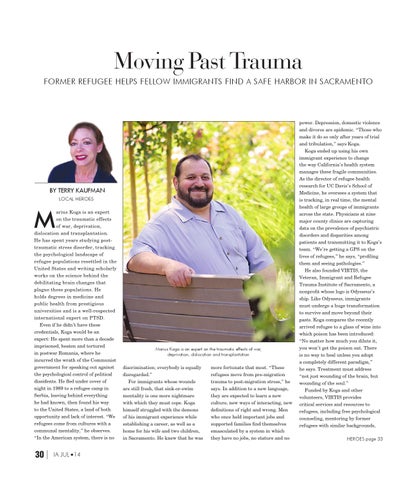
Marius Koga is an expert on the traumatic effects of war, deprivation, dislocation and transplantation
discrimination; everybody is equally disregarded.” For immigrants whose wounds are still fresh, that sink-or-swim mentality is one more nightmare with which they must cope. Koga himself struggled with the demons of his immigrant experience while establishing a career, as well as a home for his wife and two children, in Sacramento. He knew that he was
more fortunate that most. “These refugees move from pre-migration trauma to post-migration stress,” he says. In addition to a new language, they are expected to learn a new culture, new ways of interacting, new definitions of right and wrong. Men who once held important jobs and supported families find themselves emasculated by a system in which they have no jobs, no stature and no
power. Depression, domestic violence and divorce are epidemic. “Those who make it do so only after years of trial and tribulation,” says Koga. Koga ended up using his own immigrant experience to change the way California’s health system manages these fragile communities. As the director of refugee health research for UC Davis’s School of Medicine, he oversees a system that is tracking, in real time, the mental health of large groups of immigrants across the state. Physicians at nine major county clinics are capturing data on the prevalence of psychiatric disorders and disparities among patients and transmitting it to Koga’s team. “We’re getting a GPS on the lives of refugees,” he says, “profiling them and seeing pathologies.” He also founded VIRTIS, the Veteran, Immigrant and Refugee Trauma Institute of Sacramento, a nonprofit whose logo is Odysseus’s ship. Like Odysseus, immigrants must undergo a huge transformation to survive and move beyond their pasts. Koga compares the recently arrived refugee to a glass of wine into which poison has been introduced: “No matter how much you dilute it, you won’t get the poison out. There is no way to heal unless you adopt a completely different paradigm,” he says. Treatment must address “not just wounding of the brain, but wounding of the soul.” Funded by Koga and other volunteers, VIRTIS provides critical services and resources to refugees, including free psychological counseling, mentoring by former refugees with similar backgrounds, HEROES page 33