Sport www.inquiremedia.org/sport
InQ Quire
WINTER OLYMPICS ROUNDUP
Another average showing for Team GB
Photos by CNN
Photo by 90min
T
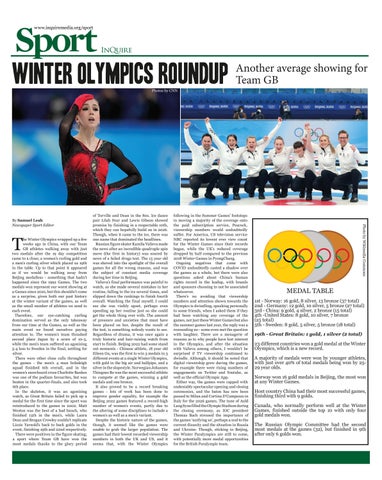
he Winter Olympics wrapped up a few weeks ago in China, with our Team GB athletes walking away with just two medals after the 19 day competition came to a close; a women’s curling gold and a men's curling silver which placed us 19th in the table. Up to that point it appeared as if we would be walking away from Beijing medalless - something that hadn’t happened since the 1992 Games. The two medals won represent our worst showing at a Games since 2010, but this shouldn’t come as a surprise, given both our past history at the winter variant of the games, as well as the small number of athletes we send to each event. Therefore, our eye-catching curling domination served as the only takeaway from our time at the Games, as well as the main event we found ourselves paying attention to. The women’s team thrashed second place Japan by a score of 10-3, while the men's team suffered an agonising 5-4 loss to Sweden in the final, settling for silver. There were other close calls throughout the games - the men's 4 man bobsleigh squad finished 6th overall, and in the women’s snowboard cross Charlotte Bankes was one of the podium favourites, but was beaten in the quarter-finals, and also took 6th place. In the skeleton, it was an agonising watch, as Great Britain failed to pick up a medal for the first time since the sport was reintroduced to the games in 2002. Matt Weston was the best of a bad bunch, who finished 15th in the men’s, while Laura Deas and Brogan Crowley couldn’t replicate Lizzie Yarnold’s back to back golds in the event, finishing 19th and 22nd respectively. There were positives in the figure skating; a sport where Team GB have won the most medals thanks to the glory period
of Torville and Dean in the 80s. Ice dance pair Lilah Fear and Lewis Gibson showed promise by finishing in a respectable 10th, which they can hopefully build on in 2026. Though, when it came to the ice, there was one name that dominated the headlines. Russian figure skater Kamila Valieva made the news after an incredible quadruple spin move (the first in history) was soured by news of a failed drugs test. The 15 year old was shoved into the spotlight of the overall games for all the wrong reasons, and was the subject of constant media coverage during her time in Beijing. Valieva’s final performance was painful to watch, as she made several mistakes in her routine, falling to the ice several times, and slipped down the rankings to finish fourth overall. Watching the final myself, I could see she was visibly upset, perhaps even speeding up her routine just so she could get the whole thing over with. The amount of pressure and anxieties that must have been placed on her, despite the result of the test, is something nobody wants to see. Regardless of drama, it was once again a truly historic and hair-raising watch from start to finish. Beijing 2022 had some stand out moments - Chinese athlete, 18 year old Eileen Gu, was the first to win 3 medals in 3 different events at a single Winter Olympics, with gold in the big air and halfpipe, and a silver in the slopestyle. Norwegian Johannes Thingnes Bo was the most successful athlete to compete at the games, winning 4 gold medals and one bronze. It also proved to be a record breaking games - lots of work has been done to improve gender equality, for example the Beijing 2022 games featured a record-high number of women’s events, partly due to the altering of some disciplines to include a women’s as well as a men’s variant. Despite the historic nature of the games, though, it seemed like the games were unable to grab the larger population. The games had their lowest recorded viewership numbers in both the UK and US, and it seems that, with the Winter Olympics
following in the Summer Games’ footsteps in moving a majority of the coverage onto the paid subscription service, Peacock, viewership numbers would undoubtedly suffer. For America, US television service NBC reported its lowest ever view count for the Winter Games since their records began, while the UK’s reduced coverage dropped by half compared to the previous 2018 Winter Games in PyongChang. Ongoing negatives that come with COVID undoubtedly casted a shadow over the games as a whole, but there were also questions asked about China’s human rights record in the leadup, with brands and sponsors choosing to not be associated whatsoever. There’s no avoiding that viewership numbers and attention shown towards the Olympics is dwindling, speaking personally to some friends, when I asked them if they had been watching any coverage of the games, not just these Winter Games but also the summer games last year, the reply was a resounding no - some even met the question with laughter. There are a menagerie of reasons as to why people have lost interest in the Olympics, and after the situation with Valieva among others, I wouldn’t be surprised if TV viewership continued to dwindle. Although, it should be noted that digital viewership grew during the games, for example there were rising numbers of engagements on Twitter and Youtube, as well as the official Olympic App. Either way, the games were capped with undeniably spectacular opening and closing ceremonies, and the baton has now been passed to Milan and Cortina D’Campezzo in Italy for the 2026 games. The tune of Auld Lang Syne filled the Olympic Stadium during the closing ceremony, as IOC president Thomas Bach stressed the importance of the games ‘unifying us’, perhaps a nod to the current disunity and the situation in Russia and Ukraine. Though, sticking in Beijing, the Winter Paralympics are still to come, with potentially more medal opportunities for the British Paralympic team.
Photo by Wikimedia Commons
By Samuel Leah Newspaper Sport Editor
MEDAL TABLE 1st - Norway: 16 gold, 8 silver, 13 bronze (37 total) 2nd - Germany: 12 gold, 10 silver, 5 bronze (27 total) 3rd - China: 9 gold, 4 silver, 2 bronze (15 total) 4th -United States: 8 gold, 10 silver, 7 bronze (25 total) 5th - Sweden: 8 gold, 5 silver, 5 bronze (18 total) 19th - Great Britain: 1 gold, 1 silver (2 total) 23 different countries won a gold medal at the Winter Olympics, which is a new record. A majority of medals were won by younger athletes, with just over 40% of total medals being won by 2529 year olds. Norway won 16 gold medals in Beijing, the most won at any Winter Games. Host country China had their most successful games, finishing third with 9 golds. Canada, who normally perform well at the Winter Games, finished outside the top 10 with only four gold medals won. The Russian Olympic Committee had the second most medals at the games (32), but finished in 9th after only 6 golds won.