News
4
Joke of a degree Academic slams article for ‘sensationalising’ University of Kent course in stand-up as one of the ‘Most Useless Degrees in Europe’ By George Knight Head of Marketing
O
n 10 September 2018, VICE released an article titled ‘An Introduction to the Most Useless University Degrees in Europe’ in which they branded the University of Kent’s postgraduate course in stand-up comedy as a course ‘worth it if you want to spend 40 years not really making any money at all’. The articles author, Nana Baah, also described the course as ‘perfect for people who believe that constantly talking about how funny they are, while saying literally nothing funny, is perfectly acceptable first date chat’. Despite slandering the course, the article failed to gain reaction from the course’s former coordinator Dr Oliver Double, who highlighted that the course had not been active since ‘around
2015’. He explained further that VICE’s words had no impact on the state of the course and instead that the course was ‘killed by the government’. The course had run successfully from between 2001 to 2015 as an ‘extended undergraduate master program’. Originally the course was a 4 year course, with 3 years undergraduate and a final year in which students could ‘specialise’ in a selection of subjects, one of which was Stand-Up Comedy. As Oliver Double described, it became ‘unsustainable when the fees went up to £9,000 a year’. Despite their being, as Double noted, around ‘14 applications including two from overseas’ the course could not be maintained and so was ultimately cancelled. Double ensured that the article had not affected the department or the course itself and instead explained that the article
did more damage to VICE. Double named the article ‘bad journalism’ due to its lack of research and saw it as ‘insulting’ to the students who undertook the course. Double highlighted the article’s narrow focus and illustration of people who ‘talk about how funny they are, whilst saying nothing funny’ and its expectation that the course would produce comedians. He argued that many former students had gone on to achieve successful careers in areas beyond simply comedy such as publishing and education. He also argued that even within comedy, the course had produce many successful comedians including Comedian Choice winner Laura Lexx. This list of successful talent was further expanded by Matt Hoss, a former student and current comedian who undertook the course before its cancellation. He pointed towards comedian group ‘The Noise Next Door’ who have been ‘Eleven time sell-out veterans of the Edinburgh Fringe Festival,’ as well as other groups such as ‘Three Half Pints’ who have shared similar success. Hoss also suggests that placing
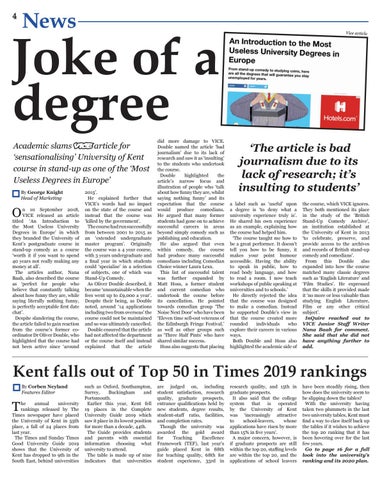
Vice article
‘The article is bad journalism due to its lack of research; it’s insulting to students’ a label such as ‘useful’ upon a degree is ‘to deny what a university experience truly is’. He shared his own experience as an example, explaining how the course had helped him. ‘The course taught me how to be a great performer. It doesn’t tell you how to be funny, it makes your point humour accessible. Having the ability to speak in public, how to read body language, and how to read a room. I now teach workshops of public speaking at universities and to schools.’ He directly rejected the idea that the course was designed to make a comedian. Instead he supported Double’s view in that the course created more rounded individuals who explore their careers in various ways. Both Double and Hoss also highlighted the academic side of
the course, which VICE ignores. They both mentioned its place in the study of the ‘British Stand-Up Comedy Archive’, an institution established at the University of Kent in 2013 ‘to celebrate, preserve, and provide access to the archives and records of British stand-up comedy and comedians’. From this Double also expanded into how the course matched many classic degrees such as ‘English Literature’ and ‘Film Studies’. He expressed that the skills it provided made it ‘no more or less valuable than studying English Literature, Film or any other critical subject’. InQuire reached out to VICE Junior Staff Writer Nana Baah for comment. She said that she did not have anything further to add.
Kent falls out of Top 50 in Times 2019 rankings By Corben Neyland Features Editor
T
he annual university rankings released by The Times newspaper have placed the University of Kent in 55th place, a fall of 24 places from last year. The Times and Sunday Times Good University Guide 2019 shows that the University of Kent has dropped to 9th in the South East, behind universities
such as Oxford, Southampton, Surrey, Buckingham and Portsmouth. Earlier this year, Kent fell 19 places in the Complete University Guide 2019 which saw it place in its lowest position for more than a decade, 44th. The Guide provides students and parents with essential information choosing what university to attend. The table is made up of nine indicators that universities
are judged on, including student satisfaction, research quality, graduate prospects, entrance qualifications held by new students, degree results, student-staff ratio, facilities, and completion rates. Though the university was awarded the gold award for Teaching Excellence Framework (TEF), last year’s guide placed Kent in 88th for teaching quality, 68th for student experience, 33rd in
research quality, and 15th in graduate prospects. It also said that the college system that is operated by the University of Kent was ‘increasingly attractive to school-leavers, whose applications have risen by more than 15% in five years’. A major concern, however, is if graduate prospects are still within the top 20, staffing levels are within the top 20, and the applications of school leavers
have been steadily rising, then how does the university seem to be slipping down the tables? With the university having taken two plummets in the last two university tables, Kent must find a way to claw itself back up the tables if it wishes to achieve the top 20 ranking that it has been hovering over for the last few years. Go to page 16 for a full look into the university’s ranking and its 2020 plan.