
POWDER METALLURGY’S DATA CHALLENGE SPECIAL ATOMISATION METHODS PRESS DEVELOPMENTS FROM CERAMITEC 2022 3NO.11VOL. 2022AUTUMN www.pm-review.comPublished by Inovar Communications Ltd POWDER METALLURGY REVIEW
In the world of metal powders, Höganäs is always at the forefront of innovation. From more sustainable production processes to new and patented powder compositions, we are dedicated to offering you the optimal solutions while reducing environmental impact. With our range of metal powders designed for efficient press and sinter processes, we can offer powders designed for any application.
Improved sustainability enhanced performance

Combining optimal powder performance with improved sustainability is a priority for Höganäs, as we are on a journey to becoming the first green metal powder producer. In addition to our material innovations, we have also committed to Science Based Targets and are founding members of the Additive Manufacturing Green Trade Association, demonstrating our ongoing commitment to leading sustainable transformation in our industry. www.hoganas.com
— 3222HOG
Shrewsbury SY1 3AF United Kingdom
Review
Subscriptions
Whilst every effort has been made to ensure the accuracy of the information in this publication, the publisher accepts no responsibility for errors or omissions or for any consequences arising there from.
Managing Director
Swetha swetha@inovar-communications.comAkshita
METALLURGYPOWDERREVIEW
Knowledge is power
Jo jo@inovar-communications.comSheffield
Features Editor
This magazine is also available for free download from www.pm-review.com
Consulting Editor
Subscriptions
Submitting news and articles
Emily-Jo emily-jo@inovar-communications.comHopson-VandenBos
ISSN 2050-9693 (Print edition)
Autumn 2022 Powder Metallurgy Review 3

Assistant Editor
Publisher & Editorial Offices
We welcome contributions from both industry and academia and are always interested to hear about company news, innovative applications for PM, research and more.
Jon Craxford
As the much-awaited return of the PM World Congress draws near, the technical programme offers a glimpse into a highly active Powder Metallurgy research base, populated by an engaged community of global companies, research institutions and academia.
Production Manager
Reproduction, storage and usage
Kim kim@inovar-communications.comHayes
Tel: +44 1743 www.pm-review.com469909
While attending PowderMet in Portland this June, I was interested to hear the term ‘brains trust’ used to describe the PM community. The term was traditionally associated with a small group of political advisers but has since come to depict any collection of experts whose knowledge makes them capable advisers to industry or academia, and while I had heard it used in other spheres before June, it was surprising to realise that this was the first time I had heard it used in the context of our highlyspecialised, expert-led industry.
In fact, the collective ‘brains trust’ of PM experts might be the most valuable tool in our industry’s arsenal in these trying times. While World PM2022 may struggle to draw a truly international audience in this post-COVID world, the event nevertheless promises to provide a rich source of knowledge for all in attendance, and the technical programme, complete with a series of Special Interest Seminars on selected topics of key importance to the industry, demonstrates the depth and breadth of research and collaboration currently ongoing.
See you FeaturesEmily-Jothere!Hopson-VandenBosEditor,PowderMetallurgy
Nick nick@inovar-communications.comWilliams
Accuracy of contents
Single photocopies of articles may be made for personal use in accordance with national copyright laws. Permission of the publisher and payment of fees may be required for all other photocopying.
Powder Metallurgy Review is published on a quarterly basis. It is available as a free electronic publication or as a paid print subscription. The annual subscription charge is £150.00 including shipping.
Dr David Consultant,WhittakerWolverhampton, UK
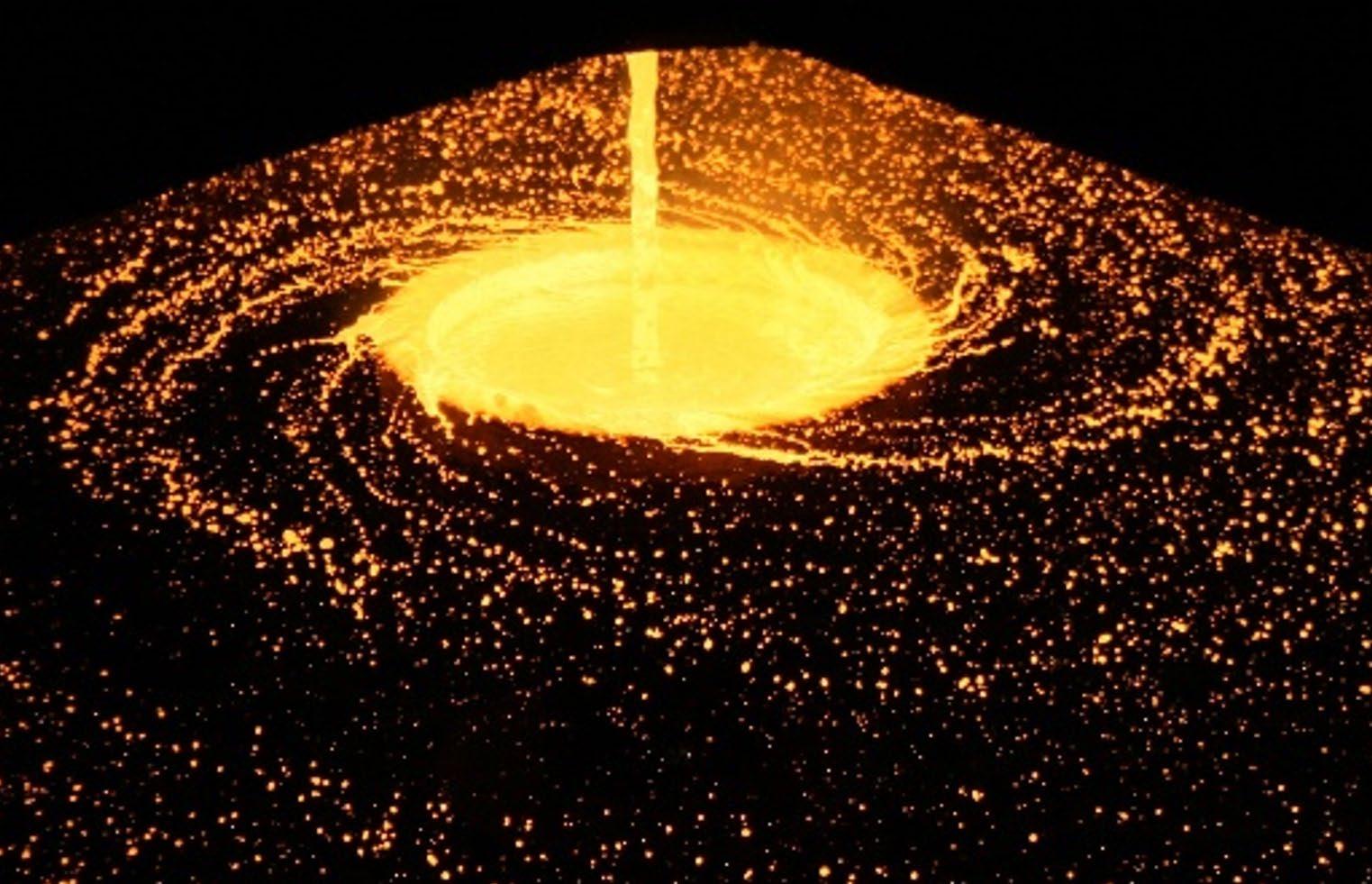
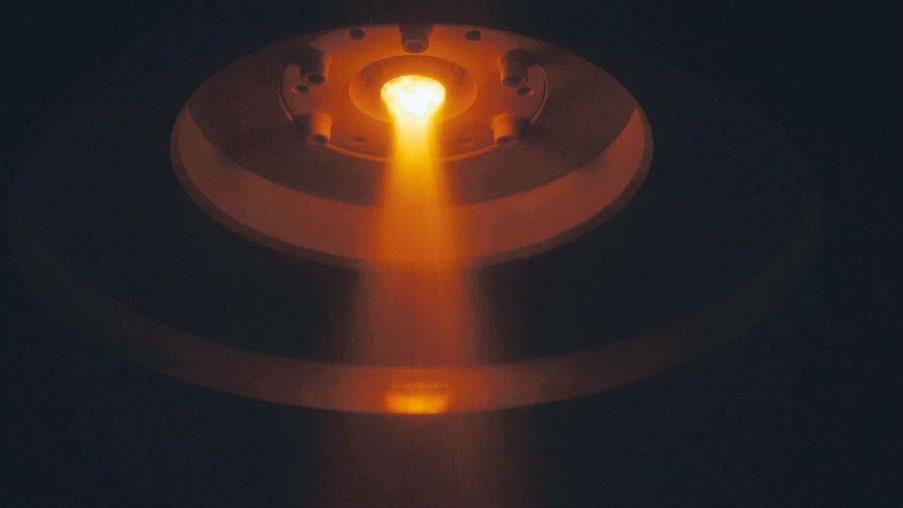
Cover image Centrifugal atomisation on a spinning cup (Courtesy Atomising Systems Ltd)
GETPDF
11 Park BattlefieldPlazaEnterprise Park
Paul paul@inovar-communications.comWhittaker
Charlie charlie@inovar-communications.comHopson-VandenBos
Advertising Sales Director
Hugo hugo@inovar-communications.comRibeiro
Inovar Communications Ltd.

Tel: +44 (0) 207 1939 jon@inovar-communications.com749
We come to this event in a period when the PM industry, like much of the manufacturing sector, is under unprecedented strain, due to rising energy prices, recruitment and staff retention challenges, and supply chain disruptions, as well as the everencroaching threat of vehicle electrification and its impact on the entire PM supply chain.
Design and production
All rights reserved. Except as outlined above, no part of this publication may be reproduced, stored in a retrieval system, or transmitted in any form or by any means, electronic, photocopying or otherwise, without prior permission of the publisher and copyright owner.

ISSN 2050-9707 (Online edition)
Inovar Communications Ltd
Digital Marketer
Deputy News Editor
Group News Editor
© 2022 Inovar Communications Ltd.
Inovar Communications Ltd cannot be held responsible for views or claims expressed by contributors or advertisers, which are not necessarily those of the publisher.
Rio Tinto is committed to sustainable development in metals processing. This pledge has been recently demonstrated through investments in the world’s first low carbon Aluminum processing technology, Elysis, and in exploring low carbon steel processing technologies. Rio Tinto will invest $1 billion over the next 5 years to help achieve its Net Zero Emissions goal by 2050.
TogetherFutureaImagineGreener
Rio Tinto Metal Powders’ Commitment to Sustainable Development

Metal Powders www.qmp-powders.comIATF 16949ISO 9001

Powder metallurgy is a Green Technology, a near net-shape process that allows for efficient use of raw materials. Rio Tinto Metal Powders (RTMP) produces iron and steel powders for the industry using carbon-free hydroelectric power generated in the Province of Quebec, Canada. The primary market for our powder products is the automotive industry, which is moving increasingly to electrification and away from internal combustion engines. RTMP is contributing to the development of new powder materials for electric components, from pump assemblies to small electric motors in e-bikes and EV’s to create a Greener Future Together.

The world is getting smaller. The pandemic has made it painfully clear how globally interconnected we truly are. We share one planet and we all need to ensure that our actions today support the generations of tomorrow. At Rio Tinto, the safety of our people is the Number One Priority. We also apply our core values to the communities in which we operate, to reduce the impact of our operations on our neighbors.
At Rio Tinto, we produce materials essential to human progress. For more information about Rio Tinto’s polices, programs, and commitment to sustainable development please visit the Rio Tinto home page at www.riotinto.com
As Ian Donaldson, Director Advanced Engi neering Applications at GKN Sinter Metals, explains, in order to compete for its place in the rapidly changing automotive supply chain, it is imperative that the PM industry moves away from a primarily documentcentric approach that relies on engineering specification sheets and limited material databases and toward developing more comprehensive databases. >>>
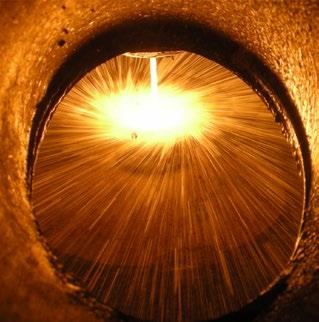
In this final instalment in the series, Strauss and Dunkley present those special atomisation methods such as centrifugal, ultrasonic, pressure (single-fluid) atomisation, and two-fluid atomisation with unconventional media. While perhaps not as widely known as gas or water atomisa tion, each of these specialist methods of metal powder atomisation has its own unique applications – some industrially significant and some highly niche. >>>
With the automotive industry’s adoption of a model-based engineering approach dependent on access to reliable information, the limited data available for PM materials is putting the industry in a vulnerable position compared to wrought or cast materials.
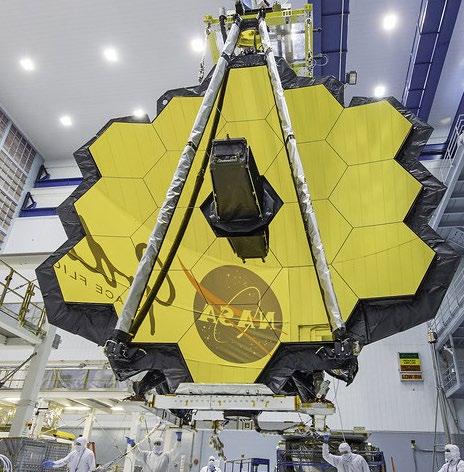
63 Powder Metallurgy’s challenge: How does automotive’s reliance on model-based decision making impact our industry?
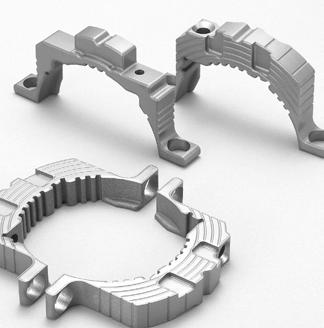
In the Winter 2021 issue of PM Review , we began our four-part series on metal powder atomisation. Over the course of this series, two atomisation experts, Joe Strauss and John Dunkley, have offered our readers a valuable overview of the principles of atomising technology, atom ised powders and their applications.
ContentsRegularfeatures... 09 Industry news >>> 114 Advertisers’ index & buyer’s guide >>> 118 Industry events >>> 10 52 1007422
GETPDF 5Autumn 2022 Powder Metallurgy Review 5© 2022 Inovar Communications Ltd
METALLURGYPOWDERREVIEW
71 How to make metal powders. Part 4: Centrifugal and other special atomisation methods
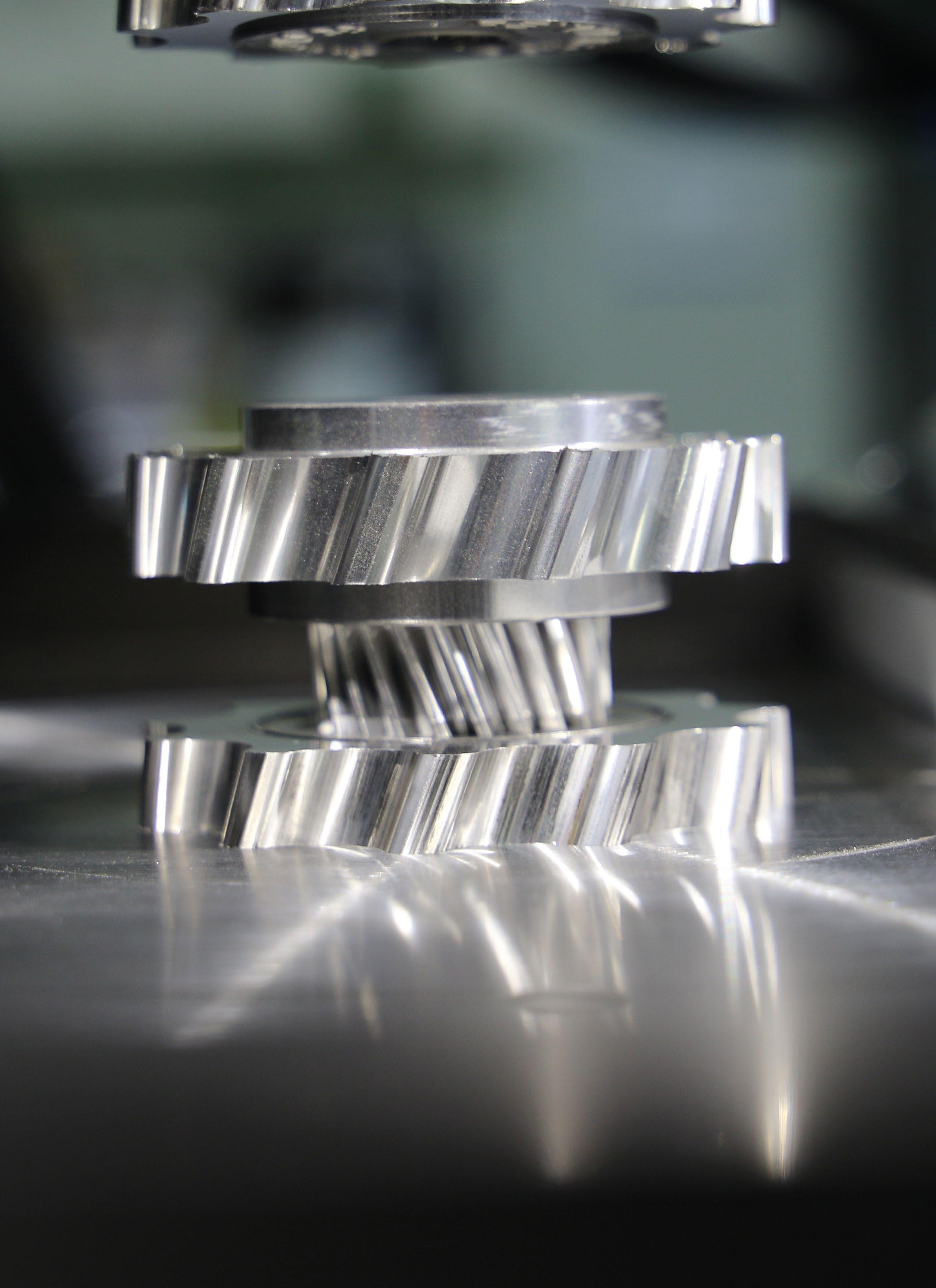
e-powered Pressing System for Helical Gears SVZe DORST Technologies GmbH & Co. KG Mittenwalder Straße 61 · 82431 Kochel am See · +49 8851 188-0 · www.dorst-technologies.com Servo-electrical driven rotation motion No mechanical pairing required Closed-loop controlled Perfect synchronisation of upper punch High-dynamic and efficient Helix angle freely programmable Watch video Visit us on booth 93/94 Our DNA is helical













GETPDF 7Autumn 2022 Powder Metallurgy Review 7© 2022 Inovar Communications Ltd
81 Precision and energy efficiency in PM press technology: Insights from Ceramitec 2022
Although the focus of Ceramitec is on ceramic production technologies, many exhibitors also offer and showcase products for the Powder Metallurgy industry – in particular, powder compaction technology for press and sinter PM. Dr Georg Schlieper visited the trade fair on behalf of PM Review , and spoke to a number of suppliers of powder compaction technology about the latest developments and trends in the industry. >>>
97 Tailoring a speciality alloy for Additive Manufacturing: From powder production to parameter optimisation
Here, Bernard North provides his knowledge able impression of the conference as a whole and outlines its opening sessions and technical programme. >>>
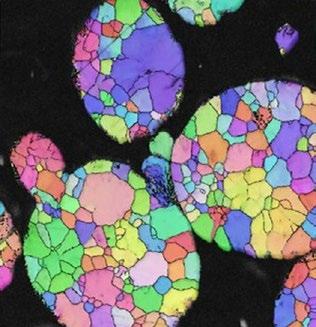
Ultra-high temperature materials, such as niobium-base alloys, have been limited to simple geometric designs due to their high working temperatures and related production Now,costs.thanks to the development of commercially available Nb-base alloy powders, it is possible to addi tively manufacture complex-shaped, high-performance components from this material. To do so, it is important to understand the full workflow, from powder production and characterisation, to determining the optimal process parameters for these speciality materials.
After a four-year interruption due to the COVID-19 pandemic, Ceramitec, the leading trade fair for the ceramics industry, reopened its doors at the Munich Exhibition Centre this June.
After a five-year hiatus, delegates from twentyseven countries gathered once more to attend the Plansee Seminar in Reutte, Austria, this June. Here, the most knowledgeable minds from the refractory metals and hard materials world, both industrial and academic, gathered to discuss the present and future of this important sector of Powder Metallurgy (and maybe enjoy some in-person networking).
In this article, researchers from Penn State University, North American Höganäs and Abbott Furnaces review the compaction and sintering effects of three commonly used lubricants – Acrawax® C, Intralube® E, and Intra lube® HD – to shed light on the best application for different types of lubri cant, and the effects these choices can have on final part quality. >>>
87 Historic traditions and new innovations: refractory metals and hard materials at the 20 th Plansee Seminar
Lubricants are a necessary addition to the Powder Metallurgy compaction process, reducing ejection forces from the tool, maintaining product quality, and increasing tool life. Depending on the application, different amounts and types of lubricant are needed to address issues related to green density and product geometry.
In this article, Taniobis GmbH and Alloyed Ltd detail the process of preparing, characterising, and processing two such alloy powders. >>>
107 Understanding the compaction and sintering effects of four commonly used lubricants in Powder Metallurgy
In order to cover this range, different plant architectures are involved such as: Gas-Atomizers (VIGA / EIGA) and Water Atomizers
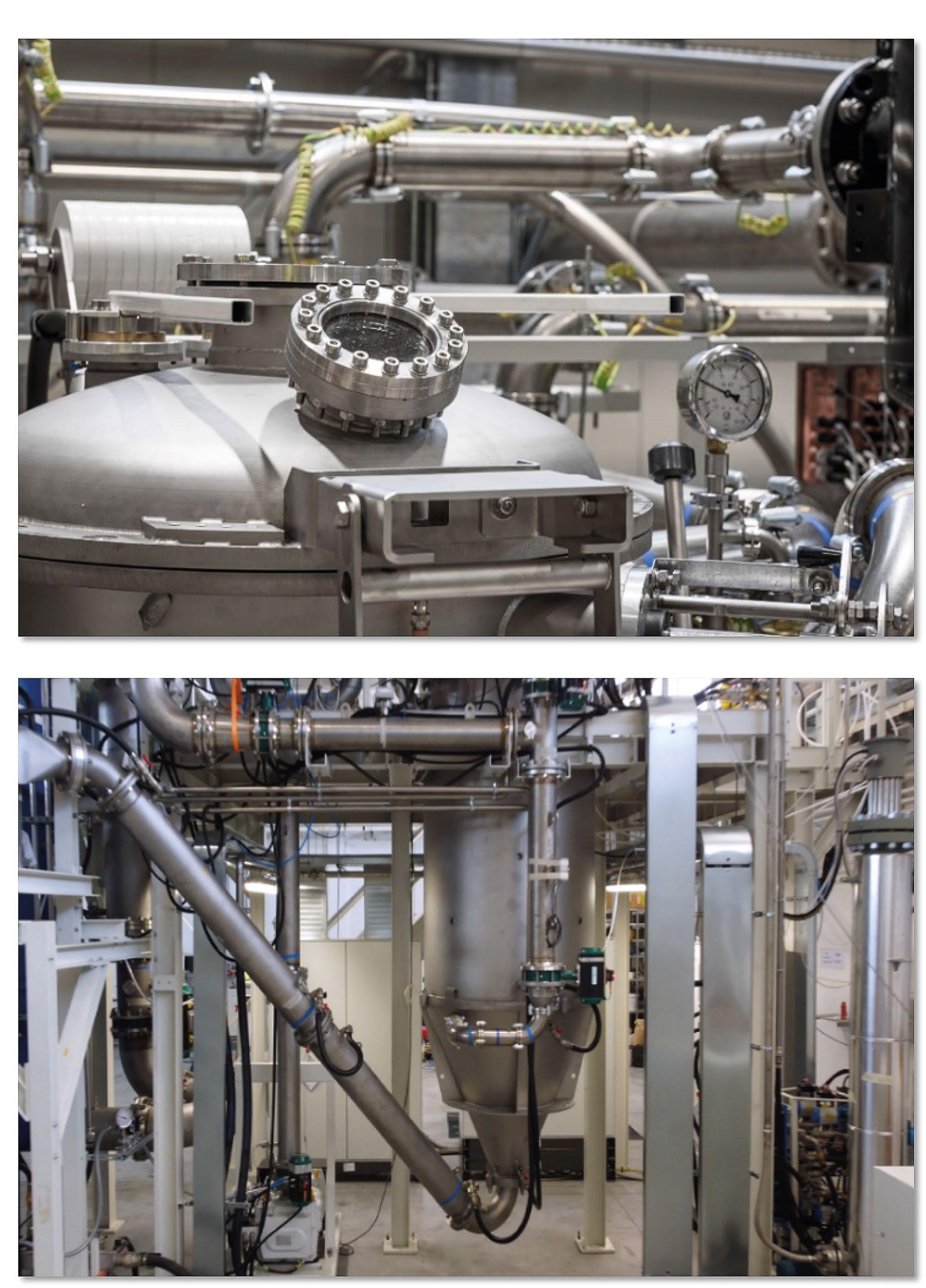
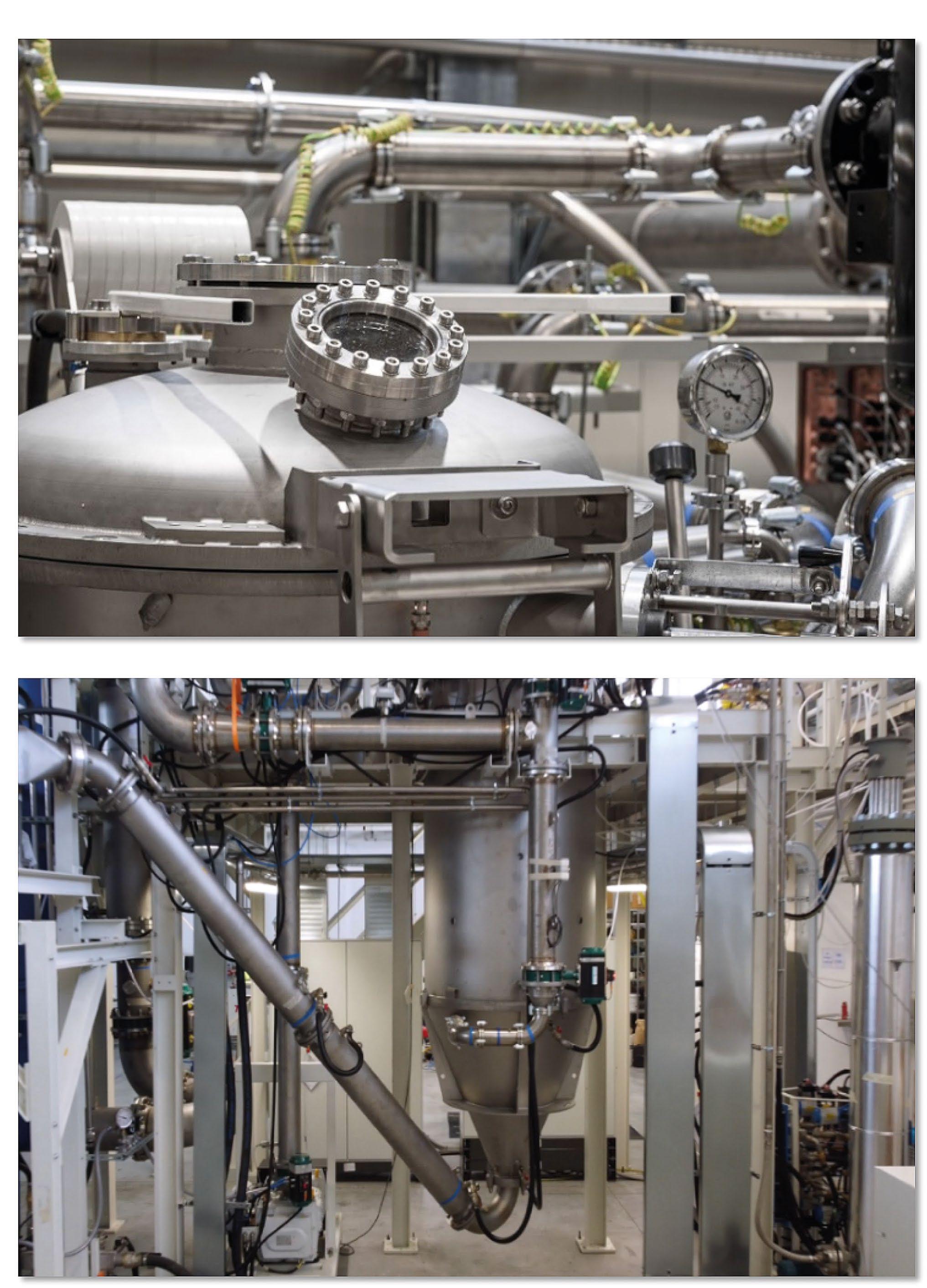
Topcast TMA Atomizers are designed to easily control all the process variables, such as Gas/Water pressure and flow rate, metal temperature and flow through the nozzle. Therefore, shape and particle size distribution of the produced powder can be adjusted and tuned according to the customer needs.
Topcast s.r.l. Via Leopoldo di Toscana, 9-11 52048 Loc. Alberoro / Monte San Savino (AR) Italy Tel. +39 0575 441341 - Fax +39 0575 441222 info@topcast.it / www.topcast.it

TMA: OPTIMIZED SOLUTION FOR DEMANDING POWDER METALLURGY

ITALYINMADE
TMA is a family of metal atomizers designed for a wide range of metallic powders production such as Titanium, Stainless Steels, Chrome-Cobalt, Nickel based alloys, Precious and Non-Ferrous metals and for a variety of different fields of application, such as: Industrial, Chemical, Electronics and Part Manufacturing using AM techniques (like SLM and EBM).
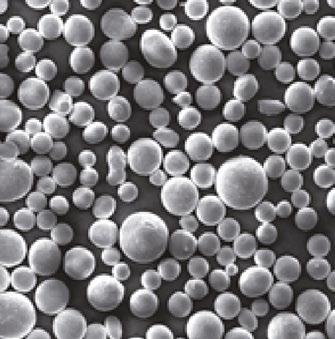

For additional details please visit our website: hiips://www.topcast.it/en/products/metal-atomizers
VACUUM INDUCTION METAL ATOMIZER
Autumn 2022 Powder Metallurgy Review© 2022 Inovar Communications Ltd 9 9
GKN Powder Metallurgy to begin production of permanent magnets for electric vehicles
“The key driver behind this stra tegic decision is our understanding of the challenges facing the automo tive industry today and tomorrow,” stated Diego Laurent, CEO at GKN PM. “The stability in manufacturing is an ongoing concern, but with our expertise, scale, and reputation, we can provide a robust solution.”
business-wide commitment to sustainability. With ambitious environmental targets in place, including achieving net zero greenhouse gas emissions in all operations worldwide by 2050, the company is contributing to a more responsible and sustainable future.
“Automakers are looking for a reliable, local supply. We aim to have in place the capacity for up to 4,000 tonnes of permanent magnets by 2024, which will see us become a key player in driving the future of the electric mobility market,” concludedwww.gknpm.comLaurent.
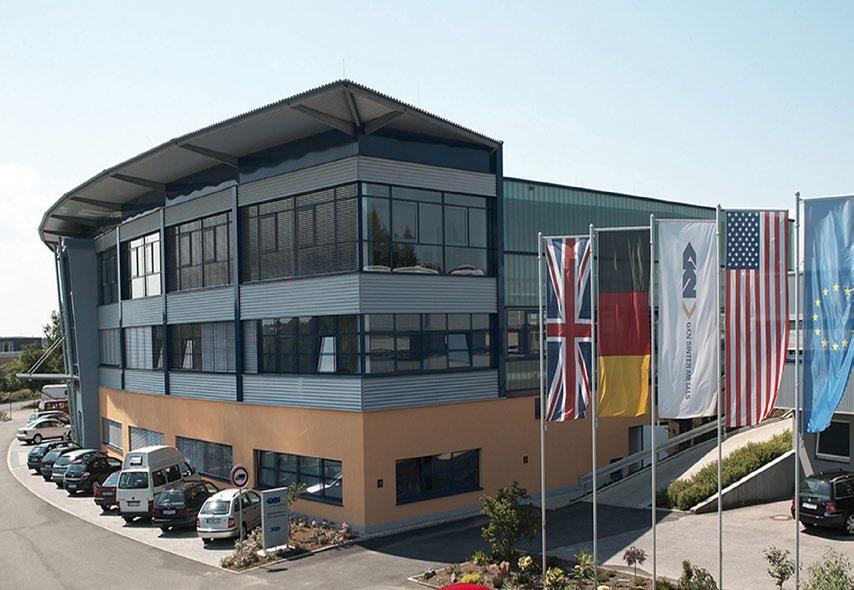
GKN Powder Metallurgy will begin manufacturing permanent magnets for electric vehicle applications (Courtesy GKN Powder Metallurgy)
| contents | news | advertisers | events | website | e-newsletter | GETPDF
GKN Powder Metallurgy has announced it will begin manu facturing permanent magnets specifically for the electric vehicle market, with significant investment planned to establish capacity for up to 4,000 tonnes per year by 2024.
Significant progress in product development has been made and the business is now entering the phase of industrialisation planning. A dedi cated Magnets project team, bringing together multidisciplinary experts, operates out of the company’s Inno vation Centres for metal powders in Cinnaminson, USA, and for Powder Metallurgy manufacturing in Rade vormwald, Germany.
To submit news for inclusion in Powder Metallurgy Review contact, Paul Whittaker, paul@inovar-communications.com
industry news
As a leading manufacturer of metal powders and Powder Metal lurgy parts, and a Tier 1 supplier to the automotive industry, GKN believes it is well positioned to meet the increasing demand for a stable, local supply of permanent magnets.
“As a trusted provider of metal powders and components for the industry, we already have a scal able production footprint,” Laurent continued. “We will leverage our well-established processes and capabilities to align these with the requirements of permanent magnet production.”According to the company, the move into permanent magnets for the EV market is part of GKN PM’s
10 © 2022 Inovar Communications LtdPowder Metallurgy Review Autumn 2022 | contents | news | advertisers | events | website | e-newsletter |Industry News
global Sustainable Development Goals (SDGs) and Environment Social Governance (ESG), reducing carbon dioxide emissions and protecting the environment. Additionally, NPR and Riken will work to accelerate efforts in the fields of marine, hydrogen, new energy projects, thermal engineering, electromagnetic compatibility (EMC), medical equipment, axial motors, MIM and other non-automotive engine parts.Through the formation of NPR-Riken Corporation, the two companies plan to integrate and utilise the management resources of both companies. It will enable the reduction of costs through shared use of infrastructure and other resources, further reducing manufacturing costs by improving production efficiency through shared product integration.
Once the formation of NPR-Riken Corporation is approved at each of the company’s shareholder meet ings, and subject to the necessary approval of relevant authorities, the two companies plan to engage in a joint share transfer in April 2023. It is reported that the president of Riken will assume the position of CEO of NPR-Riken Corporation and the presi dent of NPR will assume the position of COO of NPR-Riken Corporation. www.riken.co.jpwww.npr.co.jp
Nippon Piston Ring Co., Ltd., Tokyo, Japan, and Riken Corporation, Tokyo, Japan, have announced a Memo randum of Understanding (MoU) to establish a joint holding company formed by mutual stock transfer, and to consolidate the two companies on equal terms. The MoU has been resolved by the board of directors of the two companies and the trading name of the new joint company will be NPR-Riken Corporation.
Nippon Piston Ring and Riken Corporation plan merger to form NPR-Riken Corporation
Nippon Piston Ring received a JPMA award iron based sintered compo nent which is used in an aluminium engine block (Courtesy JPMA)
Advanced materials supplier Elkem SA, Oslo, Norway, reports that it has acquired KeyVest Belgium S.A, based in Grâce-Hollogne, Belgium. The company specialises in the sourcing of materials and production of metal powders for the refractory industry and other segments including advancedKeyVestceramics.willbeacquired from a subsidiary of Holta Invest AS, a privately held investment company headquartered in Oslo, Norway. The transaction closed on June 20, 2022, and the new name of the entity
milling company of silicon carbide and silicon metal powders. It also distributes related products that include ferrosilicon nitride, fused silica, boron carbide, and aluminium powder. The company focuses on building long-term relationships with its customers and produces around 140 tailor-made products, with annual revenues of around €10 million.“Theacquisition of KeyVest fits well into Elkem’s offerings to the refractory market,” commented Inge A Grubben-Strømnes, Elkem’s senior vice president for Silicon Products.www.keyvestbelgium.bewww.elkem.com
Elkem focuses on refractories growth with KeyVest acquisition
Founded in 1934, NPR is recog
Riken was established in 1927 to commercialise the research out of the Institute of Physical and Chem ical Research and has contributed to the development of the global automotive industry for over ninety years through its study of surface treatment, processing and materials technologies for piston rings and otherThecomponents.automotive industry is under going a remarkable transformation, and the market for internal combus tion engine parts is becoming more restricted. To address this, while the internal combustion engine remains the primary form of powertrain, the companies are dedicated to devel oping components that enable more environmentally friendly engines. The companies also believe it is necessary to increase investment in new business areas that address
nised for its high-performance, high-quality Powder Metallurgy piston rings, valve seat inserts, camshafts, and other parts primarily for use in internal combustion engines. In addition to press and sinter PM, the company also uses Metal Injection Moulding to manufac ture a wide range of components.
will be Elkem Processing Services Belgium.Refractories are designed to with stand very high temperatures and are therefore suitable for use in furnace linings for the steel, cement, and aluminium industries. Elkem offers a wide portfolio of high-quality prod ucts for the production of advanced refractory and ceramic products globally. The KeyVest acquisition will further support and expand this offering.KeyVest was established in 2007 as an independent processing and
TEKNA.COM



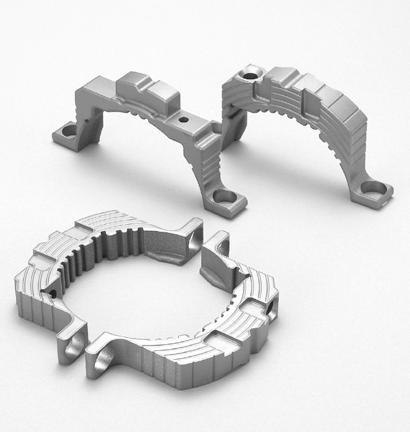
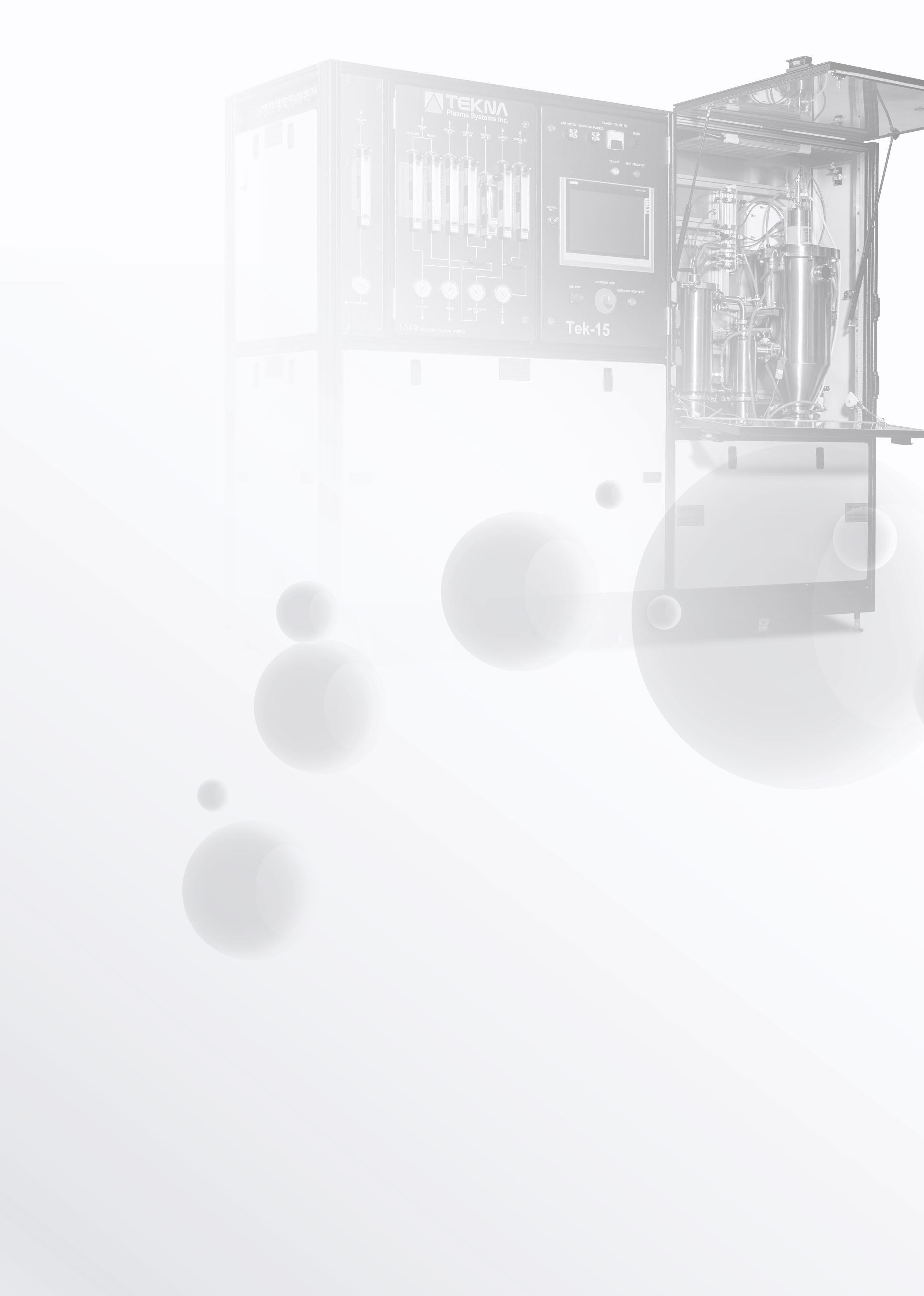
Produce PERFECTLY spherical powders with induction plasma
Process benefits Features TFlowabilitySpheroidicityContactusapdensityPurity UserIndustrialHighTurnkeythroughputstandardsfriendlySubscribetoour mailing list www.tekn a .com/webinars
We offer laboratory, pilot and industrial production spheroidization systems for a wide range of materials. Our expertise and knowledge are available to support you from testing to industrial scale-up.
With three production sites in Swit zerland and a global distribution network, Sphinx Tools produces precision solid round tools (micro
Sphinx Tools
12 © 2022 Inovar Communications LtdPowder Metallurgy Review Autumn 2022 | contents | news | advertisers | events | website | e-newsletter |
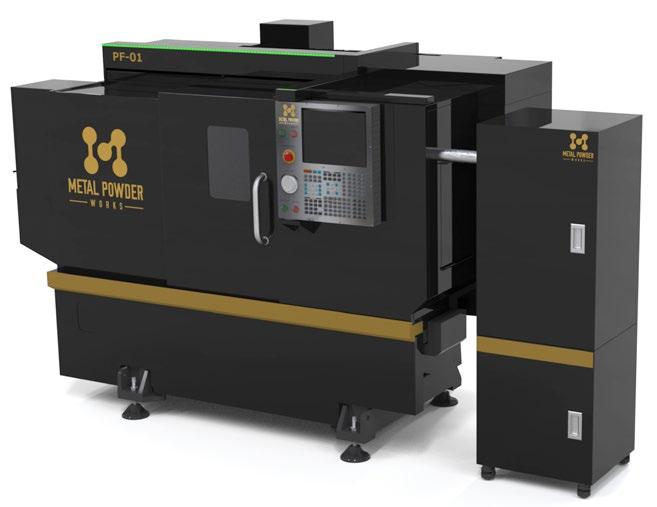
Metal Powder Works has opened a manufacturing facility at Neighborhood 91 (Courtesy Metal Powder Works)
Founded in 1958, Balax pioneered a design for cold forming taps featuring ‘Lead Form Geometry Correction,’ a process which reduces tapping torque by creating lead threads on pitch. The taps,
Industry News
Metal Powder Works (MPW), Sewickley, Pennsylvania, USA, has announced that it will join Neighbor hood 91, the Additive Manufacturing production campus located at Pittsburgh International Airport. The new facility will function as the company’s main powder production
called Thredfloers, were said to be ’BALanced AXially,’ leading to the company’s name of Balax. The company went on to add other metalworking tools to its product line, including Thredsaver cutting taps, and thread gauges. Balax conducts all manufacturing processes in house, including blank making, heat treating, shank and square grinding, fluting, thread grinding and surface treatments. It also maintains a fully equipped tapping laboratory to test new design concepts for tapping torque, tapping speed, tool geometry, coolant or lubrication performance, pretap hole sizing, and material compatibility. The company employs sixty-six staff and, in 2021, saw reve nues of $10 www.home.sandvikwww.sandvik.coromant.comwww.balax.comwww.sphinx-tools.chmillion.
Metal Powder Works to begin powder manufacturing in Neighborhood 91
MPW will market and sell primarily aluminium and copper powders from the Neighborhood 91 location. Tom Bockius, MPW’s Technical Director, will oversee the construction and installation of equipment at Neighborhood 91, with the company planning to be fully operational by the end of October 2022.“The concept of Neighborhood 91 was always to bring an Additive Manufacturing supply chain to one centralised location,” stated Barnes, MPW’s CEO. “We’re excited to be a part of Pittsburgh’s advanced manu facturingwww.neighborhood91.comwww.metalpowderworks.comscene.”
Sandvik acquires precision tools manufacturer Sphinx Tools and tap manufacturer Balax
Sandvik AB, headquartered in Stockholm, Sweden, has signed an agreement to acquire 100% of the equity in Sphinx Tools Ltd, headquar tered in Derendingen, Switzerland, and its wholly owned subsidiary P Rieger Werkzeugfabrik AG. In a further press release, the company also announced it has acquired Balax, Inc., North Lake, Wisconsin, USA, a supplier of carbide and HSS cut taps and roll forming taps for the general engineering and automotive sectors.
Sphinx Tools was founded in 1994 and has around 150 employees. In 2021, the company generated reve nues of approximately 292 MSEK.
production yield, cost and quality with its proprietary DirectPowder™ powder production technology. The process converts feedstock into fine powder particles via software-driven, patent-pending technology, which reportedly converts nearly 100% of input material into suitable powder without the need for melting. Direct Powder is said to allow for specific particle size distributions and enables non-equiaxed morphologies.
Balax acquisition
site, expanding capacity by a factor of eight and signalling a shift to an operational focus as the company winds down fundamental develop ment.Founded in 2017 by John Barnes and Chris Aldridge, MPW aims to bring a step change in metal powder
tools) and surgical cutting tools, serving customers in the automotive, aerospace and medical segments. The company will be reported within Sandvik Coromant, a division within Sandvik Manufacturing and Machining Solutions.
gkn-powder-metallurgy gkn_powder_metallurgy @GKNPowderMetal
PERMANENT MOMENTUM

PERMANENT MOMENTUM for EV manufacturing
As the EV market grows exponentially, GKN Powder Metallurgy is bringing certainty to automakers with a permanent solution for permanent magnets.
Combining automotive expertise, trusted OEM partnerships, world-leading processes and technologies, with our global manufacturing footprint, we’re addressing one of the biggest challenges for today, and tomorrow. more at gknpm.com/magnets
Discover
Kennametal Inc, Pittsburgh, Pennsylvania, USA, has announced its fourth quarter and fiscal 2022 results, with FY22 sales increasing 9% to $2 billion from FY21, up 11% on an organic basis. Fourth quarter sales saw an increase of 3% year over year to $530 million, up 7% on an organic basis.
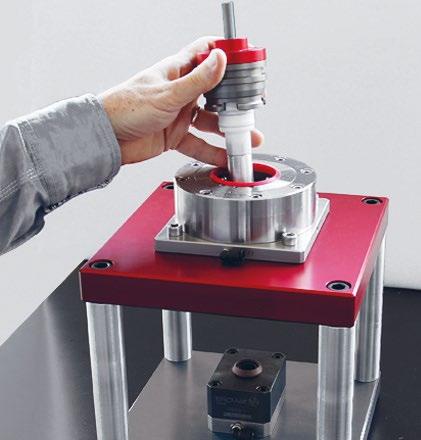
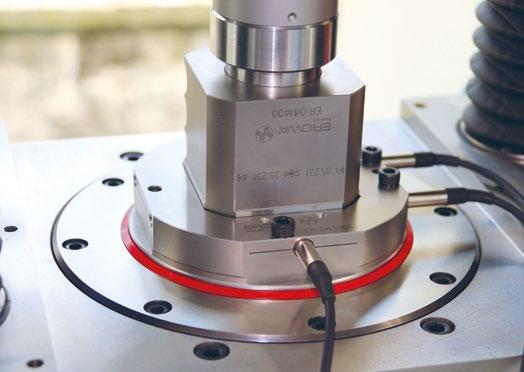
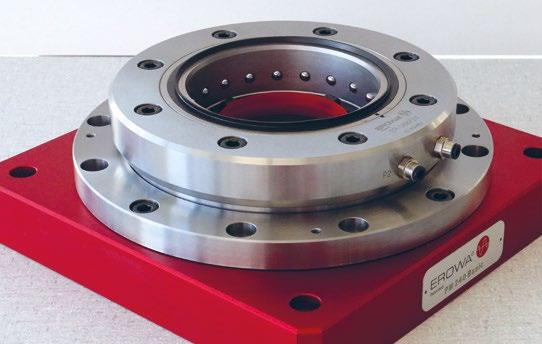
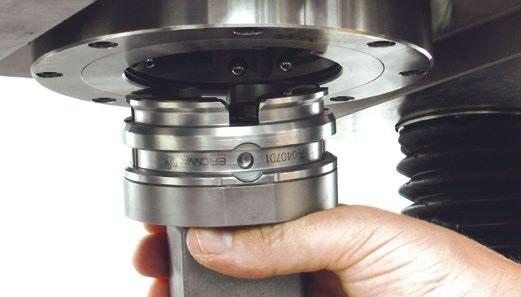
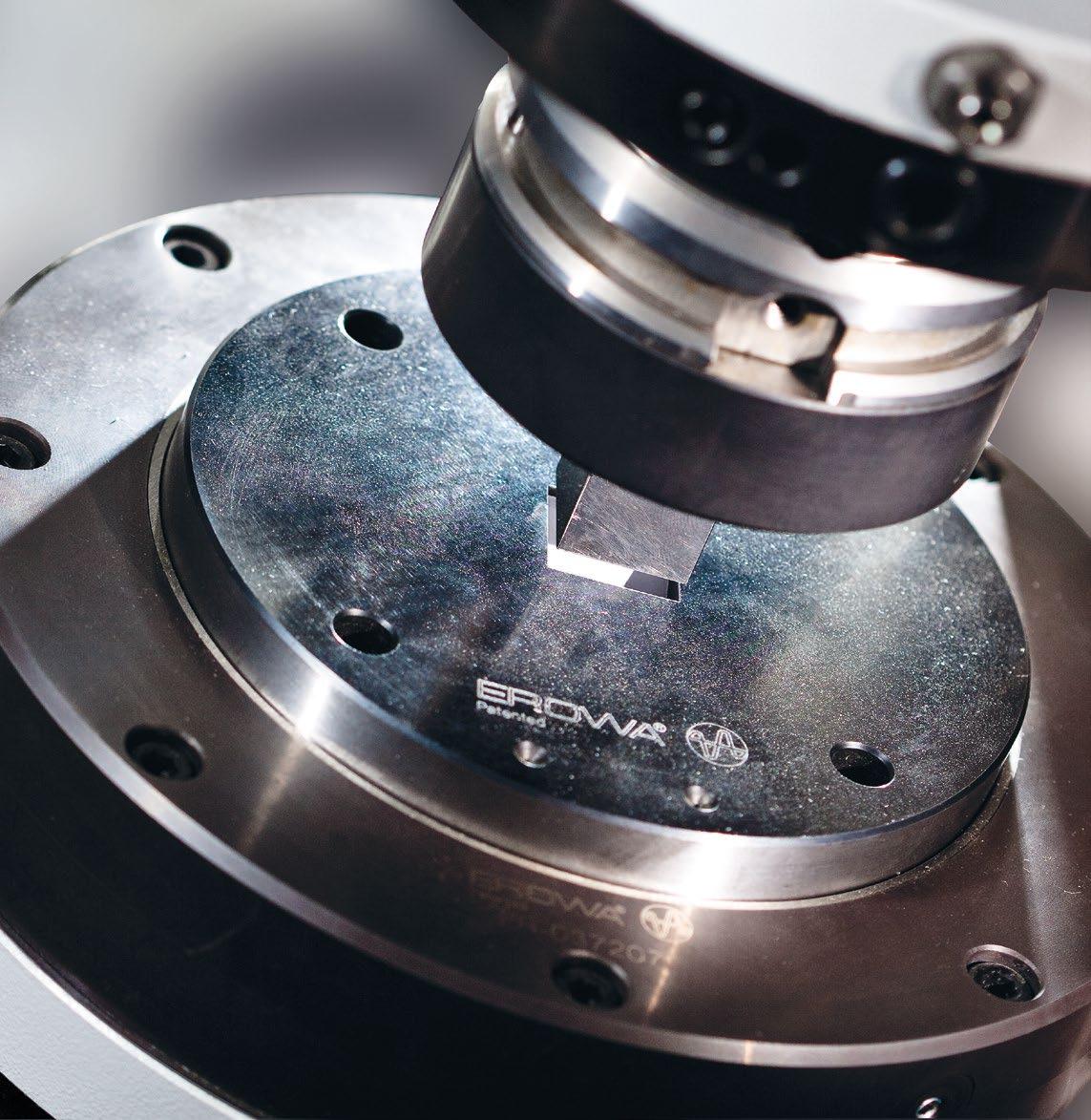
14 © 2022 Inovar Communications LtdPowder Metallurgy Review Autumn 2022 | contents | news | advertisers | events | website | e-newsletter | The EROWA PM Tooling System is the standard inter face of the press tools between the toolshop and the powder produceenablessettingItsmachine.pressunrivalledre-timealsoyoutosmall series profitably. PM SystemTooling www.erowa.com more info World CongressPM2022&Exhibition 9-13 October 2022 Lyon, France Industry News

Kennametal reports strong financial results in its 2022 fiscal year
“We posted solid results this year with strong fullyear operating leverage delivering over 300 basis points of year-over-year adjusted operating margin improvement,” stated Christopher Rossi, president and CEO. “These results demonstrate continued success in executing our operational and commercial excellence initiatives, including timely pricing actions to cover infla tionarySalespressures.”of$2,012million increased from $1,841 million in the previous year. Operating income was $218 million, or 10.8% margin, compared with $102 million, or 5.5% margin, in the prior year. The increase in operating income was said to be primarily due to organic sales growth, restructuring and related charges of $4 million compared to $40 million in the prior year, favourable pricing, lower incentive compensation costs, favourable product mix and approximately $14 million of incre mental simplification/modernisation benefits, partially offset by higher raw material costs of approximately $49 million, certain manufacturing inefficiencies including higher depreciation and approximately $25 million due to the restoration of salaries and other cost-control measures that were taken in the prior year. Adjusted operating income was $224 million, compared with $143 million, in the prior year.
Net cash flow provided by operating activities in fiscal 2022 was $181 million compared to $236 million in the prior year. The change in net cash flow provided by operating activities was driven primarily by working capital adjustments, in part, due to increased safety stock for potential supply chain disruptions and higher raw material costs, partially offset by higher net income. Free operating cash flow (FOCF) was $85 million compared to $113 million in the prior year. The change in FOCF was driven primarily by working capital adjust ments in part due to increased safety stock for potential supply chain disruptions and higher raw material costs, partially offset by higher net income and lower capital expenditures.“Givenour demonstrated ability to operate success fully in an uncertain macroeconomic environment, while maintaining a strong balance sheet, returning cash to shareholders and investing in the business, I am confident our strategic initiatives will continue to drive growth and improved profitability over the long-term,” Rossiwww.kennametal.comconcluded.
Think Tungsten. Think
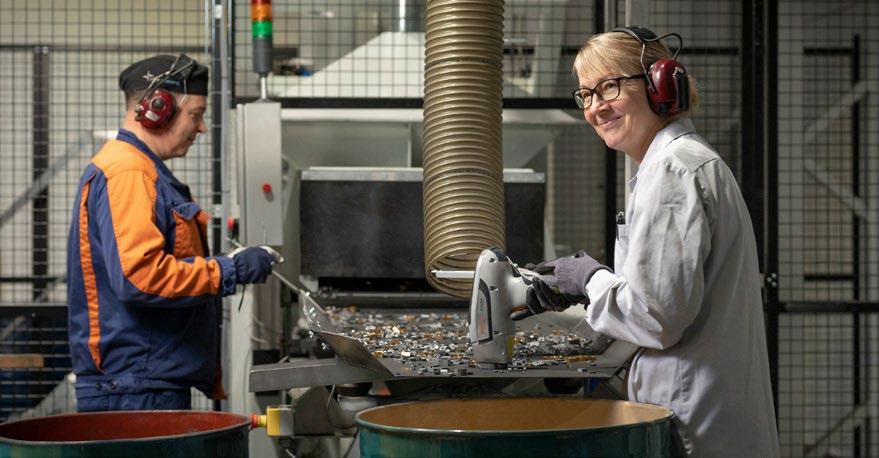
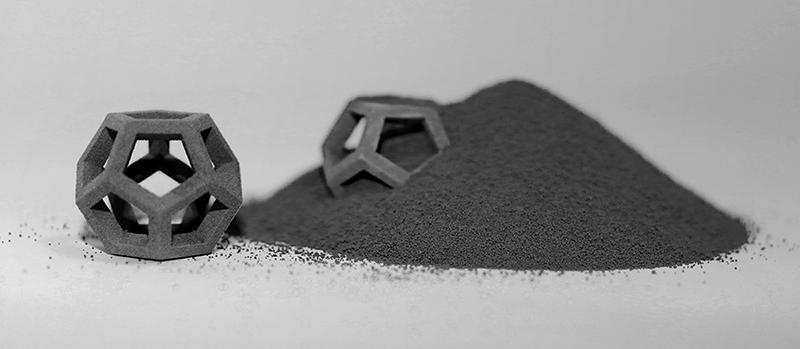
Whatever you create out of tungsten, be sure to start with the best powders on the market.
www.globaltungsten.com Responsible sourcing
GTP. Security of supply Tolling services High quality and purity Recycling services
Whether for additive manufacturing, hard metals industry, oil/gas, tungsten metal, or tungsten heavy alloy applications, Global Tungsten & Powders offers the perfect powder blends. Our laboratories are equipped with the latest technologies allowing material measurements down to the atomic Additionally,level.GTP

Global Tungsten & Powders
recycles any tungsten containing scrap you may have on hand. Benefit from our long standing expertise, especially in utilizing the zinc process for the recycling of tungsten carbide in industrial scale. Talk to our experts to see how we can help.

Alleima begins trading on Nasdaq Stockholm
Alleima is now trading on Nasdaq Stockholm (Courtesy Alleima AB)

The name Alleima is said to combine two core aspects of the company – alloys and materials –with ‘alei’, an antiquated version of ‘alloy’.“This is a historic day for our company and an important step to build for the future,” commented Göran Björkman, president and CEO of Alleima. “We are the result of nearly 160 years of collective minds, working together with our customers. Today, Alleima is a world
leader in its fields and a strong performer in its industry. As a stan dalone company, Alleima will have the right prerequisites to realise its full potential and the best possible conditions for growth and value creation.”“Iwant to thank all our employees for the great work and the quality we deliver and our customers for their trust and the advancements we achieve together,” Björkman continued. “Even though our name is new, we will not forget our origins. We will continue to offer the same advanced high-quality products and services with the same expertise and solutions that our customers are usedTheto.”Annual General Meeting of Sandvik AB decided on April 27, 2022,
16 © 2022 Inovar Communications LtdPowder Metallurgy Review Autumn 2022 | contents | news | advertisers | events | website | e-newsletter | Premium carbon based powders for powder metallurgy. Come to see us at Booth 145 9 - 13 Oct, Lyon Convention Centre GRAPHITEIMERYS & CARBON ENSACO® CONDUCTIVE CARBON BLACKS TIMREX® PRIMARY SYNTHETIC & NATURAL GRAPHITE POWDERS Contact us at imerys.com Tailor made solutions with superior consistency with respect to: purity, crystallinity, particle size distribution and oversize control Imerys grades are ideally suited to powder metallurgy applications for electrical and hybrid vehicles 9 - 13 October 2022, Lyon Convention Centre, Lyon Industry News

to distribute all shares of Alleima AB to the shareholders of Sandvik AB. Shareholders of Sandvik AB as per the record date August 29, 2022, have received one share in Alleima for every five shares held in Sandvik. The total number of outstanding shares in Alleima AB is 250,877,184. Alleima is listed on Nasdaq Stock holm under the ticker ‘ALLEI’. www.alleima.com
Sandvik AB, Stockholm, Sweden, has announced that the shares of Alleima, formerly Sandvik Materials Technology (SMT), have commenced trading on Nasdaq Stockholm. This marks the launch of Alleima as a fully independent company after being part of Sandvik.
The voestalpine Group has announced that it is setting goals to reduce emissions in Scope 2 (energy-related) and Scope 3 (raw materials, transport, etc). These reductions will be stylistically evaluated within the framework of the independent Science Based Targets initiative (SBTi) to ensure the Group’s targets are compatible with the Paris agreement goals and validated correspondingly.
step, partial replacement of the existing blast furnace route with a hybrid-electric steel pathway could reduce carbon emissions by around 30% from 2027, corresponding to around 3 to 4 million tons of CO 2 annually. In 2027, voestalpine
The objectives apply not only to the steel-producing sites in Linz and Donawitz, Austria, but the entire voestalpine Group. Specifi cally, and taking the year 2019 as its reference, the company plans a 30% reduction in Scope 1 (direct greenhouse gas emissions from production) and 2 emissions and a 25% reduction in Scope 3 emis sions by 2029.
Autumn 2022 Powder Metallurgy Review 17© 2022 Inovar Communications Ltd | contents | news | advertisers | events | website | e-newsletter | GETPDF www.ultra-infiltrant.com A SOLID LINE OF THINKING: SINTERING WITH A SOLID YOURINFILTRANTWROUGHT/WIREINFILTRATION SOLUTION. 1868 Corniche Drive, Zionsville, IN 46077 888-ULTRA-55 . privest@ultra-infiltrant.com
voestalpine’s mission is carbonneutral steel production using green hydrogen by 2050, for which the Group is already undertaking research into promising breakthroughwww.voestalpine.comtechnologies.
will begin operating one electric arc furnace at each of the Linz and Donawitz sites; the necessary preparations are already underway.
“We have decided to subject ourselves to examination by the Science Based Targets initiative to offer our stakeholders the greatest possible levels of transparency and comparability when it comes to our climate action measures,” stated Herbert Eibensteiner, CEO. “The complex process of monitoring and goal setting along the entire process chain highlights our commitment to achieving climate neutrality over the long term.”
Industry News

voestalpine joins the Science Based Targets initiative

The Science Based Targets initiative is a partnership between the Climate Disclosure Project (CDP), UN Global Compact, World Resources Institute, and World Wildlife Fund for Nature (WWF). It helps companies align their business activities with the Paris Climate Goals, and provides scien tific proof of this achievement. Globally, around 3,000 companies from a wide range of sectors including the steel industry are involved in the SBTi.
greentec steel is voestalpine’s phased plan for green steel production: in a first intermediate
Sintex a/s, headquartered in Hobro, Denmark, recently celebrated its twenty-fifth anniversary. As part of its celebration, the company welcomed the families of its employees into the facility and announced a DKK 25,000 donation to provide direct emergency relief to Ukraine.
This decision will impact around thirty of Höganäs’ employees and the closing of Höganäs Environ ment Solutions, LLC operations in North Carolina as well as Envi ronmental Solutions’ activities in Brazil, China and www.hoganas.comIndia.
be retooled and become the final assembly location for the new engine. The Michigan plant will continue production of the 3.6-litre Pentastar Upgrade for the Jeep® Grand Cherokee and Jeep Grand Cherokee L. The Tigershark 2.4-litre I-4 engine will build out in the first quarter of 2023.Engine blocks will be cast at the Kokomo Casting Plant, reput edly one of the largest facilities of its kind in the world. More than $14 million will be invested to convert existing die cast machines and cells for the new engine. Etobicoke Casting will produce the oil pan for the new engine.The company will invest nearly $2 million to support the devel opment and installation of new tooling and equipment upgrades. www.stellantis.com
Based on a current Stellantis production engine in Europe, this engine, the first to be produced by Stellantis in the region, will power two future North American HEV models. Production is expected to begin in early 2025.
18 © 2022 Inovar Communications LtdPowder Metallurgy Review Autumn 2022 | contents | news | advertisers | events | website | e-newsletter |
Stellantis has announced plans to invest a total of $99 million in three North American plants for the production of a new four-cylinder turbocharged engine. In line with the company’s Dare Forward 2030 plan, investments will be made at the US Dundee Engine Complex in Michigan and the Kokomo Casting Plant in Indiana, as well as the Etobicoke Casting Plant in Toronto, Ontario, Canada.Thenew engine is a 1.6-litre, I-4 turbocharged unit with direct fuel injection and flexibility for hybridelectric vehicle (HEV) applications.
A Grundfos Group business, Sintex manufactures and supplies a range of Powder Metallurgy components, including stainless steel parts, sintered stainless steel filters, Metal Injection Moulding, metal spraying, soft magnetic composites and permanent magnetic systems such as magnetic couplings and magnetic rotors.The company supplies to a wide variety of industries across the world.www.sintex.com
“This has been a hard deci sion to make, and we have worked thoroughly to explore options and investigate alternative routes forward,” stated Fredrik Emilson, CEO, Höganäs. “However, given the current market traction, we need to refocus our efforts on our core business and continued sustainable business transformation journey. Our priority will be on helping the affected employees and we are committed to supporting them moving forward.”
Höganäs Environment Solutions will be closed to allow parent company Höganäs to better focus on its core metal powder business (Courtesy Höganäs AB)
With an investment of nearly $83 million, Dundee Engine will
Stellantis to invest $99M in engine production across three North American plants
A contributing factor to the exit decision was last year’s imposed force majeure situation at Höganäs’ Niagara Falls plant, which ended in the closure of the site.
Sweden’s Höganäs AB has announced that it will exit its water treatment business and close Höganäs Environment Solu tions, LLC, based on a strategic
Höganäs Environment Solutions to close as focus moves to core metal powder business

Sintex Metallurgyyearstwenty-fivecelebratesofPowder
Industry News
decision to consolidate and focus on the group’s core business. The company stated it will focus on the continuing development of the competitive and sustain ability advantages within Powder Metallurgy, electrification, surface coating and Additive Manufac turing.Höganäs Environment Solutions was founded in 2017 in Cary, North Carolina, USA, as the company’s business platform for research & development, commercialisation and support of environmentally focused products and solutions. The company offered the Cleanit advanced metals-based drinking water, industrial wastewater and environmental remediation prod ucts.
Powder Metallurgy parts maker
● AIR CLASSIFIER AC SERIES FOR PRECISE SEPARATION OF METAL POWDERS ne and coarse powder fractions especially in the range < 25 µm, where conventional sieving operations fail.
Ideal for LPBF, MIM and other Additive Manufacturing applications with the need for high quality powders with high purity, sphericity and wide range of reproducible particle size distribution.

● GAS OR ULTRASONIC ATOMIZATION FOR SPHERICAL POWDERS WITHOUT ANY SATELLITES





● ALL UNITS DESIGNED FOR EASY HANDLING AND CLEANING, QUICK ALLOY CHANGE WITH MINIMUM CROSS CONTAMINATION Inert gas air classi cation on AC 1000 atomizationUltrasonicG www.bluepower-casting.com SEE YOU AT WorldPM FORMNEXT20222022 Gas Ag-basedatomizedsolderalloypowder Gas Atomization Unit AUG 3000 BLUE EQUIPMENTPOWER&EXPERTISE FOR YOUR METAL PRODUCTIONPOWDER Ultrasonic Atomizer AUS 500 powered by AMAZEMET

into






● FOR A WIDE RANGE OF METALS AND FOR SMALL TO MEDIUM AMOUNTS Temp. max. up to 2100° C . Also versions for high-reactive metals as Al or Mg available!


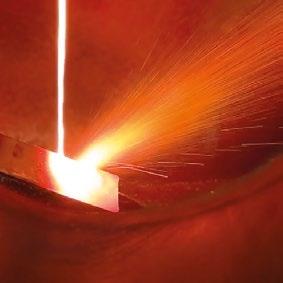
DIFFERENT ATOMIZATION AND SEPARATION TECHNOLOGIES TO MEET YOUR NEEDS:
























● WATER ATOMIZATION FOR MORE IRREGULAR POWDERS Ideal for recycling/re ning process, press & sinter process and others.

POWDER ATOMIZATION PLANTS · AIR CLASSIFIERS · VACUUM PRESSURE CASTING SYSTEMS CONTINUOUS CASTING SYSTEMS · MELTING MACHINES · GRANULATION SYSTEMS 75045 Walzbachtal · Germany · Phone +49 7203 9218-0 · E-mail: info@bluepower-casting.com


● MAXIMUM PURITY BY OXIDATION-FREE PROCESSING in the closed-chamber machine by means of de-gassing, vacuum and protective gas features

From concentrated brine to superiorly spray-dried Lithium powder with GEA.
As world-leading specialist in powder engineering, we have developed exceptional Spray Drying Solutions that define and deliver superior quality powders to your exact specifications in the most energy-and-costefficient way.
Get in touch gea.com/contacttoday The powder makes The difference.
The powder makes The difference.
As world-leading specialist in powder engineering, we have developed exceptional Spray Drying Solutions that define and deliver superior quality powders to your exact specifications in the most energy-and-costefficient way.
Get

Be it a powder, a granulate or an aglomerated product. GEA offers compact, single-line spray drying plants of any desired capacity. Our very own Nozzle or Rotary Atomizer technology allow us to cover a very wide size range. in touch gea.com/contacttoday
Get in touch gea.com/contacttoday
Be it a powder, a granulate or an aglomerated product. GEA offers compact, single-line spray drying plants of any desired capacity. Our very own Nozzle or Rotary Atomizer technology allow us to cover a very wide size range.
Be it a powder, a granulate or an aglomerated product. GEA offers compact, single-line spray drying plants of any desired capacity. Our very own Nozzle or Rotary Atomizer technology allow us to cover a very wide size range.
From concentrated brine to superiorly spray-dried Lithium powder with GEA.
Get in touch gea.com/contacttoday The powder makes The difference.
Be it a powder, a granulate or an aglomerated product. GEA offers compact, single-line spray drying plants of any desired capacity. Our very own Nozzle or Rotary Atomizer technology allow us to cover a very wide size range.
As world-leading specialist in powder engineering, we have developed exceptional Spray Drying Solutions that define and deliver superior quality powders to your exact specifications in the most energy-and-costefficient way.
From concentrated brine to superiorly spray-dried Lithium powder with GEA.
The powder makes The difference.
As world-leading specialist in powder engineering, we have developed exceptional Spray Drying Solutions that define and deliver superior quality powders to your exact specifications in the most energy-and-costefficient way.
From concentrated brine to superiorly spray-dried Lithium powder with GEA.

Autumn 2022 Powder Metallurgy Review 21© 2022 Inovar Communications Ltd | contents | news | advertisers | events | website | e-newsletter | GETPDFIndustry News
rials we have implemented dedicated management systems. On the other hand, we have high expectations towards our business partners and suppliers in terms of sustainability: The non-negotiable fundament of our business relations are – for example – our Code of Conduct for Business Partners, the Sustainability Rating as well as a grievance mechanism. We can only overcome global challenges and succeed in protecting the envi ronment as well as human rights, if we work together with all relevant stakeholders and our business part ners along the supply www.volkswagenag.comchain.”
The Responsible Raw Materials Report is a first for the automo tive industry (Courtesy Volkswagen Group)
A key priority for Volkswagen Group in 2022 is said to be engaging with suppliers in the battery supply chain – from mine to cell – to promote responsible sourcing and mining through credible certifica tion schemes. As a step towards this goal, Volkswagen joined the Initiative for Responsible Mining Assurance (IRMA) in March 2022 and pledged to gradually implement the IRMAstandards in its own battery supply chains.Volkswagen Group’s Board Member for Purchasing, Murat Aksel, expressed confidence about the progress made since the intro duction of the first Responsible Raw Material Report and thanked Volkswagen Group’s suppliers for their cooperation. “On the one hand, we are setting a good example: In order to identify, assess and miti gate human rights risk and ensure responsible sourcing of raw mate
Tekna signs titanium powder supply agreement with Marle Tangible
Often, the highest risks for human rights and the environment occur in the upstream supply chain, which is at a level where the car manu facturer itself does not have direct contractual relationships. This makes transparency and the implementation of standards particularly demanding. In this report, Volkswagen discloses – for the first time – the list of smelters in its tin, tantalum, tung sten and gold supply chains as well as the countries of origin. Further more, the carmaker prepared more binding sustainability requirements for its suppliers, targeting leather and natural rubber, among others.
Chris Collins, Chief Operations Officer at Marle Tangible, stated, “We are delighted to have signed this agreement with Tekna. Their high-quality titanium powders are impressive, consistent, and always delivered in a timely manner. We are very pleased to have secured longtermwww.tekna.comwww.tangiblesolutions3d.comsupply.”
In 2021, Volkswagen Group joined the pledge for a moratorium on deep sea mining, which poses potentially severe environmental risks. Further more, the company joined the Global Platform for Sustainable Natural Rubber (GPSNR) and supported the development of Reporting Require ments for companies in rubber supply chains.
The Volkswagen Group has published its first Responsible Raw Materials Report, detailing the group’s meth odology and activities within a newly implemented due diligence frame work. The report takes a first look back on achievements and offers an outlook on the challenges ahead.
Volkswagen publishes industry-first Responsible Raw Materials Report
Tekna added that the agreement follows a longstanding partnership between itself and Marle Tangible and positions Tekna as a preferred supplier of metal powders in the field of medical implants and devices.
The Responsible Raw Materials Report is said to be a first for the automotive industry, as it is specifi cally dedicated to address mitigation measures against human rights and environmental risks in particularly exposed supply chains. The report covers sixteen high-risk raw mate rials, including battery materials such as lithium and cobalt.
Tekna Holding ASA, Sherbrooke, Quebec, Canada, has signed a long-term titanium powder supply agreement with US-based medical device manufacturer Marle Tangible, formerly Tangible Solutions which was acquired by the Marle Group earlier this year. The agreement will see Tekna supply and deliver titanium powder to be used for Marle Tangible’s additively manufactured and specialised orthopaedic implants.
“We are excited to have been selected by Marle Tangible as their preferred partner for titanium powders,” commented Luc Dionne, Chief Executive Officer at Tekna Canada. “With the Marle Group being a leading player in orthopaedic implants, we consider this agreement a testimonial to the high quality of our products. We are delighted to add Marle Tangible to our growing list of major medical customers and look forward to a long-lasting relationship.”
IperionX Limited, Charlotte, North Carolina, USA, and Oak Ridge National Laboratory (ORNL), Oak Ridge, Tennessee, USA, are collabo rating to develop low-cost titanium alloys for Additive Manufacturing using IperionX’s titanium metal powders. Under a US Department of Energy (DOE) approved User Agree ment, the companies will work at the DOE’s Manufacturing Demonstration Facility (MDF) at ORNL, a 10,200 m 2 facility that is reputedly the nation’s only large-scale, open-access user facility for rapidly demonstrating R&D manufacturing technologies and optimising critical processes.
• Demonstration that press and sinter Powder Metallurgy parts produced using IperionX’s titanium powders have equivalent or better characteristics to parts produced using industry standard titanium
Oak Ridge National Laboratory will use IperionX’s titanium metal powders (Courtesy IperionX)
innovation. The entire Protech sales, service, and applications teams are now part of Micromeritics Korea. Additionally, to further enhance its regional customer support, the company opened an expanded sales, service, and training headquarters in Shanghai, China. The new facility is located near Shanghai Hongqiao International Airport, a hub for regional travel said to be central to the growing businesses related to advanced batteries and the net-zero economy.RubyHooi will lead the company’s sales operations in partnership with its network of distributors in Southeast Asia. Based in Singapore,
John Jordan, vice president of Worldwide Sales & Service, commented, “Asia has been a tremendous growth driver for our company; the demand from innova tive companies and institutions in Korea, China, and Southeast Asia continues to grow. Our investments in Asia are a demonstration of our unwavering commitment to collabo rate, provide superior technology, and deliver expert support to our customers in www.micromeritics.comAsia.”
Key objectives of the User Agree ment include:
22 © 2022 Inovar Communications LtdPowder Metallurgy Review Autumn 2022 | contents | news | advertisers | events | website | e-newsletter |Industry News
Hooi has spent more than a decade providing technical support and building effective relationships with customers in analytical laboratories.
• Evaluation and characterisation of spherical titanium powders produced through IperionX’s
operationsexpandsMicromeriticsinAsia
IperionX and ORNL collaborate for low-cost titanium alloys
The new Micromeritics Korea facility is headquartered in Daejeon, a centre for academic and industrial
Micromeritics Instrument Corpora tion, a supplier of high-performance systems used to characterise parti cles, powders and porous materials based in Norcross, Georgia, USA, has established direct sales, service and support operations in South Korea through the acquisition of Protech Korea, its long-time distributor.
technologies for use in Additive Manufacturing, including opportunities to use titanium powders to manufacture parts which currently rely on other metals, including stainless steel and aluminium.

Aspowders.afocus of the collaboration, initially, press and sinter Powder Metallurgy parts will be produced and tested at the MDF with the aim of validating that the components fabricated with commercially pure titanium or a Ti6Al4V alloy produced by IperionX meet the characteristics for lightweighting for the transporta tion sector, including heavy trucks, aircraft components and other transportation applications where titanium has an advantage over currently used metals such as steel andThealuminium.useragreement is expected to complement IperionX’s ongoing project to qualify and demonstrate the performance of its titanium
powder for additively manufactured aerospace parts, supporting a project with the US Navy to test titanium flight critical metal replacement components for the US Department of Defense.“Weare extremely pleased to be working with ORNL. The laboratory is an ideal partner for IperionX, with expertise in Additive Manufacturing, along with a strong interest in iden tifying new powder feedstocks that lower costs and increase energy efficiency, particularly in transporta tion,” stated Anastasios (Taso) Arima, IperionX’s Managing Director and CEO.He continued, “ORNL brings a knowledge base from numerous collaborations with advanced manufacturing companies, such as partnering in Volkswagen’s first US innovation hub in Tennessee to develop lighter vehicle components from composite materials and elec trify vehicles, its recent work with NASA which resulted in a 3D printed thermal protection shield traveling to the International Space Station, or its 3D printing work with Boeing’s 777x.”“Both organisations share Tennessee roots, and we look forward to progressing the User Agreement and establishing a strong relationship between IperionX and ORNL,” Arima www.ornl.govwww.iperionx.comconcluded.
Phone: +49 (641) 68690 - 140/141 • Mail: ivsinfo@pvatepla.com • www.pvatepla-ivs.com • Precise • reliable • efficient Your Benefits • Highest product quality • Cost efficiency through energy and gas-saving design • Maximum safety • Full compliance with machine directive • Shorter process times with the use of intelligent de-waxing technology and powerful quick cooling Visit us at World PM 2022 - Booth 85

TIJO offers nickel alloy IN625
CNC hydraulic systems, conventional and high-tempera ture sintering furnaces, sinter hardening and automatic sizingwww.dorst.demachines. | www.porite.co.in
Changsha Tijo Metal Material Co., Ltd, (TIJO), Changsha City, Hunan, China, is now offering nickel alloy IN625 metal powder, a non-magnetic, corrosion and oxidation resistant, nickel-base superalloy for Additive Manufacturing.
IN625 provides high fatigue strength and tough ness, with resistance to corrosion in temperatures up to 1093°C. The alloy is said to have good weldability in Laser or Electron Beam Powder Bed Fusion (PBF-LB and PBF-EB) Additive Manufacturing processes.
24 © 2022 Inovar Communications LtdPowder Metallurgy Review Autumn 2022 | contents | news | advertisers | events | website | e-newsletter | •Cold Isostatic Press (CIP) •Hot Isostatic Press (HIP) • Warm Isostatic Press (WIP) •Hyperbaric simulators ENGINEERED PRESSURE SYSTEMS INTERNATIONAL NV Industriezone TTS – zone Waas 2608 Walgoedstraat 19, 9140 Temse – Belgium T: +32 (0) 3 711 24 64 E: info@epsi.be hhttps://epsi highpressure com/ Your partner for all High-Pressure solutions Industry News
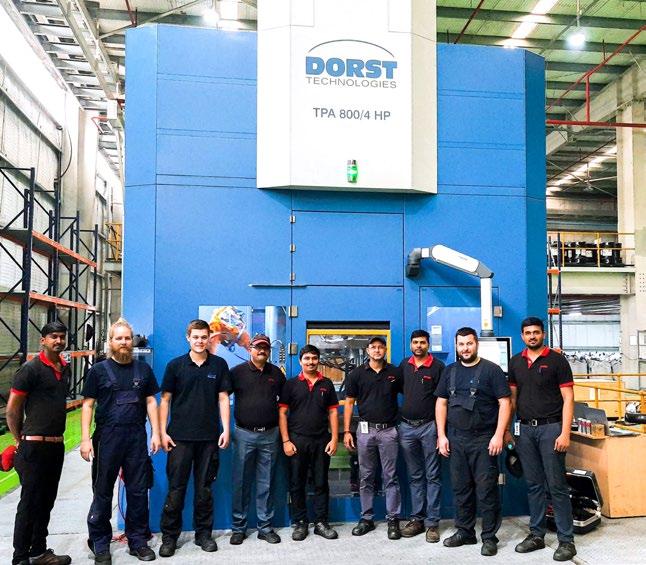
Porite India Pvt Ltd, Pune, India, has added a new TPA 800/4 hydraulic CNC powder press from Dorst Tech nologies GmbH, Kochel am See, Germany. The 8000 kN multi-platen press is now installed and operational at its Powder Metallurgy production facility in Pune. The TPA 800/4 reputedly offers high productivity and reproducibility while maintaining tight tolerances. The modular design, offering up to four upper and four lower tool levels, is equipped with an interchange able die set system for efficient setup and fast product changeover.PoriteIndia began commercial parts production at its 25,000 m 2 facility in 2017, manufacturing compo nents for vehicles and power tools, as well as oil-less bearings for sectors such as electronics, aviation, green energy, and industrial production. The company has a range of compacting presses, including advanced
TIJO’s IN625 AM alloy powder is reported to contain low amounts of oxygen, up to 0.03%, typically ranging at 0.015~0.020%. The powder morphology is typically spherical, with a smooth surface and a low level of powder www.tijo-metalpowder.comsatellites.
Porite India has added a new TPA 800/4 hydraulic CNC powder press from Dorst (Courtesy Porite India)
Parts built from IN625 can be heat treated and material properties can be varied within a specified range. Parts can be finished by various conventional means, including machining, EDM, hot-peening, grit-blast, vibratory polishing, and coatings in both as-built and in heat-treated conditions. Suitable applications include heat shields, furnace hardware, combustion liners and spray bars, gas turbine engine ducting and chemical plant hardware, as well as special marine applications.
Porite India expands production with hydraulic CNC powder press from Dorst
COMPACTINGFORSOLUTIONSEVERYNEED
Thanks to the competences available within the Group, SACMI also supplies state-of-art furnaces for the Powder Metal Industry and versatile solutions for automation aiming at increasing output rates while ensuring maximum simplicity of operation.
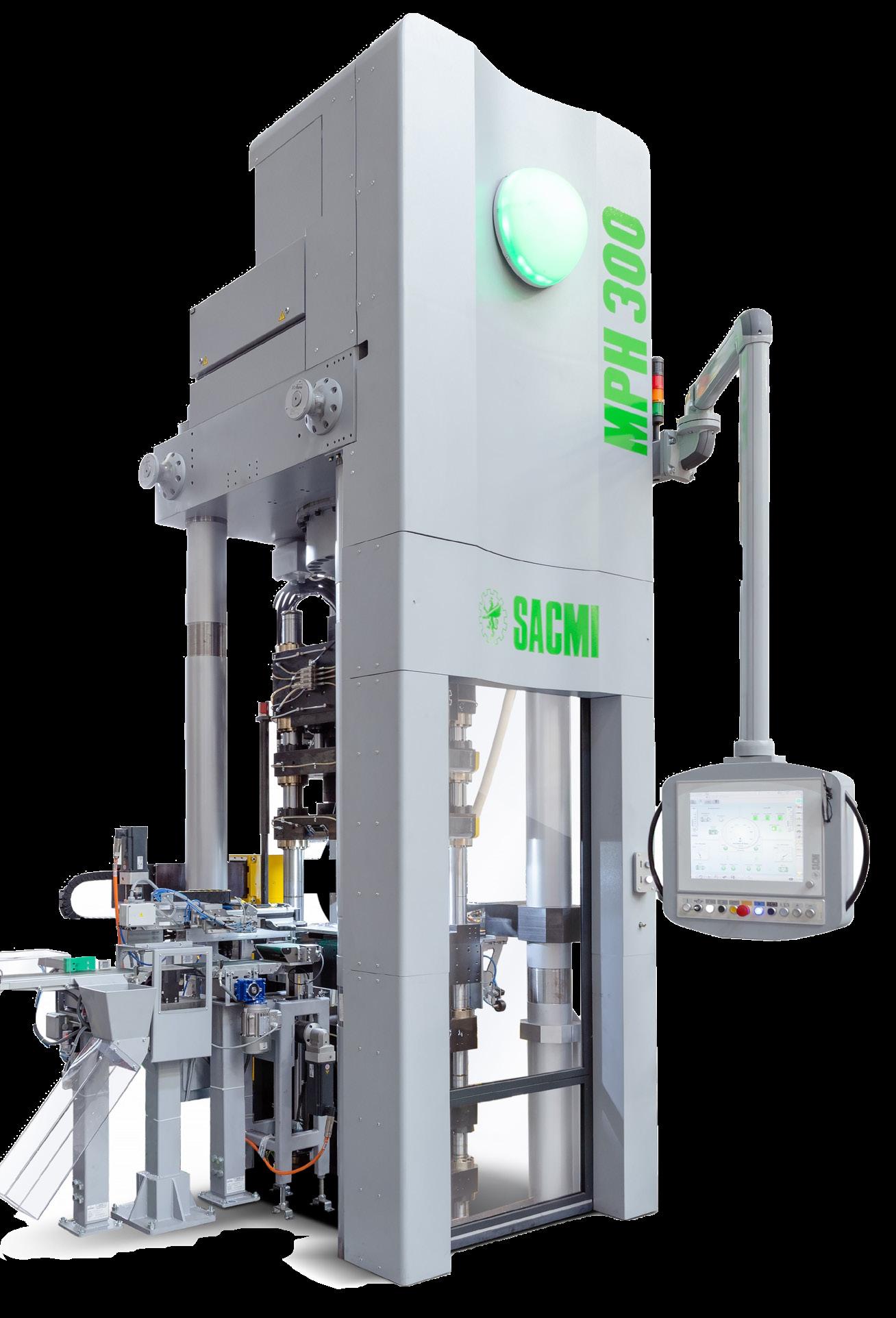
As a result of many years in the Powder Metal field and over a century of experience in designing machinery for many industries, SACMI presses are technologically advanced yet simple, safe, and highly reliable.

www.sacmi.com
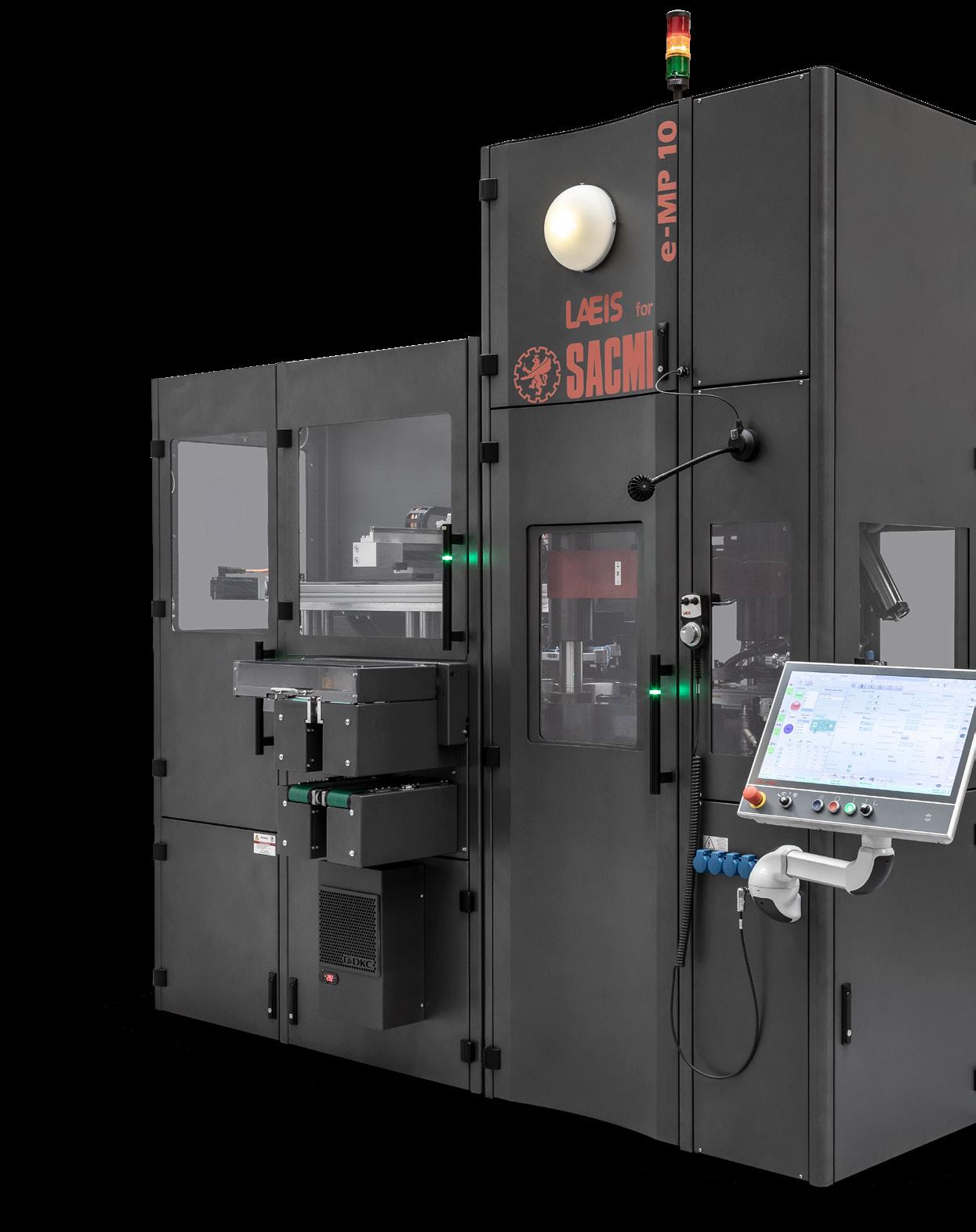
The last-born e-MP full electric presses, besides their outstanding precision and productivity, find their perfect application in the hard metal market for the production of cutting tools and inserts, but also in the field of Technical Ceramics, thanks to their appreciated flexibility of operation. They can also be equipped with an integrated automation for part extraction and palletization, allowing a very easy and efficient control of the whole productive cell.
MPH fully CNC hydraulic presses, suitable for high-speed cycles and continuous work shifts, grant extreme flexibility during the tooling and set-up stages; they offer outstanding energy efficiency and are the right choice for the compaction of multi-level parts of whatever powder.
From 80 kN up to 5000 kN
Date: Topic:
26 © 2022 Inovar Communications LtdPowder Metallurgy Review Autumn 2022 | contents | news | advertisers | events | website | e-newsletter |Industry News
Electrical presses SP and MP
The Plansee Group, headquartered in Reutte, Austria, has reported record sales of €2.02 billion in the fiscal year 2021/22, up 56% from the previous year. Excluding the effect of fully consolidating the Ceratizit subsidiary for the first time, the increase in sales would have been 15%, the company added.
Looking ahead to the current fiscal year, Wex was optimistic about the first half of the year. The Plansee Group is on solid economic footing and the order books are well filled. At the same time, however, Wex also pointed to the risks: the unpredict able consequences of the Ukraine war, uncertain gas supplies, rising inflation, increasing trade barriers between countries and regions, and excessive stockpiling in some supply chains. “This is causing us prob lems and will have an impact on our economic development in the second half of the year,” commented Wex.
Pioneer. Partnership. Performance.
LowEco-friendlyoperational costs Maximumprecisionproductivity
have reorganised its tungsten powder production to be more competitive. It is increasingly based on recycling, and to meet its ambi tious recycling targets, Ceratizit has launched an initiative to recover and recycle as much tungsten scrap as possible. The recycled tungsten is used in the Plansee Group to manufacture new products. Modern recycling technologies ensure that products made from recycled tungsten have identical properties to products made from virgin tung sten.
Outlook
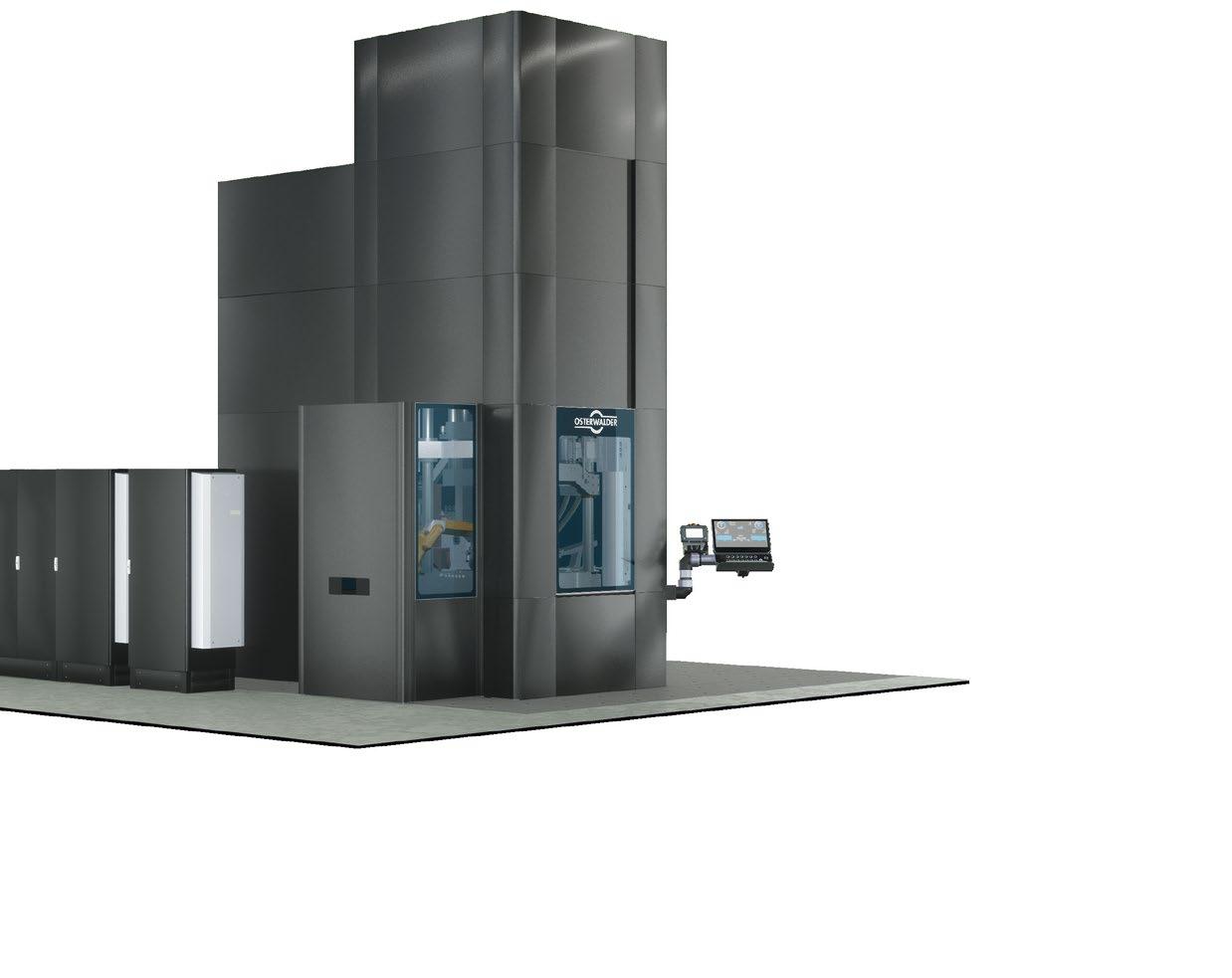
Electrical powder presses from your solution partner
With the acquisition of Ceratizit, the Plansee Group is reported to
High
www.osterwalder.com
The Plansee Group expects difficult external conditions to continue in the current fiscal year. Rising electricity and gas prices, rising inflation, logistics and supply prob lems in the procurement markets and a lack of skilled workers in several professions are among the challenges, the company stated. www.ceratizit.comwww.plansee.com
a major effort for our employees and managers. A major effort that we are successfully mastering,” stated Karlheinz Wex, spokesman of the Plansee Group Executive Board, at a press event in Reutte.
General conditions for the year were said to be anything but favour able, with disrupted supply chains, significant increases in raw mate rial costs and long delivery times presenting the Plansee Group with major challenges. However, the strong economy, internal improvement measures and the full consolidation of the hard metal subsidiary Ceratizit led the Tyrolean group to a new sales record.
“First the pandemic, then supply chain problems, now the Ukraine war. These challenges were and are
The Future of Powder Compacting is ELECTRIC
Plansee reports record sales of over €2 billion
Submitting news to PM Review is free of charge.
Contact Paul paul@inovar-communications.comWhittaker:
Additionally, nitrogen gas is mandatory for some specific technologies and applications, as it provides the perfect chemical composition for the desired mechanical properties during the final stage. The manufacturing plant’s lean design ensures, through a simple switch, a fully automatic changeover of the system, resulting in an elevated degree of efficiency and avoiding contamination.
In order to maintain the highest atomising perfor mance, the vacuum inert gas atomisation (VIGA) system automatically manages the different physical properties between the two gases. Mimete atomisation recipes are custom-made in order to deliver the distinctive prop erties of each gas (for instance, nitrogen bears lower specific weight and higher cooling capacity) and to achieve the best metal powder characteristics.
www.mimete.com
According to Mimete, a number of new alloys specifi cally developed in partnership with its customers have revealed that manufacturing based on argon gas does not fulfil all the customer’s technical requirements when compared with nitrogen gas.
Submitting news...
Autumn 2022 Powder Metallurgy Review 27© 2022 Inovar Communications Ltd | contents | news | advertisers | events | website | e-newsletter | GETPDF GF Machining Solutions Tooling for CompactingPowderTechnology System 3R + Simple, quick set-up + High accuracy + Low scrape rate + Maximal machine utilization + Increased productivity GFMS, System 3R Int’l AB, Sorterargatan 1, S-162 50 Vällingby, Sweden, e-mail: info.system3r@georgfischer.com, www.system3r.com
As both gases are inert, they are able to reach very low levels of oxidation in the molten and powder forms. Therefore, they can be employed to equal effect in metal powder manufacturing. The company explains that argon is the gas of choice for manufacturing processes where high purity is required, such as nickel superalloys. Nitrogen is preferred in steel manufacturing dedicated to Hot Isostatic Pressing consolidation as it is soluble in metal.Andrea Tarabiono, Manufacturing Director of Mimete, commented, “The addition of nitrogen, as an alternative to argon, integrates our starting plant set up, giving us the opportunity to fulfil the specifications of new customers and introduce brand-new alloys that were not feasible before. With a lean process, switching from one gas to the other is simple and straightforward. Moreover, it results in zero contamination between the two gases and enhances our market response.”
Mimete adds nitrogen atomisation option
Mimete SrL, a division of the Fomas Group, Osnago, Italy, reports that its manufacturing facility can now offer nitrogen as well as argon for the atomisation of metal powders. The company states that due to the increased demand for custom metal powders, and the potential technical advantages nitrogen offers, the decision was made to expand the manufacturing facility’s capacity.
Industry News
www.jpma.gr.jp
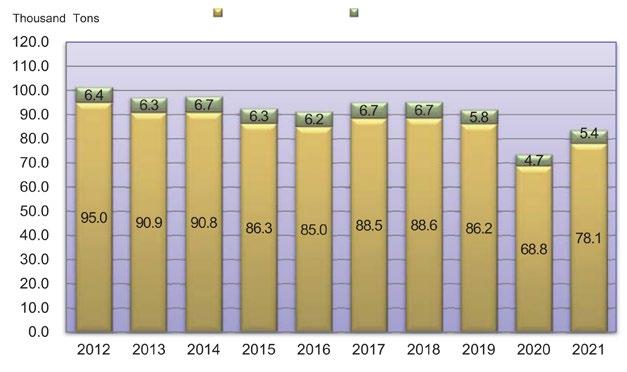
The production of structural parts and bearings in Japan from 2012 through 2021 (Courtesy METI/JPMA)
Shipments of iron powders in Japan by sector (Courtesy JPMA)
The trade association stated that in 2021, the volume of structural parts produced was 78,145 tons, a 13.5% increase from the previous year. The volume of PM bearings produced was 5,445 tons, a 16%
Shipments of copper powders in Japan by sector (Courtesy JPMA)
Of the other powder categories, the volume of friction materials was reported to be 881 tons – a 50.9% increase from the previous year.
Japan’s Powder Metallurgy industry begins road to recovery
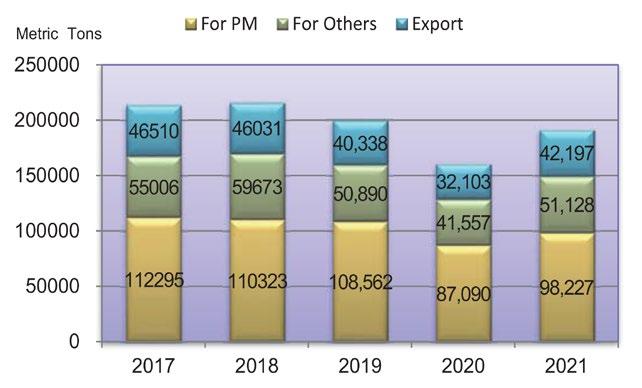
Iron powder shipments
Copper powder shipments
Production of metal powders for PM applications
28 © 2022 Inovar Communications LtdPowder Metallurgy Review Autumn 2022 | contents | news | advertisers | events | website | e-newsletter |Industry News
Shipments of ‘other powders’ in Japan from 2016 through 2020 (Courtesy JPMA)
increase from the previous year. Unsurprisingly, the automotive industry remained the largest consumer of PM structural parts and bearings by volume, with struc tural parts production for vehicles identified as 72,946 tons, a 12.2% increase from the previous year, and bearings production for vehi cles at 3,721 tons, up 15%.
The increase in demand for struc tural parts and bearings resulted in an increase in the production of metal powders. An increase in demand from overseas was notable, with a 31.4% rise in iron powder exports from the previous year accounting for 42,197 tons.
Electrical contacts volume was at 91 tons, a 33.8% increase from the
Structural parts and bearings production
The Japan Powder Metallurgy Association (JPMA) has published statistics showing the production volumes of Powder Metallurgy structural parts and bearings in Japan in 2021, along with figures highlighting the production of metal powders in the country.
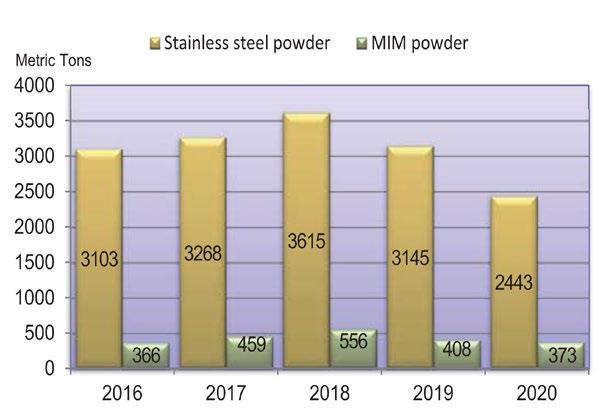
Figures for MIM powders in 2021 are not yet available, but the JPMA believes that, following a decrease in 2020, MIM powder shipments will recover to the level of 2018.
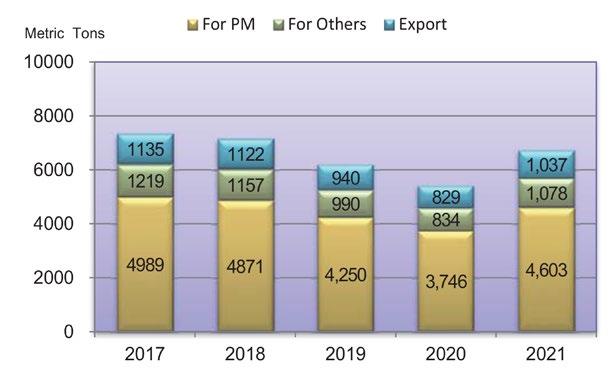
Other powder shipments
Structural parts Bearings
previous year. Despite the ongoing issues with COVID-19, demand for MIM parts for medical appliances was said to be good.
Structural parts and bearings
With an integrated, special die carrier, the press is designed for maximum rigidity and strength. It
The company’s Powder Metal lurgy products are used in a wide range of industries including the automotive sector, consumer
can be programmed through an intuitive, state-of-the-art visualisa tion system supported by Dorst’s Intelligent IPG program generator for the powder pressing process.
Read more about the Porite Group in Powder Metallurgy Review magazine, Autumn 2018. www.porite.com.twwww.dorst.de
electronic products, electrical instruments, industrial products, office equipment, electric home appliances, aerospace and green energy. Established in 1952, Porite Taiwan contributes 45% of the total production of the Porite Group.
30 © 2022 Inovar Communications LtdPowder Metallurgy Review Autumn 2022 | contents | news | advertisers | events | website | e-newsletter |
Porite Taiwan has added a fourth TPA1600/3 Powder Metallurgy press from Dorst (Courtesy Porite Taiwan)
Porite Taiwan installs fourth Dorst 1600 powder press
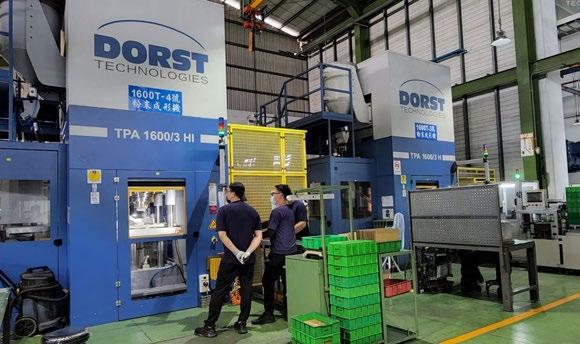
Porite Taiwan Co Ltd, Miaoli, Taiwan, has further expanded its manu facturing capacity with a fourth TPA1600/3 Powder Metallurgy press from Dorst Technologies GmbH, Kochel am See, Germany. The 16,000 kN hydraulic CNC powder press is now installed and opera tional at Porite’s Powder Metallurgy production facility.
Porite Taiwan has a range of compacting presses from 0.5 tons to 1600 tons, including advanced CNC hydraulic systems and automatic sizing machines. It has in-house tooling capability, with advanced wire cutting and electric discharge machines used to manufacture high-quality tooling. In addition to press and sinter Powder Metallurgy, the company also offers Metal Injec tion Moulding production.
The TPA1600/3 high-performance press, in a height-reduced design, is reported to enable efficient press forming of thin, single-level plates, with and without surface structure, as well as substrates and wafers for electronic applications, batteries and fuel cell elements.
Industry News
• Wide assortment of press tooling
Serving worldwide PM markets with fast turnaround
Tekna Holding ASA, Sher brooke, Quebec, Canada, has signed contracts for the sale of two TEK15 research scale plasma atomisation systems which enable the development of highly spherical metallic or ceramic powders. The two systems will be used to produce spherical powder of various materials to be applied in Addi tive Manufacturing processes such as Binder Jetting, as well as Metal Injection Moulding.
acquisition of Peterson Tool Company
• presently
Tekna announces two orders for its research-scale TEK15 plasma
• Specialty contoured surfaces
• Casting available for more complex shapes
in service in Europe, Asia & U.S.
•
• Setter tiles and other sintering trays
PTC’s product offering includes custom carbide form inserts for high-production turning and grooving appli cations, primarily within the general engineering and automotive segments. The company has a department dedi cated to designing and manufacturing HSS, carbide tipped, and solid carbide tools.
Broad product offering for the unique demands of the PM and MIM industries
Fast leadtimes reduce in-house stocking levels Contact us today to learn more. USA: 01 708 344 dthurman@sunrockceramics.com7600 Industry News
• Pusher plates for rapid cycle hydrogen atmosphere pusher furnaces
• Thin profiles
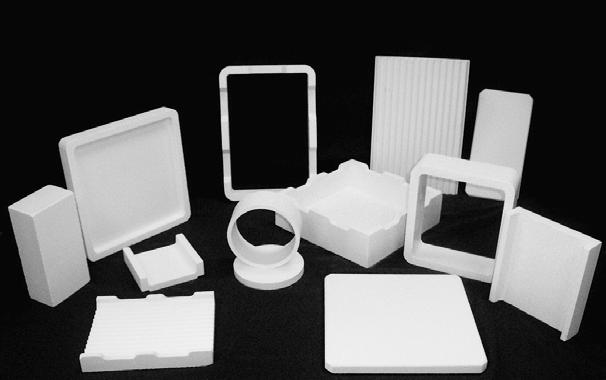
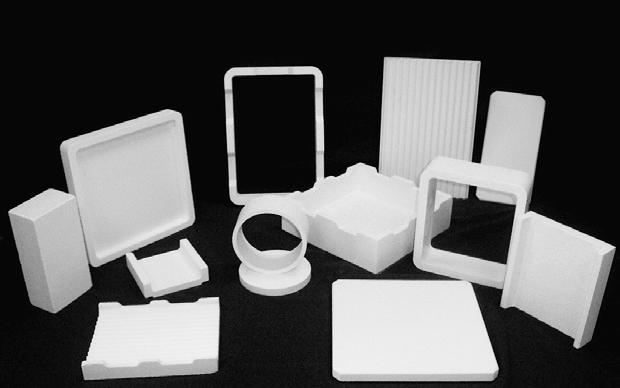
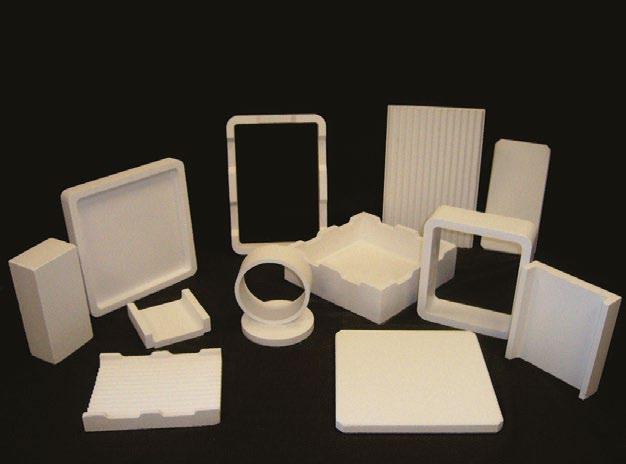
Sunrock Ceramics specializes in high alumina industrial ceramics for the most severe sintering applications in the powder metallurgy and technical ceramics markets.
PTC is reported to be a recognised worldwide leader in special cutting tool solutions, primarily for the automatic screw machine market, whether it be multi-spindle or single spindle. In 2021, the company reported revenues of $9 www.home.sandvikmillion. | www.petersontool.com
Autumn 2022 Powder Metallurgy Review 31© 2022 Inovar Communications Ltd | contents | news | advertisers | events | website | e-newsletter | GETPDF
Sandvikwww.tekna.comAB,headquartered
Products
Tekna will sell two TEK15 plasma systems which will be used for R&D purposes (Courtesy Tekna Holding)
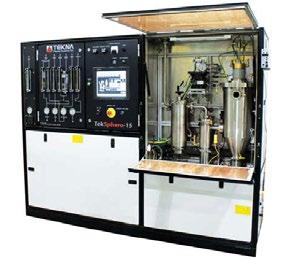
The orders amount to a total value of $1.45 million and will be delivered to customers in early 2023. The systems will be used in a government research centre in Asia and by a private company in the USA for commercial R&D purposes.“OurTEK15 system fosters innovation by enabling our customers to experiment with many different materials,” stated Romain Vert, Director of System Sales at Tekna. “The system has been developed to allow users to explore different plasma environments and conditions and make swift adjustments to produce different variations of mate rials. These agreements take the number of units sold up to fifty-seven and correspond with the increased demand Tekna is experiencing for its advanced materials.”
in Stockholm, Sweden, has announced that it has completed its acquisition of Peterson Tool Company, Inc., (PTC), Nashville, Tennessee, USA, a leading supplier of machine-specific custom insert tooling solutions. The company will be reported in the GWS Tool business unit in Walter, a division within the business area of Sandvik Manufacturing and Machining Solutions.
Sandviksystemcompletes
Wuling is reportedly a driving force in China’s growing EV market, selling 420,000 Hongguang Minis, which start at just 32,800 yuan (US $4,885). The company has yet to announce the price of its new model
Electric vehicle boost in Southeast Asia as local production begins
Thailand is reported to be aiming for EVs to reach 30% of its auto production by 2030. It has begun offering tax incentives and subsi dies for those looking to purchase. China’s Great Wall Motor has received orders for over 4,700 Ora vehicles since they went on sale in Thailand during November, more than double the country’s entire EV sales in 2021. Great Wall looks to reduce prices further by starting Thai production as early as 2023. Nikkei Asia added that Toyota Motor and SAIC Motor also are taking advantage of the Thai incentives. Toyota is expected to start selling
Looking for PM production equipment, metal powders, R&D support and more?
The Mercedes-Benz Group plans to start assembling vehicles in Thailand this year, while Thai state energy group PTT aims to begin EV production in 2024 with Hon Hai Precision Industry, the Taiwanese manufacturer also known as Foxconn.Volvo
Advertisers’ index & buyer’s guide
in Indonesia, however it is expected this could ignite the EV market in that country, where the majority of models now cost over $35,000 and only around 700 new EVs were sold in Indonesia last year.
Honda’s joint venture with Guangzhou Automobile Group in China has begun building an electric vehicle factory in Guangdong with an annual production capacity of 120,000 EVs (Courtesy Reuters/Honda)
In the Philippines, a law to bolster the EV sector took effect in May. It requires logistics providers and public transportation opera tors to electrify at least 5% of their fleets by a date to be decided later. The government is weighing new incentives for the import and manu facturing of such vehicles.
Japanese-built EVs in Thailand later this year, with plans to switch to local production as early as 2024.
32 © 2022 Inovar Communications LtdPowder Metallurgy Review Autumn 2022 | contents | news | advertisers | events | website | e-newsletter |Industry News
The electric vehicle market is taking off in Southeast Asia as automakers plan to start production in at least three countries this year, reports Nikkei Asia . Many of these companies are based in China and South Korea, while Japanese automakers, which now account for more than 90% of new-car sales in Southeast Asia, are said to be falling behind.
Discover suppliers of these and more in our new advertisers’ index and buyer’s guide, from page 114 to 116
Honda Motor’s joint venture in China with Guangzhou Automobile Group has begun building an electric vehicle factory in Guangdong prov ince with an initial investment of 3.49 billion yuan ($522 million), reported Reuters . The Japanese automaker is aiming to start the factory’s opera tion in 2024, it said in a statement. The new factory has an annual production capacity of 120,000 units.

Honda said another EV plant in China, in a joint venture with Dong feng Motor Group, is also expected to start operations in https://asia.nikkei.com2024.
Cars announced in March that it had begun assembling vehi cles in Malaysia. The Fieldman Group, a Malaysian producer of palm oil and other commodities, said in January that it would build a joint EV assembly plant with China’s Changan Automobile.VinFast,the automaking arm of Vietnamese conglomerate Vingroup, began selling locally made EVs in December. It plans to manufacture and sell vehicles in the US as well.
Hyundai Motor began full-scale production at its new electric vehicle factory in Indonesia earlier this year and China’s SAIC-GM-Wuling Auto mobile unveiled a new mini EV slated to start production in the Southeast Asian country by the end of the year.
1945,
Since NSL Analytical has been to the highest standards of quality, supports innovation powder metal, feedstock, designs final products
by testing
and
Validating Powders, Feedstock & Products

for the Powder Metallurgy Industry. Our capabilities include: Visit NSLPowder360.com to learn more or call 877.560.3875 g Powder Characterization — static and dynamic flow, density, particle size distribution, particle shape and moisture content g Surface Area — particle size, shape, roughness and porosity g Material Composition — chemical analysis of major and trace level elements for R&D and specification conformance g Validate Metal Printed Parts — metallurgical evaluations, mechanical testing, microstructure and failure analysis g Powder Studies — alloy development and powder re-use
verify
prototype
trusted
understandanalyze,test, Trust | Technology | Turnaround 4450 Cranwood Parkway, Cleveland, OH 44128 877.560.3875 | ISO/IEC 17025 ASME NQA-1 COMPLIANT
performance, and safety. NSL
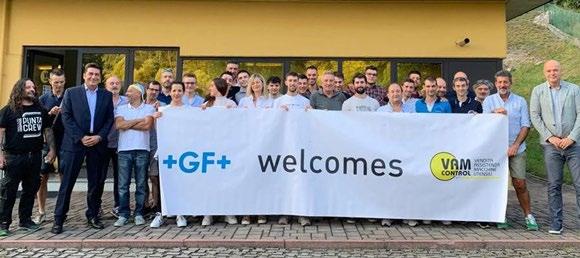
GF Machining Solutions, a division of GF, Schaffhausen, Switzerland, has announced that it has acquired 100% of Vam Control S.r.l., a machine tool service provider based in Onore, Italy. The acquisition closed on July 15, 2022, and is said to be a further step in line with the company’s Strategy 2025, which aims to strengthen its milling and auto mation capabilities and expand its service offering in Europe.
Carpenter Technology Corpora tion, headquartered in Philadelphia, Pennsylvania, USA, has announced financial results for its fiscal fourth quarter and year ended June 30, 2022. Net sales for the fourth quarter of 2022 were $563.8 million, compared with $421.6 million in the fourth quarter of 2021. This resulted in a net income of $2.6 million, up from a $57.1 million loss in Q4 2021.
Founded in 1997, Vam Control specialises in services for machine tools and currently has thirty employees. The company reported sales of €4 million in 2021. GF Machining Solutions is one of the
Overall, full year 2022 net sales were $1,836.3 million, up from $1,475.6 million in FY2021, with a net loss for the year reported at $49.1 million, an improvement on the $229.6 million loss reported for FY2021.
Operating income for the fourth quarter of 2022 was $24.6 million compared to an operating loss of $70.7 million in the prior year period. Adjusted to exclude special items, operating income was $14.9 million in the recent fourth quarter compared to adjusted operating loss of $12.5 million in the same period a year ago. The improvement in operating income is reported to be the result of increased shipments as activity levels continued to ramp to meet improving market conditions in key end-use markets compared to the previous year.
Carpenter Technology eyes accelerated growth in fiscal year 2023
Engineers (FSE) capabilities and enhance the service and solutions offered to its customers. The acqui sition will reportedly enable it to develop additional services for the European market, such as machine refurbishments and rebuilding key components and www.gfms.comwww.vamcontrol.itdevices.
“In the fourth quarter, our backlog grew by 29% on a sequential basis and 191% year-over-year. We also generated positive free cash flow of $65 million and finished the fiscal year with total liquidity of $448 million. The fourth quarter’s oper ating income results were driven by double digit sequential revenue growth in the aerospace and defense and medical end-use markets.”
34 © 2022 Inovar Communications LtdPowder Metallurgy Review Autumn 2022 | contents | news | advertisers | events | website | e-newsletter |Industry News
three divisions of GF and provides solutions for precision components, tools manufacturers and the mouldmaking industry. Founded in 1802, the corporation operates in thirtyfour countries with 139 companies, sixty-one being production facilities. GF employs over 15,000 staff and generated sales of CHF 3,722 million in 2021.GFMachining Solutions explains that customer service has expanded in recent years and is now one of the strategic segments for the company’s future growth. With the acquisition, the company anticipates that it will be able to strengthen its in-house milling and Field Service
“Fiscal year 2022 proved to be a challenging but successful year,” Thene continued. “We navigated through an unforeseen outage of our Reading Press, continued COVID-19 isolations, a difficult hiring environment, and other supply chain challenges. But in addressing each of them, I believe we are emerging from it stronger and well-positioned for growth.”
GF acquires machine tool service provider Vam Control
“Our fourth quarter results marked a successful end to the year and place us on strong ground to deliver accelerated growth in fiscal year 2023,” stated Tony Thene, Carpenter Technology’s president and CEO. “The quarter saw us return to a positive EPS as both the Specialty Alloy Operations (SAO) and Performance Engineered Products (PEP) segments outperformed our expectations. We also continued to expand our backlog across our end-use markets and secured
“Looking ahead, we expect to see continued growth across our end-use markets, especially in aerospace, defense and medical applications, where customers are still ramping to pre-pandemic levels. To capitalise on the demand in our core business, we are focused on achieving addi tional productivity and capacity gains through the Carpenter Oper ating Model. Further, our strong position in our core business is supported by our capabilities in key emerging areas including electrification and additive manu facturing that further support our long-term growth profile. We believe the continued execution of our strategy will drive sustainable long-term value creation for our customers and shareholders,” he concluded.www.carpentertechnology.com
another price increase on our trans actional business as overall demand conditions across our end-use markets remain strong.”
GF Machining Solutions has acquired machine tool service company Vam Control S.r.l. (Courtesy GF Machining Solutions)
Your Partner in MIM/AM We’ve got one mission, to support as many metal part makers in the MIM and Metal AM industry as possible. Our team of processing experts utilize 20+ years of experience to share all our knowledge and help you overcome challenges, develop better processes and become successful part makers. We help develop real world, practical solutions based on many lessons learned along our journey. Being the ONLY debind and sinter service provider with full sized production equipment, we are honored that we have been able to support every industry currently utilizing MIM and Metal AM. DSH is the only source for the best process support, toll processing and educational resource for your MIM and Metal AM applications. We Remoteoffer:Process Engineering, Small/Large Toll Processing, R+D projects, Educational Support on Total Process Management. Navigation and Support In a complex industry, we’ll guide you the entire way. 107 Commerce Road | Cedar Grove, NJ 07009 USA | +1 973.239.7792 | dshtech.com



NLB, we know a reliable pump is critical to keep your atomization system in operation. With 50 years of experience engineering reliable pumps up to 2,760 bar (40,000 psi). Our pumps can easily integrate into your control center using your current system and produce your ideal particle size. To further diminish down-time, NLB has parts and service nearby, ready when you are. Call us today to learn more!
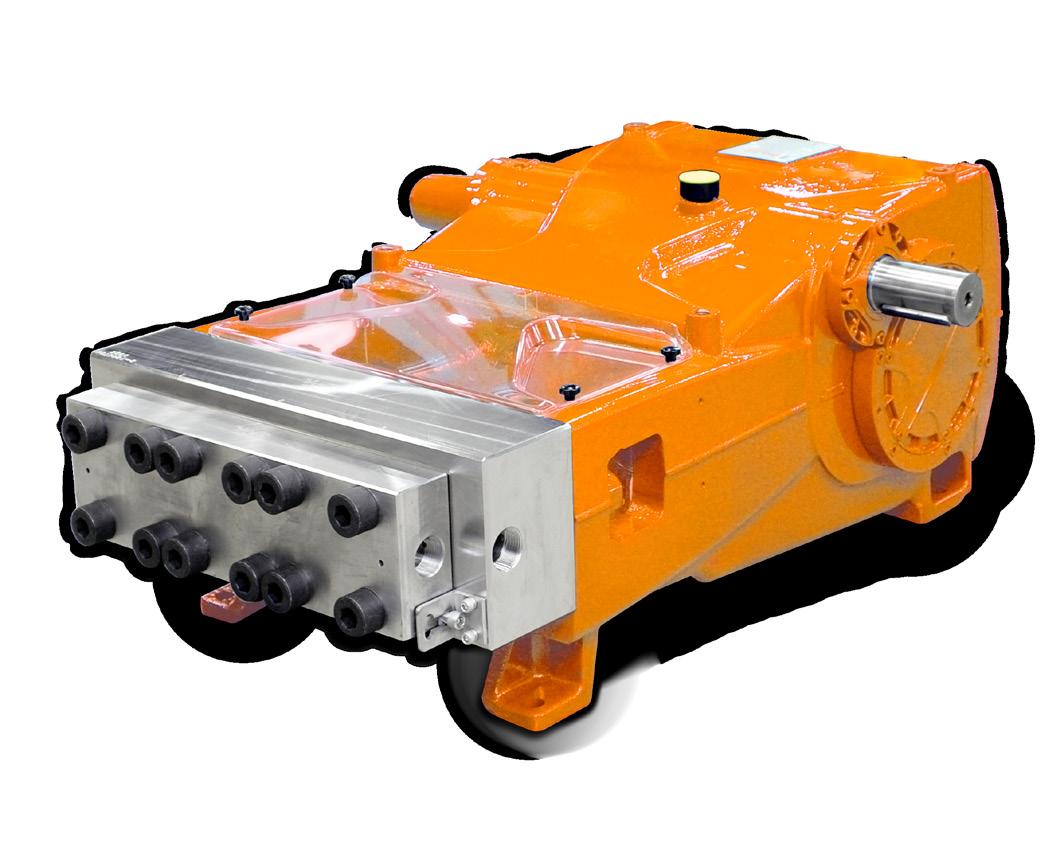
US (800) 441-5059 Europe +44 7391 745 119
At
Analytics company S&P Global, headquartered in New York, USA, has published a study entitled ‘The Future of Copper: Will the looming supply gap short-circuit the energy transition’. This study comes as a response to concerns raised by authorities – including the US government, the International Monetary Fund and the International Energy Agency – about the avail ability and reliability of minerals needed to reach climate goals.
36 © 2022 Inovar Communications LtdPowder Metallurgy Review Autumn 2022 | contents | news | advertisers | events | website | e-newsletter |
UPGRADE TO A RELIABLE PUMP CURRENTREPLACINGWITHOUTYOURSYSTEM.
“Copper is the metal of electri fication and absolutely essential to the energy transition,” stated Daniel Yergin, vice chairman, S&P Global. “Given the global consensus for NetZero Emissions by 2050, it is critical
The study utilises a detailed bottom-up approach, technology by technology, to quantify the amount of additional copper that will be required by increased electrifica tion and the energy transition – most specifically, the rapid move to electric vehicles and renewable electricity and the need for increased electricity infrastructure. It then examines the ability of copper supply to meet that demand on the basis of current trends, or with an unprec edented acceleration of supply from mining and recycling. It also identi fies the key operational risks that can constrain future supplies.
NLBCORP.COM
S&P Global’s latest study covers looming copper supply shortfalls (Courtesy S&P Global)
The study projects that copper demand will nearly double in the next decade – from 25 to 50 million metric tonnes – in order to deploy the technologies necessary to achieve net-zero goals by 2050. This demand is expected to grow to 53 million metric tonnes in 2050: more than all of the copper consumed in the world between 1900 and 2021.
to understand the physical materials required for achieving that ambi tion. The world has never produced so much copper in such a short timeframe as would be required. On current trends, the doubling of
Industry News
S&P study finds copper supply may pose challenge in achieving net-zero goals
global copper demand by 2035 would result in signifi cantNotably,shortfalls.”thestudy posits, growth in new copper supply capacity – from new mines or expansions of existing projects – would unlikely be able to keep pace with the surge in demand. The International Energy Agency has estimated that it currently takes sixteen years, on average, to develop a new mine, meaning that a new mine seeking permission today would not become productive in time to accommodate the demand spike.
Autumn 2022 Powder Metallurgy Review 37© 2022 Inovar Communications Ltd | contents | news | advertisers | events | website | e-newsletter | GETPDF
Formoreinformationvisitourwebsite
PNxxxxx
Structural
Such a supply gap would have broader consequences across the global economy, disrupting supply chains for both energy transition and non-energy transition indus tries, the study says. Given copper’s use in a wide range of end markets, it would also exert tremendous upward pressure on the cost of goods for global manufacturers as well as energy costs for consumers.
The study also finds that the burgeoning supply gap would exacerbate the growing reliance on copper imports in the United States, in particular. Imports made up nearly 44% of US copper usage in 2021 — up from just 10% in 1995. Under the study’s scenarios, that share would swell to between 57 and 67% by 2035. An intensifying competition for critical metals is very likely to have geopolitical implications, the study says.
www.malvernpanalytical.com/MetalPowders
That leaves increases in capacity utilisation (output as a percentage of an existing mine’s total capacity) and recycling as the main sources of additional supply, according to the study. Under current trends — whereby both capacity utilisation and recycling rates remain at their current ten-year global average — the study’s Rocky Road Scenario projects annual supply shortfalls that reach nearly 10 million metric tonnes in 2035. That is equivalent to 20% of the demand projected to be required for a 2050 net-zero world.
Industry News
“The challenge for all active participants in the energy transition will be to manage often competing and seemingly contradictory priorities in this New Era of Copper Demand,” said John Mothersole, director, non-ferrous metals, S&P Global Market Intelligence. “Technology and innovation will both be critical in meeting this challenge, as will partnership between governments, producers and end-users. ‘Dr Copper’, as the metal is called, may well currently be, as it has been in the past, a leading indicator of a slowdown in economic growth or recession, but the overall supply outlook for the years ahead is extremely tight.”
www.ihsmarkit.com
Measure the phase composition, residual stress, grain size and texture of your final parts with our advanced and versatile X-ray diffractometers
Get analytical insight into your materialsManufacturingAdditiveandprocesses
Morphological
Confirm the elemental composition of your alloys and presence of contaminants quickly and accurately with our trusted X-ray fluorescence systems
Ensure your powders have the correct particle size and shape distribution for optimum packing and flow with our class-leading laser diffraction and image analysis solutions
Elemental
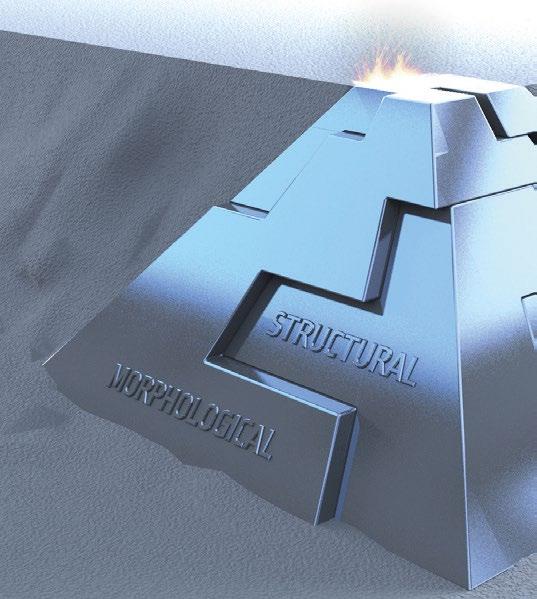
“This comprehensive analysis demonstrates that, even at the outer edge of what could happen in copper mining and refining operations, there would not be enough supply to meet the demands of a Net-Zero Emis sions by 2050 world,” added Mohsen Bonakdarpour, executive director, economics and country risk, S&P Global Market Intelligence. “Even strong price signals and incentivising policy initiatives, aggressive capacity utilization rates and all-time high recycling rates would not be enough to close the gap.”
corrosion resistance, evaluate thermal stress and distortions, and understand coating thermal shock response.www.weiss-technik.com/enwww.twi-global.com
38 © 2022 Inovar Communications LtdPowder Metallurgy Review Autumn 2022 | contents | news | advertisers | events | website | e-newsletter |
Johnson Electric Holdings Limited, headquartered in Hong Kong, has reported its business operations and finances for the three months ending June 30, 2022. The group, which includes Powder Metallurgy parts maker Stackpole International, reported that sales were down 4% from the same quarter in 2021, at $840Foreignmillion.exchange rate movements had a negative effect of $37 million on the group’s sales for the quarter. This was mainly due to the impact of weaker average exchange rates, especially for the Euro, but also for the RMB and Canadian Dollar against the US Dollar, compared to the same quarter in 2021.
Asia sales, which primarily repre sent goods invoiced to Asia-based OEMs and contract manufacturers whose end products are mostly destined to export markets, were said to have declined owing to the combination of supply chain disrup tions caused by COVID lockdowns in China, ongoing shortages of semicon ductor chips and other components, and a decline in demand for some ‘home-centric’ products that had experienced an exceptional surge in sales during the pandemic. In Europe, sales grew in the beverage and lawn segments and, in the Americas, in the medical, ventilation and white goods segments, due to increased demand.
“Despite external challenges, our business units continue to work collaboratively with customers to adjust prices to offset the surge in cost input increases experienced in the past year,” stated Dr Patrick Shui-Chung Wang, chairman and Chief Executive. “Our global operating footprint and geographically diverse sales mix also provides Johnson Electric with strong foundations to navigate further potential volatility in the macro www.johnsoneletric.comeconomy.”
quarter.Ona regional basis, APG’s sales also fared better than automotive industry production volumes, which were constrained by shortages of semiconductors, in all regions during the quarter. The sales changes by region, excluding currency effects and the acquisition of Zimmermann, were decreases of 15% in the Amer icas; 7%, in Asia; and 2%, in Europe.
TWI, Cambridge, Cambridgeshire, UK, has acquired a climatic chamber from Weiss Technik, Germany, for the conditioning of metal powders for Additive Manufacturing. The new climatic chamber will be used to assess the influence of storage conditions, such as the effect of humidity and temperature, on AM metal powders as part of IUK funded Scalable AM Rule Creation & Dissem ination (SAMRCD) project.
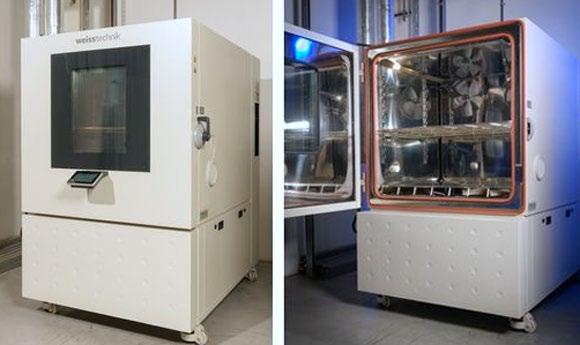
Industry News
COVID-related factory lockdowns in China adversely affected sales of powertrain cooling and Powder Metallurgy products, although other areas – such as closure and water pumps – increased. In Europe, oil & water pumps, coolant valves and Powder Metallurgy parts were said to be strong, although sales of other products decreased due to a reduc tion in light vehicle production in the region. In the Americas, there was strength reported across many product lines.
The Automotive Products Group (APG) reported sales for the quarter ended 30 June, 2022 decreased by $20 million, or 3%, compared to the same quarter in 2021. Excluding currency effects and the acquisi tion of E. Zimmermann GmbH, APG’s sales increased by $9 million, or 1%, in the quarter. This increase in underlying sales compared to a 4% decrease in global light vehicle industry production volumes in the
regulation of testing parameters to ensure simulation conditions meet the necessary requirements.
the quarter, with Asia reporting a decrease of 33%; Europe, of 7%; and the Americas, 16%.
The Industry Product Group’s sales for the quarter decreased by $17 million, or 8%, compared to the same quarter in 2021. Excluding currency effects, IPG’s sales decreased by $12 million, or 6%, in
Climatic chamber for conditioning metal powders installed at TWI
Johnson Electric reports strong sales of PM parts in Europe
The climatic chamber is capable of simulating various environmental conditions, due to its extended temperature and humidity ranges. Additionally, the climatic chamber allows for rigorous checking and
The SAMRCD project operates through a consortium led by Authen tise Ltd, London, UK, having been awarded a competitive grant by the UK Research and Innovation’s (UKRI) Transforming Foundation Industries challenge, delivered by Innovate UK. The consortium includes ICD, Mate rials Processing Institute, TWI and Photocentrics.TWIwillalso use the new climatic chamber to help customers simulate a particular environment for metal powders, simulate storage or oper ating conditions. It will help assess
TWI will use the Weiss Technik climatic chamber to assess the influ ence of storage conditions, such as the effect of humidity and tempera ture, on AM metal powders (Courtesy TWI)
www.bodycote.com Bodycote provides a complete service solution for metal parts built by the additive manufacturing process, including stress relief to minimise distortion and residual stress, EDM to prepare the component for hot isostatic pressing (HIP), heat treatment or HIP to remove microporosity, and associated quality assurance testing. Reduction in rejection rates and inspection costs Fatigue properties on par with wrought material Significant improvement in fatigue strength, fracture toughness, and tensile ductility 100% reduction in porosity possible Improved machined surfaces and consistency in properties Improved microstructure ADDING VALUE TO MANUFACTURINGADDITIVE the partner of choice for additive manufacturing heat treatment | metal joining | hot isostatic pressing | surface technology
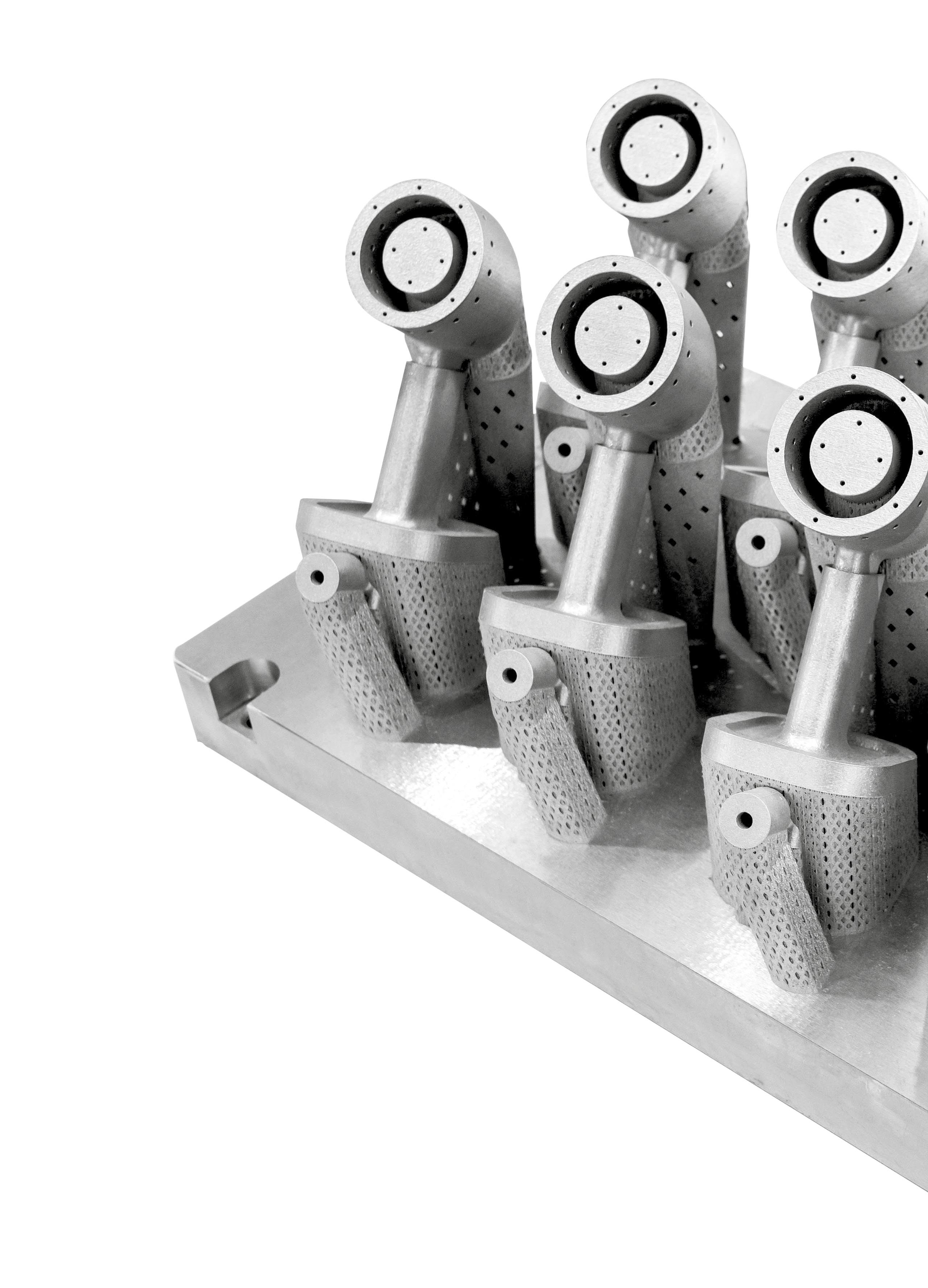
rights, sustainable procurement and ethics/compliance. All informa tion must be provided with suitable evidence and, in a further step, the data is evaluated by EcoVadis. The analysis of each topic is based on three key indicators: policies & guidelines, measures and results. After analysing the responses and related documents, EcoVadis summarises the results into an overall and a topic-based score and provides an overview of strengths andwww.ecovadis.comwww.vdm-metals.comweaknesses.
Anzeige_AM_märz22.pdf 6 01.03.2022 15:59:10


















40 © 2022 Inovar Communications LtdPowder Metallurgy Review Autumn 2022 | contents | news | advertisers | events | website | e-newsletter | ADVANCED HEATING high vacuum, inert gas, hydrogen benchmark for cleanest atmosphere combinded debinding & sintering furnace from laboratory scale to high volume production additivetechnicalmanufacturingceramicspowdermetallurgyhardmetalsCMYCYMYCMYMCK
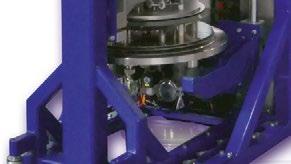

VDM Metals has been awarded Gold status by EcoVadis (Courtesy VDM Metals International)

















Sustainability oriented processes and structures are said to play a prominent role within the Acerinox Group, which has also been a member of the UN Global Compact since 2013. The first performance evaluation of the company took place in 2018, with further evaluations taking place at the end of 2019 and in summer 2021.

“We are very proud of this award, as we were able to improve our rating for the fourth time in a row,” stated Dr Niclas Müller, CEO. “This
Industry News


VDM Metals receives Gold status from EcoVadis
VDM Metals International GmbH, Werdohl, Germany, a leading supplier of nickel alloys and high alloyed special stainless steels and part of the Acerinox Group, has been awarded Gold status by EcoVadis for the first time. Gold status puts VDM Metals among the top 5% of compa nies evaluated by EcoVadis.
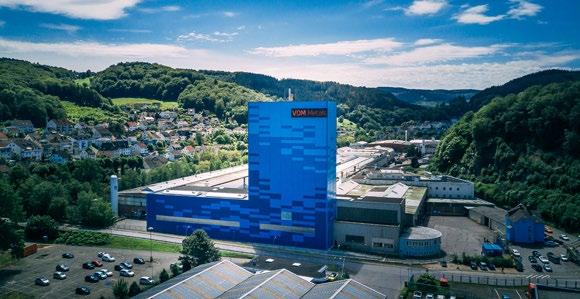




development proves that we are on the right track. At the same time, the Gold status is an encouragement to further improve our sustainability performance.”EcoVadisprovides a platform through which companies can have their sustainability performance independently assessed. Customers can access this evaluation and then take it into account in their purchasing decisions. In recent years, the EcoVadis platform has developed into an international standard, and more and more VDM Metals customers are requesting access to the company’s assessment results.Theevaluation takes place in several steps. The main element of data collection is a questionnaire covering the topics of environ mental activities, labour & human

ASM International has announced two key changes to the Society’s leader ship structure, with the promotion of Ryan Milosh to Chief Operating Officer and the addition of Kelvin Scott as Chief Information Officer. ASM International is the world’s largest professional technical society serving the needs of scientists, engi neers, and technicians who develop, test, select, and apply advanced materials, including metals, compos ites, polymers, and ceramics.
ASM structureitschangesannouncesInternationalkeytoleadership
ASM International has announced Kelvin Scott (left) as CIO and Ryan Milosh (right) as COO (Courtesy ASM International)

As Chief Operating Officer, Milosh will be responsible for oversight of all ASM International operations, except the Data Ecosystem and Information Technologies groups. In his most recent position, Milosh has
Scott is joining as a full-time staff member after five years in an IT counsel role with ASM Interna tional. His background includes more than twenty-two years of running international consulting businesses, providing IT strategy, enterprise architecture, and programme management. As Chief Information Officer, Scott will work across the organisation to develop and deploy ASM’s digital strategies and infor mation technology systems, both internal and www.asminternational.orgcustomer-facing.
Industry News
Autumn 2022 Powder Metallurgy Review 41© 2022 Inovar Communications Ltd | contents | news | advertisers | events | website | e-newsletter | GETPDF www.eltra.com

ELEMENTAL ANALYSIS OF METAL POWDERS & PARTS
served the organisation as Chief Sales and Marketing Officer. He has a wealth of experience in under standing industry requirements, building partnerships and collabora tions, and launching new products andSandyservices.Robert, Executive Director, will continue to work with Milosh on capabilities planning for the rest of the organisation with an eye to aligning the society with its lines of business and strategic priorities, as well as maximising its value to members and customers.
ELTRA’s new and innovative ELEMENTRAC series is a mile stone for C/S and O/N/H analysis in Powder Metallurgy and Additive Manufacturing: easy to use, fast analysis times and reliable results for metal powders and processed samples.
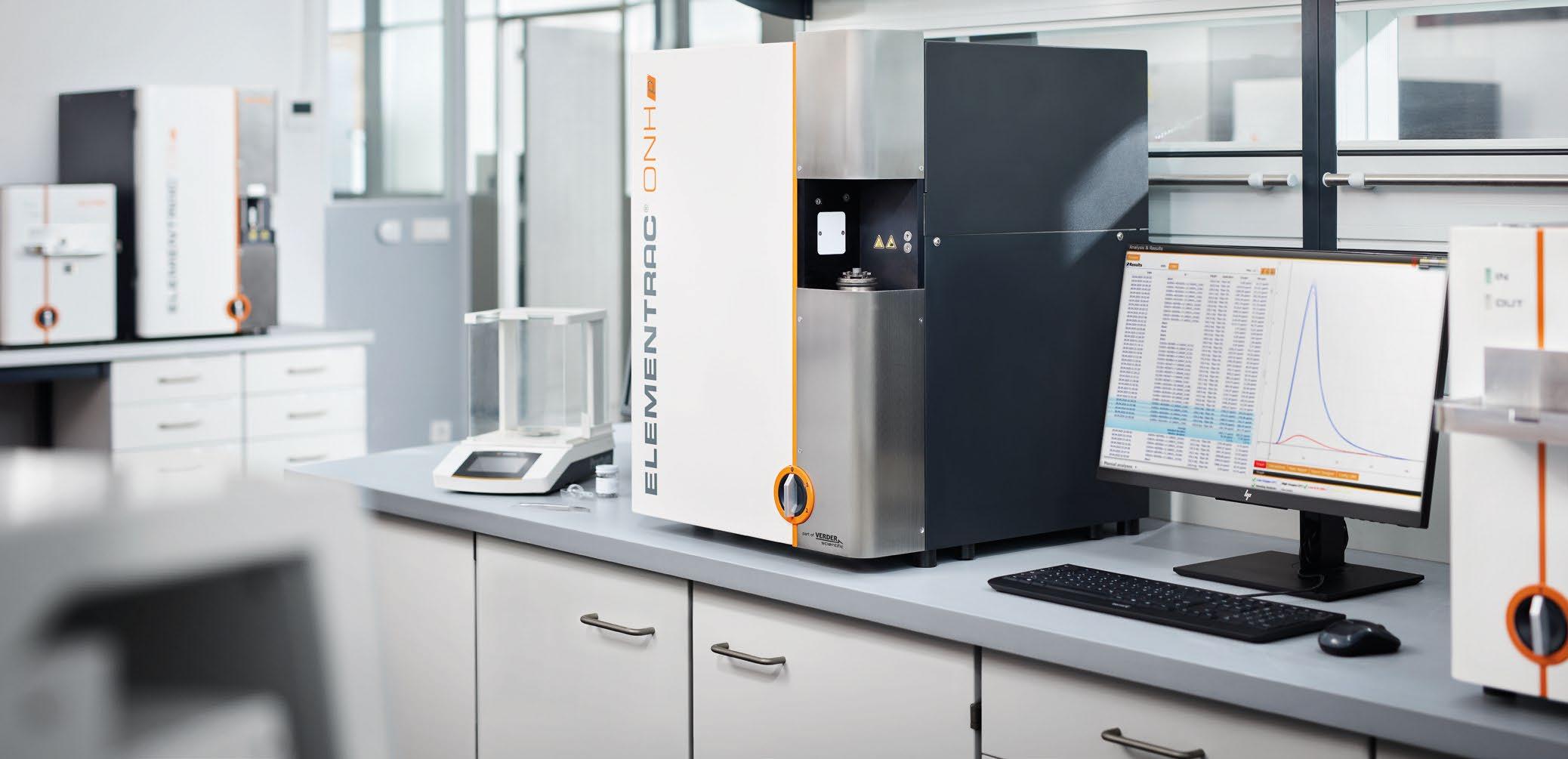
Eltra-Advert-GB-PowderMet-175x120.indd 1 01.03.2022 10:13:43
PLANTS FOR METAL POWDER PRODUCTION – YOUR STEP INTO THE ADDITIVE FUTURE



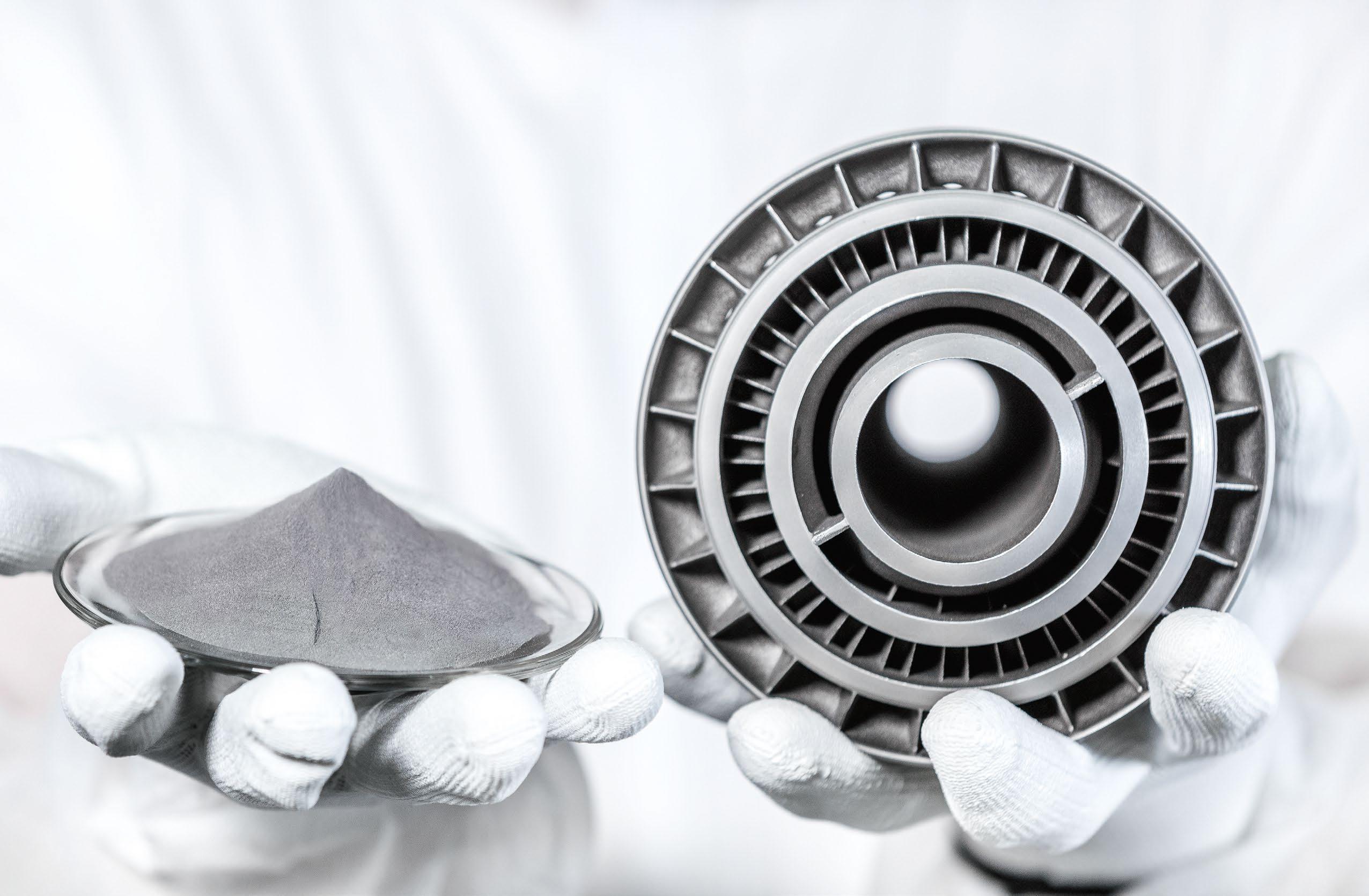
Discover more: https://www.sms-group.com/plants/powder-atomization-plant





Cost-effective and at the same time high-quality metal powders are the drivers for additive manufacturing evolving into a sustainable key industrial technology. With our innovative powder atomization plants, you can produce high-quality metal powder for various powder technologies. And thanks to our digital solutions and financing models, this is particularly efficient, flexible and cost-effective.

Lynas awarded $120M contract to build commercial heavy rare earth facility
Lacaze concluded, “This contract is an excellent example of IndoPacific cooperation to meet supply chain challenges, and Lynas looks forward to collaborating with the DoD, the State of Texas and US manufacturers as we progress our plans for the family,children.outdoors.runner,thewww.lynasrareearths.comfacility.”companyasVPGlobalTechnology.PeterwasakeencyclistandwithapassionfortheHeleavesawifeandfourHewillbesadlymissedbyallhisfriendsandcolleagues.
It is with much sadness that we report the death of Peter Vervoort who passed away on Sunday, August 7, following a fatal cycling accident. He was Peterfifty-four.wasknown to many in the Powder Metallurgy industry having spent the majority of his career working in the furnace sector. He was a regular at PM events, always approachable and keen to share his knowledge and advice.
Peter Vervoort died following a fatal cycling accident
“The development of a US heavy rare earths separation facility is an important part of our accelerated
Phase 1 of the US-based HRE facility was announced in July 2020 and, since, Lynas has worked closely with the DoD to reach this point. Construction costs for the HRE capa
growth plan and we look forward to not only meeting the rare earth needs of the US Government but also reinvigorating the local Rare Earths market,” stated Amanda Lacaze, CEO and Managing Director, Lynas Rare Earths. “This includes working to develop the Rare Earths supply chain and value-added activities.”
Industry News
Lynas has expressed its intention to co-locate the heavy rare earths separation facility with the proposed light rare earth separation facility (announced on 22 January 2021) which is sponsored and half funded by the US DoD Title III, Defense Production Act office.
working in the field of Metal Injec tionInMoulding.1996hejoined OnejoonmannProcessSolutionsbeforementMetalManagerbeforeofElinoManager.whereThermoprozessanlagenCremerGmbH,hewasAssistantGeneralIn2002,hemovedtoIndustrie-OfenbauasheadPowderMetallurgyprocessing,advancingtoGroupR&Din2010.From2011to2013,PeterrantheInjectionMouldingdepartatITBPrecisietechniekB.V.,joiningEisenmannThermalGmbHin2013asVPDevelopment.WhenEisenwasacquiredbyKorea’sin2020,Peterremainedat
Autumn 2022 Powder Metallurgy Review 43© 2022 Inovar Communications Ltd | contents | news | advertisers | events | website | e-newsletter | GETPDF
Born in 1967 in Rozenburg, the Netherlands, Peter studied Materi als Science and Engineering at the Technical University Delft. On completing his degree, he remained at TU Delft as an Associate Scientist,

Lynas Rare Earths Ltd, headquar tered in East Perth, Australia, has announced that its wholly owned subsidiary, Lynas USA LLC, has signed a follow-on contract for approximately US $120 million with the US Department of Defense (DoD) to establish a commercial heavy rare earths (HRE) separation facility in the United States, said to be the first of itsThekind.contract supports Lynas in establishing an operating footprint in the United States, including the production of separated heavy rare earth products to complement its light rare earth product suite. As a result, the US industry is hoping to secure access to domestically produced HREs which cannot be sourced today, yet which are essen tial to the development of a robust supply chain for future-facing indus tries including electric vehicles, wind turbines and electronics.
Following a detailed site selec tion process, the facility is expected to be located within an existing industrial area on the Gulf Coast of the State of Texas and is targeted to be operational in the financial year 2025. Feedstock for the facility will be a mixed rare earths carbonate produced from material sourced at the Lynas mine in Mt Weld, Western Australia. Lynas will also work with potential third-party providers to source other suitable feedstocks as they become available.
“The US government’s selection of Lynas for this strategic contract reflects our proven track record in Rare Earths production,” she continued. “The DoD’s decision to fully fund the construction of the heavy rare earths facility demon strates the priority that the U.S. Government is placing on ensuring that supply chains for these critical materials are resilient and envi ronmentally responsible, and as importantly, their confidence in Lynas’ ability to execute, including access to quality feedstock and processing expertise.”
bility as submitted in June 2021 are fully covered by this DoD contract, which is sponsored and funded by the US DoD Industrial Base Analysis and Sustainment (IBAS) programme.
Peter Vervoort dies following tragic accident
Following a twelve-month construction period, the $195 million state-of-the-art plant aims to start production in late 2023, before ramping up to full capacity in 2024. Pensana hopes to produce 12,500 tonnes of separated rare earths, including 4,500 tonnes of the criti cally important magnet metal rare earths, which represent over 5% of the world’s supply. Saltend will employ over 450 people during the twelve-month construction phase and expects to create 125 jobs.
Rare earth metals company Pensana Plc, headquartered in London, UK, reports that it has broken ground at its rare earth processing facility at Saltend Chemicals Park, located in the Humber Local Enterprise Partnership in Yorkshire, where it plans to create what it states is the world’s first rare earth processing facility powered by offshore wind, producing key components for electric vehicle and offshore wind original equipment manufacturers with low-embedded carbon.
The company states that it has secured funding under the UK Government’s £1 billion Automo tive Transformation Fund (ATF) to support the development of the Saltend rare earths processing facility. The ATF is a funding programme developed to promote the creation of a high-value end-toend electrified automotive supply chain in the UK. It is an important mechanism to reach targets set out in the UK Government’s tenpoint plan for a green industrial revolution and its recent Transport Decarbonisation Plan.


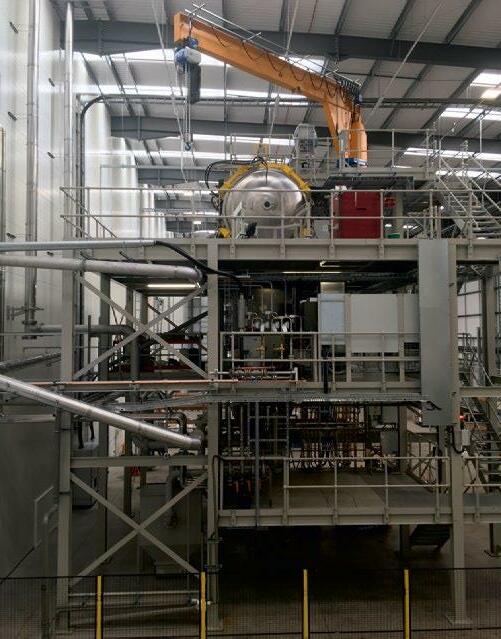


“It is a great privilege to have broken ground on the world’s first independent and sustain able rare earths separation plant,” commented Paul Atherley, Pensana chairman. “This is a huge milestone for both Pensana, the Humber region and the UK, as part of our ambition to establish a critical magnet metals supply chain to secure the green energy transition.”
“Securing ATF funding is a key development, demonstrating the UK Government’s support for this important project in line with the newly launched Critical Minerals Strategy,” he continued. “Pensana is set to play a vital role in trans forming the UK’s electric vehicle and offshore wind industries, by producing low embedded carbon magnet metals and creating highvalue local jobs.”
During the ground-breaking cere mony, the Rt Hon Kwasi Kwarteng MP attended and announced the UK Government’s Critical Minerals Strategy, which details the Govern ment’s approach to securing technology-critical minerals and metals and is an important step towards securing a resilient, longterm supply chain to deliver a green
ContiPour®
44 © 2022 Inovar Communications LtdPowder Metallurgy Review Autumn 2022 | contents | news | advertisers | events | website | e-newsletter | IndustriesScientificPhoenix Ltd High atomisationthroughputgassystems Advanced Process Solutions PSI Limited - Apex Business Park Hailsham - East Sussex - BN27 3JU - UK Tel: +44 (0)1323 449001 info@psiltd.co.uk - www.psiltd.co.uk
For productionthe of metal powders




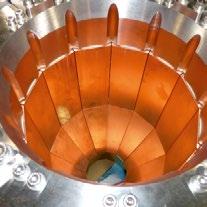

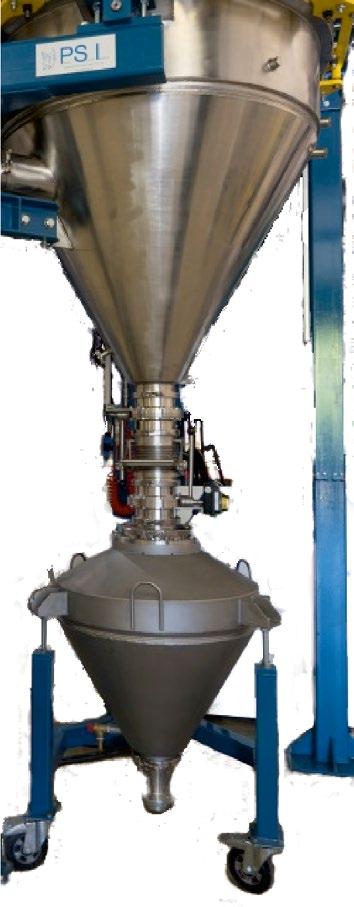
P S I provide excellence in rapid solidification systems to the worldwide A M , S L M , H I P and the renewables industries
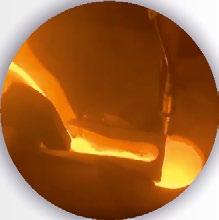

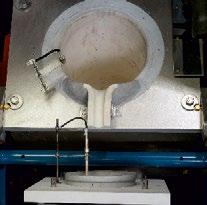
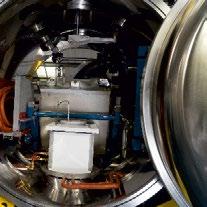

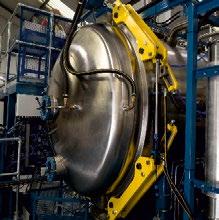
www.pensana.co.uk

Pensana breaks ground at rare earths processing facility

Kwasi Kwarteng MP, Secre tary of State at the Department of Business, Energy and Industrial Strategy, stated, “Pensana breaking ground today has been made possible in part through govern ment support and shows how our plans to secure an internationally competitive electric vehicle supply chain in the UK continues to gain momentum. This incredible facility will be the only of its kind in Europe and will help secure the resilience of Britain’s supplies into the future.”
industrial revolution for the UK.
Pensana breaks ground at its rare earth processing facility at Saltend Chemicals Park (Courtesy Pensana Plc)
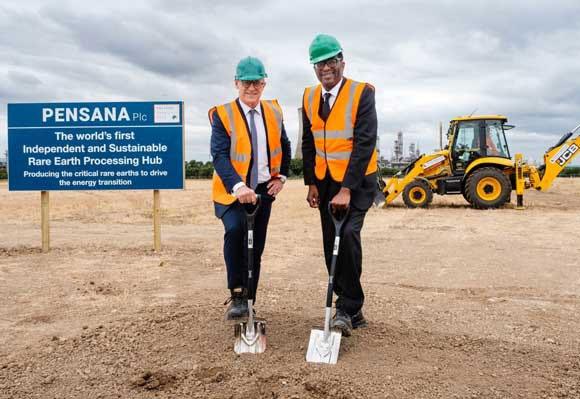
Industry News

EPMA re-elects president and treasurer during 35th General Assembly
Autumn 2022 Powder Metallurgy Review 45© 2022 Inovar Communications Ltd | contents | news | advertisers | events | website | e-newsletter | GETPDFIndustry News
“We hope to unite complementary approaches and research capabili ties with the long-term goal to create dedicated supply chain research centres that will continue to prove out domestic production techniques for CMs,” stated Burt Thomas, technical portfolio lead for critical minerals at NETL. “These domestic sources will provide jobs that can’t be off-shored in American communities that need investment. Many of these jobs will be in the nation’s historic mining and power communities and will incen tivise new cleanup initiatives at legacy mining sites.”
The research in NETL’s portfolio are multi-year efforts intended to catalyse regional economic growth and accelerate the development of upstream and midstream critical mineral supply chain technologies. These efforts are finding uncon
supply chains near unconventional mineral resources.
ers, Bruno Vicenzi and Kenan Boz, presented the various ongoing Euro pean projects and working groups, as well as an overview of the differ ent Sectoral Groups activities over 2021/2022.Moredetailed information was then reported by the chairmen of the various EPMA groups: Cesar Molins from Press & Sinter, Georg Breiten moser from Metal Injection Moulding, Peter Kjeldsteen from Functional Materials, Steven Moseley from Hard Materials, Adeline Riou from Additive Manufacturing and Jim Shipley from Hot Isostatic Pressing.
The lab has coordinated regional teams of researchers across the country through the Carbon Ore, Rare Earth, and Critical Minerals (CORECM) Initiative for US Basins, which is intended to take a step toward comprehensive resource assessment technologies and providing a beach head for the local development of
ventional mineral resources in the country and impacting the down stream manufacturing of high-value, non-fuel, carbon-based products.
In addition to finding economic value in US resources, these projects will promote the environmental and justice initiatives that are a founda tion for long-term social license to operate. CORE-CM Initiatives and the NETL team are committed to ensuring best practices for environ mental health and safety associated with any proposed work.
A look at sustainability in the steel industry was also presented by Clare Broadbent, World Steel Association. www.epma.com
“This challenge is something the US is up for. Research facilities like the proposed research centres at NETL will help scientists, engi neers, and commercial partners in these communities understand the pathways to commercialise their resources,” Thomas continued. “If we succeed, the same communities that kept the lights on for all of us by mining coal may yet be responsible for keeping the lights on by supplying the nation’s magnets, batteries, and electronicwww.netl.doe.govcomponents.”
metaux on Legal Affairs’ and Melina Hervet-Henry of AddUp Solutions gave a talk on ‘Patents applications: a strategic value for the company.’
NETL aims for critical materials supply chain research centres
The National Energy Technology Laboratory (NETL), a US-based national laboratory under the coun try’s Department of Energy Office of Fossil Energy, is working to develop critical mineral supply chains with an approach which is intended to help disadvantaged communities become critical contributors in the nation’s low-carbon energy future.
The 35 th General Assembly of the European Powder Metallurgy Asso ciation (EPMA) marked the first time in two years that members could meet at an in-person event, with the meeting taking place both online and in-person in Brussels, Belgium, on April 28, 2022. During the assembly, it was confirmed that EPMA President, Ralf Carlström of Hoganas AB and EPMA treasurer, Christoph Laumen, Linde GmbH, were re-elected to their positions for a further three-year term.
Keynote speeches, presented towards the end of the assembly, saw Elena Vyboldina of Eurometaux discuss the Russia-Ukraine crisis and its impact on EU non-ferrous metals sector. Chris Heron presented ‘Euro
NETL is currently focused on developing the technology to unlock unconventional sources of critical minerals, including overlooked resources such as waste rock, coal ash and acid mine waters.
Ralf Carlström, Hoganas AB, has been re-elected as EPMA President (Courtesy EPMA)
The EPMA team presented an overview of past and ongoing work. The current situation with the World PM2022 Congress was presented by Sabine Hazoume, while Romain Rayez gave an update on the Communication & Marketing activities. EPMA Technical Manag

PowderMet2022: State of the North American PM industry
North American metal powder shipments 2021 (Courtesy MPIF) North American iron powder shipments 2021 (Courtesy MPIF) Industry News
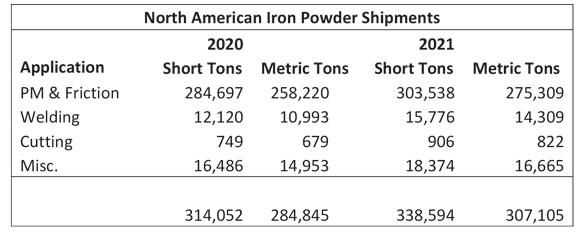
companies to work smarter, be more efficient, and innovative. New production output levels are being achieved thanks to changes and innovations made because of the pandemic. Many companies report reductions in energy consumption, furnace atmosphere gasses, scrap, and waste that is sent to landfills as a direct result of operating more efficiently.”“Somecompanies have replaced older equipment with the latest computer controlled Industry 4.0 technology. This ‘Internet of Things’ approach allows equipment to ‘talk’ to each other and learn the best parameters for the process. Automa tion within the industry continues to grow as a solution to the overall shortage of workers. From pick‐and‐place robots at the compacting presses and furnaces, to 100% vision system inspections, automation will continue to increase.”
iron powder ship ments have been the best barometer of the health of the PM industry,
The MPIF reported that total esti mated 2021 North American metal powder shipments increased by 8.1% to 359,928 mt.
Historically,mt.
North American metal powder shipments
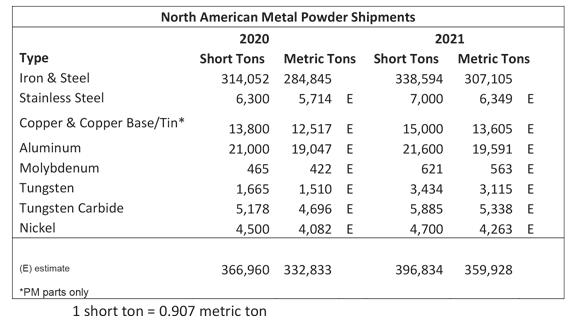
chain. We continue to feel the negative effects of the COVID‐19 pandemic,” began Brennen. The semiconductor microchip processor shortages also had a major impact on the PM sector, and continues to cause delays in automo tive production. “Most automotive companies, whose vehicles use an estimated 20‐100 processors each, depending on the vehicle’s features, agree that recovery will begin in the second half of 2022, but a normal supply won’t be met until well into 2023. Volkswagen doesn’t expect demands to be met until 2024,” BrennenFurtherexplained.globalevents negatively impacting the PM industry were highlighted by Brennen, who then went on to say that many of these major disruptions should be viewed as opportunities. “They have forced
The Opening General Session included a presentation by MPIF President Rodney Brennen, who gave delegates a detailed overview of the state of the North American Powder Metallurgy industry.
“The PM industry is alive and well, landing back on its feet, and on its way to recovery,” noted Brennen.
The PowderMet2022: International Conference on Powder Metallurgy & Particulate Materials, and the co-located AMPM2022: Additive Manufacturing with Powder Metal lurgy Conference, was held in Portland, Oregon, USA, from June 12–15, 2022. Organised by the Metal Powder Industries Federation (MPIF), the event included three days of presentations accompanied by an exhibition and a range of social and networking events.
“The North American Powder Metallurgy industry has not been immune from the unprecedented challenges facing the global supply‐
Refractory powder had a strong showing in 2021 after decreased shipments over the past few years. Molybdenum shipments increased an estimated 33.5% to 563 mt. Tung sten powder shipments increased by an estimated 106% to 3,115 mt, and tungsten carbide powder shipments increased an estimated 13.7% to 5,338
46 © 2022 Inovar Communications LtdPowder Metallurgy Review Autumn 2022 | contents | news | advertisers | events | website | e-newsletter |
Total iron powder shipments increased 7.8% to 307,105 mt. Stainless steel, copper, nickel, and aluminium powder shipments all increased by an estimated 3% to 11%. Estimated shipments for 2021 include stainless steel powder, 6,349 mt; copper and copper base powder, 13,605 mt; nickel powder, 4,263 mt; and aluminium powder 19,591 mt.
Autumn 2022 Powder Metallurgy Review 47© 2022 Inovar Communications Ltd | contents | news | advertisers | events | website | e-newsletter | GETPDF www.microtrac.com GET THE FULL PICTURE WITH CAMSIZER X2 Dynamic Image Analysis is the optimum solution for the characterization of metal powders and superior to alternative measurement methods in many areas. Benefit from the advantages of fast and reliable particle characterization with MICROTRAC’s CAMSIZER X2: I Oversize detection: High sensitivity: finds 0.005 Vol. % or less of oversize particles in a metal powder sample. I Shape measurement: Identifies satellites, elongated, broken or fused particles. I Quick analysis: Typical measurement time is 2 minutes or less. Excellent repeatability and accuracy. I Established and reliable technology: Dynamic Image Analysis is suitable for powder testing according to ISO/ASTM 52907:2019. THE FIRST CHOICE FOR METAL POWDER CHARACTERIZATION MRB-Advert-GB-PowderMet-175x120.indd 1 01.03.2022 10:33:40
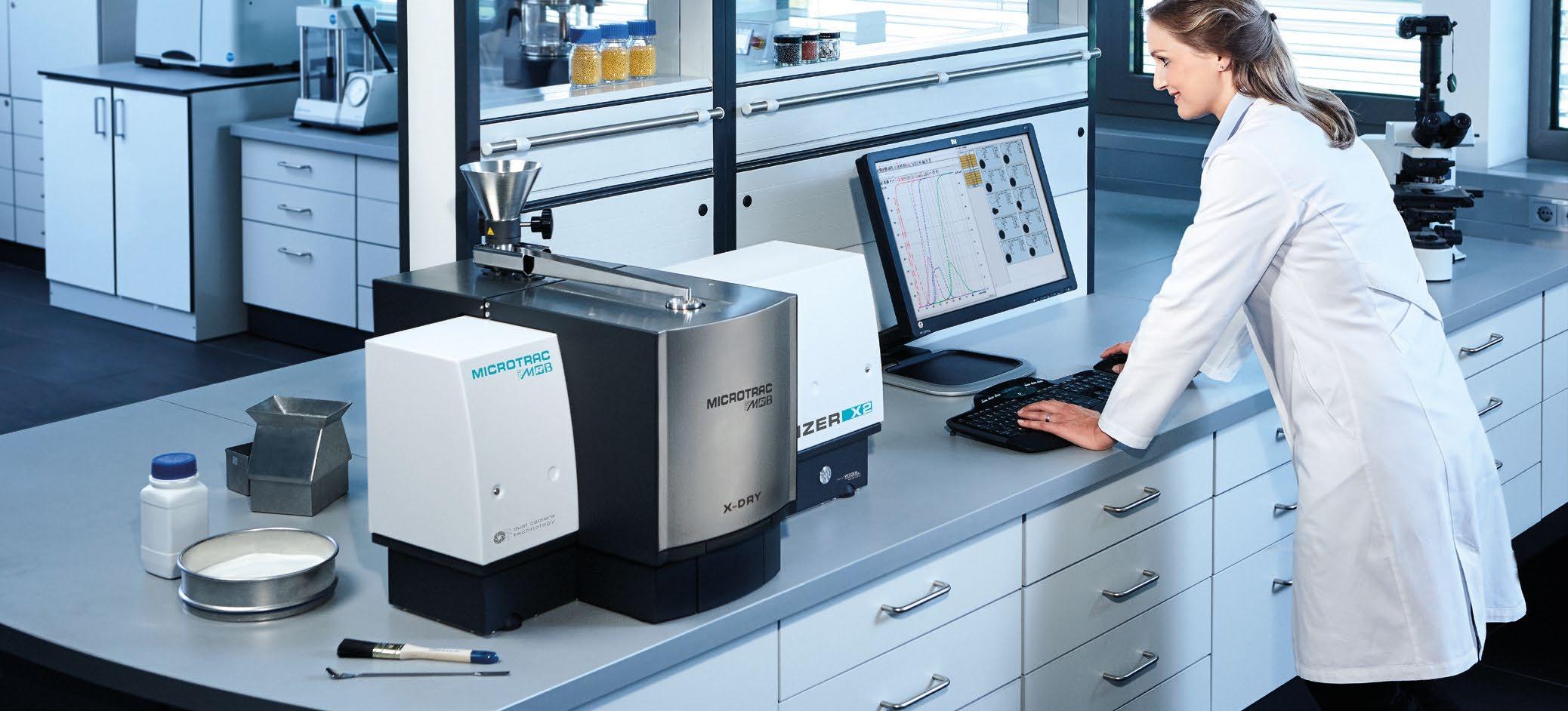
Metal powder activities
Brennen. Total 2021 North American MIM and AM powder shipments increased by an estimated 5‐10% to 3,934,767‐4,202,178 kg. Of this amount, an estimated 360,000 kg is dedicated to “ImprovingAM.powder quality will benefit both MIM and AM. A narrower particle size distribution range, greater sphericity, fewer satel lites, and less internal porosity will improve throughput, mechanical properties, and overall process consistency. Typically, these powders are manufactured by gas atomisa tion, but capacity has been added recently for plasma atomisation and research continues to develop water atomised low‐alloy materials for MIM and AM.”
machining has resulted in new high green strength materials that are suitable for green machining,” continued Brennen.
With the electrification of the automobile increasing, soft magnetic and soft magnetic composites are being researched by all major iron powder producers. “Most have ongoing collaborative efforts with their customers and academia to identify higher permeability, lower core loss, and increased part strength materials and processes. The MPIF Standards Committee is keeping a keen eye on this develop ment.”MIM and AM powder producers were reported to be seeing strong demands for materials. “Generally, the materials of choice are stain less steels and low-alloy steels, but there is considerable developmental work being performed on aluminium, titanium, and an array of other metal powders and alloys,” added
Conventional Press & Sinter
explained the MPIF, but there will likely be a correction as the auto industry downsizes engines from 8‐cylinders to 4‐cylinders, and the acceptance of hybrid (HV) and elec tric (EV) vehicles.
The MPIF stated that PM parts makers report a continued surge from the industrial sector, requiring value‐added, near‐net‐shape parts
Industry News
“Powder producers continue to respond to the needs of the industry by developing new and improved materials and additives for conven tional press and sinter, MIM, and metal AM. Over the past two years, dry lubricants have been in limited supply and high‐demand, forcing companies to seek alternatives. The demand to improve ‘value‐added’
PM and friction‐grade iron powder shipments were up 6.6% to 275,309 mt. Welding applications increased by 30.2% to 14,309 mt. Cutting, scarfing, and lancing applications increased by 21% to 822 mt. Miscel laneous uses increased 11.5% to 16,665 mt.
PowderMet2022 included a presentation on the state of the North American Powder Metallurgy industry by MPIF President Rodney Brennen
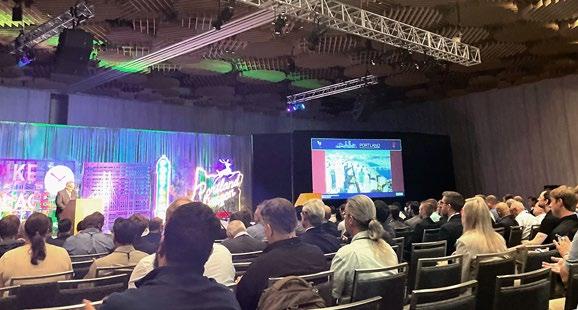
Industry News
It was reported that in 2021, the tung sten market significantly increased on an overall basis with continued strong growth in the semiconductor market, driving demand for high purity tungsten powder due to the demands for newer generation chips used in 5G, personal computers, super computers, smartphones, elec tric vehicles, smart TVs, and other ‘Internet of Things’ devices. Tungsten powder for the defence industry also remained strong. Another positive trend that boosted tungsten powder shipments was North American customers buying from domestic producers instead of Asian producers whose supply chains represented significant delays and risk.
that have cost‐effective lean‐alloy materials, with high material utili sation rates. Most have realised increased backlogs, month after month. Disrupted supply chains have resulted in the re‐shoring of some PM parts, but not to the extent that most had hoped.
Refractory metals and hard materials
The MPIF estimates over 70% of the iron powder shipped is used for parts in internal combustion engine (ICE) passenger vehicles. Unfortu nately, it appears HVs have limited use of, or are not using, powder forged connecting rods and PM main bearing caps. And, obviously, EVs don’t have connecting rods and main bearing caps.
“The general feeling from the conventional press & sinter parts makers is high single‐digit to low double digit‐growth for non‐automo tive applications. The current outlook for automotive applications is not as good due to supply chain disrup tions,” added Brennen.
Technology Roadmap. One of the six priorities identified was ‘Focus on emerging product needs’ that noted: ‘Reliance on the internal combus tion engine is decreasing and PM producers must develop materials and systems required for emerging fuel cell and hybrid‐electric vehicle technology.’ That was over twenty years ago, and we are still talking about it today…,” Brennen said.
“To put things into perspective, there is roughly 9 kg of iron powder used for powder forged connecting rods and main bearing caps in an 8‐cylinder engine. So, as HVs and EVs gain greater acceptance, we can expect iron powder shipments to decline until other applications pick up the
”Eachvolume.”year,we estimate the amount of PM in a North American passenger vehicle. In 2021, there
were roughly 15 million vehicles sold, about 500 thousand more than 2020, but 2 million less than pre‐COVID 2019. The semiconductor shortages had a devastating effect on vehicle sales as car lots were empty.”Theautomotive manufacturers reportedly diverted the semiconduc tors to produce the higher‐margin large pick‐up trucks and SUVs over the lower‐margin sedans. “This was great news for the PM industry as the large passenger vehicles consume an average 27.2 kg per vehicle, followed by the midsize crossover vehicles at 18.1 kg and the sedans at 9.1 kg. Our best estimate for EVs, less the battery, ranges from 1.8‐3.6 kg of PM. Taking everything into consideration, the estimated average weight in a 2021 North American passenger vehicle remained at 16.8 kg,” explained Brennen.Asthe semiconductor shortage wanes, and HVs and EVs gain greater acceptance, the PM weight in passenger vehicles will likely decrease 2‐3% annually without new applications, it was stated. However, there are opportunities to introduce the use of powder forged connecting rods and PM main bearing caps in HVs, and new applications in EVs.
“But we can’t depend solely on the automotive industry. In 2001, MPIF launched the PM Industry Vision and
48 © 2022 Inovar Communications LtdPowder Metallurgy Review Autumn 2022 | contents | news | advertisers | events | website | e-newsletter |
The tungsten carbide market moderately improved but was still impacted by a reduced North American oil and gas exploration and a depressed coal mining market. There was a moderate increase in demand for tungsten carbide for cutting tools and wear parts due to a resurgence in manufacturing, but the demand was impacted by shortages in raw materials and labour, as well as transportation issues and rising costs.North American oil and gas rig counts finished the year up 65% over 2020, which had the lowest levels since 1949. At the end of 2021, the North American rig count was 676 compared to a twenty-year average of 1,514 and the most recent five‐year average of 842. In 2021, coal production in the US was up 8% over 2020 according to the US Energy Information Agency, but 2020 was one of the worst years on record.
“We have a lot to look forward to as we advance the PM technology,” Brennen told the audience as he concluded his PowderMet2022 pres entation.www.mpif.org
Autumn 2022 Powder Metallurgy Review 49© 2022 Inovar Communications Ltd | contents | news | advertisers | events | website | e-newsletter | GETPDF ProGrit – Your global technology partner for powder compaction ProGrit GmbH · Kastellstrasse 6 · 8623 Wetzikon/ Switzerland Phone +4144 844 54 26 · progrit@progrit.com · www.progrit.com
Up to 1000 tons Compaction Force
Reduced automotive production resulted in inconsistent demand for cutting tools. Other manufacturing sectors picked up in 2021, but, again, shipping backlogs and COVID‐19 lockdowns in China disrupted raw materials.“Longer transportation time frames have had a significant impact on international shipments of tungsten concentrates and other raw materials. The uncertainty has led manufacturers to increase inventories to avoid the possibility of running low on raw materials.
For the most part, increased prices did not have a discernible impact on demand from many industrial manufacturers in the North American market,” added Brennen.
North American molybdenum powder demand was estimated to be up by 33%. Molybdenum is used in PM applications for such industries as aerospace, automotive, medical, defence, industrial, and electronics. Demand for these applications
Powder Metallurgy outlook
This innovative, safe, and renewable energy storage solution utilises high‐density PM pellets.”
Clamping, Measuring, Tooling and Multi Axial Compaction Systems
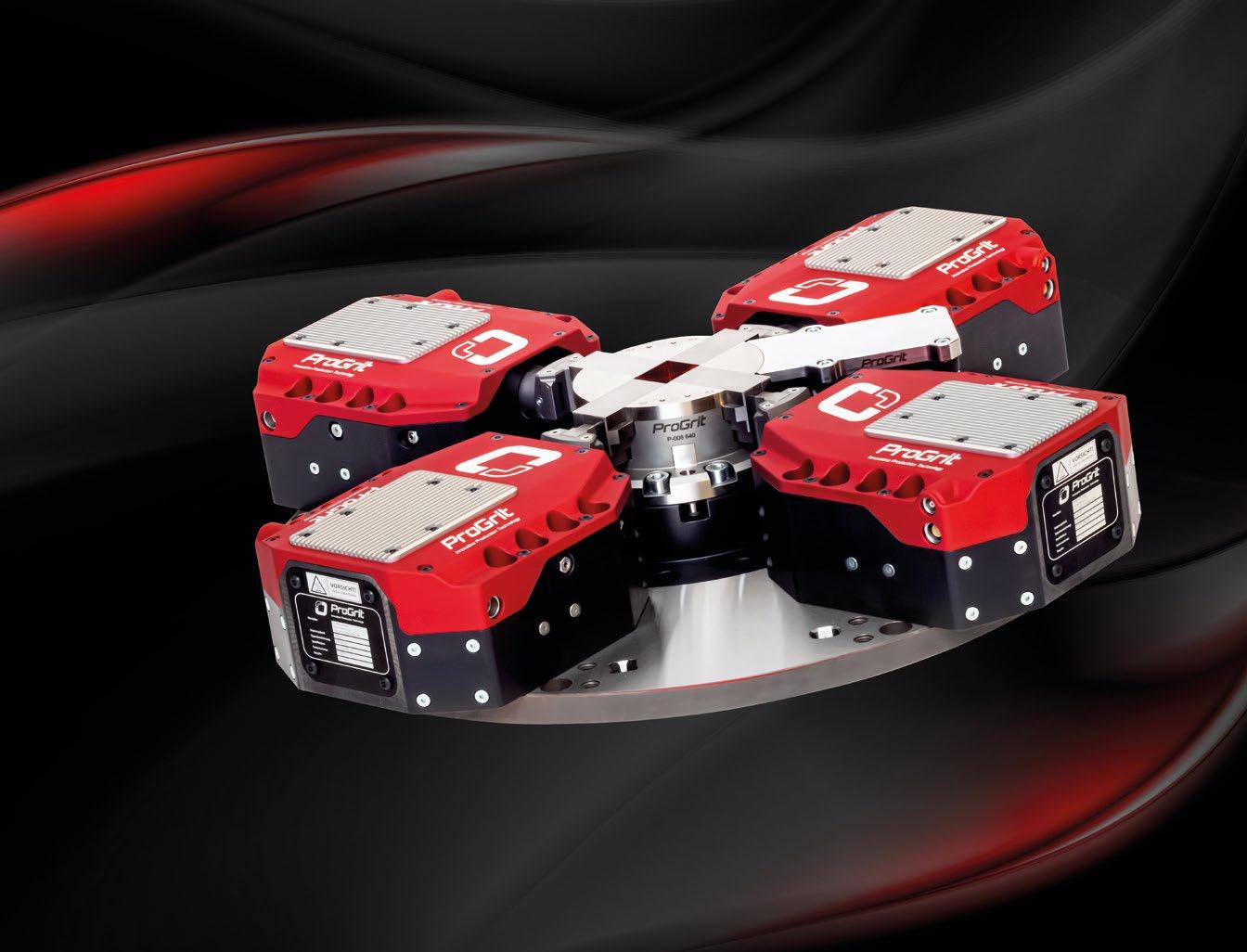
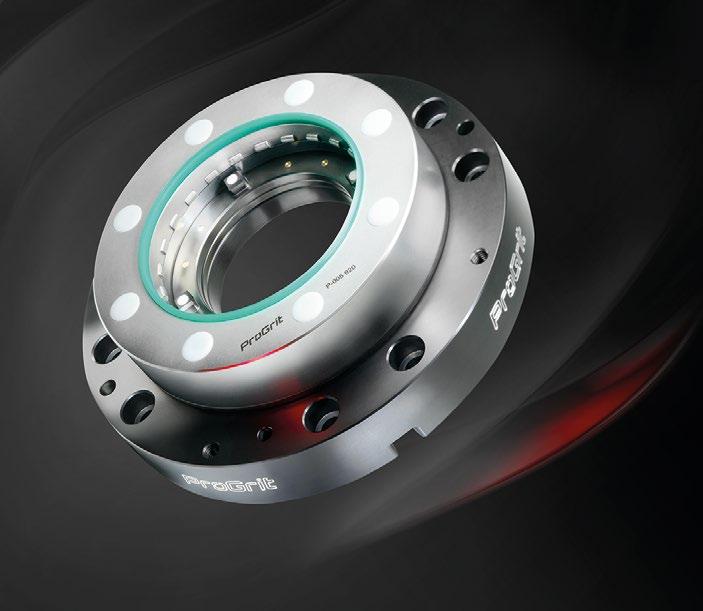
“Many companies in our industry have aggressive programmes to become carbon‐neutral, sooner than later. Last year we learned about iron powder being used as an energy source, combusting it with hot gases to drive an engine, producing sustainable electricity. We also learned about a sustainable energy‐focused infrastructure for storing zero‐emission metal‐hydride energy.
Industry News
surged in 2021 increasing the need for molybdenum powders for the diverse PM parts that service these markets, reported the MPIF.
In his concluding remarks, Brennen stated, “I believe the industry will be able to adapt and overcome, but we will need the mindset and resources to adjust to the changing environ ment. As an industry, we need to showcase our strengths and work together to advance the technology. We have a lot of advantages over other metal‐forming technologies.”
“Other non‐traditional applica tions for metal powers include water purification, thermal management, and solar energy. And how about the research to remove oxygen from moon dust? The process byproduct is metal powder that one day could be used to make structures on the moon.”“These are just a few examples of creative uses and new opportuni ties for metal powders. We need to set our sights long‐term, not just on meeting our monthly goals. We need to invest in R&D to create new appli cations and uses for metal powders and PM parts. And we need to work together for a common goal.”
“The global transition to a lowcarbon electrified economy will require millions of tonnes of battery materials, so it is critically important to produce these materials efficiently and with the lowest environmental footprint,” stated Dan Blondal, CEO of Nano One. “Rio Tinto’s partner ship and support complement our recent announcement to acquire Johnson Matthey’s LFP business in the nearby community of Candiac, Québec and amplifies the Govern ment of Canada’s Mines-to-Mobility initiative, which aims to encourage a localised battery ecosystem to serve the broader North American market. Rio Tinto brings deep experience in high volume production and tech nology commercialisation, as well as a growing battery metals business. We are excited to be partnering with Rio Tinto, our shared vision will see many opportunities for collaboration as we drive for change.”
Uniformity Labs, Fremont, California, USA, has signed an agreement with Tekna Holding ASA, Sherbrooke, Quebec, Canada, which will see Tekna supply Ti64 5/25 and Ti64 45/105 for Uniformity to produce its advanced titanium powders for Laser Beam Powder Bed Fusion (PBF-LB) AdditiveUniformity’sManufacturing.engineered powders and processes are said to enable faster production of repeatable parts, at higher density with no compro mise in quality. Tekna’s powder
“We’re excited to collaborate with Tekna for the supply of highest quality titanium powders for LPBF,” stated Adam Hopkins, founder, and CEO of Uniformity Labs. “This agreement opens a critical North American material resource for us.
www.uniformitylabs.comwww.tekna.comrequirements.”
Nano One’s patented One Pot Process and metal to cathode active material (M2CAM) technologies form a unique manufacturing platform that enables nickel-rich (NMC), iron-rich (LFP) and manganese-rich (LNMO) lithium-ion cathode active materials to be made sulfate-free from a range of battery metal sources with fewer steps, lower costs, less complexity
The complementary nature of our businesses produces an economic benefit for our customers who gain through higher printer throughput and repeatability, and a supply chain security benefit from the use of materials produced entirely in North America.”LucDionne, CEO of Tekna, commented, “We are extremely proud that Uniformity Labs has selected us to supply titanium powders. This is a testament to Tekna’s supply reli ability and reaffirms that our product quality matches with a wide range of industry
Rio Tinto has entered into a stra tegic partnership with Nano One® Materials Corp, a battery materials provider based in Barnaby, Canada. The agreement includes the supply of iron and lithium products, collaboration and a US $10 million investment into Nano One. The part nership is expected to accelerate Nano One’s multi-cathode commer cialisation strategy and support cathode active materials manu facturing in Canada for a cleaner battery supply chain.
atomisation technology uses hydroenergy and all process gasses are recycled in closed loops, achieving greener production. Together the companies will help industrial customers produce greener, more sustainable parts.
Rio Tinto and Nano One announce partnership and $10M investment
Tekna and Uniformity Labs sign titanium supply agreement
Rio Tinto and Nano One will, on closing of the agreement, enter a strategic collaboration agreement that includes a study of Rio Tinto’s battery metal products, including iron powders from the Rio Tinto Fer et Titane facility in SorelTracy, Québec, as feedstock for the production of Nano One’s cathode materials.RioTinto will contribute knowl edge from its Critical Minerals and Technology Centre, which has developed experience in the extraction and processing of critical minerals such as lithium and scandium, as well as minerals from Canada, the United States, and other international sources to further drive localisation of the lithium-ion battery value chain.
and a much smaller environmental footprint. The technology applies to all lithium-ion battery chemistries for applications in electric vehicles, renewable energy storage and port ableRioelectronics.Tintowill collaborate as required on technical and business matters in developing, designing, constructing and operating cathode production facilities. Nano One will issue 1,000,000 non-transferrable share purchase warrants to Rio Tinto as consideration for its tech nical and support services. Each warrant will entitle Rio Tinto to purchase one share at an exercise price of CAN $4.00 for a period of twelve months from the date of issu ance.“Localised, clean and secure supply chains are critical for the success of the energy transition that is now underway and this requires partnerships with innovative companies like Nano One to help us differentiate, disrupt and accel erate the path to a net-zero future,” stated Marnie Finlayson, Managing Director of Rio Tinto’s Battery Mate rials portfolio. “We are pleased to back and support Nano One’s ambi tions to drive for change and we look forward to bringing Rio Tinto’s deep experience and know-how in commercialisation and large scale projects to this exciting initiative.”
www.nanoone.cawww.riotinto.com
Industry News
50 © 2022 Inovar Communications LtdPowder Metallurgy Review Autumn 2022 | contents | news | advertisers | events | website | e-newsletter |
AIP, Inc will be opening a new facility in Columbus, Ohio expanding isostatic .press manufacturing to serve existing and new clients worldwide. Along ...............with sister companies in Mississippi, and Spain, this new addition expand global to better serve customers. T K :





W O R
Fall 2022
.................Oregon,
..............................will
CONTACT US TODAY! U S A a n d E u r o p e Q u a l i t y a s s u r a n c e w i t h c o m p e t i t i v e p r i c i n g a n d r a p i d t u r n a r o u n d t i m e s C o n v e n i e n t l o c a t i o n s n e a r l o g i s t i c a l h u b s I T S , O h i o c o m i n g s o o n ! I T S O h i o , U S A I P S O r e g o n , U S A I T S M i s s i s s i p p i , U S A I T S B i l b a o , S p a i n 1 8 0 0 3 7 5 7 1 0 8 I s o s t a t i c T o l l S e r v i c e s c o m w w w . a i p h i p . c o m UNITED STATES MANUFACTURING U S m a n u f a c t u r e r o f s m a l l r e s e a r c h t o f u l l s c a l e p r o d u c t i o n i s o s t a t i c p r e s s e s f o r o v e r 3 0 y e a r s S h i p p i n g w o r l d w i d e w i t h i n s t a l l s i n o v e r 6 0 c o u n t r i e s . N e w l y e x p a n d e d f a c i l i t y o p e n i n g i n C o l u m b u s , O h i o ISOSTATIC PRESSING SISTER COMPANIES N E W O H I O F A C I L I T I E S O P E N S O U R A W E S O M E N E


..................................reach

Since its launch in late 2021, the James Webb Space Telescope (JWST) has been providing humanity with a unique glimpse into space, from never-before-seen stars in distant nebulae to new representa tions of familiar sights like Jupiter. The telescope – the largest optical telescope in space – is designed for infrared astronomy and its high resolution and sensitivity allows it to view objects too early, distant or
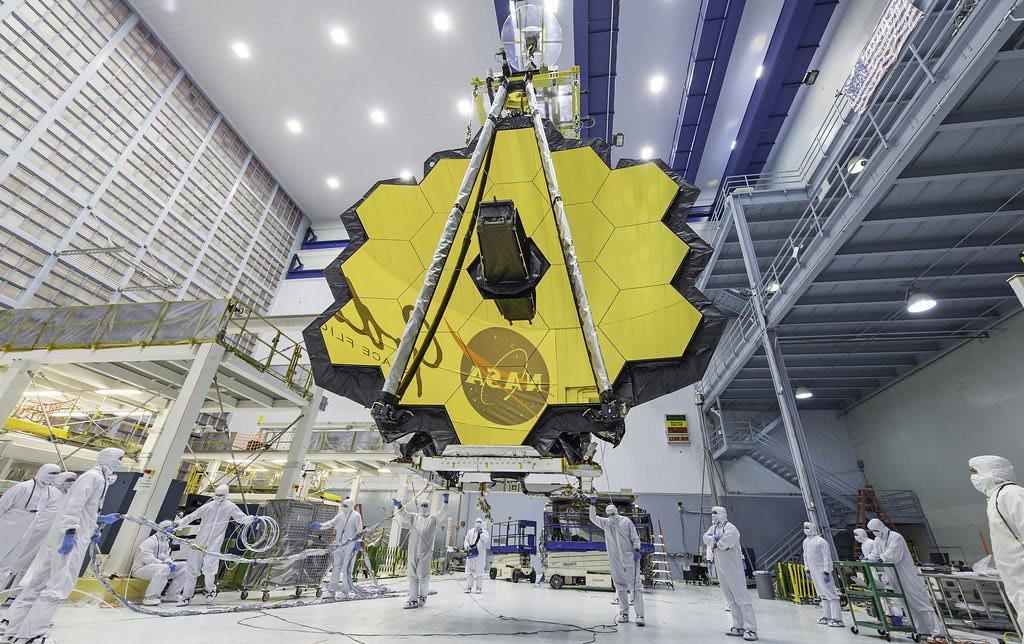
The back of the beryllium mirror blank is machined to make the mirror segment light, yet maintain its integrity (Courtesy Axsys Technologies)
52 © 2022 Inovar Communications LtdPowder Metallurgy Review Autumn 2022 | contents | news | advertisers | events | website | e-newsletter |Industry News
faint for the Hubble Space Telescope. This is enabled by eighteen hexag onal mirror segments, gold plated and made of beryllium.
After the shaping stage, SSG/ Tinsley, Richmond, California, ground the mirrors’ surfaces, smoothed and polished them before they were sent to undergo cryogenic testing. The initial cryogenic testing, by Ball Aero space, began in 2009. After around two years of testing, the mirrors and information gathered using laser interferometers were sent back to SSG/Tinsley for a final polish in June 2011. By the end of 2013, all of the assembled mirrors were at NASA Goddard, awaiting their housing, which arrived in www.webb.nasa.gov2015.
Eighteen hexagonal beryllium segments make the final mirror, shown in the cleanroom at NASA Goddard (Courtesy NASA)
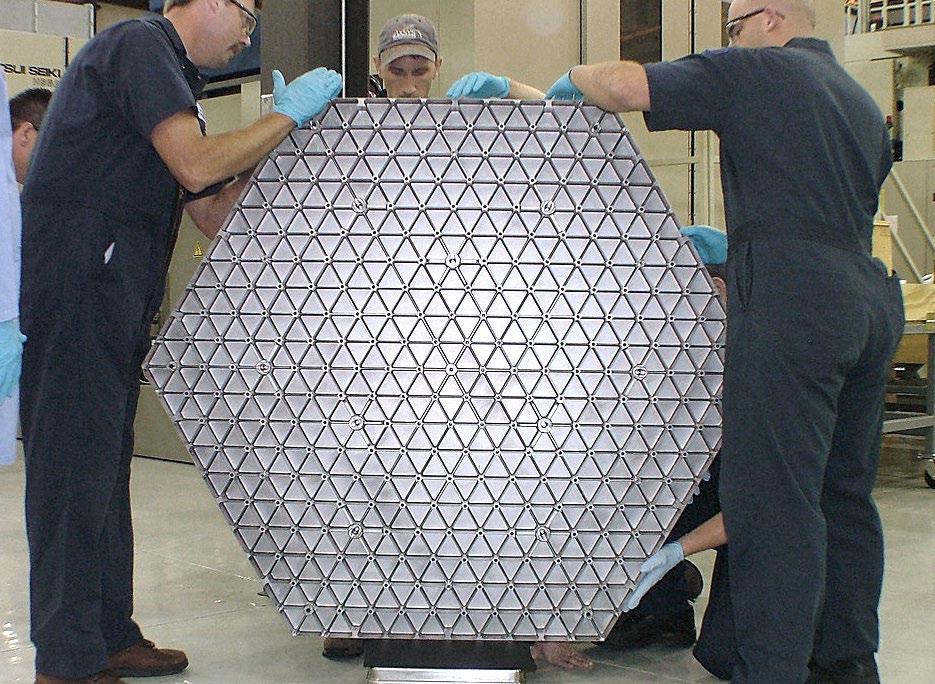
The beryllium used to make Webb’s mirror was mined in Utah and purified at the Brush Wellman (now Materion Corporation) facility in Ohio. The particular type of beryllium used in the Webb mirrors is called O-30 and is a fine, gas atomised powder.
“Beryllium is very lightweight, a third lighter than aluminum, extremely stiff and can be polished very well. It also functions well at cryogenic temperatures which made it the perfect material for the telescope,” stated Keith Smith, vice president – Nuclear and Science, Materion. “The telescope features a special grade of gas atomised beryl lium which is lightweight and has the properties needed for the telescope’s primary mirror.”
To construct the mirror segments the beryllium powder was placed into a stainless steel canister and pressed into a flat shape, a process known as Hot Isostatic Pressing (HIP). Once the steel canister was removed, the resulting beryllium slab was cut in half to make two mirror blanks, some 1.3 m across. Each mirror blank was used to make one of the eighteen mirror segments. The first two mirror blanks were completed in March 2004.Once the mirror blanks passed inspection, they were sent to Axsys Technologies in Cullman, Alabama, to be shaped into their final design. The process began with cutting away most of the back side of the beryl lium mirror blank, leaving a thin rib structure. The ribs are about 1 mm thick and although most of the metal is gone, the ribs are enough to keep the segment’s shape steady. This makes each segment very light, with each beryllium mirror segment around 20 kg in mass. A full primary mirror segment assembly, including its actuator, is about 40 kg.
Powder Metallurgy enables James Webb Space Telescope to view distant galaxies

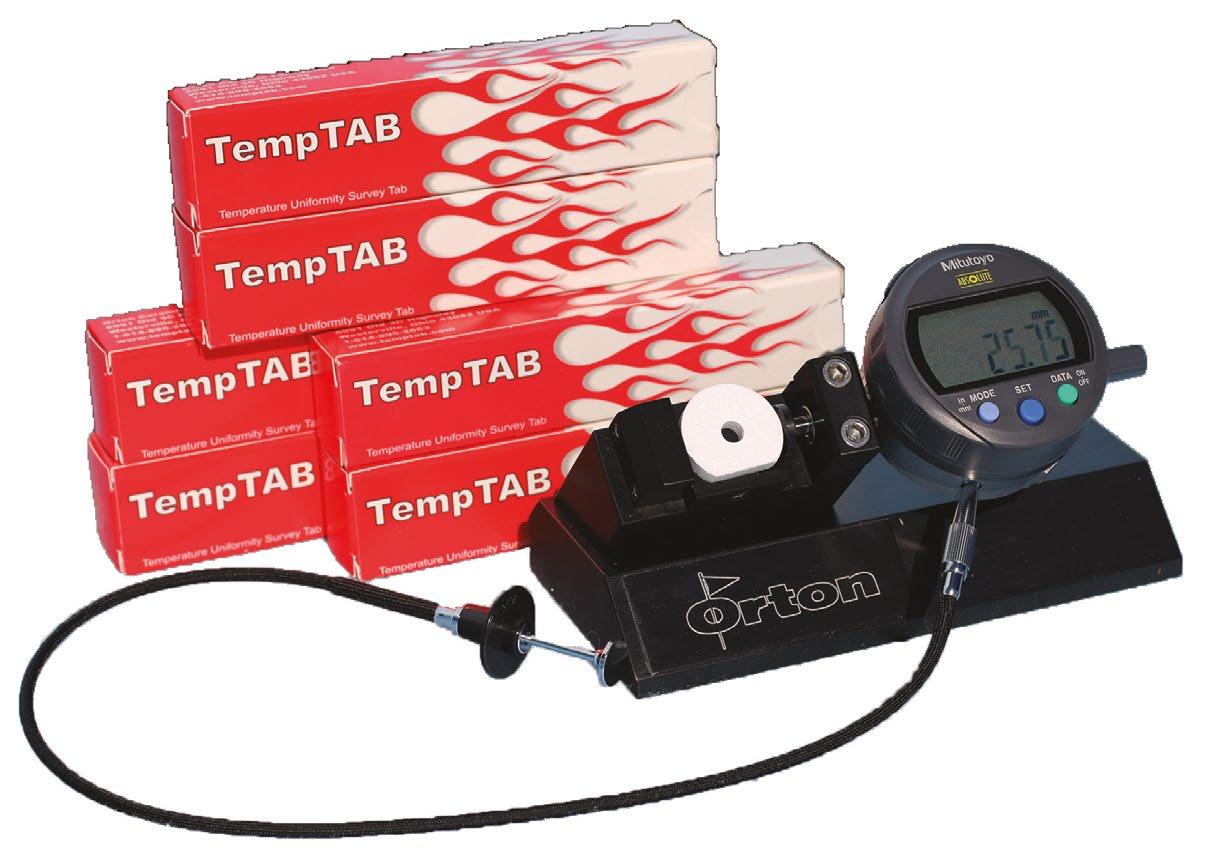
The MPAA Standards Commit tee intends to coordinate an inter-laboratory test programme in 2022 in conjunction with ASTM Committee B09 on Metal Powders and Metal Powder Products to determine the precision of the new Carney flow rate test method. A valid flowmeter funnel will be required for www.mpif.orgwww.kymerainternational.comparticipation.
The programme committee for the International Conference on Powder Metallurgy & Particulate Materials (PowderMet2023), which is sched uled to take place at Caesars Palace, Las Vegas, Nevada, USA, from June 18-21, 2023, has issued a call for papers and presentations covering the latest developments in Powder Metallurgy materials, processes, and applications.Sponsored by the Metal Powder Industries Federation (MPIF) and its affiliate APMI International, the four-day event is co-located with the Additive Manufacturing with Powder Metallurgy Conference (AMPM2023). Abstracts covering any aspect of PM and particulate materials technology are invited. The abstract submission deadline is November 5, 2022. www.mpif.org
Kymera sells calibration powders based on new MPPA standard
Prior to this, no Carney funnels are said to have been calibrated for this flow metric, but, rather, tested the apparent density of the powders. The new calibration powder is a 316L stainless steel screen cut that was tested for stability and repeatability of flow time over an extended period.
Kymera now has 200 g quanti ties of this calibration powder available to purchase with which buyers can test their own Carney flowmeter funnels. A new funnel should have a flow time of 31.0 ± 0.5 seconds for 150 g; funnels with a flow time of fewer than 28 seconds are invalid.
Kymera International, a speciality materials company headquartered in Raleigh, North Carolina, USA, has received a master Carney flowmeter in line with a new standard approved by the Metal Powder Producers Association (MPAA) Standards committee. The new standard has approved a new test method standard regarding the flow rate of non-free-flowing metal powders using a Carney flowmeter funnel.
CallPowderMet2023forPapers
54 © 2022 Inovar Communications LtdPowder Metallurgy Review Autumn 2022 | contents | news | advertisers | events | website | e-newsletter |Industry News L O O K I N G T O E X T E N D T H E L I F E O F Y O U R W I R E B E L T S ? Y O U R M E S H B E L T G L O B A L S U P P L I E +R 3 4 9 3 8 0 1 1 5 4 0 i n f o @ c o d i n a m e t a l c o m w w w c o d i n a m e t a l c o m S t J o a n B a p t i s t a , 5 7 0 8 7 8 9 L a T o r r e d e C l a r a m u n t B a r c e l o n a , S p a i n

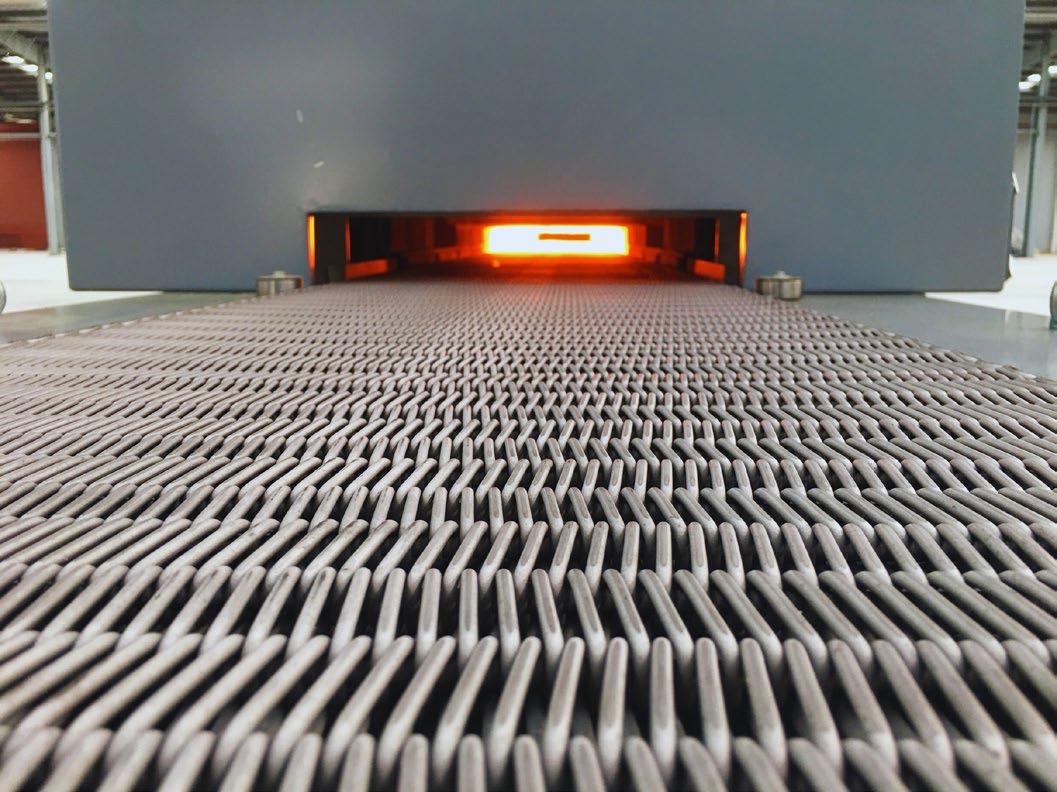
Autumn 2022 Powder Metallurgy Review 55© 2022 Inovar Communications Ltd | contents | news | advertisers | events | website | e-newsletter | GETPDFIndustry News


“Nowadays,materials.you can’t really award individual scientific honours, because research work is always a collective endeavour,” stated Torralba. “I think this award is a recognition, not only for me, but also for all the people I have worked with over the years.”
Technical University of Madrid –UPM and Armament and Materials Engineer at Escuela Politécnica Superior del Ejército, EPSE. He has also earned two PhD degrees: Dr. Eng. Metallurgy (UPM) and Dr. Eng. ArmamentTorralba(EPSE).hasbeen Head of the Materials Science and Engineering Department, vice-rector for Academ ics Infrastructures and vice-rector for Research and Innovation at MSE at Universidad Carlos III de Madrid (UC3M), as well as Deputy Direc tor of Institute IMDEA Materials, Director-General for Universities and Research of Madrid Regional Government and Higher Artistic Arts Studies. He is currently a Profes sor of MSE at UC3M and Director of IMDEA Materials Institute.
Previous winners of the Ivor Jenkins Medal include Roger

The UK’s Institute of Materials, Minerals and Mining (IOM3) has announced that Prof Jose Manuel Torralba, Director, IMDEA Materials Institute, Spain, has been awarded the 2022 Ivor Jenkins Medal. The prestigious award is presented to individuals in recognition of a signifi cant contribution that has enhanced the scientific, industrial or techno logical understanding of materials processing or component production using Powder Metallurgy and partic ulate
Prof Jose M Torralba is the recipient of the Ivor Jenkins Medal
Lawcock (2021), Prof Herbert Danninger (2020), Dr Leo Prakash (2019), David Whittaker (2018), and John Dunkley (2016). “Above all, I feel very honoured to share this award with so many very important and widely recognised researchers and technologists who have been references for me during my career,” added Torralba. “And even more so because it is an international recognition that comes from such a prestigious institute in my area of work as the www.iom3.orgIOM3.”
Prof Torralba completed studies as a Metallurgical Engineer at the
Prof Jose Manuel Torralba to receive 2022 Ivor Jenkins Medal

Industry News
The MPAA Standards Committee intends to coordinate an inter-laboratory test programme in 2022 in conjunc tion with ASTM Committee B09 on Metal Powders and Metal Powder Products to determine the precision of the new Carney flow rate test method. A valid flowmeter funnel will be required for www.kymerainternational.comparticipation.
Eddie McGee, Managing Director, Ajax Equipment, added, “This is one of the largest and most unusual hopper orders Ajax has received. Typically, customers require a substantial hopper that will be static for the length of its service life. These compact, portable hoppers can easily be moved between storage, filling and loading the screw feeders also supplied.” www.ajax.co.uk | www.libertysteelgroup.com
56 © 2022 Inovar Communications LtdPowder Metallurgy Review Autumn 2022 | contents | news | advertisers | events | website | e-newsletter |

Kymera sells calibration powders based on new MPPA standard
“From the initial phone call and subsequent first meeting, Ajax quickly understood what we wanted to achieve with our powder handling system and provided initial proposals to a fully working powder handling system that we have integrated into our processing equip
Prior to this, no Carney funnels are said to have been calibrated for this flow metric, but, rather, tested the apparent density of the powders. The new calibration powder is a 316L stainless steel screen cut that was tested for stability and repeatability of flow time over an extendedKymeraperiod.nowhas 200 g quantities of this calibration powder available to purchase with which buyers can test their own Carney flowmeter funnels. A new funnel should have a flow time of 31.0 ±0.5 seconds for 150 g; funnels with a flow time of fewer than 28 seconds are invalid.
Ajax’s cantilevered screws use a variable pitch to help ensure mass flow from the hoppers. The feeders’ casing is mounted on ferrules allowing access to the full length of the screw for easy cleaning.
Ajax supplies Liberty Powder Metals with twenty hoppers
Kymera International, a speciality materials company headquartered in Raleigh, North Carolina, USA, has received a master Carney flowmeter in line with a new standard approved by the Metal Powder Producers Asso ciation (MPAA) Standards committee. The new standard has approved a new test method standard regarding the flow rate of non-free-flowing metal powders using a Carney flowmeter funnel.
Solids handling solutions provider Ajax Equipment, Bolton, England, UK, has supplied Liberty Powder Metals, part of GFG Alliance’s Liberty Steel Group, with fifteen storage hoppers, five blending hoppers and three mass flow screw feeders for metal powder handling.
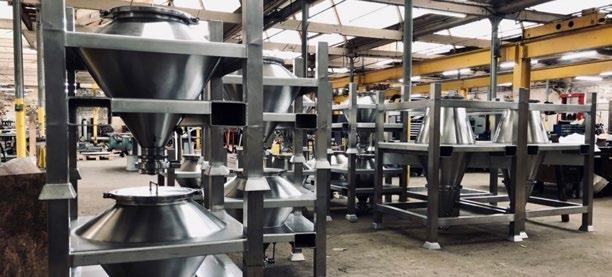
Ajax has supplied twenty hoppers and three mass flow screw feeders to Liberty Powder Metals (Courtesy Ajax)
The geometry of the fifteen stainless steel intermediate bulk containers (IBCs) was designed for efficient discharge and repose fill of powder, while the five larger hoppers’ steep double cone shape is said to allow the blending of metal powders. The design of both hoppers includes supports enabling handling with a forklift, efficient storage and straightforward loading onto the screw feeders.
ment,” stated Dan Frith, Manufacturing & Engineering Manager, Liberty Powder Metals. “When we had a speci fication issue on one of our transfer stations, Ajax was quickly able to calculate the new requirement and an alternative gearbox was sourced. Ajax’s hoppers and screw feeders perform very well.”
Permanent board members
Board members
Auditors
Takashi Suzuki, NAPAC Co., Ltd.
YasushiCorporationMori,Nippon Atomized Metal Powderswww.jpma.gr.jpCorporation
JPMA announces new president and board members
Masashi Kikuchi, Porite Corporation
Tsuyoshi Hasegawa, Kobe Steel, Ltd
Naoya Takahashi, Mitsubishi Materials Techno Corporation
Junichi Takahashi, Iwaki Diecast YoshitakeCo.,Ltd.
The Japan Powder Metallurgy Asso ciation (JPMA), based in Tokyo, has announced the appointment of a new president and members of the board during its General Assembly held on May 19, 2022.
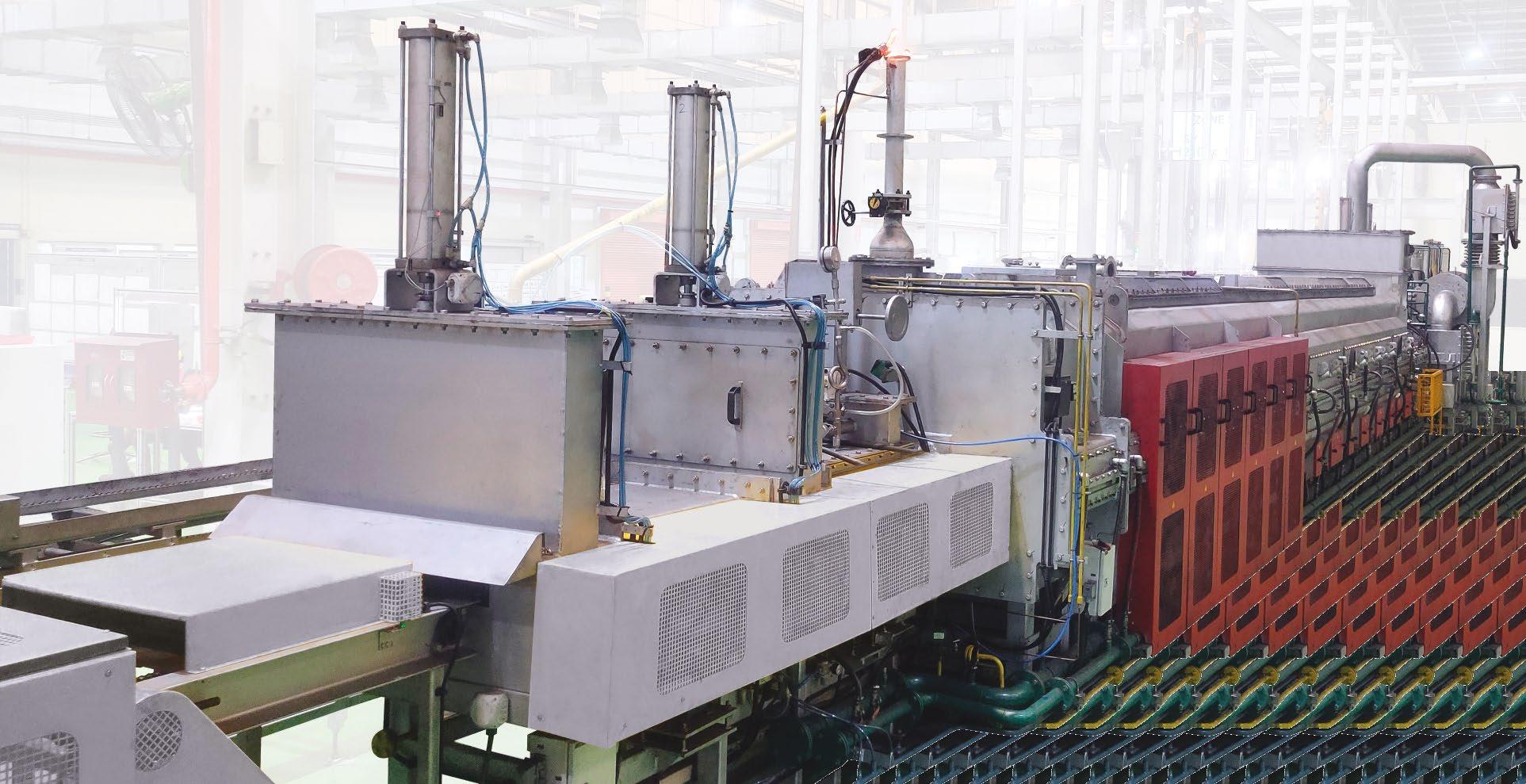
Shoichiro Tokumaru, JFE Steel Corporation
Shoei Katano, Höganäs Japan K.K. Shuzo Sonoda, Fukuda Metal Foil & Powder Co., Ltd.
Yoshida, Dowa Electronics Materials Co., Ltd.

Yoichi Inoue, Fine Sinter Co., Ltd
Shimizu, Daido Steel Co., TakayukiLtd.
Executive Director Yoshio Uetsuki

Hiroshi Ii is the JPMA’s new presi dent (Courtesy JPMA)
Masayoshi Nishimura, Fukuisinter Co., TetsuyaLtd.
Nakashima, NTN
Seiji Shimizu, NTN Advanced Materi als
Mitsuhiro Goto, Sumitomo Electric Industries, Ltd
Advanced Materials Corporation

Autumn 2022 Powder Metallurgy Review 57© 2022 Inovar Communications Ltd | contents | news | advertisers | events | website | e-newsletter | GETPDFIndustry News
Jiro Bando, Nippon Atomized Metal Powders Corporation
The association reported that Hiroshi Ii of Japan’s Diamet Corpora tion assumes the role of president, replacing Nobuhiro Hashimoto of Sumitomo Electric Industries, Ltd. The board members were confirmed as follows:
A Grand Prize in the Automotive –Engine category for conventional PM components was awarded to GKN Sinter Metals and its customer Pierburg, for an aluminium metalmatrix- composite outer gerotor for an Italian luxury sports car dry sump pump. It is reputedly the first aluminium gerotor used in a dualmaterial aluminium-steel pump gear for a production vehicle application.
In the same category, an Award of Distinction was also presented to DSB Technologies, LLC, formerly SSI Sintered Specialties LLC, and its customer Purem by Eberspaecher, for a 309L stainless steel sensor
DSB Technologies produced this 309L stainless steel sensor boss for an exhaust system (Courtesy MPIF)
Grand Prizes
This year’s winners are said to showcase outstanding examples of PM’s unique ability to challenge competing technologies, stated the MPIF. From lightweighting to complex geometries, Powder Metallurgy provides component designers with the ability to utilise advanced engineering methods that add up to part-to-part uniformity for improved product quality, shape and material flexibility, application versatility, and more.
MIM and metal AM
The winners in the 2022 Powder Metallurgy Design Excellence Awards competition, sponsored by the Metal Powder Industries Federation (MPIF), were announced during the International Conference on Powder Metallurgy and Particu late Materials (PowderMet2022), held in Portland, Oregon, USA, from June 12–15, 2022.

The inner profile of the gerotor for this high-performance applica tion was critical for it to function in conjunction with a steel inner rotor with a different thermal expansion coefficient. The part provides a 50% reduction in rotating mass, which becomes even more significant with six gerotors per gang pump assembly.
Automotive – Engine category PM In the Automotive – Engine category for conventional PM components, an Award of Distinction was given to Nichols Portland LLC, a divi sion of Nichols Portland Inc., for an eccentric ring used in a variable displacement oil pump. The sinterhardened parts provide enhanced performance compared with prior generation designs that used steamtreated as-sintered parts.
Automotive – Engine category PM
The winners of the 2022 Powder Metallurgy Design Excellence Awards compe tition showcase outstanding examples of PM components (Courtesy MPIF)
58 © 2022 Inovar Communications LtdPowder Metallurgy Review Autumn 2022 | contents | news | advertisers | events | website | e-newsletter |
Powder Metallurgy Design Excellence Award winners shine light on metal powder industry
Industry News
Awards of Distinction
This aluminium metal-matrixcomposite outer gerotor is made by GKN Sinter Metals (Courtesy MPIF)
Nichols Portland was awarded for producing this eccentric ring used in an oil pump (Courtesy MPIF)
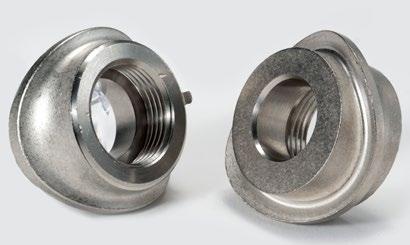
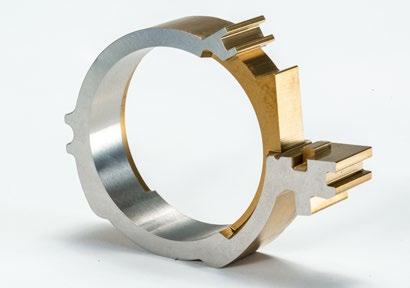
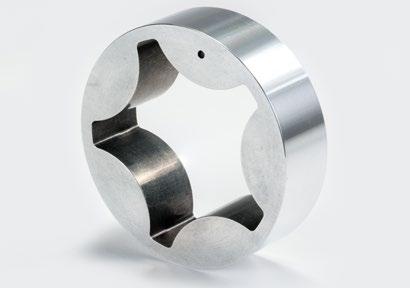
Further Grand Prize winners included parts made by MIM from Kyerim Metal Co., Ltd; ARC Group Worldwide and INDO-MIM Pvt Ltd, along with compo nents produced by metal AM from Divergent Technologies, Inc, and 3DEO Inc.
In the design competition, a total of nine Grand Prizes and eighteen Awards of Distinction were presented across the manufac turing categories of conventional Powder Metallurgy, Metal Injection Moulding and metal Additive Manu facturing. Here, we highlight the Powder Metallurgy winners.
Trends.Forecasts.Perspectives. Undisputed, industry-leading report for 27 years Order your new 2022 report today! wohlersassociates.com




boss that is welded to an automotive exhaust system and holds a sensor for monitoring engine performance.
In the Lawn & Garden/Off-Highway conventional PM components cate
Industrial Motors/Controls & Hydraulics PM
Nichols Portland received an award for this pump head sub-assembly (Courtesy MPIF)
In the Automotive – Chassis category for conventional PM components, an Award of Distinction was presented to Metalpo Ind. Com Ltda and its customer Haldex do Brasil Ind e com Ltda, for a rack used in a braking system for trucks. The rack is made from diffusion-alloyed FD-0405, warm-die compacted and case hardened to achieve good wear prop erties.
60 © 2022 Inovar Communications LtdPowder Metallurgy Review Autumn 2022 | contents | news | advertisers | events | website | e-newsletter |
This category also included a winning entry from FMS Corpo ration and their customer TEAM Industries for a spider dampener insert, part of a torque spider subassembly for ATV transmissions. The part was originally designed as a metal casting that required secondary machining, but was re-designed for PM in order to eliminate the need for extensive machining operations.
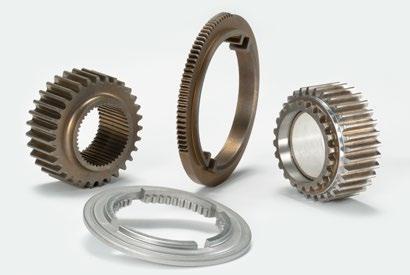
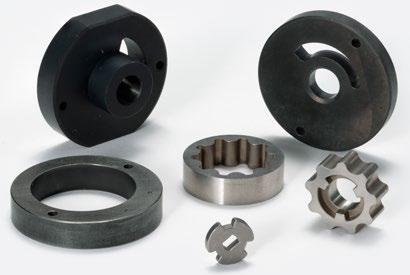
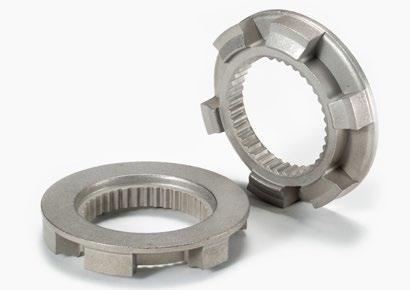
In the Hand Tools/Recreation category for conventional PM components, an Award of Distinc tion was given to Porite Taiwan Co., Ltd., for a ring gear, used in the gearbox of a cordless drill. It
Porite Taiwan produce this ring gear used in the gearbox of a cordless drill (Courtesy MPIF)
gory, an Award of Distinction was given to Alpha Precision Group, a division of Nichols Portland Inc., for a camshaft assembly used in a family of engines ranging from 19–27 hp for consumer lawn and garden machines. The assembly comprises six PM components (a cam gear, four cam lobes, and a thrust washer). All five parts are assembled to the precision ground shaft by means of highly auto mated, specialised assembly cells.
In the Industrial Motors/Controls & Hydraulics category for conven tional PM components, an Award of Distinction was presented to Nichols Portland LLC, a division of Nichols Portland Inc., for a pump head sub-assembly for fluid delivery. The assembly comprises six PM parts, an inlet plate, eccen tric ring, inner and outer gerotors, a spline coupling, and an outlet plate.
Metalpo Ind. Com Ltda received an award for this rack used in a braking system for trucks (Courtesy MPIF)
Drive and driven sprockets, pressure plate and a sector gear made by Burgess-Norton (Courtesy MPIF)
MIM and metal AM
Automotive – Transmission category PM
Lawn & Garden/Off-Highway PM
Automotive – Chassis category PM
Alpha Precision Group produced this camshaft assembly used in engines from 19–27 hp (Courtesy MPIF)
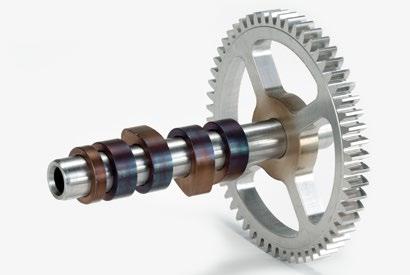
is divided into two parts due to the multi-section appearance. The two PM parts are machined, pressed for alignment, followed by a plastic injection overmould operation.
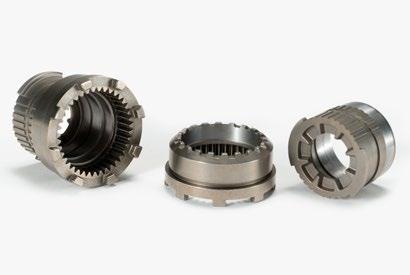
Hand Tools/Recreation PM
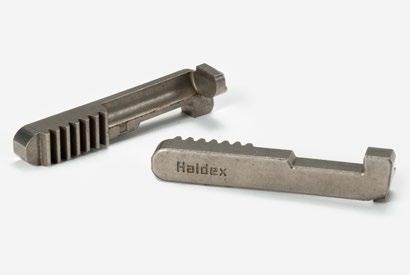
Spider dampener insert, made by FMS Corporation, is for ATV transmissions (Courtesy MPIF)
Further Awards of Distinction included MIM parts from INDOMIM Pvt Ltd., OptiMIM (a Form Technologies Company), Advanced Powder Products Inc., ARC Group Worldwide and PTI (Polymer Tech nologies Inc.). Metal additively manufactured component winners included Azoth and Amaero. www.mpif.org
In the Automotive – Transmission category for conventional PM compo nents, an Award of Distinction was given to Burgess-Norton Mfg. Co., for drive & driven sprockets, a pressure plate, and a sector gear, made for BorgWarner, and used in an automo tive transfer case. The sprockets are warm-die compacted from FL-4405 with admixed nickel.
Industry News
subscribe-pm-review-e-newsletter/https://www.pm-review.com/ COMMUNICATIONS INOVAR TO OUR WEEKLY E-NEWSLETTER SUBSCRIBE Subscribe to the Powder Metallurgy Review e-newsletter, sent weekly to key PM professionals and end-users worldwide, to make sure you benefit from timely access to the latest industry news and technology E-newslettertrends. subscribers also benefit from a free digital subscription to Powder Metallurgy Review www.pm-review.commagazine. POWDER METALLURGY REVIEW


Find
We know that additive manufacturing offers undrea med-of potential. In addition to the printer, however you also need the upstream and downstream proces ses plus the experts, who have mastered the techno logy. only find all this at Formnext! out more now and join us in Frankfurt.

You’ll
formnext.com Where ideas take shape. Make possible!impossiblethe Messe Frankfurt Group #formnext 15 – 18 NOVEMBER 2022 FRANKFURT / GERMANY
Automotive system engineering unravelled
The use of CAD was introduced decades ago in the automotive industry, stimulating a transition from 2D prints to 3D models, which became the industry standard for designing products and tooling, While it was embraced by the OEMs, the adoption was much slower further downstream in the value
A key component for MBE to be successful is reliable data in appro
Here lies the problem for the Powder Metallurgy industry, since there is much less data available in CAE databases for PM than for wrought or cast materials.
Autumn 2022 Powder Metallurgy Review 63© 2022 Inovar Communications Ltd | contents | news | advertisers | events | website | e-newsletter | GETPDF
making
Automotive
priate databases for computer aided design (CAD). While its initial adoption was for automotive electronic systems, it has spread throughout the value chain to static and dynamic material properties for structural components.
With the automotive industry’s adoption of a model-based engineering approach dependent on access to reliable information, the limited data available for PM materials is putting the industry in a vulnerable position compared to wrought or cast materials. As Ian Donaldson, Director Advanced Engineering Applications at GKN Sinter Metals, explains, in order to compete for its place in the rapidly changing automotive supply chain, it is imperative that the PM industry moves away from a primarily document-centric approach that relies on engineering specification sheets and limited material databases and toward developing more comprehensive databases.
Powder Metallurgy’s challenge: How does automotive’s reliance on model-based decision making impact our industry? model-based decision
As is well known, the speed of automotive development has been increasing rapidly, with conceptu alisation to product launch windows continuously narrowing. Although not on par with some consumer electronics, the automotive industry must comply with a myriad of safety requirements and legisla tive requirements, while meeting the ever-expanding desires from consumers for more interconnected features not present in the elec tronicsDecadesindustry.ago, to cope with these demands, the automotive industry adopted a model-based engineering (MBE) approach to enable an under standing of product performance from a component level and aid in decision making throughout the product cycle. The motivation was to reduce costs and development time while detecting design defects earlier. The integration of this approach across the system domain is visualised in Fig. 2.
Fig. 1 Rendering of a PM differential gear for use in an automotive application (Courtesy GKN Powder Metallurgy)
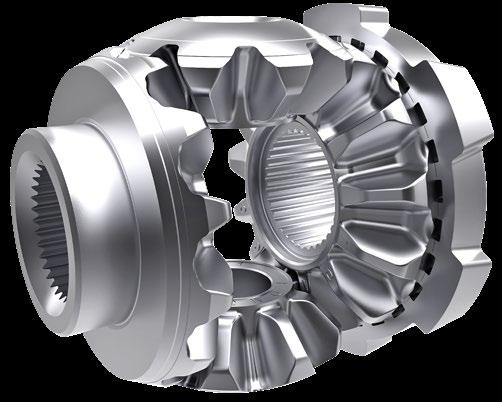
The automotive industry is familiar with the intricacy of vehicle requirements and supply chains. Adaptability and agility are demanded from both the OEM and the supply base. An early example of how this evolved is evident with integrated electronic control systems that are now booming in automobiles: each model year sees the introduction of more advanced systems to meet consumer demand for vehicles that are not only safe and reliable, but also comfortable and pleasurable to drive [2]. These control systems are integral with the vehicle operations such as antilock brakes and sensor systems for engine control and power trains. In addition, consumer features such as power auto-adjustable seating, info-systems, rain sensors, heating/ cooling systems, and steering assist must be considered.
Fig. 3

decades, with significant shifts in those directives – such as dealing with climate change – accelerating reactions to comply in the automo tive industry. More recently, with the unforeseen socio-economic disrup tion from the COVID pandemic, this evolution has become unparalleled, with the convergence of rapidly evolving consumer preferences, emerging technology, dramatically
Complying with legislative direc tives for safety, fuel economy and reduced emissions has been a focus of the automotive industry for
electronic control units (ECU)
shifting business landscapes (such as disrupted supply chains and the mass exodus of highly skilled labour through early retirement) and government directives. All these drivers combined further complicate the already complex and high-volume vehicle supply chain and the supplier sub-chains that feed into it [1].
stream. Automotive OEM compa nies realised that an approach with virtual rather than physical proto types provided a means of reducing design time with improved efficiency and reduced costs through virtual versus physical testing.

automotive
64 © 2022 Inovar Communications LtdPowder Metallurgy Review Autumn 2022 | contents | news | advertisers | events | website | e-newsletter |Automotive model-based decision making
With the extreme pressure from existing requirements and upcoming demands, system engineers needed to turn from the historical documentcentric approach to model-based design tools. Key aspects of the Visual of a traditional system showing multiple and
Fig. 2 A visualisation of MBE integration across the system domain. The system model is constrained by the specifications. Information views are shared across the domains. PM has typically fallen into the Mechanical domain
Concept developmentSystem Production Operation & support SYSTEMMODEL ProductsupportSoftwaremodelsArchitecturalmodelsVerificationmodelsElectricalmodels ManufacturingMechanicalmodels Analyticalmodels LIFE CYCLE GOVERNMENT AND CUSTOMER SPECIFICATIONS
the systems they control [5] Drivetrain Braking Battery Braking Drivetrain BrakingBraking Drivetrain InstrumentsSeats InfotainmentHeating Mirrors camerasADASLightsDrivetrain Climate Steering ECU ECU ECU ECU ECU ECU ECU ECU ECU ECU ECUECU ECU ECUECU
Autumn 2022 Powder Metallurgy Review 65© 2022 Inovar Communications Ltd | contents | news | advertisers | events | website | e-newsletter | GETPDF
document-centric methods that are a problem when dealing with 2D prints or documents such as engi neering specifications are that they are limited by their lack of accept able traceability (e.g., history), that information is not captured in a useful manner for other areas of design that can or will be impacted by changes, and that they are discon nected from the system, which leads to silo approaches in various inter connected disciplines.
To capture and maintain that information, there has been a consistent rise in the use of computer models to support the defi nition and design of complex systems [3]. The model (defined as a simpli fied, or idealised, description or conception of an abstract, particular system, or process, often in mathe matical terms) that is put forward as a basis for theoretical or empirical understanding, or for calculations and predictions [4], was key to the rapid growth in complexity in auto mobiles, particularly electronics.
The use of models allowed for improved communication between design groups with a reli able characterisation of system, subsystem, and component func
tions. Modern cars may have up to 100 electronic control units (ECU), which control such vehicle functions as engine, powertrain, transmission, brakes, suspension, entertainment system, sensor systems and more (see Fig. 3) [5].
Today’s automobiles are better than ever: more reliable, safer, smarter, more ecological, and increasingly equipped with state-ofthe-art technology. In 2010, 35% of a car’s cost was for electronics, with an estimate of over 50% projected by 2035 [6] comprising a complex matrix of electrical, electronic and software components. To achieve this level of sophistication, model-based systems engineering (MBSE) methodology supporting the conceptualisation, requirements, design, analysis, veri fication, and validation associated with the development of complex systems, is employed [7].
Placing models at the centre of system design
The resulting reduction of requirement redundancies and automatic validation of test case verification could result in the elimination of entire tracking depart ments, and teams have the ability to continuously update and manage component design inputs through parametric relationships with vehicle level inputs. Every individual with access to the model can not only see and verify their subsystem, but also view all the interactions of the subsystem with other parts of the entire system, minimising cross-functional issues and miscom munication [8]
MBE emphasises the use of rigorous visual modeling techniques throughout the System Develop ment Life Cycle (SDLC). Model Based


Automotive model-based decision making
Concept DESIGN STAGE REFINEMENT SUPPLIERSUB-ASSEMBLYLEVEL SUPPLIERCOMPONENTLEVELDESIGN, BUILD AND TEST COMPONENTS VALIDATION STAGE Operational test Level of maturity Requirementanalysis Sub-systemdesign,testandevaluation TestandevaluationDefinitionofrequirements Cost, time (defect detection) System verification & validation Integration testing & Component/sub-verificationsystemtest Cost+ Cost++ ++++Cost Cost+++ Design detailsImplementation System design
Fig. 4 V diagram representing the development, from conceptualisation to release, of a vehicle, with a relative cost impact at each phase of the cycle. The lower portion of the V diagram represents the typical PM producer’s role. Gold arrows represent iterative changes or improvements that add time and cost
System Engineering (MBSE) is a specialisation of MBE that applies MBE principles and best practices to systems engineering applica tions, to allow improved engineering productivity and efficiency across whole systems. Using MBSE, system models are more flexible, consistent, and scalable across all sub-systems; communication of requirements can be streamlined, by making all key input and output parameters avail able to all model users, and the traceability and linkage between requirements and their methods of verification is improved.
For mechanical components or subsystems, there will be concepts for utilising material processing routes such as cast, wrought or PM processing leading to requests being sent out for quotation resulting in proposals sent back with excep tions or modifications. A contract would be awarded with timelines to build prototypes, then tool designs
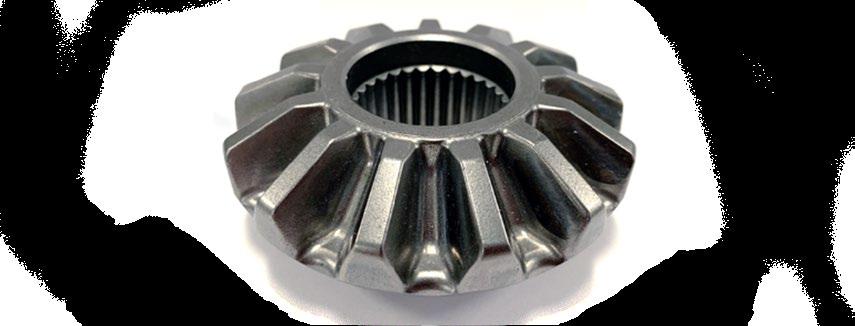
With MBSE, the authority is moved from documents to digital models. Implementing MBE allows engineering teams to understand the influences of design modifica tions down to a component level, with overall design intent maintained through analysis of a system design before it is manufactured. To help visualise the impact of this approach, Fig. 4 shows a V diagram of the design stage through to the valida tion stage [9] with some additional annotations [7].
would proceed, samples processed, and components would be built for testing.Historically, the prototypes would be physically tested with an expecta tion that design modifications would be required. So, the purpose of physical testing is to detect design deficiencies or product issues due to low confidence in the product design and is impact on the system. Information would be fed back to the supplier from the test and design changes would be made to address deficiencies. This iterative approach adds cost and significant time. If unit testing passes and moves into system or operation testing, then fails, there is huge cost impact and additional delay to the timeline.
This diagram allows visualisation of the conceptualisation to product launch cycle for new vehicles. At system design, the process flow typically moves to Tier 1 suppliers, which are then moved down into the Tiers for supply of components or subsystems (represented as the red dashed line).
Some of the issues that exist for PM are that while properties exist in publications, they have often not been through rigorous critical evaluation or included in databases; tensile data published in standards are discrete datapoints, with little statistical data; limited engineering stress-strain curves are available, particularly as data files; and fatigue endur ance is only recorded at one R ratio (R = -1) and developed via the stair case method, with limited statistical information.Whilethe multitude of varia tions in PM material modifications and processing provides a diverse portfolio of solutions to engineering problems, it is difficult to effectively capture the impact of these process variations in databases. While rela tionships for properties as a function of density utilising the existing data can be extended through interpola tion, and limited extrapolation, there must be a transfer of that existing data into databases, specifically those supporting modelling software.
Fig. 5 An example of an MBE-optimised forged PM product’s layers of inter connected implicit data and information, constituting a manufacturable geometry meeting all functional and non-functional requirements
geometryFinishedproduct
[7] PM material Tool materials
parametersTempering
Other than at the largest compa nies, the PM industry is primarily document centric, relying mainly on engineering specification documents, limited material databases for phys ical, static and dynamic properties. This is counter to the fundamental prerequisite for MBE that reliable data is available electronically (usually in software databases for structural components), linked, and comprehensive. Viewing the steel industry as an example, a wealth of data exists for physical, static, and dynamic properties in academic, government, web-based, and built in FEA software databases (e.g., Ansys, Catia and nCode) for both wrought steel and cast iron.
With MBE, a framework is estab lished to drive out waste through engineering linking at various levels, which allows engineers to focus on value-added tasks. By modelling a domain for the vehicle system where there is a shared system database linking all of the other domains, providing a view of the structure and requirements, the impact of designs modifications can be determined (see the forged PM side gear in Fig. 5).
ForgingparametersprecessForginggeometrytools PM material Tool materials
66 © 2022 Inovar Communications LtdPowder Metallurgy Review Autumn 2022 | contents | news | advertisers | events | website | e-newsletter |
The impact of MBE on the PM industry
temperaturesPreformatforgingCompactionprocessparameters temperaturesCompactionprocess parametersQuenchingForging temperaturestoolsparametersSintering Automotive model-based decision making
Without the data, design engineers will either estimate downgraded values or – worst-case scenario –exclude PM from consideration [7]. Both scenarios are detrimental to the PM industry. For the data that exists, if it is not complete or accurate, then the engineers will apply a more strin
Kt=1.04, ρ =7.0 g/cm 3
Actions to reduce the impact of MBE on PM
σ
three different densities with 100 specimen per test to develop a Haigh diagram. The Haigh diagram displays the mean stress and stress amplitude pairs and describes the mean stress sensitivity such that fatigue can be assessed for several densities. This provides additional information for material databases, building a more complete descrip tion of the PM fatigue design space for the designer. Fig. 6 shows the test specimen utilised and Fig. 7 shows the Haigh diagram for FLC24208 [7].
Fig. 7 Haigh diagram for FLC2-4208 for three densities and R ratios for elastic stress concentration factors Kt =1.04 (un-notched) and Kt =1.91 (notched). The diagram depicts the regions of finite life and infinite life [10].
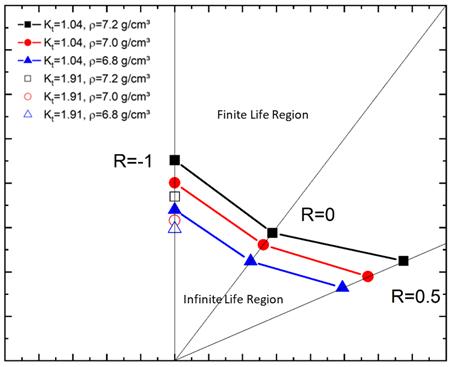
making
Autumn 2022 Powder Metallurgy Review 67© 2022 Inovar Communications Ltd | contents | news | advertisers | events | website | e-newsletter | GETPDF
Infinite life region -200 -150 -100 -50 0 50 100 150 200 250 300 350 400
gent safety factor to that data. These safety factors, uncertainties of user requirements, manufacturing errors, and operational environment vari ation coupled with a conservative approach to the statistical variation in the PM process constrain oppor tunities or removes PM as a viable alternative to automotive applica tions. An aspect that has changed making this scenario more intricate is that for new customers with appli cations where existing empirical data in similar designs for a mate rial selection has proven effective will not be accepted without being proven by a model.
100150200250300350500-250
Finiteregionlife
Kt=1.91, ρ =7.2 g/cm 3
R=0
R=0.5
To address the current landscape, stress-strain curves can provide the engineer with the data to under stand the elastic and plastic regions, plus the impact of low strain rare strain hardening. Parameters can be calculated, and a more accurate assessment can be made, which would improve the consideration potential.Formany industries, including automotive, structural fatigue and its prevention are of extreme concern. The data available to the design engineers in literature and stand ards was limited almost exclusively to rotating beam fatigue endur ance limit data developed from the staircase method, not an S-N curve. While a 90% survival confidence was provided, there was still a high degree of uncertainty for the engi neers; therefore, they would utilise more conservative safety factors, effectively penalising PM.
Fig. 6 Notched and un-notched fatigue bars where Kt = stress concentration factor [10]
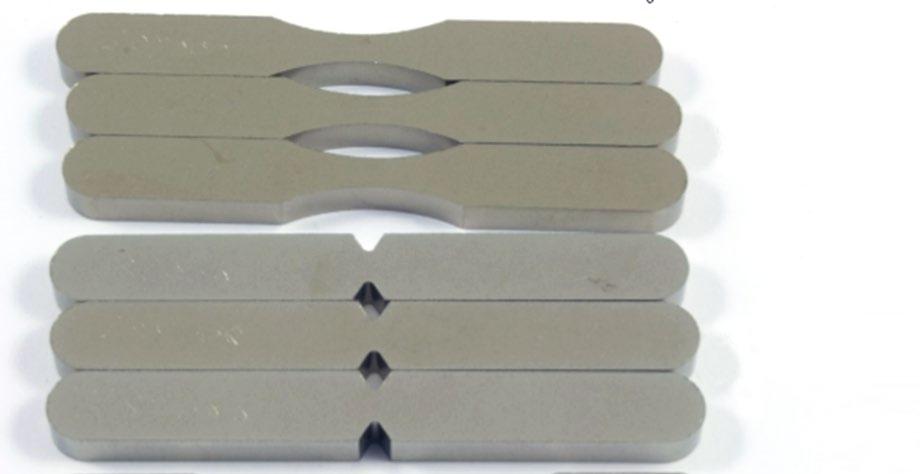
fatiguefatigueNotchedsampleBending:Kt=1.91Un-notchedsampleBending:Kt=1.04 400 (MPa)A m (MPa)
σ
Efforts within the industry to increase PM material data have occurred such as the Global PM Property Database, but this needs to be expanded. It should be noted that for the design engineers, espe cially in the US, there is the need to have strain-controlled fatigue data for materials exhibiting sufficiently measurable plasticity. This has been partially addressed by the MPIF in the engineering information section of Standard 35 for PM Structural Parts [12] but this type of data needs to be uploaded into modelling
Kt=1.04, ρ =6.8 g/cm 3
Automotive model-based decision
Kt=1.91, ρ =6.8 g/cm 3
Until recently, PM fatigue data avail able to the end user consisted of only for R = -1. A protocol was devel oped for expanding PM fatigue data beyond a stress ratio R=-1 for use in modelling [10,11]. The protocol involves producing flat bending fatigue bars (per ISO 3928), both in the notched and un-notched condi tion, then testing at three different stress ratios (R=-1, R=0, R=0.5) at
Kt=1.04, ρ =7.2 g/cm 3
Kt=1.91, ρ =7.0 g/cm 3
2. Quasistatic, linear elastic structural simulation requires isotropic elasticity properties only
4. Many material models available to handle specific physics
Automotive model-based decision making
Efforts to upload PM material property data into data bases such as ANSYS Granta need to occur from the PM industry through the support of individual companies. This database consists of Material Data Sheets (MDS) also known as Data Cards, for the simulation software. An example showing a MPIF FLC-4805 MDS dataset is shown in Fig. 8.
68 © 2022 Inovar Communications LtdPowder Metallurgy Review Autumn 2022 | contents | news | advertisers | events | website | e-newsletter |
software databases. Other efforts to get PM data into the German FKM Guide for Analytical Strength Assessment of Components [13] are underway.
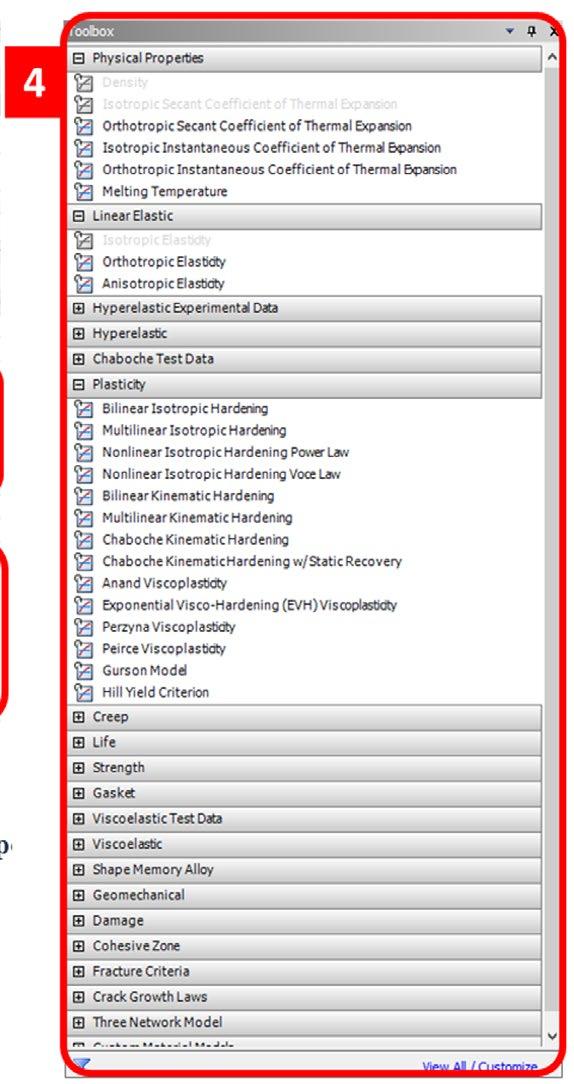
1. Select material from a database or create your own material
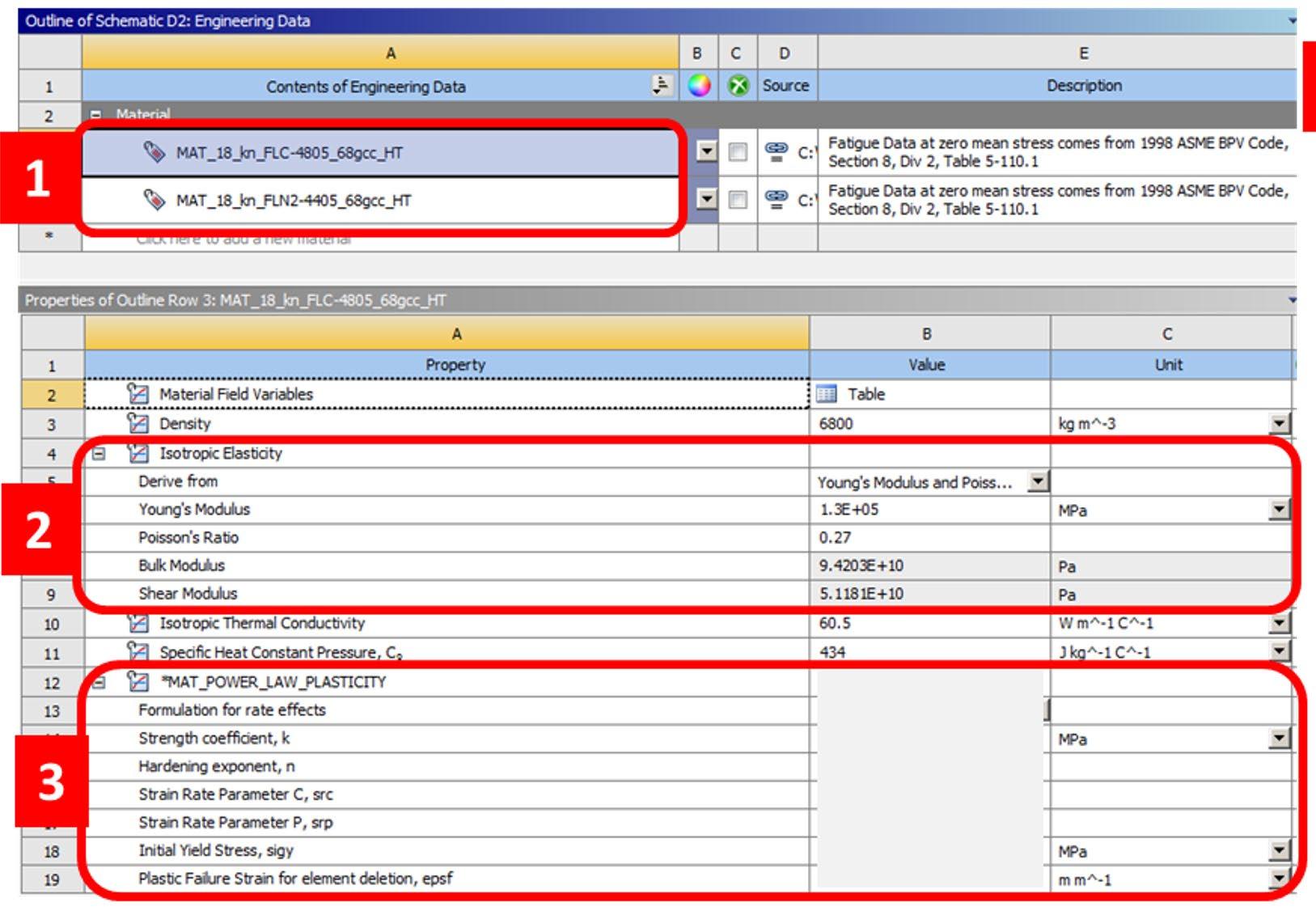
3. An example of material properties for specific physics
Conclusion
This article has discussed the proliferation of modelbased engineering in the automotive industry, and its objectives to reduce cost, time, and defects through flexible, consistent models that are linked to providing
Fig. 8 Images from Ansys Workbench Material Editor/ Selection for MPIF FLC-4805 (chosen in step 1) showing physical, static and dynamic properties that can be accessed for modelling
[12] MPIF Standard 35-SP, ‘Mate rial Standards for PM Structural Parts,’ Princeton, NJ, 2020 Edition [13] FKM (Forschungskurato rium Maschinenbau), Analytical Strength Assessment of Compo nents, VDMA Verlag, 6 th revised edition, 2012
[3] Harvey, D, Logan, P, Waite, M, Liddy, T, ‘Document the Model, Don’t Model the Document,’ as presented at SETE APCOSE 2012, Brisbane, Australia, May 2012
communication of requirements to all model users. With a foundation of reliable data in databases, every individual with access to the model can not only view and verify his or her subsystem, but also view all the interactions of their subsystem with other parts of the entire system. This goes beyond just electrical systems, connecting other domains such as the mechanical component level with modelling on physical, static and fatigue properties.
[2] Bernard, P, ‘Model-Based Design Tools for Automotive System Design,’ in EE Times, January 12, 2001
MetallurgyEngineeringChallenges,’Complexity[5]Entry/120577,oed.com/viewdictionaryentry/<www.2022>Mutschler,AF,‘GrowingAddsToAutoICSafetyinSemiconductor,November5,2020[6]MPlacek,‘Automotiveelectronicsworldwide-statistics&facts,’AutomotiveElectronicsWorldwide,Statistareport,2021[7]Donaldson,IW,Savu,VA,Schneider,M,‘Model-BasedDecisionMakingintheAutomotiveIndustryanditsImpactonthePowderMetalIndustry,’aspresentedatPowderMet2022:theInternationalConferenceonPowderMetallurgyandParticulateMaterials,Portland,OR,USA,June12-15,2022[8]Kraus,R,Papaioannou,G,SivanA,‘ApplicationofModelBasedSystemEngineering(MBSE)PrinciplestoanAutomotiveDrivelineSub-SystemArchitecture,’Master’sThesis,UniversityofDetroitMercy,2016[9]Hart,LE,‘IntroductionToModel-BasedSystemEngineering(MBSE)andSysML,’LockheedMartin,INCOSE,July30,2015[10]Schneider,M,Savu,VA,‘TheSupportEffectandItsImpactontheDesignofComplexShapedSinteredPMProducts,’InternationalJournalofPower,Volume55,No.4,2019[11]Donaldson,IW,Christensen,BD,‘FatiguePerformanceofaLowAlloySinter-HardenedSteel,’PowderMet2021,Orlando,FL,June2021
References and further reading
Automotive model-based decision making
[4] Definition of ‘model, n. and adj.,’ Oxford English Dictionary. Accessed August 22, 2022
The PM industry needs to intro duce more complete data into the databases that are utilised by the designers, as there will be less opportunity to physically test itera tions of design optimisation in future, due to increasingly complex vehicle systems and highly reduced launch timing. In addition, without database information in FEA software, PM will be either be penalised in our proper ties (downgraded) or won’t have the opportunity to quote new business.
Author I W Donaldson, FAPMI GKN Sinter Metals LLC Auburn Hills, MI, www.gknpm.comian.donaldson@gknpm.comUSA
[1] Schweitzer-Miller, M, ‘Steering innovation: The importance of agile decision-making in the auto industry,’ blog post, Kinaxis, November 2019. Accessed August 22, 2022 < decision-making-in-the-auto-industrygies-and-the-importance-of-agile-steering-innovation-new-technolohttps://www.kinaxis.com/en/blog/ >
Autumn 2022 Powder Metallurgy Review 69© 2022 Inovar Communications Ltd | contents | news | advertisers | events | website | e-newsletter | GETPDF
It is imperative for the PM industry to work towards developing more comprehensive data such as tensile stress-strain curves with associated data, fatigue at different R ratios with notch effects, and physical properties necessary for electrification. Without more efforts, the PM industry may be excluded from future opportunities.
Metal Powder Industries Federation APMI International Visit PowderMet2023.org or AMPM2023.org CALL FOR PAPERS & POSTERs Call for Papers Deadline: November 5, 2022 JUNE 18–21 • LAS VEGAS technical programCAESARS PALACE Attendees will have access to hundreds of expertspresentationstechnicalfromworldwideonthelatestresearch and development. TRADE EXHIBIT The largest annual American exhibit showcasing leading suppliers of powder metallurgy and metal additive manufacturing powders, equipment, and products. PowderMet2023 International Conference on Powder Metallurgy & Particulate Materials AMPM2023 Additive Manufacturing with Powder Metallurgy
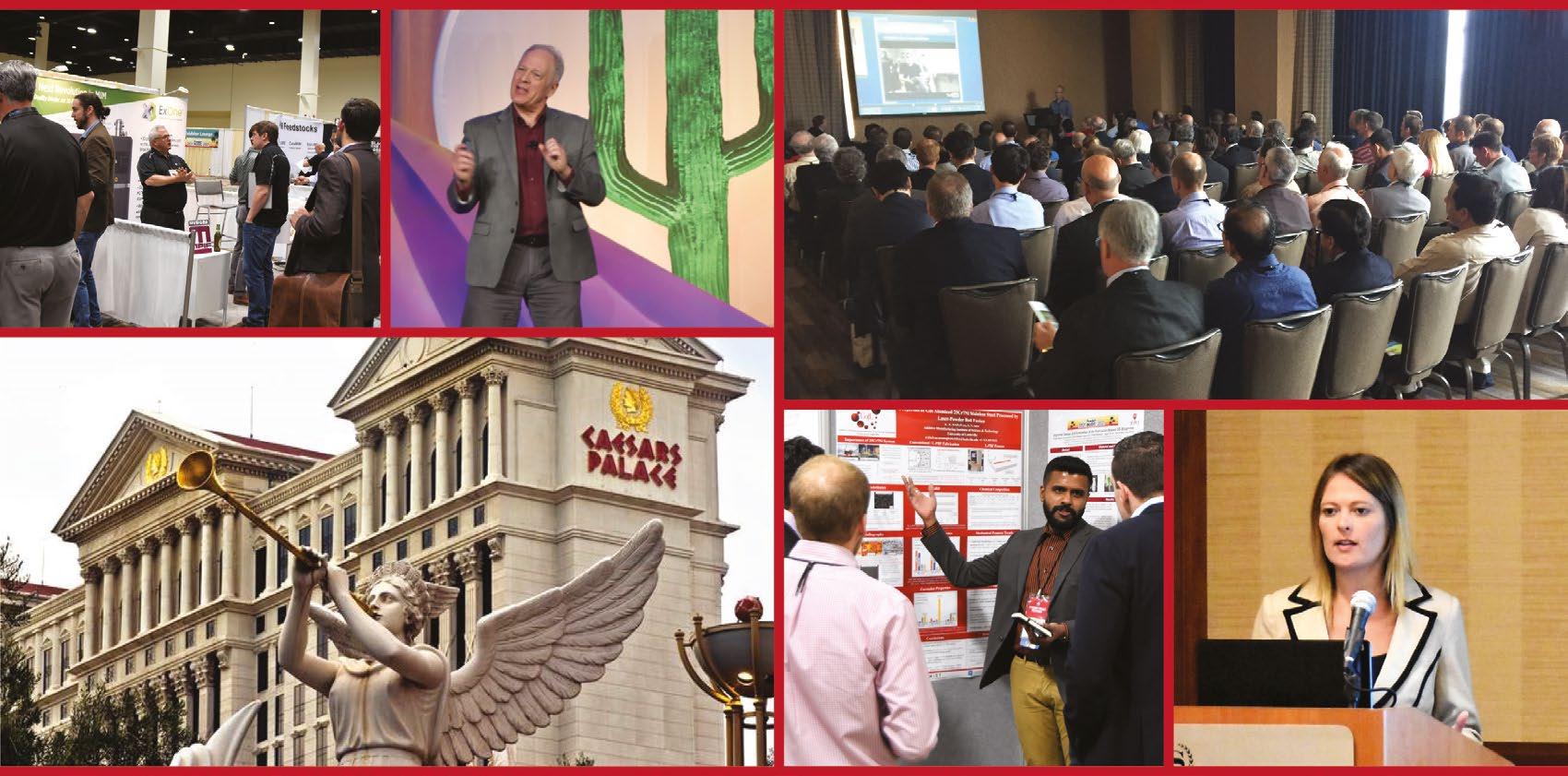

Part 4: Centrifugal and other special atomisation methods
In the Winter 2021 issue of PM Review , we began our four-part series on metal powder atomisation. Over the course of this series, two atomisation experts, Joe Strauss and John Dunkley, have offered our readers a valuable overview of the principles of atomising technology, atomised powders and their applications. In this final instalment in the series, Strauss and Dunkley present those special atomisation methods such as centrifugal, ultrasonic, pressure (single-fluid) atomisation, and two-fluid atomisation with unconventional media. While perhaps not as widely known as gas or water atomisation, each of these specialist methods of metal powder atomisation has its own unique applications – some industrially significant and some highly niche.
Centrifugal atomisation
Autumn 2022 Powder Metallurgy Review 71© 2022 Inovar Communications Ltd | contents | news | advertisers | events | website | e-newsletter | GETPDF
This is also sometimes referred to as rotary atomisation and, in prin ciple, means the breaking up of liquid metal by centrifugal forces. A spectacular illustration of one embodiment of the concept is shown
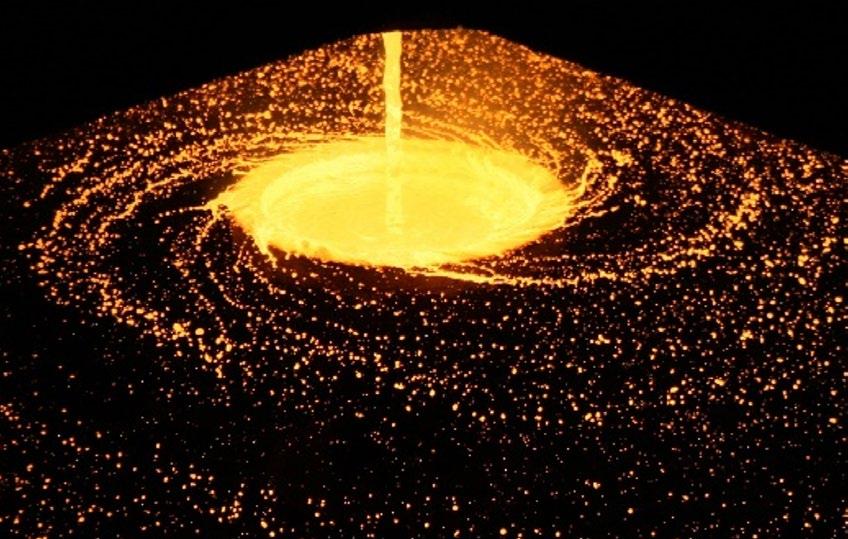
in Fig. 1. Here, a stream of metal – in this case, steel – is falling at 30 t/h onto a rotating disc or cup which is about 600 mm in diameter. As this was rotating at low speed to make very coarse particles, it is easy to see what is happening. The liquid is accelerated to the peripheral velocity
Previous instalments of this review have dealt with the most commonly used two-fluid atomisa tion techniques – that is, when one fluid (molten metal) is broken up by another (water or gas). This section will cover other atomisa tion methods, including those that produce metal droplets by mechanical disintegration of the melt. Some of these methods are well-established and are indus trially significant, with installed capacity of 50–100 kt/y, such as centrifugal atomisation. Ultrasonic atomisation has been commer cially used for many decades for low-temperature alloys, but recent developments have extended the operating temperature, which further increases the range of alloys that can potentially be processed. We will also look at pressure – or single-fluid – atomisation, which has very limited use, and will briefly mention some two-fluid methods using unconventional media (oil and cryogenic gas).
Fig. 1 Centrifugal atomisation on a spinning cup (Courtesy Atomising Systems Ltd)
How to make metal powders.
Special atomisation
• is the surface tension of the
Thus,melt we can readily estimate the particle size, which is inversely
• is the angular velocity of the disc or cup
• Material properties for the spinning cup or disc (tempera ture/strength limitations and reactivity)
Clearly, if the material, such as Ti, is high melting and very reactive, finding a material or design for the disc in very challenging. Likewise, if very coarse particles are desired, the flight distances may demand a huge vessel, perhaps over 10 m in diam eter. Such units are in operation, but only when large volumes of powder are needed and continuous opera tion can be carried out. Systems of this size are difficult to clean out for alloy/material changes, thus these systems are usually dedicated to a single
A major field of application for centrifugal atomisation is in the production of electronic grade solder powder needed to produce solder pastes. The specifications for this product call for excellent sphericity and low oxygen content (e.g., < 100 ppm) and narrow size ranges such as for Type 4 solder (- 38 /+ 20 µm) are demanded. In addition, the alloys are low melting,
ω
• is the density of the melt
γ
Fig. 3 Left; Centrifugal solder atomiser, Right; View of disc in action (Courtesy Atomising Systems Ltd)

Where:
proportional to the speed of rotation, proportional to the square root of the surface tension of the melt, and inversely proportional to the square root of melt density and cup diam eter. The above relationship can be used to examine the practical feasi bility of making any required powder size. It is clear that high surface tension and low density (e.g., Ti, Al, Mg) produces powder that is coarser, while low surface tension and high density (e.g., Pb, Sn) results in finer powder. There are two major issues to be addressed when considering the use of this type of centrifugal atomiser:
Dwrite:=k/ω x ( γ / ρ d) 0.5
Fig. 2 Log-normal plots of particle size distributions of atomised powders. 3 & 7 are centrifugal products. All others gas or water atomised products (Cour tesy ASM Metal Handbook Vol. 7)
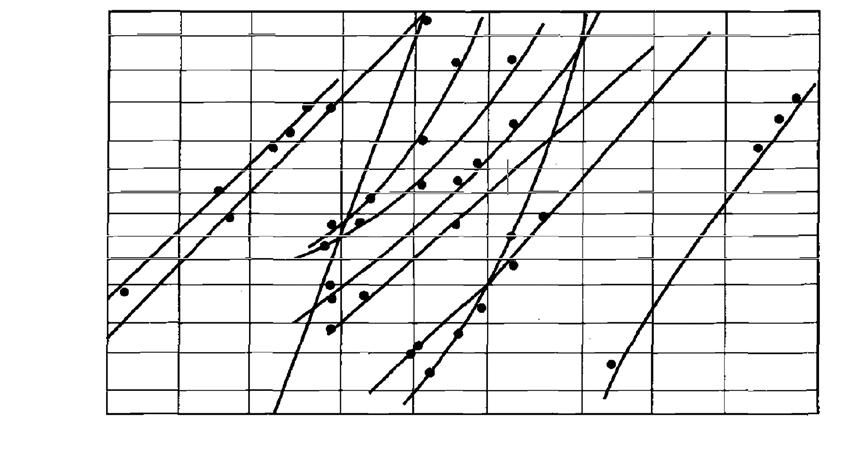
ρ
of the disc and then either forms drops or ligaments which decay into drops. If the flow of metal is large enough and the disc small enough, the melt can sometimes form sheets on leaving the disc.
Onematerial.ofthemost valuable attrib utes of this process is the very tight particle size distribution that can be achieved. The standard deviation of the log-normal distribution (d 84/d 50) produced is far lower than achiev able in two-fluid methods, where anything less than 2.0 is difficult to achieve. In the best cases, centrif ugal atomisers can achieve standard deviations of 1.4 or even 1.3. This means that yields in a narrow range – e.g., of 50–100 µm powder – where two-fluid atomisation cannot achieve more than 40% can be increased to over 67% in some cases, and -140 + 40 µm increased from ~ 58 to 90%.
• The flight distance for droplets to solidify
72 © 2022 Inovar Communications LtdPowder Metallurgy Review Autumn 2022 | contents | news | advertisers | events | website | e-newsletter |Special atomisation
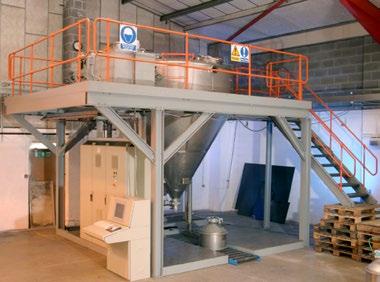
5 10 20 50 100 200 500 1000 2000 5000 99 1 2 3 4 5 6 7 8 9 101020304050607080909598521(%)distributionParticle Particle size (μm)
• d is the diameter of the disc or cup
The fact that the basic process involves all the droplets moving away from each other means that satelliting is rare, and, when carried out in an inert atmosphere, very good particle sphericity can be produced. A further advantage over two-fluid methods, is that the energy needed to drive the cup is minimal, especially when compared to driving a compressor for gas atomisation. And, even in an inert gas-purged system, the specific gas consump tion is very low, adding further to the economic advantages.
Rotary atomisation is very simple to model in some cases. The basic equilibrium of centrifugal and surface tension forces means that we can
In addition to the liquid-fed atom isers discussed above, a significant niche has been found for the Rotary Electrode Process (REP) or the Plasma Rotating Electrode Process (PREP). Here, a bar feedstock is rotated at high speed (10,000 rpm or more) and the tip of it is melted, in REP, by a direct arc struck onto it, and in PREP, by a transferred arc plasma flame from a torch. The latter avoids the problem (especially acute with titanium) of potential tungsten inclusions caused by wear of the counter-electrode. However, both systems use the rotating bar as the anode, which makes the conduction of high electrical power through a rapidly rotating workpiece chal
Applications for ferrous and like melts are obviously very demanding on the cup material. The Rapid Solidification Rate (RSR) process, developed by Pratt & Whitney, uses a water-cooled copper disc, and can handle very reactive materials, including superalloys, titanium, FeNdB, and steels. The special feature of this process, as its name implies, is that the spray is blasted with helium gas to quench the spray.
Turbineairdrive
This is a huge cost at present and may well not now be used, as the rapid quench is no longer the main reason for its use. The fact that the whole system is able to be evacu ated, allowing vacuum melting of superalloys, makes it rather costly, and it is highly likely that later applications have changed the detailed arrangements shown in the published drawing (Fig. 4).
for a product demanding rapid quenching, a water quench arrange ment was developed to process a ferrous powder from a 1.2 t furnace. This allowed over 99% yield of the product size needed. As well as metals, this technique has been demonstrated to work on slags (at up to 5 t/min), molten salts, and some low-viscosity glasses.
Impulse turbine coolant
Helium input (tube trailer)
dense, and have low surface tension, so the production of fine powders is achievable. Simple plain carbon steels are used for the disc as they can withstand the temperature and erosion by the alloy. Fig. 3 shows a centrifugal atomisation system with a 2.5 m diameter chamber that uses a 30 mm diameter disc operating at 60,000 rpm to process ~ 200 kg/h of SAC solder (Sn-Ag-Cu). Such units have now been built with continuous melting and conveying of the powder to an in-circuit classifier.
drive Air and
Zinc is another metal that is widely produced, especially for use in alkaline batteries, using centrifugal atomisation. Here, particle size is again required to be quite narrowly distributed, and a coarser size is needed. Productivity of over 1 t/h is readily achieved, but the coarser particle size requires a larger vessel, as large as 10 m. Continuous melting is common and continuous conveying of the product to the sieving station is normal. Disc materials are less easily sourced but can be Aluminiumfound. is also a candidate but, due to its low density and high surface tension, the physical demands on the cup drive are more severe for finer powders as it must be operated at very high rotational velocities. Thus, applications are mostly for coarser products in the 100–700 µ m range. Magnesium is a difficult material from a safety perspective, but is not as aggres sive to metallic cups as aluminium. Recently, a plant was built that produces ~100 µ m median powder at 200 kg/h (bear in mind that, due to relative densities, this is equivalent in volume to almost 1t/h of solder!).
Fig. 4 Schematic of the RSR process (Courtesy Pratt & Whitney) Exhaust

Collector
Autumn 2022 Powder Metallurgy Review 73© 2022 Inovar Communications Ltd | contents | news | advertisers | events | website | e-newsletter | GETPDF
Since RSR’s inception, Ervin Industries (the sole licensee of Pratt & Whitney’s RSR process) has improved and expanded the technology from lab scale to full production and has enhanced the technology to produce MIM-sized powder. The company’s current capacity is capable of supplying production quantities for numerous alloys and applications. The powder is characterised by high sphericity and low satellites, with particle sizes from 1-1000 µm.
The ‘standard’ centrifugal atom iser is very large in diameter and also does not quench the powder well. To address both limitations
1 nozzlest2 nozzlend 3 nozzlerd Collector
separatorCyclone Deflectorshield
Special atomisation
Fig. 5 Left: Pouring 1.2 t furnace to water quench centrifugal atomiser, Right: Cup in action at 50 kg/min (Courtesy Atomising Systems Ltd)
1. The atomised droplets move very slowly, so a large chamber is not needed
2. Productivity falls as frequency is increased to reduce particle size
74 © 2022 Inovar Communications LtdPowder Metallurgy Review Autumn 2022 | contents | news | advertisers | events | website | e-newsletter |
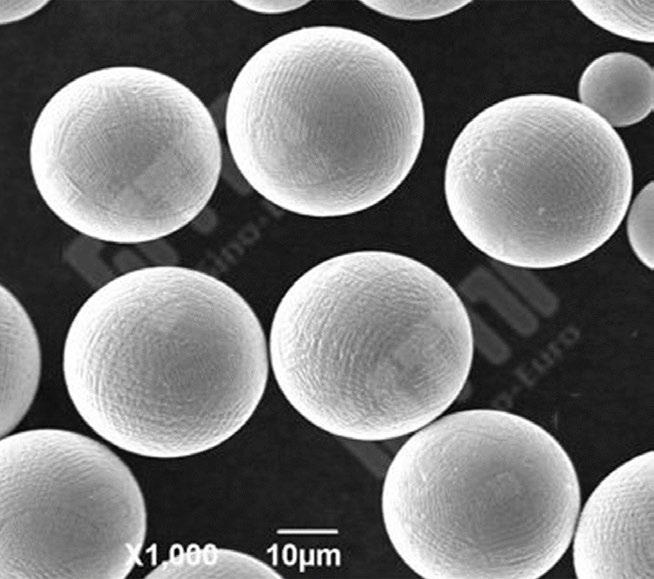
3. Energy and gas use are modest
It is well known that ultrasonic vibration can create a spray of droplets for cold liquids. If carried out on molten metal, powder can be produced. However, the material challenges for the wetted surface are significant and, until very recently, applications were restricted to lowmelting temperature solders. The ultrasonic atomisation process has some major advantages:
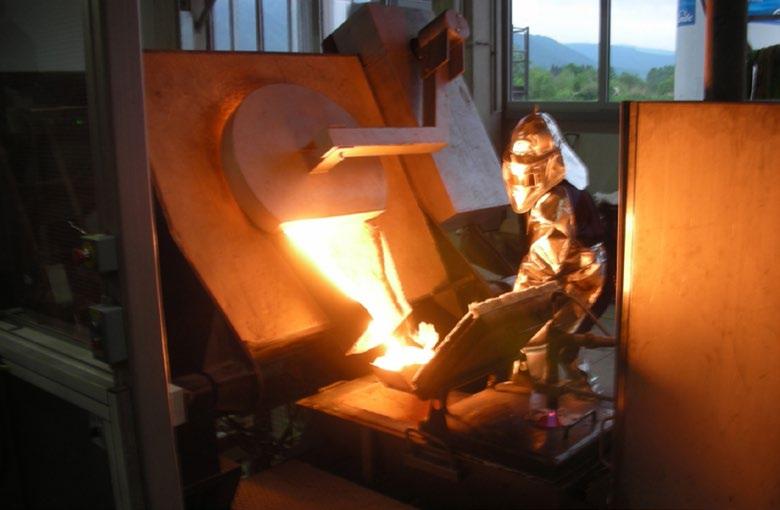
lenging. There has been some work done using lasers as the melt heat source, which eliminates the issue of electric power transmission.
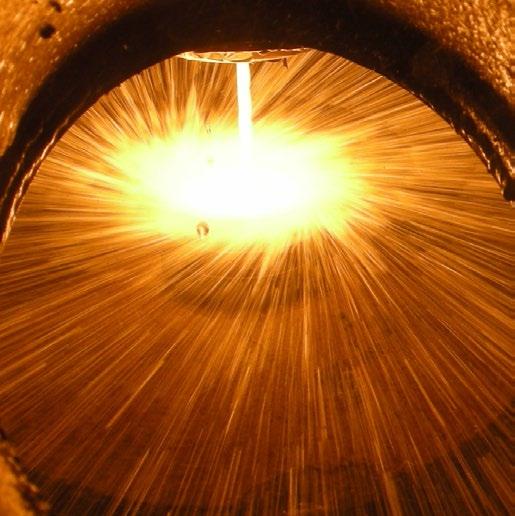
However, there are also several
2. The particle size distribution of the spray is very narrow, almost as good as centrifugal atomisation (SD ~1.4)
Thermocouple Powder collection vessel Drive belt Spindle Brush assembly Feed Monitoring for gas transferredDirect-currentMonitoringpurityforgaspurityarcplasmagun To vacuum pumps and inert gas backfill electrodeLong Special atomisation
Fig. 6 Left: REP concept (Courtesy ASM Handbook), Right: PREP stainless steel powder (Courtesy Sino-Euro Materials)
primarily by increasing the rotational velocity of the workpiece.
limitations:1.Productivity is very limited –e.g., 30-50 kg/h for solders
While the particle size distribution is very narrow, as in other centrif ugal processes, the productivity of the process is modest, in the order of tens of kiilograms per hour. The high cost of accurately straight bars, and the necessity of stopping with a stub left behind, makes the costs of the process high. Recent develop ments in China have shown that this process can be engineered to make finer powders than was previously claimed (~100 µm median size),
Ultrasonic atomisation
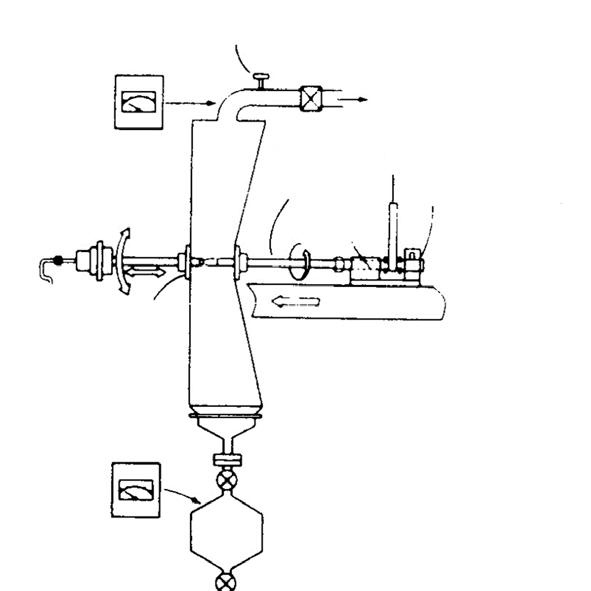
SonotrodeWire
Autumn 2022 Powder Metallurgy Review 75© 2022 Inovar Communications Ltd | contents | news | advertisers | events | website | e-newsletter | GETPDF
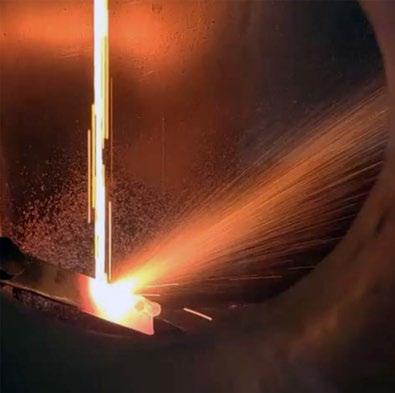
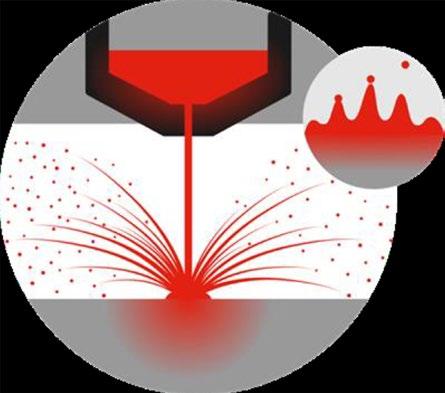
4. Some solder alloys can erode the ‘horn’ (vibrating) surface
electrodeTungsten Electric arc
Past applications of ultrasonic atomisation were limited by the horn material (temperature limita tions and reactivity with the melt) and the Curie temperature of the ultrasonic transducer (for noncooled horns), which is why its uses were restricted to low-temperature solders. Recent developments have greatly extended the temperature capability by water cooling the horn. In one configuration, the system is similar to a conventional arc button melter, wherein the hearth plate is ultrasonically vibrated. In addition, a wire feed provides a continuous material supply (as shown in Fig. 9), although the use of wire as the mate rial feedstock is somewhat limiting to alloy development, as custom wire production is costly and not possible for all alloys.
The technique involves the crea tion of a film of liquid, which must wet the surface, and the subsequent vibration of that surface. The waves produced always have a character istic wavelength, depending on the frequency of vibration and melt prop erties. See Figs. 7 & 8.
In another configuration, conven tional bottom-pour induction crucible melting is used to supply a melt stream to the vibrating hearth plate (Fig. 10). The atomisation rate is reported to be up to 3 kg/h. Although this widens the scope of alloys, pouring a continuous and consistent melt stream at such a low rate is difficult. In both configurations, scaling up to conventional production rates may not be possible, so these systems address niche applications. In any event, these advancements in ultrasonic atomisation do have their place in the production of proofof-concept powders, which are in demand.
Fig. 10 Left: Ultrasonic atomiser (melt-fed) concept, Right: The ultrasonic atomiser in action (Courtesy Amazemet)
Fig. 9 Wire-fed ultrasonic atomiser (Courtesy ATO Labs, Poland)
Melt
Special atomisation
Powder particles pot
3. As the atomiser is a tuned system with a fixed resonant frequency; it can only produce one size distribution (alloy dependent). In addition, there are only a limited range of frequencies available
Fig. 7 Left: Standing waves on a vibrating surface, Right: Droplet formation from standing wave (Courtesy Prof A Yule)
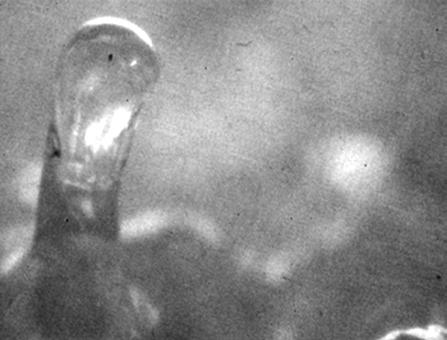
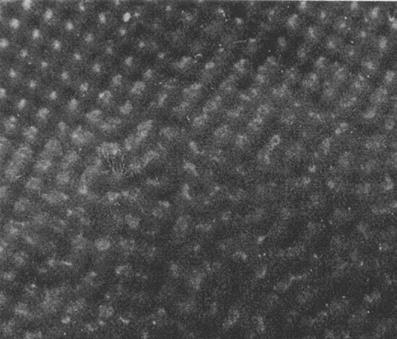
Fig. 8 Ultrasonic atomisation of solder at ~ 40 kHz. The melt is released at the top and impacts the horn (coming up from the bottom) (Courtesy Atomising Systems Ltd)
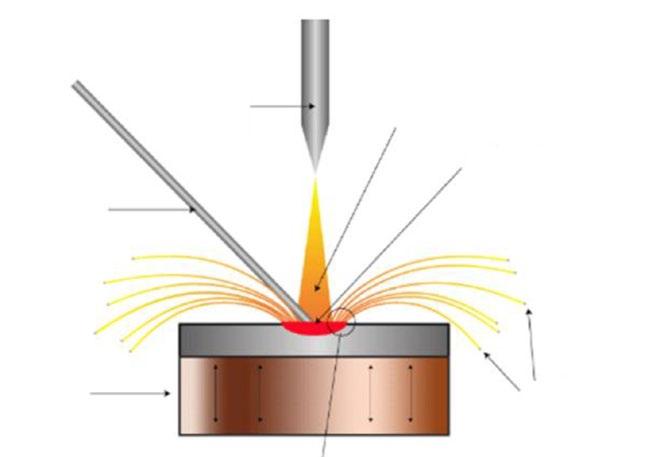

The resulting powders are similar in size to water atomised ones made with similar pressures, but differ significantly in some respects:
• Low oxygen content – no surface oxidation
• As a result, the particle morphology is less irregular and more spherical in nature
the results are shown in Figs. 11 and Table 1.
11 Apparent densities of water and oil atomised powders NiCrBSiNi20CrFe4CCu10SnAlZn 1.20 0.79 4.28 2.89 2.96 4.80 1.49 1.27 4.17 3.25 4.76 4.436543210(G/ML)densityApparent Water Hydrocarbon Special atomisation
Other two-fluid atomisationOil/hydrocarbontechniques:
One of the disadvantages of water atomisation is that the process intrinsically causes oxidation of the powder. Using a non-volatile hydrocarbon, preferably having a high flash point, in place of water is quite possible using very similar equipment and should mitigate – or eliminate – oxidation. However, there
Hydrocarbon Furnace 0.007 0.16 Powder 0.019 0.54
Water Furnace 0.025 0.07 Powder 0.257 0.08
5. Extensive safety precautions are needed to protect against fire
4. As well as some hydrogen generation, the hydrocarbon may be cracked into methane, ethane, or pyrolysed into carbon, etc.
Water Powder 0.090 3.83
Clearly, Zn and Al, with very strong oxide films, show a large increase in AD (apparent density) when oil atomised, a direct indica tion of more spherical particles. Cu10Sn bronze, on the other hand, has little reaction with water, so the effect is lessened; for Ni20Cr, it is very marked. NiCrBSi alloy, which forms a borosilicate oxide layer which is molten at the solidus of the alloy, shows only a small effect. In Table 1, we see that aluminium picks up a lot of oxygen when water atom ised, but only ppm with hydrocarbon. Higher melting alloys seem to react with the hydrocarbon, especially Ni20Cr which has a lot of carbideforming Cr in it.
2. Nitrogen purging is obviously mandatory to avoid ignition by the melt
Fe3.8C
80Ni20Cr
Hydrocarbon Furnace 0.159 3.8 Powder 0.045 4.02
NiCrBSi
76 © 2022 Inovar Communications LtdPowder Metallurgy Review Autumn 2022 | contents | news | advertisers | events | website | e-newsletter |
Water Furnace 0.006 0.07 Powder 0.041 0.07
Fig.
Table 1 Oxygen and carbon levels of water and oil atomised powders
Somepick-upof
This technology has been used for tonnage steel powder produc tion by Sumitomo and others, but was found not to be economically viable. It would seem well suited to processing aluminium, as gas/ air atomisation is so dangerous. In addition, much of the aluminium produced is made into flake for pigments and coatings by milling in a hydrocarbon. It is not uncommon to ship the powder as a paste; thus, if the atomisation hydrocarbon is the same or compatible with the milling hydrocarbon, the cost of ‘drying’ and solvent recovery systems may be eliminated.
Metal Medium Sample O 2% C%
Hydrocarbon Furnace 0.041 Powder 0.039 0.81
1. The lower specific heat of hydrocarbons means that higher liquid/metal ratios are needed to avoid excessive slurry temperatures
Al Hydrocarbon Powder 0.026 Water Powder 6.0 (Approx.)
are important differences that must be borne in mind:
• There is some risk of carbon
3. Solvent recovery in drying is mandatory for economic and environmental reasons
eqn. (1)/Ar eqn. (1)/N
Autumn 2022 Powder Metallurgy Review 77© 2022 Inovar Communications Ltd | contents | news | advertisers | events | website | e-newsletter | GETPDF
M g/M n . . M g/M n . . 00 5 10 15 20 2 4 6 8 10 12 14 80320 60 240 4016080 2020 Shot collection pan Nozzle Feed pipe MeltPumppotmotorand Drain Conveyor
Other two-fluid techniques: Cryogenic atomisationliquid
Cu/Ar 10-19 no. 100-250 no. 50-70
Researchers have carried out trials on the use of liquid nitrogen and argon at pressure of hundreds of bar, but results were not very encouraging and costs unattrac tive. The results in Fig. 12 show huge gas/metal ratios from 5–15 being used to atomise copper, while conventional gas atomisation seems to result in finer powders using only 2–5 gas-metal ratio (GMR).
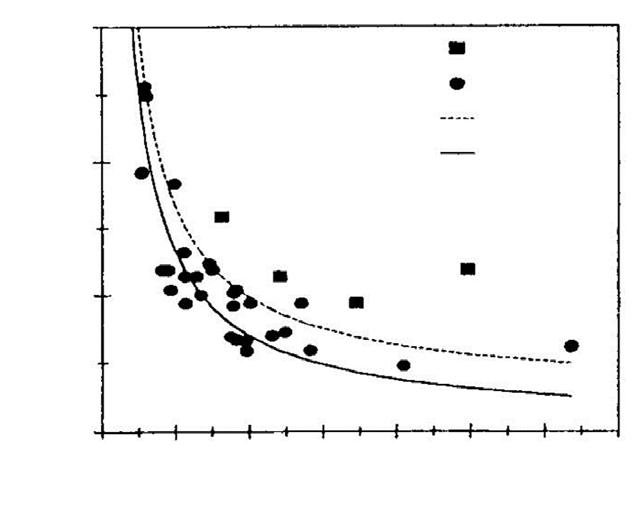
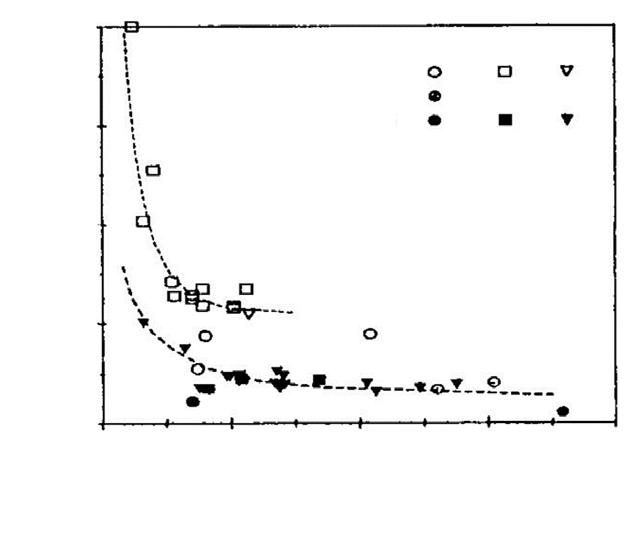
12
sation the aim is always to avoid much boiling, for practical reasons. Additionally, the quenching power of liquified gases is relatively poor due to the Leidenfrost effect.
Fig.
A process where pressurised liquid is forced through a nozzle is, of course, the most common way to form a spray of droplets in the case of water, gasoline, etc. In principle, this can be done with molten metals, but the obvious problem is how to pressurise the melt, and then how to find a nozzle that will not be eroded by the high-velocity melt. Sheikhaliev carried out experiments on a range of lower melting alloys, and one of the authors, working with his data,
Pressure atomisation(single-fluid)
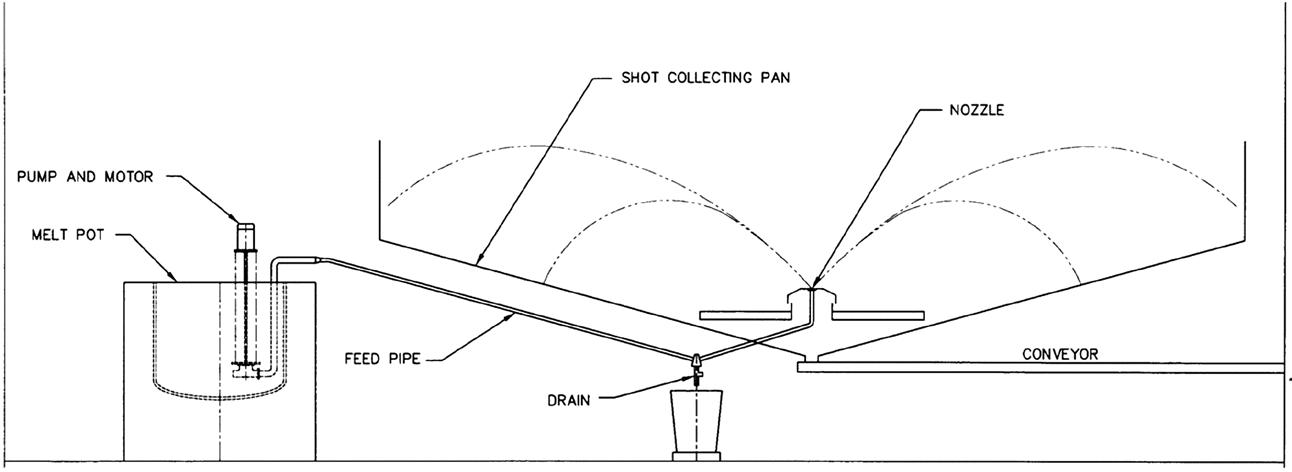
2 Cu/N 2 [μm]d50.3[μm]d50.3 Special atomisation
Fig. 12 Left: Liquid gas atomisation results, Right: Gas atomisation results (note different axes) 13 A 2 t/h lead shot pressure-swirljet atomiser (Courtesy Atomising Systems Ltd)
Nozzle no. 9
p. [bar]SnPb37 NdFeBCu
As in the case of hydrocarbons above, it is easy to imagine that using a liquid inert gas could have advantages, such as extremely low oxygen pickup and eliminating carbon pickup. However, liquid gases are not very dense with respect to water (or oil) and deliver less energy to the melt. Also, liquid gases are always used at, or above, their boiling point, while in water atomi
7
supplied a major facility for atom ising molten lead at ~2 t/h. For this metal, it was possible to use a centrifugal pump to pressurise the melt, and a steel nozzle had excellent life. The plant has been operating for over twenty years, making 0.5–1.3 mm shot. Operating costs are very low, and the unit is almost completely automated with conveying to in-line screening. A major advantage of the swirljet nozzle used is that standard devia tion of the product is almost as good as that achieved in centrifu gally atomised powders, around 1.4–1.5. This means that yields of narrow size ranges are excellent. However, the atomisation system is large (~10 m diameter) and open; however, lead is one of few metals that can be easily cooled in open air. It is also true that to make finer powders one needs to operate at higher pressures with smaller nozzles, further intensi fying problems with nozzle wear or clogging.
Over this series of articles, the authors have attempted a comprehensive overview of atomi sation methods for making metal powders with an emphasis on what is currently used in production and methods that have potential. The principal methods are gas (including air) and water atomisa tion, especially for higher melting alloys, while non-ferrous metals such as Pb, Sn, Zn, Al, etc, are sometimes processed industrially with a wider range of methods, including ultrasonic and centrif ugalTheatomisation.rangeofdemands on metal powders is very wide, and includes requirements for shape, size, chemistry (both bulk and surface), flow, bulk density, magnetic and microstructural properties, colour, reactivity and sintering activity. Such a huge range of demands leads to the selection of different atomising techniques, as well as
Joseph Tunick Strauss, PhD Engineer, president HJE Company, Inc. Johnwww.hjeco.comjoe@hjeco.comJDunkley, PhD, FREng AtomisingChairman Systems www.atomising.co.ukjjd@atomising.co.ukLimited
Conclusion
78 © 2022 Inovar Communications LtdPowder Metallurgy Review Autumn 2022 | contents | news | advertisers | events | website | e-newsletter |
Authors
post-atomising processes, chief of which are size control (sieving and classification) and heat treatment (annealing/reduction).Thesearticlescanonly serve as an introduction to a vast field of research, much of it propri etary and unpublished. The metal powder industry has a few giants, and many participants in very narrow niches, which use specific methods to exploit valu able markets. The authors, with almost a century of experience between them, have been involved in building and upgrading a large number (> 100) of atomising plants worldwide, but still cannot claim that this is a comprehensive treat ment of such a vast subject.
Fig. 14 Swirljet nozzle in Perspex spraying water (Courtesy Prof A Yule)
Special atomisation

powdermetallurgyreviewwww.linkedin.com/company/www.facebook.com/PMRmagwww.twitter.com/PMRMag COMMUNICATIONS INOVAR Get instant updates on the latest PM news, #deepdive articles and market trends www.pm-review.com POWDER METALLURGY REVIEW US ON SOCIAL MEDIA FOLLOW





Tel: +86-4000 778 909 +86-20-8327 6369 / 6389 Email: pmchina@unirischina.com pmchina@unifair.com Web: www.pmexchina.com TheOrganizer15 t h C h i n a I n t e r n a t i o n a l E x h i b i t i o n f o r P o w d er M e t a l l u r g y PM CHINA 2022 Oct 20 - 22, 2022 forBrandAnnualEventPM&MIMIndustryNanjing International Expo Center

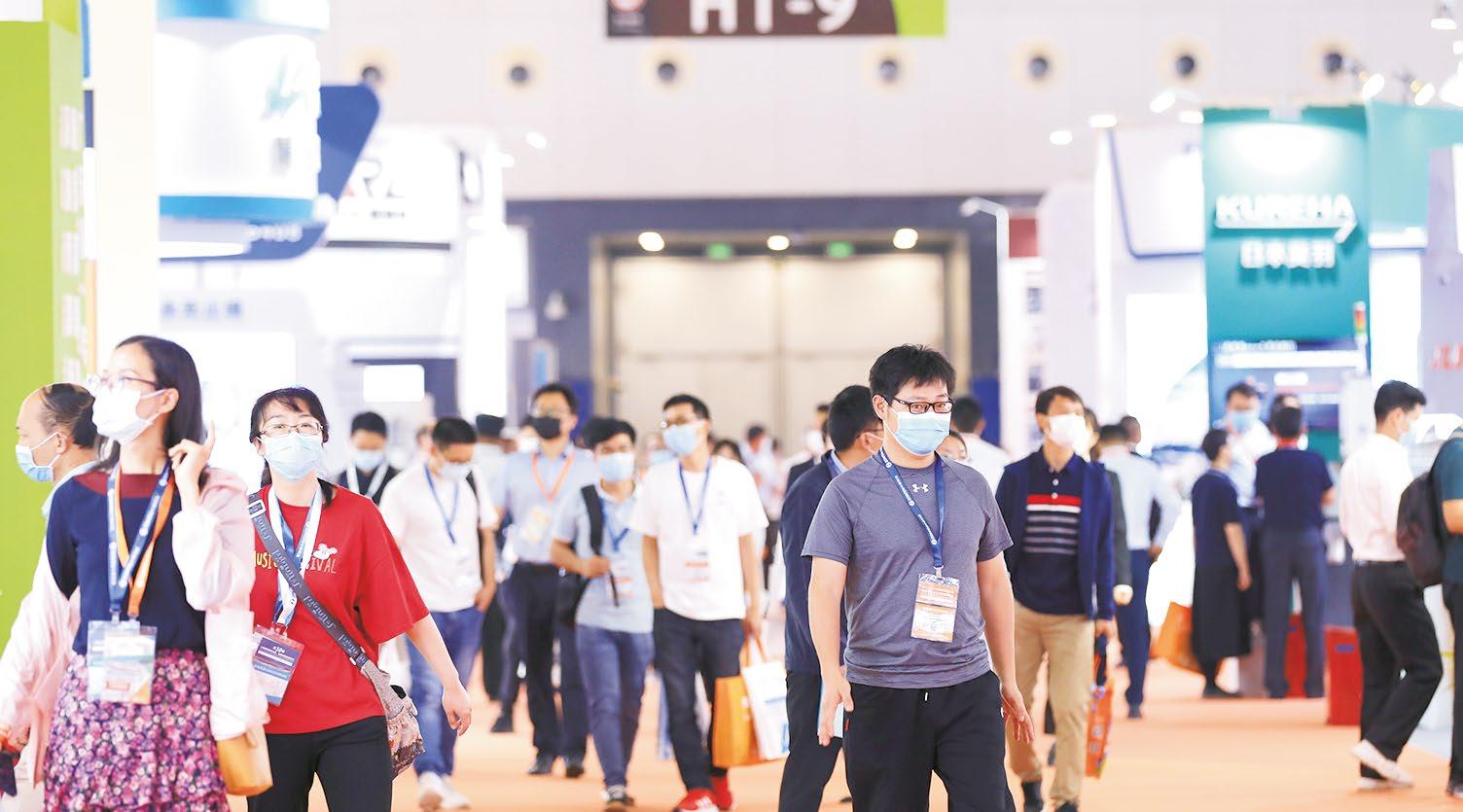
Ceramitec 2022
Precision and energy efficiency in PM press technology: Insights from Ceramitec 2022
In the exhibit hall, I spoke to six of Europe’s largest producers of
Autumn 2022 Powder Metallurgy Review 81© 2022 Inovar Communications Ltd | contents | news | advertisers | events | website | e-newsletter | GETPDF
From June 21–24, 2022, around 10,000 visitors attended the Ceramitec trade fair in Munich for the first time since 2019, following the COVID-related cancellation of the 2020 trade fair and postpone ment of the 2021 edition. Showcasing over 350 exhibitors, this exhibition of ceramic and related production technologies was a welcome oppor tunity for networking and knowledge exchange for producers of technical and non-technical ceramics and their associatedHowever,technologies.thedifficult geopolitical context in which it was held meant reduced visitor numbers, compared to prior years, and limited interna tional participation. Though life is returning to a tentative normality in the wake of the COVID pandemic, some countries, such as China, still faced strict travel restrictions at the time of the event, and growing economic uncertainty caused by supply chain disruptions and the Russian invasion of Ukraine have impacted some companies’ willing

After a four-year interruption due to the COVID-19 pandemic, Ceramitec, the leading trade fair for the ceramics industry, reopened its doors at the Munich Exhibition Centre this June. Although the focus of Ceramitec is on ceramic production technologies, many exhibitors also offer and showcase products for the Powder Metallurgy industry – in particular, powder compaction technology for press and sinter PM. Dr Georg Schlieper visited the trade fair on behalf of PM Review , and spoke to a number of suppliers of powder compaction technology about the latest developments and trends in the industry.
ness to invest in travel and exhibition stands. Nevertheless, for those who were able to attend and take advan tage of the networking opportunities on offer, the event was a great success, and marked an optimistic return for Ceramitec’s organisers.
powder compaction technology for the press and sinter PM industry about their latest product develop ments, and their view of trends in PM press technology. Two themes were common: the PM industry and its customers are demanding ever higher precision, and greater energy efficiency.
Fig. 1 Ceramitec 2022 was held from June 21–24, 2022, in Munich, Germany
Dorst Technologies GmbH & Co. KG
Sacmi
Fig. 2 Dorst’s press cell, the FlexCell 16, enables automatic deburring of green parts (Courtesy Dorst Technologies)
82 © 2022 Inovar Communications LtdPowder Metallurgy Review Autumn 2022 | contents | news | advertisers | events | website | e-newsletter |Ceramitec 2022
The main focus in the PM space for Sacmi, Imola, Italy, a renowned manu facturer of powder presses, was the compaction of helical gears (Fig. 3). “The system developed by Sacmi is completely controlled from the control panel of the press where all parameters of the part are set,” stated Andrea Zaccherini, General Manager of the Metal Product Unit of Sacmi. Sacmi’s innovative concept works with rotating punches and dies. All movements are servo-assisted and synchronised to the required precision by the press software, with helical angles up to 30° and higher being possible. The system is extremely flexible, enabling the production of complicated parts featuring an internal helical gear.
“These fully automated production cells avoid the problems of inter faces that arise when independent systems are to be connected to each other,” explained Christian Schmidt, Director of Sales and Services at Dorst. “There are no time delays
Fig. 3 Helical PM gears exhibited by Sacmi (Courtesy Sacmi)

between the systems, so the stroke rate depends only on the compaction process.”Thetrend towards fully electric presses seen in previous years at Ceramitec continues, because electric presses are so much more energy efficient than hydraulic presses. Small carbide products, such as indexable inserts, are manufactured on presses in the range of 160 kN; here, electric presses have completely replaced the hydraulic presses. Dorst now offers electric presses up to 2000 kN press force. Servo-hydraulic auxiliary units are used for higher compaction pressures.Dorstsees itself as a pioneer in the field of powder press digitisation, and Schmidt stated that a separate business unit is now working on this topic. Not only does Dorst develop system solutions, it also offers customer support in the introduction of digital services and the Internet of Things (IoT). The software Dorst IoT Solutions enables the networking of presses and the evaluation of produc tion data. “This leads to deep insights into the manufacturing process and the condition of the machine, which is of great value for quality assurance and machine maintenance,” stated Schmidt.
Almost all press manufacturers today offer powder presses with fully integrated and automated green part handling, known as ‘press cells.’ Dorst, Kochel am See, Germany, exhibited the innovative FlexCell 16, a system for pressing carbide index able inserts with a press force of 160 kN, in which the green parts are
automatically deburred with a brush and placed on trays (Fig. 2). The punch and die are cleaned at regular intervals and powder residues are automatically removed.
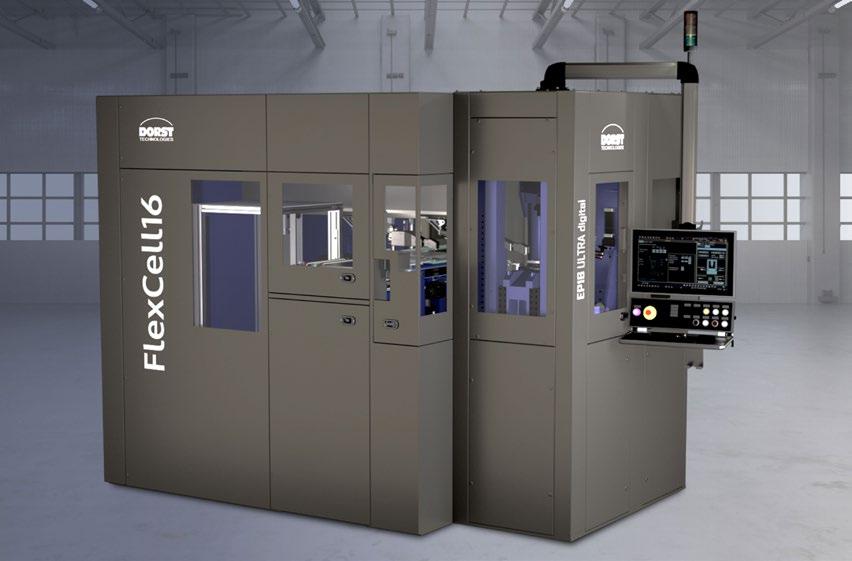
(Fig. 4). According to Markus Oechsle, board member for technology & engi neering at Maschinenfabrik Lauffer, a key advantage of press cells, apart from their compact design, is the comprehensive software that controls all of the cell’s components. In the past, the software control ling the press, green handling and, if necessary, further downstream processes, all came from different sources. This often led to interface problems between different auto mated units, as well as increasing process time. According to Oechsle, the integrated software within Maschinenfabrik Lauffer’s press cells is faster, less vulnerable, easier to operate and more sustainable.
flows. He explained that Sacmi is constantly improving the energy effi ciency of its presses, and that new functions and new features are being developed to aid in opening new markets for PM press and sintered parts.
Traditionally, Maschinenfabrik Lauffer, Horb, Germany, has focused on the production of powder presses with high press forces and, therefore, entered the development of elec tric presses relatively late. As well as its traditional offerings, Lauffer also offers fully electric presses for smaller products and high cycle rates, as well as press cells with fully automatic green part handling
Osterwalder AG
Autumn 2022 Powder Metallurgy Review 83© 2022 Inovar Communications Ltd | contents | news | advertisers | events | website | e-newsletter | GETPDFCeramitec 2022
Maschinenfabrik Lauffer GmbH
According to Zaccherini, program ming the press for a helical gear is as easy as programming a press for standard cylindrical PM parts. Setup times have been substantially reduced with the newly developed tooling concept. Electric powder presses from 100–800 kN and hydraulic presses up to 12,000 kN nominal press force are produced by Sacmi, and all machines can be connected to the digital data system of theZaccheriniuser. told PM Review that Sacmi is focused on responding to the concerns in the wider PM industry regarding the challenges posed by the transition to electromo bility, and the resulting reduction in the production of internal combus tion engines (ICEs), as well as the increasing demand for sustainable production technologies and work
Lauffer is currently seeing an increase in demand for large hydraulic presses in the sintered steel sector. According to Oechsle, composite components made of two or more different materials are increasingly being pressed. As an example, he mentioned components with a soft core and a hard surface, or vice versa.
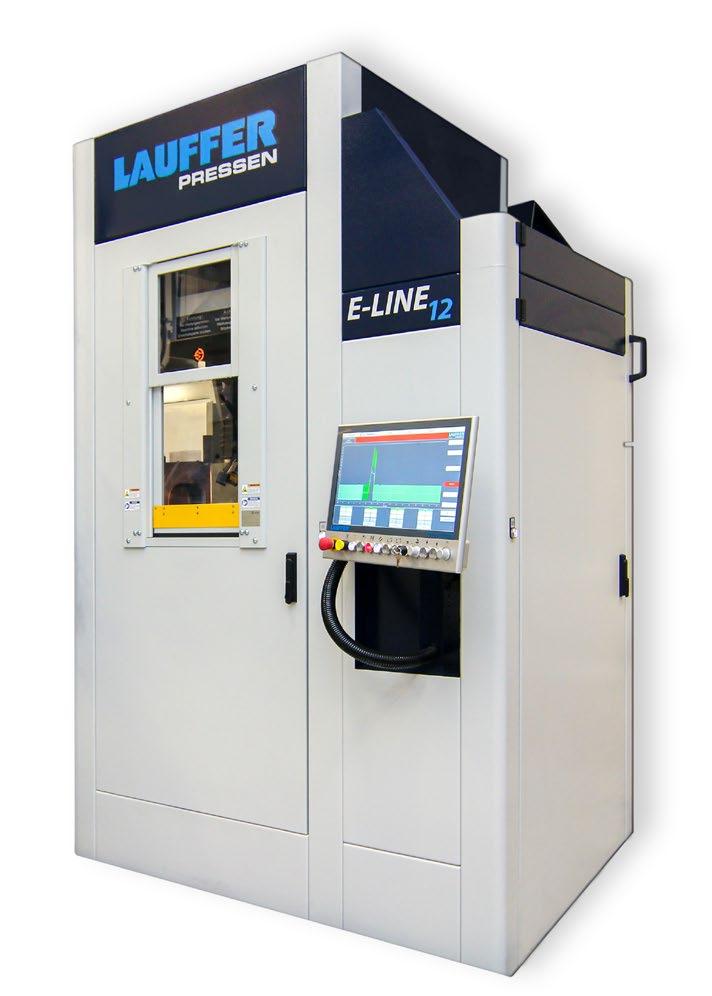
Osterwalder, Lyss, Switzerland, mainly supplies presses to the carbide industry. The company stated that it is focused on the further development of electric presses, which it suggests are almost the only press in demand in this sector. With press forces of up to 5000 kN, Osterwalder presses are probably among the largest electrically driven powder presses. Thorsten Matusche, Global Head of Sales, Osterwalder AG, stated that the energy savings offered by Osterwalder’s electric presses, compared to that of conven tional hydraulic presses, could be up to 80%.Besides these energy savings, he stated that the use of electric presses allows for an increase in the accuracy of powder compacts, as electric press systems can be controlled more precisely than hydraulic drives. Another impor tant factor is maintenance; users of
Fig. 4 Lauffer electric press E-Line 12 (Courtesy Maschinenfabrik Lauffer)
Automation GmbHRoboworker
Ceramitec 2022
PM Review that the helical gear project was realised in collaboration with a Chinese customer during the pandemic. “Since the Swiss service technicians could not travel to China, the entire commissioning of the press was carried out with the help of Osterwalder’s Chinese engineers and via video calls,” he said. “That was a great challenge, which was ultimately successfully passed.”
sation,” said Matusche. “The central control of press and parts handling allows a significant increase in strokeOsterwalderrates.” is currently investing significant efforts in software development in order to meet the requirements of Industry 4.0 and the IoT. An important topic for Osterwalder in this context is the prevention of staff operating errors. The smart press largely takes over the setup process based on predefined parameters stored in the software, thus saving setup time and preventing damage due to human error.
hydraulic presses will be familiar with the problem of leakage at sealing elements. High-power hydraulics also require cooling with water and, after coming to a stand still, take time to warm up for the next production run. In addition, an electric press does not require a press pit, generates much less noise and is more durable than a hydraulic press.Osterwalder also offers a system for pressing helical gears. The decisive factor in this technology seems to be that both the punches and the die are rotated during the compaction process. Matusche told
84 © 2022 Inovar Communications LtdPowder Metallurgy Review Autumn 2022 | contents | news | advertisers | events | website | e-newsletter |
For thirty years, Roboworker Auto mation, Weingarten, Germany, has been developing automation systems in the periphery of powder presses, including deburring and green machining solutions, as well as various solutions for repalletising, inspection, laser marking, packing, Additive Manufacturing production support equipment, and more. This year’s Ceramitec marked the first time that the company presented an entire powder press cell, under the name Roboworker Press Cell (RPC), including a fully servo-driven elec tric powder press (Fig. 6). Powder presses from 120–300 kN nominal press force, working on the ejection principle, are available. All Robow orker press automation platforms can be fully integrated into one control
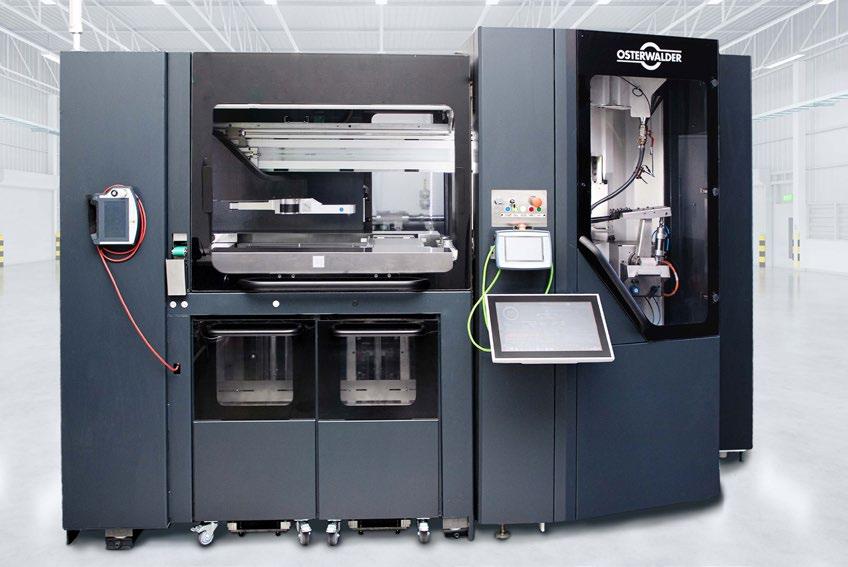
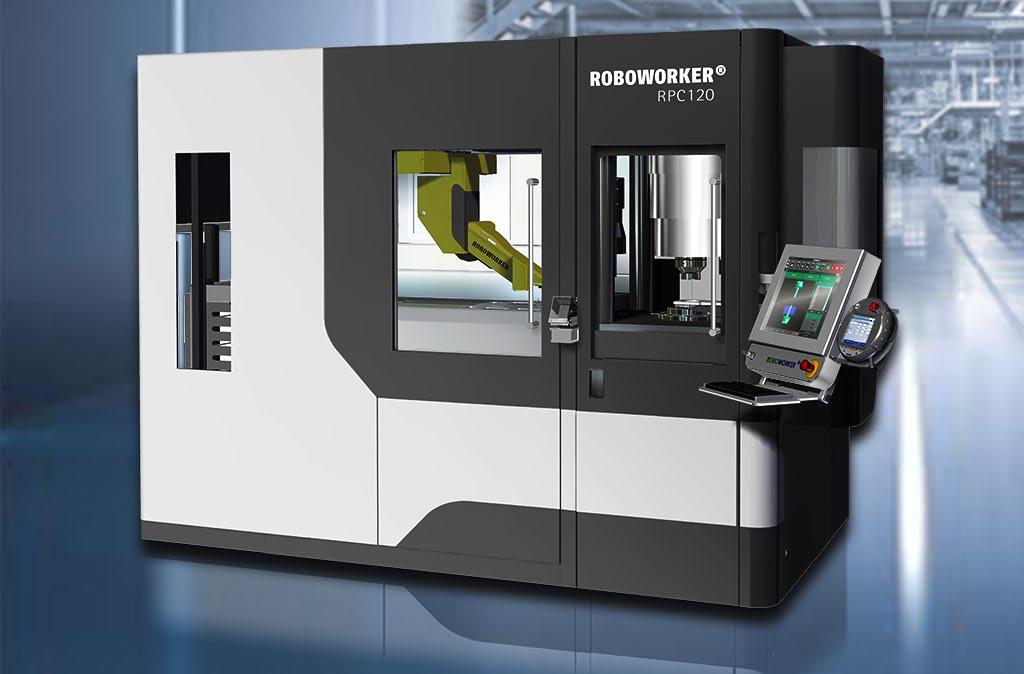
Astridarchitecture.Müller,Marketing Manager of Roboworker Automation, stated that Roboworker’s RPC technology meets the highest standards in all major decision-making criteria (such as optimal product quality and process stability, increased productivity, maximised user friend liness and ergonomics, compact layout, Industry 4.0, interface tech nology to the next process steps, and maximum containment at an outstanding price-performance ratio).
Fig. 6 Roboworker press cell RPC 120 (Courtesy Roboworker Automation)
Press cells between 80–2000 kN press force are offered under the label ‘Smart Cell’ (Fig. 5). “The complete traceability of all parts, which is part of the Smart Cell software, is a key element for digiti
Fig. 5 A press cell from Osterwalder (Courtesy Osterwalder AG)
Autumn 2022 Powder Metallurgy Review 85© 2022 Inovar Communications Ltd | contents | news | advertisers | events | website | e-newsletter | GETPDF
Author Dr Georg Schlieper Essen, georg.schlieper@hotmail.deGermany
“Some of our technological features are new in this industry and provide customers with unique benefits,” Müller said. “The features include revolutionary programming technologies, innovations in process control, in-line inspection technology and many more. The system can be equipped with multiple cameras for quality assurance and process monitoring. Through the utilisation of modern data recognition tech nology, the RPC offers full product traceability and, of course, includes Roboworker’s comprehensive Industry 4.0 communication.”
A subsidiary of the Georg Fischer Group, System 3R, Vällingby, Sweden, manufactures systems for rapid tool change on powder presses (Fig. 7). The unique reference system of System 3R can carry a workpiece from one machine to another without time-consuming realignment. By working within fixed references, System 3R converts internal setup time to external setup time. The concept centres on defining each machine’s zero point once and once only, allowing fixed references for all machines and a common system for a user’s entire workshop.Thebenefit of this tool change technology is a significant reduction of tool setup times. System 3R technology is used for electrode manufacture and EDM machining of press tools and for assembling press tools. Henrik Nordquist, Product Manager Tooling, gave an example: He said that on a single level powder press the tool setup time is usually between one and four hours; with the 3R system, this can be reduced to 15 minutes or less. The system can be used with all press Nordquisttypes.also mentioned that the precision of PM parts is significantly improved by System 3R technology, so that subsequent grinding operations can, in many cases, be eliminated, as tool positions and angles are set much more accurately. Another consequence is that tool crashes due to geometrical errors in the setup are virtually eliminated because the alignment of punches and dies is so much more accurate.
The atmosphere in the PM industry seems to have brightened significantly after COVID, despite concerns about the challenges posed by electromobility. Progress is being made in the development of new markets, and some press manufacturers once again report rising sales. Nevertheless, enor mous challenges remain – above all, the contribution that the PM industry will have to make to further reduce its carbon footprint. Powder press manufacturers have already made some progress on the way to climate neutrality, but there is a lot of work left to do.
Conclusion
Digitisation and sustainability, the major overarching topics currently being discussed throughout the manufacturing industry worldwide, were also present at Ceramitec. Considerable efforts have been made by powder press manu facturers to make progress in digitisation, readying machines for Industry 4.0 and the smart factory. The most striking advances in terms of the sustainability of PM production are energy savings of up to 80% through the use of fully electric powder presses.
System International AB3R
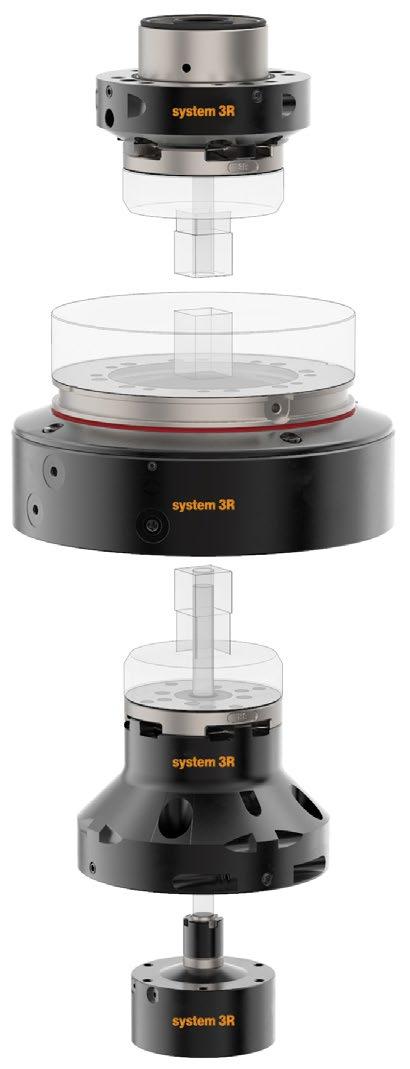
The next Ceramitec will be held from April 23–26, 2024, at Messe München, Munich, Germany.
Ceramitec 2022
Fig. 7 System 3R reference system for PM tools (Courtesy System 3R)
Conference Sponsors: Metal Injection Molding Association Metal Powder Industries Federation APMI International MANUFACTURING INNOVATIONS: • Part design • Part Inspection • Tooling • Secondary Operations • Molding • Simulation • Debinding • Competing Technologies • Sintering • Coatings MATERIALS ADVANCEMENTS: • Metals & alloys • Binder Technologies • Ceramics • Mixing • Hardmaterials • Mechanical Properties TARGETED AUDIENCE: • Product designers • Engineers • End users • Manufacturers • Researchers • Educators • Students Call Presentationsfor 2 0 2 3 International Conference on Injection Molding of Metals, Ceramics and Carbides Febr uar y 27–March 1, 2023 • Hilton Orange County/Costa Mesa, CA Visit MIM2023.org to submit an abstract. ABSTRACT SUBMISSION DEADLINE: SEPTEMBER 30, 2022
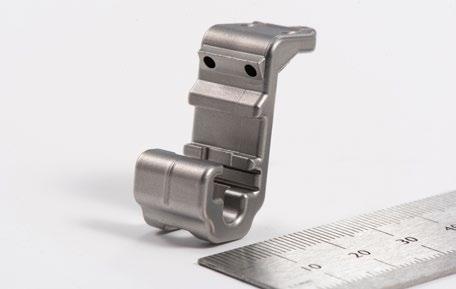
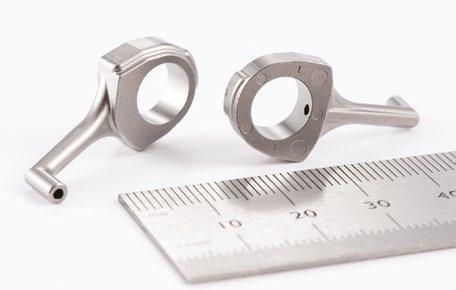
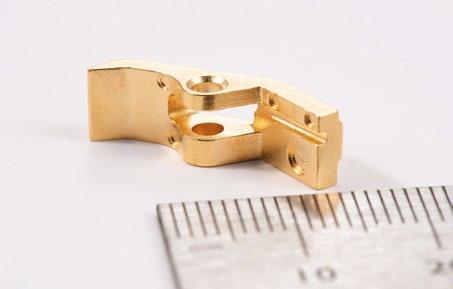
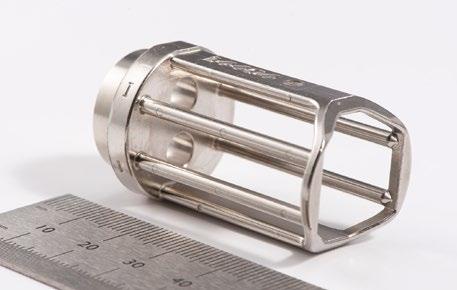
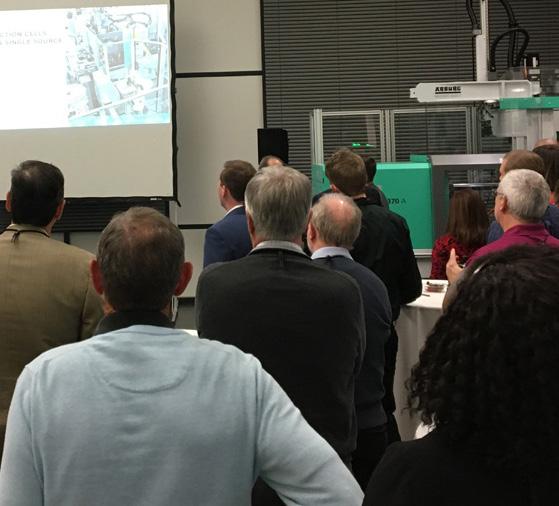
20 th Plansee Seminar
Since 1952, Plansee has held a weeklong seminar on refractory metals and hard materials at its headquar ters near Reutte in the beautiful Austrian Tyrol, initially every three and, later, every four years. The 20 th Seminar was to be held in 2021, but was delayed a year due to the COVID-19 pandemic. It was with much anticipation that the attendees finally arrived at The Plansee Group campus on May 30, 2022, and it is no exaggeration to say that there was a palpable sense of joy at being able to meet up again, in person, with so many industry colleagues after over two years of significantly constrained travel and face-to-face interaction.

Plansee Seminar Chairman Dr Karlheinz Wex welcomed the participants and emphasised the organisers’ desire to hold true to Paul Schwarzkopf’s vision of a week of personal networking to build rela tionships and promote knowledge exchange within the industry. In his opening address, he reflected on the difficulties generated by both the
pandemic and the current geopo litical situation, and stressed the importance of technological innova tion in responding to economic and societalTheremegatrends.were384attendees at the seminar, coming from twenty-seven
countries, with 85% visiting from Europe; 10% from the Americas; 4%, Asia; and 1%, Africa. Some govern ments’ approaches to COVID-19 reduced the level of international participation, most notably from Asia, and China in particular – from
Fig. 1 Heiterwangersee, close to Plansee Group’s headquarters (Courtesy Bernard North)
Autumn 2022 Powder Metallurgy Review 87© 2022 Inovar Communications Ltd | contents | news | advertisers | events | website | e-newsletter | GETPDF
Historic traditions and new innovations: refractory metals and hard materials at the 20 th Plansee Seminar
After a five-year hiatus, delegates from twenty-seven countries gathered once more to attend the Plansee Seminar in Reutte, Austria, this June. Here, the most knowledgeable minds from the refractory metals and hard materials world, both industrial and academic, gathered to discuss the present and future of this important sector of Powder Metallurgy (and maybe enjoy some in-person networking). Here, Bernard North provides his knowledgeable impression of the conference as a whole and outlines its opening sessions and technical programme.
Co and W substitution in hard materials, high entropy alloys, high temperature superalloys. Modelling.
Openingsession
The Hard Materials Group of the European Powder Metallurgy Asso ciation (EPMA) also held a half day meeting during the seminar, with several pertinent presentations – in particular, one on Additive Manu facturing and one on the use of reclaimed
Subject materialsHard Refractorymetals
TiAlN and more complex nitrides, as well as borides and carbides, primarily for metalcut ting applications
25 16 41
ManufacturingAdditive
applicationsNuclear 2 9 11
Total 3 132 68 203
unpresented content was still included in the abstracts provided to the participants. To enable the greatest opportunity possible for knowledge sharing, the organisers avoided scheduling concurrent sessions, and offered significant status to posters, which were readily accessible for most of the conference and were highlighted in a special three-hour evening poster session. Table 1 breaks down, according to this author’s judgment and allowing for some simplification, the main areas of technical focus covered by the presentations and posters.
History of Plansee Seminar, effects of macro economic and societal trends (especially envi ronmental), reviews on hard materials and refractory metals
Total Summary comments
Advances in analytical techniques, modelling sophistication
13 14 27
88 © 2022 Inovar Communications LtdPowder Metallurgy Review Autumn 2022 | contents | news | advertisers | events | website | e-newsletter |20 th Plansee Seminar
Overview 3 1 1 5
The programme included seventy-eight presentations and 110 poster presentations; 188 of a planned 203, owing to some scheduled presenters being unable to attend due to illness, travel restrictions, or other causes. The
Presentation category
Welding, brazing, and sinter joining of refrac tory metals
Various subjects including medical applica tions, energy reduction in processing, edge preparation
Physical DepositionVapour 26 26
TiCN/Al2O3 and TiALN, and derivatives thereof, for metalcutting applications
Other 6 4 10
Processing of ores and reclaim materials
Modelling and practical studies, primarily laser powder bed for refractory metals and binder jet or fused filament plus sinter for hard materials
Solid developmentmaterial
Table 1 The main areas of technical focus covered by the presentations and posters at the 20 th Plansee Seminar
Chemical DepositionVapour 17 17
Attemptingmaterials.tosummarise overall impressions from a conference with about 200 contributions inevitably involves some generalisation and subjectivity on the part of this author. That stated, he hopes his impressions from the 20 th Plansee Seminar in this article will be of benefit to readers.
processingOres/oxide 4 4
42 16 58
Analytical niques/modellingtech
where there would normally have been a large number of partici pants. Among the organisations in attendance, 56% were universities (this author was impressed by the active research being undertaken in refractory metals and hard mate rials at several universities); 28% from industry; 14%, research insti tutes; and 2%, ‘other.’
Fusion (especially small spherical tokamaks) and high temperature fission reactor- driven development
Joining 4 4
From the seminar’s early days, practices were established which
continued for decades, and some to the present: a full week without concurrent sessions; simultaneous translation of presentations; documented proceedings in German and English; the provision of excellent food, music, evening entertainment and plenty of opportunities for the participants to form social as well as professional
Plansee Seminars 1952–2022 – A view on a very special congress In this session, Prof Herbert Danninger (Vienna University of Technology, Austria), reflected on the history of the Plansee Seminar (Fig. 2). In 1921, Paul Schwarzkopf founded the Plansee company (named for the lake whose outflow cuts through the factory site), with a focus on refractory metals and, later, hardmetals (cemented carbides) in Reutte, Austria. In 1938, he moved to the USA to escape Nazi rule in Austria, returning after WWII to resume his leadership of the company in a then-divided Austria where travel and commu nication were difficult. Inspired by a conference in the (then new) area of Powder Metallurgy held at the University of Graz in 1948, he became determined to hold a substantive seminar focused closely on refractory metals and hard mate rials. The result of this ambition – the first Plansee Seminar – took place in 1952. The programmes for the 1948 and 1952 conferences are shown in Fig. 2.
bonds. Until 1977 (with a single exception) the seminar was held every three years; the frequency was then reduced to every four years. The content has developed with time as new technologies became important to the industry, most notably chemical and physical vapour deposition of thin coatings, and, later, Additive Manufacturing.
Fig. 2 Prof Herbert Danninger presented a reflection on the history of the Plansee Seminar
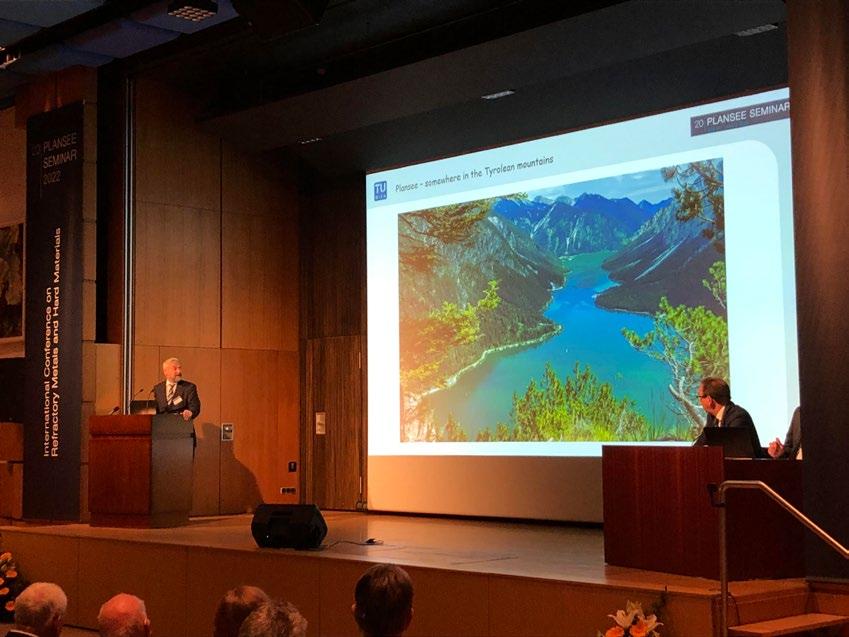
Autumn 2022 Powder Metallurgy Review 89© 2022 Inovar Communications Ltd | contents | news | advertisers | events | website | e-newsletter | GETPDF20 th Plansee Seminar
Fig. 3 Programme cover for the First International Powder Metallurgy Conference in July 1948 (left) and Plansee June 1952 (right)
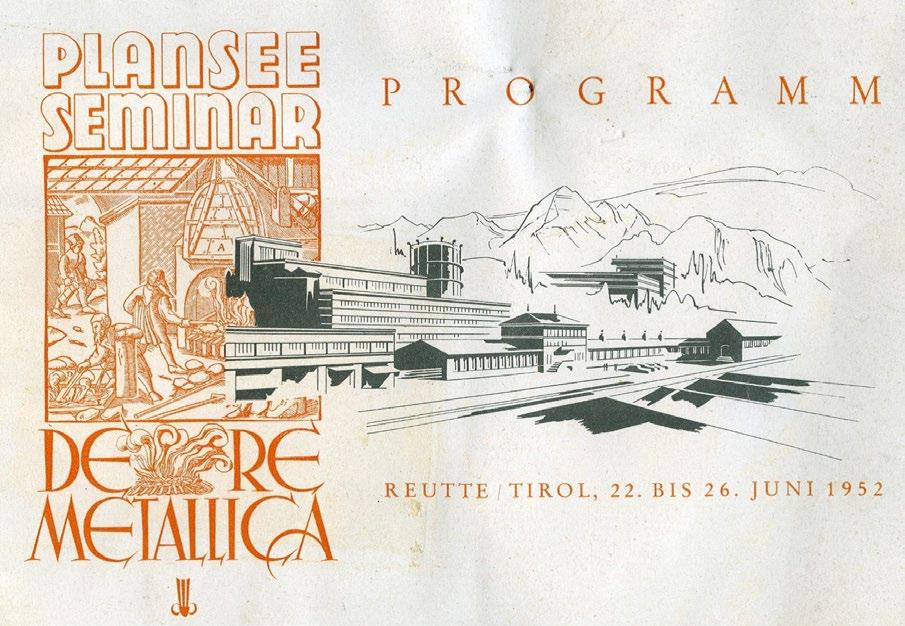
Opening sessions
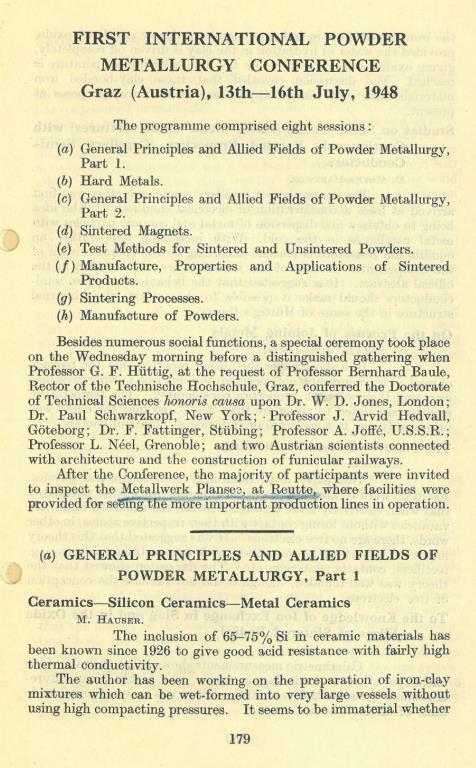
Dr Walser discussed the ‘Three R’s’ of Reduce, Reuse, and Recycle as being useful ways to characterise approaches to reducing environ mental impacts, and usually costs as well. For Reduce, examples include product performance improvements (for example, a rule-of-thumb is that cemented carbide products’ performance typically doubles every ten years), smaller and/or more near-net-shape parts, and improved efficiency in furnace heating. For Reuse, examples include regrinding/ reconditioning of solid hardmetal drills and coal mining roof bits, as well as reconditioning of solid W anodes in X Ray machines. For Recycle, Mo has an 81% rate when used in steels but is less in other applications, and the total end-of-life metric is not accurately known. W, however, has the highest end-oflife metric of all metals that have been studied at 30% (International Tungsten Industry Association [ITIA] study), greatly aided by the very high 63% recycle proportion in cemented carbides. For WC powder, there is a fourfold reduction in CO 2 generation where it is recycled through the chemical route (used for green scrap, grinding sludges, and unsorted hard scrap or used prod ucts), while for zinc reclaim material the CO 2 generation is close to zero, depending on how the electricity for processing is generated.
0.1% of total CO 2 generation, but on a specific (i.e., kg CO 2 per kg of metal) basis their numbers are relatively high, in the range 10–20 kg of CO 2 per kg of Mo or W. Most of this is in the mining and extrac tion process steps. Dr Walser referenced work by the Interna tional Molybdenum Association on Mo and by Chalmers University on W. In addition, the Austrian consulting company RFU has devel oped sustainability models and has ranked and scored commodities, including metals, from a low of C- to a high of A+. RFU rated both Mo and W at B-, apparently reasoning that the metals’ societal benefits were insufficient to fully overcome envi ronmental downsides.
20 th Plansee Seminar
Dr Herman Walser, formerly of Global Tungsten & Powders, Austria, gave a detailed talk on molybdenum and tungsten from the standpoint of how ‘green’ they are and discussed some of the steps being taken to improve this (Fig. 4). Firstly, he warned against the practice of ‘greenwashing’ (whereby organisa tions select data and/or use limited analysis to make their products or processes look environmentally friendlier than they really are) and specifically mentioned four inter national standards used to guard against that practice and force
Fig. 4 Dr Herman Walser, formerly of Global Tungsten & Powders, Austria, gave a detailed talk on molybdenum and tungsten from the standpoint of how ‘green’ they are

“Specific to anthropogenic greenhouse gases, CO2 is estimated to comprise 76% of global emissions, of which ~8% is estimated to arise from metals processing (primarily iron and steelmaking).”
90 © 2022 Inovar Communications LtdPowder Metallurgy Review Autumn 2022 | contents | news | advertisers | events | website | e-newsletter |
suppliers to follow standardised methods in their reporting: ISO 14044 (lifecycle assessment), ISO 14064 (quantification and reporting of greenhouse gases at the organi sational level), ISO 14067 (same, but at the product level), and ISO 20400 (sustainable procurement guidelines, with a ‘balanced scorecard’ including benefits).Specific to anthropogenic green house gases, CO 2 is estimated to comprise 76% of global emissions, of which ~8% is estimated to arise from metals processing (primarily iron and steelmaking). Mo and W are relatively low volume, and their manufacturing comprises less than
Molybdenum and tungsten, the greener metals?
Autumn 2022 Powder Metallurgy Review 91© 2022 Inovar Communications Ltd | contents | news | advertisers | events | website | e-newsletter | GETPDF
to drive some reduction in machining due to the elimination of the internal combustion engine (ICE) in battery electric and fuel cell vehicles. However, hybrid vehicles will still use ICEs, and the need to lightweight vehicles will demand some use of high-strength steels and aluminium alloys. Other effects of vehicle electrification on the hardmetals industry include the high use of Co for vehicle batteries (Fig. 7) which, coupled with concerns on ethical sourcing and lingering health ques tions, has reenergised research on Co substitution by other transi tion metals – not a new subject (Dr Norgren mentioned Leo Prakash’s early work on WC-CoNiFe as an example) and long commercialised for certain corrosion-resistant or
Fig.industry6Graph showing tungsten supply and demand, 2011-21 (Courtesy Statistic Report 2017 & 2021 B Zeiler/International Tungsten Industry Asso ciation [ITIA]) Fig. 7 Cobalt demand from electric vehicles (Courtesy OECD/International Energy Agency) 79.6 76.15 78.95 82.5 84.35 8599.2 105.5 91.3 81.9 50 60 70 80 90 100 110 2011 2012 2013 2014 2015 2016 2017 2018 2019 2020 2021 Wtonneskilo NPS High cobalt chemistry Low cobalt chemistry Central estimate 4003002001000 2017 (kt)demandMetal Cobalt demand from electric vehicles2030 EV30@30 20 th Plansee Seminar
An outlook on the hardmetal industry after two years of world pandemic and recent instability in Europe
In her presentation, Prof Dr Susanne Norgren of Sandvik AB and Lund University, Sweden, referenced recent ITIA statistics on W usage which showed that ~61% of global W is used in cemented carbides, and that, by market, use had grown in defence and mining & construction, but had declined in transportation – largely due to the steep drop in civil aerospace and the automotive industry during the coronavirus pandemic (Fig. 5, 6). She then summarised several megatrends and discussed their apparent, and anticipated, effects on the hardmetal industry.Withworld population continuing to increase and an increasing proportion of those people living in cities, it is expected that construc tion work needing a lot of steel will correspondingly increase; steel machining is a major use of hardmetals, and an area in which the use of CVD and PVD coatings has a huge effect on performance. With steelmaking shifting from C to H 2 to reduce iron ores, Norgren noted that it will be interesting to see how that affects steel inclusions, which in turn affectVehiclemachinability.electrification is expected
Fig. 5 Prof Dr Susanne Norgren presented an outlook on the PM hardmetals

composites (Courtesy
a) b) Grooving Grooving 512 GPa519 GPa WC-NiCrMo WC-Co 1659 HV30 1616 HV30 EKICHV30 9.9 MPa.m 1/29.0 MPa.m 1/2 20 th Plansee Seminar
Several papers elaborated on the Co replacement theme summarised by Dr Norgren in the opening session. Grades requiring excellent corro sion resistance or non-ferromagnetic behaviour have long been made with binder metals other than Co, or with much-reduced Co, using Ni, Cr, Fe and (less commonly) other metals. Sophisticated thermodynamic model ling combined with building on prior practice produced promising mate rials, and it may be safe to say that comparable combinations of hard ness and toughness to conventional hardmetals with Co binder may be obtained (Fig. 8, 9).
Key takeaways from the technical programme
Cobalt reduction/elimination in hardmetals
Fig. 8 Graphic representation of hardness, Palmqvist fracture tough ness and Young’s modulus of WC-NicrMo and WC-Co composites (Courtesy Pereira, P; Ferro Rocha, AM; Bastos, AC; Oliveira, FJ; Vilhena, LM; Ramalho, A; Sacramento, J; Malheiros, LF and Senos AMR, ‘Development of WC-NiCrMo of the (a) WC-Co and (b) WC-NiCrMo Pereira, P; Ferro Rocha, AM; Bastos, AC; Oliveira, FJ; Vilhena, LM; Ramalho, A; Sacramento, J; Malheiros, LF and Senos AMR, ‘Devel opment of WC-NiCrMo hardmetals’)
What was clear, however, talking to hardmetals manufacturers during the event, is that for most applica tions of hardmetals, other properties are also critical – in particular,
hardmetals) for the ores of metals used in batteries, fuel cells, electric motors, and electrical conductors.
Digitisation is another clear trend, and Dr Norgren referenced recent Seco work on etched QR codes on individual metalcut ting inserts, which has numerous advantages such as linkage to application conditions, problem resolution, and scrap/used insert sorting to improve recycling effectiveness.
non-magnetic applications – but evidenced by, for example, several papers at this Plansee Seminar, and the US Government’s funding of Desktop Metal’s research on the subject. However, there are many performance and practical barriers to Co substitution, including CVD adhesion on metalcutting inserts. Finally, the drive to electrification drives a big increase in mining (with associated need for wear- and impact-resistant materials including
Finally, advances in the type and precision level of analytical tech niques for materials characterisation is a hot area; Dr Norgren mentioned the increased interest in in-situ small angle neutron scattering, and subsequent presentations and posters at the seminar included many other examples.
Fig.hardmetals’)9SEMimages of the worn surface
92 © 2022 Inovar Communications LtdPowder Metallurgy Review Autumn 2022 | contents | news | advertisers | events | website | e-newsletter |
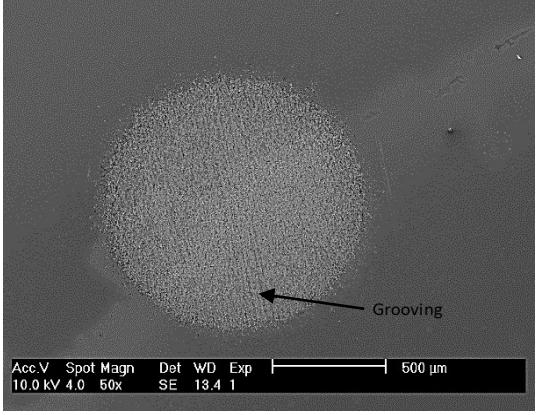
Additive Manufacturing, for all materials, is growing at more than 20% per year and is starting to have a significant role in the field of cemented carbides – initially for their associated steel cutter bodies, but more recently for hardmetal components themselves, albeit so far for high Co (> ~12 wt.%) grades outside the ‘sweet spot’ of cemented carbides, due to densification limi tations. The technology permits complex geometric features such as cooling channels and ‘lightweighting’ by voiding low-stressed areas of components, and Dr Norgren showed Varel oil and gas drilling nozzles as an example. This theme was continued by several presentations and posters later in the seminar.
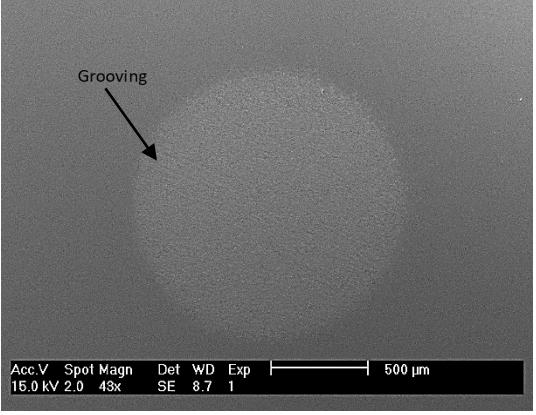
Seminar
“What struck this author was the discussion of the use of zinc reclaim WC-Co in a commercial grade, whereby a marketable ‘public virtue’ was made of hard reclaim use, though this is typically done as a matter of course...”20thPlansee
thermal fatigue resistance, as well as the advantages of a Co binder for the width of the ‘C-window’ (to avoid undesirable embrittling phases), magnetic properties for ease of quality assurance, CVD coating compatibility, W (and Cr dopant) solution in the binder metal to stabilise a single (face centered cubic) phase to improve fatigue resistance, and control of the scrap and used product streams to aid reclaim use are very important. For non-Co binders to advance much further these issues would need to be solved or somehow side-stepped. In practice, most hardmetal products are used in high-value applications where no performance loss will be tolerated.
and other first wall components of nuclear fusion reactors. At that time, the main driver was the very large-scale, long-term international ITER reactor project. This theme was continued at the 20 th Plansee Seminar, but this time with a notable emphasis on small, spherical tokamaks, made by advances in (relatively) hightemperature superconductors, and being developed by startup private/public-funded companies, and which are physically much smaller in shorter lead time projects.Inbrief, dependent some what on the individual intended component, materials for these applications need to be able to handle extremely high heat fluxes, have extreme resistance to damage by high-energy neutrons, sufficient high-temperature thermal fatigue resistance, high neutron capture cross section, acceptable transmutation prod ucts, and (to reduce the damage from any unintended air leaks)
Autumn 2022 Powder Metallurgy Review 93© 2022 Inovar Communications Ltd | contents | news | advertisers | events | website | e-newsletter | GETPDF
Some papers presented during both the Plansee seminar and the EPMA Hard Materials session elaborated on the themes discussed by Dr Walser. What struck this author was the discussion of the use of zinc reclaim WC-Co in a commercial grade, whereby a marketable ‘public virtue’ was made of hard reclaim use, though this is typically done as a matter of course, where practical, to reduce costs and dependence on overseas material suppliers. That said, in discussions with some hardmetal manufacturers, it was clear that there is still some resist ance from customers and/or internal marketing/sales constituencies to reclaim use. Ironically, this some times comes from customers who are demanding sustainability reports
CVD and PVD coatings are immensely important to the perfor mance of metalcutting tooling, and there were many papers and posters on these subjects. In summary, in the CVD area it appears that CVD TiAlN is finding some commercial application in interrupted cutting (usually milling) of ferrous alloys, while in PVD a broad range of TiALN derivatives (whereby Ti is wholly or partially substituted by other metallic species) show promise. In addition, TiB 2, which combines very high hardness with lubricious prop erties, remains an area of interest and further development (Fig. 10).
Advanced nuclear (especially fusion) reactor applications
Recycling/sustainability
Coatings
At the 19 th Plansee Seminar in 2017, this author was struck by the signifi cant number of contributions linked to hardmetal demand for the divertor
from suppliers, despite reclaim use being one of the most powerful methods to reduce the CO 2 footprint.
Fig. 10 SEM images of the surface morphologies of AlxTi1-xN coatings: (a) x=0.69-111 textured coating, (b) x=0.69-100 textured coating, (c) x=0.83-111 textured coating, (d) x=0.83-100 textured coating.x=0.83-(111) (Courtesy Yanagisawa, K; Homma, H and Okude, M, ‘Effect of Al Content and Crystallographic Orientation of CVD-AITiN Coating on Failure Mecha nism in Face-milling of Alloy Steel’)

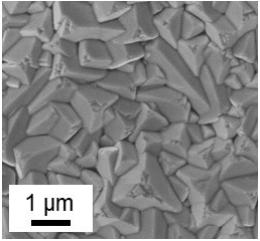
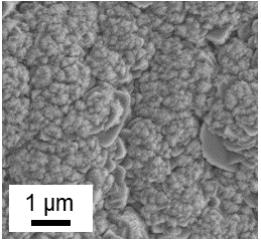
a) b) c) d) 1 μm 1 μm 1 μm 1 μm
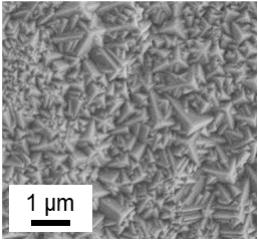
good oxidation resistance. Metallic tungsten is used in ITER and offers much of what is required property-wise, but grain growth at elevated temperature embrittles the material, oxidation resistance is mediocre, and these concerns are driving a wide range of materials developments including Cr-alloyed W (Fig. 11), investigation of non-sag (alkali metal doped) W, WTiFe high-temperature ‘superalloys’, metal-bonded W2B, and both metalbonded and binderless WC.
“...there is clearly a school of thought that no materials could actually survive the extraordinarily severe environment in a commercial power-generating reactor; whether or not that is true should become apparent over time.”
Fig. 11 Surface after loading at PSI-2 with 1000 ELM-like pulses of 0.38 GW/ m 2 for 1 ms at 400°C on (a) as-HIPed and (b) HIP+ HTed W-10Cr-0.5Y-0.5Zr alloy. For comparison, surface after the same loading at JUDITH-1 is shown on as HIPed (c) and HTed (d) W-10Cr-0.5Y alloy (Courtesy García-Rosales, C; Sal, E; Lozada, L; Hunger, K; Schlüter, K; Gago, M; Wirtz, M; de Prado, J and Sánchez, M, ‘Oxidation-resistant tungsten-based alloys as plasma-facing mate rials in nuclear fusion reactors’)
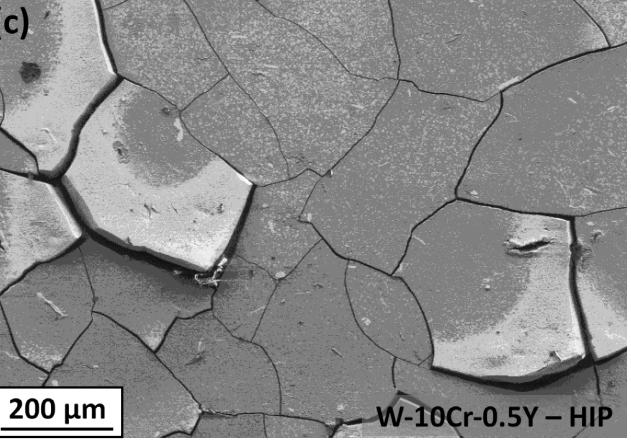
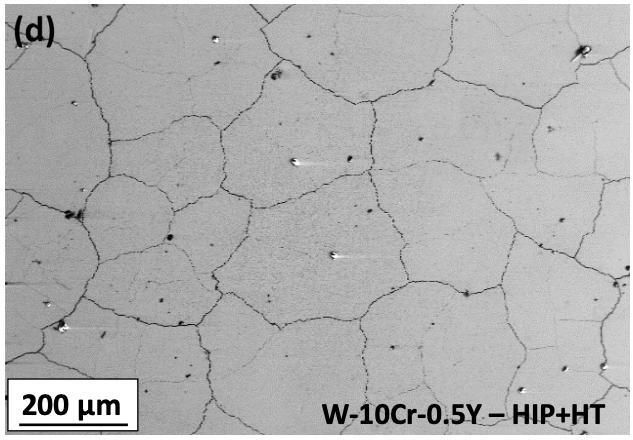
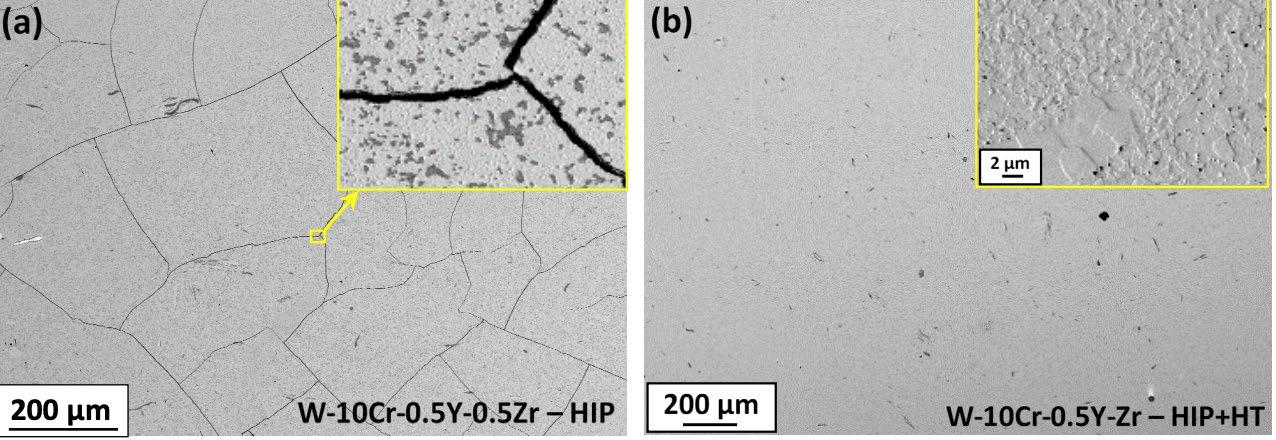
20 th Plansee Seminar
The basic principle is that high entropy (disorder) contributes to high thermodynamic stability, as well as decreasing stacking fault energy, and thus impeding dislocation flow – in summary, improving materials’ high-temperature strength, while one or more of the components may also improve oxidation and/or corrosion resistance. The multiple alloying elements also reduce thermal conductivity.
94 © 2022 Inovar Communications LtdPowder Metallurgy Review Autumn 2022 | contents | news | advertisers | events | website | e-newsletter |
Refractory metal oxides for antimicrobial applications
A single paper was presented, by Prof Dr J Peter Guggenbichler of AMiSTec GmbH, describing the very powerful antimicrobial action of Mo and W oxides and related compounds. Prof Dr Guggenbichler is a medical doctor (more specifi cally a pediatrician), and he spoke with great passion of the associated problems of hospital infections and the growing issue of antibiotic and disinfectant-resistant bacteria. Petri dish images illustrated the effective ness of Mo and W refractory metal oxides in killing such bacteria, and the presenter explained how the causative mechanisms cannot be circumvented by genetic variants of the bacteria as it evolves. In talking to both the presenter and others at the seminar it became clear that there was both prior art and strong agreement that the work is valid, and it will be interesting to see if and how the results are implemented,
From questions posed after presentations and some conver sations this author was involved in during break periods, there is clearly a school of thought that no materials could actually survive the extraordinarily severe environment in a commercial power-generating reactor; whether or not that is true should become apparent over time, but clearly W materials science is likely to be a ‘gateway’ technology for nuclear fusion, and is hence of immense importance.
High-entropy materials
High-entropy materials were defined by at least one author as being five or more component atomic species in solid solution (for metallic alloys) or the metal atom sub-lattice of, for example, a carbide or nitride phase. Some existing commercial materials may already satisfy, or at least approach, this definition (for example, the WTiTaNbC ‘gamma’ phase common in steel turning metalcutting hardmetal grades) but clearly it is an active research field, and the seminar included exam ples in refractory metals, both the binder and hard phase in cemented carbides, and PVD coatings.
Kestler finally expressed his earnest desire that the impact of COVID-19 will continue to lessen, and that conflicts will be resolved, to allow fuller international partici pation at the next seminar. We can all agree with this sentiment. This author has been fortunate to have attended five Plansee Seminars and has always found them to be
StandardBJT
Author Bernard North North Technical Management, LLC Greater Pittsburgh Area Pennsylvania, bnorth524@msn.comUSA
20 th Plansee Seminar
Additive Manufacturing was a major focus area, primarily Laser Beam Powder Bed Fusion (PBFLB) for refractory metals, and the presentations covered at least four different techniques for the AM of cemented carbide components. The latter is showing clear growth with, initially, very high Co (tough, but not very hard) grades being commercialised, but with a clear downward trend in Co level and/ or grain size to get closer to the ‘sweet spot’ of cemented carbide compositions, grain sizes, and applications.Forthisauthor, one highlight was a report on the successful AM of a mainstream hardmetal grade used for metalcutting drills and end mills (Fig. 12). This aspect of the Plansee Seminar will be reported upon, in greater detail, in the Autumn issues of PIM Interna tional and Metal AM
Additive Manufacturing
Conclusion
Autumn 2022 Powder Metallurgy Review 95© 2022 Inovar Communications Ltd | contents | news | advertisers | events | website | e-newsletter | GETPDF
since their inception under Paul Schwarzkopf, and are aptly summa rised by the statement: “To sinter the participants to a dense PM commu nity.” He then announced that the 21 st Plansee Seminar will be held May/June 2025, thus returning to its regular pre-pandemic schedule, and minimising conflicts with other major PM conferences and trade shows.
highly beneficial and educational events; the Plansee Group is to be commended for continuing this wonderful tradition through three generations of leadership. Here’s looking forward to 2025!
In his farewell address, Dr Kestler reinforced the goals of the Plansee Seminars, which have continued
for example by developing and marketing paints of such oxide particles to coat key surfaces inside hospitals.
Fig. 12 Kennametal Harv1 TE™ endmill tool manufactured from WC-10Co via Binder Jetting (BJT) (top) and conventional manufacturing (bottom)

Congress & Exhibitioneuropm2023.com1 - 4 October 2023 Lisbon, Portugal EURO METALLURGYPOWDERFIRSTANNOUNCEMENT




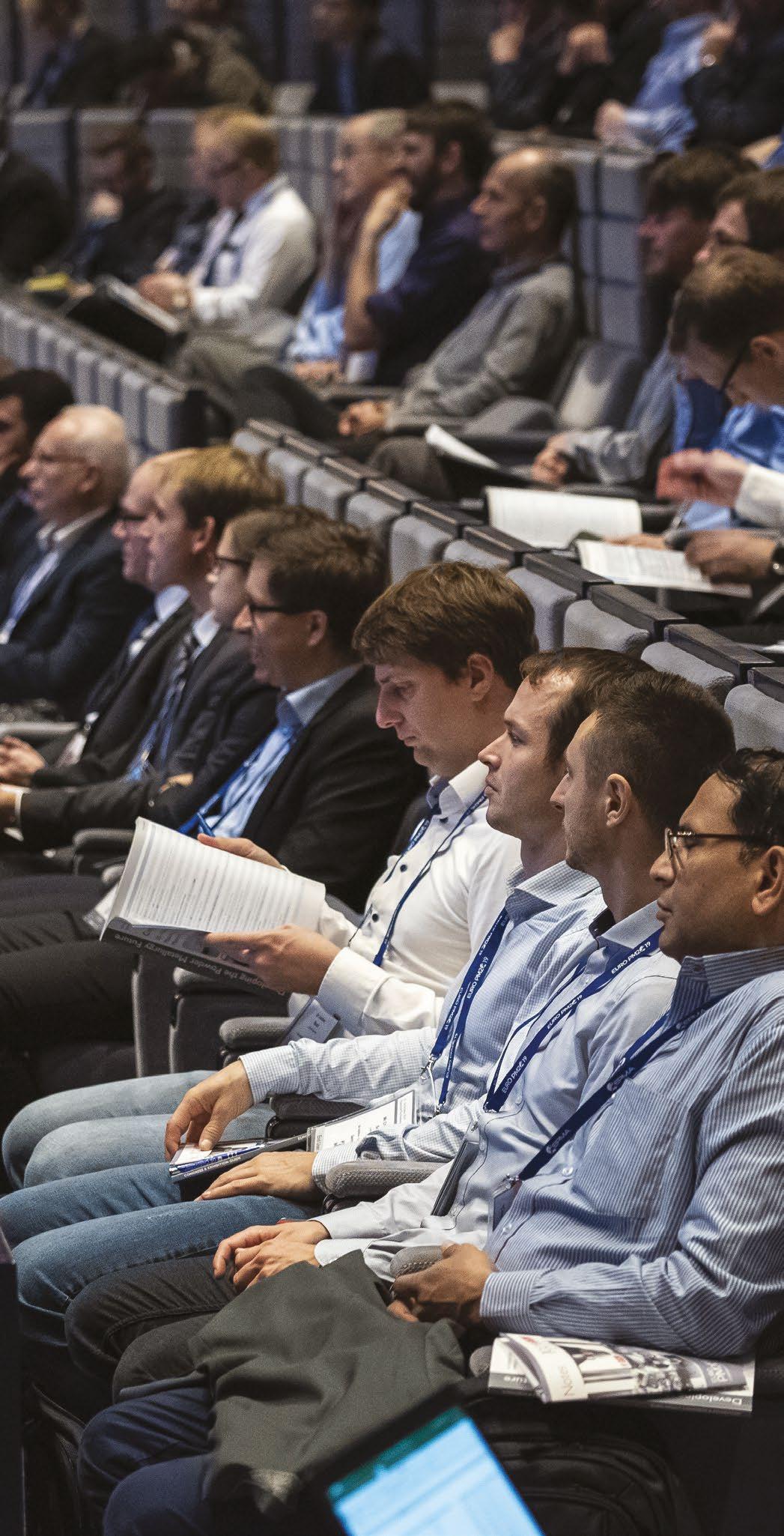

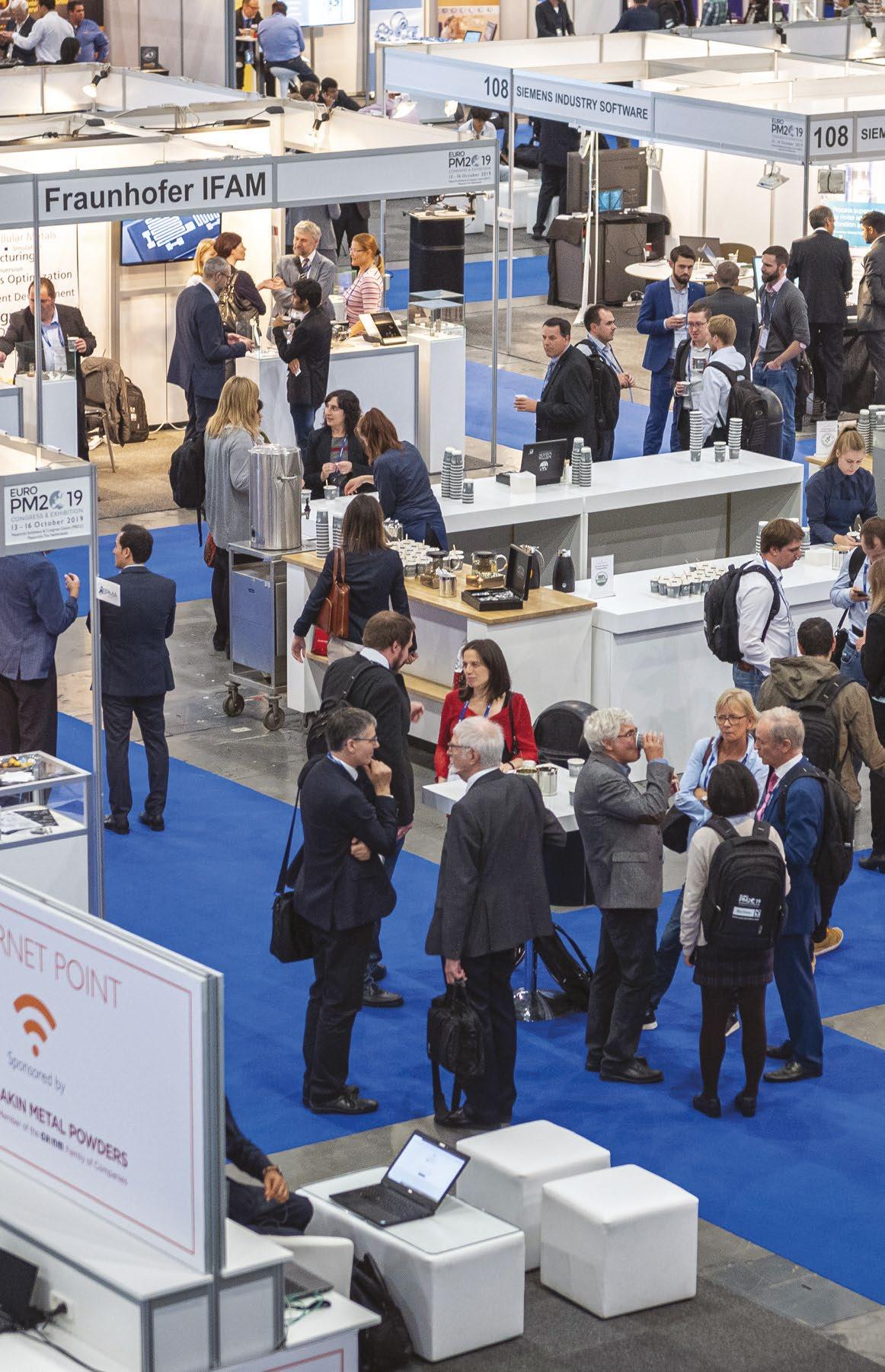
presents challenges around mould reactions and insufficient super heating, as well as being cost prohibitve for economic reasons such as loss of the alloy in gates [5]. Processing these unique hightemperature alloys in powder form allows for their near-net shape
Tailoring a speciality alloy for Additive Manufacturing: From powder production to parameter optimisation
Ultra-high temperature materials, such as niobium-base alloys, have been limited to simple geometric designs due to their high working temperatures and related production costs. Now, thanks to the development of commercially available Nb-base alloy powders, it is possible to additively manufacture complex-shaped, high-performance components from this material. To do so, it is important to understand the full workflow, from powder production and characterisation, to determining the optimal process parameters for these speciality materials. In this article, Taniobis GmbH and Alloyed Ltd detail the process of preparing, characterising, and processing two such alloy powders.
superalloy due
makes
temperature. Because of the high cost of manufacture, C-103 is, by comparison, the most readily manu facturable, if not the strongest, Nb alloy on the market today.
a prime candidate for hot structures 1100 1200 1300 1400 1500 Temperature (°C) (MPa)h100increep1%forstressCreep
Near-net shape manufacture of these alloys was previously not possible, as investment casting
Nb-base high-temperature alloy
Being the lowest-density good ductility at room temperature a melting point of 1050°C Nb-alloys
powders
As a result, Niobium-base alloys are commonly used in propul sion systems within the space and defence industry [4]. Until recently, typical applications have been limited to products with simple geometries made from sheet and bar; for instance, expansion chamber skirts made from TIG welded sheet. This is because ingot production is expensive and these alloys are chal lenging to fabricate into complex shapes due to their high hot working
400500700 IN-792 Nb-base alloys Superalloys Nb-1Zr FS85 C1031002003000 800 900 1000 Maximum
Autumn 2022 Powder Metallurgy Review 97© 2022 Inovar Communications Ltd | contents | news | advertisers | events | website | e-newsletter | GETPDF
Ultra-high temperature refrac tory alloys have the potential to perform at temperatures exceeding ~1050°C – outperforming even the most advanced Ni- and Co-base superalloys – due to the ceiling imposed by the strengthening phase stability and their high melting point. Niobium-base alloys such as C-103 are of particular interest, due to their relatively low density and good thermal conductivity, as well as excellent temperature and timedependent mechanical properties (Fig. 1) [1, 2, 3].
refractory metal with
ture
Fig. 1 Creep performance of various high-temperature alloys showing the superiority of Nb alloys. Data for superalloys extracted from [3] service tempera of 1050°C Ni-based to Ni
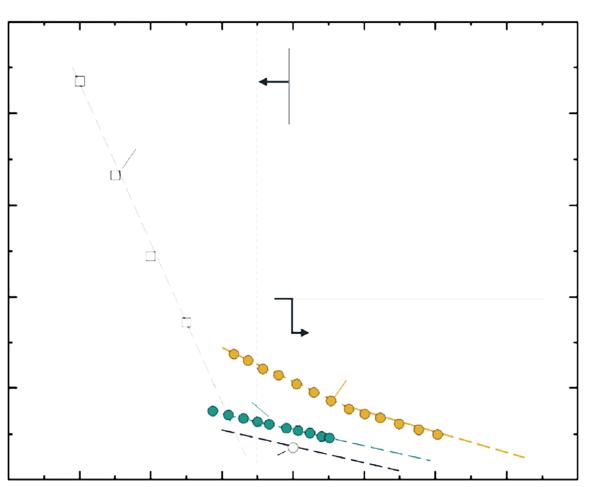
and
fo
3AL-phase and melting point
EDX spot 2 58.3 29.3 10.4 1.9 0 (1) 0 (1) (1) below detection limit | -- not determined
“The ability to manufacture complex shapes from C-103 and FS-85 via PBF-LB enables new applications such as structures for high-velocity flight and re-entry guidance, and enables the production of higher temperature gas turbines for power generation and jet propulsion.”
EDX spot 1 90.5 8.5 0.0 1.1 0 (1) 0 (1)
Alloy Analysis Nb Ta Hf W Ti Zr C H N O
Alloy powder preparation
98 © 2022 Inovar Communications LtdPowder Metallurgy Review Autumn 2022 | contents | news | advertisers | events | website | e-newsletter |Nb-base high-temperature alloy powders
C-103
EDX area 89.2 9.7 0.1 1.0 0 (1) 0 (1)
EDX spot 2 79.2 19.6 0.1 0 (1) 0 (1)
FS-85 Chemical 60.8 28.3 0.03 10.0 0.01 1.0 < 10 < 10 19 289
In this study, the electrodes were electron beam melted with dimen sions of ca. dxl = 45 x 650 mm.
manufacture using Laser Beam Powder Bed Fusion (PBF-LB), Electron Beam Powder Bed Fusion (PBF-EB), Directed Energy Deposi tion (DED), and other advanced forms of Powder Metallurgy. These technologies have major advan tages over conventional processing, including cheaper part produc tion thanks to their more efficient use of material and the ability to produce geometrically complex components with minimal waste or post-processing.Theabilityto manufacture complex shapes from C-103 [6] and FS-85 (here described for the first time) via PBF-LB enables new applications such as struc tures for high-velocity flight and re-entry guidance, and enables the
Table 1 The chemical composition of C-103 and FS-85 powders determined spectroscopically (ICP-OES) and by carrier gas hot extraction/combustion analysis
Nb-base C-103 and FS-85 alloy powders developed at Taniobis GmbH, Germany, are commercially available in the form of AMtrinsic® C-103 or AMtrinsic® FS-85 pre-alloyed powders [7]. Due to the lack of suitable crucible materials for conventional gas atomisation, they are atomised by Electrode Induction-Melting Gas Atomisation
EDX area 61.7 26.3 9.8 2.3 0 (1) 0 (1)
Prior to their use, a 90° tip was machined to fit the shape and dimension of the induction coil.
EDX spot 1 68.2 21.1 5.8 4.9 0 (1) 0 (1)
The chemical compositions of the C-103 and FS-85 powders,
(wt.%) (ppm)
The pre-alloyed rods were atom ised in a purified Ar (4.6, Linde) atmosphere through a Laval nozzle and the as-obtained raw powders sieved to remove the fine powder fraction (< 10 µm). Finally, the sieved powders were classified through 63 µm, 105 µm and 150 µm meshes. This classification provided powders with particle size distribu tions typically applied in PBF-LB (10–63 µm), PBF-EB (63–105 µm) or DED (105–150 µm).
C-103 and FS-85 PBF-LB alloy powders were fully chemically characterised by a combination of ICP-OES and carrier gas hot extrac tion and/or combustion analysis, as well as morphologically by X-ray diffraction (XRD) and Scanning Electron Microscopy (SEM)/Energy Dispersive X-Ray Analysis (EDX). Their flowability was investigated using Hall Flow measurements.
production of higher temperature gas turbines for power generation and jet propulsion. This article will describe in detail the preparation of Nb alloy powders for application in advanced metal powder-based manufacturing technologies.
(EIGA) [8] of pre-alloyed electrodes.
Alloy characterisationpowder
Chemical 88.7 0.2 9.6 < 0.1 1.0 0.2 29 < 10 44 198
determined spectroscopically (ICP-OES) and by carrier gas hot extraction/combustion analysis, are provided in Table 1. For compar ison, the overall composition and the composition of selected spots determined by EDX are given. The chemical compositions of the atomised powders correspond well with those of conventionally processed materials. However, due to the much higher surface areas, the contents of the light elements (i.e., C, N and O) are slightly higher than in the cast solids. Investiga tions by XRD, shown in Fig. 2, point to the fact that C-103 and FS-85 alloy powders crystallised in the body-centred cubic crystal struc ture. A comparison with pure Nb shows very similar appearance of the XRD patterns with the typical 110, 200 and 211 beta-phase reflec tions. Accordingly, C-103 and FS-85 can be considered as single-phase materials.Forapplication in powder bed Additive Manufacturing processes, good powder processability is mandatory [9]. A spherical particle shape is one important require ment to guarantee free flow and ensure a homogeneous distribution of the powder in each individual coating step. Other prerequisites are the absence of satellites, i.e. attachment of smaller particles on the surface of larger particles or agglomerates. The absence of pores or voids in the powders is necessary to avoid the inclusion of porosity in the built part. Both C-103 and FS-85 PBF-LB powders show an ideally spherical particle shape, as can be seen from the SEM images in Fig. 3. They have smooth surfaces and are fully deagglomerated. In addition, satel lites are absent and, consequently, the powders possess very good flow properties. Their Hall Flow, according to ASTM B213, is 12 s (C-103) and 8 s (FS-85). Particle size measurements by means of laser diffraction indicate narrow distributions with d50 values of 34 µm and 39 µm. Tap densities are in the range of 5.5 g/cm 3 (C-103)
and 6.5 g/cm 3 (FS-85). The higher density of FS-85 is attributed to its substantial Ta and W contents.
Fig. 2 XRD pattern of C-103 and FS-85 alloy powders and comparison with pure Nb powder
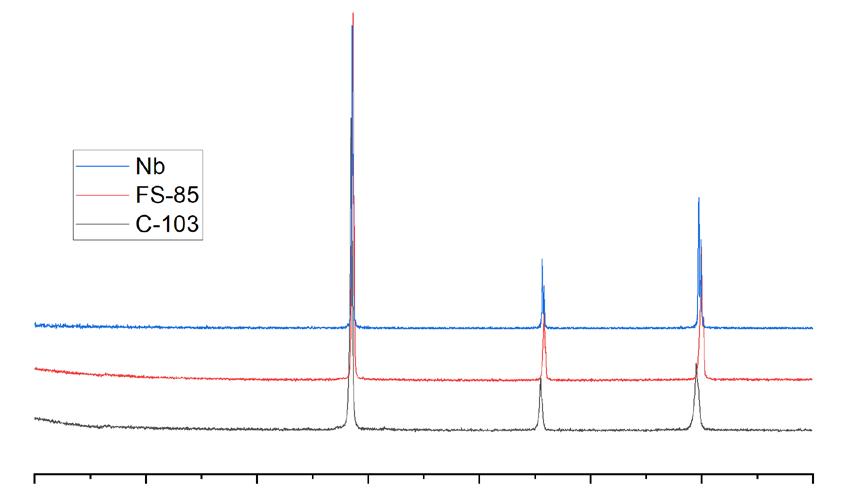
FS-85 show structural features with a more or less pronounced dendritic appearance. Similar observations have been made for Nb and Ta-modified Ti base alloys [10]. In C-103, they do not appear clearly, while the BSE image from FS-85 undoubtedly shows flowerlike dendritic features. In addition,
Fig. 3 SEM images of C-103 and FS-85 alloy powders recorded at 100x
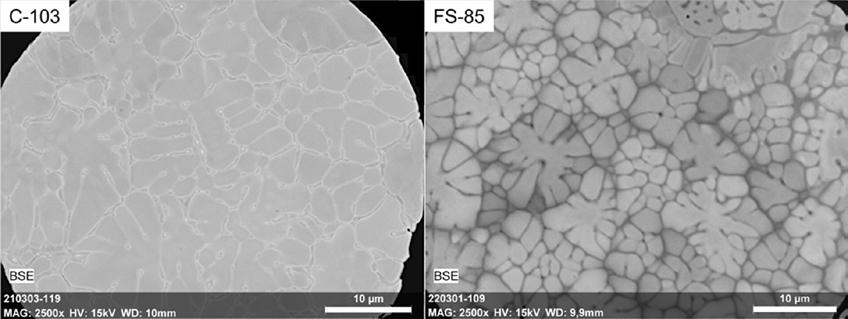
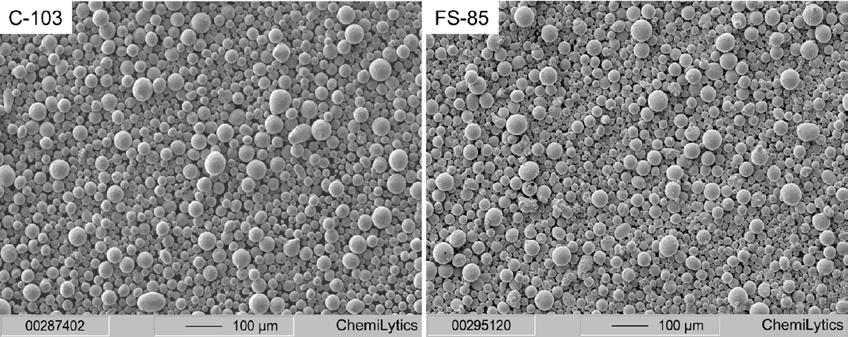
Fig.magnification4BSEimages of polished cross sections of C-103 and FS-85 alloy powders recorded at 2500x magnification FS-85FS-85C-103C-103 2 Θ (°) 10 20 30 40 50 NbFS-85C-103 60 70 80
Autumn 2022 Powder Metallurgy Review 99© 2022 Inovar Communications Ltd | contents | news | advertisers | events | website | e-newsletter | GETPDF
Nb-base high-temperature alloy powders
From the polished cross-sections shown in Fig. 4, it can be concluded that the particles are fully dense. Voids, defects or inhomogeneities are not observed. Interestingly, the BSE images of both C-103 and
20 μmμm
Fig. 5 EDX images of polished cross sections of C-103 (top) and FS-85 (bottom) alloy powders recorded at 2500 x magnification. The chemical composition of the entire area and selected spots 1 and 2 are provided in Table 1
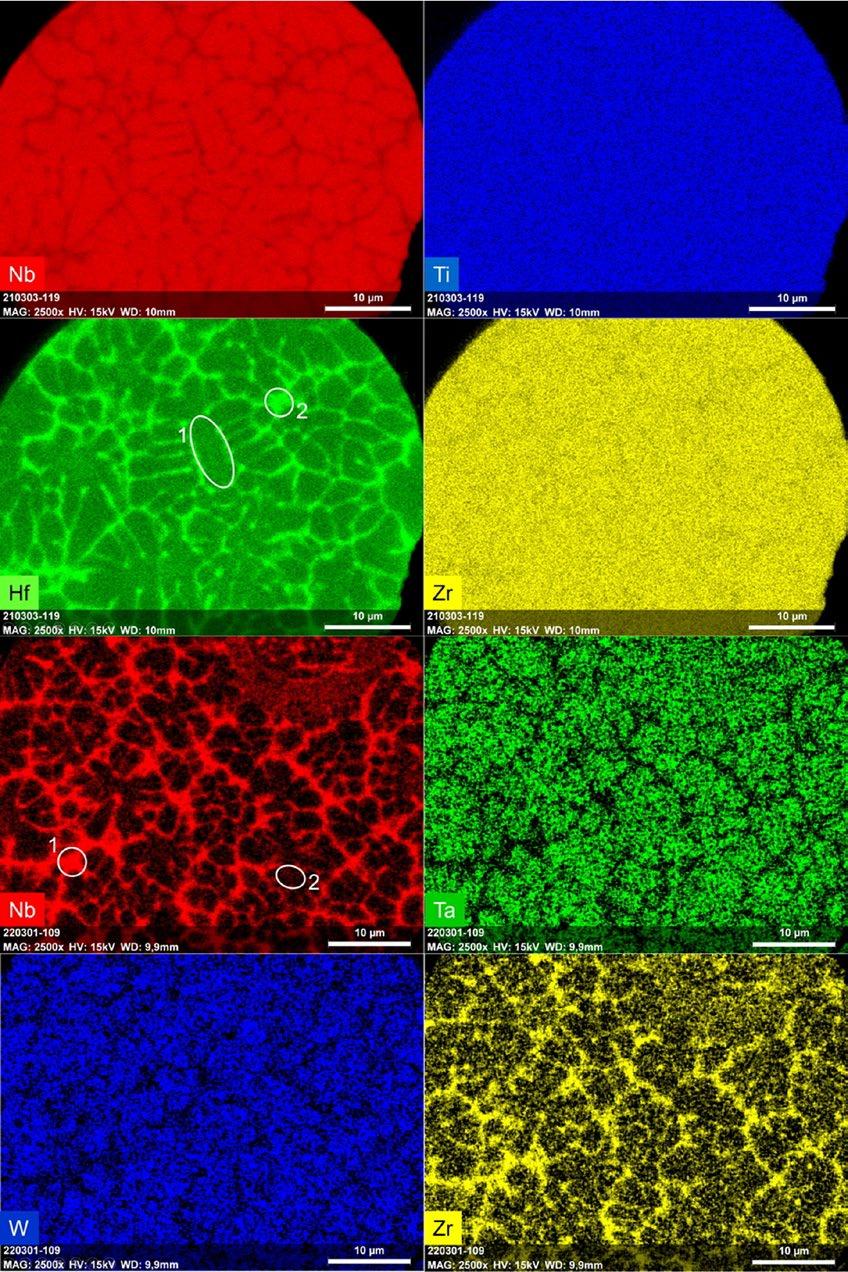
C-103 and FS-85 powder parti cles were also investigated by means of Electron Backscatter Diffraction (EBSD) to generate information on crystal size, struc ture and orientation. The average grain size of C-103 particles, at approx 20 µm, appears to be slightly coarser than in FS-85. This might be a consequence of the higher number of constituents in FS-85 than in C-103 and, conse
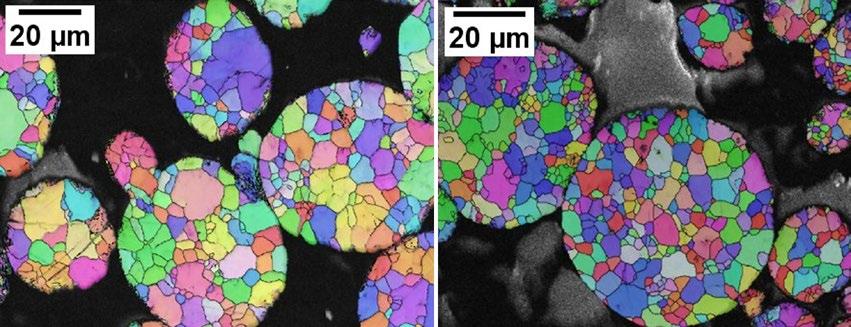
20
Fig. 6 EBSD of C-103 (left) and FS-85 (right) powders showing the grain struc ture within the powder particles
the contrast in the image of FS-85 is significantly higher than that of C-103.The EDX images of C-103 and FS-85 powder provided in Fig. 5 show clear differences in the distribution of the elements. In C-103, chemical variation of the main components Nb and Hf is observed. Nb appears enriched in the dendritic phase while Hf is enriched in the inter-dendritic phase. This is clearly expressed by the different chemical compo sitions, which are highlighted in Table 1 of spots 1 and 2 in the Hf map of C-103. While the dendritetype features contain 90.5 wt.% Nb and 8.5 wt.% Hf, the volumes between the dendrites consist of 79.2 wt.% Nb and 19.6 wt.% Hf. The secondary components Ti and Zr appear homogeneously distributed throughout the particle.
The element distribution in FS-85 is very different. None of the elements appear to be homogene ously distributed throughout the particles. There is a clear separa tion into Nb/Zr and Ta/W enriched volumes. In contrast to C-103, Nb appears with higher concentration in the inter-dendritic phase associ ated with Zr, whereas Ta and W occur preferentially in the dendrite phase. The chemical fluctuations of the elements in both phases are significantly more pronounced than with C-103. While spot 1 – which indicates the composition of the inter-dendrite phase – consists of 68.2 wt.% Nb, 21.1 wt.% Ta, 5.8 wt.% W and 4.9 wt.% Zr, the values in the dendritic structures (cf. spot 2) are 58.3 wt.%, 29.3 wt.%, 10.4 wt.% and 1.9 wt.%, respectively.
Nb-base high-temperature alloy powders
100 © 2022 Inovar Communications LtdPowder Metallurgy Review Autumn 2022 | contents | news | advertisers | events | website | e-newsletter |
HfNbNbW ZrTiTaZr
Fig. 9 shows a snapshot of one particular DOE strategy of twelve cubes being additively manufac tured. Once the optimised process parameter was narrowed down, a full test bar build was undertaken. After manufacturing the cubes, a full microstructural characterisation was performed to correlate the process parameters and micro structural attributes. The density of the cubes and the AM defects concentration (cracks and porosities measured through microstructural characterisation) were correlated with the build parameters such as laser power, exposure time, hatch and point distance.
The influence of the processing parameters such as laser power, scan speed, hatch, powder bed thickness, etc, on the quality of the
The additive manufacturability of C-103 and FS-85 was assessed by PBF-LB in a protective argon atmosphere using a Renishaw AM 400 pulsed fibre laser metal AM machine with a 1075 nm wave length. Additively manufacturing any new alloy or composition requires single track experiments to be carried out at various AM machine settings to acquire infor mation on melt pool thickness and depth. This is key to ensuring the melt pools overlap, creating sound builds without any remnant unfused powder. A single track also helps parameter selection by adjusting
Autumn 2022 Powder Metallurgy Review 101© 2022 Inovar Communications Ltd | contents | news | advertisers | events | website | e-newsletter | GETPDF
processing parameters (shown in Table 2) at a fixed layer thickness of 30 µm. A meander laser scan path was applied with a rotation of 67° between consecutive layers.
quently, a higher entropy of the FS-85 system, exhibiting extensive crystallisation. Such an effect is well known for refractory metal high-entropy alloys.
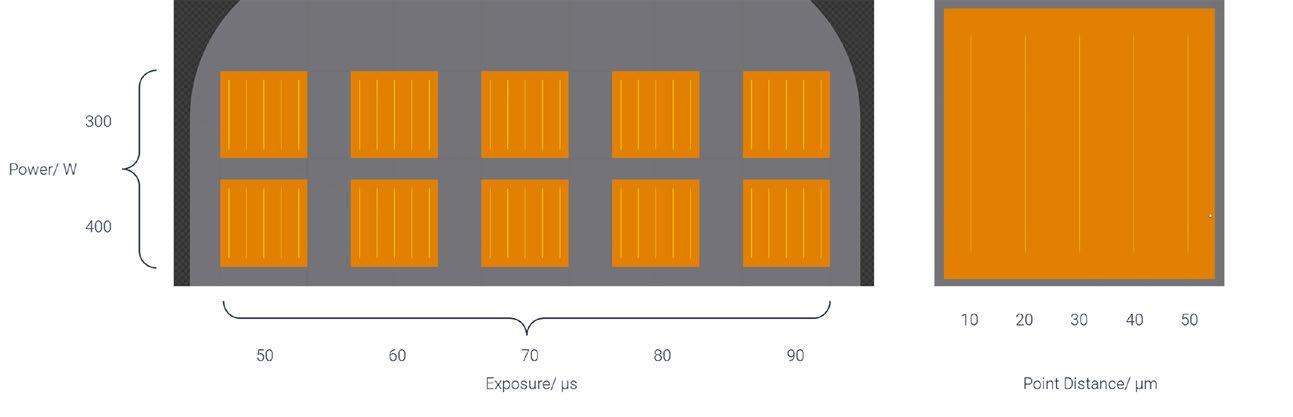
Exposure (μs) Point distance (μm) 50 400300 60 70 80 90 10 20 30 40 50 10 mm Power (W)
high-temperature alloy powders
Alloyed’s process for AM parameter development
Fig. 7 Single track design of experiments (DOEs) (top) and experiments (bottom) conducted in Renishaw AM 400 machine at 300–400 W with 50–90 µs exposure time and 10–50 µm point distance
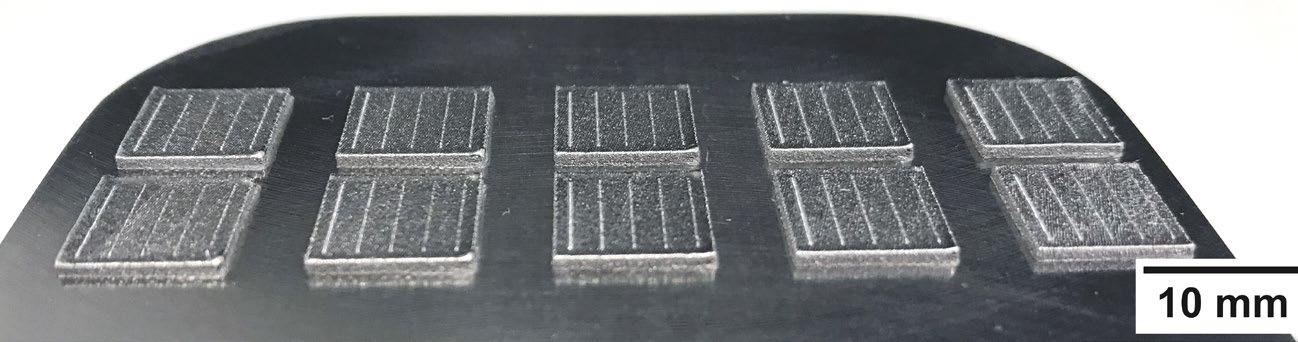
Nb-base
the trade-off between a stable scan track and keyhole forma tion due to high enthalpy. Fig. 7 provides a schematic of the various AM machine parameters tested. A snapshot of the single track samples is also shown; these were metallographically analysed to determine scan track stability and soundness. The scan track width and one-dimension energy density were plotted along with the ranking of the tracks based on the stability post metallographic analyses. This is shown in Fig. 8 and can be used as a map to visualise the effect of operating parameters on additive manufacturability.TheAMtrinsicC-103 and FS-85 powders, after being thoroughly characterised as described in the previous section, were additively manufactured with varied process parameters according to the design of experiment strategy. Cubes of dimension 10 x 10 x 10 mm were manufactured with varying
Parameter Range
Cubes with density ≥ 99.9 % were obtained by applying optimised processing parameters. A compar ison of corners, borders and bulk microstructure has been made and the micrographs for C-103 and FS-85 are shown in Figs. 11 and 12, respectively. It can be seen that both alloys are readily processable through Laser Beam Powder Bed Fusion.
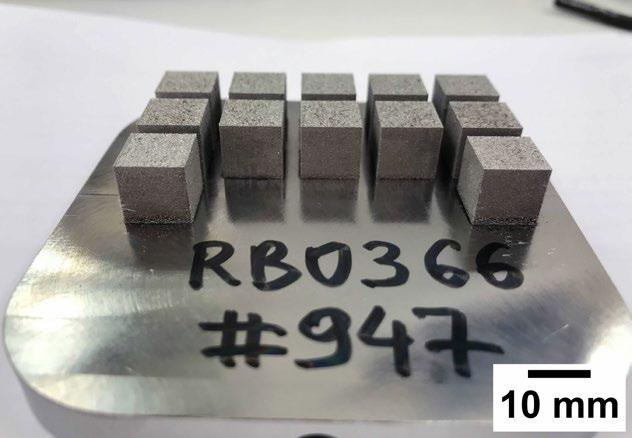
Point distance µm, 40 µm, 50 µm and 70 µm
Characterisation of additive manufacturability
102 © 2022 Inovar Communications LtdPowder Metallurgy Review Autumn 2022 | contents | news | advertisers | events | website | e-newsletter |
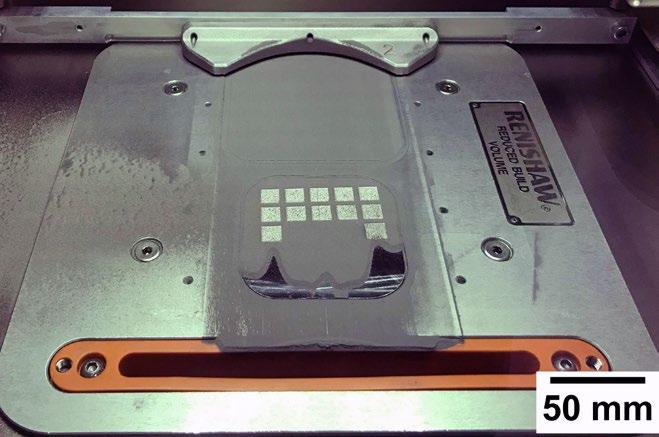
Fig. 9 Cube build of C-103 and FS-85 (top) as a part of the design of experiment strategy. Full test bar build (bottom) with the optimised Additive Manufacturing parameters
700, 155 525, 1435004003002001000 0 1000 2000 3000 4000 µmwidth/trackScan 1D EnergyUnstableDensity Stable Very stable Fig. 8 Process parameter and microstructure stability plot generated by char acterising single tracks made from various operating conditions for FS-85 50 mm 10 mm 10 mm 10 mm Nb-base high-temperature alloy powders
200
Density comparison of C-103 and FS-85
build can be assessed by investi gating its density/porosity. It can be seen that, as the laser power (all other parameters remain unchanged) is lowered from 300 to 200 W, defects – or pores – are significantly reduced around the corners, borders and bulk (Fig. 10).
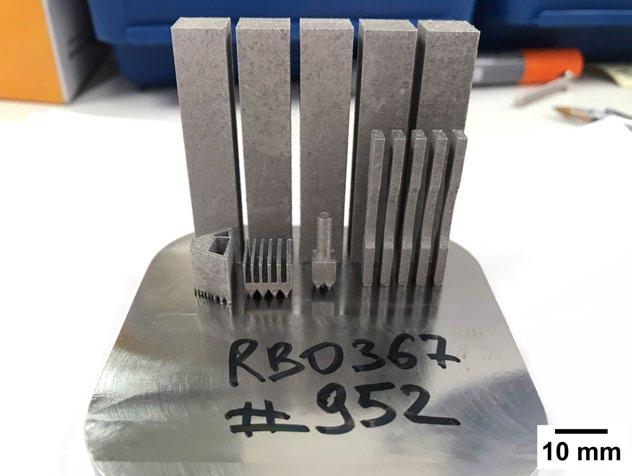
30
Hatch distance µm to 110 µm in steps of 10 µm
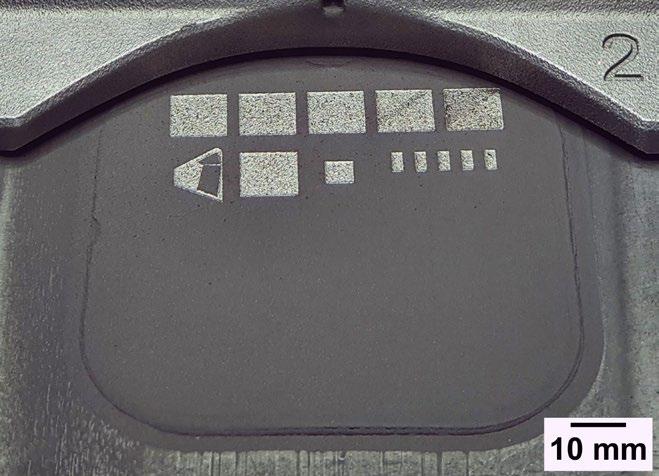
Table 2 Range of parameters used for design of experiment to determine the additive manufacturability of FS-85 and C-103 alloys
70
Exposure time µs
70
Laser power W and 300 W
Fig. 10 Optical micrographs of DOE cubes processed at 300 W (left) and 200 W (right), showing significant difference in defect concentration, size and shape

Advanced chemical and micro characterisation / EBSD
Fig. 11 Optical micrographs of corner (left), bulk (middle) and border (right) showing weak presence of defects/porosities for C-103 cube built with opti mised parameters
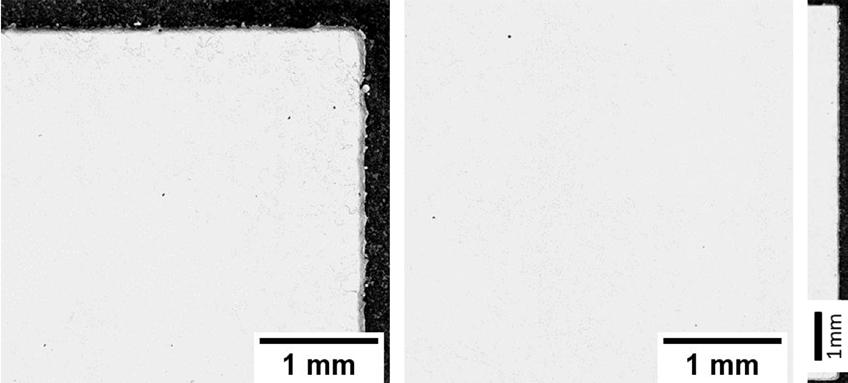
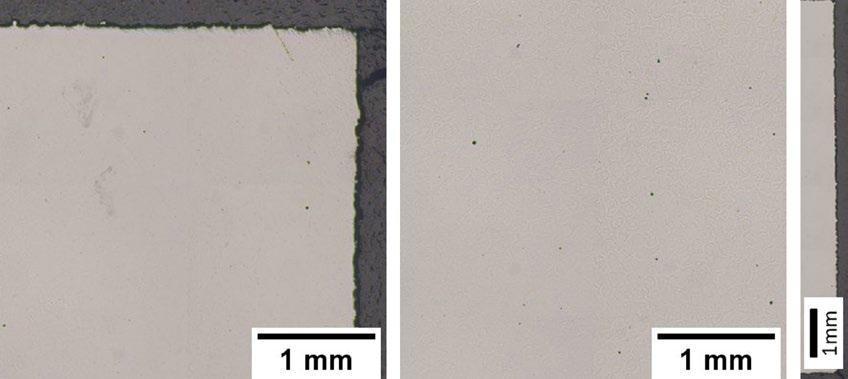
Autumn 2022 Powder Metallurgy Review 103© 2022 Inovar Communications Ltd | contents | news | advertisers | events | website | e-newsletter | GETPDF
from cube on the edge to cube on the corner dependence could be attributed to the difference in chemical composition leading to a difference in solidification texture during the Additive Manufacturing of powders using PBF-LB.
exposed to the laser beam on the powder bed, the powder melts completely. Moreover, the under lying layers are also melted and, accordingly, each individual layer is remelted several times throughout the process. In the molten layers, the individual atoms are randomly distributed, with maximum disorder; they exhibit maximum entropy. Since the cooling rates for PBF-LB are extremely high at around 10 5 K/s, a thermodynamically favoured partial demixing with the formation of dendrite-like structures observed in the powder particles can no longer take place. The remaining structure, therefore, has a very high entropy and random element distribution.
When13.
Advanced electron back scat tered diffraction examination of the AM parts was performed to assess the grain structure in the as-built components. EBSD maps of C-103 and FS-85 (Fig. 14) show predomi nantly (101) and (111) textures, respectively. This change in texture
1 mm 1 mm 1 mm 1 mm1 mm 1 mm mm11mm
Nb-base high-temperature
At the deepest part of the melt pool (i.e., at the solid/liquid boundary), a slight segregation of the alloy may occur. The reason is that the individual alloy compo nents solidify with different rates, causing local segregation. Two such melt pool boundaries are indicated in Fig. 13 in the tungsten map by a dashed line. The melt pool bounda ries are likewise visible, though not highlighted, in the Nb, Ta and Zr
maps.Tomake sure all additively manu factured components fulfilled the composition specification for C-103 and FS-85 standards, advanced chemical analysis such as ICP and LECO were applied. Table 3 shows the oxygen concentration measured using LECO for powders and the final components. This level of quality check is required for the stringent qualification of various classes of components for space applications. In general, a slight increase of oxygen (140–250 ppm) was observed, caused by the PBF-LB processing.
alloy powders
Additive Manufacturing using PBF-LB has a significant impact on the development of the morphology of the materials used. This can be illus trated for FS-85 by comparing the powder morphology shown in Fig. 5 with that of the material additively manufactured by PBF-LB shown in Fig.
Fig. 12 Optical micrographs of corner (left), bulk (middle) and border (right) showing weak presence of defects/porosities for FS-85 cube built with opti mised parameters
Fig. 14 EBSD of (left) and
WNb ZrTa 500 μm 101001 111 500 μm Nb-base high-temperature alloy powders
C-103
tured FS-85 and C-103. It is found that FS-85 is signifi cantly stronger than C-103. The corresponding ultimate strengths are approximately 750 MPa and 565 MPa, respectively. On the other hand, C-103 exhibits a significantly higher strain-to-failure of ~20–22% compared with ~6–7% in FS-85. Alloyed is currently performing ETMT measurements to investigate the high temperature capabilities of these materials. Experimental details will be published sepa rately [11]. As evident from Fig. 16, an excellent high-temperature performance can be observed for both alloys at elevated tempera tures. Either of the alloys produced by PBF-LB is clearly outperforms C-103 in in terms of strength and density compensated strength. In accordance with room temperature investigation, FS-85 is the first choice when searching for new alloys for service in high-tempera ture environments [11].
Fig. 13 EDX images of polished cross sections of FS-85 additively manufac tured specimens recorded at 3000 x magnification. Build direction was right to left. The dashed line in the W map highlights melt pool boundaries along which a
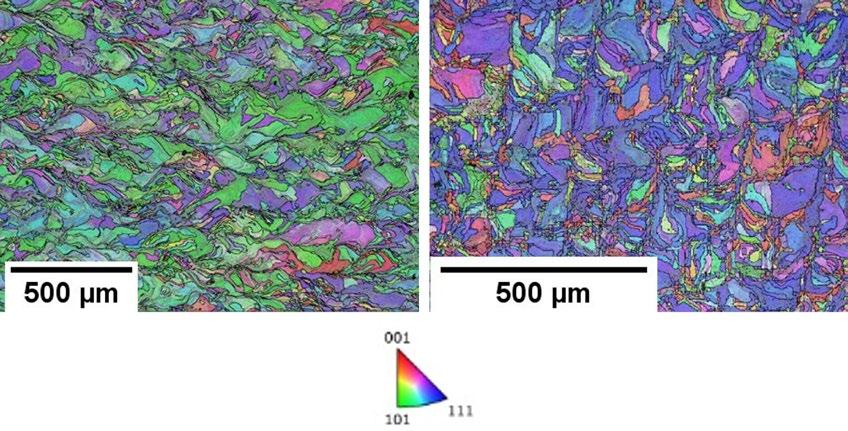
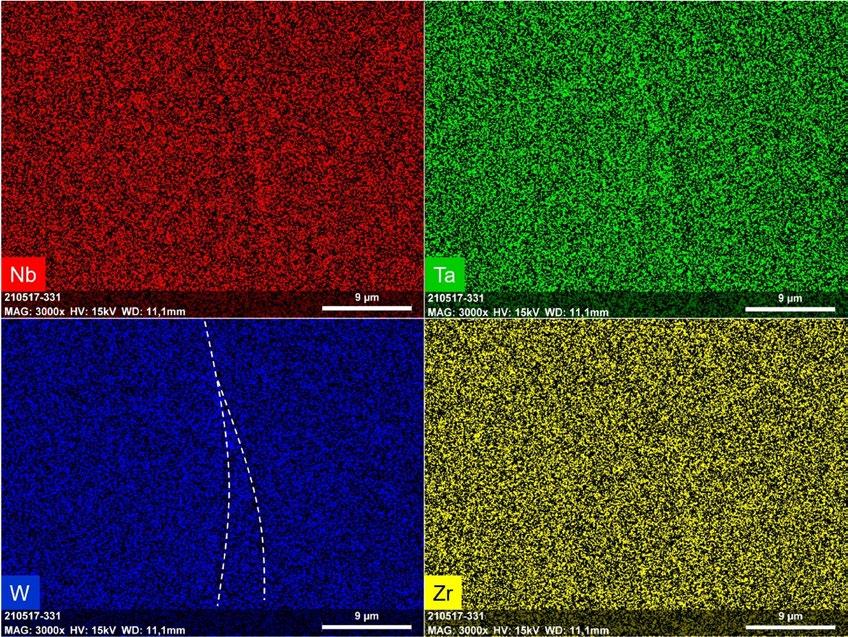
The mechanical performance of the additively manufactured FS-85 and C-103 at room temperature was measured using standard ASTM E8 tests. Rectangular blanks of dimen sion 55 x 10 x 10 mm were machined
Both these Nb alloys proved to have superior additive manufacturability and mechanical properties comparable to conventionally processed alloys. These alloys, therefore, need to be manufactured into prototype components to prove the validity of these alloys in actual component manufacture for space applications.
slight demixing occurances Alloy Source Process Oxygen content / ppm Powder AM coupon FS-85 Alloyed/Taniobis PBF-LB 180 398 C-103 Alloyed/Taniobis PBF-LB 248 423
into cylindrical dumbbell specimens with threads on either end. The samples were tested in tension in a 30 kN Instron tensile testing machine at a strain rate of 0.005 mm/min. Fig. 15 shows the room temperature performance of additively manufac
104 © 2022 Inovar Communications LtdPowder Metallurgy Review Autumn 2022 | contents | news | advertisers | events | website | e-newsletter | Table 3 Oxygen content of powders and additively manufactured components measured through LECO for qualification and to understand oxygen pickup during manufacture
Outlook for manufacturecomponent
Authors Dr Markus Weinmann Senior
Mechanical performance
FS-85 (right) as-built parts
AlloyedDirectorDrAlloyed LtdMaterialsDrmarkus.weinmann@taniobis.comTaniobisScientist,GmbHShaumikLenkaDesignEngineer,DavidCruddenofAlloyDevelopment,Ltd
[4] J J Stephens, ‘Recent advances in high-temperature niobium alloys,’ JOM 42 (1990) 22–23
‘EIGA-Innovative Production Method for Metal Powder from Reactive and Refractory Alloys,’ in Powder metallurgy & particulate materials; proceedings of the international conference on powder metallurgy & particulate materials 2-49-2-55 [9](2004)DHuck-Jones, C Langley, ‘Beyond particle size: Exploring the influence of particle shape on metal powder performance,’ Metal Additive Manu
[2]WanhillNPhilips, M Carl, N J Cunningham, ‘New Opportunities in Refractory Alloys,’ Metallurgical and Materials Transactions 51A (2020)
[5] K Chattopadhyay, R Goswami, ‘Melting and Superheating of Metals and Alloys,’ Prog. Mater. Sci. 42 (1997) 287-300
180015001200900600 Wrought C-103 PBF-LB FS-85 PBF-LB C-103 300 Temperature / °C MPa/YS0.2% 0 1002003004005006007008000 FS 85 C-1038007006005004003002001000 0 5 10 15 20 25 MPa/Stress Strain / % Nb-base high-temperature alloy powders
[8] S Pleier, W Goy, B Schaub, M Hohmann, M Mede, R Schumann,
Hakl, T Vlasák, J Lapin, ‘Creep behaviour and microstruc tural stability of cast nickel based superalloy IN 792 5A,’ Kovove Mater. 45 (2007) 177–188
[1] V V Satya Prasad, R G Baligidad, Amol A Gokhale, Niobium and Other High Temperature Refractory Metals for Aerospace Applications in Aerospace Materials and Material Technologies , Springer Singapore (2017), Eds. N Eswara Prasad, R J H
[6] O R Mireles, O Rodriguez, Y Gao, N Philips, ‘Additive Manufacture of Refractory Alloy C103 for Propulsion Applications,’ as presented at AIAA Propulsion and Energy 2020 Forum, August 24-28, 2020, VIRTUAL EVENT
Fig. 16 High-temperature tensile tests (ETMT) of yield strength C-103 and FS-85 processed by PBF-LB
Autumn 2022 Powder Metallurgy Review 105© 2022 Inovar Communications Ltd | contents | news | advertisers | events | website | e-newsletter | GETPDF
References
[3]3301J
Fig. 15 Mechanical properties of C-103 and FS-85 alloys at room temperature processed by PBF-LB
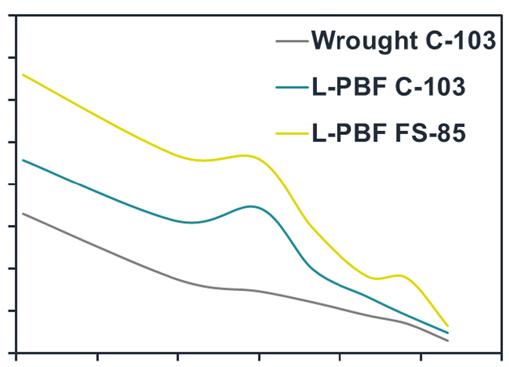
Director of Group Synergy, TaniobisDirectorDrTaniobis GmbHMelanieStenzelofMarketing,GmbH
[7] AMtrinsic® is a registered trade mark of Taniobis GmbH
Dr André Németh
facturing , Winter 2017 (Vol. 3 No. 4), pp. [10]99–103CSchulze, M Weinmann, C Schweigel, O Kessler, R Bader, Mechanical Properties of a Newly Additive Manufactured Implant Mate rial Based on Ti-42Nb, Materials 11 (2018) 124
[11] S Lenka, et al . In preparation for publication
The only magazine dedicated to MIM, CIM and sinter-based AM technologies Our exclusive deep-dive articles, company profiles, conference reports and e-newsletters are of great value to those interested in this advanced manufacturing technology for the production of complex, high volume net-shape components www.pim-international.com



Powdercompactmetal Die Die
Understanding the compaction and sintering effects of four commonly used lubricants in Powder Metallurgy
In the compaction process, force is applied to the top and bottom of the powder metal compact before pres sure is applied to consolidate the powder. As a result of this, force is also exerted on the sides of the die by the compact. Lubricants such as Acrawax C are added to the powder metal mix in the range of 0.25 wt.% to 1.5 wt.%, to reduce the interpar ticle friction in the compact and provide a mechanism to reduce the friction between the powder metal compact and the die wall during compaction and ejection. Addition ally, without the aid of a lubricant, the compact quality may be compro mised, and the overall die life can be greatly reduced. Once the compact has been formed and ejected from the die, it is loaded into a sintering furnace where the metal particles continue to bond in the presence of a reducing atmosphere and heat. Although the lubricant is a necessary element for the compaction process, it is important to completely remove the lubricant during the initial
Lubricants are a necessary addition to the Powder Metallurgy compaction process, reducing ejection forces from the tool, maintaining product quality, and increasing tool life. Depending on the application, different amounts and types of lubricant are needed to address issues related to green density and product geometry. In this article, researchers from Penn State University, North American Höganäs and Abbott Furnaces review the compaction and sintering effects of three commonly used lubricants – Acrawax® C, Intralube® E, and Intralube® HD – to shed light on the best application for different types of lubricant, and the effects these choices can have on final part quality.
Fig. 1 Schematic of the forces produced during the compaction process
Lubricant
Autumn 2022 Powder Metallurgy Review 107© 2022 Inovar Communications Ltd | contents | news | advertisers | events | website | e-newsletter | GETPDF
effects in press and sinter PM
sintering process in order to ensure the parts are adequately sintered. The PM sintering process can thus be broken down into three primary steps. The first step is the thermal removal of the lubricant that was added to the metal powder to aid the compaction process. If care is
not taken to ensure proper lubricant removal, the lubricant will dissociate at increased temperatures, forming soot at 545°C [1]. This soot can act as a barrier between the particles and limit the area of interparticle bonding surfaces. The result may be a lack of particle necking during
Compaction force from bottom punch Force excerted on the die wall by the powder metal upper punch cavity
Compactioncompactforce from
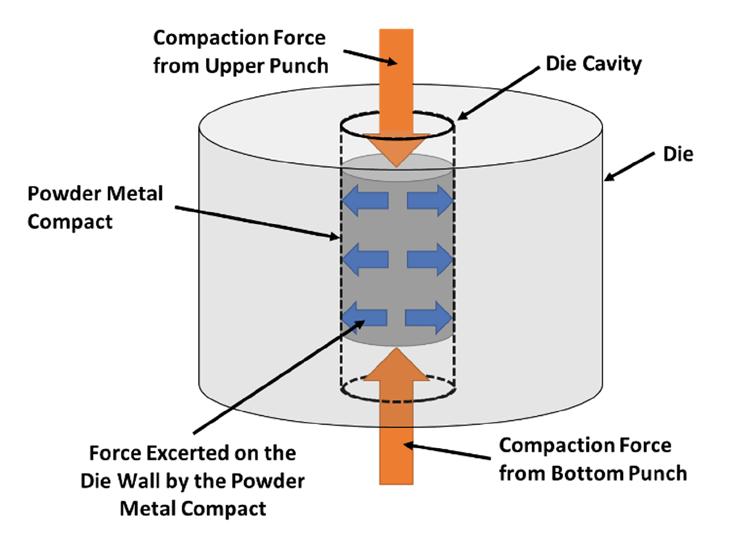
“As the applications of conventional press and sinter PM grow, the desire to improve the complexity and properties of sintered compacts also increases.”
By using warm compaction at 70°C and Intralube E, the producer may choose to reduce the amount of lubricant or may retain the higher lubricant content and generate as much as a 50% reduc tion in the ejection forces. When considering the use of Intralube E or Intralube HD, the question is which one is best suited for the compaction capability versus the desired green density.
Effect of lubricants on compaction
Fig. 2 Schematic of the key steps in the sintering process
development of innovative lubricant systems, such as Höganäs’s Intra lube E and Intralube HD, that were specifically aimed at these advanced compaction applications [2,3]. This does not, however, eliminate the need for these lubricants to be removed in the sintering process.
In the same way that compaction technology continues to advance, new sintering technology continues to be developed to remove lubri cants more efficiently from the compact without causing soot formation. One recent innova tion in sintering has been Abbot Furnace’s Vulcan SystemTM. This latest technology uses convective heating to provide a very controlled temperature range for lubricant removal. It also has the ability to accurately adjust the dew point of the atmosphere in the lubricant removal stage of the process. This technology has made it possible to achieve improved properties compared to conventional processes while also complementing the latest compaction technology to produce components with better properties that are cost competitive.
The development of new lubricants such as Intralube E and Intralube HD has previously been shown to substantially reduce compac tion pressure. Likewise, the same compaction pressure needed to produce a green density of a compact containing Acrawax C will now produce green densities that are ~2% greater in some of the most common materials blended with Intralube HD. Similarly, when compared to equal amounts of Acrawax C in a mix, the use of Intralube E may reduce the ejection forces on the compact by as much as 20%, for a compact of equal green density.
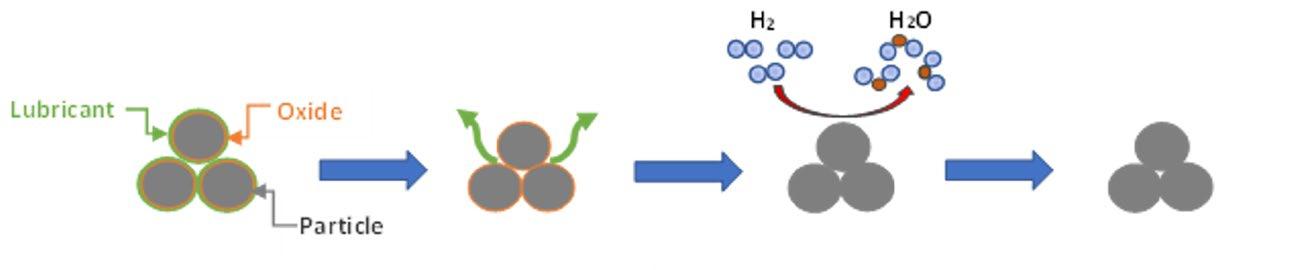
Lubricant Particle Oxide Begin heating Lubricant removal Oxidation reduction Sintering of particles
H 2 H 2O
sintering, or a reduction in the mechanical properties of the sintered component.Thesecond step in the sintering process is the removal of any oxides that may be present on the surface of the particles and, thus, act as a barrier between particles. The oxides are removed through the reaction between the reducing atmosphere in the furnace and the presence of heat. The final step in the sintering process, once all barriers to inter particle contact have been removed, is the sintering of the particles together through diffusion at an elevated temperature, typically 1120°C.Asthe applications of conven tional press and sinter PM have grown, the desire to improve the complexity and properties of sintered compacts has also increased. This, too, requires higher compacted densities and the ability to press parts in increasingly complex shapes. These factors demand that lubricant performs better to reduce the compaction pressures and ejec tion forces required to produce these compacts. This has led to the
108 © 2022 Inovar Communications LtdPowder Metallurgy Review Autumn 2022 | contents | news | advertisers | events | website | e-newsletter |Lubricant effects in press and sinter PM
When comparing equivalent amounts of lubricant in the mix, Intralube HD is better suited for green densities of 7.2 g/cm 3 and greater. Higher green densities are achieved with the same amount of compaction pressure. Likewise, ejection forces may be as much as 7% less in a system that uses Intra lube HD; however, it is important to
three types of lubricant (Acrawax C, Intralube E, and Intralube HD) mixed at three amounts (0.30, 0.50, and 0.75 wt.%), then sintered in a single-stacked and a double-stacked configuration, on a conventional furnace and in the Vulcan Process. Weight loss and transverse rupture strengths were measured for all configurations and compared.
versus compaction
The radiant style heating used in conventional sintering technology heats the compact too rapidly and results in the lubricant dissociating to form soot that is detrimental to the quality of the part and the furnace.Toevaluate the effect of the lubri cant types, amounts, green densities, and loading, testing was conducted with a sample matrix consisting of FC-0208 compacted to three densi ties (6.8, 7.0, and 7.2 g/cm 3) with
of different lubricant types [2,3]
Effect of lubricants on sintering
As illustrated in Fig. 7, as the green density increased, the amount of weight loss was reduced with each lubricant amount. It is important to note that the total weight loss is higher than the amount of lubricant
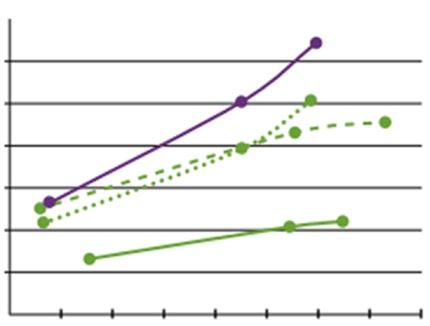
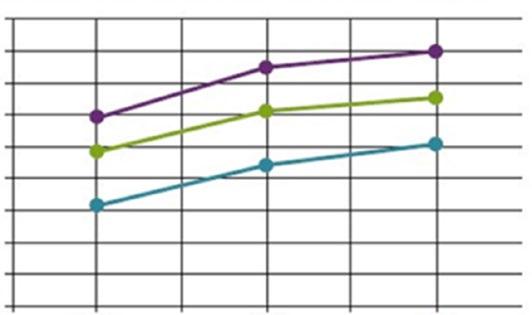
Fig. 3 Comparison density pressure
Green density (g/cm 3)


It has long been recognised that one of the key variables to success fully sintering a compact is the time required to remove the lubricant. Also, the introduction of water into


of green
Fig. 5 Compaction pressures for various amounts of Intralube E and Intralube HD [4] )(g/cmdensityGreen3
note that, by increasing the amount of Intralube E in the system, the green density is still lower, and ejec tion forces become lower than those of the original Intralube HD system (Figs. 3, 4, 5, 6).
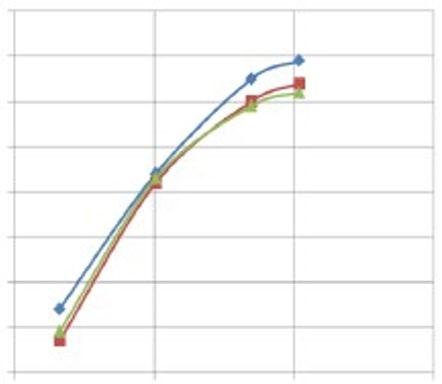


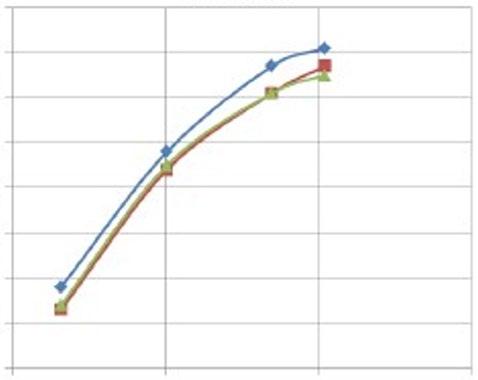
the preheat section of the furnace reacts with soot that may form with the dissociation of the lubricant.
Fig. 4 Comparison of ejection energy versus green density of compacts containing Amide wax and Intralube E [2,3]
)(J/cmenergyEjection2 Compacting pressure [MPa] Compacting pressure [MPa] FD-0200 CompactingFL-4400pressure [MPa] ASC100.29 + 2% Cu + 0.4% C + 0.5-0.8% lubricant, WDC 600 7.457.357.257.157.057 7.50 7.50 7.40 7.40 7.30 7.30 7.20 7.20 7.10 7.10 7.00 7.00 6.90 6.90 6.80 6.80 6.70 0.5% Intralube HD 0.5% Intralube E 0.6% Intralube E 350 350550 550750 750950 950 6.704540353025201510Intralube HD Amide wax 0.8% Intralube E 0.6% at 70°C Intralube E 0.8% Intralube E 0.8% at 70°CIntralube E Premix, A-wax 7.47.37.27.1 700 800 6.6 6.7 6.8 6.9 7.0 7.1 7.2 7.3 7.4
Autumn 2022 Powder Metallurgy Review 109© 2022 Inovar Communications Ltd | contents | news | advertisers | events | website | e-newsletter | GETPDFLubricant effects in press and sinter PM


Fig. 6 Ejection forces for various amounts of Intralube® E and Intralube® HD [4]
Fig. 7 Weight loss in a conventional sintering furnace for various lubricant types, amounts, loading conditions, and green densities
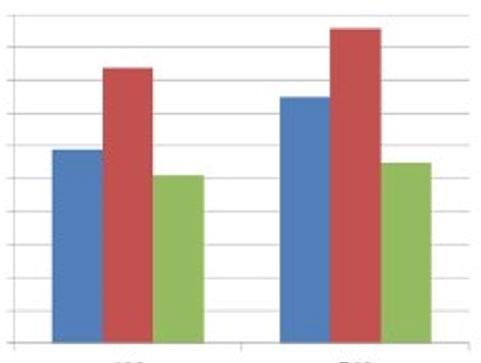
new Compacting
8
in the mix because there is also a loss of weight due to the reduction of the oxides on the metal powder particles. The result is the need for even more water to react with the soot. This approach is often not as successful as desired. In the case of high-density compacts, the steps and time needed to remove the lubricant and react the soot make it even more difficult to produce the desired quality.
Like the compaction technology and the development of better lubri cants, new sintering technology has been brought to the market that uses convective heating to ensure that the compact is heated into a temperature range where the lubri cant will melt, wick out of the part and vaporise without overheating and causing sooting. The result is a system that can remove all the lubri cant from the part. Fig. 8 illustrates, that regardless of lubricant amount, green density, or type of lubricant, all the lubricant is removed and the oxides on the particles reduced.
(kN)forceEjection loss.wt%loss.wt% 6.8 g/cm 3 7.0 g/cm 3 7.2 g/cm 3 (kN)forceEjection Compacting pressure


690 35 35 34 34 33 33 32 32 31 31 30 30 29 29 28 28 27 27 26 26 25 0.900.90 0.30 wt.% 0.30Acrawaxwt.% C Acrawax C 0.50 wt.% 0.50Intralubewt.% E Intralube E 0.75 wt.% 0.75Intralubewt.% HD Intralube HD Singlestack Singlestack SinglestackDoublestack Doublestack Doublestack0.000.000.100.100.200.200.300.400.500.500.600.600.700.700.800.800.400.30 25 690760 760 FD-0200 FL-4400 6.8 g/cm 3 7.0 g/cm 3 7.2 g/cm 3 Singlestack Singlestack SinglestackDoublestack Doublestack Doublestack Lubricant effects in press and sinter PM
110 © 2022 Inovar Communications LtdPowder Metallurgy Review Autumn 2022 | contents | news | advertisers | events | website | e-newsletter |


Mechanical properties of samples produced with a conventional sintering process and the Vulcan Process with various lubricant types, lubricant contents, green densi ties, and sintering conditions were measured. The transverse rupture strength (TRS) of those samples sintered in the conventional furnace are consistently lower and showed more variation than those sintered under similar conditions in the pressure [MPa] [MPa]
Fig. Weight loss in a Vulcan Process for various lubricant types, amounts, loading conditions, and green densities
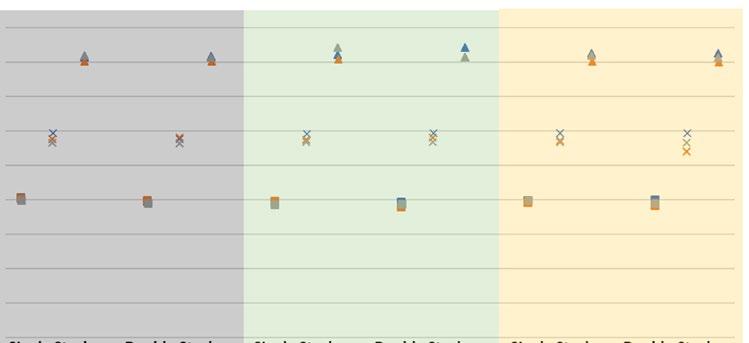

“New sintering technology has been brought to the market that uses convective heating to ensure that the compact is heated into a temperature range where the lubricant will melt, wick out of the part and vaporise without overheating...” (psi)TRS(psi)TRS
3 0.30
0.50 Intralubewt.%
0.30 Acrawaxwt.%C
Conclusion
Intralube E (TRS) 0.75 wt.% 0.75 HD (TRS)
Intralubewt.%
Tests show that Intralube HD is best suited for densities of 7.2 g/ cm 3 and above; however, similar compaction results can be achieved with the Intralube E lubricant for densities below 7.2 g/cm 3. That said, however, the amount of lubri cant is not important when using the Vulcan Process. Because the lubricant is removed completely, the benefits of lower compaction
6.8 g/cm g/cm g/cm wt.% (TRS)
3 7.0
3
3 7.2
With all the lubricant removed from the compact, it makes sense that the initial green density and heating rate would play a larger role in determining the strength, as seen in the Figs. 9 and 10. It is important to note that the amount and type of lubricant has little impact on the properties achieved by the new process, except at the higher densities (Fig. 10). Intralube E is lower in strength at 7.2 g/cm 3 As shown in the compaction data in Fig. 5, the better choice of lubri cant for higher densities would be the Intralube® HD. Likewise, since the free pore density at a 7.2 g/ cm 3 green density is 98%, 0.75 wt.% lubricant is the highest quantity of lubricant that can be in the mix. Although this case would not be seen in typical production, it was included in this study for complete ness of the data.
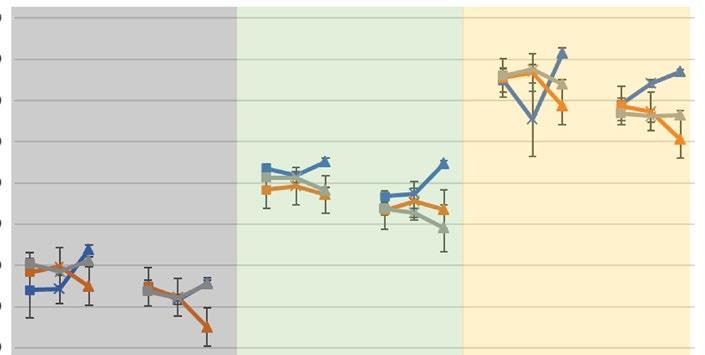
process. In all cases, the doublestacked condition produced a lower strength; however, this can be attributed to the larger thermal mass of the load. A larger thermal mass will slow the heating of the samples to the sintering tempera ture, thus reducing the effective sintering time.
As the need for improved proper ties pushes the density of compacts higher, new lubricants and sintering technology have evolved to meet the challenge. Lower compaction pressure and ejection forces are possible with the Intra lube products. Likewise, complete lubricant removal is possible with the new Vulcan Process.
Acrawax C (TRS) wt.% E (TRS)
0.50
Fig.furnace10Transverse
3 Lubricant effects in press and sinter PM
Autumn 2022 Powder Metallurgy Review 111© 2022 Inovar Communications Ltd | contents | news | advertisers | events | website | e-newsletter | GETPDF
Intralube HD (TRS) g/cm g/cm 7.2 g/cm
3 7.0
Rupture Strength of compacts with various lubricant types, amounts, loading conditions, and green densities sintered in the Vulcan Process
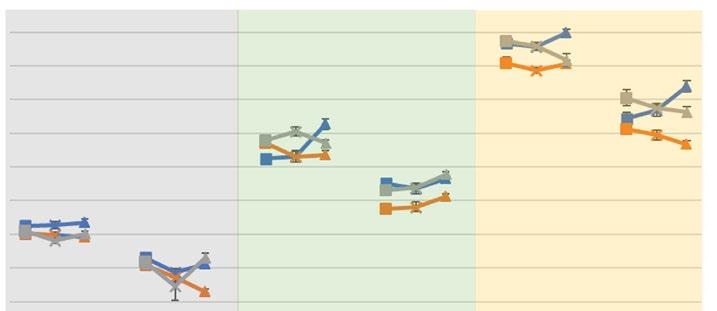
Fig. 9 Transverse Rupture Strength of compacts with various lubricant types, amounts, loading conditions, and green densities sintered in a conventional
SingleSinglestackstack SingleSinglestackstack SingleSinglestackstackDoubleDoublestackstack DoubleDoublestackstack DoubleDoublestackstack125000135000145000155000165000175000185000205000195000195000185000175000165000155000145000135000125000115000 6.8
North American Höganäs Company, Hollsopple, PA, USA
Jacob P Feldbauer and Scott E Coble Pennsylvania State University, Dubois, PA, USA
and ejection forces associated with an increase in lubricant amount can be realised without a negative effect on the final sintered product.
Lubricant effects in press and sinter PM
References and further reading
[2] Höganäs AB, Intralube E, September 2012. Accessed February 8 2022 < intralube_intralube-hd_2301hog.pdfdatasheets---all-documents/sharepoint/brochures-and-globalassets/download-media/<Accessed[3]intralube_intralube-e_0231hog.pdfdatasheets---all-documents/sharepoint/brochures-and-globalassets/download-media/https://www.höganäs.com/>—,IntralubeHD,July2018.February182022https://www.höganäs.com/ >
[6] Coble, Scot E, et al , ‘The Impact of Complete Lubricant Removal on the Mechanical Properties and Produc tion of PM Components,’ Thermal Processing, January 2022: 36-40
[1] Feldbauer, Jacob P, et al, ‘The Impact of Complete Lubricant Removal on the Mechanical Proper ties and Production of Powder Metal Components Containing Intralube® HD,’ as presented at PowderMet 2021, Orlando, FL, June 2021
The dominant variables in the sintering process are now the green density and sintering time/tempera ture. Higher green densities produce enhanced properties, and, if a similar sintering time at temperature is seen by the products, the amount of lubricant and type can be selected to optimise the compaction process without affecting the final sintered quality.
112 © 2022 Inovar Communications LtdPowder Metallurgy Review Autumn 2022 | contents | news | advertisers | events | website | e-newsletter |
Amber Tims, PMT
[7] DeWitt, Frank P Incropera and David P, Fundamentals of Heat and Mass Transfer, New York: John Wiley & Sons, Inc., 2002
[12] MPIF, Standard Test Methods for Metal Powders and Powder Metal lurgy Products. Princeton, NJ: Metal Powder Industry Federation, 2010.
[8] Feldbauer, Stephen L, PhD, ‘A Review of Lubricant Removal Systems and the Latest Technology,’ Industrial Heating January 2020: [9]24-27Levanduski, Edward and Stephen L Feldbauer, ‘Observations in Lubri cant Removal,’ as presented at PowderMet 2010, Fort Lauderdale, FL, Special Interest Session
Stephen L Feldbauer, PhD Abbott Furnace Company, St. Marys, PA, USA
[4] Neilan, Amber, et al, ‘High Performance Lubricant for Warm Die Compaction,’ as presented at PowderMet 2015, San Diego, CA, May 26, 2015
Authors
[5] Coble, Scot E, et al , ‘A Compar ison of the Mechanical Properties and Production of Powder Metal Components made with Intralube® E and Sintered Using Two Different Sintering Approaches,’ as presented at PowderMet 2022, Portland, OR, June, 2022
[10] MPIF, Materials Standards for PM Structural Parts. Princeton, NJ: Metal Powder Industries Federation, [11]2007Powell, Robert, Stringer, Craig and Feldbauer, Stephen L, ‘Lubri cant Transport within a Powder Metal Compact during Pre-Sinter,’ as presented at PowderMet 2013, Chicago, IL
FROMMARKETSSPRING2021
WWW.PM-REVIEW.COM


TECHNICAL TRENDS IN METAL-CUTTING TOOLS: AN OVERVIEW OF ONGOING INNOVATION IN ONE OF PM’S KEY
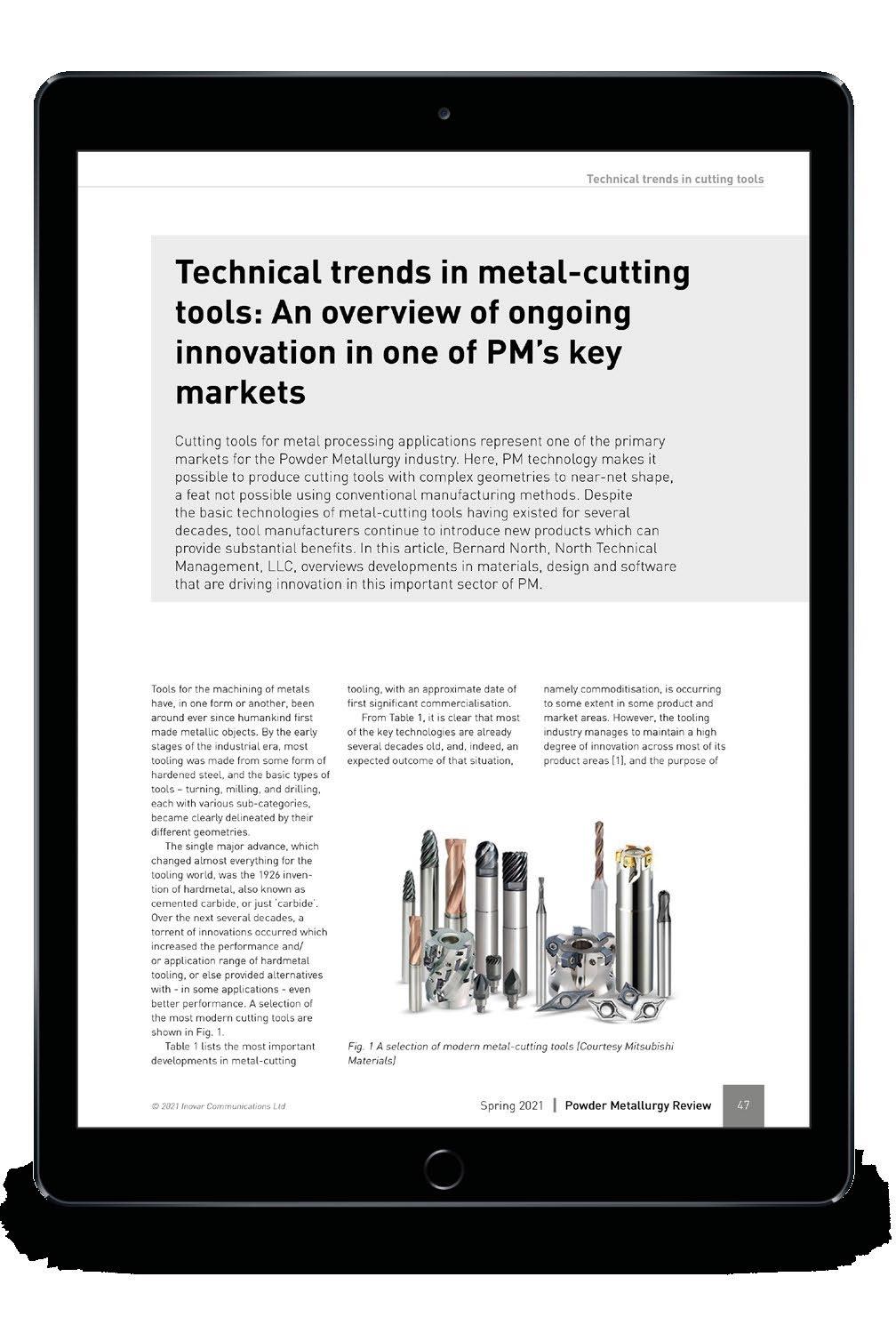
Cutting tools for metal processing applications represent one of the primary markets for the Powder Metallurgy industry. Here, PM technology makes it possible to produce cutting tools with complex geometries to near-net shape, a feat not possible using conventional manufacturing methods. Despite the basic technologies of metalcutting tools having existed for several decades, tool manufacturers continue to introduce new products which can provide substantial benefits. In this article, Bernard North, North Technical Management, LLC, overviews developments in materials, design and software that are driving innovation in this important sector of PM.
POWDER METALLURGY REVIEW FROM OUR ARCHIVE
READ NOW
ISSUE OF PM REVIEW
Topcast SRL 08 www.topcast.it
Tekna 11 www.tekna.com
ATOMISERS & POWDER PRODUCTION TECHNOLOGY
Global Tungsten & Powders Corp. 15 www.globaltungsten.com
POWDER CLASSIFICATIONPROCESSING,&ANALYSIS
Malvern Panalytical Ltd 37 www.malvernpanalytical.com
Rio Tinto QMP 04 www.riotinto.com
BluePower Casting Systems GmbH 19 www.bluepower-casting.com
Phoenix Scientific Industries Ltd 44 www.psiltd.co.uk
Imerys Graphite & Carbon 16 www.imerys-graphite-and-carbon.com
Our advertisers’ index and buyer’s guide serves as a convenient guide to suppliers across the PM supply chain. In the digital edition of PM Review magazine, available at www.pm-review.com, simply click on a company name to view its advert, or on the company’s weblink to go directly to its website.
Höganäs AB IFC www.hoganas.com
Kymera International 29 www.kymerainternational.com
NSL Analytical Services, Inc. 33 www.nslanalytical.com
Sino-Euro Mat. Tech. of Xi’an Co., Ltd. 30 en.c-semt.com
BluePower Casting Systems GmbH 19 www.bluepower-casting.com
114 © 2022 Inovar Communications LtdPowder Metallurgy Review Autumn 2022 | contents | news | advertisers | events | website | e-newsletter |
GEA Group AG 20 www.gea.com
Advertisers’ index & buyer’s guide
Hexagon Product Development Pvt. Ltd. 56 www.alphiemixer.com
POWDERS & MATERIALS
Advertisers’ index/buyer’s guide Advertise with us... Combining digital and print publishing for maximum exposure Reach out to our rapidly expanding international audience that includes component manufacturers, end-users, industry suppliers, analysts, researchers and Formore.more information contact Jon Craxford, Advertising Sales Director Tel: +44 207 1939 jon@inovar-communications.com749
Tekna 11 www.tekna.com
SMS group GmbH 42 www.sms-group.com
MUT Advanced Heating GmbH 40 www.mut-jena.de
Dorst Technologies 06 www.dorst.de
COMPACTION PRESSES, TOOLING & ANCILLARIES
Edward Orton Jr. Ceramic Foundation 53 www.ortonceramic.com
American Isostatic Presses, Inc. 51 Bandas Metalicas Codina S.L. 54 BluePower Casting Systems GmbH 19 Bodycote 39 Dorst Technologies 06 DSH Technologies, LLC 35 Edward Orton Jr. Ceramic Foundation 53 Eltra GmbH 41
EPSI 24
PART PRODUCTION
Erowa AG 14 www.erowa.com
Sino-Euro Mat. Tech. of Xi’an Co., Ltd. 30 SMS group GmbH 42 Sunrock Ceramics Co 31 System 3R International AG 27 Tekna 11 Topcast SRL 08 Ultra Infiltrant 17 Wohlers Associates, Inc. 59 World PM2022 IBC
PVA TePla AG 23 www.pvatepla.com
Erowa AG 14 Euro PM2023 96
Gasbarre Products, Inc. OBC www.gasbarre.com
System 3R International AG 27 www.system3r.com
GKN Powder Metallurgy 13 www.gknpm.com
Bandas Metalicas Codina S.L. 54 www.codinametal.com
Advertisers’ index/buyer’s guide
Sunrock Ceramics Co 31 www.sunrockceramics.com
Fluidtherm Technology Pvt. Ltd. 55/57 www.fluidtherm.com
SINTERING EQUIPMENT & ANCILLARIES
DSH Technologies, LLC 35 www.dshtech.com
Phoenix Scientific Industries Ltd 44 PM China 2022 80 PowderMet2023 / AMPM2023 70 ProGrit GmbH 49 PVA TePla AG 23 Rio Tinto QMP 04 Sacmi 25
Alphabeticalindex
Fluidtherm Technology Pvt. Ltd. 55 /57 Formnext 62 Gasbarre Products, Inc. OBC GEA Group AG 20 GKN 13
Global Tungsten & Powders Corp. 15 Hexagon Product Development Pvt. Ltd. . 56 Höganäs AB IFC Imerys Graphite & Carbon 16 Isostatic Toll Services 51 Kymera International 29 Malvern Panalytical Ltd 37 Microtrac Retsch GmbH 47 MIM2023 86
MUT Advanced Heating GmbH 40 NLB Corporation 36 NSL Analytical Services, Inc. 33 Osterwalder AG 26
Osterwalder AG 26 www.osterwalder.com
Ultra Infiltrant 17 www.ultra-infiltrant.com
Progrit GmbH 49 www.progrit.ch Sacmi 25 www.sacmi.com
Autumn 2022 Powder Metallurgy Review 115© 2022 Inovar Communications Ltd | contents | news | advertisers | events | website | e-newsletter | GETPDF
EVENTS
PowderMet2023 / AMPM2023 70 www.powdermet2022.org / www.ampm2022.org
For more information contact Jon Craxford, Advertising Sales Director Tel: +44 207 1939 jon@inovar-communications.com749
PM China 2022 80 www.pmexchina.com
116 © 2022 Inovar Communications LtdPowder Metallurgy Review Autumn 2022 | contents | news | advertisers | events | website | e-newsletter |

Wohlers Associates, Inc. 59 www.wohlersassociates.com
Combining digital and print publishing for maximum exposure
Reach out to our rapidly expanding international audience that includes component manufacturers, end-users, industry suppliers, analysts, researchers and more.
MIM2023 86 www.mim2023.org
DSH Technologies, LLC 35 www.dshtech.com

www.facebook.com/PMRmagwww.linkedin.com/company/powdermetallurgyreviewwww.twitter.com/PMRMagFOLLOWUS

QUALITY AND TESTING
NLB Corporation 36 www.nlbcorp.com
Advertisers’ index/buyer’s guide
American Isostatic Presses, Inc. 51 www.aiphip.com
Advertise with us...

HIP EQUIPMENT AND SERVICES
Isostatic Toll Services 51 www.isostatictollservices.com
Microtrac Retsch GmbH 47 www.microtrac.com
EPSI 24 www.epsi-highpressure.com
World PM2022 IBC www.worldpm2022.com
Euro PM2023 96 www.europm2023.com Formnext 62 www.formnext.com
Eltra GmbH 41 www.eltra.com
POST-PROCESSING
Bodycote 39 www.bodycote.com
CONSULTING & TOLL SINTERING
THE PM DATINGACCESSGIVESMAGAZINEREVIEWARCHIVEFREEDIGITALTOPASTISSUESBACKTO2012
A decade of exclusive content, offering unparalleled insight into the world of metal powder production and manufacturing.
DOWNLOAD ALL PAST ISSUES

www.pm-review.com METALLURGYPOWDERREVIEW
October 1–4, 2023 Lisbon, www.europm2023.comPortugal
October 25–28, 2022 Hannover, www.euroblech.comGermany
November 15–18, 2022 Frankfurt, www.formnext.comGermany
RAPID + TCT 2023
EMO Hannover 2023 September 18–23, 2023 Hannover, www.deutschemesse.co.uk/emoGermany
Industry events
Hagen Symposium 2022
April 17–21, 2023 Hannover, www.hannovermesse.deGermany
Euro PM2023
118 © 2022 Inovar Communications LtdPowder Metallurgy Review Autumn 2022 | contents | news | advertisers | events | website | e-newsletter | 20232022
June 28–29, 2023 Sheffield, conferencewww.mapp.ac.uk/events/mapp-2nd-international-UK
MAPP Second International Conference
EuroBLECH 2022
If you would like to see your Powder Metallurgy related event listed in this magazine and on our websites, please contact Kim kim@inovar-communications.comHayes,
Dritev 2023
October 9–13, 2022 Lyon, www.worldpm2022.comFrance
Hannover Messe 2023
October 20–22, 2022 Nanjing, www.pmexchina.comChina
MIM2023
Industry events
June 18–21, 2023 Las Vegas, NV, www.powdermet2023.orgUSA / www.ampm2023.org
World Titanium Conference 2023 (Ti-2023)
PowderMet2023 / AMPM2023
Formnext
Powder Metallurgy Review is dedicated to driving awareness and development of Powder Metallurgy and its related technologies. Key to this aim is our support of a range of international partner conferences. View our complete events listing on www.pm-review.com
June 12–16, 2023 Edinburgh, Scotland, conference-2023.htmlwww.iom3.org/events-awards/world-titanium-UK
PM China 2022
November 24–25, 2022 Hagen, termine/symposium-aktuell/www.pulvermetallurgie.com/symposium-Germany
Event listings and media partners
May 2–4, 2023 Chicago, IL, www.rapid3devent.comUSA
World PM2022
February 27–March 1, 2023 Costa Mesa, CA, www.mim2023.orgUSA
July 5–6, 2023 Baden, www.vdiconference.com/dritev/Germany
PRODUCTIONPOWDER TOOLS IMPROVINGFOR PM MATERIALS TECHNOLOGIESCONSOLIDATIONSOCIALAPPLICATIONSMEETING TECHNICAL CONGRESS WORLD EXHIBITION ALL-TOPIC POWDER METALLURGY EVENT OPENREGISTRATION9-13October2022Lyon,Franceworldpm2022.com

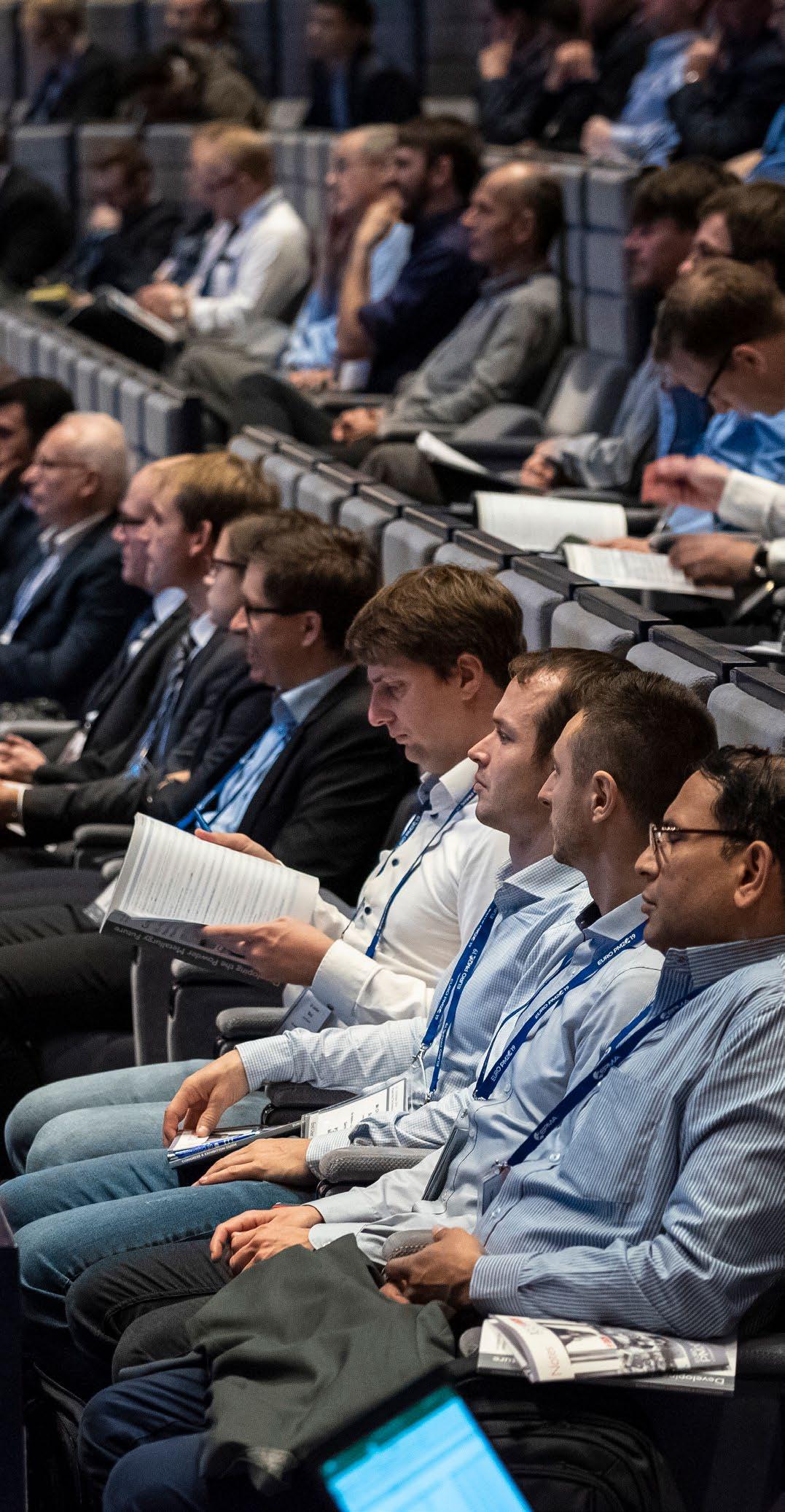
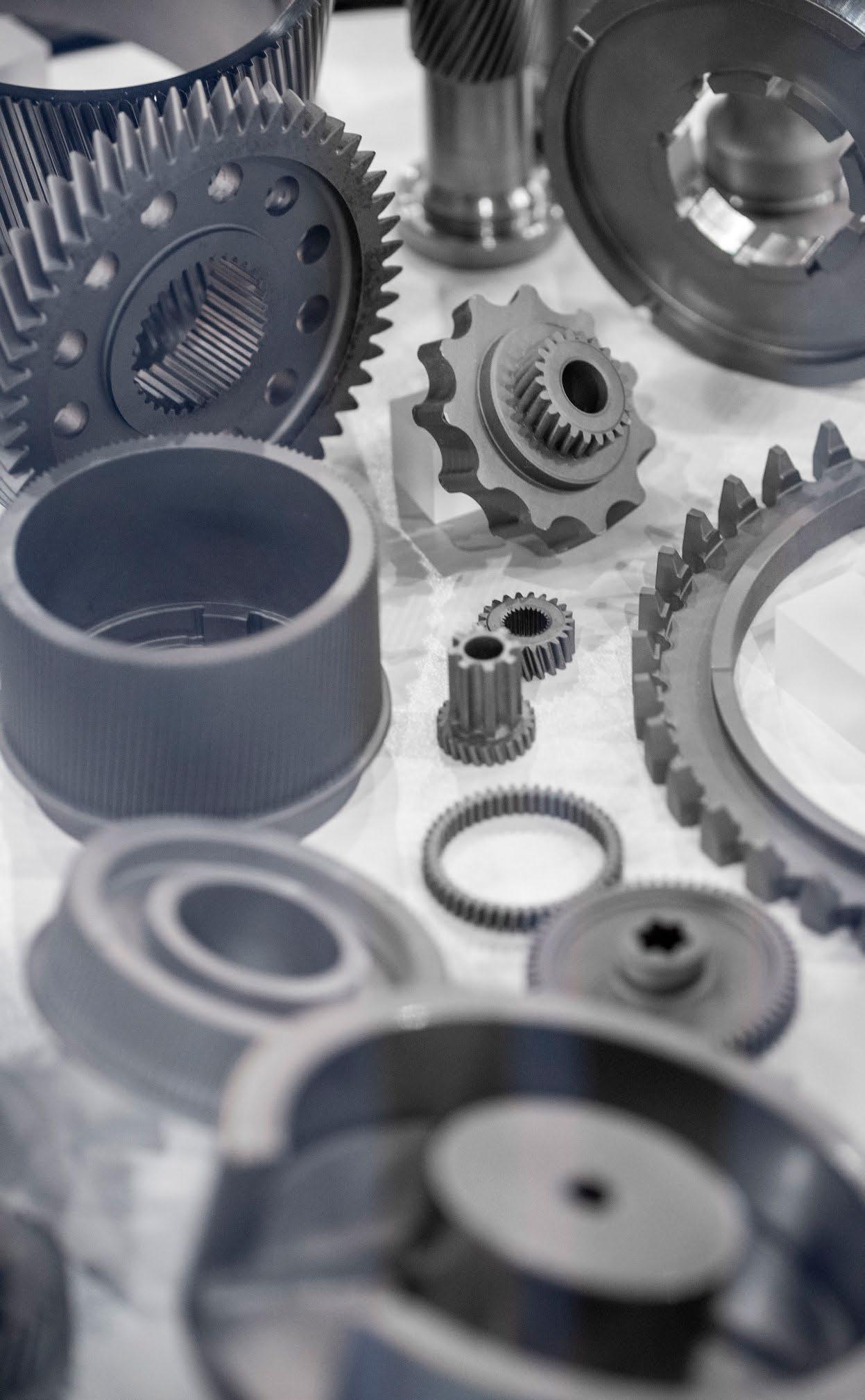
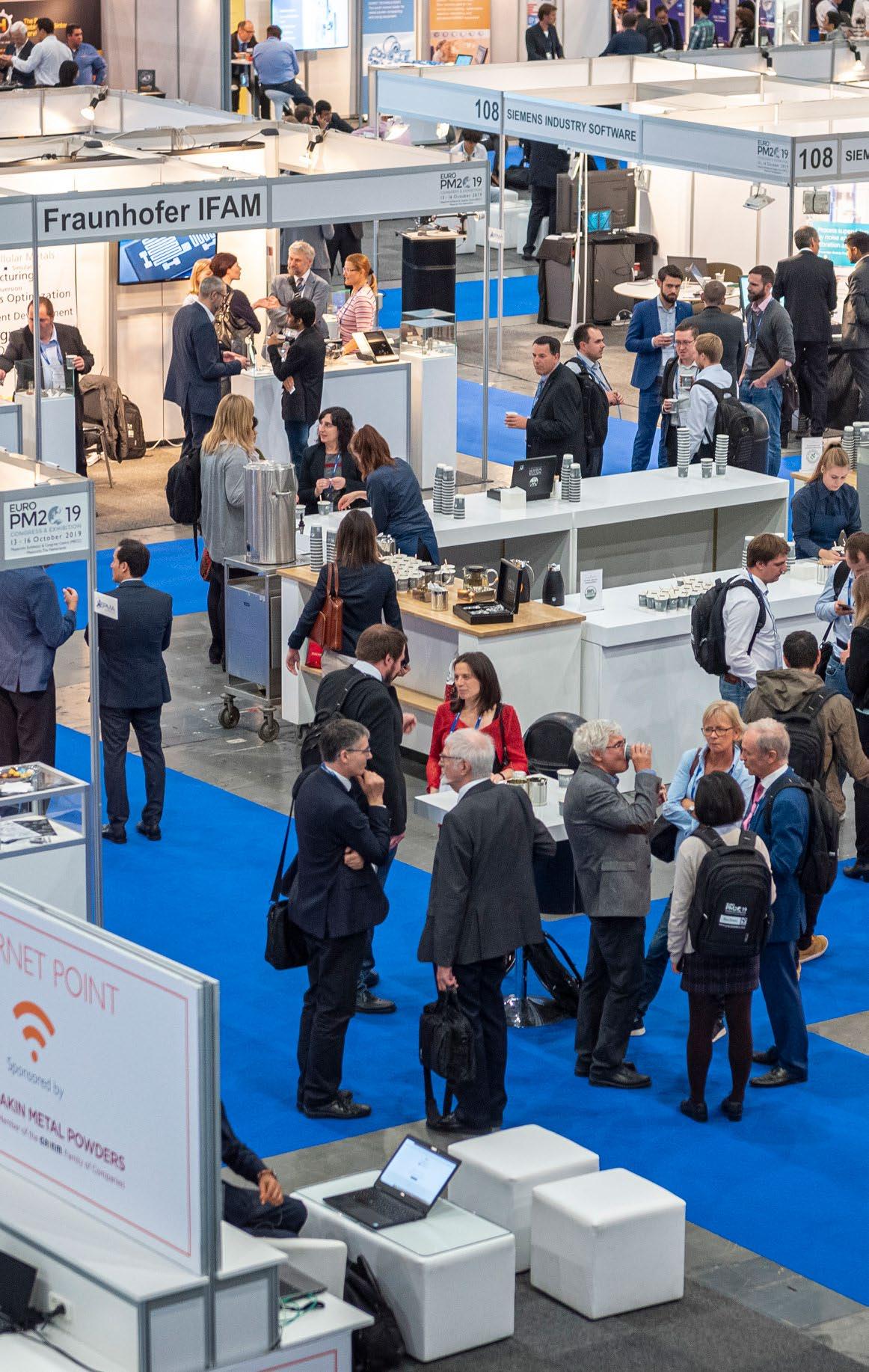
Gasbarre takes a 360º approach to servicing our customers
.
From sales and applications engineering, to equipment design, manufacturing, commissioning, and never ending aftermarket support, our team of engineers, metallurgists, and technicians understand your process from all angles. Gasbarre’s technical capability and commitment to service will ensure your success today and into the future!
CONTINUOUS FLOW FURNACESSINTERINGVACUUM n Faster floor to floor times n Superior material properties n Elevated temperatures n Energy efficient & environmentally friendly n Precise control n Capable of oil or gas quenching
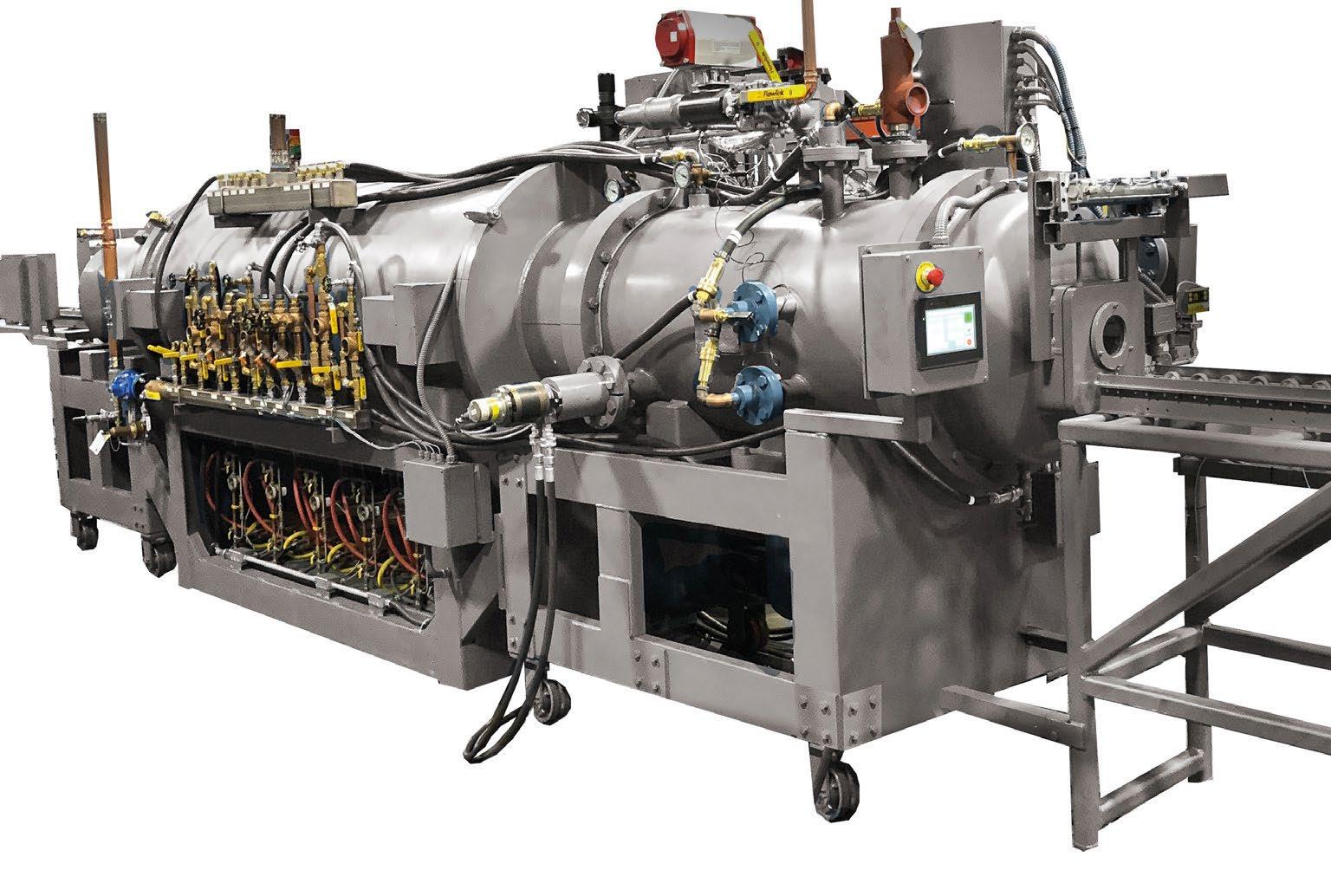
Gasbarre takes a 360º approach to servicing our customers




















COMPLETE LINE OF THERMAL PROCESSING EQUIPMENT Annealing n Brazing n Carbonitriding n Carburizing n Co-firing n Drying n Enameling Ferritic Nitrocarburizing n Glass-to-Metal Sealing n Hardening n Inert Atmosphere Processing Nitriding n Normalizing n Quenching n Sintering n Soldering n Spheroidize Annealing Steam Treating n Stress Relieving n Tempering n Vacuum Processes THERMAL PROCESSING SYSTEMS furnace-sales@gasbarre.com814.834.2200 www.gasbarre.com RELIABILITY,SERVICEEXPERTISE,ANDSELECTION CONTINUOUS FLOW FURNACESSINTERINGVACUUM n Faster floor to floor times n Superior material properties n Elevated temperatures n Energy efficient & environmentally friendly n Precise control n Capable of oil or gas quenching
From sales and applications engineering, to equipment design, manufacturing, commissioning, and never ending aftermarket support, our team of engineers, metallurgists, and technicians understand your process from all angles.
COMPLETE LINE OF THERMAL PROCESSING EQUIPMENT Annealing n Brazing n Carbonitriding n Carburizing n Co-firing n Drying n Enameling Ferritic Nitrocarburizing n Glass-to-Metal Sealing n Hardening n Inert Atmosphere Processing Nitriding n Normalizing n Quenching n Sintering n Soldering n Spheroidize Annealing Steam Treating n Stress Relieving n Tempering n Vacuum Processes THERMAL PROCESSING SYSTEMS furnace-sales@gasbarre.com814.834.2200 www.gasbarre.com RELIABILITY,SERVICEEXPERTISE,ANDSELECTION
COMPLETE LINE OF THERMAL PROCESSING EQUIPMENT Annealing n Brazing n Carbonitriding n Carburizing n Co-firing n Drying n Enameling Ferritic Nitrocarburizing n Glass-to-Metal Sealing n Hardening n Inert Atmosphere Processing Nitriding n Normalizing n Quenching n Sintering n Soldering n Spheroidize Annealing Steam Treating n Stress Relieving n Tempering n Vacuum Processes THERMAL PROCESSING SYSTEMS furnace-sales@gasbarre.com814.834.2200 www.gasbarre.com RELIABILITY,SERVICEEXPERTISE,ANDSELECTION CONTINUOUS FLOW FURNACESSINTERINGVACUUM n Faster floor to floor times n Superior material properties n Elevated temperatures n Energy efficient & environmentally friendly n Precise control n Capable of oil or gas quenching
From sales and applications engineering, to equipment design, manufacturing, commissioning, and never ending aftermarket support, our team of engineers, metallurgists, and technicians understand your process from all angles. Gasbarre’s technical capability and commitment to service will ensure your success today and into the future!
COMPLETE LINE OF THERMAL PROCESSING EQUIPMENT Annealing n Brazing n Carbonitriding n Carburizing n Co-firing n Drying n Enameling Ferritic Nitrocarburizing n Glass-to-Metal Sealing n Hardening n Inert Atmosphere Processing Nitriding n Normalizing n Quenching n Sintering n Soldering n Spheroidize Annealing Steam Treating n Stress Relieving n Tempering n Vacuum Processes THERMAL PROCESSING SYSTEMS furnace-sales@gasbarre.com814.834.2200 www.gasbarre.com RELIABILITY,SERVICEEXPERTISE,ANDSELECTION CONTINUOUS FLOW FURNACESSINTERINGVACUUM Faster floor to floor times Superior material properties Elevated temperatures n Energy efficient & environmentally friendly n Precise control n Capable of oil or gas quenching
Gasbarre’s technical capability and commitment to service will ensure your success and into the future!
Gasbarre takes a 360º approach to servicing our customers From sales and applications engineering, to equipment design, manufacturing, commissioning, and never ending aftermarket support, our team of engineers, metallurgists, and technicians understand your process from all angles. Gasbarre’s technical capability and commitment to service will ensure your success today and into the future!
today
Gasbarre’s technical capability and commitment to service will ensure your success today and into the future!
From sales and applications engineering, to equipment design, manufacturing, commissioning, and never ending aftermarket support, our team of engineers, metallurgists, and technicians understand your process from all angles.
COMPLETE LINE OF THERMAL PROCESSING EQUIPMENT Annealing n Brazing n Carbonitriding n Carburizing n Co-firing n Drying n Enameling Ferritic Nitrocarburizing n Glass-to-Metal Sealing n Hardening n Inert Atmosphere Processing Nitriding n Normalizing n Quenching n Sintering n Soldering n Spheroidize Annealing Steam Treating n Stress Relieving n Tempering n Vacuum Processes THERMAL PROCESSING SYSTEMS furnace-sales@gasbarre.com814.834.2200 www.gasbarre.com RELIABILITY,SERVICEEXPERTISE,ANDSELECTION CONTINUOUS FLOW FURNACESSINTERINGVACUUM n Faster floor to floor times n Superior material properties n Elevated temperatures n Energy efficient & environmentally friendly n Precise control n Capable of oil or gas quenching