Innovatix | Issue 1 | 2018
At the Ready:
Emergency Preparation and Response for Healthcare Facilities
PLUS
Pharmacists + Technicians: Earn CE credits by completing the program in this issue.
Innovatix | innovatix.com 1
An Innovatix Publication Series
EDITORIAL STAFF EDITOR IN CHIEF
Gary Feit, MS Vice President, Corporate Communications
CLINICAL EDITOR
Sylvia Thomas, PharmD, MS, BCPS Vice President, Clinical Pharmacy Services
MANAGING EDITOR
Eric Rodriguez Director, Corporate Communications
Table of Contents Issue 1 | 2018
DESIGNER
Jaclyn Alvarado Creative Director, J2 Design NYC, Inc.
COPY EDITOR Tina Harlan
PROOFREADER Laura F. Yandell
CONTRIBUTORS
1 Welcome Letter the Ready: Emergency Preparation and 2 AtResponse for Healthcare Facilities Employee Spending: Four Tips 7 Managing to Improve Your Bottom Line Is Your Pharmacy Safe and 9 Cyberattacks: Do You Have Proper Protections in Place? Policy Win: Home Infusion 12 Landmark Services Billed Under Medicare Innovatix IVIG Calculator: 15 The Q&A with Dr. Liya Davydov Education: Heart Failure: 17 Continuing A Guideline Directed Medical Therapy
Approach to Diagnosis and Treatment
34 Clinical Corner: Shingrix 37 Contract Updates 2 |
Insight
Leigh Davitian, JD Liya Davydov, PharmD, BCPS, BCGP Gary Feit, MS Renee Hofman, MS, RPh Eric Rodriguez Alicia Schindle Shara Siegel, MS Sylvia Thomas, PharmD, MS, BCPS
555 West 57th St., 12th Floor New York, NY 10019 phone 888.258.3273 fax 646.638.2641 innovatix.com Insight magazine is published semiannually by Innovatix and is complimentary for Innovatix members. For membership information, please call 888.258.3273. To submit ideas for editorial consideration, please contact Eric Rodriguez at 212.901.1242 or eric_rodriguez@innovatix.com. This publication is intended to provide general information on issues of interest to the members of Innovatix, LLC (“Innovatix�) and the general public. It does not constitute nor should it be used as a substitute for any business, legal, or regulatory advice. Innovatix hereby disclaims all warranties, express or implied, as to the accuracy of any of the information contained herein, whether such information is up-to-date, or its fitness for any particular use or purpose. Nothing contained in it is intended as a treatment recommendation for any particular patient or group of patients. Treating institutions and/ or physicians must make all clinical decisions regarding the use of pharmaceuticals and other products on a case-by-case basis. You should always refer to federal, state, and local laws, rules, and regulations governing the operation of your organization and should consult your own legal counsel. The opinions expressed by the authors of articles included in this issue do not necessarily reflect those of Innovatix, its affiliates, or its representatives. Furthermore, some of the content contained herein may have been originally prepared by or funded by organizations with financial interests in products or services related to the topics discussed in such article. While every effort was made to ensure the accuracy of information conveyed in this magazine, Innovatix, its affiliates, and its representatives do not accept responsibility and cannot be held liable for any errors that may exist within the publication. Innovatix is not responsible for the contents of any Web pages that are referenced by this communication. Links from this communication to other sites do not constitute an endorsement by Innovatix. These links are for convenience only. It is the responsibility of the user to evaluate the content and usefulness of information obtained from other sites. Innovatix has no control over and is not responsible for the information, practices, or content of these or any other sites. The contents of this publication are protected by copyright and are the property of Innovatix. They may not be reproduced or transmitted in any form without the express written permission of Innovatix.
Dear Valued Members, Since the last issue of Insight was published, the healthcare industry has continued to face numerous challenges. For non-acute care providers, last year’s extreme weather and climate events—from hurricanes in Texas and Puerto Rico, to fires in Oregon and California—highlight the importance of having strong procedures in place to prepare for and respond to disasters. As we near the 2018 hurricane season, emergency preparedness is certainly top of mind for many of our members. This issue’s cover story offers practical advice to help guide members’ emergency planning activities. It offers invaluable advice for any healthcare professional—especially those working in the senior living industry. The threat posed by cybercrime is another challenge facing many of our members. Over the past two years, cybercrimes and IT security incidents in the U.S. have steadily increased, with no signs of slowing down. The implications are far-reaching for businesses of all sizes, but particularly for small businesses like community pharmacies. According to the Small Business Committee, 71 percent of cyberattacks occur at businesses with fewer than 100 employees. That’s a scary fact, particularly if you don’t fully understand cybercrime. If you want to know what you should be doing to address cyberattacks and safeguard your organization’s ePHI, please review the article on page 9. Healthcare providers also continue to be challenged to improve outcomes while reducing costs. Employeeinitiated spend has become one of the largest unmanaged spend categories for many organizations. Fortunately, this is one area where non-acute care providers can gain some degree of control over costs. Please see the article on page 7, which outlines four steps that can help you take charge of this important, but often-overlooked, expense category. Although our industry faces a growing number of pressures, it’s heartening to see our members recognize the need to be proactive and advocate on the policy and regulatory front. Recent legislative triumphs clearly show how this participation pays off. After a year of riding a legislative rollercoaster, home infusion providers will finally be able to bill Medicare for the essential clinical services they provide. I am beyond pleased that, partly due to the work of our Government Affairs team, payment relief for our members is finally here. Please see page 12 for an overview of our efforts on this issue and details about some of our other policy accomplishments. This issue of Insight also features an in-depth Q&A with one of Innovatix’s pharmacy experts, Liya Davydov, regarding the Innovatix IVIG Calculator—the latest addition to our suite of clinical resources. Dr. Davydov answers frequently asked questions about the new tool and Innovatix’s clinical services. Also, be sure to take advantage of the accredited continuing education article on page 17, which details guideline-directed medical therapy for the diagnosis and treatment of heart failure. Finally, I look forward to seeing you at the 2018 Innovatix + Essensa National Meeting & Expo in Chicago this October 10-12. Working with our member-based Advisory Groups, we have put together a dynamic agenda featuring education, networking, and special guest speakers. If you have never attended the meeting, I urge you to take advantage of this extremely valuable Innovatix member benefit and join us this year. Sincerely,
John P. Sganga Senior vice president Alternate site programs Premier Innovatix | innovatix.com 1
AT THE
READY Emergency Preparation and Response for Healthcare Facilities Gary Feit, MS, vice president, corporate communications, Innovatix
I
n 2017, as a succession of hurricanes made landfall in the U.S., emergency preparation and response dominated the news. Scenes of rescues from submerged homes, entire towns without power, and widespread wind damage dramatically emphasized the need to plan for natural and manmade disasters. During this time, the senior living industry received some of the greatest scrutiny. In midSeptember, following the landfall of Hurricane Irma, eight residents of a skilled nursing facility in Hollywood, FL died after the building lost power for an extended period, and residents endured sweltering 90+ degree heat. The incident made national news, as articles in the New York Times and discussions on cable news shows sparked widespread outrage.1
2 |
Insight
While an extreme case, this tragedy touched off a long-overdue conversation about whether healthcare facilities, and skilled nursing sites in particular, are prepared to handle emergencies. In covering the story, the New York Times noted that both federal and state guidelines required nursing facilities to keep temperatures at a comfortable level, even in the event of a power outage. And Florida Governor Rick Scott implemented more stringent emergency rules for senior living facilities following the incident.2 While not all parts of the U.S. are vulnerable to hurricanes, every single healthcare facility faces the threat of some type of emergency, from fires to disease outbreaks to earthquakes, and much more. For non-acute healthcare facilities (especially nursing homes), increased scrutiny and new regulations have made emergency planning more important than ever. “We are seeing a marked increase in awareness and planning, particularly since the natural disasters of the past year,” says Andrew Baron, regional vice president of Sizewise, a healthcare facility equipment supplier. “We believe local, state, and federal governments will encourage more emergency planning, as will various accrediting agencies.” To ensure both patient safety and the ability to operate, it’s critical that non-acute healthcare facilities: • Understand the requirements surrounding emergency preparation; • Make a plan; and • Know the resources available to help them throughout the process.
What’s the Scenario? While almost all non-acute healthcare facilities have some type of contingency plan in place for emergencies and disasters, plan effectiveness varies greatly. One of the primary challenges providers face is planning for different types of emergencies. According to Sizewise’s Baron, “It’s hard for a facility to plan for every possible event – whether it’s a major storm or something more minor like a broken water main in the facility.”
Figure 1: The Centers for Medicaid and Medicare Services (CMS) has issued emergency preparation requirements for the following 17 healthcare facility types:3 • Religious Nonmedical Health Care Institutions (RNHCIs) • Ambulatory Surgical Centers (ASCs) • Hospices • Inpatient Psychiatric Services for Individuals Under Age 21 in Psychiatric Residential Treatment Facilities (PRTFs) • Programs of All-Inclusive Care for the Elderly (PACE) • Hospitals • Transplant Centers • Long-term Care (LTC) Facilities: - Skilled Nursing Facilities (SNFs) - Nursing Facilities (NFs) • Intermediate Care Facilities for Individuals with Intellectual Disabilities (ICF/IID) Along the same lines, healthcare facilities may have emergency preparation and response plans that put too much emphasis on the wrong scenarios. “Senior living communities typically don’t prepare enough, or they prepare incorrectly by not prioritizing their efforts on most probable events,” says Daniel Wicker, safety and compliance product consultant at maintenance, repair, and operations distributor HD Supply. Wicker cites facilities in the Midwest developing intricate hurricane evacuation plans but not having plans in place for tornadoes, which are far more likely and often occur with much less warning. Finally, some facilities may think they are well-prepared to deal with an emergency, when in fact they lack the resources to implement their plan. “Storing food and water for emergencies is only the beginning,” according to Pam Bentley, business development manager at Easy Meal Food Service, a supplier of storage and emergency preparedness food. A facility must also ask, “Will we have the staff to prepare the food, serve it, and clean up afterwards?”
• • • • • • • •
Home Health Agencies (HHAs) Comprehensive Outpatient Rehabilitation Facilities (CORFs) Critical Access Hospitals (CAHs) Clinics, Rehabilitation Agencies, and Public Health Agencies as Providers of Outpatient Physical Therapy and Speech-Language Pathology Services Community Mental Health Centers (CMHCs) Organ Procurement Organizations (OPOs) Rural Health Clinics (RHCs) - Federally Qualified Health Centers (FQHCs) End-Stage Renal Disease (ESRD) Facilities
Regulations & Requirements For all healthcare facilities, it’s important to be aware of pertinent laws and regulations when planning for emergencies and disasters. These regulations not only provide requirements for emergency planning, but in many cases, they also offer helpful templates and resources. For senior living facilities and other non-acute healthcare providers, emergency planning requirements changed on November 15, 2017, when they had to begin complying with all aspects of a new Centers for Medicaid and Medicare Services (CMS) regulation issued a year earlier. This regulation, Rule CMS 3178-F or Emergency Preparedness Requirements for Medicare and Medicaid Participating Providers and Suppliers, established emergency preparedness requirements for 17 healthcare provider types that are mandatory for participants in the federal Medicare and Medicaid programs. Providers that fail to meet these requirements risk losing Medicare and Medicaid reimbursement.4
Innovatix | innovatix.com 3
Figure 2: Steps for developing and implementing an emergency plan 1. Involve executive level management. 2. Have peer-to peer discussions about plans already in place. 3. Look to industry experts and best practices. 4.
Start with a template and mold the plan to fit your facility or business model.
5. Implement the plan and communicate to staff by: a. Completing and documenting training; b. Practicing plan drills; c. Benchmarking outcomes vs. expectations; and d. Revising as necessary. (Courtesy of Sizewise. Reprinted with permission.)
This new regulation is particularly notable for non-acute healthcare providers, since previous CMS emergency planning standards were based on acute care. The standards now apply to all 17 healthcare provider types (see Figure 1), with different requirements for different kinds of facilities. According to HD Supply’s Wicker, some facilities may not realize that these standards apply to them, since they weren’t regulated in the 4 |
Insight
past. “If your sign says healthcare, the standards apply to you,” he warns, “and you have to be prepared and have a plan.” While the specific standards vary by facility type, they cover four core elements of emergency preparedness:5 1. Risk assessment and emergency planning; 2. Communication planning; 3. Policies and procedures; and 4. Training and testing.
The standards themselves drill down into many aspects of emergency preparation, from how much emergency food and water skilled nursing facilities must keep on hand, to how many days’ worth of fuel needs to be stored for emergency generators. The types of emergencies and disasters include, but are not limited to, earthquakes, hurricanes, severe weather, flooding, fires, flu and virus outbreaks, and homeland security threats. Providers can find details on the CMS website at: www.cms.gov/ Medicare/Provider-Enrollment-andCertification/SurveyCertEmergPrep/ Emergency-Prep-Rule.html. In addition to federal regulation, states also play a large role in emergency and disaster planning for healthcare facilities. For example, state inspectors conduct the actual assessments to determine whether facilities are complying with the federal CMS regulations. States may also add another layer of standards and requirements on top of federal regulations. Following last year’s nursing home deaths in Florida, Governor Scott imposed a new rule requiring assisted living facilities and nursing homes to acquire sufficient generators and fuel to ensure comfortable temperatures for 96 hours following a power outage. The equipment must also be inspected within 15 days of installation.6 Florida also has its own reporting system for emergency planning and response, as well as criteria for specific provider types. (Nursing homes must have enough emergency food on hand to feed residents for 72 hours.)7
Putting the Plan in Place Once a healthcare facility understands federal and state emergency prepa-
ration requirements, making a plan that satisfies them may seem daunting – especially since plan development is only part of the process. Providers must also decide: • How (and to whom) they will communicate in an emergency or disaster; • What supplies they need to have on hand for different scenarios; and • When and how they will train staff and conduct drills. For senior living facilities, a first step in the planning process is to get the site’s leadership to agree on priorities. “Engage department heads in a round table discussion about their anticipated needs in an emergency,” recommends Sizewise’s Baron. From there, he suggests a series of steps that include team engagement, relying on outside resources, documentation, training, and evaluation (see Figure 2). A cornerstone of any emergency and disaster preparation plan is Hazard Vulnerability Analysis (HVA) (see Figure 3). The HVA is a tool that that identifies risks, their effects, and their probabilities of occurring. Prior to the new CMS guidelines, only hospitals needed to complete an HVA, but now non-acute providers like senior living facilities must do so as well. HD Supply’s Wicker points to this as an example of a helpful regulation since facilities that use the HVA properly will prioritize. “They won’t spend equal time on preparing for each risk, but rather spend the most time on what’s the most probable.” Drills are another key component of emergency planning. Simulating realworld situations puts a plan to the test and helps a facility determine which components are effective and which need more work. Drills and exercises may seem overwhelming to organize and execute, and some planners have success with a piecemeal approach. “Test pieces individually – like transportation or emergency generators – to make them less daunting,” recommends Wicker.
Being Resourceful Proper disaster and emergency preparation is a challenge that
FIGURE 3: HAZARD AND VULNERABILITY ASSESSMENT TOOL NATURALLY OCCURRING EVENTS
EVENT SCORE
SEVERITY = (MAGNITUDE - MITIGATION) RISK
PROBABILITY
HUMAN IMPACT
PROPERTY IMPACT
BUSINESS IMPACT
PREPAREDNESS
INTERNAL RESPONSE
EXTERNAL RESPONSE
Likelihood this will occur
Possibility of death or injury
Physical losses and damages
Interuption of services
Preplanning
Time, effectiveness, resources
Community/ Mutual Aid staff and supplies
Relative threat*
0 = N/A 1 = Low 2 = Moderate 3 = High
0 = N/A 1 = Low 2 = Moderate 3 = High
0 = N/A 1 = Low 2 = Moderate 3 = High
0 = N/A 1 = Low 2 = Moderate 3 = High
0 = N/A 1 = High 2 = Moderate 3 = Low or none
0 = N/A 1 = High 2 = Moderate 3 = Low or none
0 = N/A 1 = High 2 = Moderate 3 = Low or none
0100%
Hurricane
0%
Tornado
0%
Severe Thunderstorm
0%
Snow Fall
0%
Blizzard
0%
Ice Storm
0%
Earthquake
0%
Tidal Wave
0%
Temperature Extremes
0%
Drought
0%
Flood, External
0%
Wild Fire
0%
Landslide
0%
Dam Inundation
0%
Volcano
0%
Epidemic
0%
AVERAGE SCORE
0.00
*Threat increases with percentage.
0.00
0.00
0.00
0.00
0.00
0.00
0%
(Courtesy of HD Supply. Reprinted with permission.)
Innovatix | innovatix.com 5
involves extensive time and assets, but helpful resources are widely available. Government agencies are a good place to start. The CMS website referenced earlier includes templates, checklists, and other tools to assist facilities in planning for emergencies.8 State and local emergency management agencies can also help with emergency planning. Like CMS, local agencies may have templates for emergency planning and response. In addition, healthcare facilities may be able to participate in local emergency planning agency drills free of charge. These are invaluable opportunities to get firsthand experience in emergency response. Local government agencies may also be able to provide access to government grants and funding for emergency planning and response. According to HD Supply’s Wicker, now is the time to act. “Awareness has gone up because of last year’s storms,” he explains. “Government aid and grants typically flow for a year after events like these.” He recommends contacting local departments of health and other agencies to inquire about these resources. Providers can find emergency management agency listings on the FEMA website at: https://www.fema. gov/emergency-management-agencies. Ultimately, a healthcare facility’s best partners for emergency planning and response may be its suppliers. While suppliers obviously sell products and services that are vital to emergency preparation, their offerings and expertise often go far beyond a product catalog.
“We work with dietitians who can help educate facilities in terms of their emergency food needs,” explains Easy Meal’s Bentley. “We also provide presentations and webinars to help with emergency planning.” HD Supply goes even further by employing product consultants like Wicker, whose primary job is to “help customers when they have questions about emergency planning, speak to communities, and provide education at meetings for healthcare professionals.” And a supplier may be invaluable not only in planning, but also during an emergency itself. For instance, in addition to providing medical equipment, Sizewise plays a central role in coordinating mass evacuations when a disaster strikes. “During the recent Northern California wildfires, we assisted a number of LTC facilities in evacuating residents to other shelters,” says Sizewise’s Baron. His team members go into heightened standby mode when such emergencies threaten, and they move resources from other locations to be at the ready for facilities that need help. As healthcare providers open more facilities and natural and human-influenced disasters continue to proliferate, emergency planning should be of utmost importance. Providers shouldn’t hesitate to reach out to government agencies, suppliers, and other sources that can help them prepare for the unexpected. HD Supply’s Wicker sums it up: “Don’t say it won’t happen to me or can’t happen here.”
REFERENCES 1. New York Times: https://www.nytimes.com/2017/09/13/us/nursing-home-deaths-florida.html. 2. McKnight’s Senior Living News: https://www.mcknightsseniorliving.com/news/florida-governorgives-assisted-living-communities-60-days-to-get-generators/article/689315/. 3. Federal Register: https://www.federalregister.gov/documents/2016/09/16/2016-21404/medicare-andmedicaid-programs-emergency-preparedness-requirements-for-medicare-and-medicaid . 4. Centers for Medicare and Medicaid Services: https://www.cms.gov/Medicare/Provider-Enrollmentand-Certification/SurveyCertEmergPrep/Emergency-Prep-Rule.html. 5. Centers for Medicare and Medicaid Services: https://www.cms.gov/Medicare/Provider-Enrollmentand-Certification/SurveyCertEmergPrep/Core-EP-Rule-Elements.html. 6. McKnight’s Senior Living News: https://www.mcknightsseniorliving.com/news/florida-governorgives-assisted-living-communities-60-days-to-get-generators/article/689315/. 7. Florida Agency for Health Care Administration: http://ahca.myflorida.com/MCHQ/Emergency_ Activities/index.shtml. 8. Centers for Medicare and Medicaid Services: https://www.cms.gov/Medicare/Provider-Enrollmentand-Certification/SurveyCertEmergPrep/Emergency-Prep-Rule.html.
6 |
Insight
Innovatix has many suppliers and agreements that can help member healthcare facilities prepare for and respond to emergencies. These include: American Healthcare Company: emergency blankets and pillows Diesel Direct: emergency fuel Easy Meal: emergency food FedEx: emergency shipping and deliveries Grainger: generators and equipment HD Supply: generators and equipment PODS: emergency storage space Sizewise: emergency hospital beds and medical supplies Sprint: emergency communications (go-phones) US Foods: emergency water Please note this list is not exhaustive, and other suppliers and agreements may be available to help with emergency planning and response. For more details, contact your Innovatix representative at 888.258.3273.
Managing Employee Spending: Four Tips to Improve Your Bottom Line Alicia Schindle, senior field marketing manager, SAP Concur
A
s non-acute healthcare providers work to reduce expenses, employee spend management has become an important focal point for many
organizations. As in any type of business, non-acute care providers worry about a multitude of expenses – from employee salaries to facility maintenance to medical supply purchasing. Reducing those costs can be tricky, especially while simultaneously trying to improve patient outcomes.
Innovatix | innovatix.com 7
Fortunately, employee-initiated
changed the way one of the world’s
gically managing spend enterprise-wide.
spend is one category where providers
largest hospital systems manages
Due to the nature of its business, many
can often gain some degree of control
travel, processes expense reports, and
employees were routinely on the road,
over costs (e.g., ancillary travel, mileage
oversees travel and expenses spend
visiting hospitals and doctors. “We knew
reimbursement, supply invoices, and
company-wide. With the help of a fully
what we were spending overall but had
continuing education). Identifying
integrated, automated platform, the
no easy way to drill down and see where
and tracking these expenditures can
organization transformed a disparate,
we could save money — like paying for a
be challenging, since they frequently
cumbersome process into a seamless,
rental car instead of mileage for longer
occur outside of a centralized system,
end-to-end workflow. The director of
trips,” explained the company’s travel
and diverse payment options are widely
disbursement operations says that with
manager. By using a fully integrated,
available.
automation, “We went from processing
automated platform solution, “Not only
for the corporate office to processing for
do employees have a streamlined way to
Employees Are Spending Differently
the whole company — in less time with
submit expense reimbursement requests,
fewer people.” The benefits of automa-
but management has full visibility into
The way employees spend on behalf
tion are scalable across the healthcare
what’s happening, with compliance
continuum, from a large hospital system
checks along the way.” This solution
to an individual provider.
resulted in a savings of $217,000 in travel
of an organization has evolved with the digital economy. Instead of working with a procurement person, suppliers are
2) Power Up Your Fraud Mitigation
paid directly with personal credit cards.
Potential
And as a result of this direct line to the
and other expenses in the first year alone.
Unfortunately, the combination of
4) Embrace an Open Strategy
more employees spending with less
In today’s app-driven world, managing
centralization has resulted in a rise
and digitally capturing spend with apps
in malfeasance connected to employ-
employees are already using is crucial.
ee-initiated spend. The ability to verify
By connecting all travel, expenses,
the validity of expenses is a must for
purchasing cards, and invoicing tools
protecting your organization from
directly with suppliers, you can better
fraud.
manage spend and drive savings. And
organization.
The benefits of implementing a fully
your employees will be happy they can
To gain the necessary visibility into all
tracking expenses and spend extend
employee spending, an automated system
far beyond numbers. Simplifying the
is critical, but it must be accompanied by
process for employees results in more
the ability to understand, connect, and
compliance, which means more captured
control spending across many internal
spend, and ultimately, smarter manage-
and external systems. This visibility will
ment. With a greater visibility into
ensure that your employee expenses
employee spend, your organization
are being managed strategically. These
can develop a proactive strategy and
four steps can help anyone who manages
save money.
employees, vendors are marketing offers directly to them — eliminating employer visibility into cost before the expense is incurred. This new dynamic has made employee-initiated spend increasingly challenging to control. As a result, it has become one of the largest unmanaged spend categories in almost every
the finances of a non-acute care facility take charge of this important (yet often overlooked) category: 1) Automate All Spending Moving from a manual or semi-manual process across all lines of employee spending will help to increase visibility and reduce errors. Automating expense, travel, and check request processes can reduce both costs and inefficiencies. For example, automation fundamentally 8 |
Insight
integrated, automated solution for
3) Go Beyond Automation to Strategically Manage Spend Adopting technologies that connect your travel, expenses, purchasing cards, and invoicing will also help you properly forecast budgets and manage your organization’s overall spend. One large non-acute healthcare provider with a national footprint used a fully integrated, automated solution to move beyond automating processes to strate-
use an existing system. With the ongoing shortage of nurses and skilled staff, simplifying employee processes and procedures to encourage productivity and staff retention is smart business. SAP Concur is a leading provider of integrated travel and expense management services and solutions. On the web, on a smartphone, or on a tablet, its cloud-based solutions deliver an effortless experience for employees, as well as total transparency into spending and the improved operation of organizations and industries of all sizes and in all locations.
Cyberattacks:
Is Your Pharmacy Safe and Do You Have Proper Protections in Place? Leigh Davitian, JD, founder and CEO, Dumbarton Group & Associates
O
ver the past few years, as cybercrimes and IT security incidents have steadily climbed, many healthcare organizations have struggled to defend their network perimeters and keep cybercriminals at bay. While it is easy to understand why those with nefarious intentions might target a bank, credit card company, or retail establishment to illegally access money or information, it is harder to comprehend why someone might attack the electronic systems of a healthcare organization. Take note, though – it is becoming more prevalent, and pharmacies are not immune.
Innovatix | innovatix.com 9
Street value exists on the cyber blackmarket for electronic protected health information (ePHI), which includes full names, social security numbers, dates of birth, addresses, medical history, and detailed financial information. Since pharmacies are known to collect this sensitive data, theft in the pharmacy arena is on the rise. With cyberattacks becoming a growing threat, pharmacies are strongly urged to build cybersecurity protocols into the core building blocks of their business infrastructure. Increased vigilance is necessary to stay compliant with Health Insurance Portability and Accountability Act (HIPAA) requirements and to safeguard ePHI.
Defining Cybersecurity In an increasingly interconnected world, the threat of cybercrimes is omnipresent, making cybersecurity critical for survival. While not yet familiar to everyone, cybersecurity is the “technique of protecting computers, networks, programs and data from unauthorized access or attacks that are aimed for exploitation.”1 Such protection requires protocols to anticipate and recover from cyber-attacks, which occur through complex processes and the efforts of highly trained individuals.
Examples of Cyberattacks Cybercrimes take on many disguises and are becoming more sophisticated and threatening to the healthcare sector. Cyberattacks are unlike any other threat to the core integrity of a business, as these attacks are sometimes very hard to predict, identify, or prevent. Phishing is one of the most common reoccurring cybercrimes impacting pharmacies, particularly spear phishing. In these cases, an email targets a specific business or individual. A spear phishing email appears to be from someone known to you or your employee. Clicking on the information (often a web link) automatically gives cybercriminals access to all your data. Fortunately, vendors and service providers have made great strides regarding this type of cybercrime, and most pharmacies have reasonably small amounts of spam or phishing emails. Nonetheless, many pharmacies still receive multiple phishing emails each day. With their ever-increasing sophistication, good phishing replicas can look like legiti10 |
Insight
mate emails. Since 91 percent of advanced cyberattacks begin with an email, even robust security protocols can’t prevent all attacks, and employees have a phishing email response rate of 31 percent.2 Just one employee falling for a phishing email can compromise an entire network. That’s why it is critical to protect your pharmacy by training yourself and your employees to be hyperaware of possible phishing activity and to scrutinize all incoming emails. Another cybercrime is importing malware. Socially engineered malware, often accompanied by data-encrypting ransomware, provides another method of attack. An end-user is somehow tricked into running a trojan horse program (a type of malware that may be disguised as legitimate software), often from a trusted, often-visited website. The otherwise innocent website is temporarily compromised to deliver malware instead of its normal coding. This software will encrypt the computer’s data and hold it hostage until the cybercriminals are paid a set ransom fee to release the information. Criminal gangs and opportunistic cybercriminals – termed the New Mafia in cybersecurity circles – have embraced ransomware as a quick and easy way to make money, damaging healthcare organizations in the process.
Protecting Your Pharmacy: More than HIPAA Pharmacies must increase cybersecurity and protect their financial data and individuals’ ePHI. Understanding and complying with federal regulatory and statutory mandates offers some basic protections. Since the late 1990s, most pharmacies have put practices in place to follow HIPAA laws that require providers to implement a minimum set of standards. But given the complex landscape that continues to emerge in our electronic healthcare delivery process, HIPAA compliance – once the gold standard for security protocols and processes – is no longer the benchmark for securing healthcare data. In fact, some states now require additional cybersecurity regarding sharing ePHI. For example, both prescribers and pharmacists in New York must have encrypted and encoded computer systems, and these systems must be certified by the Drug Enforcement Agency (DEA) or some other
organization to confirm that they meet federal standards.3 However, many cybersecurity experts believe more needs to be done. Pharmacies must infuse mandated federal and state security protocols with new, more advanced protective mechanisms to keep their healthcare data secure and confidential. These mechanisms are carefully crafted cybersecurity protocols and processes.
Important Cybersecurity Steps for Pharmacies Sophisticated and expensive methods are available to protect pharmacy information systems, but you and your employees can also take simple, effective measures to prevent cybercrimes. The following steps can prevent or mitigate cyberattacks: • Require Authentication Requiring authentication measures to limit unauthorized access is paramount. The first step is creating strong, secure passwords. Passwords are the first line of defense in preventing unauthorized access to any computer or electronic device. Regardless of type of operating system, a password should always be required to log into desktops, laptop computers, handheld devices, and smartphones. Cybersecurity experts recommend passwords that are at least 12 characters long and change every 30 to 60 days. It’s important to unilaterally apply these policies across the organization, from senior management to front-line staff – no one should be exempt. Although a strong password will not prevent attackers from trying to gain access, it can slow them down and discourage them. • Install and Maintain Anti-Virus Software The primary way that attackers compromise pharmacy computers is through viruses that exploit vulnerabilities on such machines. Even a computer that has all the latest security updates to its operating system and applications may still be at risk because of previously undetected flaws. In addition, computers can become infected by seemingly innocent outside sources, such as CDs, email, flash drives, and Web downloads. It is important to thoroughly research which antivirus software is right for your pharmacy and to make sure it is always kept up-to-date.
• Firewalls All pharmacies should have a firewall to protect against intrusions and threats from outside sources. While anti-virus software will help find and destroy malicious software that has already entered, a firewall is designed to prevent intruders from entering in the first place. A firewall can take the form of a software product or a hardware device. In either case, its job is to inspect all messages coming into the system from the outside (either from the Internet or from a local network) and decide whether the message should be allowed. Configuring a firewall can be technically complicated, and hardware firewalls should be configured by trained technical personnel. • Encrypted Data In today’s increasingly mobile world, workplace technology is not limited to the office. When placing ePHI on a mobile device, data should be professionally encrypted. Mobile devices that cannot support encryption should not be used under any circumstances. If a laptop containing ePHI must be taken out of a secure area, the information on the laptop’s hard drive must also be protected through encryption. Many pharmacies contract with outside information technology professionals to assist with encryption protocols. • Educate Staff about Cyber Risks Cybersecurity should be included with other staff training. Make sure your employees understand the seriousness of security risks and are aware of best cybersecurity practices. The effectiveness of a pharmacy’s cybersecurity plan directly correlates to employee willingness to consistently follow established protocols. Employees should be trained to recognize suspicious emails and to notify management if there is any doubt about the authenticity of an electronic communication or if they believe a security breach has occurred. Both orientation and refresher training can ensure employees
are regularly updated about new threats and security measures.
Educational Resources on Cybersecurity Cyberattacks have always been possible, and pharmacies are recognizing that personal health information must be kept safe, secure, and protected against cybercrimes. Many resources exist to help protect networks from attacks and assist pharmacies with developing effective cybersecurity protocols and security awareness programs. The Federal Communications Commission: Cybersecurity Planning Guide is a very useful recourse.4 Another is the HIPAA Journal’s Section on Cybersecurity.5 The HIPAA Journal offers valuable information relating to: • Healthcare cybersecurity best practices; • New guidelines for HIPAA-covered entities on data and device security; • Updates from the Healthcare Industry Cybersecurity Task Force; • Details of new malware and ransomware that threaten the confidentiality,
integrity, and availability of protected health information; • New vulnerabilities that could be exploited to gain access to healthcare networks; and • Advice related to the HIPAA Security Rule and the safeguards that must be applied to secure medical devices, networks and healthcare data.
Take Cyber Threats Seriously As technology continues to evolve, so do the opportunities and challenges it provides. Technology in healthcare is at a crossroads, as it promises better coordination and quality of care while at the same time offers new opportunities to disrupt technically dependent business operations. Network protection must be a long-term organizational strategy for all healthcare entities, including all classes of pharmacies. Cybersecurity threats are serious and demand proactive IT solutions, well-trained staff, and a culture focused on fundamental data protection.
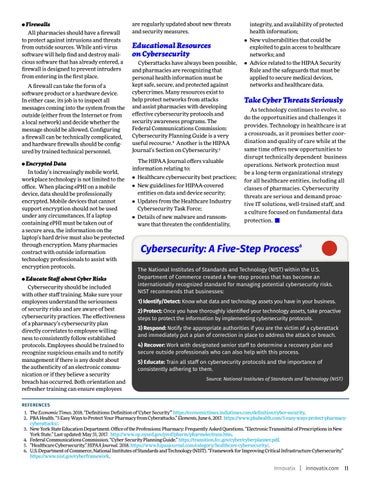
Cybersecurity: A Five-Step Process6 The National Institutes of Standards and Technology (NIST) within the U.S. Department of Commerce created a five-step process that has become an internationally recognized standard for managing potential cybersecurity risks. NIST recommends that businesses: 1) Identify/Detect: Know what data and technology assets you have in your business. 2) Protect: Once you have thoroughly identified your technology assets, take proactive steps to protect the information by implementing cybersecurity protocols. 3) Respond: Notify the appropriate authorities if you are the victim of a cyberattack and immediately put a plan of correction in place to address the attack or breach. 4) Recover: Work with designated senior staff to determine a recovery plan and secure outside professionals who can also help with this process. 5) Educate: Train all staff on cybersecurity protocols and the importance of consistently adhering to them. Source: National Institutes of Standards and Technology (NIST)
REFERENCES 1. The Economic Times. 2018. “Definitions: Definition of ‘Cyber Security’” https://economictimes.indiatimes.com/definition/cyber-security. 2. PBA Health. “5 Easy Ways to Protect Your Pharmacy from Cyberattacks.” Elements, June 6, 2017. https://www.pbahealth.com/5-easy-ways-protect-pharmacycyberattacks/. 3. New York State Education Department. Office of the Professions: Pharmacy: Frequently Asked Questions. “Electronic Transmittal of Prescriptions in New York State.” Last updated: May 31, 2017. http://www.op.nysed.gov/prof/pharm/pharmelectrans.htm. 4. Federal Communications Commission. “Cyber Security Planning Guide.” https://transition.fcc.gov/cyber/cyberplanner.pdf. 5. “Healthcare Cybersecurity.” HIPAA Journal. 2018. https://www.hipaajournal.com/category/healthcare-cybersecurity/. 6. U.S. Department of Commerce, National Institutes of Standards and Technology (NIST). “Framework for Improving Critical Infrastructure Cybersecurity.” https://www.nist.gov/cyberframework.
Innovatix | innovatix.com 11
Landmark Policy Win:
Home Infusion Services Billable Under Medicare Shara Siegel, MS, director, government affairs, Innovatix
O
n February 9, after a year of riding a legislative roller coaster, Innovatix and the infusion industry witnessed historic Congressional action on behalf of providers and Medicare beneficiaries. As of January 1, 2019, infusion providers will be able to bill – for the first time ever – for the essential home infusion services they provide to certain Medicare beneficiaries. Never before has the Medicare program reimbursed for home infusion services, making this a landmark piece of legislation that will surely lead to additional opportunities for infusion pharmacies and beneficiaries.
12 |
Insight
Congress passed the new home infusion
The Innovatix Government Affairs
become an eligible provider. Nonetheless,
law as part of the Bipartisan Budget Act of
team worked tirelessly to keep home
this new law is a major development
2018, addressing a damaging unintended,
infusion top of mind in Washington
for those providing infusion therapies.
consequence of a previous law, the 21st
and to help get this legislation across
Importantly, the law defines an eligible
Century Cures Act (Cures Act), which was
the finish line. We created the Innovatix
provider as “a supplier that is enrolled
signed into law during the holidays in
Campaign for Home Infusion Payment
under this part as a pharmacy that
2016. While this “21st Century Christmas
Relief, which encompassed more than 150
provides external infusion pumps and
Tree Act” was aptly dubbed, both for its
meetings on Capitol Hill with staff from
external infusion pump supplies and
timing and for the fact that it contained
key health policy committees, leadership,
that maintains all pharmacy licensure
attractive provisions for many different
and other key Congressional offices.
requirements in the State in which the
interests,1 it nobly paved the way for
We developed a membership survey to
applicable infusion drugs are admin-
new and important funding to accelerate
help Congress better assess the harmful
istered.” It will establish a payment for
scientific advancements and treatment
consequences of the law for providers
professional services, including nursing,
for patients in need. Unfortunately, albeit
and beneficiaries. We also sent in and
training and education (not otherwise
inadvertently, the Cures Act contained
signed on to numerous stakeholder
paid for as durable medical equipment),
two problematic provisions for the home
letters and placed multiple calls, both
and monitoring of home infusion therapy
infusion industry.
independently and with our members.
and related drugs furnished by a qual-
The Cures Act largely reduced
We appreciate our members and
payments for infusion drugs under the
partners joining in this effort to pass this
Medicare Part B durable medical equip-
legislation. Innovatix members across the
ment (DME) benefit from an average
country weighed in with their elected offi-
wholesale price (AWP) to an average
cials. Constituent outreach played a major
sales price (ASP) payment methodology
role in demonstrating the damaging impact
Furthermore, the fact that infusion
as of January 1, 2017. The law included
of the law on a local level. And, of course,
services have received recognition in
a long-sought-after policy to create a
this was an effort made possible with
Medicare Part B will serve as a gateway
Medicare payment for the professional
bicameral, tri-committee (House Ways &
for obtaining coverage for services in
services associated with home infusion
Means, House Energy & Commerce and
Medicare Part D. Some imminent chal-
therapy for Part B DME infusion drugs
Senate Finance) and bipartisan support.
lenges are to be expected in passing new
(which would not have started until
Both Republicans and Democrats recog-
infusion legislation. Congress only has a
January 1, 2021), resulting in a lengthy
nized that patient access issues related to
limited number of days left to meet and
and inappropriate four-year gap in
home infusion transcended party lines.
work in 2018, with holidays and midterm
2
Innovatix In Action
Congress has finally recognized the need to compensate providers for the valuable home infusion services they furnish beyond the ingredient cost of a drug.
elections coming up. The current
the implementation dates of the two policies.
ified home infusion therapy supplier.3
Opportunities for Home Infusion The transitional reimbursement for
Congress will adjourn at the end of 2018, and all unresolved legislation will need to be reintroduced starting in January, with the process starting anew.
The road to addressing this
home infusion clinical services delivered
dangerous “care gap” was neither
under Medicare Part B that became
short nor straightforward given the
Despite these challenges, Innovatix
law as part of the Bipartisan Budget
competing priorities of Congress and
and the industry have built solid
Act of 2018 addresses a dire gap in the
the Administration. Not unique to this
support for infusion in Congress.
reimbursement for clinical services due
Congress and Administration, though
Obtaining coverage for infusion
to the Cures Act. Providers now have
seemingly more precarious, Republicans
services under Medicare Part D
certainty and can better plan knowing
and Democrats have struggled to find
remains an exciting opportunity, and
that relief is on the way starting in 2019.
common ground on large, far-reaching
the industry is the closest it has ever
(A permanent reimbursement structure
policy issues, such as stabilizing the
been to achieving this policy goal. Part
is expected in 2021.)
D services legislation would greatly
Affordable Care Act health insurance marketplaces, tax reform, and immigration, to name a few. Even so, Innovatix pressed forward, demanding change for thousands of infusion providers and thousands of beneficiaries.
The Centers for Medicare & Medicaid Services (CMS) will now start working to implement the new law. To do this, the
change the scope of coverage for infusion providers and the vulnerable beneficiaries they serve.
agency will need to resolve issues, such as
Be sure to check out other Innovatix
billing specifications and requirements to
policy accomplishments that follow. Innovatix | innovatix.com 13
Other Major Innovatix Policy Successes POLICY ISSUE
BACKGROUND
PROVIDERS AFFECTED
INNOVATIX IN ACTION
OUTCOME
The United States Food and Drug Administration (FDA) Draft Guidance for Industry: Repackaging of Certain Human Drug Products by Pharmacies and Outsourcing Facilities
The FDA issued a draft guidance in 2015 that would have prevented long-term care pharmacies (LTCPs) from repackaging or prepacking pharmaceutical products without the receipt of a patient-specific prescription or chart order. If finalized, the guidance would have restricted LTCPs from stocking emergency kits and remote dispensing machines at nursing homes. It would also severely limit or eliminate prepackaging medications.
Pharmacists and longterm care providers
• Submitted comments to the FDA in 2015.
In January 2017, the FDA released final guidance that addressed our concerns and allows LTCPs to continue to stock emergency kits and remote dispensing machines and removes any prepackaging limits.
• The FDA selected Innovatix, among a small group of organizations, to participate in a listening session about the proposed guidance. • Expressed industry concerns on Capitol Hill.
Medicare Part D Lock-In
The Center for Medicare & Medicaid Services (CMS) Proposed Part B Drug Payment Model
Draft Memorandum of Understanding (MOU) Addressing Certain Distributions of Compounded Human Drug Products Between the State of [Insert State] and the U.S. Food and Drug Administration
Congress is intensely focused on the opioid crisis and is considering a number of proposals, including pharmacy lockin to curb substance abuse. Such a proposal could require Medicare Part D beneficiaries to use the same pharmacy for all prescriptions, which does not fit with the long-term care model where one long-term care facility contracts with one pharmacy.
Long-term care pharmacies and providers
In 2016, CMS proposed a new reimbursement model for all drugs that fall under Medicare Part B. The model was designed as a national demonstration to test how alternative incentive structures impact prescribing behavior with the aim of lowering pharmaceutical spending. However, the demonstration was far- reaching in terms of its timeframe and scope, and warranted additional consideration and input from the stakeholders impacted by the proposed rule.
All providers who bill under Medicare Part B
This is one of several draft documents that the FDA released in 2015 to bring increased scrutiny to those pharmacies crossing into manufacturing territory. While we support the intent to ensure patient safety, the guidance inappropriately proposed an arbitrary 30% cap on interstate compounded drugs and interchanged the terms “distribute” and “dispense.”
Infusion providers
• Weighed in with the House Energy & Commerce Committee. • Advocated on Capitol Hill for a long-term care exemption to pharmacy lockin proposals.
• Submitted comments to CMS that it should not move forward with this demonstration as proposed.
The House Energy & Commerce Committee in 2015 included legislative language, which was later enacted, that exempted Part D beneficiaries in skilled nursing facilities and long-term care settings from a proposed pharmacy lock-in provision. The Comprehensive Addiction and Recovery Act of 2016 was enacted into law with a provision exempting Medicare Part D beneficiaries in skilled nursing facilities and other LTC settings from the inappropriate pharmacy lock-in provision that is otherwise applied to Medicare Part D beneficiaries. In December 2016, CMS announced it would not move forward with the Medicare Part B Drug Payment Model.
• Expressed our concerns on Capitol Hill. • Submitted comments to the FDA in 2015. • Expressed our concerns on Capitol Hill.
The FDA’s 2018 Compounding Policy Priorities Plan indicated an intent to issue a revised draft Memorandum of Understanding to change the percentage of compounded drugs that could be shipped interstate by 503A compounders to 50%, which would be a notable improvement from the previously proposed 30%.
REFERENCES 1. U.S. Senate. n.d. “Reference: Glossary: ‘Christmas tree’ bill.” https://www.senate.gov/reference/glossary_term/christmas_tree_bill.htm. 2. U.S. Congress. “Legislation: 115th Congress: H.R.1892 - Bipartisan Budget Act of 2018. Sec. 50401. Home infusion therapy services temporary transitional payment.” February 9, 2018. https://www.congress.gov/bill/115th-congress/house-bill/1892/text?q=%7B%22search%22%3A%5B%22bipartisan+budget+act%22% 5D%7D&r=1#toc-HFDE57FDDC9714574BFEEF9BF935EF488. 3. U.S. Congress. “Legislation: 115th Congress: H.R.1892 - Bipartisan Budget Act of 2018. Sec. 50401. Home infusion therapy services temporary transitional payment.” February 9, 2018. https://www.congress.gov/bill/115th-congress/house-bill/1892/text?q=%7B%22search%22%3A%5B%22bipartisan+budget+act%22% 5D%7D&r=1#toc-HFDE57FDDC9714574BFEEF9BF935EF488.
14 |
Insight
QA
The Innovatix IVIG Calculator:
Q&A with Dr. Liya Davydov
Dr. Liya Davydov is senior director of clinical pharmacy services at Innovatix, where she focuses on the specialty/home infusion segments. Previously, she was a clinical pharmacy manager at Fidelis Care New York, a managed Medicaid HMO. Dr. Davydov earned both her Bachelor of Science in Pharmacy and Doctor of Pharmacy from St. John’s University. She also completed an ASHP-accredited pharmacy practice residency at Mount Sinai Medical Center in New York. She is board certified in pharmacotherapy and geriatrics.
In the following interview, Dr. Davydov answers some frequently asked questions about Innovatix’s new IVIG Calculator Tool.
1
What is the IVIG Calculator?
The IVIG Calculator is the latest addition to Innovatix’s suite of clinical resources. Members can use it to estimate their reimbursement for various intravenous immunoglobulin (IVIG) or subcutaneous immune globulin (SCIG) products from private and government payers.
2
Why was it developed?
As a group purchasing organization (GPO), Innovatix works to provide our members with effective and innovative solutions that drive savings and promote profitability. For our non-acute healthcare members, that means helping them successfully navigate reimbursement and other operational issues related to revenue. When several members administering IVIG had difficulties factoring payer reimbursement into their product decisions, we knew we needed to
develop a solution. Innovatix has always taken great pride in its ability to listen to members and respond to their needs. That’s exactly how the IVIG Calculator was born – from extensive conversations with members.
3
What are the benefits of using the calculator?
The calculator will help members: • Ensure that their patients receive the most cost-effective product and maintain continuity of treatment; • More easily determine the revenue impact of using one IVIG product over another before it’s purchased; and • Gain insight into product reimbursement to help avoid unnecessary revenue loss.
4
How does the tool work? What are some of its features and capabilities?
Users can select a product from a dropdown menu, plug in the number of grams
Do you have an Innovatix 24/7 account? Innovatix 24/7 is a web-based, self-service site, offering members access to view and download approved contract materials. It also provides documents that need to be signed, as well as a suggested list of contracts based on a facility’s specific purchasing history. Further, Innovatix 24/7 allows members to download specific reports, select email communication preferences, and access other Innovatix online tools such as the IVIG Calculator.
Follow these simple steps to set up your account: 1. Visit www.connect.innovatix. com/account/signin. 2. Click on Join under New to Innovatix 24/7. 3. Enter your email address. 4. Click send request. A pop-up message confirms the request was sent through successfully. 5. Look for an email with instructions on activating your account. Please remember to check junk or spam email folders if you do not see the activation email.
If you have any questions or need assistance, please contact your Innovatix representative at 888.258.3273 or email info@innovatix.com. Innovatix | innovatix.com 15
QA
needed for a patient infusion (even just one gram), and enter their own negotiated contract rate per J-code (which corresponds to the drug selected) from a specific private or government plan. The system will then generate two sets of results: an estimated reimbursement based on CMS (Medicare Part B) rates and a second based on the member’s own negotiated plan rate. Additionally, the calculator: • Is housed on our self-service website, which is available to members 24/7; • Can be accessed anywhere at any time via an internet-enabled device; • Includes Innovatix’s GPO contract pricing with FFF Enterprises, our designated IVIG distributor; • Supports data export to MS Excel; and • Is accompanied by complimentary training.
5
How often is pricing updated?
Innovatix’s GPO contract pricing with FFF Enterprises is updated monthly, and CMS Part B pricing is updated quarterly.
6
Who is the tool designed for? Who should be using it?
Any Innovatix member administering IVIG to patients may find it useful. Potential users include pharmacists and technicians, practice managers, nurse practitioners, office administrators, physician assistants, registered nurses, medical assistants, and reimbursement and billing staff.
7
Are any fees associated with the use of this tool?
8
What enhancements are planned?
The IVIG Calculator is part of our suite of clinical resources, which is available to members free of charge as value-added services.
Currently, users can only look up reimbursement info for one product at a time, with the capability to export that one drug’s data into Excel. We anticipate expanding capabilities soon to allow users to look up reimbursement info for several products at the same time, with the expanded option to export all information into Excel. This will make it even easier to compare reimbursement among products.
Additional Clinical Resources from Innovatix Innovatix is committed to ensuring that our members have the tools and resources they need to provide optimal patient care while operating successful businesses. Whether you manage a pharmacy, long-term care facility, or oncology practice, our in-house clinical experts have developed programs to ensure up-to-date clinical resources are always at your fingertips. All our clinical resources are available to members as free, value-added Innovatix services. In addition to our newly launched IVIG Calculator, our clinical resources include: • Access to our staff of eight in-house clinical experts, who have backgrounds in numerous pharmacy specialties. • CE credits (for pharmacists, pharmacy technicians, nurses, and LTC administrators) through monthly teleconferencing, in-person sessions at the Innovatix National Meeting, and written educational programs. • Care Solutions manuals that serve as management guides for specific diseases and conditions and highlight information to help members deliver high-quality care. • Contract Advantage tools that help members save by providing Innovatix-contracted alternatives to higher-priced, non-contracted drugs. • Current drug intelligence resources featuring new drug approvals and current FDA reviews, drug patent and exclusivity expirations, and pharmaceutical pricing trends. To learn more about the Innovatix IVIG Calculator or any of our clinical resources, please call us at 888.258.3273, email info@innovatix.com, or visit www.innovatix.com/ member-clinical-programs. 16 |
Insight
Continuing Education
Heart Failure:
A Guideline Directed Medical Therapy Approach to Diagnosis and Treatment Renee Hofman, MS, RPh, senior director, clinical pharmacy services, Innovatix
Innovatix | innovatix.com 17
CONTINUING EDUCATION
Heart Failure: A Guideline Directed Medical Therapy Approach to Diagnosis and Treatment This CE activity has been produced by the Innovatix Institute, an educational program offered by Innovatix, LLC (“Innovatix”). This activity is accredited for pharmacists and pharmacy technicians.
Goal Statement
The purpose of this activity is to provide participants with the knowledge necessary to understand the:
■■ Risk factors associated with heart failure; ■■ Importance of using guideline directed medical therapy (GDMT) for the treatment of heart failure; and
■■ Selection process to determine the best agent for patients based on this guidance.
Learning Objectives – Pharmacists
At the completion of this activity, the participant will be able to: 1. Summarize the prevalence, definition, and pathophysiology of heart failure (HF). 2. Describe the comorbidities associated with HF and the importance of treating them. 3. List the clinical assessment and testing necessary to support making a diagnosis of heart failure. 4. Describe the recommendations in the ACC/AHA guideline directed medical therapy for the treatment of HF.
Learning Objectives – Pharmacy technicians
At the completion of this activity, the participant will be able to: 1. Define heart failure. 2. Identify two oral medications used to treat heart failure. 3. List two injectable medications used to manage heart failure.
Target Audience This education is designed for pharmacists and technicians involved in the management of patients with heart failure and its comorbidities.
Type of activity Knowledge-based
Cost
This activity is free of charge.
Disclosures
This continuing education activity is managed and accredited by Innovatix. Ms. Hofman and Innovatix have no relevant or apparent financial interests or relationships to disclose. The material presented for this article has been reviewed by the Innovatix Institute CE Committee and has been found to be free of any content influenced or supported by industry. Commercial support was not received for this activity.
Pharmacy Accreditation
Innovatix, LLC is accredited by the Accreditation Council for Pharmacy Education as a provider of continuing pharmacy education. This activity has been approved for one contact hour for pharmacists and pharmacy technicians. Universal Activity Number: 0409-0000-18-005-H01-P (Pharmacists) and 0409-0000-18-005-H01-T (Technicians).
To receive CE credit, Pharmacists and Technicians must go to www.innovatix.com/evaluations. Click on Insight Magazine and scroll to find the title of this CE article. Complete the evaluation form. A score of 70 percent or higher is required to receive credit. Statements of Credit will be available from CPE Monitor within eight weeks of successful completion and submission of the online verification of Continuing Education and Program Evaluation forms and receipt of a passing score on the test. This lesson will not be valid for CE credit after April 1, 2020.
Legal Disclaimer The materials in this CE activity do not necessarily reflect the views of Innovatix or its affiliates. A qualified healthcare professional should be consulted before using any therapeutic product referenced as part of the program. Readers should verify all information and data before treating patients or employing any therapies described in the activity materials. As a condition to participating in this program, you acknowledge and agree that Innovatix is not providing any medical conclusions or advice, but is rather summarizing publicly available clinical information. The activity and corresponding materials may contain statements that may appear to be recommendations or advisory in nature, however, such statements are merely being recounted by Innovatix from the literature cited and do not constitute the recommendations or advice of Innovatix. Accordingly, Innovatix hereby disclaims all warranties, express or implied, as to the accuracy of any of the materials or information contained in the activity, or their fitness for any particular use or purpose. Clinical information and comments contained in the activity are for general guidance only. Mention of specific products in the activity or corresponding materials do not constitute an endorsement or advertisement. The activity provided is intended to provide you with information and is not intended to be used as a substitute for clinical or medical judgment. You agree that Innovatix shall not be responsible to you or any other third party for any clinical advice rendered by you, including advice related in any way to the activity. You agree to indemnify, defend, and hold Innovatix and its officers, directors, affiliates, employees, and agents (the “Innovatix Indemnitees”), harmless from and against any liability, costs, expenses, or damages, including attorneys’ fees and other costs of defense, incurred by any Innovatix Indemnitee in any action, proceeding, claim, or demand that is caused by, relates to, or arises out of your acts or omissions, or that in any way relate to your use of the information contained in the program or program materials. You agree that the activity and corresponding materials will be used for educational purposes only, and will not otherwise be copied or distributed without the prior written consent of Innovatix.
18 |
Insight
H
eart failure affects more than 5.7 million Americans, and some one million new cases are identified each year.1,3 At age 40, the risk of developing heart failure is one in five, and the prevalence for those 65 years or older is about 10 per 1000 individuals.3 The cost of heart failure is high, estimated at $30.7 billion annually in the United States alone. (This approximation includes healthcare services, medications, and missed days of work.)1,3 By the year 2030, the annual cost is expected to reach $69.7 billion, or approximately $244 for every adult in the country. That is a 127 percent increase from 2012.3 Related deaths also remain high, with one in nine deaths associated with heart failure. Almost half of those diagnosed with heart failure will die within five years.1,3 The hospitalization rate for heart failure is a concern; and patients with prior hospitalizations have a 50 percent chance of readmission within six months of discharge.4 The rate of these annual hospitalizations is highest for black men, followed by black women, white men, and white women.3 Defined, evidence-biased treatment and coordination of individualized care should help reduce both the incidence and cost of heart failure.6,8,9
Definition of Heart Failure Heart failure is a chronic, progressive condition in which the heart muscle is unable to pump enough blood through the heart to meet the body’s need for blood and oxygen. It usually results in an enlarged heart and can be caused by a structural or functional cardiac disorder.5,15 Figure 1: Normal Heart Vs. Heart Failure Heart5
CONTINUING EDUCATION resulting decreased filling occurs in diastolic dysfunction. These conditions are usually found together. (See Figure 2.)6 Figure 2: Types of Heart Failure6,8,9 CLASSIFICATION
EJECTION FRACTION
DESCRIPTION
1. Heart Failure with Reduced Ejection Fraction (HFrEF)
≤ 40 %
Also referred to as systolic HF. Randomized controlled trials have mainly enrolled patients with HFr EF, and it is only in these patients that efficacious therapies have been demonstrated to date.
2. Heart Failure with Preserved Ejection Fraction (HFpEF)
≥ 50%
Also referred to as diastolic HF. Several different criteria have been used to further define HFp EF. The diagnosis of HFp EF is challenging because it is largely one of excluding other potential noncardiac causes of symptoms suggestive of HF. To date, efficacious therapies have not been identified.
a. HFpEF, borderline
41% to 49%
These patients fall into a borderline or intermediate group. Their characteristics, treatment patterns, and outcomes appear like those of patients with HFpEF.
b. HFpEF, improved
>40
It has been recognized that a subset of patients with HFpEF previously had HFrEF. These patients with improvement or recovery in EF may be clinically distinct from those with persistently preserved or reduced EF. Further research is needed to better characterize these patients.
In patients hospitalized with heart failure, 53 percent had HF with reduced ejection fraction (HFrEF), and 47 percent had HF with preserved EF (HFpEF).3 Black men had the highest proportion of hospitalized HFrEF events (70 percent), while white women had the highest proportion of hospitalized HFpEF events (59 percent).3
Classifications and Stages The major symptoms of heart failure are related to fluid overload that causes dyspnea, orthopnea, and edema, with abdominal pain due to hepatic congestion and abnormal distention caused by ascites.2,6,16 There is also a reduction in cardiac output resulting in fatigue and weakness.2,6 Management of heart failure includes lifestyle modifications and medications, with the goal of improving symptoms and reducing mortality and morbidity.2,6
Types of Heart Failure Decreased cardiac contractility occurs in systolic dysfunction. Abnormal cardiac relaxation due to stiffness with
Heart failure can be classified using The American College of Cardiology Foundation (ACCF)/ American Heart Association (AHA) stages of heart failure to establish the development and progression of disease. This considers both risk factors for heart failure and symptoms of heart disease.6 There are four levels, and as the disease progresses from one level to the next, patients will not return to an earlier stage. The New York Heart Association (NYHA) functional classification focuses on symptoms and exercise capacity in Stages C Innovatix | innovatix.com 19
CONTINUING EDUCATION Figure 3: Comparison of ACCF/AHA and D patients. (See Appendix B.)6,7Stages of Heart Failure and NYHA Functional Classifications6, 7 ACC/AHA STAGES OF HEART FAILURE At high risk for A HF - without structural heart disease or symptoms Structural B heart disease - without signs of symptoms of heart failure Structural heart C disease with prior or cyrrent symptoms of heart failure
NYHA FUNCTIONAL CLASS None
i
i
ii
iii
iv
D
Refractory heart failure requiring specialized interventions
iv
No limitation of physical activity, Ordinary physical activity does not cause symptoms of heart failure No limitation of physical activity, Ordinary physical activity does not cause symptoms of heart failure Slight limitation of physical activity. Comfortable at rest, ordinary physical activity causes symptoms of heart failure Marked limitation of physical activity. Comfortable at rest, but less than ordinary activity causes symptoms of heart failure Unable to carry out any physical activity without symptoms of heart failure or symptoms of heart failure at rest Unable to carry out any physical activity without symptoms of heart failure or symptoms of heart failure at rest
Risk Factors Associated with Heart Failure There are many known risk factors associated with heart failure, so it is important to recognize and treat each to prevent structural heart disease and the onset of heart failure.2,6 (See Figure 4.) Figure 4: Risk Factors Associated with Heart Failure
DIABETES MELLITUS ANEMIA
CARDIOMYOPATHIES
ATRIAL FIBRILLATION
RISK FACTORS ASSOCIATED WITH HEART FAILURE
ATHEROSCLEROTIC DISEASE
HYPERTENSION
METABOLIC SYNDROME
1. Atrial Fibrillation (AF) – Patients with irregular heart rates (too fast, too slow, or irregular rhythms) are said to have 20 |
Insight
arrhythmias.18 Atrial Fibrillation (AF), the most common type of arrhythmia, occurs when the heart beats in a disorganized rapid pace, causing blood to pool in the atria. This can lead to stroke and/or HF.6 The goal of therapy is to prevent thromboembolic events and mitigate symptoms.6,18 Nondihydropyridine calcium antagonists, such as diltiazem, should be used with caution in those with depressed EF because of their negative inotropic effect (weakening the force of muscular contractions).6 2. Anemia – Patients with HF often have iron deficient anemia (ferritin < 100ng/mL or 100 to 300ng/mL if transferrin saturated is < 20 percent).9 Anemia occurs when the blood has a diminished number of red blood cells or reduced hemoglobin (required for carrying oxygen from the lungs to the rest of the body), contributing to weakness, fatigue, shortness of breath, dizziness, and headaches.19 It is important to correct this imbalance with intravenous iron supplements to improve exercise capacity and quality of life (QOL).6,9 The use of erythropoietin stimulating agents has not been useful in this situation.6,9 3. Hypertension (HTN) – Patients with increased diastolic pressure (when the heart is at rest between beats) and especially increased systolic pressure (when the heart beats while pumping blood) are at a much greater risk of developing HF.19 Advanced age, duration of hypertension, and higher levels of blood pressure increase the incidence of HF.6 Control of blood pressure can reduce the risk of HF by 50 percent. The target goal for blood pressure is about 130/80 mm/ Hg.6,9 4. Diabetes Mellitus – The inability to produce insulin, coupled with obesity, increases the risk of developing HF and negatively impacts the prognosis of those that have HF. Patients with NYHA class II through IV HF should avoid thiazolidinediones (e.g., rosiglitazone) as they are associated with fluid retention and can worsen the condition.6,13,14 5. Metabolic Syndrome – Metabolic syndrome is associated with an increased risk of developing HF. This condition includes at least three of the following: abdominal adiposity, hypertriglyceridemia, low high-density lipoprotein, hypertension, and high fasting blood sugar. It is imperative that patients with hypertension, diabetes mellitus (DM), and dyslipidemia receive treatment to reduce the incidence of HF. 6. Atherosclerotic Disease – The narrowing of the arteries due to plaque buildup reduces blood flow to the heart muscle.6 Vascular risk factors must be controlled to reduce the risk of HF.6 7. Cardiomyopathies – These diseases cause the heart muscle to become enlarged, thick, or ridged. As the disease progresses, the heart weakens.16 The condition can be acquired or inherited. While obesity, DM, hyperthyroidism, acromegaly, and growth hormone deficiency have been associated with the condition, the cause is often unknown.6 Toxins such as alcohol or cocaine, when abused, similarly contribute to this condition. It is associated with antineo-
CONTINUING EDUCATION plastic drugs, such as anthracyclines, and when these agents are used, they are given with dexrazoxane, an iron-chelating agent to decrease the risk of HF.6,13 8. Additional causes of heart failure include tachycardia, myocarditis and other inflammations of the cardiac muscle, iron overload, amyloidosis, sarcoidosis, and stress.6
Assessment Clinical assessment of HF begins with an in-depth history and physical exam.2,6 It is important to identify cardiac and noncardiac conditions and behaviors that might contribute to the development of HF. Family history can indicate if the condition is familial; volume status and vital signs should be noted.2,6 These factors will assist with staging and targeting appropriate treatment options. Important items to include in support of HF staging include history of alcohol or drug use, orthostatic blood pressure changes, weight and height, body mass calculation, depression screening and education, and obstructive sleep apnea screening.2,6 Signs and symptoms of HF (Figure 5) resulting from excess fluid include dyspnea, orthopnea, edema, abdominal pain due to hepatic congestion, and abdominal distention.2,6,10 Reduction in cardiac output may lead to fatigue and weakness. 2,6,10 Other positive findings associated with vital signs, blood pressure, and pulse are resting sinus tachycardia and narrow pulse pressure, as decreased cardiac output is suggested when pulse pressure is below 25 mmHg. 6 Appearance can also help in diagnosis; diaphoresis seen as cool, pale, and sometimes cyanotic extremities suggests poor perfusion and oxygenation.6 Additional findings include jugular venous distention, pulmonary congestion manifested by rales, displaced precordial impulse, and S3 gallop. Hepatomegaly, splenomegaly and scrotal edema as well as peripheral edema and pulsus alternations, manifested as weak and strong beats are also indicative of severe left ventricular failure.6 Figure 5: Symptoms of Heart Failure10 SYMPTOMS OF HEART FAILURE
The symptoms of heart failure include: • Shortness of breath • Chronic coughing or wheezing • Build-up of fluid (edema) • Fatigue or feeling lightheaded • Nausea or lack of appetite • Confusion or impaired thinking • High heart rate People who experience more than one should be evaluated. Initial testing to rule out other issues should include: • A12 lead-EKG; • Complete blood count (CBC) to check for anemia or infection;6 • Serum electrolytes with calcium and magnesium; • BUN, creatinine, and liver function tests (LFT) to identify electrolyte imbalance; liver and/or renal disease.6 • Lipid profile, fasting blood sugar (FBS), and thyroid stimu-
lating hormone (TSH) are also helpful.6 • B-type natriuretic peptide (BNP) or N-terminal pro-B-type natriuretic peptide (NT-proBNP) levels support a diagnosis of HF and establish prognosis.6,9 Hospital admission levels of BNP or NT-proBNP can assist with discharge prognosis. If the values diminish, patients are thought to have a better prognosis.9 BNP levels below100pg/mL are negative predictors for HF; most with HF have values above 400pg/ mL.9 (Note that severe renal impairment may interfere with interpretation of these values. )9 It is also important to remember that BNP is a substrate for neprilysin, so it can elevate BNP levels but not NT-pro BNP levels. Patients treated with sacubitril/valsartan (ARNI), a neprilysin inhibitor, should have NT-pro BNP levels followed instead of BNP levels.6,8,9 Also of note: beta-blocker initiation can precipitate a transient uptick in levels.9 • Troponin I or T in patients presenting with acutely decompensated HF; 6 • Chest X-ray to evaluate heart size, shape, and pulmonary congestion at lung base;6 and • Echocardiogram to establish left ventricular ejection fraction and exercise testing.6 Natriuretic peptide biomarker screening and early intervention may prevent HF. Treating comorbidities and coordination of care are essential to improve overall outcomes.
T E S T YO U R K N O W L E D G E Q U E ST I O N # 1:
What are the symptoms of HF?
Guideline Directed Medical Therapy Guideline directed medical therapy (GDMT) for HF is based on the 2013 ACC/AHA Guideline for the Management of Heart Failure and the 2016 and 2017 ACC/AHA focused updates, which combine lifestyle modifications and medications for best outcomes,6,8,9 and the ACC/AHA Stages of HF and NYHA Functional Classifications (Figure 3).6,7 The 2016 European Committee Guidelines for the Diagnosis and Treatment of Acute and Chronic Heart Failure is also a good source.11 Nonpharmacological interventions should be initiated and include: • Education to promote self-care; • Sodium restricted diet; and • Identification of sleep disorders with a formal sleep assessment (if NYHA class I-IV HF) to differentiate type of sleep apnea.6,9 In patients with CV disease and obstructive sleep apnea, continuous positive airway pressure (CPAP) may help with sleep quality and daytime sleepiness. In patients with NYHA class I-IV and central sleep apnea, adaptive servo-ventilaInnovatix | innovatix.com 21
CONTINUING EDUCATION tion causes harm.6,9 • Exercise and regular physical activity are recommended for those able to participate; cardiac rehabilitation is also useful to help stable patients improve functional status and mortality.6
T E S T YO U R K N O W L E D G E QUESTION #2:
What are the nonpharmacological interventions that should be initiated in all HF patients?
Patients with ACC/AHA Stage A/No NYHA Functional Classification deemed at high risk for HF (but without structural heart disease or HF symptoms), the recommendation is to treat risk factors and control hypertension and lipid disorders according to guidelines and control or avoid other risk factors such as obesity, DM, tobacco use, and known cardiotoxic agents.6 Patients with ACC/AHA Stage B / NYHA Functional Classification I with structural heart disease, but without signs or symptoms of HF and no limitation of physical activity (in whom ordinary physical activity does not cause HF symptoms), the recommendation for patients with recent or remote myocardial infarction (MI) or acute coronary syndrome (ACS) with HFrEF is to treat with an angiotensin converting enzyme (ACE) inhibitor or angiotensin receptor blocker (ARB) for those intolerant to ACE inhibitor due to cough or angioedema (see Appendix B). Taking an ACE or ARB will prevent symptomatic HF and reduce mortality.6 In addition beta blockers have been shown to reduce mortality, and statins prevent symptomatic HF and cardiovascular events.6 If the patient has structural cardiac abnormalities without MI or ACS, blood pressure control is also recommended to prevent symptomatic HF. All patients with HFrEF should receive an ACE inhibitor and a beta blocker.6 Use of an implantable cardioverter defibrillator (ICD) in patients with asymptomatic cardiomyopathy who are >40 days post MI with left ventricular ejection fraction (LVEF) < 30 percent is also recommended.6 Nondihydropyridine calcium channel blockers with negative inotropic effects (e.g., Verapamil or Diltiazem) may be harmful to those that are asymptomatic with low LVEF and no symptoms of HF or MI and should be avoided.6 Patients with ACC/AHA Stage C / NYHA Functional Classification I – IV should follow all recommendations for Stages A and B when appropriate (see Appendix A). Diuretics will improve symptoms (SOB/orthopnea) and quality of life for those patients with evidence of fluid retention, although 22 |
Insight
the effects on mortality are unknown.6,9 The loop diuretics are most commonly used, typically at high doses.6,9 Thiazides may be introduced or added to reach an euvolemic state. ACE inhibitors are indicated for all at this stage, or an ARB may be used if ACE inhibitor intolerant.6,9 Angiotensin receptor neprilysin inhibitors (ARNI) may be used in place of an ACE inhibitor or ARB in those with chronic symptomatic HFrEF NYHA class II or II to further reduce morbidity and mortality.8,9 ARNI therapy should not be used in those with a history of angioedema with previous ACE or ARB therapy and is contraindicated with concomitant ACE or ARB. A 36-hour washout period is required from the last dose of an ACE inhibitor before starting an ARNI.8,9 Beta blockers are recommended in all to reduce mortality but only bisoprolol, carvedilol, and metoprolol succinate sustained release have been studied.6,8,9
T E S T YO U R K N O W L E D G E Q U E ST I O N # 3 :
Which beta blockers are indicated for use in HF patients? Aldosterone receptor antagonists may be needed for those with NYHA II-IV HF and a LVEF of 35 percent or less to reduce mortality and morbidity in patients receiving optimal therapy with an ACE inhibitor and a beta blocker.6,8,9 Aldosterone receptor antagonists may also be added following an MI in those with LVEF ≤ 40 percent with symptoms of HF or DM.6,8,9 If used inappropriately, aldosterone receptor antagonists may be harmful due to hyperkalemia or renal insufficiency.6,9 When used in those with renal insufficiency, they increase the potential for hyperkalemia, thus monitoring of potassium levels, renal function, and diuretic dose is essential. Use is not recommended in those with baseline serum potassium > 5.0mEq/L. Start at a low dose and increase slowly if indicated.8,9 When used with ACE inhibitors, the risk of hyperkalemia increases, and if potassium supplements are used, they should be discontinued or reduced.6
T E S T YO U R K N O W L E D G E Q U E ST I O N # 4:
What is the recommended washout period in patients on an ACE inhibitor who are prescribed the fixed combination sacubitril and valsartan?
CONTINUING EDUCATION An ARB may be added if the patient remains symptomatic on an ACE inhibitor and beta blocker. If an aldosterone receptor antagonist is not indicated, the combination of an ARB, ACE and aldosterone receptor antagonist can be harmful.6,8,9 Hydralazine and isosorbide dinitrate are used in combination in African Americans with NYHA II-IV and HFrFF already receiving GDMT with an ACE inhibitor and beta blocker.6,9 It may also be useful in combination in those who cannot tolerate ACE or ARB.6,9 Anticoagulants are used in chronic HF patients with permanent, persistent, paroxysmal atrial fibrillation and any risk for cardioembolic stroke. They are not recommended in patients with:
Device Therapy for Management of Heart Failure Sudden cardiac death (SCD) is a risk for those with HFrEF and systolic dysfunction due to ventricular tachyarrhythmias. An implantable cardioverter defibrillator (ICD) can be considered in patients receiving GDMT for at least three to six months. Expected survival with good functional status is at least one year.6 Repeated use of these devices can reduce health-related quality of life (HRQOL) leading to post-traumatic stress syndrome.6 Cardiac resynchronization therapy (CRT) can improve ventricular function due to increased QRS interval by: • Improving ventricular contractile function; • Diminishing secondary mitral regurgitation; and • Reversing ventricular remodeling.6
• HF (HFrEF) without AF; • A prior thromboembolic event; and • A cardoembolic source. The selection of anticoagulant should be individualized and based on risk, cost, tolerability, drug interactions, and personal preference.
As with ICD use, GDMT and diuretics to control fluid are essential.6 An ICD is recommended for primary prevention of sudden cardiac death (SCD) for some patients with HFrEF that are > 40 days post-MI who are receiving GDMT with: • LVEF < 35 percent; NYHA class II or III with greater than one-year life expectancy; or
The I(f ) channel inhibitor, ivabradine, may benefit those hospitalized with symptomatic (NYHA class II-III) stable chronic HFrEF (LVEF < 35 percent) who are: • Receiving GDMT with a beta blocker at maximum tolerated dose; and • In sinus rhythm with a heart rate of > 70bpm at rest.9 Digoxin may be of benefit to decrease hospitalizations and improve symptoms in some.6,9 Omega -3 fatty acids have also been cited for use in both HFrEF and HFpEF to reduce mortality and cardiovascular events. Statins are of no benefit if exclusively HF, nor are hormonal therapies.6,9 For patients that present with HFpEF, the pathway is not as clear. Control of hypertension using beta blockers, ACE inhibitors, or ARB – as well as use of diuretics to alleviate symptoms and manage fluid overload are the first line of defense.6,9 Coronary revascularizations may be done in patients with coronary artery disease (CAD) and angina symptoms (e.g., chest pain and shortness of breath) or with myocardial ischemia causing characteristic HFrEF and management of atrial fibrillation (AF).6,9 Aldosterone receptor antagonists can be considered in some patients with EF ≥ 45 percent, elevated BNP levels HF hospital admission within the year, and glomerular filtration rate > 30 mL/min. ARB may be used to decrease hospitalizations.6,9 Nitrates, unless HF was accompanied by symptomatic CAD, did not improve quality of life or activity.6,9 Use of phosphodiesterase-5 inhibitors (e.g., sildenafil, vardenafil) did not improve quality of life or activity either, and nutritional supplements were shown to be of no benefit.6,9
• LVEF < 30 percent, NYHA class I with greater than one year life expectancy.6 ICD placement may not prolong survival in an unstable patient, those with frequent hospitalization, or frailty and comorbidities such as renal issues or malignancies.6 Cardiac resynchronization therapy (CRT) is indicated in those who are receiving GDMT with: • LVEF < 35 percent; • Sinus rhythm; • Left bundle branch block (LBBB) with a QRS duration of >150 ms and NYHA class II or III or ambulatory class IV6
CRT may be used in those who are receiving GDMT with: • LVEF < 35 percent; • Sinus rhythm; • Non-left bundle branch block with QRS duration >150 ms and NYHA class III/ambulatory class IV 6
or • LVEF < 35 percent; • Sinus rhythm; • Left bundle branch block with a QRS duration 120-149 ms; and NYHA class II or class III or ambulatory class I6 or • Patients with AF and LVEF < 35 percent; • Needing ventricular pacing; and • Atrioventricular nodal ablation or medication for rate control to provide ventricular pacing.6 or
Innovatix | innovatix.com 23
CONTINUING EDUCATION • LVEF < 35 percent; • Needing ventricular pacing when a device is to be replaced or implanted. CTR may be considered in those who are receiving GDMT with: • LVEF < 35 percent; • Sinus rhythm; • Non-left bundle branch block • With a QRS duration 120-149 ms and NYHA class III or ambulatory class IV; or • With a QRS duration >150 ms and NYHA class II.6 or • LVEF < 30 percent; • Ischemic HF; • Sinus rhythm; and • LBBB with QRS duration >150 ms and NYHA class I.6
CRT is not for patients with: • NYHA class I or II and non-left bundle branch block with QRS duration <150 ms and • NYHA class I or II or patients that do not have at least one-year survival expectation.6
ACC/AHA Stage D/NYHA Functional Classification IV - Refractory HF requiring specialized interventions/ unable to carry out any physical activity without HF symptoms or HF symptoms at rest must be assessed and stabilized using GDMT. Clinicians should rule out all other causes that may contribute to the refectory HF before proceeding. Things to consider are pulmonary disorders, weight loss etiology, thyroid function, and medication/diet adherence.6 Treatment is initiated to control symptoms while improving quality of life, reducing hospital admissions, and establishing end-of-life goals.6 Intravenous inotropic support with adrenergic agonists (dopamine or dobutamine) or PDE inhibitors (milrinone) to maintain organ perfusion and prevent end-organ damage until eventual treatment is defined is recommended (see Appendix C).6 For some with GDMT, cardiac transplant, device use, and surgical management may be warranted.6 Also recommended is: • Fluid restriction to reduce congestion; and • Intravenous inotropic support to maintain organ perfusion and prevent end-organ damage as bridge therapy in those that may receive mechanical circulatory support (MCS) or cardiac transplant.6 Mechanical Circulatory Support (MCS) may be helpful in some with HFrEF awaiting transplant or whose recovery is anticipated. Nondurable MCS many be helpful as bridge therapy in those with HFrEF with acute, profound hemodynamic compromise to prolong survival.6 24 |
Insight
Intravenous inotropic support may be used short-term to support and maintain organ perfusion and prevent end-organ damage in hospitalized patients with severe systolic dysfunction, low blood pressure, and low cardiac output. They are used as long-term support to maintain organ perfusion and prevent end-organ damage in palliative care patients receiving GDMT not eligible to receive mechanical circulatory support (MCS) or cardiac transplant.6 Intravenous inotropic use long-term (other than in palliative care) without defined indications as seen with severe systolic dysfunction, low blood pressure or diminished perfusion and evidence of significantly depressed cardiac output is not recommended and may cause harm.6
Summary Heart failure is a complex syndrome that can be challenging to diagnosis and treat. Patients often have multiple comorbidities, which demand: • The use of GDMT; • A team-based approach to manage care; • The creation of care plan goals and objectives; • The removal of clinical and other barriers to success; and • Appropriate education for patients and caregivers.
CONTINUING EDUCATION
Appendices Appendix A: Oral Diuretics Recommended for Use in the Treatment of Chronic HF 22-35 DRUG/STRENGTH(S)/ MANUFACTURER(S)
INITIAL DOSE & TITRATION IN ADULTS
INITIAL DOSE & TITRATION IN ELDERLY
MAXIMUM DAILY DOSE IN ADULTS/ ELDERLY
DURATION OF ACTION
POSSIBLE ADVERSE REACTIONS
COMMENTS
LOOP DIURETICS-(ORAL DOSE EQUIVALENCE (APPROXIMATE) -FUROSEMIDE 40 MG = BUMETANIDE 1 MG = TORSEMIDE 20 MG) Mechanism of Action: Inhibit the reabsorption of sodium or chloride in the loop of Henle in the renal tubes Bumetanide
0.5 to 1 mg once or twice daily
0.5 to 1 mg once or twice daily
Furosemide
20 to 40 mg once or twice daily
Torsemide
10 to 20 mg once daily
0.5mg tablet 1mg tablet 2mg tablet 0.25mg/ml injection Various manufacturers (Bumex®)
20mg tablets 40mg tablets 80mg tablets 8mg/ml oral solution 10mg/ml oral solution 10mg/ml injection Various manufacturers (LASIX®)
5mg tablet 10mg tablet 20mg tablet 100mg tablet 20mg/ml injection 50mg/5ml injection Various manufacturers (Demadex® -Roche)
10 mg
4 to 6 hours
Electrolyte and fluid depletion-may need Potassium supplementation -contraindication in patients with a prior allergic reaction to sulfonamides
Renal impairmentcontraindicated in those with low urine output/Use with caution Hepatic impairmentcontraindicated in hepatic coma/Use with caution in cirrhosis/ascites due to increased risk of precipitating hepatic coma; initiate with conservative doses and monitoring -Useful in those that high dosed of furosamide are ineffective
20 mg/day 600mg increase slowly to desired response
6 to 8 hours
Electrolyte and fluid depletion-may need Potassium supplementation -contraindication in patients with a prior allergic reaction to sulfonamides
Renal impairment -avoid if low urine output Hepatic impairmentDiminished natriuretic effect with increased sensitivity to hypokalemia and volume depletion in cirrhosis
10 to 20 mg once daily
12 to 16 hours
Electrolyte and fluid depletion-may need Potassium supplementation -contraindication in patients with a prior allergic reaction to sulfonamides
Renal impairment no dosage adjustments provided in the manufacturer’s labeling Hepatic impairmentn -no dosage adjustments provided in the manufacturer’s labeling
200mg
THIAZIDE DIURETICS Mechanism of Action: Inhibit the reabsorption of sodium or chloride at the distal portion of the renal tubes Chlorothiazide
250 to 500 mg once or twice daily
Use with caution
1,000mg
6 to 12 hours
Electrolyte disturbances/ Photosensitivity/ contraindication in patients with a prior allergic reaction to sulfonamides
Chlorthalidone
12.5 to 25 mg once daily
Use with caution
100mg
24 to 72 hours
Electrolyte disturbances/ Photosensitivity/ contraindication in patients with a prior allergic reaction to sulfonamides
250mg tablet 500mg tablet 250 mg/5 mL oral suspension 500 mg injection Various manufacturers (Diuril®)
25mg tablets 50mg tablets Various manufacturers
Renal impairment-CrCl <10 mL/minute: Avoid use. Ineffective with CrCl <30 mL/minute unless in combination with a loop diuretic Hepatic impairment -No dosage adjustments provided in manufacturer’s labeling; use with caution Renal impairmentThere are no dosage adjustments provided in the manufacturer's labeling -CrCl ≥10 mL/minute: No dosage adjustment necessary. CrCl <10 mL/minute: Avoid use. Ineffective with low GFR Hepatic impairment -There are no dosage adjustments provided in the manufacturer's labeling
Innovatix | innovatix.com 25
CONTINUING EDUCATION DRUG/STRENGTH(S)/ MANUFACTURER(S)
INITIAL INITIAL DOSE MAXIMUM DURATION DOSE & & TITRATION DAILY DOSE OF ACTION TITRATION IN ELDERLY IN ADULTS/ IN ADULTS ELDERLY 200mg 6 to 12 Hydrochlorothiazide 25 mg once Initial: 12.5 mg once daily; titrate hours 12.5 mg capsule/tablet or twice daily in increments of 25 mg tablet 12.5 mg 50 mg tablet Various manufacturers (Microzide®)
POSSIBLE ADVERSE REACTIONS Electrolyte disturbances/ Photosensitivity/ contraindication in patients with a prior allergic reaction to sulfonamides
Indapamide
2.5 mg once daily
Use with caution
5 mg
36 hours
Electrolyte disturbances/ Photosensitivity/ contraindication in patients with a prior allergic reaction to sulfonamides
Metolazone
2.5 mg once daily
Use with caution
20mg
12 to 24 hours
Electrolyte disturbances/ Photosensitivity/ contraindication in patients with a prior allergic reaction to sulfonamides
1.25mg tablets 2.5mg tablets Various manufacturers
2.5mg tablets 5mg tablets 10mg tablets Various manufacturers (Zaroxolyn®)
COMMENTS
Renal impairment -no dosage adjustments provided in the manufacturer's labeling -Usually ineffective with CrCl <30 mL/minute unless in combination with a loop diuretic.CrCl <10 mL/minute: Use not recommended. Hepatic impairment-no dosage adjustments provided in the manufacturer's labeling Renal impairment -There are no dosage adjustments provided in the manufacturer's labeling GFR <10 mL/minute: 1.25 to 2.5 mg once daily Hepatic impairmentno dosage adjustments provided in manufacturer’s labeling Renal impairment-no dosage adjustments provided in the manufacturer’s labeling -use with caution in those with renal impairment as renally excreted Hepatic impairment-no dosage adjustments provided in the manufacturer’s labeling
POTASSIUM-SPARING DIURETICS* pyrazine-carbonyl-guanidine Mechanism of Action: inhibition of sodium reabsorption at the distal convoluted tubule, cortical collecting tubule and collecting duct; this decreases the net negative potential of the tubular lumen and reduces both potassium and hydrogen secretion and their subsequent excretion. 5 mg once Use lower 20mg 24 hours Electrolyte Renal impairment-caution Amiloride 5mg tablet Various manufacturers
daily
dose-decreased clearance : use with caution
disturbancesHyperkalemia
in those with DM or SCr >1.5 mg/dL, or BUN >30 mg/dL Hepatic impairment -no dosage adjustments provided in the manufacturer’s labeling **Administered with food
ALDOSTERONE ANTAGONIST Mechanism of Action: Competes with aldosterone for receptor sites in the distal renal tubules, increasing sodium chloride and water excretion while conserving potassium and hydrogen ions; may block the effect of aldosterone on arteriolar smooth muscle as well 12.5 to 25 Avoid use of 50mg ** 1 to 3 hours Electrolyte Renal impairmentSpironolactone
25mg tablet 50 mg tablet 100mg tablet Various manufacturers (Aldactone®)
26 |
Insight
mg once daily
tablets >25 mg/ day in elderly patients with heart failure or with reduced renal function (eg, CrCl <30 mL/minute or eGFR ≤30 mL/ minute/1.73 m2.
disturbancesHyperkalemia Gynecomastia
contraindicated in those with low urine output/Use with caution in those with renal impairment - eGFR 30 to 50 mL/minute/1.73 m2: Initial: 10 mg once daily. eGFR <30 mL/minute/1.73 m2: There are no specific dosage adjustments provided in the manufacturer's labeling./ Hepatic impairment-no dosage adjustments provided in the manufacturer's labeling
CONTINUING EDUCATION DRUG/STRENGTH(S)/ MANUFACTURER(S)
Triamterene
50mg capsule 100mg capsule Various manufacturers (Dyrenium®)
INITIAL INITIAL DOSE DOSE & & TITRATION TITRATION IN ELDERLY IN ADULTS 50 to 75 mg Use with caution twice daily
MAXIMUM DURATION POSSIBLE ADVERSE DAILY DOSE OF ACTION REACTIONS IN ADULTS/ ELDERLY 200mg 7 to 9 hours Electrolyte disturbancesHyperkalemia
COMMENTS
Renal impairment no dosage adjustments provided in the manufacturer's labeling Hepatic impairment-no dosage adjustments provided in the manufacturer's labeling
SEQUENTIAL NEPHRON BLOCKADE Mechanism of Action: Competes with aldosterone for receptor sites in the distal renal tubules, increasing sodium chloride and water excretion while conserving potassium and hydrogen ions; may block the effect of aldosterone on arteriolar smooth muscle as well 2.5 to 10 mg Use with caution n/a > 24 hours Electrolyte disturbances Renal impairment - use Metolazone 2.5mg tablet 5mg tablet 10mg tablet Various manufacturers (Zaroxolyn®)
once daily plus loop diuretic
Hydrochlorothiazide 25 to 100
Use with caution
12.5mg tablet/capsule 25mg tablet 50mg tablet Various manufacturers (Microzide®)
mg once or twice daily plus loop diuretic
Chlorothiazide (IV)
500 to 1,000 Use with caution mg once plus loop diuretic
500mg Various manufacturers (Sodium Diuril®)
50mg
6 to 12 hours
n/a
n/a
-hypokalemia
caution in those with renal impairment Hepatic impairment- caution in patients with severe hepatic dysfunction
Electrolyte and fluid depletion-may need Potassium supplementation -contraindication in patients with a prior allergic reaction to sulfonamides Electrolyte and fluid depletion-may need Potassium supplementation -contraindication in patients with a prior allergic reaction to sulfonamides
Renal impairment -Creatinine clearance less than 10 mL/minute-not reccomended Hepatic impairment-no dosage adjustments provided in the manufacturer's labeling Each vial is for single dose only/ given slowly by direct intravenous injection or by intravenous infusion compatible with dextrose or sodium chloride solutions
*Eplerenone, although also a diuretic, is primarily used in chronic HF. **Higher doses may occasionally be used with close monitoring. HF indicates heart failure; IV, intravenous; and N/A, not applicable.
Appendix B: Drugs Commonly Used for Stage C HFrEF36-57 DRUG/ INITIAL STRENGTH(S)/ DOSE & MANUFACTURER(S) TITRATION IN ADULTS
INITIAL DOSE & TITRATION IN ELDERLY
MAXIMUM DAILY DOSE IN ADULTS/ ELDERLY
DURATION OF ACTION
POSSIBLE ADVERSE REACTIONS
COMMENTS
ACE INHIBITORS- **DO NOT USE WITHIN 36 HOURS OF SWITCHING TO OR FROM SACUBITRIL/VALSARTAN, A NEPRILYSIN INHIBITOR Mechanism of Action: suppression of the renin-angiotensin-aldosterone system by preventing the conversion of angiotensin I to angiotensin II 6.25 mg 3 Use 50 mg 3 times dose Angioedema involving Renal impairment- lower starting Captopril 12.5mg tablet 25mg tablet 50mg tablet 100mg tablet Various manufacturers
times daily
Enalapril
Fosinopril
2.5mg tablet 5mg tablet 10mg tablet 20mg tablet Various manufacturers (Vasotec®)
10mg tablet 20mg tablet 40mg tablet Various manufacturers
caution-start daily low and titrate
related
the extremities, face, lips, mucous membranes, tongue, glottis or larynx. -Hyperkalemia -Cough
dose and titrate slowly Hepatic impairment-no dosage adjustments provided in the manufacturer's labeling **Administer at least 1 hour before meals
2.5 mg twice Use 10 to 20 mg Daily caution-start twice daily low and titrate
12 to 24 hours
Angioedema involving the extremities, face, lips, mucous membranes, tongue, glottis or larynx. -Hyperkalemia -Cough
5 to 10 mg once daily
24 hours
Angioedema involving the extremities, face, lips, mucous membranes, tongue, glottis or larynx. -Hyperkalemia -Cough
Renal impairment- HF patients with serum creatinine >1.6 mg/ dL - 2.5 mg once daily initially, increasing to twice daily as needed. Increase further in increments of 2.5 mg/dose at ≥4day intervals to a maximum dose of 40 mg/day Hepatic impairment-no dosage adjustments provided in the manufacturer's labeling Renal impairment-reduced renal function may be more sensitive to the hemodynamic effects Hepatic impairment-no dosage adjustments provided in the manufacturer's labeling
Use 40 mg once caution-start daily low and titrate
Innovatix | innovatix.com 27
CONTINUING EDUCATION DRUG/ INITIAL STRENGTH(S)/ DOSE & MANUFACTURER(S) TITRATION IN ADULTS 2.5 to 5 mg Lisinopril once daily 2.5mg tablet 5mg tablet 10mg tablet 20mg tablet 30mg tablet 40mg tablet Various manufacturers (Prinivil®/ Zestril®)
INITIAL MAXIMUM DOSE & DAILY DOSE TITRATION IN ADULTS/ IN ELDERLY ELDERLY Use 20 to 40 mg caution-start once daily low and titrate
Perindopril
2 mg once daily
Use caution- 8 to 16 mg start low and once daily titrate
Quinapril
5 mg twice Use daily cautionstart low and titrate
Ramipril
1.25 to 2.5 mg once daily
Trandolapril
1 mg once daily
2mg tablet 4mg tablet 8mg tablet Various manufacturers (Aceon®)
25mg tablet 10mg tablet 20mg tablet 40mg tablet Various manufacturers (Accupril®)
1.25mg tablet 2.5mg tablet 5mg tablet 10mg tablet Various manufacturers (Altace®) 1mg tablet 2mg tablet 4mg tablet Various manufacturers (Mavik®)
DURATION OF ACTION
POSSIBLE ADVERSE REACTIONS
24 hours
Angioedema involving the extremities, face, lips, mucous membranes, tongue, glottis or larynx. -Hyperkalemia -Cough
3 to 10 hours
Angioedema involving the extremities, face, lips, mucous membranes, tongue, glottis or larynx. -Hyperkalemia -Cough
20 mg twice daily
24 hours
Angioedema involving the extremities, face, lips, mucous membranes, tongue, glottis or larynx. -Hyperkalemia -Cough
Use cautionstart low and titrate
10 mg once daily
24 hours
Use cautionstart low and titrate
4 mg once daily
22.5 hours Angioedema involving
COMMENTS
Renal impairmentCreatinine clearance 10 to 30 mL/ minute 2.5 mg once daily initially; 40 mg/ day maximum Creatinine clearance less than 10 mL/minute 2.5 mg once daily initially; 40 mg/day maximum Hepatic impairment-no dosage adjustments provided in the manufacturer's labeling Renal impairment-CrCl >30 mL/minute 2 mg/day initially; maximum maintenance dose: 8 mg/day. CrCl <30 mL/minute Use is not recommended Hepatic impairment-no dosage adjustments provided in the manufacturer's labeling
Renal impairment-CrCl greater than 30 mL/minute - 5 mg once daily initially. If initial dose is tolerated, increase to twice-daily administration the following day and then adjust dose at weekly intervals to optimal response. CrCl 10 to 30 mL/minute-2.5 mg once daily initially. If initial dose is tolerated, increase to twice-daily administration the following day and then adjust dose at weekly intervals to optimal response. CrCl less than 10 mL/minute-no information Hepatic impairment-no dosage adjustments provided in the manufacturer's labeling Angioedema involving Renal impairment-CrCl <40 the extremities, face, lips, mL/minute: Administer 25% of normal dose mucous membranes, tongue, glottis or larynx. Hepatic impairment-may develop markedly elevated -Hyperkalemia plasma levels as primarly -Cough hepatic metabolism the extremities, face, lips, mucous membranes, tongue, glottis or larynx. -Hyperkalemia -Cough
Renal impairment-CrCl <30 mL/minute: Initial: 0.5 mg once daily; titrate as tolerated to optimal response Hepatic impairment-consider lower doses in patients with hepatic impairment.
ARBS Mechanism of Action: angiotensin II receptor blocker-blocks the vasoconstrictor and aldosterone-secreting effects of angiotensin II by selectively blocking the binding of angiotensin II to the AT1 receptor in many tissues, such as vascular smooth muscle and the adrenal gland. 4 to 8 mg No initial 32 mg once >24 hours Angioedema Renal impairment-monitor renal Candesartan 4mg tablet 8mg tablet 16mg tablet 32mg tablet Various manufacturers (Atacand®)
28 |
Insight
once daily
dosage adjustment needed
daily
Hyperkalemia Monitor renal function Do not co-administer with aliskiren in patients with diabetes-increased risks of hypotension, hyperkalemia, and changes in renal function. Do not use in pregnancy - causes fetal toxicity.
function-if significant decrease consider discontinuing Hepatic impairment-may need to decrease dose
CONTINUING EDUCATION DRUG/ INITIAL STRENGTH(S)/ DOSE & MANUFACTURER(S) TITRATION IN ADULTS 25 to 50 mg Losartan once daily 25mg tablet 50mg tablet 100mg tablet Various manufacturers (Cozaar®)
INITIAL MAXIMUM DOSE & DAILY DOSE TITRATION IN ADULTS/ IN ELDERLY ELDERLY No initial 50 to 150 mg dosage once daily adjustment needed
DURATION OF ACTION
Valsartan
No initial dosage adjustment needed
24 hours
40mg tablet 80mg tablet 160mg tablet 320mg tablet Various manufacturers (Diovan®)
20 to 40 mg twice daily
160 mg twice daily
POSSIBLE ADVERSE REACTIONS Angioedema Hyperkalemia Monitor renal function Do not co-administer with aliskiren in patients with diabetes-increased risks of hypotension, hyperkalemia, and changes in renal function Angioedema Hyperkalemia Monitor renal function Do not co-administer with aliskiren in patients with diabetes-increased risks of hypotension, hyperkalemia, and changes in renal function
COMMENTS
Renal impairment-No dosage adjustment necessary unless the patient is volume depleted; monitor closely Hepatic impairment-start at lower dose
Renal impairment-no dosage adjustments provided in the manufacturer's labeling Hepatic impairment-no dosage adjustments provided in the manufacturer's labeling
ARNI- ***DO NOT ADMINISTER WITHIN 36 HOURS OF SWITCHING FROM OR TO AN ACE INHIBITOR Mechanism of Action: neprilysin inhibitor, sacubitril-causing increased levels of peptides that are degraded by neprilysin, such as natriuretic peptides/ angiotensin receptor blocker, valsartan-that simultaneous causes inhibition of the effects of angiotensin II 49/51 mg No initial 97/103 mg Angioedema Renal impairment-Use with Sacubitril/ twice daily dosage twice daily caution in preexisting renal Valsartan Hyperkalemia 24-26mg 49-51mg 97-103mg (Entresto®)
(sacubitril/ valsartan) (therapy may be initiated at 24/26 mg BID)
adjustment needed
(sacubitril/ valsartan)
Monitor renal function Do not co-administer with aliskiren in patients with diabetes-increased risks of hypotension, hyperkalemia, and changes in renal function
insufficiency; reduce initial dosage for severe impairment (eGFR <30 mL/minute/1.73 m2) Hepatic impairment-Moderate impairment-start at Sacubitril 24 mg/valsartan 26 mg twice daily/Severe impairment-not recommended Do not use in pregnancy - causes fetal toxicity
IƒCHANNEL INHIBITOR Mechanisms of Action: blocks the hyperpolarization-activated cyclic nucleotide-gated (HCN) channel responsible for the cardiac pacemaker If current, which regulates heart rate 5mg twice No initial 7.5mg twice 24 hours bradycardia Renal impairment- no dosage Ivabradine 5mg tablet 7. 5mg tablet (Corlanor®)
daily
dosage adjustment needed
daily
hypertension atrial fibrillation luminous phenomena (phosphenes)
adjustments provided in the manufacturer's labeling Hepatic impairmentcontraindicated in patients with severe hepatic impairment
ALDOSTERONE ANTAGONISTS Mechanisms of Action: Competes with aldosterone for receptor sites in the distal renal tubules, increasing sodium chloride and water excretion while conserving potassium and hydrogen ions; may block the effect of aldosterone on arteriolar smooth muscle as well 12.5 to 25 Avoid use 25 mg daily or 1 to 3 Electrolyte Renal impairment-contraindicated Spironolactone 25mg tablet 50 mg tablet 100mg tablet Various manufacturers (Aldactone®)
mg once daily
twice daily of tablets >25 mg/day in elderly patients with heart failure or with reduced renal function (eg, CrCl <30 mL/minute or eGFR ≤30 mL/ minute/1.73 m2
hours
disturbancesHyperkalemia Gynecomastia
in those with low urine output/ Use with caution in those with renal impairment - eGFR 30 to 50 mL/minute/1.73 m2: Initial: 10 mg once daily. eGFR <30 mL/minute/1.73 m2: There are no specific dosage adjustments provided in the manufacturer's labeling./ Hepatic impairment-no dosage adjustments provided in the manufacturer's labeling
Innovatix | innovatix.com 29
CONTINUING EDUCATION DRUG/ INITIAL STRENGTH(S)/ DOSE & MANUFACTURER(S) TITRATION IN ADULTS
INITIAL DOSE & TITRATION IN ELDERLY
MAXIMUM DAILY DOSE IN ADULTS/ ELDERLY
DURATION OF ACTION
POSSIBLE ADVERSE REACTIONS
COMMENTS
Mechanisms of Action: binds to the mineralocorticoid receptor and blocks the binding of aldosterone Eplerenone
25mg tablet 50 mg tablet Various manufacturers (Inspra®)
25mg daily
No initial dosage adjustment needed
50mg daily
n/a
Hyperkalemia Avoid concomitant administration of strong CYP3A inhibitors (e.g., ketoconazole, itraconazole, nefazodone, troleandomycin, clarithromycin, ritonavir, and nelfinavir)
Renal impairment-creatinine clearance ≤30 mL/min -contraindicated Hepatic impairment - no dosage adjustment provided by manufacturer.
BETA BLOCKERS Mechanisms of Action: beta1-selective (cardioselective) adrenoceptor blocking agent without significant membrane stabilizing activity or intrinsic sympathomimetic activity 1.25 mg Bradycardia 10 mg once n/a Bradycardia Renal impairment- caution Bisoprolol 5mg tablet 10 mg tablet Various manufacturers (Zebeta®)
once daily
may be observed - dosage reductions may be necessary.
daily
-Contraindicated in patients with cardiogenic shock, overt cardiac failure, second or third degree AV block and marked sinus bradycardia -Use caution in diabetics may mask some of the manifestations of hypoglycemia, particularly tachycardia
should be used in dose titration Hepatic impairment- caution should be used in dose titration
Mechanisms of Action: nonselective β-adrenergic blocking agent with α1-blocking activity with no intrinsic sympathomimetic activity 3.125 mg Bradycardia 50 mg twice n/a Bradycardia Renal impairment-No dosage Carvedilol 3.125mg tablet 6.25mg tablet 12.5mg tablet 25mg tablet Various manufacturers (Coreg®)
twice daily
may be observed - dosage reductions may be necessary.
daily
Carvedilol CR
10 mg once daily
Bradycardia may be observed - dosage reductions may be necessary.
80 mg once daily
10mg capsule 20mg capsule 40mg capsule 80mg capsule Various manufacturers (Coreg CR®)
n/a
-Bronchial asthma or related bronchospastic conditions. Deaths from status asthmaticus have been reported following single doses -Floppy iris syndrome -Use caution in diabetics may mask some of the manifestations of hypoglycemia, particularly tachycardia Bradycardia -Bronchial asthma or related bronchospastic conditions. Deaths from status asthmaticus have been reported following single doses -Floppy iris syndrome -Use caution in diabetics may mask some of the manifestations of hypoglycemia, particularly tachycardia
adjustment necessary Hepatic impairment -Severe impairment: Use is contraindicated **take with food to slow the rate of absorption and reduce the incidence of orthostatic effects
Renal impairment-No dosage adjustment necessary Hepatic impairment -Severe impairment: Use is contraindicated **take with food to slow the rate of absorption and reduce the incidence of orthostatic effects **Do not crush or chew
Mechanisms of Action: Selective inhibitor of beta1-adrenergic receptors; competitively blocks beta1-receptors, with little or no effect on beta2-receptors at oral doses <100 mg -does not exhibit any membrane stabilizing or intrinsic sympathomimetic activity 12.5 to 25mg 200mg once about 24 Severe bradycardia Renal impairment-No dosage Metoprolol once daily daily hours cardiogenic shock adjustment necessary succinate decompensated heart Hepatic impairment-initiate extended release (metoprolol CR/XL) 25mg tablet 50mg tablet 100mg tablet 200mg tablet Various manufacturers (Toprol XL®)
30 |
Insight
failure sick sinus syndrome -Bronchial asthma or related bronchospastic conditions-Deaths from status asthmaticus -Use caution in diabetics may mask some of the manifestations of hypoglycemia, particularly tachycardia
therapy at doses lower than those recommended for a given indication; and increase doses gradually in patients with impaired hepatic function. **Do not crush or chew
CONTINUING EDUCATION DRUG/ INITIAL STRENGTH(S)/ DOSE & MANUFACTURER(S) TITRATION IN ADULTS
INITIAL DOSE & TITRATION IN ELDERLY
MAXIMUM DAILY DOSE IN ADULTS/ ELDERLY
DURATION OF ACTION
POSSIBLE ADVERSE REACTIONS
COMMENTS
HYDRALAZINE AND ISOSORBIDE DINITRATE (TOGETHER) Mechanisms of Action: Hydralazine-exerting a peripheral vasodilating effect through a direct relaxation of vascular smooth muscle. Isosorbide dinitrate-relaxation of vascular smooth muscle and consequent dilatation of peripheral arteries and veins 25 to 50 mg, Use caution- 100 mg three Up to Drug-induced lupus-like Renal impairment - GFR <10 mL/ Hydralazine 10 mg tablet 25mg tablet 50mg tablet 100mg tablet Various manufacturers (Apresoline®)
3 or 4 times start low and times daily daily titrate
Isosorbide dinitrate
20 to 30 mg Use caution- 40 mg times 3 or 4 times start low and daily daily titrate
Fixed-dose combination:
3 times daily
Various manufacturers (Isordil®) 5 mg tablet 10 mg tablet 20 mg tablet 30 mg tablet
37.5 mg hydralazine/20 mg isosorbide dinitrate
Use caution-start low and titrate
12 hours
75 mg hydralazine/ 40 mg isosorbide dinitrate
Various manufacturers (BiDil®)
syndrome Blood dyscrasias Peripheral neuritis
minute: Administer every 8 to 16 hours Hepatic impairment-no dosage adjustments provided in the manufacturer's labeling
Monitor for hypotension headache/ lightheadedness Do not use in patients who are taking certain drugs for erectile dysfunction (phosphodiesterase inhibitors), such as sildenafil, tadalafil, or vardenafil or soluble guanylate cyclase stimulator riociguat, (Adempas®)-can cause severe hypotension, syncope, or myocardial ischemia. Monitor for hypotension Headache/ lightheadedness Do not use in patients who are taking certain drugs for erectile dysfunction (phosphodiesterase inhibitors), such as sildenafil, tadalafil, or vardenafil or soluble guanylate cyclase stimulator riociguat, (Adempas®)-can cause severe hypotension, syncope, or myocardial ischemia. Drug-induced lupus-like syndrome Blood dyscrasias Peripheral neuritis
Renal impairment-no dosage adjustments provided in the manufacturer’s labeling Hepatic impairment-no dosage adjustments provided in the manufacturer’s labeling
Renal impairment - GFR <10 mL/ minute: Administer every 8 to 16 hours Hepatic impairment-no dosage adjustments provided in the manufacturer's labeling
Appendix C: Intravenous Inotropic used in Stage D refractory HF58-60 DRUG/ STRENGTH(S)/ MANUFACTURER(S)
BOLUS
DOSE DRUG KINETICS (MCG/KG) (T 1/2-ELIMINATION INFUSION HALF-LIFE) RATE (/MIN)
EFFECTS
POSSIBLE ADVERSE REACTIONS
COMMENTS
NATURAL CATECHOLAMINE-CAUSING POSITIVE CHRONOTROPIC AND INOTROPIC EFFECTS ON THE MYOCARDIUM Mechanism of Action: natural catecholamine-causing positive chronotropic and inotropic effects on the myocardium Dopamine
Various manufacturers
5 to10 10 to 15
2 to 20 minutes
- Increased Cardiac Output - Increased Heart rate - Increased Systemic vascular resistance at 10 to 15 mcg/kg/min
Tachyarrhythmia Headache Nausea Tissue necrosis
Metabolism-renal, hepatic and Plasma Use with caution with monoamine oxidase inbitorslower dose
Mechanism of Action: direct-acting inotropic agent whose primary activity results fram stimulation of the beta-receptors of the heart 2.5 to 5 2 to 3 minutes - Increased Cardiac Increase/decrease Metabolism-hepatic Dobutamine Various manufacturers
5 to 20
Output - Increased Heart rate - Decreased Systemic vascular resistance at 2.5 to 5 mcg/kg/min not at 5 to 20 mcg/kg/ min
in blood pressure Tachyarrhythmia Headache Nausea Fever Hypersensitivity reaction
Use with caution with monoamine oxidase inbitorslower dose Contains sodium bisulfite, a sulfite that may cause allergic-type reactions
Innovatix | innovatix.com 31
CONTINUING EDUCATION DRUG/ STRENGTH(S)/ MANUFACTURER(S)
BOLUS
DOSE DRUG KINETICS (MCG/KG) (T 1/2-ELIMINATION INFUSION HALF-LIFE) RATE (/MIN)
EFFECTS
POSSIBLE ADVERSE REACTIONS
COMMENTS
PHOSPHODIESTERASE INHIBITOR Mechanism of Action: a bipyridine with positive inotrope and vasodilator, and little chronotropic activity Milrinone
Various manufacturers (Primacor®)
no
0.125 to 0.75
2.5 hours
- Increased Cardiac Decreased Output blood pressure - Increased Heart rate Tachyarrhythmia - Decreased Systemic vascular resistance - Decreased Pulmonary vascular resistance
Metabolism-hepatic Renal impairmentsignificantly increases the terminal elimination half-life-Reductions in infusion rate may be necessary
REFERENCES 1. Centers for Disease Control and Prevention, Heart Failure Fact Sheet, Division for Heart Disease and Stroke Prevention, https:// www.cdc.gov/dhdsp/data_statistics/fact_sheets/fs_heart_failure.htm (accessed January 25, 2018). 2. National Heart, Lung, and Blood Institute, Health Topics: Heart Failure, https://www.nhlbi.nih.gov/health-topics/heart-failure (accessed January 25, 2018). 3. D. Mozaffarian, E. Benjamin, A.S. Go, et al (American Heart Association Statistics Committee; Stroke Statistics Subcommittee), “Heart disease and stroke statistics–2016 update: A report from the American Heart Association,” Circulation 133, no. 4 (2016): 38-360.
15. National Heart, Lung, and Blood Institute, Health Topics: Cardiomyopathy, https://www.nhlbi.nih.gov/health-topics/ cardiomyopathy (accessed January 25, 2018). 16. WebMD, Heart Disease: Guide: Heart Disease and Dilated Cardiomyopathy, https://www.webmd.com/heart-disease/guide/ dilated-cardiomyopathy (aaccessed January 25, 2018).
4. A.S. Desai, L.W. Stevenson, “Rehospitalization for heart failure: predict or prevent?” Circulation 126, no. 4 (2012): 501-516.
17. American Heart Association. 2018. Conditions: Heart Failure. http://www.heart.org/HEARTORG/Conditions/HeartFailure/ Heart-Failure_UCM_002019_SubHomePage.jsp (accessed January 25, 2018).
5. American Heart Association. 2018. “Interactive Cardiovascular Library: Heart Failure,” https://watchlearnlive.heart.org/CVML_ Player.php?moduleSelect=hrtflr (accessed January 25, 2018).
18. National Heart, Lung, and Blood Institute, Health Topics: Atrial Fibrillation, https://www.nhlbi.nih.gov/health-topics/atrialfibrillation (accessed January 25, 2018).
6. C.W. Yancy, M. Jessup, B. Bozkurt, et al, “2013 ACCF/AHA guideline for the management of heart failure: A report of the American College of Cardiology Foundation/American Heart Association Task Force on Practice Guidelines,” J Am Coll Cardiol. 62 (2013): 147–239.
19. National Heart, Lung, and Blood Institute, Health Topics: Anemia, https://www.nhlbi.nih.gov/health-topics/anemia (accessed January 25, 2018).
7. Criteria Committee of the New York Heart Association, Nomenclature and Criteria for Diagnosis of Diseases of the Heart and Great Vessels, 9th ed. (Boston: Little, Brown & Co., 1994): 253-256. Referenced in American Heart Association, “Professional Heart Daily,” http://professional.heart.org/professional/General/ UCM_423811_Classification-of-Functional-Capacity-and-ObjectiveAssessment.jsp (accessed January 3, 2018).
20. National Heart, Lung, and Blood Institute, Health Topics: High Blood Pressure, https://www.nhlbi.nih.gov/health-topics/high-bloodpressure (accessed January 25, 2018). 21. P. Karlström, U. Alehagen, K. Boman, et al, “Brain natriuretic peptide-guided treatment does not improve morbidity and mortality in extensively treated patients with chronic heart failure: Responders to treatment have a significantly better outcome,” Eur J Heart Fail. 13 (2011): 96–103.
8. C.W. Yancy, M. Jessup, B. Bozkurt, et al, “2016 ACC/AHA/HFSA Focused Update on New Pharmacological Therapy for Heart Failure: An Update of the 2013 ACCF/AHA Guideline for the Management of Heart Failure,” Circulation 134 (2016): 282-293.
22. National Institutes of Health, U.S. National Library of Medicine, DailyMed, https://dailymed.nlm.nih.gov/dailymed/drugInfo. cfm?setid=9188ab17-8539-48a5-905f-ad35ab5a0b93 (accessed December 19, 2017).
9. C.W. Yancy, M. Jessup, B. Bozkurt, et al, “2017 ACC/AHA/ HFSA Focused Update of the 2013 ACCF/AHA Guideline for the Management of Heart Failure,” Journal of the American College of Cardiology 70 (6): 776-803.
23. National Institutes of Health, U.S. National Library of Medicine, DailyMed, https://dailymed.nlm.nih.gov/dailymed/drugInfo. cfm?setid=eadfe464-720b-4dcd-a0d8-45dba706bd33 (accessed December 19, 2017).
10. American Heart Association. 2017. “Warning Signs of Heart Failure,” http://www.heart.org/HEARTORG/Conditions/HeartFailure/ WarningSignsforHeartFailure/Warning-Signs-of-Heart-Failure_ UCM_002045_Article.jsp#.Wh79dCyou70 (accessed November 29, 2017).
24. National Institutes of Health, U.S. National Library of Medicine, DailyMed, https://dailymed.nlm.nih.gov/dailymed/drugInfo. cfm?setid=cf288ad5-d4e7-4b0b-bfd0-41c5327e6984 (accessed December 19, 2017).
11. P. Ponikowski, A.A. Voors, S.D. Anker, et al, “2016 ESC guidelines for the diagnosis and treatment of acute and chronic heart failure,” Eur Heart J. 37 (2016): 2129-2200.
25. National Institutes of Health, U.S. National Library of Medicine, DailyMed, https://dailymed.nlm.nih.gov/dailymed/drugInfo. cfm?setid=bd936e35-1af8-42da-bcc0-f22489d68574 (accessed December 19, 2017).
12. Corrine Y. Jurgens, Sarah Goodlin, Mary Dolansky, et al, “American Heart Association/Heart Failure Society of America Scientific Statement: Heart Failure Management in Skilled Nursing Facilities,” Circ Heart Fail. 8 (2015): 655-687. DOI: https://doi.org/10.1161/ HHF.0000000000000005. 13. Page, et al, “Drugs That May Cause or Exacerbate Heart Failure: A Scientific Statement from the American Heart Association,” published ahead of print on July 11, 2016; appears in Circulation 134 (2016): 32– 69. DOI: 10.1161/CIR.0000000000000426.
32 |
14. Steve Stiles, “Prescribing Pitfalls in Heart Failure with Multiple Comorbidities,” Medscape, October 9, 2017. https://www.medscape. com/viewarticle/886762 (accessed December 27, 2017).
Insight
26. National Institutes of Health, U.S. National Library of Medicine, DailyMed, https://dailymed.nlm.nih.gov/dailymed/drugInfo. cfm?setid=534700dd-ed21-4381-abbe-300893e0ced7 (accessed December 19, 2017). 27. National Institutes of Health, U.S. National Library of Medicine, DailyMed, https://dailymed.nlm.nih.gov/dailymed/drugInfo. cfm?setid=afbefaff-97c4-4f84-b989-1595f882a885 (accessed December 19, 2017).
CONTINUING EDUCATION 28. National Institutes of Health, U.S. National Library of Medicine, DailyMed, https://dailymed.nlm.nih.gov/dailymed/drugInfo. cfm?setid=5c098a1b-cca0-4c27-8e0e-3a27cb2fc003 (accessed December 19, 2017).
45. National Institutes of Health, U.S. National Library of Medicine, DailyMed, https://dailymed.nlm.nih.gov/dailymed/drugInfo. cfm?setid=a092eef4-78b8-43b9-80fc-61341c37ea43 (accessed December 20, 2017).
29. National Institutes of Health, U.S. National Library of Medicine, DailyMed, https://dailymed.nlm.nih.gov/dailymed/drugInfo. cfm?setid=6639d111-eb21-4997-b964-f5c61bc088f2 (accessed December 19, 2017).
46. National Institutes of Health, U.S. National Library of Medicine, DailyMed, https://dailymed.nlm.nih.gov/dailymed/drugInfo. cfm?setid=5ddba454-f3e6-43c2-a7a6-58365d297213 (accessed December 21, 2017).
30. National Institutes of Health, U.S. National Library of Medicine, DailyMed, https://dailymed.nlm.nih.gov/dailymed/drugInfo. cfm?setid=e0cc2d44-436a-47e8-a890-589882fff4c4 (accessed December 19, 2017).
47. National Institutes of Health, U.S. National Library of Medicine, DailyMed, https://dailymed.nlm.nih.gov/dailymed/drugInfo. cfm?setid=000dc81d-ab91-450c-8eae-8eb74e72296f (accessed December 21, 2017).
31. National Institutes of Health, U.S. National Library of Medicine, DailyMed, https://dailymed.nlm.nih.gov/dailymed/drugInfo. cfm?setid=0fed2822-3a03-4b64-9857-c682fcd462bc (accessed December 20, 2017).
48. National Institutes of Health, U.S. National Library of Medicine, DailyMed, https://dailymed.nlm.nih.gov/dailymed/drugInfo. cfm?setid=92018a65-38f6-45f 7-91d4-a34921b81d0d (accessed December 21, 2017).
32. National Institutes of Health, U.S. National Library of Medicine, DailyMed, https://dailymed.nlm.nih.gov/dailymed/drugInfo. cfm?setid=ebb177c0-d45d-4443-a85a-e76bd9931a42 (accessed December 20, 2017).
49. National Institutes of Health, U.S. National Library of Medicine, DailyMed, https://dailymed.nlm.nih.gov/dailymed/drugInfo. cfm?setid=0fed2822-3a03-4b64-9857-c682fcd462bc (accessed December 21, 2017).
33. National Institutes of Health, U.S. National Library of Medicine, DailyMed, https://dailymed.nlm.nih.gov/dailymed/drugInfo. cfm?setid=6639d111-eb21-4997-b964-f5c61bc088f2 (accessed December 20, 2017).
50. National Institutes of Health, U.S. National Library of Medicine, DailyMed, https://dailymed.nlm.nih.gov/dailymed/drugInfo. cfm?setid=6d988699-95c2-46b9-8266-23fe7016f33b#S2.1 (accessed December 21, 2017).
34. National Institutes of Health, U.S. National Library of Medicine, DailyMed, https://dailymed.nlm.nih.gov/dailymed/drugInfo. cfm?setid=afbefaff-97c4-4f84-b989-1595f882a885 (accessed December 20, 2017).
51. National Institutes of Health, U.S. National Library of Medicine, DailyMed, https://dailymed.nlm.nih.gov/dailymed/drugInfo. cfm?setid=dba0b86a-5581-45a8-a956-716c2a718eb0 (accessed December 21, 2017).
35. National Institutes of Health, U.S. National Library of Medicine, DailyMed, https://dailymed.nlm.nih.gov/dailymed/drugInfo. cfm?setid=1d9fa4e6-6516-45cd-a316-292c6a529ecc (accessed December 20, 2017).
52. National Institutes of Health, U.S. National Library of Medicine, DailyMed, https://dailymed.nlm.nih.gov/dailymed/drugInfo. cfm?setid=c57982f2-c7da-488a-7ea9-b9609439ac68 (accessed December 21, 2017).
36. National Institutes of Health, U.S. National Library of Medicine, DailyMed, https://dailymed.nlm.nih.gov/dailymed/drugInfo. cfm?setid=5599d8f8-efc8-4acc-a507-280b89fd1dda (accessed December 20, 2017).
53. National Institutes of Health, U.S. National Library of Medicine, DailyMed, https://dailymed.nlm.nih.gov/dailymed/drugInfo. cfm?setid=06400a4c-42b4-440a-92b4-1f47f98ac7ba (accessed December 21, 2017).
37. National Institutes of Health, U.S. National Library of Medicine, DailyMed, https://dailymed.nlm.nih.gov/dailymed/drugInfo. cfm?setid=bad08ec8-7f9e-47b6-83b9-437e0191080f (accessed December 20, 2017).
54. National Institutes of Health, U.S. National Library of Medicine, DailyMed, https://dailymed.nlm.nih.gov/dailymed/drugInfo. cfm?setid=44f64f0e-1b68-4478-1fb7-c1bc9402deec (accessed December 21, 2017).
38. National Institutes of Health, U.S. National Library of Medicine, DailyMed, https://dailymed.nlm.nih.gov/dailymed/drugInfo. cfm?setid=3c91edcd-b11a-4289-a1c5-d5054b18f54d (accessed December 20, 2017).
55. National Institutes of Health, U.S. National Library of Medicine, DailyMed, https://dailymed.nlm.nih.gov/dailymed/drugInfo. cfm?setid=ddbbdb09-3202-42d7-bbb0-08331dde2f54 (accessed December 21, 2017).
39. National Institutes of Health, U.S. National Library of Medicine, DailyMed, https://dailymed.nlm.nih.gov/dailymed/search. cfm?labeltype=all&query=Lisinopril+&pagesize=20&page=1(accessed December 20, 2017).
56. National Institutes of Health, U.S. National Library of Medicine, DailyMed, https://dailymed.nlm.nih.gov/dailymed/drugInfo. cfm?setid=6df6a2fa-c56c-4eb6-a485-c16585420eb0 (accessed December 21, 2017).
40. National Institutes of Health, U.S. National Library of Medicine, DailyMed, https://dailymed.nlm.nih.gov/dailymed/drugInfo. cfm?setid=cbc5b3c3-4d2c-4fa0-adbb-8ddf42e881c5 (accessed December 20, 2017).
57. National Institutes of Health, U.S. National Library of Medicine, DailyMed, https://dailymed.nlm.nih.gov/dailymed/drugInfo. cfm?setid=e1e63cd5-d1e4-4af5-bad5-1ad41ea46b00 (accessed December 21, 2017).
41. National Institutes of Health, U.S. National Library of Medicine, DailyMed, https://dailymed.nlm.nih.gov/dailymed/drugInfo. cfm?setid=237003b9-f 7da-42f1-a58a-bc1231e62d08 (accessed December 20, 2017).
58. National Institutes of Health, U.S. National Library of Medicine, DailyMed, https://dailymed.nlm.nih.gov/dailymed/drugInfo. cfm?setid=cb97d4a0-89ed-407c-a763-209386b6f 75c (accessed January 3, 2018).
42. National Institutes of Health, U.S. National Library of Medicine, DailyMed, https://dailymed.nlm.nih.gov/dailymed/search. cfm?labeltype=all&query=Ramipril&pagesize=20&page=1 (accessed December 20, 2017).
59. National Institutes of Health, U.S. National Library of Medicine, DailyMed, https://dailymed.nlm.nih.gov/dailymed/drugInfo. cfm?setid=6b17b98b-e06d-42ed-925f-69aa2699dead (accessed January 3, 2018).
43. National Institutes of Health, U.S. National Library of Medicine, DailyMed, https://dailymed.nlm.nih.gov/dailymed/drugInfo. cfm?setid=268fe552-b8f0-45ab-658a-39616c40c9d4 (accessed December 20, 2017).
60. National Institutes of Health, U.S. National Library of Medicine, DailyMed, https://dailymed.nlm.nih.gov/dailymed/drugInfo. cfm?setid=2a0a2d3a-1900-4c73-89c5-c4bde1b61553 (accessed January 3, 2018).
44. National Institutes of Health, U.S. National Library of Medicine, DailyMed, https://dailymed.nlm.nih.gov/dailymed/drugInfo. cfm?setid=a73e1339-9643-4eea-2cbe-e879c88fb50e (accessed December 20, 2017).
Innovatix | innovatix.com 33
CLINICAL CORNER
CONTINUING EDUCATION
Clinical Corner
Brief Clinical Overview of Shingrix (Zoster Vaccine Recombinant, Adjuvanted) Suspension for Intramuscular Injection Sylvia A. Thomas, PharmD, MS, BCPS, vice president, clinical pharmacy services, Innovatix
DRUG NAME Recombinant Zoster Vaccine (RZV), Adjuvanted, Suspension for Intramuscular Injection (Shingrix, GlaxoSmithKline)1 FDA-APPROVED INDICATION AND USAGE RZV was licensed by the U.S. Food and drug Administration (FDA) on October 20, 2017. It is indicated for the prevention of herpes zoster (shingles) in adults aged 50 years and older. RZV is not indicated for prevention of primary varicella infection (chickenpox) or for the treatment of shingles or postherpetic neuralgia.2, 3 PATHOPHYSIOLOGY AND MECHANISM OF ACTION Shingles is a localized, painful cutaneous eruption caused by reactivation of dormant varicella zoster virus (VZV). The incidence of shingles is one in three adults in the U.S., increasing with age from five cases per 1000 at age 50 to 11 cases per 1000 in those over 80. Complications from shingles, including postherpetic neuralgia (PHN), can be serious and long-lasting. With increasing age, there is a decline in VZV-specific immunity; studies show that RZV likely protects against zoster disease by boosting the VZV-specific immune response.4, 5 DOSAGE AND ADMINISTRATION RZV is supplied as a single-dose vial of lyophilized VZV glycoprotein E (gE) antigen component, which is reconstituted at the time of use with the accompanying vial of AS01B adjuvant suspension component. After reconstitution, a single dose of 34 |
Insight
RZV contains 50 mcg of the recombinant gE antigen in each 0.5 mL dose. RZV does not contain preservatives.6 RZV is given by intramuscular injection in two doses (0.5 mL each) at month zero, followed by a second dose administered any time after two and up to six months.7 To prepare RZV for administration:
■■ Cleanse the two vial stoppers. ■■ Use a sterile syringe and needle to withdraw the adjuvant vial contents (vial one).
■■ Transfer the syringe contents into the gE vial (vial two). ■■ Shake the contents until powder is completely dissolved. ■■ Withdraw the 0.5 mL dose of the reconstituted suspension and administer intramuscularly.8
DOSING IN SPECIAL POPULATIONS Pregnancy: There are no human data to establish any vaccineassociated risks with RZV in pregnant women. Lactation: There are no human data to establish vaccineassociated risks with RZV in either a breast-fed infant or on milk production. The benefits of breastfeeding in the infant and potential adverse effects on the child must be considered along with the underlying maternal condition. Geriatric: No clinically meaningful differences in efficacy have been found among seniors and younger adults. Pediatric: Safety and efficacy have not been studied for individuals 18 or younger.9
CLINICAL CORNER CONTRAINDICATIONS Do not administer RZV to anyone with a history of a severe allergic reaction (e.g., anaphylaxis) to any component of the vaccine or after a previous dose of Shingrix.10 WARNINGS AND PRECAUTIONS
■■ A patient’s vaccination history should be reviewed for any vaccine-related adverse reactions. Appropriate medical treatment and supervision must be available to manage possible anaphylactic reactions following administration of RZV.
■■ Immunosuppressive therapies may reduce the effectiveness of RZV.11
CLINICAL STUDIES Two placebo-controlled clinical trials (Studies 1 and 2) of RZV were conducted at sites around the world. The trials included 29,305 subjects age 50 or older who received at least one dose of RZV (n = 14,645) or placebo (n = 14,660).12 STUDY 1: EFFICACY IN SUBJECTS 50 YEARS AND OLDER Study 1 was a randomized, placebo-controlled, observer-blind clinical study conducted in 18 countries. Randomization was stratified (8:5:3:1) by age: 50-59 years, 60-69 years, 70-79 years, and ≥ 80 years. Efficacy analysis was determined for 14,759 subjects who received two doses of either RZV or placebo. Mean age was 62.3 years. The study endpoint was based on herpes zoster (HZ) cases confirmed by either polymerase chain reaction (89.4 percent) or clinical evaluation committee (10.6 percent). Subjects were followed for the development of HZ and postherpetic neuralgia (PHN) for a median of 3.1 years. RZV significantly reduced the risk of developing herpes zoster by 97.2 percent in subjects 50 or older at one month after second dose and by 93.1 percent three years after vaccination 13 Figure 1: Efficacy of RZV on Incidence of HZ for Study 114 AGE
SHINGRIX
(Years) N
PLACEBO
n Incidence N Rate of HZ per 1,000 Person-Years
n
Incidence % Rate of HZ per 1,000 EFFICACY PersonYears 210 9.1 97.2
All ≥ 50 7344 6 0.3
7415
50-59
3492 3
0.3
3525 87
7.8
96.6
60-69
2141 2
0.3
2166 75
10.8
97.4
≥ 70
1711
0.2
1724 48
9.4
97.9
1
N = Number subjects in each group; n = Number of subjects having HZ episode; HZ = Herpes zoster
STUDY 2: EFFICACY IN SUBJECTS 70 YEARS AND OLDER This was a randomized, placebo-controlled, observer-blind clinical study conducted in 18 countries. Randomization was stratified (3:1) by age: 70-79 years and ≥ 80 years. Efficacy analysis was determined for 13,163 subjects who received two doses of either RZV or placebo. Mean age was 75.5 years. Study endpoint was based on HZ cases confirmed by either polymerase chain reaction (92.3 percent) or clinical
evaluation committee (7.7 percent). Subjects were followed for the development of HZ and PHN for a median of 3.9 years. RZV reduced the risk of developing herpes zoster (HZ) by 91.3 percent in subjects 70 years or older one month after second dose, and by 85.1 percent three years after vaccination.15 Figure 2: Efficacy of RZV on Incidence of HZ for Study 216 AGE
SHINGRIX
(Years) N
n
Incidence Rate of HZ per 1,000 Person-Years All ≥ 70 6541 23 0.9 70-79 5114 17 0.9 ≥ 80 1427 6 1.2
PLACEBO N
n
Incidence Rate of HZ per 1,000 PersonYears 6622 223 9.2 5189 169 8.8 1433 54 11.0
% EFFICACY 89.8 90.0 89.1
N = Number subjects in each group; n = Number of subjects having HZ episode; HZ = Herpes zoster
Figure 3: Pooled Data from Study 1 and 2: Efficacy of RZV on Incidence of Postherpetic Neuralgia (PHN) in Patients ≥ 70 Years Compared with Placebo17 AGE
SHINGRIX
(Years) N
PLACEBO
n Incidence N Rate of PHN per 1,000 Person-Years
All ≥ 70 8250 4 0.1
8346 36
Incidence % Rate of PHN EFFICACY per 1,000 PersonYears 1.2 88.8
70-79
6468 2 0.1
6554
29
1.2
93.0
≥ 80
1782
1792
7
1.1
71.2
2 0.3
n
N = Number of subjects included in each group; n = Number of subjects having PHN (HZ-associated pain rated at least 3/10 or higher persisting at least 90 days following onset of zoster rash)
ADVERSE REACTIONS A subset of subjects (4,886 receiving RZV and 4,881 receiving placebo) from Studies 1 and 2 kept track of adverse events for seven days after each dose, with the following adverse reactions observed. Placebo was saline solution. Grade 3 adverse reactions prevent normal activity. The median duration of the adverse reaction was two-three days (see Figure 4).18 OTHER CONSIDERATIONS 20 ■■ There is no evidence for interference in the immune response to either RZV or the influenza vaccine when co-administered.
■■ RZV may be used in immunocompetent adults ≥ 50 years,
regardless of prior receipt of varicella vaccine, zoster vaccine live (Zostavax, Merck), or a history of chickenpox (varicella) or a prior history of shingles.
■■ On recommendation from the Advisory Committee on
Immunization Practices (ACIP), RZV is the preferred vaccine over Zostavax®, a live shingles vaccine (ZVL) in use since 2006.
■■ There are no head-to-head clinical trials comparing the efficacy and safety of RZV to ZVL.
Innovatix | innovatix.com 35
CLINICAL CORNER Figure 4: Adverse Reactions in Study 1 and Study 219 REACTION Any Pain Pain at Rest Any Redness Redness >100mm Any Swelling Swelling >100mm Any Myalgia Grade 3 Myalgia Any Fatigue Grade 3 Fatigue Any Headache Grade 3 Headache Any Shivering Grade 3 Shivering Any Fever Fever > 102.2°F GI (N/V, Diarrhea) Grade 3 GI
AGE 50-59 YEARS Shingrix % n = 1315 88.4 10.3 38.7 2.8 30.5 1.1 56.9 8.9 57.0 8.5 50.6 6.0 35.8 6.8 27.8 0.4 24.3 2.1
Placebo % n = 1312 14.4 0.5 1.2 0.0 0.8 0.0 15.2 0.9 19.8 1.8 21.6 1.7 7.4 0.2 3.0 0.2 10.7 0.7
AGE 60-69 YEARS Shingrix % n = 1311 82.8 6.9 38.4 2.6 26.5 0.5 49.0 5.3 45.7 5.0 39.6 3.7 30.3 4.5 23.9 0.5 16.7 0.9
Placebo % n = 1305 11.1 0.5 1.6 0.0 1.0 0.0 11.2 0.8 16.8 0.8 15.6 0.2 5.7 0.3 3.4 0.2 8.7 0.6
AGE 70 YEARS + Shingrix % n = 2258 69.2 4.0 37.7 3.1 23.0 1.3 35.1 2.8 36.6 3.5 29.0 1.5 19.5 2.2 14.3 0.1 13.5 1.2
Placebo % n = 2263 8.8 0.2 1.2 0.0 1.1 0.0 9.9 0.4 14.4 0.8 11.8 0.4 4.9 0.3 2.7 0.1 7.6 0.4
n = Number of subjects per age group
Figure 5: Comparison Between ZVL and RZV21-25 RZV, Shingrix, GlaxoSmithKline Type of Vaccine Recombinant Dosage Two doses required Route of Administration Intramuscular Recommended Age ≥50 years of Administration Storage Refrigeration Efficacy 97% reduction in shingles for all ages Duration of Protection 85% after four years Innovatix Contract Price $138.66 x two doses = $277.20
ZVL, Zostavax, Merck
Product
Strength
Live, attenuated One dose Subcutaneous ≥60 years
Shingrix
Adjuvant Suspension Component (vial one of two) Lyophilized gE Antigen Component (vial two of two) Adjuvant Suspension Component (vial one of two) Lyophilized gE Antigen Component (vial two of two)
Frozen 51% overall reduction in shingles for all ages ≤ 35% after six years $218.66 x one dose
PRESENTATION26 Shingrix is supplied as two components: ■■ A single-dose vial of lyophilized gE antigen component (brown cap); and ■■ A single-dose vial of adjuvant suspension component (blue-green cap). It is packaged without syringes or needles.
REFERENCES 1. Shingrix Prescribing Information (Research Triangle Park, NC: GlaxoSmithKline, October 2017), https://www.gsksource.com/pharma/ content/dam/GlaxoSmithKline/US/en/ Prescribing_Information/Shingrix/pdf/ SHINGRIX.PDF. 2. Ibid. 3. K.L. Dooling, A. Guo, M. Patel, et al, “Recommendations of the Advisory Committee on Immunization Practices for Use of Herpes Zoster Vaccines,” MMWR Morb Mortal Wkly Rep 67 (2018): 103-108. 4. Shingrix Prescribing Information (Research Triangle Park, NC: GlaxoSmithKline, October 2017), https://www.gsksource.com/pharma/ content/dam/GlaxoSmithKline/US/en/ Prescribing_Information/Shingrix/pdf/ SHINGRIX.PDF. 5. K.L. Dooling, A. Guo, M. Patel, et al, “Recommendations of the Advisory Committee on Immunization Practices for Use of Herpes Zoster Vaccines,” MMWR Morb Mortal Wkly Rep 67 (2018): 103-108. 6. Shingrix Prescribing Information (Research
36 |
Insight
Figure 6: Shingrix Presentations27
Shingrix
Form Package Size INJ One dose INJ
NDC Number 58160828-01
10 doses 58160829-03
STORAGE AND HANDLING REQUIREMENTS28 Both the adjuvant suspension component vials and the lyophilized gE antigen component vials are stored refrigerated between 2° and 8° C (36° and 46° F). Protect vials from light. Do not freeze. Discard if the adjuvant suspension has been frozen.
After reconstitution, administer RZV immediately or store refrigerated between 2° and 8° C (36° and 46°F) and use within six hours. Discard reconstituted vaccine if not used within six hours. Do not freeze. Discard if the vaccine has been frozen.
Triangle Park, NC: GlaxoSmithKline, October 2017), https://www.gsksource.com/pharma/ content/dam/GlaxoSmithKline/US/en/ Prescribing_Information/Shingrix/pdf/ SHINGRIX.PDF. 7. Ibid. 8. Ibid. 9. Ibid. 10. Ibid. 11. Ibid. 12. Ibid. 13. Ibid. 14. Ibid. 15. Ibid. 16. Ibid. 17. Ibid. 18. Ibid. 19. Ibid. 20. K.L. Dooling, A. Guo, M. Patel, et al, “Recommendations of the Advisory Committee on Immunization Practices for Use of Herpes Zoster Vaccines,” MMWR Morb Mortal Wkly Rep 67 (2018): 103-108. 21. Therapeutic Research Center, “Immunize
Against Shingles with the New Vaccine, Shingrix,” Pharmacist’s Letter, December 2017. 22. Therapeutic Research Center, “Clinical Resource: Shingles Vaccine: FAQs,” Pharmacist’s Letter/Prescriber’s Letter, December 2017. 23. Immunization Action Coalition, Ask the Experts: Zoster (shingles), http://immunize. org/askexperts/experts_zos.asp (accessed February 14, 2018). 24. Zostavax Prescribing Information (Whitehouse Station, NJ: Merck & Co., Inc., September 2017), http://www.merck.com/product/usa/ pi_circulars/z/zostavax/zostavax_pi2.pdf. 25. Shingrix Prescribing Information (Research Triangle Park, NC: GlaxoSmithKline, October 2017), https://www.gsksource.com/pharma/ content/dam/GlaxoSmithKline/US/en/ Prescribing_Information/Shingrix/pdf/ SHINGRIX.PDF. 26. Ibid. 27. Ibid. 28. Ibid.
CONTRACT UPDATES
Contract Updates R E BAT E / T I E R E D P R O G R A M S LONG-TERM CARE PHARMACIES
• GlaxoSmithKline: The vaccines rebate program has been extended through June 30, 2018. • Johnson & Johnson: The rebate program for Invega Sustenna and Invega Trinza was extended through December 31, 2018 with revisions. • Pfizer: The rebate program for Toviaz has been extended through June 30, 2018. • Sunovion Pharmaceuticals: Seebri Neohaler and Utibron Neohaler will have volume-based rebates through June 30, 2018. INFUSION PROVIDERS (IP)
• Sunovion Pharmaceuticals – Seebri Neohaler and Utibron Neohaler will have volume-based rebates through June 30, 2018.
New Brand Items Added To Contract
(alphabetical by generic name)
GENERIC NAME
TRADE NAME
SUPPLIER
EFFECTIVE DATE
ELIGIBLE CLASS OF TRADE
Avanafil
Stendra
Mist Pharmaceuticals
04/15/17
Infusion, Long-Term Care
Dapagliflozin-Metformin HCl
Xigduo XR
AstraZeneca
01/01/18
Long-Term Care
Dapagliflozin-Saxagliptin
Qtern
AstraZeneca
01/01/18
Long-Term Care
Dulaglutide
Trulicity
Eli Lilly & Company
10/01/2017
Long-Term Care
Efavirenz-LamivudineTenofovir DF
Symfi Lo
Mylan Specialty
04/06/18
Infusion, Long-Term Care, Mail Order, Retail
Ertugliflozin L-Pyroglutamic Acid
Steglatro
Merck & Co.
03/15/18
Infusion, Long-Term Care
Ertugliflozin-Metformin HCl
Segluromet
Merck & Co.
03/15/18
Infusion, Long-Term Care
Ertugliflozin-Sitagliptin
Steglujan
Merck & Co.
03/15/18
Infusion, Long-Term Care
Exenatide
Bydureon Bcise
AstraZeneca
01/01/18
Long-Term Care
Fluticasone Furoate Umeclidinium & Vilanterol
Trelegy Ellipta
GlaxoSmithKline
01/01/18
Infusion, Long-Term Care
Glycopyrrolate
Seebri Neohaler
Sunovion Pharmaceuticals
10/03/17
Infusion, Long-Term Care
Infliximab-abda
Renflexis
Merck & Co.
09/15/17
Infusion, Long-Term Care
Levetiracetam
Roweepra
OWP Pharmaceuticals
09/18/17
Long-Term Care
Levothyroxine Sodium
Tirosint
Mist Pharmaceuticals
07/01/17
Infusion, Long-Term Care
Mepolizumab
Nucala
GlaxoSmithKline
11/16/17
Infusion
Naldemedine
Symproic
Purdue Pharma
10/09/17
Infusion, Long-Term Care
Suvorexant
Belsomra
Merck & Co.
02/15/18
Long-Term Care
Testosterone Pellets
Testopel
Endo Pharmaceuticals
02/22/18
Infusion, Long-Term Care
Zoster Vaccine RecombinantAdjuvanted
Shingrix
Glaxo Smith Kline
11/15/17
Infusion, Long-Term Care
Innovatix | innovatix.com 37
CONTRACT UPDATES
New Contracted Suppliers
(alphabetical by supplier name)
SUPPLIER
PRODUCTS
DATES
ELIGIBLE CLASS OF TRADE
Acadia Pharmaceuticals
Nuplazid
10/01/17 – 06/30/18
Long-Term Care
Fagron, Inc.
Compounding Chemicals & Devices
04/01/18 – 06/30/18 Infusion, Long-Term Care, Mail Order, Retail
Generic Pharmaceuticals
11/15/17 – 06/30/18
Fludarabine Phosphate
01/01/18 – 06/30/18 Infusion, Long-Term Care, Mail Order, Retail
Oxaliplatin
03/01/18 – 06/30/18 Infusion, Long-Term Care, Mail Order, Retail
Baxdela
01/01/18 – 06/30/18 Infusion, Long-Term Care
FloLipid
11/15/17 – 06/30/18
Ingenus Pharmaceuticals Leucadia Pharmaceuticals Meitheal Pharmaceuticals Melinta Therapeutics Salerno Pharmaceuticals
Infusion, Long-Term Care, Mail Order, Retail
Infusion, Long-Term Care, Mail Order, Retail
Generic Launch Update
38 |
(alphabetical by generic name)
GENERIC NAME
SUPPLIER
EFFECTIVE DATE
TRADE NAME
SUPPLIER INNOVATOR
Atazanavir
Greenstone
01/02/18
Reyataz
Bristol Myers Squibb
Bortezomib
Fresenius Kabi USA
02/14/18
Velcade
Millennium Pharmaceuticals
Carvedilol Phosphate ER Apotex
12/07/17
Coreg CR
GlaxoSmithKline
Dapsone Gel
Greenstone
10/23/17
Aczone
Allergan Pharmaceuticals
Efavirenz
Mylan Pharmaceuticals
02/19/18
Sustiva
Bristol Myers Squibb
Efavirenz
Citron Pharmaceuticals
01/12/18
Sustiva
Bristol Myers Squibb
Ezetimibe/Simvastatin
Amneal Pharmaceuticals
01/14/18
Vytorin
Merck & Co.
Glatiramer Acetate
Mylan Pharmaceuticals
10/11/17
Copaxone
Teva Neuroscience
Hydrocortisone Butyrate Teligent
02/19/18
Locoid
Valeant Pharmaceuticals
Lanthanum Carbonate
Prasco
09/18/17
Fosrenol
Shire
Memantine Hydrochloride ER
Mylan Pharmaceuticals
03/02/18
Namenda XR
Allergan
Mesalamine DR
Prasco
09/18/17
Lialda
Shire
Methylphenidate Hydrochloride
Mayne Pharma
02/18/18
Ritalin LA
Novartis Pharmaceuticals
Moxifloxacin Hydrochloride
Mylan Institutional
10/09/17
Avelox
Bayer Healthcare
Palonosetron Hydrochloride
Dr. Reddy’s
04/03/18
Aloxi
Eisai
Palonosetron Hydrochloride
Teva Pharmaceuticals
03/23/18
Aloxi
Eisai
Scopolamine
Perrigo Pharmaceuticals
09/07/17
Transderm Scop Sandoz
Sotalol Hydrochloride
Epic Pharmaceuticals
11/27/17
Betapace AF
Bayer Healthcare
Triamcinolone Acetate
Amneal Biosciences
01/10/18
Kenalog
Bristol-Myers Squibb
Insight
CONTRACT UPDATES
Contract Renewals/Extensions
(alphabetical by supplier)
SUPPLIER
PRODUCTS
DATES
ELIGIBLE CLASS OF TRADE
Allison Medical
Diabetes supplies
03/15/14 – 03/31/19
Infusion, Long-Term Care, Mail Order, Retail
Amgen
Aranesp
04/01/16 – 03/31/19 Long-Term Care
Delta Hi-Tech Diabetes supplies
04/01/15 – 03/31/19 Infusion, Long-Term Care, Mail Order, Retail
MHC Medical
Diabetes supplies
07/01/15 – 03/31/19
Pari Respiratory
Aerosol Masks, Hypersal, Vortex Holding 04/01/17 – 06/30/19 Infusion, Long-Term Care, Retail Chambers, Pari Holding Nebulizers, Multivitamins, Sodium Chloride Nebulize Solution
New Innovatix/Premier Contracts
Infusion, Long-Term Care, Mail Order, Retail
(alphabetical by contract category)
CONTRACT CATEGORY CONTRACT ID
CONTRACT TITLE
SUPPLIER
Facility Management & Maintenance
PP-FA-676
Appliances and Related Products
Sears
PP-FA-677
Appliances and Related Products
MDM Commercial Enterprises
PP-FA-665
Roofing Products, Systems and Services
Johns Manville
PP-FA-666
Roofing Products, Systems and Services
Tremco
PP-FA-667
Roofing Products, Systems and Services
The Garland Company
Foodservice Products & Services
Laboratory
Materials Management
PP-DI-1442 PP-DI-1443
Foodservice Management Software and Transaction Processing Systems Foodservice Management Software and Transaction Processing Systems
SupremeCare Corporation Vision Software Technologies (VST)
PP-DI-1439
Vending Machines and Services
Gilly Vending
PP-LA-472
Blood Glucose Meters, Reagents, Consumables and Service
PP-LA-473
Blood Glucose Meters, Reagents, Consumables and Service
PP-LA-474
General Laboratory Products, Equipment and Services
Cardinal Health 200
PP-LA-475
General Laboratory Products, Equipment and Services
Fisher Scientific Healthcare
PP-LA-476
General Laboratory Products, Equipment and Services
Helmer
PP-LA-477
General Laboratory Products, Equipment and Services
Labrepco
PP-MM-631
Blood Pressure Cuffs and Accessories
Welch Allyn
PP-MM-632
Blood Pressure Cuffs and Accessories
GE Medical Systems Information Technologies
PP-MM-633
Blood Pressure Cuffs and Accessories
S2S Global
PP-MM-617
Physiological Monitoring Systems
Draeger
PP-MM-619
Physiological Monitoring Systems
GE Medical Systems Information Technologies
PP-MM-620
Physiological Monitoring Systems
Mindray DS USA
PP-MM-621
Physiological Monitoring Systems
Nihon Kohden America
PP-MM-622
Physiological Monitoring Systems
Philips Healthcare
PP-MM-623
Physiological Monitoring Systems
Spacelabs Healthcare
PP-MM-625
Physiological Monitoring Systems
Welch Allyn
PP-MM-612
Pulse Oximetry and Capnography Devices
Smiths Medical ASD
Nova Biomedical Corporation Roche Diagnostics Corporation
Innovatix | innovatix.com 39
CONTRACT UPDATES
New Innovatix/Premier Contracts CONTRACT CATEGORY CONTRACT ID
CONTRACT TITLE
SUPPLIER
Materials Management
PP-MM-614
Pulse Oximetry and Capnography Devices
Covidien
PP-MM-615
Pulse Oximetry and Capnography Devices
Masimo Americas
PP-NS-1128
Airway Clearance Products
Hill-Rom Company
PP-NS-1129
Airway Clearance Products
Electromed
PP-NS-1130
Shower Sleeve, PICC/IV Covers, and Cast Covers
2GMedical
PP-NS-1131
Shower Sleeve, PICC/IV Covers, and Cast Covers
Care+Wear
PP-NS-1132
Shower Sleeve, PICC/IV Covers, and Cast Covers
Cenorin
PP-NS-1133
Shower Sleeve, PICC/IV Covers, and Cast Covers
PSC Solutions
PP-OR-1486
Endomechanical Products
Ethicon
PP-OR-1487
Endomechanical Products
Covidien
PP-OR-1488
Endomechanical Products
Incisive Surgical
PP-OR-1489
Endomechanical Products
3M Company
PP-OR-1490
Endomechanical Products
Applied Medical Resources
PP-OR-1491
Endomechanical Products
Genicon
PP-OR-1493
Endomechanical Products
Teleflex Medical
PP-OR-1494
Endomechanical Products
Symmetry Surgical
PP-OR-1495
Endomechanical Products
Conmed
PP-OR-1496
Endomechanical Products
Microline Surgical
PP-OR-1475
Knotless Tissue Closure Device
Covidien
PP-OR-1476
Knotless Tissue Closure Device
Ethicon
PP-OR-1477
Knotless Tissue Closure Device
Surgical Specialties
PP-OR-1505
Laparoscopic Adjustable Gastric Band Products
Apollo Endosurgery
PP-OR-1467
Orthopedic Bone Cement
Stryker Orthopaedics
PP-OR-1468
Orthopedic Bone Cement Accessories
Stryker
PP-OR-1478
Surgical Energy Products
Covidien
PP-OR-1479
Surgical Energy Products
PP-OR-1480
Surgical Energy Products
PP-OR-1497
Surgical Hand Preps
Ethicon Medtronic Advanced Energy 3M Company
PP-OR-1498
Surgical Hand Preps
CareFusion 213
PP-OR-1499
Surgical Hand Preps
DebMed USA
PP-OR-1484
Suture Products
Ethicon
PP-OR-1485
Suture Products
Teleflex Medical
PP-OR-1471
Topical Skin Adhesives
Ethicon
PP-OR-1472
Topical Skin Adhesives
Covidien
PP-OR-1473
Topical Skin Adhesives
Cardinal Health 200
PP-OR-1474
Topical Skin Adhesives
S2S Global
PP-OR-1481
Trocar Products
Ethicon
PP-OR-1482
Trocar Products
Covidien
PP-OR-1483
Trocar Products
Applied Medical Resources
PP-SV-189
Ride Sharing Services
Lyft
Nursing
OR Products & Services
Purchased Services
40 |
(alphabetical by contract category)
Insight
Trade Show Corner UPCOMING EVENTS
Visit Innovatix staff at any of these events National Home Infusion Association (NHIA) 2018 Annual Conference Phoenix, AZ
APRIL
23–26
Argentum Senior Living Executive Conference San Diego, CA
M AY
14–16
American Society of Consultant Pharmacists (ASCP) 2018 ASCP Forum Arlington, VA
M AY
17–18
Integra 2018 Conference Denver, CO
JUNE
12–15
Premier Annual Breakthroughs Conference and Exhibition Nashville, TN
JUNE
19–22
National Association of Specialty Pharmacy (NASP) Annual Meeting & Expo Washington, DC
S E P T.
24–26 O C T.
10–12
National Meeting and Expo 2018
OCTOBER 10–12, 2018
+
S H E R AT O N G R A N D C H I C AG O
Innovatix + Essensa 2018 National Meeting & Expo Chicago, IL
I N C . C O M PA N I E S
For more information, contact your Innovatix representative at 888.258.3273.
Innovatix | innovatix.com 41
+
National Meeting and Expo 2018
Make plans to join us in Chicago from October 10 – 12, for three days of interactive learning, networking, and business development.
Elevate your purchasing strategy, business acumen, and clinical knowledge at the most respected industry conference dedicated to purchasing and alternate site healthcare professionals.
Register and see other event details on our National Meeting Web page at
innovatix.com/nationalmeeting 42 |
Insight