DEPARTMENTS
CEDIA Says
The Spatial Web
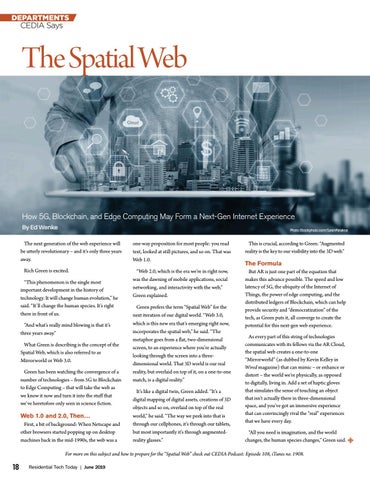
How 5G, Blockchain, and Edge Computing May Form a Next-Gen Internet Experience By Ed Wenke
Photo iStockphoto.com/SasinParaksa
The next generation of the web experience will be utterly revolutionary – and it’s only three years away. Rich Green is excited. “This phenomenon is the single most important development in the history of technology. It will change human evolution,” he said. “It’ll change the human species. It’s right there in front of us. “And what’s really mind blowing is that it’s three years away.” What Green is describing is the concept of the Spatial Web, which is also referred to as Mirrorworld or Web 3.0. Green has been watching the convergence of a number of technologies – from 5G to Blockchain to Edge Computing – that will take the web as we know it now and turn it into the stuff that we’ve heretofore only seen in science fiction.
Web 1.0 and 2.0, Then… First, a bit of background: When Netscape and other browsers started popping up on desktop machines back in the mid-1990s, the web was a
one-way proposition for most people: you read text, looked at still pictures, and so on. That was Web 1.0.
This is crucial, according to Green: “Augmented reality is the key to our visibility into the 3D web.”
“Web 2.0, which is the era we’re in right now, was the dawning of mobile applications, social networking, and interactivity with the web,” Green explained.
But AR is just one part of the equation that makes this advance possible. The speed and low latency of 5G, the ubiquity of the Internet of Things, the power of edge computing, and the distributed ledgers of Blockchain, which can help provide security and “democratization” of the tech, as Green puts it, all converge to create the potential for this next-gen web experience.
Green prefers the term “Spatial Web” for the next iteration of our digital world. “Web 3.0, which is this new era that’s emerging right now, incorporates the spatial web,” he said. “The metaphor goes from a flat, two-dimensional screen, to an experience where you’re actually looking through the screen into a threedimensional world. That 3D world is our real reality, but overlaid on top of it, on a one-to-one match, is a digital reality.” It’s like a digital twin, Green added. “It’s a digital mapping of digital assets, creations of 3D objects and so on, overlaid on top of the real world,” he said. “The way we peek into that is through our cellphones, it’s through our tablets, but most importantly it’s through augmentedreality glasses.”
The Formula
As every part of this string of technologies communicates with its fellows via the AR Cloud, the spatial web creates a one-to-one “Mirrorworld” (as dubbed by Kevin Kelley in Wired magazine) that can mimic – or enhance or distort – the world we’re physically, as opposed to digitally, living in. Add a set of haptic gloves that simulates the sense of touching an object that isn’t actually there in three-dimensional space, and you’ve got an immersive experience that can convincingly rival the “real” experiences that we have every day. “All you need is imagination, and the world changes, the human species changes,” Green said. x
For more on this subject and how to prepare for the “Spatial Web” check out CEDIA Podcast: Episode 108, iTunes no. 1908.
18
Residential Tech Today | June 2019