BUSINESS
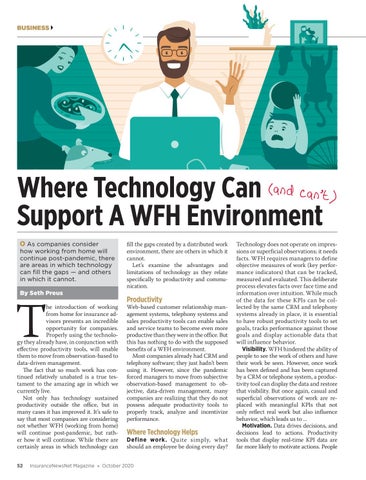
Where Technology Can (and can,t) Support A WFH Environment As companies consider how working from home will continue post-pandemic, there are areas in which technology can fill the gaps — and others in which it cannot. By Seth Preus
T
he introduction of working from home for insurance advisors presents an incredible opportunity for companies. Properly using the technology they already have, in conjunction with effective productivity tools, will enable them to move from observation-based to data-driven management. The fact that so much work has continued relatively unabated is a true testament to the amazing age in which we currently live. Not only has technology sustained productivity outside the office, but in many cases it has improved it. It’s safe to say that most companies are considering not whether WFH (working from home) will continue post-pandemic, but rather how it will continue. While there are certainly areas in which technology can 52
fill the gaps created by a distributed work environment, there are others in which it cannot. Let’s examine the advantages and limitations of technology as they relate specifically to productivity and communication.
Productivity
Web-based customer relationship management systems, telephony systems and sales productivity tools can enable sales and service teams to become even more productive than they were in the office. But this has nothing to do with the supposed benefits of a WFH environment. Most companies already had CRM and telephony software; they just hadn’t been using it. However, since the pandemic forced managers to move from subjective observation-based management to objective, data-driven management, many companies are realizing that they do not possess adequate productivity tools to properly track, analyze and incentivize performance.
Where Technology Helps
Define work. Quite simply, what should an employee be doing every day?
InsuranceNewsNet Magazine » October 2020
Technology does not operate on impressions or superficial observations; it needs facts. WFH requires managers to define objective measures of work (key performance indicators) that can be tracked, measured and evaluated. This deliberate process elevates facts over face time and information over intuition. While much of the data for these KPIs can be collected by the same CRM and telephony systems already in place, it is essential to have robust productivity tools to set goals, tracks performance against those goals and display actionable data that will influence behavior. Visibility. WFH hindered the ability of people to see the work of others and have their work be seen. However, once work has been defined and has been captured by a CRM or telephone system, a productivity tool can display the data and restore that visibility. But once again, casual and superficial observations of work are replaced with meaningful KPIs that not only reflect real work but also influence behavior, which leads us to ... Motivation. Data drives decisions, and decisions lead to actions. Productivity tools that display real-time KPI data are far more likely to motivate actions. People