WHEN THE EYES HAVE HAD IT INBALANCE
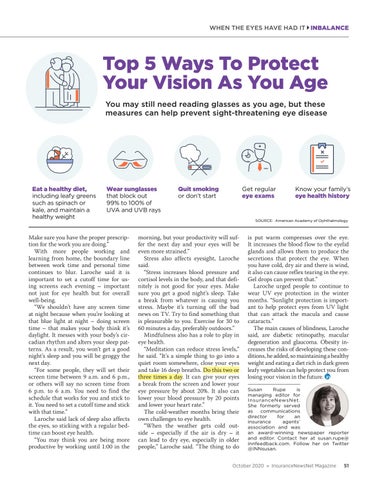
Top 5 Ways To Protect Your Vision As You Age You may still need reading glasses as you age, but these measures can help prevent sight-threatening eye disease
Eat a healthy diet, including leafy greens such as spinach or kale, and maintain a healthy weight
Wear sunglasses that block out 99% to 100% of UVA and UVB rays
Make sure you have the proper prescription for the work you are doing.” With more people working and learning from home, the boundary line between work time and personal time continues to blur. Laroche said it is important to set a cutoff time for using screens each evening – important not just for eye health but for overall well-being. “We shouldn’t have any screen time at night because when you’re looking at that blue light at night – doing screen time – that makes your body think it’s daylight. It messes with your body’s circadian rhythm and alters your sleep patterns. As a result, you won’t get a good night’s sleep and you will be groggy the next day. “For some people, they will set their screen time between 9 a.m. and 6 p.m., or others will say no screen time from 6 p.m. to 6 a.m. You need to find the schedule that works for you and stick to it. You need to set a cutoff time and stick with that time.” Laroche said lack of sleep also affects the eyes, so sticking with a regular bedtime can boost eye health. “You may think you are being more productive by working until 1:00 in the
Quit smoking or don’t start
Get regular eye exams
Know your family’s eye health history
SOURCE: American Academy of Ophthalmology
morning, but your productivity will suffer the next day and your eyes will be even more strained.” Stress also affects eyesight, Laroche said. “Stress increases blood pressure and cortisol levels in the body, and that definitely is not good for your eyes. Make sure you get a good night’s sleep. Take a break from whatever is causing you stress. Maybe it’s turning off the bad news on TV. Try to find something that is pleasurable to you. Exercise for 30 to 60 minutes a day, preferably outdoors.” Mindfulness also has a role to play in eye health. “Meditation can reduce stress levels,” he said. “It’s a simple thing to go into a quiet room somewhere, close your eyes and take 16 deep breaths. Do this two or three times a day. It can give your eyes a break from the screen and lower your eye pressure by about 20%. It also can lower your blood pressure by 20 points and lower your heart rate.” The cold-weather months bring their own challenges to eye health. “When the weather gets cold outside – especially if the air is dry – it can lead to dry eye, especially in older people,” Laroche said. “The thing to do
is put warm compresses over the eye. It increases the blood flow to the eyelid glands and allows them to produce the secretions that protect the eye. When you have cold, dry air and there is wind, it also can cause reflex tearing in the eye. Gel drops can prevent that.” Laroche urged people to continue to wear UV eye protection in the winter months. “Sunlight protection is important to help protect eyes from UV light that can attack the macula and cause cataracts.” The main causes of blindness, Laroche said, are diabetic retinopathy, macular degeneration and glaucoma. Obesity increases the risks of developing these conditions, he added, so maintaining a healthy weight and eating a diet rich in dark green leafy vegetables can help protect you from losing your vision in the future. Susan Rupe is managing editor for Insurance NewsNet. She formerly served as communications director for an insurance agents’ association and was an award-winning newspaper reporter and editor. Contact her at susan.rupe@ innfeedback.com. Follow her on Twitter @INNsusan.
October 2020 » InsuranceNewsNet Magazine
51