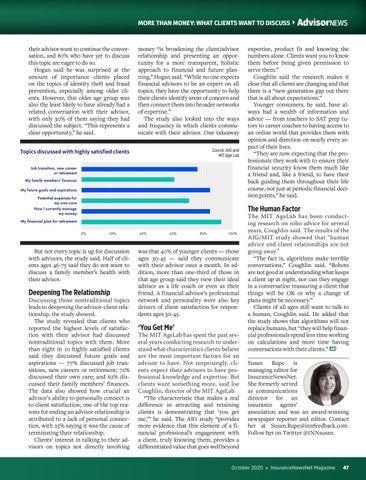
high-satisfaction client relationships (Figure 3). ot surprisingly, two of the topics that come up in gh-satisfaction relationships are purely financial in ture: “my financial plan for retirement” and “how urrently manage my money.” Aside from these o purely financial topics, discussions about four their advisor want to continue converditional topics appear to correlate positivelythe with sation, and 80% who have yet to discuss ent satisfaction:
this topic are eager to do so.
said he have was discussed surprised at the 85% of highlyHogan satisfied clients amount of importance clients placed future goals and aspirations on the topics of identity theft and fraud
77% have discussed jobespecially transitions, prevention, among older clients. this older age group was new careers, orHowever, retirement
also the least likely to have already had a related conversation with their advisor, with only 30% of them saying they had discussed the subject. “This represents a clear opportunity,” he said.
FIGURE 3:
Topics discussed with highly satisfied clients Job transition, new career or retirement My family members’ finances My future goals and aspirations Potential expenses for my own care How I currently manage my money
satisfaction and discussions (or lack thereof) of other identified potentially sensitive top-of-mind topics of conversation, such as the physical health of the client MORE THAN MONEY: WHAT CLIENTS WANT TO DISCUSS or a family member.
Key Take-Away: Having discussions about a more money set “isofbroadening the client/advisor expertise, product fit and knowing the holistic topics that move beyond purely financial relationship andtopresenting an opporalone. Clients want you to know can be important clients and may strengthennumbers the tunity for a more transparent, holistic them before being given permission to bond. Even for topics that did not produce significant approach to financial and future plan- serve them.” effects on client satisfaction, having a conversation ning,” Hogan said. “While no one expects Coughlin said the research makes it about themadvisors did not appear erode client financial to be antoexpert on allsatisfaction; clear that all clients are changing and that therefore, broadening the conversation carriesthere more is a “new generation gap out there topics, they have the opportunity to help their clients identify of concern that is all about expectations.” positive potential thanareas negative risks to and relationships, thencan connect into broader Younger consumers, he said, have aland have them an important role innetworks deepening client of expertise.” ways had a wealth of information and relationships over time. The study also looked into the ways advice — from teachers to SAT prep tuand frequency in which clients commu- tors to career coaches to having access to nicate with their advisor. One takeaway an online world that provides them with opinion and direction on nearly every aspect of their lives. Source: AIG and “They are now expecting that the proMIT Age Lab fessionals they work with to ensure their financial security know them much like a friend and, like a friend, to have their back guiding them throughout their life course, not just at periodic financial decision points,” he said.
The Human Factor
My financial plan for retirement 0%
20%
But not every topic is up for discussion with advisors, the study said. Half of clients ages 46-75 said they do not want to discuss a family member’s health with their advisor. 9
Deepening The Relationship
Discussing those nontraditional topics leads to deepening the advisor-client relationship, the study showed. The study revealed that clients who reported the highest levels of satisfaction with their advisor had discussed nontraditional topics with them. More than eight in 10 highly satisfied clients said they discussed future goals and aspirations — 77% discussed job transitions, new careers or retirement; 72% discussed their own care; and 62% discussed their family members’ finances. The data also showed how crucial an advisor’s ability to personally connect is to client satisfaction; one of the top reasons for ending an advisor relationship is attributed to a lack of personal connection, with 25% saying it was the cause of terminating their relationship. Clients’ interest in talking to their advisors on topics not directly involving
40%
60%
80%
100%
was that 40% of younger clients — those ages 30-45 — said they communicate with their advisor once a month. In addition, more than one-third of those in that age group said they view their ideal advisor as a life coach or even as their friend. A financial advisor’s professional network and personality were also key drivers of client satisfaction for respondents ages 30-45.
‘You Get Me’
The MIT AgeLab has spent the past several years conducting research to understand what characteristics clients believe are the most important factors for an advisor to have. Not surprisingly, clients expect their advisors to have professional knowledge and expertise. But clients want something more, said Joe Coughlin, director of the MIT AgeLab. “The characteristic that makes a real difference in attracting and retaining clients is demonstrating that ‘you get me,’” he said. The AIG study “provides more evidence that this element of a financial professional’s engagement with a client, truly knowing them, provides a differentiated value that goes well beyond
The MIT AgeLab has been conducting research on robo advice for several years, Coughlin said. The results of the AIG/MIT study showed that “human advice and client relationships are not going away.” “The fact is, algorithms make terrible conversations,” Coughlin said. “Robots are not good at understanding what keeps a client up at night, nor can they engage in a conversation reassuring a client that things will be OK or why a change of plans might be necessary.” Clients of all ages still want to talk to a human, Coughlin said. He added that the study shows that algorithms will not replace humans, but “they will help financial professionals spend less time working on calculations and more time having conversations with their clients.” Susan Rupe is managing editor for InsuranceNewsNet. She formerly served as communications director for an insurance agents’ association and was an award-winning newspaper reporter and editor. Contact her at Susan.Rupe@innfeedback.com. Follow her on Twitter @INNsusan.
October 2020 » InsuranceNewsNet Magazine
47