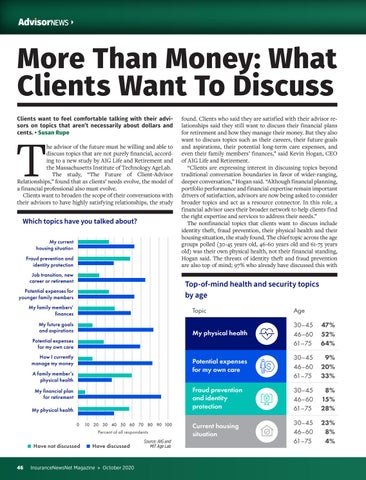
identified which important topics people are not discussing with their financial onal. Most have discussed financial matters, g plans for retirement and how to manage ney. Some also report discussing job ns and housing expenses for younger family s. Fewer people have discussed their own heir family’s health, or identity protection m prevention (Figure 1), yet they identify these First, we identified which important topics people are topics. and are not discussing with their financial -mind
Next, we sought to identify topics of current concern for clients. From a list of 25 topics, survey respondents chose the five that best represent what is most on their mind. The results are divided into three overarching themes—health and security; wealth and lifestyle; and family and loved ones—with a focus on variances between age groups.
What Topics Are More Than Money: What Top-of-mind? Clients Want To Discuss Health and
What Topics Are Being Discussed?
Next, we sought to identify topics of current concern for clients. From a list of 25 topics, survey respondents professional. Most have discussed financial matters, chose the five that best represent what is most Clients want to feel comfortable talking with their advi- found. Clients who said they are satisfied with their advisor reincluding plans for and how to manage on their The results are divided into three sors on topics thatretirement aren’t necessarily about dollars and lationships said mind. they still want to discuss their financial plans RE 1 their cents. • Susan Rupe also report discussing job for retirement how they manage theirand money. But they also and money. Some overarching themes—health security; wealth Among health-andand security-related topics, “personal want to discuss topics such as their careers, their future goals h topics have you talked about? transitions and housing expenses forbeyounger family lifestyle; family loved ones—with a focus health”and was mostand frequently across he advisor of the future must willing and able tophysical and aspirations, their potential long-term careselected expenses, and on discusspeople topics that arediscussed not purely financial, accord- even their family members’ said Kevin Hogan, CEO members. Fewer have their own variances betweenfinances,” age groups. with older respondents (ages 61-75) ing to a new study by AIG Life and Retirement andageofgroups, AIG Life and Retirement. My current health, theirthe family’s health, or identity protection Massachusetts Institute of Technology AgeLab. especially “Clientslikely are expressing interest in discussing topics interest beyond to choose it (Figure 2). Also, housing situation The study, “The1),Future of identify Client-Advisor and scam prevention (Figure yet they these traditional conversation boundaries in favor of wider-ranging, expenses, and identity protection Relationships,” found that as clients’ needs evolve, the model ofin care-related deeper conversation,” Hogan said. “Although financial planning,and Health and d prevention and asatop-of-mind topics. financial professional also must evolve. portfolio performance and financial expertise remain important
Security Topics
T
entity protection scam prevention tends to increase with age, while Clients want to broaden the scope of their conversations with drivers of satisfaction, advisors are now being asked to consider b transition, new their advisors to have highly satisfying relationships, the studythoughts broader topics andhousing act as a resource In this role, athe about tend toconnector. decrease. Note: eer or retirement financial advisor uses their broader network to help clients find FIGURE 1 survey was fielded March coincided Among healthand security-related topics, “personal the right expertise andin services to 2020, address which their needs.” tial expenses for Which topics have you talked about? The nonfinancial topics that clients want to discuss include family members health” was most frequently selected across with thephysical initial COVID-19 outbreak in the United identity theft, fraud prevention, their physical health and their age groups, (ages 61-75) amily members’ housing situation, thewith studyolder found. The chief topic across the age States, which may have lent respondents extraordinary urgency My current finances groupsespecially polled (30-45 yearstoold, 46-60 years old and 61-75 years likely choose it (Figure 2). Also, interest housing situation to health-related topics.health, not their financial standing, old) was their own physical My future goals care-related andand identity protection and Hoganinsaid. The threats expenses, of identity theft fraud prevention Fraud prevention and and aspirations identity protection are also top of mind; 97% who already have discussed scam prevention tends to increase withthis age,with while tential expenses FIGURE 2: Job transition, new thoughts about housing tend to decrease. Note: the for my own care career or retirement
Security Topics
Top-of-mind security survey was health fielded and in March 2020, topics which coincided by age with the initial COVID-19 outbreak in the United
How I currently Potential expenses for nage myyounger money family members
States, which may have lent extraordinary urgency Topic Age
My family members’ family member’s finances physical health
to health-related topics.
My future goals
My financial plan and aspirations for retirement
My physical health
Potential expenses y physical healthfor my own care
FIGURE 2:
Have discussed
My physical health 10 20 30 40 50 60 70 80 90 100 Percent of all respondents
Have not discussed
46
Have discussed
for my own care
46–60 20% Age 33% 61–75
Fraud prevention My physical health and identity protection
30–45 8%47% 30–45 46–6015%52% 46–60 61–75 64% 28% 61–75
Potential expenses
30–45 23% 46–60 20% 46–60 33% 61–75 8% 4% 61–75
Topic
My financial plan for retirement
0
47% 52% 64%
Top-of-mind health and security topics 9% 30–45 by age Potential expenses
How I currently manage my money 0 10 20 30 40 50 60 70 80 90 100 Percent of all respondents A family member’s physical health
ave not discussed
30–45 46–60 61–75
Source: AIG and MIT Age Lab
InsuranceNewsNet Magazine » October 2020
18
Currentfor housing my own care situation
Fraud prevention and identity protection
30–45
9%
30–45 46–60 61–75
8% 15% 28%