INFRONT
Industry Groups Grapple With Diversity Deficit In the wake of George Floyd’s death and widespread protest, industry groups are looking at how to increase diversity in advisors and clients. By John Hilton and Susan Rupe
T
he life insurance and financial services industries have long known they have a diversity deficit, but George Floyd’s excruciating death in May spurred the industries into action. Some organizations such as the National Association of Insurance and Financial Advisors already had initiatives in the works that they accelerated, and others pulled together new initiatives to tackle some old problems. And sometimes the renewed perspective heightened tension on some initiatives, such as the National Association of Insurance Commissioners’ working group producing a Principles for Artificial Intelligence document. The principles included the phrase “AI users should proactively avoid proxy discrimination against protected classes.” For some, that went too far. Support grew to amend the language to allow for different variables to be considered. Iowa Insurance Commissioner Doug Ommen used the example of hypertension. While there is a proven link between hypertension and race, science also shows us other links, for example, between hypertension and smoking. Birny Birnbaum, executive director of the Center for Economic Justice, scoffed at that notion. Variables can be used to predict a particular relevant outcome, he noted, they just can’t be used to discriminate against a protected class. Regulators adopted a final version of the AI principles with compromise language. As efforts get underway across the industry to confront racism and promote equality, the NAIC experience is a reminder of 6
how difficult it can be to reach a consensus when solutions conflict with other industry values. But regulators say they are committed to addressing racial inequities in insurance with more than talk. “We need people to be intentional about diversifying our departments, diversifying the industry, diversifying your company,” Ricardo Lara, California insurance commissioner, said on a recent podcast. “And, yes, you’re going to get pushback. But stay the course.” The NAIC formed a Special Committee on Race and Insurance, which held its first meeting in September. The committee started with four general areas of interest: » The current level of diversity and inclusion within the insurance industry, the insurance regulatory community and the NAIC. » Access by people of color and historically underrepresented groups to insurance products and coverages. » The existence of current practices or barriers in the insurance sector that potentially disadvantage people of color and/or historically underrepresented groups in the areas of (a) life insurance and annuities, (b) health insurance, and (c) property and casualty insurance. » Steps insurance regulators and/or the insurance industry can take to (a) increase diversity and inclusion within the insurance industry, state insurance departments and the NAIC; and (b) address practices that potentially disadvantage people of color and/or historically underrepresented groups.
‘It Is So Important’
Lara joined a trio of minority insurance regulators for an NAIC podcast to discuss the state of race and insurance. The three insurance commissioners all noted changes they had made in their states to better serve minority populations. Connecticut Commissioner Andrew Mais, for example, took office in March 2019 and found that all of the
InsuranceNewsNet Magazine » October 2020
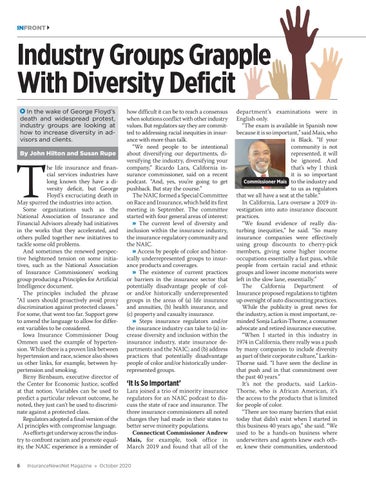
department’s examinations were in English only. “The exam is available in Spanish now because it is so important,” said Mais, who is Black. “If your community is not represented, it will be ignored. And that’s why I think it is so important Commissioner Mais to the industry and to us as regulators that we all have a seat at the table.” In California, Lara oversaw a 2019 investigation into auto insurance discount practices. “We found evidence of really disturbing inequities,” he said. “So many insurance companies were effectively using group discounts to cherry-pick members, giving some higher income occupations essentially a fast pass, while people from certain racial and ethnic groups and lower income motorists were left in the slow lane, essentially.” The California Department of Insurance proposed regulations to tighten up oversight of auto discounting practices. While the publicity is great news for the industry, action is most important, reminded Sonja Larkin-Thorne, a consumer advocate and retired insurance executive. “When I started in this industry in 1974 in California, there really was a push by many companies to include diversity as part of their corporate culture,” LarkinThorne said. “I have seen the decline in that push and in that commitment over the past 40 years.” It’s not the products, said LarkinThorne, who is African American, it’s the access to the products that is limited for people of color. “There are too many barriers that exist today that didn’t exist when I started in this business 40 years ago,” she said. “We used to be a hands-on business where underwriters and agents knew each other, knew their communities, understood