INSURERS EXIT N.Y.; TRUMP TURNS UP HEAT ON FED INFRONT
P
Trump’s Beef With The Fed
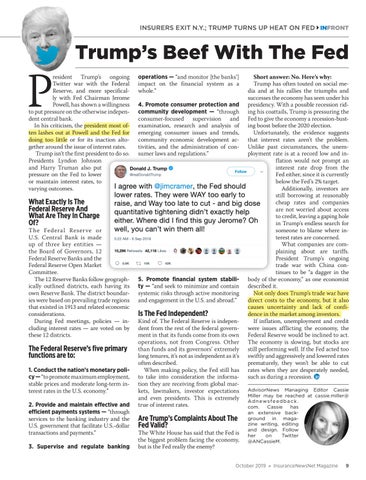
resident Trump’s ongoing Twitter war with the Federal Reserve, and more specifically with Fed Chairman Jerome Powell, has shown a willingness to put pressure on the otherwise independent central bank. In his criticism, the president most often lashes out at Powell and the Fed for doing too little or for its inaction altogether around the issue of interest rates. Trump isn’t the first president to do so. Presidents Lyndon Johnson and Harry Truman also put pressure on the Fed to lower or maintain interest rates, to varying outcomes.
operations — “and monitor [the banks’] impact on the financial system as a whole.” 4. Promote consumer protection and community development — “through consumer-focused supervision and examination, research and analysis of emerging consumer issues and trends, community economic development activities, and the administration of consumer laws and regulations.”
What Exactly Is The Federal Reserve And What Are They In Charge Of?
The Federa l Reser ve or U.S. Central Bank is made up of three key entities — the Board of Governors, 12 Federal Reserve Banks and the Federal Reserve Open Market Committee. The 12 Reserve Banks follow geographically outlined districts, each having its own Reserve Bank. The district boundaries were based on prevailing trade regions that existed in 1913 and related economic considerations. During Fed meetings, policies — including interest rates — are voted on by these 12 districts.
The Federal Reserve’s five primary functions are to: 1. Conduct the nation’s monetary policy — “to promote maximum employment, stable prices and moderate long-term interest rates in the U.S. economy.” 2. Provide and maintain effective and efficient payments systems — “through services to the banking industry and the U.S. government that facilitate U.S.-dollar transactions and payments.” 3. Supervise and regulate banking
5. Promote financial system stability — “and seek to minimize and contain systemic risks through active monitoring and engagement in the U.S. and abroad.”
Is The Fed Independent?
Kind of. The Federal Reserve is independent from the rest of the federal government in that its funds come from its own operations, not from Congress. Other than funds and its governors’ extremely long tenures, it’s not as independent as it’s often described. When making policy, the Fed still has to take into consideration the information they are receiving from global markets, lawmakers, investor expectations and even presidents. This is extremely true of interest rates.
Are Trump’s Complaints About The Fed Valid?
The White House has said that the Fed is the biggest problem facing the economy, but is the Fed really the enemy?
Short answer: No. Here’s why: Trump has often touted on social media and at his rallies the triumphs and successes the economy has seen under his presidency. With a possible recession riding his coattails, Trump is pressuring the Fed to give the economy a recession-busting boost before the 2020 election. Unfortunately, the evidence suggests that interest rates aren’t the problem. Unlike past circumstances, the unemployment rate is at a record low and inflation would not prompt an interest rate drop from the Fed either, since it is currently below the Fed’s 2% target. Additionally, investors are still borrowing at reasonably cheap rates and companies are not worried about access to credit, leaving a gaping hole in Trump’s endless search for someone to blame where interest rates are concerned. What companies are complaining about are tariffs. President Trump’s ongoing trade war with China continues to be “a dagger in the body of the economy,” as one economist described it. Not only does Trump’s trade war have direct costs to the economy, but it also causes uncertainty and lack of confidence in the market among investors. If inflation, unemployment and credit were issues afflicting the economy, the Federal Reserve would be inclined to act. The economy is slowing, but stocks are still performing well. If the Fed acted too swiftly and aggressively and lowered rates prematurely, they won’t be able to cut rates when they are desperately needed, such as during a recession. AdvisorNews Managing Editor Cassie Miller may be reached at cassie.miller@ Adnewsfeedback . com. Cassie has an extensive background in magazine writing, editing and design. Follow her on Twitter @ANCassieM.
October 2019 » InsuranceNewsNet Magazine
9