MARKET
POST EVENT
First National Health Conclave on NCD held in NewDelhi Key stakeholders in healthcare deliberated on knowledge innovation, quality improvement, policy regulations and human resource development with regard to chronic care diseases
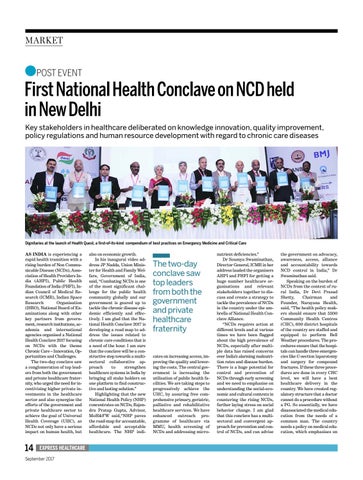
Dignitaries at the launch of Health Quest, a first-of-its-kind compendium of best practices on Emergency Medicine and Critical Care
AS INDIA is experiencing a rapid health transition with a rising burden of Non Communicable Disease (NCDs), Association of Health Providers India (AHPI), Public Health Foundation of India (PHFI), Indian Council of Medical Research (ICMR), Indian Space Research Organisation (ISRO), National Board of Examinations along with other key partners from government, research institutions, academia and international agencies organised a National Health Conclave 2017 focusing on NCDs with the theme Chronic Care – Innovation, Opportunities and Challenges. The two-day conclave saw a conglomeration of top leaders from both the government and private healthcare fraternity, who urged the need for incentivising higher private investments in the healthcare sector and also synergise the efforts of the government and private healthcare sector to achieve the goal of Universal Health Coverage (UHC), as NCDs not only have a serious impact on human health, but
14
EXPRESS HEALTHCARE
September 2017
also on economic growth. In his inaugural video address JP Nadda, Union Minister for Health and Family Welfare, Government of India, said, “Combating NCDs is one of the most significant challenge for the public health community globally and our government is geared up to tackle the chronic disease epidemic efficiently and effectively. I am glad that the National Health Conclave 2017 is developing a road map to address the issues related to chronic care conditions that is a need of the hour. I am sure that the conclave will be a constructive step towards a multisectoral collaborative approach to strengthen healthcare systems in India by bringing all stake holders on one platform to find constructive and lasting solution.” Highlighting that the new National Health Policy (NHP) concentrates on NCDs, Rajendra Pratap Gupta, Advisor, MoH&FW said,“NHP paves the road-map for accountable, affordable and acceptable healthcare. The NHP indi-
The two-day conclave saw top leaders from both the government and private healthcare fraternity
cates on increasing access, improving the quality and lowering the costs. The central government is increasing the utilisation of public health facilities. We are taking steps to progressively achieve the UHC, by assuring free comprehensive primary, geriatric, palliative and rehabilitative healthcare services. We have enhanced outreach programme of healthcare via MMU, health screening of NCDs and addressing micro-
nutrient deficiencies.” Dr Soumya Swaminathan, Director General, ICMR in her address lauded the organisers AHPI and PHFI for getting a huge number healthcare organisations and relevant stakeholders together to discuss and create a strategy to tackle the prevalence of NCDs in the country under the umbrella of National Health Conclave Alliance. “NCDs requires action at different levels and at various times we have been flagged about the high prevalence of NCDs, especially after multiple data has raised concerns over India’s alarming malnutrition rates and disease burden. There is a huge potential for control and prevention of NCDs through early screening and we need to emphasise on understanding the social-economic and cultural contexts in countering the rising NCDs, further laying stress on social behavior change. I am glad that this conclave has a multisectoral and convergent approach for prevention and control of NCDs, and can advise
the government on advocacy, awareness, access, alliance and accountability towards NCD control in India,” Dr Swaminathan said. Speaking on the burden of NCDs from the context of rural India, Dr Devi Prasad Shetty, Chairman and Founder, Narayana Health, said, “The health policy makers should ensure that 5500 Community Health Centres (CHC), 600 district hospitals of the country are staffed and equipped to perform Bell Weather procedures. The procedures ensure that the hospitals can handle three emergencies like C-section laparotomy and surgery for compound fractures. If these three procedures are done in every CHC level, we will have a best healthcare delivery in the country. We have created regulatory structure that a doctor cannot do a procedure without a PG. So essentially, we have disassociated the medical education from the needs of a common man. The country needs a policy on medical education, which emphasises on