EXPRESS COMPUTER | MARCH, 2019
| 11
CASE STUDY
Inside India’s first IoT implementation in glass manufacturing industry AFTER IMPLEMENTING THE Real Time Manufacturing Insights at Piramal Glass, the production efficiency has been enhanced by 1 per cent, which means the production lines (in five plants) are able to manufacture 1 per cent more, amounting to ` 20 crore in monetary terms, since the technology started working in all the plants over nine months back. EC’s Abhishek Raval speaks with Vijay Shah, Director - Piramal Glass & Executive Director - Piramal Enterprises and Poorav Sheth, CDO, Piramal Glass
P
iramal Glass, a global specialist in design, production, and decoration of glass packaging (flaconnage) solutions for pharmaceutical, cosmetics and perfumery, and specialty food & beverage industries, has deployed Microsoft’s Azure IoT platform to digitally transform its manufacturing operations. An early adopter of the technology, Piramal Glass has currently implemented the solution, Real-Time Manufacturing Insights (RTMI), on 46 production lines across their four plants at Kosamba and Jambusar in Gujarat, India, Sri Lanka and the United States of America. The plants have an overall capacity of 1375 tons per day, with 12 furnaces and 60 production lines, all of which run on a 24/7 basis. Piramal Glass has leveraged IoT to get real-time visibility into its line manufacturing operations and to analyse production line losses at various stages. Using Azure IoT Hub, Microsoft helped Piramal Glass acquire data from sensors on production lines to identify quality parameters at each stage and get insights on line efficiencies in real-time. This resulted in improved production efficiency and cost reduction up to 70 per cent as compared to a glass industry manufacturing execution system (MES). The RoI from IoT has been impressive. “The production efficiency has been enhanced by 1 per cent, which means the production lines (each of the five plants) are able to manufacture 1 per cent more, which amount to '20 crore in monetary terms, since the technology started working in all the plants over nine months back. It has also resulted in 70 per cent reduction in TCO,” says Vijay Shah, Director Piramal Glass & Executive
Director - Piramal Enterprises. As one of the the world’s largest supplier of glass packaging solutions, Piramal Glass is committed to continuously adding value to its customers. “We are happy to have collaborated with Microsoft on our journey towards digital transformation and business critical future readiness. Glass manufacturing is a complex process with many interactive variables. Combining digital technologies with precision high-quality glass manufacturing, has helped us fortify our accelerated growth path.” says Poorav Sheth, CDO, Piramal Glass. The Azure IoT platform enabled Piramal Glass to connect and monitor their equipment to gain real-time visibility into operational data that was previously unavailable. The technology integration was designed for fast and easy set-up to rapidly showcase the results and build on its existing sensors, equipment, systems, and data. To facilitate this transformation, Precimetrix, a Microsoft partner, brought in its Plant Monitoring System hosted on Microsoft Azure. The sensors on high speed conveyor lines were interfaced with data acquisition devices that record the key metrics, as the bottles move along the production line. This data is aggregated on an edge gateway and then pushed to Precimetrix’s Plant Monitoring System on the cloud. A custom solution was developed on top of this platform to provide stage-wise losses, production reports, quality control workflows as well as role-specific KPIs on PCs and smartphones of plant personnel. Actionable alerts are sent through SMS, email and push notifications whenever there is an anomaly
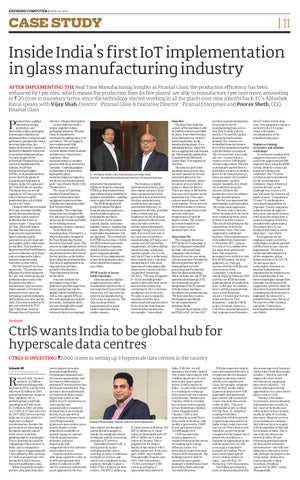
(L - R) Poorav Sheth, CDO, Piramal Glass and Vijay Shah, Director - Piramal Glass & Executive Director - Piramal Enterprises
detected or the production efficiency drops. In summary, RTMI has democratised realtime information availability to all plant stakeholders, enabling them to take faster decisions. The RTMI program will positively impact the plant head, production employees, which include employees manning the machines, supervisors, HoDs, Quality Control, Quality Assurance, logistics, furnace / engineering teams. About 90 per cent of the stakeholder departments will get impacted. “The overall cost for RTMI was less than 1/3rd of the MES software procured from a European company, which is used by most of the glass companies globally. However, it was implemented at just three production lines, when i joined the company,” says Sheth. RTMI results in lesser bottle rejections Glass manufacturing has complex processes with a considerable rejection rate. It can range from 8 per cent upto 20 per cent. IoT can catch the errors in the manufacturing cycle early, using sensors. The data can be provided instantaneously to avoid further rejections due to similar reasons.
The business is highly instrumentation heavy and thus capital intensive. Real time communication of the production data generated at the glass manufacturing assembly line can impact operational efficiency. As compared to the data provided with a certain time lag. Employees on the shop floor, when powered with real time data can take corrective actions and avoid leakages, wastage. Energy cost is very high. It is over 25 per cent of the total costs incurred on manufacturing. IoT helps save energy costs by controlling temperature, air blown during manufacturing, regulating machine speeds, etc. It’s not only the IoT that is influencing these benefits but it’s done by integrating IoT with other operational technologies like Supervisory Control and Data Acquisition Technology (SCADA). “The way it happens is - in the ascending order massive data collection, faster data transfer followed by overlaying AI, ML to extricate intelligence out of the data. The plan is also to make the machines read the data, understand and take decisions by itself rather than humans correcting the temperature, for example,” states Shah.
Data flow The data flows from the sensors of the machines to the intermittent devices provided by Moxa, from where it relays to the field gateway, which is based on-premise, in the manufacturing plants. It’s a computing device, where the data is aggregated and cleaned up. Subsequently, quality data is pushed to the Microsoft Azure cloud. This happens in real time. The furnace part of the manufacturing process has the most amount of sensors attached followed by the inspection machines, where the photo of every bottle is taken to check for defects. There are close to 300 bottles that pass every minute on the inspection line. Photo and camera based sensors, both work together. There are over 20 different kinds of sensors, which are temperature rated and can withstand temperatures of upto 90 degree celsius. The sensors have been bought from the German sensor manufacturer ‘Sick’. Successful PoC The company floated an RFP for the IoT technology. A mix of companies submitted the bids, which had large companies and startups. Microsoft won the race along with their partner Precimetrix. Microsoft provides the IoT cloud platform for data processing and Precimetrix does the plant monitoring, which includes not only IT but operational technology (OT), too. It basically involves integration of the IT element with the legacy machines installed in the production line. “We have also done custom development specifically for our requirements,” mentions Sheth. Piramal Glass began a PoC on RTMI i.e IoT, in June 2017
for three manufacturing lines. Overall there are 60 manufacturing lines across four (two in India and one each in USA and Sri Lanka) manufacturing locations globally. The sensors are embedded from the furnace level of the manufacturing line until the bottles are packed. The raw material, sand, soda ash, etc., is poured into a furnace at over 1500 degree celsius temperature. The raw material gets melted here to form what is known as molten glass. In the furnace process, there are about 150 variables (temperature, air flow, oxygen, humidity, etc), which are monitored using the sensors. Hitherto the parameters were recorded in a paper based log book. The PoC was monitored for three months, until September. The results were impressive. “We were able to find out, where the defects in the bottle were originating from; areas of defects and the reasons. This resulted in getting us the required buy-in from the operations team. They also suggested us additional features. Thus enhancements were added from September to November 2017. A phase two rollout was conducted in the same three production lines. The respective personnel were invited to view how RTMI worked, the data gathered, etc. They got convinced of the viability and effectiveness of the technology. A whole hog rollout began in February 2018 and thus far RTMI has been implemented in 46 production lines. In the past two months, data is getting acquired from close to four thousand sensors. Up until now, we have analysed close to 2 mn datapoints,” explains Sheth. In the USA plant, there is a US$ 20 mn automation project that is planned and therefore,
the IoT rollout will be done later. New equipment rollout is awaited in the USA plant, which will require reconfiguration of the manufacturing plant. Employee training, awareness and ideation workshops An extensive training of the manpower was also carried out for the approximately 900 employee base using the RTMI system. Both classroom and hands-on training was conducted. The UX of the system has been customised for the semi-educated workforce. Many of them are not even literate, so the challenge was to have a UX that will mean the same for all kinds of users. “I organised a 72 hour UX challenge on a crowdsourcing platform viz. Topcoder. Twenty companies submitted their designs for data entry and report screens, and i chose the design from a spanish company, which was awarded with a prize money. The point is the UX was designed and ready to use in three days,” says Sheth. It is important for the employees to get a feel of the technologies available and how will they have in case, they are implemented. “We hired a vendor and did roadshows in all the companies, giving demonstrations of AI, IoT, VR, AR and many other technologies. Moreover, an ideation workshop was organised for the employees on how would they like to see these technologies change their functions. On the basis of the suggestions, received, about 50 ideas have been prioritised and a roadmap has been created to implement the ideas over a period of three years. We are at the year two of the roadmap and about 17 ideas have been implemented already,” says Sheth.
Feature
CtrlS wants India to be global hub for hyperscale data centres CTRLS IS INVESTING `2,000 crores in setting up 3 hyperscale data centres in the country Srikanth RP srikanth.rp@expressindia.com
R
esearch firm, Gartner, predicts 14.2 billion connected things will be in use in 2019, and the total will reach 25 billion by 2021, producing immense volume of data. Similarly, IDC is predicting that worldwide spending on IoT will reach $1.2 trillion in 2022, growing at a CAGR of 13.6 per cent over the 2017-2022 forecast period. India too, is in the midst of a huge wave of digital transformation. Besides the government accelerating up the digital agenda, almost every sector is actively adopting digital technologies. This is spurring the need for ramping up of data centers in India, and is estimated to reach values of approximately US$ 4 billion by 2024, growing at CAGR of around 9 per cent during 2018-2024 (Source: ResearchandMarkets.com). While the growth remains positive, demands from data
centre players have also increased significantly. Performance demands have increased exponentially, and the time for delivering an optimum IT infrastructure has decreased considerably. This has led to increased demand for hyperscale data centres. Hyperscale refers to the ability of an IT architecture to scale quickly and exponentially to respond to demand that is increasingly heavily. In an app-driven world, where everyone wants everything instantly, hyperscale data centres score heavily thanks to their unmatched scalability to quickly expand or contract with changing business dynamics and most importantly with comparatively lower software and hardware costs. Hyperscale data centres offer mega capacities (such as 50 MW and upwards with ability to collocate 50,000 servers and more) and provide a new approach to the way
Sridhar Pinnapureddy, Founder and CEO, CtrlS Datacenters
data centres are designed, operated and managed to handle the complexity of new workloads and the increasing demand on IT services. Hyderabad-based CtrlS, is betting heavily on this emerging market, and is counting on India’s traditional strengths in services and talent to be a big player in this segment, through its plan to build 3 Tier-4 hyperscale data centres, 100 MW (1 million sq.
ft.) data centre in Mumbai, 150 MW (2 million sq. ft.) data centre in Hyderabad and a 70 MW (1 million sq. ft.) data centre in Chennai. This is pegged to be the largest facility in the country with 5 million square feet in the later part of 2020. Says Sridhar Pinnapureddy, Founder and CEO, CtrlS Datacenters, “CtrlS is investing ` 2,000 crores in setting up 3 hyperscale data centres in
India. With this, we will emerge as the world’s largest Tier-4 data centre player with 5 million square feet of total data centre space spread across 10 data centres in India.” As part of these plans, it is working on setting up three hyperscale data centres in Hyderabad, Mumbai and Chennai, while it currently has six data centres spread across Hyderabad, Mumbai, Noida, Bengaluru and Chennai. CtrlS is also launching its second Tier-4 data centre in Mumbai – this facility is powered by 15MW Power and spread across 150,000 square feet. CtrlS has also been trying to improve its competitiveness in this sector by ramping up its energy efficiency ratios. It is powering its hyperscale data centres with solar panels. The building exterior shall be covered by solar panels – making it a hybrid data centre powered by both solar and conventional power.
With the expected surge in data and connected devices, it is expected that the demand for hyperscale data centres will also rise significantly. Cisco, for example, estimates that by 2021, traffic within hyperscale data centres will quadruple, and hyperscale data centres will account for 55 per cent of all data centre traffic by 2021. “The new technologies (such as cloud, IoT, Big Data, AI, Analytics) combined with data localisation will drive growth of hyperscale data centres in India. In fact, today there are just over 25 Tier-4 data centre operators across the globe. Compared to the largest Tier-4 player who would have a footprint of approximately one million square feet, we will soon enjoy a cumulative footprint of 5 million Tier-4 data centre space spread across 10 data centres in India,” says BS Rao, VPMarketing, CtrlS Datacenters. The Indian government’s focus on data localisation will
also encourage every business entity to host their data locally in India — which in turn will trigger off a wave of new investments in ramping up data centre capacity — all factors which present big opportunities for a data centre player such as CtrlS. “Thanks to the Indian Government, data localisation will soon become a reality. In fact, most of the businesses will now have to host the data locally in India, be it a bank, insurance, financial services or an ecommerce company – they will now have to comply with the guideline of RBI and Government of India. This is one of the key drivers for growth in India. We are witnessing growing demand for data centre colocation infrastructure – this will turn India into a cloud data centre hub, perhaps the largest in the Asian region. Indian data centre capacity is likely to surpass 20 million square feet by 2025,” states Pinnapureddy.